

ISSN 1671-3710
CN 11-4766/R
主办:中国科学院心理研究所
出版:科学出版社
CN 11-4766/R
主办:中国科学院心理研究所
出版:科学出版社
心理科学进展 ›› 2026, Vol. 34 ›› Issue (1): 29-43.doi: 10.3724/SP.J.1042.2026.0029 cstr: 32111.14.2026.0029
聂琦1, 张捷2( )
)
收稿日期:2024-11-27
出版日期:2026-01-15
发布日期:2025-11-10
通讯作者:
张捷, E-mail: jiezhang@nuaa.edu.cn基金资助:
NIE Qi1, ZHANG Jie2()
Received:2024-11-27
Online:2026-01-15
Published:2025-11-10
摘要:
工间微休息是员工在工作间隙恢复身心能量的重要方式。以往研究主要倡导工间微休息的益处, 而企业过多关注工间微休息的代价, 造成理论与实践之间的矛盾。为了更全面地审视工间微休息的影响后果, 本研究基于资源保存理论和人际知觉理论, 分别以员工自身、直属上司、平级同事为主要视角, 探究员工工间微休息对自身行为、上司奖惩、同事社交的双刃剑效应, 识别工间微休息的利与弊。在此基础上, 结合“天时·地利·人和”中国传统哲学智慧, 提出上述双刃剑效应的调节机制, 启发员工在工间微休息过程中如何扬长避短。本研究有助于融合工间微休息领域的观点分歧, 建立一个更加完善的工间微休息理论体系, 推动工间微休息理论的辩证式发展。
中图分类号:
聂琦, 张捷. (2026). 工间微休息的双刃剑效应及其调节机制. 心理科学进展 , 34(1), 29-43.
NIE Qi, ZHANG Jie. (2026). The double-edged sword effect of micro-breaks and its boundary conditions. Advances in Psychological Science, 34(1), 29-43.
| 工间微休息 | 时间偷窃 | 员工工作脱离 | |
|---|---|---|---|
| 主要动机 | 恢复身心能量, 缓解疲劳 | 偷懒、逃避任务、恢复等多重动机 | 多由长期不满、倦怠、低资源或组织契合度差引起 |
| 持续时长与频率 | 时间短(通常在10分钟内)、频次有限;嵌入任务间隙 | 可短也可长, 往往隐蔽且可能累积为较长的时间段 | 长期、持续性的低投入状态(天、周、月) |
| 组织授权/规范性 | 在一些组织被默许或鼓励(须在规范边界内),在另一些组织被限制 | 通常被视为违规或不道德行为(未经授权);组织多采取惩戒或制度约束 | 属于态度问题,组织通过文化、激励、工作设计等长期干预 |
| 典型后果 | 促进短期恢复、提高后续任务表现或创造力 | 多数情境下与信任降低和规范冲突相关;部分情形下(若为恢复动机)可短期提升表现 | 导致绩效下降、低参与、较高离职风险和更弱的组织公民行为 |
表1 工间微休息与时间偷窃、员工工作脱离概念辨析
| 工间微休息 | 时间偷窃 | 员工工作脱离 | |
|---|---|---|---|
| 主要动机 | 恢复身心能量, 缓解疲劳 | 偷懒、逃避任务、恢复等多重动机 | 多由长期不满、倦怠、低资源或组织契合度差引起 |
| 持续时长与频率 | 时间短(通常在10分钟内)、频次有限;嵌入任务间隙 | 可短也可长, 往往隐蔽且可能累积为较长的时间段 | 长期、持续性的低投入状态(天、周、月) |
| 组织授权/规范性 | 在一些组织被默许或鼓励(须在规范边界内),在另一些组织被限制 | 通常被视为违规或不道德行为(未经授权);组织多采取惩戒或制度约束 | 属于态度问题,组织通过文化、激励、工作设计等长期干预 |
| 典型后果 | 促进短期恢复、提高后续任务表现或创造力 | 多数情境下与信任降低和规范冲突相关;部分情形下(若为恢复动机)可短期提升表现 | 导致绩效下降、低参与、较高离职风险和更弱的组织公民行为 |
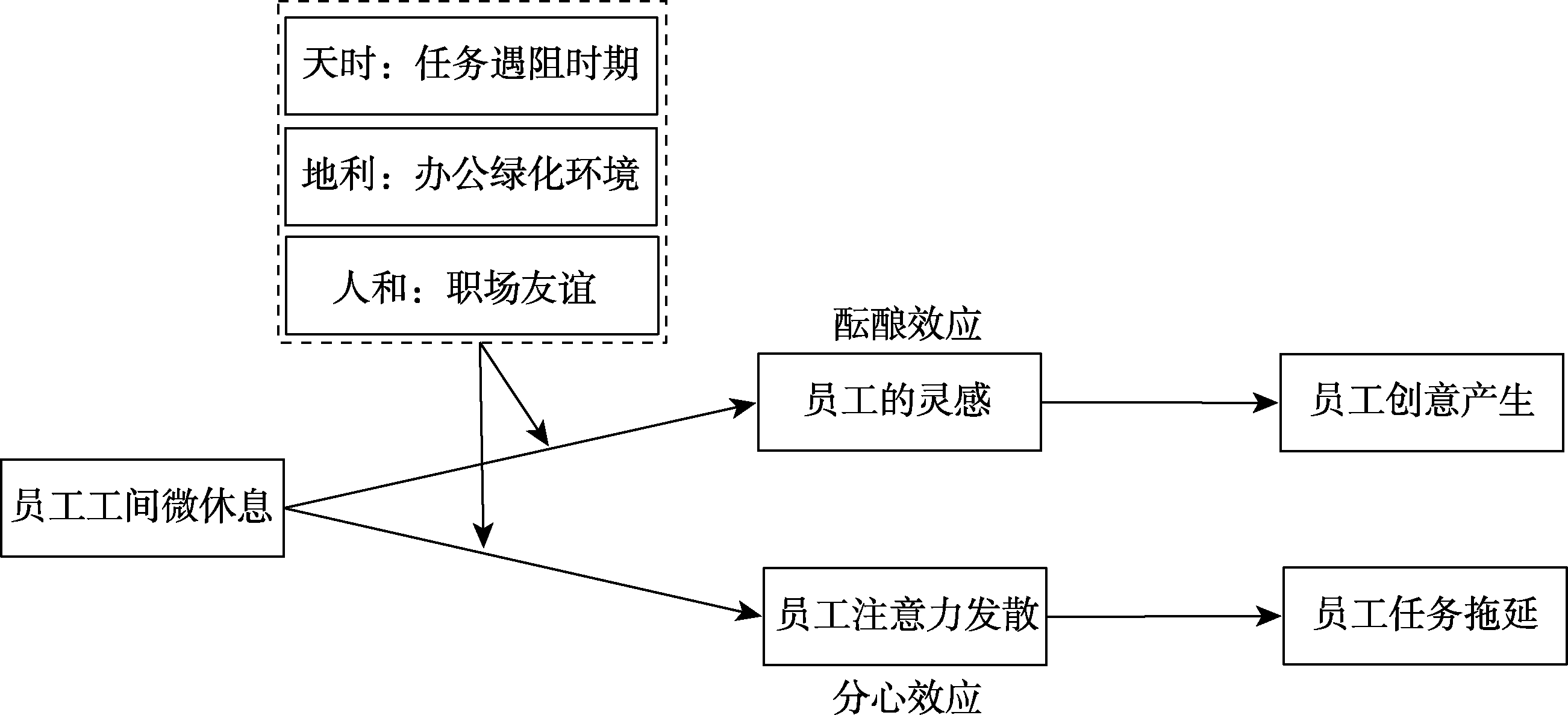
图1 员工工间微休息对员工绩效的悖论效应的理论模型
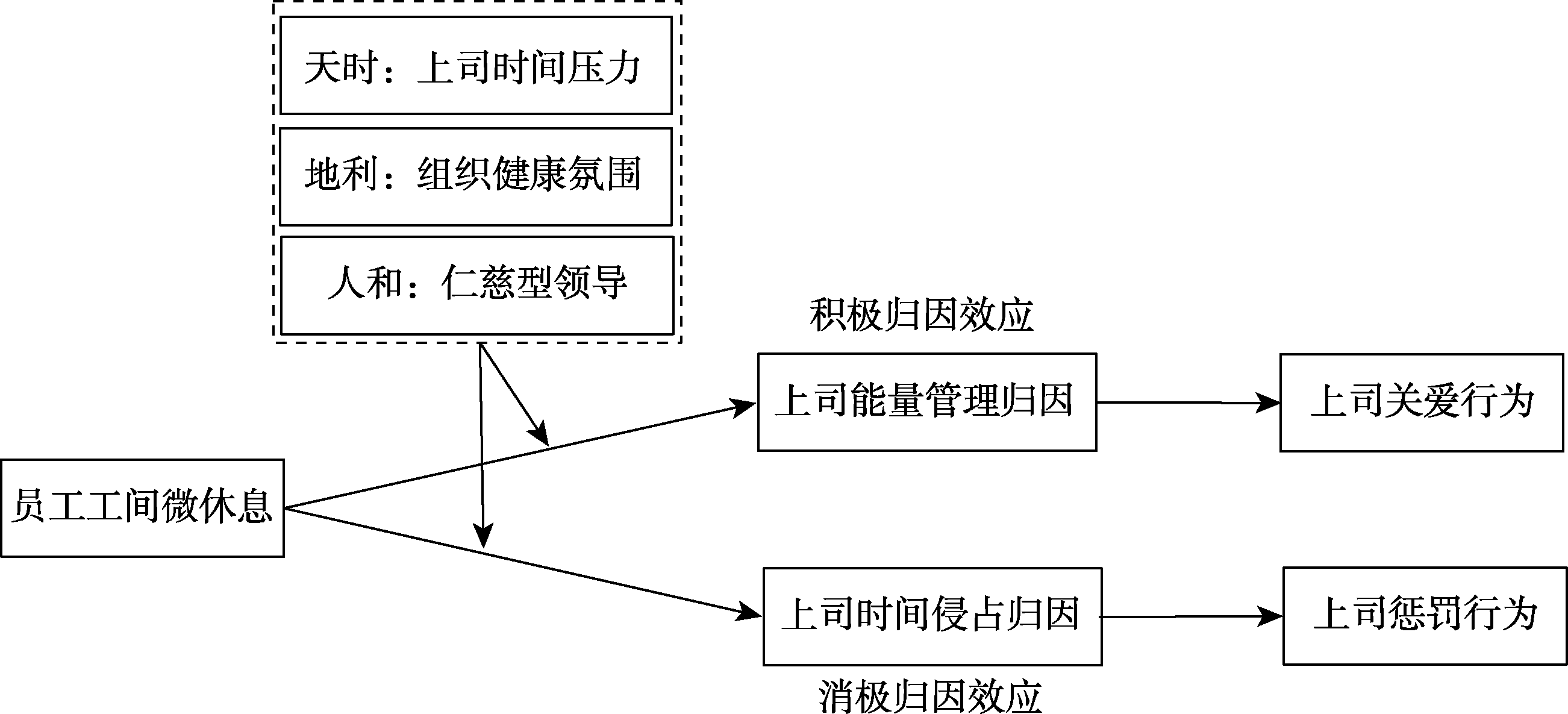
图2 上司对员工工间微休息的归因与行为反应的理论模型
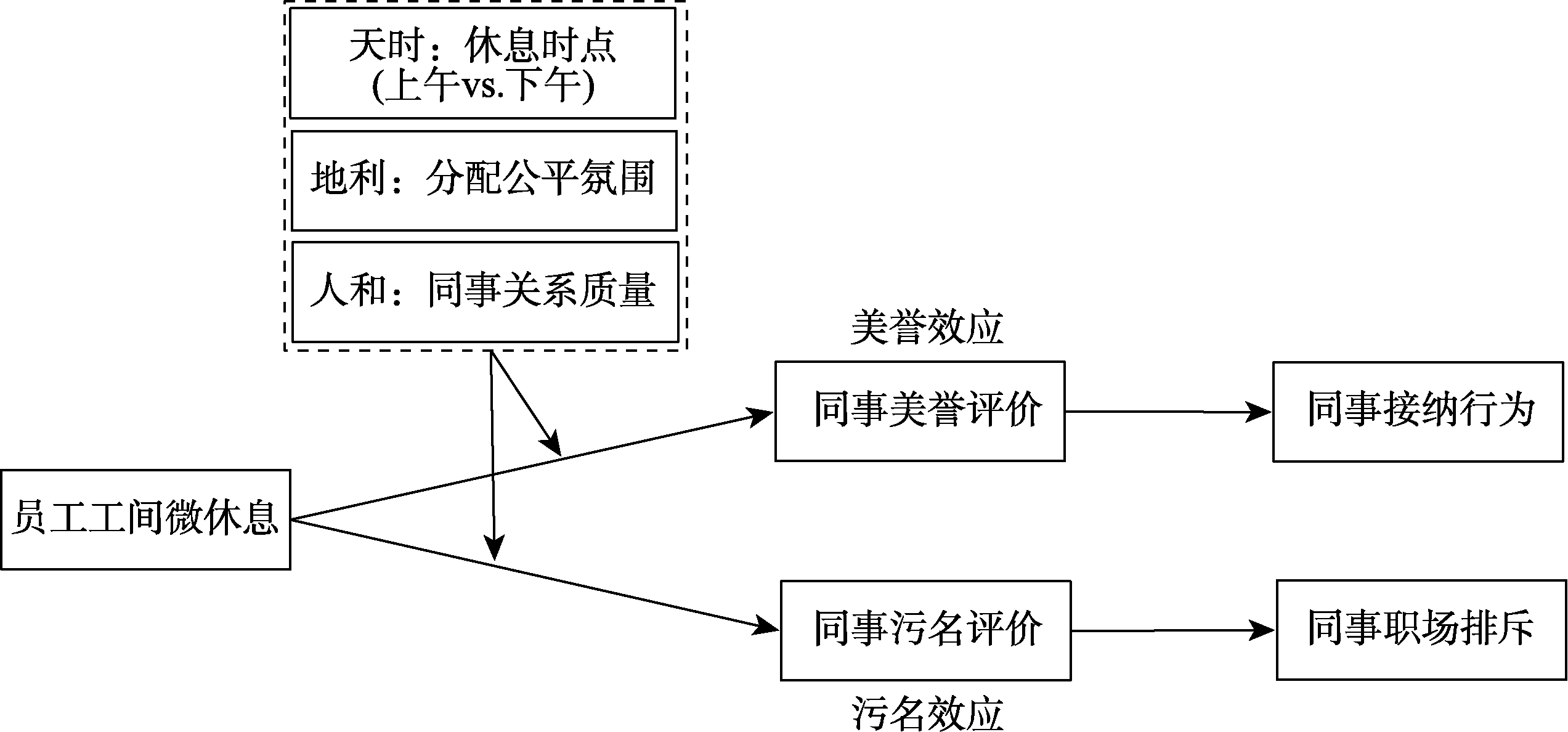
图3 同事对员工工间微休息的评价与行为反应的理论模型
| [1] |
陈晓, 王博, 张豹. (2016). 远离“城嚣”: 自然对人的积极作用、理论及其应用. 心理科学进展, 24(2), 270-281.
doi: 10.3724/SP.J.1042.2016.00270 |
| [2] | 胡海, 徐荣玲. (2017). 职场友谊对研发团队创新绩效的影响机制研究——一个带中介的调节模型. 工业技术经济, 36(11), 118-125. |
| [3] | 黄于桐. (2020). 职场友谊对员工创新行为的影响研究 [硕士学位论文]. 安徽: 安徽工业大学. |
| [4] | 贾良定, 尤树洋, 刘德鹏, 郑祎, 李珏兴. (2015). 构建中国管理学理论自信之路——从个体, 团队到学术社区的跨层次对话过程理论. 管理世界, (1), 99-117. |
| [5] | 井润田, 贾良定, 张玉利. (2021). 中国特色的企业管理理论及其关键科学问题. 管理科学学报, 24(8), 76-83. |
| [6] | 李超平, 时勘. (2003). 分配公平与程序公平对工作倦怠的影响. 心理学报, (5), 677-684. |
| [7] |
李子逸, 张泽, 张莹, 罗劲. (2022). 创造性思维的酝酿效应. 心理科学进展, 30(2), 291-307.
doi: 10.3724/SP.J.1042.2022.00291 |
| [8] | 雷亚霏. (2021). 组织公平对基层民警职业倦怠影响研究 [硕士学位论文]. 山东: 山东大学. |
| [9] | 刘亚, 龙立荣, 李晔. (2003). 组织公平感对组织效果变量的影响. 管理世界, (3), 126-132. |
| [10] |
刘亚, 周长江, 杨哈韬. (2012). 灵感的概念、结构与功能. 心理科学进展, 20(11), 1834-1842.
doi: 10.3724/SP.J.1042.2012.01834 |
| [11] | 马红宇, 谢菊兰, 唐汉瑛, 申传刚, 张晓翔. (2016). 工作性通信工具使用与双职工夫妻的幸福感: 基于溢出-交叉效应的分析. 心理学报, 48(1), 48-58. |
| [12] | 苗硕, 焦捷, 董美辰, 张紫微, 杜依诺. (2018). “天时, 地利, 人和”, 组织动态能力与企业战略的风车模型——基于一汽-大众奥迪的纵向案例研究. 技术经济, 37(4), 45-53. |
| [13] | 聂琦, 张捷, 彭坚, 毕砚昭. (2020). 养精蓄锐: 工间微休息研究述评与展望. 外国经济与管理, 42(6), 69-85. |
| [14] | 聂琦, 张捷, 彭坚, 王苗苗. (2021). 基于体验取样法的工间微休息对组织公民行为的影响研究. 管理学报, 18(2), 223-233. |
| [15] | 时勘, 周海明, 朱厚强, 郭鹏举. (2016). 健康型组织的评价模型构建及研究展望. 科研管理, 37(S1), 630-635. |
| [16] | 苏宗伟, 李欢, 杜娟. (2022). 仁慈型领导对员工工作偏离行为的双刃剑效应研究. 管理学报, 19(3), 362-372. |
| [17] | 徐淑英, 张志学. (2005). 管理问题与理论建立: 开展中国本土管理研究的策略. 南大商学评论, (4), 1-18. |
| [18] | 尹奎, 孙健敏, 张凯丽, 陈乐妮. (2018). 职场友谊对建言行为的影响: —个有调节的中介模型. 管理评论, 30(4), 132-141. |
| [19] |
张兰霞, 贾媛媛, 代广松, 毛孟雨. (2023). 能量管理策略与员工工作结果关系的潜在剖面分析. 东北大学学报(自然科学版), 44(1), 138-144.
doi: 10.12068/j.issn.1005-3026.2023.01.019 |
| [20] | 张娇娇, 罗文豪. (2022). 组织行为研究中的双刃剑效应:典型模式与策略建议. 管理评论, 34(9), 195-207. |
| [21] |
张志学, 施俊琦, 刘军. (2016). 组织行为与领导力研究的进展与前沿. 心理科学进展, 24(3), 317-326.
doi: 10.3724/SP.J.1042.2016.00317 |
| [22] | 赵修文, 黄颖, 吕琳娜, 肖金岑程豹. (2025). 领导成员交换差异对团队创新绩效的双重影响: 基于公平启发理论视角. 中国人力资源开发, 42(8), 59-74. |
| [23] | Allam Z. (2017). Employee disengagement: A fatal consequence to organization and its ameliorative measures. International Review of Management and Marketing, 7(2), 49-52. |
| [24] |
Allen T. D., & Rush M. C. (1998). The effects of organizational citizenship behavior on performance judgments: A feld study and a laboratory experiment. Journal of Applied Psychology, 83(2), 247-260.
pmid: 9577234 |
| [25] | Bennett A. (2015). Take five? Examining the impact of microbreak duration, activities, and appraisals on human energy and performance. Plos One, 10(1), 25-44. |
| [26] | Bennett A. A., Gabriel A. S., & Calderwood C. (2019). Examining the interplay of micro-break durations and activities for employee recovery: A mixed-methods investigation. Journal of Occupational Health Psychology, 25(2), 126-142. |
| [27] | Berman E. M., & West J. P. (2007). The effective manager takes a break. Review of Public Personnel Administration, 27(4), 380-400. |
| [28] | Boucsein W., & Thum M. (1997). Design of work/rest schedules for computer work based on psychophysiological recovery measures. International Journal of Industrial Ergonomics, 20(1), 51-57. |
| [29] | Brock M. E., Martin L. E., & Buckley M.R. (2013). Time Theft in organizations: The development of the time banditry questionnaire. International Journal of Selection and Assessment, 21(3), 309-321. |
| [30] |
Chaikumarn M., Nakphet N., & Janwantanakul P. (2018). Impact of rest-break interventions on the neck and shoulder posture of symptomatic VDU operators during prolonged computer work. International Journal of Occupational Safety and Ergonomics, 24(2), 251-259.
doi: 10.1080/10803548.2016.1267469 pmid: 27905266 |
| [31] | Chen C. Y., Mao H. Y., & Hsieh A. T. (2012). Role ambiguity, employee gender, and workplace friendship. Psychological Reports, 110(3), 719-730. |
| [32] | Chong S., Kim Y. J., Lee H. W., Johnson R. E., & Lin S. H. J. (2020). Mind your own break! The interactive effect of workday respite activities and mindfulness on employee outcomes via affective linkages. Organizational Behavior and Human Decision Processes, 159, 64-77. |
| [33] | Crocker J., & Major B. (1989). Social stigma and self-esteem: The self-protective properties of stigma. Psychological Review, 96(4), 608-630. |
| [34] | Cummings A., & Oldham G. R. (1998). Enhancing creativity: Managing work contexts for the high potential employee. California Management Review, 40(1), 22-38. |
| [35] | Devers C. E., Dewett T., Mishina Y., & Belsito C. A. (2009). A general theory of organizational stigma. Organization Science, 20(1), 154-171. |
| [36] | Eschleman K. J., Madsen J., Alarcon G., & Barelka A. (2014). Benefiting from creative activity: The positive relationships between creative activity, recovery experiences, and performance‐related outcomes. Journal of Occupational and Organizational Psychology, 87(3), 579-598. |
| [37] | Feldman J. M. (1981). Beyond attribution theory: Cognitive processes in performance appraisal. Journal of Applied Psychology, 66(2), 127-148. |
| [38] | Fernet C., Gagné M., & Austin S. (2010). When does quality of relationships with coworkers predict burnout over time? The moderating role of work motivation. Journal of Organizational Behavior, 31, 1163-1180. |
| [39] | Fritz C., Lam C. F., & Spreitzer G. M. (2011). It's the little things that matter: An examination of knowledge workers' energy management. Academy of Management Perspectives, 25(1), 28-39. |
| [40] | Gorgievski, M. J., & Hobfoll S. E. (2008). Work can burn us out or fire us up:Conservation of resources in burnout and engagement. In J. R. B.Halbesleben (Ed.), Handbook of stress and burnout in health care (pp. 1-22). Hauppauge, NY: Nova Science Publishers. |
| [41] | Halbesleben J. R. B., Neveu J. -P., Paustian-Underdahl S. C., & Westman M. (2014). Getting to the “COR”: Understanding the role of resources in conservation of resources theory. Journal of Management, 40(5), 1334-1364. |
| [42] | Harold C. M., Hu B., & Koopman J. (2022). Employee time theft: Conceptualization, measure development, and validation. Personnel Psychology, 75(2), 347-382. |
| [43] | Heider F. (1958a). The psychology of interpersonal relations. Wiley. |
| [44] | Heider, F. (1958b). Perceiving the other person. In R. Tagiuri &Eds.), Person perception and interpersonal behavior (pp. 22-26). Stanford University Press. |
| [45] |
Hobfoll S. E. (1989). Conservation of resources. A new attempt at conceptualizing stress. American Psychologist, 44(3), 513-524.
doi: 10.1037//0003-066x.44.3.513 pmid: 2648906 |
| [46] | Hobfoll S. E., Freedy J., Lane C., & Geller P. (1990). Conservation of social resources: Social support resource theory. Journal of Social and Personal Relationships, 7(4), 465-478. |
| [47] |
Hochwarter W. A., Ferris G. R., Zinko R., Arnell B., & James M. (2007). Reputation as a moderator of political behavior-work outcomes relationships: A two-study investigation with convergent results. Journal of Applied Psychology, 92, 567-576.
pmid: 17371101 |
| [48] | Hu B., Lu D., Meng L., & Zhang Y. (2025). When time theft promotes performance: Measure development and validation of time theft motives. Journal of Applied Psychology, 110(2), 256-281. |
| [49] |
Hunter E. M., & Wu C. (2016). Give me a better break: Choosing workday break activities to maximize resource recovery. Journal of Applied Psychology, 101(2), 302-311.
doi: 10.1037/apl0000045 pmid: 26375961 |
| [50] |
Johnson D. E., Erez A., Kiker D. S., & Motowidlo S. J. (2002). Liking and attribution of motives as mediators of the relationship between individuals’ reputations, helpful behaviors, and raters’ reward decisions. Journal of Applied Psychology, 87(4), 808-815.
pmid: 12184583 |
| [51] | Kang Y. J., Peng J., & Nie Q. (2023). Peer Reaction to Manager Stewardship Behavior: Crediting or Stigmatizing the Behavior? Journal of Business Ethics, 183, 453-474. |
| [52] | Kaplan S. (1995). The restorative benefits of nature: Toward an integrative framework. Journal of Environmental Psychology, 15(3), 169-182. |
| [53] | Kim S., Cho S., & Park Y. A. (2022). Daily microbreaks in a self-regulatory resources lens: Perceived health climate as a contextual moderator via microbreak autonomy. Journal of Applied Psychology, 107(1), 60-77. |
| [54] | Kim S., Park Y., & Headrick L. (2018). Daily micro-breaks and job performance: General work engagement as a cross-level moderator. Journal of Applied Psychology, 103(7), 772-786. |
| [55] | Kim S., Park Y., & Niu Q. (2017). Micro‐break activities at work to recover from daily work demands. Journal of Organizational Behavior, 38(1), 28-44. |
| [56] | Kühnel J., Zacher H., de Bloom J., & Bledow R. (2017). Take a break! Benefits of sleep and short breaks for daily work engagement. European Journal of Work and Organizational Psychology, 26(4), 481-491. |
| [57] | Lee K. E., Williams K. J., Sargent L. D., Williams N. S., & Johnson K. A. (2015). 40-second green roof views sustain attention: The role of micro-breaks in attention restoration. Journal of Environmental Psychology, 42, 182-189. |
| [58] | Lee K. E., Sargent L. D., Williams N. S. G., & Williams K. J. H. (2018). Linking green micro-breaks with mood and performance: Mediating roles of coherence and effort. Journal of Environmental Psychology, 60, 81-88. |
| [59] | Lim J., & Kwok K. (2015). The effects of varying break length on attention and time on task. Human Factors, 58(3), 472-481. |
| [60] | Ma W., & Ji X. (2016). Online work-break problem and its competitive analysis. Asia-Pacific Journal of Operational Research, 33(2), 1650011. |
| [61] | Martin L. E., Brock M. E., Buckley M. R., & Ketchen,D. J. (2010). Time banditry: Examining the purloining of time in organizations. Human Resource Management Review, 20(1), 26-34. |
| [62] | Marzuq N., & Drach-Zahavy A. (2012). Recovery during a short period of respite: The interactive roles of mindfulness and respite experiences. Work & Stress, 26(2), 175-194. |
| [63] | Meijman T. F., & Mulder G. (1998). Psychological aspects of workload. In P. J. D. Drenth., H. Thierry & C. J. de Wolff (Eds), Handbook of work and organizational psychology, Vol. 2: Work psychology (pp. 5-33). Hove, England: Psychology Press. |
| [64] | Nie Q., Zhang J., Peng J., & Chen X. (2023). Daily micro-break activities and workplace well-being: A recovery perspective. Current Psychology, 42(12), 9972-9985. |
| [65] | Park A. E., Zahiri H. R., Hallbeck M. S., Augenstein V., Sutton E., Yu D.,... Bingener J. (2017). Intraoperative “micro breaks” with targeted stretching enhance surgeon physical function and mental focus. Annals of Surgery, 265(2), 340-346. |
| [66] | Piccolo R. F., Bardes M., Mayer D. M., & Judge T. A. (2008). Does high quality leader-member exchange accentuate the effects of organizational justice? European Journal of Work & Organizational Psychology, 17, 273-298. |
| [67] | Qin X., Huang M., Johnson R., Hu Q., & Ju D. (2018). The short-lived benefits of abusive supervisory behavior for actors: An investigation of recovery and work engagement. Academy of Management Journal, 61(5), 1951-1975. |
| [68] | Rodell J. B., & Lynch J. W. (2016). Perceptions of employee volunteering: Is it “credited” or “stigmatized” by colleagues? Academy of Management Journal, 59(2), 611-635. |
| [69] | Senécal C. B., Vallerand R. J., & Vallières é. F. (1992). Construction and validation of the quality of interpersonal relationship. Revue Européenne De Psychologie Appliquée, 42, 315-322. |
| [70] |
Shibata S., & Suzuki N. (2004). Effects of an indoor plant on creative task performance and mood. Scandinavian Journal of Psychology, 45(5), 373-381.
pmid: 15535806 |
| [71] | Sias P. M., Tsetsi E., Woo N., & Smith A. D. (2020). With a little help from my friends: Perceived task interdependence, coworker communication, and workplace friendship. Communication Studies, 71(4), 528-549. |
| [72] |
Sio U. N., & Ormerod T. C. (2009). Does incubation enhance problem solving? A meta-analytic review. Psychological Bulletin, 135(1), 94-120.
doi: 10.1037/a0014212 pmid: 19210055 |
| [73] | Spector P. E., & Fox S. (2002). An emotion-centered model of voluntary work behavior: Some parallels between counterproductive work behavior and organizational citizenship behavior. Human Resource Management Review, 12(2), 269-292. |
| [74] | Szollos A. (2009). Toward a psychology of chronic time pressure: Conceptual and methodological review. Time & Society, 18(2-3), 332-350. |
| [75] | Thatcher A., Adamson K., Bloch L., & Kalantzis A. (2020). Do indoor plants improve performance and well-being in offices? Divergent results from laboratory and field studies. Journal of Environmental Psychology, 71, 101487. |
| [76] |
Thrash T. M., & Elliot A. J. (2003). Inspiration as a psychological construct. Journal of Personality and Social Psychology, 84(4), 871-889.
pmid: 12703654 |
| [77] | Trougakos J. P., Beal D. J., Green S. G., & Weiss H. M. (2008). Making the break count: An episodic examination of recovery activities, emotional experiences, and positive affective displays. Academy of Management Journal, 51(1), 131-146. |
| [78] | Trougakos, J. P., & Hideg I. (2009). Momentary work recovery: The role of within-day work breaks. In S. Sonnentag., P. L. Perrewé, D. C. Ganster (Eds.) Current perspectives on job-stress recovery (Research in Occupational Stress and Well-being, Volume 7) (pp. 37-84). Emerald Group Publishing Limited. |
| [79] | Van Hooff M. L., & Baas M. (2013). Recovering by means of meditation: The role of recovery experiences and intrinsic motivation. Applied Psychology, 62(2), 185-210. |
| [80] | Vijendren A., Devereux G., Tietjen A., Duffield K., Van Rompaey V., Van de Heyning P., & Yung M. (2020). The Ipswich Microbreak Technique to alleviate neck and shoulder discomfort during microscopic procedures. Applied Ergonomics, 83, 102679. |
| [81] | Wang A. C., & Cheng B. S. (2010). When does benevolent leadership lead to creativity? The moderating role of creative role identity and job autonomy. Journal of Organizational Behavior, 31(1), 106-121. |
| [82] | Wang H., Xu G., Liang C., & Li Z. (2022). Coping with job stress for hospital nurses during the COVID‐19 crisis: The joint roles of micro‐breaks and psychological detachment. Journal of Nursing Management, 30(7), 2116-2125. |
| [83] | West M. A. (2002). Sparkling fountains or stagnant ponds: An integrative model of creativity and innovation implementation in work groups. Applied Psychology, 51(3), 355-387. |
| [84] | Xu A. J., Loi R., & Chow C. W. C. (2023). Does taking charge help or harm employees’ promotability and visibility? An investigation from supervisors’ status perspective. Journal of Applied Psychology, 108(1), 53-71. |
| [85] | Zacher H., Brailsford H. A., & Parker S. L. (2014). Micro-breaks matter: A diary study on the effects of energy management strategies on occupational well-being. Journal of Vocational Behavior, 85(3), 287-297. |
| [86] |
Zhang C., Spreitzer G. M., & Qiu Z. A. (2023). Meetings and individual work during the workday: Examining their interdependent impact on knowledge workers’ energy. Journal of Applied Psychology, 108(10), 1640-1661.
doi: 10.1037/apl0001091 pmid: 37023294 |
| [1] | 曾攀, 王玉慧, 楚啸原, 郑铨, 魏新益, 雷雳. 欺凌保护行为对受欺凌者心理社会适应的双刃剑效应及作用机制[J]. 心理科学进展, 2026, 34(1): 144-156. |
| [2] | 宗树伟, 杨付, 龙立荣, 韩翼. 促进还是抑制?生成式人工智能建议采纳对创造力的双刃剑效应[J]. 心理科学进展, 2025, 33(6): 905-915. |
| [3] | 李虎, 李建国, 曾磊, 苏凌洁. 非工作时间工作连通行为对员工影响的元分析——工作自主性和心理脱离的中介作用[J]. 心理科学进展, 2025, 33(3): 411-424. |
| [4] | 苏涛, 曾浩文, 钟晓琳, 马文聪, 陈修德. 祸福相依:自恋型领导对下属效能双面效应的元分析[J]. 心理科学进展, 2024, 32(9): 1463-1487. |
| [5] | 王涛, 占小军, 余薇. AI感知对员工心理和行为的影响及理论解释[J]. 心理科学进展, 2024, 32(7): 1195-1208. |
| [6] | 严鸣, 郑石. 区分还是融合?虚拟化团队工作模式下的员工工作−家庭平衡策略[J]. 心理科学进展, 2024, 32(5): 754-770. |
| [7] | 陈斯允, 徐惠琪, 李诗颖, 牛小曼, 许丽颖. 俭以养德?节俭对亲社会行为的双刃剑效应及其理论解释[J]. 心理科学进展, 2024, 32(10): 1680-1696. |
| [8] | 龚思羽, 盛光华. 产品绿色属性信息对消费者决策的双刃剑效应:形成机理与边界机制[J]. 心理科学进展, 2023, 31(9): 1611-1625. |
| [9] | 王颂, 张了丹, 栾琨. 员工网络建构行为的概念内涵及作用机制[J]. 心理科学进展, 2023, 31(5): 840-853. |
| [10] | 郭理, 加锁锁, 李圭泉, 李蔓林. 高处不胜寒?领导工作场所孤独感的多层次双刃剑效应[J]. 心理科学进展, 2023, 31(4): 582-596. |
| [11] | 王琼. 职业可续视角下的工作重塑行为研究:动力、路径及干预机制[J]. 心理科学进展, 2022, 30(3): 499-510. |
| [12] | 加锁锁, 郭理, 蔡子君, 毛日佑. 组织中绩效压力的双刃剑效应[J]. 心理科学进展, 2022, 30(12): 2846-2856. |
| [13] | 杨洁, 张露, 黄勇. 互联网企业玩兴氛围对创新行为的跨层次作用机制[J]. 心理科学进展, 2020, 28(4): 523-534. |
| [14] | 张晶, 李伟贺, 史燕伟, 张南, 马红宇. 工作反刍及其“双刃剑”效应[J]. 心理科学进展, 2020, 28(2): 358-367. |
| [15] | 向姝婷, 赵锴, 宁南. “赋能”还是“负担”?领导者授权行为对员工工作行为影响的双刃剑效应探究[J]. 心理科学进展, 2020, 28(11): 1814-1835. |
| 阅读次数 | ||||||
|
全文 |
|
|||||
|
摘要 |
|
|||||
