

ISSN 1671-3710
CN 11-4766/R
主办:中国科学院心理研究所
出版:科学出版社
CN 11-4766/R
主办:中国科学院心理研究所
出版:科学出版社
心理科学进展 ›› 2025, Vol. 33 ›› Issue (8): 1425-1442.doi: 10.3724/SP.J.1042.2025.1425 cstr: 32111.14.2025.1425
李研1( ), 陈维1, 武瑞娟2
收稿日期:2024-09-20
出版日期:2025-08-15
发布日期:2025-05-15
通讯作者:
李研, E-mail: liyan_nankai@sina.com基金资助:
LI Yan1(), CHEN Wei1, WU Ruijuan2
Received:2024-09-20
Online:2025-08-15
Published:2025-05-15
摘要:
随着AI技术的发展, 虚拟影响者作为新兴的营销工具, 通过模拟人类特征和个性来吸引消费者, 尤其在年轻群体中影响力显著。企业可以从形式真实性和行为真实性两个维度出发, 设计不同类型的虚拟影响者。企业在营销活动中应用虚拟影响者可以通过新颖性吸引消费者注意力, 从而提高品牌创新感知, 还可以避免出现真人影响者那样的丑闻事件和不当行为风险。然而, 虚拟影响者营销也存在潜在消极效应, 如算法出错引发的算法厌恶、恐怖谷效应以及消费者对虚拟影响者真实性的质疑。影响虚拟影响者营销效应的重要调节因素包括来源透明度、产品类别/特征、应用场景以及消费者个体差异等。最后, 研究对虚拟影响者营销效应进行了总结, 并进一步探讨了虚拟影响者营销在技术赋能、作用机制、营销结果、营销伦理等领域的未来研究展望, 以及虚拟影响者营销应用的广阔发展前景和可能面临的挑战。
中图分类号:
李研, 陈维, 武瑞娟. (2025). AI技术背景下虚拟影响者营销效应及其作用机制. 心理科学进展 , 33(8), 1425-1442.
LI Yan, CHEN Wei, WU Ruijuan. (2025). Marketing effect of virtual influencers and its mechanisms in the context of AI technology. Advances in Psychological Science, 33(8), 1425-1442.
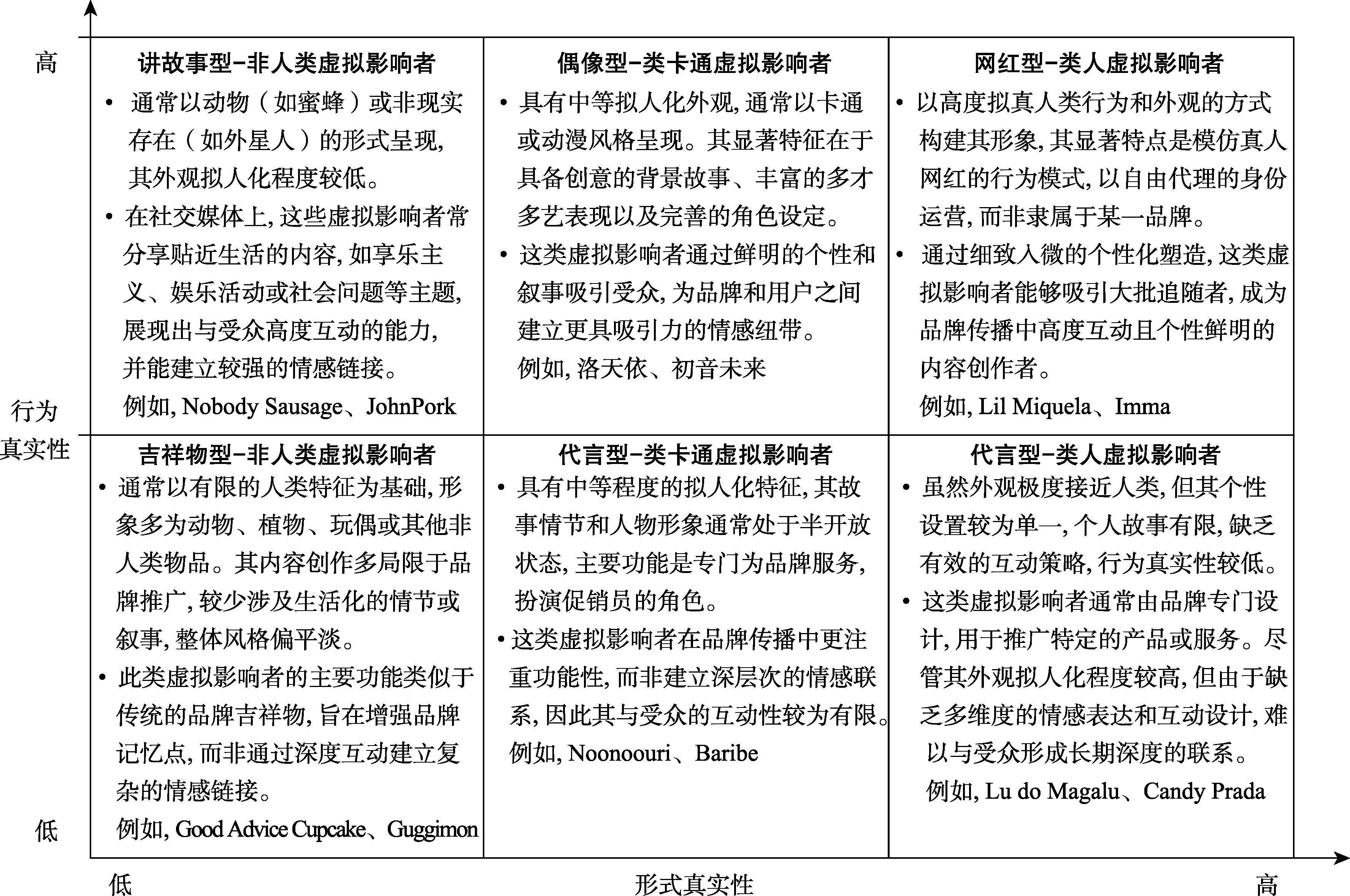
图1 虚拟影响者的分类 资料来源:作者整理
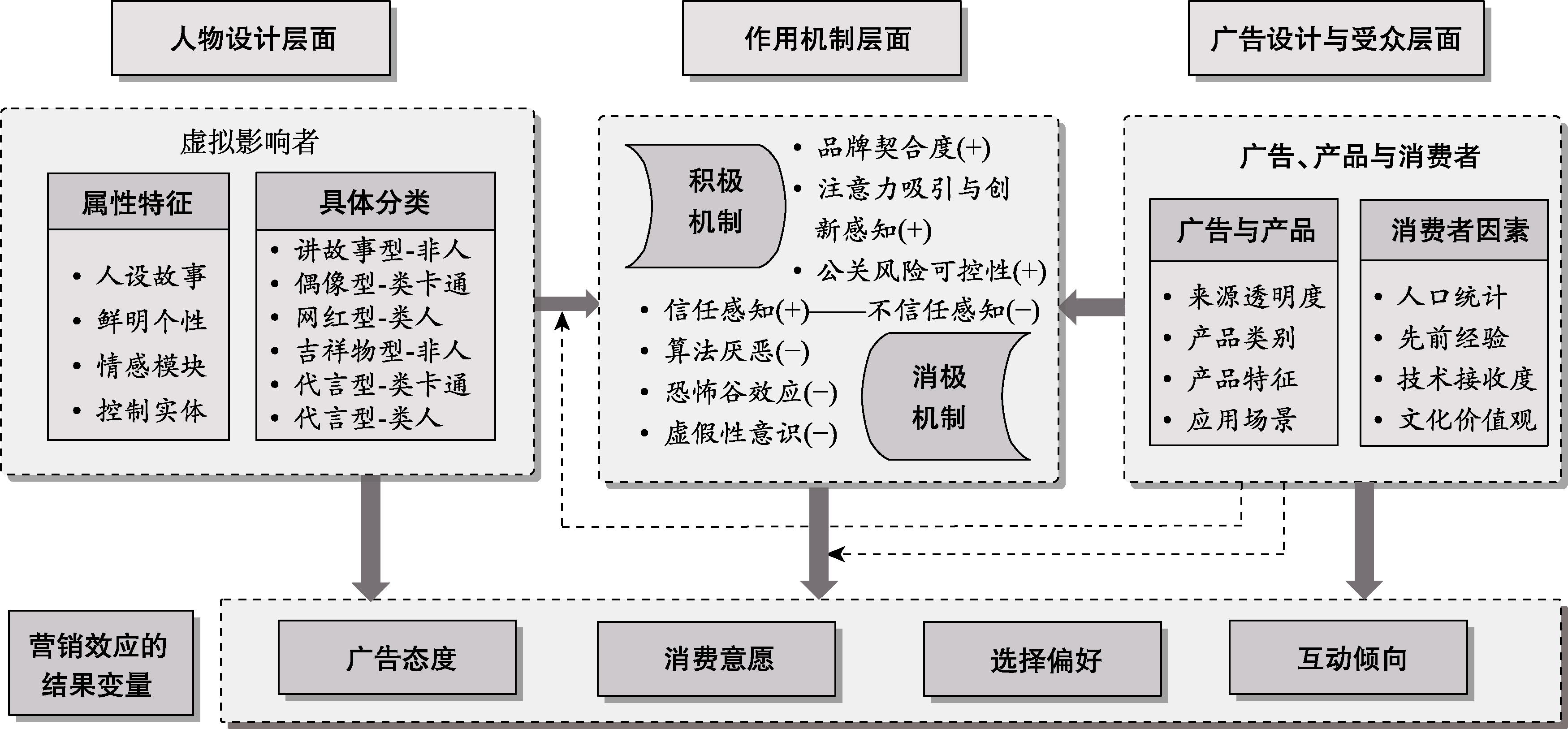
图2 本文模型框架图 注:图中加粗实线箭头表示直接效应, 虚线箭头表示调节效应
| [1] | 国海证券. (2022). 元宇宙系列深度报告之二:数字虚拟人——科技人文的交点, 赋能产业的起点. 证券研究报告. https://stock.finance.sina.com.cn/stock/go.php/vReport_Show/kind/industry/rptid/700318895103/in |
| [2] | 量子位智库. (2021). 虚拟数字人深度产业报告. https://www.100ec.cn/detail--6604822.html |
| [3] | 徐震南, 刘茜, 刘桂林. (2023). 个人品牌型虚拟数字人的打造: 情感实践的策略. 营销科学学报, 3(4), 123-143. |
| [4] | Anderson, J. R. (1983). A spreading activation theory of memory. Journal of Verbal Learning and Verbal Behavior, 22(3), 261-295. |
| [5] |
Appel, G., Grewal, L., Hadi, R., & Stephen, A. T. (2020). The future of social media in marketing. Journal of the Academy of Marketing Science, 48(1), 79-95.
doi: 10.1007/s11747-019-00695-1 pmid: 32431463 |
| [6] | Arango, L., Singaraju, S. P., & Niininen, O. (2023). Consumer responses to AI-generated charitable giving ads. Journal of Advertising, 52(4), 486-503. |
| [7] | Arsenyan, J., & Mirowska, A. (2021). Almost human? A comparative case study on the social media presence of virtual influencers. International Journal of Human- Computer Studies, 155, 102694. |
| [8] | Audrezet, A., De Kerviler, G., & Guidry Moulard, J. (2020). Authenticity under threat: When social media influencers need to go beyond self-presentation. Journal of Business Research, 117, 557-569. |
| [9] | Baklanov, N. (2019). The top Instagram virtual influencers in 2019. https://hypeauditor.com/blog/the-top-instagram-virtualinfluencers-in-2019/ |
| [10] | Banker, S., & Khetani, S. (2019). Algorithm overdependence: How the use of algorithmic recommendation systems can increase risks to consumer well-being. Journal of Public Policy & Marketing, 38(4), 500-515. |
| [11] | Bareket-Bojmel, L., Moran, S., & Shahar, G. (2016). Strategic self-presentation on Facebook: Personal motives and audience response to online behavior. Computers in Human Behavior, 55(Part B),788-795. |
| [12] | Beer, J. M., Smarr, C. A., Fisk, A. D., & Rogers, W. A. (2015). Younger and older users’ recognition of virtual agent facial expressions. International Journal of Human-Computer Studies, 75, 1-20. |
| [13] | Belanche, D., Casaló, L. V., Flavián, C., & Schepers, J. (2020). Service robot implementation: A theoretical framework and research agenda. The Service Industries Journal, 40(3-4), 203-225. |
| [14] | Bradley, S. (2020). Even better than the real thing? Meet the virtual influencers taking over your feeds. https://www.thedrum.com/news/2020/03/20/even-better-the-real-thing-meet-the-virtual-influencers-taking-over-your-feeds |
| [15] | Callahan, K. (2021). CGI Social Media Influencers: Are they above the FTC’s Influence? Journal of Business & Technology Law, 16(2), 361-385. |
| [16] | Campbell, C., Sands, S., Ferraro, C., Tsao, H. Y. J., & Mavrommatis, A. (2020). From data to action: How marketers can leverage AI. Business Horizons, 63(2), 227-243. |
| [17] |
Castelo, N., Bos, M. W., & Lehmann, D. R. (2019). Task- dependent algorithm aversion. Journal of Marketing Research, 56(5), 809-825.
doi: 10.1177/0022243719851788 |
| [18] |
Chen, G., Xie, P., Dong, J., & Wang, T. (2019). Understanding programmatic creative: The role of AI. Journal of Advertising, 48(4), 347-355.
doi: 10.1080/00913367.2019.1654421 |
| [19] | Choi, S. M., & Rifon, N. J. (2012). It is a match: The impact of congruence between celebrity image and consumer ideal self on endorsement effectiveness. Psychology & Marketing, 29(9), 639-650. |
| [20] | Davenport, T., Guha, A., Grewal, D., & Bressgott, T. (2020). How artificial intelligence will change the future of marketing. Journal of the Academy of Marketing Science, 48(1), 24-42. |
| [21] | de Boissieu, E., & Baudier, P. (2023). The perceived credibility of human-like social robots: Virtual influencers in a luxury and multicultural context. Journal of Organizational Change Management, 36(7), 1163-1179. |
| [22] |
de Borst, A. W., & de Gelder, B. (2015). Is it the real deal? Perception of virtual characters versus humans: An affective cognitive neuroscience perspective. Frontiers in Psychology, 6, 576.
doi: 10.3389/fpsyg.2015.00576 pmid: 26029133 |
| [23] | De Veirman, M., Cauberghe, V., & Hudders, L. (2017). Marketing through Instagram influencers: The impact of number of followers and product divergence on brand attitude. International Journal of Advertising, 36(5), 798-828. |
| [24] | Del Rowe, S. (2019). Get started with natural language content generation. EContent, 42(3), 16-21. |
| [25] | Deng, F., & Jiang, X. (2023). Effects of human versus virtual human influencers on the appearance anxiety of social media users. Journal of Retailing and Consumer Services, 71, 103233. |
| [26] | Deng, S., Tan, C. W., Wang, W., & Pan, Y. (2019). Smart generation system of personalized advertising copy and its application to advertising practice and research. Journal of Advertising, 48(4), 356-365. |
| [27] | Dibble, J. L., Hartmann, T., & Rosaen, S. F. (2016). Parasocial interaction and parasocial relationship: Conceptual clarification and a critical assessment of measures. Human Communication Research, 42(1), 21-44. |
| [28] | Dietvorst, B. J., Simmons, J. P., & Massey, C. (2015). Algorithm aversion: People erroneously avoid algorithms after seeing them err. Journal of Experimental Psychology: General, 144(1), 114-126. |
| [29] | Dietvorst, B. J., Simmons, J. P., & Massey, C. (2018). Overcoming algorithm aversion: People will use imperfect algorithms if they can (even slightly) modify them. Management Science, 64(3), 1155-1170. |
| [30] | Dill-Shackleford, K. E., Vinney, C., & Hopper-Losenicky, K. (2016). Connecting the dots between fantasy and reality: The social psychology of our engagement with fictional narrative and its functional value. Social and Personality Psychology Compass, 10(11), 634-646. |
| [31] |
Edwards, C., Edwards, A., Stoll, B., Lin, X., & Massey, N. (2019). Evaluations of an artificial intelligence instructor’s voice: Social identity theory in human-robot interactions. Computers in Human Behavior, 90, 357-362.
doi: 10.1016/j.chb.2018.08.027 |
| [32] | Faddoul, G., & Chatterjee, S. (2020). A quantitative measurement model for persuasive technologies using storytelling via a virtual narrator. International Journal of Human-Computer Interaction, 36(17), 1585-1604. |
| [33] | Felnhofer, A., Kaufmann, M., Atteneder, K., Kafka, J. X., Hlavacs, H., Beutl, L., Hennig-Fast, K., & Kothgassner, O. D. (2019). The mere presence of an attentive and emotionally responsive virtual character influences focus of attention and perceived stress. International Journal of Human-Computer Studies, 132, 45-51. |
| [34] | Franke, C., Groeppel-Klein, A., & Müller, K. (2023). Consumers’ responses to virtual influencers as advertising endorsers: Novel and effective or uncanny and deceiving? Journal of Advertising, 52(4), 523-539. |
| [35] | Gelbrich, K., Kerath, A., & Chun, H. H. (2023). Matching digital companions with customers: The role of perceived similarity. Psychology & Marketing, 40(11), 2291-2305. |
| [36] | Granulo, A., Fuchs, C., & Puntoni, S. (2021). Preference for human (vs. robotic) labor is stronger in symbolic consumption contexts. Journal of Consumer Psychology, 31(1), 72-80. |
| [37] | Gupta, S., Gallear, D., Rudd, J., & Foroudi, P. (2020). The impact of brand value on brand competitiveness. Journal of Business Research, 112, 210-222. |
| [38] | Guthrie, S. (2020). Virtual influencers: More human than humans. In S. Yesiloglu & J. Costello (Eds.), Influencer marketing: Building brand communities and engagement (pp. 271-285), Taylor & Francis Group. Milton Park, UK. |
| [39] | Hanus, M. D., & Fox, J. (2015). Persuasive avatars: The effects of customizing a virtual salesperson’s appearance on brand liking and purchase intentions. International Journal of Human-Computer Studies, 84, 33-40. |
| [40] | Holthöwer, J., & van Doorn, J. (2023). Robots do not judge: Service robots can alleviate embarrassment in service encounters. Journal of the Academy of Marketing Science, 51(4), 767-784. |
| [41] | Hu, H., & Ma, F. (2023). Human-like bots are not humans: The weakness of sensory language for virtual streamers in livestream commerce. Journal of Retailing and Consumer Services, 75, 103541. |
| [42] | Hwang, K., & Zhang, Q. (2018). Influence of parasocial relationship between digital celebrities and their followers on followers’ purchase and electronic word-of-mouth intentions, and persuasion knowledge. Computers in Human Behavior, 87, 155-173. |
| [43] | Kätsyri, J., Mäkäräinen, M., & Takala, T. (2017). Testing the ‘uncanny valley’ hypothesis in semi-realistic computer- animated film characters: An empirical evaluation of natural film stimuli. International Journal of Human-Computer Studies, 97, 149-161. |
| [44] | Khamis, S., Ang, L., & Welling, R. (2017). Self-branding, ‘micro-celebrity’ and the rise of social media influencers. Celebrity Studies, 8(2), 191-208. |
| [45] | Khan, R. F., & Sutcliffe, A. (2014). Attractive agents are more persuasive. International Journal of Human-Computer Interaction, 30(2), 142-150. |
| [46] | Kietzmann, J., Mills, A. J., & Plangger, K. (2020). Deepfakes: Perspectives on the future “reality” of advertising and branding. International Journal of Advertising, 40(3), 473-485. |
| [47] | Kietzmann, J., Paschen, J., & Treen, E. (2018). Artificial intelligence in advertising: How marketers can leverage artificial intelligence along the consumer journey. Journal of Advertising Research, 58(3), 263-267. |
| [48] | Kim, M., & Baek, T. H. (2024). Are virtual influencers friends or foes? Uncovering the perceived creepiness and authenticity of virtual influencers in social media marketing in the United States. International Journal of Human- Computer Interaction, 40(18), 5042-5055. |
| [49] |
Kim, T. W., & Duhachek, A. (2020). Artificial intelligence and persuasion: A construal-level account. Psychological Science, 31(4), 363-380.
doi: 10.1177/0956797620904985 pmid: 32223692 |
| [50] | Kim, T. W., Lee, H., Kim, M. Y., Kim, S. A., & Duhachek, A. (2023). AI increases unethical consumer behavior due to reduced anticipatory guilt. Journal of the Academy of Marketing Science, 51, 785-801. |
| [51] | Koles, B., Audrezet, A., Moulard, J. G., Ameen, N., & McKenna, B. (2024). The authentic virtual influencer: Authenticity manifestations in the metaverse. Journal of Business Research, 170, 114325. |
| [52] | Kramer, S. D. (2018). The impact of influencer marketing on consumers. https://www.linkedin.com/pulse/impact-influencer- marketingconsumers-shelly-demotte-kramer/ |
| [53] | Krämer, N. C., Lucas, G., Schmitt, L., & Gratch, J. (2018). Social snacking with a virtual agent on the interrelation of need to belong and effects of social responsiveness when interacting with artificial entities. International Journal of Human-Computer Studies, 109, 112-121. |
| [54] | Krämer, N. C., Rosenthal-von der Pütten, A. M., Hoffmann, L., & Sundar, S. S. (2015). Social effects of virtual and robot companions. In Sundar, S. S. (Ed.), The handbook of the psychology of communication technology (pp. 137-159), Wiley. |
| [55] | Leung, E., Paolacci, G., & Puntoni, S. (2018). Man versus machine: Resisting automation in identity-based consumer behavior. Journal of Marketing Research, 55(6), 818-831. |
| [56] | Liang, C., Peng, J., Hong, Y., & Gu, B. (2022). The hidden costs and benefits of monitoring in the gig economy. Information Systems Research, 34(1), 297-318. |
| [57] |
Liu, X. (2019). A big data approach to examining social bots on Twitter. Journal of Services Marketing, 33(4), 369-379.
doi: 10.1108/JSM-02-2018-0049 |
| [58] | Liu, Y. J., Chen, Z., Meng, J., & Wang, Z. (2022). What’s in a face? An experiment on facial information and loan approval decision. Management Science, 69(4), 2263-2283. |
| [59] | Longoni, C., & Cian, L. (2022). Artificial intelligence in utilitarian vs. hedonic contexts: The “word-of-machine” effect. Journal of Marketing, 86(1), 91-108. |
| [60] |
MacDorman, K. F. (2019). In the uncanny valley, transportation predicts narrative enjoyment more than empathy, but only for the tragic hero. Computers in Human Behavior, 94, 140-153.
doi: 10.1016/j.chb.2019.01.011 |
| [61] |
MacDorman, K. F., & Chattopadhyay, D. (2016). Reducing consistency in human realism increases the uncanny valley effect; increasing category uncertainty does not. Cognition, 146, 190-205.
doi: 10.1016/j.cognition.2015.09.019 pmid: 26435049 |
| [62] | Masteralexis, J., McKelvey, S., & Statz, K. (2021). #IAMAROBOT: Is it time for the federal trade commission to rethink its approach to virtual influencers in sports, entertainment, and the broader market? Journal of Sports & Entertainment Law, 12, 353-386. |
| [63] | Mathur, M. B., Reichling, D. B., Lunardini, F., Geminiani, A., Antonietti, A., Ruijten, P. A. M., … Aczel, B. (2020). Uncanny but not confusing: Multisite study of perceptual category confusion in the Uncanny Valley. Computers in Human Behavior, 103, 21-30. |
| [64] | Miao, F., Kozlenkova, I. V., Wang, H., Xie, T., & Palmatier, R. W. (2022). An emerging theory of avatar marketing. Journal of Marketing, 86(1), 67-90. |
| [65] | Mori, M., MacDorman, K., & Kageki, N. (2012). The uncanny valley. IEEE Robotics & Automation Magazine, 19(2), 98-100. |
| [66] | Mousas, C., Anastasiou, D., & Spantidi, O. (2018). The effects of appearance and motion of virtual characters on emotional reactivity. Computers in Human Behavior, 86, 99-108. |
| [67] | Moustakas, E., Lamba, N., Mahmoud, D., & Ranganathan, C. (2020). Blurring lines between fiction and reality. In 2020 International Conference on Cyber Security (pp. 1-6), Dublin, Ireland. |
| [68] | Muniz, F., Stewart, K., & Magalhães, L. (2023). Are they humans or are they robots? The effect of virtual influencer disclosure on brand trust. Journal of Consumer Behaviour, 23(3), 1234-1250. |
| [69] | Nass, C., & Moon, Y. (2000). Machines and mindlessness: Social responses to computers. Journal of Social Issues, 56(1), 81-103. |
| [70] | Niederman, F., & Baker, E. W. (2023). Ethics and AI issues: Old container with new wine? Information Systems Frontiers, 25(1), 9-28. |
| [71] | Paschen, U., Pitt, C., & Kietzmann, J. (2020). Artificial intelligence: Building blocks and an innovation typology. Business Horizons, 63(2), 147-155. |
| [72] |
Qin, X., & Jiang, Z. (2019). The impact of AI on the advertising process: The Chinese experience. Journal of Advertising, 48(4), 338-346.
doi: 10.1080/00913367.2019.1652122 |
| [73] | Radomskaya, V., & Pearce, P. L. (2021). Adding character: The role of destination mascots in tourism development. Tourism Management, 84, 104248. |
| [74] | Rai, A. (2020). Explainable AI: From black box to glass box. Journal of the Academy of Marketing Science, 48(1), 137-141. |
| [75] | Robinson, B. (2020). Towards an ontology and ethics of virtual influencers. Australasian Journal of Information Systems, 24, 1-8. |
| [76] | Rosenthal-von der Pütten, A. M., Krämer, N. C., Maderwald, S., Brand, M., & Grabenhorst, F. (2019). Neural mechanisms for accepting and rejecting artificial social partners in the uncanny valley. The Journal of Neuroscience, 39(33), 6555-6570. |
| [77] | Russell, J. A. (1980). A circumplex model of affect. Journal of Personality and Social Psychology, 39(6), 1161-1178. |
| [78] | Sands, S., Ferraro, C., Demsar, V., & Chandler, G. (2022). False idols: Unpacking the opportunities and challenges of falsity in the context of virtual influencers. Business Horizons, 65(6), 777-788. |
| [79] |
Schmitt, B. (2020). Speciesism: An obstacle to AI and robot adoption. Marketing Letters, 31(1), 3-6.
doi: 10.1007/s11002-019-09499-3 |
| [80] | Schouten, A. P., Janssen, L., & Verspaget, M. (2020). Celebrity vs. influencer endorsements in advertising: The role of identification, credibility, and product-endorser fit. International Journal of Advertising, 39(2), 258-281. |
| [81] | Seymour, M., Lovallo, D., Riemer, K., Dennis, A. R., & Yuan, L. (2023). Al with a human face: The case for and against digital employees. Harvard Business Review, 101(3-4), 49-54. |
| [82] | Sorosrungruang, T., Ameen, N., & Hackley, C. (2024). How real is real enough? Unveiling the diverse power of generative AI-enabled virtual influencers and the dynamics of human responses. Psychology & Marketing, 41(12), 3124-3143. |
| [83] | Stein, J. P., Appel, M., Jost, A., & Ohler, P. (2020). Matter over mind? How the acceptance of digital entities depends on their appearance, mental prowess, and the interaction between both. International Journal of Human-Computer Studies, 142, 102463. |
| [84] | Sutrop, M. (2019). Should we trust artificial intelligence? Trames: Journal of the Humanities and Social Sciences, 23(4), 499-522. |
| [85] | Tayenaka, T. (2020). CGI-created virtual influencers are the new trend in social media marketing. https://www.entrepreneur.com/article/352937 |
| [86] | Thomas, V. L., & Fowler, K. (2016). Examining the impact of brand transgressions on consumers’ perceptions of celebrity endorsers. Journal of Advertising, 45(4), 377-390. |
| [87] | Thomas, V. L., & Fowler, K. (2021). Close encounters of the AI kind: Use of AI influencers as brand endorsers. Journal of Advertising, 50(1), 11-25. |
| [88] |
Waytz, A., Gray, K., Epley, N., & Wegner, D. M. (2010). Causes and consequences of mind perception. Trends in Cognitive Sciences, 14(8), 383-388.
doi: 10.1016/j.tics.2010.05.006 pmid: 20579932 |
| [89] | Wiese, E., & Weis, P. P. (2020). It matters to me if you are human-examining categorical perception in human and nonhuman agents. International Journal of Human-Computer Studies, 133, 1-12. |
| [90] | Wong, R. (2018). Virtual influencers lead to virtual inauthenticity. https://www.adweek.com/performance-marketing/ virtual-influencers-lead-to-virtual-inauthenticity/ |
| [91] | Wright, S. A. (2016). Reinvestigating the endorser by product matchup hypothesis in advertising. Journal of Advertising, 45(1), 26-32. |
| [92] | Yamada, Y., Kawabe, T., & Ihaya, K. (2013). Categorization difficulty is associated with negative evaluation in the “uncanny valley” phenomenon. Japanese Psychological Research, 55(1), 20-32. |
| [93] | Yan, J., Xia, S., Jiang, A., & Lin, Z. (2024). The effect of different types of virtual influencers on consumers’ emotional attachment. Journal of Business Research, 177, 114646. |
| [94] | Yap, L. (2018). The case for virtual influencers. https://www.luxurysociety.com/en/articles/2018/09/case-virtual-influencers |
| [95] | Zhang, X., Shi, Y., Li, T., Guan, Y., & Cui, X. (2023). How do virtual AI streamers influence viewers’ livestream shopping behavior? The effects of persuasive factors and the mediating role of arousal. Information Systems Frontiers, 26, 1-32. |
| [96] | Zhou, X., Xiao, Y., & Jiang, Y. (2024). Making sense? The sensory-specific nature of virtual influencer effectiveness. Journal of Marketing, 88(4), 84-106. |
| [1] | 宗树伟, 杨付, 龙立荣, 韩翼. 促进还是抑制?生成式人工智能建议采纳对创造力的双刃剑效应[J]. 心理科学进展, 2025, 33(6): 905-915. |
| [2] | 解煜彬, 周荣刚. 新型人机关系下的人机双向信任[J]. 心理科学进展, 2025, 33(6): 916-932. |
| [3] | 谭美丽, 殷向洲, 张光磊, 熊普臻. 工作场所人工智能角色划分:对员工心理与行为的影响及应对策略[J]. 心理科学进展, 2025, 33(6): 933-947. |
| [4] | 项典典, 尹雨乐, 葛梦琦, 王子涵. 自建IP还是合作IP:虚拟影响者代言人选择策略对消费者融入的影响[J]. 心理科学进展, 2025, 33(6): 965-983. |
| [5] | 罗莉娟, 王康, 胡金淼, 徐四华. 当人工智能面对人类情感:服务机器人情感表达对用户体验的影响机制[J]. 心理科学进展, 2025, 33(6): 1006-1026. |
| [6] | 彭晨明, 屈奕帆, 郭晓凌, 陈增祥. 人工智能服务对消费者道德行为的双刃剑效应[J]. 心理科学进展, 2025, 33(2): 236-255. |
| [7] | 翁智刚, 陈潇潇, 张小妹, 张琚. 面向新型人机关系的社会临场感[J]. 心理科学进展, 2025, 33(1): 146-162. |
| [8] | 吴波, 张傲杰, 曹菲. 专业设计、用户设计还是AI设计?设计源效应的心理机制[J]. 心理科学进展, 2024, 32(6): 995-1009. |
| [9] | 侯悍超, 倪士光, 林书亚, 王蒲生. 当AI学习共情:心理学视角下共情计算的主题、场景与优化[J]. 心理科学进展, 2024, 32(5): 845-858. |
| [10] | 舒丽芳, 王魁, 吴月燕, 陈斯允. 人工智能指导对消费者长期目标追求的多阶段影响机制[J]. 心理科学进展, 2024, 32(3): 451-464. |
| [11] | 王永跃, 黄飘飘, 金杨华, 白新文, 岳峰凯, 张范颖, 郭子浩. 人工智能背景下制造业知识型员工技术空心化: 内涵、生成及影响机制[J]. 心理科学进展, 2024, 32(12): 2005-2017. |
| [12] | 王红丽, 李振, 周梦楠, 陈政任. 赋能或去能:人工智能对创造性人格的影响[J]. 心理科学进展, 2024, 32(12): 1990-2004. |
| [13] | 蒋建武, 龙晗寰, 胡洁宇. 工作场所人工智能应用对员工影响的元分析[J]. 心理科学进展, 2024, 32(10): 1621-1639. |
| [14] | 尹萌, 牛雄鹰. 与AI“共舞”:系统化视角下的AI−员工协作[J]. 心理科学进展, 2024, 32(1): 162-176. |
| [15] | 涂艳, 蒿坡, 龙立荣. 工作替代还是工作转型?技术型工作不安全感的内涵、影响后果及来源[J]. 心理科学进展, 2023, 31(8): 1359-1373. |
| 阅读次数 | ||||||
|
全文 |
|
|||||
|
摘要 |
|
|||||
