

ISSN 1671-3710
CN 11-4766/R
主办:中国科学院心理研究所
出版:科学出版社
CN 11-4766/R
主办:中国科学院心理研究所
出版:科学出版社
心理科学进展 ›› 2025, Vol. 33 ›› Issue (11): 1993-2008.doi: 10.3724/SP.J.1042.2025.1993 cstr: 32111.14.2025.1993
陈雅琳1,2, 贡喆1,3( )
)
收稿日期:2024-12-04
出版日期:2025-11-15
发布日期:2025-09-19
通讯作者:
贡喆, E-mail: zhegong@sicnu.edu.cn
CHEN Yalin1,2, GONG Zhe1,3()
Received:2024-12-04
Online:2025-11-15
Published:2025-09-19
摘要:
为厘清亲密伴侣暴力(intimate partner violence, IPV)脱离的复杂路径及其内部机制, 本研究对IPV脱离的多层级影响因素进行系统梳理, 结合行为阶段转变理论模型的阶段划分与心理社会准备模型的动态连续框架提出IPV脱离的阶段−连续动态交互模型(Staged-Continuum Dynamic Interaction Model, SCDIM)。SCDIM整合了阶段跃迁的触发机制以及风险/保护因素在阶段转换中的动态博弈, 为理解IPV脱离的复杂机制提供了整合性理论框架, 弥补了传统模型对多因素交互作用及阶段间非线性关系的解释局限。未来研究需对SCDIM的模型效度、适用范围进行验证, 结合跨学科视角拓展其应用前景与实证研究方向。
中图分类号:
陈雅琳, 贡喆. (2025). 何以脱而不得?亲密伴侣暴力脱离的影响因素与发生机制. 心理科学进展 , 33(11), 1993-2008.
CHEN Yalin, GONG Zhe. (2025). Why is leaving not an option? Factors and mechanisms in the disengagement from intimate partner violence. Advances in Psychological Science, 33(11), 1993-2008.
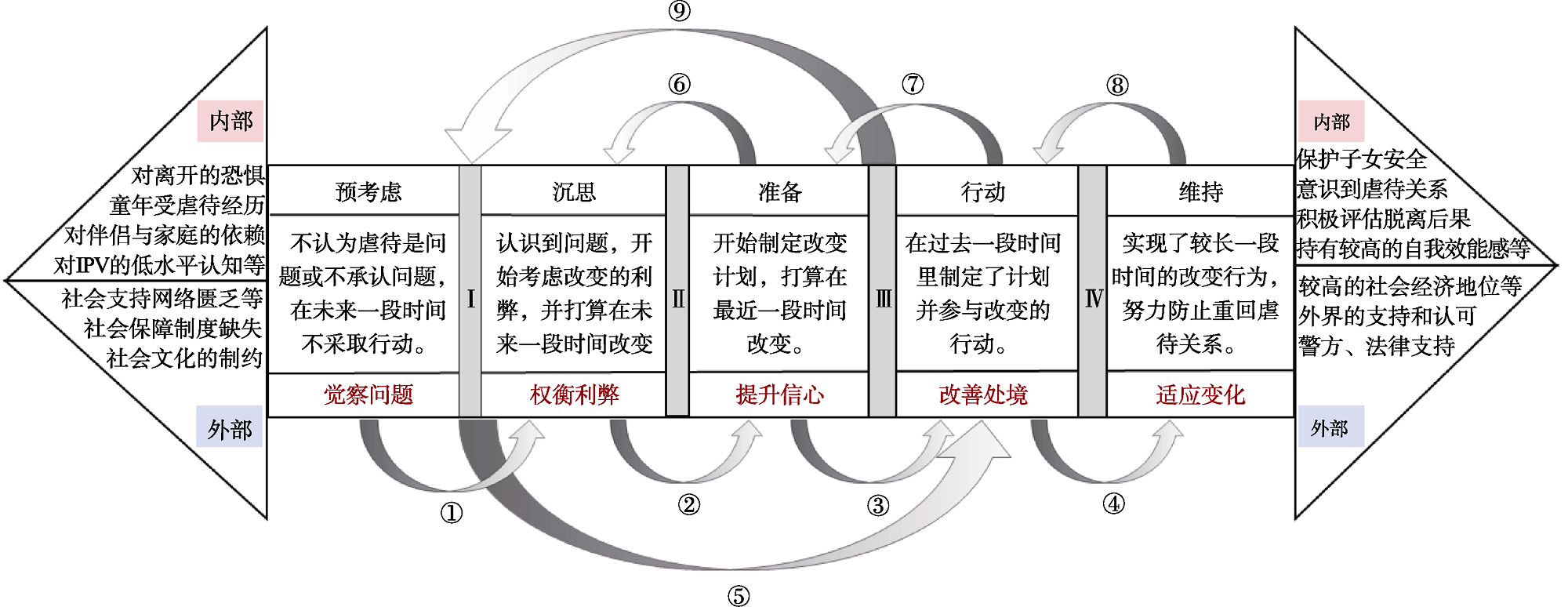
图1 IPV脱离的阶段−连续动态交互模型
| [1] | 沈毅. (2024). 亲密关系:伦理需求抑或社会交换——基于中西文化差异的比较分析. 中国社会科学评价, (3), 116-125. |
| [2] |
涂画, 张春妹. (2024). 亲密伴侣暴力的成因:社会学习和女性主义理论下基于态度的解释. 心理科学进展, 32(11), 1898-1911.
doi: 10.3724/SP.J.1042.2024.01898 |
| [3] |
张银普, 骆南峰, 石伟. (2016). 经验取样法——一种收集“真实”数据的新方法. 心理科学进展, 24(2), 305-316. https://doi.org/10.3724/sp.J.1042.2016.00305
doi: 10.3724/SP.J.1042.2016.00305 URL |
| [4] | Afrouz, R., Crisp, B. R., & Taket, A. (2020). Seeking help in domestic violence among Muslim women in Muslim- majority and non-Muslim-majority countries: A literature review. Trauma, Violence, & Abuse, 21(3), 551-566. https://doi.org/10.1177/1524838018781102 |
| [5] | Aguiar, A. P., & Corrêa, R. d. S. (2022). Violência por parceiro íntimo contra a mulher e insegurança alimentar: Uma revisão narrativa da literatura. Interface - Comunicação, Saúde, Educação, 26(4), 1-17, https://doi.org/10.1590/interface.210488 |
| [6] | Ahmad-Stout, F., Nath, S. R., Khoury, N. M., & Huang, H. (2021). Experiences of intimate partner violence: Findings from interviews with South Asian women in the United States. Journal of Interpersonal Violence, 36(3-4), NP1941-NP1964. https://doi.org/10.1177/0886260517753850 |
| [7] | Aiquipa Tello, J. J. A., & Canción Suárez, N. M. C. (2020). Survivors of partner violence: Factors and psychological processes involved in the decision to stay or leave the relationship [Mujeres supervivientes de violencia de pareja: Factores y procesos psicológicos implicados en la decisión de permanecer o abandonar la relación]. Avances en Psicología Latinoamericana, 38(1), 189-202. https://doi.org/10.12804/revistas.urosario.edu.co/apl/a.7139 |
| [8] | Ajzen, I. (1985). From intentions to actions:A theory of planned behavior. In J. Kuhl & J. Beckmann (Eds.), Action control: From cognition to behavior (pp. 11-39). Springer. |
| [9] | Anderson, D. K., & Saunders, D. G. (2003). Leaving an abusive partner. Trauma, Violence, & Abuse, 4(2), 163-191. https://doi.org/10.1177/1524838002250769 |
| [10] | Atiyat, R., & Al Momani, I. (2022). To leave or not to leave, that is the question: Discussing notions of particularity in "breaking the cycle" through the lens of feminist literary theory. Interdisciplinary Literary Studies, 24(3), 409-429. https://doi.org/10.5325/intelitestud.24.3.0409 |
| [11] | Azeez, E. P. A., Negi, D. P., Kukreja, T., Tanwar, K. C., Kumar, M. S., Kalyani, V., & Harmain, D. (2024). Why do they decide to stay? Experience of Indian women surviving intimate partner violence. Journal of Aggression Conflict and Peace Research, 16(2), 172-188. https://doi.org/10.1108/jacpr-09-2023-0827 |
| [12] | Badenes-Sastre, M., Beltrán-Morillas, A. M., & Expósito, F. (2024). Absence versus presence of intimate partner violence in a sample of Spanish women: Conflict resolution strategies and associated variables. Violence Against Women, 30(3-4), 832-853. |
| [13] | Badenes-Sastre, M., Lorente, M., Beltrán-Morillas, A. M., & Expósito, F. (2023). Transformative effect of intimate partner violence against women based on sociocultural factors trapping women in a violent relationship. Current Psychology, 43(12), 10786-10800. https://doi.org/10.1007/s12144-023-05101-2 |
| [14] | Band-Winterstein, T. (2015). Aging in the shadow of violence: A phenomenological conceptual framework for understanding elderly women who experienced lifelong IPV. Journal of Elder Abuse & Neglect, 27(4-5), 303-327, https://doi.org/10.1080/08946566.2015.1091422 |
| [15] | Barnett, O. W., & LaViolette, A. D. (1993). It could happen to anyone: Why battered women stay. Sage Publications, Inc. |
| [16] | Barrios, V. R., Khaw, L. B. L., Bermea, A., & Hardesty, J. L. (2021). Future directions in intimate partner violence research: An intersectionality framework for analyzing women’s processes of leaving abusive relationships. Journal of Interpersonal Violence, 36(23-24), NP12600-NP12625. |
| [17] | Bates, E. A. (2020). “No one would ever believe me”: An exploration of the impact of intimate partner violence victimization on men. Psychology of Men & Masculinities, 21(4), 497-507. |
| [18] | Bliese, P. D., Adler, A. B., & Flynn, P. J. (2017). Transition processes: A review and synthesis integrating methods and theory. Annual Review of Organizational Psychology and Organizational Behavior, 4(1), 263-286. https://doi.org/10.1146/annurev-orgpsych-032516-113213 |
| [19] |
Bridges, A. J., Karlsson, M. E., Jackson, J. C., Andrews, A. R., & Villalobos, B. T. (2018). Barriers to and methods of help seeking for domestic violence victimization: A comparison of hispanic and non-hispanic white women residing in the United States. Violence Against Women, 24(15), 1810-1829. https://doi.org/10.1177/1077801218754409
doi: 10.1177/1077801218754409 URL pmid: 29409400 |
| [20] | Bronfenbrenner, U. (1979). The ecology of human development: Experiments by nature and design. Harvard University Press. |
| [21] | Bruton, C., & Tyson, D. (2017). Leaving violent men: A study of women’s experiences of separation in Victoria, Australia. Australian & New Zealand Journal of Criminology, 51(3), 339-354. https://doi.org/10.1177/0004865817746711 |
| [22] | Burke, J. G., Gielen, A. C., McDonnell, K. A., O'campo, P., & Maman, S. (2001). The process of ending abuse in intimate relationships: A qualitative exploration of the transtheoretical model. Violence Against Women, 7(10), 1144-1163. |
| [23] | Cao, J., Liu, X., & Gonzalez-Guarda, R. M. (2022). Trapped in my roles as a woman with no help: Experiences of intimate partner violence against Chinese women. Violence Against Women, 29(5), 964-986. https://doi.org/10.1177/10778012221104504 |
| [24] | Caridade, S., Pinheiro, I., & Dinis, M. A. P. (2020). Stay or leave abusive dating relationships: Portuguese victims’ reasons and barriers. Social Sciences, 9(5), 84. https://doi.org/10.3390/socsci9050084 |
| [25] | Catallo, C., Jack, S. M., Ciliska, D., & MacMillan, H. L. (2012). Identifying the turning point: Using the transtheoretical model of change to map intimate partner violence disclosure in emergency department settings. International Scholarly Research Notices, 2012(1), 239468. https://doi.org/10.5402/2012/239468 |
| [26] | Cervantes, M. V., & Sherman, J. (2021). Falling for the ones that were abusive: Cycles of violence in low-income women's intimate relationships. Journal of Interpersonal Violence, 36(13-14), NP7567-NP7595. https://doi.org/10.1177/0886260519829771 |
| [27] |
Chan, B., & Sachs, C. J. (2023). Intimate partner violence and sexual violence. Emergency Medicine Clinics of North America, 41(2), 369-380. https://doi.org/10.1016/j.emc.2023.01.007
doi: 10.1016/j.emc.2023.01.007 URL pmid: 37024170 |
| [28] |
Chang, J. C., Dado, D., Hawker, L., Cluss, P. A., Buranosky, R., Slagel, L., McNeil, M., & Scholle, S. H. (2010). Understanding turning points in intimate partner violence: Factors and circumstances leading women victims toward change. Journal of Women's Health, 19(2), 251-259. https://doi.org/10.1089/jwh.2009.1568
doi: 10.1089/jwh.2009.1568 URL pmid: 20113147 |
| [29] | Cheung, D. S. T., Tiwari, A., & Wang, A. X. M. (2015). Intimate Partner Violence in Late Life: A Case Study of Older Chinese Women. Journal of Elder Abuse & Neglect, 27(4-5), 428-437. https://doi.org/10.1080/08946566.2015.1092903 |
| [30] | Childress, S., Panchanadeswaran, S., & Joshi, M. (2021). Leaving and beyond: Voices of survivors of domestic violence from Kyrgyzstan. Journal of Interpersonal Violence, 36(3-4), 1718-1744. https://doi.org/10.1177/0886260517743550 |
| [31] | Cluss, P. A., Chang, J. C., Hawker, L., Scholle, S. H., Dado, D., Buranosky, R., & Goldstrohm, S. (2006). The process of change for victims of intimate partner violence: Support for a psychosocial readiness model. Women's Health Issues, 16(5), 262-274. |
| [32] | Cohen, V., Clark, S. M., Saker, K. M., Dunn, S. E., Watson-Singleton, N. N., & Kaslow, N. J. (2024). Intimate partner violence and barriers to leaving among low- income African American women: The role of self-esteem as a mediating factor. Journal of African American Studies, 28(3), 283-297. https://doi.org/10.1007/s12111-024-09671-8 |
| [33] | Costanza Baldry, A., & Cinquegrana, V. (2020). The decision to leave the abusive partner by women survivors of intimate partner violence and risk of further revictimization: The role of gratitude and risk perception. Violence Against Women, 27(9), 1232-1251. https://doi.org/10.1177/1077801220935203 |
| [34] | Counts, D. A., Brown, J. K., & Campbell, J. (1999). To have and to hit: Cultural perspectives on wife beating. University of Illinois Press. |
| [35] | Dobash, R. E., & Dobash, R. P. (1988). Research as social action:The struggle for battered women. In K. Yllö, & M. Bograd (Ed.), Feminist perspectives on wife abuse (pp. 51-74). SAGE Publications. |
| [36] |
Eckstein, J. J. (2019). “I’m strong for her” versus “I rely on him”: Male and female victims’ reasons for staying reflect sex-gender conflations. Journal of Applied Communication Research, 47(2), 216-235. https://doi.org/10.1080/00909882.2019.1584403
doi: 10.1080/00909882.2019.1584403 URL |
| [37] |
Enander, V., & Holmberg, C. (2008). Why does she leave? The leaving process(es) of battered women. Health care for women international, 29(3), 200-226. https://doi.org/10.1080/07399330801913802
doi: 10.1080/07399330801913802 URL pmid: 18350425 |
| [38] | Estrellado, A. F., & Loh, J. (2016). To stay in or leave an abusive relationship: Losses and gains experienced by battered Filipino women. Journal of Interpersonal Violence, 34(9), 1843-1863. https://doi.org/10.1177/0886260516657912 |
| [39] | Fawole, O. I., Okedare, O. O., & Reed, E. (2021). Home was not a safe haven: Women's experiences of intimate partner violence during the COVID-19 lockdown in Nigeria. BMC Women’s Health, 21(1), Article 32. https://doi.org/10.1186/s12905-021-01177-9 |
| [40] | Ferrer-Perez, V. A., Bosch-Fiol, E., Ferreiro-Basurto, V., Delgado-Alvarez, C., & Sánchez-Prada, A. (2020). Comparing implicit and explicit attitudes toward intimate partner violence against women. Frontiers in psychology, 11, Article 2147. https://doi.org/10.3389/fpsyg.2020.02147 |
| [41] |
Francis, L., Loxton, D., & James, C. (2017). The culture of pretence: A hidden barrier to recognising, disclosing and ending domestic violence. Journal of Clinical Nursing, 26(15-16), 2202-2214. https://doi.org/10.1111/jocn.13501
doi: 10.1111/jocn.13501 URL pmid: 27504594 |
| [42] | Fredrickson, B. (2004). Gratitude, like other positive emotions, broadens and builds. The Psychology of Gratitude/Oxford University Press. |
| [43] | Gaffney, H., Mansell, W., & Tai, S. (2019). Conversational agents in the treatment of mental health problems: Mixed-method systematic review. JMIR mental health, 6(10), e14166. https://doi.org/10.2196/14166 |
| [44] | Gracia, E., Lila, M., & Santirso, F. A. (2020). Attitudes toward intimate partner violence against women in the European Union: A systematic review. European Psychologist, 25(2), 104-121. https://doi.org/10.1027/1016-9040/a000392 |
| [45] | Grych, J., Hamby, S., & Banyard, V. (2015). The resilience portfolio model: Understanding healthy adaptation in victims of violence. Psychology of Violence, 5(4), 343-354. https://doi.org/10.1037/a0039671 |
| [46] | Henderson, A. J., Bartholomew, K., & Dutton, D. G. (1997). He loves me; he loves me not: Attachment and separation resolution of abused women. Journal of Family Violence, 12, 169-191. |
| [47] | Heron, R. L., Eisma, M., & Browne, K. (2022). Why do female domestic violence victims remain in or leave abusive relationships? A qualitative study. Journal of Aggression, Maltreatment & Trauma, 31(5), 677-694. https://doi.org/10.1080/10926771.2021.2019154 |
| [48] | Hightower, J., Smith, M. G., & Hightower, H.C. (2013). Hearing the voices of abused older women. In J. A. Yaffe (Ed.), Elder abuse and mistreatment (pp. 205-227). Routledge. |
| [49] | Hing, N., O’Mullan, C., Mainey, L., Nuske, E., Breen, H., & Taylor, A. (2021). Impacts of male intimate partner violence on women: A life course perspective. International Journal of Environmental Research and Public Health, 18(16), 8303. |
| [50] |
Howell, K. H., Thurston, I. B., Schwartz, L. E., Jamison, L. E., & Hasselle, A. J. (2018). Protective factors associated with resilience in women exposed to intimate partner violence. Psychology of Violence, 8(4), 438-447.
doi: 10.1037/vio0000147 pmid: 30393573 |
| [51] | Hutchison, E. D. (2010). A life course perspective. In E. D. Hutchison (Ed.), Dimensions of human behavior: The changing life course (4th ed., pp. 1-38). SAGE Publications. |
| [52] | Kalmuss, D. (1984). The intergenerational transmission of marital aggression. Journal of Marriage and Family, 46(1), 11-19. https://doi.org/10.2307/351858 |
| [53] | Khaw, L., & Hardesty, J. L. (2007). Theorizing the process of leaving: Turning points and trajectories in the stages of change. Family Relations, 56(4), 413-425. https://doi.org/10.1111/j.1741-3729.2007.00470.x |
| [54] |
Koenig, M. A., Stephenson, R., Ahmed, S., Jejeebhoy, S. J., & Campbell, J. (2006). Individual and contextual determinants of domestic violence in North India. American Journal of Public Health, 96(1), 132-138. https://doi.org/10.2105/AJPH.2004.050872
doi: 10.2105/AJPH.2004.050872 URL pmid: 16317213 |
| [55] | Kraft, P., Sutton, S. R., & Reynolds, H. M. (1999). The transtheoretical model of behaviour change: Are the stages qualitatively different? Psychology & Health, 14(3), 433-450. https://doi.org/10.1080/08870449908407339 |
| [56] | Lahav, Y. (2023). Hyper-Sensitivity to the perpetrator and the likelihood of returning to abusive relationships. Journal of Interpersonal Violence, 38(1-2), NP1815-NP1841, Article 08862605221092075. https://doi.org/10.1177/08862605221092075 |
| [57] | Larkin, G. L. (2008). Deadly sins and cardinal virtues in the clinical management of intimate partner violence. The Journal of Clinical Ethics, 19(4), 334-345. https://doi.org/10.1086/JCE200819405 |
| [58] | Launius, M. H., & Lindquist, C. U. (1988). Learned helplessness, external locus of control, and passivity in battered women. Journal of Interpersonal Violence, 3(3), 307-318. https://doi.org/10.1177/088626088003003004 |
| [59] | Lenio, J. A. (2006). Analysis of the Transtheoretical Model of behavior change. UW-Stout Journal of Student Research, 5(1), 73-86. |
| [60] | Lipsky, S., Caetano, R., Field, C. A., & Larkin, G. L. (2006). The role of intimate partner violence, race, and ethnicity in help-seeking behaviors. Ethnicity and Health, 11(1), 81-100. https://doi.org/10.1080/13557850500391410 |
| [61] | Lyons, M., & Brewer, G. (2022). Experiences of intimate partner violence during lockdown and the COVID-19 pandemic. Journal of Family Violence, 37(6), 969-977. https://doi.org/10.1007/s10896-021-00260-x |
| [62] |
Masten, A. S., Burt, K. B., Roisman, G. I., Obradović, J., Long, J. D., & Tellegen, A. (2004). Resources and resilience in the transition to adulthood: Continuity and change. Development and Psychopathology, 16(4), 1071-1094. https://doi.org/10.1017/S0954579404040143
URL pmid: 15704828 |
| [63] | McKinley, C. E., & Liddell, J. L. (2022). "Why I stayed in that relationship": Barriers to indigenous women's ability to leave violent relationships. Violence Against Women, 28(14), 3352-3374. https://doi.org/10.1177/10778012221104507 |
| [64] |
McLeroy, K. R., Bibeau, D., Steckler, A., & Glanz, K. (1988). An ecological perspective on health promotion programs. Health Education Quarterly, 15(4), 351-377. https://doi.org/10.1177/109019818801500401
doi: 10.1177/109019818801500401 URL pmid: 3068205 |
| [65] | Moffitt, T. E. (2013). Childhood exposure to violence and lifelong health: Clinical intervention science and stress- biology research join forces. Development and Psychopathology, 25(4pt2), 1619-1634. https://doi.org/10.1017/s0954579413000801 |
| [66] | Moffitt, T. E., Arseneault, L., Belsky, D., Dickson, N., Hancox, R. J., Harrington, H., … Caspi, A. (2011). A gradient of childhood self-control predicts health, wealth, and public safety. Proceedings of the National Academy of Sciences, 108(7), 2693-2698. https://doi.org/10.1073/pnas.1010076108 |
| [67] | Monterrosa, A. E. (2019). How race and gender stereotypes influence help-seeking for intimate partner violence. Journal of Interpersonal Violence, 36(17-18), NP9153-NP9174. https://doi.org/10.1177/0886260519853403 |
| [68] | Muñoz-Rivas, M., Ronzón-Tirado, R. C., Redondo, N., & Cassinello, M. D. Z. (2022). Adolescent victims of physical dating violence: Why do they stay in abusive relationships? Journal of Interpersonal Violence, 37(11-12), NP10362-NP10381. https://doi.org/10.1177/0886260520986277 |
| [69] | Murvartian, L., Saavedra-Macías, F. J., de la Mata, M. L., & Crowe, A. (2024). Understanding social workers and health professionals' public stigma against women who experience intimate partner violence in Spain. Journal of Family Violence.https://doi.org/10.1007/s10896-024-00714-y |
| [70] | Myin-Germeys, I., Kasanova, Z., Vaessen, T., Vachon, H., Kirtley, O., Viechtbauer, W., & Reininghaus, U. (2018). Experience sampling methodology in mental health research: New insights and technical developments. World Psychiatry, 17(2), 123-132. https://doi.org/10.1002/wps.20513 |
| [71] |
Niu, Z., Jia, L., Li, Y., Yang, L., Liu, Y., Lian, S., Wang, D., Wang, W., Yang, L., Pan, W., & Li, X. (2024). Trial-by-trial variability of TMS-EEG in healthy controls and patients with depressive disorder. IEEE Transactions on Neural Systems and Rehabilitation Engineering, 32, 3869-3877. https://doi.org/10.1109/tnsre.2024.3486759
doi: 10.1109/TNSRE.2024.3486759 URL pmid: 39466867 |
| [72] | O’Neal, E. N., & Beckman, L. O. (2016). Intersections of race, ethnicity, and gender: Reframing knowledge surrounding barriers to social services among latina intimate partner violence victims. Violence Against Women, 23(5), 643-665. https://doi.org/10.1177/1077801216646223 |
| [73] | Otero-García, L., Durán-Martín, E., Castellanos-Torres, E., Sanz-Barbero, B., & Vives-Cases, C. (2024). Accessibility of intimate partner violence-related services for young women in Spain. Qualitative study on professionals’ perspectives. PloS One, 19(4), Article 0297886. https://doi.org/10.1371/journal.pone.0297886 |
| [74] |
Overstreet, N. M., & Quinn, D. M. (2013). The intimate partner violence stigmatization model and barriers to help seeking. Basic and Applied Social Psychology, 35(1), 109-122. https://doi.org/10.1080/01973533.2012.746599
URL pmid: 23524454 |
| [75] |
Pinnewala, P. (2009). Good women, martyrs, and survivors: A theoretical framework for South Asian women's responses to partner violence. Violence Against Women, 15(1), 81-105. https://doi.org/10.1177/1077801208328005
doi: 10.1177/1077801208328005 URL pmid: 19015391 |
| [76] | Prochaska, J. O., & DiClemente, C. C. (1984). The transtheoretical approach: Crossing traditional boundaries of therapy. Dow Jones-Irwin. |
| [77] | Prochaska, J. O., DiClemente, C. C., & Norcross, J. C. (1992). In search of the structure of change. In Y. F. Klar, J. D., Chinsky, J. M. & Nadler, A. (Ed.), Self change: Social psychological and clinical perspectives (pp. 87-114). Springer. https://doi.org/10.1007/978-1-4612-2922-3_5 |
| [78] |
Prochaska, J. O., & Velicer, W. F. (1997). The transtheoretical model of health behavior change. American Journal of Health Promotion, 12(1), 38-48. https://doi.org/10.4278/0890-1171-12.1.38
doi: 10.4278/0890-1171-12.1.38 URL pmid: 10170434 |
| [79] | Pugh, B., Li, L., & Sun, I. Y. (2018). Perceptions of why women stay in physically abusive relationships: A comparative study of Chinese and U.S. college students. Journal of Interpersonal Violence, 36(7-8), 3778-3813. https://doi.org/10.1177/0886260518778264 |
| [80] | Rai, A., & Choi, Y. J. (2018). Socio-cultural risk factors impacting domestic violence among South Asian immigrant women: A scoping review. Aggression and Violent Behavior, 38, 76-85. https://doi.org/10.1016/j.avb.2017.12.001 |
| [81] |
Reisenhofer, S., & Taft, A. (2013). Women's journey to safety-the transtheoretical model in clinical practice when working with women experiencing intimate partner violence: A scientific review and clinical guidance. Patient Education and Counseling, 93(3), 536-548. https://doi.org/10.1016/j.pec.2013.08.004
doi: 10.1016/j.pec.2013.08.004 URL pmid: 24007763 |
| [82] |
Rizzo, C. J., Joppa, M. C., Barker, D., Zlotnick, C., Warren, J., Saint-Eloi Cadely, H., & Brown, L. K. (2020). Individual and relationship characteristics of adolescent girls with histories of physical dating violence. Journal of Interpersonal Violence, 35(5-6), 1389-1414. https://doi.org/10.1177/0886260517696859
doi: 10.1177/0886260517696859 URL pmid: 29294672 |
| [83] | Roberto, K. A., & McCann, B. R. (2018). Violence and abuse in rural older women’s lives: A life course perspective. Journal of Interpersonal Violence, 36(3-4), NP2205-2227NP. https://doi.org/10.1177/0886260518755490 |
| [84] | Roberto, K. A., & McCann, B. R. (2021). Violence and abuse in rural older women’s lives: A life course perspective. Journal of Interpersonal Violence, 36(3-4), NP2205-2227NP. https://doi.org/10.1177/0886260518755490 |
| [85] | Sabri, B. (2014). Domestic violence among South Asian women:An ecological perspective. In M. Taylor, J. A. Pooley, & R. S. Taylor (Eds.), Overcoming domestic violence: Creating a dialogue around vulnerable populations (pp. 105-119). Nova Science Publishers, Inc., Hauppauge, NY. |
| [86] |
Sabri, B., Nnawulezi, N., Njie-Carr, V. P. S., Messing, J., Ward-Lasher, A., Alvarez, C., & Campbell, J. C. (2018). Multilevel risk and protective factors for intimate partner violence among African, Asian, and Latina immigrant and refugee Women: Perceptions of Effective Safety Planning Interventions. Race and Social Problems, 10(4), 348-365. https://doi.org/10.1007/s12552-018-9247-z
doi: 10.1007/s12552-018-9247-z URL pmid: 31289602 |
| [87] | Sabri, B., Simonet, M., & Campbell, J. C. (2018). Risk and protective factors of intimate partner violence among South Asian immigrant women and perceived need for services. Cultural Diversity & Ethnic Minority Psychology, 24(3), 442-452. https://doi.org/10.1037/cdp0000189 |
| [88] |
Saftlas, A. F., Harland, K. K., Wallis, A. B., Cavanaugh, J., Dickey, P., & Peek-Asa, C. (2014). Motivational interviewing and intimate partner violence: A randomized trial. Annals of Epidemiology, 24(2), 144-150. https://doi.org/10.1016/j.annepidem.2013.10.006
doi: 10.1016/j.annepidem.2013.10.006 URL pmid: 24252714 |
| [89] | Sandhu, K. K., & Barrett, H. R. (2020). “Should I stay, or should I go?”: The experiences of, and choices available to women of South Asian heritage living in the UK when leaving a relationship of choice following intimate partner violence (IPV). Social Sciences, 9(9), Article 151. https://doi.org/10.3390/socsci9090151 |
| [90] | Sani, A. I., & Carvalho, C. (2018). Domestic violence and children at risk: Empirical study of Portuguese police records [Violência doméstica e crianças em risco: Estudo empírico com autos da polícia portuguesa]. Psicologia: Teoria e Pesquisa, 34, Article e34. https://doi.org/10.1590/0102.3772e34417 |
| [91] | Sani, A. I., & Pereira, D. (2020). Mothers as victims of intimate partner violence: The decision to leave or stay and resilience-oriented intervention. Social Sciences, 9(10), 174. https://doi.org/10.3390/socsci9100174 |
| [92] | Schutte, N. S., Malouff, J. M., & Doyle, J. S. (1988). The relationship between characteristics of the victim, persuasive techniques of the batterer, and returning to a battering relationship. The Journal of Social Psychology, 128(5), 605-610. https://doi.org/10.1080/00224545.1988.9922914 |
| [93] | Schwarzer, R., Knoll, N., & Rieckmann, N. (2004). Social support. In A. Kaptein & J. Weinman (Eds.), Health psychology (pp. 158-182). Blackwell Publishing, Oxford, UK. |
| [94] | Shah, A. H., Catalano, A., Bhatia, U., Gupta, D., Daruwalla, N., Osrin, D., & Nadkarni, A. (2024). Coping strategies and help-seeking behaviors among survivors of intimate partner violence: A qualitative study of spouses of men with heavy drinking in India. Health & Social Care in the Community,Article 6839787. https://doi.org/10.1155/2024/6839787 |
| [95] |
Shurman, L. A., & Rodriguez, C. M. (2006). Cognitive- affective predictors of women’s readiness to end domestic violence relationships. Journal of Interpersonal Violence, 21(11), 1417-1439. https://doi.org/10.1177/0886260506292993
URL pmid: 17057160 |
| [96] | Smith, S. G., Basile, K. C., Gilbert, L. K., Merrick, M. T., Patel, N., Walling, M., & Jain, A. (2017). National intimate partner and sexual violence survey (NISVS): 2010-2012 state report. https://stacks.cdc.gov/view/cdc/46305 |
| [97] | Spencer, C. M., Stith, S. M., & Cafferky, B. (2020). What puts individuals at risk for physical intimate partner violence perpetration? A meta-analysis examining risk markers for men and women. Trauma, Violence, & Abuse, 23(1), 36-51. https://doi.org/10.1177/1524838020925776 |
| [98] |
Stöckl, H., & Sorenson, S. B. (2024). Violence against women as a global public health issue. Annual Review of Public Health, 45(1), 277-294. https://doi.org/10.1146/annurev-publhealth-060722-025138
doi: 10.1146/annurev-publhealth-060722-025138 URL pmid: 38842174 |
| [99] | Storer, H. L., Rodriguez, M., & Franklin, R. (2018). “Leaving was a process, not an event”: The lived experience of dating and domestic violence in 140 characters. Journal of Interpersonal Violence, 36(11-12), NP6553-NP6580. https://doi.org/10.1177/0886260518816325 |
| [100] | Taherkhani, S., Negarandeh, R., & Farshadpour, F. (2019). Barriers to leaving a relationship from the perspective of married abused Iranian women: Secondary analysis of the interviews with abused women. Journal of Interpersonal Violence, 35(19-20), 4162-4184. https://doi.org/10.1177/0886260519844777 |
| [101] | Tarzia, L., Murray, E., Humphreys, C., Glass, N., Taft, A., Valpied, J., & Hegarty, K. (2016). I-decide: An online intervention drawing on the psychosocial readiness model for women experiencing domestic violence. Women's Health Issues, 26(2), 208-216. https://doi.org/10.1016/j.whi.2015.07.011 |
| [102] | Torous, J., Bucci, S., Bell, I. H., Kessing, L. V., Faurholt-Jepsen, M., Whelan, P., … Firth, J. (2021). The growing field of digital psychiatry: Current evidence and the future of apps, social media, chatbots, and virtual reality. World Psychiatry, 20(3), 318-335. https://doi.org/ https://doi.org/10.1002/wps.20883 |
| [103] | Velicer, W. F., Prochaska, J. O., Fava, J. L., Norman, G. J., & Redding, C. A. (1998). Smoking cessation and stress management: Applications of the transtheoretical model of behavior change. Homeostasisin Health and Disease, 38(5-6), 216-233. |
| [104] | Voolma, H. (2018). “I must be silent because of residency”: Barriers to escaping domestic violence in the context of insecure immigration status in England and Sweden. Violence Against Women, 24(15), 1830-1850. https://doi.org/10.1177/1077801218755974 |
| [105] | Walker, L. E. (1977). Who are the battered women? Frontiers: A Journal of Women Studies, 2(1), 52-57. |
| [106] | Wickrama, K. A. S., & Noh, S. (2009). The long arm of community: The influence of childhood community contexts across the early life course. Journal of Youth and Adolescence, 39(8), 894-910. https://doi.org/10.1007/s10964-009-9411-2 |
| [107] |
Young-Wolff, K. C., & McCaw, B. (2019). Intimate partner violence and psychological distress: Opportunities for prevention and early intervention among emerging adult women. Journal of Women's Health, 28(8), 1013-1014. https://doi.org/10.1089/jwh.2019.7918
doi: 10.1089/jwh.2019.7918 URL pmid: 31314682 |
| [108] | Žukauskienė, R., Kaniušonytė, G., Bergman, L. R., Bakaitytė, A., & Truskauskaitė-Kunevičienė, I. (2021). The role of social support in identity processes and posttraumatic growth: A study of victims of intimate partner violence. Journal of Interpersonal Violence, 36(15-16), 7599-7624. https://doi.org/10.1177/0886260519836785 |
| [1] | 涂画, 张春妹. 亲密伴侣暴力的成因:社会学习和女性主义理论下基于态度的解释[J]. 心理科学进展, 2024, 32(11): 1898-1911. |
| [2] | 陈国典, 杨通平. 正念对亲密关系的影响[J]. 心理科学进展, 2020, 28(9): 1551-1563. |
| [3] | 赖晓璐, 刘学兰, 黎莉. 亲密关系中的自我扩张[J]. 心理科学进展, 2018, 26(12): 2170-2179. |
| [4] | 王浩;俞国良. 亲密关系中的权力认知[J]. 心理科学进展, 2017, 25(4): 639-651. |
| [5] | 李涛;徐振兴; 冯菲. 亲密伴侣暴力中儿童的社会适应及干预[J]. 心理科学进展, 2016, 24(9): 1448-1456. |
| [6] | 贾凤翔;石伟. 自我扩张模型的研究述评[J]. 心理科学进展, 2012, 20(1): 137-148. |
| [7] | 孟庆东;王争艳. 网络亲密关系的性质与成因[J]. 心理科学进展, 2009, 17(2): 396-402. |
| [8] | 侯珂,邹泓,蒋索. 社会人格取向的成人依恋研究[J]. 心理科学进展, 2005, 13(5): 640-650. |
| 阅读次数 | ||||||
|
全文 |
|
|||||
|
摘要 |
|
|||||
