

ISSN 1671-3710
CN 11-4766/R
主办:中国科学院心理研究所
出版:科学出版社
CN 11-4766/R
主办:中国科学院心理研究所
出版:科学出版社
心理科学进展 ›› 2025, Vol. 33 ›› Issue (10): 1712-1730.doi: 10.3724/SP.J.1042.2025.1712 cstr: 32111.14.2025.1712
黄皓1,2, 杨陈1, 梅玫1( ), 刘晓萌3
收稿日期:2025-04-09
出版日期:2025-10-15
发布日期:2025-08-18
通讯作者:
梅玫, E-mail: mei@cqut.edu.cn基金资助:
HUANG Hao1,2, YANG Chen1, MEI Mei1(), LIU Xiaomeng3
Received:2025-04-09
Online:2025-10-15
Published:2025-08-18
摘要:
鼓励和促进金字塔底层(Bottom of the Pyramid, BOP)创业是近年来实现长效脱贫与乡村振兴有效衔接的新思路。然而, 迄今为止, 影响BOP群体创业行为的认知因素却很少受到关注。本研究聚焦“贫困心态是否影响创业构思”这一核心研究问题, 通过三大研究模块揭示BOP创业情境下贫困心态与创业构思的关系:1)稀缺理论视角下贫困心态影响创业构思的过程机理; 2)建构主义视角下贫困心态影响创业构思的干预策略; 3)稀缺自我调节视角下贫困心态构型及其预测效应。通过多视角系统研究设计, 本研究拟揭示贫困心态与创业构思的关系在本土BOP创业情境下的发展规律, 加深对情境-认知驱动下BOP创业者创新活动前端的理论认识, 为政府和实践界针对BOP群体的创业扶持政策制定和创业知识服务设计提供理论指导和实践启示。
中图分类号:
黄皓, 杨陈, 梅玫, 刘晓萌. (2025). 贫穷限制想象?贫困心态对创业构思的影响. 心理科学进展 , 33(10), 1712-1730.
HUANG Hao, YANG Chen, MEI Mei, LIU Xiaomeng. (2025). Does poverty limit imagination? The impact of a poverty mindset on entrepreneurial ideation. Advances in Psychological Science, 33(10), 1712-1730.
| 概念 | 主要观点 | 学者 |
|---|---|---|
| 创业想法 | 想象中创业的一种抽象表现 | Dimov ( |
| 创业构思集 | 个体在任何给定的时间都可以在记忆中获得完整的创业想法集——从想法的“火花”到完全商业化的想法 | Hill & Birkinshaw ( |
| 创业构思 | 创业过程中产生一个新颖且有用的创意的过程 | Perry-Smith & Mannucci ( |
| 新企业构思 | “想象中的未来企业” (即产品/服务、市场和实现这些产品的手段的想象组合) | Davidsson ( |
| 创业想法 | 对潜在未来风险概念的初步且基本不完整的心理表征 | Vogel ( |
| 创业构思 | 产生和选择新的创业想法的过程 | Kier & McMullen ( |
| 创业想法 | 创业者可能想要创造的东西, 而不是逐渐具体化的初创企业本身 | Warnick et al., ( |
表1 创业构思内容的相关概念演进
| 概念 | 主要观点 | 学者 |
|---|---|---|
| 创业想法 | 想象中创业的一种抽象表现 | Dimov ( |
| 创业构思集 | 个体在任何给定的时间都可以在记忆中获得完整的创业想法集——从想法的“火花”到完全商业化的想法 | Hill & Birkinshaw ( |
| 创业构思 | 创业过程中产生一个新颖且有用的创意的过程 | Perry-Smith & Mannucci ( |
| 新企业构思 | “想象中的未来企业” (即产品/服务、市场和实现这些产品的手段的想象组合) | Davidsson ( |
| 创业想法 | 对潜在未来风险概念的初步且基本不完整的心理表征 | Vogel ( |
| 创业构思 | 产生和选择新的创业想法的过程 | Kier & McMullen ( |
| 创业想法 | 创业者可能想要创造的东西, 而不是逐渐具体化的初创企业本身 | Warnick et al., ( |
| 理论视角 | 主要假设 | 解释机制 | 核心内容 |
|---|---|---|---|
| 稀缺理论视角 | 稀缺通过影响人们的思考和决策方式来诱导特定的思维模式, 并随后影响个体的行为 | 贫困心态对创业构思的影响机制 | 管窥效应:资源应对启发式和前瞻性思维的中介作用 带宽效应:直觉认知和认知灵活性的中介作用 |
| 建构主义视角 | 个体通过与环境、他人的互动, 主动构建对事物的理解和认知 | 贫困心态-创业构思的干预策略 | 通过意义建构干预管窥效应:创新合法性感知的调节作用 通过认知建构干预带宽效应:构思结构化的调节作用 |
| 稀缺自我调节视角 | 个体如何自我调节以应对稀缺心态取决于稀缺心态的可变性 | 贫困心态构型的识别及其预测效应 | 贫困心态构型的存在型、可复制性以及对创业心态和创业构思的预测效应 |
表2 理论视角整合
| 理论视角 | 主要假设 | 解释机制 | 核心内容 |
|---|---|---|---|
| 稀缺理论视角 | 稀缺通过影响人们的思考和决策方式来诱导特定的思维模式, 并随后影响个体的行为 | 贫困心态对创业构思的影响机制 | 管窥效应:资源应对启发式和前瞻性思维的中介作用 带宽效应:直觉认知和认知灵活性的中介作用 |
| 建构主义视角 | 个体通过与环境、他人的互动, 主动构建对事物的理解和认知 | 贫困心态-创业构思的干预策略 | 通过意义建构干预管窥效应:创新合法性感知的调节作用 通过认知建构干预带宽效应:构思结构化的调节作用 |
| 稀缺自我调节视角 | 个体如何自我调节以应对稀缺心态取决于稀缺心态的可变性 | 贫困心态构型的识别及其预测效应 | 贫困心态构型的存在型、可复制性以及对创业心态和创业构思的预测效应 |
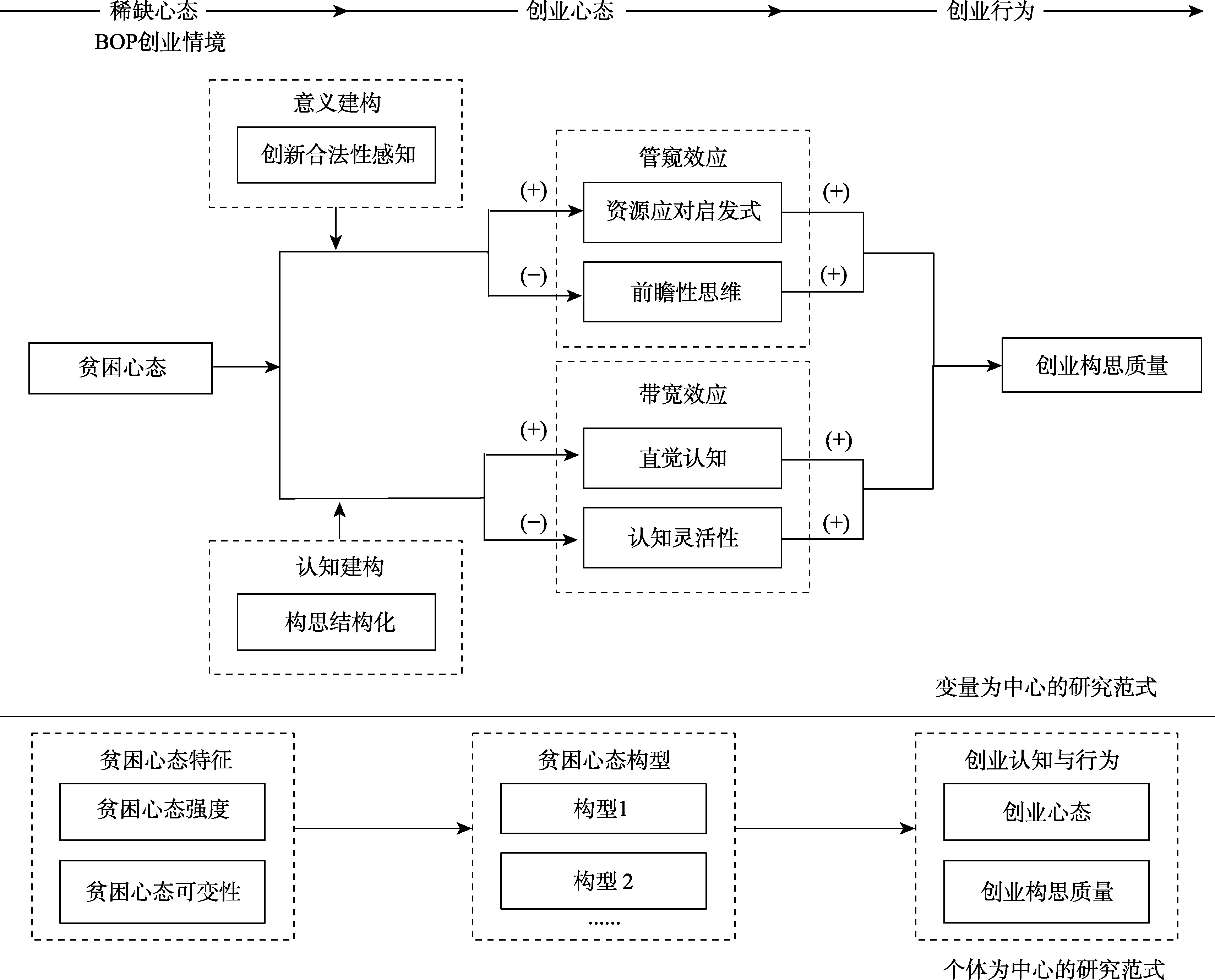
图1 总体理论模型
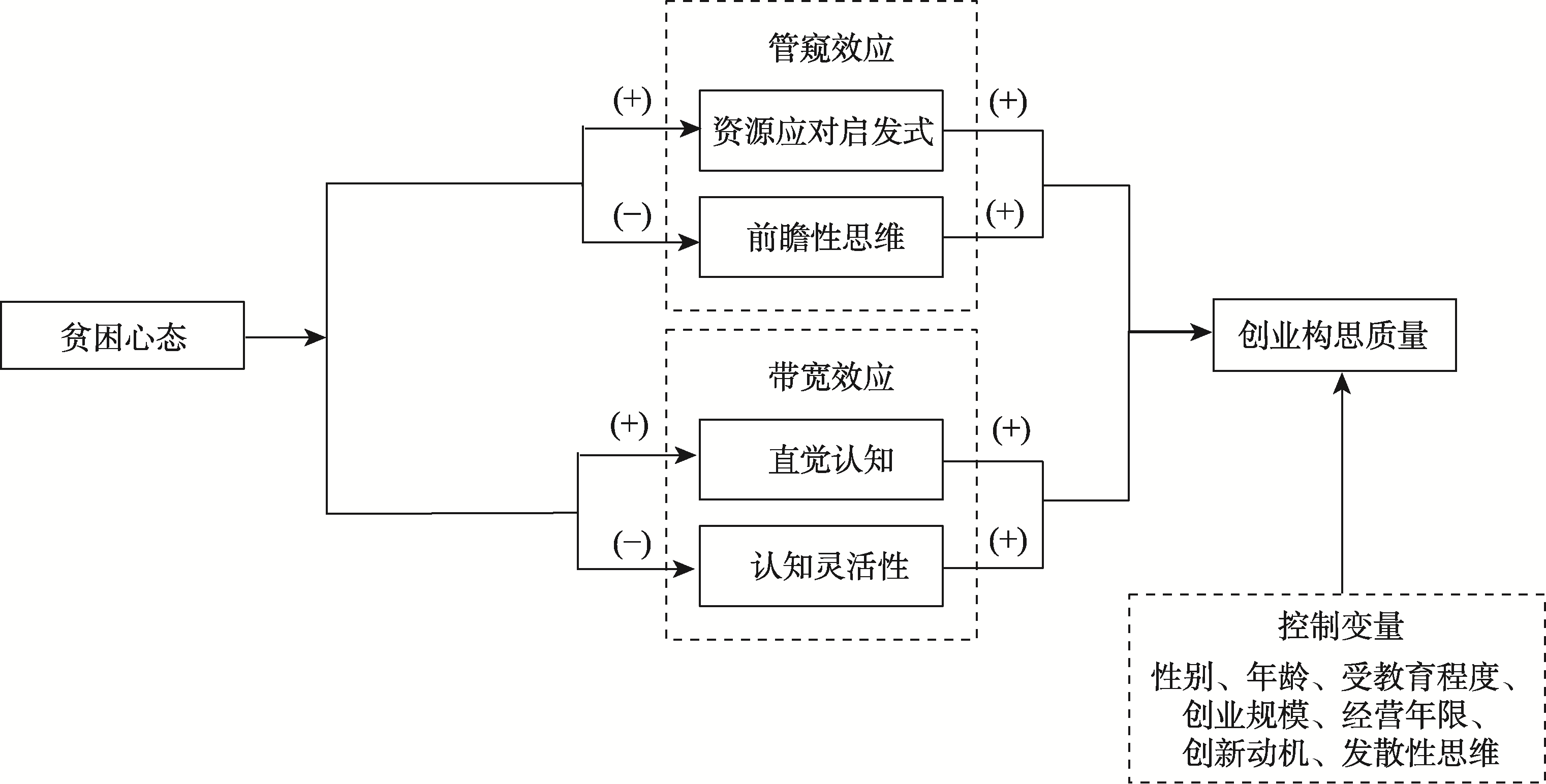
图2 研究模块一——理论模型
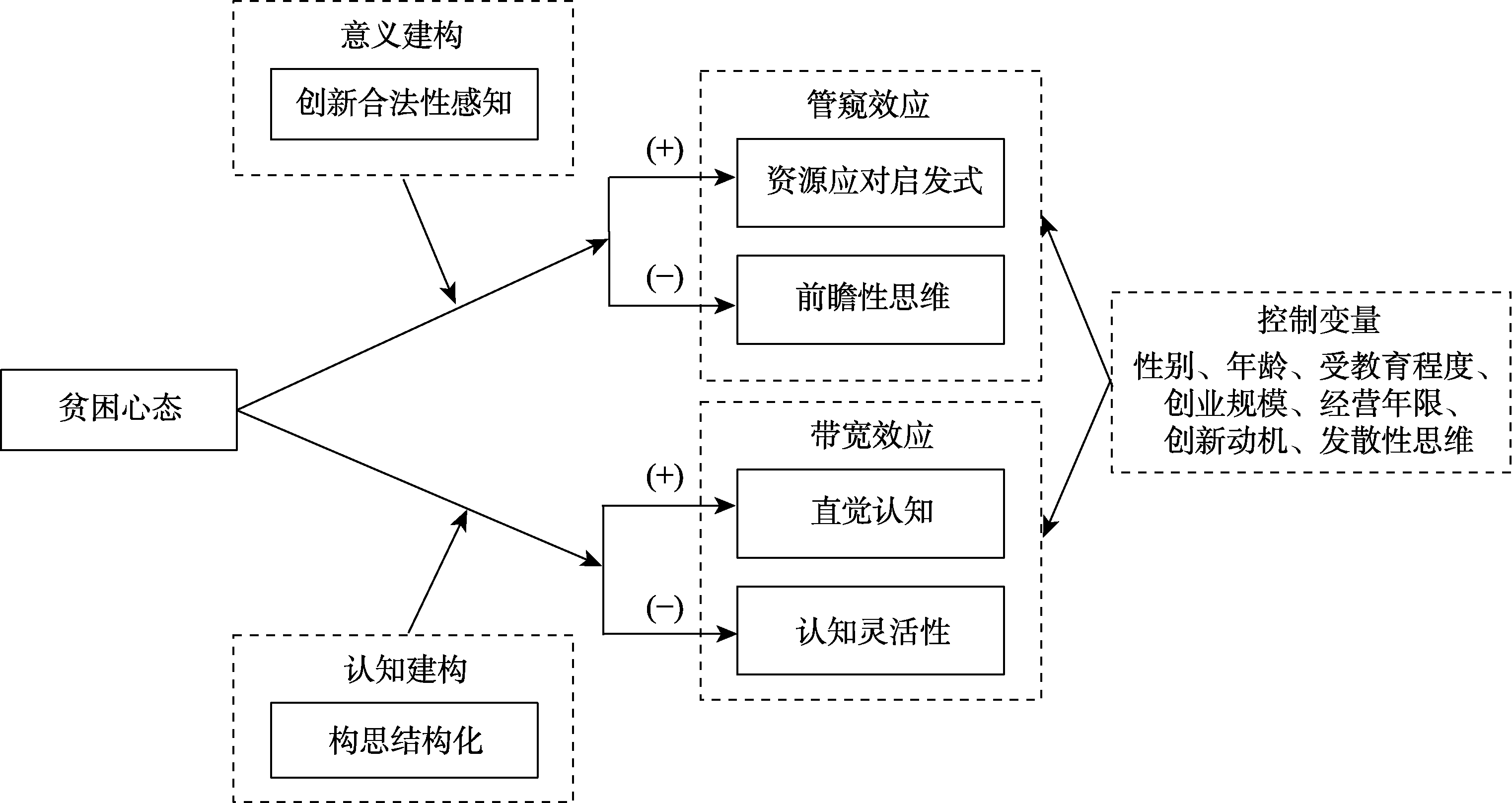
图3 研究模块二——理论模型
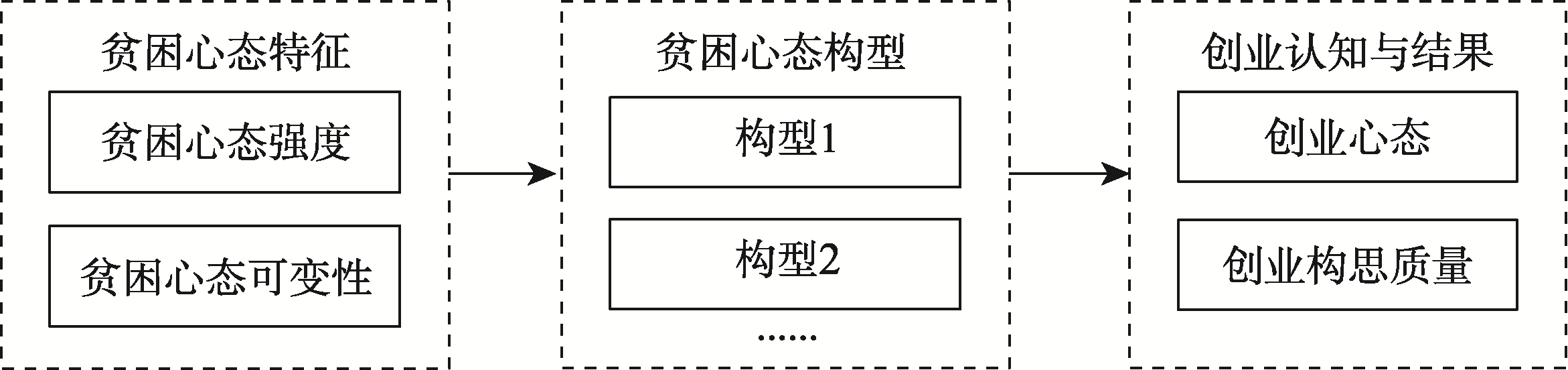
图4 研究模块三——理论模型
| 实验名称 | 自变量 | 中介变量 | 调节变量 | 因变量 | 实验形式 | 实验对象 |
|---|---|---|---|---|---|---|
| 实验1 | 贫困心态 | 创业心态 | - | 创业构思质量 | 实验室实验 | 成人群体 |
| 实验2 | 贫困心态 | - | 创新合法性感知 | RICH; 前瞻性思维 | 现场实验 | BOP群体 |
| 实验3 | 贫困心态 | - | 构思结构化 | 直觉认知; 认知灵活性 | 现场实验 | BOP群体 |
表3 实验基本设计
| 实验名称 | 自变量 | 中介变量 | 调节变量 | 因变量 | 实验形式 | 实验对象 |
|---|---|---|---|---|---|---|
| 实验1 | 贫困心态 | 创业心态 | - | 创业构思质量 | 实验室实验 | 成人群体 |
| 实验2 | 贫困心态 | - | 创新合法性感知 | RICH; 前瞻性思维 | 现场实验 | BOP群体 |
| 实验3 | 贫困心态 | - | 构思结构化 | 直觉认知; 认知灵活性 | 现场实验 | BOP群体 |
| 操纵变量 | 对照组 | 实验组 |
|---|---|---|
| 贫困心态 | 情景式模拟充裕条件, 个体在资源不受限的状态下做出最优抉择 | 情景式模拟贫困条件, 个体在经济严重受限的状态下做出次优抉择 |
| 创新合法性感知 | 以知名成功企业家创业经验的数个案例作为培训材料 | 以贫困家庭通过尝试产品和商业模式创新获得成功的数个案例作为培训材料 |
| 构思结构化 | 创业基础知识培训 | 创业构思框架培训 |
表4 主要变量操纵计划
| 操纵变量 | 对照组 | 实验组 |
|---|---|---|
| 贫困心态 | 情景式模拟充裕条件, 个体在资源不受限的状态下做出最优抉择 | 情景式模拟贫困条件, 个体在经济严重受限的状态下做出次优抉择 |
| 创新合法性感知 | 以知名成功企业家创业经验的数个案例作为培训材料 | 以贫困家庭通过尝试产品和商业模式创新获得成功的数个案例作为培训材料 |
| 构思结构化 | 创业基础知识培训 | 创业构思框架培训 |
| 结果变量 | 测量方式 |
|---|---|
| 创业构思质量 | 请被试者阅读一项关于特定技术的描述, 并在特定时间内构思一个基于这项技术的潜在商业想法(包括但不限于新产品、新服务及新的商业模式), 并对该想法进行简短描述。由一位创业研究学者与一位业界专家独立对该想法进行基于可行性和新颖性的双盲评价, 以评估所提出创业想法的可行性及新颖性的综合表现。 |
表5 结果变量测量
| 结果变量 | 测量方式 |
|---|---|
| 创业构思质量 | 请被试者阅读一项关于特定技术的描述, 并在特定时间内构思一个基于这项技术的潜在商业想法(包括但不限于新产品、新服务及新的商业模式), 并对该想法进行简短描述。由一位创业研究学者与一位业界专家独立对该想法进行基于可行性和新颖性的双盲评价, 以评估所提出创业想法的可行性及新颖性的综合表现。 |
| [1] |
傅安国, 张再生, 郑剑虹, 岳童, 林肇宏, 吴娜, 黄希庭. (2020). 脱贫内生动力机制的质性探究. 心理学报, 52(1), 66-81+86-91.
doi: 10.3724/SP.J.1041.2020.00066 |
| [2] | 胡小勇, 徐步霄, 杨沈龙, 郭永玉. (2019). 心理贫困: 概念、表现及其干预. 心理科学, 42(5), 1224-1229. |
| [3] | 斯晓夫, 严雨姗, 傅颖. (2020). 创业减贫前沿理论研究与未来方向. 管理世界, 36(11), 194-207. |
| [4] | 万倩雯, 卫田, 刘杰. (2019). 弥合社会资本鸿沟: 构建企业社会创业家与金字塔底层个体间的合作关系——基于LZ农村电商项目的单案例研究. 管理世界, 35(5), 179-196. |
| [5] | 汪三贵. (2018). 中国40年大规模减贫: 推动力量与制度基础. 中国人民大学学报, 32(6), 1-11. |
| [6] |
徐富明, 张慧, 马红宇, 邓颖, 史燕伟, 李欧. (2017). 贫困问题: 基于心理学的视角. 心理科学进展, 25(8), 1431-1440.
doi: 10.3724/SP.J.1042.2017.01431 |
| [7] | 张彦驰, 童丹丹, 陈晨, 郭永玉. (2023). 贫困心态对跨期决策的影响: 分析思维与损益框架的作用. 心理科学, 46(2), 419-426. |
| [8] | Adomako S. (2021). Resource-induced coping heuristics and entrepreneurial orientation in dynamic environments. Journal of Business Research, 122, 477-487. |
| [9] | Allinson C. W., Chell E., & Hayes J. (2000). Intuition and entrepreneurial behaviour. European Journal of Work and Organizational Psychology, 9(1), 31-43. |
| [10] | Alvarez S. A., Barney J. B., & Anderson P. (2013). Forming and exploiting opportunities: The implications of discovery and creation processes for entrepreneurial and organizational research. Organization Science, 24(1), 301-317. |
| [11] | Amabile T. M. (1997). Motivating creativity in organizations: On doing what you love and loving what you do. California Management Review, 40(1), 39-58. |
| [12] | Asante E. A., Khurshid H., Affum-Osei E., & Antwi C. O. (2023). Examining the impact of trait grit on aspiring entrepreneur's new venture ideation: Evidence from Ghana. Journal of Vocational Behavior, 144, Article 103889. https://doi.org/10.1016/j.jvb.2023.103889 |
| [13] |
Baddeley A. (2003). Working memory: Looking back and looking forward. Nature Reviews Neuroscience, 4(10), 829-839.
doi: 10.1038/nrn1201 pmid: 14523382 |
| [14] | Baker T., & Nelson R. E. (2005). Creating something from nothing: Resource construction through entrepreneurial bricolage. Administrative Science Quarterly, 50(3), 329-366. |
| [15] | Baldacchino L., Ucbasaran D., & Cabantous L. (2023). Linking experience to intuition and cognitive versatility in new venture ideation: A dual‐process perspective. Journal of Management Studies, 60(5), 1105-1146. |
| [16] | Berzenski S. R., LaSalle-Castro R., Marcelo A. K., & Yates T. M. (2022). The development of divergent thinking despite poverty: Moderating factors. Cognitive Development, 64, Article 101244. https://doi.org/10.1016/j.cogdev.2022.101244 |
| [17] | Blocker C., Zhang J. Z., Hill R. P., Roux C., Corus C., Hutton M.,... Minton E. (2023). Rethinking scarcity and poverty: Building bridges for shared insight and impact. Journal of Consumer Psychology, 33(3), 489-509. |
| [18] | Brown A. R., & Wood M. (2023). Iron cages or open horizons? Entrepreneurial ecosystems and the shaping of new venture ideation. In Academy of management proceedings (Vol. 2023,No.1, p. 12990). Briarcliff Manor, NY 10510: Academy of Management. |
| [19] |
Cañas J., Quesada J., Antolí A., & Fajardo I. (2003). Cognitive flexibility and adaptability to environmental changes in dynamic complex problem-solving tasks. Ergonomics, 46(5), 482-501.
doi: 10.1080/0014013031000061640 pmid: 12745698 |
| [20] | Cannon C., Goldsmith K., & Roux C. (2019). A self- regulatory model of resource scarcity. Journal of Consumer Psychology, 29(1), 104-127. |
| [21] | Chater N., & Loewenstein G. (2016). The under-appreciated drive for sense-making. Journal of Economic Behavior & Organization, 126, 137-154. |
| [22] | Cornelissen J. P., & Clarke J. S. (2010). Imagining and rationalizing opportunities: Inductive reasoning and the creation and justification of new ventures. Academy of Management Review, 35(4), 539-557. |
| [23] | Crossan M. M., Lane H. W., & White R. E. (1999). An organizational learning framework: From intuition to institution. Academy of Management Review, 24(3), 522-537. |
| [24] |
Dajani D. R., & Uddin L. Q. (2015). Demystifying cognitive flexibility: Implications for clinical and developmental neuroscience. Trends in Neurosciences, 38(9), 571-578.
doi: 10.1016/j.tins.2015.07.003 pmid: 26343956 |
| [25] | Davidsson P. (2015). Entrepreneurial opportunities and the entrepreneurship nexus: A re-conceptualization. Journal of Business Venturing, 30(5), 674-695. |
| [26] | Dayan M., Zacca R., & Di Benedetto A. (2013). An exploratory study of entrepreneurial creativity: Its antecedents and mediators in the context of UAE firms. Creativity and Innovation Management, 22(3), 223-240. |
| [27] | De Bruijn E. J., & Antonides G. (2020). Determinants of financial worry and rumination. Journal of Economic Psychology, 76, Article 102233. https://doi.org/10.1016/j.joep.2019.102233 |
| [28] | De Bruijn E. J., & Antonides G. (2022). Poverty and economic decision making: A review of scarcity theory. Theory and Decision, 92(1), 5-37. |
| [29] | Derry S. J. (1996). Cognitive schema theory in the constructivist debate. Educational Psychologist, 31(3-4), 163-174. |
| [30] | Desa G. (2012). Resource mobilization in international social entrepreneurship: Bricolage as a mechanism of institutional transformation. Entrepreneurship Theory and Practice, 36(4), 727-751. |
| [31] | Dimov D. (2007). From opportunity insight to opportunity intention: The importance of person-situation learning match. Entrepreneurship Theory and Practice, 31(4), 561-583. |
| [32] | Duffy R. D., Kim H. J., Boren S., Pendleton L., & Perez G. (2023). Lifetime experiences of economic constraints and marginalization among incoming college students: A latent profile analysis. Journal of Diversity in Higher Education, 16(3), 384-396. |
| [33] | Duymedjian R., & Rüling C. C. (2010). Towards a foundation of bricolage in organization and management theory. Organization Studies, 31(2), 133-151. |
| [34] | Entman R. M. (1993). Framing: Toward clarification of a fractured paradigm. Journal of Communication, 43(4), 51-58. |
| [35] | Ferguson S. L., Moore E. W. G., & Hull D. M. (2020). Finding latent groups in observed data: A primer on latent profile analysis in Mplus for applied researchers. International Journal of Behavioral Development, 44(5), 458-468. |
| [36] |
Frederiks A. J., Englis B. G., Ehrenhard M. L., & Groen A. J. (2019). Entrepreneurial cognition and the quality of new venture ideas: An experimental approach to comparing future-oriented cognitive processes. Journal of Business Venturing, 34(2), 327-347.
doi: 10.1016/j.jbusvent.2018.05.007 |
| [37] | Gemmell R. M. (2010). Entrepreneurial ideation: An examination of how technology entrepreneurs generate novel and useful new business ideas [Unpublished doctoral dissertation]. Case Western Reserve University, Cleveland. |
| [38] | Gennetian L. A., & Shafir E. (2015). The persistence of poverty in the context of financial instability: A behavioral perspective. Journal of Policy Analysis and Management, 34(4), 904-936. |
| [39] | Ghafourian F. S., Mohammadi Elyasi G., Ahmadpour Dariani M., & Yadollahi Farsi J. (2022). Who talks about entrepreneurial ideation facilitation? A bibliometric analysis. Journal of the International Council for Small Business, 3(2), 134-152. |
| [40] | Gielnik M. M., Barabas S., Frese M., Namatovu-Dawa R., Scholz F. A., Metzger J. R., & Walter T. (2014). A temporal analysis of how entrepreneurial goal intentions, positive fantasies, and action planning affect starting a new venture and when the effects wear off. Journal of Business Venturing, 29(6), 755-772. |
| [41] |
Gilbert D. T., & Wilson T. D. (2007). Prospection: Experiencing the future. Science, 317(5843), 1351-1354.
doi: 10.1126/science.1144161 pmid: 17823345 |
| [42] | Gish J. J., Wagner D. T., Grégoire D. A., & Barnes C. M. (2019). Sleep and entrepreneurs' abilities to imagine and form initial beliefs about new venture ideas. Journal of Business Venturing, 34(6), Article 105943. https://doi.org/10.1016/j.jbusvent.2019.06.004 |
| [43] | Gruber M., MacMillan I. C., & Thompson J. D. (2013). Escaping the prior knowledge corridor: What shapes the number and variety of market opportunities identified before market entry of technology start-ups? Organization Science, 24(1), 280-300. |
| [44] | Gundry L. K., Ofstein L. F., & Monllor J. (2016). Entrepreneurial team creativity: Driving innovation from ideation to implementation. Journal of Enterprising Culture, 24(1), 55-77. |
| [45] | Haushofer J., & Fehr E. (2014). On the psychology of poverty. Science, 344(6186), 862-867. |
| [46] | Hill S. A., & Birkinshaw J. M. (2010). Idea sets: Conceptualizing and measuring a new unit of analysis in entrepreneurship research. Organizational Research Methods, 13(1), 85-113. |
| [47] | Huang L., Li X., Xu F., & Li F. (2023). Consequences of scarcity: The impact of perceived scarcity on executive functioning and its neural basis. Frontiers in Neuroscience, 17, Article 1158544. https://doi.org/10.3389/fnins.2023.1158544 |
| [48] | Kier A. S., & McMullen J. S. (2018). Entrepreneurial imaginativeness in new venture ideation. Academy of Management Journal, 61(6), 2265-2295. |
| [49] | Kier A. S., & McMullen J. S. (2020). Entrepreneurial imaginativeness and new venture ideation in newly forming teams. Journal of Business Venturing, 35(6), Article 106048. https://doi.org/10.1016/j.jbusvent.2020.106048 |
| [50] | Kornish L. J., & Ulrich K. T. (2014). The importance of the raw idea in innovation: Testing the sow's ear hypothesis. Journal of Marketing Research, 51(1), 14-26. |
| [51] |
Kraus M. W., Piff P. K., Mendoza-Denton R., Rheinschmidt M. L., & Keltner D. (2012). Social class, solipsism, and contextualism: How the rich are different from the poor. Psychological Review, 119(3), 546-572.
doi: 10.1037/a0028756 pmid: 22775498 |
| [52] | Lanivich S. E. (2015). The RICH entrepreneur: Using conservation of resources theory in contexts of uncertainty. Entrepreneurship Theory and Practice, 39(4), 863-894. |
| [53] | Loasby B. J. (2007). A cognitive perspective on entrepreneurship and the firm. Journal of Management Studies, 44(7), 1078-1106. |
| [54] |
Mani A., Mullainathan S., Shafir E., & Zhao J. (2013). Poverty impedes cognitive function. Science, 341(6149), 976-980.
doi: 10.1126/science.1238041 pmid: 23990553 |
| [55] | Martin L., & Wilson N. (2016). Opportunity, discovery and creativity: A critical realist perspective. International Small Business Journal, 34(3), 261-275. |
| [56] | Martin M. M., & Rubin R. B. (1995). A new measure of cognitive flexibility. Psychological Reports, 76(2), 623-626. |
| [57] | McMullen J. S., & Kier A. S. (2017). You don’t have to be an entrepreneur to be entrepreneurial: The unique role of imaginativeness in new venture ideation. Business Horizons, 60(4), 455-462. |
| [58] | McMullen J. S., & Shepherd D. A. (2006). Entrepreneurial action and the role of uncertainty in the theory of the entrepreneur. Academy of Management Review, 31(1), 132-152. |
| [59] | Melati I. S., Arief S., & Baswara S. Y. (2018). Does financial background affect entrepreneur students' creativity: An investigation of how rich and poor students start their businesses. Journal of Entrepreneurship Education, 21(1), 1-11. |
| [60] | Msuya I., Boudou M., Levira F., Moshi I., O’Dwyer J., & Killeen G. (2024). Evaluation of a participatory approach to stratifying neighbourhoods across the Tanzanian city of Dar es Salaam in terms of income by comparing with latent profile analysis of deprivation based on national census data. medRxiv, 2024-04. |
| [61] | Morris M. H., Kuratko D. F., Audretsch D. B., & Santos S. (2020). Overcoming the liability of poorness: Disadvantage, fragility, and the poverty entrepreneur. Small Business Economics, 58(1), 41-55. |
| [62] |
Morris M. H., Soleimanof S., & Tucker R. (2023). Drivers of fragility in the ventures of poverty entrepreneurs. Small Business Economics, 61(1), 305-323.
doi: 10.1007/s11187-022-00687-6 pmid: 38625217 |
| [63] | Morris M. H., & Tucker R. (2021). The entrepreneurial mindset and poverty. Journal of Small Business Management, 61(1), 102-131. |
| [64] | Nakara W. A., Messeghem K., & Ramaroson A. (2021). Innovation and entrepreneurship in a context of poverty: A multilevel approach. Small Business Economics, 56(4), 1601-1617. |
| [65] | Nichols L., & Hunt B. (2011). The significance of spirituality for individuals with chronic illness: Implications for mental health counseling. Journal of Mental Health Counseling, 33(1), 51-66. |
| [66] | Nicolai M., & Thompson N. A. (2023). ‘How might we?’: Studying new venture ideation in and through practices. Scandinavian Journal of Management, 39(2), Article 101275. https://doi.org/10.1016/j.scaman.2023.101275 |
| [67] | Osborne D., & Weiner B. (2015). A latent profile analysis of attributions for poverty: Identifying response patterns underlying people’s willingness to help the poor. Personality and Individual Differences, 85, 149-154. |
| [68] | Perry-Smith J. E., & Mannucci P. V. (2017). From creativity to innovation: The social network drivers of the four phases of the idea journey. Academy of Management Review, 42(1), 53-79. |
| [69] | Pidduck R. J., Clark D. R., & Zhang Y. (2023, July). Leveraging paradoxes for new venture ideation: A cultural tightness-looseness theory. Paper presented at the AOM Annual Meeting Proceedings, Boston, MA. |
| [70] | Poblete C., Mandakovic V., & Apablaza M. (2023). “As if it were home”: An exploratory study of the role of homesickness among migrant entrepreneurs. Entrepreneurship & Regional Development, 35(9-10), 905-937. |
| [71] | Rahman Z. (2023). How do constraints affect early-stage entrepreneurial activity? A regulatory focus perspective[Unpublished doctoral dissertation]. University of Alberta, Edmonton. |
| [72] | Rerup C. (2005). Learning from past experience: Footnotes on mindfulness and habitual entrepreneurship. Scandinavian Journal of Management, 21(4), 451-472. |
| [73] | Reypens L., Bacq S., & Milanov H. (2021). Beyond bricolage: Early-stage technology venture resource mobilization in resource-scarce contexts. Journal of Business Venturing, 36(4), Article 106110. https://doi.org/10.1016/j.jbusvent.2021.106110 |
| [74] |
Roese N. J., & Olson J. M. (2007). Better, stronger, faster: Self-serving judgment, affect regulation, and the optimal vigilance hypothesis. Perspectives on Psychological Science, 2(2), 124-141.
doi: 10.1111/j.1745-6916.2007.00033.x pmid: 18552989 |
| [75] | Roux C., Goldsmith K., & Bonezzi A. (2015). On the psychology of scarcity: When reminders of resource scarcity promote selfish (and generous) behavior. Journal of Consumer Research, 42(1), 615-631. |
| [76] | Sandberg J., & Tsoukas H. (2015). Making sense of the sensemaking perspective: Its constituents, limitations, and opportunities for further development. Journal of Organizational Behavior, 36(S1), S6-S32. |
| [77] | Sarpong D., Maclean M., Oruh E. S., & Botchie D. (2023). On the consequences of scarcity mindset: How ‘having too little’ means so much for ethnic venture failure. European Management Journal, 41(2), 251-262. |
| [78] |
Schilbach F., Schofield H., & Mullainathan S. (2016). The psychological lives of the poor. American Economic Review, 106(5), 435-440.
pmid: 29547249 |
| [79] | Schneider J. W. (1985). Social problems theory: The constructionist view. Annual Review of Sociology, 11(1), 209-229. |
| [80] |
Shah A. K., Mullainathan S., & Shafir E. (2012). Some consequences of having too little. Science, 338(6107), 682-685.
doi: 10.1126/science.1222426 pmid: 23118192 |
| [81] | Shah P., & Thapa N. (2023). Finding the sweet spot: Evaluating the role of structured idea-generation framework in generating high-quality new venture ideas. Journal of Business Venturing Insights, 20, Article e00417. https://doi.org/10.1016/j.jbvi.2023.e00417 |
| [82] | Shantz A. F. (2019). The opportunity not taken: Institutional and cognitive barriers to entrepreneurial innovation in contexts of resource scarcity[Unpublished doctoral dissertation]. York University, Toronto. |
| [83] | Shantz A. S., Zietsma C., Kistruck G. M., & Cruz L. B. (2024). Exploring the relative efficacy of ‘within-logic contrasting’ and ‘cross-logic analogizing’ framing tactics for adopting new entrepreneurial practices in contexts of poverty. Journal of Business Venturing, 39(1), Article 106341. https://doi.org/10.1016/j.jbusvent.2023.106341 |
| [84] | Spurk D., Hirschi A., Wang M., Valero D., & Kauffeld S. (2020). Latent profile analysis: A review and “how to” guide of its application within vocational behavior research. Journal of vocational behavior, 120, Article 103445. https://doi.org/10.1016/j.jvb.2020.103445 |
| [85] | Steffens P., Davidsson P., & Fitzsimmons J. (2009). Performance configurations over time: Implications for growth-and profit-oriented strategies. Entrepreneurship Theory and Practice, 33(1), 125-148. |
| [86] | Stephan U., Patterson M., Kelly C., & Mair J. (2016). Organizations driving positive social change: A review and an integrative framework of change processes. Journal of Management, 42(5), 1250-1281. |
| [87] | Stroe S., Sirén C., Parida V., & Wincent J. (2022). Framing ideas for new venture resources acquisition in crises: An fsQCA analysis. Journal of Business Venturing Insights, 17, Article e00307. https://doi.org/10.1016/j.jbvi.2022.e00307 |
| [88] | Su Y., Song J., Lu Y., Fan D., & Yang M. (2023). Economic poverty, common prosperity, and underdog entrepreneurship. Journal of Business Research, 165, Article 114061. https://doi.org/10.1016/j.jbusres.2023.114061 |
| [89] | Sutter C., Bruton G. D., & Chen J. (2019). Entrepreneurship as a solution to extreme poverty: A review and future research directions. Journal of Business Venturing, 34(1), 197-214. |
| [90] | Tein J. Y., Coxe S., & Cham H. (2013). Statistical power to detect the correct number of classes in latent profile analysis. Structural Equation Modeling: A Multidisciplinary Journal, 20(4), 640-657. |
| [91] | Tost L. P. (2011). An integrative model of legitimacy judgments. Academy of Management Review, 36(4), 686-710. |
| [92] | Tripathi R. C., Pande N., Tripathi V. N., Shankar S., Pande A., & Bahadur R. (2022). Scarcity mindsets and generational differences in India: The role of cognitive and affective factors. Psychology and Developing Societies, 34(1), 45-78. |
| [93] | Van Burg E., Podoynitsyna K., Beck L., & Lommelen T. (2012). Directive deficiencies: How resource constraints direct opportunity identification in SMEs. Journal of Product Innovation Management, 29(6), 1000-1011. |
| [94] | Vogel P. (2017). From venture idea to venture opportunity. Entrepreneurship Theory and Practice, 41(6), 943-971. |
| [95] | Von Eye A., & Bergman L. R. (2003). Research strategies in developmental psychopathology: Dimensional identity and the person-oriented approach. Development and Psychopathology, 15(3), 553-580. |
| [96] | Wang M., & Hanges P. J. (2011). Latent class procedures: Applications to organizational research. Organizational Research Methods, 14(1), 24-31. |
| [97] | Wang Q., Liu S., Wang F., & Shi W. (2024). How money scarcity influences individuals’ cognitive control. SAGE Open, 14(2), 1-14. |
| [98] | Wang Q., Shi R., Zhang K., Han C., & Gao Y. (2023). The impact of entrepreneurs’ cognitive flexibility on the business performance of new ventures: An empirical study based on Chinese new ventures. Current Psychology, 42(28), 24668-24681. |
| [99] | Wardoyo C., Narmaditya B. S., Handayati P., Fauzan S., Prayitno P. H., Sahid S., & Wibowo A. (2023). Determinant factors of entrepreneurial ideation among university students: A systematic literature review. Heliyon, 9(6), Article e17227. https://doi.org/10.1016/j.heliyon.2023.e17227 |
| [100] | Warnick B. J., Kier A. S., LaFrance E. M., & Cuttler C. (2021). Head in the clouds? Cannabis users’ creativity in new venture ideation depends on their entrepreneurial passion and experience. Journal of Business Venturing, 36(2), Article 106088. https://doi.org/10.1016/j.jbusvent.2020.106088 |
| [101] | Wiklund J., Patzelt H., & Dimov D. (2016). Entrepreneurship and psychological disorders: How ADHD can be productively harnessed. Journal of Business Venturing Insights, 6, 14-20. |
| [102] | William B. (2023). The conception of New Venture Ideas by novice entrepreneurs: A question of nature or nurture? [Unpublished doctoral dissertation]. University of Essex, Colchester. |
| [103] | Yu X., Zhao X., & Hou Y. (2023). Cognitive flexibility and entrepreneurial creativity: The chain mediating effect of entrepreneurial alertness and entrepreneurial self-efficacy. Frontiers in Psychology, 14, Article 1292797. https://doi.org/10.3389/fpsyg.2023.1292797 |
| [104] | Zhang R., Ma Q., & Guan D. (2023). The impact of financial scarcity on green consumption: Sequential mediating effects of anxiety and self‐efficacy. Psychology & Marketing, 40(6), 1162-1178. |
| [105] | Zhao J., & Tomm B. (2018, February 26). Psychological responses to scarcity. Oxford Research Encyclopedia of Psychology. https://doi.org/10.1093/acrefore/9780190236557.013.41 |
| [106] | Zheng H., Luo J., & Yu R. (2014). From memory to prospection: What are the overlapping and the distinct components between remembering and imagining? Frontiers in Psychology, 5, Article 856. https://doi.org/10.3389/fpsyg.2014.00856 |
| [1] | 刘楠, 邱钰婷, 董志强, 李爱梅. 抚育动机何以促进亲社会行为?基于进化适应性知-能量机制及助推[J]. 心理科学进展, 2025, 33(11): 1854-1869. |
| [2] | 岳童, 王洪, 田兴江, 吴婷, 傅安国, 周燕鹏. 感动的社会联结效应及其理论解释[J]. 心理科学进展, 2025, 33(11): 1983-1992. |
| [3] | 陈雅琳, 贡喆. 何以脱而不得?亲密伴侣暴力脱离的影响因素与发生机制[J]. 心理科学进展, 2025, 33(11): 1993-2008. |
| [4] | 陈兰双, 王祯, 管健. 心理时间多维视角对群际帮助行为的积极作用: 可行性、差异性和适配性[J]. 心理科学进展, 2025, 33(11): 2009-2026. |
| [5] | 邢采, 刘志飞, 曹福娴, 苗萌, 鲁宇涛, 丁晓彤, 付祝师. 医疗决策中的概率忽视: 内在机制及干预[J]. 心理科学进展, 2025, 33(10): 1731-1744. |
| [6] | 彭彦琴, 史瑞琪. 正念发展的伦理转向:基于智慧的超越性道德[J]. 心理科学进展, 2025, 33(6): 1057-1066. |
| [7] | 张婷雨, 林佳佳, 孙翠翠. 社会排斥与创造力关系的元分析[J]. 心理科学进展, 2025, 33(4): 632-646. |
| [8] | 岳童, 王洪, 傅安国, 徐浩, 李文俏. 为何人际价值观冲突难以达成共识? 理论解释及调解策略[J]. 心理科学进展, 2024, 32(9): 1528-1538. |
| [9] | 何佳妮, 杨洁, 纪婷婷, 丁毅. 看不见的底层: 对低社会等级者的人际忽视及其理论解释[J]. 心理科学进展, 2024, 32(9): 1539-1550. |
| [10] | 包寒吴霜, 王梓西, 程曦, 苏展, 杨盈, 张光耀, 王博, 蔡华俭. 基于词嵌入技术的心理学研究:方法及应用[J]. 心理科学进展, 2023, 31(6): 887-904. |
| [11] | 袁香儿, 赵睿雯, 朱冬青. 医患个体特征影响共享决策的心理路径:基于内隐原型视角[J]. 心理科学进展, 2023, 31(6): 1044-1054. |
| [12] | 包诗钺, 张靖, 冀月欣, 胡小勇. 社会本质主义对偏见的影响及其机制[J]. 心理科学进展, 2023, 31(6): 1068-1077. |
| [13] | 蔡华俭, 张明杨, 包寒吴霜, 朱慧珺, 杨紫嫣, 程曦, 黄梓航, 王梓西. 心理学视野下的社会变迁研究:研究设计与分析方法[J]. 心理科学进展, 2023, 31(2): 159-172. |
| [14] | 刘春晓, 刘立志, 王丹, 陈文锋. 集体仪式促进群体情绪感染的机制[J]. 心理科学进展, 2022, 30(8): 1870-1882. |
| [15] | 周国梅, 郑若颖, 林佳, 刘心阁. 面孔吸引力的整体表征及其动态性增强[J]. 心理科学进展, 2022, 30(7): 1429-1438. |
| 阅读次数 | ||||||
|
全文 |
|
|||||
|
摘要 |
|
|||||
