

ISSN 1671-3710
CN 11-4766/R
主办:中国科学院心理研究所
出版:科学出版社
CN 11-4766/R
主办:中国科学院心理研究所
出版:科学出版社
心理科学进展 ›› 2025, Vol. 33 ›› Issue (10): 1698-1711.doi: 10.3724/SP.J.1042.2025.1698 cstr: 32111.14.2025.1698
张光磊1, 朱时佳1, 王华英2( ), 何宇恒1
收稿日期:2024-09-03
出版日期:2025-10-15
发布日期:2025-08-18
通讯作者:
王华英, E-mail: wanghuaying@jxufe.edu.cn基金资助:
ZHANG Guanglei1, ZHU Shijia1, WANG Huaying2(), HE Yuheng1
Received:2024-09-03
Online:2025-10-15
Published:2025-08-18
摘要:
非体面工作是指可能会给从业者造成身体、社交或道德层面的污点, 令人反感或有损个人尊严的职业或工作任务。非体面工作从业者的工作意义感一直是该领域关注的重要话题。现有研究主要从个体或内群体视角出发, 探讨从业者工作组文化或职业意识形态及个人正常化策略对其工作意义建构的影响。然而, 关于非体面工作从业者在工作意义建构过程中所体现的共生性维度与他人维度的系统研究仍较匮乏, 社会支持在其中的边界作用亦未得到充分揭示。因此, 本研究拟从社会支持视角出发, 基于工作意义构建四象限理论框架——“能动-共生”和“自我-他人”维度, 系统探讨非体面工作从业者工作意义建构的个体与人际机制。预期成果将有助于从更全面的视角理解非体面工作从业者工作意义的构建机制, 并在实践中通过管理个体或人际因素, 启发员工工作意义的建构。
中图分类号:
张光磊, 朱时佳, 王华英, 何宇恒. (2025). 非体面工作对其从业者工作意义感的影响机制. 心理科学进展 , 33(10), 1698-1711.
ZHANG Guanglei, ZHU Shijia, WANG Huaying, HE Yuheng. (2025). The effects of dirty work on its practitioners’ work meaningfulness. Advances in Psychological Science, 33(10), 1698-1711.
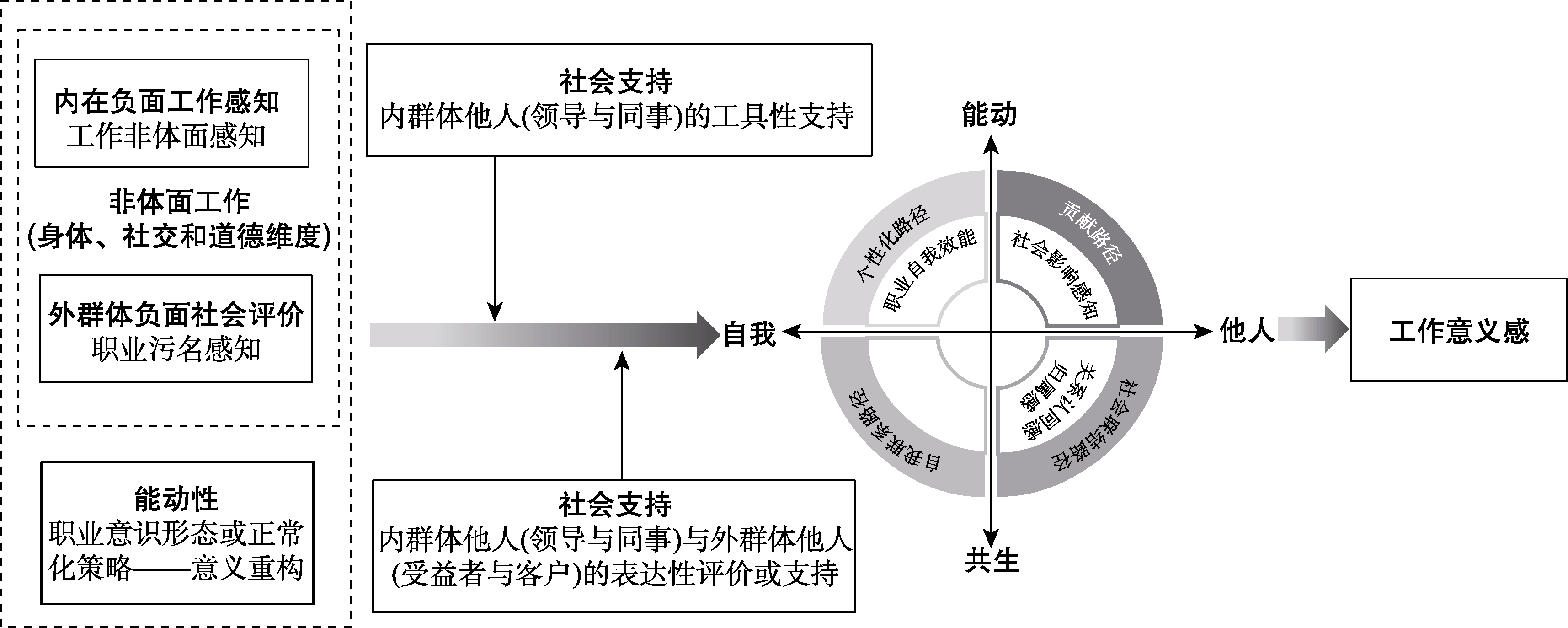
图1 研究理论框架
| [1] | 李铭泽, 董辰浩, 张光磊, 万玮. (2025). “规矩方圆”:同事“义警”行为对员工工作满意度的影响机制研究. 珞珈管理评论, (2), 1-15. |
| [2] | 田喜洲, 左晓燕, 彭小平. (2017). 工作意味着什么——工作意义概念、影响与研究框架. 心理研究, (2), 56-66. |
| [3] |
王红丽, 李振, 徐光毅. (2022). “矛盾” 视角下非体面工作从业者矛盾职业认同形成机制. 心理科学进展, 30(11), 2405-2413.
doi: 10.3724/SP.J.1042.2022.02405 |
| [4] | 王红丽, 李振, 徐光毅, 郭子生, 刘善仕. (2023). 夹缝求生: 矛盾视角下非体面工作从业者矛盾职业认同动态演化过程研究. 南开管理评论, 27(5), 78-88+128. |
| [5] | 王玉梅, 于晓彤, 文珊珊. (2022). 职业污名感和工作不洁感一致性对工作幸福感和工作结果的影响. 中国人力资源开发, 39(2), 6-17. |
| [6] | 张光磊, 范铭钰, 陈丝璐, 刘林熙. (2020). 中国情境下的肮脏工作:类型拓展与抑制模型建构. 中国人力资源开发, 37(12), 99-110. |
| [7] |
张光磊, 黄婷, 殷向洲. (2022). 非体面工作者职业污名的作用机制及其应对策略. 心理科学进展, 30(3), 703-714.
doi: 10.3724/SP.J.1042.2022.00703 |
| [8] | 张燕, 李贵卿. (2017). “肮脏”工作: 概念、测量以及对从业者的影响. 外国经济与管理, 39(10), 86-101. |
| [9] | 周晔, 黄旭, 欧阳侃. (2020). 主动抑或回避: 职业污名、自我评价和任务绩效. 外国经济与管理, 42(8), 50-67. |
| [10] |
Andersen S. M., & Chen S. (2002). The relational self: An interpersonal social-cognitive theory. Psychological Review, 109(4), 619-645.
doi: 10.1037/0033-295x.109.4.619 pmid: 12374322 |
| [11] | Ashforth B. E., & Kreiner G. E. (1999). “How can you do it?”: Dirty work and the challenge of constructing a positive identity. Academy of Management Review, 24(3), 413-434. |
| [12] | Ashforth, B. E., & Kreiner G. E. (2013). Profane or profound? Finding meaning in dirty work. In B. J. Dik, Z. S. Byrne, & M. F. Steger (Eds.), Purpose and meaning in the workplace (pp. 127-150). APA Books. |
| [13] | Ashforth B. E., & Kreiner G. E. (2014). Dirty work and dirtier work: Differences in countering physical, social, and moral stigma. Management and Organization Review, 10(1), 81-108. |
| [14] | Ashforth B. E., Kreiner G. E., Clark M. A., & Fugate M. (2007). Normalizing dirty work: Managerial tactics for countering occupational taint. Academy of Management Journal, 50(1), 149-174. |
| [15] | Ashforth B. E., & Mael F. (1989). Social identity theory and the organization. Academy of Management Review, 14(1), 20-39. |
| [16] | Bailey C., & Madden A. (2016). What makes work meaningful—or meaningless. MIT Sloan Management Review, 57(4), 92-93. |
| [17] | Bailey C., Madden A., & Lips-Wiersma M. (2025). Experiencing meaningful work through worthwhile contributions: A critical discourse analysis. Human Relations, 78(5), 550-578. |
| [18] | Bakan D. (1966). The duality of human existence: An essay on psychology and religion. Rand Mcnally. |
| [19] | Baran B. E., Rogelberg S. G., Carello Lopina E., Allen J. A., Spitzmüller C., & Bergman M. (2012). Shouldering a silent burden: The toll of dirty tasks. Human Relations, 65(5), 597-626. |
| [20] |
Baumeister R. F., & Leary M. R. (1995). The need to belong: Desire for interpersonal attachments as a fundamental human motivation. Psychological Bulletin, 117(3), 497-529.
pmid: 7777651 |
| [21] | Bentein K., Garcia A., Guerrero S., & Herrbach O. (2017). How does social isolation in a context of dirty work increase emotional exhaustion and inhibit work engagement? A process model. Personnel Review, 46(8), 1620-1634. |
| [22] |
Bergman M. E., & Chalkley K. M. (2007). “Ex” marks a spot: The stickiness of dirty work and other removed stigmas. Journal of Occupational Health Psychology, 12(3), 251-265.
pmid: 17638491 |
| [23] | Bosmans K., Mousaid S., De Cuyper N., Hardonk S., Louckx F., & Vanroelen C. (2016). Dirty work, dirty worker? Stigmatisation and coping strategies among domestic workers. Journal of Vocational Behavior, 92, 54-67. |
| [24] | Brewer M. B., & Gardner W. (1996). Who is this “We”? Levels of collective identity and self representations. Journal of Personality and Social Psychology, 71(1), 83-93. |
| [25] | Bunderson J. S., & Thompson J. A. (2009). The call of the wild: Zookeepers, callings, and the double-edged sword of deeply meaningful work. Administrative Science Quarterly, 54(1), 32-57. |
| [26] | Clarke M., & Ravenswood K. (2019). Constructing a career identity in the aged care sector: Overcoming the “taint” of dirty work. Personnel Review, 48(1), 76-97. |
| [27] | Collins P. H., & Bilge S. (2016). Intersectionality. Polity, Cambridge, UK. |
| [28] | Crenshaw, K. W. (1994). Mapping the margins:Intersectionality, identity politics, and violence against women of color. In M. A. Fineman & R. Mykitiuk (Eds.), The public nature of private violence (pp. 93-118). Routledge. |
| [29] | Deci, E. L., & Ryan R. M. (2012). Self-determination theory. In P. A. M. Van Lange, A. W. Kruglanski, & E. T. Higgins (Eds.), Handbook of theories of social psychology (pp. 416-436). Sage Publications Ltd. |
| [30] | Dick P. (2005). Dirty work designations: How police officers account for their use of coercive force. Human Relations, 58(11), 1363-1390. |
| [31] | Elsbach. D. (2003). Relating physical environment to self-categorizations: Identity threat and affirmation in a non-territorial office space. Administrative Science Quarterly, 48(4), 622-654. |
| [32] | Galazka A. M., & Wallace J. (2023). Challenging the ‘dirty worker’—‘clean client’ dichotomy: Conceptualizing worker‐client relations in dirty work. International Journal of Management Reviews, 25(4), 707-724. |
| [33] | Goffman E. (1963). Stigma: Notes on the management of spoiled identity. London: Prentice-Hall. |
| [34] |
Grant A. M. (2008). The significance of task significance: Job performance effects, relational mechanisms, and boundary conditions. Journal of Applied Psychology, 93(1), 108-124.
doi: 10.1037/0021-9010.93.1.108 pmid: 18211139 |
| [35] | Hackman J. R., & Oldham G. R. (1976). Motivation through the design of work: Test of a theory. Organizational Behavior and Human Performance, 16(2), 250-279. |
| [36] |
Hamilton P., Redman T., & McMurray R. (2019). ‘Lower than a snake’s belly’: Discursive constructions of dignity and heroism in low-status garbage work. Journal of Business Ethics, 156, 889-901.
doi: 10.1007/s10551-017-3618-z |
| [37] | Hughes, E. C. (1951). Work and the self. In J. H. Rohret & M. Sherif (Eds.), Social psychology at the crossroads (pp. 313-323). Harper & Brothers. |
| [38] | Hughes E. C. (1958). Men and their work. Free Press. |
| [39] | Hughes J., Simpson R., Slutskaya N., Simpson A., & Hughes K. (2017). Beyond the symbolic: A relational approach to dirty work through a study of refuse collectors and street cleaners. Work,Employment and Society, 31(1), 106-122. |
| [40] | Kahn W. A. (1990). Psychological conditions of personal engagement and disengagement at work. Academy of Management Journal, 33(4), 692-724. |
| [41] | Kahn, W. A. (2007). Meaningful connections:Positive relationships and attachments at work.In J. E. Dutton & B. R. Ragins (Eds.), Exploring positive relationships at work: Building a theoretical and research foundation (pp. 189-206). Lawrence Erlbaum Associates. |
| [42] | Kamise Y. (2013). Occupational stigma and coping strategies of women engaged in the commercial sex industry: A study on the perception of “Kyaba-Cula Hostesses” in Japan. Sex Roles, 69(1), 42-57. |
| [43] | Kreiner G., Mihelcic C. A., & Mikolon S. (2022). Stigmatized work and stigmatized workers. Annual Review of Organizational Psychology and Organizational Behavior, 9(1), 95-120. |
| [44] | Kreiner G. E., Ashforth B. E., & Sluss D. M. (2006). Identity dynamics in occupational dirty work: Integrating social identity and system justification perspectives. Organization Science, 17(5), 619-636. |
| [45] | Kusluvan H., Akova O., & Kusluvan S. (2022). Occupational stigma and career commitment: Testing mediation and moderation effects of occupational self-esteem. International Journal of Hospitality Management, 102, 103149. |
| [46] | Laaser K., & Bolton S. (2022). Absolute autonomy, respectful recognition and derived dignity: Towards a typology of meaningful work. International Journal of Management Reviews, 24(3), 373-393. |
| [47] | Lai J. Y., Chan K. W., & Lam L. W. (2013). Defining who you are not: The roles of moral dirtiness and occupational and organizational disidentification in affecting casino employee turnover intention. Journal of Business Research, 66(9), 1659-1666. |
| [48] | Levin D. Z., & Cross R. (2004). The strength of weak ties you can trust: The mediating role of trust in effective knowledge transfer. Management Science, 50(11), 1477-1490. |
| [49] | Lips-Wiersma M., & Morris L. (2009). Discriminating between ‘meaningful work’ and the ‘management of meaning’. Journal of Business Ethics, 88, 491-511. |
| [50] | Lips-Wiersma M., & Wright S. (2012). Measuring the meaning of meaningful work: Development and validation of the comprehensive meaningful work scale (CMWS). Group & Organization Management, 37(5), 655-685. |
| [51] | Masten, A. S., Cutuli J. J., Herbers J. E., & Reed M.-G. J. (2009). Resilience in development.In S. J. Lopez & C. R. Snyder (Eds.), Oxford handbook of positive psychology (2nd ed., pp. 117-131). Oxford University Press. |
| [52] | Mastracci S. H. (2022). Dirty work and emotional labor in public service: Why government employers should adopt an ethic of care. Review of Public Personnel Administration, 42(3), 537-552. |
| [53] | Mavin S., & Grandy G. (2013). Doing gender well and differently in dirty work: The case of exotic dancing. Gender, Work & Organization, 20(3), 232-251. |
| [54] | Mendonca A., D’Cruz P., & Noronha E. (2024). Identity work at the intersection of dirty work, caste, and precarity: How Indian cleaners negotiate stigma. Organization, 31(1), 3-26. |
| [55] | Mikolon S., Alavi S., & Reynders A. (2021). The Catch-22 of countering a moral occupational stigma in employee- customer interactions. Academy of Management Journal, 64(6), 1714-1739. |
| [56] | Mitra R., & Buzzanell P. M. (2017). Communicative tensions of meaningful work: The case of sustainability practitioners. Human Relations, 70(5), 594-616. |
| [57] | Ni D., Song L. J., Zheng X., Zhu J., Zhang M., & Xu L. (2022). Extending a helping hand: How receiving gratitude makes a difference in employee performance during a crisis. Journal of Business Research, 149, 967-982. |
| [58] | Pratt, M. G., & Ashforth B. E. (2003). Fostering meaningfulness in working and at work. In K. S. Cameron, J. E. Dutton, & R. E. Quinn (Eds.), Positive organizational scholarship: Foundations of a new discipline (pp. 309-327). Berrett-Koehler. |
| [59] | Pratt, M. G., Pradies C., & Lepisto D. A. (2013). Doing well, doing good, and doing with: Organizational practices for effectively cultivating meaningful work. In B. Dik, Z. Byrne, & M. Steger (Eds.), Purpose and meaning in the workplace (pp. 173-196). APA Books. |
| [60] | Press E. (2021). Dirty work: Essential jobs and the hidden toll of inequality in America. Farrar, Straus and Giroux. |
| [61] | Rabelo V. C., & Mahalingam R. (2019). “They really don’t want to see us”: How cleaners experience invisible ‘dirty’ work. Journal of Vocational Behavior, 113, 103-114. |
| [62] | Rapp D. J., Hughey J. M., & Kreiner G. E. (2024). Dirty heroes? Healthcare workers’ experience of mixed social evaluations during the pandemic. Academy of Management Journal, 67(4), 1124-1157. |
| [63] | Rigotti T., Schyns B., & Mohr G. (2008). A short version of the occupational self-efficacy scale: Structural and construct validity across five countries. Journal of Career Assessment, 16(2), 238-255. |
| [64] | Robertson K. M., O’Reilly J., & Hannah D. R. (2020). Finding meaning in relationships: The impact of network ties and structure on the meaningfulness of work. Academy of Management Review, 45(3), 596-619. |
| [65] | Rosso B. D., Dekas K. H., & Wrzesniewski A. (2010). On the meaning of work: A theoretical integration and review. Research in Organizational Behavior, 30, 91-127. |
| [66] |
Salancik G. R., & Pfeffer J. (1978). A social information processing approach to job attitudes and task design. Administrative Science Quarterly, 23(2), 224-253.
pmid: 10307892 |
| [67] |
Schaubroeck J. M., Lam L. W., Lai J. Y., Lennard A. C., Peng A. C., & Chan K. W. (2018). Changing experiences of work dirtiness, occupational disidentification, and employee withdrawal. Journal of Applied Psychology, 103(10), 1086-1100.
doi: 10.1037/apl0000330 pmid: 29939037 |
| [68] | Shantz A., & Booth J. E. (2014). Service employees and self-verification: The roles of occupational stigma consciousness and core self-evaluations. Human Relations, 67(12), 1439-1465. |
| [69] | Shepherd D. A., Maitlis S., Parida V., Wincent J., & Lawrence T. B. (2022). Intersectionality in intractable dirty work: How Mumbai ragpickers make meaning of their work and lives. Academy of Management Journal, 65(5), 1680-1708. |
| [70] | Simpson, R., Slutskaya N., & Hughes J. (2019). Meanings and dirty work.In R. Yeoman, C. Bailey, A. Madden, & M. Thompson (Eds.), The Oxford handbook of meaningful work (pp. 223-236). Oxford University Press. |
| [71] | Sluss D. M., & Ashforth B. E. (2007). Relational identity and identification: Defining ourselves through work relationships. Academy of Management Review, 32(1), 9-32. |
| [72] | Slutskaya N., Simpson R., Hughes J., Simpson A., & Uygur S. (2016). Masculinity and class in the context of dirty work. Gender, Work & Organization, 23(2), 165-182. |
| [73] | Sommerfeldt E. J., & Kent M. L. (2020). Public relations as “dirty work”: Disconfirmation, cognitive dissonance, and emotional labor among public relations professors. Public Relations Review, 46(4), 101933. |
| [74] | Soni‐Sinha U., & Yates C. A. (2013). ‘Dirty work?’ Gender, race and the union in industrial cleaning. Gender, Work & Organization, 20(6), 737-751. |
| [75] | Soral P., Pati S. P., Singh S. K., & Cooke F. L. (2022). Coping with dirty work: A meta-synthesis from a resource perspective. Human Resource Management Review, 32(4), 100861. |
| [76] | Spreitzer G. M. (1995). Psychological empowerment in the workplace: Dimensions, measurement, and validation. Academy of Management Journal, 38(5), 1442-1465. |
| [77] | Stacey C. L. (2005). Finding dignity in dirty work: The constraints and rewards of low-wage home care labour. Sociology of Health & Illness, 27(6), 831-854. |
| [78] | Swann Jr W. B., Johnson R. E., & Bosson J. K. (2009). Identity negotiation at work. Research in Organizational Behavior, 29, 81-109. |
| [79] | Tajfel, H., & Turner J. C. (1986). The social identity theory of intergroup behavior. In S. Worchel & W. G. Austin (Eds.) Psychology of intergroup relations (2nd ed., pp. 7-24). Nelson-Hall Publishers. |
| [80] | Tracy S. J., & Scott C. (2006). Sexuality, masculinity, and taint management among firefighters and correctional officers: Getting down and dirty with “America’s heroes” and the “scum of law enforcement”. Management Communication Quarterly, 20(1), 6-38. |
| [81] | Weller S. L., Brown A. D., & Clarke C. A. (2023). Questing for meaningfulness through narrative identity work: The helpers, the heroes, and the hurt. Human Relations, 76(4), 551-576. |
| [82] | Wrzesniewski A. C., Dutton J. E., & Debebe G. (2003). Interpersonal sensemaking and the meaning of work. Research in Organizational Behavior, 25, 93-135. |
| [1] | 吴佳桧, 傅海伦, 张玉环. 感知社会支持与学生学业成就关系的元分析:学习投入的中介作用[J]. 心理科学进展, 2023, 31(4): 552-569. |
| [2] | 张光磊, 黄婷, 殷向洲. 非体面工作者职业污名的作用机制及其应对策略[J]. 心理科学进展, 2022, 30(3): 703-714. |
| [3] | 王红丽, 李振, 徐光毅. “矛盾”视角下非体面工作从业者矛盾职业认同形成机制[J]. 心理科学进展, 2022, 30(11): 2405-2413. |
| [4] | 姚唐, 邱琪, 穆琳, 郑秋莹, 肖为群. 社会支持视角下顾客在线互助心理和行为机制[J]. 心理科学进展, 2017, 25(6): 912-922. |
| [5] | 邢小莉;赵俊峰;赵国祥. 神经及内分泌系统对社会支持缓冲应激的调节机制[J]. 心理科学进展, 2016, 24(4): 517-524. |
| [6] | 赵丹;余林. 社会交往对老年人认知功能的影响[J]. 心理科学进展, 2016, 24(1): 46-54. |
| [7] | 宋佳萌;范会勇. 社会支持与主观幸福感关系的元分析[J]. 心理科学进展, 2013, 21(8): 1357-1370. |
| [8] | 李永娟;蒋丽;胥遥山;王璐璐. 工作压力与社会支持对安全绩效的影响[J]. 心理科学进展, 2011, 19(3): 318-327. |
| [9] | 李琦;刘爱萍;罗劲. 金钱镇痛理论述评[J]. 心理科学进展, 2010, 18(8): 1283-1289. |
| [10] | 史茜; 舒晓兵; 罗玉越. 工作需求控制支持压力模型及实证研究评析[J]. 心理科学进展, 2010, 18(4): 655-663. |
| [11] | 王志云;Dominik Schoebi;Meinrad Perrez. 中国和欧洲家庭的家务分工:文化的视角(英文) [J]. 心理科学进展, 2010, 18(10): 1668-1678. |
| [12] | 李海峰;陈天勇. 老年社会功能与主观幸福感[J]. 心理科学进展, 2009, 17(4): 759-765. |
| [13] | 张静秋;汤永隆;邓丽俐;刘玲爽;赵玉芳;胡丽. 5·12四川地震灾民社会支持的调查[J]. 心理科学进展, 2009, 17(3): 542-546. |
| [14] | 辛玖岭;吴胜涛;吴坎坎;王文忠;张建新. 四川灾区群众社会支持系统现状及其与主观幸福感的关系[J]. 心理科学进展, 2009, 17(3): 532-536. |
| [15] | 祝卓宏;吴胜涛;王文忠;史占彪;张建新. 打麻将、吸烟、饮酒行为对震后灾区民众心理健康的影响 [J]. 心理科学进展, 2009, 17(3): 551-555. |
| 阅读次数 | ||||||
|
全文 |
|
|||||
|
摘要 |
|
|||||
