

ISSN 1671-3710
CN 11-4766/R
主办:中国科学院心理研究所
出版:科学出版社
CN 11-4766/R
主办:中国科学院心理研究所
出版:科学出版社
心理科学进展 ›› 2025, Vol. 33 ›› Issue (10): 1663-1683.doi: 10.3724/SP.J.1042.2025.1663 cstr: 32111.14.2025.1663
徐敏亚1, 陈丽萍2, 刘贝妮3( )
)
收稿日期:2024-11-08
出版日期:2025-10-15
发布日期:2025-08-18
通讯作者:
刘贝妮, E-mail: liubeini@btbu.edu.cn作者简介:第一联系人:徐敏亚、陈丽萍共为第一作者。
基金资助:
XU Minya1, CHEN Liping2, LIU Beini3()
Received:2024-11-08
Online:2025-10-15
Published:2025-08-18
摘要:
人工智能的不断发展引发了知识型员工的心理与行为变化, 重塑了其对现代工作环境的感受和对组织未来发展的期待。目前关于人工智能对知识型员工的影响及作用机制研究仍呈现碎片化状态。本研究基于工具性和人本性视角, 探究人工智能对知识型员工“有所作为”和“自我实现”的赋能与激活路径, 主要包括两方面的内容: (1) 从工具性视角, 探究人工智能的信息作用及其对员工思维能力的“双刃剑”影响, 厘清人工智能时代下知识型员工“有所作为”的创造力过程; (2) 从人本性视角, 探究人工智能赋能员工心理需求变化及幸福感感知, 进而识别其对知识型员工“自我实现”的离留决策影响。研究预期将深化人工智能对知识型员工影响的理解, 拓展人机协同的理论研究并提供实践参考。
中图分类号:
徐敏亚, 陈丽萍, 刘贝妮. (2025). 人工智能对知识型员工的影响及作用机制——基于工具性和人本性视角. 心理科学进展 , 33(10), 1663-1683.
XU Minya, CHEN Liping, LIU Beini. (2025). The impacts and mechanisms of artificial intelligence on knowledge workers: An instrumental and humanistic perspective. Advances in Psychological Science, 33(10), 1663-1683.
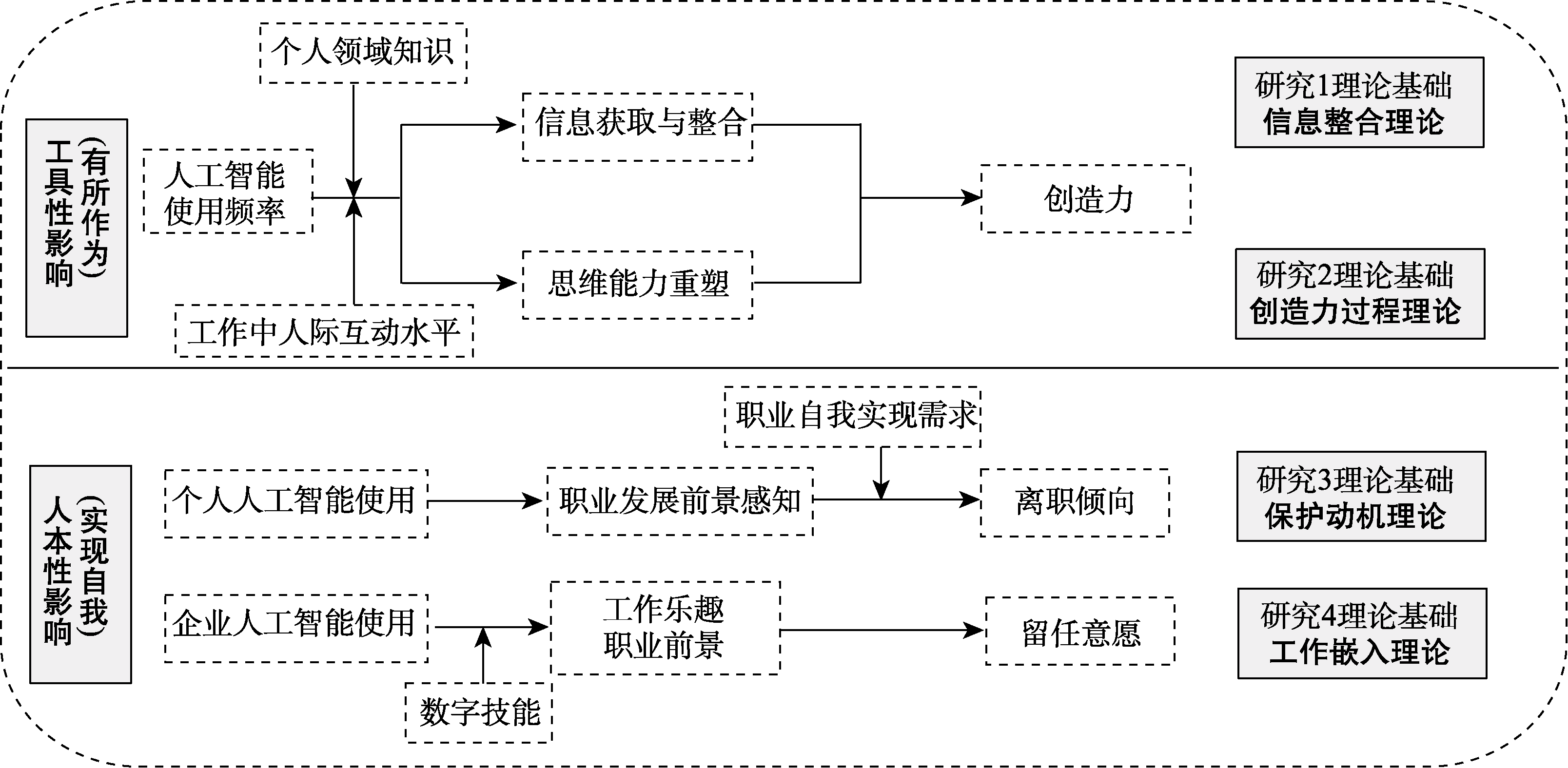
图1 本研究的总体理论框架

图2 研究1的理论框架图
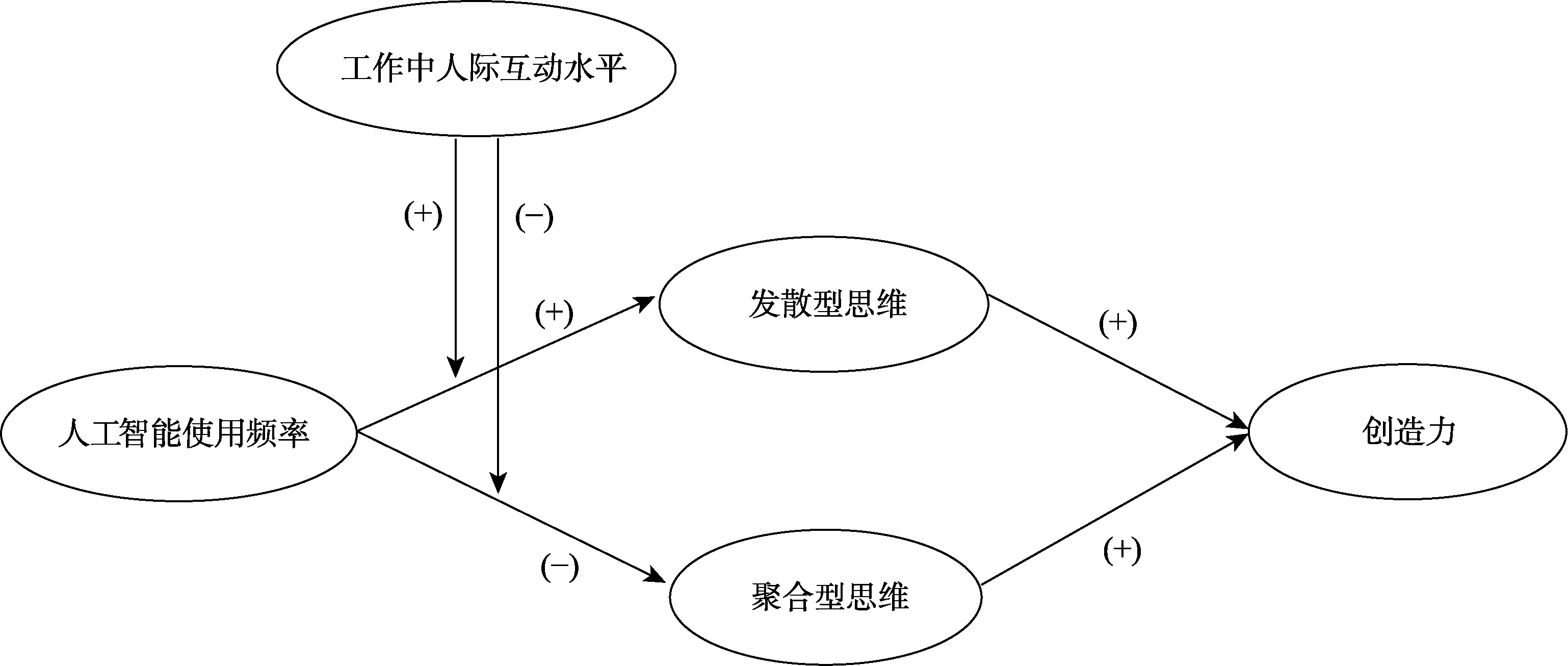
图3 研究2的理论框架图
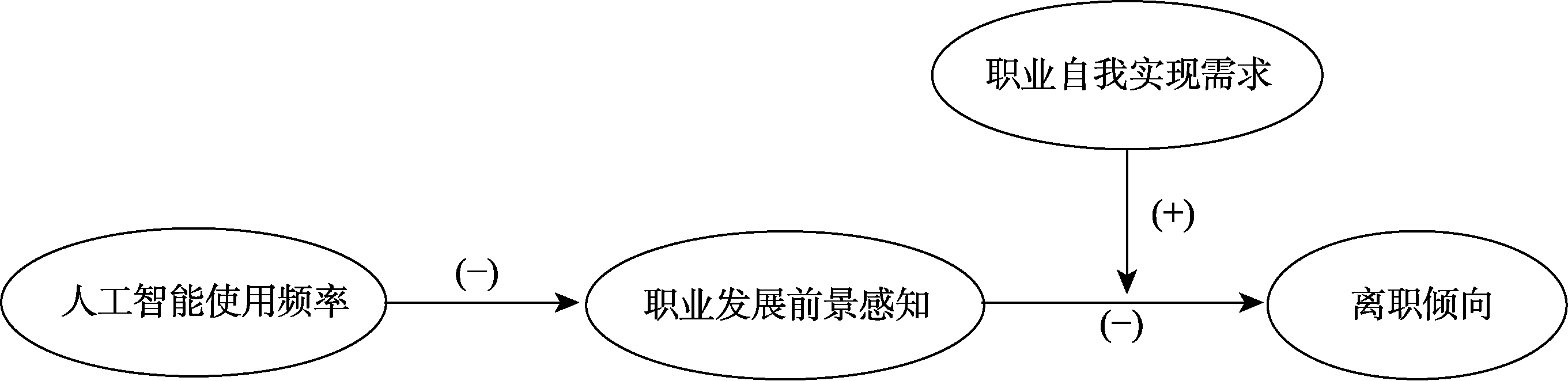
图4 研究3的理论框架图
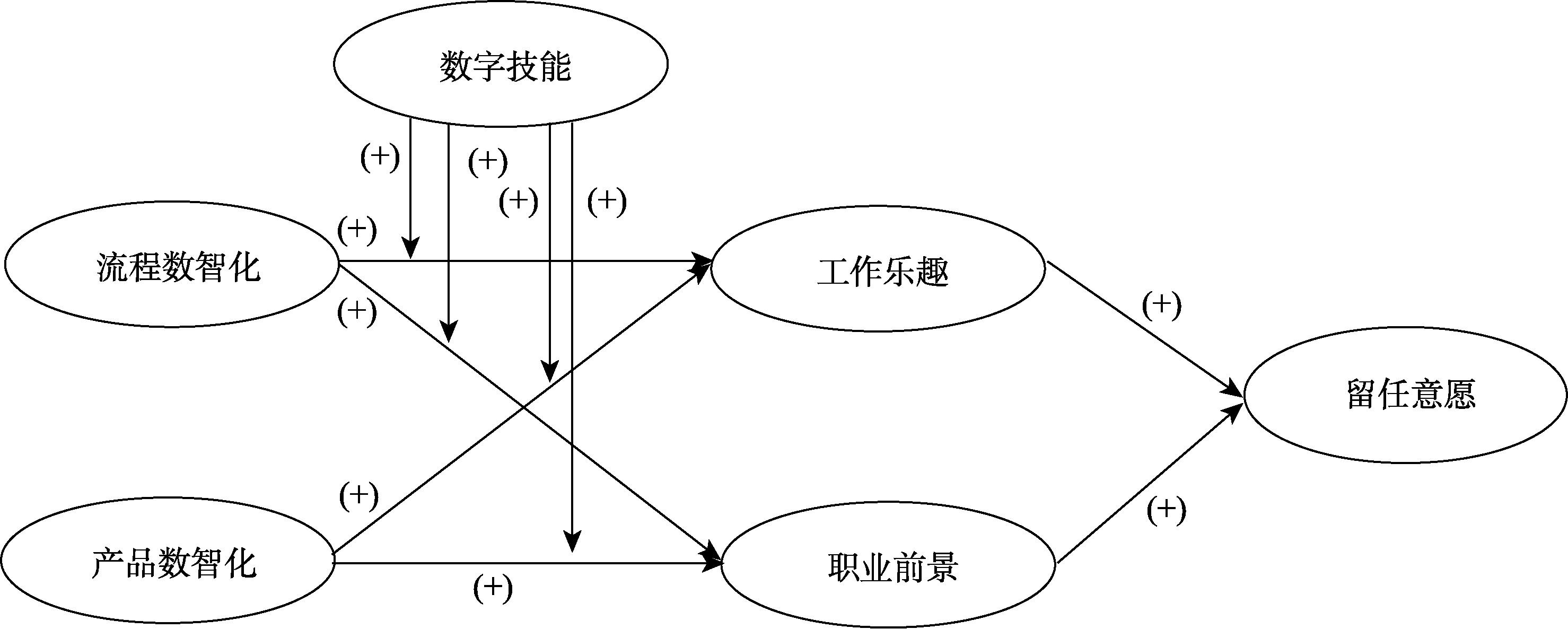
图5 研究4的理论框架图
| [1] | 杜宇骁, 胡斌, 龙立荣. (2023). 智能系统冲击下员工合作行为机制:从个体博弈到群体行为反转. 系统管理学报, 32(6), 1223-1243. |
| [2] | 傅金娣, 孙元, 胡峰. (2025). 企业数字化社交技术使用如何赋能员工即兴能力?——基于交互记忆的视角. 管理世界, 41(1), 168-186. |
| [3] | 高山行, 刘嘉慧. (2018). 人工智能对企业管理理论的冲击及应对. 科学学研究, 36(11), 2004-2010. |
| [4] | 刘柏, 鞠瑶蕾. (2025). “大水漫灌”到“精准滴灌”:企业流程数字化与商业信用结构调整. 南开管理评论, 28(5), 28-38. |
| [5] | 孙锐, 袁圆, 朱秋华, 陈丽君, 赵坤. (2024). 感知算法控制的双刃剑效应对零工工作者情绪耗竭的影响: 基于合法性判断视角. 系统管理学报, 33(5), 1373-1385+1396. |
| [6] | 谢小云, 左玉涵, 胡琼晶. (2021). 数字化时代的人力资源管理:基于人与技术交互的视角. 管理世界, 37(1), 200-216+213. |
| [7] | 徐鹏, 徐向艺. (2020). 人工智能时代企业管理变革的逻辑与分析框架. 管理世界, 36(1), 122-129+238. |
| [8] | Alavi M., & Tiwana A. (2002). Knowledge integration in virtual teams: The potential role of kms. Journal of the American Society for Information Science and Technology, 53(12), 1029-1037. |
| [9] | Allen R., & Choudhury P. (2022). Algorithm-augmented work and domain experience: The countervailing forces of ability and aversion. Organization Science, 33(1), 149-169. |
| [10] | Amabile T. M. (1988). A model of creativity and innovation in organizations. Research in Organizational Behavior, 10, 123-167. |
| [11] | Anderson N. H. (1971). Integration theory and attitude change. Psychological Review, 78(3), 171-206. |
| [12] | Anderson N. H. (1981). Foundations of information integration theory. Academic, New York, NY. |
| [13] | Armengaud E., Sams C., Von Falck G., List G., Kreiner C., & Riel A. (2017). Industry 4.0 as digitalization over the entire product lifecycle: Opportunities in the automotive domain. Systems, Software and Services Process Improvement:24th European Conference. |
| [14] | Arts S., & Fleming L. (2018). Paradise of novelty—or loss of human capital? Exploring new fields and inventive output. Organization Science, 29(6), 1074-1092. |
| [15] | Bajohr H. (2022). Algorithmic empathy: Toward a critique of aesthetic AI. Configurations, 30(2), 203-231. |
| [16] | Bankins S., & Formosa P. (2023). The ethical implications of artificial intelligence (AI) for meaningful work. Journal of Business Ethics, 185(4), 725-740. |
| [17] | Barak M. (2018). Are digital natives open to change? Examining flexible thinking and resistance to change. Computers & Education, 121, 115-123. |
| [18] | Benbya H., Pachidi S., & Jarvenpaa S. L. (2021). Special issue editorial: Artificial intelligence in organizations: Implications for information systems research. Journal of the Association for Information Systems, 22(2), 281-303. |
| [19] | Berg J. M. (2016). Balancing on the creative highwire. Administrative Science Quarterly, 61(3), 433-468. |
| [20] | Brem A., Giones F., & Werle M. (2023). The AI digital revolution in innovation: A conceptual framework of artificial intelligence technologies for the management of innovation. IEEE Transactions on Engineering Management, 70(2), 770-776. |
| [21] | Brynjolfsson E., & McAfee A. (2014). The second machine age: Work, progress, and prosperity in a time of brilliant technologies. W.W. Norton & Company. |
| [22] | Carnabuci G., & Diószegi B. (2015). Social networks, cognitive style, and innovative performance: A contingency perspective. Academy of Management Journal, 58(3), 881-905. |
| [23] | Chan A. (2023). GPT-3 and InstructGPT: Technological dystopianism, utopianism, and “Contextual” perspectives in AI ethics and industry. AI and Ethics, 3(1), 53-64. |
| [24] | Charles-Leija H., Castro C. G., Toledo M., & Ballesteros- Valdés R. (2023). Meaningful work, happiness at work, and turnover intentions. International Journal of Environmental Research and Public Health, 20(4), 3565. |
| [25] | Chen L., Hsieh J. J. P.-A., & Rai A. (2022). How does intelligent system knowledge empowerment yield payoffs? Uncovering the adaptation mechanisms and contingency role of work experience. Information Systems Research, 33(3), 1042-1071. |
| [26] | Chowdhury S., Dey P., Joel-Edgar S., Bhattacharya S., Rodriguez-Espindola O., Abadie A., & Truong L. (2023). Unlocking the value of artificial intelligence in human resource management through AI capability framework. Human Resource Management Review, 33(1), 100899. |
| [27] | Chua R. Y. J., Roth Y., & Lemoine J.-F. (2014). The impact of culture on creativity. Administrative Science Quarterly, 60(2), 189-227. |
| [28] | Chui M., Hall B., Mayhew H., & Singla A. (2022). The state of AI in 2022—and a half decade in review. https://www.mckinsey.com/capabilities/quantumblack/our-insights/the-state-of-ai-in-2022-and-a-half-decade-in-review#/ |
| [29] | Cohen W. M., & Levinthal D. A. (1990). Absorptive capacity: A new perspective on learning and innovation. Administrative Science Quarterly, 35(1), 128-152. |
| [30] | Commerford B. P., Dennis S. A., Joe J. R., & Ulla J. W. (2022). Man versus machine: Complex estimates and auditor reliance on artificial intelligence. Journal of Accounting Research, 60(1), 171-201. |
| [31] | Cui T., Wu Y., & Tong Y. (2018). Exploring ideation and implementation openness in open innovation projects: IT-enabled absorptive capacity perspective. Information & Management, 55(5), 576-587. |
| [32] | Davison R. M., Laumer S., Tarafdar M., & Wong L. H. M. (2023). Pickled eggs: Generative AI as research assistant or co-author? Information Systems Journal, 33(5), 989-994. |
| [33] | de Véricourt F., & Gurkan H. (2024). Is your machine better than you? You may never know. Management Science, Advance online publication. https://doi.org/10.1287/mnsc.2023.4791 |
| [34] | Deci E. L., Olafsen A. H., & Ryan R. M. (2017). Self- determination theory in work organizations: The state of a science. Annual Review of Organizational Psychology and Organizational Behavior, 4(1), 19-43. |
| [35] | Dennis A. R., Lakhiwal A., & Sachdeva A. (2023). AI agents as team members: Effects on satisfaction, conflict, trustworthiness, and willingness to work with. Journal of Management Information Systems, 40(2), 307-337. |
| [36] | Dobrev S. D., & Kim T.-Y. (2019). Bringing the firms (and forms) back in: Organizational form identity and individual turnover. Academy of Management Journal, 62(4), 1028-1051. |
| [37] | Doshi A. R., & Hauser O. P. (2024). Generative AI enhances individual creativity but reduces the collective diversity of novel content. Science Advances, 10(28), eadn5290. |
| [38] | Dwivedi Y. K., Kshetri N., Hughes L., Slade E. L., Jeyaraj A., Kar A. K.,... Wright R. (2023). Opinion paper: “So what if ChatGPT wrote it?” multidisciplinary perspectives on opportunities, challenges and implications of generative conversational AI for research, practice and policy. International Journal of Information Management, 71, 102642. |
| [39] | Eapen T. T., Finkenstadt D. J., Folk J., & Venkataswamy L. (2023). How generative AI can augment human creativity. Harvard Business Review, 101(4), 56-64. |
| [40] | Eek F., & Axmon A. (2013). Attitude and flexibility are the most important work place factors for working parents’ mental wellbeing, stress, and work engagement. Scandinavian Journal of Public Health, 41(7), 692-705. |
| [41] | Einola K., Khoreva V., & Tienari J. (2024). A colleague named Max: A critical inquiry into affects when an anthropomorphised AI (ro)bot enters the workplace. Human Relations, 77(11), 1620-1649. |
| [42] | Eisenhardt K. M., & Martin J. A. (2000). Dynamic capabilities: What are they? Strategic Management Journal, 21(10-11), 1105-1121. |
| [43] | Fabian E. N., Dong J. Q., Broekhuizen T., & Verhoef P. C. (2023). Business value of SME digitalisation: When does it pay off more? European Journal of Information Systems, 33(3), 383-402. |
| [44] | Favoretto C., Mendes G. H. S., Oliveira M. G., Cauchick- Miguel P. A., & Coreynen W. (2022). From servitization to digital servitization: How digitalization transforms companies' transition towards services. Industrial Marketing Management, 102, 104-121. |
| [45] | Fredrickson, B. L., & Branigan C. A. (2001). Positive emotions. In T. J. Mayne & G. A. Bonnano (Eds.), Emotion: Current issues and future directions (pp. 123-151). Guilford. |
| [46] | Fügener A., Grahl J., Gupta A., & Ketter W. (2021). Will humans-in-the-loop become borgs? Merits and pitfalls of working with AI. MIS Quarterly, 45(3), 1527-1556. |
| [47] | Fui-Hoon Nah F., Zheng R., Cai J., Siau K., & Chen L. (2023). Generative AI and ChatGPT: Applications, challenges, and AI-human collaboration. Journal of Information Technology Case and Application Research, 25(3), 277-304. |
| [48] | Gasparovich, E. O., Uskova E. V., & Dongauzer E. V. (2021). The impact of digitalization on employee engagement. In Ashmarina, S. I., & Mantulenko, V. V. (Eds.), Digital economy and the new labor market: Jobs, competences and innovative HR technologies. Springer International Publishing. |
| [49] | Gong Y., Cheung S.-Y., Wang M., & Huang J.-C. (2012). Unfolding the proactive process for creativity. Journal of Management, 38(5), 1611-1633. |
| [50] | Grant R. M. (1996). Prospering in dynamically-competitive environments: Organizational capability as knowledge integration. Organization Science, 7(4), 375-387. |
| [51] | Guichard J., Pouyaud J., de Calan C., & Dumora B. (2012). Identity construction and career development interventions with emerging adults. Journal of Vocational Behavior, 81(1), 52-58. |
| [52] | Guilford J. P. (1968). Intelligence, creativity, and their educational implications. Knapp. |
| [53] | Hackman J. R., & Oldham G. R. (1976). Motivation through the design of work: Test of a theory. Organizational Behavior and Human Performance, 16(2), 250-279. |
| [54] |
Harter J. K., Schmidt F. L., & Hayes T. L. (2002). Business- unit-level relationship between employee satisfaction, employee engagement, and business outcomes: A meta-analysis. Journal of Applied Psychology, 87(2), 268-279.
pmid: 12002955 |
| [55] | He W., Po-An J. J., Schroeder A., & Fang Y. (2022). Attaining individual creativity and performance in multidisciplinary and geographically distributed IT project teams: The role of transactive memory systems. MIS Quarterly, 46(2), 1035-1072. |
| [56] | Holste J. S., & Fields D. (2010). Trust and tacit knowledge sharing and use. Journal of Knowledge Management, 14(1), 128-140. |
| [57] | Hom P. W., Allen D. G., & Griffeth R. W. (2019). Employee retention and turnover: Why employees stay or leave. Routledge. |
| [58] |
Hom P. W., Lee T. W., Shaw J. D., & Hausknecht J. P. (2017). One hundred years of employee turnover theory and research. Journal of Applied Psychology, 102(3), 530-545.
doi: 10.1037/apl0000103 pmid: 28125259 |
| [59] |
Humphrey S. E., Nahrgang J. D., & Morgeson F. P. (2007). Integrating motivational, social, and contextual work design features: A meta-analytic summary and theoretical extension of the work design literature. Journal of Applied Psychology, 92(5), 1332-1356.
pmid: 17845089 |
| [60] | Jarrahi M. H. (2019). In the age of the smart artificial intelligence: AI’s dual capacities for automating and informating work. Business Information Review, 36(4), 178-187. |
| [61] | Jia N., Luo X., Fang Z., & Liao C. (2024). When and how artificial intelligence augments employee creativity. Academy of Management Journal, 67(1), 5-32. |
| [62] | Jussupow E., Spohrer K., Heinzl A., & Gawlitza J. (2021). Augmenting medical diagnosis decisions? An investigation into physicians’ decision-making process with artificial intelligence. Information Systems Research, 32(3), 713-735. |
| [63] | Kawaguchi K. (2021). When will workers follow an algorithm? A field experiment with a retail business. Management Science, 67(3), 1670-1695. |
| [64] | Kellogg K. C., Valentine M. A., & Christin A. (2020). Algorithms at work: The new contested terrain of control. Academy of Management Annals, 14(1), 366-410. |
| [65] | Kilgour M., & Koslow S. (2009) Why and how do creative thinking techniques work? Trading off originality and appropriateness to make more creative advertising. Journal of the Academy of Marketing Science, 37(3), 298-309. |
| [66] | Kumar K., & Thakur G. S. M. (2012). Advanced applications of neural networks and artificial intelligence: A review. International Journal of Information Technology and Computer Science, 4(6), 57-68. |
| [67] | Lebovitz S., Lifshitz-Assaf H., & Levina N. (2022). To engage or not to engage with AI for critical judgments: How professionals deal with opacity when using AI for medical diagnosis. Organization Science, 33(1), 126-148. |
| [68] | Lehmann C. A., Haubitz C. B., Fügener A., & Thonemann U. W. (2022). The risk of algorithm transparency: How algorithm complexity drives the effects on the use of advice. Production and Operations Management, 31(9), 3419-3434. |
| [69] | Leonardi P. M. (2011). When flexible routines meet flexible technologies: Affordance, constraint, and the imbrication of human and material agencies. MIS Quarterly, 35(1), 147-167. |
| [70] | Levina N., & Vaast E. (2005). The emergence of boundary spanning competence in practice: Implications for implementation and use of information systems. MIS Quarterly, 29(2), 335-363. |
| [71] | Lips-Wiersma M., & Morris L. (2009). Discriminating between ‘meaningful work’ and the ‘management of meaning’. Journal of Business Ethics, 88(3), 491-511. |
| [72] | Liu M., Tang X., Xia S., Zhang S., Zhu Y., & Meng Q. (2024). Algorithm aversion: Evidence from ridesharing drivers. Management Science, Advance online publication. https://doi.org/10.1287/mnsc.2022.02475 |
| [73] | Lowik S., Kraaijenbrink J., & Groen A. J. (2017). Antecedents and effects of individual absorptive capacity: A micro-foundational perspective on open innovation. Journal of Knowledge Management, 21(6), 1319-1341. |
| [74] | Lu J. G., Akinola M., & Mason M. F. (2017). “Switching on” creativity: Task switching can increase creativity by reducing cognitive fixation. Organizational Behavior and Human Decision Processes, 139, 63-75. |
| [75] | Lyngstadaas H., & Berg T. (2022). Harder, better, faster, stronger: Digitalisation and employee well-being in the operations workforce. Production Planning & Control, 35(13), 1656-1673. |
| [76] | Madjar N. (2005). The contributions of different groups of individuals to employees’ creativity. Advances in Developing Human Resources, 7(2), 182-206. |
| [77] | Mannucci P. V., & Perry-Smith J. E. (2022). “Who are you going to call?” Network activation in creative idea generation and elaboration. Academy of Management Journal, 65(4), 1192-1217. |
| [78] | Marikyan D., Papagiannidis S., Rana O. F., Ranjan R., & Morgan G. (2022). “Alexa, let’s talk about my productivity”: The impact of digital assistants on work productivity. Journal of Business Research, 142, 572-584. |
| [79] | Martín-Peña M.-L., Sánchez-López J.-M., & Díaz-Garrido E. (2019). Servitization and digitalization in manufacturing: The influence on firm performance. Journal of Business & Industrial Marketing, 35(3), 564-574. |
| [80] | Maslow A. H. (1954). Motivation & personality. Harper & Row. |
| [81] | Melville N. P., Robert L., & Xiao X. (2023). Putting humans back in the loop: An affordance conceptualization of the 4th industrial revolution. Information Systems Journal, 33(4), 733-757. |
| [82] | Miron-Spektor E., Gino F., & Argote L. (2011). Paradoxical frames and creative sparks: Enhancing individual creativity through conflict and integration. Organizational Behavior and Human Decision Processes, 116(2), 229-240. |
| [83] | Mitchell T. R., Holtom B. C., Lee T. W., Sablynski C. J., & Erez M. (2001). Why people stay: Using job embeddedness to predict voluntary turnover. Academy of Management Journal, 44(6), 1102-1121. |
| [84] | Mitchell V. L. (2006). Knowledge integration and information technology project performance. MIS Quarterly, 30(4), 919-939. |
| [85] |
Mobley W. H., Horner S. O., & Hollingsworth A. T. (1978). An evaluation of precursors of hospital employee turnover. Journal of Applied Psychology, 63(4), 408-414.
pmid: 701211 |
| [86] | Möhlmann M., Zalmanson L., Henfridsson O., & Gregory R. W. (2021). Algorithmic management of work on online labor platforms: When matching meets control. MIS Quarterly, 45(4), 1999-2022. |
| [87] |
Morgeson F. P., & Humphrey S. E. (2006). The work design questionnaire (WDQ): Developing and validating a comprehensive measure for assessing job design and the nature of work. Journal of Applied Psychology, 91(6), 1321-1339.
doi: 10.1037/0021-9010.91.6.1321 pmid: 17100487 |
| [88] | Mou J., Cohen J., Bhattacherjee A., & Kim J. (2022). A test of protection motivation theory in the information security literature: A meta-analytic structural equation modeling approach in search advertising. Journal of the Association for Information Systems, 23(1), 196-236. |
| [89] | Müller-Wienbergen F., Müller O., Seidel S., & Becker J. (2011). Leaving the beaten tracks in creative work—a design theory for systems that support convergent and divergent thinking. Journal of the Association for Information Systems, 12(11), 714-740. |
| [90] | Murray A., Rhymer J., & Sirmon D. G. (2021). Humans and technology: Forms of conjoined agency in organizations. Academy of Management Review, 46(3), 552-571. |
| [91] | Nambisan S., Lyytinen K., Majchrzak A., & Song M. (2017). Digital innovation management- reinventing innovation management research in a digital world. MIS Quarterly, 41(1), 223-238. |
| [92] | Nawaz A., & Kundi G. M. (2010). Digital literacy: An analysis of the contemporary paradigms. Journal of Science and Technology Education Research, 1(2), 19-29. |
| [93] | Newell S., & Marabelli M. (2015). Strategic opportunities (and challenges) of algorithmic decision-making: A call for action on the long-term societal effects of ‘datification’. The Journal of Strategic Information Systems, 24(1), 3-14. |
| [94] | Ng K. C., Zhang X., Thong J. Y. L., & Tam K. Y. (2021a). Protecting against threats to information security: An attitudinal ambivalence perspective. Journal of Management Information Systems, 38(3), 732-764. |
| [95] | Ng S., Faraji-Rad A., & Batra R. (2021b). Uncertainty evokes consumers’ preference for brands incongruent with their global-local citizenship identity. Journal of Marketing Research, 58(2), 400-415. |
| [96] |
Ng T. W., & Lucianetti L. (2016). Within-individual increases in innovative behavior and creative, persuasion, and change self-efficacy over time: A social-cognitive theory perspective. Journal of Applied Psychology, 101(1), 14-34.
doi: 10.1037/apl0000029 pmid: 26052714 |
| [97] | Nonaka I., & Takeuchi H. (1995). The knowledge-creating company: How Japanese companies create the dynamics of innovation. Oxford University Press. |
| [98] |
Noy S., & Zhang W. (2023). Experimental evidence on the productivity effects of generative artificial intelligence. Science, 381(6654), 187-192.
doi: 10.1126/science.adh2586 pmid: 37440646 |
| [99] | Okhuysen G. A., & Eisenhardt K. M. (2002). Integrating knowledge in groups: How formal interventions enable flexibility. Organization Science, 13(4), 370-386. |
| [100] | Oliveira P., & Roth A. V. (2012). The influence of service orientation on B2B e-service capabilities: An empirical investigation. Production and Operations Management, 21(3), 423-443. |
| [101] | Pachidi S., Berends H., Faraj S., & Huysman M. (2021). Make way for the algorithms: Symbolic actions and change in a regime of knowing. Organization Science, 32(1), 18-41. |
| [102] | Pagani, M., & Champion R. (2024). Could artificial intelligence make us humans more creative. In Pagani, M., & Champion, R. (Eds.), Artificial intelligence for business creativity (pp. 24-43). Routledge. |
| [103] | Pakarinen P., & Huising R. (2024). Relational expertise: What machines can't know. Journal of Management Studies, 62(5), 2053-2082. https://doi.org/10.1111/joms.12915 |
| [104] | Paul S., Yuan L., Jain H., Spohrer J., & Lifshitz-Assaf H. (2022). Intelligence augmentation: Human factors in AI and future of work. AIS Transactions on Human-Computer Interaction, 14(3), 426-445. |
| [105] | Perry-Smith J. E., & Mannucci P. V. (2017). From creativity to innovation: The social network drivers of the four phases of the idea journey. Academy of Management Review, 42(1), 53-79. |
| [106] | Peters P., Poutsma E., Van der Heijden, B. I. J. M., Bakker A. B., & de Bruijn T. (2014). Enjoying new ways to work: An HRM-process approach to study flow. Human Resource Management, 53(2), 271-290. |
| [107] | Porter L. W. (1963). Job attitudes in management: IV. Perceived deficiencies in need fulfillment as a function of size of company. Journal of Applied Psychology, 47(6), 386-397. |
| [108] | Porter L. W., & Steers R. M. (1973). Organizational, work, and personal factors in employee turnover and absenteeism. Psychological Bulletin, 80(2), 151-176. |
| [109] | Rahwan I., Cebrian M., Obradovich N., Bongard J., Bonnefon J.-F., Breazeal C.,... Wellman M. (2019). Machine behaviour. Nature, 568(7753), 477-486. |
| [110] | Rai A., Constantinides P., & Sarker S. (2019). Editor’s comments: Next-generation digital platforms: Toward human-AI hybrids. MIS Quarterly, 43(1), III-IX. |
| [111] | Reiche B. S., Kraimer M. L., & Harzing A. W. (2011). Why do international assignees stay? An organizational embeddedness perspective. Journal of International Business Studies, 42(4), 521-544. |
| [112] | Rhee L., & Leonardi P. M. (2018). Which pathway to good ideas? An attention‐based view of innovation in social networks. Strategic Management Journal, 39(4), 1188-1215. |
| [113] | Rinta-Kahila T., Penttinen E., Salovaara A., Soliman W., & Ruissalo J. (2023). The vicious circles of skill erosion: A case study of cognitive automation. Journal of the Association for Information Systems, 24(5), 1378-1412. |
| [114] | Rogers R. W. (1975). A protection motivation theory of fear appeals and attitude change. The Journal of Psychology, 91(1), 93-114. |
| [115] | Rozak H., Adhiatma A., Fachrunnisa O., & Rahayu T. (2022). Social media engagement, organizational agility and digitalization strategic plan to improve SMEs’ performance. IEEE Transactions on Engineering Management, 70(11), 3766-3775. |
| [116] |
Ryan R. M., & Deci E. L. (2000). Intrinsic and extrinsic motivations: Classic definitions and new directions. Contemporary Educational Psychology, 25(1), 54-67.
doi: 10.1006/ceps.1999.1020 pmid: 10620381 |
| [117] | Ryan R. M., & Deci E. L. (2001). On happiness and human potentials: A review of research on hedonic and eudaimonic well-being. Annual Review of Psychology, 52(1), 141-166. |
| [118] | Sankowska A., & Söderlund J. (2015). Trust, reflexivity and knowledge integration: Toward a conceptual framework concerning mobile engineers. Human Relations, 68(6), 973-1000. |
| [119] | Scharp Y. S., Bakker A. B., Breevaart K., Kruup K., & Uusberg A. (2023). Playful work design: Conceptualization, measurement, and validity. Human Relations, 76(4), 509-550. |
| [120] | Sergeeva A. V., Faraj S., & Huysman M. (2020). Losing touch: An embodiment perspective on coordination in robotic surgery. Organization Science, 31(5), 1248-1271. |
| [121] | Shao Z., Benitez J., Zhang J., Zheng H. Q., & Ajamieh A. (2023). Antecedents and performance outcomes of employees' data analytics skills: An adaptation structuration theory-based empirical investigation. European Journal of Information Systems, 32(6), 921-940. |
| [122] | Shepherd D. A., & Majchrzak A. (2022). Machines augmenting entrepreneurs: Opportunities (and threats) at the nexus of artificial intelligence and entrepreneurship. Journal of Business Venturing, 37(4), 106227. |
| [123] | Shi Y., Zheng X., Venkatesh V. G., Humdan E. A. I., & Paul S. K. (2022). The impact of digitalization on supply chain resilience: An empirical study of the Chinese manufacturing industry. Journal of Business & Industrial Marketing, 38(1), 1-11. |
| [124] | Singh J., & Fleming L. (2010). Lone inventors as sources of breakthroughs: Myth or reality? Management Science, 56(1), 41-56. |
| [125] | Spring M., Faulconbridge J., & Sarwar A. (2022). How information technology automates and augments processes: Insights from artificial‐intelligence‐based systems in professional service operations. Journal of Operations Management, 68(6-7), 592-618. |
| [126] | Strich F., Mayer A.-S., & Fiedler M. (2021). What do I do in a world of artificial intelligence? Investigating the impact of substitutive decision-making AI systems on employees’ professional role identity. Journal of the Association for Information Systems, 22(2), 304-324. |
| [127] | Susarla A., Gopal R., Thatcher J. B., & Sarker S. (2023). The Janus effect of generative AI: Charting the path for responsible conduct of scholarly activities in information systems. Information Systems Research, 34(2), 399-408. |
| [128] | Tang P. M., Koopman J., Mai K. M., De Cremer D., Zhang J. H., Reynders P.,... Chen I. H. (2023a). No person is an island: Unpacking the work and after-work consequences of interacting with artificial intelligence. Journal of Applied Psychology, 108(11), 1766-1789. |
| [129] | Tang P. M., Koopman J., McClean S. T., Zhang J. H., Li C. H., De Cremer D.,... Ng C. T. S. (2022). When conscientious employees meet intelligent machines: An integrative approach inspired by complementary theory and role theory. Academy of Management Journal, 65(3), 1019-1054. |
| [130] | Tang P. M., Koopman J., Yam K. C., De Cremer D., Zhang J. H., & Reynders P. (2023b). The self‐regulatory consequences of dependence on intelligent machines at work: Evidence from field and experimental studies. Human Resource Management, 62(5), 721-744. |
| [131] | Tell, F. (2011). Knowledge integration and innovation:A survey of the literature.In C. Berggren, A. Bergek, L. Bengtsson, M. Hobday, & J. Söderlund (Eds.), Knowledge integration and innovation: Critical challenges facing international technology-based firms (pp. 20-68). Oxford University Press. |
| [132] |
Teodoridis F., Bikard M., & Vakili K. (2019). Creativity at the knowledge frontier: The impact of specialization in fast- and slow-paced domains. Administrative Science Quarterly, 64(4), 894-927.
doi: 10.1177/0001839218793384 |
| [133] | Tiwana A., & McLean E. R. (2005). Expertise integration and creativity in information systems development. Journal of Management Information Systems, 22(1), 13-43. |
| [134] | Tong S., Jia N., Luo X., & Fang Z. (2021). The Janus face of artificial intelligence feedback: Deployment versus disclosure effects on employee performance. Strategic Management Journal, 42(9), 1600-1631. |
| [135] | Vendrell-Herrero F., Bustinza O. F., Opazo-Basaez M., & Gomes E. (2023). Treble innovation firms: Antecedents, outcomes, and enhancing factors. International Journal of Production Economics, 255, 108682. |
| [136] | Vodanovich S., Sundaram D., & Myers M. (2010). Research commentary—digital natives and ubiquitous information systems. Information Systems Research, 21(4), 711-723. |
| [137] | Wang W., Gao G., & Agarwal R. (2024). Friend or foe? Teaming between artificial intelligence and workers with variation in experience. Management Science, 70(9), 5627-6482. |
| [138] | World Economic Forum. (2018). The future of jobs report. Geneva, Switzerland: Centre for the New Economy and Society. |
| [139] | Xu L., Liu Z., Ji M., Dong Y., & Wu C. H. (2022). Leader perfectionism—friend or foe of employee creativity? Locus of control as a key contingency. Academy of Management Journal, 65(6), 2092-2117. |
| [140] | Yam K. C., Tang P. M., Jackson J. C., Su R., & Gray K. (2023). The rise of robots increases job insecurity and maladaptive workplace behaviors: Multimethod evidence. Journal of Applied Psychology, 108(5), 850-870. |
| [141] | Yang X., Guan Y., Zhang Y., She Z., Buchtel E., Mak M. C. K., & Hu H. (2020). A relational model of career adaptability and career prospects: The roles of leader- member exchange and agreeableness. Journal of Occupational and Organizational Psychology, 93(2), 405-430. |
| [142] | Yang Y., & Yee R. W. Y. (2022). The effect of process digitalization initiative on firm performance: A dynamic capability development perspective. International Journal of Production Economics, 254, 108654. |
| [143] | Ye H., & Kankanhalli A. (2017). Solvers’ participation in crowdsourcing platforms: Examining the impacts of trust, and benefit and cost factors. The Journal of Strategic Information Systems, 26(2), 101-117. |
| [144] | Zahedi F. M., & Song J. (2014). Dynamics of trust revision: Using health infomediaries. Journal of Management Information Systems, 24(4), 225-248. |
| [145] | Zhang Y., Fang Y., Wei K.-K., & He W. (2013). Cognitive elaboration during wiki use in project teams: An empirical study. Decision Support Systems, 55(3), 792-801. |
| [146] | Zhou J., & George J. M. (2001). When job dissatisfaction leads to creativity: Encouraging the expression of voice. Academy of Management Journal, 44(4), 682-696. |
| [147] | Zimmerman R. D., Swider B. W., & Boswell W. R. (2018). Synthesizing content models of employee turnover. Human Resource Management, 58(1), 99-114. |
| [1] | 宗树伟, 杨付, 龙立荣, 韩翼. 促进还是抑制?生成式人工智能建议采纳对创造力的双刃剑效应[J]. 心理科学进展, 2025, 33(6): 905-915. |
| [2] | 张婷雨, 林佳佳, 孙翠翠. 社会排斥与创造力关系的元分析[J]. 心理科学进展, 2025, 33(4): 632-646. |
| [3] | 李精精, 张剑, 张娜. 团队工作激情如何影响团队创造力?动态计算视角下的多层次因果环机制探究[J]. 心理科学进展, 2024, 32(2): 206-227. |
| [4] | 白新文, 齐舒婷, 王琢钧, 任思羽, 孙文. 夙敌之争影响决策者创新识别的双刃剑效应及其认知深度和广度机制[J]. 心理科学进展, 2024, 32(12): 1961-1979. |
| [5] | 王红丽, 李振, 周梦楠, 陈政任. 赋能或去能:人工智能对创造性人格的影响[J]. 心理科学进展, 2024, 32(12): 1990-2004. |
| [6] | 王永跃, 黄飘飘, 金杨华, 白新文, 岳峰凯, 张范颖, 郭子浩. 人工智能背景下制造业知识型员工技术空心化: 内涵、生成及影响机制[J]. 心理科学进展, 2024, 32(12): 2005-2017. |
| [7] | 骆南峰, 李统鉴, 陈雯, 张慧君, 刘俊池, 沈子维. 突破性创造力与渐进性创造力真的区分开了吗? 基于2011~2024文献的分析[J]. 心理科学进展, 2024, 32(11): 1882-1897. |
| [8] | 余光钰, 聂琦, 彭坚. 员工绿色创造力的诱发机制:个体、情境及其共同作用模式[J]. 心理科学进展, 2024, 32(10): 1709-1725. |
| [9] | 李子颖, 李佳璟, 蒋家丽, 雷秀雅, 孟泽龙. 媒体多任务与创造力的关系:基于多视角的解释[J]. 心理科学进展, 2023, 31(7): 1195-1205. |
| [10] | 李亚丹, 杜颖, 谢聪, 刘春宇, 杨毅隆, 李阳萍, 邱江. 语义距离与创造性思维关系的元分析[J]. 心理科学进展, 2023, 31(4): 519-534. |
| [11] | 姚海娟, 王琦, 李兆卿. 情绪调节中的认知重评创造力[J]. 心理科学进展, 2022, 30(3): 601-612. |
| [12] | 李子逸, 张泽, 张莹, 罗劲. 创造性思维的酝酿效应[J]. 心理科学进展, 2022, 30(2): 291-307. |
| [13] | 尹俊婷, 王冠, 罗俊龙. 威胁对创造力的影响:认知与情绪双加工路径[J]. 心理科学进展, 2021, 29(5): 815-826. |
| [14] | 叶超群, 林郁泓, 刘春雷. 创造力产生过程中的神经振荡机制[J]. 心理科学进展, 2021, 29(4): 697-706. |
| [15] | 张亚坤, 陈宁, 陈龙安, 施建农. 让智慧插上创造的翅膀:创造动力系统的激活及其条件[J]. 心理科学进展, 2021, 29(4): 707-722. |
| 阅读次数 | ||||||
|
全文 |
|
|||||
|
摘要 |
|
|||||
