

ISSN 0439-755X
CN 11-1911/B
CN 11-1911/B
Acta Psychologica Sinica ›› 2026, Vol. 58 ›› Issue (5): 809-826.doi: 10.3724/SP.J.1041.2026.0809
• Reports of Empirical Studies • Previous Articles Next Articles
REN Ruyue, LIU Yu, LAN Jijun, LI Yuan( ), YOU Xuqun()
Published:2026-05-25
Online:2026-03-05
Contact:
YOU Xuqun, E-mail: Supported by:REN Ruyue, LIU Yu, LAN Jijun, LI Yuan, YOU Xuqun. (2026). The effects of attention and memory representations on change blindness during global motion direction transients in traffic-scene images. Acta Psychologica Sinica, 58(5), 809-826.
Add to citation manager EndNote|Ris|BibTeX
URL: https://journal.psych.ac.cn/acps/EN/10.3724/SP.J.1041.2026.0809

Figure 1. Schematic Visualization of Traffic Scene Complexity. Note. The left panel shows the input image, and the right panel displays the predicted complexity heatmap. The number at the bottom indicates the complexity score predicted by ICNet. A color version is available online; hereinafter the same.

Figure 2. Schematic Illustration of Change Types in Traffic Scenes. Note. The image was divided into eight regions after the change, each corresponding to keys 1-8 on the number pad.

Figure 3. Movement Paths in Experiment 1 (turning motion vs. straight motion). Note. At position, an instantaneous change in the scene is triggered. The same applies below.

Figure 4. Flowchart of the Experiment.

Figure 5. A: Box-Violin Plot of the Effect of Movement Speed on Change Detection Accuracy Rate under Different Movement Paths. B: The Effects of Movement Speed and Change Type on Change Detection Accuracy Rate in the Turning Motion and Straight Motion Groups. Note. *p < 0.05, **p < 0.01, ***p < 0.001, hereinafter the same.

Figure 6. A: Box-Violin Plot of the Effect of Movement Speed on Reaction Time for Correct Change Detection under Different Movement Paths. B: The Effects of Movement Speed and Change Type on Reaction Time for Correct Change Detection in the Turning Motion and Straight Motion Groups.

Figure 7. Turning Movement Paths in Experiment 2 (short movement time vs. long movement time).

Figure 8. A: Box-Violin Plot of the Effect of Movement Time on Change Detection Accuracy Rate under Different Movement Paths. B: The Effects of Movement Time and Change Type on Change Detection Accuracy Rate in the Turning Motion and Straight Motion Groups.

Figure 9. A: Box-Violin Plot of the Effect of Movement Time on Reaction Time for Correct Change Detection under Different Movement Paths. B: The Effects of Movement Time and Change Type on Reaction Time for Correct Change Detection in the Turning Motion and Straight Motion Groups.

Figure 10. Movement Paths in Experiment 3.

Figure 11. A: Box-Violin Plot of Change Detection Accuracy Rate under Different Movement Paths. B: The Effects of Movement Path and Change Type on Change Detection Accuracy Rate.
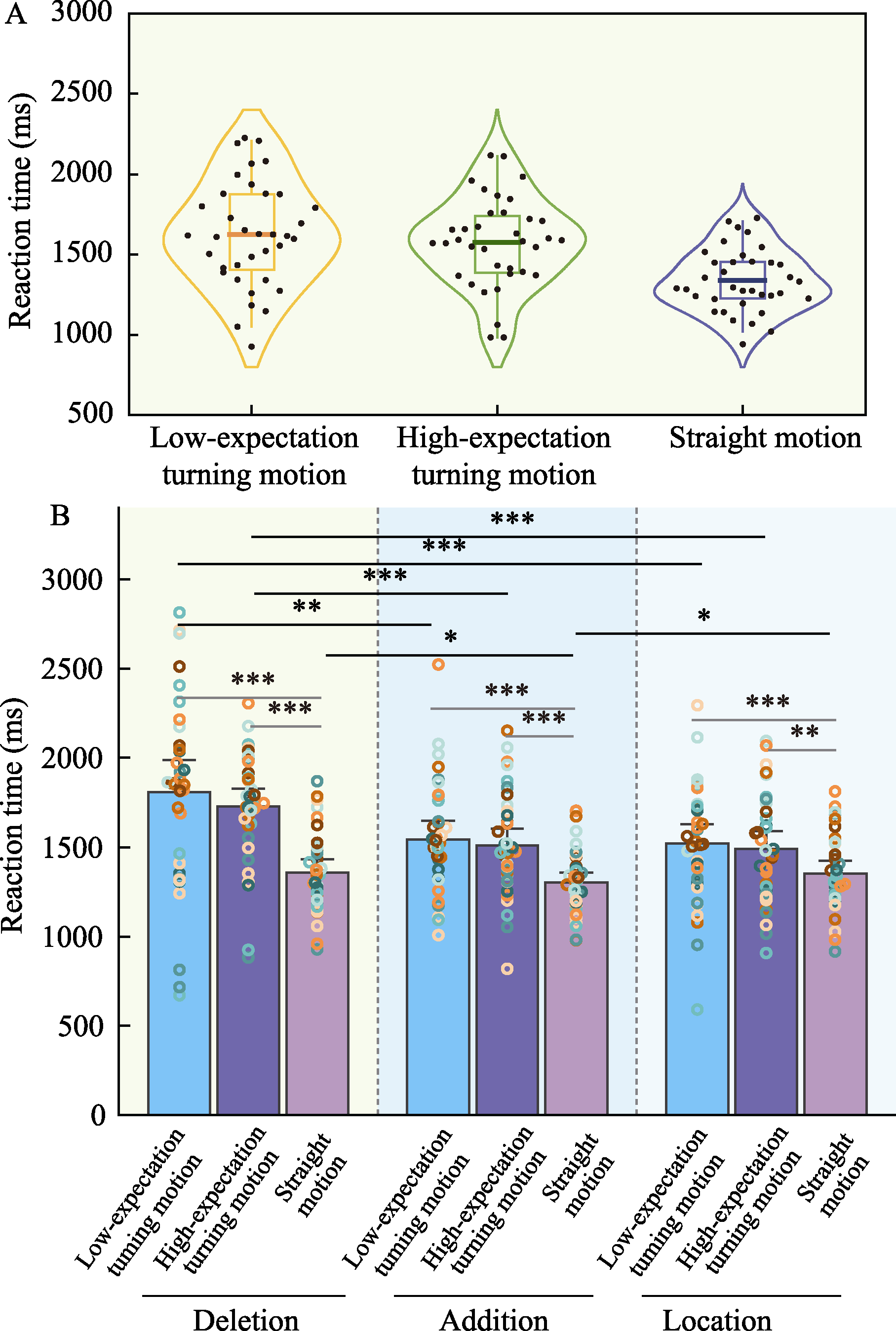
Figure 12. A: Box-Violin Plot of Reaction Time for Correct Change Detection under Different Movement Paths. B: The Effects of Movement Path and Change Type on Reaction Time for Correct Change Detection.
| [1] |
Abrams, R. A., & Christ, S. E. (2003). Motion onset captures attention. Psychological Science, 14(5), 427-432. https://doi.org/10.1111/1467-9280.01458
doi: 10.1111/1467-9280.01458 URL pmid: 12930472 |
| [2] |
Awh, E., & Vogel, E. K. (2008). The bouncer in the brain. Nature Neuroscience, 11(1), 5-6. https://doi.org/10.1038/nn0108-5
doi: 10.1038/nn0108-5 URL pmid: 18160954 |
| [3] | Bays, P. M., Catalao, R. F., & Husain, M. (2009). The precision of visual working memory is set by allocation of a shared resource. Journal of Vision, 9(10), 1-11. https://doi.org/10.1167/9.10.7 |
| [4] |
Beanland, V., Filtness, A. J., & Jeans, R. (2017). Change detection in urban and rural driving scenes: Effects of target type and safety relevance on change blindness. Accident Analysis & Prevention, 100, 111-122. https://doi.org/10.1016/j.aap.2017.01.011
doi: 10.1016/j.aap.2017.01.011 URL |
| [5] |
Beanland, V., Fitzharris, M., Young, K. L., & Lenné, M. G. (2013). Driver inattention and driver distraction in serious casualty crashes: Data from the Australian national crash in-depth study. Accident Analysis & Prevention, 54, 99-107. https://doi.org/10.1016/j.aap.2012.12.043
doi: 10.1016/j.aap.2012.12.043 URL |
| [6] |
Beck, M. R., Peterson, M. S., & Angelone, B. L. (2007). The roles of encoding, retrieval, and awareness in change detection. Memory & Cognition, 35(4), 610-620. https://doi.org/10.3758/BF03193299
doi: 10.3758/BF03193299 URL |
| [7] |
Berggren, N., & Eimer, M. (2019). The roles of relevance and expectation for the control of attention in visual search. Journal of Experimental Psychology: Human Perception and Performance, 45(9), 1191-1205. https://doi.org/10.1037/xhp0000666
doi: 10.1037/xhp0000666 URL pmid: 31157535 |
| [8] |
Bonneh, Y. S., Cooperman, A., & Sagi, D. (2001). Motion-induced blindness in normal observers. Nature, 411(6839), 798-801. https://doi.org/10.1038/35081073
doi: 10.1038/35081073 URL |
| [9] |
Brockmole, J. R., & Henderson, J. M. (2005). Object appearance, disappearance, and attention prioritization in real-world scenes. Psychonomic Bulletin & Review, 12(6), 1061-1067. https://doi.org/10.3758/BF03206444
doi: 10.3758/BF03206444 URL |
| [10] |
Chun, M. M., & Potter, M. C. (1995). A two-stage model for multiple target detection in rapid serial visual presentation. Journal of Experimental Psychology: Human Perception and Performance, 21(1), 109-127. https://doi.org/10.1037/0096-1523.21.1.109
doi: 10.1037/0096-1523.21.1.109 URL |
| [11] |
Cohen-Dallal, H., Markus, O., & Pertzov, Y. (2023). Adaptive visual working memory: Expecting a delayed estimation task enhances visual working memory precision. Journal of Experimental Psychology: Human Perception and Performance, 49(1), 7-21. https://doi.org/10.1037/xhp0001066
doi: 10.1037/xhp0001066 URL |
| [12] |
Cole, G. G., & Kuhn, G. (2010). Attentional capture by object appearance and disappearance. Quarterly Journal of Experimental Psychology, 63(1), 147-159. https://doi.org/10.1080/17470210902853522
doi: 10.1080/17470210902853522 URL |
| [13] |
Donaldson, M. J., & Yamamoto, N. (2016). Detection of object onsets and offsets: Does the primacy of onset persist even with bias for detecting offset? Attention, Perception, & Psychophysics, 78(7), 1901-1915. https://doi.org/10.3758/s13414-016-1185-5
doi: 10.3758/s13414-016-1185-5 URL |
| [14] |
Faul, F., Erdfelder, E., Lang, A. G., & Buchner, A. (2007). G*Power 3: A flexible statistical power analysis program for the social, behavioral, and biomedical sciences. Behavior Research Methods, 39(2), 175-191. https://doi.org/10.3758/bf03193146
doi: 10.3758/bf03193146 URL pmid: 17695343 |
| [15] | Feng, T., Zhai, Y., Yang, J., Liang, J., Fan, D. P., Zhang, J.,... Tao, D. (2022). IC9600: A benchmark dataset for automatic image complexity assessment. IEEE Transactions on Pattern Analysis and Machine Intelligence, 45(7), 8577-8593. https://doi.org/10.1109/TPAMI.2022.3232328 |
| [16] |
Franconeri, S. L., & Simons, D. J. (2003). Moving and looming stimuli capture attention. Perception & Psychophysics, 65(7), 999-1010. https://doi.org/10.3758/BF03194829
doi: 10.3758/BF03194829 URL |
| [17] |
Galpin, A., Underwood, G., & Crundall, D. (2009). Change blindness in driving scenes. Transportation Research Part F: Traffic Psychology and Behaviour, 12(2), 179-185. https://doi.org/10.1016/j.trf.2008.11.002
doi: 10.1016/j.trf.2008.11.002 URL |
| [18] |
Gao, Z., Ding, X., Yang, T., Liang, J., & Shui, R. (2013). Coarse-to-fine construction for high-resolution representation in visual working memory. PLOS ONE, 8(2), e57913. https://doi.org/10.1371/journal.pone.0057913
doi: 10.1371/journal.pone.0057913 URL |
| [19] |
Gilchrist, A. L., & Cowan, N. (2014). A two-stage search of visual working memory: Investigating speed in the change-detection paradigm. Attention, Perception, & Psychophysics, 76(7), 2031-2050. https://doi.org/10.3758/s13414-014-0704-5
doi: 10.3758/s13414-014-0704-5 URL |
| [20] |
Henderson, J. M., & Hollingworth, A. (2003). Global transsaccadic change blindness during scene perception. Psychological Science, 14(5), 493-497. https://doi.org/10.1111/1467-9280.02459
doi: 10.1111/1467-9280.02459 URL pmid: 12930482 |
| [21] |
Hollingworth, A. (2003). Failures of retrieval and comparison constrain change detection in natural scenes. Journal of Experimental Psychology: Human Perception and Performance, 29(2), 388-403. https://doi.org/10.1037/0096-1523.29.2.388
doi: 10.1037/0096-1523.29.2.388 URL |
| [22] |
Kondyli, V., Bhatt, M., Levin, D., & Suchan, J. (2023). How do drivers mitigate the effects of naturalistic visual complexity? On attentional strategies and their implications under a change blindness protocol. Cognitive Research: Principles and Implications, 8(1), 54-84. https://doi.org/10.1186/s41235-023-00501-1
doi: 10.1186/s41235-023-00501-1 URL |
| [23] |
Kvasova, D., Coll, L., Stewart, T., & Soto-Faraco, S. (2024). Crossmodal semantic congruence guides spontaneous orienting in real-life scenes. Psychological Research, 88(7), 2138-2148. https://doi.org/10.1007/s00426-024-02018-8
doi: 10.1007/s00426-024-02018-8 URL |
| [24] |
Martens, M. H. (2011). Change detection in traffic: Where do we look and what do we perceive? Transportation Research Part F: Traffic Psychology and Behaviour, 14(3), 240-250. https://doi.org/10.1016/j.trf.2011.01.004
doi: 10.1016/j.trf.2011.01.004 URL |
| [25] | Milders, M., Hay, J., Sahraie, A., & Niedeggen, M. (2004). Central inhibition ability modulates attention-induced motion blindness. Cognition, 94(2), B23-B33. https://doi.org/10.1016/j.cognition.2004.06.003 |
| [26] | Murphy, S., & Andalis, J. (2013). Unconscious priming: Masked primes facilitate change detection and change identification performance. International Journal of Psychological Studies, 5(1), 45-54. https://doi.org/10.5539/ijps.v5n1p45 |
| [27] |
Nishiyama, M., & Kawaguchi, J. (2014). Visual long-term memory and change blindness: Different effects of pre-and post-change information on one-shot change detection using meaningless geometric objects. Consciousness and Cognition, 30, 105-117. https://doi.org/10.1016/j.concog.2014.09.001
doi: 10.1016/j.concog.2014.09.001 URL pmid: 25282403 |
| [28] |
Raymond, J. E., Shapiro, K. L., & Arnell, K. M. (1992). Temporary suppression of visual processing in an RSVP task: An attentional blink? Journal of Experimental Psychology: Human Perception and Performance, 18(3), 849-860. https://doi.org/10.1037/0096-1523.18.3.849
doi: 10.1037/0096-1523.18.3.849 URL |
| [29] |
Rensink, R. A. (2018). To have seen or not to have seen: A look at Rensink, O’Regan, and Clark (1997). Perspectives on Psychological Science, 13(2), 230-235. https://doi.org/10.1177/1745691617707269
doi: 10.1177/1745691617707269 URL pmid: 29592637 |
| [30] |
Rensink, R. A. (2002). Change detection. Annual Review of Psychology, 53(1), 245-277. https://doi.org/10.1146/annurev.psych.53.100901.135125
doi: 10.1146/psych.2002.53.issue-1 URL |
| [31] |
Rensink, R. A., O’Regan, J. K., & Clark, J. J. (1997). To see or not to see: The need for attention to perceive changes in scenes. Psychological Science, 8(5), 368-373. https://doi.org/10.1111/j.1467-9280.1997.tb00427.x
doi: 10.1111/j.1467-9280.1997.tb00427.x URL |
| [32] |
Roth, N., McLaughlin, J., Obermayer, K., & Rolfs, M. (2024). Gaze behavior reveals expectations of potential scene changes. Psychological Science, 35(12), 1350-1363. https://doi.org/10.1177/09567976241279198
doi: 10.1177/09567976241279198 URL pmid: 39570640 |
| [33] | Shen, M., Dong, Y., Zhou, J., Ma, F., & Zhang, H. (2010). The flash-lag effect: Latency difference is not the cause. Chinese Journal of Applied Psychology, 16(1), 3-11. |
| [34] |
Simons, D. J. (2011). Change blindness, representations, and embodied cognition: Comment on “Embodied cognition and the perception- action link” by Bridgeman and Tseng. Physics of Life Reviews, 8(1), 86-87. https://doi.org/10.1016/j.plrev.2011.01.009
doi: 10.1016/j.plrev.2011.01.009 URL |
| [35] |
Simons, D. J., & Levin, D. T. (1997). Change blindness. Trends in Cognitive Sciences, 1(7), 261-267. https://doi.org/10.1016/S1364-6613(97)01080-2
doi: 10.1016/S1364-6613(97)01080-2 URL pmid: 21223921 |
| [36] |
Simons, D. J., & Rensink, R. A. (2005). Change blindness: Past, present, and future. Trends in Cognitive Sciences, 9(1), 16-20. https://doi.org/10.1016/j.tics.2004.11.006
URL pmid: 15639436 |
| [37] |
Steelman, K. S., McCarley, J. S., & Wickens, C. D. (2013). Great expectations: Top-down attention modulates the costs of clutter and eccentricity. Journal of Experimental Psychology: Applied, 19(4), 403-419. https://doi.org/10.1037/a0034546
doi: 10.1037/a0034546 URL |
| [38] |
Suchow, J. W., & Alvarez, G. A. (2011). Motion silences awareness of visual change. Current Biology, 21(2), 140-143. https://doi.org/10.1016/j.cub.2010.12.019
doi: 10.1016/j.cub.2010.12.019 URL pmid: 21215632 |
| [39] |
Theeuwes, J. (2010). Top-down and bottom-up control of visual selection. Acta Psychologica, 135(2), 77-99. https://doi.org/10.1016/j.actpsy.2010.02.006
doi: 10.1016/j.actpsy.2010.02.006 URL pmid: 20507828 |
| [40] |
Tombu, M., & Seiffert, A. E. (2008). Attentional costs in multiple- object tracking. Cognition, 108(1), 1-25. https://doi.org/10.1016/j.cognition.2007.12.014
doi: 10.1016/j.cognition.2007.12.014 URL |
| [41] |
Türkan, B. N., Amado, S., Ercan, E. S., & Perçinel, I. (2016). Comparison of change detection performance and visual search patterns among children with/without ADHD: Evidence from eye movements. Research in Developmental Disabilities, 49-50, 205-215. https://doi.org/10.1016/j.ridd.2015.12.002
doi: 10.1016/j.ridd.2015.12.002 URL pmid: 26707929 |
| [42] |
Van Pelt, J., Lowe, B. G., Robinson, J. E., Donaldson, M. J., Johnston, P., & Yamamoto, N. (2025). An event-related potential study of onset primacy in visual change detection. Attention, Perception, & Psychophysics, 87(4), 1219-1229. https://doi.org/10.3758/s13414-025-03027-4
doi: 10.3758/s13414-025-03027-4 URL |
| [43] |
Wallisch, P., Mackey, W. E., Karlovich, M. W., & Heeger, D. J. (2023). The visible gorilla: Unexpected fast—not physically salient— Objects are noticeable. Proceedings of the National Academy of Sciences, 120(22), e2214930120. https://doi.org/10.1073/pnas.2214930120
doi: 10.1073/pnas.2214930120 URL |
| [44] |
Wood, K., & Simons, D. J. (2019). Now or never: Noticing occurs early in sustained inattentional blindness. Royal Society Open Science, 6(11), 191333. http://dx.doi.org/10.1098/rsos.191333
doi: 10.1098/rsos.191333 URL |
| [45] |
Wright, R. D., Pellaers, A. C., & Dekergommeaux, R. T. (2024). Detecting multiple simultaneous and sequential feature changes. Frontiers in Cognition, 3, 1436351. https://doi.org/10.3389/fcogn.2024.1436351
doi: 10.3389/fcogn.2024.1436351 URL |
| [46] |
Wu, Q., & Flombaum, J. I. (2024). The motion-silencing illusion depends on object-centered representation. Psychological Science, 35(5), 504-516. https://doi.org/10.1177/09567976241235104
doi: 10.1177/09567976241235104 URL pmid: 38564652 |
| [47] |
Yantis, S., & Jonides, J. (1984). Abrupt visual onsets and selective attention: Evidence from visual search. Journal of Experimental Psychology: Human Perception and Performance, 10(5), 601-621. https://doi.org/10.1037/0096-1523.10.5.601
doi: 10.1037/0096-1523.10.5.601 URL |
| [48] | Yao, R. (2013). The flick of the wrist and the wave of the wand: Low-level mechanisms for inducing change blindness [Unpublished doctorial dissertation]. University of Illinois at Urbana-Champaign. |
| [49] |
Yao, R., Wood, K., & Simons, D. J. (2019). As if by magic: An abrupt change in motion direction induces change blindness. Psychological Science, 30(3), 436-443. https://doi.org/10.1177/0956797618822969
doi: 10.1177/0956797618822969 URL pmid: 30730789 |
| [50] | You, X., & Song, X. (2009). Hemispheric specialization effects in visual image generation. Acta Psychologica Sinica, 41(10), 911-921. https://doi.org/10.3724/SP.J.1041.2009.00911 |
| [51] |
You, X., Zhang, Y., & Liu, D. (2008). The allocation of attention in judgment of categorical spatial relations on simulation scenes. Acta Psychologica Sinica, 40(7), 759-765.
doi: 10.3724/SP.J.1041.2008.00759 URL |
| [52] |
Zhang, W., & Luck, S. J. (2008). Discrete fixed-resolution representations in visual working memory. Nature, 453(7192), 233-235. https:// doi.org/10.1038/nature06860
doi: 10.1038/nature06860 URL |
| [53] |
Zhao, N., Chen, W., Xuan, Y., Mehler, B., Reimer, B., & Fu, X. (2014). Drivers’ and non-drivers’ performance in a change detection task with static driving scenes: Is there a benefit of experience? Ergonomics, 57(7), 998-1007. https://doi.org/10.1080/00140139.2014.909952
doi: 10.1080/00140139.2014.909952 URL pmid: 24787715 |
| [54] |
Zuanazzi, A., & Noppeney, U. (2020). The intricate interplay of spatial attention and expectation: A multisensory perspective. Multisensory Research, 33(4-5), 383-416. https://doi.org/10.1163/22134808-20201482
doi: 10.1163/22134808-20201482 URL |
| [1] | WANG Da, YANG Zhihao, MEI Gaoxing. Serial dependence for same-category and cross-category stimuli in social attention [J]. Acta Psychologica Sinica, 2026, 58(7): 1312-1324. |
| [2] | LIANG Xingjie, CHEN Huifang, WANG Luyao, SUN Yanliang. Modulation of rhythmic temporal attention by consciousness state: Evidence from behavior, hierarchical drift-diffusion modeling, and EEG measures [J]. Acta Psychologica Sinica, 2026, 58(3): 450-466. |
| [3] | LIAN Haomin, ZHANG Qian, GU Xuemin, LI Shouxin. Influence of Sustained Visual Attention on the Prioritization of Visual Working Memory [J]. Acta Psychologica Sinica, 2025, 57(2): 191-206. |
| [4] | FENG Biao, ZHANG Donghuan, CHEN Wei, ZENG Ling, WU Xiaoyue, HUANG Junling, ZHENG Xifu. Perceptual or conceptual? Modulation of fear generalization pathways by prior learning experience [J]. Acta Psychologica Sinica, 2025, 57(12): 2100-2115. |
| [5] | YANG Zhou, ZHU Jia-Wen, SU Lin, XIONG Ming-Jie, JACKSON Todd. The gaze biases towards pain-related information during the late stages predict the persistence of chronic pain: Evidence from eye movements [J]. Acta Psychologica Sinica, 2024, 56(1): 44-60. |
| [6] | PANG Chao, CHEN Yanzhang, WANG Li, YANG Xiduan, HE Ya, LI Zhiying, OUYANG Xiaoyu, FU Shimin, NAN Weizhi. Different attentional selection modes of object information in the encoding and maintenance stages of visual working memory [J]. Acta Psychologica Sinica, 2023, 55(9): 1397-1410. |
| [7] | GAO Yulin, TANG Xiaoyu, LIU Siyu, WANG Aijun, ZHANG Ming. Effects of endogenous spatial cue validity on audiovisual integration in older adults [J]. Acta Psychologica Sinica, 2023, 55(5): 671-684. |
| [8] | ZHUO Linan, ZENG Xiangyu, WU Bing, NIU Rongrong, YU Ping, WANG Weiwen. The function of mPFC-NAc circuit in decision impulsivity: A study based on an animal model [J]. Acta Psychologica Sinica, 2023, 55(4): 556-571. |
| [9] | YIN Huazhan, ZHANG Li, LIU Pengyu, LI Dan. How the dimension of negative emotional motivation influences time perception: The mediating role of attention control and attention bias [J]. Acta Psychologica Sinica, 2023, 55(12): 1917-1931. |
| [10] | CHEN Yueyuan, FANG Weining, GUO Beiyuan, BAO Haifeng. Effects of interruption on work performance and the moderating effects of mental fatigue [J]. Acta Psychologica Sinica, 2023, 55(1): 22-35. |
| [11] | SUN Bo, ZENG Xianqing, XU Kaiyu, XIE Yunting, FU Shimin. Neural correlates of consciousness of emotional faces and the unconscious automatic processing: Evidence from event-related potentials (ERPs) [J]. Acta Psychologica Sinica, 2022, 54(8): 867-880. |
| [12] | YAN Chi, GAO Yunfei, HU Saisai, SONG Fangxing, WANG Yonghui, ZHAO Jingjing. The impact and mechanism of gaze cues on object-based attention [J]. Acta Psychologica Sinica, 2022, 54(7): 748-760. |
| [13] | ZHOU Zinuan, CHEN Yanzhang, FU Shimin. The effects of expectation on attention are dependent on whether expectation is on the target or on the distractor [J]. Acta Psychologica Sinica, 2022, 54(3): 221-235. |
| [14] | ZHANG Qing, WANG Zhengyan. The interplay of maternal sensitivity and infant temperament and attention in predicting toddlers’ executive function: A two-year longitudinal study [J]. Acta Psychologica Sinica, 2022, 54(2): 141-153. |
| [15] | CHEN Xiaoyu, DU Yuanyuan, LIU Qiang. Positive emotions enhance adaptability to contextual-cueing learning [J]. Acta Psychologica Sinica, 2022, 54(12): 1481-1490. |
| Viewed | ||||||
|
Full text |
|
|||||
|
Abstract |
|
|||||
