


1 引言: 研究的意义
全球垃圾增长导致严重的环境问题, 推进垃圾分类和减量, 成为亟需解决的难题。社会影响指人们受到他人或群体影响的一种方式(Abrahamse & Steg, 2013), 是干预垃圾分类行为的关键因素之一(Ling et al., 2021)。社会影响通过声誉关注、社会距离、社会规范、志愿者监管等, 促进垃圾分类行为(Hottle et al., 2015; Leeabai et al., 2019; Lin et al., 2016; Woodard et al., 2000)。其中, 志愿者与居民互动, 是增加社会影响、促进分类的关键因素(Grönlund & Falk, 2019; Xu et al., 2016; Zelenika et al., 2018)。若无桶前志愿者监管, 虽然居民也有分类行为, 但参与率较低, 垃圾混放污染率仍居高不下, 难以将废弃物回收利用(Hottle et al., 2015; Zelenika et al., 2018)。
与其他干预措施相比, 桶前志愿者监管显著提高了垃圾分类率, 特别是志愿者的榜样示范、监督、与居民的情感联结和信息传递等, 是促进居民分类及其习惯养成的最有效方法之一(李长军 等, 2022; Xu et al., 2016; Zelenika et al., 2018)。志愿者的贡献往往超过实际财政支出, 具有较强的社会效益(Pillemer et al., 2017)。但现实中部分垃圾分类实践难以成功, 原因之一是无法维持居民的持久垃圾分类行为。比如居民仅在实践要求的当下有分类行为, 但在下次或未来, 分类行为减少或停止。人形成习惯需要时间, Xu等人(2016)提出志愿者值守3个月可帮助人们养成垃圾分类习惯。然而, 在法律法规未完善的情况下, 居民不配合志愿者进行垃圾分类的情况时有发生。
为了说服居民配合, 有些社区选择熟人(李安麒, 2020; 王泗通, 2019)或老年人作为志愿者劝说监管(Xu et al., 2016), 也有请小学生影响家人做分类回收(Deng et al., 2022; Maddox et al., 2011)。当人们得知自己熟悉的人从事环保行为时, 其环保合作意愿更强(Xu et al., 2021)。因此, 招募社区成员作为社区领袖或榜样, 尤其有号召力的群体如老年人、学生代表等, 示范回收行为, 并告知和说服不回收的邻居, 比单独提供垃圾分类信息更有效(Knickmeyer, 2020)。但是, 究竟什么类型的志愿者更促进居民合作和参与分类?熟悉的人、老年人或者小学生?以及内在机制是什么?目前研究尚无定论。因此, 本研究考察对志愿者的熟悉度和年龄, 如何影响人们配合垃圾分类及其内在作用机制。
1.1 熟悉度对合作的影响
以往研究表明, 熟悉度与合作性存在显著相关。Quervel-Chaumette等人(2015)发现, 个体之间的熟悉度越高, 利他偏好越强, 而利他偏好是人类合作的基础。一般情况下, 人们遇到新伙伴时投入相对较少, 伴随熟悉度增加, 合作性会增加(Keller & Reeve, 1998)。经典的曝光效应表明, 仅是一个刺激物反复呈现, 增加熟悉度, 就能减少人们的不确定感, 并促进人们对该刺激物的积极偏好(Lunn et al., 2020; Zajonc, 1968)。也有研究发现, 只要增加一些最低限度的熟悉度, 比如了解对方的身份, 人们的合作行为就会增加(Gächter & Fehr, 1999)。然而, 熟悉度与合作性是否存在因果关系, 尚需验证。
合作是群体成员一起活动以实现共同目标的行为, 社会困境中的合作是指个体愿意付出一定代价而惠及群体的行为(Rand, 2016; 孙倩 等, 2022)。以往合作的研究大多是基于需要付出代价或投资的任务, 而常见的日常合作行为只需要很少努力, 指当下为他人着想, 并在做决定前考虑他人需求的行为(van Doesum et al., 2021)。垃圾分类需要全民参与, 本质是一种群体的日常合作行为。但是在推行分类实践中, 虽有桶前志愿者值守, 但居民合作程度欠佳, 有些居民不分类(王泗通, 2019)。有定性研究发现, 同居民有密切关系的人如邻居、家人等, 会增加居民分类的合作参与度(Li et al., 2017)。但目前较少定量研究论证人们对志愿者的熟悉度, 是否以及如何影响人们与志愿者的合作, 参与垃圾分类。因此, 基于定量方法, 本研究提出假设1: 高熟悉的比低熟悉的志愿者更能促进人们合作意向、愿意做垃圾分类。
1.2 合作中的年龄差异
此外, 由于家庭等级制度和孝道规范, 老年人在代际关系中更受到尊重, 甚至具有超越年轻人的权力。根据礼貌理论(politeness theory), 为了避免威胁面子, 人们会更多采用礼貌沟通的策略, 维护老年人的面子(Zhang et al., 2005)。由此, 本研究提出假设2: 垃圾分类实践中, 不论熟悉与否, 人们对老年志愿者的合作性更高。
1.3 熟悉度影响合作的潜在机制
熟悉度为何会影响合作行为?以往研究揭示有两种可能的社会影响机制, 分别是声誉关注和社会距离。
1.3.1 声誉关注
在熟人社会中, 声誉(reputation)对个人的行为起着重要作用, 是人类合作的关键因素, 人们对声誉的关注可以促进合作(Giardini et al., 2021; Wang, 2021)。声誉关注(reputational concern)指人们关心自己被他人评价的程度(Romano, Saral et al., 2021), 影响人们的亲社会行为, 有时起到中介作用(Wu et al., 2016)。间接互惠(indirect reciprocity)反映了声誉对合作的重要性(Wang, 2021), 是指人们通过众人传播的声誉去衡量个体是否利他, 人们更愿意帮助利他的人, 同利他的人合作(谢晓非 等, 2017)。例如, 人们通过在熟人面前为公益(如垃圾分类)做贡献, 提高自己声誉, 可能会在随后的间接互惠中获得回报(Sylwester & Roberts, 2013)。
声誉的另一个潜在作用是促进合作伙伴选择。个人通过帮助他人获得良好声誉, 该声誉可用于指导他人选择合作伙伴的决策, 这个模式通常被称为竞争利他主义(competitive altruism, Számadó et al., 2021)。竞争利他主义能有效解释为何熟人在场时, 人们会表现出更多亲社会行为。个人塑造可靠的利他形象, 通过声誉传播使他人知道这是一位好的合作伙伴, 这是一种吸引他人提供合作机会的主动获利策略。人们周围经常存在着各种能使自己受益的机会, 当机会提供者寻找合作伙伴时, 有良好声誉的个体将会有更多被选择的机会, 也能得到更多回报和帮助(谈晨皓 等, 2017)。因此竞争利他主义表明了声誉对合作的重要性(Farmer & Farrelly, 2021)。
人们对过去经验和他人的观察进行评估性的非正式交流即闲聊(gossip, Számadó et al., 2021), 这在维护个体声誉体系中起着关键作用(Yao et al., 2014)。闲聊内容包括他人的合作性, 这会影响个人声誉和人们未来与之互动合作的意图。闲聊的威胁可以促进合作行为(Romano, Saral et al., 2021; Wu et al., 2016), 因为当人们知道自己被观察, 并且这些观察信息能被传达给其他团队成员, 个人会在闲聊威胁下比其他情况下表现得更加合作(Számadó et al., 2021)。熟悉是闲聊可能性增加的原因, 与不熟悉的人相比, 人们更有可能谈论熟悉的人(Yao et al., 2014), 比如熟悉的人进行垃圾分类的情况。
当有朋友或熟悉的人在身边时, 人们更倾向于做出诸如捐赠利他等合作行为(谈晨皓 等, 2017)。当人们得知自己的垃圾分类行为会被熟人看到时, 声誉传播的可能性增加, 人们可能会表现得更加合作, 做垃圾分类的可能性更高。
1.3.2 社会距离
根据社会影响理论(social impact theory), 社会影响力与影响源的强度、直接性和数量成正比(Latané, 1996)。亲密可以增加社会影响的显著性, 比如人们会更容易受到邻居的影响, 而非陌生人。人们之间情感或关系紧密度的抽象程度即是社会距离(social distance), 这是心理距离的表现形式之一, 是人们在面对基于自身的事件和行为时, 感受到与他人关系的距离, 是衡量与他人关系的主观心理尺度(卢洋 等, 2016; Trope et al., 2007; Zhang et al., 2021)。Simmel (1955)根据社会距离, 将人与人之间的距离分为近距离、中等距离和远距离。本研究将这三种类型的距离分别对应高熟悉的人、低熟悉的人和陌生人。
1.4 研究的整体思路
综上所述, 本文采用3个实验和1个现场质性研究, 重点探讨对志愿者的熟悉度和年龄, 是否以及如何影响居民的合作意向。实验1考察熟悉度和志愿者年龄对人们合作性的影响。为了验证实验1的发现以及检验年龄差异, 实验2考察年轻人和老年人面对不同类型志愿者时的合作差异。为了检验实验1和实验2结果的生态效度, 我们开展质性调研, 对多位参与管理垃圾分类实践的工作人员进行现场访谈。实验1和实验2都验证了熟悉度影响人们的合作意向, 实验3引入声誉关注和社会距离, 进一步探究高熟悉度促进合作的作用机制。
2 实验1: 志愿者熟悉度和年龄对人们合作性的影响
2.1 被试
根据G*power 3.1 (Faul et al., 2007)的计算, 对于本研究适用的被试内重复测量方差分析, 在显著性水平α = 0.05且中等效应(f = 0.25)时, 预测达到95%的统计力水平的总样本量至少为22。我们实际邀请了154位大学生自愿参与本实验, 问卷通过线上随机分发给被试。其中部分被试可能没有认真读题, 71人作答勾选全部一样的选项, 4人除一个选项外其他勾选全部一样的选项, 剔除这75份不合格样本后, 有效被试是79人, 平均年龄20.16岁(SD = 1.01岁), 35.44%是女性。
2.2 设计与材料
采用3 (志愿者熟悉度: 高/低/陌生) × 3 (志愿者年龄组: 小学生/年轻人/老年人)双因素被试内设计, 因变量为被试对志愿者的合作意愿, 即选择垃圾分类或不分类。
熟悉度类型操纵与检验。为了区分人们对桶前志愿者的熟悉程度, 将高熟悉度定义为认识了5年的邻居志愿者, 低熟悉度定义为在小区见过且有印象的志愿者。陌生为不认识的志愿者, 即熟悉度为零, 不需操纵检验。为检验熟悉度类型操纵是否有效, 主试随机邀请21位被试, 分别对“认识了5年的邻居”和“在小区见过且有印象的人”的熟悉度感知进行7点评分(1 = 完全不熟悉, 7 = 完全熟悉), 这些被试均未参加正式实验。结果显示, 高熟悉度(M = 5.76, SD = 1.04)材料显著高于低熟悉度材料感知(M = 4.43, SD = 1.33), t(20) = 7.14, p < 0.001, Cohen's d = 1.14, 表明熟悉度类型操纵有效。
实验材料。心理想象可以引发与真实经历一样的情感和动机反应, 想象某一情境会产生与亲身经历一样的效果(于海涛 等, 2013)。我们采用以往研究范式(Fields et al., 2021; Hsee & Weber, 1997)以及现实中的垃圾分类场景(Zhao et al., 2021), 材料由18道3句话的情境框架题组成。如表1所示, 每一道情境题都包括3(志愿者熟悉度: 高/低/陌生) × 3(志愿者年龄组: 小学生/年轻人/老年人)这9种条件, 通过拉丁方设计, 形成9份不同的情境题目, 共计162道题目。每位被试阅读回答18道题目, 每个实验条件下包括2道题目。每道情境框架题目中, 第一句呈现一个垃圾分类情境, 为避免社会赞许性等混淆因素, 每个情境中的主人公以无性别指向的第三人称指代, 例如“小黄”等; 第二句呈现自变量的不同条件; 第三句提出问题, 请被试推测情境中主人公是否会立刻分类, 从“是、否、不确定”三个选项中进行选择, 由此测量被试的合作意愿, 即因变量。
表1 实验1和实验2中设计的情境示例
| 前半句情境框架 | 实验条件举例 | 自变量条件 | 因变量问题 |
|---|---|---|---|
| 小黄把吃剩的外卖拿出去扔掉, 一位志愿者告诉小黄, 要先将饭菜投放到厨余垃圾桶, 再将餐盒等投放到其他垃圾桶。 | 这位志愿者是小黄认识了5年的小学生邻居。 | 高熟悉−小学生 | 实验1: 您认为小黄此时是否会立刻分类? (是/否/不确定) 实验2: 您认为小黄此时(下次)会立刻分类的可能性是? (1~7) |
| 这位志愿者是小黄在小区见过且有印象的一位小学生。 | 低熟悉−小学生 | ||
| 这位志愿者是小黄不认识的一位小学生。 | 陌生的−小学生 | ||
| 这位志愿者是小黄认识了5年的年轻人邻居。 | 高熟悉−年轻人 | ||
| 这位志愿者是小黄在小区见过且有印象的一位年轻人。 | 低熟悉−年轻人 | ||
| 这位志愿者是小黄不认识的一位年轻人。 | 陌生的−年轻人 | ||
| 这位志愿者是小黄认识了5年的老年人邻居。 | 高熟悉−老年人 | ||
| 这位志愿者是小黄在小区见过且有印象的一位老年人。 | 低熟悉−老年人 | ||
| 这位志愿者是小黄不认识的一位老年人。 | 陌生的−老年人 |
注: 加下划线的材料为自变量条件示例。实验1和实验2的差异为因变量测量, 实验1中为离散变量(是、否、不确定), 实验2中为连续变量(李克特7点可能性评分, 数字越大, 可能性越高)。
2.3 程序
施测过程中采用拉丁方设计平衡呈现顺序, 被试被随机分配到9套问卷中的1套。问卷通过线上随机发放。被试首先浏览注意事项, 选择知情同意后开始答题, 最后填报人口学信息(控制变量), 如年龄、性别、教育程度、是否有小孩、做志愿者的意愿(7点评分, 分数越高, 意愿越高)、是否遇到过桶前值守志愿者(是/否)、垃圾分类态度(7点评分)、所在地区是否颁布垃圾分类管理条例(是/否/不清楚)。
为尽可能保证真实客观, 并避免题目顺序和被试的理解偏差等影响, 实验材料控制如下: (1)采用拉丁方设计; (2)题目随机排列; (3)强调材料匿名及无标准答案, 请按自己的真实意愿填写。答题时间5分钟左右, 结束后, 实验者向被试表示感谢。
2.4 结果
首先采用卡方检验, 考察居民面对不同熟悉度和年龄组志愿者时垃圾分类合作意向的差异。结果表明, 面对不同类型志愿者, 选择配合做垃圾分类的被试人数比例有显著差异, χ2(16, N = 1422) = 285.64, p < 0.001。如图1所示, 被试配合高熟悉度的志愿者做垃圾分类的比例(79.11%)显著高于低熟悉度志愿者(61.60%), 配合低熟悉度志愿者的比例显著高于陌生人(27.64%)。这表明, 人们对志愿者的熟悉度越高, 合作性越高, 且只要增加熟悉度, 就会促进人们的合作, 与假设1相符。
图1
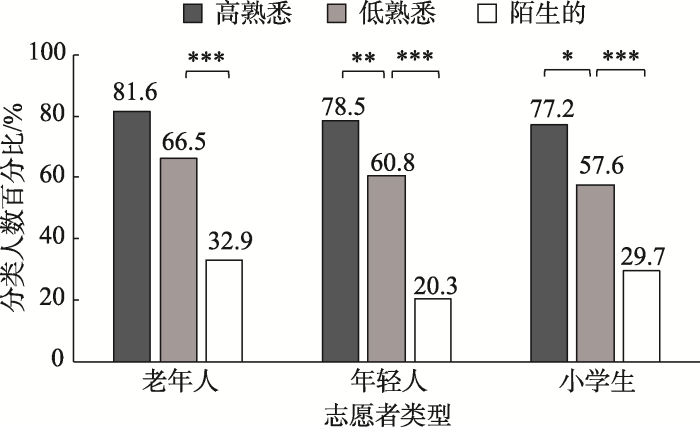
进一步优势比分析表明, 在高熟悉度条件下, 被试对不同年龄组志愿者的合作比例均没有显著差异(ps > 0.1), 表明高熟悉度比年龄因素更为重要地促进了合作性。但是, 在低熟悉度条件下, 被试配合老年志愿者的比例(88.98%)显著高于配合小学生志愿者的比例(77.12%), χ2(1, N = 236) = 5.90, p = 0.015, odds ratio = 2.40, 95% CI [1.17,4.92]; 在陌生的条件下, 被试配合老年志愿者的比例(59.09%)也显著高于配合年轻志愿者的比例(40.00%), χ2(1, N = 168) = 6.11, p = 0.013, odds ratio = 0.46, 95% CI [0.25,0.86]。这些结果初步表明, 高熟悉度会显著促进人们的垃圾分类合作意向, 人们对桶前志愿者越熟悉, 合作性越高; 且在低熟悉度或陌生的条件下, 人们对老年人志愿者的合作性更高。
为进一步探究人口学等控制变量是否影响合作性, 我们进行分层回归分析。在第一层引入人口学变量(被试年龄、性别、学历, 是否有小孩); 第二层引入垃圾分类态度(Cronbach’s α系数为0.836); 第三层引入是否遇到过桶前值守志愿者; 第四层引入做志愿者的意愿; 第五层引入是否颁布条例。结果表明, 均未发现以上变量对垃圾分类合作性的显著影响(ps > 0.1), 有可能同因变量测量是离散型有关, 实验2将继续探讨控制变量的作用。
2.5 讨论
实验1表明, 同低熟悉或陌生的志愿者相比, 高熟悉的志愿者更能促进人们合作意向、愿意做垃圾分类, 初步验证了假设1。实验1中被试是大学生群体, 为了提高生态效度, 实验2选择年龄区间更广的中青年人和老年人, 重复验证志愿者的熟悉度和年龄对人们合作性的影响, 同时探究该影响对于不同年龄组的被试是否存在差异。由于儿童还没有形成稳定的价值观和内在的合作策略(Foulkes et al., 2018; Gutiérrez-Roig et al., 2014), 比成年人更容易受到他人亲社会影响, 且为保证被试能准确理解实验材料, 实验2和实验3均未选择儿童被试。此外, 人们每天都会产生垃圾, 垃圾分类需要习惯养成和长效机制。因此, 实验2和实验3增加此时立刻分类和下次分类两种情况, 细化因变量题目采用7点评分, 再次考察志愿者类型如何影响人们分类的习惯养成。
3 实验2: 志愿者熟悉度和年龄对不同年龄组合作性的影响
3.1 被试及设计
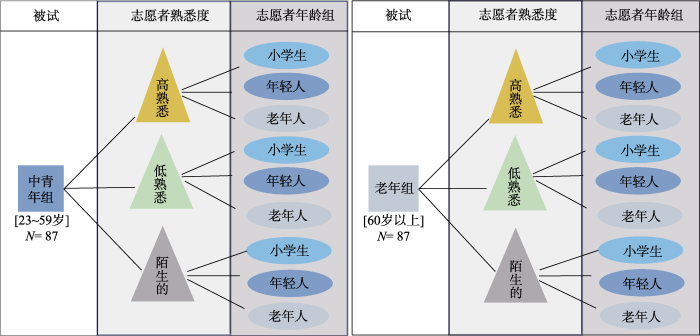
根据G*power 3.1 (Faul et al., 2007)的计算, 对于本研究适用的混合方差分析, 在显著性水平α = 0.05且中等效应(f = 0.25)时, 预测达到95%的统计力水平的总样本量至少为22。为了保证信效度, 我们实际邀请了100位中青年人(23~59岁)和100位老年人(60岁以上), 自愿参与本实验。问卷通过线上随机分发给被试, 其中26人因填写内容有90%以上重复被剔除, 有效被试是174人, 包括87位中青年人(M = 40.63 ± 7.60岁, 42.53%男性)和87位老年人(M = 68.90 ± 4.97岁, 47.13%男性)。如图2所示, 采用2 (被试年龄组: 中青年组/老年组; 被试间) × 3 (志愿者熟悉度: 高/低/陌生; 被试内) × 3 (志愿者年龄组: 小学生/年轻人/老年人; 被试内)混合设计, 因变量为被试对志愿者的合作意愿, 即垃圾分类的可能性。每位被试均完成被试内变量(志愿者熟悉度: 高/低/陌生; 志愿者年龄组: 小学生/年轻人/老年人)共计9个条件的测试, 即每个条件分别由87位中青年被试和87位老年被试完成。
图2
3.2 材料
实验2材料与实验1大致相同(见表1), 请被试想象假定情境后回答问题, 其中进行了两处调整。第一, 基于跨期选择研究中的情境范式(陈海贤, 何贵兵, 2014; Zhang et al., 2021), 分别请被试推测情境中的主人公, “此时立刻”和“下次”分类的可能性。做出此调整, 是基于实验1和预实验中被试反馈, 在此时立刻分类的情境下, 由于人们可能是第一次遇到要求在垃圾桶旁做分类, 因没有经验, 产生无关因素干扰。经“上次”志愿者的提醒和要求, 人们在“下次”扔垃圾的情境下会有心理准备, 能否主动做好分类, 也能体现志愿者的影响程度。因此, 增加“此时立刻”和“下次”分类两个选项, 可以排除无关因素干扰, 探究志愿者类型是否影响垃圾分类的习惯养成。第二, 为更精确测量被试的合作性, 将选项扩展为7点可能性评分, 1为一点儿都不可能, 7为完全有可能, 数值越大, 可能性越高。
3.3 预实验及程序
实验2邀请了38位被试(20~69岁)自愿参与预实验, 结果显示与预期基本相符, “此时立刻”和“下次”情境的结果差异, 表明这两个情境的想象操控有效, 由此开始实验2的正式实验。实验程序与实验1基本一致, 采用拉丁方设计(见表1), 其中不同的是, 实验2的被试包括中青年组和老年组。
3.4 结果与讨论
3.4.1 年龄与熟悉度
为了验证中青年人和老年人面对不同类型志愿者时的合作差异, 我们以被试对志愿者的合作意愿(垃圾分类可能性)为因变量, 进行2 (被试年龄组: 中青年组/老年组; 被试间) × 3 (志愿者熟悉度: 高/低/陌生; 被试内) × 3 (志愿者年龄组: 小学生/年轻人/老年人; 被试内)混合因素方差分析。
结果表明(见图3), 在此时立刻和下次分类情境下, 志愿者熟悉度的主效应显著, [立刻: F(2, 344) = 128.04, p < 0.001, η2 = 0.43; 下次: F(2, 344) = 99.05, p < 0.001, η2 = 0.37], 人们对高熟悉度志愿者的合作性(立刻: M = 5.47, SD = 0.04; 下次: M = 5.72, SD = 0.07)显著高于对低熟悉度志愿者的合作性(立刻: M = 4.86, SD = 0.09; 下次: M = 5.24, SD = 0.09), 对低熟悉度也显著高于对陌生志愿者的合作性(立刻: M = 4.53, SD = 0.02; 下次: M = 4.85, SD = 0.11)。这说明人们对桶前志愿者的熟悉度越高, 合作性也越高, 重复了实验1的结果, 高熟悉度会促进合作。
图3
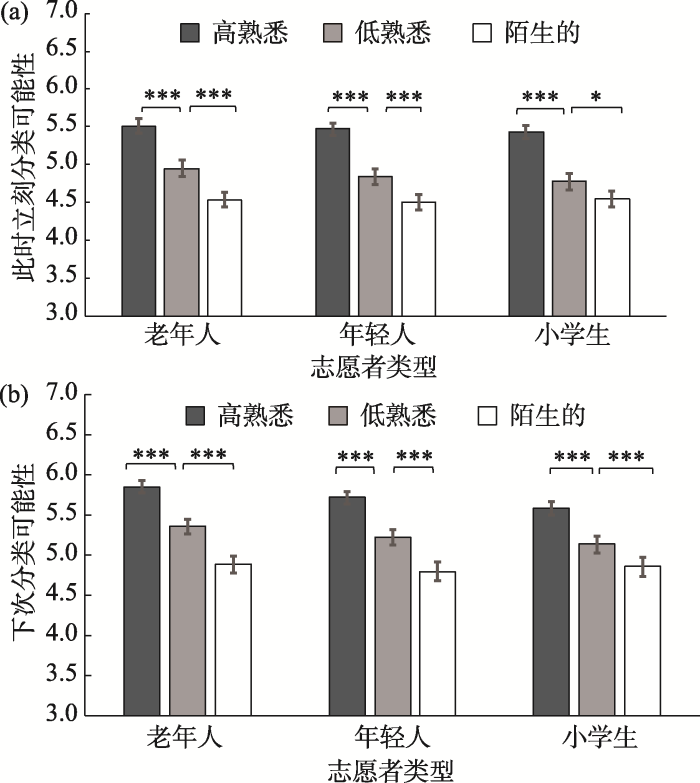
在此时立刻分类情境下, 被试年龄组与志愿者熟悉度的交互作用显著, F(2, 344) = 14.39, p <0.001, η2 = 0.08, 即中青年被试对陌生志愿者的合作性(M = 4.77, SD = 0.13)显著高于老年被试(M = 4.28, SD = 0.13), p = 0.008。除此之外, 未发现其他显著结果。
但是, 与立刻分类情境不同, 在下次分类情境下, 被试年龄组、志愿者熟悉度、志愿者年龄组三因素交互作用呈边缘显著, F(4, 688) =2.03, p = 0.088, η2 = 0.01。被试年龄组与志愿者熟悉度的交互作用呈边缘显著, F(2, 344) = 2.61, p = 0.075, η2 = 0.02。志愿者年龄组的主效应显著, F(2, 344) = 5.53, p = 0.004, η2 = 0.03。志愿者年龄组与志愿者熟悉度的交互作用显著, F(4, 688) = 3.12, p = 0.015, η2 = 0.02。简单效应分析表明, 在高熟悉度(p = 0.001)和低熟悉度(p = 0.021)条件下, 人们对老年志愿者的合作性均显著高于对小学生志愿者的合作性, 这与实验1的结果类似, 即都发现在低熟悉条件下, 人们对老年志愿者的合作性更高。被试年龄组与志愿者年龄组的交互作用显著, F(2, 344) = 3.34, p = 0.037, η2 = 0.02, 老年被试对老年志愿者的合作性(M = 5.54, SD = 0.11)显著高于中青年被试(M = 5.20, SD = 0.11), p = 0.025。
简言之, 在此时立刻和下次分类情境下, 同低熟悉或陌生的志愿者相比, 高熟悉的志愿者更能促进人们合作意向、愿意做垃圾分类, 验证了假设1。在下次分类情境下, 与实验1结果一致的是, 在低熟悉度条件下, 人们对老年志愿者的合作性更高, 表明人们更愿意和老年志愿者合作。
被试年龄组差异主要体现在, 老年被试对老年志愿者的合作性显著高于中青年被试, 但对陌生志愿者的合作性显著低于中青年被试, 说明熟悉度对老年组影响更大, 该结果不支持假设3。该发现支持了社会情绪选择理论(socioemotional selectivity theory), 即老年人比年轻人更倾向于参与熟悉的且有情感意义的社会交往(Carstensen et al., 2003)。
我们还通过t检验发现, 人们在两种分类情境中的合作性以及亲社会性差异。人们下次主动做好分类的可能性(M = 5.27, SD = 1.06)显著高于当下立刻分类的可能性(M = 4.95, SD = 1.10), t(173) = −3.17, p = 0.002, Cohen's d = 0.30。老年被试(M = 6.21, SD = 1.44)做志愿者的意愿显著高于中青年被试(M = 4.94, SD = 1.84), t(172) = −5.05, p = 0.002, Cohen's d = 0.77; 女性(M = 5.42, SD = 1.01)对志愿者的合作性比男性(M = 5.09, SD = 1.10)更高, t(172) = 2.03, p = 0.044, Cohen's d = 0.32。这些结果表明, 人们养成垃圾分类的习惯是循序渐进的, 熟悉的志愿者监管对分类习惯养成起着关键作用。
3.4.2 控制变量和回归分析
为进一步探究人口学变量(模型1)及垃圾分类态度(模型2)、是否遇见过桶前值守(模型3)、做志愿者的意愿(模型4)等控制变量是否影响合作性, 我们进行了同实验1类似的分层回归分析。结果表明(见网络版附表1和附表2), 在控制人口学变量后, 是否遇见过桶前值守(立刻: β = 0.22, t = 2.66, p = 0.009), 垃圾分类态度(下次: β = 0.47, t = 6.99, p < 0.001; Cronbach’s α系数为0.796)以及做志愿者的意愿(立刻: β = 0.26, t = 3.05, p = 0.003; 下次: β = 0.43, t = 5.98, p < 0.001), 均能显著正向预测垃圾分类的合作性。换言之, 桶前志愿者的监督, 以及被试的亲社会性(即做志愿者)在垃圾分类推广中起到了关键作用。
实验1和实验2的结果一致表明, 高熟悉的比低熟悉的志愿者更能促进人们合作意向。被试年龄和熟悉度对合作性产生交互作用, 即在低熟悉度条件下, 人们对老年志愿者合作性更高。由于我们测量的是被试报告的行为态度和意愿, 不是实际行为, 结果可能存在一些偏差。为了验证研究成果的生态效度, 我们通过访谈调研进行质性研究。
3.5 质性研究: 分类实践的访谈调研
为了检验实验1和实验2结果的生态效度, 探究熟悉度的影响是否客观存在, 以及在垃圾分类推行实践中的经验, 我们分别在2020~2021年间开展质性研究, 多次接触访谈过6位参与垃圾分类实践、经验丰富的工作人员, 1位来自上海居委会, 其他5位分别来自4个环保公益组织。
访谈结果有两点主要发现。首先, 居民分类习惯的养成, 需要桶前志愿者监管; 同居民熟悉、沟通能力较好且有影响力的老年人志愿者, 监管效果好, 更能促进居民分类, 保证高分类参与率。该结论同本研究成果相互验证。其次, 在桶前志愿者的监管下, 居民垃圾分类习惯的养成大约需要3个月。该结果同样验证了Xu等人(2016)在上海的现场实验发现, 志愿者值守3个月可帮助人们养成垃圾分类的习惯。
此外, 我们分别于2021年7月和2022年7月份观察北京6个小区的分类情况, 结果显示, 其中3个小区没有桶前志愿者监管, 居民分类参与率是21.19% (分类数: 32人次, 总观察数: 151人次); 其中3个小区有桶前志愿者监管, 居民分类参与率是70.34% (分类数: 102人次, 总观察数: 145人次)。由此可见, 没有志愿者存在的条件下, 仍有居民选择分类, 但是志愿者的监管, 会显著提升分类参与率。
虽然该质性研究和两个实验的结果相互验证, 取得了若干有价值的成果, 但仍存在一些局限, 如未探讨作用机制。实验3将进一步考察熟悉度影响合作的潜在机制, 再次检验人们对不同类型桶前志愿者的合作性差异, 重点揭示心理机制, 验证声誉关注和社会距离的潜在中介作用。其次, 为避免社会赞许性的干扰, 实验1和实验2材料情境中的主人公以无性别指向的第三人称指代, 例如“小黄”等, 可能在一定程度上难以做到让全部被试有完全等价的代入感, 因此实验3直接测量被试的态度。
4 实验3: 社会距离和声誉关注的中介作用
4.1 被试和设计
根据G*power 3.1 (Faul et al., 2007)的计算, 对于本研究适用的被试内重复测量方差分析, 在显著性水平α = 0.05且中等效应(f = 0.25)时, 预测达到95%的统计力水平的总样本量至少为36。我们实际邀请了85位被试自愿参与本实验, 数据通过线上问卷星和线下纸质问卷两种方式随机采集, 发放线下纸质问卷44份, 回收有效样本44份; 发放线上问卷41份, 其中1位被试中途退出, 回收有效样本40份。最终有效被试是84人, 平均年龄26.05岁 (SD = 11.01岁), 50%是女性。我们分别分析了线上和线下的数据, 发现结果模式相同, 以往有研究同样表明, 线上和线下收集的实验数据具有类似的结果和效应量(Paolacci et al., 2010; 陶琳 等, 2020)。因此, 最终合并共同分析线上和线下数据。
实验3重点考察熟悉度促进合作的中介机制, 为了确保答题有效率, 采用2 (志愿者熟悉度: 高/陌生) × 2 (志愿者年龄组: 年轻人/老年人)被试内设计, 通过拉丁方设计平衡4个条件的呈现顺序。所有被试均完成4个条件, 为避免练习效应, 每周完成一个条件, 分4周完成。因变量为被试对模拟情境中志愿者的合作意愿, 即垃圾分类的可能性。
4.2 材料及程序
鉴于现实中, 很多地方政府将垃圾分类管理交给第三方公司, 费用成本高昂。实验3, 将高熟悉度定义为小区内非常熟悉的志愿者, 陌生定义为第三方公司派来的不熟悉的志愿者(见表2)。为了检验实验材料的准确清晰性, 邀请8位被试(19~64岁)进行预实验, 确定正式问卷。正式实验中, 被试首先浏览注意事项, 选择知情同意后开始答题, 完成声誉关注与社会距离的测量, 最后填报人口学信息等。
表2 实验3中设计的情境示例
| 前半句情境框架 | 实验条件举例 | 自变量条件 | 因变量问题 |
|---|---|---|---|
| 您把吃剩的外卖拿出去扔掉, 一位志愿者告诉您, 要进行垃圾分类, 要先将饭菜投放到厨余垃圾桶, 再将餐盒等投放到其他垃圾桶。 | 这位志愿者是第三方公司的一位老年人, 您对这位老年人不熟悉 | 陌生的−老年人 | 您此时(下次)会立刻分类的可能性是? (1~7) |
| 这位志愿者是第三方公司的一位年轻人, 您对这位年轻人不熟悉 | 陌生的−年轻人 | ||
| 这位志愿者是住在您小区的一位老年人, 您对这位老年人非常熟悉 | 高熟悉−老年人 | ||
| 这位志愿者是住在您小区的一位年轻人, 您对这位年轻人非常熟悉 | 高熟悉−年轻人 |
注: 加下划线的材料为自变量条件示例。
声誉关注 通过声誉关注量表(Wu et al., 2016), 对每个条件下被试的声誉关注水平进行测量, 采用5点评分(1 = 完全不同意, 5 = 完全同意)。该量表的Cronbach’s α系数为0.792。
为尽可能保证真实客观, 避免被试的理解偏差等影响, 填写问卷前向被试强调材料匿名及无标准答案, 请按自己的真实想法填写。每次答题时间5分钟左右, 4次填写结束后, 实验者向被试给予礼物表示感谢。
4.3 结果与讨论
4.3.1 熟悉度与年龄的主效应检验
为了验证志愿者熟悉度和年龄对合作的影响, 我们以被试对志愿者的合作意愿(垃圾分类的可能性)为因变量, 进行2 (志愿者熟悉度: 高/陌生) × 2 (志愿者年龄组: 年轻人/老年人) 方差分析。结果表明(见图4), 无论此时分类或下次分类情境, 尽管年龄的主效应不显著(ps > 0.1), 但熟悉度的主效应均显著(ps < 0.001), 人们对高熟悉度志愿者的合作性(M = 5.81, SD = 0.89)显著高于对陌生志愿者的合作性(M = 5.39, SD = 1.04)。这与实验1和实验2结论一致, 高熟悉度能显著提升人们的垃圾分类合作意愿。
图4
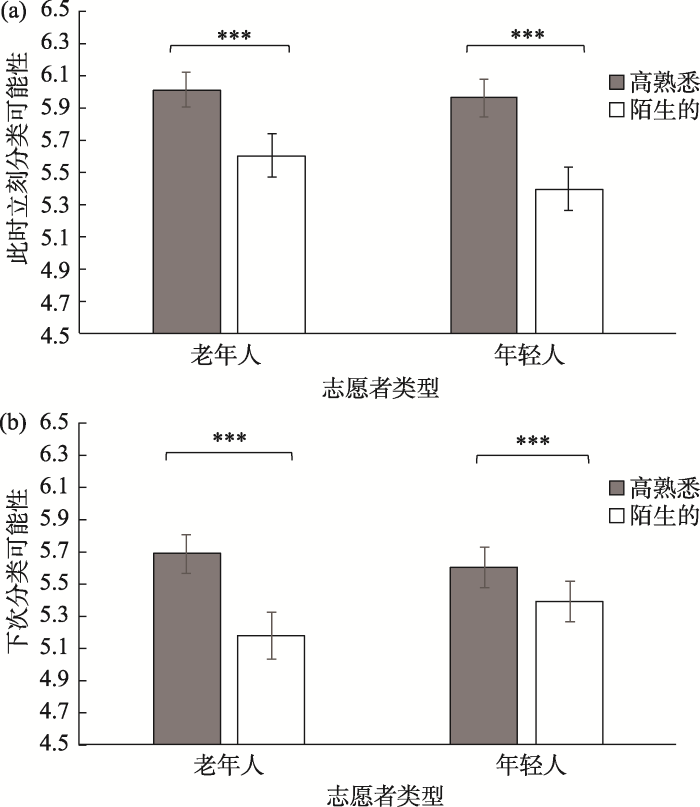
在下次分类情境下, 熟悉度和年龄的交互作用显著, F (1, 83) = 4.41, p = 0.039, η2 = 0.05。在高熟悉度条件下, 人们对不同年龄志愿者的合作性没有显著差异(p = 0.383); 但在陌生条件下, 人们对年轻人志愿者(M = 5.39, SD = 1.16)略高于对老年人志愿者的合作性(M = 5.18, SD = 1.35), p = 0.041。这一点与实验1和实验2有所不同, 可能是由于实验3在陌生条件下, 设置了志愿者是来自第三方公司的情境。
4.3.2 声誉关注与社会距离的中介效应分析
3个实验结果一致表明, 高熟悉的比低熟悉的志愿者更能促进人们合作意向、愿意做垃圾分类, 这其中的作用机制是什么?下面将检验声誉关注和社会距离在熟悉度与合作性之间的中介作用。在同时包含两个中介变量的模型中, 如果熟悉度对社会距离的预测显著、社会距离对声誉关注的预测作用显著、以及声誉关注对合作性的预测作用显著, 则表明支持链式中介效应。相反, 如果社会距离对声誉关注的预测作用不显著, 而两中介变量各自的作用显著, 则表明并行中介效应得到支持。具体分析过程如下。
图5
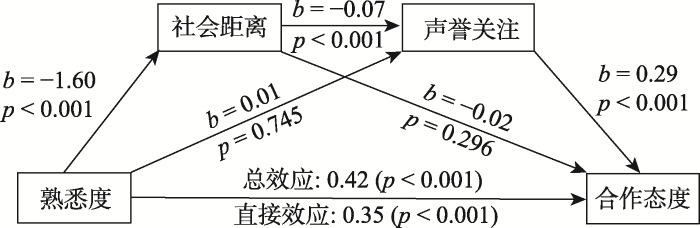
结果表明, 整个回归方程显著, R2 = 0.14, F(5, 1338) = 43.58, p < 0.001。以社会距离和声誉关注为中介变量的路径间接效应为0.034, 95% CI [0.019,0.053], 所有间接效应合计0.070, 95% CI [0.007,0.133], 且熟悉度到社会距离、社会距离到声誉关注、声誉关注到合作性这三条路径系数均显著, 即社会距离和声誉关注在熟悉度与合作性之间起链式中介作用, 符合假设4的预期。但是以社会距离(b = 0.031, 95% CI [−0.027, 0.090])及以声誉关注(b = 0.004, 95% CI [−0.020, 0.030])分别为中介变量的路径间接效应均不显著, 表明二者不存在单独中介效应。
4.3.3 控制变量和回归分析
为进一步考察控制变量的影响, 我们进行分层回归分析(见网络版附表3)。同实验2结果类似, 在控制人口学变量后, 被试的声誉关注(β = 0.26, t = 2.40, p = 0.019)、垃圾分类态度(β = 0.24, t = 2.26, p = 0.026; Cronbach’s α系数为0.874)和是否遇见过桶前值守(β = 0.20, t = 2.00, p = 0.049), 均显著正向预测对垃圾分类的合作性。
简言之, 同实验1和实验2一样, 实验3也发现, 高熟悉度显著促进合作性, 年龄与熟悉度仅在下次分类场景中产生交互作用。与此同时, 社会距离和声誉关注在熟悉度与合作性之间起到链式中介作用。
5 总讨论
本研究通过3个实验和1个质性调研, 探讨了人们对不同类型志愿者的合作性差异及其作用机制。结果发现, 熟悉度显著影响人们的合作性, 高熟悉的比低熟悉的志愿者更能促进人们合作意向。年龄仅与熟悉度产生交互作用, 在低熟悉条件下, 人们对老年志愿者的合作性更高(实验1和实验2)。熟悉度对老年被试和中青年被试的影响均显著, 且同中青年被试相比, 老年被试对老年志愿者的合作性更高, 但对陌生志愿者的合作性低于中青年被试(实验2)。社会距离和声誉关注可作为熟悉度促进合作的心理机制, 起到链式中介作用(实验3)。这些发现对促进人们的合作行为, 以及解决公共物品困境比如垃圾分类难题提供了科学依据。
5.1 熟悉度对合作的影响及其心理机制
中国在本质上是一个熟人社会, 关系、面子和人情等感性因素具有特殊的重要意义(张琪, 邓铸, 2020), 通过熟人关系规劝居民参与垃圾分类, 是利用中国人讲关系、重交情的传统, 舆论压力也是利用熟人社会中人们重视面子的心理(王泗通, 2019)。因此, 熟悉度对人们的合作行为有着显著影响。目前一些地方政府将垃圾分类管理交给第三方公司, 费用成本高昂1(1http://cgj.sz.gov.cn/zwgk/zbxx/zbgg/content/post_7702914.html), 如果能招募到社区里居民较为熟悉的人来做志愿者, 或提前增加居民对志愿者的熟悉度, 会比第三方监管效果更好且节省成本。
社会距离和声誉关注在熟悉度促进合作过程中起到链式中介作用。声誉帮助个体预测他人行为, 从而激励人们牺牲个人利益, 与他人合作进行亲社会行为, 以便拥有良好的声誉, 让自己未来获得更多受益机会(Giardini et al., 2021)。与此同时, 人们通过社会距离判断对方如何响应自己的声誉投入, 如果社会距离越远, 双方互动的机会越低, 未来与对方合作的机会越少, 那么拥有再好的声誉, 在人们看来也不值得, 人们会倾向于放弃追求声誉, 转而倾向获得个人利益(谈晨皓 等, 2017)。而当有熟悉的人在场时, 社会距离越近, 人们主观上认为自己得到对方回馈的可能性越大, 对声誉进行投资的价值就越大, 更愿意去获得一个好的声誉, 从而会更倾向于牺牲个人利益去合作。因此, 人们之间越熟悉, 社会距离越近, 越促进人们对声誉的关注, 增加人们的合作行为, 比如更愿意实施垃圾分类行为。
5.2 合作中的年龄差异
与以往研究结果不同, 熟悉度对老年人合作性的影响也是显著的, 未支持假设3。首先, 这可能是因为以往一些研究考察的是有血缘关系的群体(Molina et al., 2019), 本研究关注的是无血缘关系的对象。其次, 以往研究大多通过最后通牒博弈、独裁者博弈、公共物品困境等范式来评估人们的合作差异, 合作结果通常涉及物质性成本, 而配合做垃圾分类这种日常困境及其行为决策, 是在人际关系层面实现, 受到他人的熟悉度或可信度的影响(van Doesum et al., 2021)。社会情绪选择性理论认为, 老年人因感知到生命时间有限, 会更聚焦在有意义的社会关系方面, 老年人更重视情感关系(Carstensen et al., 2003), 因此高熟悉度更会促进老年人的合作性。
多元回归分析和质性调研结果表明, 社区里居民熟悉的志愿者的监管引导, 及被试的亲社会性, 在垃圾分类推广中起着关键作用。此外, 老年人比年轻人更愿意加入志愿者, 这与亲社会增长假说(the prosocial growth hypothesis)一致, 即随着增龄, 人们的亲社会性会增加(van Lange et al., 1997)。通过帮助他人, 可以缓冲退休老年人面对其具有意义感的社会角色的丧失, 提升老年人的自尊水平、积极情感和生活满意度(Caprara & Steca, 2005)。老年人可能认为环保活动比其他类型的志愿活动更具有价值, 更需要参与到造福后代及改善世界的工作中(Pillemer et al., 2017)。
5.3 局限与展望
本研究基于更广泛意义上的亲社会行为, 即垃圾分类日常困境, 考察人们的合作差异, 为促进居民垃圾分类, 提出低成本且有效的策略即熟悉度的影响。较之以往研究, 我们采用实验和访谈方法, 基于竞争利他主义和社会影响理论, 验证熟悉度与合作性之间的因果关系, 并明确声誉关注和社会距离在其中的链式中介作用。研究样本涵盖了中青年人和老年人, 为有效促进不同年龄群体的合作性提供科学依据。尽管取得了有价值的成果, 但仍存在一些不足, 值得未来研究探讨。首先, 本研究测量的是人们的行为态度, 并未测量实际发生的行为, 从而可能导致一些结果偏差。未来研究可通过现场实验验证。其次, 中青年组被试的年龄范围跨度较大(23~59岁), 未来可以将被试年龄划分细化, 探究更为细致的差异; 另外情境材料中未具体细分人物角色, 比如未区分小学生志愿者以及垃圾投递者年龄等, 未来可对此进一步探究。第三, 仅重点考察了熟悉度和年龄这两个因素, 未来可以考察志愿者的表情、言语表达、沟通技巧等因素, 如何影响人们的合作性。第四, 熟悉度影响合作的过程中, 可能还存在其他潜在的中介变量, 也可作为未来的研究方向。
6 结论
本研究系统探讨了对桶前志愿者的熟悉度、志愿者年龄与居民合作性之间的因果关系及其内在作用机制。结果表明, 招募社区居民较熟悉的人做志愿者, 或提前增加居民对志愿者的熟悉度, 可促进居民配合及其分类习惯养成, 社会距离和声誉关注可作为熟悉度促进合作的心理机制, 起到链式中介作用, 初步构建了资源分类合作中的理论框架。这些重要发现为政策制定者和管理者提供实证支持, 为推行垃圾分类及降低成本提供了参考价值和科学支撑。
附表1 实验2此时立刻分类情境下的回归分析(N = 174)
| 预测变量 | 均值 | 标准差 | 模型1 | 模型2 | 模型3 | 模型4 | ||||
|---|---|---|---|---|---|---|---|---|---|---|
| β | t | β | t | β | t | β | t | |||
| 年龄(岁) | 54.76 | 15.55 | 0.13 | 1.05 | 0.11 | 0.91 | 0.05 | 0.37 | −0.00 | −0.04 |
| 性别 | 0.45 | 0.50 | −0.12 | −1.67 | −0.11 | −1.50 | −0.07 | −0.92 | −0.06 | −0.75 |
| 学历 | 3.32 | 1.98 | 0.29 | 2.62** | 0.29 | 2.58* | 0.17 | 1.42 | 0.22 | 1.84 |
| 有孩子否1 | 0.92 | 0.27 | 0.09 | 1.14 | 0.08 | 0.94 | 0.06 | 0.70 | 0.04 | 0.56 |
| 分类态度 | 6.34 | 1.03 | 0.11 | 1.44 | 0.11 | 1.47 | 0.02 | 0.28 | ||
| 见值守否2 | 0.37 | 0.49 | 0.22 | 2.66** | 0.25 | 3.12** | ||||
| 志愿意愿3 | 5.57 | 1.76 | 0.26 | 3.05** | ||||||
| R2 | 0.07 | 0.08 | 0.12 | 0.17 | ||||||
| F | 3.14* | 2.94* | 3.72** | 4.68*** | ||||||
| ΔR2 | 0.01 | 0.04 | 0.05 | |||||||
| ΔF | 2.09 | 7.07** | 9.31** | |||||||
注:性别编码:男 = 1, 女 = 0; 1是否有小孩: 是 = 1, 否 = 0; 2是否“遇见桶前值守”: 是 = 1, 否 = 0; 3志愿者意愿(7点评分, 数值越大, 意愿越高), * p < 0.05, **p < 0.01, ***p < 0.001。
附表2 实验2下次分类情境下的回归分析(N = 174)
| 预测变量 | 均值 | 标准差 | 模型1 | 模型2 | 模型3 | 模型4 | ||||
|---|---|---|---|---|---|---|---|---|---|---|
| β | t | β | t | β | t | β | t | |||
| 年龄(岁) | 54.76 | 15.55 | 0.21 | 1.74 | 0.14 | 1.31 | 0.11 | 0.99 | 0.03 | 0.26 |
| 性别 | 0.45 | 0.50 | −0.17 | −2.27* | −0.12 | −1.78 | −0.10 | −1.42 | −0.07 | −1.19 |
| 学历 | 3.32 | 1.98 | 0.07 | 0.62 | 0.05 | 0.50 | −0.01 | −0.10 | 0.07 | 0.68 |
| 有孩子否1 | 0.92 | 0.27 | 0.10 | 1.27 | 0.04 | 0.51 | 0.03 | 0.37 | 0.07 | 0.10 |
| 分类态度 | 6.34 | 1.03 | 0.47 | 6.99*** | 0.47 | 7.01*** | 0.33 | 4.95*** | ||
| 见值守否2 | 0.37 | 0.49 | 0.11 | 1.49 | 0.16 | 2.43* | ||||
| 志愿意愿3 | 5.57 | 1.76 | 0.43 | 5.98*** | ||||||
| R2 | 0.07 | 0.28 | 0.29 | 0.42 | ||||||
| F | 3.36* | 13.21*** | 11.45*** | 16.97*** | ||||||
| ΔR2 | 0.21 | 0.01 | 0.13 | |||||||
| ΔF | 48.80*** | 2.20 | 35.78*** | |||||||
注:性别编码:男 = 1, 女 = 0; 1是否有小孩: 是 = 1, 否 = 0; 2是否“遇见桶前值守”: 是 = 1, 否 = 0; 3志愿者意愿(7点评分, 数值越大, 意愿越高), * p < 0.05, **p < 0.01, ***p < 0.001。
附表3 实验3分层回归分析(N = 84)
| 预测变量 | 均值 | 标准差 | 模型1 | 模型2 | 模型3 | 模型4 | 模型5 | 模型6 | ||||||
|---|---|---|---|---|---|---|---|---|---|---|---|---|---|---|
| β | t | β | t | β | t | β | t | β | t | β | t | |||
| 年龄(岁) | 26.05 | 11.01 | −0.06 | −0.28 | −0.06 | −0.28 | −0.08 | −0.35 | −0.15 | −0.71 | −0.22 | −1.05 | −0.32 | −1.50 |
| 性别 | 0.50 | 0.50 | −0.45 | −3.97 | −0.45 | −3.97*** | −0.38 | −3.35*** | −0.33 | −2.87** | −0.31 | −2.73** | −0.33 | −2.98** |
| 学历 | 15.44 | 1.70 | −0.11 | −1.05 | −0.12 | −1.11 | −0.10 | −0.94 | −0.05 | −0.46 | −0.08 | −0.79 | −0.07 | −0.74 |
| 有孩子否1 | 0.24 | 0.43 | 0.08 | 0.32 | 0.08 | 0.33 | 0.09 | 0.39 | 0.16 | 0.74 | 0.20 | 0.89 | 0.31 | 1.37 |
| 社会距离 | 4.54 | 1.19 | 0.05 | 0.45 | 0.11 | 1.07 | 0.15 | 1.46 | 0.16 | 1.63 | 0.20 | 2.00* | ||
| 声誉关注 | 3.76 | 0.60 | 0.26 | 2.40 * | 0.23 | 2.24* | 0.21 | 1.99* | 0.13 | 1.24 | ||||
| 分类态度 | 6.02 | 0.97 | 0.24 | 2.26* | 0.25 | 2.48* | 0.18 | 1.62 | ||||||
| 见值守否2 | 0.28 | 0.40 | 0.20 | 2.00* | 0.17 | 1.67 | ||||||||
| 志愿意愿3 | 4.61 | 1.66 | 0.23 | 1.95 | ||||||||||
| R2 | 0.20 | 0.21 | 0.26 | 0.31 | 0.34 | |||||||||
| F | 5.09*** | 4.07** | 4.56*** | 4.85*** | 4.91*** | |||||||||
| ΔR2 | 0.00 | 0.06 | 0.05 | 0.04 | ||||||||||
| ΔF | 0.20 | 5.76* | 5.12* | 4.01* | ||||||||||
注:性别编码:男 = 1, 女 = 0; 1是否有小孩: 是 = 1, 否 = 0; 2是否“遇见桶前值守”: 是 = 1, 否 = 0; 3志愿者意愿(7点评分, 数值越大, 意愿越高), * p < 0.05, **p < 0.01, ***p < 0.001。
参考文献
Social influence approaches to encourage resource conservation: A meta-analysis
DOI:10.1016/j.gloenvcha.2013.07.029 URL [本文引用: 1]
Inclusion of other in the self scale and the structure of interpersonal closeness
DOI:10.1037/0022-3514.63.4.596 URL [本文引用: 1]
Age-related differences in social economic decision making: The ultimatum game
Why distance matters: Effects on cooperation, persuasion and deception
Self-efficacy beliefs as determinants of prosocial behavior conducive to life satisfaction across ages
DOI:10.1521/jscp.24.2.191.62271 URL [本文引用: 1]
Socioemotional selectivity theory and the regulation of emotion in the second half of life
DOI:10.1023/A:1024569803230 URL [本文引用: 2]
The Effect of psychological distance on intertemporal choice and risky choice
DOI:10.3724/SP.J.1041.2014.00677
[本文引用: 2]

<p>Temporal distance, social distance and probabilistic distance are three basic dimensions of psychological distance. It has been proved that different kinds of psychological distance have similar effects on cognitive representations of events. In general, distant events are represented as high-level construals, whereas near events are represented as low-level construals. As events become more distant, the high-level construals become more influential in shaping preference whereas the low-level construals become less influential (Liberman, Trope, & Stephan, 2007; Liberman, & Trope, 2008; Trope, & Liberman, 2010). This study investigates the effects of temporal, social and probabilistic distance on intertemporal choice and risky choice. We hypothesize that different kinds of distance have similar effects on intertemporal and risky choice, based on the assumptions that these three kinds of distance share the same nature as psychological distance, and that intertemporal choice and risky choice have common processes of option representation and weighting. When psychological distance increases, money magnitude as high-level construal becomes more influential while time and probability as low-level construals become less influential (Sagristano, Trope, & Liberman, 2002; Trope & Liberman, 2003). Therefore, participants in distant conditions would choose delayed and risky alternatives with larger monetary value. Experiment 1 investigated the effect of temporal distance on intertemporal and risky choices. Participants were told that they would participate in a visual experiment, but before that they needed to make an intertemporal choice as their rewards between “¥50 immediately” and “¥90 in 3 months” (experiment 1a), or between “¥50 for sure” and “¥200 with the probability of 20%” (experiment 1b). In near condition, the experiment would be conducted soon, and in distant condition the experiment would be conducted in 6 months. Experiment 2 investigated the effect of social distance. In near condition, participants would make choice for themselves, and in distant condition, for other people. Experiment 3 investigated the effect of probabilistic distance. In near condition, participants were told that they would participate in the experiment with 90% probability, and in distant condition, with 10% probability. The options of intertemporal choice and risky choice are similar to experiment 1. The results show that no matter what kind of distance was involved, there were more participants in distant condition who chose delayed or risky alternatives than those who did in near condition, which confirms the hypotheses. The similar effects of temporal, social and probabilistic distance on intertemporal and risky choices suggest that intermporal and risky choices share common psychological process, and these three kinds of distance are homogeneous psychological distance.</p>
心理距离对跨期选择和风险选择的影响
Commitment and intergenerational influence: A field study on the role of children in promoting recycling in the family
Undersociality: Miscalibrated social cognition can inhibit social connection
DOI:10.1016/j.tics.2022.02.007 URL [本文引用: 1]
Men increase time spent on a charitable task when in the presence of women and other men: Evidence of competitive altruism in online mating scenarios
G*power 3: A flexible statistical power analysis program for the social, behavioral, and biomedical sciences
DOI:10.3758/bf03193146
PMID:17695343
[本文引用: 3]
G*Power (Erdfelder, Faul, & Buchner, 1996) was designed as a general stand-alone power analysis program for statistical tests commonly used in social and behavioral research. G*Power 3 is a major extension of, and improvement over, the previous versions. It runs on widely used computer platforms (i.e., Windows XP, Windows Vista, and Mac OS X 10.4) and covers many different statistical tests of the t, F, and chi2 test families. In addition, it includes power analyses for z tests and some exact tests. G*Power 3 provides improved effect size calculators and graphic options, supports both distribution-based and design-based input modes, and offers all types of power analyses in which users might be interested. Like its predecessors, G*Power 3 is free.
An ERP investigation of age differences in the negativity bias for self-relevant and non-self-relevant stimuli
DOI:10.1016/j.neurobiolaging.2021.02.009
PMID:33773473
[本文引用: 1]
As we age, we show increased attention and memory for positive versus negative information, and a key event-related potential (ERP) marker of emotion processing, the late positive potential (LPP), is sensitive to these changes. In young adults the emotion effect on the LPP is also quite sensitive to the self-relevance of stimuli. Here we investigated whether the shift toward positive stimuli with age would be magnified by self-relevance. Participants read 2-sentence scenarios that were either self-relevant or non-self-relevant with a neutral, positive, or negative critical word in the second sentence. The LPP was largest for self-relevant negative information in young adults, with no significant effects of emotion for non-self-relevant scenarios. In contrast, older adults showed a smaller negativity bias, and the effect of emotion was not modulated by self-relevance. The 3-way interaction of age, emotion, and self-relevance suggests that the presence of self-relevant stimuli may reduce or inhibit effects of emotion for non-self-relevant stimuli on the LPP in young adults, but that older adults do not show this effect to the same extent.Copyright © 2021. Published by Elsevier Inc.
Age differences in the prosocial influence effect
DOI:10.1111/desc.2018.21.issue-6 URL [本文引用: 2]
Familiarity—The bridge from social interactions to relationships?
DOI:10.1037/com0000224
PMID:32338942
[本文引用: 3]
One approach that is starting to reveal interesting variation in social interactions assesses how familiarity of individuals affects their behavior toward one another. This was studied by Prior, Smith, Dooling, and Ball (2020) with a model songbird species, zebra finches (). This work is important in that it reveals how fundamental simple familiarity-repeated social experience with another individual-is to communication and interaction in social species. More work is now needed, and in a wide range of species exhibiting a wide range of variation in social behavior, to assess the extent to which variation in familiarity is the bridge that links social interactions to social relationships in groups of animals. (PsycInfo Database Record (c) 2020 APA, all rights reserved).
Collective action as a social exchange
DOI:10.1016/S0167-2681(99)00045-1 URL [本文引用: 4]
Gossip and competitive altruism support cooperation in a Public Good game
DOI:10.1098/rstb.2020.0303
URL
[本文引用: 2]
When there is an opportunity to gain a positive reputation, individuals are more willing to sacrifice their immediate self-interest. Partner choice creates opportunities for competitive altruism, i.e. individuals compete to be regarded as more generous and to be chosen for future partnerships. Tests of the competitive altruism hypothesis have focused so far on reputation based on direct observation, whereas the role of gossip has not been theoretically and empirically addressed. Partner choice can create an incentive to cooperate and to send truthful messages, but it can also work in the opposite direction. In order to understand the consequences of partner choice on cooperation and gossip, we designed an experimental study in which participants played a sequence of Public Goods games and gossip rounds. In our two treatments, we observed that cooperation increased when there was an opportunity to be selected, but also that cooperators sent more honest messages than defectors, and that this strategy was prevalent in the treatment in which inter-group competition was implemented. We also found evidence that participants detached themselves from the information more often when lying. Taken together, our study fills a theoretical and empirical gap by showing that partner choice increases both cooperation and honesty of gossip.
Familiarity and group productivity
DOI:10.1037/0021-9010.76.4.578 URL [本文引用: 1]
Does it make a difference? The effects of volunteering from the viewpoint of recipients-A literature review
DOI:10.13109/diac.2019.10.issue-1 URL [本文引用: 1]
Transition from reciprocal cooperation to persistent behaviour in social dilemmas at the end of adolescence
Toward zero waste: Composting and recycling for sustainable venue based events
DOI:10.1016/j.wasman.2015.01.019
PMID:25666546
[本文引用: 2]
This study evaluated seven different waste management strategies for venue-based events and characterized the impacts of event waste management via waste audits and the Waste Reduction Model (WARM). The seven waste management scenarios included traditional waste handling methods (e.g. recycle and landfill) and management of the waste stream via composting, including purchasing where only compostable food service items were used during the events. Waste audits were conducted at four Arizona State University (ASU) baseball games, including a three game series. The findings demonstrate a tradeoff among CO2 equivalent emissions, energy use, and landfill diversion rates. Of the seven waste management scenarios assessed, the recycling scenarios provide the greatest reductions in CO2 eq. emissions and energy use because of the retention of high value materials but are compounded by the difficulty in managing a two or three bin collection system. The compost only scenario achieves complete landfill diversion but does not perform as well with respect to CO2 eq. emissions or energy. The three game series was used to test the impact of staffed bins on contamination rates; the first game served as a baseline, the second game employed staffed bins, and the third game had non staffed bins to determine the effect of staffing on contamination rates. Contamination rates in both the recycling and compost bins were tracked throughout the series. Contamination rates were reduced from 34% in the first game to 11% on the second night (with the staffed bins) and 23% contamination rates at the third game. Copyright © 2015 Elsevier Ltd. All rights reserved.
A fundamental prediction error: Self-others discrepancies in risk preference
DOI:10.1037/0096-3445.126.1.45 URL [本文引用: 1]
Familiarity breeds cooperation
Social factors influencing household waste separation: A literature review on good practices to improve the recycling performance of urban areas
DOI:10.1016/j.jclepro.2019.118605 URL [本文引用: 1]
Dynamic social impact: The creation of culture by communication
DOI:10.1111/j.1460-2466.1996.tb01501.x URL [本文引用: 1]
The effects of setting conditions of trash bins on waste collection performance and waste separation behaviors; distance from walking path, separated setting, and arrangements
DOI:S0956-053X(19)30347-2
PMID:31279396
[本文引用: 1]
This study investigated the effects of setting conditions of trash bins on waste collection, separation efficiency, and incorrect disposal. Tested trash bins are for combustible wastes, PET bottles, cans, and glass bottles. Monitoring results were analyzed by statistical tests to distinguish real effects and experimental errors. The distance to trash bins along walking path gave no significant effects on waste collection and the others. On the other hand, when the distance was out of walking path, its increase significantly decreased waste collection of combustible wastes. In contrast, the distance gave no significant effect on separation efficiency and foreign waste percentage. It was suggested that threshold distance that affects waste disposal behaviors is between 8 and 410 m. When trash bins were set separately, it affected the motivation of waste separations. Separated setting of combustible waste and PET bottle trash bins in the opposite side of the original position significantly decreased separation efficiencies of these wastes. Because no significant effect was found on separation efficiency of other wastes whose trash bins were set in the original position, additional 3 m distance to the opposite side might exceed the threshold distance and have caused low separation efficiencies. The preference of trash bin arrangement gave no significant effect on waste collection and the others excluding separation efficiency of can. These results suggest that appropriate location of trash bins can improve waste collection and waste separation. It might be useful for waste management in public areas with high population density like shopping mall.Copyright © 2019 Elsevier Ltd. All rights reserved.
Social work advocacy in the study of community garbage sorting (Unpublished master's thesis)
社会工作倡导理论介入社区生活垃圾分类的研究 (硕士学位论文)
Key measure indicators affecting residents’ waste sorting performance in Shanghai communities
上海市社区内影响居民垃圾分类效果的关键措施指标研究
Incentives for food waste diversion: Exploration of a long term successful Chinese city residential scheme
DOI:10.1016/j.jclepro.2017.03.198 URL [本文引用: 1]
Visual prompts or volunteer models: An experiment in recycling
DOI:10.3390/su8050458 URL [本文引用: 1]
Social-contextual influences on public participation in incentive programs of household waste separation
DOI:10.1016/j.jenvman.2020.111914 URL [本文引用: 1]
The Effect on cooperative behaviors by cooperation index and social distance
合作指数与社会距离对合作行为的影响
Using behavioural science to help fight the coronavirus
The role of intergenerational influence in waste education programmes: The THAW project
DOI:10.1016/j.wasman.2011.07.023
PMID:21868211
[本文引用: 1]
Whilst the education of young people is often seen as a part of the solution to current environmental problems seeking urgent attention, it is often forgotten that their parents and other household members can also be educated/influenced via home-based educational activities. This paper explores the theory of intergenerational influence in relation to school based waste education. Waste Watch, a UK-based environmental charity (www.wastewatch.org.uk), has pioneered a model that uses practical activities and whole school involvement to promote school based action on waste. This methodology has been adopted nationally. This paper outlines and evaluates how effective school based waste education is in promoting action at a household level. The paper outlines Waste Watch's 'Taking Home Action on Waste (THAW)' project carried out for two and half years in Rotherham, a town in South Yorkshire, England. The project worked with 6705 primary age children in 39 schools (44% of primary schools in the project area) to enable them to take the "reduce, reuse and recycle message" home to their families and to engage these (i.e. families) in sustainable waste management practices. As well as substantial increases in students' knowledge and understanding of waste reduction, measurement of the impact of the project in areas around 12 carefully chosen sample schools showed evidence of increased participation in recycling and recycling tonnages as well as declining levels of residual waste. Following delivery of the project in these areas, an average increase of 8.6% was recorded in recycling set out rates which led to a 4.3% increase in paper recycling tonnages and an 8.7% increase in tonnages of cans, glass and textiles collected for recycling. Correspondingly, there was a 4.5% fall in tonnages of residual waste. Waste Watch's THAW project was the first serious attempt to measure the intergenerational influence of an education programme on behaviour at home (i.e. other than schools' own waste). It clearly shows that household recycling behaviour can be positively impacted by intergenerational influence via a practical school-based waste education model. However, although the model could potentially have a big impact if rolled out nationally, it will require seed funding and the long-term durability of the model has not yet been fully quantified.Copyright © 2011 Elsevier Ltd. All rights reserved.
The problem of not waste sorting behaviour, comparison of waste sorters and non-sorters in European Union: Cross-cultural analysis
DOI:10.1016/j.scitotenv.2019.03.342 URL [本文引用: 2]
Intergenerational cooperation within the household: A public good game with three generations
DOI:10.1007/s11150-018-9414-4 [本文引用: 3]
Familiarity with teammate’s attitudes improves team performance in virtual reality
DOI:10.1371/journal.pone.0241011 URL [本文引用: 1]
The effect of social distance on representation of other’s behavior: The role of valence of the content of evaluation
社会距离对他人行为表征的影响: 评价内容效价的作用
Running experiments on Amazon Mechanical Turk
DOI:10.1017/S1930297500002205
URL
[本文引用: 1]
Although Mechanical Turk has recently become popular among social scientists as a source of experimental data, doubts may linger about the quality of data provided by subjects recruited from online labor markets. We address these potential concerns by presenting new demographic data about the Mechanical Turk subject population, reviewing the strengths of Mechanical Turk relative to other online and offline methods of recruiting subjects, and comparing the magnitude of effects obtained using Mechanical Turk and traditional subject pools. We further discuss some additional benefits such as the possibility of longitudinal, cross cultural and prescreening designs, and offer some advice on how to best manage a common subject pool.
Engaging older adults in environmental volunteerism: The retirees in service to the environment program
Familiarity affects other-regarding preferences in pet dogs
Cooperation, fast and slow: Meta-analytic evidence for a theory of social heuristics and self-interested deliberation
DOI:10.1177/0956797616654455
PMID:27422875
[本文引用: 1]
Does cooperating require the inhibition of selfish urges? Or does "rational" self-interest constrain cooperative impulses? I investigated the role of intuition and deliberation in cooperation by meta-analyzing 67 studies in which cognitive-processing manipulations were applied to economic cooperation games (total N = 17,647; no indication of publication bias using Egger's test, Begg's test, or p-curve). My meta-analysis was guided by the social heuristics hypothesis, which proposes that intuition favors behavior that typically maximizes payoffs, whereas deliberation favors behavior that maximizes one's payoff in the current situation. Therefore, this theory predicts that deliberation will undermine pure cooperation (i.e., cooperation in settings where there are few future consequences for one's actions, such that cooperating is not in one's self-interest) but not strategic cooperation (i.e., cooperation in settings where cooperating can maximize one's payoff). As predicted, the meta-analysis revealed 17.3% more pure cooperation when intuition was promoted over deliberation, but no significant difference in strategic cooperation between more intuitive and more deliberative conditions.© The Author(s) 2016.
Generosity and cooperation across the life span: A lab-in-the-field study
DOI:10.1037/pag0000457
PMID:33705189
[本文引用: 4]
Understanding persistence and changes in prosociality across the life span is fundamental to inform theory and practice. As life expectancy increases and pressing societal challenges demand increasing generosity and cooperation among individuals, it is crucial to understand intergenerational interactions. We present the findings from a novel lab-in-the-field experiment (N = 359, 18-90 years) that examines generosity and cooperation between generations. Our methodological approach allows us to study the effect of age on prosocial behavior as a function of the age of an unknown partner. We ask participants to make several decisions, and to state their expectations for their partners' behavior, in a dictator game and a prisoner's dilemma game with real monetary outcomes. The dictator game serves as a measure of generosity, whereas the prisoner's dilemma serves as a measure of cooperation. We find that individuals used age as key information to condition behavior. Generosity was greater among older adults in response to young and older relative to middle-aged partners. Among younger adults, cooperation was greater in response to middle-aged and older partners relative to their own age cohort. All age groups expect less cooperation from young partners than from older and middle-aged partners. However, relative to young adults, older adults are more cooperative with young partners. Our study has crucial implications for the understanding of human generosity and cooperation across the life span. (PsycInfo Database Record (c) 2021 APA, all rights reserved).
Direct and indirect reciprocity among individuals and groups
DOI:10.1016/j.copsyc.2021.08.003
PMID:34481332
[本文引用: 2]
Direct and indirect reciprocity are two fundamental mechanisms that promote prosocial behavior within groups and across societies. Here, we review recent work that illustrates how a (direct and indirect) reciprocity framework can illuminate our understanding of several factors related to prosocial behavior - namely group membership, gossip, and third-party punishment. We propose that each of these factors can promote prosocial behavior via proximate psychological mechanisms related to direct and indirect reciprocity: reputational concern, expectations, and anticipation of future interaction. Finally, we discuss the implications of adopting such a framework and highlight a number of avenues for future research.Copyright © 2021 The Author(s). Published by Elsevier Ltd.. All rights reserved.
Exposure to positive and negative nature affects cooperative behavior: The mediating role of cooperative expectations
正负性自然环境对合作行为的影响: 合作预期的中介作用
Reputation-based partner choice is an effective alternative to indirect reciprocity in solving social dilemmas
DOI:10.1016/j.evolhumbehav.2012.11.009 URL [本文引用: 1]
The language of cooperation: Reputation and honest signalling
DOI:10.1098/rstb.2020.0286
URL
[本文引用: 3]
Large-scale non-kin cooperation is a unique ingredient of human success. This type of cooperation is challenging to explain in a world of self-interested individuals. There is overwhelming empirical evidence from different disciplines that reputation and gossip promote cooperation in humans in different contexts. Despite decades of research, important details of reputation systems are still unclear. Our goal with this theme issue is to promote an interdisciplinary approach that allows us to explore and understand the evolution and maintenance of reputation systems with a special emphasis on gossip and honest signalling. The theme issue is organized around four main questions: What are the necessary conditions for reputation-based systems? What is the content and context of reputation systems? How can reputations promote cooperation? And, what is the role of gossip in maintaining reputation systems and thus cooperation?
Should I sacrifice my profit before his eyes? Partner’s ability and social distance affecting the tendency of reputation-profit game
DOI:10.3724/SP.J.1041.2017.01206 URL [本文引用: 5]
我会在谁面前舍弃利益?——对象的能力与社会距离对名利博弈倾向的影响
The perceived self-efficacy on early functional exercise adherence among postoperative breast cancer patients
乳腺癌患者术后自我效能感对早期功能锻炼依从性的影响
Construal levels and psychological distance: Effects on representation, prediction, evaluation, and behavior
DOI:10.1016/S1057-7408(07)70013-X
PMID:21822366
[本文引用: 1]
Construal level theory (CLT) is an account of how psychological distance influences individuals' thoughts and behavior. CLT assumes that people mentally construe objects that are psychologically near in terms of low-level, detailed, and contextualized features, whereas at a distance they construe the same objects or events in terms of high-level, abstract, and stable characteristics. Research has shown that different dimensions of psychological distance (time, space, social distance, and hypotheticality) affect mental construal and that these construals, in turn, guide prediction, evaluation, and behavior. The present paper reviews this research and its implications for consumer psychology.
Social mindfulness and prosociality vary across the globe
DOI:10.1073/pnas.2023846118
URL
[本文引用: 2]
Cooperation is key to well-functioning groups and societies. Rather than addressing high-cost cooperation involving giving money or time and effort, we examine social mindfulness—a form of interpersonal benevolence that requires basic perspective-taking and is aimed at leaving choice for others. Do societies differ in social mindfulness, and if so, does it matter? Here, we find not only considerable variation across 31 nations and regions but also an association between social mindfulness and countries’ performance on environmental protection. We conclude that something as small and concrete as interpersonal benevolence can be entwined with current and future issues of global importance.
Development of prosocial, individualistic, and competitive orientations: Theory and preliminary evidence
The authors adopt an interdependence analysis of social value orientation, proposing that prosocial, individualistic, and competitive orientations are (a) partially rooted in different patterns of social interaction as experienced during the periods spanning early childhood to young adulthood and (b) further shaped by different patterns of social interaction as experienced during early adulthood, middle adulthood, and old age. Congruent with this analysis, results revealed that relative to individualists and competitors, prosocial individuals exhibited greater levels of secure attachment (Studies 1 and 2) and reported having more siblings, especially sisters (Study 3). Finally, the prevalence of prosocials increased--and the prevalence of individualists and competitors decreased--from early adulthood to middle adulthood and old age (Study 4).
Community experience and its optimization in solving the dilemma of garbage classification
破解垃圾分类困境的社区经验及其优化
Analysis of influencing mechanism on waste separation behavior in Shanghai
DOI:10.1016/j.seta.2021.101479 URL [本文引用: 2]
The use of cash vouchers to incentive householders to recycle
Reputation management: Why and how gossip enhances generosity
DOI:10.1016/j.evolhumbehav.2015.11.001 URL [本文引用: 3]
Is altruism just other-benefiting? A dual pathway model from an evolutionary perspective
DOI:10.3724/SP.J.1042.2017.01441 URL [本文引用: 1]
利他仅仅利他吗? ——进化视角的双路径模型
DOI:10.3724/SP.J.1042.2017.01441
[本文引用: 1]
利他对受助者及社会有弥足珍贵的价值, 能提高群体的功能性, 增加危机中的生存概率从而保持种群延续; 但利他会降低助人者自身的适应性, 使其生存与繁殖的可能性较其他个体, 尤其是自利者, 处于不利地位。利他行为是如何得到进化的这一难题吸引了各领域学者的关注。本文回顾了具有代表性的多水平选择理论与竞争性利他理论, 结合利他研究的最新实证证据, 提出利他增加助人者适应性的双路径模型。内部路径指利他行为可以通过自激励的内在过程, 促进助人者身心的正性互动, 带来内部效用增益, 从而在某些时刻提高其适应性。外部路径为利他传递展现助人者品质的信号, 有助于提升其群体内地位并增加合作、择偶机会。进而, 利他行为能够在个体与群体层面的进化选择中得到保存。未来研究可以从身心关系的角度继续探讨利他问题, 促成利他的正性循环。
Perceived key elements of a successful residential food waste sorting program in urban apartments: Stakeholder views
DOI:10.1016/j.jclepro.2015.12.107 URL [本文引用: 5]
Influence of role models on public participation in household waste separation: An examination of local contextual moderators
DOI:10.1016/j.spc.2021.04.032 URL [本文引用: 1]
Familiarity with interest breeds gossip: Contributions of emotion, expectation, and reputation
DOI:10.1371/journal.pone.0104916 URL [本文引用: 2]
Imagining contact reduce intergroup bias: Theoretical basis, practical demand, underlying mechanisms
DOI:10.3724/SP.J.1042.2013.01824
[本文引用: 1]
Recent studies indicate that simply imagining oneself interacting with an out-group member would reduce intergroup bias and improve intergroup relations. Why does the imagined contact produce positive intergroup outcomes? Mental imagery has been found to elicit emotional and motivational responses as the real experiences (Dadds, Bovbjerg, Redd, & Cutmore, 1997). Moreover, as an important form, the imagined contact can complement more direct forms of contact, although it is not a replacement for direct contact. The effect of imagining contact on bias reduction is mediated by intergroup anxiety, self-disclosure, out-group trust, and the vividness of the imagined scenario, and moderated by group size, group identification, prior contact, and perceptual fluency. We will further discuss the implications of these ?ndings, and provide suggestions for future research (e.g., specifying the processes of imagining contact, focusing on imagining contact of minorities, refining the duration of imagining contact, and integrating it with the intergroup contact theory).
想象接触减少偏见: 理论依据, 实践需要与作用机制
DOI:10.3724/SP.J.1042.2013.01824
[本文引用: 1]
心理想象可以引发与真实经历一样的情感和动机反应, 仅仅想象某一情境就会产生与亲身经历一样的效果, 这为群际接触研究提供了新的理论视角。想象接触作为群际接触的一种形式, 有效弥补了直接接触的不足。群际焦虑、自我表露、外群体信任和想象情景的生动性中介了想象接触减少偏见的效应, 而群体规模、群体认同、接触经历和知觉流畅性则调节了这种效应。未来研究需要具体化想象接触的过程、关注少数群体的想象接触、细化想象接触的时效性、整合群际接触理论。
Attitudinal effects of mere exposure
Toward zero waste events: Reducing contamination in waste streams with volunteer assistance
DOI:S0956-053X(18)30172-7
PMID:29576514
[本文引用: 3]
Public festivals and events generate a tremendous amount of waste, especially when they involve food and drink. To reduce contamination across waste streams, we evaluated three types of interventions at a public event. In a randomized control trial, we examined the impact of volunteer staff assistance, bin tops, and sample 3D items with bin tops, on the amount of contamination and the weight of the organics, recyclable containers, paper, and garbage bins at a public event. The event was the annual Apple Festival held at the University of British Columbia, which was attended by around 10,000 visitors. We found that contamination was the lowest in the volunteer staff condition among all conditions. Specifically, volunteer staff reduced contamination by 96.1% on average in the organics bin, 96.9% in the recyclable containers bin, 97.0% in the paper bin, and 84.9% in the garbage bin. Our interventions did not influence the weight of the materials in the bins. This finding highlights the impact of volunteers on reducing contamination in waste streams at events, and provides suggestions and implications for waste management for event organizers to minimize contamination in all waste streams to achieve zero waste goals.Copyright © 2018. Published by Elsevier Ltd.
Influence of reputational concern and social distance on moral decision-making under the harmful dilemma: Evidence from behavioral and ERPs study
DOI:10.3724/SP.J.1041.2022.00613
[本文引用: 1]
Reputational concern has been suggested as an important determinant of human cooperative behavior and moral judgment in social interactions. Previous studies have demonstrated that reputational concern influences behavioral and neural responses during prosocial behaviors and decision-making, such as moral decision-making. Moral decision- making is a typical social decision-making process involving trade-offs between the self and others. It refers to the process in which individuals make optimal choices under the guidance of social systems and norms according to their own value orientations when faced with a variety of possible dilemmas and conflicts in behavioral choices. Emerging studies have shown that social distance modulates behavioral and neural responses during moral decision-making. However, little is known about how reputational concern and social distance interact to affect moral decision-making, particularly regarding the underlying cognitive neural mechanism of moral decision-making associated with proscriptive morality (i.e., harmful behavior). In the present study, we adopted the “shock-benefit dilemma” task and event-related potential (ERP) technology to examine temporal processing of the interactive influence of reputational concern and social distance on moral decision-making when faced with harmful dilemmas. Participants were instructed to complete a series of alternative dilemmas in an anonymous or public context. After being instructed whether their decisions were going to be made public to the target person, participants decided whether to deliver a certain intensity of painful electric shocks toward the targets (i.e., friends, acquaintances, or strangers) to receive money. A choice not to shock the targets meant that they would forego the benefit. Behavioral and neural responses were recorded while the participants made their decisions. The experiment consisted of 360 trials, including two blocks of anonymous and public situations and 120 trials with friends, acquaintances, and strangers. The results showed that participants administered fewer electric shocks to friends than to acquaintances and strangers, which suggested an obvious “egoistic altruism” decision tendency in anonymous situations. Participants spent more time and experienced greater disgust in dilemmas involving acquaintances relative to those involving friends and strangers, which showed an obvious “acquaintance effect”. However, these differences were weakened in public situations. As for the ERP results, the dilemmas involving acquaintances elicited a larger P260 component, which is associated with emotional responses, and late positive potential (LPP, 300~450 ms), which is associated with cognitive reasoning. However, these differences in ERP indices disappeared in public situations. The aim of this study was to explore the interaction between reputational concern and social distance in behavioral and neural responses during moral decision-making involving harmful dilemmas. The results supported the hypothesis that individuals follow the egoistic altruism moral principle to conduct moral decision-making involving reputational concern and social distance. These findings suggest that the uncertainty of acquaintance relations induces stronger negative emotions and cognitive load during moral decision-making, and reputational concern effectively weakens the aversion and dilemma conflict brought about by self-interest tendencies and interpersonal uncertainties.
声誉关注与社会距离对伤害困境中道德决策的影响: 来自行为与ERPs的证据
DOI:10.3724/SP.J.1041.2022.00613
[本文引用: 1]
在社会交往中, 声誉关注是人类合作行为和道德判断的重要决定因素之一。以往研究只是单独考察声誉关注或社会距离会如何影响道德决策行为, 但两者如何交互影响道德决策尚不清楚, 尤其是禁止性道德范畴领域(如, 伤害他人行为)下道德决策的认知神经机制。本研究要求被试在匿名或公开情境下决策是否愿意对不同社会距离他人(朋友、熟人、陌生人)实施疼痛电击以增加自己的金钱收益, 同时记录其决策时的行为和神经反应。结果发现, 匿名情境下被试对朋友的电击伤害要显著低于对熟人和陌生人的, 表现出一种明显的“利己的利他主义”决策倾向; 与朋友和陌生人相比, 被试在涉及熟人的两难决策中花费了更长的时间, 体验到了更强烈的厌恶情绪, 并诱发了更大波幅的与情绪反应有关的P260成分, 以及与认知推理有关的晚期正成分(LPP: 300~450 ms), 表现出一种典型的“熟人效应”。然而, 行为与ERP指标上的这些差异在公开情境下均显著减弱了。这表明个体在禁止性道德范畴领域下的道德决策遵循着一种“利己的利他主义”的道德原则, 熟人关系的不确定性会在道德决策中诱发强烈的负性情绪和认知负荷, 而声誉关注削弱了利己倾向和人际关系的不确定性所带来的厌恶情绪和认知冲突。
Visualizing recycling: Promoting recycling through mental simulation
DOI:10.1016/j.resconrec.2021.105783 URL [本文引用: 2]
The different effects on cooperative behavior among teenagers by the social distance and the cooperation index
社会距离与合作指数对不同年龄青少年合作行为影响的差异
Closeness difference: The influence of social distance on implicit cooperative attitude
亲疏有别: 社会距离对内隐合作态度的影响
Perceptions of conflict management styles in Chinese intergenerational dyads
DOI:10.1080/0363775052000342535 URL [本文引用: 1]
I am better than others: Waste management policies and self-enhancement bias
DOI:10.3390/su132313257
URL
[本文引用: 1]
Waste source separation has been a social dilemma globally with a low participation rate. This research attempted to solve this dilemma by exploring the effect of mandatory (versus voluntary) policies on waste separation from the perspective of the self-versus based on deterrence theory and self-enhancement motivation. Hypothetical scenarios were used to demonstrate the effectiveness of mandatory policies and self-enhancement bias for residents (n = 589) and adolescents (n = 121). Study 2 was performed to replicate the findings of Study 1 with a no-implementation policy condition, and Study 3 extended the findings to adolescents. We found robust self-enhancement bias, where participants perceived themselves to be better than others in both willingness to perform and attitudes toward waste separation behavior. Specifically, participants tended to perceive themselves to perform waste separation well when policy compliance was voluntary, but they tended to perceive others to perform well when policy compliance was mandatory with supervision. These findings highlight the impact of mandatory policy with supervision and self-enhancement bias in waste management. The present studies provide substantial evidence and implications for the necessity of supervision in mandatory policy implementation.


