


1 引言
社交焦虑(social anxiety)指个体在社交场合中对他人审视或评价的非理性恐惧(Morrison & Heimberg, 2013), 当该状态表现出慢性特征并严重影响其社会功能时, 则会发展成精神障碍(Rapee & Spence, 2004)。在美国, 社交焦虑障碍的终身患病率高达12.1% (Ruscio et al., 2008)。在我国15岁以上人群中, 社交焦虑障碍的检出率在所有焦虑亚型中最高(Guo et al., 2016)。社交焦虑严重限制了关系这一基本心理需要的满足, 阻碍社会性发展(Ryan & La Guardia, 2000), 对儿童青少年的社会适应有着广泛的负面影响, 如提高孤独感(Maes et al., 2019)、削弱同伴关系质量(Chiu et al, 2021)等。鉴于社交焦虑的高患病率和广泛的不良后效, 明晰其在人生中各阶段的发展具有一定的现实意义。
社交焦虑并非稳定不变的人格特征, 它既能呈现出10年以上的曲线变化(Ladd et al., 2019), 也能在以日为单位的观测期间内上下波动(Kashdan & Steger, 2006)。目前已有大量纵向研究直接或间接地涉及了社交焦虑的发展趋势, 但相应的理论和实证证据存在不一致甚至矛盾。另外, 社交焦虑还存在特质与状态的争议, 社交焦虑稳定性的年龄趋势也缺少探讨。因此, 为澄清以往研究的争议, 基于更大样本得出更准确的结论, 本研究拟通过元分析的方法对涉及社交焦虑的纵向研究进行定量整合, 刻画社交焦虑从学步期至青年期的发展轨迹及相应年龄组内的稳定性, 并探讨影响该发展轨迹和稳定性的潜在调节变量。
1.1 社交焦虑的结构和内涵
当前学界通常从情感、认知、行为和生理体验四个方面对社交焦虑进行界定(Maes et al., 2019)。在情感上, 社交焦虑表现为个体在预期或实际面对人际交往时所产生的强烈的紧张不安、焦虑、苦恼等主观体验(Morrison & Heimberg, 2013)。在认知上, 社交焦虑者存在偏向负面评价的信息加工方式——负面评价恐惧(Rapee & Heimberg, 1997), 他们不仅建构了关于自身的偏差印象或心理表征, 也认为他人会对此做出觉察, 并更多地被这种潜在的评价威胁所困扰(刘洋, 张大均, 2010)。在行为上, 社交焦虑者还会采取回避和退出社交场合等行为策略来避免其人际紧张和不安(Rubin et al., 2003)。在生理上, 社交焦虑者还会出现脸红、心跳加快、出汗等一系列生理唤醒状态(Patterson & Ritts, 1997)。
此外, 较多构念与社交焦虑有不同程度的重合, 其中羞怯(shyness)最为典型。羞怯是一种类特质构念(trait-like construct), 指个体在真实或想象的社交情境中产生的自我聚焦型焦虑(Melchior & Cheek, 1990)。由于羞怯与社交焦虑的症状高度类似, 且两者常常相伴出现(Rapee & Spence, 2004), 因此有学者将羞怯归为社交焦虑的亚类(Beidel & Turner, 1999; Leary, 2013)。而且, 主流的社交焦虑量表同样包含了羞怯的测量条目, 如多维度儿童焦虑量表(MASC; March et al., 1997)和自我意识量表中的社交焦虑子量表(SAS-SCS; Scheier & Carver, 1985)。
综上所述, 本研究所关注的社交焦虑是指个体在面对面或想象的社交场合中表现出的情感状态(社交紧张、焦虑、苦恼)、认知特征(负面评价恐惧)、行为倾向(社交退缩、社交回避)和类人格特质(羞怯)四个方面。但因为生理反应与其他采用主观报告的维度存在较大差异, 且同样的生理反应在其他焦虑亚型中也普遍存在(缺乏特异性), 本研究不考虑生理反应。
1.2 社交焦虑在各年龄段的发展
从群体层面探讨心理与行为的毕生发展一般有两种方法, 即平均水平变化(mean-level change)和等级排序稳定性(rank-order stability) (Roberts & DelVecchio, 2000)。前者考察的是构念的平均水平随时间的变化趋势, 即发展轨迹; 后者通常以重测相关系数为效应量, 衡量的是个体在群体中的相对位置随时间变化的程度, 描述了发展的个体差异。上述两种方法虽然都关注构念的跨时间一致性, 但在理论上是相互独立的(Roberts et al., 2006), 群体平均水平的波动并不意味着所有个体都呈同量同向的变化。结合埃里克森的人格发展理论和儿童青少年的主要学习阶段, 本研究从学步期、学前儿童期、小学儿童期、青春期、青年早期和青年晚期六个阶段对社交焦虑的发展进行探讨。
1.2.1 社交焦虑的平均水平变化
学步期(1~3岁)。婴儿出生不久, 与羞怯相关的气质性个体差异随即显现, 表现为早期的行为抑制倾向(Fox et al., 2001)。大约1.5岁时, 幼儿产生对各种新异社会事物的恐惧性羞怯, 即神经系统对外部环境不断适应的过程(Buss, 1986)。2到3岁左右, 幼儿自我意识觉醒, 同伴交往也开始出现, 此时个体会出现自我意识性羞怯, 表现为社交情境中的紧张不安, 对外界评价趋于敏感(Lagattuta & Thompson, 2007)。总体而言, 学步期处于社交“从无到有”的过程, 神经发育和自我认知的发展可能使其社交焦虑(尤其是羞怯)呈现出稳定到缓慢上升的趋势(Baardstu et al., 2020; Eggum-Wilkens et al., 2015)。
小学儿童期(6~12岁)。生理发育上, 小学儿童的脑和神经系统发育表现出均匀和平稳的特点; 心理发展上也更为协调, 其心理活动在保持开放和纯真的同时, 也没有明显的闭锁性。因此, 小学儿童时期的亲子关系、同伴关系和师生关系均较为和谐(林崇德, 2009)。综上, 小学儿童身心发育的协调性可能使该阶段的社交焦虑呈现逐渐下滑(Ettekal et al., 2022)或稳定发展(Booth-LaForce & Oxford, 2008)的趋势。但是, 小学晚期的儿童可能因身体发育的提前到来而面临人际不适。元分析显示社交焦虑障碍平均在童年晚期首次出现(de Lijster et al., 2017), 部分研究也发现童年晚期的社交焦虑会出现短暂上升(Ahlen & Ghaderi, 2020)。
青春期(12~18岁)。关于社交焦虑在青春期的发展, 当前的研究结论也存在较大差异。一方面, 青春期生理发育加速而心理发展缓慢等不协调的特征给青少年自我评价(包括社交能力的自我评价)带来了巨大挑战(Harter, 2006a)。中断假说(disruption hypothesis)也指出, 青春早期社会适应性的人格特征(如宜人性和情绪稳定性)会出现短暂的下降(Soto & Tackett, 2015)。因此, 该阶段的社交焦虑呈现上升趋势(Weymouth & Buehler, 2018)。另一方面, 成熟法则(maturity principle)强调, 到青春后期, 个体的人格发展更趋成熟(Harter, 2006b; Roberts et al., 2006), 有利于个体人际关系质量的提高和社会支持的获得(Barańczuk, 2019; Mund & Neyer, 2014), 从而削弱了社会焦虑。但也有研究发现成熟法则适用于整个青春期, 即整个青春期社交焦虑的平均水平呈持续下降趋势(Ladd et al., 2019)。
综合来看, 对于学步期和青年期, 社交焦虑发展方向的理论依据较为一致, 分别呈缓慢上升和下降趋势。在学前儿童期, 社交焦虑存在因积极偏向地自我概念而下滑, 以及因难以适应社交范围快速扩大而上升两种可能。小学儿童期则就其晚期是否存在短暂上升有争议。对于青春期, 则存在成熟法则(因社会认知能力的成熟而社交无畏)和中断假说(因青春期发育而社交焦虑)的矛盾。
1.2.2 社交焦虑的等级排序稳定性
与平均水平变化相比, 研究者对社交焦虑稳定性的关注较少。首先, 社交焦虑的稳定程度如何?一方面, 如前所述, 社交焦虑在婴儿期就开始出现早期的行为抑制倾向, 随后逐渐扩散至社交场合中的广泛性恐惧。因此, 有研究者视社交焦虑为特质性构念(Hayward et al., 2008; Modini et al., 2015)。另一方面, 也有研究发现社交焦虑会在较短的观测区间内发生变化, 会因此时此刻的情绪情感(Kashdan & Steger, 2006)和社会性行为(Goodman et al., 2021)而波动, 呈现出状态性的特点。其次, 社交焦虑的稳定性会呈现出怎么样的年龄趋势?对这一问题的探讨具有较大的干预启示。稳定性较低的时期可能提示该阶段最适合对社交焦虑进行干预, 且效果可能更好; 而对于稳定性较高的时期, 说明此时的社交焦虑较难改变, 需要本人付出更多的努力和外界的更多关注。研究显示, 成年期前是个体人格逐渐成熟的过程, 传统人格特征从学前期到成年中期的稳定性波动上升(Roberts & DelVecchio, 2000), 儿童和青少年的人格稳定性更低, 可塑性更强。另外, 童年期到青年期是社会网络逐渐扩大的过程(Wrzus et al., 2013), 个体会在这个过程中形成自身的社会性态度和人际关系准则(Bühler & Orth, 2022)。因此, 如果社交焦虑呈现出特质属性, 那么可以预期其稳定性随年龄增加而逐渐上升。
1.3 调节变量
由前所述, 社交焦虑的发展在以往研究中存在较大的异质性, 这提示需要进一步探索潜在的调节因子。综合已有文献, 以下样本特征和变量特征可能会产生影响。
样本特征方面, 出生组、性别和文化可能起关键作用。首先, 心理发展的年龄差异可能与出生组效应相混淆。以往的横断历史元分析揭示了我国青少年和大学生的社交焦虑水平呈逐年上升趋势(时蒙 等, 2019; Xin et al., 2022), 居民消费水平的提升和社会连结的下滑解释了这种出生组效应(Xin et al., 2022)。但该结果只能揭示平均水平的出生组效应, 社交焦虑的发展是否也存在出生组效应仍未知。其次, 虽然女性的社交焦虑水平显著高于男性(van Loo et al., 2023), 但发展轨迹高度相似(叶贝 等, 2019; Ladd et al., 2019)。类似构念的元分析也表明, 孤独感与自尊的平均水平变化和稳定性不受性别的影响(Mund et al., 2020; Orth et al., 2018)。由此可以推测社交焦虑的平均水平变化和稳定性也不受性别的影响。最后, 社交焦虑在集体主义文化中更能被接受, 甚至被认为是合理的(Heinrichs et al., 2006)。元分析也发现亚洲样本报告的社交焦虑显著高于欧洲样本(Woody et al., 2015)。然而, 社交焦虑水平较高的文化是否意味着其增速更快或者稳定性更低仍不得而知。此外, 除探讨男性比的调节作用外, 我们还从文化层面关注男性化指数的作用。男性化指数越高, 表明该社会的男性化气质(如竞争性、冷漠、独断性)越明显, 已有研究表明对传统男性角色的认同能够降低社交焦虑的风险(Moscovitch et al., 2005)。
变量特征方面, 社交焦虑类型与测量方式也可能有着显著影响。一方面, 社交焦虑是一个从社交无畏到社交恐怖症的连续体, 其中负面评价恐惧最为普遍, 一般性的情感焦虑和羞怯在连续体的中端, 社交退缩则在连续体的最末端(Rapee & Spence, 2004)。那么不同维度症状严重程度的差异是否意味着其在发展趋势上也存在差异?另外, 羞怯的内隐理论强调羞怯是稳定不变的人格特征(Beer, 2002), 而来自元分析的证据则支持社交焦虑障碍并非终身障碍(Vriends et al., 2014)。这可能说明羞怯的稳定性比其他维度更高。另一方面, 在测量方式上, 有研究表明自我报告的社交焦虑比教师和父母报告更为有效, 稳定性更强(DiBartolo & Grills, 2006); 但也有研究发现母亲报告的羞怯稳定性要显著高于青少年的自我报告(Lawson et al., 2023)。因此, 测量方式可能存在调节作用, 但方向不清晰。
基于结果稳健性的考虑, 除了以上调节变量外, 我们还纳入了研究特征变量(发表年份、文章语言、发表状态、文章质量), 进一步检验选择性报告偏差的严重性。
2 方法
本研究在PRISMA 2020的声明(Page et al., 2021)下进行元分析。同时, 为迎合开放科学的趋势, 文献检索工作开展前, 本元分析方案已预注册在PROSPERO平台上, 注册号为CRD42022341547。
2.1 文献检索
首次检索在两个中文数据库(中国知网、万方数据)和三个外文数据库(Web of Science, ProQuest, PubMed)中进行, 时间为2022年6月。此外, 为提升纳入文献的全面性, 我们还从涉及社交焦虑的纵向元分析中补充文献(如Chiu et al, 2021; Maes et al., 2019)。2022年12月进行二次检索, 除在上述五个数据库的基础上进行更新外, 还新增检索EBOSCO (含MEDLINE、PsycINFO和PsycArticles)库。中文检索词包括社交焦虑(社交焦虑、社交回避、社交苦恼、交往焦虑、害羞、羞怯、社交恐惧、社交恐怖、互动焦虑、人际焦虑、评价恐惧)和纵向研究(纵向、追踪、前瞻、交叉滞后、面板、T1、T2、时间点、队列、纵断)两个部分。同样地, 英文检索词也包括社交焦虑(“SAD” “social anxi*” “social phobi*” “interaction anxi*” “social avoid*” “social distress” “social fear” “fear of eval*” “fear of negative eval*” “communication anxi*” “fear of rejection” “social inhib*” “social worry” “shy*”)和纵向研究(“stability” “consistency” “continuity” “change” “longit*” “lagged” “panel” “prospective” “follow up” “follow-up” “reciprocal” “cohort” “time point”)两个部分。“*”号表示该词可拓展, 如“social avoid*”可扩展为social avoidance、social avoiding等。各数据库的具体检索策略和二次检索的筛选流程见补充材料1 (
2.2 文献筛选
文献纳入标准1(1本研究预注册时的预期目标是刻画生命全程社交焦虑平均水平和稳定性的发展, 但最终符合标准的文献不含中老年期的样本, 基于现有数据我们只能分析学步期到青年期的发展。为与预注册同步, 我们没有将样本的年龄范围做为纳入标准之一。):(1)有效样本量至少达30; (2)由于本研究关注的是社交焦虑的年龄效应, 故样本年龄的离散程度应在合理范围内。根据前人研究的建议(Orth et al., 2018; Orth et al., 2021), 将T1时年龄的标准差在5及以下做为纳入标准。对于没有报告年龄标准差但被描述为同一学段的样本, 为了最大化保留数据, 我们认为该离散程度也在合理范围内; (3)研究至少测量了前文中界定的社交焦虑的某一方面(情感、认知、行为、羞怯); (4)研究须采用纵向追踪设计; (5)波段的间隔至少在6个月, 最长间隔至少与计划年龄组范围有50%的重叠(Hoff et al., 2018)。选择6个月做为纳入标准是为了减轻延滞效应(carry-over effects)的影响(Orth et al., 2018; Orth et al., 2021)。(6)每个波段所使用的社交焦虑量表在内容、题量、计分方式等方面须完全一致; (7)有足够的效应量信息, 即每个波段社交焦虑的平均值、标准差和波段间的相关系数; (8)文章须采用中文或英文撰写。
文献排除标准:(1)临床样本; (2)样本经历了特殊事件(如重大自然灾害)或心理干预; (3)采用实验法、观察法和同伴提名法测量社交焦虑的研究; (4)采用某种标准将社交焦虑划分为类别变量的研究, 如仅报告OR、RR等数值。
图1
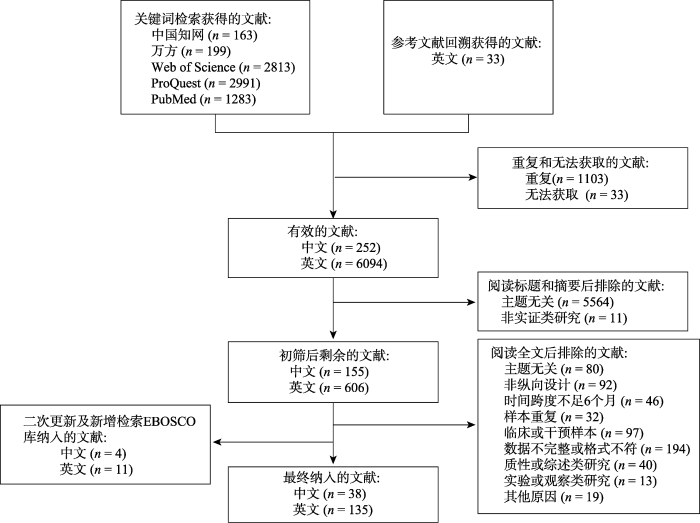
图1
PRISMA文献筛选流程图
注:格式不符指文章所报告的数据为不可比的非连续型数据, 如OR和RR等分类数据、同伴提名数据。其他原因包括非中英文论文、有效样本量不足30、样本均龄标准差大于5和量表前后不一致等。
2.3 文献编码
编码表形成后, 由两位心理学研究生独立进行编码工作。对于编码不一致的内容, 通过协商讨论或再次阅读原文后达成一致。采用Cohen Kappa值衡量编码者间的一致性, 0.8及以上表示编码者一致性高(McHugh, 2012)。
2.3.1 效应量
本研究选取两次相邻波段间的标准化均值差(d)和相关系数(r)做为效应量。标准化均值差用于考察社交焦虑的平均水平变化。参考以往研究(如Roberts et al., 2006), d值的计算公式为:T2的均值减T1的均值, 再用该差值除去T1的标准差(Morris & DeShon, 2002)。根据Orth等人(2018)的建议, 构念的平均水平变化通常会随时间间隔的增大而增大, 因此我们再将d值除去波段的间隔年数, 得到以年为单位的标准化均值差(dyear)。由于纵向研究通常不报告d值, 因此我们编码的是每个波段社交焦虑的均值和标准差, 波段间要求间隔6个月且不重叠(Kappa = 0.96~0.98)。例如, 一项测量5次且每次间隔3个月的研究, 我们选择的是T1、T3和T5的数据。相关系数用于考察社交焦虑稳定性, 直接选取两个相邻波段间的相关系数(Kappa = 0.95~1.00)。
本研究分别对每个年龄组下的效应量进行元分析。对于年龄组的划分, 考虑到学龄期间是人格社会性发展的关键期, 且有足够的效应量用于分析, 因此我们将学龄期间划分为更窄的年龄段, 以更精确地刻画社交焦虑的发展趋势。共划分11个年龄组, 分别是学步期(1~3岁)、学前儿童期(3~6岁)、小学儿童早期(6~8岁)、小学儿童中期(8~10岁)、小学儿童晚期(10~12岁)、青春早期(12~14岁)、青春中期(14~16岁)、青春晚期(16~18岁)、青年过渡期(18~20岁)、青年早期(20~25岁)、青年晚期(25~35岁)。本研究选择两个相邻波段间的年龄均值做为判定其所属年龄组的证据(Orth et al., 2018; Orth et al., 2021)。比如, T1时所测样本为10岁, T2时为13岁, 年龄均值为11.5岁, 则该效应量应划分至小学儿童晚期。此外, 部分研究虽然未报告样本平均年龄, 但有明显信息可以做出推断的则保留, 如大学生样本则编码为20岁。样本T1时均龄的Kappa值为0.96。
2.3.2 研究特征
文献发表年份记录的是文章正式发表在期刊上的年份, 对于学位论文编码为学位申请者答辩的年份(Kappa = 1.00)。文章语言包括中文和英文两个类别(Kappa = 1.00)。发表状态包括已发表的期刊论文和未发表的学位论文两个类别(Kappa = 0.96)。对于文章质量, 参考观察性队列和横断研究质量评价工具(National Institutes of Health, 2014)及张亚利等人(2019)编制的相关类元分析文献质量评价量表, 形成了本研究的文献质量评价标准(见附录), 主要评价的是文章的方法学质量, 不涉及理论深度或语言功底等。共包括被试选取、T1数据有效率、样本流失率、量表信度、量表的纵向等值检验和出版物等级6个指标, 总分介于0~12之间, 分数越高代表文献的质量越高(Kappa = 0.84~1.00)。各文献的具体得分见补充材料2 (
2.3.3 样本特征
样本的出生年代通过T1数据收集年代减去样本的平均年龄获得(Kappa = 0.94)。对于未报告数据收集年代的研究, 采用此公式进行计算:T1数据收集年代 = 文章发表年代 - 2 (横断历史元分析中推断数据收集年代的常见做法; 辛自强, 张梅, 2009) − 数据收集的时间跨度。性别编码为男性样本占总样本的比例(Kappa = 0.97)。此外, 对每个研究样本选取的国家和大洲进行编码, 并根据Hofstede (1983)的国家文化维度理论, 提取每个国家对应的个体主义指数和男性化指数(Kappa = 1.00), 数据来源于
2.3.4 变量特征
2.4 发表偏倚
发表偏倚是指已经发表的研究不足以代表研究总体而引发的偏差, 会威胁到元分析结果的准确性(Borenstein et al., 2009)。本研究通过两种方法来检验发表偏倚。一方面, 本研究纳入了未发表的学位论文, 通过检验发表状态的调节效应可直接检验发表偏倚。另一方面则采用Begg秩相关法和Egger线性回归法进行检验。前者通过标准化效应值与效应值方差的秩相关(Kendall’s τ)来判断发表偏倚的严重程度, Kendall’s τ不显著表明发表偏倚不严重(Begg & Mazumdar, 1994)。后者则通过线性回归法来检验漏斗图的对称性, 若回归方程的截距项显著不为0, 说明存在发表偏倚(Borenstein et al., 2009)。
2.5 数据分析
由于本研究在每个年龄组下分别进行效应量整合, 因此一个研究既可能给一个年龄组提供多个效应量, 也可能给多个年龄组提供多个效应量, 这违反了传统元分析中效应量相互独立的基本假设(Borenstein et al., 2009)。一些类似研究(如Orth et al., 2018; Orth et al., 2021; Roberts et al., 2006)采用平均效应量的方式来应对效应量依赖的问题, 但这种方法不仅会损失较多的信息, 降低统计检验力, 而且会增大估计的标准误, 削弱估计的精确性(Cheung, 2014)。为此, 本研究采用三水平元分析(three-level meta-analysis)来估计总体效应量并检验调节效应。三水平模型允许从一个研究中提取多个效应量, 并在估计时排除效应量依赖的影响, 它将方差来源分为水平1的抽样误差、水平2的研究内误差和水平3的研究间误差, 提高了元分析估计的精确性(Cheung, 2014)。本研究在Cheung (2019)的方案指导下, 采用R 4.2.1中的metaSEM包进行元分析。每个效应量的抽样误差在分析前通过Borenstein等(2009)的公式来计算。异质性方面, 通过Q统计量来检验效应量间的异质性水平, 并使用I2衡量水平2和水平3方差占总方差的比例。对于调节效应检验, 考虑到类别调节变量在部分年龄组内对应的效应量个数极少或缺失, 因此本研究参考前人研究的做法(Mund et al., 2020; Orth et al., 2018; Orth et al., 2021), 在所有年龄组内(即利用所有效应量)检验调节效应。
此外, 对于社交焦虑的稳定性分析, 本研究先将每个相关系数转换为Fisher’s Z值, 得到总体效应量的估计值后再将其进行反转换, 得到总体相关系数r。为与Roberts和DelVecchio (2000)的所发现的人格的稳定性做对比, 本研究将时间间隔控制为1年, 探讨社交焦虑在1年时间间隔的稳定性(Mund et al., 2020)。另外, 检验某个心理构念的稳定性, 除了参考等级排序相关系数的点估计值外, 还应考察该系数与时间间隔的关系(Fraley & Roberts, 2005)。相关系数通常与时间间隔呈负相关, 如果相关系数随着时间间隔的增大呈线性下降趋势并趋近于0, 说明该构念的特质属性较弱; 如果相关系数随着时间间隔的增大的降幅呈先快后慢的趋势, 在较长的时间间隔后不再明显下降, 则该构念的特质属性较强(Fraley & Roberts, 2005)。为此, 我们使用SPSS 24.0, 以时间间隔为自变量, 以相关系数为因变量, 通过曲线估计来判断相关系数与时间间隔的函数关系。考虑到相邻间隔通常较短, 对于3个及以上波段的研究, 我们选取首次波段和最后波段的相关系数, 以尽量给较长的间隔提供更多的效应量。曲线估计中, 同一独立样本的多个效应量通过平均化来处理。
3 结果
3.1 描述性统计
最终共纳入了173项研究, 192个独立样本, 221个效应量, 样本总数为170197人(SD = 1591.60)。其中203个效应量可用于平均水平变化元分析(N = 158799), 163个效应量可用于稳定性元分析(N = 123888)。所有效应量在各项研究信息上的分布如表1所示。所有纳入文献的具体信息和编码内容可见补充材料2 (
表1 221个效应量的研究信息
| 研究信息 | M/K | Min | Max | SD | % |
|---|---|---|---|---|---|
| 男性比(%) | 46.35 | 0 | 1 | 12.72 | |
| 出生年代 | 1997.30 | 1970 | 2015 | 8.40 | |
| 所属大洲 | |||||
| 北美洲 | 89 | 40.27 | |||
| 欧洲 | 59 | 26.70 | |||
| 亚洲 | 65 | 29.42 | |||
| 大洋洲 | 8 | 3.62 | |||
| 社交焦虑类型 | |||||
| 认知 | 17 | 7.69 | |||
| 情感 | 65 | 29.42 | |||
| 行为 | 20 | 9.05 | |||
| 类特质 | 42 | 19.00 | |||
| 一般/混合 | 77 | 34.84 | |||
| 测量方式 | |||||
| 自我报告 | 173 | 78.28 | |||
| 他人报告 | 48 | 21.72 | |||
| 测量波段 | 2.71 | 2 | 13 | 1.38 | |
| 总时间间隔(年) | 2.06 | 0.5 | 19 | 2.54 | |
| 发表状态 | |||||
| 已发表 | 186 | 84.16 | |||
| 未发表 | 35 | 15.84 | |||
| 文章语言 | |||||
| 中文 | 49 | 22.17 | |||
| 英文 | 172 | 77.83 | |||
| 发表年代 | 2015.73 | 1992 | 2022 | 6.09 |
注:M表示均值(连续变量), K表示频次(类别变量), Min和Max表示连续变量的最小和最大值, SD为标准差, %为频次的百分比。
3.2 发表偏倚
由于来自未发表研究的效应量明显少于已发表研究, 在部分年龄组内缺少未发表的效应量, 故我们通过元回归的方法在所有效应量下检验发表状态的调节效应(1=已发表, 0=未发表)。结果显示, 就社交焦虑的平均水平变化而言, 发表状态的调节效应不显著(B = −0.01, p = 0.860); 就稳定性而言, 已发表的效应量显著高于未发表(B = 0.12, p = 0.017)。进一步发表偏差检验结果如表2所示, 没有一致的证据指向某个分析组存在发表偏倚。总体而言, 本元分析较少受到发表偏倚的影响。
表2 社交焦虑平均水平变化和稳定性的发表偏倚检验
| 年龄组(岁) | 水平变化 | 稳定性 | ||||||
|---|---|---|---|---|---|---|---|---|
| Egger线性回归法 | Begg秩相关法 | Egger线性回归法 | Begg秩相关法 | |||||
| 截距 | p | τ | p | 截距 | p | τ | p | |
| 1~3 | −4.56 | 0.010 | −0.60 | 0.136 | 0.39 | 0.674 | −0.05 | 1.000 |
| 3~6 | −1.84 | 0.179 | −0.24 | 0.159 | −3.79 | 0.027 | 0.22 | 0.209 |
| 6~8 | −2.16 | 0.349 | −0.14 | 0.487 | 3.12 | 0.597 | 0.11 | 0.652 |
| 8~10 | 1.09 | 0.446 | 0.07 | 0.607 | 0.47 | 0.789 | 0.28 | 0.135 |
| 10~12 | −1.19 | 0.162 | −0.01 | 0.925 | 0.37 | 0.694 | 0.05 | 0.653 |
| 12~14 | −2.92 | 0.146 | −0.07 | 0.308 | 1.73 | 0.263 | −0.10 | 0.257 |
| 14~16 | 1.37 | 0.286 | 0.08 | 0.350 | 4.50 | 0.022 | −0.11 | 0.315 |
| 16~18 | −1.49 | 0.639 | −0.12 | 0.501 | −3.07 | 0.584 | −0.05 | 0.856 |
| 18~20 | −3.25 | 0.278 | −0.14 | 0.326 | 9.70 | <0.001 | 0.25 | 0.126 |
| 20~25 | 2.58 | 0.204 | −0.08 | 0.624 | 8.48 | <0.001 | 0.07 | 0.692 |
| 25~35 | 0.28 | 0.169 | 1.00 | 0.042 | −4.23 | 0.259 | −0.53 | 0.207 |
| 所有效应量 | −1.01 | 0.091 | −0.09 | 0.018 | 0.88 | 0.168 | 0.02 | 0.678 |
3.3 社交焦虑的平均水平变化
表3 各年龄组社交焦虑平均水平变化的估计
| 年龄组(岁) | K | Neffect size | 出生年代 | dyear | 95% CI | 异质性 | |||
|---|---|---|---|---|---|---|---|---|---|
| M | 范围 | Q | 水平2 I2 | 水平3 I2 | |||||
| 1~3 | 6 | 6 | 2005.19 | (1991, 2015) | −0.034 | [−0.219, 0.151] | 71.79*** | \ | 97.34% |
| 3~6 | 14 | 19 | 1999.58 | (1980, 2015) | −0.171* | [−0.316, −0.026] | 314.01*** | 6.11% | 93.11% |
| 6~8 | 11 | 15 | 1997.95 | (1980, 2011) | −0.077 | [−0.172, 0.018] | 132.51*** | 92.85% | 0 |
| 8~10 | 19 | 25 | 1997.65 | (1980, 2008) | −0.032 | [−0.113, 0.048] | 564.54*** | 67.15% | 29.64% |
| 10~12 | 42 | 58 | 1998.23 | (1980, 2009) | −0.048* | [−0.090, −0.006] | 759.09*** | 74.02% | 20.54% |
| 12~14 | 63 | 100 | 1997.33 | (1977, 2007) | −0.090 | [−0.215, 0.034] | 6686.36*** | 8.53% | 90.99% |
| 14~16 | 44 | 63 | 1995.04 | (1980, 2006) | 0.023 | [−0.025, 0.070] | 1027.33*** | 70.22% | 27.09% |
| 16~18 | 12 | 18 | 1991.68 | (1984, 1997) | −0.067 | [−0.138, 0.004] | 427.89*** | 49.71% | 44.92% |
| 18~20 | 17 | 25 | 1995.92 | (1980, 2000) | −0.128* | [−0.250, −0.006] | 950.10*** | 68.88% | 29.83% |
| 20~25 | 13 | 19 | 1996.70 | (1980, 1998) | −0.022 | [−0.128, 0.083] | 308.96*** | 94.93% | 0 |
| 25~35 | 3 | 4 | 1974.86 | (1970, 1980) | −0.030 | [−0.087, 0.027] | 0.05 | 0 | 0 |
注:K表示独立样本的个数; Neffect size表示效应量的个数; M表示样本出生年代的加权平均值; dyear表示以年为单位的标准化均值差; 水平2 I2表示研究内方差占总方差的比例; 水平3 I2表示研究间方差占总方差的比例; 1~3岁组不存在效应量嵌套, 故采用两水平分析。*p < 0.05, **p < 0.01, ***p < 0.001, 下同。
图2
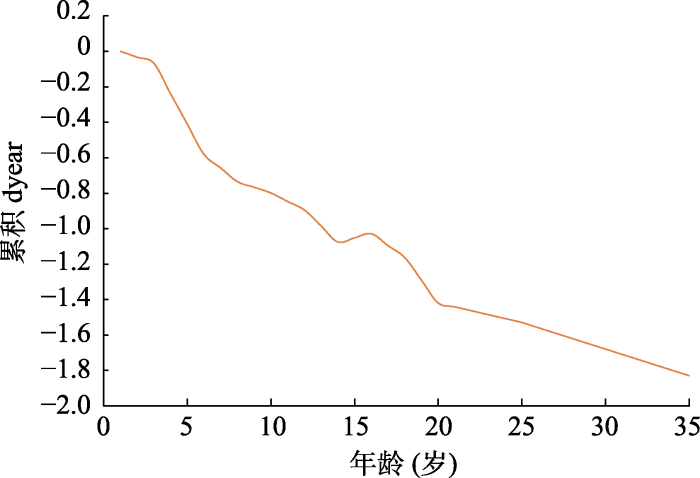
表4 社交焦虑平均水平变化和稳定性的调节效应检验
| 调节变量 | 水平变化 | 稳定性 | ||||
|---|---|---|---|---|---|---|
| B | 95% CI | p | B | 95% CI | p | |
| 发表年份 | 0.027 | [−0.023, 0.076] | 0.291 | −0.012 | [−0.044, 0.021] | 0.483 |
| 发表语言 | 0.024 | [−0.082, 0.130] | 0.663 | −0.119 | [−0.196, −0.042] | 0.002 |
| 文章质量 | −0.027 | [−0.060, 0.005] | 0.099 | 0.010 | [−0.012, 0.031] | 0.372 |
| 男性比 | −0.018 | [−0.075, 0.039] | 0.537 | −0.066 | [−0.115, −0.018] | 0.007 |
| 出生年代 | −0.013 | [−0.062, 0.036] | 0.610 | −0.012 | [−0.047, 0.024] | 0.512 |
| 个体主义指数 | 0.003 | [−0.045, 0.052] | 0.896 | 0.045 | [0.012, 0.077] | 0.008 |
| 男性化指数 | −0.037 | [−0.087, 0.013] | 0.145 | −0.037 | [−0.070, −0.004] | 0.029 |
| 大洲 | ||||||
| 北美洲(vs亚洲) | 0.003 | [−0.116, 0.122] | 0.962 | 0.100 | [0.020, 0.179] | 0.014 |
| 欧洲(vs亚洲) | 0.075 | [−0.051, 0.201] | 0.244 | 0.132 | [0.050, 0.214] | 0.002 |
| 大洋洲(vs亚洲) | 0.089 | [−0.189. 0.368] | 0.531 | 0.158 | [−0.020, 0.337] | 0.082 |
| 测量方式 | −0.031 | [−0.118, 0.055] | 0.478 | −0.083 | [−0.149, −0.017] | 0.013 |
| 社交焦虑类型 | ||||||
| 情感(vs一般) | 0.067 | [−0.039, 0.172] | 0.215 | 0.075 | [−0.001, 0.150] | 0.052 |
| 认知(vs一般) | −0.038 | [−0.180, 0.104] | 0.599 | 0.031 | [−0.067, 0.130] | 0.531 |
| 行为(vs一般) | 0.020 | [−0.119, 0.159] | 0.778 | −0.049 | [−0.145, 0.048] | 0.320 |
| 羞怯(vs一般) | 0.025 | [−0.101, 0.150] | 0.698 | 0.036 | [−0.046, 0.118] | 0.386 |
注:发表语言(1 = 中文, 0 = 英文); 测量方式(1 = 自我报告, 0 = 他人报告); 大洲将亚洲设置为参考变量; 社交焦虑类型则将一般型设置为参考变量。
3.4 社交焦虑的稳定性
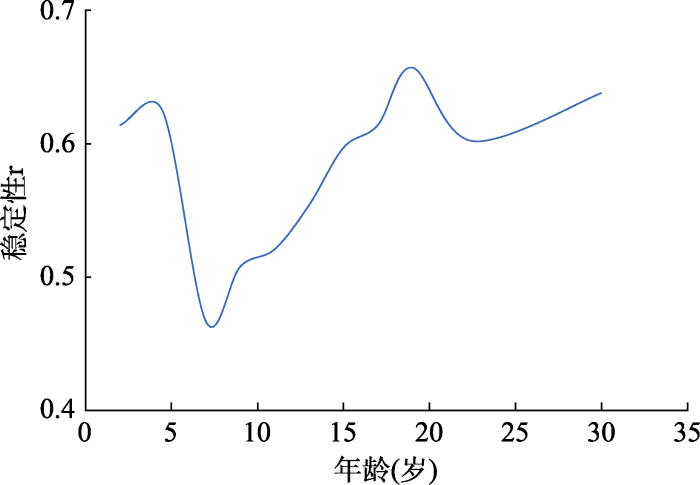
对11个年龄组内社交焦虑的稳定性进行独立元分析, 结果如表5所示, 控制在一年的等级排序相关系数在0.467到0.657之间。基于元分析结果, 绘制了相应的年龄趋势图(见图3), 可见社交焦虑的稳定性在学步期和学前儿童期较高, 但在小学儿童期迅速降至低谷, 青春期以后则逐渐回升, 青年过渡期达到顶峰, 青年期则继续稳定在较高水平。调节效应检验结果见表4。研究特征方面, 来自中文文献效应量的稳定性显著低于英文文献。样本特征方面, 男性比和男性化指数与稳定性呈显著负相关; 个体主义指数与稳定性呈显著正相关; 来自北美洲和欧洲样本的稳定性显著高于亚洲样本。变量特征上, 来自他人报告的稳定性显著高于自我报告。
表5 各年龄组社交焦虑稳定性的估计
| 年龄组 (岁) | K | Neffect size | 出生年代 | r | 异质性 | |||||
|---|---|---|---|---|---|---|---|---|---|---|
| M | 范围 | 调整前 | 调整后 | 95% CI | Q | 水平2 I2 | 水平3 I2 | |||
| 1~3 | 7 | 7 | 2005.18 | (1991, 2015) | 0.609 | 0.614 | [0.555, 0.666] | 15.36* | \ | 74.23% |
| 3~6 | 14 | 18 | 1999.93 | (1991, 2015) | 0.606 | 0.624 | [0.557, 0.682] | 428.65*** | 23.63% | 73.37% |
| 6~8 | 8 | 10 | 1996.52 | (1989, 2011) | 0.485 | 0.467 | [0.302, 0.604] | 281.58*** | 0 | 96.79% |
| 8~10 | 12 | 16 | 1998.22 | (1983, 2006) | 0.500 | 0.508 | [0.416, 0.589] | 311.88*** | 6.67% | 91.29% |
| 10~12 | 28 | 41 | 1999.14 | (1981, 2009) | 0.518 | 0.521 | [0.471, 0.567] | 525.20*** | 52.60% | 43.87% |
| 12~14 | 45 | 65 | 2000.06 | (1977, 2007) | 0.543 | 0.554 | [0.515, 0.590] | 1647.80*** | 21.79% | 74.07% |
| 14~16 | 31 | 43 | 1997.30 | (1988, 2006) | 0.596 | 0.597 | [0.561, 0.631] | 1259.35*** | 11.99% | 84.42% |
| 16~18 | 7 | 10 | 1989.50 | (1984, 1997) | 0.589 | 0.614 | [0.507, 0.702] | 206.76*** | 0 | 96.20% |
| 18~20 | 14 | 20 | 1995.87 | (1980, 2000) | 0.668 | 0.657 | [0.573, 0.727] | 1061.14*** | 19.14% | 78.96% |
| 20~25 | 11 | 20 | 1996.13 | (1990, 1998) | 0.602 | 0.602 | [0.518, 0.675] | 810.18*** | 35.75% | 60.61% |
| 25~35 | 4 | 5 | 1984.95 | (1970, 1990) | 0.536 | 0.638 | [0.610, 0.665] | 48.01*** | 0.81% | 87.62% |
注:调整前r为未控制时间间隔的相关系数, 调整后r为控制时间间隔为1年的相关系数, 95% CI为调整后r的95%置信区间。
图3
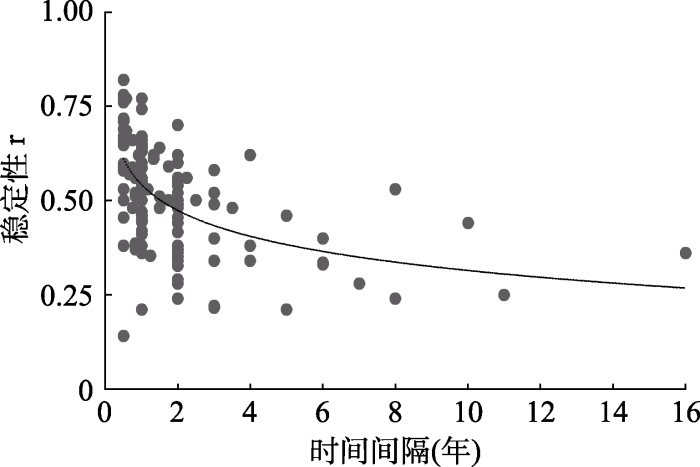
此外, 继续检验社交焦虑稳定性的“稳定性”。控制样本量后的偏相关结果显示, 稳定性与时间间隔呈显著负相关(r = −0.41, p < 0.001)。进一步曲线估计的结果显示, 11个函数方程中, 对数模型的拟合度最优(F = 53.15, R2 = 0.28), 线性模型位居第七(F = 30.06, R2 = 0.18)。因此, 社交焦虑的稳定性与时间间隔是对数函数关系(如图4), 降幅呈现出先快后慢的趋势, 在6年左右明显放缓。
图4
4 讨论
4.1 社交焦虑的平均水平变化
结果显示, 社交焦虑的平均水平从学步期至青年期呈逐步下降趋势, 总体上支持人格成熟论而非适应困难的观点。学步期幼儿虽然会因新异刺激的增加而出现行为抑制, 但此时的羞怯, 尤其是陌生人恐惧主要表现为生物学上的神经过敏性反应, 真正意义上的社会性恐惧仍然较少(Buss, 1986)。因此, 对大多数幼儿而言, 这种以生物学为基础的羞怯反应会随着时间的推移而减弱(Bastien et al., 2020; Buss, 1986)。进入学前期后, 随着自我意识的提升, 儿童不仅容易持有积极倾向的自我概念, 而且社交圈子的扩大对用游戏探索世界的儿童而言可能具有社会协助性而非造成适应困难(Munley, 1977)。此外, 学前期也开始出现真正意义上的友谊, 有利于削弱社交焦虑(Rubin et al., 2009)。进入小学后, 儿童在社交范围进一步扩大的同时也获得了更多的自主性, 人格的社会适应性进一步发展, 自尊水平大幅提升(Harter, 2006b; Orth, et al., 2018), 这可能是该阶段社交焦虑明显下降的原因之一。青春期的社交焦虑进一步下降, 但降幅较小学时期有所放缓, 这仍然支持了成熟法则而非中断假说。困境孕育成长的观点(deficits-breeds growth perspective)强调, 尽管青春期面临身心发展不协调等种种心理危机, 但大多数个体会在挑战中逐渐走向社会适应, 而避免人格缺陷(Baltes et al., 1999; Hoff et al., 2018)。正如研究结果所示, 青春中期短暂的社交焦虑上升会在晚期时重新回到人格成熟的发展轨道。沿着适应性发展的道路, 成年期后的个体不仅确立了自我同一性, 而且逐渐建立了稳定的社会连结, 社会网络规模达到顶峰(Wrzus et al., 2013), 社交焦虑则稳定在较低的水平。
4.2 社交焦虑的稳定性
从年龄趋势上看, 学步期和学前期社交焦虑的稳定性较高, 小学儿童期最低, 青春中期以后逐渐回升, 青年期则维持在较高水平。根据Fraley和Roberts (2005)的观点, 心理构念的稳定性取决于随机环境事件(如搬家、转学)、个体与环境的交易(包括主动、反应性和唤起性的过程)和发展的恒常性因素(如基因、遗传)。幼儿阶段随机环境事件较低, 而发展的恒常性因素较高。学步幼儿的心理状态主要受遗传因素的影响, 社交焦虑在该阶段主要表现为一种生物性的气质(Buss, 1986); 学前期虽然社会接触增多, 但此时的发展环境仍以家庭环境为主, 与父母的依恋连结仍然较强(林崇德, 2009)。这可能是学步至学前阶段社交焦虑的稳定性要高于学龄期间的原因。随着年龄的增长, 发展的恒常性下降, 而环境因素对稳定性的影响日益增多(Briley & Tucker-Drob, 2014)。个体进入学校后, 师生关系和同学关系开始出现, 社会性生活事件逐渐增多(Wrzus et al., 2013), 但由于此时的人格发展仍处于塑形期, 儿童的能力和心理资源难以调动个体与环境的交易过程(Roberts & DelVecchio, 2000)。因此, 环境、人际关系和人格的不稳定可能是小学儿童和青春早期社交焦虑稳定性较低的原因。但是, 步入青春晚期, 尤其是成年期后, 个体与环境的交易发挥了主要作用(Fraley & Roberts, 2005)。此时, 个体的自我同一性逐渐确立, 高度的身份认同感和控制感不仅使成年人倾向于选择适合自身身份的环境, 而且会唤醒他人产生与自身身份相一致的反应(Roberts & DelVecchio, 2000), 这进一步提高了成年期包括社交焦虑在内的各项心理特征的稳定性。即社交焦虑的成年人会主动选择“安全”的环境来应对其焦虑情绪, 而且会不自觉地诱导他人以“社恐人”的方式对待他, 从而导致其社交焦虑更稳定, 更不易改变。
从稳定性程度上看, 控制时间间隔为一年的社交焦虑的相关系数在0.467到0.657之间, 与传统人格特征的稳定性范围(0.31到0.71之间)基本相当(Roberts & DelVecchio, 2000), 说明在较短的间隔内, 社交焦虑高度稳定。此外, 社交焦虑的稳定性与时间间隔呈对数函数关系, 随着时间间隔的增加, 稳定性的降幅逐渐放缓并进入平原期。如图4所示的对数曲线, 16年时间间隔下的稳定性系数仍在0.3左右, 而根据最新的效应强度判断标准, 相关系数在0.3及以上即为相对较大的效应量(Gignac & Szodorai, 2016), 这提示初始水平的社交焦虑对多年后的社交焦虑仍有一定的预测力度。根据Fraley和Roberts (2005)的观点, 可推测社交焦虑具有较强的特质属性, 倾向于特质性构念。
4.3 与其他相近构念的比较
首先, 自尊与社交焦虑存在中等强度的负相关(张亚利 等, 2019), 研究发现, 自尊的平均水平从4到11岁呈上升趋势, 11到15岁间保持平稳, 而后又明显上升至30岁, 随后保持平稳(Orth et al., 2018)。而本研究发现社交焦虑在青春早期仍在下降, 这可能说明该阶段是自尊和社交焦虑存在分化的时期。就稳定性而言, 自尊的发展与社交焦虑类似, 从童年晚期到中年期持续上升(Trzesniewski et al., 2013)。其次, 传统人格特征(宜人性、尽责性、情绪稳定性和开放性)的平均水平从青春期到青年晚期呈波动上升趋势(Roberts & Wood, 2006), 这再次提示人格渐趋适应性可能是社交焦虑平均水平随年龄下滑的原因之一。在稳定性上, 人格特征从幼儿期到老年期也呈现波动上升趋势, 与社交焦虑基本相当。最后, 由于孤独感和社交焦虑都表达了人际适应不良的心理特征, 因此大量研究对两者的内涵和前因后果进行了对比。最近的一项元分析发现, 孤独感的稳定性从儿童期到中年期逐渐上升, 也呈现出特质性属性; 但在平均水平变化上, 孤独感没有呈现出明显的年龄趋势(Mund et al., 2020), 这给区分社交焦虑与孤独感提供了进一步的证据。
4.4 调节效应
平均水平变化上, 研究特征、样本特征和变量特征的调节效应均不显著, 这提示所刻画的社交焦虑的发展轨迹较为稳健。但是, 除青年晚期外的年龄组均发现了效应量间的显著异质性, 仍需要未来研究进一步探讨其他潜在的调节变量。
稳定性上, 大洲的调节效应显著, 来自亚洲样本的稳定性显著低于欧洲和北美洲, 这可能正是文化差异(个体主义指数和男性化指数)所致; 而发表语言的调节效应可能也与此有关, 因为来自中文文章的效应量正好属于亚洲样本。就个体主义而言, 个体主义指数越高的国家, 社交焦虑的稳定性越高, 这可能与社会规范和自我建构的类型有关。一方面, 在个体主义文化中, 个体的行为取决于自己的所思所想; 但在集体主义文化中, 个体需要受制于不同的社会规范和角色期望, 因此社交焦虑的波动性更大(Hofmann et al., 2010)。另一方面, 与独立性自我建构的个体主义文化相比, 集体主义文化强调依存性自我建构, 个体常常需要参考他人的感受和行为表现来认知和建构自我, 其社交焦虑的水平受外界的影响更大(Hong & Woody, 2007), 因此稳定性通常更低。就男性化指数而言, 结果显示男性化指数越高的国家, 社交焦虑的稳定性越低。这可能是因为男性化文化下社会竞争性较强(Hofstede, 1983), 个体社会连结的建立常常与自身所取得的成就有关, 社交焦虑受竞争性成败和个人荣誉的影响较大(Howell et al., 2015)。此外, 男性比的调节效应也显著, 即男性占比越大的样本, 个体在样本中的等级排序越容易随着时间而变动。研究表明, 虽然女性更容易出现社交焦虑障碍, 但男性患者会因社交焦虑障碍经历更多的痛苦, 即便如此他们寻求帮助的几率也更大(Asher et al., 2017); 这提示男性的社交焦虑更容易加重或减轻, 而女性更倾向于维持现状。最后, 他人报告社交焦虑的稳定性显著高于自我报告, 这可能是因为父母和教师通常基于社交回避等外化表现进行评估, 而很难观察到儿童内部的主观体验(DiBartolo & Grills, 2006), 因此容易出现判断定势。
4.5 研究意义、启示和局限
首先, 以往关于社交焦虑的发展的研究存在较大的异质性, 尤其是在学前儿童期、小学儿童晚期和青春期三个阶段上, 不同理论持有不同发展方向的观点且都有相关实证研究的支持。基于此, 本研究对以往的相关纵向研究进行整合, 刻画出了社交焦虑的发展轨迹, 总体上支持人格成熟理论, 以更全面的视角澄清了以往研究的争议。其次, 以往研究极少关注社交焦虑稳定性的年龄效应, 本研究首次基于元分析的视角发现了社交焦虑稳定性的发展趋势, 初步支持社交焦虑趋近于特质性而非状态性构念; 而且, 小学儿童期和青春早期相对较低的稳定性, 提示教育工作者该阶段可能是干预社交焦虑的黄金时期, 以防止进一步发展成精神障碍。最后, 以往单个纵向研究往往难以排除部分样本特征的干扰, 影响了研究结果的推广性。而本研究通过元分析的手段发现社交焦虑的发展不受出生组效应的干扰, 但是文化因素可能是解释社交焦虑稳定性的关键因素。
诚然, 本研究也存在一些局限, 有待未来研究的进一步探索。第一, 学步期和青年晚期的效应量较少, 这可能限制了对该年龄段社交焦虑平均水平变化和稳定性的准确估计。第二, 我们没有检索到青年晚期后的相关研究, 故无法推断社交焦虑在中老年期的平均水平和稳定性的发展, 因此未来研究者需要从毕生发展的视角来进一步关注中老年期社交焦虑的发展。第三, Weeks等人(2009)强调, 评价恐惧是社交焦虑的核心特征, 包括正性和负性两个方面; 前者是指个体对他人正面评价的苦恼和担忧, 与后者相互独立(刘洋, 张大均, 2010)。由于正性评价恐惧是社交焦虑能够鉴别于抑郁症的核心认知特征, 也被一些研究者建议纳入为社交焦虑的诊断标准(叶友才 等, 2021)。遗憾的是, 涉及正性评价恐惧的纵向研究极少, 还需要未来研究者的进一步探讨。第四, 虽然本研究较全面地纳入了社交焦虑的认知、情感、行为和类特质维度, 但仍属于广泛性社交焦虑, 未考虑特殊情境下的社交焦虑, 如身材焦虑、演讲焦虑等。第五, 本研究探讨的是社交焦虑总体性的发展趋势, 无法推断所有个体的发展具有同质性。比如, 有研究发现, 虽然大部分个体的羞怯在童年期至青年期间保持稳定或下降, 但仍有超过两成的被试呈上升趋势(Tang et al., 2017), 这提示未来研究需要将以个体为中心的方法运用在社交焦虑发展趋势的研究中。
5 结论
为准确刻画社交焦虑平均水平和稳定性的年龄趋势, 本研究对来自173项纵向研究的192个独立样本进行三水平元分析, 得出以下结论:(1)在平均水平上, 社交焦虑从学步期至青年期总体呈逐步下降趋势, 总体上支持人格成熟论。(2)在稳定性上, 社交焦虑在青年期前呈U型趋势, 青年期间保持在较高的稳定性。(3)社交焦虑的平均水平变化不受研究特征、被试特征和变量特征的影响。(4)社交焦虑的稳定性受文章语言、大洲、文化、性别和测量方式的调节。(5)社交焦虑的稳定性系数随着时间间隔的增长呈先快后慢的下降趋势, 趋近于特质性构念。
附录:文章质量评价标准
共6个指标: (1)被试的选取。随机选取计2分, 非随机选取计1分, 未报告计0分。(2) T1数据的有效率。数据有效率在0.9及以上计2分, 介于0.8~0.9之间计1分, 0.8以下及未报告的计0分。(3)样本的流失率。波段间的平均流失率在20%及以下计2分, 20%~40%之间计1分, 40%以上及未报告计0分。(4)测量工具的内部一致性信度。信度在0.8及以上计2分, 介于0.7~0.8之间计1分, 0.7以下及未报告的计0分。(5)测量工具的纵向等值检验。满足强等值(尺度等值)及以上计2分, 以下计1分, 未报告计0分。(6)出版物等级。CSSCI和SSCI三区及以上期刊计2分, CSSCI扩展版、北大核心、SSCI四区和博士学位论文计1分, 普通期刊及硕士学位论文计0分。
参考文献
Dimension-specific symptom patterns in trajectories of broad anxiety: A longitudinal prospective study in school-aged children
DOI:10.1017/S0954579418001384
PMID:30688179
[本文引用: 1]

Theories of maladaptive anxiety in children have suggested different developmental trajectories across age. Weems (2008) suggested that one subgroup of children demonstrates high and stable levels of broad anxiety, but shifting levels of dimension-specific symptoms in part due to related normative challenges. In a prospective longitudinal design, the current study examined patterns of dimension-specific anxiety symptoms in subgroups of children following different developmental trajectories of broad anxiety. A total of 300 children (150 girls, 150 boys) ages 8-11 at baseline, completed the Spence Children's Anxiety Scale four times over 3 years. Using latent class growth mixture modeling, we found evidence of three subgroups of children following different trajectories of broad anxiety across age: low-stable, moderate-increasing, and high-decreasing. Compared with other children, the subgroup with moderate and increasing levels of broad anxiety demonstrated an initially higher level of separation anxiety with larger improvement across time but, initially, similar levels of generalized and social anxiety with a larger increase across age. High broad anxiety was partly carried by different sets of dimension-specific symptoms at different ages, which suggests that children with high levels of broad anxiety across time may be more sensitive to normative challenges that happen in typical child development.
Gender differences in social anxiety disorder: A review
DOI:S0272-7358(16)30517-7
PMID:28578248
[本文引用: 1]
Gender differences in social anxiety disorder (SAD) have not received much empirical attention despite the large body of research on the disorder, and in contrast to significant literature about gender differences in other disorders such as depression or posttraumatic stress disorder. To address this gap, we comprehensively reviewed the literature regarding gender differences in eight domains of SAD: prevalence, clinical presentation, functioning and impairment, comorbidity, course, treatment seeking, physiological arousal, and the oxytocin system. Findings from the present review indicate that women are more likely to have SAD and report greater clinical severity. Notwithstanding, men with the disorder may seek treatment to a greater extent. According to the present review, the course of SAD seems to be similar for men and women, and findings regarding gender differences in functional impairment and comorbidity are inconclusive. We highlight areas requiring future research and discuss the findings in the context of a number of theoretical perspectives. We believe that further research and integration of scientific findings with existing theories is essential in order to increase our understanding and awareness of gender differences in SAD, thus facilitating gender-sensitive and specifically-tailored interventions for both men and women with the disorder.Copyright © 2017. Published by Elsevier Ltd.
Longitudinal pathways from shyness in early childhood to personality in adolescence: Do peers matter?
DOI:10.1111/jora.v30.s2 URL [本文引用: 2]
Lifespan psychology: Theory and application to intellectual functioning
The focus of this review is on theory and research of lifespan (lifespan developmental) psychology. The theoretical analysis integrates evolutionary and ontogenetic perspectives on cultural and human development across several levels of analysis. Specific predictions are advanced dealing with the general architecture of lifespan ontogeny, including its directionality and age-differential allocation of developmental resources into the three major goals of developmental adaptation: growth, maintenance, and regulation of loss. Consistent with this general lifespan architecture, a meta-theory of development is outlined that is based on the orchestrated and adaptive interplay between three processes of behavioral regulation: selection, optimization, and compensation. Finally, these propositions and predictions about the general nature of lifespan development are examined and supported by empirical evidence on the development of cognition and intelligence across the life span.
The five factor model of personality and social support: A meta-analysis
DOI:10.1016/j.jrp.2019.05.002
[本文引用: 1]
Objective: The aim of the study was to evaluate the relation between the Big Five personality traits and social support. Method: Data for the meta-analysis were collected from 72 studies, which included 84 independent samples, 624 effect sizes, and 37 678 participants. Results: Lower neuroticism and higher extraversion, openness to experience, agreeableness, and conscientiousness were associated with greater perceived availability of social support. Higher extraversion was related to greater perceived received social support. The personality traits-social support relationship was stronger for samples reporting perceived availability of social support from many people than it was for samples reporting perceived availability of social support from concrete people. Conclusion: The study extends current knowledge on the associations between personality traits and social support. (C) 2019 Elsevier Inc. All rights reserved.
Disentangling the direction of associations between sleep and temperament in toddlers
DOI:10.1080/15402002.2019.1629442
PMID:31233348
[本文引用: 1]
Although much research has investigated the associations between children's sleep and their temperament, the direction of these associations remains unclear, largely due to a lack of longitudinal studies with repeated assessments of both sleep and temperament. Aiming to clarify the temporal precedence of these two constructs, the current study investigated reciprocal associations between toddlers' sleep and temperament with a longitudinal design.The sample consisted of 82 toddlers (39 girls) assessed twice.At both 2 ( = 25.23 months; = 1.11) and 3 years of age ( = 36.81 months; = 0.91), toddlers' sleep duration and quality were assessed using actigraphy and their temperament was reported by their mothers with the Toddler Behavior Assessment Questionnaire.Shorter nighttime sleep duration (ß = - .28, = .03) and lower sleep efficiency (ß = - .33, = .01) at 2 years predicted more temperamental proneness to anger at 3 years, while greater temperamental social fear at 2 years was predictive of shorter 24-hour (ß = - .44, = .02) and nighttime (ß = - .36, = .04) sleep duration at 3 years. Associations between temperamental activity level and sleep variables were non-significant.The direction of the associations between toddlers' sleep and their temperament may vary according to which dimension of temperament is considered. These findings should encourage practitioners to identify the beginning of the causal chain leading to sleep or temperamental difficulties so as to develop well-tailored intervention plans.
Implicit self-theories of shyness
Three studies examined implicit self-theories in relation to shy people's goals, responses, and consequences within social situations. Shy incremental theorists were more likely than shy entity theorists to view social situations as a learning opportunity and to approach social settings (Study 1). Shy incremental theorists were less likely to use strategies aimed at avoiding social interaction (Studies 2 and 3) and suffered fewer negative consequences of their shyness (Study 3). These findings generalized across both hypothetical and actual social situations as well as both self-reports and observer reports and could not be attributed to individual differences in level of shyness. Together, these studies indicate that implicit self-theories of shyness are important for understanding individual differences among shy people and suggest new avenues for implicit self-theories research.
Operating characteristics of a rank correlation test for publication bias
An adjusted rank correlation test is proposed as a technique for identifying publication bias in a meta-analysis, and its operating characteristics are evaluated via simulations. The test statistic is a direct statistical analogue of the popular "funnel-graph." The number of component studies in the meta-analysis, the nature of the selection mechanism, the range of variances of the effect size estimates, and the true underlying effect size are all observed to be influential in determining the power of the test. The test is fairly powerful for large meta-analyses with 75 component studies, but has only moderate power for meta-analyses with 25 component studies. However, in many of the configurations in which there is low power, there is also relatively little bias in the summary effect size estimate. Nonetheless, the test must be interpreted with caution in small meta-analyses. In particular, bias cannot be ruled out if the test is not significant. The proposed technique has potential utility as an exploratory tool for meta-analysts, as a formal procedure to complement the funnel-graph.
Examining launch and snare effects in the longitudinal associations between shyness and socio-emotional difficulties in childhood
DOI:10.1111/sode.v31.1 URL [本文引用: 1]
Trajectories of social withdrawal from grades 1 to 6: Prediction from early parenting, attachment, and temperament
DOI:10.1037/a0012954
PMID:18793064
[本文引用: 1]
From 1,092 children in the NICHD Study of Early Child Care and Youth Development, the authors identified 3 trajectory patterns of social withdrawal from teacher reports in Grades 1-6: a normative consistently low group (86%), a decreasing group (5%) with initially high withdrawal that decreased, and an increasing group (9%) with initially low withdrawal that increased. Prediction models supported the role of early dysregulated temperament, insensitive parenting, and attachment. Preschool shy temperament was a specific pathway to decreasing withdrawal, and poor inhibitory control was a specific pathway to increasing withdrawal. Children on the increasing pathway were more lonely, solitary, and were excluded by peers. Results suggest differentiated pathways to varying trajectories of social withdrawal and highlight the importance of identification of longitudinal patterns in relation to risk.
Genetic and environmental continuity in personality development: A meta-analysis
DOI:10.1037/a0037091
PMID:24956122
[本文引用: 1]
The longitudinal stability of personality is low in childhood but increases substantially into adulthood. Theoretical explanations for this trend differ in the emphasis placed on intrinsic maturation and socializing influences. To what extent does the increasing stability of personality result from the continuity and crystallization of genetically influenced individual differences, and to what extent does the increasing stability of life experiences explain increases in personality trait stability? Behavioral genetic studies, which decompose longitudinal stability into sources associated with genetic and environmental variation, can help to address this question. We aggregated effect sizes from 24 longitudinal behavioral genetic studies containing information on a total of 21,057 sibling pairs from 6 types that varied in terms of genetic relatedness and ranged in age from infancy to old age. A combination of linear and nonlinear meta-analytic regression models were used to evaluate age trends in levels of heritability and environmentality, stabilities of genetic and environmental effects, and the contributions of genetic and environmental effects to overall phenotypic stability. Both the genetic and environmental influences on personality increase in stability with age. The contribution of genetic effects to phenotypic stability is moderate in magnitude and relatively constant with age, in part because of small-to-moderate decreases in the heritability of personality over child development that offset increases in genetic stability. In contrast, the contribution of environmental effects to phenotypic stability increases from near zero in early childhood to moderate in adulthood. The life-span trend of increasing phenotypic stability, therefore, predominantly results from environmental mechanisms.PsycINFO Database Record (c) 2014 APA, all rights reserved.
Rank-order stability of relationship satisfaction: A meta-analysis of longitudinal studies
DOI:10.1037/pspp0000430 URL [本文引用: 1]
A theory of shyness
In W. H. Jones, J. M. Cheek, & S. R. Briggs (Eds.),
Modeling dependent effect sizes with three-level meta-analyses: A structural equation modeling approach
DOI:10.1037/a0032968
PMID:23834422
[本文引用: 2]
Meta-analysis is an indispensable tool used to synthesize research findings in the social, educational, medical, management, and behavioral sciences. Most meta-analytic models assume independence among effect sizes. However, effect sizes can be dependent for various reasons. For example, studies might report multiple effect sizes on the same construct, and effect sizes reported by participants from the same cultural group are likely to be more similar than those reported by other cultural groups. This article reviews the problems and common methods to handle dependent effect sizes. The objective of this article is to demonstrate how 3-level meta-analyses can be used to model dependent effect sizes. The advantages of the structural equation modeling approach over the multilevel approach with regard to conducting a 3-level meta-analysis are discussed. This article also seeks to extend the key concepts of Q statistics, I2, and R2 from 2-level meta-analyses to 3-level meta-analyses. The proposed procedures are implemented using the open source metaSEM package for the R statistical environment. Two real data sets are used to illustrate these procedures. New research directions related to 3-level meta-analyses are discussed.PsycINFO Database Record (c) 2014 APA, all rights reserved.
A guide to conducting a meta-analysis with non-independent effect sizes
DOI:10.1007/s11065-019-09415-6
PMID:31446547
[本文引用: 1]
Conventional meta-analytic procedures assume that effect sizes are independent. When effect sizes are not independent, conclusions based on these conventional procedures can be misleading or even wrong. Traditional approaches, such as averaging the effect sizes and selecting one effect size per study, are usually used to avoid the dependence of the effect sizes. These ad-hoc approaches, however, may lead to missed opportunities to utilize all available data to address the relevant research questions. Both multivariate meta-analysis and three-level meta-analysis have been proposed to handle non-independent effect sizes. This paper gives a brief introduction to these new techniques for applied researchers. The first objective is to highlight the benefits of using these methods to address non-independent effect sizes. The second objective is to illustrate how to apply these techniques with real data in R and Mplus. Researchers may modify the sample R and Mplus code to fit their data.
Prospective associations between peer functioning and social anxiety in adolescents: A systematic review and meta-analysis
DOI:10.1016/j.jad.2020.10.055
PMID:33190116
[本文引用: 2]
During adolescence, peer relationships take precedence and there is a normative increase in social anxiety. Although prospective studies have suggested peer functioning and social anxiety can influence each other, their findings have not been examined systematically. We performed a systematic review and meta-analysis of prospective studies to examine the bidirectional relationship between peer functioning and social anxiety in adolescence.EMBASE, PsycINFO, Medline, and PubMed were searched to identify relevant articles. Meta-analysis was conducted to examine the mean effect sizes of prospective associations between social anxiety and four dimensions of peer functioning. Moderator analysis was performed, with age, gender, time interval between baseline and follow-up assessment, and publication year as moderators.Meta-analyses of 23 studies showed that friendship quality (r =-.11), peer rejection (r =-.06), and peer victimization (r =.23) were each associated with later social anxiety, but peer acceptance was not (r =-.11). Social anxiety at baseline was associated with prospective levels of friendship quality (r =-.11), peer rejection (r=.09), and peer victimization (r =.17), but not peer acceptance (r =-.14). Age moderated the association between friendship quality and prospective social anxiety. Other moderator effects were statistically non-significant.Limitations include different classifications of peer functioning, the use of self-report measures, heterogeneity between studies, and underrepresentation of clinical samples.A significant bidirectional association was found with social anxiety across three dimensions of peer functioning. Psychological prevention and intervention targeting peer functioning and social anxiety are indicated.Copyright © 2020. Published by Elsevier B.V.
The age of onset of anxiety disorders
DOI:10.1177/0706743716640757
URL
[本文引用: 1]
The objective was to estimate the age of onset (AOO) for all anxiety disorders and for specific subtypes. Gender differences in the AOO of anxiety disorders were examined, as were the influence of study characteristics on reported AOOs.
Who is best at predicting children's anxiety in response to a social evaluative task?: A comparison of child, parent, and teacher reports
DOI:10.1016/j.janxdis.2005.06.003
PMID:16112539
[本文引用: 2]
The purpose of this preliminary study was to examine the validity of child, parent, and teacher reports of child social anxiety in predicting the child's responses to a social evaluative task. Children, parents, and teachers each completed a measure of social anxiety, as well as a measure that asked them to predict the child's anxiety during a behavioral approach task (BAT) of reading aloud in front of a video camera. Consistent with previous literature, analyses revealed poor agreement across informants. Importantly, children's reports predicted their own anxious feelings and, to some degree, their behaviors during the task, whereas other informants' reports did not. We recommend that further research examine the relative validity of multiple informants' reports in predicting children's real-life behavior.
Self-conscious shyness: Growth during toddlerhood, strong role of genetics, and no prediction from fearful shyness
Fearful and self-conscious subtypes of shyness have received little attention in the empirical literature. Study aims included: 1) determining if fearful shyness predicted self-conscious shyness, 2) describing development of self-conscious shyness, and 3) examining genetic and environmental contributions to fearful and self-conscious shyness. Observed self-conscious shyness was examined at 19, 22, 25, and 28 months in same-sex twins (MZ = 102, DZ = 111, missing zygosity = 3 pairs). Self-conscious shyness increased across toddlerhood, but onset was earlier than predicted by theory. Fearful shyness (observed [6 and 12 months] and parents' reports [12 and 22 months]) was not predictive of self-conscious shyness. Independent genetic factors made strong contributions to parent-reported (but not observed) fearful shyness (additive genetic influence =.69 and.72 at 12 and 22 months, respectively) and self-conscious shyness (additive genetic influence =.90 for the growth model intercept). Results encourage future investigation of patterns of change and interrelations in shyness subtypes.
Chronic, increasing, and decreasing peer victimization trajectories and the development of externalizing and internalizing problems in middle childhood
Continuity and discontinuity of behavioral inhibition and exuberance: Psychophysiological and behavioral influences across the first four years of life
Four-month-old infants were screened (N = 433) for temperamental patterns thought to predict behavioral inhibition, including motor reactivity and the expression of negative affect. Those selected (N = 153) were assessed at multiple age points across the first 4 years of life for behavioral signs of inhibition as well as psychophysiological markers of frontal electroencephalogram (EEG) asymmetry. Four-month temperament was modestly predictive of behavioral inhibition over the first 2 years of life and of behavioral reticence at age 4. Those infants who remained continuously inhibited displayed right frontal EEG asymmetry as early as 9 months of age while those who changed from inhibited to noninhibited did not. Change in behavioral inhibition was related to experience of nonparental care. A second group of infants, selected at 4 months of age for patterns of behavior thought to predict temperamental exuberance, displayed a high degree of continuity over time in these behaviors.
Patterns of continuity: A dynamic model for conceptualizing the stability of individual differences in psychological constructs across the life course
In contemporary psychology there is debate over whether individual differences in psychological constructs are stable over extended periods of time. The authors argue that it is impossible to resolve such debates unless researchers focus on patterns of stability and the developmental mechanisms that may give rise to them. To facilitate this shift in emphasis, they describe a formal model that integrates 3 developmental processes: stochastic-contextual processes, person-environment transactions, and developmental constancies. The theoretical and mathematical analyses indicate that this model makes novel predictions about the way in which test-retest correlations are structured across a wide range of ages and test-retest intervals. The authors illustrate the utility of the model by comparing its predictions against meta-analytic data on Neuroticism. The discussion emphasizes the value of focusing on patterns of continuity, not only as phenomena to be explained but as data capable of clarifying the developmental processes underlying stability and change for a variety of psychological constructs.
Effect size guidelines for individual differences researchers
DOI:10.1016/j.paid.2016.06.069 URL [本文引用: 1]
Social comparisons and social anxiety in daily life: An experience-sampling approach
DOI:10.1037/abn0000671
PMID:34472884
[本文引用: 1]
Judgments about the self compared to internalized standards are central to theoretical frameworks of social anxiety. Yet, empirical research on social comparisons-how people view themselves relative to others-and social anxiety is sparse. This research program examines the nature of everyday social comparisons in the context of social anxiety across 2 experience-sampling studies containing 8,396 unique entries from 273 adults. Hypotheses and analyses were preregistered with the Open Science Foundation (OSF) prior to data analysis. Study 1 was a 3-week daily diary study with undergraduates, and Study 2 was a 2-week ecological momentary assessment (EMA) study with a clinical sample of adults diagnosed with social anxiety disorder (SAD) and a psychologically healthy comparison group. In both studies, social anxiety was associated with less favorable, more unstable social comparisons. In both studies, favorable social comparisons were associated with higher positive affect and lower negative affect and social anxiety. In both studies, social comparisons and momentary affect/social anxiety were more strongly linked in people with elevated trait social anxiety/SAD compared to less socially anxious participants. Participants in Study 2-even those with SAD-made more favorable social comparisons when they were with other people than when alone. Taken together, results suggest that social anxiety is associated with unfavorable, unstable self-views that are linked to compromised well-being. (PsycInfo Database Record (c) 2021 APA, all rights reserved).
Meta-analysis of the prevalence of anxiety disorders in mainland China from 2000 to 2015
DOI:10.1038/srep28033
[本文引用: 1]
Although anxiety disorders (ADs) have been recognized as one of the most prevalent mental disorders in mainland China, the prevalence of ADs has not been reported until now. The lack of a consolidated and comparable review on the prevalence of ADs in mainland China necessitated this meta-analysis to measure the prevalence. To identify the relevant studies on ADs for the analysis, we searched published studies in electronic databases up to July 2015. The pooled prevalence in the overall population and the prevalences by gender and location were estimated. A total of 21 studies were included in the analysis. The pooled current/lifetime prevalences of ADs, generalized AD, non-specific AD, panic disorder, social phobia, agoraphobia, specific phobia, post-traumatic stress disorder, and obsessive-compulsive disorder were 24.47‰/41.12‰, 5.17‰/4.66‰, 8.30‰/6.89‰, 1.08‰/3.44‰, 0.70‰/4.11‰, 0.19‰/2.15‰, 0.63‰/19.61‰, 0.49‰/1.83‰, and 0.90‰/3.17‰, respectively. Subgroup analyses indicated that compared with males, females had a consistently significantly higher prevalence of ADs. However, no difference was observed between those in urban and rural areas. The pooled prevalence of ADs was relatively lower than those of some other countries. A higher prevalence of ADs in women than in men was commonly observed, whereas the prevalences in urban and rural areas were nearly the same.
The self
In N. Eisenberg (Ed.),
Developmental and individual difference perspectives on self-esteem
In D. K. Mroczek & T. D. Little (Eds.),
The developmental psychopathology of social anxiety in adolescents
To evaluate a developmental psychopathology approach for understanding adolescent social anxiety, parent-reported predictors of social anxiety were examined in a nonclinical sample of adolescents. Structured diagnostic interviews were obtained from biological parents of 770 participants. Potential risk factors assessed included child characteristics: negative affect, shyness, separation anxiety disorder, and childhood chronic illness, as well as parent characteristics: major depression, panic disorder, and agoraphobia. Adolescent social anxiety was measured multiple times during high school. Findings indicate stability in social anxiety symptoms across time. Parent-reported, childhood negative affect, shyness, and chronic illness as well as parental panic disorder or agoraphobia were associated with adolescent social anxiety. Interactions were observed between parent-reported childhood shyness and gender and between parent-reported childhood shyness and parent-reported childhood chronic illness in the prediction of social anxiety. Parent-reported childhood shyness was a stronger predictor of adolescent social anxiety in females compared to males. The combined effect of subjects being positive for both parent-reported childhood shyness and parent-reported childhood chronic illness was greater than would be expected based on additive effects. This study provides support for a multifactorial and developmentally informed understanding of adolescent social anxiety.
Cultural differences in perceived social norms and social anxiety
Cultural considerations in social anxiety are a rarely investigated topic although it seems likely that differences between countries in social norms may relate to the extent of social anxiety. The present study investigated individuals' personal and perceived cultural norms and their relation to social anxiety and fear of blushing. A total of 909 participants from eight countries completed vignettes describing social situations and evaluated the social acceptability of the behavior of the main actor both from their own, personal perspective as well as from a cultural viewpoint. Personal and cultural norms showed somewhat different patterns in comparison between types of countries (individualistic/collectivistic). According to reported cultural norms, collectivistic countries were more accepting toward socially reticent and withdrawn behaviors than was the case in individualistic countries. In contrast, there was no difference between individualistic and collectivistic countries on individuals' personal perspectives regarding socially withdrawn behavior. Collectivistic countries also reported greater levels of social anxiety and more fear of blushing than individualistic countries. Significant positive relations occurred between the extent to which attention-avoiding behaviors are accepted in a culture and the level of social anxiety or fear of blushing symptoms. These results provide initial evidence that social anxiety may be related to different cultural norms across countries.
Normative changes in interests from adolescence to adulthood: A meta-analysis of longitudinal studies
DOI:10.1037/bul0000140
PMID:29494193
[本文引用: 2]
Vocational interests predict a variety of important outcomes and are among the most widely applied individual difference constructs in psychology and education. Despite over 90 years of research, little is known about the longitudinal development of interests. In this meta-analysis, the authors investigate normative changes in interests through adolescence and young adulthood. Effect sizes were aggregated from 49 longitudinal studies reporting mean-level changes in vocational interests, containing 98 total samples and 20,639 participants. Random effects meta-analytic regression models were used to assess age-related changes and gender differences across Holland's (1959, 1997) RIASEC categories and composite dimensions (people, things, data, and ideas). Results showed that mean-level interest scores generally increase with age, but effect sizes varied across interest categories and developmental periods. Adolescence was defined by two broad patterns of change: interest scores generally decreased during early adolescence, but then increased during late adolescence. During young adulthood, the most striking changes were found across the people and things orientations. Interests involving people tended to increase (artistic, social, and enterprising), whereas interests involving things either decreased (conventional) or remained constant (realistic and investigative). Gender differences associated with occupational stereotypes reached a lifetime peak during early adolescence, then tended to decrease in all subsequent age periods. Overall findings suggest there are normative changes in vocational interests from adolescence to adulthood, with important implications for developmental theories and the applied use of interests. (PsycINFO Database Record(c) 2018 APA, all rights reserved).
Cultural aspects in social anxiety and social anxiety disorder
DOI:10.1002/da.20759
PMID:21132847
[本文引用: 1]
To examine cultural aspects in social anxiety and social anxiety disorder (SAD), we reviewed the literature on the prevalence rates, expressions, and treatments of social anxiety/SAD as they relate to culture, race, and ethnicity. We further reviewed factors that contribute to the differences in social anxiety/SAD between different cultures, including individualism/collectivism, perception of social norms, self-construal, gender roles, and gender role identification. Our review suggests that the prevalence and expression of social anxiety/SAD depends on the particular culture. Asian cultures typically show the lowest rates, whereas Russian and US samples show the highest rates, of SAD. Taijin kyofusho is discussed as a possible culture-specific expression of social anxiety, although the empirical evidence concerning the validity of this syndrome has been mixed. It is concluded that the individual's social concerns need to be examined in the context of the person's cultural, racial, and ethnic background in order to adequately assess the degree and expression of social anxiety and SAD. This has direct relevance for the upcoming DSM-V.© 2010 Wiley-Liss, Inc.
National cultures in four dimensions: A research-based theory of cultural differences among nations
Cultural mediators of self-reported social anxiety
DOI:10.1016/j.brat.2007.01.011
PMID:17350589
[本文引用: 1]
East Asians generally endorse higher social anxiety than do Westerners. Widely used measures of social anxiety, however, may not account for different social values across cultures. Drawing from Korean (n=251) and Euro-Canadian (n=250) community samples, this study used a cross-sectional design to examine the relationship between ratings of social anxiety and beliefs and self-views typically found in East Asian cultures. Results indicated that independent self-construal and identity consistency, views of the self that are typically associated with Western cultures, fully mediate the ethnic difference on self-reported social anxiety. Moreover, two indicators of East Asian views of the self in social contexts (interdependent self-construal and self-criticism) were partial mediators. Overall, the data suggest conceptualizations of pathological social anxiety may need to be revised to be useful for studying individuals in East Asian cultures.
Culture of honour theory and social anxiety: Cross-regional and sex differences in relationships among honour-concerns, social anxiety and reactive aggression
DOI:10.1080/02699931.2014.922055 URL [本文引用: 1]
A prospective longitudinal study of shyness from infancy to adolescence: Stability, age-related changes, and prediction of socio-emotional functioning
DOI:10.1007/s10802-012-9635-6
PMID:22527608
[本文引用: 1]
This longitudinal, population-based and prospective study investigated the stability, age-related changes, and socio-emotional outcomes of shyness from infancy to early adolescence. A sample of 921 children was followed from ages 1.5 to 12.5 years. Parent-reported shyness was assessed at five time points and maternal- and self-reported social skills and symptoms of anxiety and depression were assessed at age 12.5 years. Piecewise latent growth curve analysis was applied, with outcomes regressed on latent shyness intercept and slope factors. Results showed moderate stability and increasing levels of shyness across time, with more variance and a steeper increase in early as compared to mid-to-late childhood. Both stable shyness and increased shyness in mid-to-late (but not early) childhood predicted poorer social skills and higher levels of anxiety and depression symptoms in early adolescence. The implications of the evidence for two developmental periods in shyness trajectories with differential impact on later socio-emotional functioning are discussed.
Expanding the topography of social anxiety: An experience-sampling assessment of positive emotions, positive events, and emotion suppression
DOI:10.1111/j.1467-9280.2006.01674.x
PMID:16466419
[本文引用: 2]
The relation between social anxiety and hedonic activity remains poorly understood. From a self-regulatory perspective, we hypothesized that socially anxious individuals experience diminished positive experiences and events on days when they are unable to manage socially anxious feelings adequately. In this 21-day experience-sampling study, we constructed daily measures of social anxiety and emotion regulation. Greater dispositional social anxiety was associated with less positive affect and fewer positive events in everyday life. Among individuals defined as socially anxious from their scores on a global self-report measure of social anxiety, the number of positive events was lowest on days when they both were more socially anxious and tended to suppress emotions and highest on days when they were less socially anxious and more accepting of emotional experiences. Irrespective of dispositional social anxiety, participants reported the most intense positive emotions on the days when they were both least socially anxious and most accepting of emotional experiences. Possible clinical implications are discussed.
Longitudinal changes in victimized youth’s social anxiety and solitary behavior
DOI:10.1007/s10802-018-0467-x [本文引用: 3]
The development of self-conscious emotions:Cognitive processes and social influences
In J. L. Tracy, R. W. Robins, & J. Price Tagney (Eds.),
The development of shyness from late childhood to adolescence: A longitudinal study of Mexican-origin youth
DOI:10.1177/19485506211070674
PMID:36644497
[本文引用: 1]
Shyness, the tendency to be inhibited and uncomfortable in novel social situations, is a consequential personality trait, especially during adolescence. The present study examined the development of shyness from late childhood (age 10) through adolescence (age 16) using data from a large, longitudinal study of Mexican-origin youth ( = 674). Using both self- and mother-reports of shyness assessed via the, we found moderate to high rank-order stabilities across two-year intervals and a mean-level decrease in shyness from age 10 to 16. Anxiety and depression were associated with higher initial levels of shyness, and anxiety was associated with greater decreases in shyness from age 10 to 16. Contrary to predictions, neither nativity (country of birth) nor language proficiency (English, Spanish) was associated with the development of shyness across adolescence. Thus, youth generally decline in shyness during adolescence, although there is substantial individual variability in shyness trajectories.
Social anxiety, shyness, and related constructs
In J. P. Robinson, P. R. Shaver, & L. S. Wrightsman (Eds.),
On theory of fear of evaluation and its relative research
Cognitive-behavioral models of social anxiety propose that fear of negative evaluation is the core feature of social anxiety. However, Weeks and Heimberg propose that fear of evaluation is the core feature of social anxiety, whether it is negative or positive. It has been 40 years since fear of negative evaluation was proposed by Watson and Friend, and there are many relative researches during these years, including measurement tools, heredity traits, attention deviation and its application in some areas such as studying, while research on fear of positive evaluation just begins. And measurement tools, cognitive features, clinical interventions on fear of evaluation and research in China are all the new research directions in the future.
评价恐惧理论及相关研究述评
社交焦虑认知行为模型将负面评价恐惧作为社交焦虑的核心特征, Weeks和Heimberg提出评价恐惧概念并认为, 无论是正面评价恐惧还是负面评价恐惧, 都是社交焦虑的核心特征。Watson和Friend提出负面评价恐惧至今已有40年, 负面评价恐惧的测量工具、遗传特质、注意偏向及其在学习等领域中的应用已有相关研究。而正面评价恐惧的研究才刚刚开展。评价恐惧测量工具的完善、研究内容的拓展、临床干预的充实、跨文化研究的加强等都是未来的研究方向。
Loneliness and social anxiety across childhood and adolescence: Multilevel meta-analyses of cross-sectional and longitudinal associations
DOI:10.1037/dev0000719
PMID:30896228
[本文引用: 3]
Social relationships are of vital importance for children's and adolescents' development, and disruptions in these relationships can have serious implications. Such disruptions play a central role in both loneliness and social anxiety. Although both phenomena are closely related, they have largely been studied separately, and important questions have remained unanswered concerning how both go together within and across time. Multilevel meta-analyses were performed on 102 cross-sectional studies, published between 1981 and 2016, including 41,776 participants (39% males) with a mean age of 15.59 years. Longitudinal associations were examined in 10 studies, including 3,995 participants (46% males), using a novel technique that enables the examination of such associations even when these were not reported in the original empirical studies. Results indicated a strong, positive cross-sectional association between loneliness and social anxiety symptoms. This associations did not systematically differ in strength across childhood and adolescence. Moreover, results showed that loneliness and social anxiety symptoms were reciprocally associated over time. To conclude, loneliness and social anxiety symptoms are positively associated both within and across time, and across childhood and adolescence. Breaking this vicious cycle is of great importance, as both phenomena may be associated with profound problems in multiple domains of youth development. Moreover, failing to pay attention to both loneliness and social anxiety symptoms might substantially reduce the effectiveness of intervention programs focusing on either of the two. (PsycINFO Database Record (c) 2019 APA, all rights reserved).
The Multidimensional Anxiety Scale for Children (MASC): Factor structure, reliability, and validity
DOI:10.1097/00004583-199704000-00019 URL [本文引用: 1]
Interrater reliability: The kappa statistic
The kappa statistic is frequently used to test interrater reliability. The importance of rater reliability lies in the fact that it represents the extent to which the data collected in the study are correct representations of the variables measured. Measurement of the extent to which data collectors (raters) assign the same score to the same variable is called interrater reliability. While there have been a variety of methods to measure interrater reliability, traditionally it was measured as percent agreement, calculated as the number of agreement scores divided by the total number of scores. In 1960, Jacob Cohen critiqued use of percent agreement due to its inability to account for chance agreement. He introduced the Cohen's kappa, developed to account for the possibility that raters actually guess on at least some variables due to uncertainty. Like most correlation statistics, the kappa can range from -1 to +1. While the kappa is one of the most commonly used statistics to test interrater reliability, it has limitations. Judgments about what level of kappa should be acceptable for health research are questioned. Cohen's suggested interpretation may be too lenient for health related studies because it implies that a score as low as 0.41 might be acceptable. Kappa and percent agreement are compared, and levels for both kappa and percent agreement that should be demanded in healthcare studies are suggested.
Shyness and anxious self-preoccupation during a social interaction
A systematic review of the psychometric properties of trait social anxiety self-report measures
DOI:10.1007/s10862-015-9483-0 URL [本文引用: 2]
Combining effect size estimates in meta-analysis with repeated measures and independent-groups designs
DOI:10.1037/1082-989x.7.1.105
PMID:11928886
[本文引用: 1]
When a meta-analysis on results from experimental studies is conducted, differences in the study design must be taken into consideration. A method for combining results across independent-groups and repeated measures designs is described, and the conditions under which such an analysis is appropriate are discussed. Combining results across designs requires that (a) all effect sizes be transformed into a common metric, (b) effect sizes from each design estimate the same treatment effect, and (c) meta-analysis procedures use design-specific estimates of sampling variance to reflect the precision of the effect size estimates.
Social anxiety and social anxiety disorder
DOI:10.1146/clinpsy.2013.9.issue-1 URL [本文引用: 2]
The impact of self-construals on social anxiety: A gender-specific interaction
DOI:10.1016/j.paid.2004.05.021 URL [本文引用: 1]
The stability and change of loneliness across the life span: A meta-analysis of longitudinal studies
DOI:10.1177/1088868319850738
PMID:31179872
[本文引用: 4]
Individuals experience loneliness when they perceive a deficiency in the quality or quantity of their social relationships. In the present meta-analysis, we compiled data from 75 longitudinal studies conducted in Asia, Australia, Europe, and North America ( = 83, 679) to examine the rank-order and mean-level development of loneliness across the life span. Data were analyzed using two- and three-level meta-analyses and generalized additive mixed models. The results indicate that the rank order of loneliness is as stable as the rank order of personality traits and follows an inverted U-shaped trajectory across the life span. Regarding mean-level development, loneliness was found to decrease throughout childhood and to remain essentially stable from adolescence to oldest old age. Thus, in contrast to other personality characteristics, changes in loneliness are not generally related to age. Implications for theory are discussed.
Treating personality-relationship transactions with respect: Narrow facets, advanced models, and extended time frames
DOI:10.1037/a0036719
PMID:25090133
[本文引用: 1]
Contrary to premises of dynamic transactionism, most studies investigating personality-relationship transaction only found personality effects on relationships but failed to find effects of relationship experiences on personality development. The current study reconsiders this issue in 3 ways. First, alongside the broad Big Five characteristics (Neuroticism, Extraversion, Openness, Agreeableness, and Conscientiousness), specific personality facets were considered to make comparisons with relationships more symmetric. Second, a recent extension of latent change modeling was applied allowing for a theoretically more appropriate model that compensates for the shortcomings of traditionally used cross-lagged panel or growth curve models. Third, personality-relationship transaction was studied from young adulthood to midlife using a 15-year longitudinal study with 654 German adults. Results showed patterns of personality-relationship transaction with the romantic partner, friends, kin, and other interaction partners. Specifically, the development of Neuroticism, Agreeableness, and Conscientiousness and their facets was closely interacting with partner and friend relationships, underlining the importance of these relationships for personality maturation during the adult years. We conclude that relationship effects have often been underestimated in previous studies. They are not bound to specific developmental periods, such as emerging adulthood, but their detection depends on the modeling approach and the analysis level (broad dimensions vs. facets). Relationship effects are most likely to occur in relationships that reflect self-selected life styles and circumstances.
Erikson's theory of psychosocial development and career development
DOI:10.1016/0001-8791(77)90062-8 URL [本文引用: 2]
Development of domain-specific self-evaluations: A meta-analysis of longitudinal studies
DOI:10.1037/pspp0000378
PMID:33252972
[本文引用: 6]
This meta-analysis investigated the normative development of domain-specific self-evaluations (also referred to as self-concept or domain-specific self-esteem) by synthesizing the available longitudinal data on mean-level change. Eight domains of self-evaluations were assessed: academic abilities, athletic abilities, physical appearance, morality, romantic relationships, social acceptance, mathematics, and verbal abilities. Analyses were based on data from 143 independent samples which included 112,204 participants. As the effect size measure, we used the standardized mean change d per year. The mean age associated with effect sizes ranged from 5 to 28 years. Overall, developmental trajectories of self-evaluations were positive in the domains of academic abilities, social acceptance, and romantic relationships. In contrast, self-evaluations showed negative developmental trajectories in the domains of morality, mathematics, and verbal abilities. Little mean-level change was observed for self-evaluations of physical appearance and athletic abilities. Moderator analyses were conducted for the full set of samples and for the subset of samples between ages 10 and 16 years. The moderator analyses indicated that the pattern of findings held across demographic characteristics of the samples, including gender and birth cohort. The meta-analytic dataset consisted largely of Western and White/European samples, pointing to the need of conducting more research with non-Western and ethnically diverse samples. The meta-analytic findings suggest that the notion that self-evaluations generally show a substantial decline in the transition from early to middle childhood should be revised. Also, the findings did not support the notion that self-evaluations reach a critical low point in many domains in early adolescence. (PsycInfo Database Record (c) 2021 APA, all rights reserved).
Development of self-esteem from age 4 to 94 years: A meta-analysis of longitudinal studies
DOI:10.1037/bul0000161
PMID:30010349
[本文引用: 11]
To investigate the normative trajectory of self-esteem across the life span, this meta-analysis synthesizes the available longitudinal data on mean-level change in self-esteem. The analyses were based on 331 independent samples, including data from 164,868 participants. As effect size measure, we used the standardized mean change per year. The mean age associated with the effect sizes ranged from 4 to 94 years. Results showed that average levels of self-esteem increased from age 4 to 11 years (cumulative = 0.34; cumulative ds are relative to age 4), remained stable from age 11 to 15, increased strongly until age 30 (cumulative = 1.05), continued to increase until age 60 (cumulative = 1.30), peaked at age 60 and remained constant until age 70, declined slightly until age 90 (cumulative = 1.15), and declined more strongly until age 94 (cumulative = 0.76). Moderator analyses were conducted for the full set of samples and for the subset of samples between ages 10 to 20 years. Although the measure of self-esteem accounted for differences in effect sizes, the moderator analyses suggested that the pattern of mean-level change held across gender, country, ethnicity, sample type, and birth cohort. The meta-analytic findings clarify previously unresolved issues about the nature and magnitude of self-esteem change in specific developmental periods (i.e., childhood, adolescence, and old age) and draw a much more precise picture of the life span trajectory of self-esteem. (PsycINFO Database Record(c) 2018 APA, all rights reserved).
Updating guidance for reporting systematic reviews: Development of the PRISMA 2020 statement
DOI:10.1016/j.jclinepi.2021.02.003
PMID:33577987
[本文引用: 1]
To describe the processes used to update the PRISMA 2009 statement for reporting systematic reviews, present results of a survey conducted to inform the update, summarize decisions made at the PRISMA update meeting, and describe and justify changes made to the guideline.We reviewed 60 documents with reporting guidance for systematic reviews to generate suggested modifications to the PRISMA 2009 statement. We invited 220 systematic review methodologists and journal editors to complete a survey about the suggested modifications. The results of these projects were discussed at a 21-member in-person meeting. Following the meeting, we drafted the PRISMA 2020 statement and refined it based on feedback from co-authors and a convenience sample of 15 systematic reviewers.The review of 60 documents revealed that all topics addressed by the PRISMA 2009 statement could be modified. Of the 110 survey respondents, more than 66% recommended keeping six of the original checklist items as they were and modifying 15 of them using wording suggested by us. Attendees at the in-person meeting supported the revised wording for several items but suggested rewording for most to enhance clarity, and further refinements were made over six drafts of the guideline.The PRISMA 2020 statement consists of updated reporting guidance for systematic reviews. We hope that providing this detailed description of the development process will enhance the acceptance and uptake of the guideline and assist those developing and updating future reporting guidelines.Copyright © 2021. Published by Elsevier Inc.
Social and communicative anxiety: A review and meta-analysis
DOI:10.1080/23808985.1997.11678944 URL [本文引用: 1]
A cognitive-behavioral model of anxiety in social phobia
DOI:10.1016/s0005-7967(97)00022-3
PMID:9256517
[本文引用: 1]
The current paper presents a model of the experience of anxiety in social/evaluative situations in people with social phobia. The model describes the manner in which people with social phobia perceive and process information related to potential evaluation and the way in which these processes differ between people high and low in social anxiety. It is argued that distortions and biases in the processing of social/evaluative information lead to heightened anxiety in social situations and, in turn, help to maintain social phobia. Potential etiological factors as well as treatment implications are also discussed.
The etiology of social phobia: Empirical evidence and an initial model
Research into the etiology of social phobia has lagged far behind that of descriptive and maintaining factors. The current paper reviews data from a variety of sources that have some bearing on questions of the origins of social fears. Areas examined include genetic factors, temperament, childrearing, negative life events, and adverse social experiences. Epidemiological data are examined in detail and factors associated with social phobia such as cognitive distortions and social skills are also covered. The paper concludes with an initial model that draws together some of the current findings and aims to provide a platform for future research directions.
The rank-order consistency of personality traits from childhood to old age: A quantitative review of longitudinal studies
DOI:10.1037/0033-2909.126.1.3
PMID:10668348
[本文引用: 6]
The present study used meta-analytic techniques to test whether trait consistency maximizes and stabilizes at a specific period in the life course. From 152 longitudinal studies, 3,217 test-retest correlation coefficients were compiled. Meta-analytic estimates of mean population test-retest correlation coefficients showed that trait consistency increased from.31 in childhood to.54 during the college years, to.64 at age 30, and then reached a plateau around.74 between ages 50 and 70 when time interval was held constant at 6.7 years. Analysis of moderators of consistency showed that the longitudinal time interval had a negative relation to trait consistency and that temperament dimensions were less consistent than adult personality traits.
Personality trait change in adulthood
DOI:10.1111/j.1467-8721.2008.00543.x
PMID:19756219
[本文引用: 1]
Recent longitudinal and cross-sectional aging research has shown that personality traits continue to change in adulthood. In this article, we review the evidence for mean-level change in personality traits, as well as for individual differences in change across the life span. In terms of mean-level change, people show increased selfconfidence, warmth, self-control, and emotional stability with age. These changes predominate in young adulthood (age 20-40). Moreover, mean-level change in personality traits occurs in middle and old age, showing that personality traits can change at any age. In terms of individual differences in personality change, people demonstrate unique patterns of development at all stages of the life course, and these patterns appear to be the result of specific life experiences that pertain to a person's stage of life.
Patterns of mean-level change in personality traits across the life course: A meta-analysis of longitudinal studies
DOI:10.1037/0033-2909.132.1.1
PMID:16435954
[本文引用: 4]
The present study used meta-analytic techniques (number of samples = 92) to determine the patterns of mean-level change in personality traits across the life course. Results showed that people increase in measures of social dominance (a facet of extraversion), conscientiousness, and emotional stability, especially in young adulthood (age 20 to 40). In contrast, people increase on measures of social vitality (a 2nd facet of extraversion) and openness in adolescence but then decrease in both of these domains in old age. Agreeableness changed only in old age. Of the 6 trait categories, 4 demonstrated significant change in middle and old age. Gender and attrition had minimal effects on change, whereas longer studies and studies based on younger cohorts showed greater change.
Personality development in the context of the neo-socioanalytic model of personality
In D. K. Mroczek & T. D. Little (Eds.),
The development of personality traits in adulthood
In O. P. John, R. W. Robins, & L. A. Pervin (Eds.),
Avoiding and withdrawing from the peer group
In K. H. Rubin, W. M. Bukowski, & B. Laursen (Eds.),
Social withdrawal in childhood
In E. J. Mash & R. A. Barkley (Eds.),
Social fears and social phobia in the USA: Results from the National Comorbidity Survey Replication
DOI:10.1017/S0033291707001699
PMID:17976249
[本文引用: 1]
Despite heightened awareness of the clinical significance of social phobia, information is still lacking about putative subtypes, functional impairment, and treatment-seeking. New epidemiologic data on these topics are presented from the National Comorbidity Survey Replication (NCS-R).The NCS-R is a nationally representative household survey fielded in 2001-2003. The World Health Organization (WHO) Composite International Diagnostic Interview Version 3.0 (CIDI 3.0) was used to assess 14 performance and interactional fears and DSM-IV social phobia.The estimated lifetime and 12-month prevalence of social phobia are 12.1% and 7.1% respectively. Performance and interactional fears load onto a single latent factor, and there is little evidence for distinct subtypes based either on the content or the number of fears. Social phobia is associated with significant psychiatric co-morbidity, role impairment, and treatment-seeking, all of which have a dose-response relationship with number of social fears. However, social phobia is the focus of clinical attention in only about half of cases where treatment is obtained. Among non-co-morbid cases, those with the most fears were least likely to receive social phobia treatment.Social phobia is a common, under-treated disorder that leads to significant functional impairment. Increasing numbers of social fears are associated with increasingly severe manifestations of the disorder.
What is being optimized?: Self-determination theory and basic psychological needs
In S. H. Qualls & N. Abeles (Eds.),
The self‐consciousness scale: A revised version for use with general populations
DOI:10.1111/jasp.1985.15.issue-8 URL [本文引用: 1]
A cross-temporal meta-analysis of changes in Chinese college students’ social anxiety during 1998-2015
中国大学生社交焦虑变迁的横断历史研究: 1998-2015
Personality traits in childhood and adolescence: Structure, development, and outcomes
DOI:10.1177/0963721415589345
URL
[本文引用: 1]
Like adults, children and adolescents can be described in terms of personality traits: characteristic patterns of thinking, feeling, and behaving. We review recent research examining how youths’ specific behavioral tendencies cohere into broader traits, how these traits develop across childhood and adolescence, and how they relate to important biological, social, and health outcomes. We conclude that there are both key similarities and key differences between youth and adult personality traits, that youths’ personality traits help shape the course of their lives, and that a full understanding of youth personality traits will require additional research at the intersection of personality, developmental, and clinical psychology.
Shyness trajectories across the first four decades predict mental health outcomes
DOI:10.1007/s10802-017-0265-x
PMID:28120251
[本文引用: 1]
Although childhood shyness is presumed to predict mental health problems in adulthood, no prospective studies have examined these outcomes beyond emerging adulthood. As well, existing studies have been limited by retrospective and cross-sectional designs and/or have examined shyness as a dichotomous construct. The present prospective longitudinal study (N = 160; 55 males, 105 females) examined shyness trajectories from childhood to the fourth decade of life and mental health outcomes. Shyness was assessed using parent- and self-rated measures from childhood to adulthood, once every decade at ages 8, 12-16, 22-26, and 30-35. At age 30-35, participants completed a structured psychiatric interview and an experimental task examining attentional biases to facial emotions. We found 3 trajectories of shyness, including a low-stable trajectory (59.4%), an increasing shy trajectory from adolescence to adulthood (23.1%), and a decreasing shy trajectory from childhood to adulthood (17.5%). Relative to the low-stable trajectory, the increasing, but not the decreasing, trajectory was at higher risk for clinical social anxiety, mood, and substance-use disorders and was hypervigilant to angry faces. We found that the development of emotional problems in adulthood among the increasing shy trajectory might be explained in part by adverse peer and social influences during adolescence. Our findings suggest different pathways for early and later developing shyness and that not all shy children grow up to have psychiatric and emotional problems, nor do they all continue to be shy.
Stability of self-esteem across the life span
Two studies examined the rank-order stability of self-esteem from age 6 to 83: Study 1 was a meta-analysis of 50 published articles (N = 29,839) and Study 2 analyzed data from 4 large national studies (N = 74,381). Self-esteem showed substantial continuity over time (disattenuated correlations ranged from the.50s to.70s), comparable to the stability found for personality traits. Both studies provided evidence for a robust developmental trend: Self-esteem stability was low during childhood, increased throughout adolescence and young adulthood, and declined during midlife and old age. This trend could not be explained by age differences in the reliability of self-esteem measures, and generally replicated across gender, ethnicity, self-esteem scale, nationality (U.S. vs. non-U.S.), and year of publication.
Prevalence of internalizing disorders, symptoms, and traits across age using advanced nonlinear models
DOI:10.1017/S0033291721001148
URL
[本文引用: 1]
Most epidemiological studies show a decrease of internalizing disorders at older ages, but it is unclear how the prevalence exactly changes with age, and whether there are different patterns for internalizing symptoms and traits, and for men and women. This study investigates the impact of age and sex on the point prevalence across different mood and anxiety disorders, internalizing symptoms, and neuroticism.
Social anxiety disorder, a lifelong disorder? A review of the spontaneous remission and its predictors
DOI:10.1111/acps.12249
PMID:24506164
[本文引用: 1]
Based on clinical observations, social anxiety disorder (SAD) is usually described as a chronic disorder. Its natural course in the community is less clear.The present review summarises prospective and retrospective spontaneous remission rates of SAD in the community and its predictors that were published after 1987. Remission rates were specified as partial, defined as still having social fears, but not fulfilling the diagnostic criteria, and full, defined as having no social fears anymore.In prospective studies, remission rates of SAD varied between 36% and 93% and in retrospective studies between 3% and 80%. The estimated average remission rate in prospective studies was 50% for full remission and 79% when including partial remission. In retrospective studies, the average remission rate was 26% during the last year and 56% over the lifetime. Diverse predictors of remission of SAD have been found that can be clustered into less severe anxiety, less additional psychopathology, less stress, employment, and mental health.The enormous variation in remission rates indicates that SAD might have different course types (short, fluctuating, and chronic) and is not necessarily a chronic disorder. Prevention and treatment should be focused on enhancing positive and reducing negative factors.© 2014 John Wiley & Sons A/S. Published by John Wiley & Sons Ltd.
“To avoid evaluation, withdraw”: Fears of evaluation and depressive cognitions lead to social anxiety and submissive withdrawal
DOI:10.1007/s10608-008-9203-0 URL [本文引用: 1]
Early adolescents’ relationships with parents, teachers, and peers and increases in social anxiety symptoms
DOI:10.1037/fam0000396
PMID:29620376
[本文引用: 1]
Previous research on social anxiety has clearly identified interpersonal relationships as important for social anxiety symptoms. Few studies, however, have utilized longitudinal designs and have examined mechanisms that might explain links between negative interpersonal relationships and changes in youths' social anxiety over time. Recent models of social anxiety suggest that negative interpersonal relationships are linked to social anxiety through effects on social skills and behaviors. Using an autoregressive design and a sample of 416 two-parent families (51% female, 91% White), this study examined whether connections among parent-adolescent hostility, teacher support (6th grade), and changes in early adolescent social anxiety symptoms (6th to 8th grades) are mediated by youths' compliance with peers (7th grade). Results indicated that youths who experienced greater parent-adolescent hostility and lower teacher support engaged in greater compliance with peers. In turn, those who engaged in greater compliance with peers experienced increases in social anxiety symptoms. Significant indirect effects were substantiated for only parent-adolescent hostility. Associations were unique to adolescent social anxiety after accounting for depressive symptoms. Associations did not differ for early adolescent girls and boys. The results reveal that nuanced social processes involving social behaviors and relationships with parents and teachers have important and potentially unique implications for changes in early adolescent social anxiety symptoms. (PsycINFO Database Record(c) 2018 APA, all rights reserved).
A review of scales to measure social anxiety disorder in clinical and epidemiological studies
Cultural differences in social anxiety: A meta-analysis of Asian and European heritage samples
DOI:10.1037/a0036548 URL [本文引用: 1]
Social network changes and life events across the life span: A meta-analysis
DOI:10.1037/a0028601
PMID:22642230
[本文引用: 3]
For researchers and practitioners interested in social relationships, the question remains as to how large social networks typically are, and how their size and composition change across adulthood. On the basis of predictions of socioemotional selectivity theory and social convoy theory, we conducted a meta-analysis on age-related social network changes and the effects of life events on social networks using 277 studies with 177,635 participants from adolescence to old age. Cross-sectional as well as longitudinal studies consistently showed that (a) the global social network increased up until young adulthood and then decreased steadily, (b) both the personal network and the friendship network decreased throughout adulthood, (c) the family network was stable in size from adolescence to old age, and (d) other networks with coworkers or neighbors were important only in specific age ranges. Studies focusing on life events that occur at specific ages, such as transition to parenthood, job entry, or widowhood, demonstrated network changes similar to such age-related network changes. Moderator analyses detected that the type of network assessment affected the reported size of global, personal, and family networks. Period effects on network sizes occurred for personal and friendship networks, which have decreased in size over the last 35 years. Together the findings are consistent with the view that a portion of normative, age-related social network changes are due to normative, age-related life events. We discuss how these patterns of normative social network development inform research in social, evolutionary, cultural, and personality psychology.(PsycINFO Database Record (c) 2013 APA, all rights reserved).
Changes of social anxiety in Chinese adolescents during 2002-2020: An increasing trend and its relationship with social change
DOI:10.1016/j.childyouth.2022.106614 URL [本文引用: 2]
Changes in Chinese middle school students’ mental health (1992-2005): A cross-temporal meta-analysis
DOI:10.3724/SP.J.1041.2009.00069 URL [本文引用: 1]
1992年以来中学生心理健康的变迁:一项横断历史研究
Developmental trajectories and influencing factors of fear of negative evaluation in adolescence
青少年早期负面评价恐惧的发展轨迹及其影响因素
Tall trees catch much wind: Fear of positive evaluation in social anxiety
DOI:10.3724/SP.J.1042.2021.01056
[本文引用: 1]
Fear of positive evaluation (FPE) is a key trait to effectively distinguish social anxiety from depressive symptom. It is defined as an emotional response involving fear of and distress about positive evaluation from others. Its role of social anxiety manifests in that it leads individuals with social anxiety to deny the positive evaluation, avoid attention from others, and be in negative mood by themselves. Furthermore, it aggravates individual's cognitive bias, and suppress positive emotions through Disqualification of Positive Social Outcomes (DPSO) and the Interpretation Bias (IB), thereby maintaining and exacerbating the symptoms relating to social anxiety. Future research not only should more consider the application of FPE in education and consultation, but also should pay more attention to its special characters in Chinese modest culture background.
树大招风:社交焦虑者的正性评价恐惧
DOI:10.3724/SP.J.1042.2021.01056
[本文引用: 1]
正性评价恐惧是社交焦虑能够有效鉴别于抑郁症的核心特征。正性评价恐惧是指对他人给予的积极评价感到恐惧, 并因此而担忧的一种情绪反应。正性评价恐惧不仅会使社交焦虑者表现出否认积极认知、回避关注及情绪消极化等特点, 还会通过去正性化思维和解释偏向进一步加剧其认知偏差并抑制其正性情绪, 从而维持和加剧个体的社交焦虑症状。未来研究应关注正性评价恐惧在教育和咨询中的应用, 以及本土倡导谦虚文化背景下正性评价恐惧特点的研究。
The relationship between self-esteem and social anxiety: A meta-analysis with Chinese students
DOI:10.3724/SP.J.1042.2019.01005
[本文引用: 3]
Social anxiety has become a serious public health concern in our society. It is imperative to examine risk factors for this problem. Among these predictive variables, self-esteem has been one of the most examined risk factors for social anxiety. Numerous studies have explored the relationship between self-esteem and social anxiety among Chinese students. However, these results are far from consistency. Therefore, this meta-analysis was conducted to explore the relation between self-esteem and social anxiety among Chinese students, and investigate the moderating effects of measurement tools of social anxiety, participant types, and gender. Through literature retrieval, 58 independent effect sizes together with 32181 participants which met the inclusion criteria of meta-analysis were selected. Heterogeneity test indicated that random effects model was appropriate for the meta-analysis. The results of funnel plot and Egger’s intercept illustrated no publication bias. Main-effect test indicated a significant negative correlation between self-esteem and social anxiety (r = -0.35, 95%CI = [-0.39, -0.31]). Further moderation analyses revealed that the association between self-esteem and social anxiety was moderated by measurement tools of social anxiety, but not by the type of participants and gender. The results supported the fear management theories of self-esteem and the cognitive models of social anxiety. Longitudinal or experimental studies are needed in the future to reveal the causal relationship between self-esteem and social anxiety.
自尊与社交焦虑的关系:基于中国学生群体的元分析
DOI:10.3724/SP.J.1042.2019.01005
[本文引用: 3]
运用元分析方法探讨自尊与社交焦虑的关系。经过文献检索和筛选, 共纳入原始文献58篇, 含58个独立样本, 被试总数达32181名。根据同质性检验结果, 选择随机效应模型分析发现, 自尊与社交焦虑存在中等程度的负相关(r = -0.35, 95%CI为[-0.39, -0.31]), 社交焦虑测量工具类型能够显著调节两者的关系, 但性别和被试类型对二者的关系不存在显著的调节效应。结果表明个体的自尊水平与社交焦虑关系密切, 支持了自尊的恐惧管理理论和社交焦虑认知理论。未来应开展纵向研究或实验研究来揭示自尊与社交焦虑的因果关系。


