

ISSN 0439-755X
CN 11-1911/B
主办:中国心理学会
中国科学院心理研究所
出版:科学出版社
心理学报 ›› 2026, Vol. 58 ›› Issue (11): 2270-2288.doi: 10.3724/SP.J.1041.2026.2270 cstr: 32110.14.2026.2270
蔡金方1,2, 王思博1,2, 岳筱溪1,2, 林幽町3( ), 孙彦良1,2()
收稿日期:2025-12-14
发布日期:2026-09-10
出版日期:2026-11-25
通讯作者:
孙彦良, E-mail: yanliangsun@126.com;基金资助:
CAI Jinfang1,2, WANG Sibo1,2, YUE Xiaoxi1,2, LIN Youting3(), SUN Yanliang1,2()
Received:2025-12-14
Online:2026-09-10
Published:2026-11-25
摘要:
情绪在形塑时间信息的编码与加工中具有重要作用。尽管注意归一化模型已较好阐释情绪对空间注意的调节机制, 但情绪如何通过底层的神经计算增益机制来调节节律性时间注意, 尚不明确。基于注意归一化框架, 本研究结合行为测量与计算建模, 系统考察了情绪状态对节律性时间注意的稳态增益特征及其动态形成过程的影响。实验1通过操纵不同效价的诱发材料, 构建了差异化的情绪状态, 检验情绪对时间注意增益机制的作用方式。结果显示, 随刺激对比度变化的行为表现呈现不同的增益特征:消极情绪下, 节律性时间注意主要表现为最大响应强度(d'max)升高的响应增益; 中性和积极情绪下, d'max未发生显著变化, 而半饱和对比度(c50)显著降低, 表现为对比增益。实验2通过改变节律性线索强度, 进一步检验情绪对注意配置动态过程的塑造作用。结果表明, 情绪通过差异化的增益模式显著重塑节律性时间注意的表现, 且行为结果与模型拟合一致显示, 积极与消极情绪均可拓宽时间注意窗口, 增强随时间变化的注意灵活性。综上, 本研究首次在归一化计算框架下证实:情绪状态可通过差异化的增益机制调节节律性时间注意, 并对注意配置的时间动态产生特异影响。该发现深化了情绪—注意交互的理论解释, 为时间认知领域中情绪调控机制提供了新的计算证据。
中图分类号:
蔡金方, 王思博, 岳筱溪, 林幽町, 孙彦良. (2026). 情绪调控节律性时间注意的归一化机制. 心理学报, 58(11), 2270-2288.
CAI Jinfang, WANG Sibo, YUE Xiaoxi, LIN Youting, SUN Yanliang. (2026). The normalization mechanism of emotional modulation on rhythmic temporal attention. Acta Psychologica Sinica, 58(11), 2270-2288.
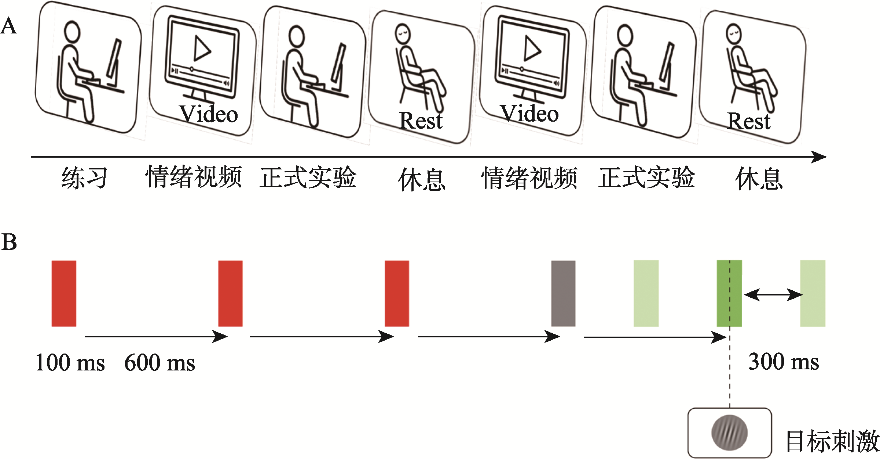
图1 实验1流程图 注:(A) 实验实施流程示意图。在每个子组块开始前, 被试观看一段情绪诱发视频以确立相应的情绪状态, 随后完成朝向辨别任务。目标消失后屏幕保持空白, 直至被试做出按键反应。被试在不同组块间休息5分钟。(B) 单个试次的流程示意图; 节律性线索为依次呈现的红色方块, 每个红色方块呈现100 ms, 间隔(ISI)为600 ms。在最后一个红色方块消失600 ms后, 呈现一个100 ms白色方块警示信号(图中灰色方块仅为示意)。目标刺激(Gabor光栅)在警示信号消失后呈现100 ms。在线索有效(valid)条件下(占60%的试次), 目标在节律预期的精确时间点出现(绿色矩形, 警示信号后600 ms)。在线索无效(invalid)条件下(占40%的试次), 目标(淡绿色矩形)则随机地在预期时间点之前(300 ms)或之后(900 ms)出现。被试的任务是迅速且准确地对Gabor光栅的朝向做出判断。绿色条带仅为时间窗口示意, 非真实刺激。彩图见电子版, 下同。
| 指标 | 消极情绪 | 中性情绪 | 积极情绪 | F | ηp2 | 简单效应 |
|---|---|---|---|---|---|---|
| 情绪效价 | 2.52±0.20 | 4.92±0.21 | 6.78±0.20 | 101.00*** | 0.842 | 积极>中性***; 积极>消极***; 中性>消极*** |
| 唤醒度 | 6.85±0.28 | 3.10±0.15 | 6.20±0.22 | 83.20*** | 0.814 | 消极>中性***; 积极>中性***; 消极 vs 积极: ns |
| PANAS-PA | 18.50±1.43 | 22.10±1.65 | 29.30±1.17 | 16.10*** | 0.573 | 积极>中性***; 积极>消极***; 中性 vs 消极: ns |
| PANAS-NA | 25.60±0.43 | 11.30±0.31 | 11.60±0.67 | 364.00*** | 0.968 | 消极>中性***; 消极>积极***; 中性 vs 积极: ns |
表1 不同情绪视频诱发的效价、唤醒度以及PANAS量表得分差异
| 指标 | 消极情绪 | 中性情绪 | 积极情绪 | F | ηp2 | 简单效应 |
|---|---|---|---|---|---|---|
| 情绪效价 | 2.52±0.20 | 4.92±0.21 | 6.78±0.20 | 101.00*** | 0.842 | 积极>中性***; 积极>消极***; 中性>消极*** |
| 唤醒度 | 6.85±0.28 | 3.10±0.15 | 6.20±0.22 | 83.20*** | 0.814 | 消极>中性***; 积极>中性***; 消极 vs 积极: ns |
| PANAS-PA | 18.50±1.43 | 22.10±1.65 | 29.30±1.17 | 16.10*** | 0.573 | 积极>中性***; 积极>消极***; 中性 vs 消极: ns |
| PANAS-NA | 25.60±0.43 | 11.30±0.31 | 11.60±0.67 | 364.00*** | 0.968 | 消极>中性***; 消极>积极***; 中性 vs 积极: ns |
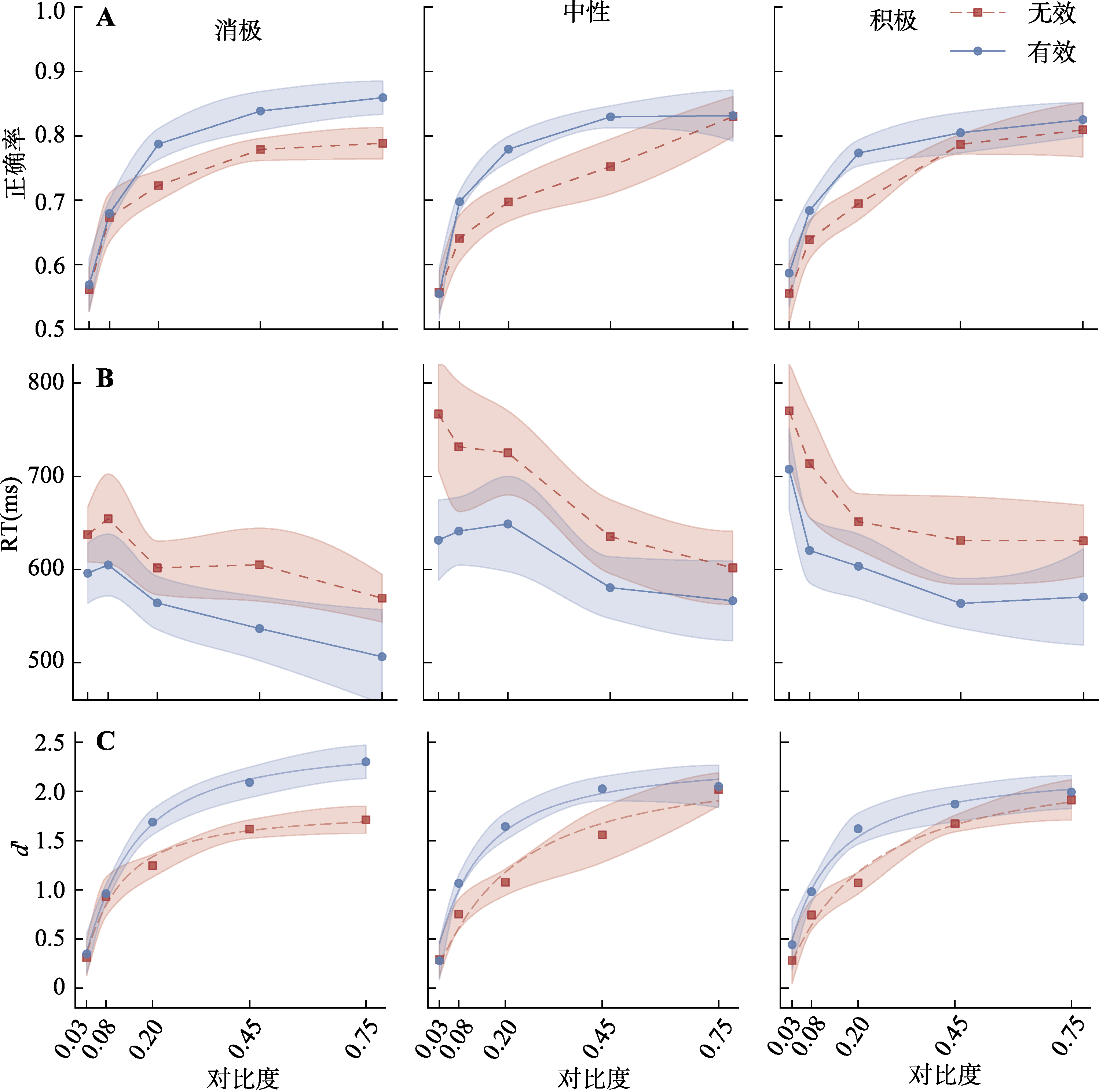
图2 实验1中不同情绪状态对节律性时间注意的影响 注:数据随刺激对比度的变化情况分别在消极(左列)、中性(中列)和积极(右列)情绪条件下绘制。(A)正确率, (B)反应时, (C)辨别力(d')及其对应的归一化模型拟合曲线。在A-C图中, 带有圆形标记的蓝色实线代表节律有效条件, 带有方形标记的红色虚线代表节律无效条件。阴影区域表示被试间(N=13)的标准误(SEM)计算的95%置信区间。在C图中, 实线和虚线曲线显示了归一化模型对群体平均d' 数据的最佳拟合预测。该模型在各情绪条件下均极好地拟合了数据。
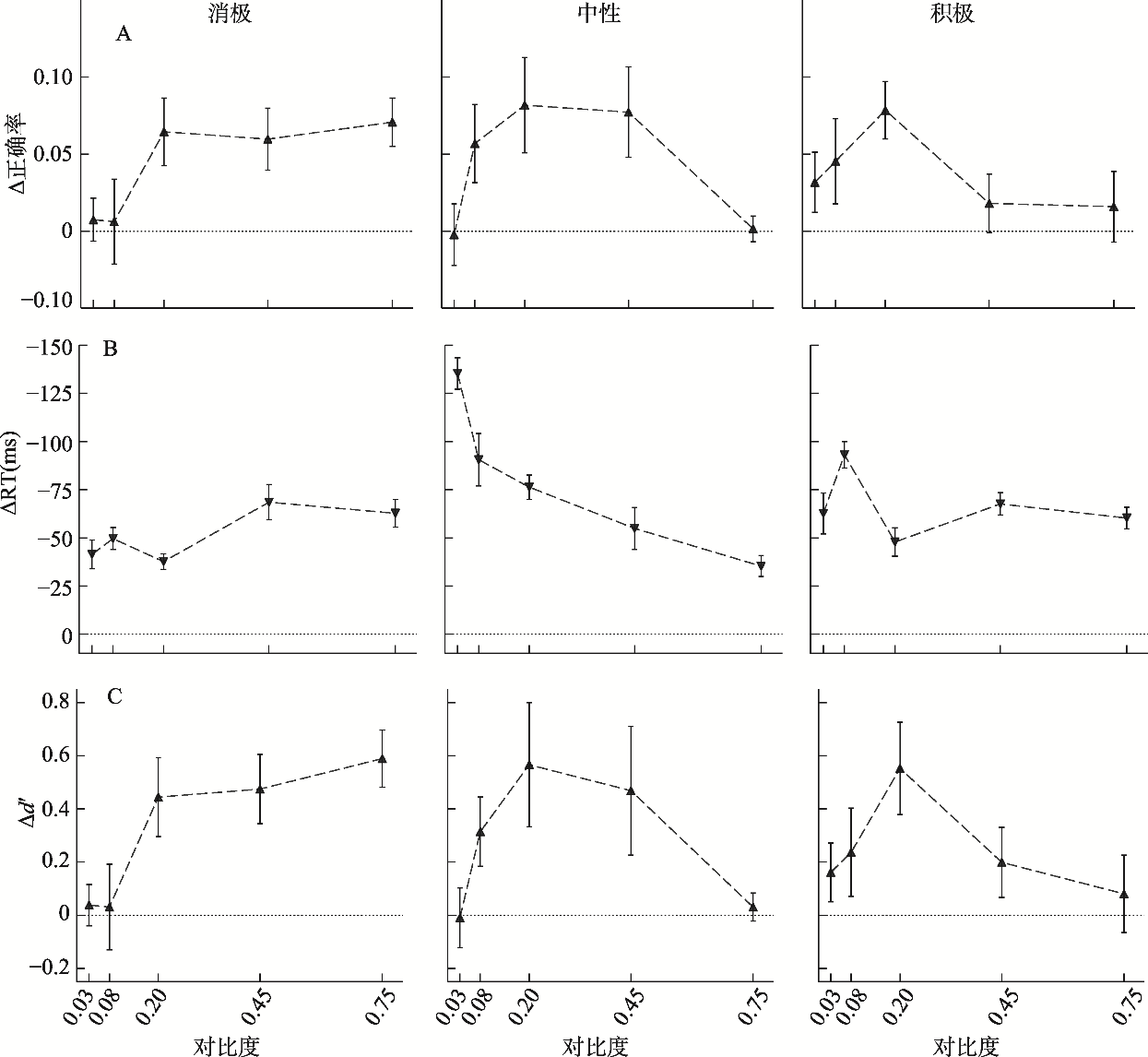
图3 实验1中不同情绪状态下节律性时间注意的增益 注:数据随刺激对比度的变化情况分别在消极(左列)、中性(中列)和积极(右列)情绪条件下绘制。纵坐标表示注意效应的大小, 即有效线索条件减去无效线索条件后的差值, 分别对应(A)正确率、(B)反应时以及(C)辨别力d’。数据揭示了差异化的增益模式:消极情绪下的注意增益随对比度增加呈现单调递增的趋势, 符合响应增益的特征。相比之下, 中性和积极情绪下的注意增益呈现出典型的倒U型轮廓, 即在中等对比度下效应最强, 符合对比增益的特征。误差棒代表标准误(SEM)。
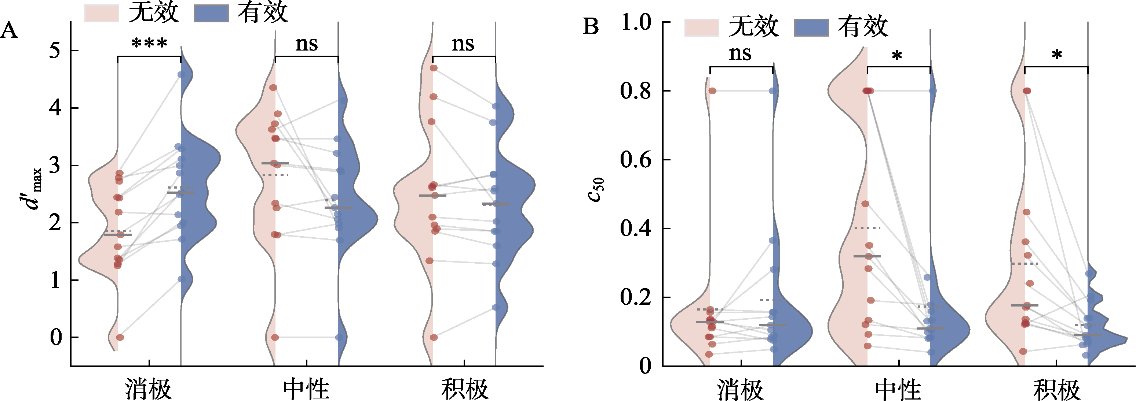
图4 情绪调节时间注意的差异化增益机制 注:小提琴图描绘了不同情绪状态(消极、中性、积极)和线索有效性条件(蓝色=有效; 红色=无效)下, 个体被试(N=13)的最佳拟合参数分布。(A)最大响应(d'max), 反映响应增益。(B)半饱和对比度(c50), 反映对比增益。图中展示了个体数据点, 并用灰色线条连接了同一被试的有效和无效条件。实线横条表示中位数; 点线横条表示平均值。每种情绪状态下有效性条件之间的统计比较标注在图上方。结果显示出明显的分离:消极情绪选择性地增加了d'max (响应增益), 而中性和积极情绪选择性地降低了c50 (对比增益)。ns 不显著; ** p < 0.01; *** p < 0.001。
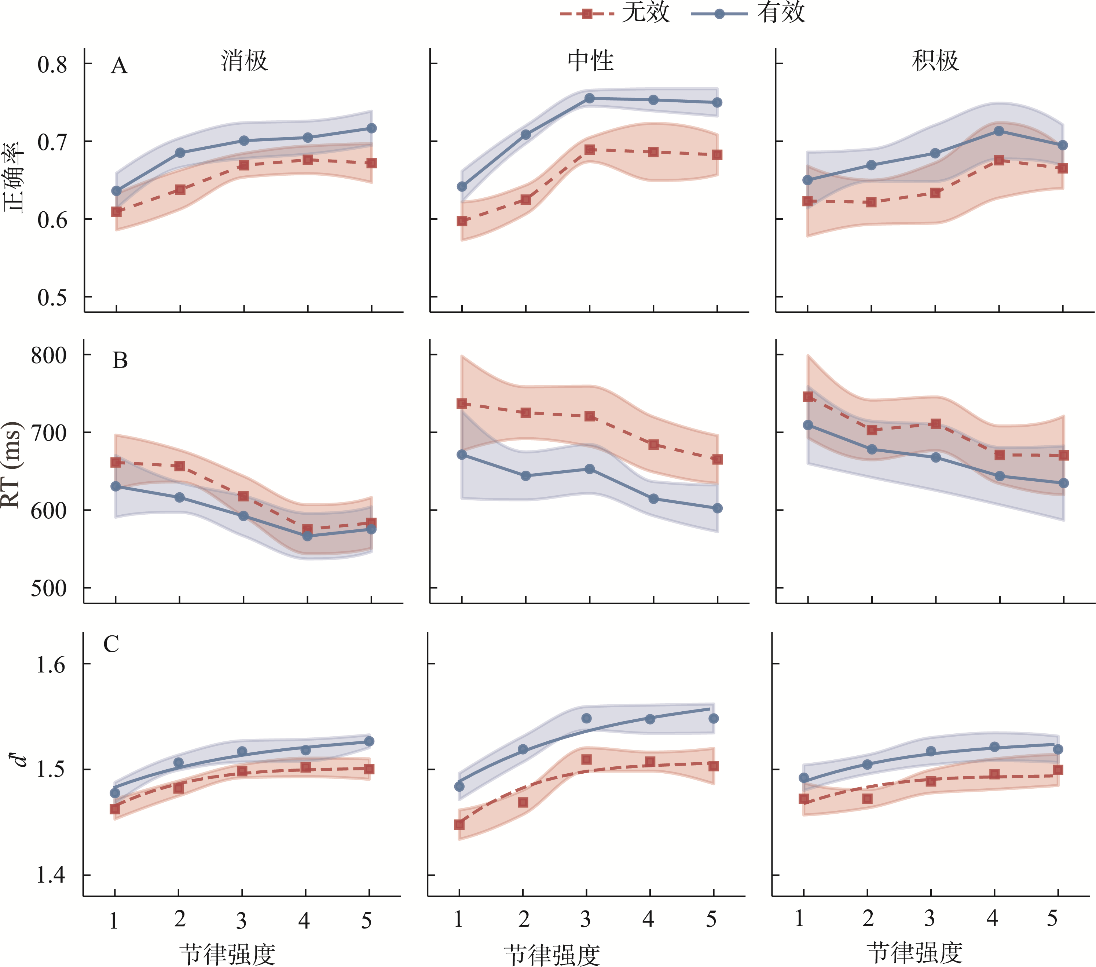
图5 实验2中情绪对节律性时间注意动态建立过程的影响 注:图中展示了消极、中性和积极情绪下的(A) 正确率; (B) 反应时和(C)辨别力d’分别在消极(左列)、中性(中列)和积极(右列)情绪状态下的展示。阴影区域表示被试间 (N=13) 的标准误(SEM)。图(C)的平滑曲线代表动态归一化模型的最佳拟合预测。预测曲线基于剔除两名被试后重新估计的模型参数(拟合流程与参数见网络版补充材料)。在所有情绪条件下, 时间注意均产生了可靠的收益, 表现为有效试次的正确率高于无效试次, 反应速度快于无效试次。然而, 该效应的幅度及其发展轨迹随情绪状态而变化。特别是反应时结果(图B)显示, 相对于中性条件, 消极和积极情绪显著减小了有效性效应, 反映出在情绪状态下时间注意窗口更宽且更灵活。这一模式表明, 随着节律证据的积累, 情绪重塑了时间注意的动态分配。
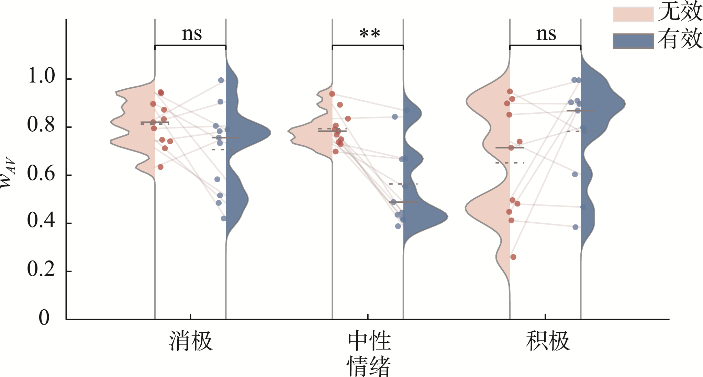
图6 实验2动态归一化模型中情绪对注意权重参数(wav)分配的影响 注:图中各列分别对应消极(左)、中性(中)和积极(右)情绪状态下, 有效(蓝色)与无效(红色)条件间注意权重参数的分布情况。图中散点代表个体被试(N=11)的模型拟合参数, 灰色连线连接了同一被试在不同条件下的数据点。实线横条代表中位数, 点线横条代表平均值。统计标识显示, 中性情绪下有效与无效条件的权重差异显著, 表明注意资源高度聚焦; 而消极和积极情绪下两者差异未达显著水平, 反映了更为均衡的资源分配模式。ns不显著; ** p < 0.01; *** p < 0.001。
| 指标 | 效应 | RM-ANOVA(主分析) | LMM 随机截距 | LMM 随机斜率(全协方差) |
|---|---|---|---|---|
| 实验2 反应时 | 情绪×有效性 | F(2, 24)=10.02, p < 0.001 | F(2, 348)=1.50, p=0.225 | F(2, 288)=3.49, p=0.032 |
| 实验2 正确率 | 情绪×有效性 | F(2, 24)=2.67, p=0.090 | F(2, 348)=2.35, p=0.097 | F(2, 300)=5.08, p=0.007 |
| 实验1 正确率 | 情绪×有效性×对比度 | F(8, 96)=5.35, p < 0.001 | F(8, 348)=1.60, p=0.122 | F(8, 300)=4.09, p < 0.001 |
| 实验1 反应时 | 情绪×有效性×对比度 | F(8, 96)=2.34, p=0.024 | F(8, 348)=0.50, p=0.853 | F(8, 288)=1.03, p=0.414 |
补充表S1 实验1和实验2关键效应的重复测量方差分析与线性混合效应模型结果对照
| 指标 | 效应 | RM-ANOVA(主分析) | LMM 随机截距 | LMM 随机斜率(全协方差) |
|---|---|---|---|---|
| 实验2 反应时 | 情绪×有效性 | F(2, 24)=10.02, p < 0.001 | F(2, 348)=1.50, p=0.225 | F(2, 288)=3.49, p=0.032 |
| 实验2 正确率 | 情绪×有效性 | F(2, 24)=2.67, p=0.090 | F(2, 348)=2.35, p=0.097 | F(2, 300)=5.08, p=0.007 |
| 实验1 正确率 | 情绪×有效性×对比度 | F(8, 96)=5.35, p < 0.001 | F(8, 348)=1.60, p=0.122 | F(8, 300)=4.09, p < 0.001 |
| 实验1 反应时 | 情绪×有效性×对比度 | F(8, 96)=2.34, p=0.024 | F(8, 348)=0.50, p=0.853 | F(8, 288)=1.03, p=0.414 |
| 被试编号 | 正确率 | 平均d′ | r30 | r30秩次 | r6 | r6秩次 | 分析决定 |
|---|---|---|---|---|---|---|---|
| 01 | 0.708 | 1.114 | 0.756 | 12 | 0.623 | 9 | 纳入 |
| 02 | 0.580 | 0.404 | 0.802 | 13 | 0.717 | 12 | 纳入 |
| 03 | 0.693 | 1.044 | 0.364 | 4 | 0.272 | 3 | 纳入 |
| 04 | 0.541 | 0.209 | 0.509 | 5 | 0.275 | 4 | 纳入 |
| 05 | 0.699 | 1.061 | 0.233 | 2 | −0.023 | 2 | 排除 |
| 06 | 0.793 | 1.669 | 0.745 | 11 | 0.663 | 10 | 纳入 |
| 07 | 0.622 | 0.642 | −0.105 | 1 | −0.024 | 1 | 排除 |
| 08 | 0.615 | 0.594 | 0.609 | 9 | 0.847 | 13 | 纳入 |
| 09 | 0.705 | 1.091 | 0.282 | 3 | 0.480 | 6 | 纳入 |
| 10 | 0.717 | 1.161 | 0.559 | 6 | 0.428 | 5 | 纳入 |
| 11 | 0.748 | 1.361 | 0.561 | 7 | 0.504 | 7 | 纳入 |
| 12 | 0.708 | 1.117 | 0.732 | 10 | 0.671 | 11 | 纳入 |
| 13 | 0.627 | 0.668 | 0.591 | 8 | 0.570 | 8 | 纳入 |
补充表S2 实验2逐被试剖面一致性指标及模型拟合纳入决定
| 被试编号 | 正确率 | 平均d′ | r30 | r30秩次 | r6 | r6秩次 | 分析决定 |
|---|---|---|---|---|---|---|---|
| 01 | 0.708 | 1.114 | 0.756 | 12 | 0.623 | 9 | 纳入 |
| 02 | 0.580 | 0.404 | 0.802 | 13 | 0.717 | 12 | 纳入 |
| 03 | 0.693 | 1.044 | 0.364 | 4 | 0.272 | 3 | 纳入 |
| 04 | 0.541 | 0.209 | 0.509 | 5 | 0.275 | 4 | 纳入 |
| 05 | 0.699 | 1.061 | 0.233 | 2 | −0.023 | 2 | 排除 |
| 06 | 0.793 | 1.669 | 0.745 | 11 | 0.663 | 10 | 纳入 |
| 07 | 0.622 | 0.642 | −0.105 | 1 | −0.024 | 1 | 排除 |
| 08 | 0.615 | 0.594 | 0.609 | 9 | 0.847 | 13 | 纳入 |
| 09 | 0.705 | 1.091 | 0.282 | 3 | 0.480 | 6 | 纳入 |
| 10 | 0.717 | 1.161 | 0.559 | 6 | 0.428 | 5 | 纳入 |
| 11 | 0.748 | 1.361 | 0.561 | 7 | 0.504 | 7 | 纳入 |
| 12 | 0.708 | 1.117 | 0.732 | 10 | 0.671 | 11 | 纳入 |
| 13 | 0.627 | 0.668 | 0.591 | 8 | 0.570 | 8 | 纳入 |
| 编号 | 分析与指标 | 家族划分依据 | 纳入同一家族的比较 | m | 校正方法 |
|---|---|---|---|---|---|
| M1 | 情绪操纵视频效价(2.1.5) | 效价主效应后三水平比较 | 积极-中性; 积极-消极; 中性-消极 | 3 | BH-FDR |
| M2 | 情绪操纵视频唤醒度(2.1.5) | 唤醒度主效应后三水平比较 | 消极-中性; 积极-中性; 消极-积极 | 3 | BH-FDR |
| M3 | 情绪操纵PANAS- PA(2.1.5) | 情绪主效应后三水平比较 | 积极-中性; 积极-消极; 消极-中性 | 3 | BH-FDR |
| M4 | 情绪操纵PANAS- NA(2.1.5) | 情绪主效应后三水平比较 | 消极-中性; 消极-积极; 中性-积极 | 3 | BH-FDR |
| E1-1 | 实验1正确率(2.2.1) | 情绪×有效性×对比度交互作用 | 3情绪×5对比度下正确率的有效-无效比较 | 15 | BH-FDR |
| E1-2 | 实验1反应时(2.2.2) | 情绪×有效性×对比度交互作用 | 3情绪×5对比度下反应时的有效-无效比较 | 15 | BH-FDR |
| E1-3 | 实验1 d′max(2.2.3) | 情绪×有效性交互作用 | 消极:有效-无效; 中性:有效-无效; 积极:有效-无效 | 3 | BH-FDR |
| E1-4 | 实验1 c50(2.2.3) | 情绪×有效性交互作用 | 消极:有效-无效; 中性:有效-无效; 积极:有效-无效 | 3 | BH-FDR |
| E1-5 | 实验1 Δd′(2.2.3) | 消极情绪下的理论驱动对比度比较 | 0.45-0.03; 0.45-0.08 | 2 | BH-FDR |
| E1-6 | 实验1 Δd′(2.2.3) | 积极情绪下的理论驱动对比度比较 | 0.20-0.03; 0.20-0.75 | 2 | BH-FDR |
| E1-7 | 实验1正确率(2.2.1) | 风险率补充分析中目标比较 | 无效早期300 ms-无效晚期900 ms | 1 | BH-FDR |
| E1-8 | 实验1反应时(2.2.2) | 风险率补充分析的三时间点比较 | 300-600 ms; 300-900 ms; 600-900 ms | 3 | BH-FDR |
| E2-1 | 实验2正确率(3.2.1) | 节律强度主效应后目标比较 | 3线索-1线索 | 1 | BH-FDR |
| E2-2 | 实验2正确率(3.2.1) | 中性情绪节律强度简单效应 | 3线索-1线索; 3线索-5线索 | 2 | BH-FDR |
| E2-3 | 实验2反应时(3.2.2) | 情绪主效应后理论驱动比较 | 中性-消极; 积极-消极 | 2 | BH-FDR |
| E2-4 | 实验2反应时(3.2.2) | 节律强度主效应后目标比较 | 1线索-4线索 | 1 | BH-FDR |
| E2-5 | 实验2反应时(3.2.2) | 情绪×有效性交互作用 | 消极:无效-有效; 中性:无效-有效; 积极:无效-有效 | 3 | BH-FDR |
| E2-6 | 实验2 ΔRT(3.2.2) | 情绪对有效性效应大小影响 | 中性-消极; 中性-积极 | 2 | BH-FDR |
| E2-7 | 实验2 wav(3.2.4) | 情绪×有效性交互作用 | 消极:有效-无效; 中性:有效-无效; 积极:有效-无效 | 3 | BH-FDR |
补充表S3 各事后比较家族的定义检验数量与校正方法
| 编号 | 分析与指标 | 家族划分依据 | 纳入同一家族的比较 | m | 校正方法 |
|---|---|---|---|---|---|
| M1 | 情绪操纵视频效价(2.1.5) | 效价主效应后三水平比较 | 积极-中性; 积极-消极; 中性-消极 | 3 | BH-FDR |
| M2 | 情绪操纵视频唤醒度(2.1.5) | 唤醒度主效应后三水平比较 | 消极-中性; 积极-中性; 消极-积极 | 3 | BH-FDR |
| M3 | 情绪操纵PANAS- PA(2.1.5) | 情绪主效应后三水平比较 | 积极-中性; 积极-消极; 消极-中性 | 3 | BH-FDR |
| M4 | 情绪操纵PANAS- NA(2.1.5) | 情绪主效应后三水平比较 | 消极-中性; 消极-积极; 中性-积极 | 3 | BH-FDR |
| E1-1 | 实验1正确率(2.2.1) | 情绪×有效性×对比度交互作用 | 3情绪×5对比度下正确率的有效-无效比较 | 15 | BH-FDR |
| E1-2 | 实验1反应时(2.2.2) | 情绪×有效性×对比度交互作用 | 3情绪×5对比度下反应时的有效-无效比较 | 15 | BH-FDR |
| E1-3 | 实验1 d′max(2.2.3) | 情绪×有效性交互作用 | 消极:有效-无效; 中性:有效-无效; 积极:有效-无效 | 3 | BH-FDR |
| E1-4 | 实验1 c50(2.2.3) | 情绪×有效性交互作用 | 消极:有效-无效; 中性:有效-无效; 积极:有效-无效 | 3 | BH-FDR |
| E1-5 | 实验1 Δd′(2.2.3) | 消极情绪下的理论驱动对比度比较 | 0.45-0.03; 0.45-0.08 | 2 | BH-FDR |
| E1-6 | 实验1 Δd′(2.2.3) | 积极情绪下的理论驱动对比度比较 | 0.20-0.03; 0.20-0.75 | 2 | BH-FDR |
| E1-7 | 实验1正确率(2.2.1) | 风险率补充分析中目标比较 | 无效早期300 ms-无效晚期900 ms | 1 | BH-FDR |
| E1-8 | 实验1反应时(2.2.2) | 风险率补充分析的三时间点比较 | 300-600 ms; 300-900 ms; 600-900 ms | 3 | BH-FDR |
| E2-1 | 实验2正确率(3.2.1) | 节律强度主效应后目标比较 | 3线索-1线索 | 1 | BH-FDR |
| E2-2 | 实验2正确率(3.2.1) | 中性情绪节律强度简单效应 | 3线索-1线索; 3线索-5线索 | 2 | BH-FDR |
| E2-3 | 实验2反应时(3.2.2) | 情绪主效应后理论驱动比较 | 中性-消极; 积极-消极 | 2 | BH-FDR |
| E2-4 | 实验2反应时(3.2.2) | 节律强度主效应后目标比较 | 1线索-4线索 | 1 | BH-FDR |
| E2-5 | 实验2反应时(3.2.2) | 情绪×有效性交互作用 | 消极:无效-有效; 中性:无效-有效; 积极:无效-有效 | 3 | BH-FDR |
| E2-6 | 实验2 ΔRT(3.2.2) | 情绪对有效性效应大小影响 | 中性-消极; 中性-积极 | 2 | BH-FDR |
| E2-7 | 实验2 wav(3.2.4) | 情绪×有效性交互作用 | 消极:有效-无效; 中性:有效-无效; 积极:有效-无效 | 3 | BH-FDR |
| 情绪 | 线索有效性 | attn | pn | tauAV | aAV | tauAI | aAI | AVDur | base | AVWeights | R2 |
|---|---|---|---|---|---|---|---|---|---|---|---|
| 消极 | 无效 | 4.448 | 10.760 | 1.819 | 49.503 | 8.915 | 28.106 | 88.476 | 49.790 | 0.564 | 0.940 |
| 消极 | 有效 | 4.569 | 11.158 | 4.701 | 8.427 | 1.621 | 7.426 | 301.318 | 73.160 | 0.416 | 0.940 |
| 中性 | 无效 | 3.096 | 5.977 | 8.796 | 42.972 | 31.395 | 4.527 | 74.198 | 89.025 | 0.148 | 0.909 |
| 中性 | 有效 | 3.333 | 11.276 | 1.001 | 14.801 | 13.208 | 4.553 | 739.606 | 82.600 | 0.530 | 0.909 |
| 积极 | 无效 | 3.760 | 6.031 | 7.114 | 43.768 | 2.618 | 48.645 | 118.974 | 84.940 | 0.131 | 0.907 |
| 积极 | 有效 | 3.642 | 9.077 | 29.860 | 10.635 | 13.127 | 1.135 | 296.944 | 75.956 | 0.330 | 0.907 |
补充表S4 实验2动态归一化模型剔除后重估的自由参数与R2
| 情绪 | 线索有效性 | attn | pn | tauAV | aAV | tauAI | aAI | AVDur | base | AVWeights | R2 |
|---|---|---|---|---|---|---|---|---|---|---|---|
| 消极 | 无效 | 4.448 | 10.760 | 1.819 | 49.503 | 8.915 | 28.106 | 88.476 | 49.790 | 0.564 | 0.940 |
| 消极 | 有效 | 4.569 | 11.158 | 4.701 | 8.427 | 1.621 | 7.426 | 301.318 | 73.160 | 0.416 | 0.940 |
| 中性 | 无效 | 3.096 | 5.977 | 8.796 | 42.972 | 31.395 | 4.527 | 74.198 | 89.025 | 0.148 | 0.909 |
| 中性 | 有效 | 3.333 | 11.276 | 1.001 | 14.801 | 13.208 | 4.553 | 739.606 | 82.600 | 0.530 | 0.909 |
| 积极 | 无效 | 3.760 | 6.031 | 7.114 | 43.768 | 2.618 | 48.645 | 118.974 | 84.940 | 0.131 | 0.907 |
| 积极 | 有效 | 3.642 | 9.077 | 29.860 | 10.635 | 13.127 | 1.135 | 296.944 | 75.956 | 0.330 | 0.907 |
| [1] | Abreu R., Leal A., & Figueiredo P. (2018). EEG-informed fMRI: A review of data analysis methods. Frontiers in Human Neuroscience, 12, 29. https://doi.org/10.3389/fnhum.2018.00029 |
| [2] | Acerbi L., & Ma W. J. (2017). Practical Bayesian optimization for model fitting with Bayesian adaptive direct search. Advances in Neural Information Processing Systems, 30, 1834-1844. |
| [3] | Arnal L. H., & Giraud A.-L. (2012). Cortical oscillations and sensory predictions. Trends in Cognitive Sciences, 16(7), 390-398. https://doi.org/10.1016/j.tics.2012.05.003 |
| [4] | Barr D. J., Levy R., Scheepers C., & Tily H. J. (2013). Random effects structure for confirmatory hypothesis testing: Keep it maximal. Journal of Memory and Language, 68(3), 255-278. |
| [5] | Barrett L. F. (2017). The theory of constructed emotion: An active inference account of interoception and categorization. Social Cognitive and Affective Neuroscience, 12(1), 1-23. https://doi.org/10.1093/scan/nsw154 |
| [6] | Bates D., Mächler M., Bolker B., & Walker S. (2015). Fitting linear mixed-effects models using lme4. Journal of Statistical Software, 67(1), 1-48. https://doi.org/10.18637/jss.v067.i01 |
| [7] | Breska A., & Deouell L. Y. (2017). Neural mechanisms of rhythm-based temporal prediction: Delta phase-locking reflects temporal predictability but not rhythmic entrainment. PLoS Biology, 15(2), e2001665. |
| [8] | Carandini M., & Heeger D. J. (2012). Normalization as a canonical neural computation. Nature Reviews Neuroscience, 13(1), 51-62. https://doi.org/10.1038/nrn3136 |
| [9] | Carrasco M. (2011). Visual attention: The past 25 years. Vision Research, 51(13), 1484-1525. https://doi.org/10.1016/j.visres.2011.04.012 |
| [10] | Codispoti M., De Cesarei A., & Ferrari V. (2023). Alpha- band oscillations and emotion: A review of studies on picture perception. Psychophysiology, 60(12), e14438. https://doi.org/10.1111/psyp.14438 |
| [11] | Cohen J. D., McClure S. M., & Yu A. J. (2007). Should I stay or should I go? How the human brain manages the trade-off between exploitation and exploration. Philosophical Transactions of the Royal Society B: Biological Sciences, 362(1481), 933-942. https://doi.org/10.1098/rstb.2007.2098 |
| [12] | Damasio A. R. (1994). Descartes’ error: Emotion, reason, and the human brain. G.P. Putnam’s Sons. |
| [13] | den Ouden H. E. M., Kok P., & de Lange F. P. (2012). How prediction errors shape perception, attention, and motivation. Frontiers in Psychology, 3, 548. https://doi.org/10.3389/fpsyg.2012.00548 |
| [14] | Denison R. N., Carrasco M., & Heeger D. J. (2021). A dynamic normalization model of temporal attention. Nature Human Behaviour, 5(12), 1674-1685. https://doi.org/10.1038/s41562-021-01129-1 |
| [15] | Droit-Volet S., & Meck W. H. (2007). How emotions colour our perception of time. Trends in Cognitive Sciences, 11(12), 504-513. https://doi.org/10.1016/j.tics.2007.09.008 |
| [16] | Eysenck M. W., Derakshan N., Santos R., & Calvo M. G. (2007). Anxiety and cognitive performance: Attentional control theory. Emotion, 7(2), 336-353. https://doi.org/10.1037/1528-3542.7.2.336 |
| [17] | Feldman H., & Friston K. J. (2010). Attention, uncertainty, and free-energy. Frontiers in Human Neuroscience, 4, 215. https://doi.org/10.3389/fnhum.2010.00215 |
| [18] | Forgas J. P. (1995). Mood and judgment: The affect infusion model (AIM). Psychological Bulletin, 117(1), 39-66. https://doi.org/10.1037/0033-2909.117.1.39 |
| [19] | Fredrickson B. L. (2001). The role of positive emotions in positive psychology: The broaden-and-build theory of positive emotions. American Psychologist, 56(3), 218-226. https://doi.org/10.1037/0003-066X.56.3.218 |
| [20] | Fredrickson B. L. (2004). The broaden-and-build theory of positive emotions. Philosophical Transactions of the Royal Society of London. Series B, Biological Sciences, 359(1449), 1367-1378. https://doi.org/10.1098/rstb.2004.1512 |
| [21] | Frijda N. H. (1986). The emotions. Cambridge University Press. https://books.google.com.sg/books?id=QkNuuVf-pBMC |
| [22] | Friston K. J., Stephan K. E., Montague R., & Dolan R. J. (2014). Computational psychiatry: The brain as a phantastic organ. The Lancet. Psychiatry, 1(2), 148-158. https://doi.org/10.1016/S2215-0366(14)70275-5 |
| [23] | Gable P., & Harmon-Jones E. (2010). The motivational dimensional model of affect: Implications for breadth of attention, memory, and cognitive categorisation. Cognition & Emotion, 24(2), 322-337. https://doi.org/10.1080/02699930903378305 |
| [24] | Gable P. A., & Harmon-Jones E. (2008). Approach-motivated positive affect reduces breadth of attention. Psychological Science, 19(5), 476-482. https://doi.org/10.1111/j.1467-9280.2008.02112.x |
| [25] | Gasper K., & Clore G. L. (2002). Attending to the big picture: Mood and global versus local processing of visual information. Psychological Science, 13(1), 34-40. https://doi.org/10.1111/1467-9280.00406 |
| [26] | Geddert R., & Egner T. (2022). No need to choose: Independent regulation of cognitive stability and flexibility challenges the stability-flexibility trade-off. Journal of Experimental Psychology: General, 151(12), 3009-3027. https://doi.org/10.1037/xge0001241 |
| [27] | Ghosh S., & Maunsell J. H. R. (2024). Locus coeruleus norepinephrine contributes to visual-spatial attention by selectively enhancing perceptual sensitivity. Neuron, 112(13), 2231-2240.e5. https://doi.org/10.1016/j.neuron.2024.04.001 |
| [28] | Glaze C. M., Kable J. W., & Gold J. I. (2015). Normative evidence accumulation in unpredictable environments. eLife, 4, e08825. |
| [29] | Green D. M., & Swets J. A. (1966). Signal detection theory and psychophysics. John Wiley and Sons. |
| [30] | Gross J. J., & Feldman Barrett L. (2011). Emotion generation and emotion regulation: One or two depends on your point of view. Emotion Review, 3(1), 8-16. https://doi.org/10.1177/1754073910380974 |
| [31] | Grupe D. W., & Nitschke J. B. (2013). Uncertainty and anticipation in anxiety: An integrated neurobiological and psychological perspective. Nature Reviews Neuroscience, 14(7), 488-501. https://doi.org/10.1038/nrn3524 |
| [32] | Harmon-Jones E., Gable P. A., & Price T. F. (2012). The influence of affective states varying in motivational intensity on cognitive scope. Frontiers in Integrative Neuroscience, 6, 73. |
| [33] | Henry M. J., & Obleser J. (2012). Frequency modulation entrains slow neural oscillations and optimizes human listening behavior. Proceedings of the National Academy of Sciences, 109(49), 20095-20100. https://doi.org/10.1073/pnas.1213390109 |
| [34] | Herrmann K., Heeger D. J., & Carrasco M. (2012). Feature-based attention enhances performance by increasing response gain. Vision Research, 74, 10-20. https://doi.org/10.1016/j.visres.2012.04.016 |
| [35] | Insel T. R., & Cuthbert B. N. (2015). Brain disorders? Precisely: Precision medicine comes to psychiatry. Science, 348(6234), 499-500. https://doi.org/10.1126/science.aab2358 |
| [36] | Isen, A. M. (2010). Positive affect and decision making. In M. Lewis, J. M. Haviland-Jones, & L. F. Barrett (Eds.), Handbook of emotions (pp. 261-277). Guilford Press. |
| [37] | Jones M. R., Moynihan H., MacKenzie N., & Puente J. (2002). Temporal aspects of stimulus-driven attending in dynamic arrays. Psychological Science, 13(4), 313-319. https://doi.org/10.1111/1467-9280.00458 |
| [38] | Kanai R., Komura Y., Shipp S., & Friston K. (2015). Cerebral hierarchies: Predictive processing, precision and the pulvinar. Philosophical Transactions of the Royal Society B: Biological Sciences, 370(1668), 20140169. https://doi.org/10.1098/rstb.2014.0169 |
| [39] | Ke S.-C., Lo Y.-H., & Tseng P. (2025). The bidirectional effect of attention on gamma sensory stimulation: 40 hz entrainment is weakened by externally-induced distraction but enhanced by internally-induced distraction. Journal of Alzheimer’s Disease, 108(1), 353-366. https://doi.org/10.1177/13872877251376383 |
| [40] | Kensinger E. A. (2009). Remembering the details: Effects of emotion. Emotion Review, 1(2), 99-113. https://doi.org/10.1177/1754073908100432 |
| [41] | Kuznetsova A., Brockhoff P. B., & Christensen R. H. B. (2017). lmerTest package: Tests in linear mixed effects models. Journal of Statistical Software, 82(13), 1-26. https://doi.org/10.18637/jss.v082.i13 |
| [42] | Lakatos P., Gross J., & Thut G. (2019). A new unifying account of the roles of neuronal entrainment. Current Biology, 29(18), R890-R905. https://doi.org/10.1016/j.cub.2019.07.075 |
| [43] | Lake J. I., LaBar K. S., & Meck W. H. (2016). Emotional modulation of interval timing and time perception. Neuroscience & Biobehavioral Reviews, 64, 403-420. https://doi.org/10.1016/j.neubiorev.2016.03.003 |
| [44] | LeDoux J. (2012). Rethinking the emotional brain. Neuron, 73(4), 653-676. https://doi.org/10.1016/j.neuron.2012.02.004 |
| [45] | Lee T.-H., Greening S. G., Ueno T., Clewett D., Ponzio A., Sakaki M., & Mather M. (2018). Arousal increases neural gain via the locus coeruleus-noradrenaline system in younger adults but not in older adults. Nature Human Behaviour, 2(5), 356-366. https://doi.org/10.1038/s41562-018-0344-1 |
| [46] | Lerner J. S., & Keltner D. (2001). Fear, anger, and risk. Journal of Personality and Social Psychology, 81(1), 146-159. https://doi.org/10.1037/0022-3514.81.1.146 |
| [47] | Lerner J. S., Li Y., Valdesolo P., & Kassam K. S. (2015). Emotion and decision making. Annual Review of Psychology, 66(1), 799-823. https://doi.org/10.1146/annurev-psych-010213-115043 |
| [48] | Liesefeld H. R., & Janczyk M. (2019). Combining speed and accuracy to control for speed-accuracy trade-offs(?). Behavior Research Methods, 51(1), 40-60. https://doi.org/10.3758/s13428-018-1076-x |
| [49] | Marshall T. R., O’Shea J., Jensen O., & Bergmann T. O. (2015). Frontal eye fields control attentional modulation of alpha and gamma oscillations in contralateral occipitoparietal cortex. Journal of Neuroscience, 35(4), 1638-1647. https://doi.org/10.1523/JNEUROSCI.3116-14.2015 |
| [50] | Mather M., Clewett D., Sakaki M., & Harley C. W. (2016). Norepinephrine ignites local hotspots of neuronal excitation: How arousal amplifies selectivity in perception and memory. The Behavioral and Brain Sciences, 39, e200. https://doi.org/10.1017/S0140525X15000667 |
| [51] | Mather M., & Sutherland M. R. (2011). Arousal-biased competition in perception and memory. Perspectives on Psychological Science, 6(2), 114-133. https://doi.org/10.1177/1745691611400234 |
| [52] | Naar R., Taras S. E., Korts L., Uusberg A., & Uusberg H. (2025). High-frequency SSVEP: Evidence for task-driven but not for stimulus-driven affective attention. Psychophysiology, 62(12), e70209. https://doi.org/10.1111/psyp.70209 |
| [53] | Nobre A., Correa A., & Coull J. (2007). The hazards of time. Current Opinion in Neurobiology, 17(4), 465-470. https://doi.org/10.1016/j.conb.2007.07.006 |
| [54] | Nobre A. C., & van Ede F. (2018). Anticipated moments: Temporal structure in attention. Nature Reviews Neuroscience, 19(1), 34-48. https://doi.org/10.1038/nrn.2017.141 |
| [55] | Peirce J., Gray J. R., Simpson S., MacAskill M., Höchenberger R., Sogo H., Kastman E., & Lindeløv J. K. (2019). PsychoPy2: Experiments in behavior made easy. Behavior Research Methods, 51(1), 195-203. https://doi.org/10.3758/s13428-018-01193-y |
| [56] | Pessoa L. (2017). A network model of the emotional brain. Trends in Cognitive Sciences, 21(5), 357-371. https://doi.org/10.1016/j.tics.2017.03.002 |
| [57] | Pessoa L., & Adolphs R. (2010). Emotion processing and the amygdala: From a “low road” to “many roads” of evaluating biological significance. Nature Reviews Neuroscience, 11(11), 773-782. https://doi.org/10.1038/nrn2920 |
| [58] | Pestilli F., Ling S., & Carrasco M. (2009). A population- coding model of attention’s influence on contrast response: Estimating neural effects from psychophysical data. Vision Research, 49(10), 1144-1153. https://doi.org/10.1016/j.visres.2008.09.018 |
| [59] | Phelps E. A. (2006). Emotion and cognition: Insights from studies of the human amygdala. Annual Review of Psychology, 57(1), 27-53. https://doi.org/10.1146/annurev.psych.56.091103.070234 |
| [60] | Phelps E. A., Lempert K. M., & Sokol-Hessner P. (2014). Emotion and decision making: Multiple modulatory neural circuits. Annual Review of Neuroscience, 37, 263-287. https://doi.org/10.1146/annurev-neuro-071013-014119 |
| [61] | Poe G. R., Foote S., Eschenko O., Johansen J. P., Bouret S., Aston-Jones G.,... Sara S. J. (2020). Locus coeruleus: A new look at the blue spot. Nature Reviews Neuroscience, 21(11), 644-659. https://doi.org/10.1038/s41583-020-0360-9 |
| [62] | Pourtois G., Schettino A., & Vuilleumier P. (2013). Brain mechanisms for emotional influences on perception and attention: What is magic and what is not. Biological Psychology, 92(3), 492-512. https://doi.org/10.1016/j.biopsycho.2012.02.007 |
| [63] | Pruessner L., Barnow S., Holt D. V., Joormann J., & Schulze K. (2020). A cognitive control framework for understanding emotion regulation flexibility. Emotion, 20(1), 21-29. https://doi.org/10.1037/emo0000658 |
| [64] | R Core Team. (2023). R: A language and environment for statistical computing. R Foundation for Statistical Computing. https://www.R-project.org/ |
| [65] | Reynolds J. H., & Heeger D. J. (2009). The normalization model of attention. Neuron, 61(2), 168-185. https://doi.org/10.1016/j.neuron.2009.01.002 |
| [66] | Riva G., Wiederhold B. K., & Mantovani F. (2019). Neuroscience of virtual reality: From virtual exposure to embodied medicine. Cyberpsychology, Behavior and Social Networking, 22(1), 82-96. https://doi.org/10.1089/cyber.2017.29099.gri |
| [67] | Rohenkohl G., Cravo A. M., Wyart V., & Nobre A. C. (2012). Temporal expectation improves the quality of sensory information. Journal of Neuroscience, 32(24), 8424-8428. https://doi.org/10.1523/JNEUROSCI.0804-12.2012 |
| [68] | Rowe G., Hirsh J. B., & Anderson A. K. (2007). Positive affect increases the breadth of attentional selection. Proceedings of the National Academy of Sciences, 104(1), 383-388. https://doi.org/10.1073/pnas.0605198104 |
| [69] | Sass K., Habel U., Kellermann T., Mathiak K., Gauggel S., & Kircher T. (2014). The influence of positive and negative emotional associations on semantic processing in depression: An fMRI study. Human Brain Mapping, 35(2), 471-482. https://doi.org/10.1002/hbm.22186 |
| [70] | Schroeder C. E., & Lakatos P. (2009). Low-frequency neuronal oscillations as instruments of sensory selection. Trends in Neurosciences, 32(1), 9-18. https://doi.org/10.1016/j.tins.2008.09.012 |
| [71] | Seymour B., & Dolan R. (2008). Emotion, decision making, and the amygdala. Neuron, 58(5), 662-671. |
| [72] | Singh G. S., & Acerbi L. (2024). PyBADS: Fast and robust black-box optimization in Python. Journal of Open Source Software, 9(94), 5694. https://doi.org/10.21105/joss.05694 |
| [73] | Smith C. A., & Ellsworth P. C. (1985). Patterns of cognitive appraisal in emotion. Journal of Personality and Social Psychology, 48(4), 813-838. |
| [74] | Storbeck J., & Clore G. L. (2008). Affective arousal as information: How affective arousal influences judgments, learning, and memory. Social and Personality Psychology Compass, 2(5), 1824-1843. https://doi.org/10.1111/j.1751-9004.2008.00138.x |
| [75] | Teng X., & Zhang R.-Y. (2025). Sequential temporal anticipation characterized by neural power modulation and in recurrent neural networks. eLife, 13, RP99383. https://doi.org/10.7554/eLife.99383 |
| [76] | Thiele A., & Bellgrove M. A. (2018). Neuromodulation of attention. Neuron, 97(4), 769-785. https://doi.org/10.1016/j.neuron.2018.01.008 |
| [77] | Todd R. M., Cunningham W. A., Anderson A. K., & Thompson E. (2012). Affect-biased attention as emotion regulation. Trends in Cognitive Sciences, 16(7), 365-372. https://doi.org/10.1016/j.tics.2012.06.003 |
| [78] | Vuilleumier P. (2005). How brains beware: Neural mechanisms of emotional attention. Trends in Cognitive Sciences, 9(12), 585-594. https://doi.org/10.1016/j.tics.2005.10.011 |
| [79] | Westermann R., Spies K., Stahl G., & Hesse F. W. (1996). Relative effectiveness and validity of mood induction procedures: A meta-analysis. European Journal of Social Psychology, 26(4), 557-580. https://doi.org/10.1002/(SICI)1099-0992(199607)26:4%253C557::AID-EJSP769%253E3.0.CO;2-4 |
| [80] | Wise T., Michely J., Dayan P., & Dolan R. J. (2019). A computational account of threat-related attentional bias. PLOS Computational Biology, 15(10), e1007341. https://doi.org/10.1371/journal.pcbi.1007341 |
| [81] | Wu X., Wang A., & Zhang M. (2021). How the size of exogenous attentional cues alters visual performance: From response gain to contrast gain. Quarterly Journal of Experimental Psychology, 74(10), 1773-1783. https://doi.org/10.1177/17470218211024829 |
| [82] | Xu Q., Ye C., Gu S., Hu Z., Lei Y., Li X., Huang L., & Liu Q. (2021). Negative and positive bias for emotional faces: Evidence from the attention and working memory paradigms. Neural Plasticity, 2021, 8851066. https://doi.org/10.1155/2021/8851066 |
| [83] | Yu A. J., & Dayan P. (2005). Uncertainty, neuromodulation, and attention. Neuron, 46(4), 681-692. https://doi.org/10.1016/j.neuron.2005.04.026 |
| [84] | Zhang X., Japee S., Safiullah Z., Mlynaryk N., & Ungerleider L. G. (2016). A normalization framework for emotional attention. PLOS Biology, 14(11), e1002578. https://doi.org/10.1371/journal.pbio.1002578 |
| [1] | 李雨桐, 章吟娴, 李姗, 隋雪. 抑郁倾向个体视觉言语情绪信息加工的注意特征[J]. 心理学报, 2026, 58(9): 1828-1842. |
| [2] | 李宜伟, 汤煜尧, 王庭栋, 张丹丹. 前额P3幅度调控对情绪调节的促进作用[J]. 心理学报, 2026, 58(8): 1493-1505. |
| [3] | 韩宪国, 马昕玥, 杨仪琳, 吴琴, 李丹. 早期青少年多元情绪调节与心理适应: 基于多水平潜在剖面分析[J]. 心理学报, 2026, 58(8): 1532-1552. |
| [4] | 刘莉, 王静怡, 邢晓沛, 王美芳. 父母严厉管教与儿童情绪管理的动态双向关系:基于随机截距交叉滞后模型的分析[J]. 心理学报, 2026, 58(8): 1553-1566. |
| [5] | 郑显亮, 宋子佳, 蔡若男, 刘志青. 位高寡助: 权力感如何抑制网络利他行为[J]. 心理学报, 2026, 58(8): 1620-1633. |
| [6] | 潘静洲, 孙彬彬, 许灏颖, 崔泽婷. 非正式领导地位的动态演化: 同事情绪的双路径影响[J]. 心理学报, 2026, 58(8): 1634-1649. |
| [7] | 张文洁, 龙如意, 李苗青, 范伟, 傅小兰. 情绪效价和反应指向对幼儿助人行为的影响: 来自行为和fNIRS的证据[J]. 心理学报, 2026, 58(6): 1143-1159. |
| [8] | 李思瑾, 汤煜尧, 李奇, 王庭栋, 张丹丹. 知人知面, 还需知情:人际距离和情绪表露对人际情绪调节的影响[J]. 心理学报, 2026, 58(5): 840-852. |
| [9] | 张宝山, 陈彦羽, 王梦泽. 诱发孤独刻板印象情境中老年人信任的特征及机制[J]. 心理学报, 2026, 58(5): 887-902. |
| [10] | 宋艺, 付晓彤, 袁加锦, 孙萌, 杨洁敏. 基于执行意图的自我同情语料库编制及其情绪调节功效检验[J]. 心理学报, 2026, 58(3): 480-499. |
| [11] | 袁梦琪, 邹迪, 代乔, 万蓓, 刘庆科, 顾思梦, 王福顺. 不确定性与预期误差对情绪强度的作用:来自行为、眼动和fMRI的证据[J]. 心理学报, 2026, 58(12): 2532-2546. |
| [12] | 黄勇, 汪浩岚, 杨洁敏, 李亚琴, 高伟, 袁加锦. 人际情绪调节对观察学习性恐惧的干预优势:行为与事件相关电位证据[J]. 心理学报, 2026, 58(10): 1990-2007. |
| [13] | 汤煜尧, 李宜伟, 郭新宇, 张丹丹. 基于条件化安慰剂的情绪调节:背外侧前额叶对条件化建立的作用[J]. 心理学报, 2026, 58(10): 2008-2021. |
| [14] | 刘荣, 张双喜, 孙潇, 张桂敏, 宋耀武. 情绪特异性还是普遍性?——抑郁患者抑制控制损伤的ALE元分析[J]. 心理学报, 2026, 58(10): 2022-2034. |
| [15] | 王雪珂, 邓芳, 陈立, 冯廷勇. 孤独症儿童负性情绪调节特征及干预:基于多模态评估的正念与认知策略训练[J]. 心理学报, 2026, 58(1): 39-56. |
| 阅读次数 | ||||||
|
全文 |
|
|||||
|
摘要 |
|
|||||
