

ISSN 0439-755X
CN 11-1911/B
主办:中国心理学会
中国科学院心理研究所
出版:科学出版社
CN 11-1911/B
主办:中国心理学会
中国科学院心理研究所
出版:科学出版社
心理学报 ›› 2026, Vol. 58 ›› Issue (9): 1873-1887.doi: 10.3724/SP.J.1041.2026.1873 cstr: 32110.14.2026.1873
熊思成, 罗艳红, 熊戈, 陈芸, 张斌( )
收稿日期:2025-11-14
发布日期:2026-07-29
出版日期:2026-09-25
通讯作者:
张斌, E-mail: zb303@163.com基金资助:
XIONG Sicheng, LUO Yanhong, XIONG Ge, CHEN Yun, ZHANG Bin()
Received:2025-11-14
Online:2026-07-29
Published:2026-09-25
摘要:
入学初期的大学新生面临社会网络重构与人际适应的关键挑战。在此时期, 社交媒体究竟是促进新生关系融入抑或引发人际疏离仍存分歧, 其深层的作用机制及边界条件也尚待澄清。本研究在大学入学首月对306名新生进行了为期30天的密集追踪调查, 通过构建残差动态结构方程模型, 揭示了社交媒体使用与人际适应在微观时间序列下的关联机制, 以及自我概念清晰性的密集中介作用与嫉妒的跨层次调节效应。结果发现:(1)前日社交媒体使用显著负向预测当日新生的人际适应; (2)前日社交媒体使用会通过降低当日自我概念清晰性, 进而对次日新生的人际适应产生显著的间接负向影响; (3)嫉妒在上述关系中起跨层次调节作用, 即高嫉妒新生更易因前日社交媒体使用, 出现当日自我概念清晰性下降与次日人际适应恶化。上述证据深化了对大学适应期社交媒体负面影响机制的理解, 为引导新生在当下数字生态中平稳适应大学环境提供实践启迪。
中图分类号:
熊思成, 罗艳红, 熊戈, 陈芸, 张斌. (2026). 入学初期大学新生社交媒体使用与人际适应的动态关系: 有调节的密集追踪中介模型. 心理学报, 58(9), 1873-1887.
XIONG Sicheng, LUO Yanhong, XIONG Ge, CHEN Yun, ZHANG Bin. (2026). The dynamic relationship between social media use and interpersonal adaptation among freshmen in their first month of college: A moderated intensive longitudinal mediation model. Acta Psychologica Sinica, 58(9), 1873-1887.
| 变量 | M | SD | ICC | 1 | 2 | 3 | 4 |
|---|---|---|---|---|---|---|---|
| 1. 社交媒体使用 | 221.11 | 124.93 | 0.51 | 1 | −0.31*** | −0.25*** | 0.10*** |
| 2. 人际适应 | 6.24 | 2.07 | 0.49 | −0.30*** | 1 | 0.36*** | −0.06 |
| 3. 自我概念清晰性 | 5.14 | 2.19 | 0.46 | −0.23*** | 0.32*** | 1 | −0.12*** |
| 4. 嫉妒 | 4.70 | 2.62 | − | − | − | − | 1 |
表1 各变量描述统计及相关系数
| 变量 | M | SD | ICC | 1 | 2 | 3 | 4 |
|---|---|---|---|---|---|---|---|
| 1. 社交媒体使用 | 221.11 | 124.93 | 0.51 | 1 | −0.31*** | −0.25*** | 0.10*** |
| 2. 人际适应 | 6.24 | 2.07 | 0.49 | −0.30*** | 1 | 0.36*** | −0.06 |
| 3. 自我概念清晰性 | 5.14 | 2.19 | 0.46 | −0.23*** | 0.32*** | 1 | −0.12*** |
| 4. 嫉妒 | 4.70 | 2.62 | − | − | − | − | 1 |
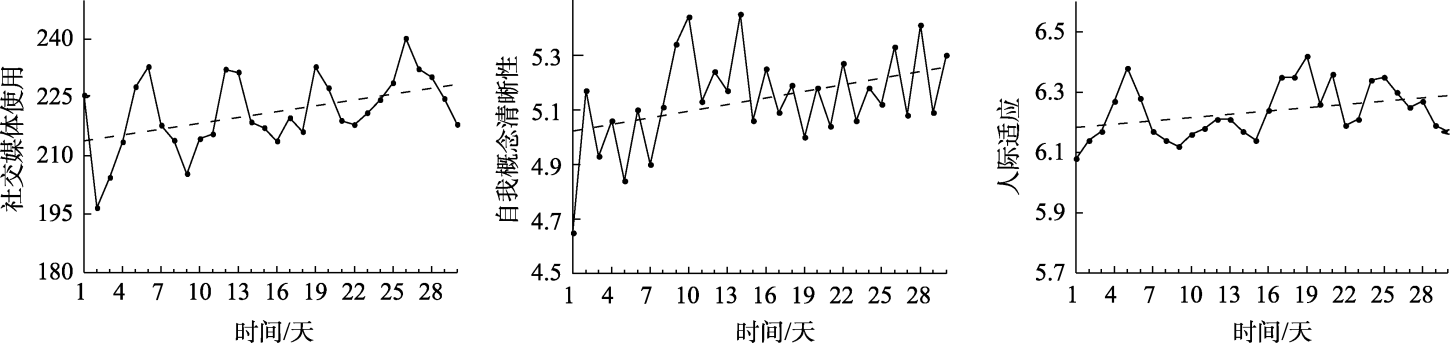
图1 社交媒体使用、自我概念清晰性及人际适应的日水平变化轨迹
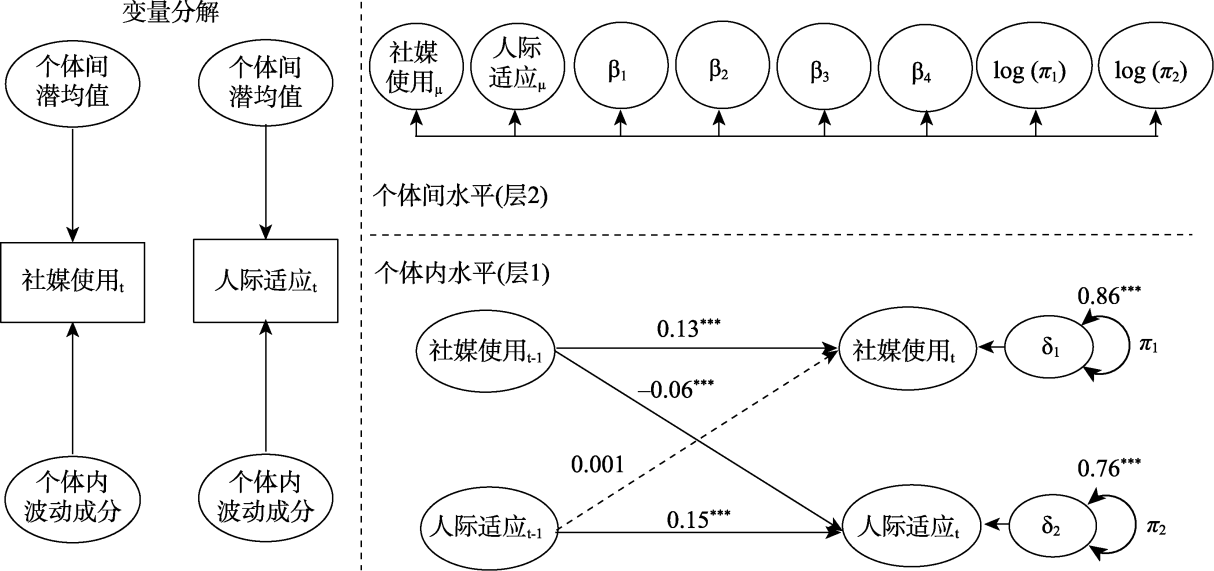
图2 社交媒体使用与人际适应的密集追踪交叉滞后模型 注:μ = 均值, β = 自回归和交叉滞后的标准化路径系数, δ = 残差项, π = 残差方差; 为了更清晰地呈现模型假设, 控制变量、个体间水平和时间趋势相关的路径未予呈现; ***p < 0.001。
| 参数 | 估计值 | 标准差 | 95% BCI |
|---|---|---|---|
| 个体内自回归路径系数 | |||
| 社交媒体使用t−1→社交媒体使用t (β1) | 0.13*** | 0.01 | [0.11, 0.16] |
| 人际适应t−1→人际适应t (β2) | 0.15*** | 0.01 | [0.12, 0.17] |
| 个体内交叉滞后路径系数 | |||
| 社交媒体使用t−1→人际适应t (β3) | −0.06*** | 0.01 | [−0.08, −0.04] |
| 人际适应t−1→社交媒体使用t (β4) | 0.001 | 0.01 | [−0.019, 0.023] |
| 个体内残差方差 | |||
| 社交媒体使用 (π1) | 0.86*** | 0.02 | [0.85, 0.88] |
| 人际适应 (π2) | 0.76*** | 0.01 | [0.75, 0.77] |
表2 社交媒体使用与人际适应的交叉滞后模型参数估计
| 参数 | 估计值 | 标准差 | 95% BCI |
|---|---|---|---|
| 个体内自回归路径系数 | |||
| 社交媒体使用t−1→社交媒体使用t (β1) | 0.13*** | 0.01 | [0.11, 0.16] |
| 人际适应t−1→人际适应t (β2) | 0.15*** | 0.01 | [0.12, 0.17] |
| 个体内交叉滞后路径系数 | |||
| 社交媒体使用t−1→人际适应t (β3) | −0.06*** | 0.01 | [−0.08, −0.04] |
| 人际适应t−1→社交媒体使用t (β4) | 0.001 | 0.01 | [−0.019, 0.023] |
| 个体内残差方差 | |||
| 社交媒体使用 (π1) | 0.86*** | 0.02 | [0.85, 0.88] |
| 人际适应 (π2) | 0.76*** | 0.01 | [0.75, 0.77] |
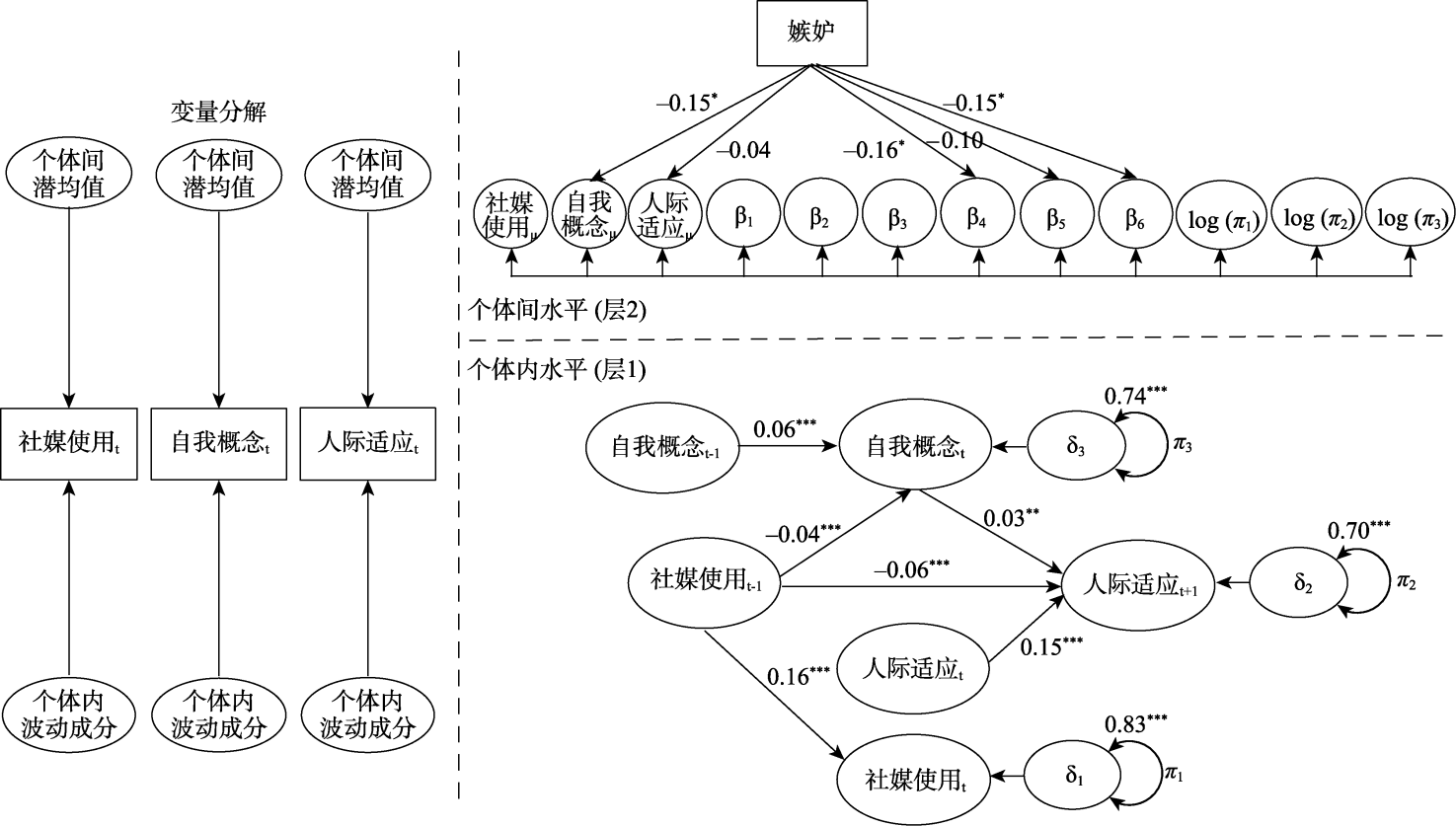
图3 层2变量调节的二阶滞后的1-1-1密集追踪中介模型 注: μ = 均值, β = 标准化路径系数, δ = 残差项, π = 残差方差; 图中省略了时间趋势相关路径, 并在个体间水平仅展示与调节变量相关的路径系数; *p < 0.05, **p < 0.01, ***p < 0.001。
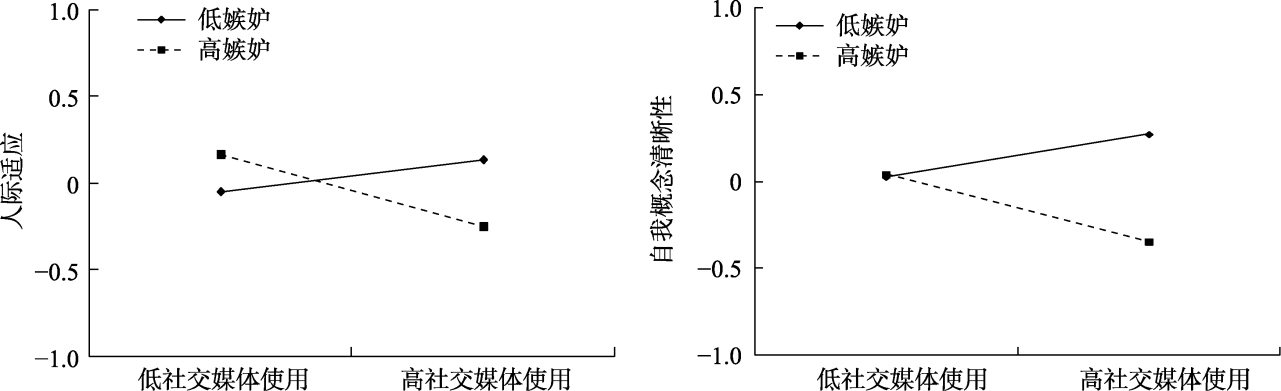
图4 嫉妒与社交媒体使用对自我概念清晰性及人际适应的交互作用
| 参数 | 估计值 | 标准差 | 95% BCI |
|---|---|---|---|
| 个体内自回归路径系数 | |||
| 社交媒体使用t−1→社交媒体使用t (β1) | 0.16*** | 0.01 | [0.13, 0.18] |
| 自我概念清晰性t−1→自我概念清晰性t (β2) | 0.06*** | 0.01 | [0.04, 0.09] |
| 人际适应t→人际适应t+1 (β3) | 0.15*** | 0.01 | [0.12, 0.17] |
| 个体内中介作用路径系数 | |||
| 社交媒体使用t−1→自我概念清晰性t (β4) | −0.04*** | 0.01 | [−0.06, −0.01] |
| 自我概念清晰性t→人际适应t+1 (β5) | 0.03** | 0.01 | [0.01, 0.04] |
| 社交媒体使用t−1→人际适应t+1 (β6) | −0.06*** | 0.01 | [−0.08, −0.04] |
| 个体间调节作用路径系数 | |||
| 嫉妒→人际适应t+1 | −0.04 | 0.07 | [−0.18, 0.08] |
| 嫉妒→自我概念清晰性t | −0.15* | 0.06 | [−0.28, −0.03] |
| 嫉妒×社交媒体使用t−1→自我概念清晰性t | −0.16* | 0.07 | [−0.28, −0.02] |
| 嫉妒×自我概念清晰性t→人际适应t+1 | −0.10 | 0.08 | [−0.25, 0.04] |
| 嫉妒×社交媒体使用t−1→人际适应t+1 | −0.15* | 0.06 | [−0.27, −0.03] |
| 个体内残差方差 | |||
| 社交媒体使用 (π1) | 0.83*** | 0.02 | [0.80, 0.85] |
| 人际适应 (π2) | 0.70*** | 0.01 | [0.69, 0.72] |
| 自我概念清晰性 (π3) | 0.74*** | 0.01 | [0.72, 0.75] |
表3 自我概念清晰性的中介及嫉妒的调节参数估计
| 参数 | 估计值 | 标准差 | 95% BCI |
|---|---|---|---|
| 个体内自回归路径系数 | |||
| 社交媒体使用t−1→社交媒体使用t (β1) | 0.16*** | 0.01 | [0.13, 0.18] |
| 自我概念清晰性t−1→自我概念清晰性t (β2) | 0.06*** | 0.01 | [0.04, 0.09] |
| 人际适应t→人际适应t+1 (β3) | 0.15*** | 0.01 | [0.12, 0.17] |
| 个体内中介作用路径系数 | |||
| 社交媒体使用t−1→自我概念清晰性t (β4) | −0.04*** | 0.01 | [−0.06, −0.01] |
| 自我概念清晰性t→人际适应t+1 (β5) | 0.03** | 0.01 | [0.01, 0.04] |
| 社交媒体使用t−1→人际适应t+1 (β6) | −0.06*** | 0.01 | [−0.08, −0.04] |
| 个体间调节作用路径系数 | |||
| 嫉妒→人际适应t+1 | −0.04 | 0.07 | [−0.18, 0.08] |
| 嫉妒→自我概念清晰性t | −0.15* | 0.06 | [−0.28, −0.03] |
| 嫉妒×社交媒体使用t−1→自我概念清晰性t | −0.16* | 0.07 | [−0.28, −0.02] |
| 嫉妒×自我概念清晰性t→人际适应t+1 | −0.10 | 0.08 | [−0.25, 0.04] |
| 嫉妒×社交媒体使用t−1→人际适应t+1 | −0.15* | 0.06 | [−0.27, −0.03] |
| 个体内残差方差 | |||
| 社交媒体使用 (π1) | 0.83*** | 0.02 | [0.80, 0.85] |
| 人际适应 (π2) | 0.70*** | 0.01 | [0.69, 0.72] |
| 自我概念清晰性 (π3) | 0.74*** | 0.01 | [0.72, 0.75] |
| [1] |
Arıcak, O. T., Dündar, Ş., & Saldaña, M. (2015). Mediating effect of self-acceptance between values and offline/online identity expressions among college students. Computers in Human Behavior, 49, 362-374.
doi: 10.1016/j.chb.2015.03.025 URL |
| [2] |
Becht, A. I., Nelemans, S. A., Van Dijk, M. P., Branje, S. J., Van Lier, P. A., Denissen, J. J., & Meeus, W. H. (2017). Clear self, better relationships: Adolescents’ self-concept clarity and relationship quality with parents and peers across 5 years. Child Development, 88(6), 1823-1833.
doi: 10.1111/cdev.12921 URL |
| [3] | Beras, K. (2018). Prime time: The first 6 weeks adjusting, belonging, and thriving in college. Journal of College Orientation, Transition, and Retention, 25(2), 4-11. |
| [4] | Burgoon, J. K., Stern, L. A., & Dillman, L. (1995). Interpersonal adaptation: Dyadic interaction patterns. Cambridge University Press. |
| [5] |
Campbell, J. D., Trapnell, P. D., Heine, S. J., Katz, I. M., Lavallee, L. F., & Lehman, D. R. (1996). Self-concept clarity: Measurement, personality correlates, and cultural boundaries. Journal of Personality and Social Psychology, 70(1), 141-156.
doi: 10.1037/0022-3514.70.1.141 URL |
| [6] |
Chai, X., & Lin, D. (2021). School transition during adolescence: Turning crisis into opportunity. Advances in Psychological Science, 29(5), 864-874.
doi: 10.3724/SP.J.1042.2021.00864 |
|
[柴晓运, 林丹华. (2021). 化危为机: 青少年学校转折期的过渡. 心理科学进展, 29(5), 864-874.]
doi: 10.3724/SP.J.1042.2021.00864 |
|
| [7] | Cheng, Q. (2023). Alone together: A perspective on the phenomenon of “lonely social” among youth in the social media era and the logic of its formation. Contemporary Youth Research, 5, 74-84. |
| [成倩. (2023). 聚而不群: 社交媒体时代青年“孤独社交”的现象透视与形成逻辑. 当代青年研究, 5, 74-84.] | |
| [8] | Cinelli, M., De Francisci Morales, G., Galeazzi, A., Quattrociocchi, W., & Starnini, M. (2021). The echo chamber effect on social media. Proceedings of the National Academy of Sciences, 118(9), e2023301118. |
| [9] | Cohen, J. (2013). Statistical power analysis for the behavioral sciences. Routledge. |
| [10] |
Credé, M., & Niehorster, S. (2012). Adjustment to college as measured by the student adaptation to college questionnaire: A quantitative review of its structure and relationships with correlates and consequences. Educational Psychology Review, 24(1), 133-165.
doi: 10.1007/s10648-011-9184-5 URL |
| [11] | DataReportal. (2025). Digital 2024: China. Retrieved February 21 from https://datareportal.com/reports/digital-2025-china |
| [12] |
Dong, J., Lee, S., Wang, C. -h., & Shannon, D. M. (2023). Impact on social capital and learning engagement due to social media usage among the international students in the U.S. Education and Information Technologies, 28(7), 8027-8050.
doi: 10.1007/s10639-022-11520-8 |
| [13] | Elder, G. H., Shanahan, M. J., & Jennings, J. A. (2015). Human development in time and place. In R. M. Lerner (Ed.), Handbook of child psychology and developmental science. Wiley. |
| [14] |
Falgoust, G., Winterlind, E., Moon, P., Parker, A., Zinzow, H., & Madathil, K. C. (2023). Applying the uses and gratifications theory to identify motivational factors behind young adult's participation in viral social media challenges on TikTok. Human Factors in Healthcare, 2, 100014.
doi: 10.1016/j.hfh.2022.100014 URL |
| [15] |
Fang, J., Wen, Z., Dong, Y., & Wang, X. (2025). Mediation analysis of intensive longitudinal data. Advances in Psychological Science, 33(4), 717-728.
doi: 10.3724/SP.J.1042.2025.0717 |
|
[方杰, 温忠麟, 董育铭, 王晓洁. (2025). 密集追踪数据的中介效应分析. 心理科学进展, 33(4), 717-728.]
doi: 10.3724/SP.J.1042.2025.0717 |
|
| [16] |
Fang, J., Wen, Z., Wang, H., & Gu, H. (2025). Moderated mediation analyses of intensive longitudinal data. Acta Psychologica Sinica, 57(5), 915-928.
doi: 10.3724/SP.J.1041.2025.0915 URL |
|
[方杰, 温忠麟, 王惠惠, 顾红磊. (2025). 密集追踪数据的有调节的中介效应分析. 心理学报, 57(5), 915-928.]
doi: 10.3724/SP.J.1041.2025.0915 |
|
| [17] | Fang, X., Wo, J., & Lin, X. (2005). Development of Chinese college student adjustment scale. Studies of Psychology and Behavior, 3(2), 95-101. |
| [方晓义, 沃建中, 蔺秀云. (2005). 《中国大学生适应量表》的编制. 心理与行为研究, 3(2), 95-101.] | |
| [18] |
Festinger, L. (1954). A theory of social comparison processes. Human Relations, 7(2), 117-140.
doi: 10.1177/001872675400700202 URL |
| [19] |
Granovetter, M. (1983). The strength of weak ties: A network theory revisited. Sociological Theory, 1, 201-233.
doi: 10.2307/202051 URL |
| [20] |
Gray, R., Vitak, J., Easton, E. W., & Ellison, N. B. (2013). Examining social adjustment to college in the age of social media: Factors influencing successful transitions and persistence. Computers & Education, 67, 193-207.
doi: 10.1016/j.compedu.2013.02.021 URL |
| [21] | Haktanir, A., Watson, J. C., Ermis-Demirtas, H., Karaman, M. A., Freeman, P. D., Kumaran, A., & Streeter, A. (2021). Resilience, academic self-concept, and college adjustment among first-year students. Journal of College Student Retention: Research, Theory & Practice, 23 (1), 161-178. |
| [22] |
Hu, Y., Tian, H., Hou, Y., Zhu, M., & Gao, X. (2025). Social networking sites use exacerbates appearance anxiety in young Chinese women: The moderating role of self-concept clarity. Psychology of Popular Media, 15(2), 227-239.
doi: 10.1037/ppm0000600 URL |
| [23] |
Jia, G., Dai, H., Chu, Y., Wang, X., Hao, Y., & Wang, S. (2022). Psychometric evaluation of the Chinese version of social anxiety scale for social media users and cross-sectional investigation into this disorder among college students. Comprehensive Psychiatry, 116, 152328.
doi: 10.1016/j.comppsych.2022.152328 URL |
| [24] | Jiang, T. (2022). Mediating effects and moderating effects in causal inference. China Industrial Economics, (5), 100-120. |
| [江艇. (2022). 因果推断经验研究中的中介效应与调节效应. 中国工业经济, (5), 100-120.] | |
| [25] |
Kahlow, J. A., Coker, M. C., & Richards, R. (2020). The multimodal nature of Snapchat in close relationships: Toward a social presence-based theoretical framework. Computers in Human Behavior, 111, 106409.
doi: 10.1016/j.chb.2020.106409 URL |
| [26] | Latif, K., Weng, Q., Pitafi, A. H., Ali, A., Siddiqui, A. W., Malik, M. Y., & Latif, Z. (2021). Social comparison as a double-edged sword on social media: The role of envy type and online social identity. Telematics and Informatics, 56, 101470. |
| [27] | Lazarus, R. S., & Folkman, S. (1984). Stress, appraisal, and coping. New York: Springer. |
| [28] |
Lennarz, H. K., Lichtwarck-Aschoff, A., Finkenauer, C., & Granic, I. (2017). Jealousy in adolescents' daily lives: How does it relate to interpersonal context and well-being? Journal of Adolescence, 54, 18-31.
doi: S0140-1971(16)30131-2 pmid: 27863267 |
| [29] |
Lewandowski, G. W., Nardone, N., & Raines, A. J. (2010). The role of self-concept clarity in relationship quality. Self and Identity, 9(4), 416-433.
doi: 10.1080/15298860903332191 URL |
| [30] |
Li, T., & Xu, H. (2022). Self-concept clarity and social anxiety: Analysis of the multiple mediating effects. Studies of Psychology and Behavior, 20(5), 700-706.
doi: 10.12139/j.1672-0628.2022.05.018 |
|
[李甜甜, 徐鹤文. (2022). 大学生自我概念清晰性与社交焦虑的关系: 多重中介效应分析. 心理与行为研究, 20(5), 700-706.]
doi: 10.12139/j.1672-0628.2022.05.018 |
|
| [31] | Lian, S., Rao, S., Wu, Y., Zhang, Y., & Zhang, D. (2025). Short-form video social media dependence and sense of emptiness: The mediating effect of interpersonal disturbances and moderating role of self-construal. Chinese Journal of Clinical Psychology, 33(3), 572-577. |
| [连帅磊, 饶仕杰, 吴宇彤, 张艳红, 张冬静. (2025). 短视频社交媒体依赖与大学生空虚感的关系: 人际关系困扰的中介作用和依存型自我建构的调节作用. 中国临床心理学杂志, 33(3), 572-577.] | |
| [32] |
Lin, S., Falbo, T., Qu, W., Wang, Y., & Feng, X. (2021). Chinese only children and loneliness: Stereotypes and realities. American Journal of Orthopsychiatry, 91(4), 531-544.
doi: 10.1037/ort0000554 URL |
| [33] | Mattingly, B. A., McIntyre, K. P., & Lewandowski, G. W. (2020). Interpersonal relationships and the self-concept. Springer. |
| [34] |
McNeish, D., & MacKinnon, D. P. (2025). Intensive longitudinal mediation in Mplus. Psychological Methods, 30(2), 393-415.
doi: 10.1037/met0000536 URL |
| [35] |
Mercan, N., & Uysal, B. (2023). The relationship of social media addiction with interpersonal problem-solving and personality traits in university students. Archives of Psychiatric Nursing, 43, 50-56.
doi: 10.1016/j.apnu.2022.12.025 pmid: 37032015 |
| [36] |
Ng, J. C., Lin, E. S., & Lee, V. K. (2023). Does Instagram make you speak ill of others or improve yourself? A daily diary study on the moderating role of malicious and benign envy. Computers in Human Behavior, 148, 107873.
doi: 10.1016/j.chb.2023.107873 URL |
| [37] |
Niu, X., Gou, L. X., Han, Y., Zhou, X., & Wang, J. L. (2025). Self-concept clarity and envy as mediators between upward social comparison on social networking sites and subjective well-being. British Journal of Developmental Psychology, 43(3), 611-628.
doi: 10.1111/bjdp.v43.3 URL |
| [38] |
O’Day, E. B., & Heimberg, R. G. (2021). Social media use, social anxiety, and loneliness: A systematic review. Computers in Human Behavior Reports, 3, 100070.
doi: 10.1016/j.chbr.2021.100070 URL |
| [39] |
Olson, C., Toma, C. L., & Brown, B. B. (2025). The role of friendship maintenance over communication technologies in freshmen’s social adjustment to college. Journal of American College Health, 73(10), 4130-4139.
doi: 10.1080/07448481.2025.2475316 URL |
| [40] |
Osler, L. (2024). (Self-) envy, digital technology, and me. Topoi, 43(3), 659-672.
doi: 10.1007/s11245-024-10047-6 |
| [41] | Petre, C. E. (2021). The relationship between Internet use and self-concept clarity: A systematic review and meta-analysis. Cyberpsychology: Journal of Psychosocial Research on Cyberspace, 15(2), 1-4. |
| [42] |
Piccerillo, L., & Digennaro, S. (2025). Adolescent social media use and emotional intelligence: A systematic review. Adolescent Research Review, 10(2), 201-218.
doi: 10.1007/s40894-024-00245-z |
| [43] |
Pouwels, J. L., Valkenburg, P. M., Beyens, I., van Driel, I. I., & Keijsers, L. (2021). Social media use and friendship closeness in adolescents’ daily lives: An experience sampling study. Developmental Psychology, 57(2), 309-323.
doi: 10.1037/dev0001148 pmid: 33539132 |
| [44] |
Rafiq, A., & Linden, B. (2024). Social media and self-concept among postsecondary students: A scoping review. Cyberpsychology, Behavior, and Social Networking, 2727 (3), 194-201.
doi: 10.1089/cyber.2023.0451 URL |
| [45] |
Rice, R. E. (1993). Media appropriateness: Using social presence theory to compare traditional and new organizational media. Human Communication Research, 19(4), 451-484.
doi: 10.1111/hcre.1993.19.issue-4 URL |
| [46] | Rizki, S., & Anti, T. P. (2025). Social media and teens’ self-concept: A systematic literature review. SocioSphere: Interdisciplinary Journal of Social Sciences and Humanities, 1(1), 1-12. |
| [47] |
Schneider, S., & Junghaenel, D. U. (2023). Estimating reliabilities and correcting for sampling error in indices of within- person dynamics derived from intensive longitudinal data. Behavior Research Methods, 55(7), 3872-3891.
doi: 10.3758/s13428-022-01995-1 |
| [48] |
Seo, M., Kim, J., & Yang, H. (2016). Frequent interaction and fast feedback predict perceived social support: Using crawled and self-reported data of Facebook users. Journal of Computer-Mediated Communication, 21(4), 282-297.
doi: 10.1111/jcc4.12160 URL |
| [49] |
She, R., Han Mo, P. K., Li, J., Liu, X., Jiang, H., Chen, Y., Ma, L., & Fai Lau, J. T. (2023). The double-edged sword effect of social networking use intensity on problematic social networking use among college students: The role of social skills and social anxiety. Computers in Human Behavior, 140, 107555.
doi: 10.1016/j.chb.2022.107555 URL |
| [50] | Slotter, E. B., & Emery, L. F. (2017). Self-concept clarity and social role transitions. In J. Lodi-Smith & K. G. DeMarree (Eds.), Self-concept clarity: Perspectives on assessment, research, and applications (pp. 85-106). Springer. |
| [51] |
Smith, R. H., Parrott, W. G., Diener, E. F., Hoyle, R. H., & Kim, S. H. (1999). Dispositional envy. Personality and Social Psychology Bulletin, 25(8), 1007-1020.
doi: 10.1177/01461672992511008 URL |
| [52] |
Sundararajan, L. (2020). Strong-ties and weak-ties rationalities: Toward an expanded network theory. Review of General Psychology, 24(2), 134-143.
doi: 10.1177/1089268020916438 |
| [53] |
Tajmirriyahi, M., & Ickes, W. (2020). Self-concept clarity as a predictor of self-disclosure in romantic relationships. Journal of Social and Personal Relationships, 37(6), 1873-1891.
doi: 10.1177/0265407520911131 URL |
| [54] |
Tandon, A., Dhir, A., & Mäntymäki, M. (2021). Jealousy due to social media? A systematic literature review and framework of social media-induced jealousy. Internet Research, 31(5), 1541-1582.
doi: 10.1108/INTR-02-2020-0103 URL |
| [55] |
Tang, J. H., & Wang, C. C. (2012). Self-disclosure among bloggers: Re-examination of social penetration theory. Cyberpsychology, Behavior, and Social Networking, 15(5), 245-250.
doi: 10.1089/cyber.2011.0403 URL |
| [56] | Teng, G., Jin, S., & Ma, Y. (2015). The influence of new media on university freshmen’s school adaption and education countermeasures. Journal of Northeastern University (Social Science), 17(3), 288-294. |
|
[滕国鹏, 金盛华, 马莹华. (2015). 新媒体对大学新生入学适应的影响及教育策略. 东北大学学报(社会科学版), 17(3), 288-294.]
doi: 10.15936/j.cnki.10083758.2015.03.011 |
|
| [57] |
Thiel, C. E., Bonner, J., Bush, J. T., Welsh, D. T., & Pati, R. (2021). Rationalize or reappraise? How envy and cognitive reappraisal shape unethical contagion. Personnel Psychology, 74(2), 237-263.
doi: 10.1111/peps.v74.2 URL |
| [58] |
Thomas, L., Briggs,, P., Hart, A., & Kerrigan, F. (2017). Understanding social media and identity work in young people transitioning to university. Computers in Human Behavior, 76, 541-553.
doi: 10.1016/j.chb.2017.08.021 URL |
| [59] |
Thomas, L., Orme, E., & Kerrigan, F. (2020). Student loneliness: The role of social media through life transitions. Computers & Education, 146, 103754.
doi: 10.1016/j.compedu.2019.103754 URL |
| [60] |
Török, I. A., Herold, R., Bandi, S., Varga, J. É., Rózsa, S., Somlai, E. H., & Kállai, J. (2025). Social networks and self-function-related interpersonal impairment in problematic Facebook and internet use. Computers in Human Behavior Reports, 18, 100697.
doi: 10.1016/j.chbr.2025.100697 URL |
| [61] | Uzuncakmak, T., Taplak, A. S., & Polat, S. (2022). The relationship between purpose of social media use, social support, loneliness and depression: A sample of first year university students. International Journal of Caring Sciences, 15(2), 1322-1329. |
| [62] |
Valkenburg, P. M., & Peter, J. (2011). Online communication among adolescents: An integrated model of its attraction, opportunities, and risks. Journal of Adolescent Health, 48(2), 121-127.
doi: 10.1016/j.jadohealth.2010.08.020 URL |
| [63] | Wang, B., Jin, C., & Zhao, B. (2020). Relationships among family function, interpersonal adaptation and cyberbullying of adolescents: A moderated mediation effect. Psychological Development and Education, 36(4), 469-476. |
| [王博晨, 金灿灿, 赵宝宝. (2020). 青少年家庭功能、人际适应和网络欺凌的关系: 一个有调节的中介作用. 心理发展与教育, 36(4), 469-476.] | |
| [64] |
Wohn, D. Y., & LaRose, R. (2014). Effects of loneliness and differential usage of Facebook on college adjustment of first-year students. Computers & Education, 76, 158-167.
doi: 10.1016/j.compedu.2014.03.018 URL |
| [65] |
Wolfers, L. N., & Utz, S. (2022). Social media use, stress, and coping. Current Opinion in Psychology, 45, 101305.
doi: 10.1016/j.copsyc.2022.101305 URL |
| [66] |
Wong, T. K., & Hamza, C. A. (2025). Online self-presentation, self-concept clarity, and depressive symptoms: A within- person examination. Journal of Youth and Adolescence, 54(4), 997-1013.
doi: 10.1007/s10964-024-02109-0 |
| [67] |
Wu, C., Yun, Y., Xiao, Z., Zhou, Z., Tong, T., & Ren, Z. (2024). The application of ecological momentary assessment in suicide research. Advances in Psychological Science, 32(12), 2067-2090.
doi: 10.3724/SP.J.1042.2024.02067 |
|
[吴才智, 贠芸, 肖志华, 周忠英, 童婷, 任志洪. (2024). 生态瞬时评估在自杀研究中的应用. 心理科学进展, 32(12), 2067-2090.]
doi: 10.3724/SP.J.1042.2024.02067 |
|
| [68] | Wu, P. Feng, R., & Zhang, J. (2024). The relationship between loneliness and problematic social media usage in Chinese university students: A longitudinal study. BMC Psychology, 12(1), 13. |
| [69] |
Wu, W., Huang, L., & Yang, F. (2024). Social anxiety and problematic social media use: A systematic review and meta-analysis. Addictive Behaviors, 153, 107995.
doi: 10.1016/j.addbeh.2024.107995 URL |
| [70] |
Xiang, Y., He, J., & Li, Q. (2022). The causal mechanism between envy and subjective well-being: Based on a longitudinal study and a diary method. Acta Psychologica Sinica, 54(1), 40-53.
doi: 10.3724/SP.J.1041.2022.00040 |
|
[向燕辉, 何佳丽, 李清银. (2022). 嫉妒与幸福感因果机制: 基于追踪和日记法研究. 心理学报, 54(1), 40-53.]
doi: 10.3724/SP.J.1041.2022.00040 |
|
| [71] |
Yang, C., Holden, S. M., & Carter, M. D. (2017). Emerging adults' social media self-presentation and identity development at college transition: Mindfulness as a moderator. Journal of Applied Developmental Psychology, 52, 212-221.
doi: 10.1016/j.appdev.2017.08.006 URL |
| [72] |
Yang, C, & Lee, Y. (2020). Interactants and activities on Facebook, Instagram, and Twitter: Associations between social media use and social adjustment to college. Applied Developmental Science, 24(1), 62-78.
doi: 10.1080/10888691.2018.1440233 URL |
| [73] |
Yang, Q., van den Bos, K., Zhang, X., Adams, S., & Ybarra, O. (2022). Identity lost and found: Self-concept clarity in social network site contexts. Self and Identity, 21(4), 406-429.
doi: 10.1080/15298868.2021.1940270 URL |
| [74] |
Ye, Y., Zhang, L., Zhao, J., & Kong, F. (2023). The relationship between gratitude and social well-being: Evidence from a longitudinal study and a daily diary investigation. Acta Psychologica Sinica, 55(7), 1087-1098.
doi: 10.3724/SP.J.1041.2023.01087 |
|
[叶颖, 张琳婷, 赵晶晶, 孔风. (2023). 感恩与社会幸福感的双向关系: 来自长期追踪法和日记法的证据. 心理学报, 55(7), 1087-1098.]
doi: 10.3724/SP.J.1041.2023.01087 |
|
| [75] |
Yusainy, C., Adila, I., Kusumastuti, A., Hikmiah, Z., Faradisa, K. R., & Valentinovich, K. V. (2023). When I hate to follow you: Hate-following, envy, and schadenfreude on Instagram. Jurnal Psikologi, 50(3), 245-258.
doi: 10.22146/jpsi.84357 URL |
| [76] | Zhang, X., Luo, J., Peng, T., & Duan, B. (2020). The impact of online positive feedback on friendship quality in college freshmen: The chain mediating effect of self-concept clarity and hope. Chinese Journal of Special Education, 1(11), 83-89. |
| [张晓州, 罗杰, 彭婷, 段宝军. (2020). 线上积极反馈对大学新生友谊质量的影响: 自我概念清晰性与希望的链式中介作用. 中国特殊教育, 1(11), 83-89.] | |
| [77] |
Zhang, Y., Li, S., & Yu, G. (2021). The relationship between social media use and fear of missing out: A meta-analysis. Acta Psychologica Sinica, 53(3), 273-290.
doi: 10.3724/SP.J.1041.2021.00273 |
|
[张亚利, 李森, 俞国良. (2021). 社交媒体使用与错失焦虑的关系: 一项元分析. 心理学报, 53(3), 273-290.]
doi: 10.3724/SP.J.1041.2021.00273 |
|
| [78] | Zhou, H., & Long, L. R. (2004). Statistical remedies for common method biases. Advances in Psychological Science, 12(6), 942-950. |
| [周浩, 龙立荣. (2004). 共同方法偏差的统计检验与控制方法. 心理科学进展, 12(6), 942-950.] | |
| [79] |
Zhou, W., Yan, Z., Yang, Z., & Hussain, Z. (2023). Problematic social media use and mental health risks among first-year Chinese undergraduates: A three-wave longitudinal study. Frontiers in Psychiatry, 14, 1237924.
doi: 10.3389/fpsyt.2023.1237924 URL |
| [1] | 向燕辉, 何佳丽, 李清银. 嫉妒与幸福感因果机制:基于追踪和日记法研究[J]. 心理学报, 2022, 54(1): 40-53. |
| [2] | 李巧灵, 赵君哲, 乔诗绮, 郭腾飞, 王明辉, 赵国祥. 不同社交媒体使用目的对员工工作绩效的影响机制[J]. 心理学报, 2021, 53(11): 1260-1270. |
| [3] | 刘庆奇;牛更枫;范翠英;周宗奎. 被动性社交网站使用与自尊和自我概念清晰性:有调节的中介模型[J]. 心理学报, 2017, 49(1): 60-71. |
| [4] | 段锦云;古晓花;孙露莹. 外显自尊、内隐自尊及其分离对建议采纳的影响[J]. 心理学报, 2016, 48(4): 371-384. |
| [5] | David ,M. ,Buss. 人类“性交往”的进化[J]. 心理学报, 2007, 39(03): 502-512. |
| [6] | 王晓钧. 嫉妒与人格的关系[J]. 心理学报, 2002, 34(02): 66-73. |
| 阅读次数 | ||||||
|
全文 |
|
|||||
|
摘要 |
|
|||||
