

ISSN 0439-755X
CN 11-1911/B
主办:中国心理学会
中国科学院心理研究所
出版:科学出版社
CN 11-1911/B
主办:中国心理学会
中国科学院心理研究所
出版:科学出版社
心理学报 ›› 2026, Vol. 58 ›› Issue (4): 725-739.doi: 10.3724/SP.J.1041.2026.0725 cstr: 32110.14.2026.0725
许销冰1, 张忞硕1, 张瑾2( )
)
收稿日期:2024-01-08
发布日期:2026-01-16
出版日期:2026-04-25
通讯作者:
张瑾, E-mail: jinzhang@jnu.edu.cn基金资助:
XU Xiaobing1, ZHANG Minshuo1, ZHANG Jin2()
Received:2024-01-08
Online:2026-01-16
Published:2026-04-25
摘要:
眼镜作为一种改变个体面部外观的配饰, 能够影响他人对个体性格特质的判断。本文探讨了佩戴眼镜(vs. 不戴眼镜)对个人可信度判断的影响。通过6个实验, 本研究发现佩戴眼镜(vs. 不佩戴)会使人们认为佩戴者更具可信度, 这是因为人们会将佩戴眼镜和受到良好教育关联起来。在商业环境中, 该效应受到感知对象所在公司类型的调节, 当公司为科技或创意设计等受教育门槛较高的公司时, 眼镜对可信度判断的影响减弱。此外, 我们还检验了佩戴眼镜影响个体可信度评价的两个下游结果:戴眼镜的CEO在危机公关中更容易获得公众的宽恕, 以及人们更愿意参加发起人为配戴眼镜者的非营利组织(NPO)举办的活动。
中图分类号:
许销冰, 张忞硕, 张瑾. (2026). 看见信任:眼镜影响信任的机制与在商业中的后效. 心理学报, 58(4), 725-739.
XU Xiaobing, ZHANG Minshuo, ZHANG Jin. (2026). Lens of trust: How eyeglasses shape trustworthiness and its downstream consequences in business. Acta Psychologica Sinica, 58(4), 725-739.

图1 阿里巴巴集团董事长蔡崇信不戴眼镜(左)与戴眼镜(右) (来源:搜狐网)
| 参考文献 | 自变量 | 因变量 | 中介变量 | 研究方法 | 主要结论 |
|---|---|---|---|---|---|
| Willis & Todorov, | 面孔曝光时间 | 可信度 | 实验 | 人们能够在100 ms内快速判断面孔的可信度信息。 | |
| Todorov et al., | 面孔特征 | 可信度 | 实验 | 内眉较高、颧骨明显、下巴宽、鼻梁较浅的面孔更值得信赖。 | |
| 袁博 等, | 面孔相似性 | 信任决策 | 实验 | 在缺乏直接经验或声誉信息的情况下, 个体对陌生人进行信任决策时, 会采用联结学习机制将不同情境中习得的声誉信息(如相似的面孔)泛化到新的互动情境中, 进而指导其做出信任决策。 | |
| Krumhuber et al., | 动态面部 | 信任行为 | 可信度推断 | 实验 | 面部动态显著影响参与者选择与谁一起玩游戏和合作的决定。 |
| Dotsch & Todorov, | 面孔特征 | 可信度、支配性 | 实验 | 人们对面孔可信度的诊断信息主要集中于嘴巴、眼睛、眉毛和头发区域。 | |
| Santos & Young, | 面部特征 | 平易近人、可信度 | 实验 | 面部的内部特征(眼睛、鼻子和嘴巴)提供的信息比外部特征(头发、脸型、耳朵和下巴)对社会推理更有用, 尤其是在判断平易近人和可信度等特征时。当上头部、眼睛、鼻子或嘴巴区域被单独呈现或这些区域被遮挡时, 判断一致性会受到影响。 | |
| Scharlemann et al., | 是否微笑 | 信任决策 | 实验、调查 | 微笑会增加可信度。 | |
| Oliveira & Garcia- Marques, 2022 | 面部遮挡 | 可信度 | 实验 | 面部遮挡通常会降低对其的可信度。 | |
| Wilson & Eckel, | 面部吸引力 | 可信度 | 实验 | 好看的面孔被认为更值得信赖。 | |
| Stirrat & Perrett, | 面部宽度比例 | 吸引力、可信度 | 实验 | 相比面部较窄的男性来说, 面部较宽的男性既没有吸引力, 也不值得信任。 | |
| Brownlow, | 面孔类型(娃娃脸vs. 成熟脸) | 可信度、专业度 | 实验 | 娃娃脸的演讲者更具有可信度。 | |
| Guido et al., | 胡须(有vs. 无) | 购买意愿 | 可信度 | 实验 | 留胡子的代言人被认为更可信。 |
| Hellström & Tekle, | 面部属性(眼镜、头发、胡须) | 智力、可信度、吸引力等 | 实验 | 戴眼镜和留胡子的人被认为更善良、更值得信赖、更和蔼可亲。 | |
| Graham & Ritchie, | 眼镜类型(眼镜vs. 太阳镜) | 可信度、能力和吸引力 | 实验 | 戴太阳镜会降低可信度, 但是否戴眼镜对可信度没有影响。眼睛是否佩戴物品对能力和吸引力感知均没有影响。 | |
| Leder et al., | 无眼镜vs. 全框眼镜vs. 无框眼镜 | 智力、可信度、吸引力、可爱度、可合作性等 | 实验 | 无框眼镜会增加感知可信度, 但不会降低吸引力。 | |
| Thornton, | 戴眼镜vs. 不戴眼镜 | 聪明、诚实、可靠等 | 实验 | 戴眼镜的人被认为更聪明、更勤奋、更诚实、更可靠。 | |
| O’Neal & Lapitsky, | 着装合适度 | 购买意愿 | 可信度 | 实验 | 一个人穿着得体完成广告中描述的任务时, 参与者会认为他们更可信, 他们也更有可能购买他们的产品。 |
| Karl et al., | 着装类型 | 能力、权威、可信度、效率等 | 调查 | 公共服务人员在穿着正式或休闲的商务装时, 会感到更有能力、更权威、更值得信赖和更高效。 |
表1 外表影响可信度研究的文献回顾
| 参考文献 | 自变量 | 因变量 | 中介变量 | 研究方法 | 主要结论 |
|---|---|---|---|---|---|
| Willis & Todorov, | 面孔曝光时间 | 可信度 | 实验 | 人们能够在100 ms内快速判断面孔的可信度信息。 | |
| Todorov et al., | 面孔特征 | 可信度 | 实验 | 内眉较高、颧骨明显、下巴宽、鼻梁较浅的面孔更值得信赖。 | |
| 袁博 等, | 面孔相似性 | 信任决策 | 实验 | 在缺乏直接经验或声誉信息的情况下, 个体对陌生人进行信任决策时, 会采用联结学习机制将不同情境中习得的声誉信息(如相似的面孔)泛化到新的互动情境中, 进而指导其做出信任决策。 | |
| Krumhuber et al., | 动态面部 | 信任行为 | 可信度推断 | 实验 | 面部动态显著影响参与者选择与谁一起玩游戏和合作的决定。 |
| Dotsch & Todorov, | 面孔特征 | 可信度、支配性 | 实验 | 人们对面孔可信度的诊断信息主要集中于嘴巴、眼睛、眉毛和头发区域。 | |
| Santos & Young, | 面部特征 | 平易近人、可信度 | 实验 | 面部的内部特征(眼睛、鼻子和嘴巴)提供的信息比外部特征(头发、脸型、耳朵和下巴)对社会推理更有用, 尤其是在判断平易近人和可信度等特征时。当上头部、眼睛、鼻子或嘴巴区域被单独呈现或这些区域被遮挡时, 判断一致性会受到影响。 | |
| Scharlemann et al., | 是否微笑 | 信任决策 | 实验、调查 | 微笑会增加可信度。 | |
| Oliveira & Garcia- Marques, 2022 | 面部遮挡 | 可信度 | 实验 | 面部遮挡通常会降低对其的可信度。 | |
| Wilson & Eckel, | 面部吸引力 | 可信度 | 实验 | 好看的面孔被认为更值得信赖。 | |
| Stirrat & Perrett, | 面部宽度比例 | 吸引力、可信度 | 实验 | 相比面部较窄的男性来说, 面部较宽的男性既没有吸引力, 也不值得信任。 | |
| Brownlow, | 面孔类型(娃娃脸vs. 成熟脸) | 可信度、专业度 | 实验 | 娃娃脸的演讲者更具有可信度。 | |
| Guido et al., | 胡须(有vs. 无) | 购买意愿 | 可信度 | 实验 | 留胡子的代言人被认为更可信。 |
| Hellström & Tekle, | 面部属性(眼镜、头发、胡须) | 智力、可信度、吸引力等 | 实验 | 戴眼镜和留胡子的人被认为更善良、更值得信赖、更和蔼可亲。 | |
| Graham & Ritchie, | 眼镜类型(眼镜vs. 太阳镜) | 可信度、能力和吸引力 | 实验 | 戴太阳镜会降低可信度, 但是否戴眼镜对可信度没有影响。眼睛是否佩戴物品对能力和吸引力感知均没有影响。 | |
| Leder et al., | 无眼镜vs. 全框眼镜vs. 无框眼镜 | 智力、可信度、吸引力、可爱度、可合作性等 | 实验 | 无框眼镜会增加感知可信度, 但不会降低吸引力。 | |
| Thornton, | 戴眼镜vs. 不戴眼镜 | 聪明、诚实、可靠等 | 实验 | 戴眼镜的人被认为更聪明、更勤奋、更诚实、更可靠。 | |
| O’Neal & Lapitsky, | 着装合适度 | 购买意愿 | 可信度 | 实验 | 一个人穿着得体完成广告中描述的任务时, 参与者会认为他们更可信, 他们也更有可能购买他们的产品。 |
| Karl et al., | 着装类型 | 能力、权威、可信度、效率等 | 调查 | 公共服务人员在穿着正式或休闲的商务装时, 会感到更有能力、更权威、更值得信赖和更高效。 |
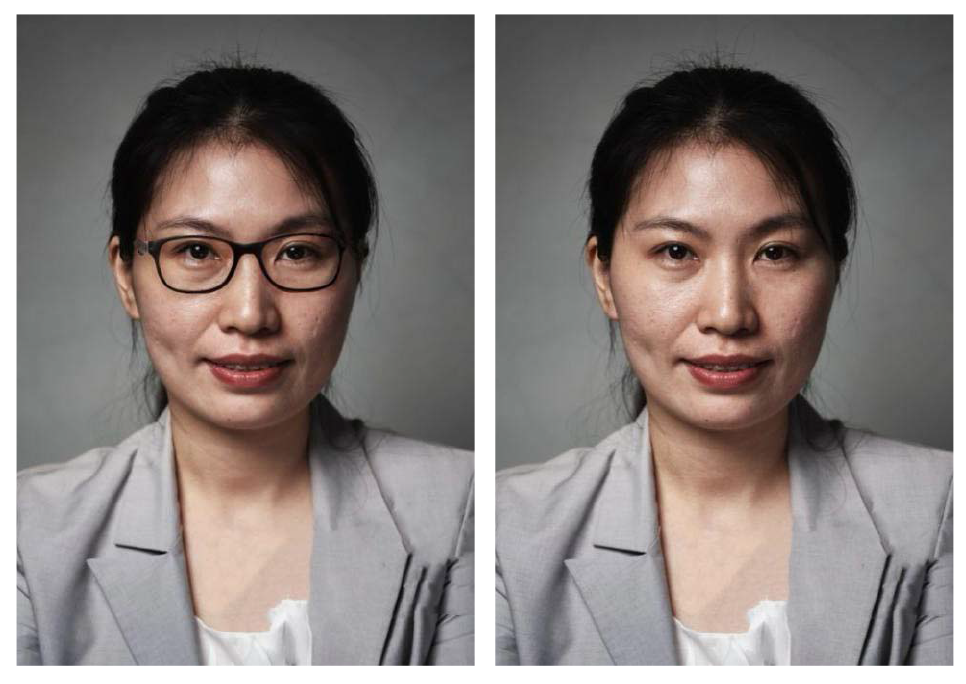
图2 实验1实验材料 (图片来源:iStockphoto)

图3 实验4b实验材料 (图片来源:AI生成)

图8 实验4a CEO照片(左−不佩戴眼镜组, 右−佩戴眼镜组, 图片来源为AI生成)
| [1] |
Aaker J., Vohs K. D., & Mogilner C. (2010). Nonprofits are seen as warm and for-profits as competent: Firm stereotypes matter. Journal of Consumer Research, 37(2), 224-237.
doi: 10.1086/651566 URL |
| [2] |
Arcidiacono P., Bayer P., & Hizmo A. (2010). Beyond signaling and human capital: Education and the revelation of ability. American Economic Journal: Applied Economics, 2(4), 76-104.
doi: 10.1257/app.2.4.76 URL |
| [3] |
Bargh J. A., & Chartrand T. L. (1999). The unbearable automaticity of being. American Psychologist, 54(7), 462-479.
doi: 10.1037/0003-066X.54.7.462 URL |
| [4] | Barrow R., & Woods R. (2006). An introduction to philosophy of education. Routledge. |
| [5] | Biddle B. J. (1979). Role theory: Expectations, identities, and behaviors. New York: Academic. |
| [6] | Bindemann M., Scheepers C., & Burton A. M. (2009). Viewpoint and center of gravity affect eye movements to human faces. Journal of Vision, 9(2), 1-16. |
| [7] |
Blair I. V., Judd C. M., Sadler M. S., & Jenkins C. (2002). The role of Afrocentric features in person perception: Judging by features and categories. Journal of Personality and Social Psychology, 83(1), 5-25.
pmid: 12088132 |
| [8] | Blasi, A. (2005). Moral character:A psychological approach. In D. K. Lapsley & F. C. Power (Eds.), Character psychology and character education (pp. 67-100). University of Notre Dame Press. |
| [9] | Brewer, M. B., & Miller N. (1988). Contact and cooperation:When do they work? In P. A. Katz & D. A. Taylor (Eds.), Eliminating racism: Profiles in controversy (pp. 315-326). New York: Plenum Press. |
| [10] |
Brownlow S. (1992). Seeing is believing: Facial appearance, credibility, and attitude change. Journal of Nonverbal behavior, 16, 101-115.
doi: 10.1007/BF00990325 URL |
| [11] |
Brüderl J., Preisendörfer P., & Ziegler R. (1992). Survival chances of newly founded business organizations. American Sociological Review, 57(2), 227-242.
doi: 10.2307/2096207 URL |
| [12] | Cantor N., & Mischel W. (1979). Prototypes in person perception. In L. Berkowitz (Ed.) , Advances in experimental social psychology (Vol. 12, pp. 4-53). New York: Academic Press. |
| [13] |
Colombo M. G., & Grilli L. (2005). Founders’ human capital and the growth of new technology-based firms: A competence-based view. Research Policy, 34(6), 795-816.
doi: 10.1016/j.respol.2005.03.010 URL |
| [14] |
Cook J., & Wall T. (1980). New work attitude measures of trust, organizational commitment and personal need non-fulfilment. Journal of Occupational Psychology, 53(1), 39-52.
doi: 10.1111/joop.1980.53.issue-1 URL |
| [15] |
Danes S. M., & Hira T. K. (1990). Knowledge, beliefs, and practices in the use of credit cards. Home Economics Research Journal, 18(3), 223-235.
doi: 10.1177/1077727X9001800304 URL |
| [16] |
Dotsch R., & Todorov A. (2012). Reverse correlating social face perception. Social Psychological and Personality Science, 3(5), 562-571.
doi: 10.1177/1948550611430272 URL |
| [17] | Dzadze P., Osei Mensah J., Aidoo R., & Nurah G. K. (2012). Factors determining access to formal credit in Ghana: A case study of smallholder farmers in the Abura-Asebu Kwamankese district of central region of Ghana. Journal of Development and Agricultural Economics, 4(14), 416-423. |
| [18] |
Eagly A. H., & Karau S. J. (2002). Role congruity theory of prejudice toward female leaders. Psychological Review, 109(3), 573-598.
doi: 10.1037/0033-295x.109.3.573 pmid: 12088246 |
| [19] | Elman D. (1977). Physical characteristics and the perception of masculine traits. Journal of Social Psychology, 103(1), 157-158. |
| [20] |
Engell A. D., Haxby J. V., & Todorov A. (2007). Implicit trustworthiness decisions: Automatic coding of face properties in the human amygdala. Journal of Cognitive Neuroscience, 19(9), 1508-1519.
doi: 10.1162/jocn.2007.19.9.1508 pmid: 17714012 |
| [21] |
Fiske S. T., Cuddy A. J., & Glick P. (2007). Universal dimensions of social cognition: Warmth and competence. Trends in Cognitive Sciences, 11(2), 77-83.
doi: 10.1016/j.tics.2006.11.005 pmid: 17188552 |
| [22] | Fiske S. T., & Neuberg S. L. (1990). A continuum of impression formation, from category-based to individuating processes: Influences of information and motivation on attention and interpretation. Advances in Experimental Social Psychology, 23, 1-74. |
| [23] | Fridlund A. J. (1992). The behavioral ecology and sociality of human faces. In M. S. Clark (Ed.), Review of personality and social psychology, No. 13. Emotion (pp. 90-121). Thousand Oaks, CA: Sage. |
| [24] |
Gefen D., & Straub D. W. (2004). Consumer trust in B2C e-commerce and the importance of social presence: Experiments in e-products and e-services. Omega, 32(6), 407-424.
doi: 10.1016/j.omega.2004.01.006 URL |
| [25] |
Goodlad J. I. (1992). The moral dimensions of schooling and teacher education. Journal of Moral Education, 21(2), 87-97.
doi: 10.1080/0305724920210201 URL |
| [26] | Goodman J. F., & Lesnick H. (2001). The moral stake in education: Contested premises and practices. New York: Longman. |
| [27] |
Gorn G. J., Jiang Y., & Johar G. V. (2008). Babyfaces, trait inferences, and company evaluations in a public relations crisis. Journal of Consumer Research, 35(1), 36-49.
doi: 10.1086/529533 URL |
| [28] |
Graham D. L., & Ritchie K. L. (2019). Making a spectacle of yourself: The effect of glasses and sunglasses on face perception. Perception, 48(6), 461-470.
doi: 10.1177/0301006619844680 pmid: 31006340 |
| [29] |
Guéguen N. (2015). Effect of wearing eyeglasses on judgment of socioprofessional group membership. Social Behavior and Personality: An International Journal, 43(4), 661-665.
doi: 10.2224/sbp.2015.43.4.661 URL |
| [30] |
Guido G., Peluso A. M., & Moffa V. (2011). Beardedness in advertising: Effects on endorsers’ credibility and purchase intention. Journal of Marketing Communications, 17(1), 37-49.
doi: 10.1080/13527260903157383 URL |
| [31] |
Harris M. B. (1991). Sex differences in stereotypes of spectacles. Journal of Applied Social Psychology, 21(20), 1659-1680.
doi: 10.1111/jasp.1991.21.issue-20 URL |
| [32] |
Harris M. B., Harris R. J., & Bochner S. (1982). Fat, four-eyed, and female: Stereotypes of obesity, glasses, and gender. Journal of Applied Social Psychology, 12(6), 503-516.
doi: 10.1111/jasp.1982.12.issue-6 URL |
| [33] | Hasart J. K., & Hutchinson K. L. (1993). The effects of eyeglasses on perceptions of interpersonal attraction. Journal of Social Behavior & Personality, 8(3), 521-528. |
| [34] | Hayes A. F. (2012). PROCESS: A versatile computational tool for observed variable mediation, moderation, and conditional process modeling [White paper]. Retrieved from http://www.afhayes.com/public/process2012.pdf |
| [35] | Hayes A. F. (2017). Introduction to mediation, moderation, and conditional process analysis: A regression-based approach. New York: Guilford Publications. |
| [36] |
Hellström Å., & Tekle J. (1994). Person perception through facial photographs: Effects of glasses, hair, and beard on judgments of occupation and personal qualities. European Journal of Social Psychology, 24(6), 693-705.
doi: 10.1002/ejsp.v24:6 URL |
| [37] | Huang E. Y., & Lin S. C. (2006). How R&D management practice affects innovation performance: An investigation of the high-tech industry in Taiwan. Industrial Management & Data Systems, 106(7), 966-996. |
| [38] | Huang S. P. (2017). Effects of innovative education on innovation capability and organizational performance in high-tech industry. EURASIA Journal of Mathematics, Science and Technology Education, 14(3), 777-784. |
| [39] |
Humphrey N., Curran A., Morris E., Farrell P., & Woods K. (2007). Emotional intelligence and education: A critical review. Educational Psychology, 27(2), 235-254.
doi: 10.1080/01443410601066735 URL |
| [40] |
Ibrahim S. S., & Aliero H. M. (2012). An analysis of farmers’ access to formal credit in the rural areas of Nigeria. African Journal of Agricultural Research, 7(47), 6249-6253.
doi: 10.5897/AJAR URL |
| [41] |
Johnson D., & Grayson K. (2005). Cognitive and affective trust in service relationships. Journal of Business Research, 58(4), 500-507.
doi: 10.1016/S0148-2963(03)00140-1 URL |
| [42] |
Karl K. A., Hall L. M., & Peluchette J. V. (2013). City employee perceptions of the impact of dress and appearance: You are what you wear. Public Personnel Management, 42(3), 452-470.
doi: 10.1177/0091026013495772 URL |
| [43] |
Kellerman J. M., & Laird J. D. (1982). The effect of appearance on self-perceptions. Journal of Personality, 50(3), 296-351.
doi: 10.1111/jopy.1982.50.issue-3 URL |
| [44] | Keltner D., & Haidt J. (1999). Social functions of emotions at four levels of analysis. Cognition & Emotion, 13(5), 505-521. |
| [45] |
Krumhuber E., Manstead A. S., Cosker D., Marshall D., Rosin P. L., & Kappas A. (2007). Facial dynamics as indicators of trustworthiness and cooperative behavior. Emotion, 7(4), 730-735.
pmid: 18039040 |
| [46] |
Leder H., Forster M., & Gerger G. (2011). The glasses stereotype revisited: Effects of eyeglasses on perception, recognition, and impression of faces. Swiss Journal of Psychology, 70(4), 211-222.
doi: 10.1024/1421-0185/a000059 URL |
| [47] | Li B., & Bai Y. (2020). Market signaling of educational background: Evidence from a field experiment. Economic Research Journal, 55(10), 176-192. |
| [李彬, 白岩. (2020). 学历的信号机制:来自简历投递实验的证据. 经济研究, 55(10), 176-192.] | |
| [48] | Li S. M., Li S. Y., Kang M. T., Zhou Y., Liu L. R., Li H.,... Anyang Childhood Eye Study Group. (2015). Near work related parameters and myopia in Chinese children: The Anyang childhood eye study. Plos One, 10(8), e0134514. |
| [49] | Liao L., Ji L., & Zhang W. Q. (2015). Education and credit: Evidence from P2P lending platform. Journal of Financial Research, 3, 146-159. |
| [廖理, 吉霖, 张伟强. (2015). 借贷市场能准确识别学历的价值吗?——来自P2P平台的经验证据. 金融研究, 3, 146-159.] | |
| [50] | Liu J. C., Ran G. M., Zang Q., Hu Y. H., Yu X. H., Zhang Q. Z., & Yang D. (2021). The development of Chinese undergraduate dynamic affective facial database. Chinese Journal of Applied Psychology, 27(3), 234-243. |
| [刘俊材, 冉光明, 张琪, 胡艳红, 余晓惠, 张琼之, 杨蝶. (2021). 中国大学生动态情绪面孔库的建设. 应用心理学, 27(3), 234-243.] | |
| [51] | Lundberg J. K., & Sheehan E. P. (1994). The effects of glasses and weight on perceptions of attractiveness and intelligence. Journal of Social Behavior and Personality, 9(4), 753-760. |
| [52] |
Lv L., Huang M., Guan D., & Yang K. (2023). Minor flaws are better: The positive effect of aesthetic imperfection about avatar endorsers on brand authenticity. Journal of Business Research, 166, 114125.
doi: 10.1016/j.jbusres.2023.114125 URL |
| [53] | Ma F. L., Tang Y. L., Zheng T. T., & Xu F. (2014). The development of 3- to 5-year-olds’ trust judgment based on face. Psychological Development and Education, 30(4), 337-344. |
| [马凤玲, 汤玉龙, 郑婷婷, 徐芬. (2014). 3-5岁幼儿基于面孔的信任判断的发展. 心理发展与教育, 30(4), 337-344.] | |
| [54] | Ma H. W., & Yao Q. (2012). Subordinates’ trust in supervisors: As a kind of willingness of action. Acta Psychologica Sinica, 44(6), 818-829. |
| [马华维, 姚琦. (2012). 企业中的上级信任: 作为一种行动意愿. 心理学报, 44(6), 818-829.] | |
| [55] |
Macrae C. N., & Bodenhausen G. V. (2001). Social cognition: Categorical person perception. British Journal of Psychology, 92(1), 239-255.
doi: 10.1348/000712601162059 URL |
| [56] |
Mirshahi A., Ponto K. A., Hoehn R., Zwiener I., Zeller T., Lackner K.,... Pfeiffer N. (2014). Myopia and level of education: Results from the Gutenberg Health Study. Ophthalmology, 121(10), 2047-2052.
doi: 10.1016/j.ophtha.2014.04.017 pmid: 24947658 |
| [57] |
Nobi B., Kim K. M., & Lee S. (2022). The aftermath of a brand transgression: The role of brand forgiveness and brand evangelism. Journal of Asia Business Studies, 16(6), 1030-1040.
doi: 10.1108/JABS-05-2021-0204 URL |
| [58] |
Ohanian R. (1990). Construction and validation of a scale to measure celebrity endorsers’ perceived expertise, trustworthiness, and attractiveness. Journal of Advertising, 19(3), 39-52.
doi: 10.1080/00913367.1990.10673191 URL |
| [59] | Okamura Y. (2018). The effect of the shape of eyeglasses on judgements toward wearers’ occupations: Replication and extension of Guéguen (2015). Romanian Journal of Psychological Studies, 6(1), 17-22. |
| [60] | Okamura Y., & Ura M. (2017). The effect of the shape of eyeglasses on judgements of personality. The European Proceedings of Social & Behavioural Sciences, 32, 111-116. |
| [61] |
Oliveira M., & Garcia-Marques T. (2022). The effect of facial occlusion on facial impressions of trustworthiness and dominance. Memory & Cognition, 50(6), 1131-1146.
doi: 10.3758/s13421-022-01316-z |
| [62] |
O'Neal G. S., & Lapitsky M. (1991). Effects of clothing as nonverbal communication on credibility of the message source. Clothing and Textiles Research Journal, 9(3), 28-34.
doi: 10.1177/0887302X9100900305 URL |
| [63] |
Oreopoulos P., & Salvanes K. G. (2011). Priceless: The nonpecuniary benefits of schooling. Journal of Economic Perspectives, 25(1), 159-184.
doi: 10.1257/jep.25.1.159 URL |
| [64] |
Paharia N. (2020). Who receives credit or blame? The effects of made-to-order production on responses to unethical and ethical company production practices. Journal of Marketing, 84(1), 88-104.
doi: 10.1177/0022242919887161 URL |
| [65] |
Priester J. R., & Petty R. E. (2003). The influence of spokesperson trustworthiness on message elaboration, attitude strength, and advertising effectiveness. Journal of Consumer Psychology, 13(4), 408-421.
doi: 10.1207/S15327663JCP1304_08 URL |
| [66] | Research and Markets. (2024). Eyewear Market, Size, Global Forecast 2023-2030, Industry Trends, Growth, Share, Outlook, Impact of Inflation, Opportunity Company Analysis. Retrievedfromhttps://finance.yahoo.com/news/global-eyewear-market-report-2023-151300962.html on 10th May,2023. |
| [67] |
Rubin E., Iriberri A., & Ayaburi E. (2025). Speculation in investment in technology firms: A trust-based perspective. International Journal of Bank Marketing, 43(1), 1-25.
doi: 10.1108/IJBM-02-2024-0084 URL |
| [68] |
Santos I. M., & Young A. W. (2011). Inferring social attributes from different face regions: Evidence for holistic processing. Quarterly Journal of Experimental Psychology, 64(4), 751-766.
doi: 10.1080/17470218.2010.519779 URL |
| [69] | Saw S. M., Chua W. H., Hong C. Y., Wu H. M., Chan W. Y., Chia K. S.,... Tan D. (2002). Nearwork in early-onset myopia. Investigative Ophthalmology & Visual Science, 43(2), 332-339. |
| [70] |
Scharlemann J. P., Eckel C. C., Kacelnik A., & Wilson R. K. (2001). The value of a smile: Game theory with a human face. Journal of Economic Psychology, 22(5), 617-640.
doi: 10.1016/S0167-4870(01)00059-9 URL |
| [71] |
Sharpe D. L., Yao R., & Liao L. (2012). Correlates of credit card adoption in urban China. Journal of Family and Economic Issues, 33, 156-166.
doi: 10.1007/s10834-012-9309-0 URL |
| [72] |
Spence M. (1973). Job market signaling. Quarterly Journal of Economics, 87(3), 355-374.
doi: 10.2307/1882010 URL |
| [73] |
Stirrat M., & Perrett D. I. (2010). Valid facial cues to cooperation and trust: Male facial width and trustworthiness. Psychological Science, 21(3), 349-354.
doi: 10.1177/0956797610362647 pmid: 20424067 |
| [74] |
Tanner R. J., & Maeng A. (2012). A tiger and a president: Imperceptible celebrity facial cues influence trust and preference. Journal of Consumer Research, 39(4), 769-783.
doi: 10.1086/665412 URL |
| [75] |
Terry R. L. (1989). Eyeglasses and gender stereotypes. Optometry and Vision Science, 66(10), 694-697.
pmid: 2587035 |
| [76] |
Terry R. L., & Krantz J. H. (1993). Dimensions of trait attributions associated with eyeglasses, men’s facial hair, and women’s hair length. Journal of Applied Social Psychology, 23(21), 1757-1769.
doi: 10.1111/jasp.1993.23.issue-21 URL |
| [77] | Terry R. L., & Macy R. J. (1991). Children’s social judgments of other children who wear eyeglasses. Journal of Social Behavior and Personality, 6(4), 965-974. |
| [78] |
Thornton G. R. (1944). The effect of wearing glasses upon judgments of personality traits of persons seen briefly. Journal of Applied Psychology, 28(3), 203-207.
doi: 10.1037/h0055862 URL |
| [79] |
Tian Y. Y., Li D, Yan X. B., Li Z., Cui Q., & Jiang Z. Q. (2024). The representational momentum effect and the reference dependence effect on the evaluation of dynamic happy expressions. Acta Psychologica Sinica, 56(1), 29-43.
doi: 10.3724/SP.J.1041.2024.00029 |
|
[田杨阳, 李东, 闫向博, 李曌, 崔倩, 蒋重清. (2024). 动态高兴表情评价中的表征动量效应和参照依赖效应. 心理学报, 56(1), 29-43.]
doi: 10.3724/SP.J.1041.2024.00029 |
|
| [80] |
Todorov A., Baron S. G., & Oosterhof N. N. (2008). Evaluating face trustworthiness: A model based approach. Social Cognitive and Affective Neuroscience, 3(2), 119-127.
doi: 10.1093/scan/nsn009 pmid: 19015102 |
| [81] |
Todorov A., Mandisodza A. N., Goren A., & Hall C. C. (2005). Inferences of competence from faces predict election outcomes. Science, 308(5728), 1623-1626.
doi: 10.1126/science.1110589 pmid: 15947187 |
| [82] |
Todorov A., Pakrashi M., & Oosterhof N. N. (2009). Evaluating faces on trustworthiness after minimal time exposure. Social Cognition, 27(6), 813-833.
doi: 10.1521/soco.2009.27.6.813 URL |
| [83] |
Van’t Wout M., & Sanfey A. G. (2008). Friend or foe: The effect of implicit trustworthiness judgments in social decision-making. Cognition, 108(3), 796-803.
doi: 10.1016/j.cognition.2008.07.002 pmid: 18721917 |
| [84] | Von Rennenkampff A., Kühnen U., & Sczesny S. (2003). Die attribution von führungskompetenz in abhängigkeit von geschlechtsstereotyper kleidung. In U. Pasero (Ed.), Gender-from Costs to Benefits (pp. 170-182). Westdeutscher Verlag. |
| [85] |
Wang X. J., Wang N., Han S. F., Liu S., & Zhang L. (2018). The influence of facial trustworthiness on helping behavior: The role of attachment type. Acta Psychologica Sinica, 50(11), 1292-1302.
doi: 10.3724/SP.J.1041.2018.01292 |
|
[王秀娟, 王娜, 韩尚锋, 刘燊, 张林. (2018). 面孔可信度对助人行为的影响: 依恋安全的调节作用. 心理学报, 50(11), 1292-1302.]
doi: 10.3724/SP.J.1041.2018.01292 |
|
| [86] | Wang Z., Mao H., Li Y. J., & Liu F. (2017). Smile big or not? Effects of smile intensity on perceptions of warmth and competence. Journal of Consumer Research, 43(5), 787-805. |
| [87] | Wegner D. M., & Vallacher R. R. (1977). Implicit psychology: An introduction to social cognition. Oxford University Press. |
| [88] | Wei C., Liu M. W., & Hung I. (2025). The color gradation effect: How boundlessness shapes brand attribute judgments. International Journal of Research in Marketing. https://doi.org/10.1016/j.ijresmar.2025.02.004 |
| [89] |
Williams K. M., Bertelsen G., Cumberland P., Wolfram C., Verhoeven V. J., Anastasopoulos E.,... European Eye Epidemiology Consortium. (2015). Increasing prevalence of myopia in Europe and the impact of education. Ophthalmology, 122(7), 1489-1497.
doi: 10.1016/j.ophtha.2015.03.018 pmid: 25983215 |
| [90] |
Willis J., & Todorov A. (2006). First impressions: Making up your mind after a 100-ms exposure to a face. Psychological Science, 17(7), 592-598.
doi: 10.1111/j.1467-9280.2006.01750.x pmid: 16866745 |
| [91] |
Wilson R. K., & Eckel C. C. (2006). Judging a book by its cover: Beauty and expectations in the trust game. Political Research Quarterly, 59(2), 189-202.
doi: 10.1177/106591290605900202 URL |
| [92] |
Yuan B., Wang X. P., Yin J., & Li W. Q. (2023). The role of cross-situational stimulus generalization in the formation of trust towards face: A perspective based on direct and observational learning. Acta Psychologica Sinica, 55(7), 1099-1114.
doi: 10.3724/SP.J.1041.2023.01099 |
|
[袁博, 王晓萍, 尹军, 李伟强. (2023). 跨情境的刺激泛化在面孔信任形成中的作用:基于直接互动与观察学习的视角. 心理学报, 55(7), 1099-1114.]
doi: 10.3724/SP.J.1041.2023.01099 |
|
| [93] | Zhang L., Li Y., Liu S., Tan Q., Xu Q., & Yang Y. P. (2016). The impression processing of unfamiliar faces: Based on the facia-characteristics. Journal of Psychological Science, 39(6), 1373-1378. |
| [张林, 李玥, 刘燊, 谭群, 徐强, 杨亚平. (2016). 陌生面孔的印象加工: 基于面孔特征的视角. 心理科学, 39(6), 1373-1378.] | |
| [94] |
Zhang X. B., & Zuo B. (2012). Two-stage model of stereotype activation based on face perception. Acta Psychologica Sinica, 44(9), 1189-1201.
doi: 10.3724/SP.J.1041.2012.01189 |
| [张晓斌, 佐斌. (2012). 基于面孔知觉的刻板印象激活两阶段模型. 心理学报, 44(9), 1189-1201.] |
| [1] | 郑晓莹, 韩润蕾, 刘汝晗, 徐菁. 信息加工流畅性与真实性对互联网公益捐助的影响[J]. 心理学报, 2024, 56(2): 226-238. |
| [2] | 李庆功, 方溦, 胡超, 石德君, 胡晓晴, 傅根跃, 王乾东. 灰姑娘能变成白雪公主吗?感知到的信任对他人面孔表征的影响[J]. 心理学报, 2023, 55(9): 1518-1528. |
| [3] | 王秀娟, 王娜, 韩尚锋, 刘燊, 张林. 面孔可信度对助人行为的影响:依恋安全的调节作用[J]. 心理学报, 2018, 50(11): 1292-1302. |
| [4] | 马华维,姚琦. 企业中的上级信任:作为一种行动意愿[J]. 心理学报, 2012, 44(6): 818-829. |
| [5] | 王怀明,马谋超. 名人广告源可信度因子结构[J]. 心理学报, 2004, 36(03): 365-369. |
| 阅读次数 | ||||||
|
全文 |
|
|||||
|
摘要 |
|
|||||
