

ISSN 0439-755X
CN 11-1911/B
主办:中国心理学会
中国科学院心理研究所
出版:科学出版社
CN 11-1911/B
主办:中国心理学会
中国科学院心理研究所
出版:科学出版社
心理学报 ›› 2026, Vol. 58 ›› Issue (4): 698-724.doi: 10.3724/SP.J.1041.2026.0698 cstr: 32110.14.2026.0698
陈斯允1, 程梅子2, 熊继伟3( ), 房心怡2, 吴来安2()
收稿日期:2025-06-30
发布日期:2026-01-16
出版日期:2026-04-25
通讯作者:
熊继伟, E-mail: xiongjiwei@whu.edu.cn;基金资助:
CHEN Siyun1, CHENG Meizi2, XIONG Jiwei3(), FANG Xinyi2, WU Laian2()
Received:2025-06-30
Online:2026-01-16
Published:2026-04-25
摘要:
作为音乐最基本的元素之一, 音乐节奏影响着人们的情感体验与认知反应, 但关于音乐节奏如何影响个体的亲环境行为, 当前仍效应未知且原因不明。文章系统考察了“林间慢板”关联效应及其对亲环境行为的影响。具体而言, 研究1通过机器学习和二手数据建模, 在GoFundMe众筹平台数据中发现了慢节奏音乐与环保众筹项目支持行为之间的正相关关系; 研究2采用激励兼容设计, 证实了播放慢节奏(vs. 快节奏)音乐时个体更多选择环保产品; 研究3A、研究3B和研究3C共同探讨了自然联结性在音乐节奏对亲环境行为中的中介效应, 即慢节奏(vs. 快节奏)音乐通过增强个体的自然联结感(即“林间慢板”关联), 进而正向驱动了亲环境行为; 研究4则验证了自然元素音轨的调节效应, 即当接入自然元素音轨时, 音乐节奏效应消失; 研究5和研究6分别考察了绿色价值观和城市化倾向的边界条件, 发现慢节奏音乐对亲环境行为的积极作用随着绿色价值观的降低与城市化倾向的提高而减弱。文章不仅丰富了音乐营销、亲环境行为以及环境心理学相关的理论知识, 同时为促进亲环境行为参与提供有益参考。
中图分类号:
陈斯允, 程梅子, 熊继伟, 房心怡, 吴来安. (2026). “林间慢板”:音乐节奏如何影响个体的亲环境行为. 心理学报, 58(4), 698-724.
CHEN Siyun, CHENG Meizi, XIONG Jiwei, FANG Xinyi, WU Laian. (2026). Adagio in the woods: How does music tempo impact individual pro-environmental behavior?. Acta Psychologica Sinica, 58(4), 698-724.

图1 研究1中GoFundMe平台数据获取与变量提取过程示意图
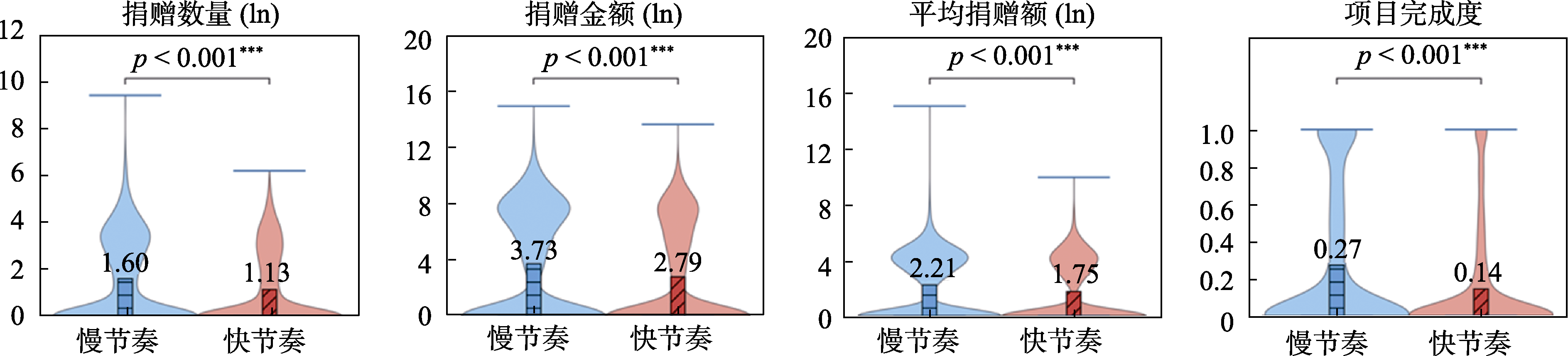
图2 研究1中的无模型证据 注: ①考虑到捐赠数量、捐赠金额以及平均捐赠额的原始数据在量级上的差异, 我们对其进行自然对数转换(ln (n+1))以减少数据偏度。②图中小提琴图直观展示了变量的分布形态与波动范围, 条形图则标示出各组数据的均值。③图中标注的p值与星号表示方差分析的统计结果, ***p < 0.001。
| 变量 | 捐赠数量 | 捐赠金额 | 平均捐赠额 | 项目完成度 |
|---|---|---|---|---|
| Panel A | 模型1 | 模型2 | 模型3 | 模型4 |
| 核心解释变量: | ||||
| BPM | −0.013*** | −0.011*** | −0.009*** | −0.020*** |
| (0.001) | (0.001) | (0.001) | (0.001) | |
| 文本/音频/视频特征固定效应 | No | No | No | No |
| 常数项 | −4.183*** | −2.935*** | −2.977*** | −4.263*** |
| (0.210) | (0.197) | (0.206) | (0.316) | |
| χ2 | 148.780 | 127.757 | 72.903 | 290.142 |
| Panel B | 模型5 | 模型6 | 模型7 | 模型8 |
| 核心解释变量: | ||||
| BPM | −0.006*** | −0.005*** | −0.005*** | −0.013*** |
| (0.001) | (0.001) | (0.001) | (0.001) | |
| 项目层面控制变量: | ||||
| 慈善机构项目 | 0.202*** | 0.232*** | 0.248*** | 0.249*** |
| (0.038) | (0.036) | (0.038) | (0.056) | |
| 更新次数 | −0.001 | −0.001 | −0.001* | −0.002* |
| (0.001) | (0.001) | (0.001) | (0.001) | |
| 评论数量 | 0.002*** | 0.001** | 0.000 | 0.003*** |
| (0.000) | (0.000) | (0.000) | (0.001) | |
| 筹资目标金额 | −0.059*** | −0.044*** | −0.036*** | −0.277*** |
| (0.008) | (0.007) | (0.007) | (0.012) | |
| 众筹持续天数 | 0.568*** | 0.484*** | 0.400*** | 0.685*** |
| (0.019) | (0.018) | (0.018) | (0.029) | |
| 标题字数 | 0.241*** | 0.224*** | 0.206*** | 0.381*** |
| (0.045) | (0.042) | (0.044) | (0.065) | |
| 描述字数 | 0.377*** | 0.362*** | 0.345*** | 0.359*** |
| (0.017) | (0.015) | (0.016) | (0.024) | |
| 图片数量 | −0.001 | 0.000 | 0.001 | 0.005 |
| (0.010) | (0.009) | (0.009) | (0.014) | |
| 视频数量 | −0.036 | −0.035 | −0.034 | −0.063* |
| (0.023) | (0.022) | (0.022) | (0.032) | |
| 封面类型 | 0.002 | 0.004 | 0.005 | −0.023 |
| (0.032) | (0.030) | (0.031) | (0.047) | |
| 音乐层面控制变量: | ||||
| 平均响度 | −0.000 | 0.000 | 0.001 | 0.000 |
| (0.004) | (0.003) | (0.003) | (0.005) | |
| 音频复杂度 | −0.107* | −0.092 | −0.084 | −0.163* |
| (0.053) | (0.050) | (0.051) | (0.076) | |
| 音频人声 | −0.008 | 0.009 | 0.025 | 0.025 |
| (0.033) | (0.031) | (0.032) | (0.049) | |
| 文本/音频/视频特征固定效应 | Yes | Yes | Yes | Yes |
| 常数项 | 1.919*** | 2.516*** | 1.764*** | 0.843*** |
| (0.130) | (0.116) | (0.125) | (0.138) | |
| χ2 | 2011.869 | 1817.476 | 1360.698 | 1565.942 |
表1 研究1中的回归分析结果
| 变量 | 捐赠数量 | 捐赠金额 | 平均捐赠额 | 项目完成度 |
|---|---|---|---|---|
| Panel A | 模型1 | 模型2 | 模型3 | 模型4 |
| 核心解释变量: | ||||
| BPM | −0.013*** | −0.011*** | −0.009*** | −0.020*** |
| (0.001) | (0.001) | (0.001) | (0.001) | |
| 文本/音频/视频特征固定效应 | No | No | No | No |
| 常数项 | −4.183*** | −2.935*** | −2.977*** | −4.263*** |
| (0.210) | (0.197) | (0.206) | (0.316) | |
| χ2 | 148.780 | 127.757 | 72.903 | 290.142 |
| Panel B | 模型5 | 模型6 | 模型7 | 模型8 |
| 核心解释变量: | ||||
| BPM | −0.006*** | −0.005*** | −0.005*** | −0.013*** |
| (0.001) | (0.001) | (0.001) | (0.001) | |
| 项目层面控制变量: | ||||
| 慈善机构项目 | 0.202*** | 0.232*** | 0.248*** | 0.249*** |
| (0.038) | (0.036) | (0.038) | (0.056) | |
| 更新次数 | −0.001 | −0.001 | −0.001* | −0.002* |
| (0.001) | (0.001) | (0.001) | (0.001) | |
| 评论数量 | 0.002*** | 0.001** | 0.000 | 0.003*** |
| (0.000) | (0.000) | (0.000) | (0.001) | |
| 筹资目标金额 | −0.059*** | −0.044*** | −0.036*** | −0.277*** |
| (0.008) | (0.007) | (0.007) | (0.012) | |
| 众筹持续天数 | 0.568*** | 0.484*** | 0.400*** | 0.685*** |
| (0.019) | (0.018) | (0.018) | (0.029) | |
| 标题字数 | 0.241*** | 0.224*** | 0.206*** | 0.381*** |
| (0.045) | (0.042) | (0.044) | (0.065) | |
| 描述字数 | 0.377*** | 0.362*** | 0.345*** | 0.359*** |
| (0.017) | (0.015) | (0.016) | (0.024) | |
| 图片数量 | −0.001 | 0.000 | 0.001 | 0.005 |
| (0.010) | (0.009) | (0.009) | (0.014) | |
| 视频数量 | −0.036 | −0.035 | −0.034 | −0.063* |
| (0.023) | (0.022) | (0.022) | (0.032) | |
| 封面类型 | 0.002 | 0.004 | 0.005 | −0.023 |
| (0.032) | (0.030) | (0.031) | (0.047) | |
| 音乐层面控制变量: | ||||
| 平均响度 | −0.000 | 0.000 | 0.001 | 0.000 |
| (0.004) | (0.003) | (0.003) | (0.005) | |
| 音频复杂度 | −0.107* | −0.092 | −0.084 | −0.163* |
| (0.053) | (0.050) | (0.051) | (0.076) | |
| 音频人声 | −0.008 | 0.009 | 0.025 | 0.025 |
| (0.033) | (0.031) | (0.032) | (0.049) | |
| 文本/音频/视频特征固定效应 | Yes | Yes | Yes | Yes |
| 常数项 | 1.919*** | 2.516*** | 1.764*** | 0.843*** |
| (0.130) | (0.116) | (0.125) | (0.138) | |
| χ2 | 2011.869 | 1817.476 | 1360.698 | 1565.942 |
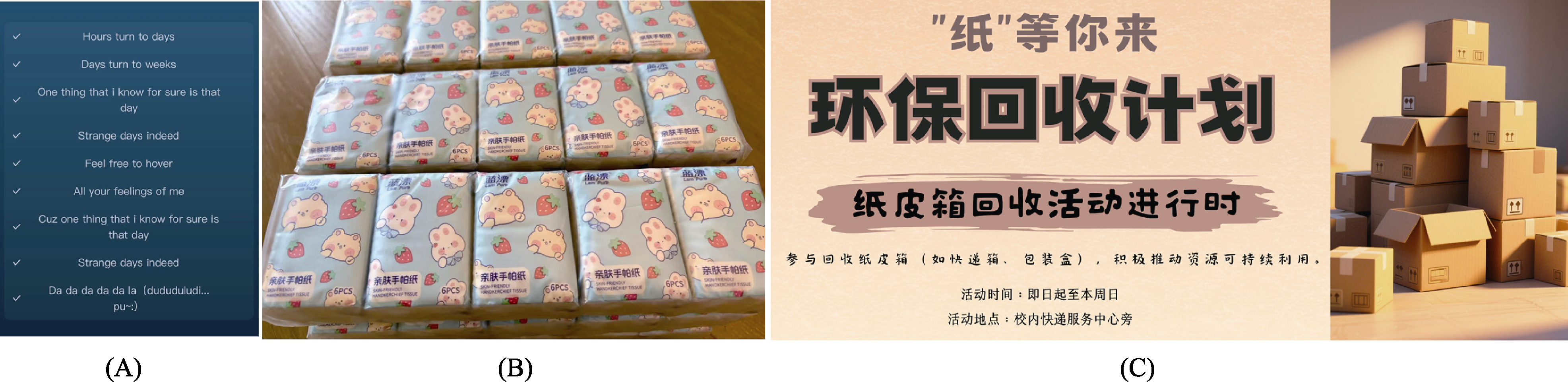
图3 研究2中男声音乐的歌词(A)和真实品牌蓝漂纸巾(B)与研究3B中的回收活动海报(C)

图4 研究4中YNJA环保品牌宣传片的视频画面定格及其绿色诉求文案 注: ①本实验的刺激材料以视频的方式呈现, 视频总时长为43秒, 以上画面分别出现于第4秒、第9秒、第13秒、第19秒、第24秒、第25秒、第28秒、第30秒、第36秒和第37秒。
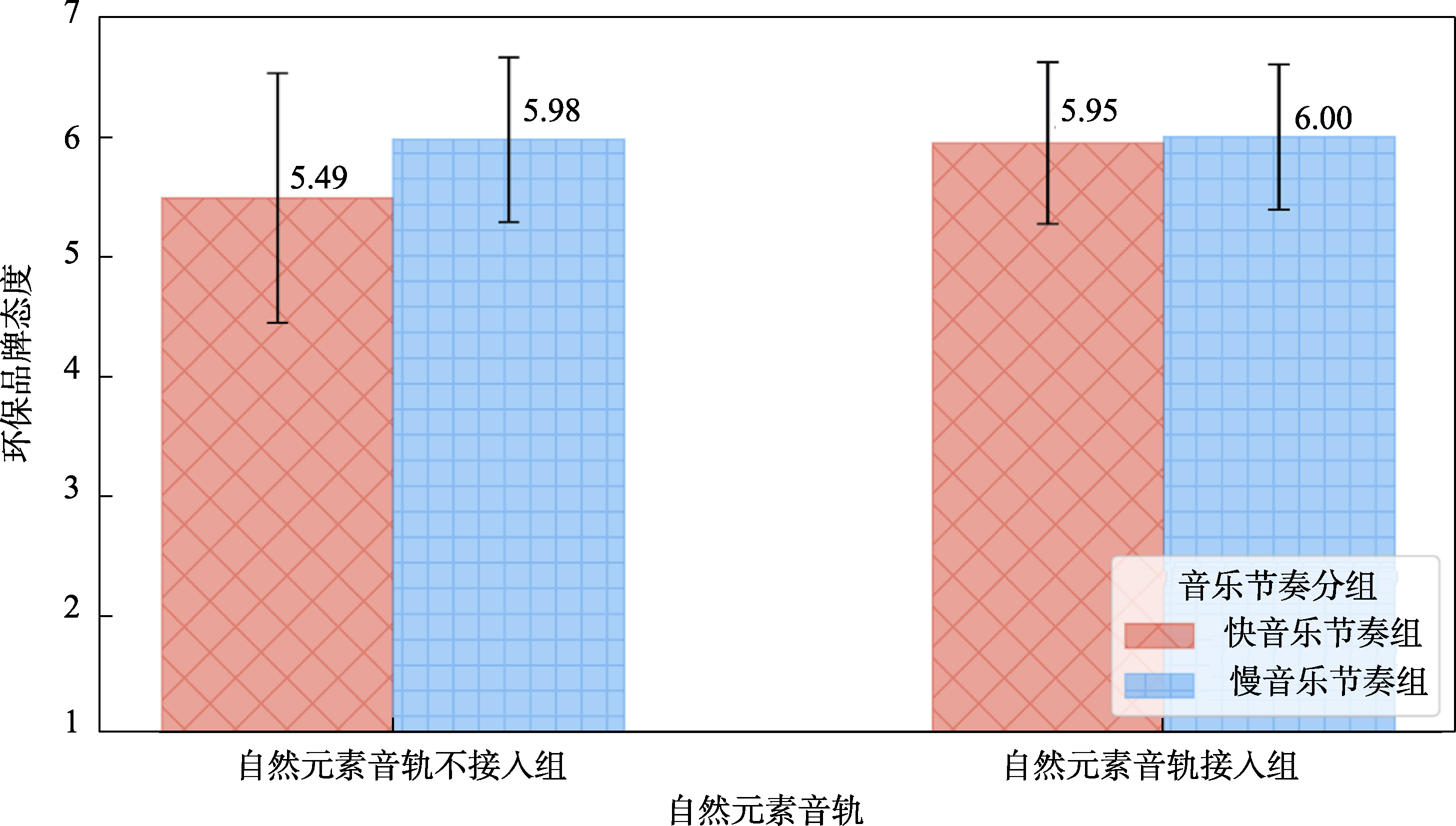
图5 研究4中音乐节奏与自然元素音轨的调节效应

图6 研究5中平衡处理下的选项呈现(A)与顺序对调的选项呈现(B)
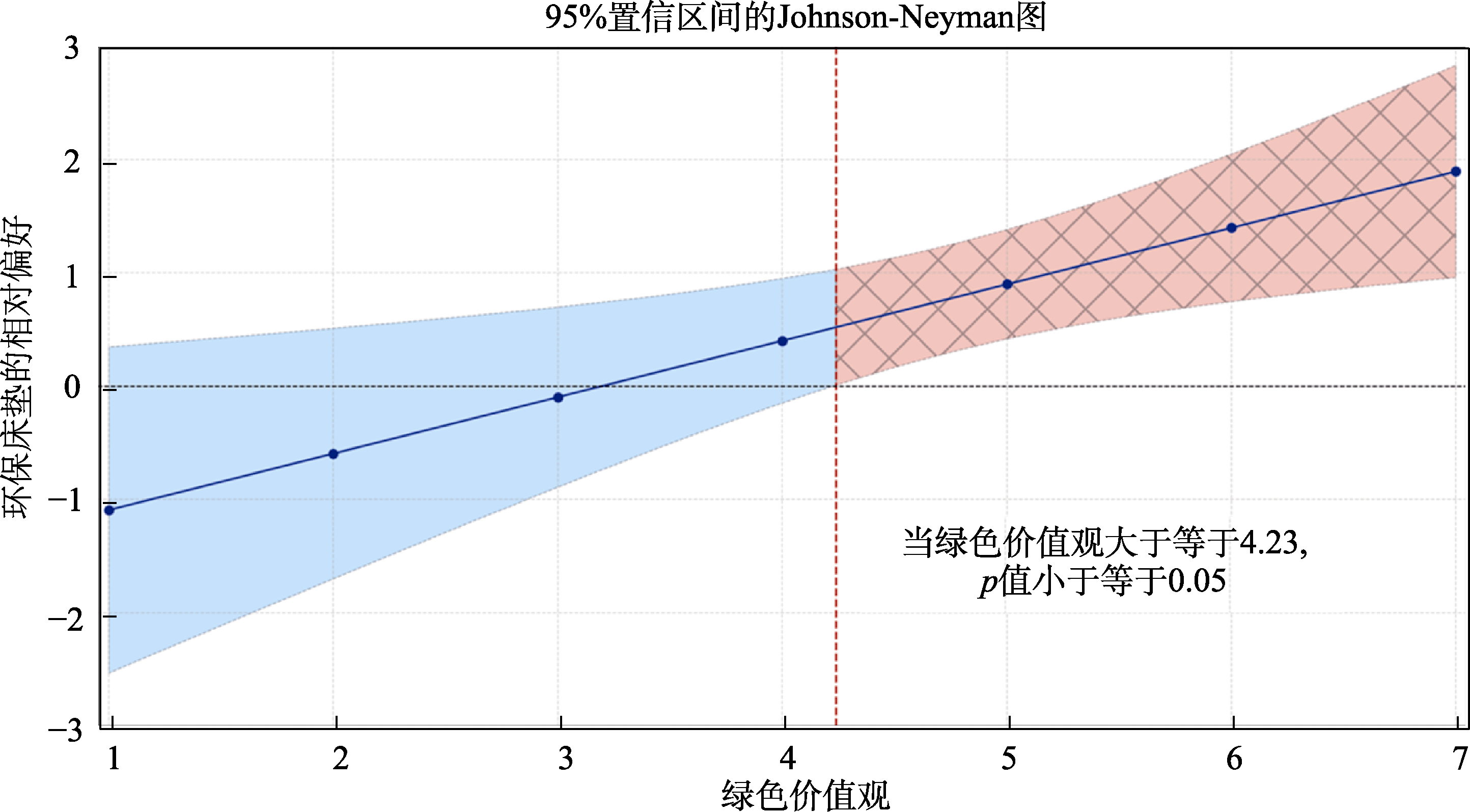
图7 研究5中绿色价值观在音乐节奏对亲环境行为影响中的调节效应
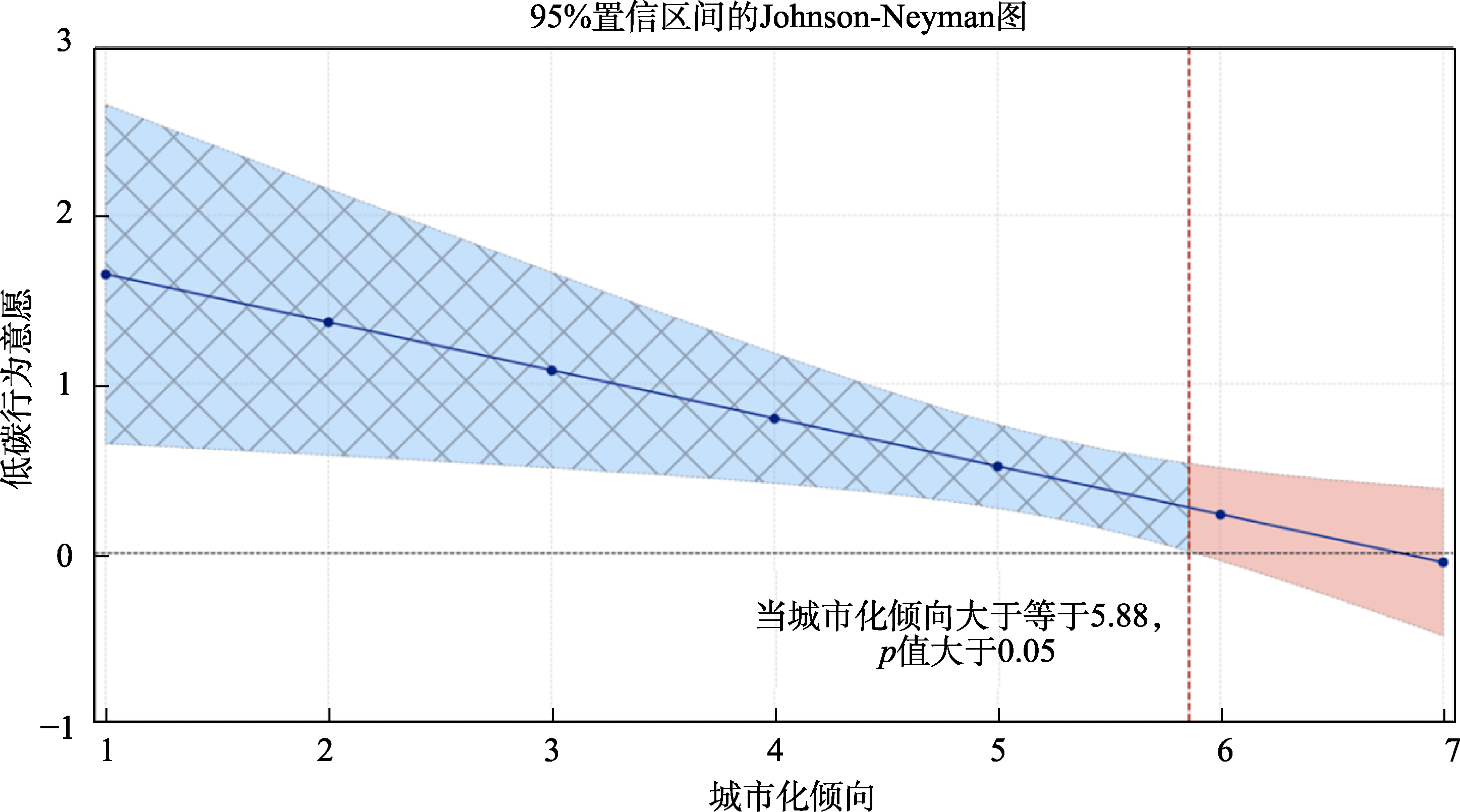
图8 研究6中城市化倾向在音乐节奏对亲环境行为影响中的调节效应
| [1] |
Alganad A. M. N., Isa N. M., & Fauzi W. I. M. (2023). Why people do not purchase green cars in Malaysia: The influence of consumption values on consumers’ attitude towards green cars. Case Studies on Transport Policy, 12, 101007.
doi: 10.1016/j.cstp.2023.101007 URL |
| [2] |
Alt M., Bruns H., DellaValle N., & Murauskaite-Bull I. (2024). Synergies of interventions to promote pro-environmental behaviors - A meta-analysis of experimental studies. Global Environmental Change, 84, 102776.
doi: 10.1016/j.gloenvcha.2023.102776 URL |
| [3] |
Barnes S. J., & Wang W. (2024). "I like the sound of that": Understanding the effectiveness of audio in ads. Internet Research, 35(3), 1104-1125.
doi: 10.1108/INTR-10-2023-0898 URL |
| [4] |
Brinkhof L. P., Ridderinkhof K. R., Krugers H. J., Murre J. M., & de Wit S. (2023). Assessing the degree of urbanisation using a single-item self-report measure: A validation study. International Journal of Environmental Health Research, 33(5), 508-517.
doi: 10.1080/09603123.2022.2036331 URL |
| [5] |
Cao D., Meadows M., & Ma X. (2023). Thinking fast and slow: A revised SOR model for an empirical examination of impulse buying at a luxury fashion outlet. European Journal of Marketing, 58(1), 342-368.
doi: 10.1108/EJM-01-2022-0046 URL |
| [6] |
Chen S. Y., Ponomarenko V., Lv L. X., & Ahlstrom D. (2025). Visual complexity, brand gender, and ad effectiveness. International Journal of Research in Marketing, 42(2), 365-390.
doi: 10.1016/j.ijresmar.2024.09.004 URL |
| [7] |
Chen S., & Ran Y. (2024). A silver lining of the epidemic: How contagious disease salience leads to minimalistic consumption, Environment, Development and Sustainability, 26(9), 24339-24357.
doi: 10.1007/s10668-023-03646-7 |
| [8] |
Chen S., & Wei H. (2022). Minimalism in capsule hotels: Enhancing tourist responses by using minimalistic lifestyle appeals congruent with brand personality. Tourism Management, 93, 104579.
doi: 10.1016/j.tourman.2022.104579 URL |
| [9] |
Cinelli M. D., & LeBoeuf R. A. (2020). Keeping it real: How perceived brand authenticity affects product perceptions. Journal of Consumer Psychology, 30(1), 40-59.
doi: 10.1002/jcpy.v30.1 URL |
| [10] |
Clayton S., Colléony A., Conversy P., Maclouf E., Martin L., Torres A. C.,... Prévot A. C. (2017). Transformation of experience: Toward a new relationship with nature. Conservation Letters, 10(5), 645-651.
doi: 10.1111/conl.2017.10.issue-5 URL |
| [11] | Colverson A., Lamb D., Garvan C., Toh K. B., Porges E., Tremura W., & Williamson J. (2021). Relationships between music and empathic decision making in healthy young adults. Music & Science, 4, 1-11. |
| [12] |
Correia S., Guimarães P., & Zylkin T. (2020). Fast Poisson estimation with high-dimensional fixed effects. The Stata Journal, 20(1), 95-115.
doi: 10.1177/1536867X20909691 URL |
| [13] |
Day R. F., Lin C. H., Huang W. H., & Chuang S. H. (2009). Effects of music tempo and task difficulty on multi-attribute decision-making: An eye-tracking approach. Computers in Human Behavior, 25(1), 130-143.
doi: 10.1016/j.chb.2008.08.001 URL |
| [14] |
Elsotouhy M. M., Ghonim M. A., Alasker T. H., & Khashan M. A. (2024). Investigating health and fitness app users’ stickiness, WOM, and continuance intention using SOR model: The moderating role of health consciousness. International Journal of Human-Computer Interaction, 40(5), 1235-1250.
doi: 10.1080/10447318.2022.2135813 URL |
| [15] |
Eroglu S. A., Machleit K. A., & Chebat J. C. (2005). The interaction of retail density and music tempo: Effects on shopper responses. Psychology & Marketing, 22(7), 577-589.
doi: 10.1002/mar.v22:7 URL |
| [16] |
Esfidani M. R., Samani S. R., & Khanlari A. (2022). Music and consumer behavior in chain stores: Theoretical explanation and empirical evidence. The International Review of Retail, Distribution and Consumer Research, 32(3), 331-348.
doi: 10.1080/09593969.2022.2048411 URL |
| [17] |
Essiz O., & Senyuz A. (2024). Predicting the value‐based determinants of sustainable luxury consumption: A multi‐analytical approach and pathway to sustainable development in the luxury industry. Business Strategy and the Environment, 33(3), 1721-1758.
doi: 10.1002/bse.v33.3 URL |
| [18] |
Flecke S. L., Huber J., Kirchler M., & Schwaiger R. (2024). Nature experiences and pro-environmental behavior: Evidence from a randomized controlled trial. Journal of Environmental Psychology, 99, 102383.
doi: 10.1016/j.jenvp.2024.102383 URL |
| [19] |
Gong Y., Li J., Xie J., Zhang L., & Lou Q. (2022). Will “green” parents have “green” children? The relationship between parents’ and early adolescents’ green consumption values. Journal of Business Ethics, 179(2), 369-385.
doi: 10.1007/s10551-021-04835-y |
| [20] |
Greenberg D. M., Decety J., & Gordon I. (2021). The social neuroscience of music: Understanding the social brain through human song. American Psychologist, 76(7), 1172-1185.
doi: 10.1037/amp0000819 pmid: 34110844 |
| [21] |
Grewal R., Gupta S., & Hamilton R. (2021). Marketing insights from multimedia data: Text, image, audio, and video. Journal of Marketing Research, 58(6), 1025-1033.
doi: 10.1177/00222437211054601 URL |
| [22] |
Hagtvedt H., & Brasel S. A. (2016). Cross-modal communication: Sound frequency influences consumer responses to color lightness. Journal of Marketing Research, 53(4), 551-562.
doi: 10.1509/jmr.14.0414 URL |
| [23] | Han J., Chen L., Gong Y., Qi Y., Zeng C., Wei C., & Sun Y. (2025). Environmental music enhances nature affinity via nature connectedness: Preliminary evidence from Chinese students. Ecopsychology, 17(4). https://doi.org/10.1089/eco.2024.0043 |
| [24] |
Haney A. M., Fleming M. N., Wycoff A. M., Griffin S. A., & Trull T. J. (2023). Measuring affect in daily life: A multilevel psychometric evaluation of the PANAS-X across four ecological momentary assessment samples. Psychological Assessment, 35(6), 469-483.
doi: 10.1037/pas0001231 pmid: 36931821 |
| [25] |
Hanlon J., & Taruffi L. (2025). The Power of Love (songs): Can listening to pop love songs influence the commitment, intimacy, satisfaction, and passionate love of adults in romantic relationships? Musicae Scientiae, 29(4), 576-597. https://doi.org/10.1177/10298649241302
doi: 10.1177/10298649241302401 URL |
| [26] |
Hasford J., Kidwell B., & Hardesty D. M. (2018). Emotional ability and associative learning: How experiencing and reasoning about emotions impacts evaluative conditioning. Journal of Consumer Research, 45(4), 743-760.
doi: 10.1093/jcr/ucy026 URL |
| [27] | Hayes A. F. (2017). Introduction to mediation, moderation, and conditional process analysis: A regression-based approach. Guilford Publications. |
| [28] |
Hong M., Liang D., & Lu T. (2025). Charity begins with prosocial music: Musical differences in intertemporal prosocial discounting and generosity. Psychology of Music, 53(1), 6-20.
doi: 10.1177/03057356241238004 URL |
| [29] |
Hua S., Jiang X., Gao Y. Z. Y., Mu Y., & Du Y. (2025). The impacts of music training and music sophistication on empathy. Acta Psychologica Sinica, 57(4), 544-558.
doi: 10.3724/SP.J.1041.2025.0544 |
|
[华山, 姜欣桐, 高扬震宇, 穆妍, 杜忆. (2025). 音乐训练与音乐素养对共情能力的影响. 心理学报, 57(4), 544-558.]
doi: 10.3724/SP.J.1041.2025.0544 |
|
| [30] |
Huang J., Xu J., & Wan X. (2022). Influence of associative learning on consumer behavior: From the perspective of product search experience. Advances in Psychological Science, 30(11), 2414-2423.
doi: 10.3724/SP.J.1042.2022.02414 |
|
[黄建平, 许婧娴, 宛小昂. (2022). 联想学习对消费行为的影响: 基于产品搜索经验的视角. 心理科学进展, 30(11), 2414-2423.]
doi: 10.3724/SP.J.1042.2022.02414 |
|
| [31] |
Huang X., & Labroo A. A. (2020). Cueing morality: The effect of high-pitched music on healthy choice. Journal of Marketing, 84(6), 130-143.
doi: 10.1177/0022242918813577 URL |
| [32] | Huang Y., Zhang K., Deng X., & Zhang Q. (2025). Fast fashion consumption signals low self-control. Journal of Consumer Research, https://doi.org/10.1093/jcr/ucaf032 |
| [33] |
Husain G., Thompson W. F., & Schellenberg E. G. (2002). Effects of musical tempo and mode on arousal, mood, and spatial abilities. Music Perception, 20(2), 151-171.
doi: 10.1525/mp.2002.20.2.151 URL |
| [34] |
Jeong S. Y., Yu J. I., Seo T. B., & Kim Y. P. (2024). Effects of the music tempo during walking exercise on heart rate variation, lactic acid, and aerobic variables in male college students. Journal of Exercise Rehabilitation, 20(6), 220-226.
doi: 10.12965/jer.2448598.299 pmid: 39781502 |
| [35] |
Jiang C., Guo X., Huang J., & Wan X. (2023). Expectations generated based on associative learning guide visual search for novel packaging labels. Food Quality and Preference, 104, 104743.
doi: 10.1016/j.foodqual.2022.104743 URL |
| [36] |
Jiang X., Ding Z., & Liu R. (2019). Can Chinese residential low-carbon consumption behavior intention be better explained? The role of cultural values. Natural Hazards, 95(1), 155-171.
doi: 10.1007/s11069-018-3461-2 |
| [37] |
Keeler K. R., Puranik H., Wang Y., & Yin J. (2025). In sync or out of tune? The effects of workplace music misfit on employees. Journal of Applied Psychology, 110(9), 1157-1173.
doi: 10.1037/apl0001278 URL |
| [38] |
Kellaris J. J., & Kent R. J. (1992). The influence of music on consumers' temporal perceptions: Does time fly when you're having fun? Journal of Consumer Psychology, 1(4), 365-376.
doi: 10.1016/S1057-7408(08)80060-5 URL |
| [39] |
Kim K., & Zauberman G. (2019). The effect of music tempo on consumer impatience in intertemporal decisions. European Journal of Marketing, 53(3), 504-523.
doi: 10.1108/EJM-10-2017-0696 URL |
| [40] |
Klein S. A., & Hilbig B. E. (2018). How virtual nature experiences can promote pro-environmental behavior. Journal of Environmental Psychology, 60, 41-47.
doi: 10.1016/j.jenvp.2018.10.001 URL |
| [41] |
Knoferle K. M., Spangenberg E. R., Herrmann A., & Landwehr J. R. (2012). It is all in the mix: The interactive effect of music tempo and mode on in-store sales. Marketing Letters, 23, 325-337.
doi: 10.1007/s11002-011-9156-z URL |
| [42] |
Krettenauer T., Lefebvre J. P., & Goddeeris H. (2024). Pro-environmental behaviour, connectedness with nature, and the endorsement of pro-environmental norms in youth: Longitudinal relations. Journal of Environmental Psychology, 94, 102256.
doi: 10.1016/j.jenvp.2024.102256 URL |
| [43] | Krishna A., Cian L., & Sokolova T. (2016). The power of sensory marketing in advertising. Current Opinion in Psychology, 10, 142-147. |
| [44] |
Lange F. (2023). Behavioral paradigms for studying pro-environmental behavior: A systematic review. Behavior Research Methods, 55(2), 600-622.
doi: 10.3758/s13428-022-01825-4 |
| [45] |
Lei S., Wu Q., & Du J. (2025). How music tempo influences consumer preferences for advertising with different regulatory focuses: Shopping in jumping tempo. Journal of Advertising Research, 65(4), 579-1596.
doi: 10.1080/00218499.2025.2464277 URL |
| [46] |
Lenzi C., & Perucca G. (2022). No place for poor men: On the asymmetric effect of urbanization on life satisfaction. Social Indicators Research, 164(1), 165-187.
doi: 10.1007/s11205-022-02946-1 |
| [47] |
Leung G. Y., Hazan H., & Chan C. S. (2022). Exposure to nature in immersive virtual reality increases connectedness to nature among people with low nature affinity. Journal of Environmental Psychology, 83, 101863.
doi: 10.1016/j.jenvp.2022.101863 URL |
| [48] |
Levitin D. J., Grahn J. A., & London J. (2018). The psychology of music: Rhythm and movement. Annual Review of Psychology, 69(1), 51-75.
doi: 10.1146/psych.2018.69.issue-1 URL |
| [49] |
Li J., Zhou L., Jiang J., Wang D., & Jiang C. (2024). The influence of music on prosocial behavior and its mechanisms. Advances in Psychological Science, 32(7), 1179-1194.
doi: 10.3724/SP.J.1042.2024.01179 URL |
|
[李俊朋, 周临舒, 江俊, 王丹妮, 蒋存梅. (2024). 音乐对亲社会行为的影响及其作用机制, 心理科学进展, 32(7), 1179-1194.]
doi: 10.3724/SP.J.1042.2024.01179 |
|
| [50] |
Li X., Yin K., Shan Y., Wang X., & Geng W. (2025). Effects of user interface orientation on sense of immersion in augmented reality. International Journal of Human- Computer Interaction, 41(8), 4685-4699.
doi: 10.1080/10447318.2024.2352923 URL |
| [51] |
Liu G., Abolhasani M., & Hang H. (2022). Disentangling effects of subjective and objective characteristics of advertising music. European Journal of Marketing, 56(4), 1153-1183.
doi: 10.1108/EJM-01-2021-0017 URL |
| [52] |
Liu W., & Yang Q. (2025). How to increase consumers' pro-environmental behaviors? The role of involving consumers in creative activities. Psychology & Marketing, 42(6), 1541-1562.
doi: 10.1002/mar.v42.6 URL |
| [53] |
Liu Y., Cleary A., Fielding K. S., Murray Z., & Roiko A. (2022). Nature connection, pro-environmental behaviours and wellbeing: Understanding the mediating role of nature contact. Landscape and Urban Planning, 228, 104550.
doi: 10.1016/j.landurbplan.2022.104550 URL |
| [54] |
Lowe M. L., & Haws K. L. (2017). Sounds big: The effects of acoustic pitch on product perceptions. Journal of Marketing Research, 54(2), 331-346.
doi: 10.1509/jmr.14.0300 URL |
| [55] |
Luo K., & Wang Y. (2025). Unraveling the pathways of sustainable music education: A moderated mediation analysis of environmental awareness, pedagogical approaches, and student engagement. Frontiers in Psychology, 16, 1554944.
doi: 10.3389/fpsyg.2025.1554944 URL |
| [56] |
Majeed S., Kim W. G., & Kim T. (2023). Perceived green psychological benefits and customer pro-environment behavior in the value-belief-norm theory: The moderating role of perceived green CSR. International Journal of Hospitality Management, 113, 103502.
doi: 10.1016/j.ijhm.2023.103502 URL |
| [57] | Masagca R. C. (2025). Music as ergogenic aid: Comparative analysis of music tempos on selected physical fitness components of untrained collegiate students. Sportis, 11(1), 1-37. |
| [58] |
Migliavada R., Luceri F., & Torri L. (2024). Chew that beat! How music tempo influences eating behaviors and emotions. Food Quality and Preference, 118, 105195.
doi: 10.1016/j.foodqual.2024.105195 URL |
| [59] |
Mitchell C. J., De Houwer J., & Lovibond P. F. (2009). The propositional nature of human associative learning. Behavioral and Brain Sciences, 32(2), 183-198.
doi: 10.1017/S0140525X09000855 pmid: 19386174 |
| [60] |
Navarro-Cáceres M., Oliveira H. G., Martins P., & Cardoso A. (2020). Integration of a music generator and a song lyrics generator to create Spanish popular songs. Journal of Ambient Intelligence and Humanized Computing, 11(11), 4421-4437.
doi: 10.1007/s12652-020-01822-5 |
| [61] |
Olubunmi O. A., Xia P. B., & Skitmore M. (2016). Green building incentives: A review. Renewable and Sustainable Energy Reviews, 59, 1611-1621.
doi: 10.1016/j.rser.2016.01.028 URL |
| [62] |
Pantoja F., & Borges A. (2021). Background music tempo effects on food evaluations and purchase intentions. Journal of Retailing and Consumer Services, 63, 102730.
doi: 10.1016/j.jretconser.2021.102730 URL |
| [63] |
Pichierri M., & Pino G. (2023). Less saturated, more eco‐friendly: Color saturation and consumer perception of product sustainability. Psychology & Marketing, 40(9), 1830-1849.
doi: 10.1002/mar.v40.9 URL |
| [64] |
Publicover J. L., Wright T. S., Baur S., & Duinker P. N. (2018). Music as a tool for environmental education and advocacy: Artistic perspectives from musicians of the Playlist for the Planet. Environmental Education Research, 24(7), 925-936.
doi: 10.1080/13504622.2017.1365356 URL |
| [65] |
Ray T. N., Franz S. A., Jarrett N. L., & Pickett S. M. (2021). Nature enhanced meditation: Effects on mindfulness, connectedness to nature, and pro-environmental behavior. Environment and Behavior, 53(8), 864-890.
doi: 10.1177/0013916520952452 URL |
| [66] |
Ruth N. (2018). “They don’t really care…”: Effects of music with prosocial content and corresponding media coverage on prosocial behavior. Musicae Scientiae, 22(3), 415-433.
doi: 10.1177/1029864917716735 URL |
| [67] |
Santos I. L. S., Pimentel C. E., Mariano T. E., & Abreu A. B. D.. (2023). The mediating role of music preference in the relationship between personality and pro-sociability. Psychology of Music, 51(4), 1302-1313.
doi: 10.1177/03057356221137928 URL |
| [68] |
Saracevic S., Schlegelmilch B. B., & Wu T. (2022). How normative appeals influence pro-environmental behavior: The role of individualism and collectivism. Journal of Cleaner Production, 344, 131086.
doi: 10.1016/j.jclepro.2022.131086 URL |
| [69] |
Septianto F. (2016). “Chopin” effect? An exploratory study on how musical tempo influence consumer choice of drink with different temperatures. Asia Pacific Journal of Marketing and Logistics, 28(5), 765-779.
doi: 10.1108/APJML-11-2015-0182 URL |
| [70] |
Shen L. (2010). On a scale of state empathy during message processing. Western Journal of Communication, 74(5), 504-524.
doi: 10.1080/10570314.2010.512278 URL |
| [71] |
Shi J., & Jiang Z. (2023). Willingness to pay a premium price for green products: Does a reference group matter? Environment, Development and Sustainability, 25(8), 8699-8727.
doi: 10.1007/s10668-022-02419-y |
| [72] |
Shipley N. J., & Van Riper C. J. (2022). Pride and guilt predict pro-environmental behavior: A meta-analysis of correlational and experimental evidence. Journal of Environmental Psychology, 79, 101753.
doi: 10.1016/j.jenvp.2021.101753 URL |
| [73] |
Song R., Motevalli S., & Zhou Y. (2024). Melodic movements: The role of music in shaping sport performance and psychological responses. International Sports Studies, 46(2), 96-124.
doi: 10.69665/iss.v46i2 URL |
| [74] | Steghaus S., & Poth C. H. (2024). Feeling tired versus feeling relaxed: Two faces of low physiological arousal. Plos One, 19(9), e0310034. |
| [75] |
Stehl P., White M. P., Vitale V., Pahl S., Elliott L. R., Fian L., & van den Bosch M. (2024). From childhood blue space exposure to adult environmentalism: The role of nature connectedness and nature contact. Journal of Environmental Psychology, 93, 102225.
doi: 10.1016/j.jenvp.2023.102225 URL |
| [76] |
Stewart K., & Koh H. E. (2017). Hooked on a feeling: The effect of music tempo on attitudes and the mediating role of consumers' affective responses. Journal of Consumer Behaviour, 16(6), 550-564.
doi: 10.1002/cb.v16.6 URL |
| [77] |
Stuppy A., Landwehr J. R., & McGraw A. P. (2024). The art of slowness: Slow motion enhances consumer evaluations by increasing processing fluency. Journal of Marketing Research, 61(2), 185-203.
doi: 10.1177/00222437231179187 URL |
| [78] |
Sun L., & Yang Y. (2024). The cognitive and neural mechanisms of metric structure in music: A predictive perspective. Advances in Psychological Science, 32(10), 1567-1577.
doi: 10.3724/SP.J.1042.2024.01567 |
|
[孙丽君, 杨玉芳. (2024). 预期视角下音乐节拍结构的认知与神经机制. 心理科学进展, 32(10), 1567-1577.]
doi: 10.3724/SP.J.1042.2024.01567 |
|
| [79] |
Sun W., Chang E. C., & Xu Y. (2023). The effects of background music tempo on consumer variety-seeking behavior: The mediating role of arousal. Frontiers in Psychology, 14, 1236006.
doi: 10.3389/fpsyg.2023.1236006 URL |
| [80] |
Teixeira A., Gabriel R., Martinho J., Santos M., Faria A., Oliveira I., & Moreira H. (2023). Pro-environmental behaviors: Relationship with nature visits, connectedness to nature and physical activity. American Journal of Health Promotion, 37(1), 12-29.
doi: 10.1177/08901171221119089 URL |
| [81] |
Wang Z., & Li K. (2023). Can environmentally themed music increase consumers' willingness to pay for low-carbon food? A discrete choice experiment method. Frontiers in Sustainable Food Systems, 7, 1302511.
doi: 10.3389/fsufs.2023.1302511 URL |
| [82] | Warburton W. A., Mohi S., Sweller N., Tarabay C., Spencer L., & Olsen K. (2024). Violent and prosocial music: Evidence for the impact of lyrics and musical tone on aggressive thoughts, feelings, and behaviors. Aggressive Behavior, 50(3), e22148. |
| [83] |
Winterich K. P., Nenkov G. Y., & Gonzales G. E. (2019). Knowing what it makes: How product transformation salience increases recycling. Journal of Marketing, 83(4), 21-37.
doi: 10.1177/0022242919842167 |
| [84] |
Wong C. H., Szeto W. M., & Wong K. H. (2007). Automatic lyrics alignment for Cantonese popular music. Multimedia Systems, 12(4), 307-323.
doi: 10.1007/s00530-006-0055-8 URL |
| [85] |
Xu L., Zhao S., Cotte J., & Cui N. (2023). Cyclical time is greener: The impact of temporal perspective on pro-environmental behavior. Journal of Consumer Research, 50(4), 722-741.
doi: 10.1093/jcr/ucad016 URL |
| [86] |
Yan L., Keh H. T., & Wang X. (2021). Powering sustainable consumption: The roles of green consumption values and power distance belief. Journal of Business Ethics, 169, 499-516.
doi: 10.1007/s10551-019-04295-5 |
| [87] | Yurdum L., Singh M., Glowacki L., Vardy T., Atkinson Q. D., Hilton C. B.,... Mehr S. A. (2023). Universal interpretations of vocal music. Proceedings of the National Academy of Sciences, 120(37), e2218593120. |
| [88] |
Zelenski J. M., & Desrochers J. E. (2021). Can positive and self-transcendent emotions promote pro-environmental behavior? Current Opinion in Psychology, 42, 31-35.
doi: 10.1016/j.copsyc.2021.02.009 pmid: 33819735 |
| [89] |
Zhang K., Liu H., & Ye J. (2023). Role of music tempo in choosing from large and small choice sets: Insights from functional magnetic resonance imaging (fMRI). Marketing Letters, 34, 633-652.
doi: 10.1007/s11002-023-09672-9 |
| [90] |
Zhen M., Xia W., & Lin D. (2025). Effects of musical tempo on human thermal comfort during interval exercise. Building and Environment, 268, 112359.
doi: 10.1016/j.buildenv.2024.112359 URL |
| [91] |
Zhou X., Yan X., & Jiang Y. (2024). Making sense? The sensory-specific nature of virtual influencer effectiveness. Journal of Marketing, 88(4), 84-106.
doi: 10.1177/00222429231203699 URL |
| [92] |
Zhou Y., & Geng L. (2025). Getting outdoors for ordinary beauty: Exposure to nature promotes meaning in life through enhanced savoring. Journal of Outdoor Recreation and Tourism, 50, 100883.
doi: 10.1016/j.jort.2025.100883 URL |
| [1] | 冯文婷, 薛舒允, 汪涛. 拟人的品牌更环保?拟人化沟通对促进绿色消费倾向的影响[J]. 心理学报, 2025, 57(4): 720-738. |
| [2] | 魏心妮, 喻丰, 彭凯平, 钟年. 心理丰富提高亲环境行为意愿[J]. 心理学报, 2023, 55(8): 1330-1343. |
| [3] | 吴波;李东进;王财玉. 绿色还是享乐?参与环保活动对消费行为的影响[J]. 心理学报, 2016, 48(12): 1574-1588. |
| 阅读次数 | ||||||
|
全文 |
|
|||||
|
摘要 |
|
|||||
