

ISSN 0439-755X
CN 11-1911/B
主办:中国心理学会
中国科学院心理研究所
出版:科学出版社
CN 11-1911/B
主办:中国心理学会
中国科学院心理研究所
出版:科学出版社
心理学报 ›› 2026, Vol. 58 ›› Issue (4): 683-697.doi: 10.3724/SP.J.1041.2026.0683 cstr: 32110.14.2026.0683
占小军1, 吴可盈1, 王涛2, 马君3( ), 祝养浩4(), 周雯珺1
收稿日期:2024-11-05
发布日期:2026-01-16
出版日期:2026-04-25
通讯作者:
马君, E-mail: majunswufe@126.com;基金资助:
ZHAN Xiaojun1, WU Keying1, WANG Tao2, MA Jun3(), ZHU Yanghao4(), ZHOU Wenjun1
Received:2024-11-05
Online:2026-01-16
Published:2026-04-25
摘要:
备选是指最终被组织安排承担某项任务或角色, 但并非该任务或角色首选的员工, 近年来逐渐受到学者关注。然而现有研究却忽视了任务分配情境下备选对员工自身态度和行为的影响。本研究基于社会信息加工理论和联想命题评价理论, 采用情境实验(研究1)和三阶段问卷调查(研究2), 探讨了任务分配情境下备选对员工行为的“双刃剑”效应及边界条件。研究结果表明, 当上级发展性反馈水平高时, 备选会激发和谐型激情, 进而引发主动担责行为; 当上级发展性反馈水平低时, 备选会引起工作拖延倾向, 进而发生时间窃取行为。研究结论为大众更加客观、辩证地认识备选提供参考和借鉴。
中图分类号:
占小军, 吴可盈, 王涛, 马君, 祝养浩, 周雯珺. (2026). 位居次席: 备选对员工主动担责和时间窃取行为的影响机制. 心理学报, 58(4), 683-697.
ZHAN Xiaojun, WU Keying, WANG Tao, MA Jun, ZHU Yanghao, ZHOU Wenjun. (2026). Coming in second: Influence mechanism of alternative choice on employee taking charge and time theft behaviors. Acta Psychologica Sinica, 58(4), 683-697.
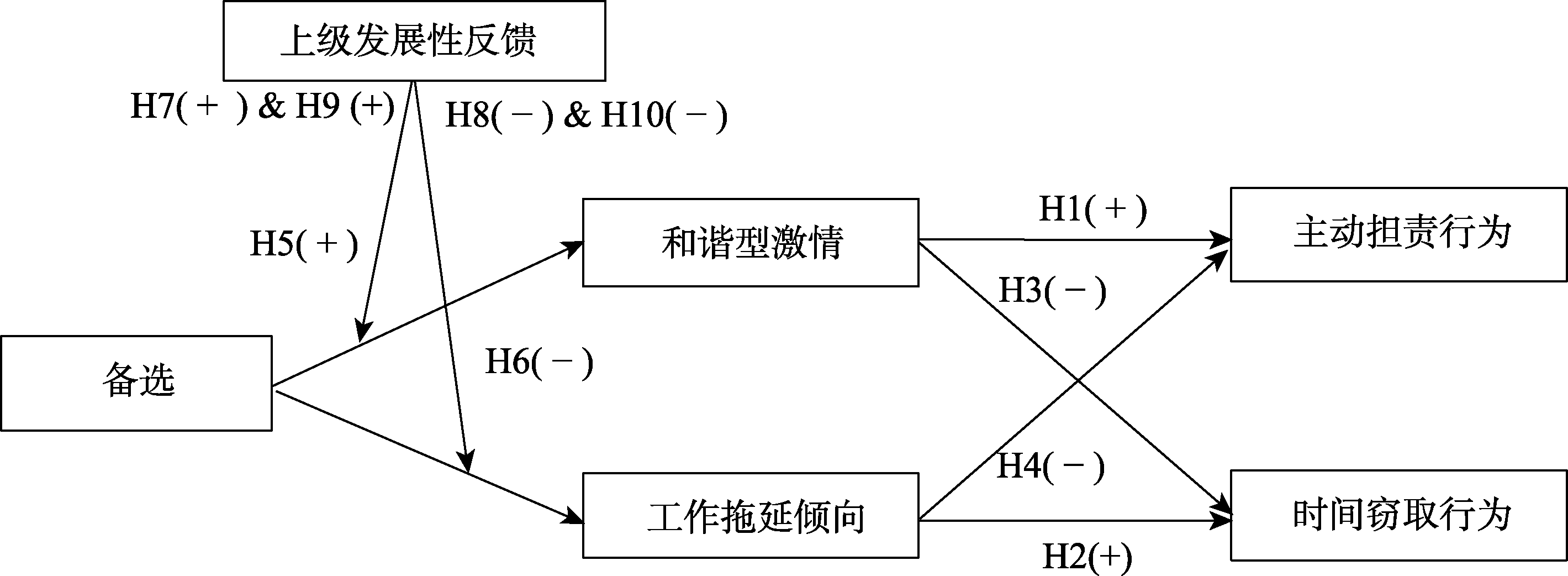
图1 理论模型
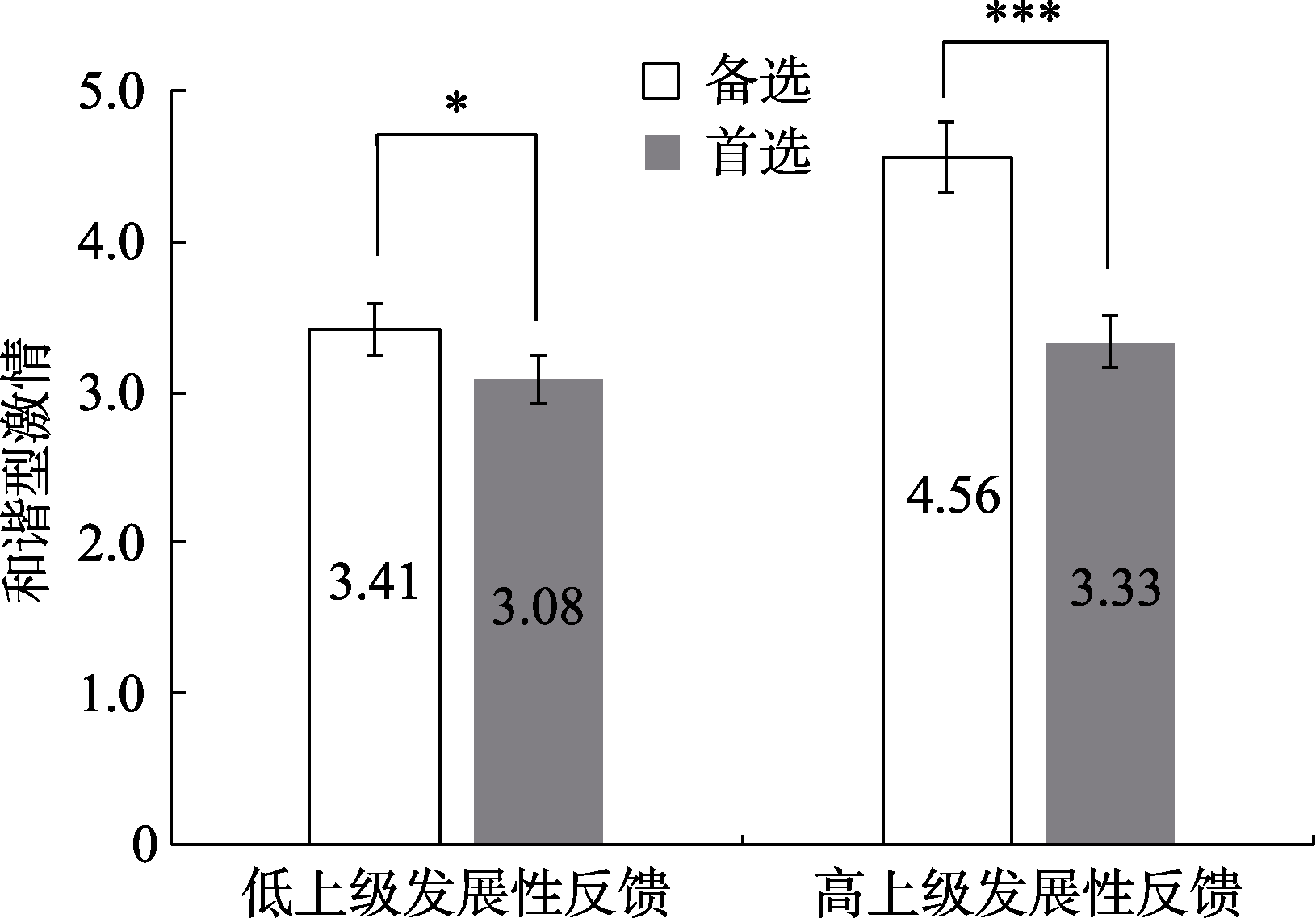
图2 备选(首选)和上级发展性反馈的交互对和谐型激情的简单效应 注: *表示p < 0.05, ***表示p < 0.001。
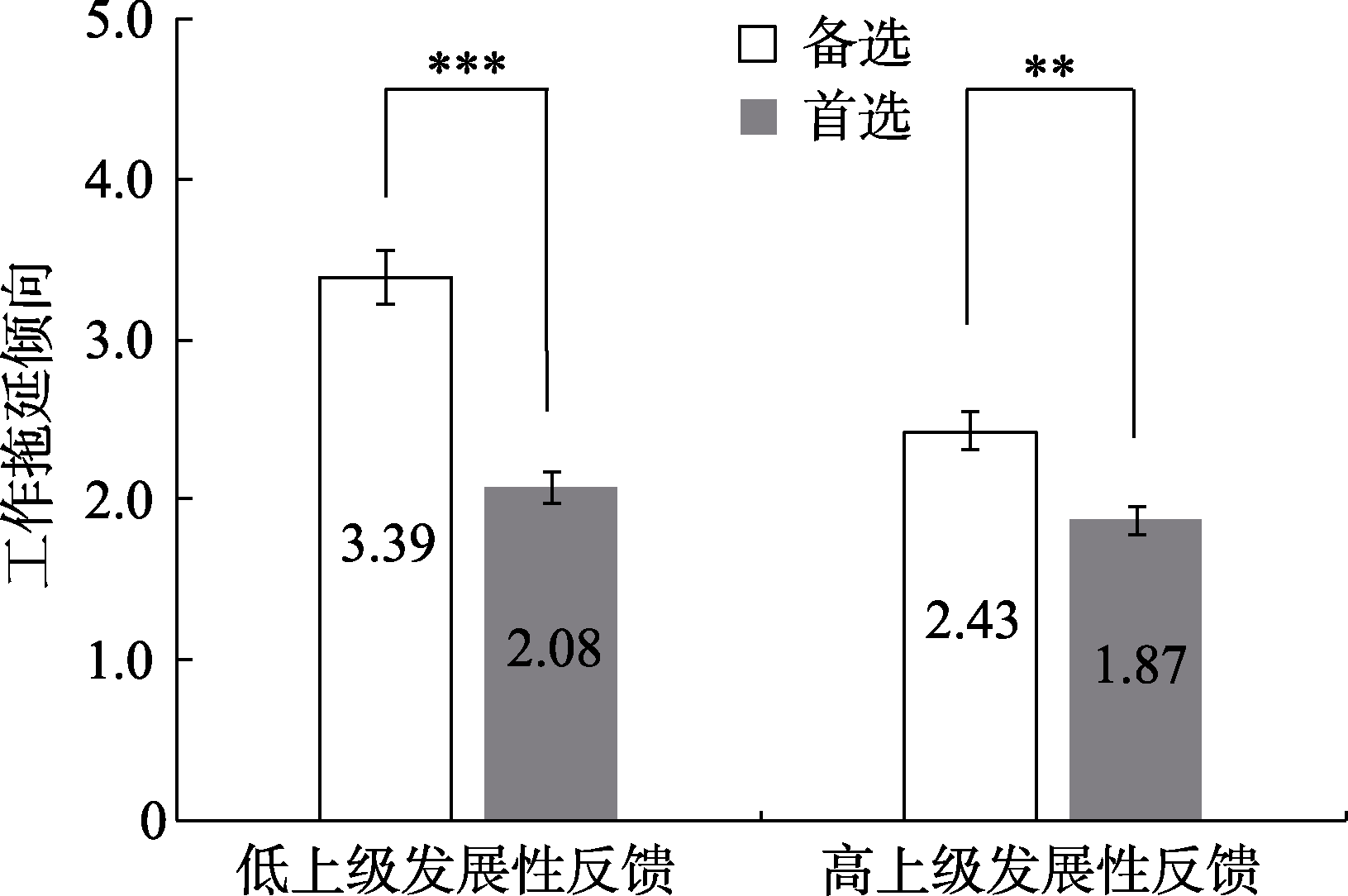
图3 备选(首选)和上级发展性反馈的交互对工作拖延倾向的简单效应 注: **表示p < 0.01, ***表示p < 0.001。
| 模型 | 模型构成 | χ2/df | TLI | CFI | RMSEA | SRMR |
|---|---|---|---|---|---|---|
| 七因子模型 | AC, DF, HP, OP, WP, TC, TT | 2.42 | 0.92 | 0.92 | 0.07 | 0.05 |
| 六因子模型 | AC, DF, HP+OP, WP, TC, TT | 5.17 | 0.75 | 0.77 | 0.11 | 0.12 |
| 五因子模型 | AC+DF, HP+OP, WP, TC, TT | 5.86 | 0.71 | 0.73 | 0.12 | 0.13 |
| 四因子模型 | AC+DF, HP+OP+WP, TC, TT | 7.61 | 0.62 | 0.64 | 0.14 | 0.16 |
| 三因子模型 | AC+DF, HP+OP+WP, TC+TT | 9.50 | 0.50 | 0.53 | 0.16 | 0.19 |
| 双因子模型 | AC+DF+HP+OP+WP, TC+TT | 10.81 | 0.42 | 0.45 | 0.17 | 0.19 |
| 单因子模型 | AC+DF+HP+OP+WP+TC+TT | 13.22 | 0.26 | 0.32 | 0.19 | 0.20 |
表1 验证性因子分析结果
| 模型 | 模型构成 | χ2/df | TLI | CFI | RMSEA | SRMR |
|---|---|---|---|---|---|---|
| 七因子模型 | AC, DF, HP, OP, WP, TC, TT | 2.42 | 0.92 | 0.92 | 0.07 | 0.05 |
| 六因子模型 | AC, DF, HP+OP, WP, TC, TT | 5.17 | 0.75 | 0.77 | 0.11 | 0.12 |
| 五因子模型 | AC+DF, HP+OP, WP, TC, TT | 5.86 | 0.71 | 0.73 | 0.12 | 0.13 |
| 四因子模型 | AC+DF, HP+OP+WP, TC, TT | 7.61 | 0.62 | 0.64 | 0.14 | 0.16 |
| 三因子模型 | AC+DF, HP+OP+WP, TC+TT | 9.50 | 0.50 | 0.53 | 0.16 | 0.19 |
| 双因子模型 | AC+DF+HP+OP+WP, TC+TT | 10.81 | 0.42 | 0.45 | 0.17 | 0.19 |
| 单因子模型 | AC+DF+HP+OP+WP+TC+TT | 13.22 | 0.26 | 0.32 | 0.19 | 0.20 |
| 变量 | M | SD | 1 | 2 | 3 | 4 | 5 | 6 | 7 | 8 | 9 | 10 |
|---|---|---|---|---|---|---|---|---|---|---|---|---|
| 1. 性别 | − | − | −− | |||||||||
| 2. 年龄 | 2.67 | 1.03 | 0.06 | −− | ||||||||
| 3. 受教育程度 | 2.71 | 0.89 | 0.08 | 0.02 | −− | |||||||
| 4. 工作年限 | 2.39 | 0.95 | −0.01 | 0.19** | −0.02 | −− | ||||||
| 5. 强迫型激情 | 2.09 | 0.67 | 0.01 | −0.01 | 0.01 | 0.09 | −− | |||||
| 6. 备选 | 3.87 | 0.99 | −0.05 | −0.09 | 0.04 | 0.03 | 0.16** | −− | ||||
| 7. 上级发展性反馈 | 2.60 | 0.70 | 0.01 | 0.01 | 0.02 | 0.04 | −0.03 | −0.08 | −− | |||
| 8. 和谐型激情 | 3.22 | 0.85 | −0.04 | −0.05 | 0.06 | −0.01 | 0.14** | 0.37** | −0.16** | −− | ||
| 9. 工作拖延倾向 | 2.22 | 0.72 | 0.01 | 0.06 | 0.02 | 0.10 | −0.03 | 0.18** | −0.13* | 0.04 | −− | |
| 10. 主动担责行为 | 3.82 | 0.79 | −0.06 | 0.09 | 0.01 | 0.05 | −0.15** | 0.18** | −0.06 | 0.24** | 0.15** | −− |
| 11. 时间窃取行为 | 2.39 | 0.88 | 0.08 | 0.00 | −0.02 | 0.05 | −0.08 | −0.27** | 0.04 | −0.47** | 0.25** | 0.01 |
表2 描述性统计与相关性分析结果
| 变量 | M | SD | 1 | 2 | 3 | 4 | 5 | 6 | 7 | 8 | 9 | 10 |
|---|---|---|---|---|---|---|---|---|---|---|---|---|
| 1. 性别 | − | − | −− | |||||||||
| 2. 年龄 | 2.67 | 1.03 | 0.06 | −− | ||||||||
| 3. 受教育程度 | 2.71 | 0.89 | 0.08 | 0.02 | −− | |||||||
| 4. 工作年限 | 2.39 | 0.95 | −0.01 | 0.19** | −0.02 | −− | ||||||
| 5. 强迫型激情 | 2.09 | 0.67 | 0.01 | −0.01 | 0.01 | 0.09 | −− | |||||
| 6. 备选 | 3.87 | 0.99 | −0.05 | −0.09 | 0.04 | 0.03 | 0.16** | −− | ||||
| 7. 上级发展性反馈 | 2.60 | 0.70 | 0.01 | 0.01 | 0.02 | 0.04 | −0.03 | −0.08 | −− | |||
| 8. 和谐型激情 | 3.22 | 0.85 | −0.04 | −0.05 | 0.06 | −0.01 | 0.14** | 0.37** | −0.16** | −− | ||
| 9. 工作拖延倾向 | 2.22 | 0.72 | 0.01 | 0.06 | 0.02 | 0.10 | −0.03 | 0.18** | −0.13* | 0.04 | −− | |
| 10. 主动担责行为 | 3.82 | 0.79 | −0.06 | 0.09 | 0.01 | 0.05 | −0.15** | 0.18** | −0.06 | 0.24** | 0.15** | −− |
| 11. 时间窃取行为 | 2.39 | 0.88 | 0.08 | 0.00 | −0.02 | 0.05 | −0.08 | −0.27** | 0.04 | −0.47** | 0.25** | 0.01 |
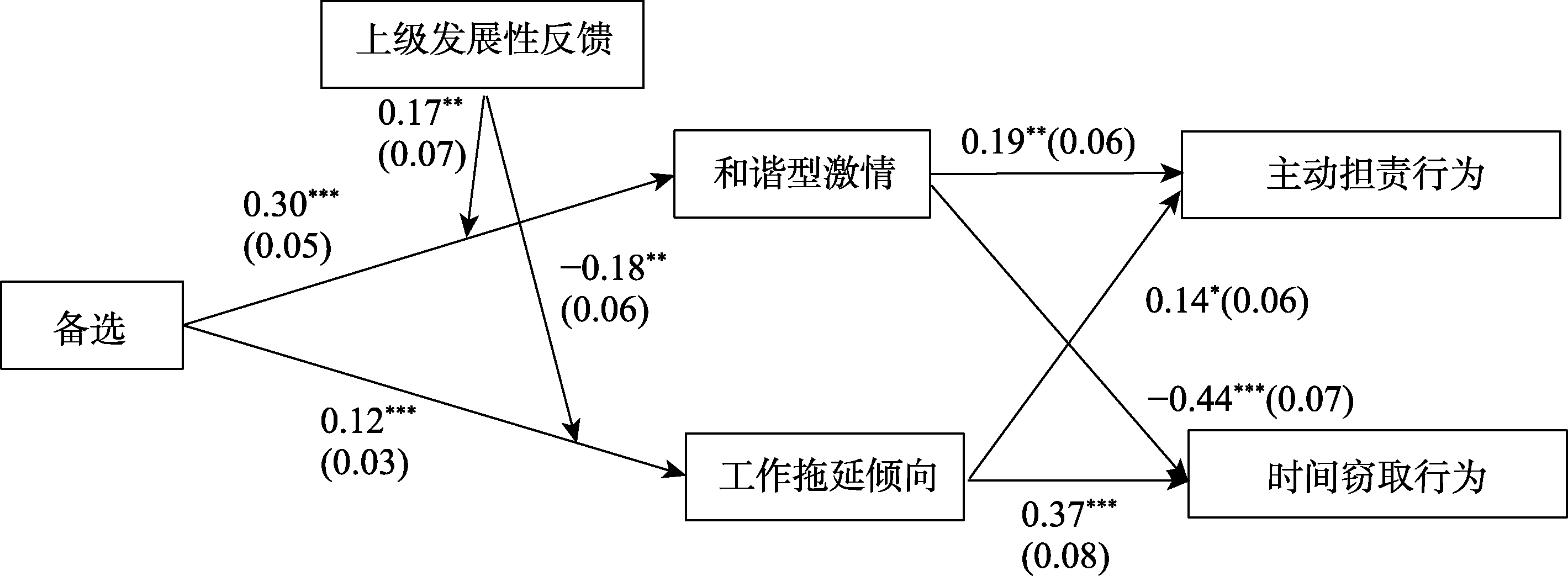
图4 全模型路径分析结果 注: 报告为非标准化系数, 括号内为标准误; ***表示p < 0.001; **表示p < 0.01; *表示p < 0.05。
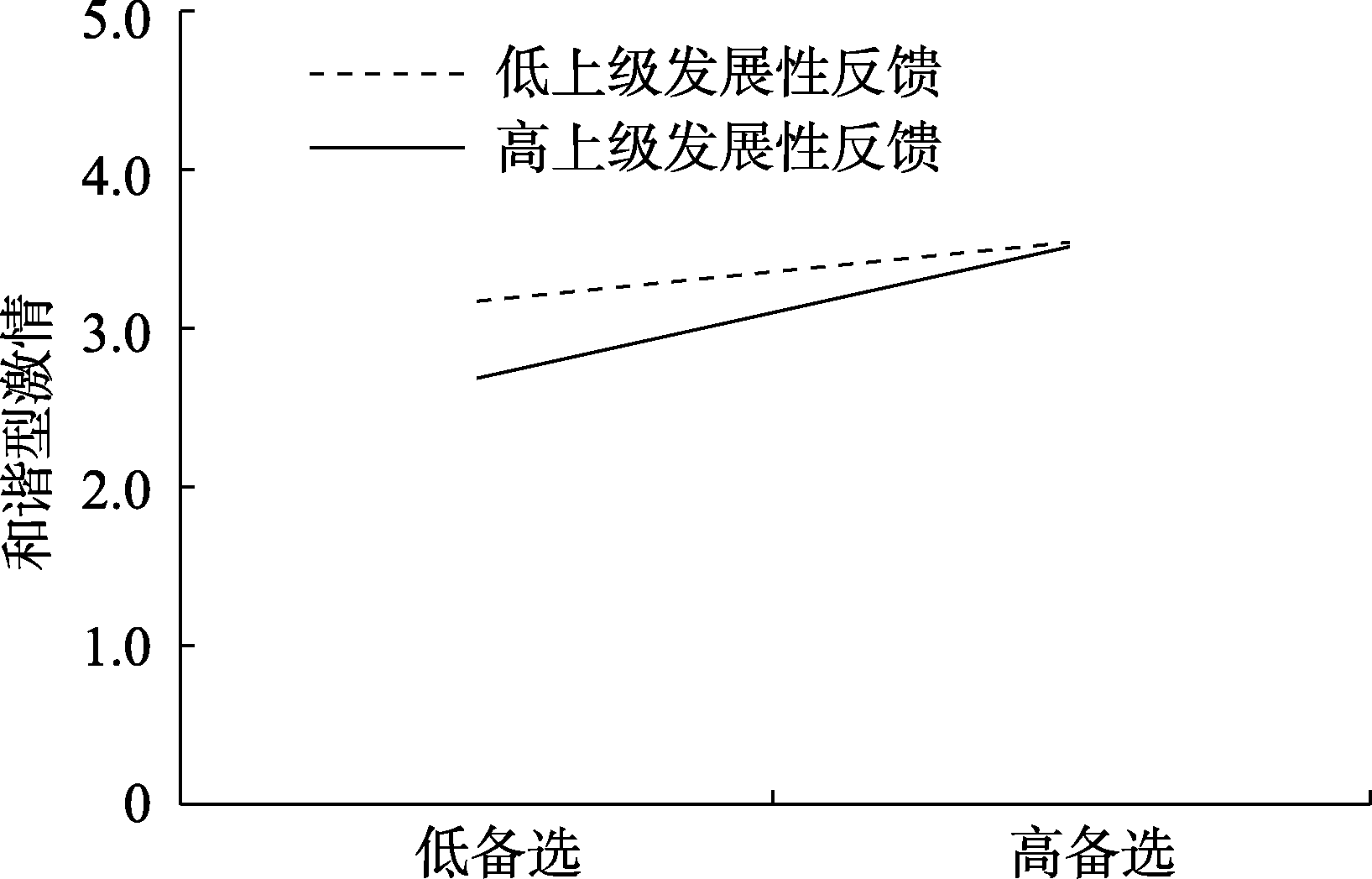
图5 上级发展性反馈对备选与和谐型激情的调节效应图
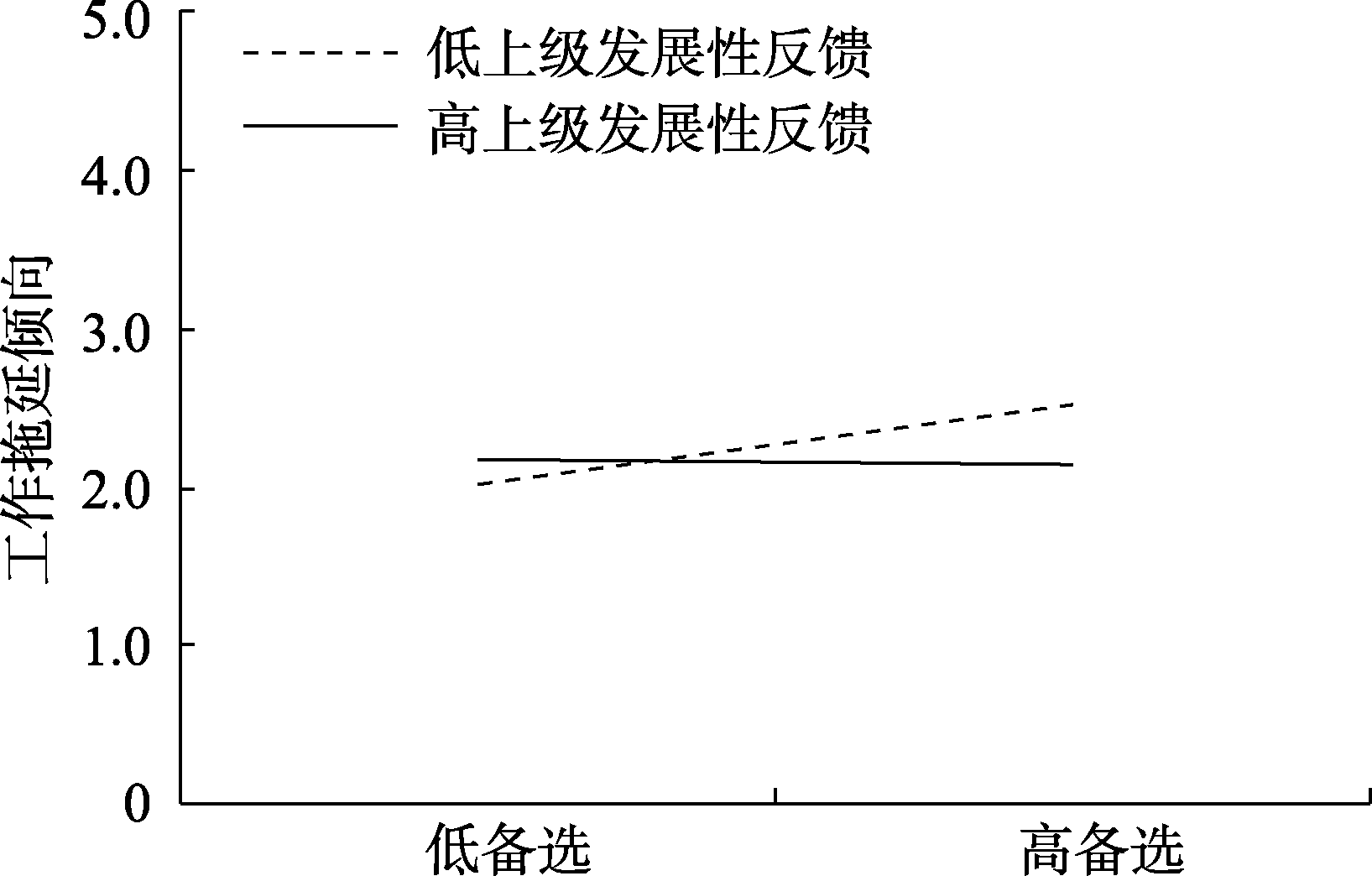
图6 上级发展性反馈对备选与工作拖延倾向的调节效应图
| 上级发展性 反馈 | 备选→和谐型激情→ 主动担责行为 | 备选→工作拖延倾向→ 时间窃取行为 | 备选→和谐型激情→ 时间窃取行为 | 备选→工作拖延倾向→ 主动担责行为 | ||||||||
|---|---|---|---|---|---|---|---|---|---|---|---|---|
| 间接效应 | 标准误 | 95% CI | 间接效应 | 标准误 | 95% CI | 间接效应 | 标准误 | 95% CI | 间接效应 | 标准误 | 95% CI | |
| 低上级发展性反馈 | 0.03 | 0.02 | [0.002, 0.068] | 0.09 | 0.03 | [0.023, 0.157] | −0.08 | 0.03 | [−0.141, −0.021] | 0.03 | 0.02 | [0.003, 0.063] |
| 高上级发展性反馈 | 0.08 | 0.03 | [0.028, 0.133] | −0.00 | 0.01 | [−0.027, 0.025] | −0.19 | 0.05 | [−0.274, −0.099] | 0.00 | 0.01 | [−0.011, 0.010] |
| 差异 | 0.05 | 0.02 | [0.002, 0.089] | −0.09 | 0.04 | [−0.168, −0.014] | −0.11 | 0.05 | [−0.196, −0.015] | −0.03 | 0.02 | [−0.067, 0.000] |
表3 有调节的中介效应分析结果
| 上级发展性 反馈 | 备选→和谐型激情→ 主动担责行为 | 备选→工作拖延倾向→ 时间窃取行为 | 备选→和谐型激情→ 时间窃取行为 | 备选→工作拖延倾向→ 主动担责行为 | ||||||||
|---|---|---|---|---|---|---|---|---|---|---|---|---|
| 间接效应 | 标准误 | 95% CI | 间接效应 | 标准误 | 95% CI | 间接效应 | 标准误 | 95% CI | 间接效应 | 标准误 | 95% CI | |
| 低上级发展性反馈 | 0.03 | 0.02 | [0.002, 0.068] | 0.09 | 0.03 | [0.023, 0.157] | −0.08 | 0.03 | [−0.141, −0.021] | 0.03 | 0.02 | [0.003, 0.063] |
| 高上级发展性反馈 | 0.08 | 0.03 | [0.028, 0.133] | −0.00 | 0.01 | [−0.027, 0.025] | −0.19 | 0.05 | [−0.274, −0.099] | 0.00 | 0.01 | [−0.011, 0.010] |
| 差异 | 0.05 | 0.02 | [0.002, 0.089] | −0.09 | 0.04 | [−0.168, −0.014] | −0.11 | 0.05 | [−0.196, −0.015] | −0.03 | 0.02 | [−0.067, 0.000] |
| [1] |
Bernerth J. B., & Aguinis H. (2016). A critical review and best-practice recommendations for control variable usage. Personnel Psychology, 69(1), 229-283.
doi: 10.1111/peps.2016.69.issue-1 URL |
| [2] |
Brislin R. W. (1970). Back-translation for cross-cultural research. Journal of Cross-cultural Psychology, 1(3), 185-216.
doi: 10.1177/135910457000100301 URL |
| [3] |
Call M. L., Campbell E. M., Dunford B. B., Boswell W. R., & Boss R. W. (2021). Shining with the stars? Unearthing how group star proportion shapes non-star performance. Personnel Psychology, 74(3), 543-572.
doi: 10.1111/peps.v74.3 URL |
| [4] |
Fehr R., Fulmer A., & Keng-Highberger F. T. (2020). How do employees react to leaders’ unethical behavior? The role of moral disengagement. Personnel Psychology, 73(1), 73-93.
doi: 10.1111/peps.v73.1 URL |
| [5] |
Fuller Jr J. B., Marler L. E., & Hester K. (2012). Bridge building within the province of proactivity. Journal of Organizational Behavior, 33(8), 1053-1070.
doi: 10.1002/job.v33.8 URL |
| [6] |
Gawronski B., & Bodenhausen G. V. (2006). Associative and propositional processes in evaluation: An integrative review of implicit and explicit attitude change. Psychological Bulletin, 132(5), 692-731.
doi: 10.1037/0033-2909.132.5.692 pmid: 16910748 |
| [7] | Gawronski B., & Bodenhausen G. V. (2011). The associative- propositional evaluation model: Theory, evidence, and open questions. Advances in Experimental Social Psychology, 44, 59-127. |
| [8] |
Harold C. M., Hu B., & Koopman J. (2022). Employee time theft: Conceptualization, measure development, and validation. Personnel Psychology, 75(2), 347-382.
doi: 10.1111/peps.v75.2 URL |
| [9] |
Ho V. T., Wong S. S., & Lee C. H. (2011). A tale of passion: Linking job passion and cognitive engagement to employee work performance. Journal of Management Studies, 48(1), 26-47.
doi: 10.1111/j.1467-6486.2009.00878.x URL |
| [10] |
Hu B. Y., & Meng L. (2024). Formation and consequences of employee time theft: A motivational perspective. Advances in Psychological Science, 32(3), 433-450.
doi: 10.3724/SP.J.1042.2024.00433 |
|
[胡碧芸, 孟亮. (2024). 动机视角下员工时间偷窃的产生机制及影响. 心理科学进展, 32(3), 433-450.]
doi: 10.3724/SP.J.1042.2024.00433 |
|
| [11] |
Jiang W., An Y., Wang L., & Zheng C. (2021). Newcomers’ reaction to the abusive supervision toward peers during organizational socialization. Journal of Vocational Behavior, 128, 103586.
doi: 10.1016/j.jvb.2021.103586 URL |
| [12] |
Kühnel J., Bledow R., & Feuerhahn N. (2016). When do you procrastinate? Sleep quality and social sleep lag jointly predict self-regulatory failure at work. Journal of Organizational Behavior, 37(7), 983-1002.
doi: 10.1002/job.v37.7 URL |
| [13] | Lan M., Hu Z., & Nie T. (2025). Unwilling or unable? The impact of role clarity and job competence on frontline employees’ taking charge behaviors in hospitality industry. Behavioral Sciences, 15(4), 526. |
| [14] |
Lebel R. D., & Patil S. V. (2018). Proactivity despite discouraging supervisors: The powerful role of prosocial motivation. Journal of Applied Psychology, 103(7), 724-737.
doi: 10.1037/apl0000301 pmid: 29578739 |
| [15] |
Li J., Zhang J., Shao B., & Chen C. (2020). A latent profile analysis of work passion: Structure, antecedent, and outcomes. Personnel Review, 49(3), 846-863.
doi: 10.1108/PR-04-2019-0145 URL |
| [16] |
Liao H., Feng Q., Zhu L., & Guan O. Z. (2023). The award goes to...someone else: A natural quasi-experiment examining the impact of performance awards on nominees’ workplace collaboration. Academy of Management Journal, 66(5), 1303-1333.
doi: 10.5465/amj.2021.0662 URL |
| [17] |
Lin C. S., Jin M., Huang P. C., & Xiao R. (2023). Does it take two to tango? The joint role of high-performance work systems and ethical leadership. Journal of Business Research, 156, 113536.
doi: 10.1016/j.jbusres.2022.113536 URL |
| [18] |
Liu X. Y., Liu J., Xu J., & Wu R. R. (2015). The effect of workplace ostracism on proactive behavior: The self- verification theory perspective. Acta Psychologica Sinica, 47(6), 826-836.
doi: 10.3724/SP.J.1041.2015.00826 URL |
| [刘小禹, 刘军, 许浚, 吴蓉蓉. (2015). 职场排斥对员工主动性行为的影响机制——基于自我验证理论的视角. 心理学报, 47(6), 826-836.] | |
| [19] |
Lorinkova N. M., & Perry S. J. (2017). When is empowerment effective? The role of leader-leader exchange in empowering leadership, cynicism, and time theft. Journal of Management, 43(5), 1631-1654.
doi: 10.1177/0149206314560411 URL |
| [20] |
Lu H. L., Yang Y., Wang Y. L., Zhang X., & Tan L. (2021). Does distrust motivate or discourage employees? The double-edged sword of feeling ability-distrusted by supervisors. Acta Psychologica Sinica, 53(12), 1376-1392.
doi: 10.3724/SP.J.1041.2021.01376 |
|
[卢海陵, 杨洋, 王永丽, 张昕, 谭玲. (2021). “激将法”会激发还是打击员工? 感知能力不被领导信任的“双刃剑”效应. 心理学报, 53(12), 1376-1392.]
doi: 10.3724/SP.J.1041.2021.01376 |
|
| [21] |
Ma J., & Zhu M. T. (2023). Accept or change your fate: Exploring the golem effect and underdog effect of underdog expectations. Acta Psychologica Sinica, 55(6), 1029-1048.
doi: 10.3724/SP.J.1041.2023.01029 |
|
[马君, 朱梦霆. (2023). 命运天定还是逆天改命: 探索劣势者成见的“傀儡效应”与“黑马效应”. 心理学报, 55(6), 1029-1048.]
doi: 10.3724/SP.J.1041.2023.01029 |
|
| [22] |
Malik A. R., & Singh P. (2014). ‘High potential’ programs: Let’s hear it for ‘B’ players. Human Resource Management Review, 24(4), 330-346.
doi: 10.1016/j.hrmr.2014.06.001 URL |
| [23] |
Michailidis E., Xanthopoulou D., & Michaelides G. (2026). Daily workplace embitterment and work-related rumination during off-job time: Illegitimate tasks as antecedents and the buffering role of appreciation. Work & Stress, 40(1), 7-29. https:// doi.org/10.1080/02678373.2025.2484761
doi: 10.1080/02678373.2025.2484761 URL |
| [24] |
Morrison E. W., & Phelps C. C. (1999). Taking charge at work: Extrarole efforts to initiate workplace change. Academy of Management Journal, 42(4), 403-419.
doi: 10.2307/257011 URL |
| [25] | Nie Q., Zhang J., Lu Y., & Bi Y. Z. (2022). The paradoxical effects of leaders’ high performance expectations: An approach-avoidance framework perspective. Journal of Industrial Engineering and Engineering Management, 36(1), 53-63. |
| [聂琦, 张捷, 陆渊, 毕砚昭. (2022). 领导高绩效期望的双面性: 趋近-回避理论视角. 管理工程学报, 36(1), 53-63.] | |
| [26] |
Nurmohamed S. (2020). The underdog effect: When low expectations increase performance. Academy of Management Journal, 63(4), 1106-1133.
doi: 10.5465/amj.2017.0181 URL |
| [27] |
Nurmohamed S., & Schwingel-Sauer Z. (2024). Beyond the first choice: The impact of being an alternate choice on social integration and feedback seeking. Journal of Applied Psychology, 109(4), 587-598.
doi: 10.1037/apl0001163 pmid: 38032602 |
| [28] |
Parke M. R., Weinhardt J. M., Brodsky A., Tangirala S., & DeVoe S. E. (2018). When daily planning improves employee performance: The importance of planning type, engagement, and interruptions. Journal of Applied Psychology, 103(3), 300-312.
doi: 10.1037/apl0000278 pmid: 29154579 |
| [29] |
Salancik G. R., & Pfeffer J. (1978). A social information processing approach to job attitudes and task design. Administrative Science Quarterly, 23(2), 224-253.
pmid: 10307892 |
| [30] |
Shen Y., Chou W. J., Schaubroeck J. M., & Liu J. (2023). Benevolent leadership, harmonious passion, and employee work behaviors: A multi-level moderated mediation model. Journal of Business Research, 157, 113571.
doi: 10.1016/j.jbusres.2022.113571 URL |
| [31] |
Sirén C., Patel P. C., & Wincent J. (2016). How do harmonious passion and obsessive passion moderate the influence of a ceo’s change-oriented leadership on company performance? The Leadership Quarterly, 27(4), 653-670.
doi: 10.1016/j.leaqua.2016.03.002 URL |
| [32] |
Tang Y., Pu X., Xu E., Huang X., Zhang G., & Xiao J. (2025). Passion ignites: Effect of expert worker passion on employee performance in knowledge worker teams. Journal of Business Research, 188, 115052.
doi: 10.1016/j.jbusres.2024.115052 URL |
| [33] |
Vallerand R. J., Blanchard C., Mageau G. A., Koestner R., Ratelle C., Léonard M., Gagne M., & Marsolais J. (2003). Les passions de l’ame: On obsessive and harmonious passion. Journal of Personality and Social Psychology, 85(4), 756-767.
doi: 10.1037/0022-3514.85.4.756 pmid: 14561128 |
| [34] | Wang Z., Wang Q., & Wang D. (2024). Reducing employees’ time theft through leader’s developmental feedback: The serial multiple mediating effects of perceived insider status and work passion. Behavioral Sciences, 14(4), 269. |
| [35] |
Xu C., Yao Z., & Xiong Z. (2023). The impact of work- related use of information and communication technologies after hours on time theft. Journal of Business Ethics, 187(1), 185-198.
doi: 10.1007/s10551-022-05167-1 |
| [36] |
Xu S. Y., Yang C. M., Li C. P., & Li H. R. (2024). How “slacking off” sparks innovation: Evidence from a scenario experiment and a survey study on curvilinear mediation of recovery experience. Acta Psychologica Sinica, 57(1), 135-151.
doi: 10.3724/SP.J.1041.2025.0135 URL |
|
[徐世勇, 杨春梦, 李超平, 李海蓉. (2025). “摸鱼”如何带来创新?恢复体验曲线中介效应的情景实验与调查证据. 心理学报, 57(1), 135-151.]
doi: 10.3724/SP.J.1041.2025.0135 |
|
| [37] |
Yousaf A., Yusuf F., & Umrani W. A. (2023). Creatures of a lesser god! Gender-based differences in HR attributions mediated by person-job fit: A poly-contextual analysis. Personnel Review, 52(7), 1842-1860.
doi: 10.1108/PR-08-2021-0597 URL |
| [38] |
Zagenczyk T. J., & Powell E. E. (2023). Social networks and citizenship behavior: The mediating effect of organizational identification. Human Resource Management, 62(4), 461-475.
doi: 10.1002/hrm.v62.4 URL |
| [39] | Zhang Y., Tan C., & Wang N. (2024). How does supervisor developmental feedback make employees sense the meaning of work? Asia Pacific Journal of Human Resources, 62(1), e12376. |
| [40] |
Zhao F., Zhu H., Chen Y., & Wang L. (2024). True meaning and due duty: Examining how and when career calling promotes employee taking charge. Journal of Managerial Psychology, 39(1), 18-38.
doi: 10.1108/JMP-03-2023-0161 URL |
| [41] |
Zhou J. (2003). When the presence of creative coworkers is related to creativity: Role of supervisor close monitoring, developmental feedback, and creative personality. Journal of Applied Psychology, 88(3), 413-422.
pmid: 12814291 |
| [42] |
Zigarmi D., Galloway F. J., & Roberts T. P. (2018). Work locus of control, motivational regulation, employee work passion, and work intentions: An empirical investigation of an appraisal model. Journal of Happiness Studies, 19(1), 231-256.
doi: 10.1007/s10902-016-9813-2 URL |
| [43] |
Zou Y, C., Zhang H. M., Peng J., Nie Q., & Wang Z. (2023). Change or procrastination? Employees’ differentiated responses to illegitimate tasks. Acta Psychologica Sinica, 55(9), 1529-1541.
doi: 10.3724/SP.J.1041.2023.01529 |
|
[邹艳春, 章惠敏, 彭坚, 聂琦, 王震. (2023). 变革还是拖延? 员工对不合规任务的差异化应对. 心理学报, 55(9), 1529-1541.]
doi: 10.3724/SP.J.1041.2023.01529 |
| [1] | 唐小飞, 王昌梅, 孙晓东, 张恩忠. 类人智能机器人信任对员工工作贡献意愿的影响: 基于人机关系信任的归维考察[J]. 心理学报, 2025, 57(11): 1933-1950. |
| [2] | 王永跃, 张范颖, 岳峰凯, 谢江佩. 时间压力作用下知识存量对即兴行为的影响机制[J]. 心理学报, 2025, 57(10): 1791-1812. |
| [3] | 高雪原, 张志朋, 谢宝国, 龙立荣, 尹奎. “好压力, 坏压力?” 算法规范压力对服务绩效的双刃剑效应[J]. 心理学报, 2025, 57(10): 1813-1831. |
| [4] | 张一杰, 郑晓明. 危机事件强度对员工主动行为的双刃剑效应:危机领导力的调节作用[J]. 心理学报, 2025, 57(8): 1482-1498. |
| [5] | 农梅兰, 朱瑜, 王雁飞. 以家庭之名行不义之事: 不道德亲家庭行为的影响及其机制[J]. 心理学报, 2025, 57(7): 1262-1280. |
| [6] | 王永跃, 王静, 刘军, 金杨华. 辱虐管理变化的动态前因:一个潜变化分数模型[J]. 心理学报, 2025, 57(3): 479-494. |
| [7] | 王国轩, 龙立荣, 李绍龙, 孙芳, 望家晴, 黄世英子. 负面绩效反馈下员工绩效改进动机的人机比较[J]. 心理学报, 2025, 57(2): 298-314. |
| [8] | 徐世勇, 杨春梦, 李超平, 李海蓉. “摸鱼”如何带来创新?恢复体验曲线中介效应的情景实验与调查证据[J]. 心理学报, 2025, 57(1): 135-151. |
| [9] | 李其容, 王春淼, 孙明慧. 创业激情的“错位”对创业努力和创业成瘾的影响机制[J]. 心理学报, 2024, 56(11): 1568-1584. |
| [10] | 贾建锋, 刘伟鹏, 段锦云, 赵洋. 妒忌还是钦佩: 员工对同事被授权的心理与行为反应[J]. 心理学报, 2024, 56(10): 1401-1416. |
| [11] | 赵晨, 林晨, 周锦来, 高中华. 愿景沟通中负面反馈的解释水平对下属愿景追逐行为的影响[J]. 心理学报, 2024, 56(10): 1417-1430. |
| [12] | 赵富强, 祝含秋, 陈耘, 陈祝慧. 员工跨界何以影响上司支持:上司信任与向上建议寻求的作用[J]. 心理学报, 2024, 56(10): 1431-1447. |
| [13] | 倪丹, 郑晓明. 同事帮助行为对观察者的人际影响:基于社会比较理论[J]. 心理学报, 2024, 56(8): 1125-1140. |
| [14] | 赵锴, 俞溪, 张山杉. 委以重任还是排斥打压?明星员工与团队领导的人际互动后果[J]. 心理学报, 2024, 56(5): 630-649. |
| [15] | 李其容, 李春萱. 团队反思训练对团队双元发展的影响及机制[J]. 心理学报, 2024, 56(3): 311-325. |
| 阅读次数 | ||||||
|
全文 |
|
|||||
|
摘要 |
|
|||||
