

ISSN 0439-755X
CN 11-1911/B
主办:中国心理学会
中国科学院心理研究所
出版:科学出版社
CN 11-1911/B
主办:中国心理学会
中国科学院心理研究所
出版:科学出版社
心理学报 ›› 2026, Vol. 58 ›› Issue (1): 130-150.doi: 10.3724/SP.J.1041.2026.0130 cstr: 32110.14.2026.0130
钟杰1, 倪丹2, 郑晓明3( ), 马超4
收稿日期:2024-11-27
发布日期:2025-10-28
出版日期:2026-01-25
通讯作者:
郑晓明, E-mail: zhengxm@sem.tsinghua.edu.cn基金资助:
ZHONG Jie1, NI Dan2, ZHENG Xiaoming3(), MA Chao4
Received:2024-11-27
Online:2025-10-28
Published:2026-01-25
摘要:
基于边界理论, 本文关注上下级关系对职业主动行为的影响, 探讨了职业边界入侵在其中发挥的中介作用、职业未来时间观和组织支持员工发展发挥的调节作用。本研究采纳三个实证研究进行检验。研究1考察了上下级关系与职业主动行为之间的直接关系; 研究2检验了职业未来时间观和组织支持员工发展在其中发挥调节作用; 研究3验证了整体模型, 包括职业边界入侵这一中介机制及其边界条件。结果发现:上下级关系与职业边界入侵、职业主动行为之间呈现曲线关系。在高职业未来时间观和组织支持员工发展的情况下, 员工在面临紧密的上下级关系时, 往往感受到更高的职业边界入侵, 进而更多地会降低职业主动行为; 而在低职业未来时间观和组织支持员工发展的情况下, 随着上下级关系的提升, 员工则较少感受到职业边界入侵, 进而倾向于提升职业主动行为。本文首次从跨边界视角提出并验证了上下级关系和职业主动行为之间的复杂关系, 为理解中国文化情境下的上下级关系对职业发展的影响提供了新视角, 具有重要的理论与实践意义。
中图分类号:
钟杰, 倪丹, 郑晓明, 马超. (2026). 上下级关系与职业主动行为之间的倒U型关系——基于跨边界视角. 心理学报, 58(1), 130-150.
ZHONG Jie, NI Dan, ZHENG Xiaoming, MA Chao. (2026). The inverted U-shaped relationship between Supervisor−Subordinate Guanxi and proactive career behavior: From cross-boundary perspective. Acta Psychologica Sinica, 58(1), 130-150.
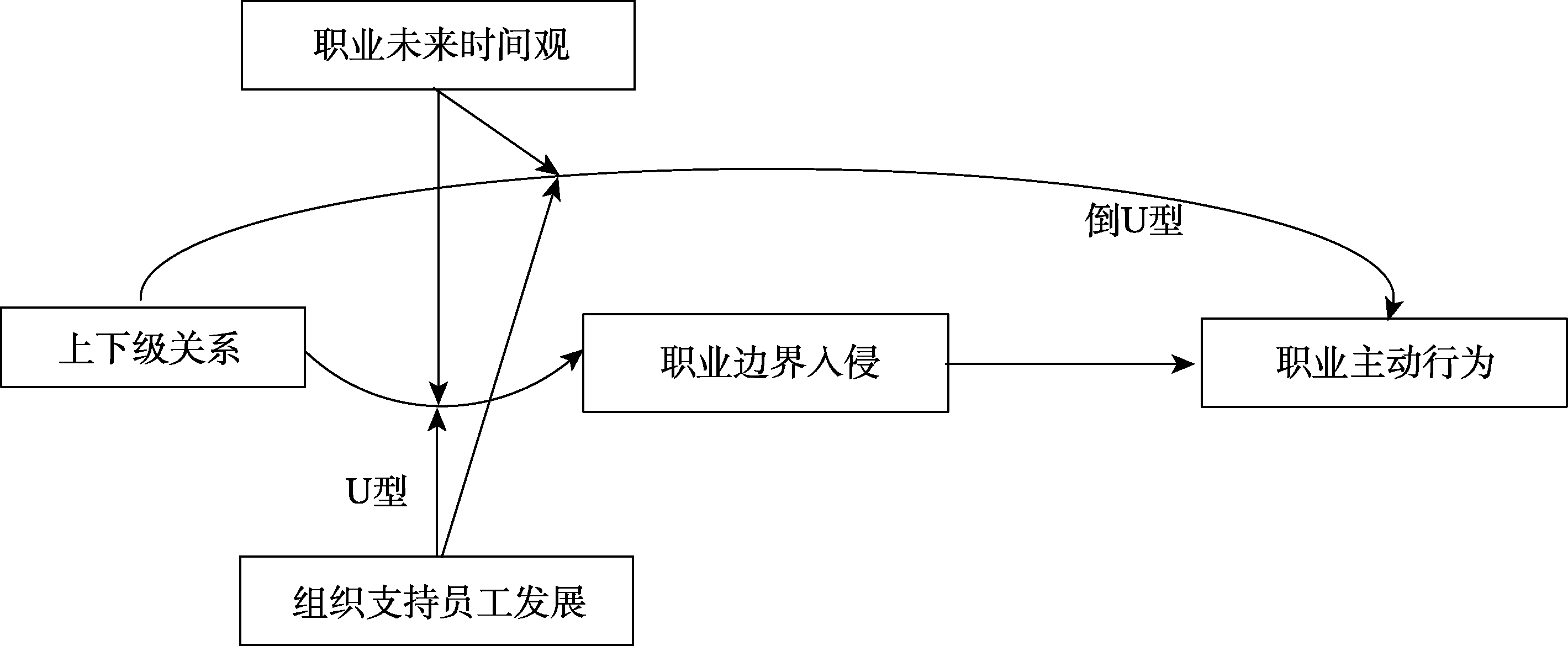
图1 理论模型
| 变量 | M | SD | 1 | 2 | 3 | 4 | 5 | 6 |
|---|---|---|---|---|---|---|---|---|
| 1. 性别 | 1.30 | 0.46 | − | |||||
| 2. 年龄 | 29.89 | 6.26 | 0.11 | − | ||||
| 3. 教育程度 | 3.03 | 0.92 | 0.03 | 0.12 | − | |||
| 4. 工作年限 | 4.83 | 4.81 | 0.08 | 0.62** | −0.14 | − | ||
| 5. 上下级关系 | 3.18 | 0.75 | −0.33** | −0.004 | −0.08 | −0.11 | − | |
| 6. 职业主动行为 | 3.81 | 0.55 | −0.05 | 0.02 | 0.01 | 0.03 | 0.07 | − |
表1 研究1变量的均值、标准差和相关系数
| 变量 | M | SD | 1 | 2 | 3 | 4 | 5 | 6 |
|---|---|---|---|---|---|---|---|---|
| 1. 性别 | 1.30 | 0.46 | − | |||||
| 2. 年龄 | 29.89 | 6.26 | 0.11 | − | ||||
| 3. 教育程度 | 3.03 | 0.92 | 0.03 | 0.12 | − | |||
| 4. 工作年限 | 4.83 | 4.81 | 0.08 | 0.62** | −0.14 | − | ||
| 5. 上下级关系 | 3.18 | 0.75 | −0.33** | −0.004 | −0.08 | −0.11 | − | |
| 6. 职业主动行为 | 3.81 | 0.55 | −0.05 | 0.02 | 0.01 | 0.03 | 0.07 | − |
| 变量 | 职业主动行为 | ||||
|---|---|---|---|---|---|
| 模型1 系数 (SE) | 模型2 系数 (SE) | 模型3 系数 (SE) | |||
| 截距 | 3.83*** (0.25) | 3.81*** (0.25) | 3.80*** (0.25) | ||
| 性别 | −0.06 (0.09) | −0.04 (0.09) | −0.04 (0.09) | ||
| 年龄 | 0.0002 (0.01) | 0.001 (0.01) | 0.001(0.01) | ||
| 教育程度 | 0.01 (0.05) | 0.02 (0.05) | 0.02 (0.05) | ||
| 工作年限 | 0.03 (0.01) | 0.01 (0.01) | 0.01 (0.01) | ||
| 上下级关系 | 0.05 (0.06) | 0.08 (0.06) | |||
| 上下级关系的平方 | −0.10* (0.05) | ||||
| R2 | 0.004 | 0.01 | 0.03 | ||
| R2 change | 0.004 | 0.003 | 0.02 | ||
| F | 0.18 | 0.27 | 0.99 | ||
| F change | 0.18 | 0.62 | 4.55* | ||
表2 研究1的回归结果
| 变量 | 职业主动行为 | ||||
|---|---|---|---|---|---|
| 模型1 系数 (SE) | 模型2 系数 (SE) | 模型3 系数 (SE) | |||
| 截距 | 3.83*** (0.25) | 3.81*** (0.25) | 3.80*** (0.25) | ||
| 性别 | −0.06 (0.09) | −0.04 (0.09) | −0.04 (0.09) | ||
| 年龄 | 0.0002 (0.01) | 0.001 (0.01) | 0.001(0.01) | ||
| 教育程度 | 0.01 (0.05) | 0.02 (0.05) | 0.02 (0.05) | ||
| 工作年限 | 0.03 (0.01) | 0.01 (0.01) | 0.01 (0.01) | ||
| 上下级关系 | 0.05 (0.06) | 0.08 (0.06) | |||
| 上下级关系的平方 | −0.10* (0.05) | ||||
| R2 | 0.004 | 0.01 | 0.03 | ||
| R2 change | 0.004 | 0.003 | 0.02 | ||
| F | 0.18 | 0.27 | 0.99 | ||
| F change | 0.18 | 0.62 | 4.55* | ||
| Model | χ2 | df | χ2/df | Δχ2 | CFI | TLI | RMSEA | SRMR |
|---|---|---|---|---|---|---|---|---|
| 1. 四因子模型 | 1291.63 | 421 | 3.07 | — | 0.91 | 0.92 | 0.07 | 0.06 |
| 2. 三因子模型 | 2091.51 | 424 | 4.93 | 799.88*** | 0.84 | 0.82 | 0.09 | 0.09 |
| 3. 二因子模型 | 4158.53 | 426 | 9.76 | 2866.90*** | 0.64 | 0.60 | 0.14 | 0.21 |
| 4. 一因子模型 | 10764.51 | 465 | 23.15 | 9472.88*** | 0.51 | 0.46 | 0.16 | 0.22 |
表3 验证性因子分析结果
| Model | χ2 | df | χ2/df | Δχ2 | CFI | TLI | RMSEA | SRMR |
|---|---|---|---|---|---|---|---|---|
| 1. 四因子模型 | 1291.63 | 421 | 3.07 | — | 0.91 | 0.92 | 0.07 | 0.06 |
| 2. 三因子模型 | 2091.51 | 424 | 4.93 | 799.88*** | 0.84 | 0.82 | 0.09 | 0.09 |
| 3. 二因子模型 | 4158.53 | 426 | 9.76 | 2866.90*** | 0.64 | 0.60 | 0.14 | 0.21 |
| 4. 一因子模型 | 10764.51 | 465 | 23.15 | 9472.88*** | 0.51 | 0.46 | 0.16 | 0.22 |
| 变量 | M | SD | 1 | 2 | 3 | 4 | 5 | 6 | 7 | 8 | 9 | 10 |
|---|---|---|---|---|---|---|---|---|---|---|---|---|
| 1. 性别 | − | − | − | |||||||||
| 2. 年龄(岁) | 37.58 | 6.17 | 0.22** | − | ||||||||
| 3. 教育程度 | 3.62 | 1.03 | −0.13** | −0.28** | − | |||||||
| 4. 上下级关系年限 | 4.50 | 2.72 | 0.07 | 0.24** | −0.03 | − | ||||||
| 5. 工作年限 | 5.49 | 3.42 | −0.15** | 0.24** | 0.18** | 0.51** | − | |||||
| 6. LMX | 3.94 | 0.60 | −0.02 | −0.04 | 0.06 | −0.10* | −0.01 | − | ||||
| 7. 主动性人格 | 3.76 | 0.62 | 0.0001 | −0.04 | 0.04 | −0.06 | 0.01 | 0.25** | − | |||
| 8. 上下级关系 | 3.51 | 0.68 | −0.05 | 0.01 | 0.01 | −0.09 | −0.07 | 0.61** | 0.20** | − | ||
| 9. 职业未来时间观 | 3.72 | 0.55 | −0.03 | −0.16** | 0.01 | −0.09 | −0.07 | 0.34** | 0.55** | 0.18** | − | |
| 10. 组织支持员工发展 | 3.94 | 0.75 | 0.03 | 0.02 | −0.04 | −0.01 | −0.06 | 0.49** | 0.23** | 0.28** | 0.29** | − |
| 11. 职业主动行为 | 3.92 | 0.61 | −0.10* | 0.02 | 0.07 | −0.01 | 0.03 | 0.10* | 0.15** | 0.12* | 0.23** | 0.07 |
表4 研究2变量的均值、标准差和相关系数
| 变量 | M | SD | 1 | 2 | 3 | 4 | 5 | 6 | 7 | 8 | 9 | 10 |
|---|---|---|---|---|---|---|---|---|---|---|---|---|
| 1. 性别 | − | − | − | |||||||||
| 2. 年龄(岁) | 37.58 | 6.17 | 0.22** | − | ||||||||
| 3. 教育程度 | 3.62 | 1.03 | −0.13** | −0.28** | − | |||||||
| 4. 上下级关系年限 | 4.50 | 2.72 | 0.07 | 0.24** | −0.03 | − | ||||||
| 5. 工作年限 | 5.49 | 3.42 | −0.15** | 0.24** | 0.18** | 0.51** | − | |||||
| 6. LMX | 3.94 | 0.60 | −0.02 | −0.04 | 0.06 | −0.10* | −0.01 | − | ||||
| 7. 主动性人格 | 3.76 | 0.62 | 0.0001 | −0.04 | 0.04 | −0.06 | 0.01 | 0.25** | − | |||
| 8. 上下级关系 | 3.51 | 0.68 | −0.05 | 0.01 | 0.01 | −0.09 | −0.07 | 0.61** | 0.20** | − | ||
| 9. 职业未来时间观 | 3.72 | 0.55 | −0.03 | −0.16** | 0.01 | −0.09 | −0.07 | 0.34** | 0.55** | 0.18** | − | |
| 10. 组织支持员工发展 | 3.94 | 0.75 | 0.03 | 0.02 | −0.04 | −0.01 | −0.06 | 0.49** | 0.23** | 0.28** | 0.29** | − |
| 11. 职业主动行为 | 3.92 | 0.61 | −0.10* | 0.02 | 0.07 | −0.01 | 0.03 | 0.10* | 0.15** | 0.12* | 0.23** | 0.07 |
| 变量 | 职业主动行为 | ||||
|---|---|---|---|---|---|
| 模型1 系数 (SE) | 模型2 系数 (SE) | 模型3 系数 (SE) | 模型4 系数 (SE) | 模型5 系数 (SE) | |
| 截距 | 2.91*** (0.33) | 3.07*** (0.37) | 3.04*** (0.37) | 3.49*** (0.38) | 3.05*** (0.39) |
| 性别 | −0.14* (0.06) | −0.13* (0.06) | −0.13* (0.06) | −0.14* (0.06) | −0.12 (0.06) |
| 年龄 | 0.01 (0.01) | 0.007 (0.01) | 0.01 (0.01) | 0.01* (0.01) | 0.01 (0.01) |
| 教育程度 | 0.05 (0.03) | 0.05 (0.03) | 0.05 (0.03) | 0.06* (0.03) | 0.05 (0.03) |
| 上下级关系年限 | 0.002 (0.01) | 0.001 (0.01) | 0.001 (0.01) | 0.001 (0.01) | 0.001 (0.01) |
| 工作年限 | −0.004 (0.01) | −0.003 (0.01) | −0.004 (0.01) | −0.01 (0.01) | −0.004 (0.01) |
| LMX | 0.07 (0.05) | 0.03 (0.06) | 0.05 (0.06) | −0.03 (0.06) | 0.04 (0.07) |
| 主动性人格 | 0.13** (0.05) | 0.13** (0.05) | 0.13** (0.05) | 0.04 (0.05) | 0.13* (0.05) |
| 上下级关系 | 0.06 (0.05) | 0.04 (0.05) | 0.10 (0.05) | 0.07 (0.06) | |
| 上下级关系×上下级关系 | −0.09* (0.04) | −0.06 (0.04) | −0.09 (0.05) | ||
| 职业未来时间观 | 0.33*** (0.07) | ||||
| 上下级关系×职业未来时间观 | −0.14 (0.07) | ||||
| 上下级关系×上下级关系×职业未来时间观 | −0.19** (0.07) | ||||
| 组织支持员工发展 | 0.07 (0.05) | ||||
| 上下级关系×组织支持员工发展 | 0.02 (0.05) | ||||
| 上下级关系×上下级关系×组织支持员工发展 | −0.10* (0.05) | ||||
| R2 | 0.04 | 0.05 | 0.06 | 0.11 | 0.07 |
| R2 change | 0.04 | 0.002 | 0.01 | 0.05 | 0.01 |
| F | 2.92** | 2.70** | 2.93** | 4.37** | 2.66*** |
| F change | 2.92** | 1.16 | 4.59* | 8.24*** | 1.80 |
表5 研究2的回归结果
| 变量 | 职业主动行为 | ||||
|---|---|---|---|---|---|
| 模型1 系数 (SE) | 模型2 系数 (SE) | 模型3 系数 (SE) | 模型4 系数 (SE) | 模型5 系数 (SE) | |
| 截距 | 2.91*** (0.33) | 3.07*** (0.37) | 3.04*** (0.37) | 3.49*** (0.38) | 3.05*** (0.39) |
| 性别 | −0.14* (0.06) | −0.13* (0.06) | −0.13* (0.06) | −0.14* (0.06) | −0.12 (0.06) |
| 年龄 | 0.01 (0.01) | 0.007 (0.01) | 0.01 (0.01) | 0.01* (0.01) | 0.01 (0.01) |
| 教育程度 | 0.05 (0.03) | 0.05 (0.03) | 0.05 (0.03) | 0.06* (0.03) | 0.05 (0.03) |
| 上下级关系年限 | 0.002 (0.01) | 0.001 (0.01) | 0.001 (0.01) | 0.001 (0.01) | 0.001 (0.01) |
| 工作年限 | −0.004 (0.01) | −0.003 (0.01) | −0.004 (0.01) | −0.01 (0.01) | −0.004 (0.01) |
| LMX | 0.07 (0.05) | 0.03 (0.06) | 0.05 (0.06) | −0.03 (0.06) | 0.04 (0.07) |
| 主动性人格 | 0.13** (0.05) | 0.13** (0.05) | 0.13** (0.05) | 0.04 (0.05) | 0.13* (0.05) |
| 上下级关系 | 0.06 (0.05) | 0.04 (0.05) | 0.10 (0.05) | 0.07 (0.06) | |
| 上下级关系×上下级关系 | −0.09* (0.04) | −0.06 (0.04) | −0.09 (0.05) | ||
| 职业未来时间观 | 0.33*** (0.07) | ||||
| 上下级关系×职业未来时间观 | −0.14 (0.07) | ||||
| 上下级关系×上下级关系×职业未来时间观 | −0.19** (0.07) | ||||
| 组织支持员工发展 | 0.07 (0.05) | ||||
| 上下级关系×组织支持员工发展 | 0.02 (0.05) | ||||
| 上下级关系×上下级关系×组织支持员工发展 | −0.10* (0.05) | ||||
| R2 | 0.04 | 0.05 | 0.06 | 0.11 | 0.07 |
| R2 change | 0.04 | 0.002 | 0.01 | 0.05 | 0.01 |
| F | 2.92** | 2.70** | 2.93** | 4.37** | 2.66*** |
| F change | 2.92** | 1.16 | 4.59* | 8.24*** | 1.80 |
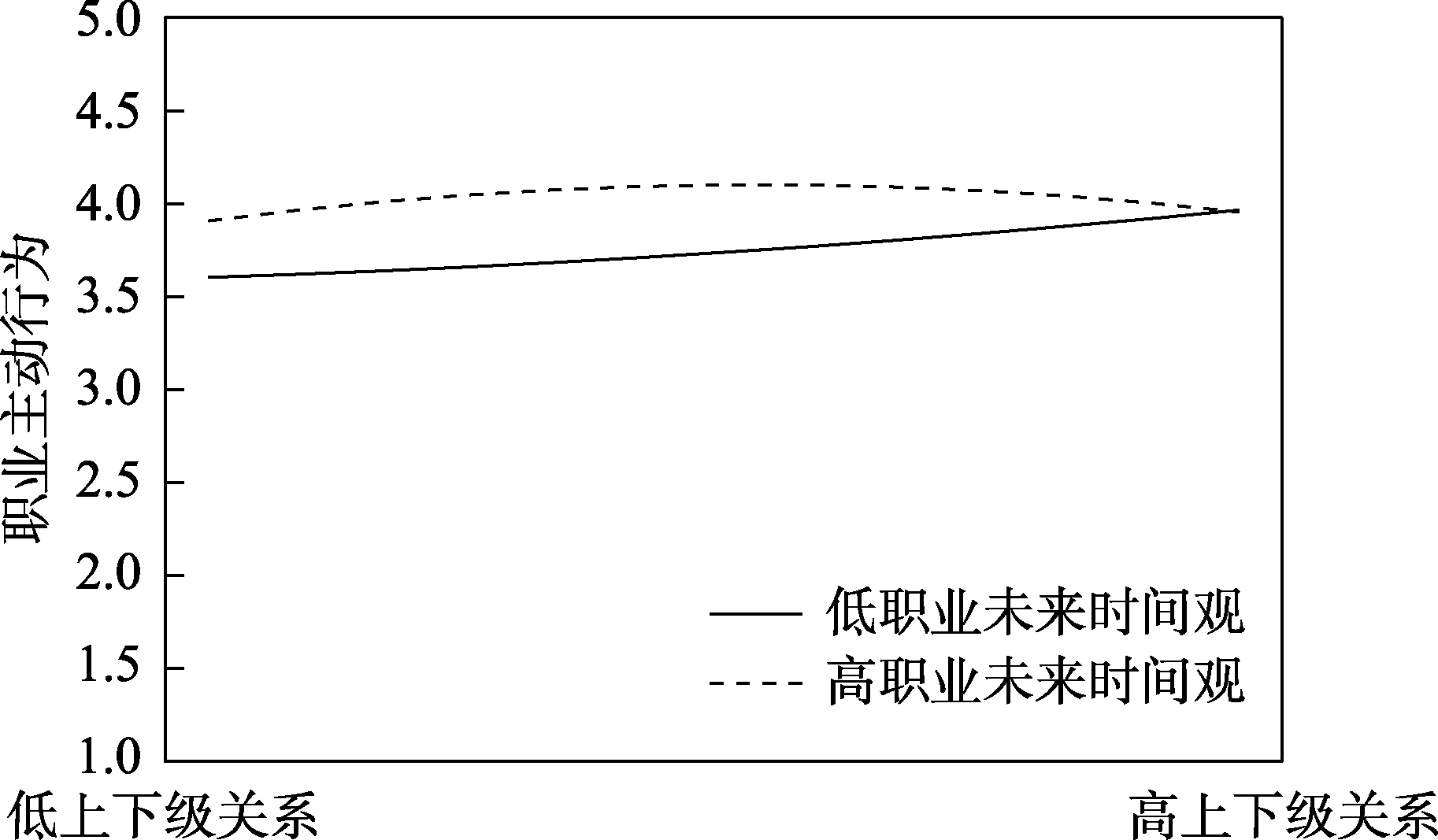
图2 职业未来时间观对上下级关系与职业主动行为间倒U关系的调节效应
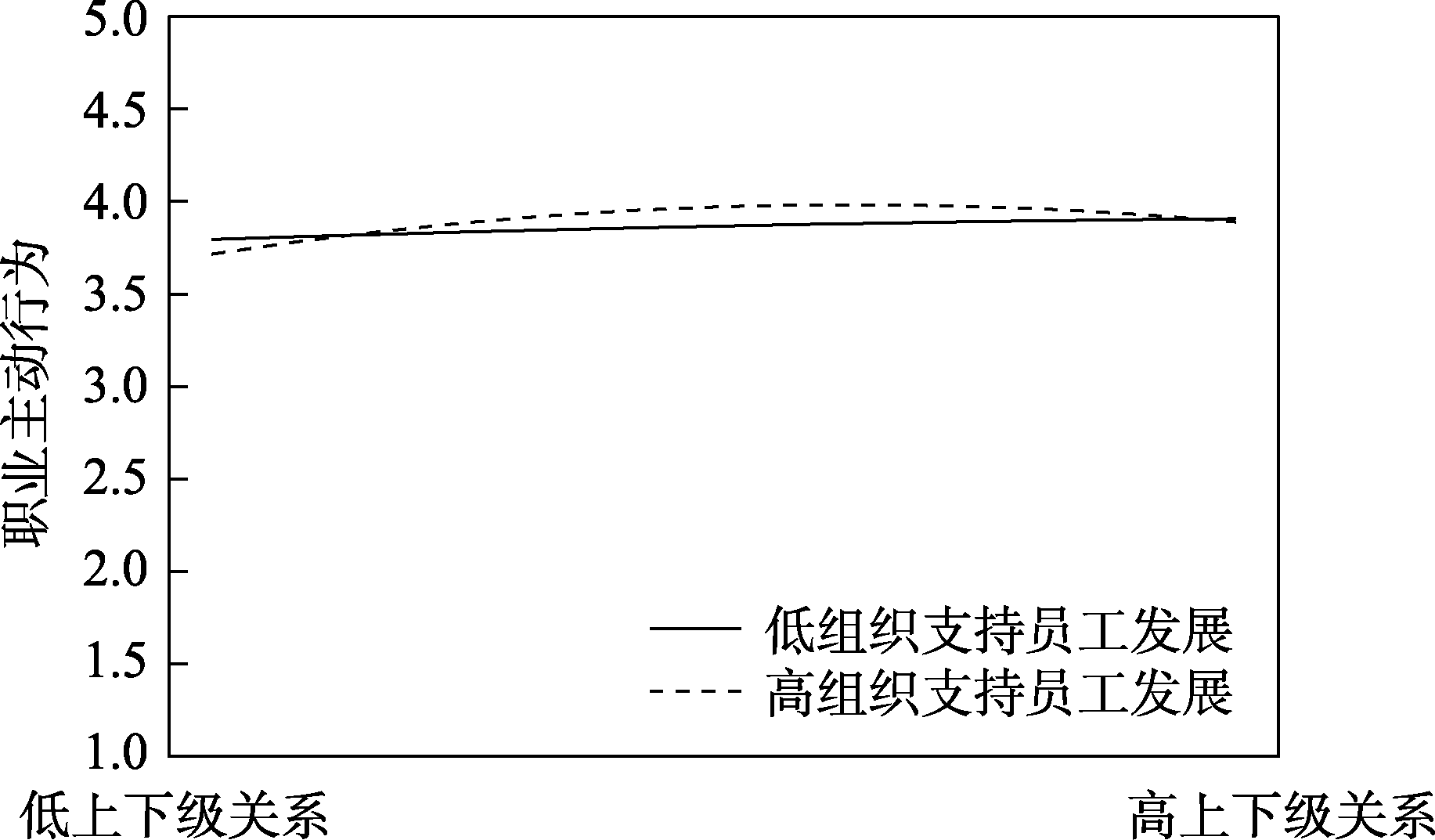
图3 组织支持员工发展对上下级关系与职业主动行为间倒U关系的调节效应
| 变量 | M | SD | 1 | 2 | 3 | 4 | 5 | 6 | 7 | 8 | 9 | 10 | 11 |
|---|---|---|---|---|---|---|---|---|---|---|---|---|---|
| 1. 性别 | − | − | − | ||||||||||
| 2. 年龄(岁) | 31.97 | 6.03 | 0.05 | − | |||||||||
| 3. 教育程度 | 4.92 | 0.65 | 0.06 | −0.22** | − | ||||||||
| 4. 上下级关系年限 | 4.47 | 3.32 | 0.07 | 0.39** | −0.12 | − | |||||||
| 5. 工作年限 | 6.36 | 4.62 | −0.02 | 0.73** | −0.26** | 0.56** | − | ||||||
| 6. LMX | 4.10 | 0.45 | 0.03 | 0.01 | −0.04 | −0.08 | −0.01 | − | |||||
| 7. 主动性人格 | 4.06 | 0.57 | 0.15* | −0.11 | −0.02 | −0.09 | −0.15* | 0.56** | − | ||||
| 8. 上下级关系 | 3.87 | 0.64 | 0.02 | 0.07 | 0.01 | −0.03 | 0.02 | 0.67** | 0.54** | − | |||
| 9. 职业未来时间观 | 4.20 | 0.49 | 0.13* | −0.15* | 0.01 | −0.08 | −0.22** | 0.50** | 0.50** | 0.44** | − | ||
| 10. 组织支持员工发展 | 4.18 | 0.58 | 0.15* | 0.08 | 0.04 | 0.09 | 0.10 | 0.53** | 0.37** | 0.46** | 0.46** | − | |
| 11. 职业边界入侵 | 2.22 | 0.98 | −0.04 | 0.01 | −0.02 | −0.04 | 0.10 | −0.19** | −0.15* | −0.10 | −0.18** | −0.08 | − |
| 12. 职业主动行为 | 4.23 | 0.63 | 0.01 | −0.09 | 0.03 | 0.04 | −0.09 | 0.06 | 0.02 | −0.04 | 0.01 | 0.01 | −0.48** |
表6 研究3变量的均值、标准差和相关系数
| 变量 | M | SD | 1 | 2 | 3 | 4 | 5 | 6 | 7 | 8 | 9 | 10 | 11 |
|---|---|---|---|---|---|---|---|---|---|---|---|---|---|
| 1. 性别 | − | − | − | ||||||||||
| 2. 年龄(岁) | 31.97 | 6.03 | 0.05 | − | |||||||||
| 3. 教育程度 | 4.92 | 0.65 | 0.06 | −0.22** | − | ||||||||
| 4. 上下级关系年限 | 4.47 | 3.32 | 0.07 | 0.39** | −0.12 | − | |||||||
| 5. 工作年限 | 6.36 | 4.62 | −0.02 | 0.73** | −0.26** | 0.56** | − | ||||||
| 6. LMX | 4.10 | 0.45 | 0.03 | 0.01 | −0.04 | −0.08 | −0.01 | − | |||||
| 7. 主动性人格 | 4.06 | 0.57 | 0.15* | −0.11 | −0.02 | −0.09 | −0.15* | 0.56** | − | ||||
| 8. 上下级关系 | 3.87 | 0.64 | 0.02 | 0.07 | 0.01 | −0.03 | 0.02 | 0.67** | 0.54** | − | |||
| 9. 职业未来时间观 | 4.20 | 0.49 | 0.13* | −0.15* | 0.01 | −0.08 | −0.22** | 0.50** | 0.50** | 0.44** | − | ||
| 10. 组织支持员工发展 | 4.18 | 0.58 | 0.15* | 0.08 | 0.04 | 0.09 | 0.10 | 0.53** | 0.37** | 0.46** | 0.46** | − | |
| 11. 职业边界入侵 | 2.22 | 0.98 | −0.04 | 0.01 | −0.02 | −0.04 | 0.10 | −0.19** | −0.15* | −0.10 | −0.18** | −0.08 | − |
| 12. 职业主动行为 | 4.23 | 0.63 | 0.01 | −0.09 | 0.03 | 0.04 | −0.09 | 0.06 | 0.02 | −0.04 | 0.01 | 0.01 | −0.48** |
| 变量 | 职业主动行为 | |||||
|---|---|---|---|---|---|---|
| 模型1 系数 (SE) | 模型2 系数 (SE) | 模型3 系数 (SE) | 模型4 系数 (SE) | 模型5 系数 (SE) | 模型6 系数 (SE) | |
| 截距 | 4.24*** (0.59) | 3.57*** (0.72) | 3.33*** (0.71) | 2.99*** (0.70) | 3.18*** (0.72) | 3.10*** (0.72) |
| 性别 | 0.01 (0.08) | 0.004 (0.08) | 0.01 (0.08) | 0.01 (0.08) | 0.02 (0.08) | 0.01 (0.08) |
| 年龄 | −0.02 (0.01) | −0.02 (0.01) | −0.02 (0.01) | −0.01 (0.01) | −0.01 (0.01) | −0.01 (0.01) |
| 教育程度 | 0.02 (0.06) | 0.03 (0.06) | 0.05 (0.06) | 0.07 (0.06) | 0.06 (0.06) | 0.06 (0.06) |
| 上下级关系年限 | 0.01 (0.02) | 0.01 (0.02) | 0.01 (0.01) | 0.02 (0.01) | 0.01 (0.01) | 0.02 (0.01) |
| 工作年限 | 0.01 (0.01) | 0.01 (0.01) | 0.01 (0.01) | 0.01 (0.01) | 0.01 (0.01) | 0.01 (0.01) |
| 主动性人格 | −0.02 (0.09) | 0.02 (0.09) | 0.04 (0.09) | 0.14 (0.09) | 0.14 (0.09) | 0.17 (0.09) |
| LMX | 0.11 (0.11) | 0.21 (0.13) | 0.24 (0.13) | 0.20 (0.12) | 0.18 (0.13) | 0.15 (0.13) |
| 上下级关系 | −0.14 (0.09) | −0.32** (0.10) | −0.24* (0.10) | −0.23* (0.10) | −0.19 (0.10) | |
| 上下级关系×上下级关系 | −0.34** (0.10) | −0.39 (0.10) | −0.41*** (0.11) | −0.38** (0.11) | ||
| 职业未来时间观 | 0.29* (0.12) | 0.20 (0.13) | ||||
| 上下级关系×职业未来时间观 | −0.80*** (0.17) | −0.56** (0.19) | ||||
| 上下级关系×上下级关系×职业未来时间观 | −1.12*** (0.20) | −0.83** (0.26) | ||||
| 组织支持员工发展 | 0.17 (0.10) | 0.09 (0.10) | ||||
| 上下级关系×组织支持员工发展 | −0.70*** (0.16) | −0.50** (0.17) | ||||
| 上下级关系×上下级关系×组织支持员工发展 | −0.81*** (0.15) | −0.46* (0.18) | ||||
| R2 | 0.02 | 0.03 | 0.07 | 0.19 | 0.18 | 0.22 |
| R2 change | 0.02 | 0.01 | 0.04 | 0.11 | 0.11 | 0.03 |
| F | 0.76 | 0.98 | 2.14* | 4.61*** | 4.35*** | 4.39*** |
| F change | 0.76 | 2.54 | 11.10** | 11.21*** | 10.23*** | 7.27*** |
表7 研究3的回归结果一
| 变量 | 职业主动行为 | |||||
|---|---|---|---|---|---|---|
| 模型1 系数 (SE) | 模型2 系数 (SE) | 模型3 系数 (SE) | 模型4 系数 (SE) | 模型5 系数 (SE) | 模型6 系数 (SE) | |
| 截距 | 4.24*** (0.59) | 3.57*** (0.72) | 3.33*** (0.71) | 2.99*** (0.70) | 3.18*** (0.72) | 3.10*** (0.72) |
| 性别 | 0.01 (0.08) | 0.004 (0.08) | 0.01 (0.08) | 0.01 (0.08) | 0.02 (0.08) | 0.01 (0.08) |
| 年龄 | −0.02 (0.01) | −0.02 (0.01) | −0.02 (0.01) | −0.01 (0.01) | −0.01 (0.01) | −0.01 (0.01) |
| 教育程度 | 0.02 (0.06) | 0.03 (0.06) | 0.05 (0.06) | 0.07 (0.06) | 0.06 (0.06) | 0.06 (0.06) |
| 上下级关系年限 | 0.01 (0.02) | 0.01 (0.02) | 0.01 (0.01) | 0.02 (0.01) | 0.01 (0.01) | 0.02 (0.01) |
| 工作年限 | 0.01 (0.01) | 0.01 (0.01) | 0.01 (0.01) | 0.01 (0.01) | 0.01 (0.01) | 0.01 (0.01) |
| 主动性人格 | −0.02 (0.09) | 0.02 (0.09) | 0.04 (0.09) | 0.14 (0.09) | 0.14 (0.09) | 0.17 (0.09) |
| LMX | 0.11 (0.11) | 0.21 (0.13) | 0.24 (0.13) | 0.20 (0.12) | 0.18 (0.13) | 0.15 (0.13) |
| 上下级关系 | −0.14 (0.09) | −0.32** (0.10) | −0.24* (0.10) | −0.23* (0.10) | −0.19 (0.10) | |
| 上下级关系×上下级关系 | −0.34** (0.10) | −0.39 (0.10) | −0.41*** (0.11) | −0.38** (0.11) | ||
| 职业未来时间观 | 0.29* (0.12) | 0.20 (0.13) | ||||
| 上下级关系×职业未来时间观 | −0.80*** (0.17) | −0.56** (0.19) | ||||
| 上下级关系×上下级关系×职业未来时间观 | −1.12*** (0.20) | −0.83** (0.26) | ||||
| 组织支持员工发展 | 0.17 (0.10) | 0.09 (0.10) | ||||
| 上下级关系×组织支持员工发展 | −0.70*** (0.16) | −0.50** (0.17) | ||||
| 上下级关系×上下级关系×组织支持员工发展 | −0.81*** (0.15) | −0.46* (0.18) | ||||
| R2 | 0.02 | 0.03 | 0.07 | 0.19 | 0.18 | 0.22 |
| R2 change | 0.02 | 0.01 | 0.04 | 0.11 | 0.11 | 0.03 |
| F | 0.76 | 0.98 | 2.14* | 4.61*** | 4.35*** | 4.39*** |
| F change | 0.76 | 2.54 | 11.10** | 11.21*** | 10.23*** | 7.27*** |
| 变量 | 职业边界入侵 | |||||
|---|---|---|---|---|---|---|
| 模型1 系数 (SE) | 模型2 系数 (SE) | 模型3 系数 (SE) | 模型4 系数 (SE) | 模型5 系数 (SE) | 模型6 系数 (SE) | |
| 截距 | 4.68*** (0.89) | 5.30*** (1.09) | 5.57*** (1.09) | 5.92*** (1.08) | 6.08*** (1.11) | 5.84*** (1.11) |
| 性别 | −0.01 (0.12) | 0.003 (0.12) | −0.01 (0.12) | 0.01 (0.12) | −0.04 (0.12) | −0.002 (0.12) |
| 年龄 | −0.02 (0.02) | −0.02 (0.02) | −0.03 (0.02) | −0.03 (0.01) | −0.03 (0.01) | −0.03 (0.01) |
| 教育程度 | −0.01 (0.10) | −0.02 (0.10) | −0.05 (0.10) | −0.06 (0.09) | −0.05 (0.09) | −0.05 (0.09) |
| 上下级关系年限 | −0.05* (0.02) | −0.05* (0.02) | −0.04 (0.02) | −0.05* (0.02) | −0.05* (0.02) | −0.05* (0.02) |
| 工作年限 | 0.06* (0.02) | 0.06* (0.02) | 0.06* (0.02) | 0.05* (0.02) | 0.06*** (0.02) | 0.06* (0.02) |
| 主动性人格 | −0.07 (0.13) | −0.11 (0.14) | −0.12 (0.14) | −0.26 (0.14) | −0.28* (0.13) | −0.29* (0.14) |
| LMX | −0.39* (0.16) | −0.49* (0.19) | −0.53* (0.19) | −0.45* (0.19) | −0.50* (0.20) | −0.42* (0.20) |
| 上下级关系 | 0.13 (0.13) | 0.34* (0.16) | 0.34* (0.15) | 0.32* (0.16) | 0.33* (0.16) | |
| 上下级关系×上下级关系 | 0.38* (0.16) | 0.64*** (0.16) | 0.67*** (0.17) | 0.71*** (0.17) | ||
| 职业未来时间观 | −0.73*** (0.18) | −0.54* (0.20) | ||||
| 上下级关系×职业未来时间观 | 0.38 (0.27) | 0.12 (0.29) | ||||
| 上下级关系×上下级关系×职业未来时间观 | 1.44*** (0.30) | 0.87* (0.40) | ||||
| 组织支持员工发展 | −0.36 (0.15) | −0.23 (0.16) | ||||
| 上下级关系×组织支持员工发展 | 0.48 (0.25) | 0.40 (0.27) | ||||
| 上下级关系×上下级关系×组织支持员工发展 | 1.04*** (0.23) | 0.66* (0.28) | ||||
| R2 | 0.07 | 0.76 | 0.10 | 0.20 | 0.19 | 0.22 |
| R2 change | −0.07 | 0.004 | 0.02 | 0.10 | 0.09 | 0.20 |
| F | 2.71* | 2.50* | 2.94** | 4.88*** | 4.59*** | 4.32*** |
| F change | 2.71* | 0.97 | 6.08* | 9.72*** | 8.69*** | 5.86*** |
表8 研究3的回归结果二
| 变量 | 职业边界入侵 | |||||
|---|---|---|---|---|---|---|
| 模型1 系数 (SE) | 模型2 系数 (SE) | 模型3 系数 (SE) | 模型4 系数 (SE) | 模型5 系数 (SE) | 模型6 系数 (SE) | |
| 截距 | 4.68*** (0.89) | 5.30*** (1.09) | 5.57*** (1.09) | 5.92*** (1.08) | 6.08*** (1.11) | 5.84*** (1.11) |
| 性别 | −0.01 (0.12) | 0.003 (0.12) | −0.01 (0.12) | 0.01 (0.12) | −0.04 (0.12) | −0.002 (0.12) |
| 年龄 | −0.02 (0.02) | −0.02 (0.02) | −0.03 (0.02) | −0.03 (0.01) | −0.03 (0.01) | −0.03 (0.01) |
| 教育程度 | −0.01 (0.10) | −0.02 (0.10) | −0.05 (0.10) | −0.06 (0.09) | −0.05 (0.09) | −0.05 (0.09) |
| 上下级关系年限 | −0.05* (0.02) | −0.05* (0.02) | −0.04 (0.02) | −0.05* (0.02) | −0.05* (0.02) | −0.05* (0.02) |
| 工作年限 | 0.06* (0.02) | 0.06* (0.02) | 0.06* (0.02) | 0.05* (0.02) | 0.06*** (0.02) | 0.06* (0.02) |
| 主动性人格 | −0.07 (0.13) | −0.11 (0.14) | −0.12 (0.14) | −0.26 (0.14) | −0.28* (0.13) | −0.29* (0.14) |
| LMX | −0.39* (0.16) | −0.49* (0.19) | −0.53* (0.19) | −0.45* (0.19) | −0.50* (0.20) | −0.42* (0.20) |
| 上下级关系 | 0.13 (0.13) | 0.34* (0.16) | 0.34* (0.15) | 0.32* (0.16) | 0.33* (0.16) | |
| 上下级关系×上下级关系 | 0.38* (0.16) | 0.64*** (0.16) | 0.67*** (0.17) | 0.71*** (0.17) | ||
| 职业未来时间观 | −0.73*** (0.18) | −0.54* (0.20) | ||||
| 上下级关系×职业未来时间观 | 0.38 (0.27) | 0.12 (0.29) | ||||
| 上下级关系×上下级关系×职业未来时间观 | 1.44*** (0.30) | 0.87* (0.40) | ||||
| 组织支持员工发展 | −0.36 (0.15) | −0.23 (0.16) | ||||
| 上下级关系×组织支持员工发展 | 0.48 (0.25) | 0.40 (0.27) | ||||
| 上下级关系×上下级关系×组织支持员工发展 | 1.04*** (0.23) | 0.66* (0.28) | ||||
| R2 | 0.07 | 0.76 | 0.10 | 0.20 | 0.19 | 0.22 |
| R2 change | −0.07 | 0.004 | 0.02 | 0.10 | 0.09 | 0.20 |
| F | 2.71* | 2.50* | 2.94** | 4.88*** | 4.59*** | 4.32*** |
| F change | 2.71* | 0.97 | 6.08* | 9.72*** | 8.69*** | 5.86*** |
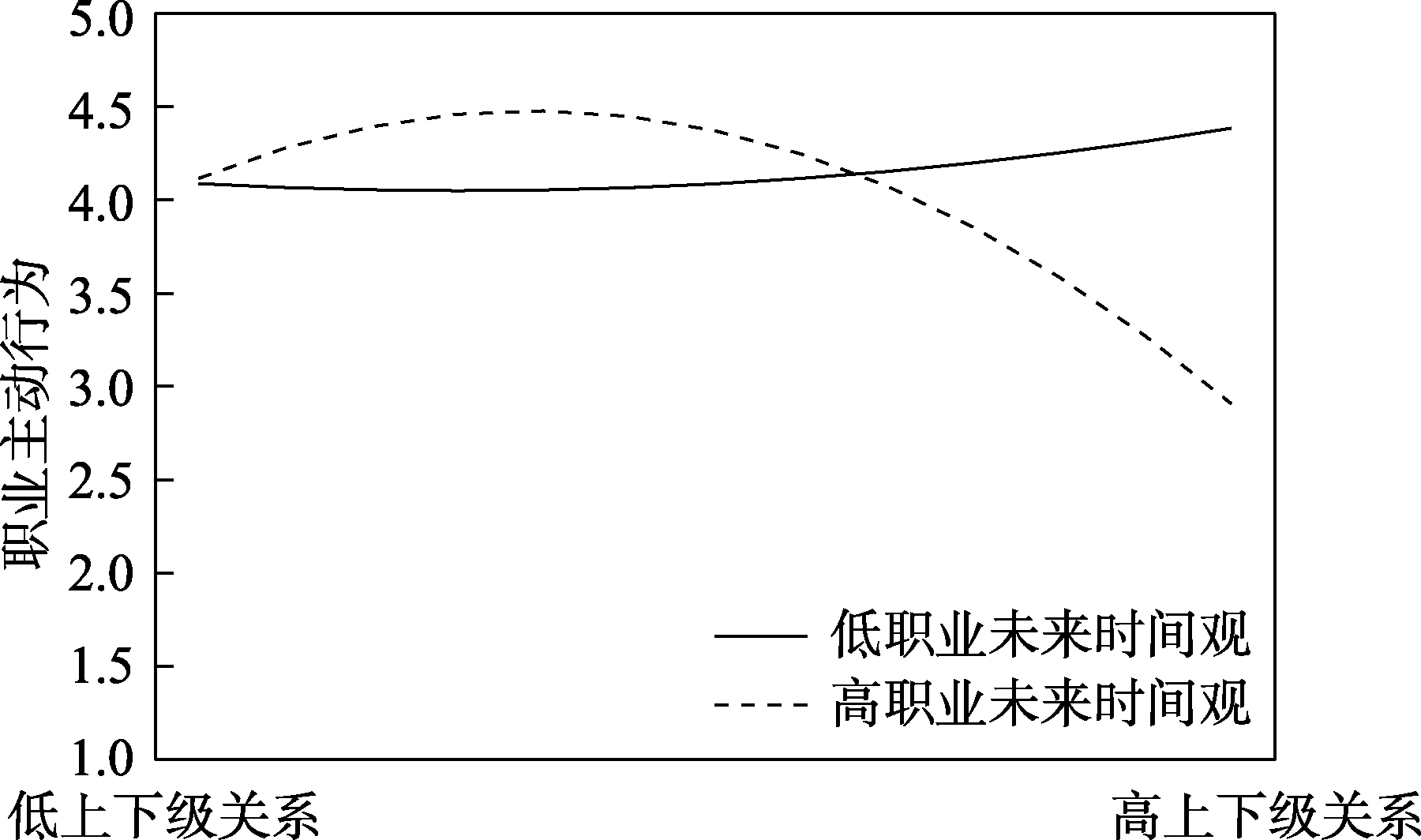
图4 职业未来时间观对上下级关系与职业主动行为间接倒U关系的调节效应
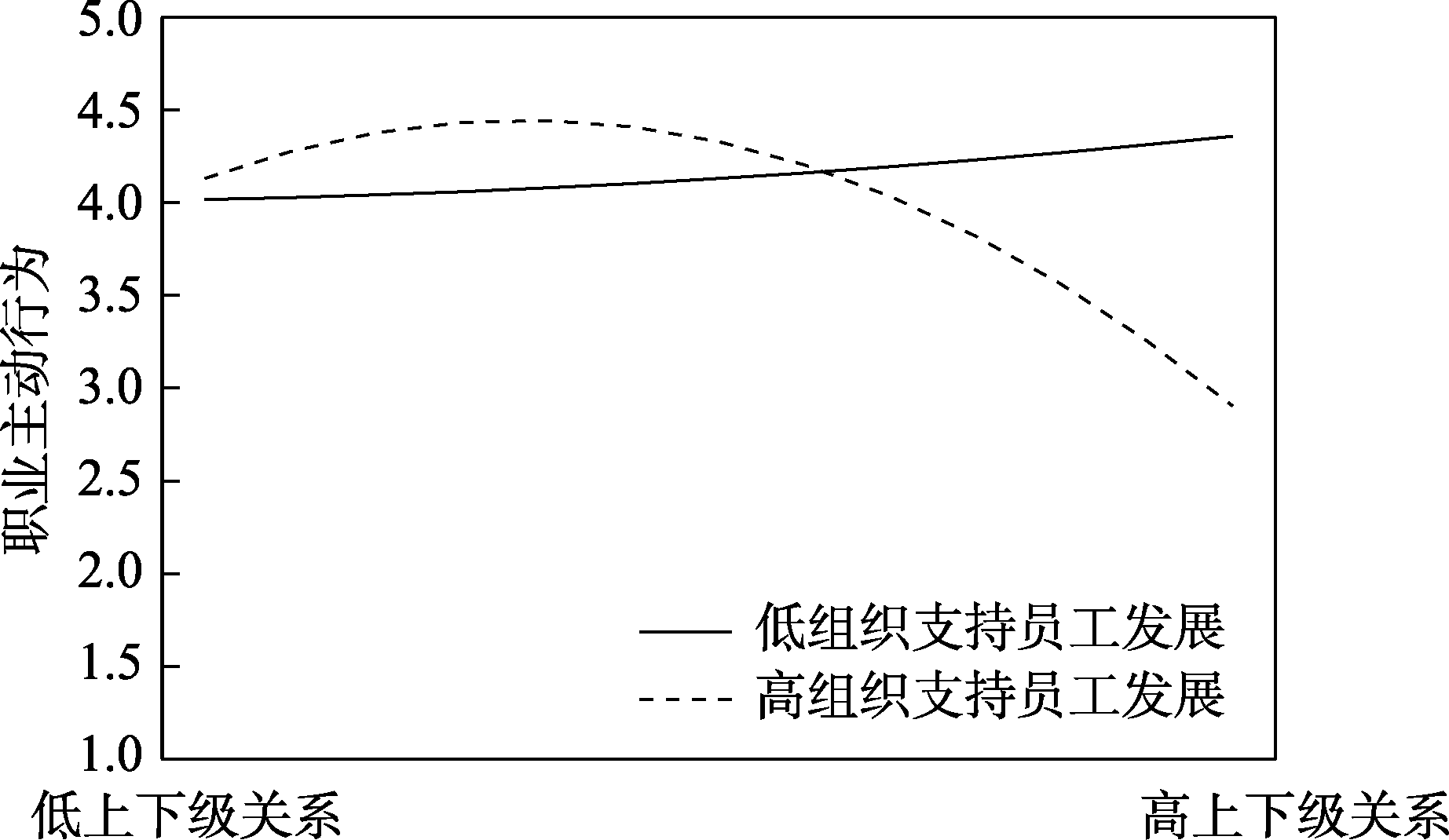
图5 组织支持员工发展对上下级关系与职业主动行为间倒U关系的调节效应
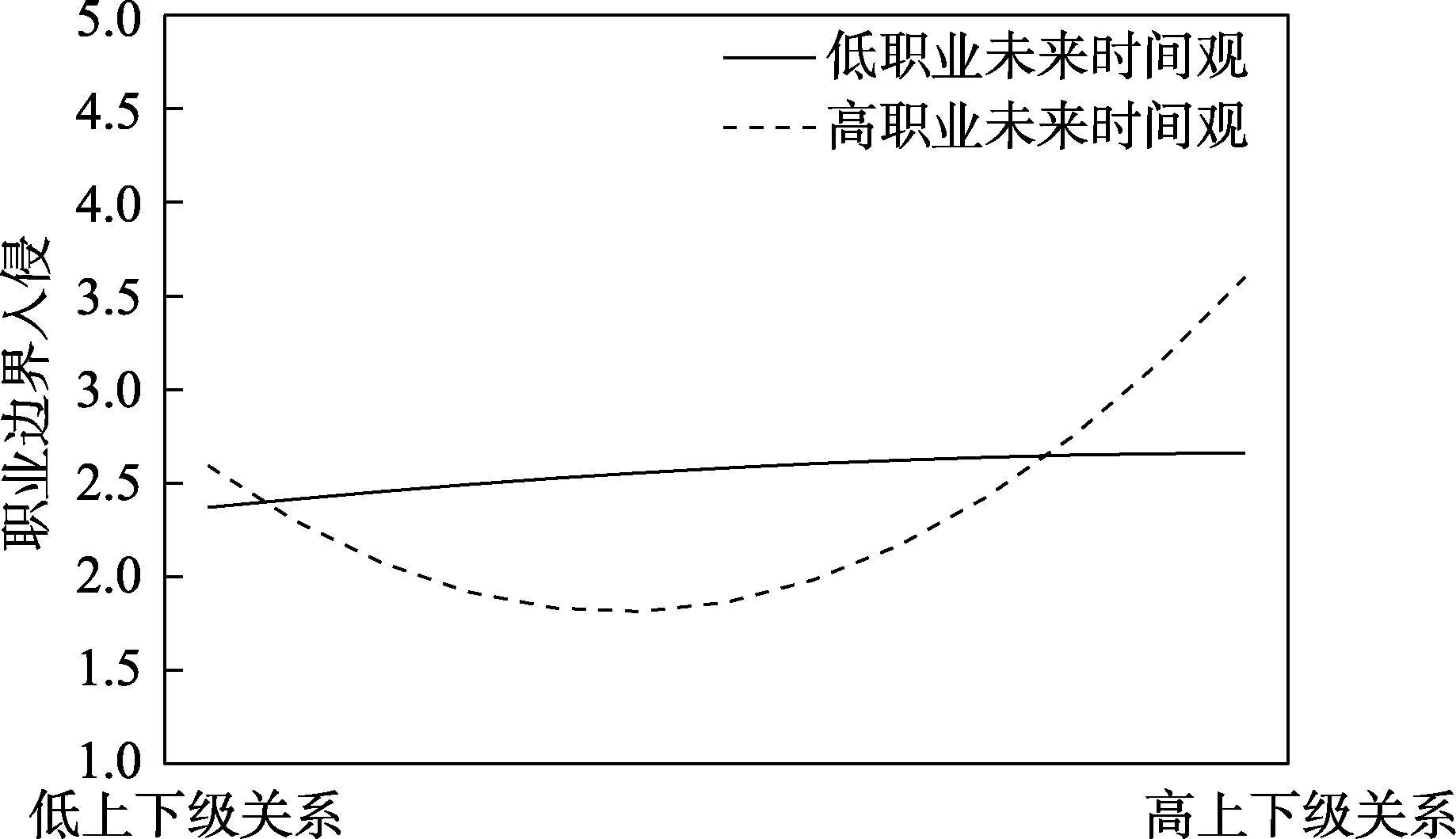
图6 职业未来时间观对上下级关系与职业边界入侵间接U型关系的调节效应
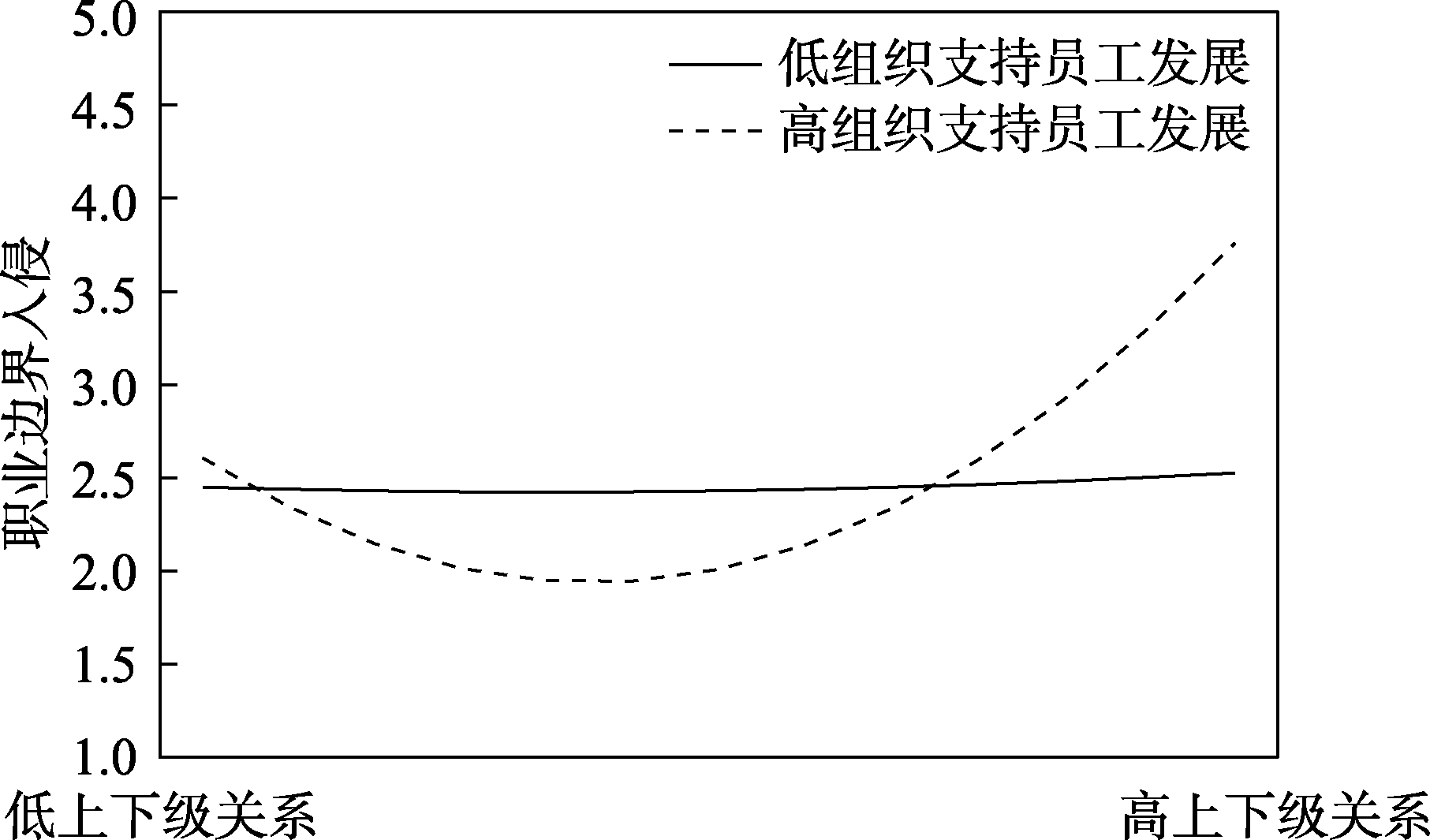
图7 组织支持员工发展对上下级关系与职业边界入侵间U型关系的调节效应
| 自变量取值 | 瞬时间接效应值(95% CI) | ||
|---|---|---|---|
| SSG−SD | 均值 | SSG+SD | |
| 主效应模型 | −1.24 [−2.00, −0.53] | −1.45 [−2.36, −0.61] | −1.67 [−2.72, −0.70] |
| 调节模型 | |||
| 职业未来时间观−SD | −11.78 [−22.99, −1.72] | −14.02 [−27.15, −2.17] | −16.24 [−31.33, −2.63] |
| 职业未来时间观+SD | −14.53 [−28.61, −1.84] | −17.14 [−33.76, −2.35] | −20.01 [−38.94, −2.91] |
| 组织支持员工发展−SD | −8.92 [−13.26, −5.18] | −10.58 [−15.71, −6.16] | −12.23 [−18.15, −7.14] |
| 组织支持员工发展+SD | −11.34 [−16.94, −6.46] | −13.44 [−20.05, −7.65] | −15.55 [−23.19, −8.90] |
表9 瞬时间接效应的Monte Carlo分析结果
| 自变量取值 | 瞬时间接效应值(95% CI) | ||
|---|---|---|---|
| SSG−SD | 均值 | SSG+SD | |
| 主效应模型 | −1.24 [−2.00, −0.53] | −1.45 [−2.36, −0.61] | −1.67 [−2.72, −0.70] |
| 调节模型 | |||
| 职业未来时间观−SD | −11.78 [−22.99, −1.72] | −14.02 [−27.15, −2.17] | −16.24 [−31.33, −2.63] |
| 职业未来时间观+SD | −14.53 [−28.61, −1.84] | −17.14 [−33.76, −2.35] | −20.01 [−38.94, −2.91] |
| 组织支持员工发展−SD | −8.92 [−13.26, −5.18] | −10.58 [−15.71, −6.16] | −12.23 [−18.15, −7.14] |
| 组织支持员工发展+SD | −11.34 [−16.94, −6.46] | −13.44 [−20.05, −7.65] | −15.55 [−23.19, −8.90] |
| [1] |
Ammons, S. K. (2013). Work-family boundary strategies: Stability and alignment between preferred and enacted boundaries. Journal of Vocational Behavior, 82(1), 49-58.
pmid: 25620801 |
| [2] |
Ashforth, B. E., Kreiner, G. E., & Fugate, M. (2000). All in a day’s work: Boundaries and micro role transitions. Academy of Management Review, 25(3), 472-491.
doi: 10.2307/259305 URL |
| [3] |
Bond, M., Marín, V. I., Dolch, C., Bedenlier, S., & Zawacki-Richter, O. (2018). Digital transformation in German higher education: Student and teacher perceptions and usage of digital media. International Journal of Educational Technology in Higher Education, 15(1), 1-20.
doi: 10.1186/s41239-017-0083-9 URL |
| [4] |
Boyce, L. A., Zaccaro, S. J., & Wisecarver, M. Z. (2010). Propensity for self-development of leadership attributes: Understanding, predicting, and supporting performance of leader self-development. The Leadership Quarterly, 21(1), 159-178.
doi: 10.1016/j.leaqua.2009.10.012 URL |
| [5] | Brislin, R. W. (1980). Translation and content analysis of oral and written material. In H. C. Triandis & J. W. Berry (Eds.), Handbook of cross-cultural psychology (pp. 349-444). Allyn and Bacon. |
| [6] |
Bulger, C. A., Matthews, R. A., & Hoffman, M. E. (2007). Work and personal life boundary management: Boundary strength, work/personal life balance, and the segmentation- integration continuum. Journal of Occupational Health Psychology, 12(4), 365-375.
doi: 10.1037/1076-8998.12.4.365 URL |
| [7] |
Capitano, J., & Greenhaus, J. H. (2018). When work enters the home: Antecedents of role boundary permeability behavior. Journal of Vocational Behavior, 109, 87-100.
doi: 10.1016/j.jvb.2018.10.002 URL |
| [8] |
Chen, Y., Friedman, R., Yu, E., Fang, W., & Lu, X. (2009). Supervisor-subordinate guanxi: Developing a three- dimensional model and scale. Management and Organization Review, 5(3), 375-399.
doi: 10.1111/j.1740-8784.2009.00153.x URL |
| [9] |
Chernyak-Hai, L., & Halabi, S. (2018). Future time perspective and interpersonal empathy: Implications for preferring autonomy-versus dependency-oriented helping. British Journal of Social Psychology, 57(4), 793-814.
doi: 10.1111/bjso.12260 pmid: 29926924 |
| [10] |
Cho, E. (2020). Examining boundaries to understand the impact of COVID-19 on vocational behaviors. Journal of Vocational Behavior, 119, 103437. https://doi.org/10.1016/j.jvb.2020.103437
doi: 10.1016/j.jvb.2020.103437 URL |
| [11] |
Cobb, H. R., Murphy, L. D., Thomas, C. L., Katz, I. M., & Rudolph, C. W. (2022). Measuring boundaries and borders: A taxonomy of work-nonwork boundary management scales. Journal of Vocational Behavior, 137, 103760. https://doi.org/10.1016/j.jvb.2022.103760
doi: 10.1016/j.jvb.2022.103760 URL |
| [12] |
Davidson, T., Van Dyne, L., & Lin, B. (2017). Too attached to speak up? It depends: How supervisor-subordinate guanxi and perceived job control influence upward constructive voice. Organizational Behavior and Human Decision Processes, 143, 39-53.
doi: 10.1016/j.obhdp.2017.07.002 URL |
| [13] |
Deng, H., Guan, Y., Zhou, X., Li, Y., Cai, D., Li, N., & Liu, B. (2024). The “double-edged sword” effects of career support mentoring on newcomer turnover: How and when it helps or hurts. Journal of Applied Psychology, 109(7), 1094-1114.
doi: 10.1037/apl0001143 URL |
| [14] |
Ehrhardt, K., & Ragins, B. R. (2019). Relational attachment at work: A complementary fit perspective on the role of relationships in organizational life. Academy of Management Journal, 62(1), 248-282.
doi: 10.5465/amj.2016.0245 |
| [15] |
Epitropaki, O., Marstand, A. F., Van der Heijden, B., Bozionelos, N., Mylonopoulos, N., Van der Heijde, C.,...Indicator Group. (2021). What are the career implications of “seeing eye to eye”? Examining the role of leader- member exchange (LMX) agreement on employability and career outcomes. Personnel Psychology, 74(4), 799-830.
doi: 10.1111/peps.v74.4 URL |
| [16] | Fu, B., Liang, X. J., & Yang, M. X. (2023). The paradoxical effect of Supervisor-Subordinate Guanxi on work well- being. Chinese Journal of Management, 20(1), 66-75. |
| [付博, 梁潇杰, 杨朦晰. (2023). 上下级关系对下属工作幸福感的“双刃剑”效应. 管理学报, 20(1), 66-75.] | |
| [17] |
Guan, X., & Frenkel, S. J. (2019). Explaining supervisor-subordinate guanxi and subordinate performance through a conservation of resources lens. Human Relations, 72(11), 1752-1775.
doi: 10.1177/0018726718813718 URL |
| [18] |
Guan, Y., Zhuang, M., Cai, Z., Ding, Y., Wang, Y., Huang, Z., & Lai, X. (2017). Modeling dynamics in career construction: Reciprocal relationship between future work self and career exploration. Journal of Vocational Behavior, 101, 21-31.
doi: 10.1016/j.jvb.2017.04.003 URL |
| [19] | Gunz,, H., Peiperl, M., & Tzabbar, D. (2007). Boundaries in the study of careers. In: H. Gunz & M. Peiperl (Eds.), Handbook of career studies (pp.471-494). London: Sage. |
| [20] | Guo, X. W. (2011). Reviews on the research of supervisor-subordinate relationship in Chinese context: Leader-member exchange and Supervisor-Subordinate Guanxi. Nankai Business Review, 14(2), 61-68. |
| [郭晓薇. (2011). 中国情境中的上下级关系构念研究述评——兼论领导——成员交换理论的本土贴切性. 南开管理评论, 14(2), 61-68.] | |
| [21] |
Hayes, A. F., & Preacher, K. J. (2010). Quantifying and testing indirect effects in simple mediation models when the constituent paths are nonlinear. Multivariate Behavioral Research, 45(4), 627-660.
doi: 10.1080/00273171.2010.498290 pmid: 26735713 |
| [22] |
Hirschi, A., Freund, P. A., & Herrmann, A. (2014). The career engagement scale: Development and validation of a measure of proactive career behaviors. Journal of Career Assessment, 22(4), 575-594.
doi: 10.1177/1069072713514813 URL |
| [23] |
Hirschi, A., & Koen, J. (2021). Contemporary career orientations and career self-management: A review and integration. Journal of Vocational Behavior, 126, 103505. https://doi.org/10.1016/j.jvb.2020.103505
doi: 10.1016/j.jvb.2020.103505 URL |
| [24] |
Huang, J. T., & Hsieh, H. H. (2015). Supervisors as good coaches: Influences of coaching on employees’ in-role behaviors and proactive career behaviors. The International Journal of Human Resource Management, 26(1), 42-58.
doi: 10.1080/09585192.2014.940993 URL |
| [25] |
Hunter, E. M., Clark, M. A., & Carlson, D. S. (2019). Violating work-family boundaries: Reactions to interruptions at work and home. Journal of Management, 45(3), 1284-1308.
doi: 10.1177/0149206317702221 |
| [26] | IBM. (2020). Transforming different Likert scales to a common scale. IBM. https://www.ibm.com/support/pages/transforming-different-likert-scales-common-scale. |
| [27] |
Klehe, U. C., Fasbender, U., & van der Horst, A. (2021). Going full circle: Integrating research on career adaptation and proactivity. Journal of Vocational Behavior, 126, 103526.
doi: 10.1016/j.jvb.2020.103526 URL |
| [28] |
Kossek, E. E., Dumas, T. L., Piszczek, M. M., & Allen, T. D. (2021). Pushing the boundaries: A qualitative study of how stem women adapted to disrupted work-nonwork boundaries during the COVID-19 pandemic. Journal of Applied Psychology, 106(11), 1615-1629.
doi: 10.1037/apl0000982 pmid: 34871022 |
| [29] |
Kraimer, M. L., Seibert, S. E., Wayne, S. J., Liden, R. C., & Bravo, J. (2011). Antecedents and outcomes of organizational support for development: The critical role of career opportunities. Journal of Applied Psychology, 96(3), 485-500.
doi: 10.1037/a0021452 pmid: 21114356 |
| [30] |
Law, K. S., Wong, C. S., Wang, D., & Wang, L. (2000). Effect of supervisor-subordinate guanxi on supervisory decisions in China: An empirical investigation. The International Journal of Human Resource Management, 11(4), 751-765.
doi: 10.1080/09585190050075105 URL |
| [31] |
LeBreton, J. M., Tonidandel, S., & Krasikova, D. V. (2013). Residualized relative importance analysis: A technique for the comprehensive decomposition of variance in higher order regression models. Organizational Research Methods, 16(3), 449-473.
doi: 10.1177/1094428113481065 URL |
| [32] |
Lent, R. W., Morris, T. R., Wang, R. J., Moturu, B. P., Cygrymus, E. R., & Yeung, J. G. (2022). Test of a social cognitive model of proactive career behavior. Journal of Career Assessment, 30(4), 756-775.
doi: 10.1177/10690727221080948 URL |
| [33] |
Li, G., Rubenstein, A. L., Lin, W., Wang, M., & Chen, X. (2018). The curvilinear effect of benevolent leadership on team performance: The mediating role of team action processes and the moderating role of team commitment. Personnel Psychology, 71(3), 369-397.
doi: 10.1111/peps.2018.71.issue-3 URL |
| [34] | Li, Q., She, Z., Yang, B.-Y., & Yang, B. (2024). Push or pull? An examination of the curvilinear effect of leader workaholism on follower creativity. Management Review, 35(4), 203-214. |
| [李全, 佘卓霖, 杨百寅, 杨斌. (2023). 推力还是阻力? 工作狂领导对下属创造力的非线性影响研究. 管理评论, 35(4), 203-214.] | |
| [35] | Li, Y., & Li, X. Y. (2015). The mechanism of Supervisor- Subordinate Guanxi influencing middle managers’ career growth: The moderated role of organizational structure and organizational interpersonal climate. Management Review, 27(6), 120-127. |
| [李云, 李锡元. (2015). 上下级 “关系” 影响中层管理者职业成长的作用机理——组织结构与组织人际氛围的调节作用. 管理评论, 27(6), 120-127.] | |
| [36] | Li, Y. P., & Tu, Y. D. (2011). Does high LMX quality benefit subordinate's career success? A moderated mediation study. Acta Psychologica Sinica, 43(8), 941-952. |
| [李燕萍, 涂乙冬. (2011). 与领导关系好就能获得职业成功吗? 一项调节的中介效应研究. 心理学报, 43(8), 941-952.] | |
| [37] | Liu, J.,Huang, B., Sheng. X. F., Wang, Y., & Yu, X. T. (2018). Employee’s proactive career behaviors: The new path for transcending career boundary. Human Resources Development of China, 35(2), 129-140. |
| [刘晋, 黄波, 盛小丰, 王颖, 于晓彤. (2018). 跨越职业边界的新途径: 员工的主动职业行为. 中国人力资源开发, 35(2), 129-140.] | |
| [38] |
Malhotra, N. K., Kim, S. S., & Patil, A. (2006). Common method variance in IS research: A comparison of alternative approaches and a reanalysis of past research. Management Science, 52(12), 1865-1883.
doi: 10.1287/mnsc.1060.0597 URL |
| [39] | Meyers, M. C. (2020). The neglected role of talent proactivity: Integrating proactive behavior into talent-management theorizing. Human Resource Management Review, 30(2), 100703. |
| [40] |
Nederhof, A. J. (1985). Methods of coping with social desirability bias: A review. European Journal of Social Psychology, 15(3), 263-280. https://doi.org/10.1002/ejsp.2420150303
doi: 10.1002/ejsp.v15:3 URL |
| [41] |
Piszczek, M. M., & Berg, P. (2014). Expanding the boundaries of boundary theory: Regulative institutions and work- family role management. Human Relations, 67(12), 1491-1512.
doi: 10.1177/0018726714524241 URL |
| [42] |
Podsakoff, P. M., MacKenzie, S. B., Lee, J. Y., & Podsakoff, N. P. (2003). Common method biases in behavioral research: A critical review of the literature and recommended remedies. Journal of Applied Psychology, 88(5), 879-903.
doi: 10.1037/0021-9010.88.5.879 pmid: 14516251 |
| [43] |
Preacher, K. J., & Selig, J. P. (2012). Advantages of Monte Carlo confidence intervals for indirect effects. Communication Methods and Measures, 6(2), 77-98.
doi: 10.1080/19312458.2012.679848 URL |
| [44] |
Qin, X., Chen, C., Yam, K. C., Huang, M., & Ju, D. (2020). The double-edged sword of leader humility: Investigating when and why leader humility promotes versus inhibits subordinate deviance. Journal of Applied Psychology, 105(7), 693-712.
doi: 10.1037/apl0000456 pmid: 31670527 |
| [45] |
Qin, X., Huang, M., Johnson, R. E., Hu, Q., & Ju, D. (2018). The short-lived benefits of abusive supervisory behavior for actors: An investigation of recovery and work engagement. Academy of Management Journal, 61(5), 1951-1975.
doi: 10.5465/amj.2016.1325 URL |
| [46] | Rafaeli, E., & Gleason, M. E. (2009). Skilled support within intimate relationships. Journal of Family Theory & Review, 1(1), 20-37. |
| [47] |
Ren, S., & Chadee, D. (2017a). Is Guanxi always good for employee self-development in China? Examining non- linear and moderated relationships. Journal of Vocational Behavior, 98, 108-117.
doi: 10.1016/j.jvb.2016.10.005 URL |
| [48] |
Ren, S., & Chadee, D. (2017b). Influence of work pressure on proactive skill development in China: The role of career networking behavior and Guanxi HRM. Journal of Vocational Behavior, 98, 152-162.
doi: 10.1016/j.jvb.2016.11.004 URL |
| [49] | Rodrigues, R., Guest, D. E., & Budjanovcanin, A. (2016). Bounded or boundaryless? An empirical investigation of career boundaries and boundary crossing. Work, Employment and Society, 30(4), 669-686. |
| [50] |
Rudolph, C. W., Kooij, D. T., Rauvola, R. S., & Zacher, H. (2018). Occupational future time perspective: A meta‐analysis of antecedents and outcomes. Journal of Organizational Behavior, 39(2), 229-248.
doi: 10.1002/job.v39.2 URL |
| [51] |
Scandura, T. A., & Graen, G. B. (1984). Moderating effects of initial leader-member exchange status on the effects of a leadership intervention. Journal of Applied Psychology, 69(3), 428-436.
doi: 10.1037/0021-9010.69.3.428 URL |
| [52] |
Schmitt, A., Gielnik, M. M., Zacher, H., & Klemann, D. K. (2013). The motivational benefits of specific versus general optimism. The Journal of Positive Psychology, 8(5), 425-434.
doi: 10.1080/17439760.2013.820338 URL |
| [53] |
Seibert, S. E., Kraimer, M. L., & Liden, R. C. (2001). A social capital theory of career success. Academy of Management Journal, 44(2), 219-237.
doi: 10.2307/3069452 URL |
| [54] |
Shieh, G. (2010). On the misconception of multicollinearity in detection of moderating effects: Multicollinearity is not always detrimental. Multivariate Behavioral Research, 45(3), 483-507
doi: 10.1080/00273171.2010.483393 pmid: 26760490 |
| [55] |
Smale, A., Bagdadli, S., Cotton, R., Dello Russo, S., Dickmann, M., Dysvik, A.,... Verbruggen, M. (2019). Proactive career behaviors and subjective career success: The moderating role of national culture. Journal of Organizational Behavior, 40(1), 105-122.
doi: 10.1002/job.2316 |
| [56] |
Strauss, K., Griffin, M. A., & Parker, S. K. (2012). Future work selves: How salient hoped-for identities motivate proactive career behaviors. Journal of Applied Psychology, 97(3), 580-598.
doi: 10.1037/a0026423 pmid: 22122111 |
| [57] | Su, Y. F., Bai, X. W., & Ming, X. D. (2022). Effects of supervisor-subordinate guanxi and subordinate’s traditionality on work engagement and job performance: A moderated mediation model. Management Review, 11, 193-205. |
| [苏永发, 白新文, 明晓东. (2022). 上下级关系及下属传统性对工作投入和绩效的影响——被调节的中介效应模型. 管理评论, 11, 193-205.] | |
| [58] |
Volmer, J., Spurk, D., & Niessen, C. (2012). Leader-member exchange (LMX), job autonomy, and creative work involvement. The Leadership Quarterly, 23(3), 456-465.
doi: 10.1016/j.leaqua.2011.10.005 URL |
| [59] |
Wang, Q., Weng, Q., McElroy, J. C., Ashkanasy, N. M., & Lievens, F. (2014). Organizational career growth and subsequent voice behavior: The role of affective commitment and gender. Journal of Vocational Behavior, 84(3), 431-441.
doi: 10.1016/j.jvb.2014.03.004 URL |
| [60] |
Wang, Z., Song, Y., & Jiang, F. (2024). Are they more proactive or less engaged? Understanding employees' career proactivity after promotion failure through an attribution lens. Journal of Vocational Behavior, 155, 104061. https://doi.org/10.1016/j.jvb.2024.104061
doi: 10.1016/j.jvb.2024.104061 URL |
| [61] |
Wang, Z., & Xu, H. (2019). When and for whom ethical leadership is more effective in eliciting work meaningfulness and positive attitudes: The moderating roles of core self-evaluation and perceived organizational support. Journal of Business Ethics, 156(4), 919-940.
doi: 10.1007/s10551-017-3563-x |
| [62] |
Wei, L. Q., Liu, J., Chen, Y. Y., & Wu, L. Z. (2010). Political skill, supervisor-subordinate guanxi and career prospects in Chinese firms. Journal of Management Studies, 47(3), 437-454.
doi: 10.1111/joms.2010.47.issue-3 URL |
| [63] |
Weikamp, J. G., & Göritz, A. S. (2016). Organizational citizenship behaviour and job satisfaction: The impact of occupational future time perspective. Human Relations, 69(11), 2091-2115.
doi: 10.1177/0018726716633512 URL |
| [64] |
Wolff, M. S., White, J. C., Abraham, M., Schnabel, C., Wieser, L., & Niessen, C. (2024). The threat of electronic performance monitoring: Exploring the role of leader- member exchange on employee privacy invasion. Journal of Vocational Behavior, 154, 104031. https://doi.org/10.1016/j.jvb.2024.104031
doi: 10.1016/j.jvb.2024.104031 URL |
| [65] |
Wu, C. H., Parker, S. K., & De Jong, J. P. (2014). Need for cognition as an antecedent of individual innovation behavior. Journal of Management, 40(6), 1511-1534.
doi: 10.1177/0149206311429862 URL |
| [66] |
Wu, C. H., Parker, S. K., Wu, L. Z., & Lee, C. (2018). When and why people engage in different forms of proactive behavior: Interactive effects of self-construals and work characteristics. Academy of Management Journal, 61(1), 293-323.
doi: 10.5465/amj.2013.1064 URL |
| [67] |
Xiang, H., Coleman, S., Johannsson, M., & Bates, R. (2014). Workplace stress and job satisfaction among biologics development professionals. Health, 6(14), 1790-1802.
doi: 10.4236/health.2014.614211 URL |
| [68] | Xie, J. L., Song, Y., Luo, Y., Xie, K., & Guo, H. (2022). The applications and directions of boundary theory in organizational behavior research. Human Resources Development of China, 39(4), 127-140. |
| [谢菊兰, 宋娅, 骆亚, 谢凯, 郭好. (2022). 边界理论在组织行为学研究中的应用. 中国人力资源开发, 39(4), 127-140.] | |
| [69] |
Xu, S., Yang, C., Li, C., & Li, H. (2024). How “slacking off” sparks innovation: Evidence from a scenario experiment and a survey study on curvilinear mediation of recovery experience. Acta Psychologica Sinica, 57(1), 135-151.
doi: 10.3724/SP.J.1041.2025.0135 URL |
|
[徐世勇, 杨春梦, 李超平, 李海蓉. (2025). “摸鱼” 如何带来创新? 恢复体验曲线中介效应的情景实验与调查证据. 心理学报, 57(1), 135-151.]
doi: 10.3724/SP.J.1041.2025.0135 |
|
| [70] |
Yang, X., Guan, Y., Zhang, Y., She, Z., Buchtel, E. E., Mak, M. C. K., & Hu, H. (2020). A relational model of career adaptability and career prospects: The roles of leader- member exchange and agreeableness. Journal of Occupational and Organizational Psychology, 93(2), 405-430.
doi: 10.1111/joop.v93.2 URL |
| [71] | Yao,, C., & Baruch, Y. (2024). Understanding careers in China:The relevance of evolving work-life values and culture. In X. W. Chan, S. Shang & L. Lu (Eds.), work-life research in the Asia-Pacific: Implications for justice, equity, diversity, and inclusion (pp. 183-207). Cham: Springer Nature Switzerland. |
| [72] |
Yao, C., Duan, Z., & Baruch, Y. (2020). Time, space, Confucianism and careers: A contextualized review of careers research in China-Current knowledge and future research agenda. International Journal of Management Reviews, 22(3), 222-248.
doi: 10.1111/ijmr.v22.3 URL |
| [73] |
Zacher, H. (2015). Daily manifestations of career adaptability: Relationships with job and career outcomes. Journal of Vocational Behavior, 91, 76-86.
doi: 10.1016/j.jvb.2015.09.003 URL |
| [74] |
Zacher, H., & Frese, M. (2009). Remaining time and opportunities at work: Relationships between age, work characteristics, and occupational future time perspective. Psychology and Aging, 24(2), 487-493.
doi: 10.1037/a0015425 pmid: 19485664 |
| [75] |
Zhong, J., Ma, C., Chen, Z. X., Zhang, L., & Zhang, X. (2024). Humble leader, successful follower: Linking leader humility with follower career outcomes via leader competence from an implicit leadership theory perspective. Journal of Vocational Behavior, 155, 104060. https://doi.org/10.1016/j.jvb.2024.104060
doi: 10.1016/j.jvb.2024.104060 URL |
| [76] | Zhong, J., Zhang, L., & Xu, G. (2022). Is supervisor- subordinate Guanxi always good for subordinate commitment toward organizations? An inverted U-shaped perspective. Leadership & Organization Development Journal, 43(4), 517-532. |
| [77] | Zhong. J. & Zheng. X. M. (2023). In the era of generative artificial intelligence, where is your career anchor? Tsinghua Business Review, (11), 22-30. |
| [钟杰, 郑晓明. (2023). 生成式人工智能时代, 你的职业锚在哪里? 清华管理评论, (11), 22-30.] | |
| [78] | Zhou, H., & Long, L. R. (2004). Statistical remedies for common method biases. Advances in Psychological Science, 12(6), 942-950. |
| [周浩, 龙立荣. (2004). 共同方法偏差的统计检验与控制方法. 心理科学进展, 12(6), 942-950.] |
| [1] | 王红丽, 陈政任, 李振, 刘智强, 梁翠琪, 赵彬洁. 何以跳脱时间困境:算法控制对零工工作者影响效应的主观时间边界[J]. 心理学报, 2025, 57(2): 275-297. |
| [2] | 李锐;凌文辁;柳士顺. 组织心理所有权的前因与后果:基于“人-境互动”的视角[J]. 心理学报, 2012, 44(9): 1202-1216. |
| 阅读次数 | ||||||
|
全文 |
|
|||||
|
摘要 |
|
|||||
