

ISSN 0439-755X
CN 11-1911/B
主办:中国心理学会
中国科学院心理研究所
出版:科学出版社
CN 11-1911/B
主办:中国心理学会
中国科学院心理研究所
出版:科学出版社
心理学报 ›› 2026, Vol. 58 ›› Issue (1): 151-165.doi: 10.3724/SP.J.1041.2026.0151 cstr: 32110.14.2026.0151
王静1, 王雪华2, 范秀成3( )
)
收稿日期:2024-06-18
发布日期:2025-10-28
出版日期:2026-01-25
通讯作者:
范秀成, E-mail: xcfan@fudan.edu.cn作者简介:王静和王雪华为本文的共同第一作者。
基金资助:
WANG Jing1, WANG Xuehua2, FAN Xiucheng3()
Received:2024-06-18
Online:2025-10-28
Published:2026-01-25
摘要:
人口老龄化已成为全球性现象, 积极应对老龄化的有效举措之一是大力发展银发经济。为充分释放老年人口消费潜力, 需洞察不同老化心态对老年消费行为的影响。本研究通过1个调查和4个实验, 检验了老年人看待过去时“经验获益” (vs.“时间损失”)心态对时尚消费的作用机制和边界条件。研究表明:相比“时间损失”心态, “经验获益”心态将提升时尚消费意愿, 老化威胁感知在老化心态与时尚消费的关系中起中介作用。同时, 死亡凸显调节不同老化心态对时尚消费的影响。低死亡凸显情况下, 持“经验获益” (vs.“时间损失”)老化心态的个体更偏好时尚消费; 而高死亡凸显情况下, 两者之间差异消失。本文从“经验获益”与“时间损失”视角, 剖析老化心态及其对时尚消费的作用, 丰富了老年消费、时尚消费和年老身份建构方面的文献。
中图分类号:
王静, 王雪华, 范秀成. (2026). 经验获益还是时间损失?老化心态对时尚消费的影响机制. 心理学报, 58(1), 151-165.
WANG Jing, WANG Xuehua, FAN Xiucheng. (2026). Experience-gained vs. time-elapsed: How different types of aging mindset affect fashion consumption?. Acta Psychologica Sinica, 58(1), 151-165.
| 老化心态 | 时间损失 | 经验获益 |
|---|---|---|
| 共性 | 对过去时间的看法 | |
| 差异性 | ||
| 无形资源 | 时间资源 | 经验资源 |
| 损益框架 | 损失 | 收益 |
| 变化和连续性 | 变化 | 连续性 |
| 态度效价 | 消极 | 积极 |
表1 “时间损失”vs.“经验获益”老化心态的划分
| 老化心态 | 时间损失 | 经验获益 |
|---|---|---|
| 共性 | 对过去时间的看法 | |
| 差异性 | ||
| 无形资源 | 时间资源 | 经验资源 |
| 损益框架 | 损失 | 收益 |
| 变化和连续性 | 变化 | 连续性 |
| 态度效价 | 消极 | 积极 |
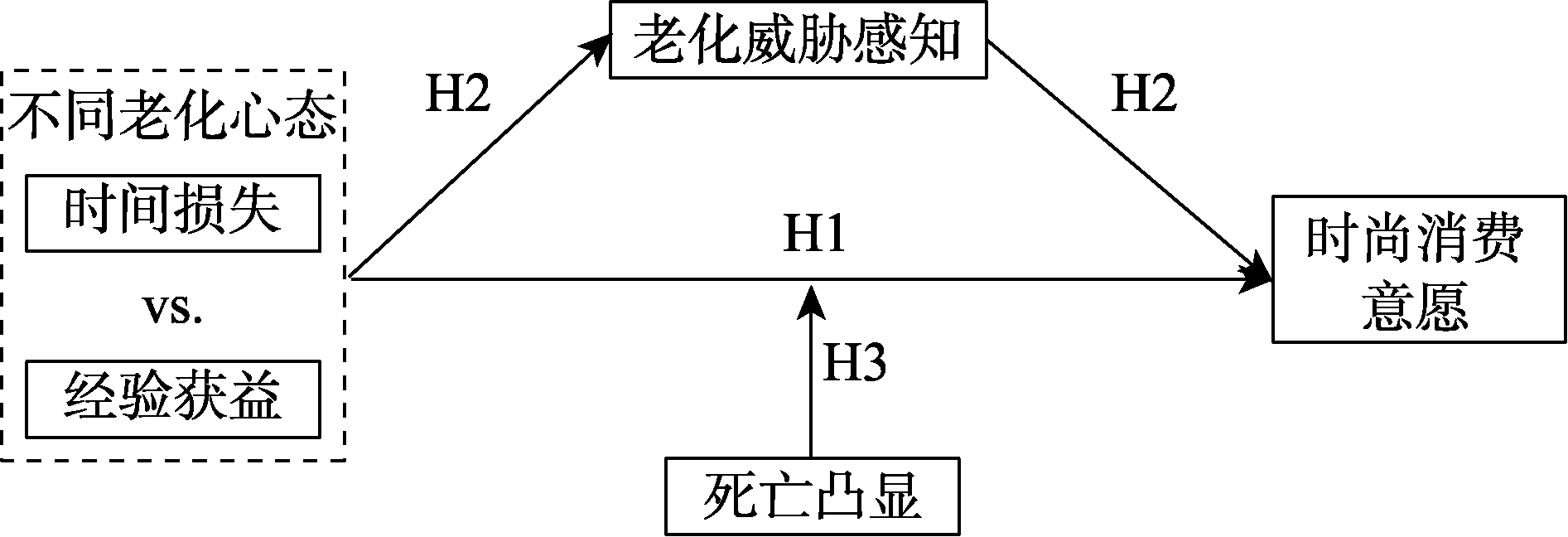
图1 理论模型框架图
| 研究 | 检验假设 | 自变量操控 | 因变量测量 | 中介或调节变量 | 样本来源 |
|---|---|---|---|---|---|
| 预调研 | H1 | — | 时尚涉入度、时尚消费意愿 | — | Prolific |
| 研究1 | H1 | 语义操控和事件回想 | 特定时尚产品偏好 | — | Prolific |
| 研究2 | H1 | 特定时尚产品偏好 | — | Prolific | |
| 研究3 | H1 & H2 | 总体时尚消费意愿 | 老化威胁感知 | Credamo | |
| 研究4 | H3 | 特定时尚产品偏好 | 死亡凸显 | Credamo |
表2 研究概览
| 研究 | 检验假设 | 自变量操控 | 因变量测量 | 中介或调节变量 | 样本来源 |
|---|---|---|---|---|---|
| 预调研 | H1 | — | 时尚涉入度、时尚消费意愿 | — | Prolific |
| 研究1 | H1 | 语义操控和事件回想 | 特定时尚产品偏好 | — | Prolific |
| 研究2 | H1 | 特定时尚产品偏好 | — | Prolific | |
| 研究3 | H1 & H2 | 总体时尚消费意愿 | 老化威胁感知 | Credamo | |
| 研究4 | H3 | 特定时尚产品偏好 | 死亡凸显 | Credamo |
| 变量 | 1 | 2 | 3 | 4 | 5 |
|---|---|---|---|---|---|
| 1.时尚涉入度 | 1 | ||||
| 2.时尚消费意愿 | 0.770** | 1 | |||
| 3.社会心理丧失 | −0.137 | −0.063 | 1 | ||
| 4.生理变化 | 0.105 | 0.147* | −0.475** | 1 | |
| 5.心理成长 | 0.143* | 0.189** | −0.430** | 0.534** | 1 |
表3 相关系数矩阵
| 变量 | 1 | 2 | 3 | 4 | 5 |
|---|---|---|---|---|---|
| 1.时尚涉入度 | 1 | ||||
| 2.时尚消费意愿 | 0.770** | 1 | |||
| 3.社会心理丧失 | −0.137 | −0.063 | 1 | ||
| 4.生理变化 | 0.105 | 0.147* | −0.475** | 1 | |
| 5.心理成长 | 0.143* | 0.189** | −0.430** | 0.534** | 1 |
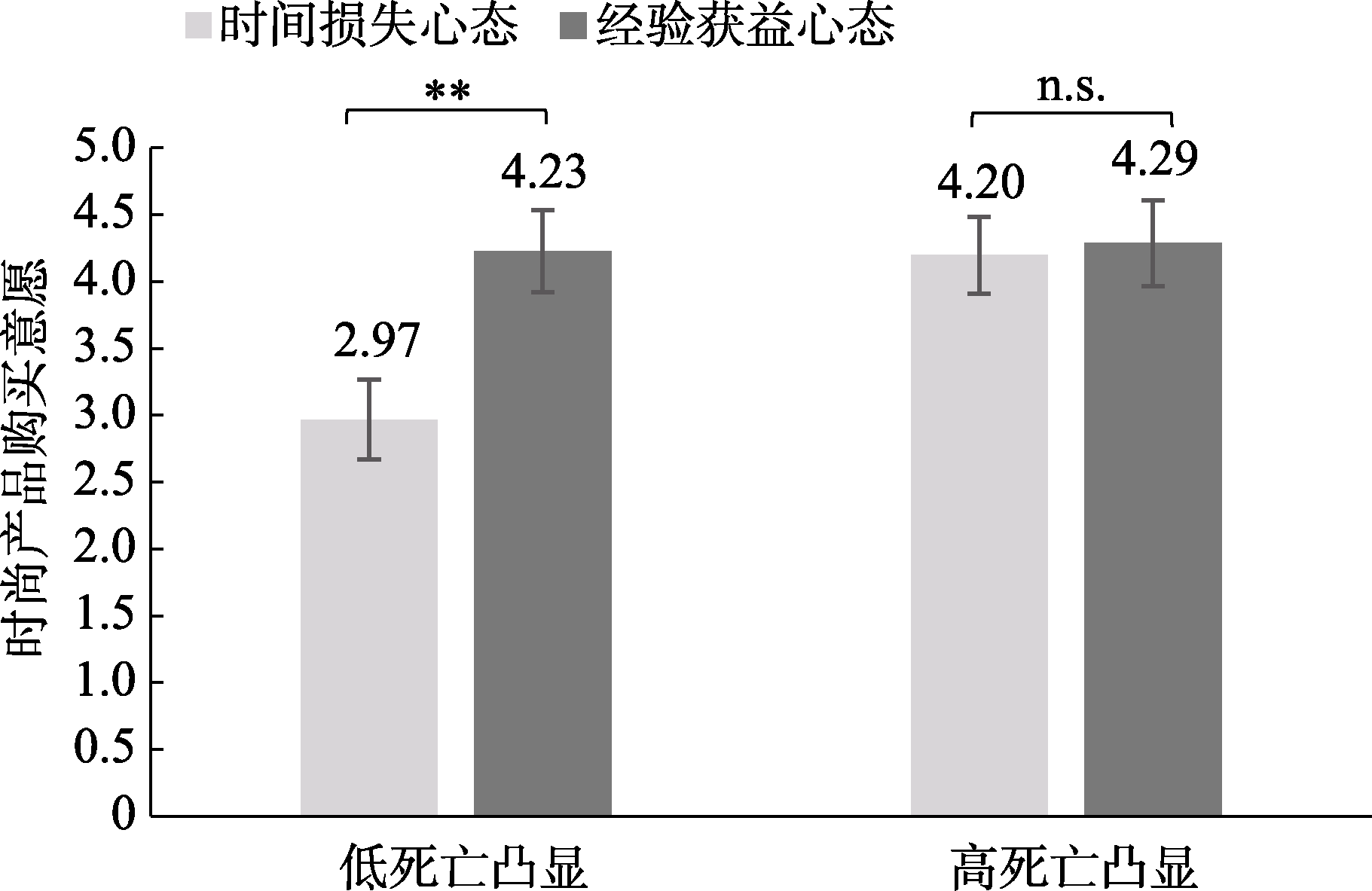
图2 死亡凸显的调节作用 注:误差线表示标准误差, ** p < 0. 01, n.s.表示不显著
| [1] |
Amatulli, C., Peluso, A. M., Guido, G., & Yoon, C. (2018). When feeling younger depends on others: The effects of social cues on older consumers. Journal of Consumer Research, 45(4), 691-709.
doi: 10.1093/jcr/ucy034 URL |
| [2] |
Arsel, Z., Crockett, D., & Scott, M. L. (2022). Diversity, equity, and inclusion (DEI) in the journal of consumer research: A curation and research agenda. Journal of Consumer Research, 48(5), 920-933.
doi: 10.1093/jcr/ucab057 URL |
| [3] |
Barnhart, M., & Peñaloza, L. (2013). Who are you calling old? Negotiating old age identity in the elderly consumption ensemble. Journal of Consumer Research, 39(6), 1133-1153.
doi: 10.1086/668536 URL |
| [4] |
Bellezza, S., Gino, F., & Keinan, A. (2014). The red sneakers effect: Inferring status and competence from signals of nonconformity. Journal of Consumer Research, 41(1), 35-54.
doi: 10.1086/674870 URL |
| [5] |
Berg, H., & Liljedal, K. T. (2022). Elderly consumers in marketing research: A systematic literature review and directions for future research. International Journal of Consumer Studies, 46(5), 1640-1664.
doi: 10.1111/ijcs.v46.5 URL |
| [6] |
Bodner, E., Shrira, A., Hoffman, Y., & Bergman, Y. S. (2021). Day-to-day variability in subjective age and ageist attitudes and their association with depressive symptoms. The Journals of Gerontology: Series B, 76(5), 836-844.
doi: 10.1093/geronb/gbaa125 URL |
| [7] |
Brothers, A., Gabrian, M., Wahl, H., & Diehl, M. (2019). A new multidimensional questionnaire to assess awareness of age-related change (AARC). The Gerontologist, 59(3), e141-e151.
doi: 10.1093/geront/gny006 URL |
| [8] |
Brown, K. E., Hall, A., Hillebrant-Openshaw, M., & Fulton, E. K. (2022). Can an aging leopard change its spots? The role of mindset of aging on implicit and explicit attitudes in older adults. Research on Aging, 45(3-4), 291-298.
doi: 10.1177/01640275221104827 URL |
| [9] |
Cameron, M. P., Richardson, M., & Siameja, S. (2016). Customer dissatisfaction among older consumers: A mixed-methods approach. Ageing and Society, 36(2), 420-441.
doi: 10.1017/S0144686X14001354 URL |
| [10] |
Catterall, M., & Maclaran, P. (2001). Body talk: Questioning the assumptions in cognitive age. Psychology & Marketing, 18(10), 1117-1133.
doi: 10.1002/mar.v18:10 URL |
| [11] |
Cavusoglu, L., & Atik, D. (2023). Extending the diversity conversation: Fashion consumption experiences of underrepresented and underserved women. Journal of Consumer Affairs, 57(1), 387-417.
doi: 10.1111/joca.v57.1 URL |
| [12] |
Cutright, K. M., Bettman, J. R., & Fitzsimons, G. J. (2013). Putting brands in their place: How a lack of control keeps brands contained. Journal of Marketing Research, 50(3), 365-377.
doi: 10.1509/jmr.10.0202 URL |
| [13] |
Dapkus, M. A. (1985). A thematic analysis of the experience of time. Journal of Personality and Social Psychology, 49(2), 408-419.
pmid: 4032226 |
| [14] |
de la Fuente, J., Santiago, J., Román, A., Dumitrache, C., & Casasanto, D. (2014). When you think about it, your past is in front of you: How culture shapes spatial conceptions of time. Psychological Science, 25(9), 1682-1690.
doi: 10.1177/0956797614534695 pmid: 25052830 |
| [15] |
Diehl, M., Wahl, H., Barrett, A. E., Brothers, A. F., Miche, M., Montepare, J. M., Westerhof, G. J., & Wurm, S. (2014). Awareness of aging: Theoretical considerations on an emerging concept. Developmental Review, 34(2), 93-113.
pmid: 24958998 |
| [16] |
Droulers, O., Lacoste-Badie, S., & Malek, F. (2015). Age-related differences in emotion regulation within the context of sad and happy TV programs. Psychology & Marketing, 32(8), 795-807.
doi: 10.1002/mar.2015.32.issue-8 URL |
| [17] |
Eisend, M. (2022). Older people in advertising. Journal of Advertising, 51(3), 308-322.
doi: 10.1080/00913367.2022.2027300 URL |
| [18] | Fairhurst, A. E., Good, L. K., & Gentry, J. W. (1989). Fashion involvement: An instrument validation procedure. Clothing and Textiles Research Journal, 7(3), 10-14. |
| [19] | Fan, X. C., Chen, X., & Ruan, Y. W. (2023). Consumer happiness: The theoretical framework and the research prospect. Journal of Marketing Science, 3(1), 78-97. |
| [范秀成, 陈晓, 阮艳雯. (2023). 消费者幸福感:理论框架与未来展望. 营销科学学报, 3(1), 78-97.] | |
| [20] |
Festjens, A., & Janiszewski, C. (2015). The value of time. Journal of Consumer Research, 42(2), 178-195.
doi: 10.1093/jcr/ucv021 URL |
| [21] |
Fritsche, I., Jonas, E., & Fankhänel, T. (2008). The role of control motivation in mortality salience effects on ingroup support and defense. Journal of Personality and Social Psychology, 95(3), 524-541.
doi: 10.1037/a0012666 pmid: 18729692 |
| [22] | Giovannini, S., Xu, Y., & Thomas, J. (2015). Luxury fashion consumption and Generation Y consumers. Journal of Fashion Marketing and Management, 19(1), 22-40. |
| [23] | Goldsmith, R. E., Moore, M. A., & Beaudoin, P. (1999). Fashion innovativeness and self‐concept: A replication. Journal of Product & Brand Management, 8(1), 7-18. |
| [24] |
Guido, G., Amatulli, C., & Peluso, A. M. (2014). Context effects on older consumers’ cognitive age: The Role of hedonic versus utilitarian goals. Psychology & Marketing, 31(2), 103-114.
doi: 10.1002/mar.2014.31.issue-2 URL |
| [25] |
Guy, B. S., Rittenburg, T. L., & Hawes, D. K. (1994). Dimensions and characteristics of time perceptions and perspectives among older consumers. Psychology & Marketing, 11(1), 35-56.
doi: 10.1002/mar.v11:1 URL |
| [26] |
Gwinner, K. P., & Stephens, N. (2001). Testing the implied mediational role of cognitive age. Psychology & Marketing, 18(10), 1031-1048.
doi: 10.1002/mar.v18:10 URL |
| [27] |
Hettich, D., Hattula, S., & Bornemann, T. (2018). Consumer decision-making of older people: A 45-year review. The Gerontologist, 58(6), e349-e368.
doi: 10.1093/geront/gnx007 URL |
| [28] | Hu, Z., Peng, X. Z., & Wu, Y. S. (2022). On the “Chinese Approach” to actively addressing population ageing. Social Sciences in China, (9), 46-66. |
| [胡湛, 彭希哲, 吴玉韶. (2022). 积极应对人口老龄化的“中国方案”. 中国社会科学, (9), 46-66.] | |
| [29] |
Huang, C. L., & Hu, C. (2023). The terror management and sorrow management of death consciousness. Acta Psychologica Sinica, 55(2), 318-337.
doi: 10.3724/SP.J.1041.2023.00318 |
|
[黄成利, 胡超. (2023). 死亡意识的恐惧管理和悲伤管理. 心理学报, 55(2), 318-337.]
doi: 10.3724/SP.J.1041.2023.00318 |
|
| [30] |
Huang, M., & Yang, F. (2023). Self-transcendence or self-enhancement: People’s perceptions of meaning and happiness in relation to the self. Journal of Experimental Psychology: General, 152(2), 590-610.
doi: 10.1037/xge0001297 URL |
| [31] |
Jerslev, A. (2017). The elderly female face in beauty and fashion ads: Joan Didion for Céline. European Journal of Cultural Studies, 21(3), 349-362.
doi: 10.1177/1367549417708436 URL |
| [32] |
Ji, L. J., Wu, Y., & Yang, Y. Y. (2023). The breath of temporal information focus among Chinese people. Acta Psychologica Sinica, 55(3), 421-434
doi: 10.3724/SP.J.1041.2023.00421 URL |
|
[纪丽君, 吴莹, 杨宜音. (2023). 中国人的时间知觉广度. 心理学报, 55(3), 421-434.]
doi: 10.3724/SP.J.1041.2023.00421 |
|
| [33] |
Kastarinen, A., Närvänen, E., & Valtonen, A. (2023). Doing family over time: The multilayered and multitemporal nature of intergenerational caring through consumption. Journal of Consumer Research, 50(2), 282-302.
doi: 10.1093/jcr/ucac050 URL |
| [34] | Kautish, P., Khare, A., & Sharma, R. (2021). Influence of values, brand consciousness and behavioral intentions in predicting luxury fashion consumption. Journal of Product & Brand Management, 30(4), 513-531. |
| [35] |
Kim, J. K., Holtz, B. C., & Vogel, R. M. (2022). Wearing your worth at work: The consequences of employees’ daily clothing choices. Academy of Management Journal, 66(5), 1411-1437.
doi: 10.5465/amj.2021.1358 URL |
| [36] |
Kim, N., & Jin, B. (2023). Does beauty encourage sharing? Exploring the role of physical attractiveness and racial similarity in collaborative fashion consumption. Journal of Business Research, 165, 114083.
doi: 10.1016/j.jbusres.2023.114083 URL |
| [37] |
Kuppelwieser, V. G., & Klaus, P. (2020). Revisiting the age construct: Implications for service research. Journal of Service Research, 24(3), 372-389.
doi: 10.1177/1094670520975138 URL |
| [38] |
Laidlaw, K., Power, M. J., & Schmidt, S. (2007). The attitudes to ageing questionnaire (AAQ): Development and psychometric properties. International Journal of Geriatric Psychiatry, 22(4), 367-379.
pmid: 17051535 |
| [39] |
Lambert-Pandraud, R., & Laurent, G. (2010). Why do older consumers buy older brands? The role of attachment and declining innovativeness. Journal of Marketing, 74(5), 104-121.
doi: 10.1509/jmkg.74.5.104 URL |
| [40] |
Lawrie, S. I., Eom, K., Moza, D., Gavreliuc, A., & Kim, H. S. (2019). Cultural variability in the association between age and well-being: The role of uncertainty avoidance. Psychological Science, 31(1), 51-64.
doi: 10.1177/0956797619887348 URL |
| [41] | Le, X., & Peng, X. Z. (2016). A New understanding of the consumption of China’s elderly population and the thinking of public policy. Fudan Journal (Social Sciences Edition), 58(2), 126-134. |
| [乐昕, 彭希哲. (2016). 老年消费新认识及其公共政策思考. 复旦学报(社会科学版), 58(2), 126-134.] | |
| [42] |
Li, B., Zhu, Q., He, R. W., Li, A. M., & Wei, H. Y. (2023). The effect of mortality salience on consumers’ preference for experiential purchases and its mechanism. Acta Psychologica Sinica, 55(2), 301-317.
doi: 10.3724/SP.J.1041.2023.00301 URL |
|
[李斌, 朱钦, 贺汝婉, 李爱梅, 卫海英. (2023). 死亡凸显对消费者体验性消费选择偏好的影响及其作用机制. 心理学报, 55(2), 301-317.]
doi: 10.3724/SP.J.1041.2023.00301 |
|
| [43] |
Lim, C. M., & Kim, Y. (2011). Older consumers’ TV home shopping: Loneliness, parasocial interaction, and perceived convenience. Psychology & Marketing, 28(8), 763-780.
doi: 10.1002/mar.v28.8 URL |
| [44] |
Lin, Y., & Xia, K. (2012). Cognitive age and fashion consumption. International Journal of Consumer Studies, 36(1), 97-105.
doi: 10.1111/ijc.2012.36.issue-1 URL |
| [45] | Liu, C., & Lu, T. H. (2005). Unscramble the Chinese older market in 21st century: Opportunity and challenge. Journal of Business Economics, (11), 24-28. |
| [刘超, 卢泰宏. (2005). 21世纪中国老年消费市场解读. 商业经济与管理, (11), 24-28.] | |
| [46] |
Lu, K. X., Wang, X., & Li, H. (2019). The relationship of death anxiety defense mechanisms in terror management theory. Advances in Psychological Science, 27(2), 344-356.
doi: 10.3724/SP.J.1042.2019.00344 |
|
[陆可心, 王旭, 李虹. (2019). 恐惧管理中死亡焦虑不同防御机制之间的关系. 心理科学进展, 27(2), 344-356.]
doi: 10.3724/SP.J.1042.2019.00344 |
|
| [47] |
Mandel, N., & Smeesters, D. (2008). The sweet escape: Effects of mortality salience on consumption quantities for high- and low-self-esteem consumers. Journal of Consumer Research, 35(2), 309-323.
doi: 10.1086/587626 URL |
| [48] |
Mcneill, L. S. (2018). Fashion and women’s self-concept: A typology for self-fashioning using clothing. Journal of Fashion Marketing and Management: An International Journal, 22(1), 82-98.
doi: 10.1108/JFMM-09-2016-0077 URL |
| [49] |
McQuarrie, E. F., Miller, J., & Phillips, B. J. (2013). The megaphone effect: Taste and audience in fashion blogging. Journal of Consumer Research, 40(1), 136-158.
doi: 10.1086/669042 URL |
| [50] |
Mock, S. E., & Eibach, R. P. (2011). Aging attitudes moderate the effect of subjective age on psychological well-being: Evidence from a 10-year longitudinal study. Psychology and Aging, 26(4), 979-986.
doi: 10.1037/a0023877 pmid: 21728444 |
| [51] |
Moschis, G. P. (2012). Consumer behavior in later life: Current knowledge, issues, and new directions for research. Psychology & Marketing, 29(2), 57-75.
doi: 10.1002/mar.2012.29.issue-2 URL |
| [52] |
Muzinich, N., Pecotich, A., & Putrevu, S. (2003). A model of the antecedents and consequents of female fashion innovativeness. Journal of Retailing and Consumer Services, 10(5), 297-310.
doi: 10.1016/S0969-6989(02)00060-7 URL |
| [53] |
Oishi, S., & Tsang, S. (2022). The socio-ecological psychology of residential mobility. Journal of Consumer Psychology, 32(3), 519-536.
doi: 10.1002/jcpy.v32.3 URL |
| [54] |
Okan, M., Elmadag, A. B., & İdemen, E. (2021). Frontline employee age and customer mistreatment: A meta-analysis. Journal of Services Marketing, 35(1), 98-115.
doi: 10.1108/JSM-06-2019-0246 URL |
| [55] |
Pang, Y., Wang, L., & Chen, F. (2025). Message framing to enhance consumer compliance with disease detection communication for prevention: The moderating role of age. Journal of Consumer Psychology, 35(3), 484-494.
doi: 10.1002/jcpy.v35.3 URL |
| [56] |
Park, J., Kim, D., & Hyun, H. (2021). Understanding self-service technology adoption by “older” consumers. Journal of Services Marketing, 35(1), 78-97.
doi: 10.1108/JSM-10-2019-0420 URL |
| [57] | Peng, X. Z., & Chen, Q. (2022). On China's silver economy. Chinese Social Security Review, 6(4), 49-66. |
| [彭希哲, 陈倩. (2022). 中国银发经济刍议. 社会保障评论, 6(4), 49-66.] | |
| [58] |
Robinson, T. D., Veresiu, E., & Babić Rosario, A. (2022). Consumer timework. Journal of Consumer Research, 49(1), 96-111.
doi: 10.1093/jcr/ucab046 URL |
| [59] |
Rupprecht, F. S., Martin, K., & Lang, F. R. (2022). Aging-related fears and their associations with ideal life expectancy. European Journal of Ageing, 19(3), 587-597.
doi: 10.1007/s10433-021-00661-3 |
| [60] | Saran, R., Roy, S., & Sethuraman, R. (2016). Personality and fashion consumption: A conceptual framework in the Indian context. Journal of Fashion Marketing and Management, 20(2), 157-176. |
| [61] |
Schau, H. J., Gilly, M. C., & Wolfinbarger, M. (2009). Consumer identity renaissance: The resurgence of identity-inspired consumption in retirement. Journal of Consumer Research, 36(2), 255-276.
doi: 10.1086/597162 URL |
| [62] |
Sherman, E., Schiffman, L. G., & Mathur, A. (2001). The influence of gender on the new-age elderly’s consumption orientation. Psychology & Marketing, 18(10), 1073-1089.
doi: 10.1002/mar.v18:10 URL |
| [63] |
Shimizu, Y., Hashimoto, T., & Karasawa, K. (2022). Decreasing anti-elderly discriminatory attitudes: Conducting a ‘stereotype embodiment theory’-based intervention. European Journal of Social Psychology, 52(1), 174-190.
doi: 10.1002/ejsp.v52.1 URL |
| [64] |
Shipp, A. J., Edwards, J. R., & Lambert, L. S. (2009). Conceptualization and measurement of temporal focus: The subjective experience of the past, present, and future. Organizational Behavior and Human Decision Processes, 110(1), 1-22.
doi: 10.1016/j.obhdp.2009.05.001 URL |
| [65] | Shrira,, A., Palgi, Y., & Diehl, M. (2022). Advancing the field of subjective views of aging:An overview of recent achievements. In Y. Palgi, A. Shrira, & M. Diehl (Eds.), Subjective views of aging: Theory, research, and practice (pp. 11-37). Springer International Publishing. |
| [66] |
Silva, S. C., Rocha, T. V., De Cicco, R., Galhanone, R. F., & Manzini Ferreira Mattos, L. T. (2021). Need for touch and haptic imagery: An investigation in online fashion shopping. Journal of Retailing and Consumer Services, 59, 102378.
doi: 10.1016/j.jretconser.2020.102378 URL |
| [67] | Steverink, N., Westerhof, G. J., Bode, C., & Dittmann-Kohli, F. (2001). The personal experience of aging, individual resources, and subjective well-being. The Journals of Gerontology: Series B, 56(6), 364-373. |
| [68] |
Sudbury, L., & Simcock, P. (2009). Understanding older consumers through cognitive age and the list of values: A U.K.-based perspective. Psychology & Marketing, 26(1), 22-38.
doi: 10.1002/mar.v26:1 URL |
| [69] |
Sung, Y., & Yoon, C. (2024). Social and cultural influences on older consumers. Current Opinion in Psychology, 55, 101740.
doi: 10.1016/j.copsyc.2023.101740 URL |
| [70] |
Szmigin, I., & Carrigan, M. (2001). Time, consumption, and the older consumer: An interpretive study of the cognitively young. Psychology & Marketing, 18(10), 1091-1116.
doi: 10.1002/mar.v18:10 URL |
| [71] |
Townsend, K., Kent, A., & Sadkowska, A. (2019). Fashioning clothing with and for mature women: A small-scale sustainable design business model. Management Decision, 57(1), 3-20.
doi: 10.1108/MD-12-2016-0942 URL |
| [72] |
Twigg, J., & Majima, S. (2014). Consumption and the constitution of age: Expenditure patterns on clothing, hair and cosmetics among post-war ‘baby boomers’. Journal of Aging Studies, 30, 23-32.
doi: 10.1016/j.jaging.2014.03.003 URL |
| [73] |
Wang, X., Sun, Y., & Kramer, T. (2021). Ritualistic consumption decreases loneliness by increasing meaning. Journal of Marketing Research, 58(2), 282-298.
doi: 10.1177/0022243721993426 URL |
| [74] |
Weiss, D., Job, V., Mathias, M., Grah, S., & Freund, A. M. (2016). The end is (not) near: Aging, essentialism, and future time perspective. Developmental Psychology, 52(6), 996-1009.
doi: 10.1037/dev0000115 pmid: 27228453 |
| [75] |
Weiss, D., & Kornadt, A. E. (2018). Age-stereotype internalization and dissociation: Contradictory processes or two sides of the same coin? Current Directions in Psychological Science, 27(6), 477-483.
doi: 10.1177/0963721418777743 URL |
| [76] |
Weiss, D., & Lang, F. R. (2009). Thinking about my generation: Adaptive effects of a dual age identity in later adulthood. Psychology and Aging, 24(3), 729-734.
doi: 10.1037/a0016339 pmid: 19739929 |
| [77] |
Wilson-Nash, C., Pavlopoulou, I., & Wang, Z. (2023). Selecting, optimizing, and compensating during lockdown: How older consumers use social networking services to improve social well-being. Journal of Interactive Marketing, 58(2-3), 301-320.
doi: 10.1177/10949968231155156 URL |
| [78] |
Xi, W., Zhang, X., & Ayalon, L. (2022). When less intergenerational closeness helps: The influence of intergenerational physical proximity and technology attributes on technophobia among older adults. Computers in Human Behavior, 131, 107234.
doi: 10.1016/j.chb.2022.107234 URL |
| [79] |
Xu, L., Chen, Q., Cui, N., & Lu, K. L. (2019). Enjoy the present or wait for the future? Effects of individuals’ view of time on intertemporal choice. Acta Psychologica Sinica, 51(1), 96-105.
doi: 10.3724/SP.J.1041.2019.00096 |
|
[徐岚, 陈全, 崔楠, 陆凯丽. (2019). 享受当下, 还是留待未来?——时间观对跨期决策的影响. 心理学报, 51(1), 96-105.]
doi: 10.3724/SP.J.1041.2019.00096 |
|
| [80] |
Xu, L., Zhao, S., Cotte, J., & Cui, N. (2023). Cyclical time is greener: The impact of temporal perspective on pro-environmental behavior. Journal of Consumer Research, 50(4), 722-741.
doi: 10.1093/jcr/ucad016 URL |
| [81] |
Xu, R., Zhang, B. S., & Lin, Y. (2021). Effects of family affective involvement on aging self-stereotypes: An analysis based on latent growth model. Acta Psychologica Sinica, 53(11), 1215-1227.
doi: 10.3724/SP.J.1041.2021.01215 |
|
[徐冉, 张宝山, 林瑶. (2021). 家人情感卷入对老年自我刻板印象的影响:基于潜变量增长模型的分析. 心理学报, 53(11), 1215-1227.]
doi: 10.3724/SP.J.1041.2021.01215 |
|
| [82] |
Yannopoulou, N., Manika, D., Chandrasapth, K., Tajvidi, M., & Wells, V. (2023). What we do know and don’t know about marketing communications on mature consumers. European Journal of Marketing, 57(8), 1969-1995.
doi: 10.1108/EJM-12-2020-0906 URL |
| [83] |
Yu, S., Hudders, L., & Cauberghe, V. (2018). Are fashion consumers like schooling fish? The effectiveness of popularity cues in fashion e-commerce. Journal of Business Research, 85, 105-116.
doi: 10.1016/j.jbusres.2017.12.035 URL |
| [84] | Zhang, H. Y., Ding, Z. H., Jiang, X., Wang, Y. W., & Xuan, S. Q. (2023). People prefer new products as they become older: The effect of aging perception on new product purchase intention. Management Review, 35(7), 174-184. |
| [张惠莹, 丁志华, 江欣, 王亚维, 宣善奇. (2023). 越老越爱新:衰老感知对新产品购买意愿的影响. 管理评论, 35(7), 174-184.] | |
| [85] |
Zimbardo, P., & Boyd, J. (1999). Putting time in perspective: A valid, reliable individual-differences metric. Journal of Personality and Social Psychology, 77(6), 1271-1288.
doi: 10.1037/0022-3514.77.6.1271 URL |
| [1] | 冉雅璇, 牛熠欣, 陈斯允. “多”反而少:元认知推断视角下支付渠道数量对个体捐赠的影响[J]. 心理学报, 2021, 53(4): 413-430. |
| 阅读次数 | ||||||
|
全文 |
|
|||||
|
摘要 |
|
|||||
