

ISSN 0439-755X
CN 11-1911/B
主办:中国心理学会
中国科学院心理研究所
出版:科学出版社
CN 11-1911/B
主办:中国心理学会
中国科学院心理研究所
出版:科学出版社
心理学报 ›› 2025, Vol. 57 ›› Issue (7): 1201-1215.doi: 10.3724/SP.J.1041.2025.1201 cstr: 32110.14.2025.1201
龙翼婷, 姜英杰( ), 袁媛, 张晓靖, 丛佩瑶, 郭彦麟
收稿日期:2022-09-02
发布日期:2025-04-24
出版日期:2025-07-25
通讯作者:
姜英杰, E-mail: jiangyj993@nenu.edu.cn基金资助:
LONG Yiting, JIANG Yingjie(), YUAN Yuan, ZHANG Xiaojing, CONG Peiyao, GUO Yanlin
Received:2022-09-02
Online:2025-04-24
Published:2025-07-25
摘要:
具有适应性的情景记忆在社会合作决策中扮演着关键角色, 然而以往研究在探讨公平如何塑造这种记忆时存在争议, 且常常忽略了奖赏对记忆的额外影响。本研究通过3个实验, 利用独裁者游戏范式, 深入考察了公平对情景记忆的影响, 以及相对奖赏与绝对奖赏在其中的调节作用。研究结果显示, (1)趋近高公平和回避低公平的动机均可能有效增强情景记忆; (2)相对奖赏的大小调节了公平对情景记忆的影响, 被试对大奖赏下的高公平分配以及小奖赏下的低公平分配有更好的记忆效果, 而绝对奖赏则未展现出类似的作用; (3)公平和奖赏都能够通过情景记忆来促进后续合作决策。总体而言, 本研究通过揭示社会性(公平)与非社会性(奖赏)因素间复杂的交互作用, 为理解社会性情景记忆的形成机制提供了新的视角。
中图分类号:
龙翼婷, 姜英杰, 袁媛, 张晓靖, 丛佩瑶, 郭彦麟. (2025). 公平影响适应性情景记忆:相对奖赏的调节作用. 心理学报, 57(7), 1201-1215.
LONG Yiting, JIANG Yingjie, YUAN Yuan, ZHANG Xiaojing, CONG Peiyao, GUO Yanlin. (2025). The influence of fairness on adaptive episodic memory: The moderating role of relative reward. Acta Psychologica Sinica, 57(7), 1201-1215.
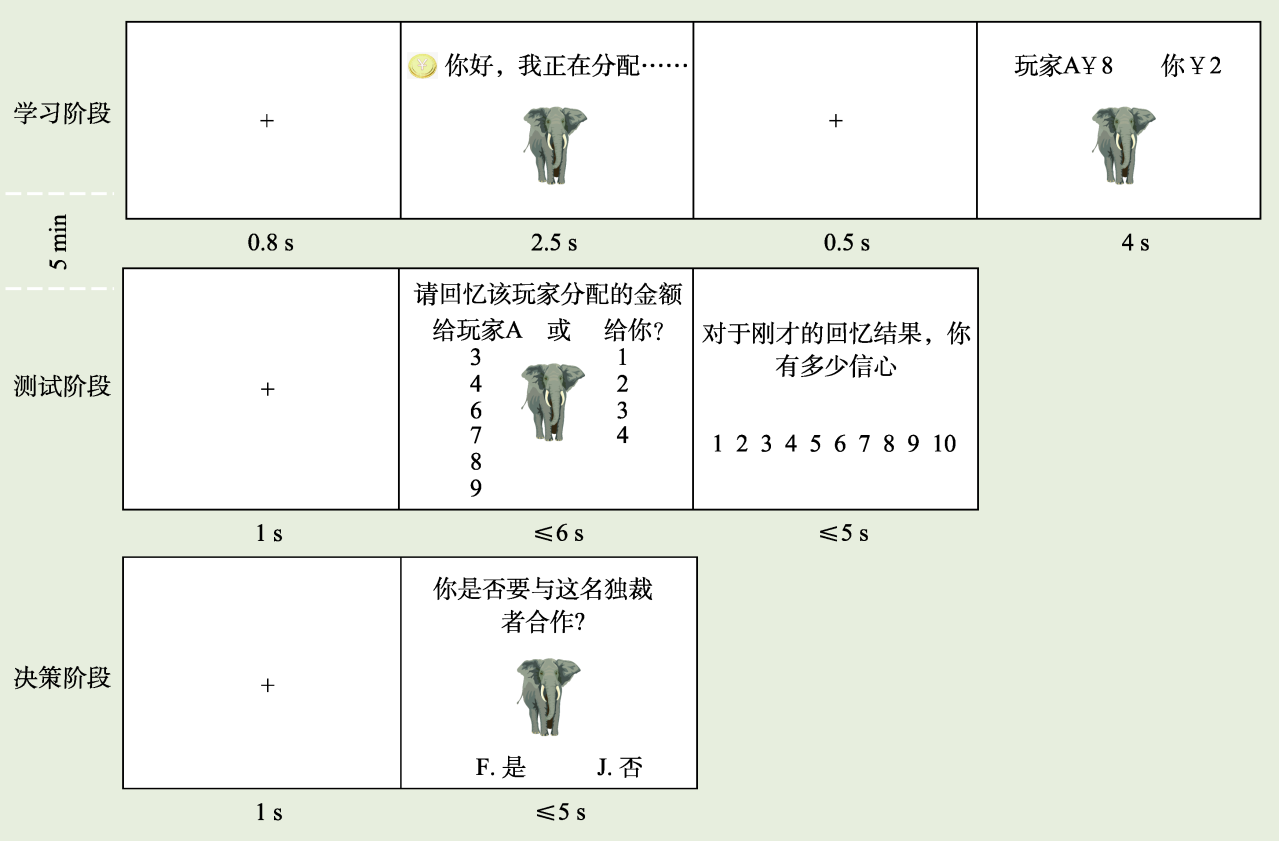
图1 预实验流程图
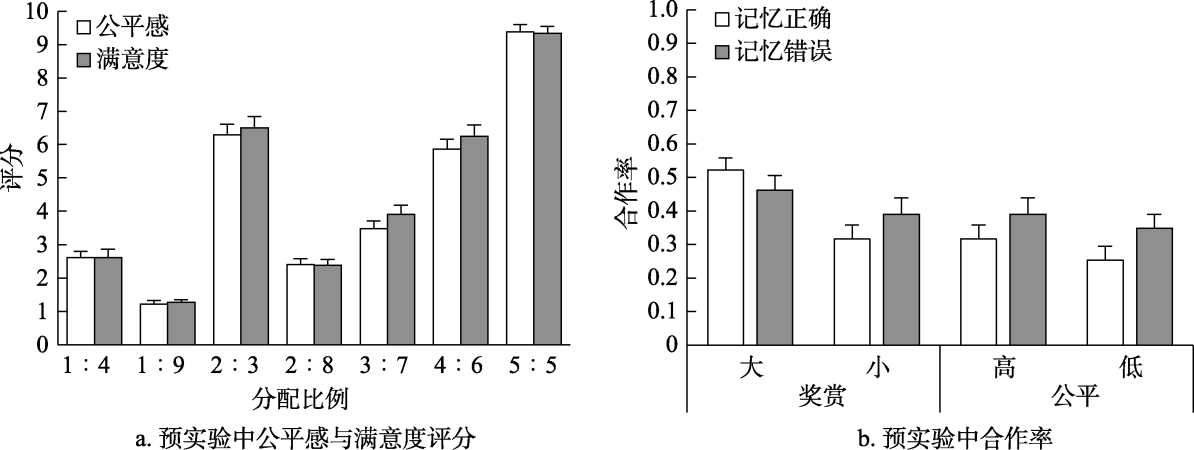
图2 预实验中的公平感和满意度评分(a)与合作率(b) (误差线为标准误)
| 条件 | 1 : 4 | 1 : 9 | 2 : 3 | 2 : 8 | 4 : 6 | |
|---|---|---|---|---|---|---|
| 情景记忆成绩 | 0.24(0.18) | 0.33(0.15) | 0.32(0.22) | 0.43 (0.19) | 0.31(0.21) | |
| 信心判断 | 5.00(1.64) | 5.62(1.63) | 5.25(1.63) | 4.85(1.59) | 6.45(1.87) | |
| 合作率 | 回忆正确 | 0.17(0.30) | 0.18(0.31) | 0.42(0.38) | 0.32(0.35) | 0.79(0.34) |
| 回忆错误 | 0.32(0.30) | 0.33(0.27) | 0.48(0.33) | 0.38(0.30) | 0.53(0.26) | |
表1 预实验中不同条件下记忆成绩、信心判断和合作率的平均值(标准差)
| 条件 | 1 : 4 | 1 : 9 | 2 : 3 | 2 : 8 | 4 : 6 | |
|---|---|---|---|---|---|---|
| 情景记忆成绩 | 0.24(0.18) | 0.33(0.15) | 0.32(0.22) | 0.43 (0.19) | 0.31(0.21) | |
| 信心判断 | 5.00(1.64) | 5.62(1.63) | 5.25(1.63) | 4.85(1.59) | 6.45(1.87) | |
| 合作率 | 回忆正确 | 0.17(0.30) | 0.18(0.31) | 0.42(0.38) | 0.32(0.35) | 0.79(0.34) |
| 回忆错误 | 0.32(0.30) | 0.33(0.27) | 0.48(0.33) | 0.38(0.30) | 0.53(0.26) | |
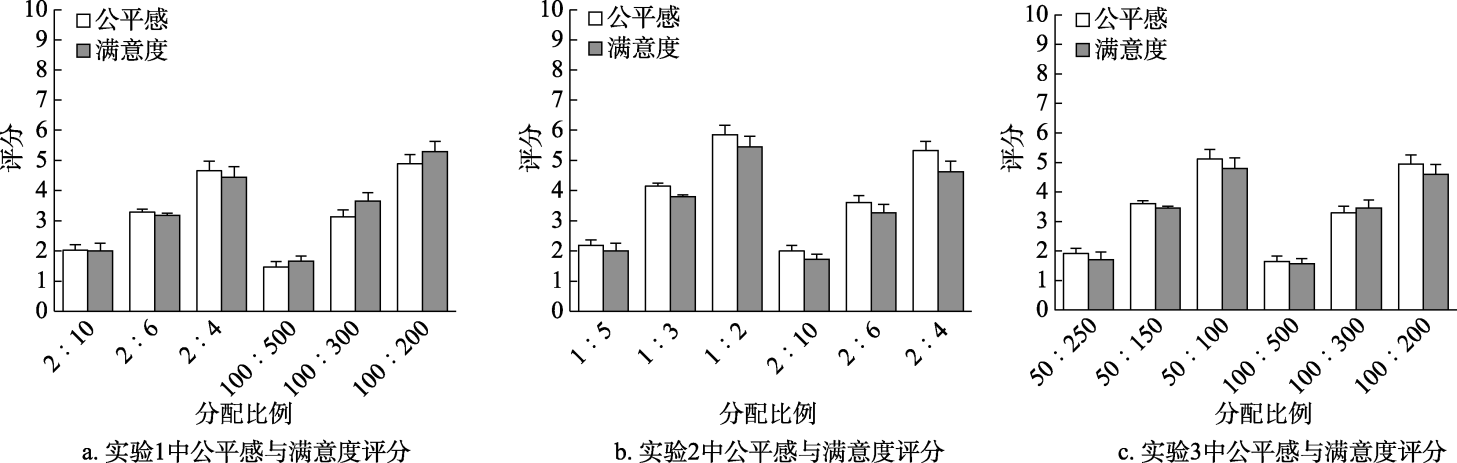
图3 正式实验中不同分配条件下的公平感和满意度评分(误差线为标准误)
| 条件 | 100 : 200 | 100 : 300 | 100 : 500 | 2 : 4 | 2 : 6 | 2 : 10 |
|---|---|---|---|---|---|---|
| 记忆成绩 | 0.55(0.20) | 0.49(0.17) | 0.35(0.18) | 0.44(0.16) | 0.52(0.14) | 0.33(0.20) |
| 信心判断 | 6.52(1.20) | 5.98(1.27) | 6.05(1.36) | 6.12 (1.36) | 5.92(1.35) | 6.00(1.22) |
| 合作率(记忆正确) | 0.68(0.23) | 0.40(0.29) | 0.26(0.23) | 0.59(0.32) | 0.47(0.22) | 0.39(0.36) |
| 合作率(记忆错误) | 0.33(0.21) | 0.40(0.17) | 0.44(0.44) | 0.37(0.25) | 0.44(0.23) | 0.44(0.16) |
表2 实验1中不同条件下记忆成绩、信心判断和合作率的平均值(标准差)
| 条件 | 100 : 200 | 100 : 300 | 100 : 500 | 2 : 4 | 2 : 6 | 2 : 10 |
|---|---|---|---|---|---|---|
| 记忆成绩 | 0.55(0.20) | 0.49(0.17) | 0.35(0.18) | 0.44(0.16) | 0.52(0.14) | 0.33(0.20) |
| 信心判断 | 6.52(1.20) | 5.98(1.27) | 6.05(1.36) | 6.12 (1.36) | 5.92(1.35) | 6.00(1.22) |
| 合作率(记忆正确) | 0.68(0.23) | 0.40(0.29) | 0.26(0.23) | 0.59(0.32) | 0.47(0.22) | 0.39(0.36) |
| 合作率(记忆错误) | 0.33(0.21) | 0.40(0.17) | 0.44(0.44) | 0.37(0.25) | 0.44(0.23) | 0.44(0.16) |
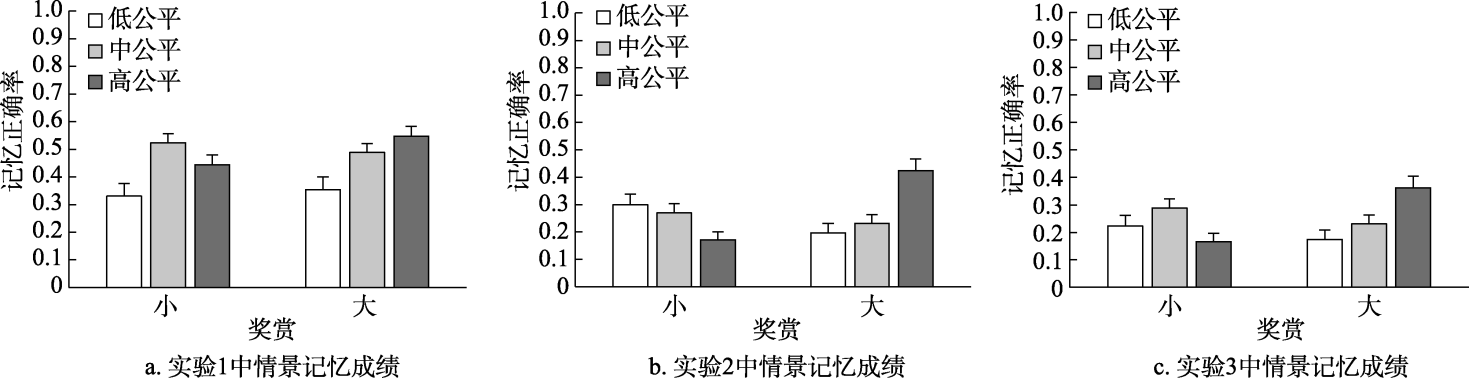
图4 奖赏和公平对情景记忆成绩的影响(误差线为标准误)
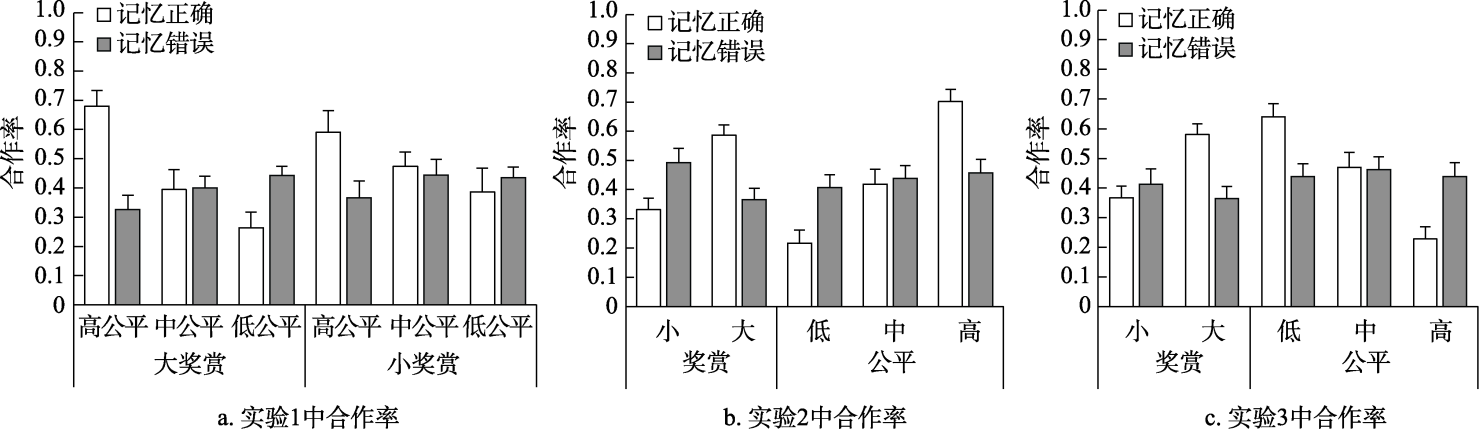
图5 奖赏、公平基于情景记忆对合作决策的影响(误差线为标准误)
| 条件 | 1 : 2 | 1 : 3 | 1 : 5 | 2 : 4 | 2 : 6 | 2 : 10 |
|---|---|---|---|---|---|---|
| 记忆成绩 | 0.17(0.17) | 0.27(0.20) | 0.30(0.22) | 0.42(0.25) | 0.23(0.18) | 0.20(0.20) |
| 奖赏记忆成绩 | 0.55(0.23) | 0.66(0.19) | 0.63(0.21) | 0.62(0.24) | 0.54(0.28) | 0.56(0.23) |
| 公平记忆成绩 | 0.43(0.23) | 0.40(0.22) | 0.40(0.22) | 0.52(0.26) | 0.48(0.24) | 0.39(0.27) |
| 信心判断 | 5.03(1.51) | 4.68(1.36) | 5.04(1.52) | 5.32(1.43) | 4.81(1.51) | 5.42(1.46) |
| 合作率 | 0.52(0.31) | 0.37(0.28) | 0.27(0.20) | 0.65(0.21) | 0.48(0.26) | 0.39(0.28) |
表3 实验2中不同条件下记忆成绩、信心判断和合作率的平均值(标准差)
| 条件 | 1 : 2 | 1 : 3 | 1 : 5 | 2 : 4 | 2 : 6 | 2 : 10 |
|---|---|---|---|---|---|---|
| 记忆成绩 | 0.17(0.17) | 0.27(0.20) | 0.30(0.22) | 0.42(0.25) | 0.23(0.18) | 0.20(0.20) |
| 奖赏记忆成绩 | 0.55(0.23) | 0.66(0.19) | 0.63(0.21) | 0.62(0.24) | 0.54(0.28) | 0.56(0.23) |
| 公平记忆成绩 | 0.43(0.23) | 0.40(0.22) | 0.40(0.22) | 0.52(0.26) | 0.48(0.24) | 0.39(0.27) |
| 信心判断 | 5.03(1.51) | 4.68(1.36) | 5.04(1.52) | 5.32(1.43) | 4.81(1.51) | 5.42(1.46) |
| 合作率 | 0.52(0.31) | 0.37(0.28) | 0.27(0.20) | 0.65(0.21) | 0.48(0.26) | 0.39(0.28) |
| 变量 | B | Std | t | p | 95% CI |
|---|---|---|---|---|---|
| 截距 | 0.26 | 0.05 | 5.39 | < 0.001 | [0.17, 0.36] |
| 相对奖赏: 奖赏记忆 | 0.14 | 0.03 | 4.35 | < 0.001 | [0.08, 0.21] |
| 高公平: 公平记忆 | 0.46 | 0.07 | 6.42 | < 0.001 | [0.32, 0.60] |
| 中公平: 公平记忆 | 0.10 | 0.08 | 1.25 | 0.213 | [−0.06, 0.25] |
| 低公平: 公平记忆 | −0.20 | 0.08 | −2.41 | 0.017 | [−0.36, −0.04] |
表4 实验2中对合作率进行的混合线性模型结果
| 变量 | B | Std | t | p | 95% CI |
|---|---|---|---|---|---|
| 截距 | 0.26 | 0.05 | 5.39 | < 0.001 | [0.17, 0.36] |
| 相对奖赏: 奖赏记忆 | 0.14 | 0.03 | 4.35 | < 0.001 | [0.08, 0.21] |
| 高公平: 公平记忆 | 0.46 | 0.07 | 6.42 | < 0.001 | [0.32, 0.60] |
| 中公平: 公平记忆 | 0.10 | 0.08 | 1.25 | 0.213 | [−0.06, 0.25] |
| 低公平: 公平记忆 | −0.20 | 0.08 | −2.41 | 0.017 | [−0.36, −0.04] |
| 条件 | 50 : 100 | 50 : 150 | 50 : 250 | 100 : 200 | 100 : 300 | 100 : 500 |
|---|---|---|---|---|---|---|
| 记忆成绩 | 0.17(0.13) | 0.29(0.13) | 0.22(0.16) | 0.33(0.20) | 0.23(0.17) | 0.17(0.16) |
| 奖赏记忆成绩 | 0.57(0.23) | 0.54(0.19) | 0.33(0.20) | 0.56(0.18) | 0.49(0.19) | 0.54(0.20) |
| 公平记忆成绩 | 0.39(0.20) | 0.46(0.16) | 0.34(0.20) | 0.43(0.21) | 0.43(0.19) | 0.38(0.23) |
| 信心判断 | 4.09(1.34) | 4.03(1.35) | 4.17(1.42) | 4.62(1.58) | 4.02(1.41) | 4.58(1.65) |
| 合作率 | 0.44(0.27) | 0.41(0.26) | 0.32(0.22) | 0.59(0.24) | 0.49(0.24) | 0.36(0.21) |
表5 实验3中不同条件下记忆成绩、信心判断和合作率的平均值(标准差)
| 条件 | 50 : 100 | 50 : 150 | 50 : 250 | 100 : 200 | 100 : 300 | 100 : 500 |
|---|---|---|---|---|---|---|
| 记忆成绩 | 0.17(0.13) | 0.29(0.13) | 0.22(0.16) | 0.33(0.20) | 0.23(0.17) | 0.17(0.16) |
| 奖赏记忆成绩 | 0.57(0.23) | 0.54(0.19) | 0.33(0.20) | 0.56(0.18) | 0.49(0.19) | 0.54(0.20) |
| 公平记忆成绩 | 0.39(0.20) | 0.46(0.16) | 0.34(0.20) | 0.43(0.21) | 0.43(0.19) | 0.38(0.23) |
| 信心判断 | 4.09(1.34) | 4.03(1.35) | 4.17(1.42) | 4.62(1.58) | 4.02(1.41) | 4.58(1.65) |
| 合作率 | 0.44(0.27) | 0.41(0.26) | 0.32(0.22) | 0.59(0.24) | 0.49(0.24) | 0.36(0.21) |
| 变量 | B | Std | t | p | 95% CI |
|---|---|---|---|---|---|
| 截距 | 0.33 | 0.05 | 6.54 | < 0.001 | [0.23, 0.43] |
| 相对奖赏: 奖赏记忆 | 0.003 | 0.001 | 3.54 | < 0.001 | [0.001, 0.004] |
| 高公平: 公平记忆 | 0.20 | 0.09 | 2.11 | 0.036 | [0.01, 0.38] |
| 中公平: 公平记忆 | 0.001 | 0.09 | 0.01 | 0.992 | [−0.18, 0.18] |
| 低公平: 公平记忆 | −0.31 | 0.10 | −3.10 | 0.002 | [−0.51, −0.12] |
表6 实验3中对合作率进行的混合线性模型结果
| 变量 | B | Std | t | p | 95% CI |
|---|---|---|---|---|---|
| 截距 | 0.33 | 0.05 | 6.54 | < 0.001 | [0.23, 0.43] |
| 相对奖赏: 奖赏记忆 | 0.003 | 0.001 | 3.54 | < 0.001 | [0.001, 0.004] |
| 高公平: 公平记忆 | 0.20 | 0.09 | 2.11 | 0.036 | [0.01, 0.38] |
| 中公平: 公平记忆 | 0.001 | 0.09 | 0.01 | 0.992 | [−0.18, 0.18] |
| 低公平: 公平记忆 | −0.31 | 0.10 | −3.10 | 0.002 | [−0.51, −0.12] |
| [1] | Babür, B. G., Leong, Y. C., Pan, C. X., & Hackel, L. M. (2024). Neural responses to social rejection reflect dissociable learning about relational value and reward. Proceedings of the National Academy of Sciences of the United States of America, 121(49), e2400022121. https://doi.org/10.1073/pnas.2400022121 |
| [2] |
Barclay, P. (2008). Enhanced recognition of defectors depends on their rarity. Cognition, 107(3), 817-828. https://doi.org/10.1016/j.cognition.2007.11.013
doi: 10.1016/j.cognition.2007.11.013 URL pmid: 18187128 |
| [3] |
Bell, R., Schain, C., & Echterhoff, G. (2014). How selfish is memory for cheaters? Evidence for moral and egoistic biases. Cognition, 132(3), 437-442. https://doi.org/10.1016/j.cognition.2014.05.001
doi: 10.1016/j.cognition.2014.05.001 URL pmid: 24908343 |
| [4] |
Biderman, N., Bakkour, A., & Shohamy, D. (2020). What are memories for? The hippocampus bridges past experience with future decisions. Trends in Cognitive Sciences, 24(7), 542-556. https://doi.org/10.1016/j.tics.2020.04.004
doi: S1364-6613(20)30106-6 URL pmid: 32513572 |
| [5] | da Silva Castanheira, K., Lalla, A., Ocampo, K., Otto, A. R., & Sheldon, S. (2021). Reward at encoding but not retrieval modulates memory for detailed events. Cognition, 219, 104957. https://doi.org/10.1016/j.cognition.2021.104957 |
| [6] | Elliot, A. J. (2006). The hierarchical model of approach- avoidance motivation. Motivation and Emotion, 30(2), 111-116. https://doi.org/10.1007/s11031-006-9028-7 |
| [7] |
FeldmanHall, O., Montez, D. F., Phelps, E. A., Davachi, L., & Murty, V. P. (2021). Hippocampus guides adaptive learning during dynamic social interactions. Journal of Neuroscience, 41(6), 1340-1348. https://doi.org/10.1523/jneurosci.0873-20.2020
doi: 10.1523/JNEUROSCI.0873-20.2020 URL pmid: 33361462 |
| [8] |
Fliessbach, K., Weber, B., Trautner, P., Dohmen, T., Sunde, U., Elger, C. E., & Falk, A. (2007). Social comparison affects reward-related brain activity in the human ventral striatum. Science, 318(5854), 1305-1308. https://doi.org/10.1126/science.1145876
URL pmid: 18033886 |
| [9] | Goetz, P. W., Robinson, M. D., & Meier, B. P. (2008). Attentional training of the appetitive motivation system: Effects on sensation seeking preferences and reward-based behavior. Motivation and Emotion, 32(2), 120-126. https://doi.org/10.1007/s11031-008-9091-3 |
| [10] |
Grabenhorst, F., & Rolls, E. T. (2009). Different representations of relative and absolute subjective value in the human brain. Neuroimage, 48(1), 258-268. https://doi.org/10.1016/j.neuroimage.2009.06.045
doi: 10.1016/j.neuroimage.2009.06.045 URL pmid: 19560545 |
| [11] |
Hackel, L. M., & Zaki, J. (2018). Propagation of economic inequality through reciprocity and reputation. Psychological Science, 29(4), 604-613. https://doi.org/10.1177/0956797617741720
doi: 10.1177/0956797617741720 URL pmid: 29474134 |
| [12] | Hu, X., & Mai, X. (2021). Social value orientation modulates fairness processing during social decision-making: Evidence from behavior and brain potentials. Social Cognitive and Affective Neuroscience, 16(7), 670-682. https://doi.org/10.1093/scan/nsab032 |
| [13] |
Jang, A. I., Nassar, M. R., Dillon, D. G., & Frank, M. J. (2019). Positive reward prediction errors during decision-making strengthen memory encoding. Nature Human Behaviour, 3(7), 719-732. https://doi.org/10.1038/s41562-019-0597-3
doi: 10.1038/s41562-019-0597-3 URL pmid: 31061490 |
| [14] | Kadwe, P. P., Sklenar, A. M., Frankenstein, A. N., Levy, P. U., & Leshikar, E. D. (2022). The influence of memory on approach and avoidance decisions: Investigating the role of episodic memory in social decision making. Cognition, 225, 105072. https://doi.org/10.1016/j.cognition.2022.105072 |
| [15] | Kroneisen, M., & Bell, R. (2022). Memory as a cognitive requirement for reciprocal cooperation. Current Opinion in Psychology, 43, 271-277. https://doi.org/10.1016/j.copsyc.2021.08.008 |
| [16] | Kroneisen, M., Bott, F. M., & Mayer, M. (2021). Remembering the bad ones: Does the source memory advantage for cheaters influence our later actions positively? Quarterly Journal of Experimental Psychology, 74(10), 1669-1685. https://doi.org/10.1177/17470218211007822 |
| [17] | Kroneisen, M., Woehe, L., & Rausch, L. S. (2015). Expectancy effects in source memory: How moving to a bad neighborhood can change your memory. Psychonomic Bulletin & Review, 22(1), 179-189. https://doi.org/10.3758/s13423-014-0655-9 |
| [18] |
Lee, D., Lee, J. E., Lee, J., Kim, C., & Jung, Y.-C. (2022). Insular activation and functional connectivity in firefighters with post-traumatic stress disorder. BJPsych Open, 8(2), e69. https://doi.org/10.1192/bjo.2022.32
doi: 10.1192/bjo.2022.32 URL pmid: 35287782 |
| [19] | Lempert, K. M., Cohen, M. S., MacNear, K. A., Reckers, F. M., Zaneski, L., Wolk, D. A., & Kable, J. W. (2022). Aging is associated with maladaptive episodic memory-guided social decision-making. Proceedings of the National Academy of Sciences of the United States of America, 119(42), e2208681119. https://doi.org/10.1073/pnas.2208681119 |
| [20] | Li, H., Long, Q., Chen, A., & Li, Q. (2019). The influence of reward motivation on emotion regulation. Acta Physiologica Sinica, 71 (4), 562-574. |
| [李含笑, 龙泉杉, 陈安涛, 李晴. (2019). 奖赏动机对情绪调节的影响. 生理学报, 71 (4), 562-574. doi:10.13294/ j.aps.2019.0044 ] | |
| [21] | Liu, H.-H., Hwang, Y.-D., Hsieh, M. H., Hsu, Y.-F., & Lai, W.-S. (2017). Misfortune may be a blessing in disguise: Fairness perception and emotion modulate decision making. Psychophysiology, 54(8), 1163-1179. https://doi.org/10.1111/psyp.12870 |
| [22] | Murty, V. P., FeldmanHall, O., Hunter, L. E., Phelps, E. A., & Davachi, L. (2016). Episodic memories predict adaptive value-based decision-making. Journal of Experimental Psychology: General, 145(5), 548-558. https://doi.org/10.1037/xge0000158 |
| [23] | Otto, A. R., & Vassena, E. (2021). It's all relative: Reward- induced cognitive control modulation depends on context. Journal of Experimental Psychology: General, 150(2), 306-313. https://doi.org/10.1037/xge0000842 |
| [24] | Schaper, M. L., Horn, S. S., Bayen, U. J., Buchner, A., & Bell, R. (2022). Adaptive prospective memory for faces of cheaters and cooperators. Journal of Experimental Psychology: General, 151(6), 1358-1376. https://doi.org/10.1037/xge0001128 |
| [25] |
Schaper, M. L., Mieth, L., & Bell, R. (2019). Adaptive memory: Source memory is positively associated with adaptive social decision making. Cognition, 186, 7-14. https://doi.org/10.1016/j.cognition.2019.01.014
doi: S0010-0277(19)30020-4 URL pmid: 30711769 |
| [26] | Villaseñor, J. J., Sklenar, A. M., Frankenstein, A. N., Levy, P. U., McCurdy, M. P., & Leshikar, E. D. (2021). Value-directed memory effects on item and context memory. Memory & Cognition, 49(6), 1082-1100. https://doi.org/10.3758/s13421-021-01153-6 |
| [27] |
Wabnegger, A., Schlintl, C., & Schienle, A. (2022). The association between local brain structure and disgust propensity. Scientific Reports, 12(1), 1327. https://doi.org/10.1038/s41598-022-05407-4
doi: 10.1038/s41598-022-05407-4 URL pmid: 35079079 |
| [28] | Wei, Z. Y., Zhao, Z. Y., & Zheng, Y. (2017). The neural basis of social influence in a dictator decision. Frontiers in Psychology, 8, 2134. https://doi.org/10.3389/fpsyg.2017.02134 |
| [29] |
Wischnewski, M., & Schutter, D. J. L. G. (2018). Dissociating absolute and relative reward- and punishment-related electrocortical processing: An event-related potential study. International Journal of Psychophysiology, 126, 13-19. https://doi.org/10.1016/j.ijpsycho.2018.02.010
doi: S0167-8760(17)30435-X URL pmid: 29481828 |
| [30] |
Wu, X., Fu, H., Zhang, T., Bao, D., Hu, J., Zhu, R.,... Liu, C. (2024). A cognitive computational mechanism for mutual cooperation: The roles of positive expectation and social reward. Acta Psychologica Sinica, 56(9), 1299-1312.
doi: 10.3724/SP.J.1041.2024.01299 |
|
[吴小燕, 付洪宇, 张腾飞, 鲍东琪, 胡捷, 朱睿达,... 刘超. (2024). 共赢促进合作的认知计算机制: 互惠中积极期望与社会奖赏的作用. 心理学报, 56(9), 1299-1312. https://doi.org/10.3724/SP.J.1041.2024.01299 ]
doi: 10.3724/SP.J.1041.2024.01299 URL |
|
| [31] | Yang, Z., Zheng, Y., Wang, C., Lai, X., Hu, K., Li, Q., & Liu, X. (2022). Fairness decision-making of opportunity equity in gain and loss contexts. Journal of Experimental Social Psychology, 98, 104243. https://doi.org/10.1016/j.jesp.2021.104243 |
| [32] |
You, T., Zhang, L., Qi, G., & Long, C. (2023). Opportunity (in)equity affects outcome evaluation at an early cognitive stage. Acta Psychologica Sinica, 55(12), 1997-2012.
doi: 10.3724/SP.J.1041.2023.01997 |
|
[尤婷婷, 张利平, 祁国梅, 龙长权. (2023). 机会公平在早期加工阶段影响个体实际结果的评价. 心理学报, 55(12), 1997-2012. https://doi.org/10.3724/SP.J.1041.2023.01997 ]
doi: 10.3724/SP.J.1041.2023.01997 URL |
|
| [33] | Zhang, Y., Wang, Z., Luo, N., Wang, X., & Li, X. (2023). Influence of experience of lovelortedness on attentional bias of love-related stimuli: Approach or avoidance? Psychological Development and Education, 39(1), 12-20. https://doi.org/10.16187/j.cnki.issn1001-4918.2023.01.02 |
| [张妍, 王峥, 罗娜, 王小莹, 李晓南. (2023). 失恋经历对爱情相关刺激注意偏向的影响: 趋近还是回避? 心理发展与教育, 39 (1), 12-20.] | |
| [34] | Zhao, Q. (2023). The superior psychological impact of absolute (vs. relative) standing feedback does not depend on the reward criterion. Social Psychology of Education, 26(2), 473-484. https://doi.org/10.1007/s11218-023-09758-2 |
| [35] |
Zhong, Y., & Jiang, Y. (2024). How does value influences memory: A perspective from specificity. Advances in Psychological Science, 32(1), 75-84.
doi: 10.3724/SP.J.1042.2024.00075 |
|
[钟玉璇, 姜英杰. (2024). 价值影响记忆的作用机制:基于特异性视角. 心理科学进展, 32(1), 75-84. https://doi.org/10.3724/SP.J.1042.2024.00075 ]
doi: 10.3724/SP.J.1042.2024.00075 URL |
| [1] | 何全兴, 李兆岚, 杨海波. 物质成瘾患者和行为成瘾患者在纹状体和前额叶激活的异同:基于双系统模型的元分析[J]. 心理学报, 2025, 57(8): 1333-1348. |
| [2] | 汪祚军, 叶妍, 程雪岩, 徐四华. “人情”与公平的抉择?恩惠对不公平规避行为的影响[J]. 心理学报, 2025, 57(8): 1452-1467. |
| [3] | 夏莲香, 刘凯歌, 李新宇, 叶群. 编码方式与叙事连贯性调节情绪对时间顺序记忆的影响[J]. 心理学报, 2025, 57(1): 1-17. |
| [4] | 吴小燕, 付洪宇, 张腾飞, 鲍东琪, 胡捷, 朱睿达, 封春亮, 古若雷, 刘超. 共赢促进合作的认知计算机制: 互惠中积极期望与社会奖赏的作用[J]. 心理学报, 2024, 56(9): 1299-1312. |
| [5] | 牛惠, 胡艳梅, 郑旭涛, 姜英杰, 刘佳. 奖赏对工作记忆提取准确性的促进及其机制[J]. 心理学报, 2024, 56(4): 435-446. |
| [6] | 吴珺, 李晚晨, 姚晓欢, 刘洁, 崔芳. 友善重要, 还是公平重要?亲社会性与公平性调节复杂道德判断[J]. 心理学报, 2024, 56(11): 1541-1555. |
| [7] | 贾建锋, 刘伟鹏, 段锦云, 赵洋. 妒忌还是钦佩: 员工对同事被授权的心理与行为反应[J]. 心理学报, 2024, 56(10): 1401-1416. |
| [8] | 陈沛琪, 张银玲, 胡馨木, 王静, 买晓琴. 10~12岁儿童社会价值取向对第三方利他行为的影响:情绪的作用[J]. 心理学报, 2023, 55(8): 1255-1269. |
| [9] | 张弘弛, 成旋, 毛伟宾. 奖赏预测误差对时间顺序记忆和来源记忆的影响[J]. 心理学报, 2023, 55(7): 1049-1062. |
| [10] | 龙翼婷, 姜英杰, 崔璨, 岳阳. 奖赏预测误差对项目和联结记忆影响的分离:元记忆的作用[J]. 心理学报, 2023, 55(6): 877-891. |
| [11] | 姜英杰, 马潇潇, 姜元涛, 任吉梅, 龙翼婷. 编码后奖赏影响基于议程的学习:奖赏预期和结果的作用[J]. 心理学报, 2023, 55(4): 542-555. |
| [12] | 王俊秀, 刘洋洋. “均”与“寡”阶段性变动下中国居民公平感的变迁[J]. 心理学报, 2023, 55(3): 406-420. |
| [13] | 李妍, 程竞暄, 喻婧. 老年人情景记忆更新的改变:竞争记忆的回溯性干扰[J]. 心理学报, 2023, 55(1): 106-116. |
| [14] | 李建花, 解佳佳, 庄锦英. 生理周期对情景记忆的影响[J]. 心理学报, 2022, 54(5): 466-480. |
| [15] | 何怡娟, 胡馨木, 买晓琴. 共情关怀对公平决策的影响——来自ERP的证据[J]. 心理学报, 2022, 54(4): 385-397. |
| 阅读次数 | ||||||
|
全文 |
|
|||||
|
摘要 |
|
|||||
