

ISSN 0439-755X
CN 11-1911/B
主办:中国心理学会
中国科学院心理研究所
出版:科学出版社
CN 11-1911/B
主办:中国心理学会
中国科学院心理研究所
出版:科学出版社
心理学报 ›› 2026, Vol. 58 ›› Issue (7): 1357-1369.doi: 10.3724/SP.J.1041.2026.1357 cstr: 32110.14.2026.1357
姚昭1( ), 李甜甜1, 朱湘茹2()
收稿日期:2025-08-27
发布日期:2026-05-15
出版日期:2026-07-25
通讯作者:
姚昭, E-mail: yaozhao@xjtu.edu.cn;基金资助:
YAO Zhao1(), LI Tiantian1, ZHU Xiangru2()
Received:2025-08-27
Online:2026-05-15
Published:2026-07-25
摘要:
本研究基于概念隐喻理论, 采用效价判断和垂直Stroop任务, 结合事件相关电位(Event-related potential, ERP)技术, 考察视觉模拟(实验1)和手部运动模拟(实验2)对二语抽象概念空间隐喻联结的影响及其神经时程。结果显示: 视觉模拟仅诱发“积极−上”的隐喻联结, 表现为积极词在上方呈现时的反应时显著短于其在下方呈现, 并伴随波幅减小的N400; 而手部运动模拟则诱发“积极−上/消极−下”的双向隐喻联结, 表现为空间隐喻一致条件下的反应时更短、N400波幅减小和LPC波幅增大。上述发现不仅证实了二语抽象概念空间隐喻效应的存在, 更揭示了不同模态具身体验对二语抽象概念空间隐喻联结的梯度调节作用, 并明确了该调节过程不仅发生在语义整合阶段, 还延续至晚期的认知资源调控阶段。
中图分类号:
姚昭, 李甜甜, 朱湘茹. (2026). 具身体验对二语抽象概念空间隐喻的梯度调节: 来自ERP的证据. 心理学报, 58(7), 1357-1369.
YAO Zhao, LI Tiantian, ZHU Xiangru. (2026). Gradient modulation of spatial metaphors for abstract concepts in L2 by embodied experience: ERP evidence. Acta Psychologica Sinica, 58(7), 1357-1369.
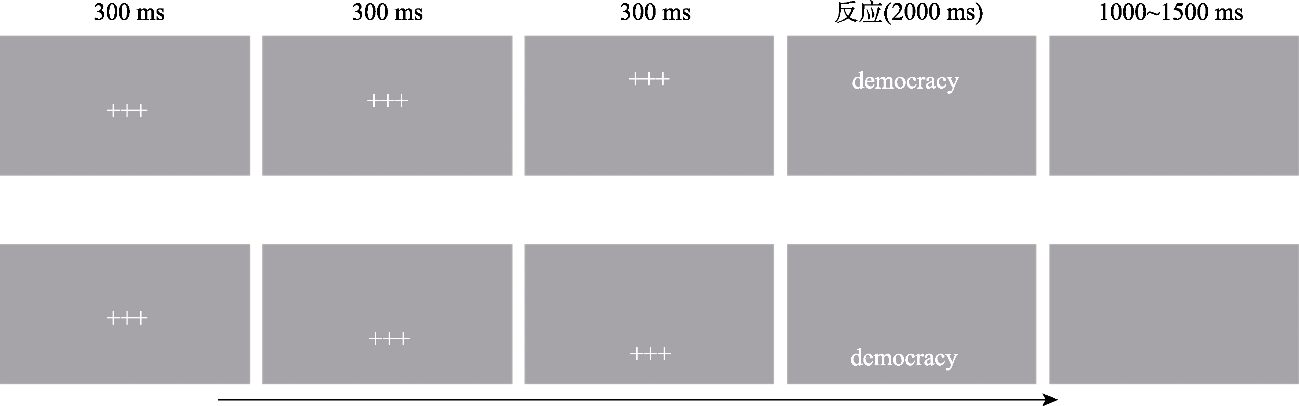
图1 实验1流程图
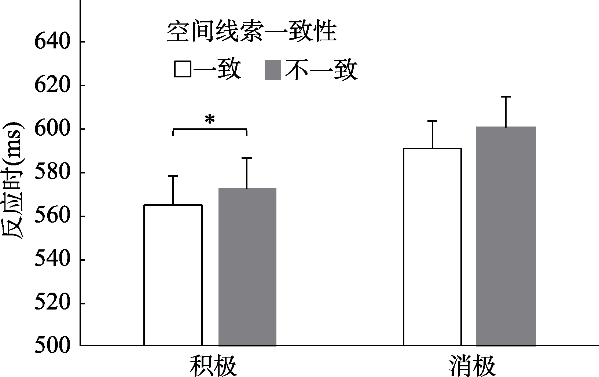
图2 二语抽象概念在不同实验条件下的反应时
注: * p = 0.07
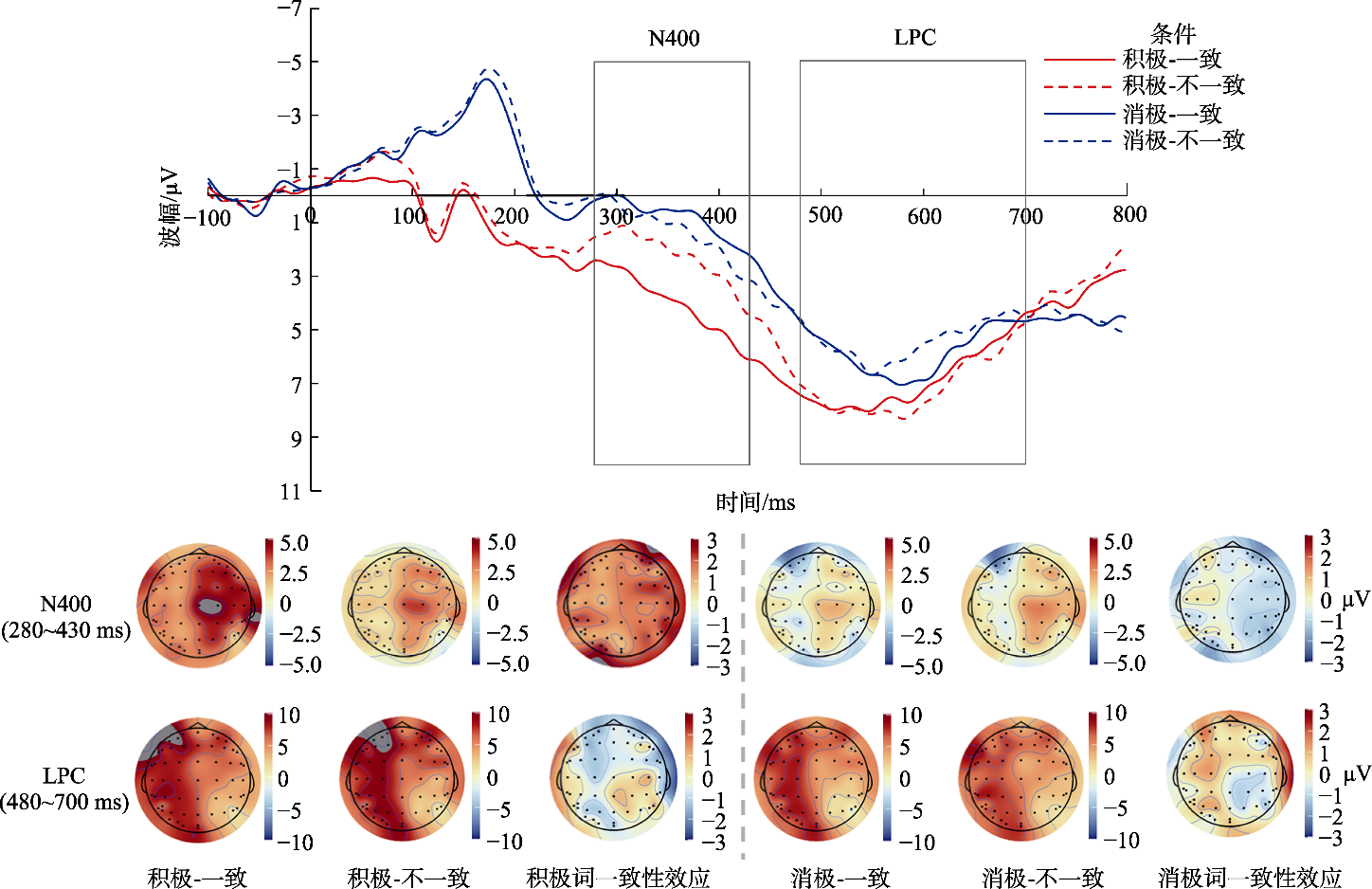
图3 不同实验条件下的ERPs波形图(在FC3 FCz FC4 C3 Cz C4上的平均波幅)与地形图(N400和LPC对应的地形图及其差异波)。彩图见电子版, 下同。
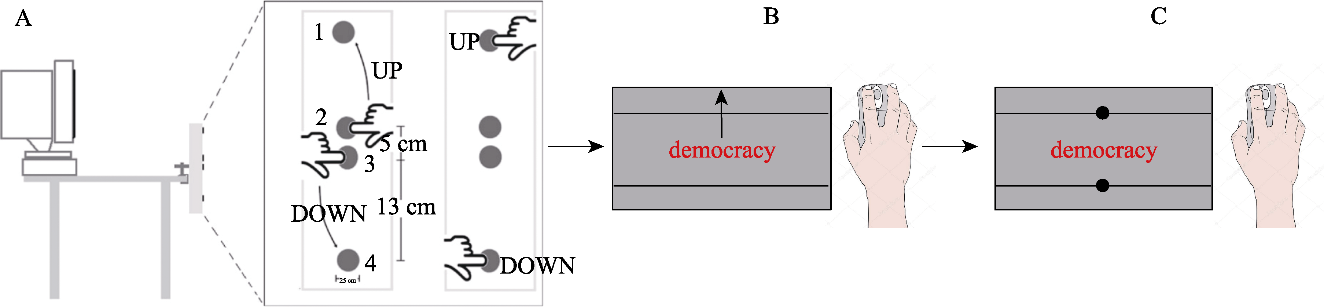
图4 反应设备示意图 注: 图4-A为Lachmair等人(2011)采用的反应设备: 在特制键盘上进行按键; 图4-B为Schütt等人(2023)的反应界面: 将目标词拖动至分界线上方或下方; 图4-C为本研究的反应界面: 移动鼠标至指定点并点击。

图5 实验2流程图
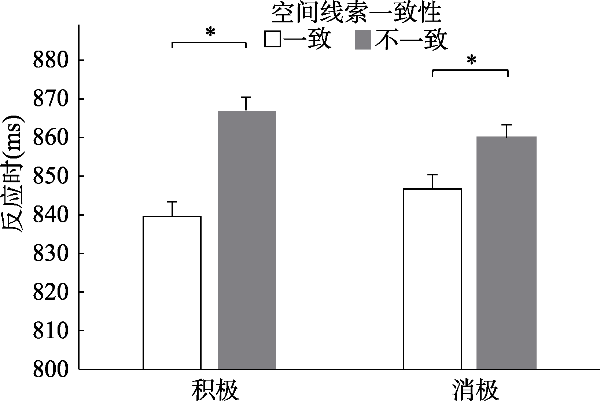
图6 二语抽象概念在不同实验条件下的反应时
注: * p < 0.05
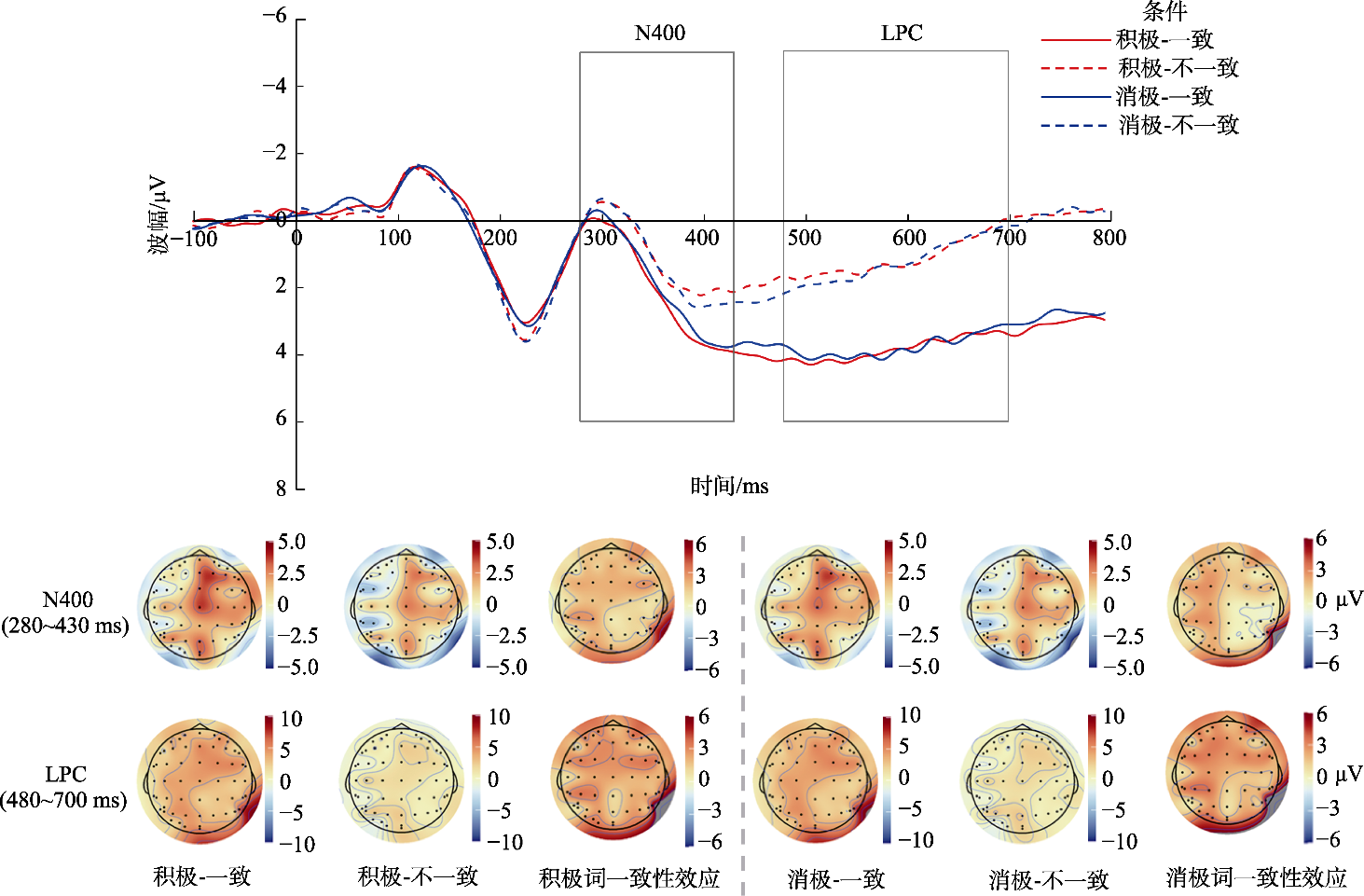
图7 不同实验条件下的ERPs波形图(在FC3 FCz FC4 C3 Cz C4上的平均波幅)与地形图(N400和LPC对应的地形图及其差异波)
| [1] | Bai, X. J., Song, L., Zhang, Q. H., Zhou, G. D., & Zhang, P. (2022). Effects of upright and slumped postures on emotional conceptual processing. Journal of Psychological Science, 45(3), 523-529. |
| [白学军, 宋璐, 张琪涵, 周广东, 章鹏. (2022). 直立、蜷曲姿势对情绪概念加工的影响. 心理科学, 45(3), 523-529.] | |
| [2] | Bai, Y. T., & He, W. G. (2021). The embodied cognition effect of the second language: Automatic activation or native language mediation? Advances in Psychological Science, 29(11), 1970-1978. |
| [白亚停, 何文广. (2021). 二语具身认知: 自动激活还是母语中介? 心理科学进展, 29(11), 1970-1978.] | |
| [3] | Bao, L., & Zhang, Q. (2024). The aging of emotional words processing in implicit and explicit emotion task: An ERP study. Cerebral Cortex, 34(11), bhae424. |
| [4] | Barsalou, L. W. (1999). Perceptual symbol systems. Behavioral and Brain Sciences, 22(4), 577-660. |
| [5] | Barsalou, L. W. (2008a). Cognitive and neural contributions to understanding the conceptual system. Current Directions in Psychological Science, 17(2), 91-95. |
| [6] | Barsalou, L. W. (2008b). Grounded cognition. Annual Review of Psychology, 59, 617-645. |
| [7] | Chen, J. X., Fang, Z. M., Huang, R., Ye, B. Y., Yang, W. P., & Wei, L. Q. (2024). The influence of embodied emotion on creative thinking of individuals with depressive tendency. Studies of Psychology and Behavior, 22(5), 602-608. |
| [陈建新, 方紫梦, 黄蓉, 叶宝仪, 杨伟平, 魏柳青. (2024). 具身情绪对抑郁倾向个体创造性思维的影响. 心理与行为研究, 22(5), 602-608.] | |
| [8] | Cohen, J. (2013). Statistical power analysis for the behavioral sciences. Routledge. |
| [9] | Dong, Y. Q., Fan, N., & Lu, Z. Y. (2018). The influence of body movement trend on congruency effect of space-morality. Journal of Psychological Science, 41(6), 1345-1352. |
| [董月晴, 范宁, 鲁忠义. (2018). 身体动作趋势对道德词空间-效价一致性效应的影响. 心理科学, 41(6), 1345-1352.] | |
| [10] | Dudschig, C., De La Vega, I., & Kaup, B. (2014). Embodiment and second-language: Automatic activation of motor responses during processing spatially associated L 2 words and emotion L2 words in a vertical Stroop paradigm. Brain and Language, 132, 14-21. |
| [11] | Dudschig, C., De La Vega, I., & Kaup, B. (2015). What’s up? Emotion-specific activation of vertical space during language processing. Acta Psychologica, 156, 143-155. |
| [12] | Faul, F., Erdfelder, E., Lang, A. -G., & Buchner, A. (2007). G*Power 3: A flexible statistical power analysis program for the social, behavioral, and biomedical sciences. Behavior Research Methods, 39(2), 175-191. |
| [13] | Gu, Y. G. (2007). On multimedia learning and multimodal learning. Foreign Language Teaching with Computers, 2, 3-12. |
| [顾曰国. (2007). 多媒体、多模态学习剖析. 外语电化教学, 2, 3-12.] | |
| [14] | Guo, Y. L., & Lu, Z. Y. (2020). The embodied processing mechanism of spatio-temporal metaphor in sight translation. Foreign Language Teaching and Research, 52(5), 761-772+801. |
| [郭亚玲, 鲁忠义. (2020). 视译过程中时间-空间隐喻的具身加工机制. 外语教学与研究, 52(5), 761-772.] | |
| [15] | Herring, D. R., White, K. R., Jabeen, L. N., Song, I., & Crites, S. L. (2015). Something (important) is out there! Effects of prime arousal and location on evaluative priming. Motivation and Emotion, 39(5), 742-752. |
| [16] | Hu, J. H. (2021). The interaction of language mode and power space metaphor processing for Chinese EFL learners. Journal of PLA University of Foreign Languages, 44(1), 10-18, 159. |
| [胡杰辉. (2021). 中国英语学习者语言模式与权力空间隐喻认知的交互作用研究. 解放军外国语学院学报, 44(1), 10-18, 159.] | |
| [17] | Jia, L., Lu, J. H., Wang, Y., & Zhang, C. J. (2021). Metaphorical conflict control in the conceptual mapping of social power: Processing characteristic and stages. Studies of Psychology and Behavior, 19(3), 417-423. |
| [贾磊, 陆家豪, 王逸, 张常洁. (2021). 权力概念隐喻映射中的冲突控制: 特征与过程. 心理与行为研究, 19(3), 417-423.] | |
| [18] | Kanske, P., & Kotz, S. A. (2007). Concreteness in emotional words: ERP evidence from a hemifield study. Brain Research, 1148, 138-148. |
| [19] | Koch, A., Alves, H., Krüger, T., & Unkelbach, C. (2016). A general valence asymmetry in similarity: Good is more alike than bad. Journal of Experimental Psychology: Learning, Memory, and Cognition, 42(8), 1171-1192. |
| [20] | Kutas, M., & Federmeier, K. D. (2011). Thirty years and counting: Finding meaning in the N400 component of the event-related brain potential (ERP). Annual Review of Psychology, 62, 621-647. |
| [21] | Kutas, M., & Hillyard, S. A. (1980). Reading senseless sentences: Brain potentials reflect semantic incongruity. Science, 207(4427), 203-205. |
| [22] | Lachmair, M., Dudschig, C., De Filippis, M., De La Vega, I., & Kaup, B. (2011). Root versus roof: Automatic activation of location information during word processing. Psychonomic Bulletin & Review, 18(6), 1180-1188. |
| [23] | Lakoff, G., Jr. (Ed.). (2008). The Cambridge handbook of metaphor and thought. Cambridge University Press. |
| [24] | Lakoff, G., & Johnson, M. (1980). Metaphors we live by. Chicago: University of Chicago Press. |
| [25] | Lakoff, G., & Johnson, M. (1999). Philosophy in the flesh: The embodied mind and its challenge to western thought. New York: Basic Books. |
| [26] | Lu, S. Y., & Peng, C. (2022). Second language acquisition under embodied cognitive theory. TCSOL Studies, 1, 31-37. |
| [鹿士义, 彭聪. (2022). 具身认知理论下的二语习得. 华文教学与研究, 1, 31-37.] | |
| [27] | Lu, Z. Y., Jia, L. N., & Zhai, D. X. (2017). The mapping for vertical spatial metaphor of the moral concepts: Bidirectional and unbalanced. Acta Psychologica Sinica, 49(2), 186-196. |
| [鲁忠义, 贾利宁, 翟冬雪. (2017). 道德概念垂直空间隐喻理解中的映射: 双向性及不平衡性. 心理学报, 49(2), 186-196.] | |
| [28] | Luck, S. J. (2014). An introduction to the event-related potential technique. Cambridge, MA: MIT Press. |
| [29] | Meier, B. P., & Robinson, M. D. (2004). Why the sunny side is up: Associations between affect and vertical position. Psychological Science, 15(4), 243-247. |
| [30] | Meier, B. P., Sellbom, M., & Wygant, D. B. (2007). Failing to take the moral high ground: Psychopathy and the vertical representation of morality. Personality and Individual Differences, 43(4), 757-767. |
| [31] | Mu, B. B., & Wan, X. A. (2014). The emotional distractor previewing effect in visual search. Acta Psychologica Sinica, 46(11), 1603-1612. |
| [牟兵兵, 宛小昂. (2014). 视觉搜索中的情绪干扰项预习效应. 心理学报, 46(11), 1603-1612.] | |
| [32] | Norman, T., & Peleg, O. (2022). The reduced embodiment of a second language. Bilingualism: Language and Cognition, 25(3), 406-416. |
| [33] | Rosburg, T., Johansson, M., Weigl, M., & Mecklinger, A. (2015). How does testing affect retrieval-related processes? An event-related potential (ERP) study on the short-term effects of repeated retrieval. Cognitive Affective & Behavioral Neuroscience, 15(1), 195-210. |
| [34] | Schubert, T. W. (2005). Your highness: Vertical positions as perceptual symbols of power. Journal of Personality and Social Psychology, 89(1), 1-21. |
| [35] | Schütt, E., Mackenzie, I. G., Kaup, B., & Dudschig, C. (2023). Replacing vertical actions by mouse movements: A web- suited paradigm for investigating vertical spatial associations. Psychological Research, 87(1), 194-209. |
| [36] | Scott, G. G., O’Donnell, P. J., Leuthold, H., & Sereno, S. C. (2009). Early emotion word processing: Evidence from event-related potentials. Biological Psychology, 80(1), 95-104. |
| [37] | Shen, M. Q., Xie, J. S., Zhang, K., Li, Y., Zeng, C. X., & Wang, R. M. (2014). The spatial metaphor of bilingual affective concepts processing. Acta Psychologica Sinica, 46(11), 1671-1681. |
| [沈曼琼, 谢久书, 张昆, 李莹, 曾楚轩, 王瑞明. (2014). 二语情绪概念理解中的空间隐喻. 心理学报, 46(11), 1671-1681.] | |
| [38] | Unkelbach, C., Fiedler, K., Bayer, M., Stegmüller, M., & Danner, D. (2008). Why positive information is processed faster: The density hypothesis. Journal of Personality and Social Psychology, 95(1), 36-49. |
| [39] | Villani, C., Lugli, L., Liuzza, M. T., & Borghi, A. M. (2019). Varieties of abstract concepts and their multiple dimensions. Language and Cognition, 11(3), 403-430. |
| [40] | Wang, H. L., Jiang, Z. L., Feng, X. H., & Lu, Z. Y. (2020). Spatial iconicity of moral concepts: Co-dependence of linguistic and embodied symbols. Acta Psychologica Sinica, 52(2), 128-138. |
| [王汉林, 蒋泽亮, 冯晓慧, 鲁忠义. (2020). 道德概念的空间形象性: 语言因素和具身因素的共同作用. 心理学报, 52(2), 128-138.] | |
| [41] | Wang, Q. (2016). Embodied cognition processing and representation of power words by second language learners with different proficiency levels. Journal of PLA University of Foreign Languages, 39(6), 86-93+107. |
| [王倩. (2016). 不同二语水平双语者对权力词的具身认知加工及表征差异研究. 解放军外国语学院学报, 39(6), 86-93+107.] | |
| [42] | Wang, Q. (2019). Neural mechanism and representation of English and Chinese metaphors of Chinese EFL learners of different proficiency levels: An ERP study. Foreign Language Research, (1), 79-86. |
| [王倩. (2019). 不同二语水平学习者对英汉隐喻认知加工的神经机制及表征: 来自ERP的证据. 外语学刊, (1), 79-86.] | |
| [43] | Wang, X., Lu, J. M., & Chen, W. Y. (2019). The processing of emotional words and its emotional effect characteristics: Evidence from ERP studies. Advances in Psychological Science, 27(11), 1842-1852. |
| [王霞, 卢家楣, 陈武英. (2019). 情绪词加工过程及其情绪效应特点: ERP的证据. 心理科学进展, 27(11), 1842-1852.] | |
| [44] | Wang, Y. N., Zhou, L. M., & Luo, Y. J. (2008). The pilot establishment and evaluation of Chinese affective words system. Chinese Mental Health Journal, 22(8), 608-612. |
| [王一牛, 周立明, 罗跃嘉. (2008). 汉语情感词系统的初步编制及评定. 中国心理卫生杂志, 22(8), 608-612.] | |
| [45] | Wei, J., Carroll, R. J., Harden, K. K., & Wu, G. (2012). Comparisons of treatment means when factors do not interact in two-factorial studies. Amino Acids, 42(5), 2031-2035. |
| [46] | Wu, X., Jia, H., Wang, E., Du, C., Wu, X., & Dang, C. (2016). Vertical position of Chinese power words influences power judgments: Evidence from spatial compatibility task and event-related Potentials. International Journal of Psychophysiology, 102, 55-61. |
| [47] | Xie, H. H. (2024). Multimodal discourse analysis from an interdisciplinary perspective: Theory, methods, and practice. Modern Linguistics, 12(8), 750-758. |
| [谢红海. (2024). 跨学科视角下的多模态话语分析: 理论、方法与实践. 现代语言学, 12(8), 750-758.] | |
| [48] | Xie, Z. L., & Liu, S. S. (2025). The impact of embodied experience on the valence judgment of L2 positive emotion words. Modern Foreign Languages, 48(3), 328-339. |
| [谢枝龙, 刘深深. (2025). 具身体验对二语积极情绪词效价判断的影响. 现代外语, 48(3), 328-339.] | |
| [49] | Yu, S. Z., & Zhang, Y. (2020). An empirical study of embodied cognition in L2 processing in emotional abstract concepts. Journal of Ningbo University (Liberal Arts Edition), 33(6), 102-107. |
| [于善志, 张雨. (2020). 二语情感抽象概念加工的具身认知研究. 宁波大学学报(人文科学版), 33(6), 102-107.] | |
| [50] | Yu, W. H., & Lu, Z. Y. (2020). A new perspective on the cognitive function of gestures: The “spatializing” gesture hypothesis. Advances in Psychological Science, 28(3), 426-433. |
| [于文华, 鲁忠义. (2020). 手势认知功能研究的新视角: “空间化”手势假设. 心理科学进展, 28(3), 426-433.] | |
| [51] | Zhu, L., Sai, X. Y., & Jiadela, M. (2022). The effect of secondary task on power-space interactions during the performance of a semantic category judgment task. Acta Psychologica Sinica, 54(7), 772-778. |
| [朱磊, 赛雪莹, 贾德拉·木拉提. (2022). 次要任务对词类判断任务中权力空间表征激活的影响. 心理学报, 54(7), 772-778.] | |
| [52] | Zwaan, R. A. (2004). The immersed experiencer: Toward an embodied theory of language comprehension. In B. H. Ross (Ed.), The psychology of learning and motivation: Advances in research and theory (Vol. 44, pp. 35-62). Elsevier Science. |
| [1] | 杨景童, 姜英杰, 龙翼婷. 社会价值取向对互惠合作中来源记忆的影响[J]. 心理学报, 2026, 58(7): 1325-1342. |
| [2] | 钟毅平, 牛娜娜, 范伟, 任梦梦, 李梅. 动作自主性与社会距离对主动控制感的影响:来自行为与ERPs的证据[J]. 心理学报, 2023, 55(12): 1932-1948. |
| [3] | 李梅, 李琎, 张冠斐, 钟毅平, 李红. 承诺水平与社会距离对信任投资的影响:来自行为与ERPs的证据[J]. 心理学报, 2023, 55(11): 1859-1871. |
| [4] | 占友龙, 肖啸, 谭千保, 李琎, 钟毅平. 声誉关注与社会距离对伤害困境中道德决策的影响:来自行为与ERPs的证据[J]. 心理学报, 2022, 54(6): 613-627. |
| [5] | 曹敏, 谢和平, 孙丽君, 张冬静, 孔繁昌, 周宗奎. 网络游戏中化身参照的加工优势:来自行为与ERPs的证据[J]. 心理学报, 2021, 53(6): 639-650. |
| [6] | 周文洁, 邓丽群, 丁锦红. 物体颜色对情景记忆的影响[J]. 心理学报, 2021, 53(3): 229-243. |
| [7] | 段珅, 孟陆. 排名列表项目展示方式对于项目评价的极化效应[J]. 心理学报, 2021, 53(11): 1271-1285. |
| [8] | 李琎, 孙宇, 杨子鹿, 钟毅平. 社会价值取向对自我社会奖赏加工的影响——来自ERPs的证据[J]. 心理学报, 2020, 52(6): 786-800. |
| [9] | 张积家, 付雅, 王斌. 文化影响亲属词性别概念加工中的空间隐喻与重量隐喻——来自彝族、白族和摩梭人的证据[J]. 心理学报, 2020, 52(4): 440-455. |
| [10] | 王汉林, 蒋泽亮, 冯晓慧, 鲁忠义. 道德概念的空间形象性:语言因素和具身因素的共同作用[J]. 心理学报, 2020, 52(2): 128-138. |
| [11] | 章文佩, 沈群伦, 宋锦涛, 周仁来. 基于事件相关电位(ERPs)和机器学习的考试焦虑诊断 *[J]. 心理学报, 2019, 51(10): 1116-1127. |
| [12] | 赵思敏;吴岩;李天虹;郭庆童. 词汇识别中歧义词素语义加工:ERP研究[J]. 心理学报, 2017, 49(3): 296-306. |
| [13] | 汪新筱;严秀英;张积家;董方虹. 平辈亲属词语义加工中长幼概念的空间隐喻和重量隐喻——来自中国朝鲜族和汉族的证据[J]. 心理学报, 2017, 49(2): 174-185. |
| [14] | 范伟;钟毅平;杨子鹿;李琎;欧阳益; 蔡荣华; 李慧云 ;傅小兰 . 外倾个体的自我参照加工程度效应[J]. 心理学报, 2016, 48(8): 1002-1012. |
| [15] | 吴岩;莫德圆;王海英; 于溢洋;陈烜之;张明. 语义分类任务中部件位置在汉字识别中的作用[J]. 心理学报, 2016, 48(6): 599-606. |
| 阅读次数 | ||||||
|
全文 |
|
|||||
|
摘要 |
|
|||||
