

ISSN 0439-755X
CN 11-1911/B
主办:中国心理学会
中国科学院心理研究所
出版:科学出版社
CN 11-1911/B
主办:中国心理学会
中国科学院心理研究所
出版:科学出版社
心理学报 ›› 2026, Vol. 58 ›› Issue (7): 1254-1278.doi: 10.3724/SP.J.1041.2026.1254 cstr: 32110.14.2026.1254
崔勋绚1,2, 乔紫藤3, 刘宁1,2( )
)
收稿日期:2025-05-07
发布日期:2026-05-15
出版日期:2026-07-25
通讯作者:
刘宁, E-mail: liuning@sdnu.edu.cn基金资助:
CUI Xunxuan1,2, QIAO Ziteng3, LIU Ning1,2()
Received:2025-05-07
Online:2026-05-15
Published:2026-07-25
摘要:
随着人工智能技术的快速发展, 人智协同关系日益受到关注。拟人化虽被广泛视为促进人智交互的重要策略, 但效果并不稳定, 有时甚至适得其反。本文通过6个递进的研究探讨了拟人化对人智合作意愿的影响, 从社会认知视角揭示其心理机制, 并进一步考察了感知威胁(包括现实威胁和独特性威胁)的调节作用。研究1a与1b采用被动文字操纵方式, 发现拟人化能通过提升感知热情间接促进合作意愿; 研究2通过主动想象操纵, 发现拟人化能同时提高感知热情−能力以及合作意愿, 且感知热情−能力是拟人化促进人智合作意愿的中介机制; 研究3a重复验证了拟人化通过感知热情−能力影响合作意愿的路径, 研究3b进一步发现, 即使在高现实威胁条件下, 感知热情与能力的中介路径依然成立, 现实威胁并未产生调节作用; 研究4采用机器人外观图片操纵拟人化, 结果发现外观拟人化会负向影响人智合作意愿且受到感知独特性威胁的调节。研究发现有助于回答人智合作中何以拟人与何时拟人的关键问题, 对优化人工智能拟人化设计, 促进人智合作提供了理论参考。
中图分类号:
崔勋绚, 乔紫藤, 刘宁. (2026). 拟人化对人工智能的感知热情−能力及人智合作意愿的影响. 心理学报, 58(7), 1254-1278.
CUI Xunxuan, QIAO Ziteng, LIU Ning. (2026). The impact of anthropomorphism on perceived warmth-competence of AI and human-AI cooperation intention. Acta Psychologica Sinica, 58(7), 1254-1278.
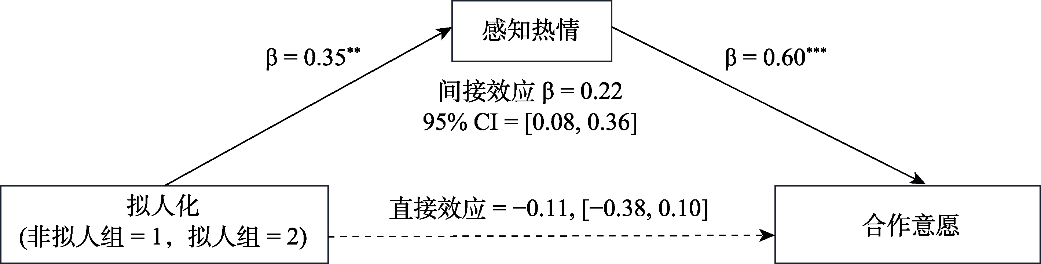
图1 研究1a:拟人化−感知热情−合作意愿路径检验 注:所有路径系数为标准化的路径系数, **p < 0.01, ***p < 0.001。
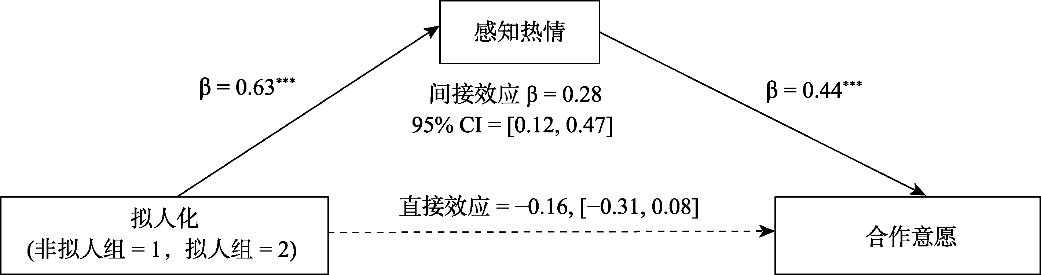
图2 研究1b:拟人化−感知热情−合作意愿路径检验 注:所有路径系数为标准化的路径系数, ***p < 0.001
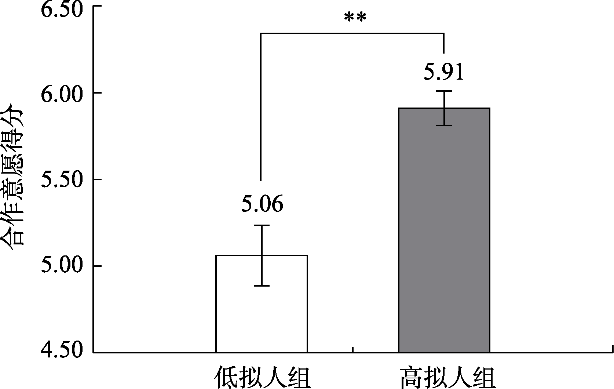
图3 研究2:拟人化影响合作意愿
注:**p < 0.01, ***p < 0.001。
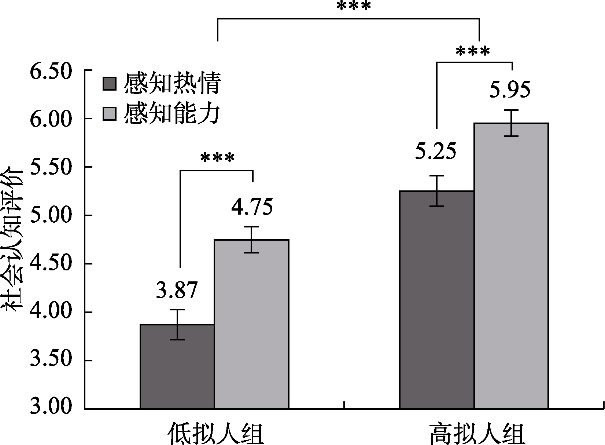
图4 研究2:拟人化分组对AI感知热情−能力的影响
注:**p < 0.01, ***p < 0.001。
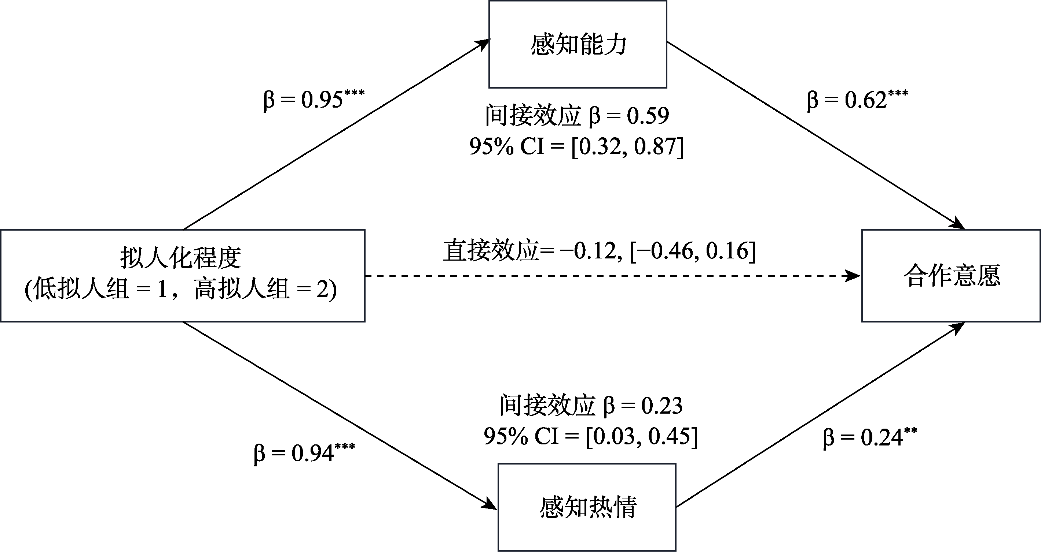
图5 研究2:拟人化−感知热情与能力−合作意愿路径检验 注:所有路径系数为标准化的路径系数, **p < 0.01, ***p < 0.001。
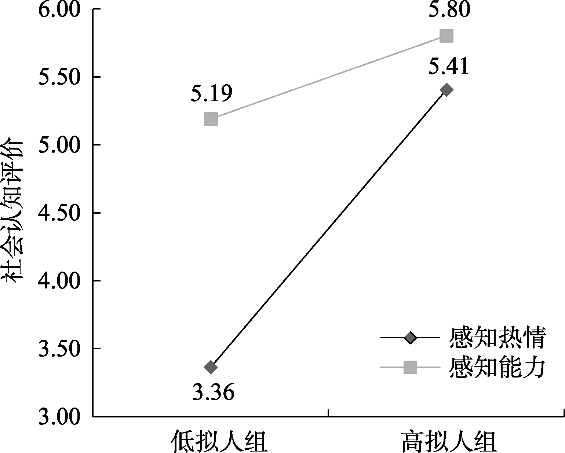
图6 研究3a:拟人化对AI感知热情−能力的影响
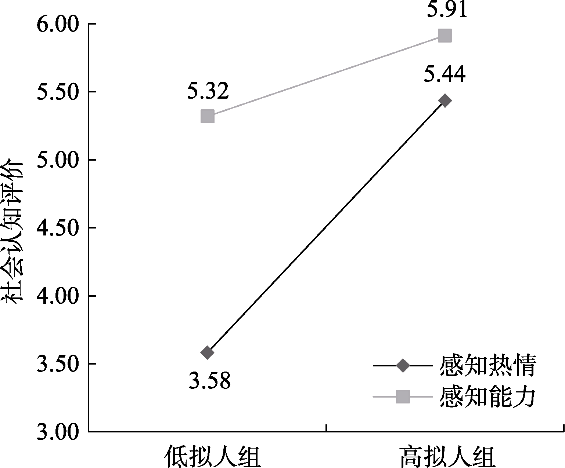
图7 研究3b:拟人化对AI感知热情−能力的影响
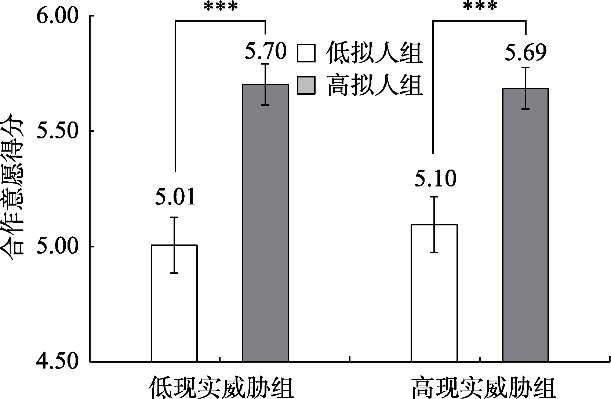
图8 研究3a、3b:拟人化影响合作意愿
注:***p < 0.001。
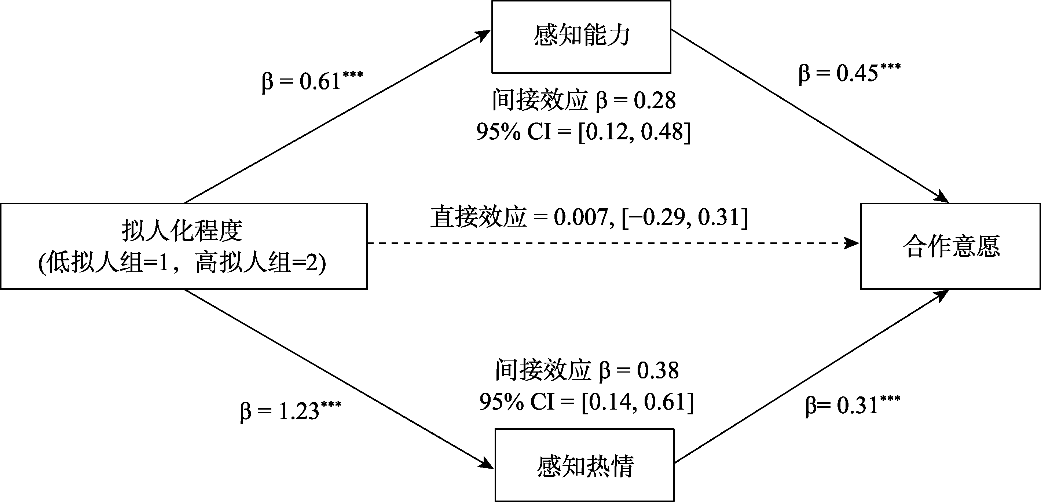
图9 研究3a:拟人化−感知热情与能力−合作意愿路径检验 注:所有路径系数为标准化的路径系数, ***p < 0.001。
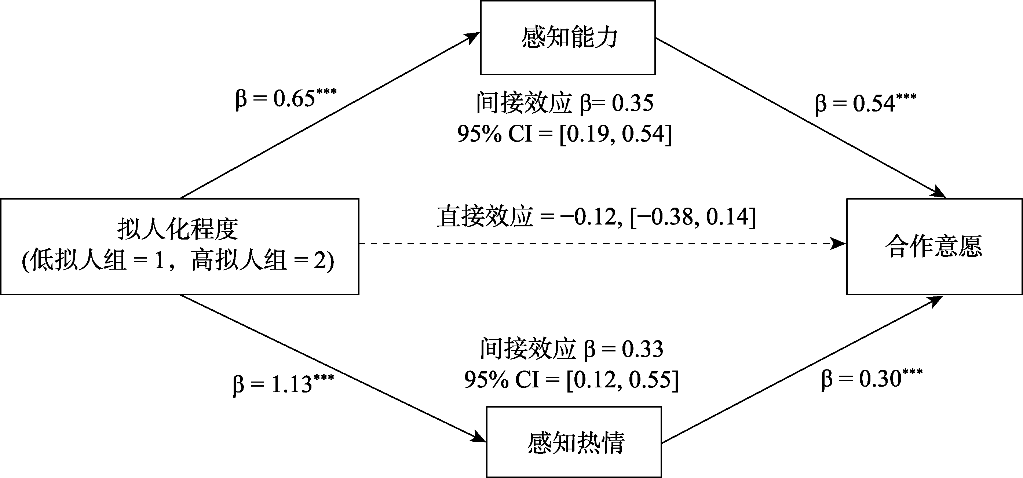
图10 研究3b:拟人化−感知热情与能力−合作意愿路径检验 注:所有路径系数为标准化的路径系数, ***p < 0.001。
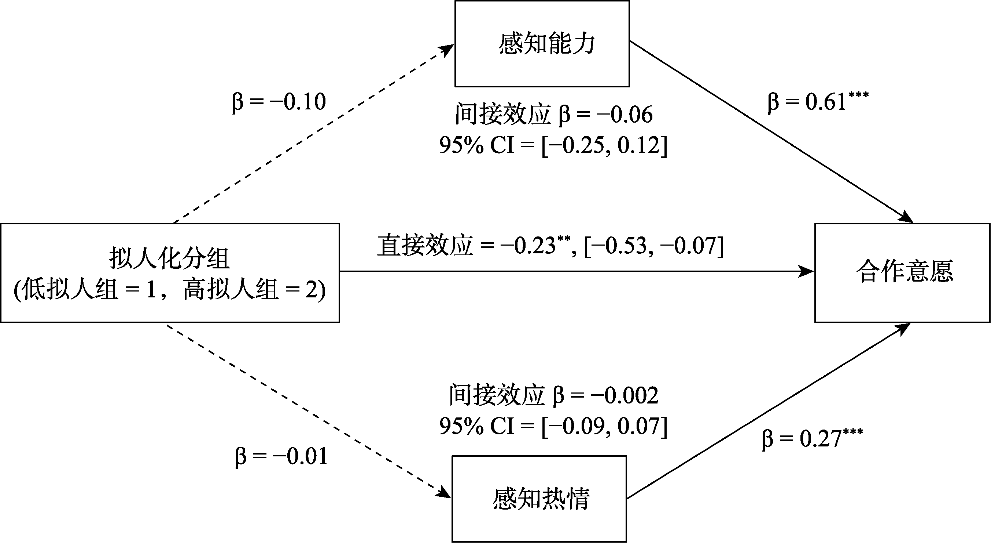
图11 研究4:拟人化组别−感知热情与能力−合作意愿路径检验 注:所有路径系数为标准化的路径系数, **p < 0.01, ***p < 0.001。
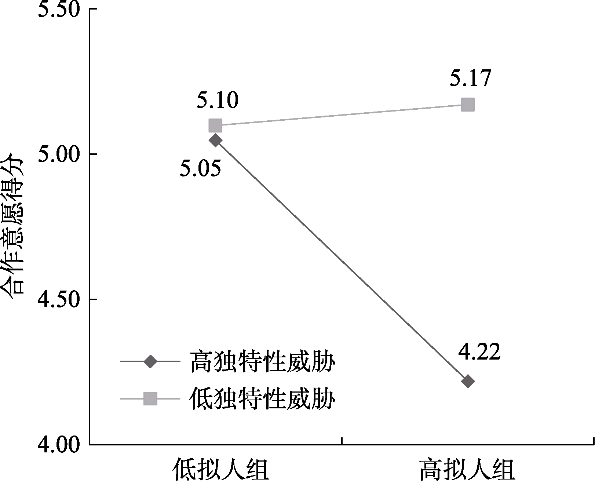
图12 独特性威胁对于拟人化影响合作意愿的调节作用 注:高/低独特性威胁分组的划分标准为M ± 1SD
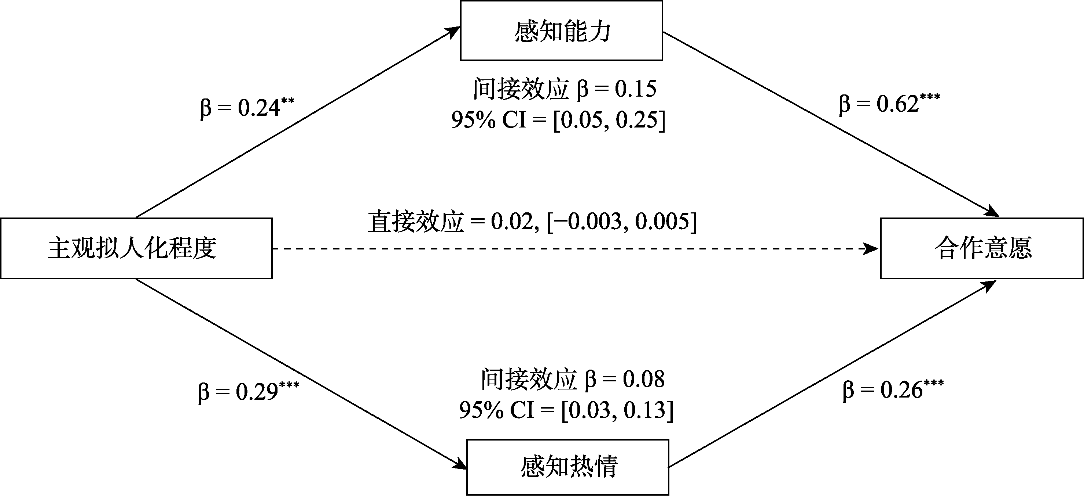
附图1 研究4:主观拟人化−感知热情与能力−合作意愿路径检验 注:所有路径系数为标准化的路径系数, **p < 0.01, ***p < 0.001。
| [1] | Aaker, J., Vohs, K. D., & Mogilner, C. (2010). Nonprofits are seen as warm and for-profits as competent: Firm stereotypes matter. Journal of Consumer Research, 37(2), 224-237. |
| [2] | Abbink, K., & Harris, D. (2019). In-group favouritism and out-group discrimination in naturally occurring groups. PLoS ONE, 14(9), e0221616. |
| [3] | Aggarwal, P., & McGill, A. L. (2012). When brands seem human, do humans act like brands? Automatic behavioral priming effects of brand anthropomorphism. Journal of Consumer Research, 39(2), 307-323. |
| [4] | Alabed, A., Javornik, A., & Gregory-Smith, D. (2022). AI anthropomorphism and its effect on users’ self-congruence and self-AI integration: A theoretical framework and research agenda. Technological Forecasting and Social Change, 182, 121786. |
| [5] | Aron, A., Aron, E. N., & Smollan, D. (1992). Inclusion of Other in the Self Scale and the structure of interpersonal closeness. Journal of Personality and Social Psychology, 63(4), 596-612. |
| [6] | Balliet, D., Li, N. P., Macfarlan, S. J., & Van Vugt, M. (2011). Sex differences in cooperation: A meta-analytic review of social dilemmas. Psychological Bulletin, 137(6), 881-909. |
| [7] | Bartneck, C., Kulić, D., Croft, E., & Zoghbi, S. (2009). Measurement instruments for the anthropomorphism, animacy, likeability, perceived intelligence, and perceived safety of robots. International Journal of Social Robotics, 1(1), 71-81. |
| [8] | Bergmann, K., Eyssel, F., & Kopp, S. (2012). A second chance to make a first impression? How appearance and nonverbal behavior affect perceived warmth and competence of virtual agents over time. In M. Walker, M. Neff, A. Paiva, & Y. Nakano (Eds.), Proceedings of the 12th international conference on Intelligent Virtual Agents (Vol. 7502, pp. 126-138). Springer. |
| [9] | Bernerth, J. B., & Aguinis, H. (2016). A critical review and best‐practice recommendations for control variable usage. Personnel Psychology, 69(1), 229-283. |
| [10] | Brewer, M. B. (2007). The importance of being we: Human nature and intergroup relations. American Psychologist, 62(8), 728-738. |
| [11] | Crolic, C., Thomaz, F., Hadi, R., & Stephen, A. T. (2022). Blame the bot: Anthropomorphism and anger in customer- chatbot interactions. Journal of Marketing, 86(1), 132-148. |
| [12] | Cuddy, A. J. C., Glick, P., & Beninger, A. (2011). The dynamics of warmth and competence judgments, and their outcomes in organizations. Research in Organizational Behavior, 31, 73-98. |
| [13] | Dou, X., Wu, C.-F., Wang, X., & Niu, J. (2020). User expectations of social robots in different applications: An online user study. In C. Stephanidis, M. Kurosu, H. Degen, & L. Reinerman-Jones (Eds.), HCI International 2020-Late breaking papers: Multimodality and Intelligence (Vol. 12204, pp. 64-72). Springer Nature. |
| [14] | Du, F., Qi, Y., Min, Y. C., Wang, X. T., & Chen, Y. N. (2024). Human and Artificial Intelligence: The synergy of human and AI in the era of intelligence. Shaanxi Normal University Press. |
| [杜峰, 齐玥, 闵宇晨, 王小桃, 陈亚楠. (2024). 人与AI: 智能时代的人机关系. 陕西师范大学出版社.] | |
| [15] | Eisenbruch, A. B., & Krasnow, M. M. (2022). Why warmth matters more than competence: A new evolutionary approach. Perspectives on Psychological Science, 17(6), 1604-1623. |
| [16] | Epley, N., Waytz, A., Akalis, S., & Cacioppo, J. T. (2008). When we need a human: Motivational determinants of anthropomorphism. Social Cognition, 26(2), 143-155. |
| [17] | Epley, N., Waytz, A., & Cacioppo, J. T. (2007). On seeing human: A three-factor theory of anthropomorphism. Psychological Review, 114(4), 864-886. |
| [18] | Eyssel, F., Hegel, F., Horstmann, G., & Wagner, C. (2010). Anthropomorphic inferences from emotional nonverbal cues: A case study. In 19th International Symposium in Robot and Human Interactive Communication (pp. 646-651). IEEE. |
| [19] | Eyssel, F., & Kuchenbrandt, D. (2012). Social categorization of social robots: Anthropomorphism as a function of robot group membership. British Journal of Social Psychology, 51(4), 724-731. |
| [20] | Faul, F., Erdfelder, E., Buchner, A., & Lang, A.-G. (2009). Statistical power analyses using G*Power 3.1: Tests for correlation and regression analyses. Behavior Research Methods, 41(4), 1149-1160. |
| [21] | Ferrari, F., Paladino, M. P., & Jetten, J. (2016). Blurring Human-Machine distinctions: Anthropomorphic appearance in social robots as a threat to human distinctiveness. International Journal of Social Robotics, 8(2), 287-302. |
| [22] | Fiske, S. T. (2018). Stereotype content: Warmth and competence endure. Current Directions in Psychological Science, 27(2), 67-73. |
| [23] | Fiske, S. T., Cuddy, A. J. C., & Glick, P. (2007). Universal dimensions of social cognition: Warmth and competence. Trends in Cognitive Sciences, 11(2), 77-83. |
| [24] | Fiske, S. T., Cuddy, A. J. C., Glick, P., & Xu, J. (2002). A model of (often mixed) stereotype content: Competence and warmth respectively follow from perceived status and competition. Journal of Personality and Social Psychology, 82(6), 878-902. |
| [25] | Gilad, Z., Amir, O., & Levontin, L. (2021). The effects of warmth and competence perceptions on users’ choice of an AI system. In Proceedings of the 2021 CHI Conference on Human Factors in Computing Systems (pp. 1-13). ACM. |
| [26] | Glikson, E., & Woolley, A. W. (2020). Human trust in artificial intelligence: Review of empirical research. Academy of Management Annals, 14(2), 627-660. |
| [27] | Golec de Zavala, A., Federico, C. M., Sedikides, C., Guerra, R., Lantos, D., Mroziński, B.,... Baran, T. (2019). Low self-esteem predicts out-group derogation via collective narcissism, but this relationship is obscured by in-group satisfaction. Journal of Personality and Social Psychology, 119(3), 741-764. |
| [28] | Gray, K., & Wegner, D. M. (2012). Feeling robots and human zombies: Mind perception and the uncanny valley. Cognition, 125(1), 125-130. |
| [29] | Guo, D., Yang, D., Zhang, H., Song, J., Wang, P., Zhu, Q.,... Zhang, Z. (2025). DeepSeek-R1 incentivizes reasoning in LLMs through reinforcement learning. Nature, 645(8081), 633-638. |
| [30] | Han, B., Deng, X., & Fan, H. (2023). Partners or opponents? How mindset shapes consumers’ attitude toward anthropomorphic artificial intelligence service robots. Journal of Service Research, 26(3), 441-458. |
| [31] | Harris-Watson, A. M., Larson, L. E., Lauharatanahirun, N., DeChurch, L. A., & Contractor, N. S. (2023). Social perception in Human-AI teams: Warmth and competence predict receptivity to AI teammates. Computers in Human Behavior, 145, 107765. |
| [32] | Haslam, N. (2006). Dehumanization: An integrative review. Personality and Social Psychology Review, 10(3), 252-264. |
| [33] | Hayes, A. F. (2013). Introduction to mediation, moderation, and conditional process analysis: A regression-based approach. New York: The Guilford Press. |
| [34] | Hu, Q., Lu, Y., Pan, Z., Gong, Y., & Yang, Z. (2021). Can AI artifacts influence human cognition? The effects of artificial autonomy in intelligent personal assistants. International Journal of Information Management, 56, 102250. |
| [35] | Huang, H. L., Cheng, L. K., Sun, P. C., & Chou, S. J. (2021). The effects of perceived identity threat and realistic threat on the negative attitudes and usage intentions toward hotel service robots: The moderating effect of the robot’s anthropomorphism. International Journal of Social Robotics, 13(7), 1599-1611. |
| [36] | Jackson, J. C., Castelo, N., & Gray, K. (2020). Could a rising robot workforce make humans less prejudiced? American Psychologist, 75(7), 969-982. |
| [37] | Kahn, P. H., Ishiguro, H., Friedman, B., Kanda, T., Freier, N. G., Severson, R. L., & Miller, J. (2007). What is a human? Toward psychological benchmarks in the field of human- robot interaction. Interaction Studies: Social Behaviour and Communication in Biological and Artificial Systems, 8(3), 363-390. |
| [38] | Kervyn, N., Fiske, S. T., & Malone, C. (2012). Brands as intentional agents framework: How perceived intentions and ability can map brand perception. Journal of Consumer Psychology, 22(2), 166-176. |
| [39] | Khadpe, P., Krishna, R., Li, F. F., Hancock, J. T., & Bernstein, M. S. (2020). Conceptual metaphors impact perceptions of human-AI collaboration. Proceedings of the ACM on Human-Computer Interaction, 4(CSCW2), 1-26. |
| [40] | Kim, H. C., & Kramer, T. (2015). Do materialists prefer the “brand-as-servant”? The interactive effect of anthropomorphized brand roles and materialism on consumer responses. Journal of Consumer Research, 42(2), 284-299. |
| [41] | Lee, S.-L., Lau, I. Y.-M., & Hong, Y.-Y. (2011). Effects of appearance and functions on likability and perceived occupational suitability of robots. Journal of Cognitive Engineering and Decision Making, 5(2), 232-250. |
| [42] | Leyens, J.-P., Paladino, P. M., Rodriguez-Torres, R., Vaes, J., Demoulin, S., Rodriguez-Perez, A., & Gaunt, R. (2000). The emotional side of prejudice: The attribution of secondary emotions to ingroups and outgroups. Personality and Social Psychology Review, 4(2), 186-197. |
| [43] | McClure, P. K. (2018). “You’re fired,” says the robot: The rise of automation in the workplace, technophobes, and fears of unemployment. Social Science Computer Review, 36(2), 139-156. |
| [44] | McKee, K. R., Bai, X., & Fiske, S. T. (2023). Humans perceive warmth and competence in artificial intelligence. iScience, 26(8), 107256. |
| [45] | Mitchell, M. (2024). Debates on the nature of artificial general intelligence. Science, 383(6689), eado7069. |
| [46] | Mori, M. (1970). The uncanny valley. Energy, 7, 33-35. |
| [47] | National Academies of Sciences, Engineering, and Medicine (NASEM). (2021). Human-AI teaming: State-of-the-art and research needs. Retrieved Jan. 16, 2026, from https://nap.nationalacademies.org/catalog/26355/human-ai-teaming-state-of-the-art-and-research-needs |
| [48] | Neave, N., Jackson, R., Saxton, T., & Hönekopp, J. (2015). The influence of anthropomorphic tendencies on human hoarding behaviours. Personality and Individual Differences, 72, 214-219. |
| [49] | O’Neill, T., McNeese, N., Barron, A., & Schelble, B. (2022). Human-autonomy teaming: A review and analysis of the empirical literature. Human Factors, 64(5), 904-938. |
| [50] | Onnasch, L., & Roesler, E. (2020). A taxonomy to structure and analyze human-robot interaction. International Journal of Social Robotics, 13(4), 833-849. |
| [51] | Park, D., Lee, Y., & Kim, Y. M. (2023). Effects of autonomous driving context and anthropomorphism of in-vehicle voice agents on intimacy, trust, and intention to use. International Journal of Human-Computer Interaction, 40(22), 7179-7192. |
| [52] | Pelau, C., Dabija, D.-C., & Ene, I. (2021). What makes an AI device human-like? The role of interaction quality, empathy and perceived psychological anthropomorphic characteristics in the acceptance of artificial intelligence in the service industry. Computers in Human Behavior, 122, 106855. |
| [53] | Phillips, E., Zhao, X., Ullman, D., & Malle, B. F. (2018). What is human-like?: Decomposing robots’ human-like appearance using the anthropomorphic roBOT (ABOT) database. In Proceedings of the 2018 ACM/IEEE International Conference on Human-Robot Interaction (pp. 105-113). ACM. |
| [54] | Piçarra, N., & Giger, J.-C. (2018). Predicting intention to work with social robots at anticipation stage: Assessing the role of behavioral desire and anticipated emotions. Computers in Human Behavior, 86, 129-146. |
| [55] | Puzakova, M., Kwak, H., & Rocereto, J. F. (2013). When humanizing brands goes wrong: The detrimental effect of brand anthropomorphization amid product wrongdoings. Journal of Marketing, 77(3), 81-100. |
| [56] | Qi, T., Liu, H., & Huang, Z. (2025). An assistant or A friend? The role of parasocial relationship of human-computer interaction. Computers in Human Behavior, 167, 108625. |
| [57] | Reeves, B., Hancock, J., & Liu, X. (2020). Social robots are like real people: First impressions, attributes, and stereotyping of social robots. Technology, Mind, and Behavior, 1(1), 76-89. |
| [58] | Riek, B. M., Mania, E. W., & Gaertner, S. L. (2006). Intergroup threat and outgroup attitudes: A meta-analytic review. Personality and Social Psychology Review, 10(4), 336-353. |
| [59] | Riva, P., Sacchi, S., & Brambilla, M. (2015). Humanizing machines: Anthropomorphization of slot machines increases gambling. Journal of Experimental Psychology: Applied, 21(4), 313-325. |
| [60] | Robbins, J. M., & Krueger, J. I. (2005). Social projection to ingroups and outgroups: A review and meta-analysis. Personality and Social Psychology Review, 9(1), 32-47. |
| [61] | Roesler, E., Manzey, D., & Onnasch, L. (2021). A meta- analysis on the effectiveness of anthropomorphism in human-robot interaction. Science Robotics, 6(58), eabj5425. |
| [62] | Schanke, S., Burtch, G., & Ray, G. (2021). Estimating the impact of “humanizing” customer service chatbots. Information Systems Research, 32(3), 736-751. |
| [63] | Sevillano, V., & Fiske, S. T. (2016). Warmth and competence in animals. Journal of Applied Social Psychology, 46(5), 276-293. |
| [64] | Shariff, A., Bonnefon, J. F., & Rahwan, I. (2017). Psychological roadblocks to the adoption of self-driving vehicles. Nature Human Behaviour, 1(10), 694-696. |
| [65] | Silver, D., Huang, A., Maddison, C. J., Guez, A., Sifre, L., Van Den Driessche, G.,... Hassabis, D. (2016). Mastering the game of Go with deep neural networks and tree search. Nature, 529(7587), 484-489. |
| [66] | Stephan, W. G., Boniecki, K. A., Ybarra, O., Bettencourt, A., Ervin, K. S., Jackson, L. A.,... Renfro, C. L. (2002). The role of threats in the racial attitudes of Blacks and Whites. Personality and Social Psychology Bulletin, 28(9), 1242-1254. |
| [67] | Stephan, W. G., Ybarra, O., & Morrison, K. R. (2009). Intergroup threat theory. In T. D. Nelson (Ed.), Handbook of prejudice (pp. 43-59). Mahwah, NJ: Lawrence Erlbaum. |
| [68] | Stephan, W. G., Ybarra, O., & Rios, K. (2016). Intergroup threat theory. In T. D. Nelson (Ed.), Handbook of prejudice, stereotyping, and discrimination (2nd ed., pp. 255-278). Psychology Press. |
| [69] | Steyvers, M., Tejeda, H., Kumar, A., Belem, C., Karny, S., Hu, X.,... Smyth, P. (2025). What large language models know and what people think they know. Nature Machine Intelligence, 7(2), 221-231. |
| [70] | Tam, K.-P., Lee, S.-L., & Chao, M. M. (2013). Saving Mr. Nature: Anthropomorphism enhances connectedness to and protectiveness toward nature. Journal of Experimental Social Psychology, 49(3), 514-521. |
| [71] | Tian, L. M., & Zhang, X. K. (2007). Relationship between self-esteem and self-serving bias. Advances in Psychological Science, 15(4), 631-636. |
| [田录梅, 张向葵. (2007). 自尊与自我服务偏好的关系述评. 心理科学进展, 15(4), 631-636.] | |
| [72] | Vaccaro, M., Almaatouq, A., & Malone, T. (2024). When combinations of humans and AI are useful: A systematic review and meta-analysis. Nature Human Behaviour, 8(12), 2293-2303. |
| [73] | Vimalkumar, M., Sharma, S. K., Singh, J. B., & Dwivedi, Y. K. (2021). ‘Okay google, what about my privacy?’: User’s privacy perceptions and acceptance of voice based digital assistants. Computers in Human Behavior, 120, 106763. |
| [74] | Wan, E. W., Chen, R. P., & Jin, L. (2017). Judging a book by its cover? The effect of anthropomorphism on product attribute processing and consumer preference. Journal of Consumer Research, 43(6), 1008-1030. |
| [75] | Waytz, A., Heafner, J., & Epley, N. (2014). The mind in the machine: Anthropomorphism increases trust in an autonomous vehicle. Journal of Experimental Social Psychology, 52, 113-117. |
| [76] | Wu, Y. T., Wang, B., Bao, H. W. S., Li, R. N., Wu, Y., Wang, J. Q.,... Yang, L. (2025). Humans perceive warmth and competence in large language models. Acta Psychologica Sinica, 57(11), 1-17. |
| [武月婷, 王博, 包寒吴霜, 李若男, 吴怡, 王嘉琪, … 杨丽. (2025). 人类对大语言模型的热情和能力感知. 心理学报, 57(11), 1-17.] | |
| [77] | Xie, Y., Zhu, K., Zhou, P., & Liang, C. (2023). How does anthropomorphism improve human-AI interaction satisfaction: A dual-path model. Computers in Human Behavior, 148, 107878. |
| [78] | Xu, L. Y., Wang, X. F., Yu, F., & Peng, K. P. (2024). The influence of perceived robot threat on workplace objectification. Acta Psychologica Sinica, 56(2), 210-225. |
| [许丽颖, 王学辉, 喻丰, 彭凯平. (2024). 感知机器人威胁对职场物化的影响. 心理学报, 56(2), 210-225.] | |
| [79] | Xu, L. Y., Yu, F., Wu, J. H., Han, T. T., & Zhao, L. (2017). Anthropomorphism: Antecedents and consequences. Advances in Psychological Science, 25(11), 1942-1954. |
| [许丽颖, 喻丰, 邬家骅, 韩婷婷, 赵靓. (2017). 拟人化:从“它”到“他”. 心理科学进展, 25(11), 1942-1954.] | |
| [80] | Xu, W., Gao, Z. F., & Ge, L. Z. (2024). New research paradigms and agenda of human factors science in the intelligence era. Acta Psychologica Sinica, 56(3), 363-382. |
| [许为, 高在峰, 葛列众. (2024). 智能时代人因科学研究的新范式取向及重点. 心理学报, 56(3), 363-382.] | |
| [81] | Yam, K. C., Bigman, Y. E., Tang, P. M., Ilies, R., De Cremer, D., Soh, H., & Gray, K. (2021). Robots at work: People prefer—and forgive—service robots with perceived feelings. Journal of Applied Psychology, 106(10), 1557-1572. |
| [82] | Yam, K. C., Goh, E-Y., Fehr, R., Lee, R., Soh, H., & Gray, K. (2022). When your boss is a robot: Workers are more spiteful to robot supervisors that seem more human. Journal of Experimental Social Psychology, 102, 104360. |
| [83] | Yeomans, M., Shah, A., Mullainathan, S., & Kleinberg, J. (2019). Making sense of recommendations. Journal of Behavioral Decision Making, 32(4), 403-414. |
| [84] | Yin, M. (2025). Bridging the gap between machine confidence and human perceptions. Nature Machine Intelligence, 7(3), 330-331. |
| [85] | Yogeeswaran, K., Złotowski, J., Livingstone, M., Bartneck, C., Sumioka, H., & Ishiguro, H. (2016). The interactive effects of robot anthropomorphism and robot ability on perceived threat and support for robotics research. Journal of Human- Robot Interaction, 5(2), 29-47. |
| [86] | Yu, F., & Xu, L. Y. (2020). Artificial intelligence and anthropomorphism. Journal of Northwest Normal University (Social Sciences), 57(5), 52-60. |
| [喻丰, 许丽颖. (2020). 人工智能之拟人化. 西北师大学报(社会科学版), 57(5), 52-60.] | |
| [87] | Zhang, Q., Feng, J. P., & Wang, E. P. (2009). The classification of intergroup threat and the effect of threat on prejudice. Advances in Psychological Science, 17(2), 473-480. |
| [张婍, 冯江平, 王二平. (2009). 群际威胁的分类及其对群体偏见的影响. 心理科学进展, 17(2), 473-480.] | |
| [88] | Zhang, X., Yu, P., Ma, L., & Liang, Y. (2025). How the human-like characteristics of AI assistants affect employee creativity: A social network ties perspective. International Journal of Human-Computer Interaction, 41(10), 6431-6449. |
| [89] | Zhao, Y. J., Xu, L. Y., Yu, F., & Jin, W. L. (2024). Perceived opacity leads to algorithm aversion in the workplace. Acta Psychologica Sinica, 56(4), 497-514. |
| [赵一骏, 许丽颖, 喻丰, 金旺龙. (2024). 感知不透明性增加职场中的算法厌恶. 心理学报, 56(4), 497-514.] | |
| [90] | Zhou, P., Xie, Y., & Liang, C. (2023). How to increase consumers’ continued use intention of artificial intelligence voice assistants? The role of anthropomorphic features. Electronic Markets, 33, 60. |
| [91] | Zuo, B., Dai, T. T., Wen, F. F., & Suo, Y. X. (2015). The Big Two model in social cognition. Journal of Psychological Science, 38(4), 1019-1023. |
| [佐斌, 代涛涛, 温芳芳, 索玉贤. (2015). 社会认知内容的“大二”模型. 心理科学, 38(4), 1019-1023.] |
| [1] | 胡小勇, 李穆峰, 李悦, 李凯, 喻丰. 人工智能决策的道德缺失效应及其机制与应对策略[J]. 心理学报, 2026, 58(1): 74-95. |
| [2] | 冯文婷, 薛舒允, 汪涛. 拟人的品牌更环保?拟人化沟通对促进绿色消费倾向的影响[J]. 心理学报, 2025, 57(4): 720-738. |
| [3] | 武月婷, 王博, 包寒吴霜, 李若男, 吴怡, 王嘉琪, 程诚, 杨丽. 人类对大语言模型的热情和能力感知[J]. 心理学报, 2025, 57(11): 2043-2059. |
| [4] | 许丽颖, 赵一骏, 喻丰. 人工智能主管提出的道德行为建议更少被遵从[J]. 心理学报, 2025, 57(11): 2060-2082. |
| [5] | 董达, 陈巍. 人不是物:社会认知的稽古维新[J]. 心理学报, 2025, 57(1): 173-189. |
| [6] | 赵一骏, 许丽颖, 喻丰, 金旺龙. 感知不透明性增加职场中的算法厌恶[J]. 心理学报, 2024, 56(4): 497-514. |
| [7] | 孙楚, 耿海燕. 自我与他人视角的动态信息加工:一项行为振荡研究[J]. 心理学报, 2023, 55(2): 224-236. |
| [8] | 吴文清, 张沁圆, 赵欣. 谁来做选择?选择对学龄前儿童分享行为及感受的影响[J]. 心理学报, 2023, 55(11): 1815-1826. |
| [9] | 许丽颖, 喻丰, 彭凯平. 算法歧视比人类歧视引起更少道德惩罚欲[J]. 心理学报, 2022, 54(9): 1076-1092. |
| [10] | 赵欣, 李丹丹, 杨向东. 学龄前儿童社会善念理解的发展与心理理论的关系[J]. 心理学报, 2022, 54(8): 892-904. |
| [11] | 龚少英, 上官晨雨, 翟奎虎, 郭雅薇. 情绪设计对多媒体学习的影响[J]. 心理学报, 2017, 49(6): 771-782. |
| [12] | 刘笛;王海忠. 基于人性本真性的拟人化广告的负面情绪与态度 ——愧疚感的中介作用[J]. 心理学报, 2017, 49(1): 128-137. |
| [13] | 宋娟; 郭丰波; 张振; 原胜; 金花; 王益文. 人际距离影响疼痛共情:朋友启动效应[J]. 心理学报, 2016, 48(7): 833-844. |
| [14] | 冯文婷;汪涛;魏华;周南. 孤独让我爱上你:产品陈列对孤独个体产品偏好的影响[J]. 心理学报, 2016, 48(4): 398-409. |
| [15] | 杨沈龙;郭永玉;胡小勇; 舒首立;李静. 低阶层者的系统合理化水平更高吗? ——基于社会认知视角的考察[J]. 心理学报, 2016, 48(11): 1467-1478. |
| 阅读次数 | ||||||
|
全文 |
|
|||||
|
摘要 |
|
|||||
