

ISSN 0439-755X
CN 11-1911/B
主办:中国心理学会
中国科学院心理研究所
出版:科学出版社
CN 11-1911/B
主办:中国心理学会
中国科学院心理研究所
出版:科学出版社
心理学报 ›› 2026, Vol. 58 ›› Issue (6): 1090-1112.doi: 10.3724/SP.J.1041.2026.1090 cstr: 32110.14.2026.1090
李亚丹1( ), 谢聪2, 张姬毓1, 苏佳豪1
收稿日期:2025-04-10
发布日期:2026-04-28
出版日期:2026-06-25
通讯作者:
李亚丹,E-mail:liyadan@snnu.edu.cn作者简介:李亚丹和谢聪为本文共同第一作者。
基金资助:
LI Yadan1(), XIE Cong2, ZHANG Jiyu1, SU Jiahao1
Received:2025-04-10
Online:2026-04-28
Published:2026-06-25
摘要:
心智游移(mind-wandering, MW)与创造性思维的关系复杂。然而, 以往研究仅将心智游移视为单一结构进行探讨, 忽视了其异质性, 导致研究结论存在分歧。本研究采用功能性近红外光谱脑成像技术(functional near-infrared spectroscopy, fNIRS), 通过两个实验, 分别从特质和状态层面探讨不同类型的心智游移对创造性思维的预测作用及其神经机制。结果发现, 在静息态下, 积极−建设型心智游移(positive-constructive daydreaming, PCD)分别在双侧颞上回之间的功能连接对创造性观点产生的正向预测、额极与左颞中回之间的功能连接对创造性观点产生的负向预测、左背外侧前额叶与右额下回之间的功能连接对创造性观点评价的正向预测中发挥了中介作用(实验1)。在任务态下, 相比于有意的心智游移(deliberate MW), 任务相关的心智游移(task-related MW)对创造性思维的预测权重更大, 且能够负向预测创造性任务期间左额下回与左缘上回之间的静态功能连接、双侧额下回之间的静态功能连接, 并正向预测右背外侧前额叶与右额下回之间的动态功能连接(实验2)。上述结果表明, 特定类型的心智游移能正向预测创造性思维, 为正确理解心智游移的适应性作用和阐明创造性思维形成的潜在路径提供了新启示。
中图分类号:
李亚丹, 谢聪, 张姬毓, 苏佳豪. (2026). 不同类型心智游移对创造性思维的差异化预测及其神经机制. 心理学报, 58(6), 1090-1112.
LI Yadan, XIE Cong, ZHANG Jiyu, SU Jiahao. (2026). Differential predictions of various types of mind-wandering on creative thinking and the underlying neural mechanisms. Acta Psychologica Sinica, 58(6), 1090-1112.
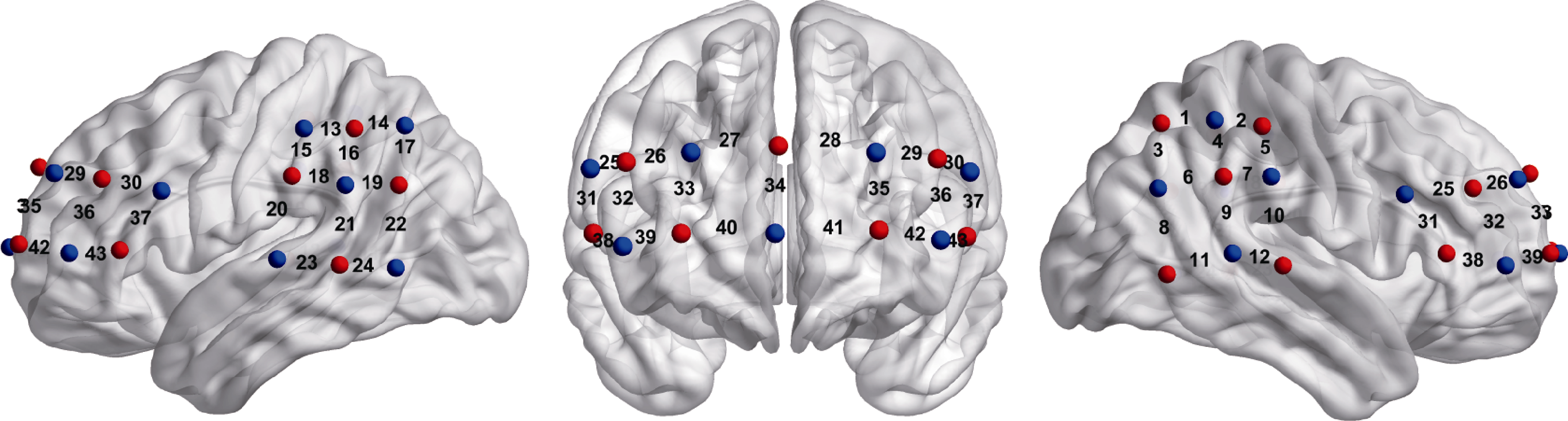
图1 fNIRS光极排布与通道编号 注: 红色为发射极; 蓝色为接收极; 数字为数据通道及其相应的编号。彩图见电子版, 下同。
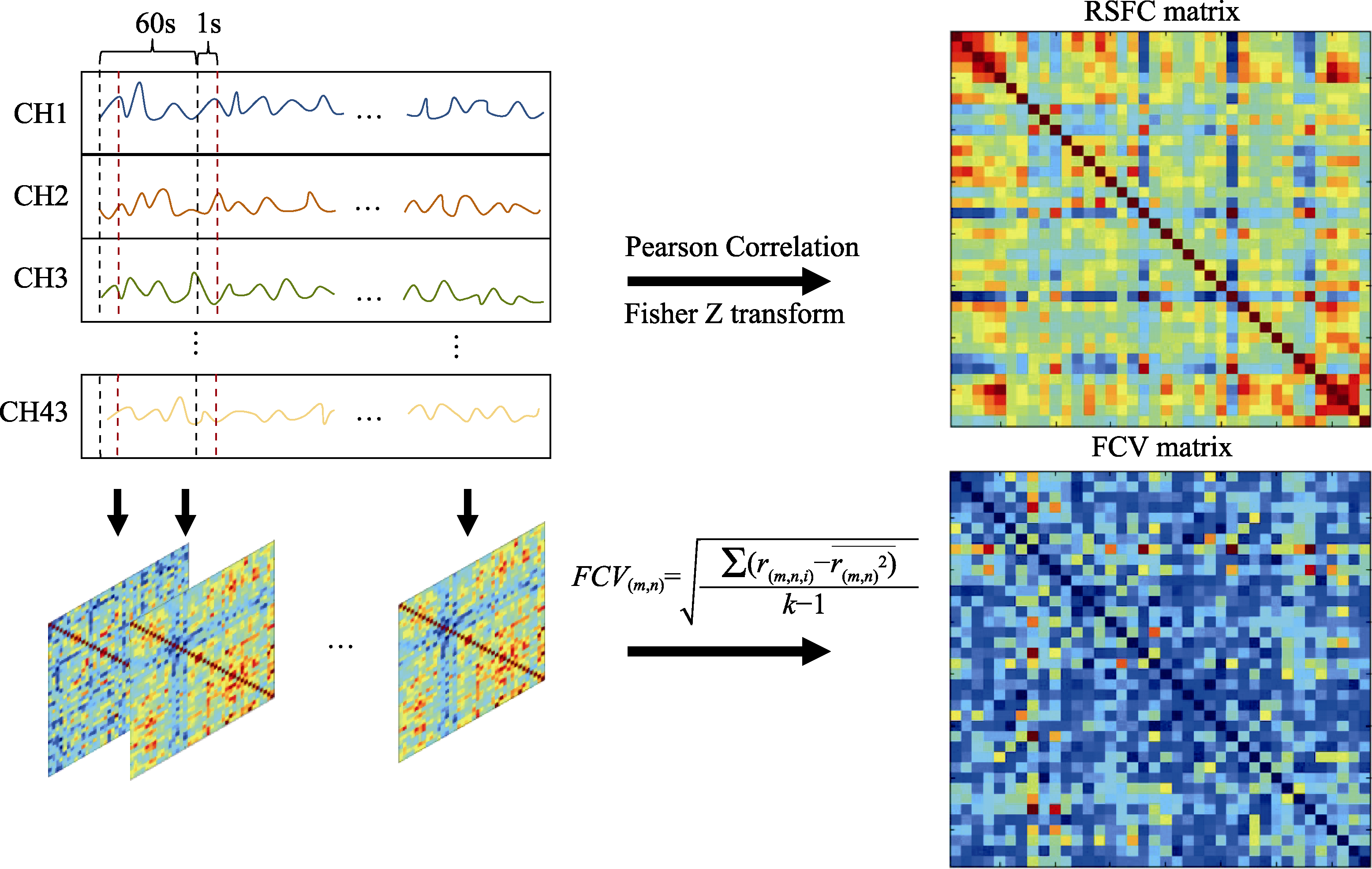
图2 功能连接矩阵构建流程 注: RSFC: 静息态功能连接; FCV: 动态功能连接。
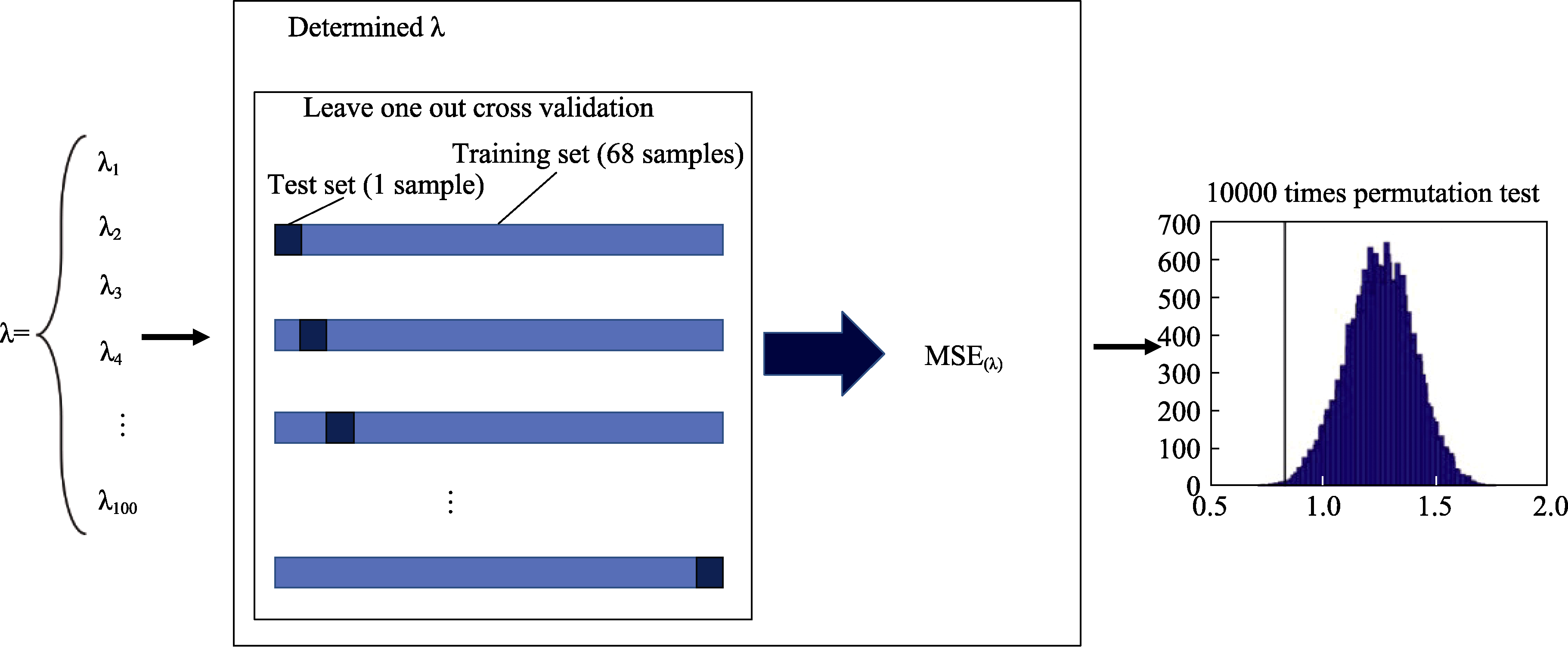
图3 LASSO回归模型构建流程

图4 基于静态功能连接的创造性观点产生预测模型
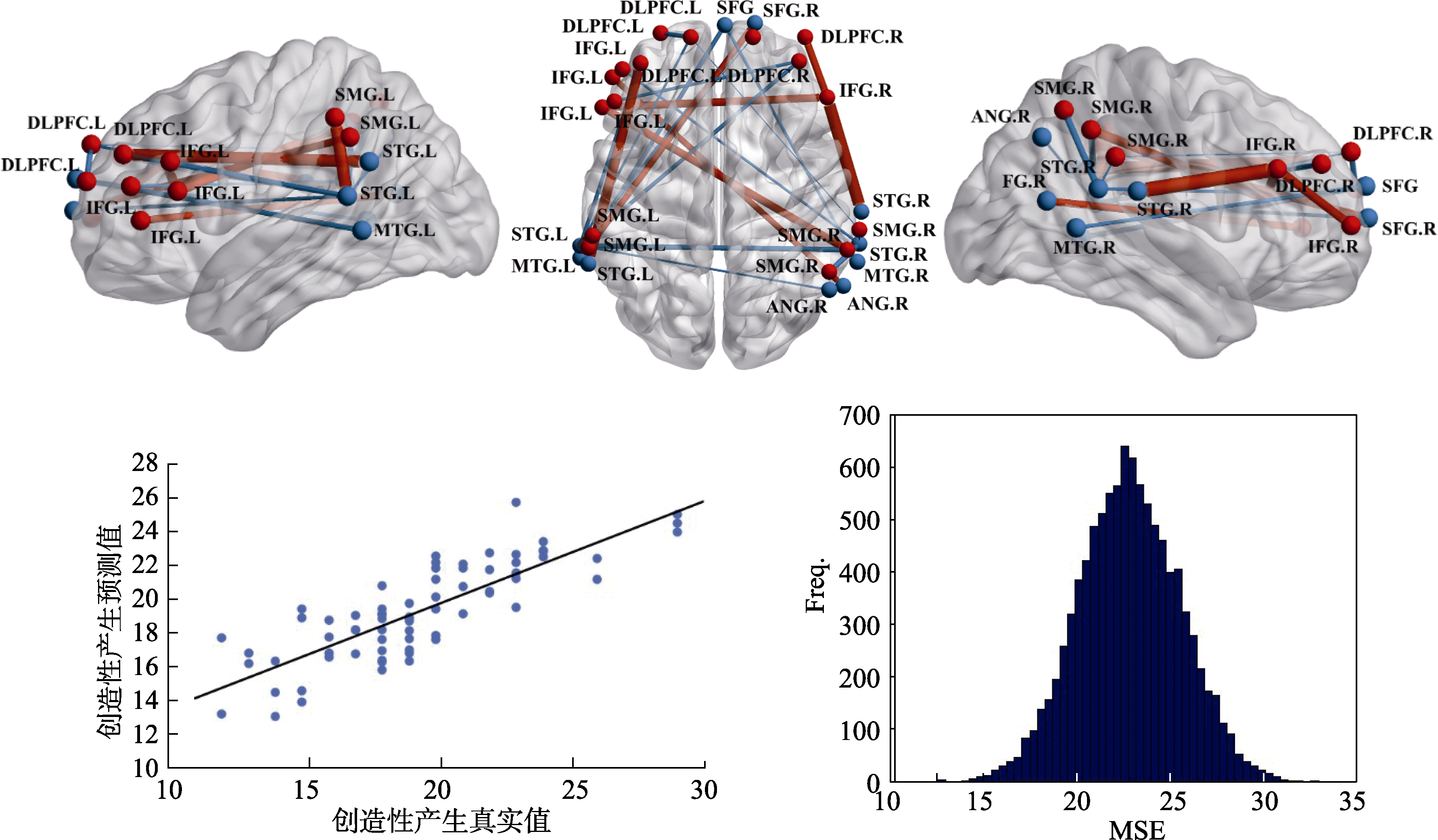
图5 基于动态功能连接的创造性观点产生预测模型 注: 上图为预测模型中具体功能连接及其相应节点, 红色节点为额顶控制网络相关脑区, 蓝色节点为默认网络相关节点, 红色连边为预测模型中权重为正的功能连接, 蓝色连边为预测模型中权重为负的功能连接; 下左图为创造性观点产生预测值与真实值散点图; 下右图为置换检验结果, 竖线为真实MSE值。L: 左侧; R: 右侧; SMG: 缘上回; STG: 颞上回; IFG: 额下回; DLPFC: 背外侧前额叶; ANG: 角回; SFG: 额上回; FG: 梭状回; Freq.: 置换检验中各MSE出现频率; MSE: 均方误差。

图6 基于静态功能连接的创造性观点评价预测模型 注: L: 左侧; R: 右侧; SMG: 缘上回; STG: 颞上回; IFG: 额下回; DLPFC: 背外侧前额叶; ANG: 角回; SFG: 额上回; MTG: 颞中回; FG: 梭状回; Freq.: 置换检验中各MSE出现频率; MSE: 均方误差。

图7 基于动态功能连接的创造性观点评价预测模型 注: L: 左侧; R: 右侧; SMG: 缘上回; STG: 颞上回; IFG: 额下回; DLPFC: 背外侧前额叶; ANG: 角回; SFG: 额上回; MTG: 颞中回; FG: 梭状回; Freq.: 置换检验中各MSE出现频率; MSE: 均方误差。
| 变量 | 产生 | 评价 |
|---|---|---|
| 产生预测值 | 0.73*** | 0.29** |
| 评价预测值 | 0.32** | 0.78*** |
| Steiger's Z | 3.60*** | −4.49*** |
表1 基于静态功能连接的预测模型特异性
| 变量 | 产生 | 评价 |
|---|---|---|
| 产生预测值 | 0.73*** | 0.29** |
| 评价预测值 | 0.32** | 0.78*** |
| Steiger's Z | 3.60*** | −4.49*** |
| 变量 | 产生 | 评价 |
|---|---|---|
| 产生预测值 | 0.83*** | 0.38** |
| 评价预测值 | 0.40*** | 0.81*** |
| Steiger's Z | 4.91*** | −4.71*** |
表2 基于动态功能连接的预测模型特异性
| 变量 | 产生 | 评价 |
|---|---|---|
| 产生预测值 | 0.83*** | 0.38** |
| 评价预测值 | 0.40*** | 0.81*** |
| Steiger's Z | 4.91*** | −4.71*** |
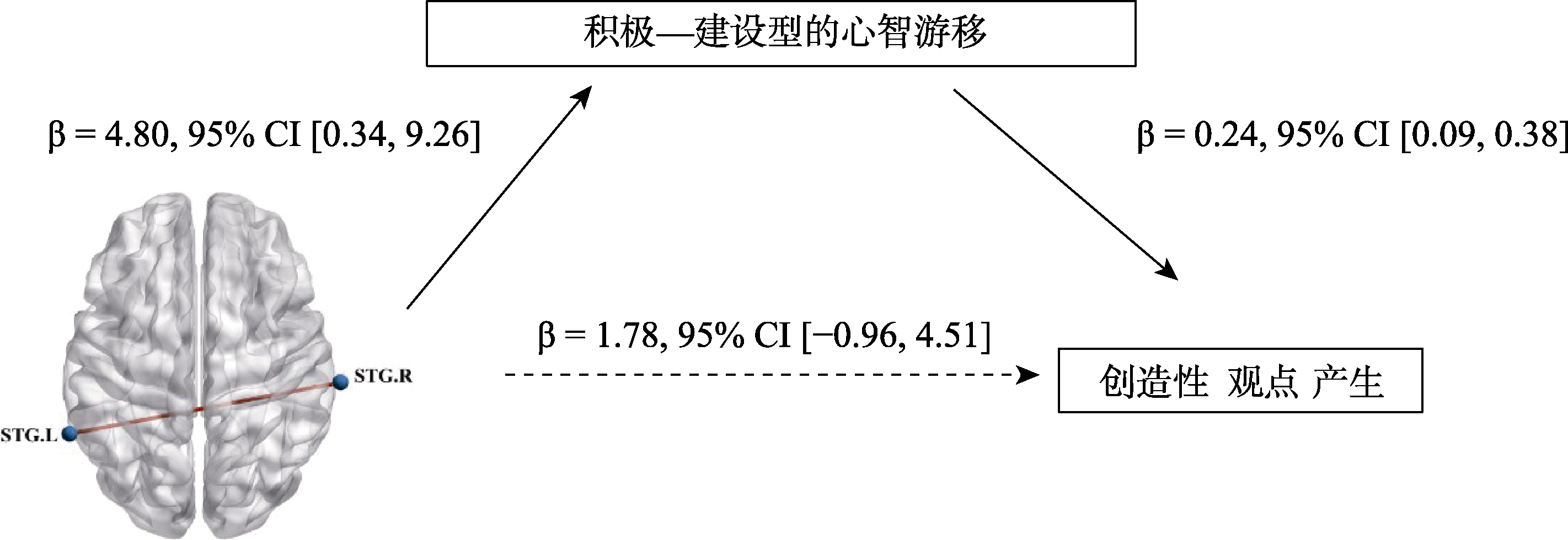
图8 PCD在双侧STG静态功能连接与创造性观点产生之间的中介作用
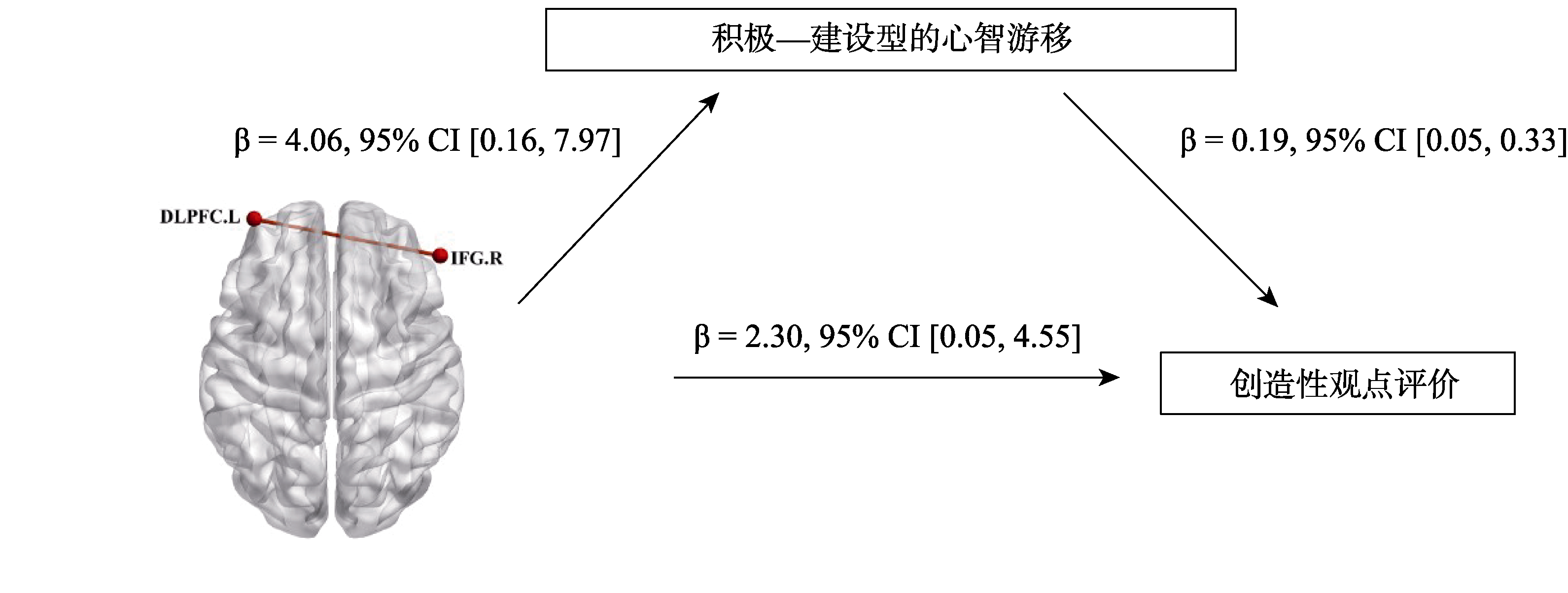
图9 PCD在左侧DLPFC与右侧IFG静态功能连接与创造性观点评价之间的中介作用
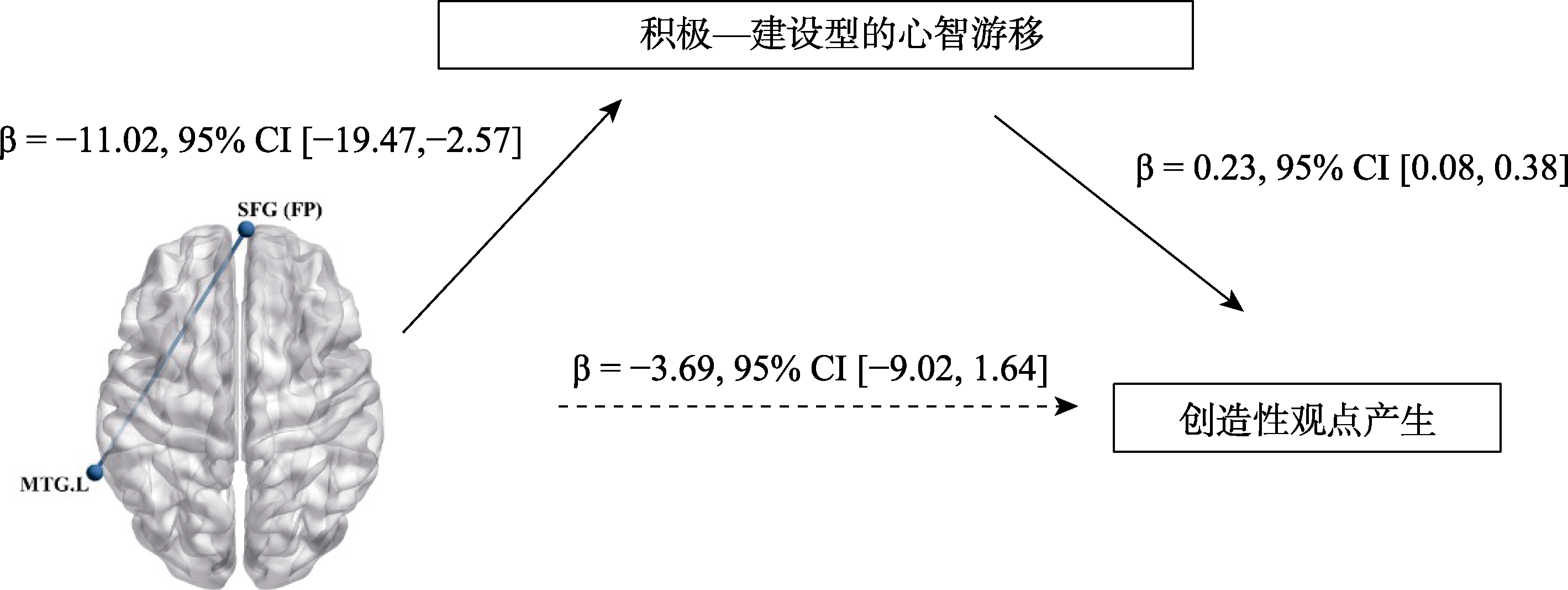
图10 PCD在左侧MTG与SFG (FP)动态功能连接与创造性观点产生之间的中介作用 注: L: 左侧; R: 右侧; STG: 颞上回; MTG: 颞中回; SFG (FP): 额极; DLPFC: 背外侧前额叶; IFG: 额下回; PCD: 积极−建设型心智游移。
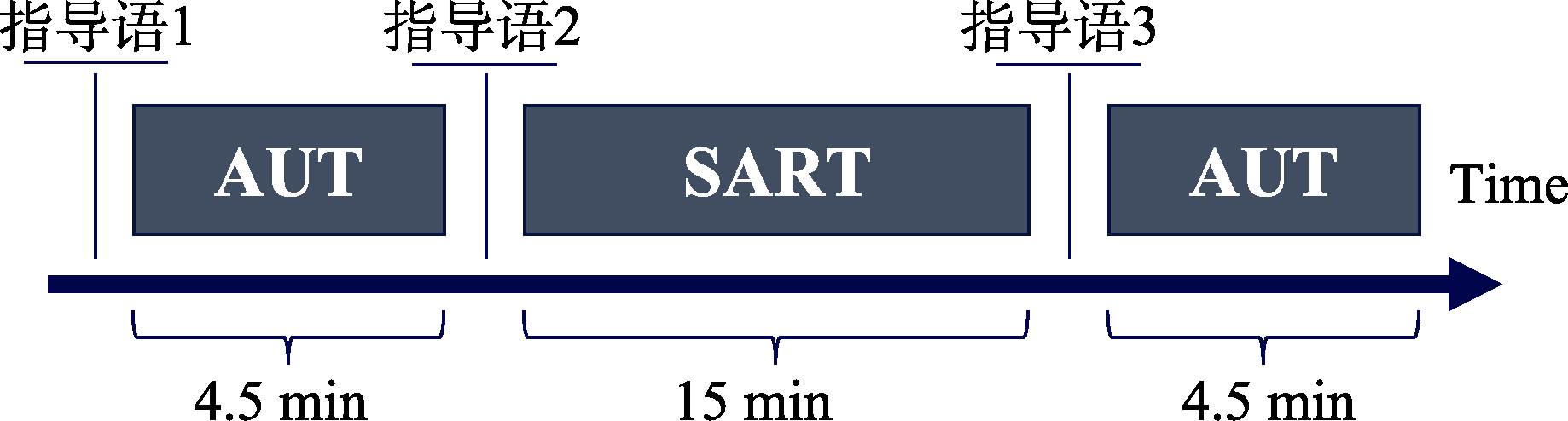
图11 实验2总流程 注: AUT: 多用途任务; SART: 持续注意反应任务。
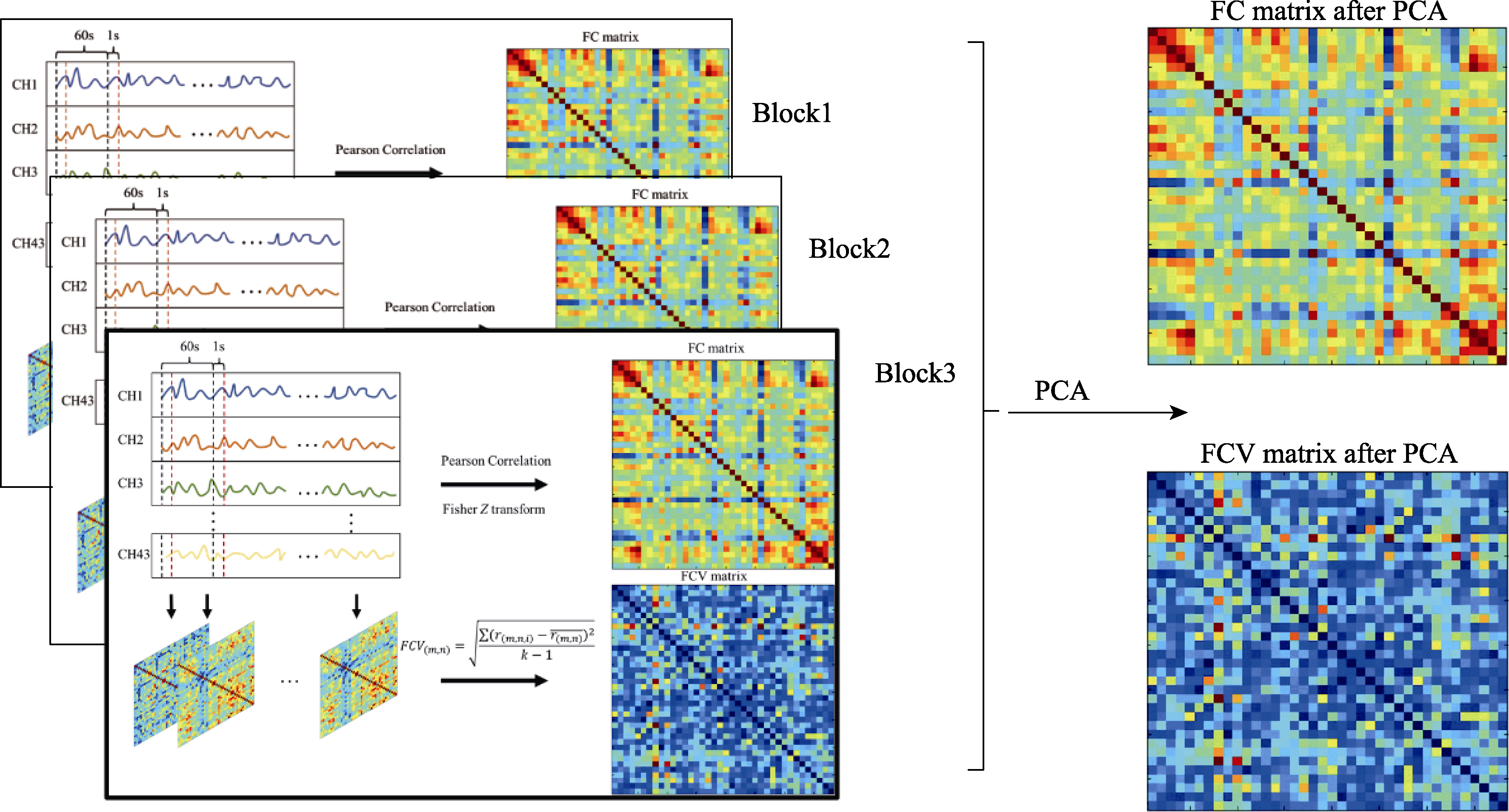
图12 功能连接矩阵构建流程 注: FC: 功能连接; FCV: 动态功能连接; PCA: 主成分分析。
| 变量 | MW-r | MW-u | MW-d | MW-s | errors |
|---|---|---|---|---|---|
| MW-r | — | ||||
| MW-u | −0.18 | — | |||
| MW-d | 0.93*** | −0.11 | — | ||
| MW-s | 0.14 | 0.85*** | 0.03 | — | |
| errors | −0.07 | 0.25* | −0.04 | 0.18 | — |
表3 心智游移与SART任务错误率之间的相关性
| 变量 | MW-r | MW-u | MW-d | MW-s | errors |
|---|---|---|---|---|---|
| MW-r | — | ||||
| MW-u | −0.18 | — | |||
| MW-d | 0.93*** | −0.11 | — | ||
| MW-s | 0.14 | 0.85*** | 0.03 | — | |
| errors | −0.07 | 0.25* | −0.04 | 0.18 | — |
| 变量 | 数目 | 频率 (总和) | 频率 (心智游移) |
|---|---|---|---|
| MW-r | 240 | 15.9% | 57.1% |
| MW-u | 180 | 11.9% | 42.9% |
| MW-d | 189 | 12.5% | 45.0% |
| MW-s | 231 | 15.3% | 55.0% |
| MW-总 | 420 | 27.8% | 100% |
表4 SART期间被试心智游移状况
| 变量 | 数目 | 频率 (总和) | 频率 (心智游移) |
|---|---|---|---|
| MW-r | 240 | 15.9% | 57.1% |
| MW-u | 180 | 11.9% | 42.9% |
| MW-d | 189 | 12.5% | 45.0% |
| MW-s | 231 | 15.3% | 55.0% |
| MW-总 | 420 | 27.8% | 100% |
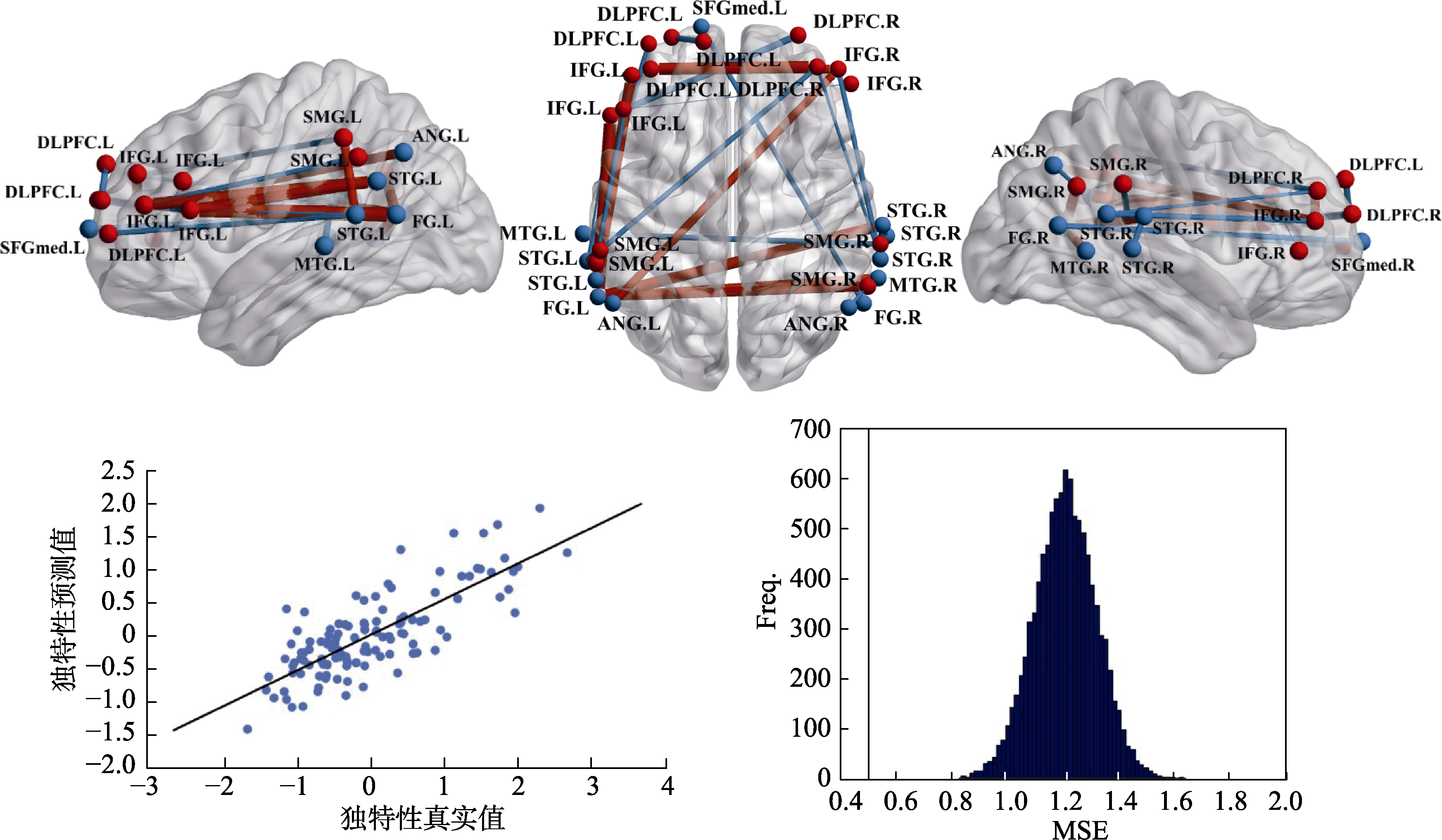
图13 基于静态功能连接的发散思维独特性的预测模型
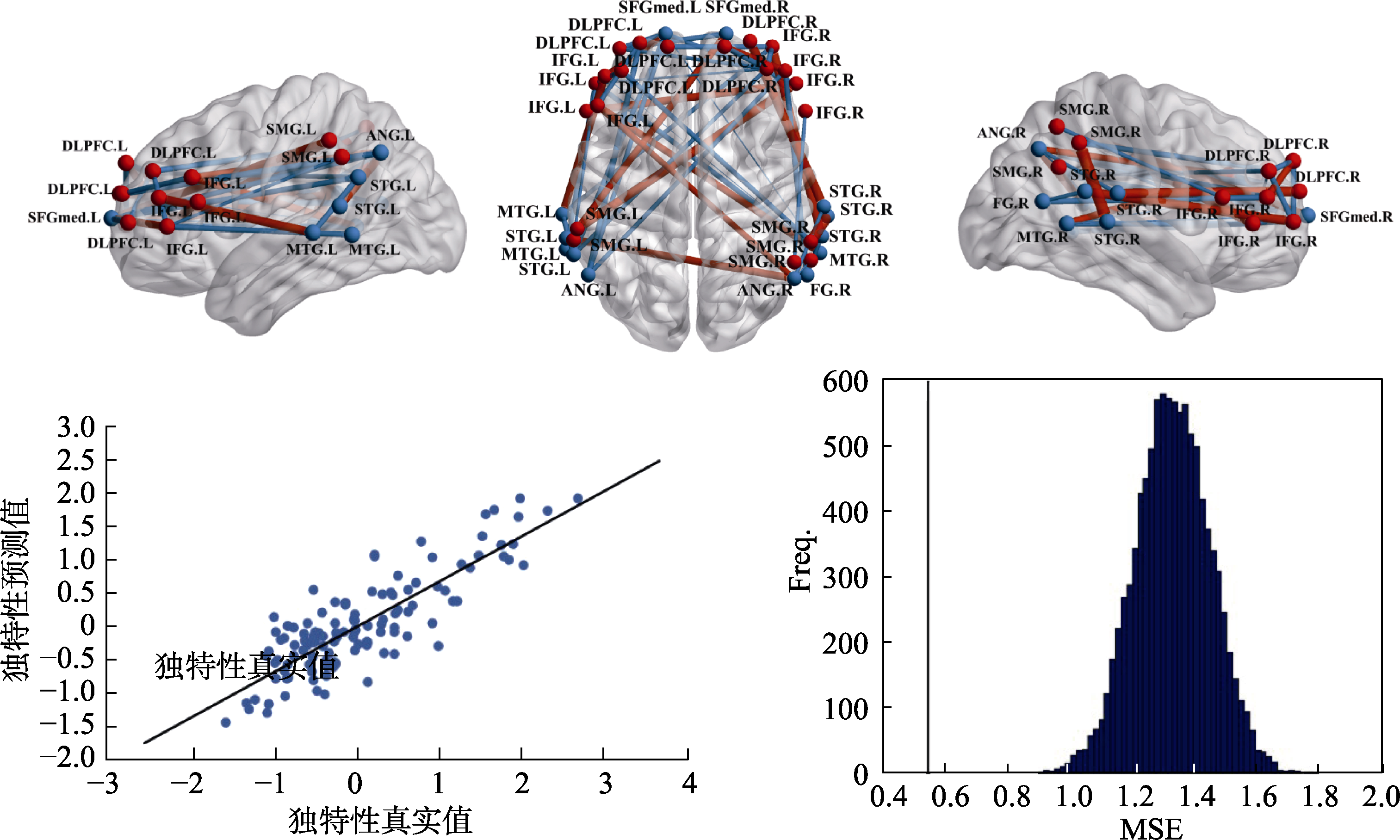
图14 基于动态功能连接的发散思维独特性的预测模型 注: L: 左侧; R: 右侧; SMG: 缘上回; STG: 颞上回; IFG: 额下回; DLPFC: 背外侧前额叶; ANG: 角回; SFG: 额上回; MTG: 颞中回; FG: 梭状回; Freq.: 置换检验中各MSE出现频率; MSE: 均方误差。
| Predictor | IFG.L − SMG.L | IFG.L − IFG.R | DLPFC.R − IFG.Ra | ||||||
|---|---|---|---|---|---|---|---|---|---|
| Step1 | Step2 | Step3 | Step1 | Step2 | Step3 | Step1 | Step2 | Step3 | |
| 性别 | −0.12 | −0.05 | −0.03 | −0.33* | −0.09 | 0.00 | 0.10 | 0.12 | 0.11 |
| 年龄 | −0.16 | −0.05 | −0.06 | 0.13 | 0.06 | 0.01 | 0.13 | 0.13 | 0.15 |
| Pre | 0.29* | 0.30* | 0.49*** | 0.65*** | 0.30* | 0.24 | |||
| MW-r | −0.27* | 0.02 | −0.45*** | 0.29* | |||||
| R2 | 0.04 | 0.10 | 0.17 | 0.13 | 0.31 | 0.49 | 0.04 | 0.13 | 0.21 |
| ΔR2 | 0.04 | 0.06 | 0.07 | 0.13 | 0.18 | 0.18 | 0.04 | 0.09 | 0.08 |
| F | 1.14 | 2.14 | 2.87* | 4.11* | 8.23*** | 10.03*** | 1.09 | 2.67 | 3.60* |
| ΔF | 1.14 | 4.02* | 4.65* | 0.47 | 14.5*** | 13.9*** | 1.09 | 5.64* | 5.74* |
表5 MW-r对酝酿后创造性思维期间功能连接的回归
| Predictor | IFG.L − SMG.L | IFG.L − IFG.R | DLPFC.R − IFG.Ra | ||||||
|---|---|---|---|---|---|---|---|---|---|
| Step1 | Step2 | Step3 | Step1 | Step2 | Step3 | Step1 | Step2 | Step3 | |
| 性别 | −0.12 | −0.05 | −0.03 | −0.33* | −0.09 | 0.00 | 0.10 | 0.12 | 0.11 |
| 年龄 | −0.16 | −0.05 | −0.06 | 0.13 | 0.06 | 0.01 | 0.13 | 0.13 | 0.15 |
| Pre | 0.29* | 0.30* | 0.49*** | 0.65*** | 0.30* | 0.24 | |||
| MW-r | −0.27* | 0.02 | −0.45*** | 0.29* | |||||
| R2 | 0.04 | 0.10 | 0.17 | 0.13 | 0.31 | 0.49 | 0.04 | 0.13 | 0.21 |
| ΔR2 | 0.04 | 0.06 | 0.07 | 0.13 | 0.18 | 0.18 | 0.04 | 0.09 | 0.08 |
| F | 1.14 | 2.14 | 2.87* | 4.11* | 8.23*** | 10.03*** | 1.09 | 2.67 | 3.60* |
| ΔF | 1.14 | 4.02* | 4.65* | 0.47 | 14.5*** | 13.9*** | 1.09 | 5.64* | 5.74* |
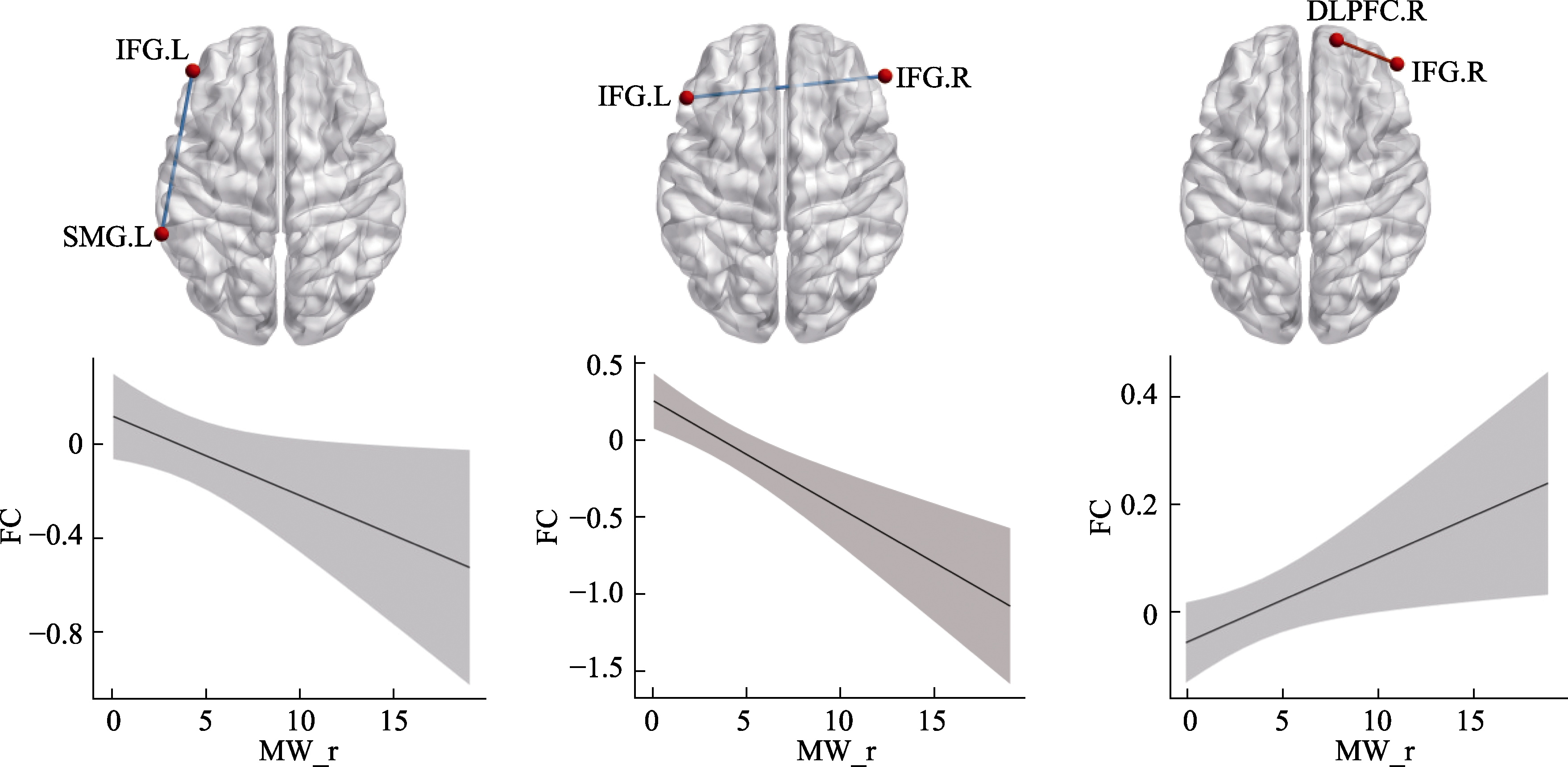
图15 MW-r对酝酿后创造性思维期间功能连接的预测 注: 上图中a为基于动态功能连接的分析结果; 下图为对应的边际均值估算结果; L: 左侧; R: 右侧; IFG: 额下回; SMG: 缘上回; DLPFC: 背外侧前额叶; MW-r: 任务相关的心智游移; FC: 功能连接估计值。
| 节点1 | 节点2 | 权重 | ||||
|---|---|---|---|---|---|---|
| 通道 | 脑区 | 网络 | 通道 | 脑区 | 网络 | |
| 28 | DLPFC.L | FPCN | 16 | SMG.L | FPCN | 2.18 |
| 41 | SFG.L | DMN | 38 | IFG.R | FPCN | 1.97 |
| 32 | IFG.R | FPCN | 8 | FG.R | DMN | 1.55 |
| 28 | DLPFC.L | FPCN | 14 | SMG.L | FPCN | 1.30 |
| 16 | SMG.L | FPCN | 12 | STG.R | DMN | 1.22 |
| 19 | STG.L | DMN | 10 | STG.R | DMN | 0.86 |
| 37 | IFG.L | FPCN | 33 | DLPFC.R | FPCN | 0.41 |
| 29 | DLPFC.L | FPCN | 16 | SMG.L | FPCN | 0.38 |
| 38 | IFG.R | FPCN | 4 | SMG.R | FPCN | −0.45 |
| 37 | IFG.L | FPCN | 4 | SMG.R | FPCN | −1.63 |
| 30 | IFG.L | FPCN | 17 | ANG.L | DMN | −2.32 |
| 31 | IFG.R | FPCN | 12 | STG.R | DMN | −2.90 |
表S1 基于静态功能连接的创造性观点产生预测模型中各预测变量权重值
| 节点1 | 节点2 | 权重 | ||||
|---|---|---|---|---|---|---|
| 通道 | 脑区 | 网络 | 通道 | 脑区 | 网络 | |
| 28 | DLPFC.L | FPCN | 16 | SMG.L | FPCN | 2.18 |
| 41 | SFG.L | DMN | 38 | IFG.R | FPCN | 1.97 |
| 32 | IFG.R | FPCN | 8 | FG.R | DMN | 1.55 |
| 28 | DLPFC.L | FPCN | 14 | SMG.L | FPCN | 1.30 |
| 16 | SMG.L | FPCN | 12 | STG.R | DMN | 1.22 |
| 19 | STG.L | DMN | 10 | STG.R | DMN | 0.86 |
| 37 | IFG.L | FPCN | 33 | DLPFC.R | FPCN | 0.41 |
| 29 | DLPFC.L | FPCN | 16 | SMG.L | FPCN | 0.38 |
| 38 | IFG.R | FPCN | 4 | SMG.R | FPCN | −0.45 |
| 37 | IFG.L | FPCN | 4 | SMG.R | FPCN | −1.63 |
| 30 | IFG.L | FPCN | 17 | ANG.L | DMN | −2.32 |
| 31 | IFG.R | FPCN | 12 | STG.R | DMN | −2.90 |
| 节点1 | 节点2 | 权重 | ||||
|---|---|---|---|---|---|---|
| 通道 | 脑区 | 网络 | 通道 | 脑区 | 网络 | |
| 25 | IFG.R | FPCN | 10 | STG.R | DMN | 8.25 |
| 21 | STG.L | DMN | 13 | SMG.L | FPCN | 5.97 |
| 29 | DLPFC.L | FPCN | 19 | STG.L | DMN | 5.64 |
| 37 | IFG.L | FPCN | 25 | IFG.R | FPCN | 2.85 |
| 37 | IFG.L | FPCN | 4 | SMG.R | FPCN | 2.81 |
| 39 | IFG.R | FPCN | 25 | IFG.R | FPCN | 2.07 |
| 40 | SFG.R | DMN | 16 | SMG.L | FPCN | 0.87 |
| 43 | IFG.L | FPCN | 8 | FG.R | DMN | 0.60 |
| 9 | STG.R | DMN | 1 | SMG.R | FPCN | −0.34 |
| 21 | STG.L | DMN | 4 | SMG.R | FPCN | −0.56 |
| 35 | DLPFC.L | FPCN | 28 | DLPFC.L | FPCN | −1.28 |
| 34 | SFG | DMN | 24 | MTG.L | DMN | −1.60 |
| 26 | DLPFC.R | FPCN | 21 | STG.L | DMN | −2.05 |
| 29 | DLPFC.L | FPCN | 21 | STG.L | DMN | −2.15 |
| 30 | IFG.L | FPCN | 26 | DLPFC.R | FPCN | −3.05 |
| 40 | SFG.R | DMN | 21 | STG.L | DMN | −3.27 |
| 34 | SFG | DMN | 11 | MTG.R | DMN | −3.30 |
| 36 | IFG.L | FPCN | 9 | STG.R | DMN | −3.83 |
| 28 | DLPFC.L | FPCN | 21 | STG.L | DMN | −4.06 |
| 21 | STG.L | DMN | 3 | ANG.R | DMN | −4.38 |
| 9 | STG.R | DMN | 7 | SMG.R | FPCN | −5.39 |
| 28 | DLPFC.L | FPCN | 7 | SMG.R | FPCN | −6.09 |
| 27 | DLPFC.R | FPCN | 21 | STG.L | DMN | −6.29 |
表S2 基于动态功能连接的创造性观点产生预测模型中各预测变量权重值
| 节点1 | 节点2 | 权重 | ||||
|---|---|---|---|---|---|---|
| 通道 | 脑区 | 网络 | 通道 | 脑区 | 网络 | |
| 25 | IFG.R | FPCN | 10 | STG.R | DMN | 8.25 |
| 21 | STG.L | DMN | 13 | SMG.L | FPCN | 5.97 |
| 29 | DLPFC.L | FPCN | 19 | STG.L | DMN | 5.64 |
| 37 | IFG.L | FPCN | 25 | IFG.R | FPCN | 2.85 |
| 37 | IFG.L | FPCN | 4 | SMG.R | FPCN | 2.81 |
| 39 | IFG.R | FPCN | 25 | IFG.R | FPCN | 2.07 |
| 40 | SFG.R | DMN | 16 | SMG.L | FPCN | 0.87 |
| 43 | IFG.L | FPCN | 8 | FG.R | DMN | 0.60 |
| 9 | STG.R | DMN | 1 | SMG.R | FPCN | −0.34 |
| 21 | STG.L | DMN | 4 | SMG.R | FPCN | −0.56 |
| 35 | DLPFC.L | FPCN | 28 | DLPFC.L | FPCN | −1.28 |
| 34 | SFG | DMN | 24 | MTG.L | DMN | −1.60 |
| 26 | DLPFC.R | FPCN | 21 | STG.L | DMN | −2.05 |
| 29 | DLPFC.L | FPCN | 21 | STG.L | DMN | −2.15 |
| 30 | IFG.L | FPCN | 26 | DLPFC.R | FPCN | −3.05 |
| 40 | SFG.R | DMN | 21 | STG.L | DMN | −3.27 |
| 34 | SFG | DMN | 11 | MTG.R | DMN | −3.30 |
| 36 | IFG.L | FPCN | 9 | STG.R | DMN | −3.83 |
| 28 | DLPFC.L | FPCN | 21 | STG.L | DMN | −4.06 |
| 21 | STG.L | DMN | 3 | ANG.R | DMN | −4.38 |
| 9 | STG.R | DMN | 7 | SMG.R | FPCN | −5.39 |
| 28 | DLPFC.L | FPCN | 7 | SMG.R | FPCN | −6.09 |
| 27 | DLPFC.R | FPCN | 21 | STG.L | DMN | −6.29 |
| 节点1 | 节点2 | 权重 | ||||
|---|---|---|---|---|---|---|
| 通道 | 脑区 | 网络 | 通道 | 脑区 | 网络 | |
| 42 | DLPFC.L | FPCN | 38 | IFG.R | FPCN | 1.88 |
| 43 | IFG.L | FPCN | 36 | IFG.L | FPCN | 1.37 |
| 23 | MTG.L | DMN | 7 | SMG.R | FPCN | 1.31 |
| 40 | SFG.R | DMN | 39 | IFG.R | FPCN | 1.30 |
| 26 | DLPFC.R | FPCN | 23 | MTG.L | DMN | 1.02 |
| 41 | SFG.L | DMN | 33 | DLPFC.R | FPCN | 0.93 |
| 43 | IFG.L | FPCN | 37 | IFG.L | FPCN | 0.57 |
| 42 | DLPFC.L | FPCN | 37 | IFG.L | FPCN | 0.37 |
| 42 | DLPFC.L | FPCN | 36 | IFG.L | FPCN | 0.29 |
| 43 | IFG.L | FPCN | 33 | DLPFC.R | FPCN | 0.07 |
| 41 | SFG.L | DMN | 37 | IFG.L | FPCN | 0.04 |
| 35 | DLPFC.L | FPCN | 16 | SMG.L | FPCN | −0.05 |
| 10 | STG.R | DMN | 4 | SMG.R | FPCN | −0.38 |
| 33 | DLPFC.R | FPCN | 4 | SMG.R | FPCN | −0.38 |
| 26 | DLPFC.R | FPCN | 17 | ANG.L | DMN | −0.40 |
| 31 | IFG.R | FPCN | 29 | DLPFC.L | FPCN | −0.45 |
| 17 | ANG.L | DMN | 11 | MTG.R | DMN | −0.51 |
| 29 | DLPFC.L | FPCN | 26 | DLPFC.R | FPCN | −0.61 |
| 37 | IFG.L | FPCN | 7 | SMG.R | FPCN | −0.66 |
| 10 | STG.R | DMN | 8 | FG.R | DMN | −0.71 |
| 8 | FG.R | DMN | 3 | ANG.R | DMN | −0.74 |
| 17 | ANG.L | DMN | 14 | SMG.L | FPCN | −1.07 |
| 30 | IFG.L | FPCN | 12 | STG.R | DMN | −2.03 |
表S3 基于静态功能连接对于创造性观点评价的预测模型
| 节点1 | 节点2 | 权重 | ||||
|---|---|---|---|---|---|---|
| 通道 | 脑区 | 网络 | 通道 | 脑区 | 网络 | |
| 42 | DLPFC.L | FPCN | 38 | IFG.R | FPCN | 1.88 |
| 43 | IFG.L | FPCN | 36 | IFG.L | FPCN | 1.37 |
| 23 | MTG.L | DMN | 7 | SMG.R | FPCN | 1.31 |
| 40 | SFG.R | DMN | 39 | IFG.R | FPCN | 1.30 |
| 26 | DLPFC.R | FPCN | 23 | MTG.L | DMN | 1.02 |
| 41 | SFG.L | DMN | 33 | DLPFC.R | FPCN | 0.93 |
| 43 | IFG.L | FPCN | 37 | IFG.L | FPCN | 0.57 |
| 42 | DLPFC.L | FPCN | 37 | IFG.L | FPCN | 0.37 |
| 42 | DLPFC.L | FPCN | 36 | IFG.L | FPCN | 0.29 |
| 43 | IFG.L | FPCN | 33 | DLPFC.R | FPCN | 0.07 |
| 41 | SFG.L | DMN | 37 | IFG.L | FPCN | 0.04 |
| 35 | DLPFC.L | FPCN | 16 | SMG.L | FPCN | −0.05 |
| 10 | STG.R | DMN | 4 | SMG.R | FPCN | −0.38 |
| 33 | DLPFC.R | FPCN | 4 | SMG.R | FPCN | −0.38 |
| 26 | DLPFC.R | FPCN | 17 | ANG.L | DMN | −0.40 |
| 31 | IFG.R | FPCN | 29 | DLPFC.L | FPCN | −0.45 |
| 17 | ANG.L | DMN | 11 | MTG.R | DMN | −0.51 |
| 29 | DLPFC.L | FPCN | 26 | DLPFC.R | FPCN | −0.61 |
| 37 | IFG.L | FPCN | 7 | SMG.R | FPCN | −0.66 |
| 10 | STG.R | DMN | 8 | FG.R | DMN | −0.71 |
| 8 | FG.R | DMN | 3 | ANG.R | DMN | −0.74 |
| 17 | ANG.L | DMN | 14 | SMG.L | FPCN | −1.07 |
| 30 | IFG.L | FPCN | 12 | STG.R | DMN | −2.03 |
| 节点1 | 节点2 | 权重 | ||||
|---|---|---|---|---|---|---|
| 通道 | 脑区 | 网络 | 通道 | 脑区 | 网络 | |
| 37 | IFG.L | FPCN | 25 | IFG.R | FPCN | 7.32 |
| 33 | DLPFC.R | FPCN | 27 | DLPFC.R | FPCN | 4.60 |
| 41 | SFG.L | DMN | 38 | IFG.R | FPCN | 2.77 |
| 27 | DLPFC.R | FPCN | 3 | ANG.R | DMN | −0.03 |
| 30 | IFG.L | FPCN | 11 | MTG.R | DMN | −0.20 |
| 31 | IFG.R | FPCN | 3 | ANG.R | DMN | −0.34 |
| 43 | IFG.L | FPCN | 17 | ANG.L | DMN | −0.47 |
| 32 | IFG.R | FPCN | 10 | STG.R | DMN | −0.54 |
| 30 | IFG.L | FPCN | 10 | STG.R | DMN | −0.56 |
| 22 | FG.L | DMN | 10 | STG.R | DMN | −0.83 |
| 14 | SMG.L | FPCN | 13 | SMG.L | FPCN | −1.23 |
| 28 | DLPFC.L | FPCN | 11 | MTG.R | DMN | −1.26 |
| 27 | DLPFC.R | FPCN | 21 | STG.L | DMN | −1.30 |
| 36 | IFG.L | FPCN | 9 | STG.R | DMN | −1.64 |
| 23 | MTG.L | DMN | 14 | SMG.L | FPCN | −1.67 |
| 43 | IFG.L | FPCN | 22 | FG.L | DMN | −1.99 |
| 25 | IFG.R | FPCN | 3 | ANG.R | DMN | −2.20 |
| 30 | IFG.L | FPCN | 3 | ANG.R | DMN | −2.34 |
| 39 | IFG.R | FPCN | 11 | MTG.R | DMN | −2.48 |
| 34 | SFG | DMN | 32 | IFG.R | FPCN | −3.10 |
| 19 | STG.L | DMN | 8 | FG.R | DMN | −3.13 |
| 14 | SMG.L | FPCN | 9 | STG.R | DMN | −3.20 |
| 28 | DLPFC.L | FPCN | 3 | ANG.R | DMN | −3.45 |
| 42 | DLPFC.L | FPCN | 17 | ANG.L | DMN | −4.07 |
| 14 | SMG.L | FPCN | 11 | MTG.R | DMN | −5.20 |
| 19 | STG.L | DMN | 11 | MTG.R | DMN | −5.69 |
表S4 基于动态功能连接对于创造性观点评价的预测模型
| 节点1 | 节点2 | 权重 | ||||
|---|---|---|---|---|---|---|
| 通道 | 脑区 | 网络 | 通道 | 脑区 | 网络 | |
| 37 | IFG.L | FPCN | 25 | IFG.R | FPCN | 7.32 |
| 33 | DLPFC.R | FPCN | 27 | DLPFC.R | FPCN | 4.60 |
| 41 | SFG.L | DMN | 38 | IFG.R | FPCN | 2.77 |
| 27 | DLPFC.R | FPCN | 3 | ANG.R | DMN | −0.03 |
| 30 | IFG.L | FPCN | 11 | MTG.R | DMN | −0.20 |
| 31 | IFG.R | FPCN | 3 | ANG.R | DMN | −0.34 |
| 43 | IFG.L | FPCN | 17 | ANG.L | DMN | −0.47 |
| 32 | IFG.R | FPCN | 10 | STG.R | DMN | −0.54 |
| 30 | IFG.L | FPCN | 10 | STG.R | DMN | −0.56 |
| 22 | FG.L | DMN | 10 | STG.R | DMN | −0.83 |
| 14 | SMG.L | FPCN | 13 | SMG.L | FPCN | −1.23 |
| 28 | DLPFC.L | FPCN | 11 | MTG.R | DMN | −1.26 |
| 27 | DLPFC.R | FPCN | 21 | STG.L | DMN | −1.30 |
| 36 | IFG.L | FPCN | 9 | STG.R | DMN | −1.64 |
| 23 | MTG.L | DMN | 14 | SMG.L | FPCN | −1.67 |
| 43 | IFG.L | FPCN | 22 | FG.L | DMN | −1.99 |
| 25 | IFG.R | FPCN | 3 | ANG.R | DMN | −2.20 |
| 30 | IFG.L | FPCN | 3 | ANG.R | DMN | −2.34 |
| 39 | IFG.R | FPCN | 11 | MTG.R | DMN | −2.48 |
| 34 | SFG | DMN | 32 | IFG.R | FPCN | −3.10 |
| 19 | STG.L | DMN | 8 | FG.R | DMN | −3.13 |
| 14 | SMG.L | FPCN | 9 | STG.R | DMN | −3.20 |
| 28 | DLPFC.L | FPCN | 3 | ANG.R | DMN | −3.45 |
| 42 | DLPFC.L | FPCN | 17 | ANG.L | DMN | −4.07 |
| 14 | SMG.L | FPCN | 11 | MTG.R | DMN | −5.20 |
| 19 | STG.L | DMN | 11 | MTG.R | DMN | −5.69 |
| 节点1 | 节点2 | 权重 | ||||
|---|---|---|---|---|---|---|
| 通道 | 脑区 | 网络 | 通道 | 脑区 | 网络 | |
| 37 | IFG.L | FPCN | 22 | FG.L | DMN | 0.35 |
| 29 | DLPFC.L | FPCN | 26 | DLPFC.R | FPCN | 0.31 |
| 22 | FG.L | DMN | 10 | STG.R | DMN | 0.26 |
| 36 | IFG.L | FPCN | 19 | STG.L | DMN | 0.26 |
| 37 | IFG.L | FPCN | 19 | STG.L | DMN | 0.16 |
| 22 | FG.L | DMN | 6 | SMG.L | FPCN | 0.15 |
| 22 | FG.L | DMN | 11 | MTG.R | DMN | 0.12 |
| 32 | IFG.R | FPCN | 29 | DLPFC.L | FPCN | 0.11 |
| 32 | IFG.R | FPCN | 17 | ANG.L | DMN | 0.10 |
| 21 | STG.L | DMN | 13 | SMG.L | FPCN | 0.07 |
| 37 | IFG.L | FPCN | 33 | DLPFC.R | FPCN | −0.01 |
| 35 | DLPFC.L | FPCN | 28 | DLPFC.L | FPCN | −0.05 |
| 23 | MTG.L | DMN | 7 | SMG.R | FPCN | −0.06 |
| 12 | STG.R | DMN | 10 | STG.R | DMN | −0.08 |
| 26 | DLPFC.R | FPCN | 13 | SMG.L | FPCN | −0.09 |
| 41 | SFGmed.L | DMN | 8 | FG.R | DMN | −0.10 |
| 32 | IFG.R | FPCN | 9 | STG.R | DMN | −0.11 |
| 42 | DLPFC.L | FPCN | 21 | STG.L | DMN | −0.12 |
| 36 | IFG.L | FPCN | 16 | SMG.L | FPCN | −0.13 |
| 6 | SMG.L | FPCN | 3 | ANG.R | DMN | −0.18 |
| 26 | DLPFC.R | FPCN | 9 | STG.R | DMN | −0.21 |
| 37 | IFG.L | FPCN | 21 | STG.L | DMN | −0.27 |
| 38 | IFG.R | FPCN | 30 | IFG.L | FPCN | −0.36 |
表S5 基于静态任务态功能连接的独特性预测模型中各预测变量权重
| 节点1 | 节点2 | 权重 | ||||
|---|---|---|---|---|---|---|
| 通道 | 脑区 | 网络 | 通道 | 脑区 | 网络 | |
| 37 | IFG.L | FPCN | 22 | FG.L | DMN | 0.35 |
| 29 | DLPFC.L | FPCN | 26 | DLPFC.R | FPCN | 0.31 |
| 22 | FG.L | DMN | 10 | STG.R | DMN | 0.26 |
| 36 | IFG.L | FPCN | 19 | STG.L | DMN | 0.26 |
| 37 | IFG.L | FPCN | 19 | STG.L | DMN | 0.16 |
| 22 | FG.L | DMN | 6 | SMG.L | FPCN | 0.15 |
| 22 | FG.L | DMN | 11 | MTG.R | DMN | 0.12 |
| 32 | IFG.R | FPCN | 29 | DLPFC.L | FPCN | 0.11 |
| 32 | IFG.R | FPCN | 17 | ANG.L | DMN | 0.10 |
| 21 | STG.L | DMN | 13 | SMG.L | FPCN | 0.07 |
| 37 | IFG.L | FPCN | 33 | DLPFC.R | FPCN | −0.01 |
| 35 | DLPFC.L | FPCN | 28 | DLPFC.L | FPCN | −0.05 |
| 23 | MTG.L | DMN | 7 | SMG.R | FPCN | −0.06 |
| 12 | STG.R | DMN | 10 | STG.R | DMN | −0.08 |
| 26 | DLPFC.R | FPCN | 13 | SMG.L | FPCN | −0.09 |
| 41 | SFGmed.L | DMN | 8 | FG.R | DMN | −0.10 |
| 32 | IFG.R | FPCN | 9 | STG.R | DMN | −0.11 |
| 42 | DLPFC.L | FPCN | 21 | STG.L | DMN | −0.12 |
| 36 | IFG.L | FPCN | 16 | SMG.L | FPCN | −0.13 |
| 6 | SMG.L | FPCN | 3 | ANG.R | DMN | −0.18 |
| 26 | DLPFC.R | FPCN | 9 | STG.R | DMN | −0.21 |
| 37 | IFG.L | FPCN | 21 | STG.L | DMN | −0.27 |
| 38 | IFG.R | FPCN | 30 | IFG.L | FPCN | −0.36 |
| 节点1 | 节点2 | 权重 | ||||
|---|---|---|---|---|---|---|
| 通道 | 脑区 | 网络 | 通道 | 脑区 | 网络 | |
| 12 | STG.R | DMN | 4 | SMG.R | FPCN | 1.19 |
| 33 | DLPFC.R | FPCN | 10 | STG.R | DMN | 0.75 |
| 38 | IFG.R | FPCN | 13 | SMG.L | FPCN | 0.67 |
| 39 | IFG.R | FPCN | 9 | STG.R | DMN | 0.62 |
| 36 | IFG.L | FPCN | 23 | MTG.L | DMN | 0.45 |
| 38 | IFG.R | FPCN | 37 | IFG.L | FPCN | 0.44 |
| 21 | STG.L | DMN | 3 | ANG.R | DMN | 0.42 |
| 40 | SFGmed.R | DMN | 13 | SMG.L | FPCN | 0.28 |
| 43 | IFG.L | FPCN | 41 | SFGmed.L | DMN | 0.27 |
| 30 | IFG.L | FPCN | 11 | MTG.R | DMN | 0.25 |
| 32 | IFG.R | FPCN | 27 | DLPFC.R | FPCN | 0.21 |
| 30 | IFG.L | FPCN | 3 | ANG.R | DMN | 0.04 |
| 35 | DLPFC.L | FPCN | 17 | ANG.L | DMN | −0.01 |
| 42 | DLPFC.L | FPCN | 41 | SFGmed.L | DMN | −0.04 |
| 32 | IFG.R | FPCN | 8 | FG.R | DMN | −0.07 |
| 42 | DLPFC.L | FPCN | 40 | SFGmed.R | DMN | −0.07 |
| 39 | IFG.R | FPCN | 28 | DLPFC.L | FPCN | −0.09 |
| 27 | DLPFC.R | FPCN | 26 | DLPFC.R | FPCN | −0.12 |
| 39 | IFG.R | FPCN | 26 | DLPFC.R | FPCN | −0.12 |
| 23 | MTG.L | DMN | 19 | STG.L | DMN | −0.14 |
| 43 | IFG.L | FPCN | 11 | MTG.R | DMN | −0.14 |
| 29 | DLPFC.L | FPCN | 4 | SMG.R | FPCN | −0.16 |
| 41 | SFGmed.L | DMN | 19 | STG.L | DMN | −0.17 |
| 43 | IFG.L | FPCN | 24 | MTG.L | DMN | −0.17 |
| 35 | DLPFC.L | FPCN | 30 | IFG.L | FPCN | −0.20 |
| 41 | SFGmed.L | DMN | 17 | ANG.L | DMN | −0.25 |
| 32 | IFG.R | FPCN | 17 | ANG.L | DMN | −0.26 |
| 41 | SFGmed.L | DMN | 38 | IFG.R | FPCN | −0.26 |
| 43 | IFG.L | FPCN | 29 | DLPFC.L | FPCN | −0.26 |
| 39 | IFG.R | FPCN | 23 | MTG.L | DMN | −0.28 |
| 26 | DLPFC.R | FPCN | 19 | STG.L | DMN | −0.36 |
| 42 | DLPFC.L | FPCN | 26 | DLPFC.R | FPCN | −0.41 |
| 9 | STG.R | DMN | 8 | FG.R | DMN | −0.48 |
| 10 | STG.R | DMN | 3 | ANG.R | DMN | −0.49 |
| 31 | IFG.R | FPCN | 1 | SMG.R | FPCN | −0.50 |
| 43 | IFG.L | FPCN | 16 | SMG.L | FPCN | −0.63 |
| 43 | IFG.L | FPCN | 26 | DLPFC.R | FPCN | −0.77 |
| 6 | SMG.L | FPCN | 3 | ANG.R | DMN | −0.98 |
| 41 | SFGmed.L | DMN | 11 | MTG.R | DMN | −1.01 |
| 36 | IFG.L | FPCN | 11 | MTG.R | DMN | −1.17 |
表S6 基于动态任务态功能连接的独特性预测模型中各预测变量权重
| 节点1 | 节点2 | 权重 | ||||
|---|---|---|---|---|---|---|
| 通道 | 脑区 | 网络 | 通道 | 脑区 | 网络 | |
| 12 | STG.R | DMN | 4 | SMG.R | FPCN | 1.19 |
| 33 | DLPFC.R | FPCN | 10 | STG.R | DMN | 0.75 |
| 38 | IFG.R | FPCN | 13 | SMG.L | FPCN | 0.67 |
| 39 | IFG.R | FPCN | 9 | STG.R | DMN | 0.62 |
| 36 | IFG.L | FPCN | 23 | MTG.L | DMN | 0.45 |
| 38 | IFG.R | FPCN | 37 | IFG.L | FPCN | 0.44 |
| 21 | STG.L | DMN | 3 | ANG.R | DMN | 0.42 |
| 40 | SFGmed.R | DMN | 13 | SMG.L | FPCN | 0.28 |
| 43 | IFG.L | FPCN | 41 | SFGmed.L | DMN | 0.27 |
| 30 | IFG.L | FPCN | 11 | MTG.R | DMN | 0.25 |
| 32 | IFG.R | FPCN | 27 | DLPFC.R | FPCN | 0.21 |
| 30 | IFG.L | FPCN | 3 | ANG.R | DMN | 0.04 |
| 35 | DLPFC.L | FPCN | 17 | ANG.L | DMN | −0.01 |
| 42 | DLPFC.L | FPCN | 41 | SFGmed.L | DMN | −0.04 |
| 32 | IFG.R | FPCN | 8 | FG.R | DMN | −0.07 |
| 42 | DLPFC.L | FPCN | 40 | SFGmed.R | DMN | −0.07 |
| 39 | IFG.R | FPCN | 28 | DLPFC.L | FPCN | −0.09 |
| 27 | DLPFC.R | FPCN | 26 | DLPFC.R | FPCN | −0.12 |
| 39 | IFG.R | FPCN | 26 | DLPFC.R | FPCN | −0.12 |
| 23 | MTG.L | DMN | 19 | STG.L | DMN | −0.14 |
| 43 | IFG.L | FPCN | 11 | MTG.R | DMN | −0.14 |
| 29 | DLPFC.L | FPCN | 4 | SMG.R | FPCN | −0.16 |
| 41 | SFGmed.L | DMN | 19 | STG.L | DMN | −0.17 |
| 43 | IFG.L | FPCN | 24 | MTG.L | DMN | −0.17 |
| 35 | DLPFC.L | FPCN | 30 | IFG.L | FPCN | −0.20 |
| 41 | SFGmed.L | DMN | 17 | ANG.L | DMN | −0.25 |
| 32 | IFG.R | FPCN | 17 | ANG.L | DMN | −0.26 |
| 41 | SFGmed.L | DMN | 38 | IFG.R | FPCN | −0.26 |
| 43 | IFG.L | FPCN | 29 | DLPFC.L | FPCN | −0.26 |
| 39 | IFG.R | FPCN | 23 | MTG.L | DMN | −0.28 |
| 26 | DLPFC.R | FPCN | 19 | STG.L | DMN | −0.36 |
| 42 | DLPFC.L | FPCN | 26 | DLPFC.R | FPCN | −0.41 |
| 9 | STG.R | DMN | 8 | FG.R | DMN | −0.48 |
| 10 | STG.R | DMN | 3 | ANG.R | DMN | −0.49 |
| 31 | IFG.R | FPCN | 1 | SMG.R | FPCN | −0.50 |
| 43 | IFG.L | FPCN | 16 | SMG.L | FPCN | −0.63 |
| 43 | IFG.L | FPCN | 26 | DLPFC.R | FPCN | −0.77 |
| 6 | SMG.L | FPCN | 3 | ANG.R | DMN | −0.98 |
| 41 | SFGmed.L | DMN | 11 | MTG.R | DMN | −1.01 |
| 36 | IFG.L | FPCN | 11 | MTG.R | DMN | −1.17 |
| [1] | Abraham, A. (2018). The neuroscience of creativity. Cambridge University Press. https://doi.org/10.1017/9781316816981 |
| [2] |
Agnoli, S., Vanucci, M., Pelagatti, C., & Corazza, G. E. (2018). Exploring the link between mind wandering, mindfulness, and creativity: A multidimensional approach. Creativity Research Journal, 30(1), 41-53. https://doi.org/10.1080/10400419.2018.1411423
doi: 10.1080/10400419.2018.1411423 URL |
| [3] |
Allen, E. A., Damaraju, E., Plis, S. M., Erhardt, E. B., Eichele, T., & Calhoun, V. D. (2014). Tracking whole-brain connectivity dynamics in the resting state. Cerebral Cortex, 24(3), 663-676. https://doi.org/10.1093/cercor/bhs352
doi: 10.1093/cercor/bhs352 URL |
| [4] |
Amabile, T. M. (1982). Social psychology of creativity: A consensual assessment technique. Journal of Personality and Social Psychology, 43(5), 997-1013. https://doi.org/10.1037/0022-3514.43.5.997
doi: 10.1037/0022-3514.43.5.997 URL |
| [5] |
Baird, B., Smallwood, J., Mrazek, M. D., Kam, J. W., Franklin, M. S., & Schooler, J. W. (2012). Inspired by distraction: Mind wandering facilitates creative incubation. Psychological Science, 23(10), 1117-1122. https://doi.org/10.1177/0956797612446024
doi: 10.1177/0956797612446024 URL pmid: 22941876 |
| [6] |
Baird, B., Smallwood, J., & Schooler, J. W. (2011). Back to the future: Autobiographical planning and the functionality of mind-wandering. Consciousness and Cognition, 20(4), 1604-1611. https://doi.org/10.1016/j.concog.2011.08.007
doi: 10.1016/j.concog.2011.08.007 URL pmid: 21917482 |
| [7] |
Beaty, R. E., Benedek, M., Kaufman, S. B., & Silvia, P. J. (2015). Default and executive network coupling supports creative idea production. Scientific Reports, 5, 10964. https://doi.org/10.1038/srep10964
doi: 10.1038/srep10964 URL pmid: 26084037 |
| [8] |
Beaty, R. E., Chen, Q. L., Christensen, A. P., Kenett, Y. N., Silvia, P. J., Benedek, M., & Schacter, D. L. (2020). Default network contributions to episodic and semantic processing during divergent creative thinking: A representational similarity analysis. NeuroImage, 209, 116499. https://doi.org/10.1016/j.neuroimage.2019.116499
doi: 10.1016/j.neuroimage.2019.116499 URL |
| [9] |
Beaty, R. E., Kenett, Y. N., Christensen, A. P., Rosenberg, M. D., Benedek, M., Chen, Q., … Silvia, P. J. (2018). Robust prediction of individual creative ability from brain functional connectivity. Proceedings of the National Academy of Sciences, 115(5), 1087-1092. https://doi.org/10.1073/pnas.1713532115
doi: 10.1073/pnas.1713532115 URL |
| [10] |
Beaty, R. E., Thakral, P. P., Madore, K. P., Benedek, M., & Schacter, D. L. (2018). Core network contributions to remembering the past, imagining the future, and thinking creatively. Journal of Cognitive Neuroscience, 30(12), 1939-1951. https://doi.org/10.1162/jocn_a_01327
doi: 10.1162/jocn_a_01327 URL pmid: 30125219 |
| [11] |
Bendetowicz, D., Urbanski, M., Garcin, B., Foulon, C., Levy, R., Brechemier, M. L., … Volle, E. (2018). Two critical brain networks for generation and combination of remote associations. Brain, 141(1), 217-233. https://doi.org/10.1093/brain/awx294
doi: 10.1093/brain/awx294 URL pmid: 29182714 |
| [12] |
Benedek, M., Schues, T., Beaty, R. E., Jauk, E., Koschutnig, K., Fink, A., & Neubauer, A. C. (2018). To create or to recall original ideas: Brain processes associated with the imagination of novel object uses. Cortex, 99, 93-102. https://doi.org/10.1016/j.cortex.2017.10.024
doi: S0010-9452(17)30372-6 URL pmid: 29197665 |
| [13] | Boccia, M., Piccardi, L., Palermo, L., Nori, R., & Palmiero, M. (2015). Where do bright ideas occur in our brain? Meta- analytic evidence from neuroimaging studies of domain- specific creativity. Frontiers in Psychology, 6, 1195. https://doi.org/10.3389/fpsyg.2015.01195 |
| [14] | Buckner, R. L., Andrews-Hanna, J. R., & Schacter, D. L. (2008). The brain’s default network:Anatomy, function, and relevance to disease. Annals of the New York Academy of Sciences, 1124(1), 1-38. https://doi.org/10.1196/annals.1440.011 |
| [15] |
Chen, Q., Beaty, R. E., & Qiu, J. (2020). Mapping the artistic brain: Common and distinct neural activations associated with musical, drawing, and literary creativity. Human Brain Mapping, 41(12), 3403-3419. https://doi.org/10.1002/hbm.25025
doi: 10.1002/hbm.25025 URL pmid: 32472741 |
| [16] |
Christoff, K., Gordon, A. M., Smallwood, J., Smith, R., & Schooler, J. W. (2009). Experience sampling during fMRI reveals default network and executive system contributions to mind wandering. Proceedings of the National Academy of Sciences of the United States of America, 106(21), 8719-8724. https://doi.org/10.1073/pnas.0900234106
doi: 10.1073/pnas.0900234106 URL pmid: 19433790 |
| [17] |
Christoff, K., Irving, Z. C., Fox, K. C., Spreng, R. N., & Andrews-Hanna, J. R. (2016). Mind-wandering as spontaneous thought: A dynamic framework. Nature Reviews Neuroscience, 17(11), 718-731. https://doi.org/10.1038/nrn.2016.113
doi: 10.1038/nrn.2016.113 URL pmid: 27654862 |
| [18] | Chrysikou, E. G. (2018). The costs and benefits of cognitive control for creativity. In R. E. Jung & O. Vartanian (Eds.), The Cambridge handbook of the neuroscience of creativity (pp. 299-317). Cambridge University Press. https://doi.org/10.1017/9781316556238.018 |
| [19] |
Chrysikou, E. G. (2019). Creativity in and out of (cognitive) control. Current Opinion in Behavioral Sciences, 27, 94-99. https://doi.org/10.1016/j.cobeha.2018.09.014
doi: 10.1016/j.cobeha.2018.09.014 URL |
| [20] |
Cui, X., Bryant, D. M., & Reiss, A. L. (2012). NIRS-based hyperscanning reveals increased interpersonal coherence in superior frontal cortex during cooperation. NeuroImage, 59(3), 2430-2437. https://doi.org/10.1016/j.neuroimage.2011.09.003
doi: 10.1016/j.neuroimage.2011.09.003 URL pmid: 21933717 |
| [21] |
Du, Q., Gordon, R., & Tolmie, A. (2025). The role of mind wandering during incubation in divergent and convergent creative thinking. Brain Sciences, 15(6), 595. https://doi.org/10.3390/brainsci15060595
doi: 10.3390/brainsci15060595 URL |
| [22] |
Duan, L., Van Dam, N. T., Ai, H., & Xu, P. (2020). Intrinsic organization of cortical networks predicts state anxiety: An functional near-infrared spectroscopy (fNIRS) study. Translational Psychiatry, 10(1), 402. https://doi.org/10.1038/s41398-020-01088-7
doi: 10.1038/s41398-020-01088-7 URL pmid: 33219215 |
| [23] |
Faul, F., Erdfelder, E., Buchner, A., & Lang, A. G. (2009). Statistical power analyses using G*Power 3.1: Tests for correlation and regression analyses. Behavior Research Methods, 41(4), 1149-1160. https://doi.org/10.3758/BRM.41.4.1149
doi: 10.3758/BRM.41.4.1149 URL pmid: 19897823 |
| [24] |
Fong, A. H. C., Yoo, K., Rosenberg, M. D., Zhang, S., Li, C. R., Scheinost, D., Constable, R. T., & Chun, M. M. (2019). Dynamic functional connectivity during task performance and rest predicts individual differences in attention across studies. NeuroImage, 188, 14-25. https://doi.org/10.1016/j.neuroimage.2018.11.057
doi: S1053-8119(18)32138-4 URL pmid: 30521950 |
| [25] |
Fox, K. C. R., & Beaty, R. E. (2019). Mind-wandering as creative thinking: Neural, psychological, and theoretical considerations. Current Opinion in Behavioral Sciences, 27, 123-130. https://doi.org/10.1016/j.cobeha.2018.10.009
doi: 10.1016/j.cobeha.2018.10.009 URL |
| [26] |
Fox, K. C., Spreng, R. N., Ellamil, M., Andrews-Hanna, J. R., & Christoff, K. (2015). The wandering brain: Meta-analysis of functional neuroimaging studies of mind-wandering and related spontaneous thought processes. NeuroImage, 111, 611-621. https://doi.org/10.1016/j.neuroimage.2015.02.039
doi: 10.1016/j.neuroimage.2015.02.039 URL pmid: 25725466 |
| [27] |
Fu, Z., Wang, X., Wang, X., Yang, H., Wang, J., Wei, T., … Bi, Y. (2022). Different computational relations in language are captured by distinct brain systems. Cerebral Cortex, 33(4), 997-1013. https://doi.org/10.1093/cercor/bhac117
doi: 10.1093/cercor/bhac117 URL |
| [28] |
Fürst, G., Ghisletta, P., & Lubart, T. (2016). Toward an integrative model of creativity and personality: Theoretical suggestions and preliminary empirical testing. The Journal of Creative Behavior, 50(2), 87-108.
doi: 10.1002/jocb.71 URL |
| [29] |
Fürst, G., & Grin, F. (2018). A comprehensive method for the measurement of everyday creativity. Thinking Skills and Creativity, 28, 84-97. https://doi.org/10.1016/j.tsc.2018.03.007
doi: 10.1016/j.tsc.2018.03.007 URL |
| [30] | Girn, M., Mills, C., Roseman, L., Carhart-Harris, R. L., & Christoff, K. (2020). Updating the dynamic framework of thought: Creativity and psychedelics. NeuroImage, 213, 116726. https://doi.org/10.1016/j.neuroimage.2020.116726 |
| [31] |
Goclowska, M. A., Ritter, S. M., Elliot, A. J., & Baas, M. (2019). Novelty seeking is linked to openness and extraversion, and can lead to greater creative performance. Journal of Personality, 87(2), 252-266. https://doi.org/10.1111/jopy.12387
doi: 10.1111/jopy.12387 URL pmid: 29604214 |
| [32] |
Golchert, J., Smallwood, J., Jefferies, E., Seli, P., Huntenburg, J. M., Liem, F., … Margulies, D. S. (2017). Individual variation in intentionality in the mind-wandering state is reflected in the integration of the default-mode, fronto-parietal, and limbic networks. NeuroImage, 146, 226-235. https://doi.org/10.1016/j.neuroimage.2016.11.025
doi: S1053-8119(16)30642-5 URL pmid: 27864082 |
| [33] |
Green, A. E., Cohen, M. S., Kim, J. U., & Gray, J. R. (2012). An explicit cue improves creative analogical reasoning. Intelligence, 40(6), 598-603. https://doi.org/10.1016/j.intell.2012.08.005
doi: 10.1016/j.intell.2012.08.005 URL |
| [34] | Guilford, J. P. (1968). Intelligence, creativity, and their educational implications. Edits Pub. |
| [35] | Hart, Y., Goldberg, H., Striem-Amit, E., Mayo, A. E., Noy, L., & Alon, U. (2018). Creative exploration as a scale-invariant search on a meaning landscape. Nature Communications, 9, 5411. https://doi.org/10.1038/s41467-018-07715-8 |
| [36] |
Huang, Y., Song, X., & Ye, Q. (2024). Mind wandering and the incubation effect: Investigating the influence of working memory capacity and cognitive load on divergent thinking. Thinking Skills and Creativity, 52, 101499. https://doi.org/10.1016/j.tsc.2024.101499
doi: 10.1016/j.tsc.2024.101499 URL |
| [37] |
Huba, G. J., Aneshensel, C. S., & Singer, J. L. (1981). Development of scales for three second-order factors of inner experience. Multivariate Behavioral Research, 16(2), 181-206. https://doi.org/10.1207/s15327906mbr1602_4
doi: 10.1207/s15327906mbr1602_4 URL pmid: 26825422 |
| [38] | Huba, G. J., & Tanaka, J. S. (1983). Confirmatory evidence for three daydreaming factors in the Short Imaginal Processes Inventory. Imagination, Cognition and Personality, 3(2), 139-147. |
| [39] | Huppert, T. J., Diamond, S. G., Franceschini, M. A., & Boas, D. A. (2009). HomER: A review of time-series analysis methods for near-infrared spectroscopy of the brain. Applied Optics, 48(10), 280-298. https://doi.org/10.1364/ao.48.00d280 |
| [40] |
Irving, Z. C., Glasser, A., Gopnik, A., Pinter, V., & Sripada, C. (2020). What does “mind-wandering” mean to the folk? An empirical investigation. Cognitive Science, 44(10), e12908. https://doi.org/10.1111/cogs.12908
doi: 10.1111/cogs.v44.10 URL |
| [41] | Irving, Z. C., McGrath, C., Flynn, L., Glasser, A., & Mills, C. (2022). The shower effect: Mind wandering facilitates creative incubation during moderately engaging activities. Psychology of Aesthetics, Creativity, and the Arts, 18(6), 1096-1107. https://doi.org/10.1037/aca0000516 |
| [42] |
Ivancovsky, T., Shamay-Tsoory, S., Lee, J., Morio, H., & Kurman, J. (2019). A dual process model of generation and evaluation: A theoretical framework to examine cross- cultural differences in the creative process. Personality and Individual Differences, 139, 60-68. https://doi.org/10.1016/j.paid.2018.11.012
doi: 10.1016/j.paid.2018.11.012 URL |
| [43] |
Jayasinghe, S. (2020). Conceptualizing mind wandering using a systems approach: A preliminary exploration. Integrative Psychological and Behavioral Science, 54(4), 742-751. https://doi.org/10.1007/s12124-020-09527-2
doi: 10.1007/s12124-020-09527-2 URL |
| [44] |
Karapanagiotidis, T., Bernhardt, B. C., Jefferies, E., & Smallwood, J. (2017). Tracking thoughts: Exploring the neural architecture of mental time travel during mind- wandering. NeuroImage, 147, 272-281. https://doi.org/10.1016/j.neuroimage.2016.12.031
doi: S1053-8119(16)30753-4 URL pmid: 27989779 |
| [45] |
Kenett, Y. N., Levy, O., Kenett, D. Y., Stanley, H. E., Faust, M., & Havlin, S. (2018). Flexibility of thought in high creative individuals represented by percolation analysis. Proceedings of the National Academy of Sciences of the United States of America, 115(5), 867-872. https://doi.org/10.1073/pnas.1717362115
doi: 10.1073/pnas.1717362115 URL pmid: 29339514 |
| [46] |
Killingsworth, M. A., & Gilbert, D. T. (2010). A wandering mind is an unhappy mind. Science, 330(6006), 932. https://doi.org/10.1126/science.1192439
doi: 10.1126/science.1192439 URL pmid: 21071660 |
| [47] |
Kleinmintz, O. M., Ivancovsky, T., & Shamay-Tsoory, S. G. (2019). The two-fold model of creativity: The neural underpinnings of the generation and evaluation of creative ideas. Current Opinion in Behavioral Sciences, 27, 131-138. https://doi.org/10.1016/j.cobeha.2018.11.004
doi: 10.1016/j.cobeha.2018.11.004 URL |
| [48] |
Kucyi, A., Esterman, M., Riley, C. S., & Valera, E. M. (2016). Spontaneous default network activity reflects behavioral variability independent of mind-wandering. Proceedings of the National Academy of Sciences, 113(48), 13899-13904. https://doi.org/10.1073/pnas.1611743113
doi: 10.1073/pnas.1611743113 URL |
| [49] |
Leszczynski, M., Chaieb, L., Reber, T. P., Derner, M., Axmacher, N., & Fell, J. (2017). Mind wandering simultaneously prolongs reactions and promotes creative incubation. Scientific Reports, 7, 10616. https://doi.org/10.1038/s41598-017-10616-3
doi: 10.1038/s41598-017-10847-4 URL |
| [50] |
Li, H. X., Lu, B., Chen, X., Li, X. Y., Castellanos, F. X., & Yan, C. G. (2021). Exploring self-generated thoughts in a resting state with natural language processing. Behaviour Research Methods, 54(4), 1725-1743. https://doi.org/10.3758/s13428-021-01710-6
doi: 10.3758/s13428-021-01710-6 URL |
| [51] | Li, Y., Xie, C., Yang, Y., Liu, C., Du, Y., & Hu, W. (2022). The role of daydreaming and creative thinking in the relationship between inattention and real-life creativity: A test of multiple mediation model. Thinking Skills and Creativity, 46, 101225. https://doi.org/10.1016/j.tsc.2022.101181 |
| [52] |
Liu, C., Ren, Z. T., Zhuang, K. X., He, L., Yan, T. R., Zeng, R. C., & Qiu, J. (2021). Semantic association ability mediates the relationship between brain structure and human creativity. Neuropsychologia, 151, 107722. https://doi.org/10.1016/j.neuropsychologia.2020.107722
doi: 10.1016/j.neuropsychologia.2020.107722 URL |
| [53] |
Lu, K., Yu, T., & Hao, N. (2020). Creating while taking turns, The choice to unlocking group creative potential. NeuroImage, 219, 117025. https://doi.org/10.1016/j.neuroimage.2020.117025
doi: 10.1016/j.neuroimage.2020.117025 URL |
| [54] |
Maillet, D., Beaty, R. E., Kucyi, A., & Schacter, D. L. (2019). Large-scale network interactions involved in dividing attention between the external environment and internal thoughts to pursue two distinct goals. NeuroImage, 197, 49-59. https://doi.org/10.1016/j.neuroimage.2019.04.054
doi: S1053-8119(19)30340-4 URL pmid: 31018153 |
| [55] |
Marchetti, I., Van de Putte, E., & Koster, E. H. W. (2014). Self-generated thoughts and depression: From daydreaming to depressive symptoms. Frontiers in Human Neuroscience, 8, 131. https://doi.org/10.3389/fnhum.2014.00131
doi: 10.3389/fnhum.2014.00131 URL pmid: 24672458 |
| [56] |
Marron, T. R., Berant, E., Axelrod, V., & Faust, M. (2020). Spontaneous cognition and its relationship to human creativity: A functional connectivity study involving a chain free association task. NeuroImage, 220, 117064. https://doi.org/10.1016/j.neuroimage.2020.117064
doi: 10.1016/j.neuroimage.2020.117064 URL |
| [57] |
Marron, T. R., Lerner, Y., Berant, E., Kinreich, S., Shapira- Lichter, I., Hendler, T., & Faust, M. (2018). Chain free association, creativity, and the default mode network. Neuropsychologia, 118(Part A), 40-58. https://doi.org/10.1016/j.neuropsychologia.2018.03.018
doi: S0028-3932(18)30111-8 URL pmid: 29555561 |
| [58] |
Mayseless, N., Hawthorne, G., & Reiss, A. L. (2019). Real-life creative problem solving in teams: fNIRS-based hyperscanning study. NeuroImage, 203, 116161. https://doi.org/10.1016/j.neuroimage.2019.116161
doi: 10.1016/j.neuroimage.2019.116161 URL |
| [59] |
McDaniel, C., Habibi, A., & Kaplan, J. (2025). Mind wandering during creative incubation predicts increases in creative performance in a writing task. Scientific Reports, 15(1), 24629. https://doi.org/10.1038/s41598-025-09736-y
doi: 10.1038/s41598-025-09736-y URL |
| [60] |
McMillan, R. L., Kaufman, S. B., & Singer, J. L. (2013). Ode to positive constructive daydreaming. Frontiers in Psychology, 4, 626. https://doi.org/10.3389/fpsyg.2013.00626
doi: 10.3389/fpsyg.2013.00626 URL pmid: 24065936 |
| [61] |
Mednick, S. A. (1962). The associative basis of the creative process. Psychological Review, 69(3), 220-232. https://doi.org/10.1037/h0048850
doi: 10.1037/h0048850 URL |
| [62] | Mikolov, T., Sutskever, I., Chen, K., Corrado, G. S., & Dean, J. (2013). Distributed representations of words and phrases and their compositionality. Advances in Neural Information Processing Systems, 26, 3111-3119. |
| [63] |
Mittner, M., Boekel, W., Tucker, A. M., Turner, B. M., Heathcote, A., & Forstmann, B. U. (2014). When the brain takes a break: A model-based analysis of mind wandering. The Journal of Neuroscience, 34(49), 16286-16295. https://doi.org/10.1523/JNEUROSCI.2062-14.2014
doi: 10.1523/JNEUROSCI.2062-14.2014 URL |
| [64] |
Mrazek, M. D., Phillips, D. T., Franklin, M. S., Broadway, J. M., & Schooler, J. W. (2013). Young and restless: Validation of the Mind-Wandering Questionnaire (MWQ) reveals disruptive impact of mind-wandering for youth. Frontiers in Psychology, 4, 560. https://doi.org/10.3389/fpsyg.2013.00560
doi: 10.3389/fpsyg.2013.00560 URL pmid: 23986739 |
| [65] |
Mooneyham, B. W., & Schooler, J. W. (2013). The costs and benefits of mind-wandering: A review. Canadian Journal of Experimental Psychology, 67(1), 11-18. https://doi.org/10.1037/a0031569
doi: 10.1037/a0031569 URL |
| [66] | Murray, S., Liang, N., Brosowsky, N., & Seli, P. (2021). What are the benefits of mind wandering to creativity? Psychology of Aesthetics, Creativity, and the Arts, 18(3), 403-416. https://doi.org/10.1037/aca0000420 |
| [67] |
Robertson, I. H., Manly, T., Andrade, J., Baddeley, B. T., & Yiend, J. (1997). ‘Oops!’: Performance correlates of everyday attentional failures in traumatic brain injured and normal subjects. Neuropsychologia, 35(6), 747-758.
doi: 10.1016/s0028-3932(97)00015-8 pmid: 9204482 |
| [68] |
Seli, P., Kane, M. J., Smallwood, J., Schacter, D. L., Maillet, D., Schooler, J. W., & Smilek, D. (2018). Mind-wandering as a natural kind: A family-resemblances view. Trends in Cognitive Sciences, 22(6), 479-490. https://doi.org/10.1016/j.tics.2018.03.010
doi: S1364-6613(18)30071-8 URL pmid: 29776466 |
| [69] | Shen, W., & Shao, M. (2019). The classification method of words in text, the evaluation method and system of literal creativity (CN Patent No. CN109241276A) |
| [沈汪兵, 邵美玲. (2019). 文本中词语分类方法、言语创造性评价方法和系统 (中国专利号CN109241276A).] | |
| [70] |
Simonton, D. K. (2011). Creativity and discovery as blind variation: Campbell's (1960) BVSR model after the half- century mark. Review of General Psychology, 15(2), 158-174. https://doi.org/10.1037/a0022912
doi: 10.1037/a0022912 URL |
| [71] |
Sio, U. N., & Ormerod, T. C. (2009). Does incubation enhance problem solving? A meta-analytic review. Psychological Bulletin, 135(1), 94-120. https://doi.org/10.1037/a0014212
doi: 10.1037/a0014212 URL pmid: 19210055 |
| [72] |
Smallwood, J., Nind, L., & O’Connor, R. C. (2009). When is your head at? An exploration of the factors associated with the temporal focus of the wandering mind. Consciousness and Cognition, 18(1), 118-125. https://doi.org/10.1016/j.concog.2008.11.004
doi: 10.1016/j.concog.2008.11.004 URL pmid: 19121953 |
| [73] | Smeekens, B. A., & Kane, M. J. (2016). Working memory capacity, mind wandering, and creative cognition: An individual-differences investigation into the benefits of controlled versus spontaneous thought. Psychology of Aesthetics, Creativity, and the Arts, 10(4), 389-415. https://doi.org/10.1037/aca0000046 |
| [74] | Stawarczyk, D. (2018). Phenomenological properties of mind- wandering and daydreaming: A historical overview and functional correlates. In K. Christoff & K. C. R. Fox (Eds.), The Oxford handbook of spontaneous thought: Mind- wandering, creativity, and dreaming (pp. 193-214). Oxford University Press. https://doi.org/10.1093/oxfordhb/9780190464745.013.18 |
| [75] | Steindorf, L., Hammerton, H. A., & Rummel, J. (2021). Mind wandering outside the box: About the role of off-task thoughts and their assessment during creative incubation. Psychology of Aesthetics, Creativity, and the Arts, 15(4), 584-595. https://doi.org/10.1037/aca0000373 |
| [76] | Sun, J. (2013). “Jieba” Chinese for “to stutter” Chinese text segmentation: Built to be the best Python Chinese word segmentation module. https://github.com/fxsjy/jieba |
| [77] |
Sun, J., He, L., Chen, Q., Yang, W., Wei, D., & Qiu, J. (2021). The bright side and dark side of daydreaming predict creativity together through brain functional connectivity. Human Brain Mapping, 43(3), 902-914. https://doi.org/10.1002/hbm.25693
doi: 10.1002/hbm.25693 URL pmid: 34676650 |
| [78] |
Sun, J., Liu, Z., Rolls, E. T., Chen, Q., Yao, Y., Yang, W., … Qiu, J. (2019). Verbal creativity correlates with the temporal variability of brain networks during the resting state. Cerebral Cortex, 29(3), 1047-1058. https://doi.org/10.1093/cercor/bhy010
doi: 10.1093/cercor/bhy010 URL |
| [79] |
Tagliazucchi, E., & Laufs, H. (2014). Decoding wakefulness levels from typical fMRI resting-state data reveals reliable drifts between wakefulness and sleep. Neuron, 82(3), 695-708. https://doi.org/10.1016/j.neuron.2014.03.020
doi: 10.1016/j.neuron.2014.03.020 URL pmid: 24811386 |
| [80] |
Tempest, G. D., & Radel, R. (2019). Put on your (fNIRS) thinking cap: Frontopolar activation during augmented state creativity. Behavioural Brain Research, 373, 112082. https://doi.org/10.1016/j.bbr.2019.112082
doi: 10.1016/j.bbr.2019.112082 URL |
| [81] |
Unwalla, K., Cadieux, M. L., & Shore, D. I. (2021). Haptic awareness changes when lying down. Scientific Reports, 11(1), 13479. https://doi.org/10.1038/s41598-021-92192-1
doi: 10.1038/s41598-021-92192-1 URL pmid: 34188078 |
| [82] |
Urquhart, E. L., Wang, X., Liu, H., Fadel, P. J., & Alexandrakis, G. (2020). Differences in net information flow and dynamic connectivity metrics between physically active and inactive subjects measured by functional near-infrared spectroscopy (fNIRS) during a fatiguing handgrip task. Frontiers in Neuroscience, 14, 167. https://doi.org/10.3389/fnins.2020.00167
doi: 10.3389/fnins.2020.00167 URL pmid: 32210748 |
| [83] |
Vanderhasselt, M. A., De Raedt, R., & Baeken, C. (2009). Dorsolateral prefrontal cortex and Stroop performance: Tackling the lateralization. Psychonomic Bulletin & Review, 16(3), 609-612. https://doi.org/10.3758/PBR.16.3.609
doi: 10.3758/PBR.16.3.609 URL |
| [84] |
Wang, S., Tepfer, L. J., Taren, A. A., & Smith, D. V. (2020). Functional parcellation of the default mode network: A large-scale meta-analysis. Scientific Reports, 10(1), 16096. https://doi.org/10.1038/s41598-020-72317-8
doi: 10.1038/s41598-020-72317-8 URL pmid: 32999307 |
| [85] |
Wang, X., Wu, W., Ling, Z., Xu, Y., Fang, Y., Wang, X., … Bi, Y. (2018). Organizational principles of abstract words in the human brain. Cerebral Cortex, 28(12), 4305-4318. https://doi.org/10.1093/cercor/bhx283
doi: 10.1093/cercor/bhx283 URL |
| [86] | Xie, C., Li, Y., Yang, Y., Du, Y., & Liu, C. (2023). What’s behind deliberation? The effect of task-related mind- wandering on post-incubation creativity. Psychological Research, 87(7), 2157-2170. https://doi.org/10.1007/s00426-023-01793-0 |
| [87] |
Xie, C., Luchini, S., Beaty, R. E., Du, Y., Liu, C. Y., & Li, Y. D. (2022). Automated creativity prediction using natural language processing and resting-state functional connectivity: An fNIRS study. Creativity Research Journal, 34(4), 401-418. https://doi.org/10.1080/10400419.2022.2108265
doi: 10.1080/10400419.2022.2108265 URL |
| [88] |
Yamaoka, A., & Yukawa, S. (2019). Does mind wandering during the thought incubation period improve creativity and worsen mood? Psychological Reports, 123(5), 1785-1800. https://doi.org/10.1177/0033294119896039
doi: 10.1177/0033294119896039 URL |
| [89] |
Zabelina, D. L., & Andrews-Hanna, J. R. (2016). Dynamic network interactions supporting internally-oriented cognition. Current Opinion in Neurobiology, 40, 86-93. https://doi.org/10.1016/j.conb.2016.06.014
doi: S0959-4388(16)30080-0 URL pmid: 27420377 |
| [90] |
Zanesco, A. P. (2020). Quantifying streams of thought during cognitive task performance using sequence analysis. Behavior Research Methods, 52, 2417-2437. https://doi.org/10.3758/s13428-020-01416-1
doi: 10.3758/s13428-020-01416-1 URL |
| [91] |
Zanesco, A. P., Denkova, E., & Jha, A. P. (2020). Self-reported mind wandering and response time variability differentiate prestimulus electroencephalogram microstate dynamics during a sustained attention task. Journal of Cognitive Neuroscience, 33(1), 28-45. https://doi.org/10.1162/jocn_a_01636
doi: 10.1162/jocn_a_01636 URL |
| [92] | Zedelius, C. M., & Schooler, J. W. (2016). The richness of inner experience: Relating styles of daydreaming to creative processes. Frontiers in Psychology, 6, 2063. https://doi.org/10.3389/fpsyg.2015.02063 |
| [93] | Zedelius, C. M., Protzko, J., Broadway, J. M., & Schooler, J. W. (2021). What types of daydreaming predict creativity? Laboratory and experience sampling evidence. Psychology of Aesthetics, Creativity, and the Arts, 15(4), 596-611. https://doi.org/10.1037/aca0000342 |
| [94] |
Zhou, X., & Lei, X. (2018). Wandering minds with wandering brain networks. Neuroscience Bulletin, 34(6), 1017-1027. https://doi.org/10.1007/s12264-018-0278-7
doi: 10.1007/s12264-018-0278-7 URL pmid: 30136075 |
| [1] | 周详, 张婧婧, 白博仁, 翟宏堃, 崔虞馨, 祖冲. “三心二意”胜过“一心一意”: 媒体多任务提升低工作记忆容量者创造力[J]. 心理学报, 2024, 56(8): 1031-1046. |
| [2] | 陈嫣然, 梁正, 赵庆柏, 黄宇, 李松清, 于全磊, 周治金. 创造性思维中语义搜索过程:基于答案累积时间函数和语义相似性的量化分析[J]. 心理学报, 2022, 54(8): 881-891. |
| [3] | 白学军, 姚海娟. 高低创造性思维水平者的认知抑制能力:行为和生理的证据[J]. 心理学报, 2018, 50(11): 1197-1211. |
| [4] | 赵庆柏;柯娓;童彪;周治金; 周宗奎. 网络语言的创造性加工过程:新颖N400与LPC[J]. 心理学报, 2017, 49(2): 143-154. |
| [5] | 赵庆柏, 魏琳琳, 李瑛, 周治金, 赵黎莉, 唐磊. 新颖语义联结形成的右半球优势效应[J]. 心理学报, 2017, 49(11): 1370-1382. |
| [6] | 范亮艳;范晓芳;罗位超;吴功航;严序;尹大志;吕岳;朱君明;徐冬溶. 艺术设计中创造性思维的fMRI研究:一项基于智能CAD的探索[J]. 心理学报, 2014, 46(4): 427-436 . |
| [7] | 施建农,徐凡. 超常与常态儿童的兴趣、动机与创造性思维的比较研究[J]. 心理学报, 1997, 29(3): 271-277. |
| 阅读次数 | ||||||
|
全文 |
|
|||||
|
摘要 |
|
|||||
