

ISSN 0439-755X
CN 11-1911/B
主办:中国心理学会
中国科学院心理研究所
出版:科学出版社
CN 11-1911/B
主办:中国心理学会
中国科学院心理研究所
出版:科学出版社
心理学报 ›› 2026, Vol. 58 ›› Issue (6): 1077-1089.doi: 10.3724/SP.J.1041.2026.1077 cstr: 32110.14.2026.1077
刘迪1, 王彦悦1,2, 陈群林1( ), 邱江1()
收稿日期:2026-03-30
发布日期:2026-04-28
出版日期:2026-06-25
通讯作者:
邱江, qiuj318@swu.edu.cn;作者简介:刘迪和王彦悦为共同第一作者
基金资助:
LIU Di1, WANG Yanyue1,2, CHEN Qunlin1(), QIU Jiang1()
Received:2026-03-30
Online:2026-04-28
Published:2026-06-25
摘要:
尽管创造性思维的过程机制日益受到重视, 但在远距离联想问题解决等领域, 许多研究仍主要依赖正确率、反应时等结果性指标, 对该时间进程中搜索策略、模式变化关注相对不足。基于此, 研究通过两个研究考察不同搜索空间限制下创造性问题解决的过程性搜索机制。实验1针对远距离联想测验(RAT)在过程测量及线索维度控制上的局限, 开发多维度RAT材料库并验证其信效度, 结果发现任务表现与效标显著相关, 能有效测量不同搜索空间限制下的创造性思维过程; 实验2加入语义分析检验不同搜索空间限制条件下的行为表现与过程性指标, 结果发现高限制空间下个体倾向线索引导的局部搜索并在接近目标时呈突变式变化, 其语义跳跃更频繁, 低限制下倾向全局搜索, 以渐进式趋近目标。综上, 研究为考察不同搜索空间限制中联想−控制交互支持创造性问题解决提供了工具, 并为理解该过程性搜索机制提供了新的视角。
中图分类号:
刘迪, 王彦悦, 陈群林, 邱江. (2026). 不同搜索空间限制下创造性问题解决的过程性搜索机制. 心理学报, 58(6), 1077-1089.
LIU Di, WANG Yanyue, CHEN Qunlin, QIU Jiang. (2026). Processual search mechanisms in creative problem solving under different search space constraints. Acta Psychologica Sinica, 58(6), 1077-1089.
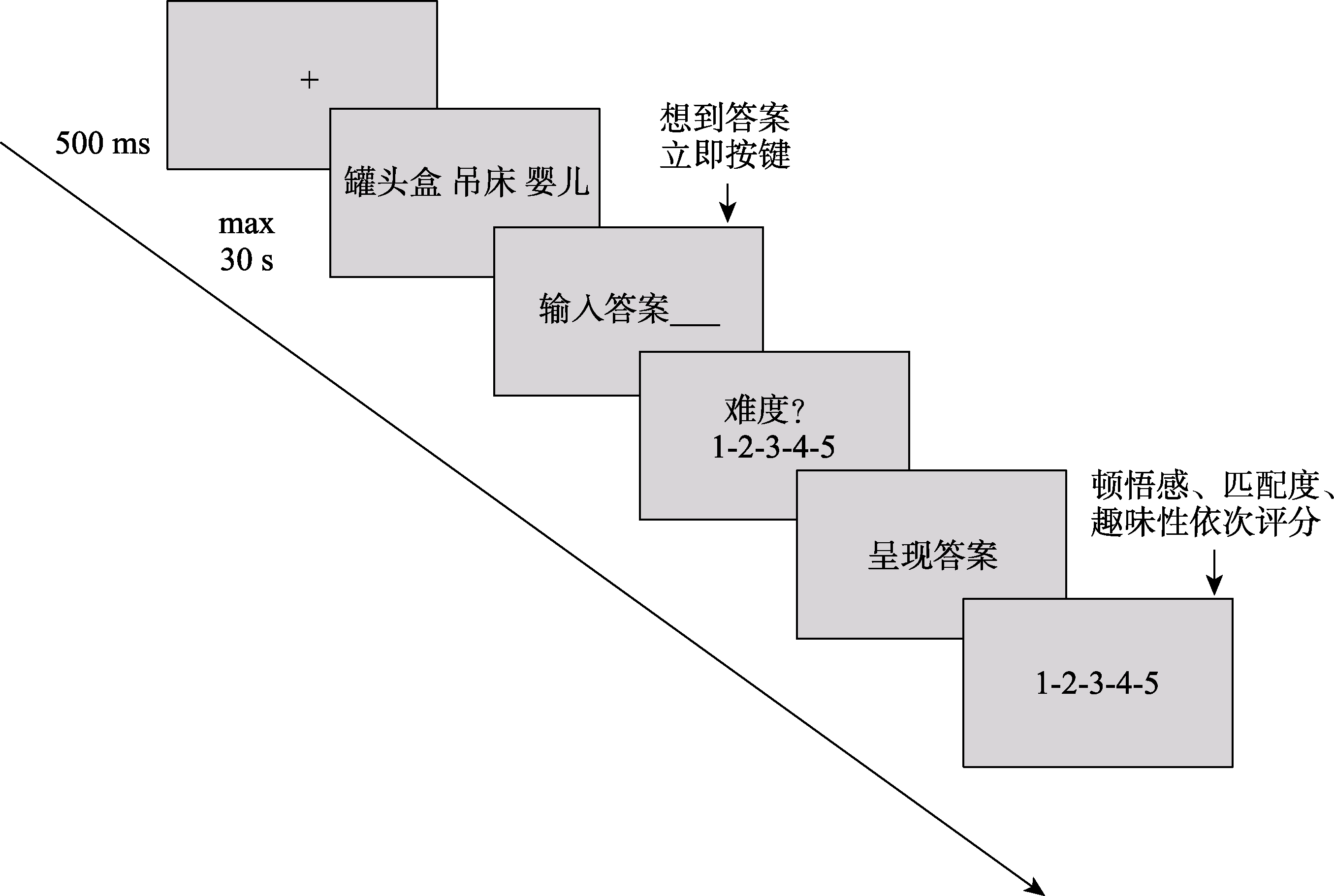
图1 MD-RAT材料评分任务
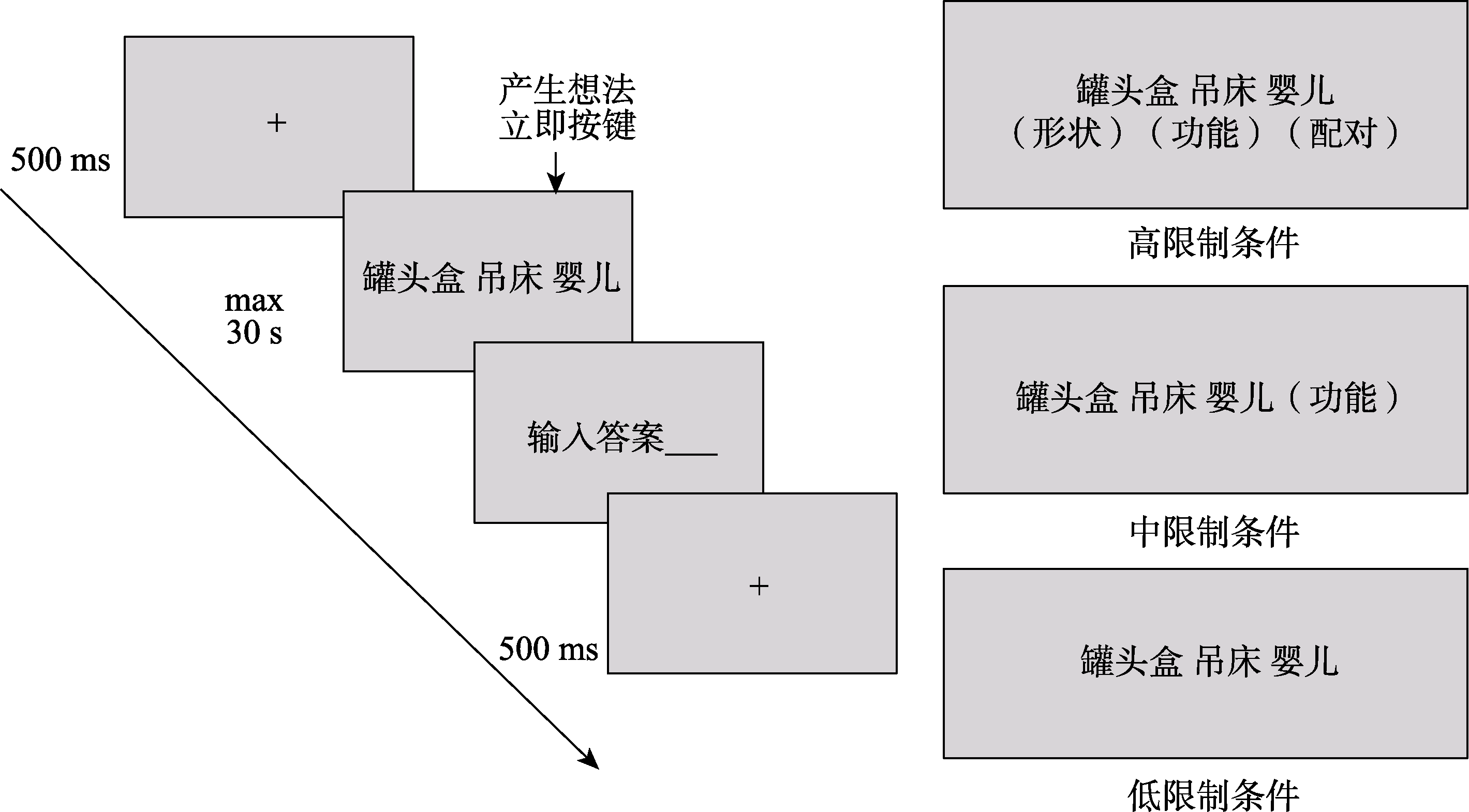
图2 实验1流程示意图
| 指标 | 最小值 | 最大值 | 平均值 | 标准差 |
|---|---|---|---|---|
| 通过率 | 0.25 | 0.89 | 0.65 | 0.16 |
| 反应时 | 10.05 | 30.97 | 19.86 | 5.61 |
| 难度 | 2.29 | 3.68 | 2.93 | 0.39 |
| 顿悟感 | 2.21 | 3.86 | 3.02 | 0.36 |
| 匹配度 | 3.68 | 4.57 | 4.23 | 0.23 |
| 趣味性 | 3.46 | 4.18 | 3.81 | 0.15 |
表1 MD-RAT材料难度、顿悟感等指标的描述性统计
| 指标 | 最小值 | 最大值 | 平均值 | 标准差 |
|---|---|---|---|---|
| 通过率 | 0.25 | 0.89 | 0.65 | 0.16 |
| 反应时 | 10.05 | 30.97 | 19.86 | 5.61 |
| 难度 | 2.29 | 3.68 | 2.93 | 0.39 |
| 顿悟感 | 2.21 | 3.86 | 3.02 | 0.36 |
| 匹配度 | 3.68 | 4.57 | 4.23 | 0.23 |
| 趣味性 | 3.46 | 4.18 | 3.81 | 0.15 |
| 指标 | 组别 | N | 平均数 | 标准差 | F | p |
|---|---|---|---|---|---|---|
| 正确率 | 高 | 78 | 0.76 | 0.08 | 26.15 | < 0.001 |
| 中 | 79 | 0.74 | 0.11 | |||
| 低 | 75 | 0.64 | 0.13 | |||
| 反应时 | 高 | 78 | 16.25 | 7.14 | 12.74 | < 0.001 |
| 中 | 79 | 19.96 | 7.83 | |||
| 低 | 75 | 23.16 | 10.24 |
表2 不同限制条件下正确率与反应时间的单因素方差分析
| 指标 | 组别 | N | 平均数 | 标准差 | F | p |
|---|---|---|---|---|---|---|
| 正确率 | 高 | 78 | 0.76 | 0.08 | 26.15 | < 0.001 |
| 中 | 79 | 0.74 | 0.11 | |||
| 低 | 75 | 0.64 | 0.13 | |||
| 反应时 | 高 | 78 | 16.25 | 7.14 | 12.74 | < 0.001 |
| 中 | 79 | 19.96 | 7.83 | |||
| 低 | 75 | 23.16 | 10.24 |
| 条件 | 正确率 | 言语流畅性 | 创造性成就 |
|---|---|---|---|
| 言语流畅性 | |||
| 高 | 0.34** | ||
| 中 | 0.20 | ||
| 低 | 0.32** | ||
| 创造性成就 | |||
| 高 | 0.26* | 0.28* | |
| 中 | 0.16 | 0.22 | |
| 低 | 0.27* | 0.30** | |
| 经验开放性 | |||
| 高 | 0.24* | 0.13 | 0.30** |
| 中 | 0.09 | 0.02 | 0.15 |
| 低 | 0.29* | 0.27* | 0.11 |
表3 不同空间限制条件下MD-RAT任务正确率与效标的相关性分析
| 条件 | 正确率 | 言语流畅性 | 创造性成就 |
|---|---|---|---|
| 言语流畅性 | |||
| 高 | 0.34** | ||
| 中 | 0.20 | ||
| 低 | 0.32** | ||
| 创造性成就 | |||
| 高 | 0.26* | 0.28* | |
| 中 | 0.16 | 0.22 | |
| 低 | 0.27* | 0.30** | |
| 经验开放性 | |||
| 高 | 0.24* | 0.13 | 0.30** |
| 中 | 0.09 | 0.02 | 0.15 |
| 低 | 0.29* | 0.27* | 0.11 |
| 变量名 | 组别 | 平均值 | 标准差 | t值 | p值 |
|---|---|---|---|---|---|
| 难度 | 高限制组 | 2.78 | 0.42 | −0.41 | 0.684 |
| 低限制组 | 2.83 | 0.34 | |||
| 顿悟感 | 高限制组 | 2.95 | 0.32 | −0.02 | 0.986 |
| 低限制组 | 2.95 | 0.35 | |||
| 匹配度 | 高限制组 | 4.33 | 0.19 | −0.24 | 0.811 |
| 低限制组 | 4.34 | 0.14 | |||
| 趣味性 | 高限制组 | 3.82 | 0.15 | −1.03 | 0.308 |
| 低限制组 | 3.86 | 0.13 |
表4 实验2材料难度、顿悟感等指标的描述性统计及差异性检验
| 变量名 | 组别 | 平均值 | 标准差 | t值 | p值 |
|---|---|---|---|---|---|
| 难度 | 高限制组 | 2.78 | 0.42 | −0.41 | 0.684 |
| 低限制组 | 2.83 | 0.34 | |||
| 顿悟感 | 高限制组 | 2.95 | 0.32 | −0.02 | 0.986 |
| 低限制组 | 2.95 | 0.35 | |||
| 匹配度 | 高限制组 | 4.33 | 0.19 | −0.24 | 0.811 |
| 低限制组 | 4.34 | 0.14 | |||
| 趣味性 | 高限制组 | 3.82 | 0.15 | −1.03 | 0.308 |
| 低限制组 | 3.86 | 0.13 |
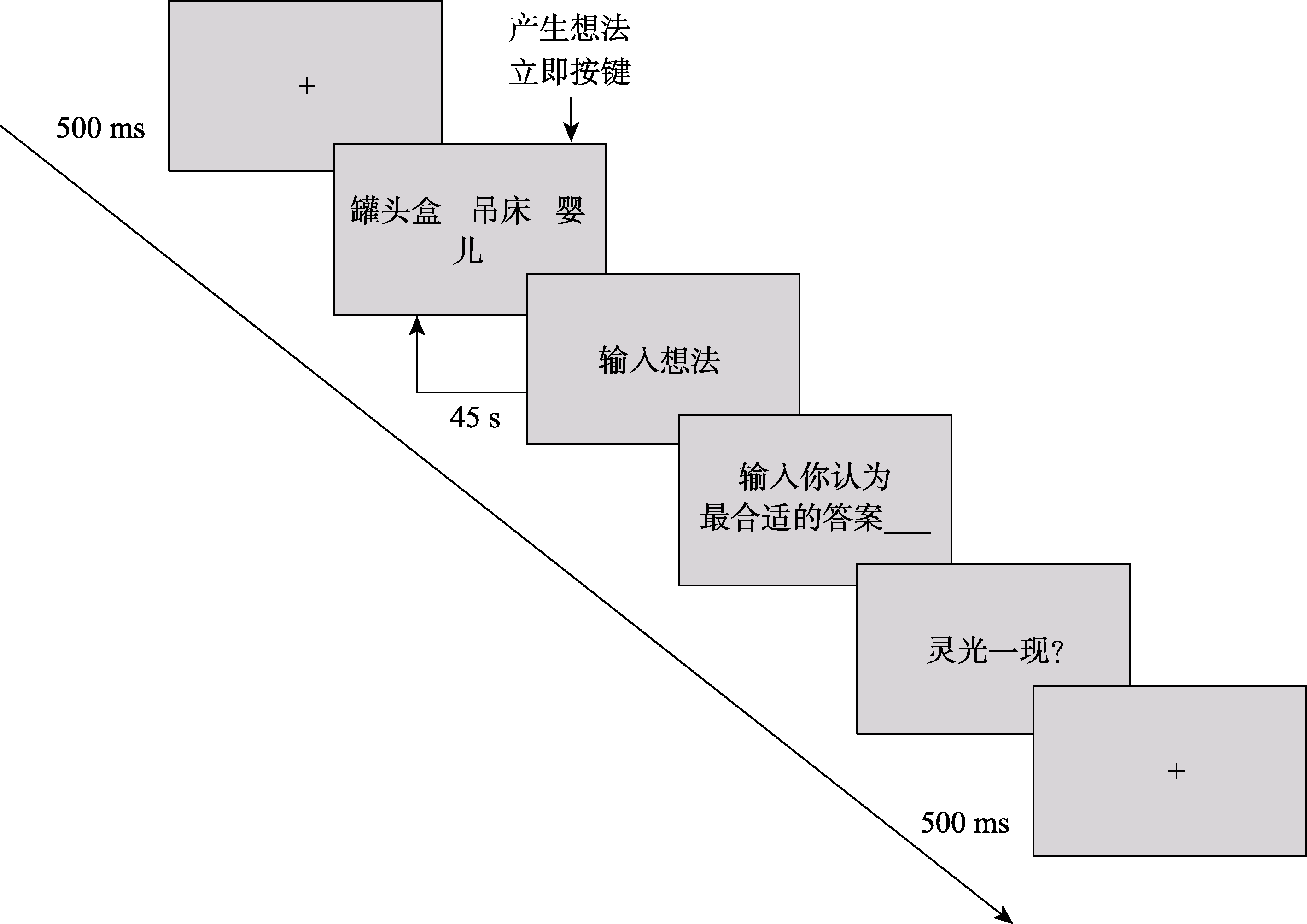
图3 实验2流程示意图
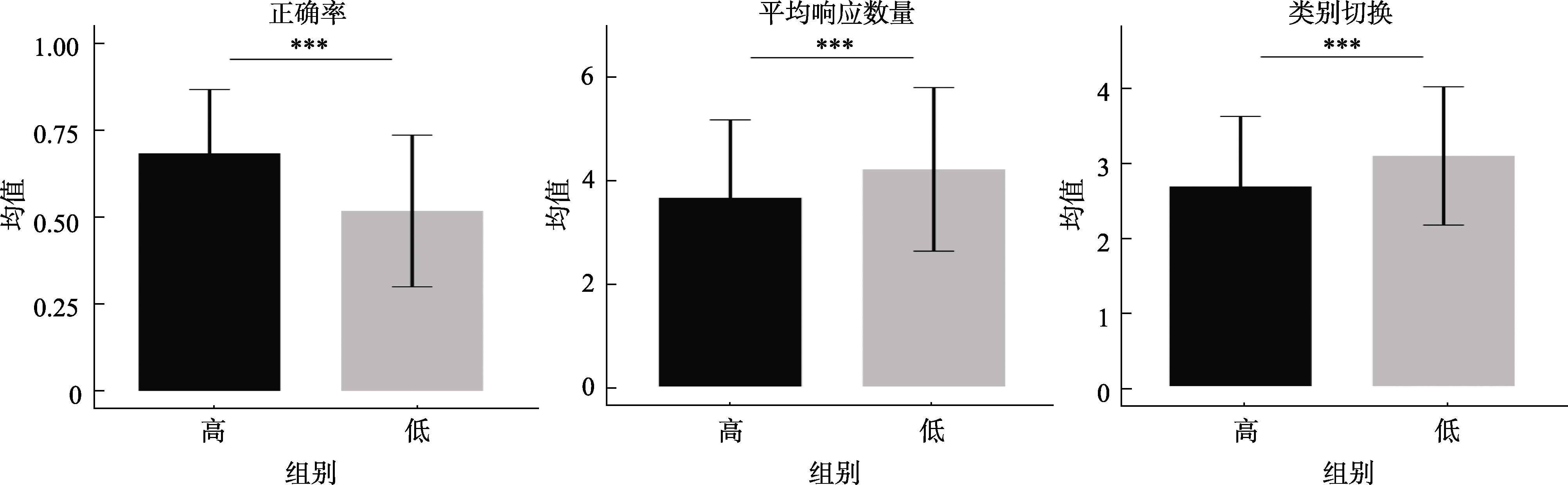
图4 限制性RAT任务正确率、响应次数、类别切换指标柱状图
| 效应 | Beta | SE | t | p |
|---|---|---|---|---|
| 固定效应 | ||||
| 截距 | 0.39 | 0.01 | 30.27 | < 0.001 |
| 间隔 | −0.02 | 0.004 | −5.57 | < 0.001 |
| 任务 | −0.06 | 0.01 | −6.72 | < 0.001 |
| 间隔×任务 | 0.01 | 0.004 | 2.56 | 0.012 |
| 随机效应 | 方差 | 标准差 | ||
| 被试 | 0.003 | 0.06 | ||
| 试次 | 0.001 | 0.03 | ||
| 残差 | 0.02 | 0.13 |
表5 响应间隔影响语义相似性变化的线性混合效应模型
| 效应 | Beta | SE | t | p |
|---|---|---|---|---|
| 固定效应 | ||||
| 截距 | 0.39 | 0.01 | 30.27 | < 0.001 |
| 间隔 | −0.02 | 0.004 | −5.57 | < 0.001 |
| 任务 | −0.06 | 0.01 | −6.72 | < 0.001 |
| 间隔×任务 | 0.01 | 0.004 | 2.56 | 0.012 |
| 随机效应 | 方差 | 标准差 | ||
| 被试 | 0.003 | 0.06 | ||
| 试次 | 0.001 | 0.03 | ||
| 残差 | 0.02 | 0.13 |

图5 高、低限制条件下语义相似度随响应间隔变化的柱状图
| 效应 | Beta | SE | t | p |
|---|---|---|---|---|
| 固定效应 | ||||
| 截距 | 0.78 | 0.02 | 33.02 | < 0.001 |
| 响应顺序 | 0.12 | 0.01 | 15.45 | < 0.001 |
| 任务 | −0.36 | 0.02 | −14.88 | < 0.001 |
| 响应顺序×任务 | −0.10 | 0.01 | −9.62 | 0.011 |
| 随机效应 | 方差 | 标准差 | ||
| 被试 | 0.008 | 0.09 | ||
| 试次 | 0.0009 | 0.03 | ||
| 残差 | 0.03 | 0.19 |
表6 响应路径相似性变化的线性混合效应模型
| 效应 | Beta | SE | t | p |
|---|---|---|---|---|
| 固定效应 | ||||
| 截距 | 0.78 | 0.02 | 33.02 | < 0.001 |
| 响应顺序 | 0.12 | 0.01 | 15.45 | < 0.001 |
| 任务 | −0.36 | 0.02 | −14.88 | < 0.001 |
| 响应顺序×任务 | −0.10 | 0.01 | −9.62 | 0.011 |
| 随机效应 | 方差 | 标准差 | ||
| 被试 | 0.008 | 0.09 | ||
| 试次 | 0.0009 | 0.03 | ||
| 残差 | 0.03 | 0.19 |
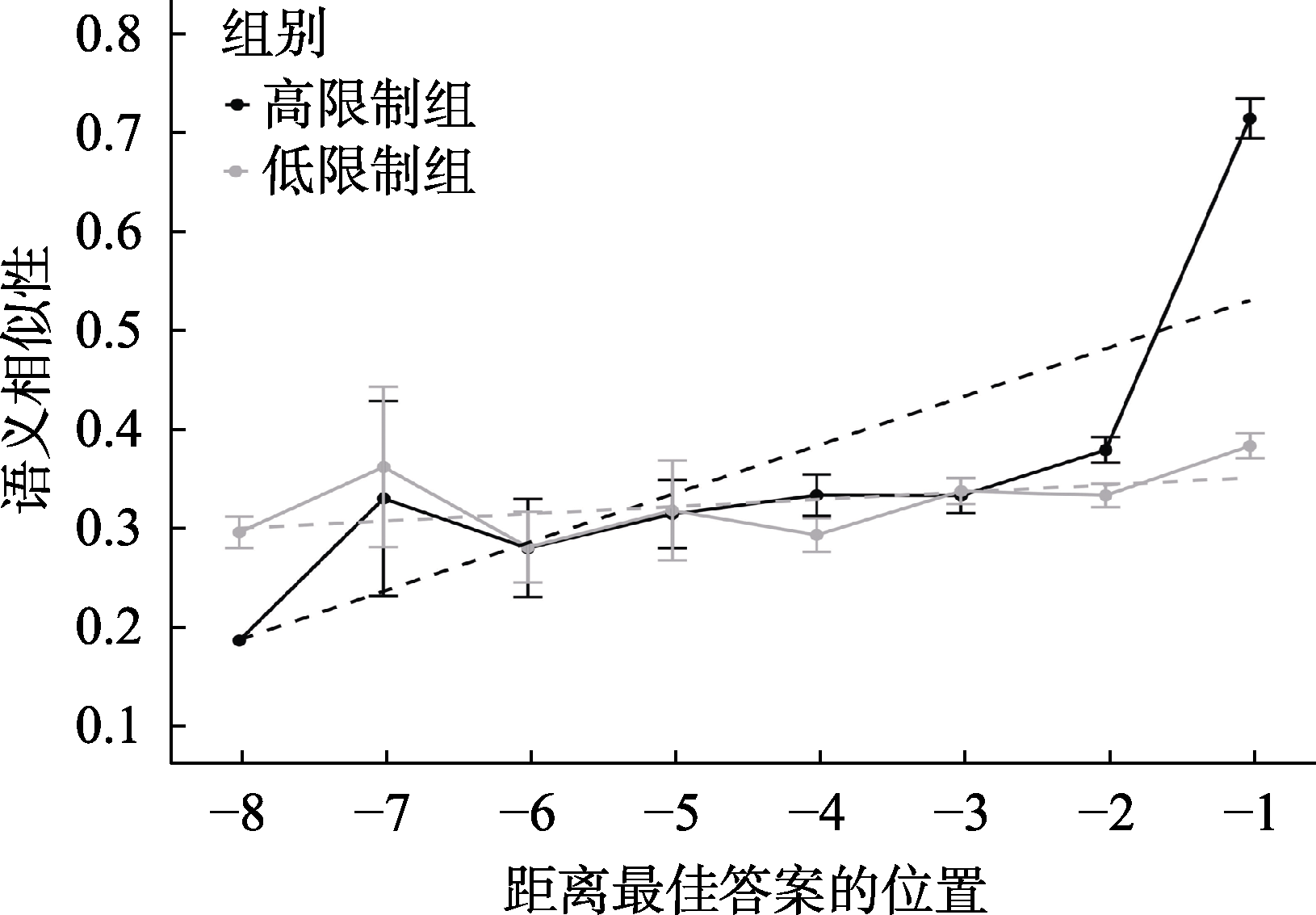
图6 联想路径的语义相似性变化折线图
| [1] |
Beaty, R. E., Benedek, M., Silvia, P. J., & Schacter, D. L. (2016). Creative cognition and brain network dynamics. Trends in Cognitive Sciences, 20(2), 87-95.
doi: S1364-6613(15)00254-5 pmid: 26553223 |
| [2] |
Beaty, R. E., & Johnson, D. R. (2021). Automating creativity assessment with SemDis: An open platform for computing semantic distance. Behavior Research Methods, 53(2), 757-780.
doi: 10.3758/s13428-020-01453-w |
| [3] |
Beaty, R. E., & Kenett, Y. N. (2023). Associative thinking at the core of creativity. Trends in Cognitive Sciences, 27(7), 671-683.
doi: 10.1016/j.tics.2023.04.004 URL |
| [4] | Beaty, R. E., Kenett, Y. N., Hass, R. W., & Schacter, D. L. (2023). Semantic memory and creativity: The costs and benefits of semantic memory structure in generating original ideas. Thinking & Reasoning, 29(2), 305-339. |
| [5] |
Beaty, R. E., Silvia, P. J., Nusbaum, E. C., Jauk, E., & Benedek, M. (2014). The roles of associative and executive processes in creative cognition. Memory & Cognition, 42(7), 1186-1197.
doi: 10.3758/s13421-014-0428-8 URL |
| [6] |
Becker, M., & Cabeza, R. (2023). Assessing creativity independently of language: A language-independent remote associate task (LI-RAT). Behavior Research Methods, 55(1), 85-102.
doi: 10.3758/s13428-021-01773-5 |
| [7] |
Becker, M., Sommer, T., & Kühn, S. (2020). Verbal insight revisited: fMRI evidence for early processing in bilateral insulae for solutions with AHA! experience shortly after trial onset. Human Brain Mapping, 41(1), 30-45.
doi: 10.1002/hbm.24785 pmid: 31520521 |
| [8] |
Bendetowicz, D., Urbanski, M., Aichelburg, C., Levy, R., & Volle, E. (2017). Brain morphometry predicts individual creative potential and the ability to combine remote ideas. Cortex, 86, 216-229.
doi: S0010-9452(16)30316-1 pmid: 27919546 |
| [9] |
Bendetowicz, D., Urbanski, M., Garcin, B., Foulon, C., Levy, R., Bréchemier, M. -L.,... Volle, E. (2018). Two critical brain networks for generation and combination of remote associations. Brain, 141(1), 217-233.
doi: 10.1093/brain/awx294 pmid: 29182714 |
| [10] |
Benedek, M., Jauk, E., Sommer, M., Arendasy, M., & Neubauer, A. C. (2014). Intelligence, creativity, and cognitive control: The common and differential involvement of executive functions in intelligence and creativity. Intelligence, 46, 73-83.
pmid: 25278640 |
| [11] | Bernard, M., Kenett, Y. N., Ovando-Tellez, M., Benedek, M., & Volle, E. (2019). Building Individual Semantic Networks and Exploring their Relationships with Creativity. Proceedings of the Annual Meeting of the Cognitive Science Society, 41, 138-144. |
| [12] |
Bowden, E. M., & Jung-Beeman, M. (2003). Normative data for 144 compound remote associate problems. Behavior Research Methods, Instruments, & Computers, 35, 634-639.
doi: 10.3758/BF03195543 URL |
| [13] | Cai, Q., & Brysbaert, M. (2010). SUBTLEX-CH: Chinese word and character frequencies based on film subtitles. PLoS ONE, 5(6), e10729. |
| [14] | Chen, J., Xu, T. W., & Chen, Q. L. (2024). Development and preliminary exploration of Chinese word remote associates test. Psychology: Techniques and Application, 12(5), 283-295. |
| [陈静, 许天委, 陈群林. (2024). 中文词语远距离联想测验的编制及初步探索. 心理技术与应用, 12(5), 283-295.] | |
| [15] |
Christensen, A. P., Kenett, Y. N., Cotter, K. N., Beaty, R. E., & Silvia, P. J. (2018). Remotely close associations: Openness to experience and semantic memory structure. European Journal of Personality, 32(4), 480-492.
doi: 10.1002/per.2157 URL |
| [16] | Davidson, J. E. (2003). Insights about insightful problem solving. In J. E. Davidson & R. J. Sternberg (Eds.), The psychology of problem solving (pp. 149-175). Cambridge University Press. |
| [17] |
Frith, E., Kane, M. J., Welhaf, M. S., Christensen, A. P., Silvia, P. J., & Beaty, R. E. (2021). Keeping creativity under control: Contributions of attention control and fluid intelligence to divergent thinking. Creativity Research Journal, 33(2), 138-157.
doi: 10.1080/10400419.2020.1855906 URL |
| [18] |
Hass, R. W. (2017). Semantic search during divergent thinking. Cognition, 166, 344-357.
doi: S0010-0277(17)30162-2 pmid: 28601001 |
| [19] |
Hills, T. T., Jones, M. N., & Todd, P. M. (2012). Optimal foraging in semantic memory. Psychological Review, 119(2), 431-440.
doi: 10.1037/a0027373 pmid: 22329683 |
| [20] |
Hills, T. T., Todd, P. M., & Goldstone, R. L. (2008). Search in external and internal spaces: Evidence for generalized cognitive search processes. Psychological Science, 19(8), 802-808.
doi: 10.1111/j.1467-9280.2008.02160.x pmid: 18816288 |
| [21] |
Hills, T. T., Todd, P. M., Lazer, D., Redish, A. D., Couzin, I. D., & Cognitive, Search Research Group. (2015). Exploration versus exploitation in space, mind, and society. Trends in Cognitive Sciences, 19(1), 46-54.
doi: 10.1016/j.tics.2014.10.004 pmid: 25487706 |
| [22] | Huang, P., Chen, H., & Liu, C. (2012). The development of Chinese word remote associates test for college students. Psychological Testing, 59(4), 581-607. |
| [23] |
Kenett, Y. N., Anaki, D., & Faust, M. (2014). Investigating the structure of semantic networks in low and high creative persons. Frontiers in Human Neuroscience, 8, 407.
doi: 10.3389/fnhum.2014.00407 pmid: 24959129 |
| [24] | Kenett, Y., & Austerweil, J. L. (2016). Examining Search Processes in Low and High Creative Individuals with RandomWalks. Proceedings of the Annual Meeting of the Cognitive Science Society, 38, 313-318. |
| [25] |
Kenett, Y. N., & Faust, M. (2019). A semantic network cartography of the creative mind. Trends in Cognitive Sciences, 23(4), 271-274.
doi: S1364-6613(19)30024-5 pmid: 30803872 |
| [26] |
Knoblich, G., Ohlsson, S., Haider, H., & Rhenius, D. (1999). Constraint relaxation and chunk decomposition in insight problem solving. Journal of Experimental Psychology: Learning, Memory, and Cognition, 25(6), 1534-1555.
doi: 10.1037/0278-7393.25.6.1534 URL |
| [27] |
Lezama, R., Gómez-Ariza, C. J., & Bajo, M. T. (2023). Individual differences in semantic priming and inhibitory control predict performance in the Remote Associates Test (RAT). Thinking Skills and Creativity, 50, 101426.
doi: 10.1016/j.tsc.2023.101426 URL |
| [28] |
Mednick, S. (1962). The associative basis of the creative process. Psychological Review, 69(3), 220-232.
doi: 10.1037/h0048850 URL |
| [29] | Ohlsson, S. (1992). Information-processing explanations of insight and related phenomena. In M. Keane & K. Gilhooley (Eds.), Advances in the psychology of thinking (pp. 1-44). Harvester-Wheatsheaf. |
| [30] | Ovando-Tellez, M., Benedek, M., Kenett, Y. N., Hills, T., Bouanane, S., Bernard, M.,... Volle, E. (2022). An investigation of the cognitive and neural correlates of semantic memory search related to creative ability. Communications Biology, 5(1), 604. |
| [31] |
Ovando-Tellez, M., Kenett, Y. N., Benedek, M., Bernard, M., Belo, J., Beranger, B., Bieth, T., & Volle, E. (2023). Brain connectivity-based prediction of combining remote semantic associates for creative thinking. Creativity Research Journal, 35(3), 522-546.
doi: 10.1080/10400419.2023.2192563 URL |
| [32] |
Runco, M. A. (2025). Updating the standard definition of creativity to account for the artificial creativity of AI. Creativity Research Journal, 37(1), 1-5.
doi: 10.1080/10400419.2023.2257977 URL |
| [33] |
Silvia, P. J., Beaty, R. E., & Nusbaum, E. C. (2013). Verbal fluency and creativity: General and specific contributions of broad retrieval ability (Gr) factors to divergent thinking. Intelligence, 41(5), 328-340.
doi: 10.1016/j.intell.2013.05.004 URL |
| [34] |
Simon, H. A., & Newell, A. (1971). Human problem solving: The state of the theory in 1970. American Psychologist, 26(2), 145-159.
doi: 10.1037/h0030806 URL |
| [35] |
Smith, K. A., Huber, D. E., & Vul, E. (2013). Multiply- constrained semantic search in the remote associates test. Cognition, 128(1), 64-75.
doi: 10.1016/j.cognition.2013.03.001 URL |
| [36] | Wang, Z. Q., & Zhang, X. L. (2020). The Validity and reliability of the Chinese version of the Creative Achievement Questionnaire. Studies of Psychology and Behavior, 18(3), 390-397. |
| [王战旗, 张兴利. (2020). 创造力成就问卷的中文修订. 心理与行为研究, 18(3), 390-397.] | |
| [37] |
Wiley, J., & Jarosz, A. F. (2012). Working memory capacity, attentional focus, and problem solving. Current Directions in Psychological Science, 21(4), 258-262.
doi: 10.1177/0963721412447622 URL |
| [38] |
Zare, M., & Flinchbaugh, C. (2019). Voice, creativity, and big five personality traits: A meta-analysis. Human Performance, 32(1), 30-51.
doi: 10.1080/08959285.2018.1550782 URL |
| [1] | 刘丽;白学军. 注意控制定势和线索类型在注意捕获中的作用[J]. 心理学报, 2016, 48(9): 1093-1104. |
| [2] | 王慧媛; 隋洁; 张明. 线索靶子关联和搜索策略对注意捕获的作用 ——来自意义线索的证据[J]. 心理学报, 2016, 48(7): 783-793. |
| [3] | 陈穗清;张积家;李艳霞;张惠霞. 手语词识别的影响因素探讨 ——手语词的两个网络系统及其交互作用[J]. 心理学报, 2015, 47(7): 878-889. |
| [4] | 王慧媛;张明;隋洁. 线索靶子关联和搜索策略对注意捕获的作用[J]. 心理学报, 2014, 46(2): 185-195. |
| [5] | 田燕,罗俊龙,李文福,邱江,张庆林. 原型表征对创造性问题解决过程中的启发效应的影响[J]. 心理学报, 2011, 43(06): 619-628. |
| [6] | 李彬寅,许百华,崔翔宇,盛,峰,雷婧宇. 图像记忆对动态搜索的影响[J]. 心理学报, 2010, 42(04): 485-495. |
| [7] | 胡凤培,葛列众,徐伟丹. 项目突显方式对视觉搜索策略的影响[J]. 心理学报, 2005, 37(03): 314-319. |
| [8] | 隋南,翁旭初,高扬,匡培梓. 梨状皮层或苍白球损毁对大鼠空间认知能力的影响[J]. 心理学报, 1995, 27(4): 428-433. |
| [9] | 隋南,谢东,匡培梓. 杏仁复合体损毁对大鼠空间认知能力的影响[J]. 心理学报, 1995, 27(3): 311-316. |
| [10] | 张煜,彭聃龄. 对语义网络中概念非类属关系的实验研究[J]. 心理学报, 1993, 25(1): 51-59. |
| [11] | 隋南,陈双双,匡培梓. 海马结构、前额皮层或尾-壳核损毁对大鼠空间认知能力的影响[J]. 心理学报, 1992, 24(4): 81-87. |
| [12] | 陈永明,雷晓军,宋均. 句子加工和语义记忆结构的实验研究[J]. 心理学报, 1992, 24(2): 3-9. |
| [13] | 隋南,匡培梓. 隔区或皮质顶叶损毁对大鼠空间认知能力的影响及大鼠搜索策略差异的研究[J]. 心理学报, 1992, 24(1): 82-90. |
| 阅读次数 | ||||||
|
全文 |
|
|||||
|
摘要 |
|
|||||
