

ISSN 0439-755X
CN 11-1911/B
主办:中国心理学会
中国科学院心理研究所
出版:科学出版社
CN 11-1911/B
主办:中国心理学会
中国科学院心理研究所
出版:科学出版社
心理学报 ›› 2026, Vol. 58 ›› Issue (4): 740-754.doi: 10.3724/SP.J.1041.2026.0740 cstr: 32110.14.2026.0740
康娜1, 柳武妹2( ), 曾伏娥3
收稿日期:2025-02-17
发布日期:2026-01-16
出版日期:2026-04-25
通讯作者:
柳武妹, E-mail: wumeijiayou@163.com基金资助:
KANG Na1, LIU Wumei2(), ZENG Fue3
Received:2025-02-17
Online:2026-01-16
Published:2026-04-25
摘要:
提高资源利用率, 实现社会的可持续发展是全球共同关注的问题。然而, 尚未有研究关注产品获取方式对消费者产品处置倾向的影响。通过9项研究和1个补充性分析, 本文发现了一种新颖的“租赁−转租”效应。具体而言, 研究1纵向追踪了消费者在现实生活中对其租赁(vs. 购买)产品的转租情况, 随后的5个线上实验(研究2a~ 2c和研究3a、3c)和2个实验室实验(研究2d和研究3b)进一步证实了这一效应, 并揭示了这一效应受到效用最大化的紧迫感驱动(研究3a、3b和研究3c)。此外, 本文进一步发现, 上述效应受到资源稀缺(研究4)的调节, 即该效应在资源稀缺(vs. 控制)条件下消失(vs. 存在)。最后, 单文章元分析证实了产品获取方式对消费者产品转租倾向的效应稳健。本文不仅推进了产品获取方式和产品处置的相关研究, 还为如何促进循环性和可持续性消费提供了实践启示。
中图分类号:
康娜, 柳武妹, 曾伏娥. (2026). 租赁之物, 急用其效: 产品获取方式如何影响消费者对产品的转租倾向?. 心理学报, 58(4), 740-754.
KANG Na, LIU Wumei, ZENG Fue. (2026). Renting with urgency: How product acquisition mode shapes consumers’ propensity to sublet?. Acta Psychologica Sinica, 58(4), 740-754.
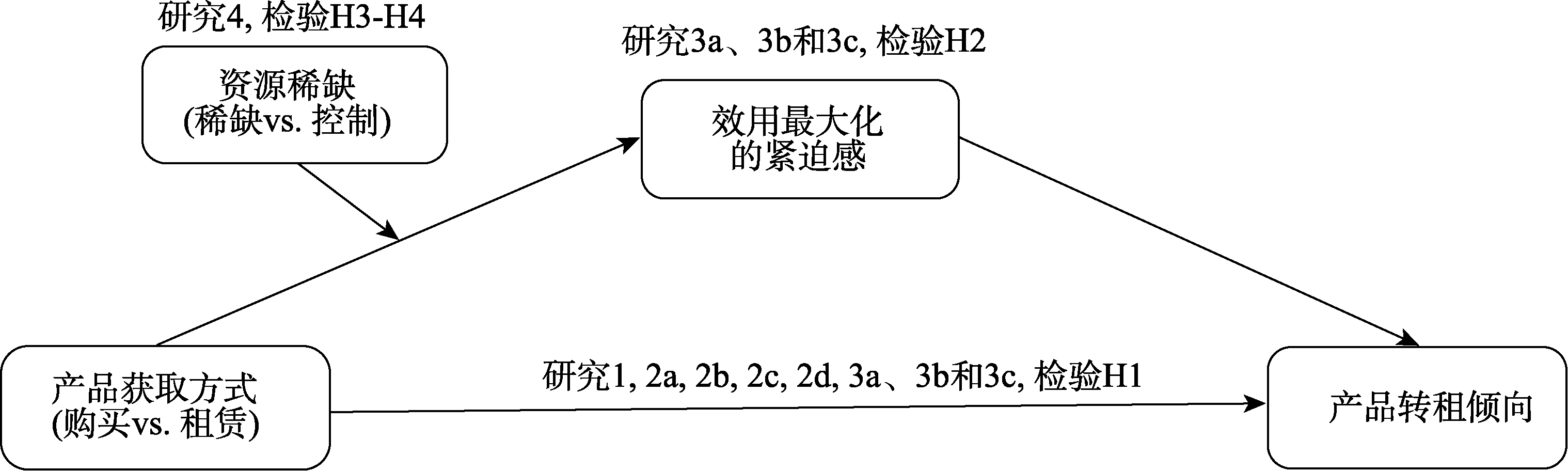
图1 本文模型框架图
| 研究 | 样本来源和 样本量 | 研究设计 | 实验刺激 | 研究结果 | ||||
|---|---|---|---|---|---|---|---|---|
| 组别(n) | M (SD)/ Percentages | χ2 / t / F | p | |||||
| 研究1 (田野实验, 预注册) | Credamo, N = 113 | 产品获取方式 (购买vs. 租赁) 单因素被试间设计 | / | 租赁组(57) | 92.98% | Pearson χ2 = 6.82 | 0.009 | |
| 购买组(56) | 75.00% | |||||||
| 研究2a (线上实验) | Credamo, N = 160 | 与研究1相同 | 黑神话悟空游戏机 | 租赁组(80) | 5.61 (0.92) | t(158) = −3.63 | <0.001 | |
| 购买组(80) | 5.01 (1.16) | |||||||
| 研究2b (线上实验) | Credamo, N = 160 | 与研究1相同 | 自行车 | 租赁组(80) | 5.32 (1.19) | t(158) = −3.37 | 0.001 | |
| 购买组(80) | 4.58 (1.56) | |||||||
| 研究2c (线上实验) | Credamo, N = 200 | 与研究1相同 | 露营帐篷 | 租赁组(100) | 5.68 (1.18) | t(198) = −2.76 | 0.006 | |
| 购买组(100) | 5.14 (1.54) | |||||||
| 研究2d (实验室实验) | 在校大学生, N = 200 | 与研究1相同 | 滑板 | 租赁组(100) | 4.17 (1.50) | t(198) = −2.12 | 0.036 | |
| 购买组(100) | 3.71 (1.57) | |||||||
| 研究3a (线上实验) | Credamo, N = 160 | 与研究1相同 | 滑雪板 | 租赁组(80) | 5.60 (0.84) | t(158) = −2.74 | 0.007 | |
| 购买组(80) | 5.09 (1.42) | |||||||
| 研究3b (实验室实验) | 在校大学生, N = 180 | 与研究1相同 | 电动滑板车 | 租赁组(90) | 4.64 (1.20) | t(178) = −2.21 | 0.028 | |
| 购买组(90) | 4.21 (1.45) | |||||||
| 研究3c (线上实验) | Credamo, N = 160 | 与研究1相同 | 投影仪 | 租赁组(80) | 5.43 (1.21) | t(158) = −2.62 | 0.010 | |
| 购买组(80) | 4.81 (1.75) | |||||||
| 研究4 (线上实验) | Credamo, N = 320 | 2(产品获取方式: 购买 vs. 租赁)×2(资源稀缺:稀缺 vs. 控制)双因素被试间设计 | 自行车 | 稀缺组 | 租赁组(80) | 5.48 (0.99) | F(1, 316) = 2.48 | 0.116 |
| 购买组(80) | 5.15 (1.27) | |||||||
| 控制组 | 租赁组(80) | 5.29 (1.24) | F(1, 316) = 23.48 | <0.001 | ||||
| 购买组(80) | 4.28 (1.72) | |||||||
表1 实验设计总览
| 研究 | 样本来源和 样本量 | 研究设计 | 实验刺激 | 研究结果 | ||||
|---|---|---|---|---|---|---|---|---|
| 组别(n) | M (SD)/ Percentages | χ2 / t / F | p | |||||
| 研究1 (田野实验, 预注册) | Credamo, N = 113 | 产品获取方式 (购买vs. 租赁) 单因素被试间设计 | / | 租赁组(57) | 92.98% | Pearson χ2 = 6.82 | 0.009 | |
| 购买组(56) | 75.00% | |||||||
| 研究2a (线上实验) | Credamo, N = 160 | 与研究1相同 | 黑神话悟空游戏机 | 租赁组(80) | 5.61 (0.92) | t(158) = −3.63 | <0.001 | |
| 购买组(80) | 5.01 (1.16) | |||||||
| 研究2b (线上实验) | Credamo, N = 160 | 与研究1相同 | 自行车 | 租赁组(80) | 5.32 (1.19) | t(158) = −3.37 | 0.001 | |
| 购买组(80) | 4.58 (1.56) | |||||||
| 研究2c (线上实验) | Credamo, N = 200 | 与研究1相同 | 露营帐篷 | 租赁组(100) | 5.68 (1.18) | t(198) = −2.76 | 0.006 | |
| 购买组(100) | 5.14 (1.54) | |||||||
| 研究2d (实验室实验) | 在校大学生, N = 200 | 与研究1相同 | 滑板 | 租赁组(100) | 4.17 (1.50) | t(198) = −2.12 | 0.036 | |
| 购买组(100) | 3.71 (1.57) | |||||||
| 研究3a (线上实验) | Credamo, N = 160 | 与研究1相同 | 滑雪板 | 租赁组(80) | 5.60 (0.84) | t(158) = −2.74 | 0.007 | |
| 购买组(80) | 5.09 (1.42) | |||||||
| 研究3b (实验室实验) | 在校大学生, N = 180 | 与研究1相同 | 电动滑板车 | 租赁组(90) | 4.64 (1.20) | t(178) = −2.21 | 0.028 | |
| 购买组(90) | 4.21 (1.45) | |||||||
| 研究3c (线上实验) | Credamo, N = 160 | 与研究1相同 | 投影仪 | 租赁组(80) | 5.43 (1.21) | t(158) = −2.62 | 0.010 | |
| 购买组(80) | 4.81 (1.75) | |||||||
| 研究4 (线上实验) | Credamo, N = 320 | 2(产品获取方式: 购买 vs. 租赁)×2(资源稀缺:稀缺 vs. 控制)双因素被试间设计 | 自行车 | 稀缺组 | 租赁组(80) | 5.48 (0.99) | F(1, 316) = 2.48 | 0.116 |
| 购买组(80) | 5.15 (1.27) | |||||||
| 控制组 | 租赁组(80) | 5.29 (1.24) | F(1, 316) = 23.48 | <0.001 | ||||
| 购买组(80) | 4.28 (1.72) | |||||||
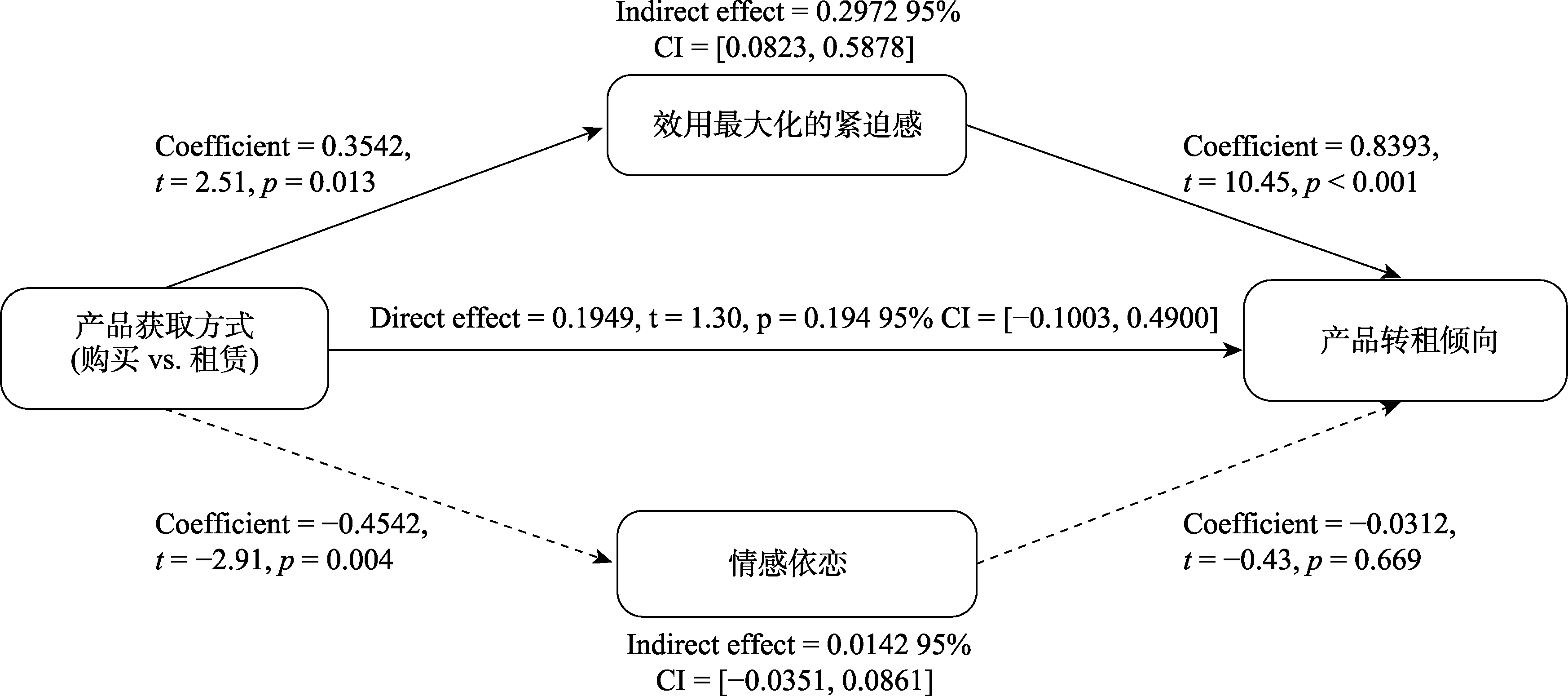
图2 研究3a中效用最大化的紧迫感的中介效应分析结果

图3 研究4中产品获取方式和资源稀缺对自行车转租倾向的交互效应
| 不处置 | 转卖 | 转租 | 捐赠 | 其它 | |
|---|---|---|---|---|---|
| 人数(n) | 17 | 48 | 37 | 10 | 1 |
| 百分比(%) | 15.04 | 42.48 | 32.74 | 8.85 | 0.88 |
表1 产品处置习惯
| 不处置 | 转卖 | 转租 | 捐赠 | 其它 | |
|---|---|---|---|---|---|
| 人数(n) | 17 | 48 | 37 | 10 | 1 |
| 百分比(%) | 15.04 | 42.48 | 32.74 | 8.85 | 0.88 |
| 3000元及以下 | 3001-6000元 | 6001-9000元 | 9000元以上 | |
|---|---|---|---|---|
| 人数(n) | 20 | 23 | 28 | 42 |
| 百分比(%) | 17.70 | 20.35 | 24.78 | 37.17 |
表2 月收入水平
| 3000元及以下 | 3001-6000元 | 6001-9000元 | 9000元以上 | |
|---|---|---|---|---|
| 人数(n) | 20 | 23 | 28 | 42 |
| 百分比(%) | 17.70 | 20.35 | 24.78 | 37.17 |
| [1] |
Aspara J., & Wittkowski K. (2019). Sharing-dominant logic? Quantifying the association between consumer intelligence and choice of social access modes. Journal of Consumer Research, 46(2), 201-222.
doi: 10.1093/jcr/ucy074 URL |
| [2] |
Bagga C. K., Bendle N., & Cotte J. (2019). Object valuation and non-ownership possession: How renting and borrowing impact willingness-to-pay. Journal of the Academy of Marketing Science, 47(1), 97-117.
doi: 10.1007/s11747-018-0596-3 |
| [3] |
Bardhi F., & Eckhardt G. M. (2012). Access-based consumption: The case of car sharing. Journal of Consumer Research, 39(4), 881-898.
doi: 10.1086/666376 URL |
| [4] | Borenstein M., Hedges L. V., Higgins J. P., & Rothstein H. R. (2021). Introduction to meta-analysis. John Wiley & Sons. |
| [5] |
Chen S. Y., Xiong J. W., & Peng K. P. (2025). The “diminished enjoyment with the best deal” effect: How does frugal mindset impact the anticipated enjoyment and experiential evaluation in food consumption? Acta Psychologica Sinica, 57(1), 152-172.
doi: 10.3724/SP.J.1041.2025.0152 |
|
[陈斯允, 熊继伟, 彭凯平. (2025). “羊毛薅尽口味乏”:节俭心态如何影响食物预期享受与体验评估. 心理学报, 57(1), 152-172.]
doi: 10.3724/SP.J.1041.2025.0152 |
|
| [6] |
Donnelly G. E., Lamberton C., Reczek R. W., & Norton M. I. (2017). Social recycling transforms unwanted goods into happiness. Journal of the Association for Consumer Research, 2(1), 48-63.
doi: 10.1086/689866 URL |
| [7] |
Durgee J. F., & O’Connor G. C. (1995). An exploration into renting as consumption behavior. Psychology & Marketing, 12(2), 89-104.
doi: 10.1002/mar.v12:2 URL |
| [8] |
Edbring E. G., Lehner M., & Mont O. (2016). Exploring consumer attitudes to alternative models of consumption: Motivations and barriers. Journal of Cleaner Production, 123, 5-15.
doi: 10.1016/j.jclepro.2015.10.107 URL |
| [9] |
Fan L., Li X., & Jiang Y. (2019). Room for opportunity: Resource scarcity increases attractiveness of range marketing offers. Journal of Consumer Research, 46(1), 82-98.
doi: 10.1093/jcr/ucy059 URL |
| [10] | Fuchs C., Prandelli E., & Schreier M. (2010). The psychological effects of empowerment strategies on consumers’ product demand. Journal of Marketing, 74(1), 65-79. |
| [11] |
Gal D., & Rucker D. D. (2018). The loss of loss aversion: Will it loom larger than its gain? Journal of Consumer Psychology, 28(3), 497-516.
doi: 10.1002/jcpy.2018.28.issue-3 URL |
| [12] | Gao S. S., & Herbert W. E. (1996). Lease finance in emerging markets: An eastern European study. Managerial Finance, 22(12), 39-53. |
| [13] |
Gignac G. E., & Szodorai E. T. (2016). Effect size guidelines for individual differences researchers. Personality and Individual Differences, 102, 74-78.
doi: 10.1016/j.paid.2016.06.069 URL |
| [14] |
Goldsmith K., Roux C., & Ma J. (2017). When seeking the best brings out the worst in consumers: Understanding the relationship between a maximizing mindset and immoral behavior. Journal of Consumer Psychology, 28(2), 293-309.
doi: 10.1002/jcpy.2018.28.issue-2 URL |
| [15] |
Gong X. S., & Jiang J. (2018). The effect of incidental similarity (“dress same”) on consumers’ product disposition intentions and its underlying mechanism. Acta Psychologica Sinica, 50(3), 337-348.
doi: 10.3724/SP.J.1041.2018.00337 URL |
| [宫秀双, 蒋晶. (2018). 撞衫对消费者产品处置意向的影响及其心理机制. 心理学报, 50(3), 337-348.] | |
| [16] |
Guo Y., Lamberton C., & Goldsmith K. (2024). The role of product acquisition mode in self-and social-signals of status. Marketing Letters, 35(1), 143-157.
doi: 10.1007/s11002-023-09688-1 |
| [17] |
Harding R. D., Hildebrand D., Kramer T., & Lasaleta J. D. (2019). The impact of acquisition mode on expected speed of product mastery and subsequent consumer behavior. Journal of Consumer Research, 46(1), 140-158.
doi: 10.1093/jcr/ucy063 |
| [18] |
Haws K. L., Naylor R. W., Coulter R. A., & Bearden W. O. (2012). Keeping it all without being buried alive: Understanding product retention tendency. Journal of Consumer Psychology, 22(2), 224-236.
doi: 10.1016/j.jcps.2011.05.003 URL |
| [19] | Hayes A. F. (2013). Introduction to mediation, moderation, and conditional process analysis: A regression-based approach. Guilford Publications. |
| [20] |
Huang B., Suri A., Tezer A., & Sénécal S. (2024). This is not mine anymore: The dark side of collaborative consumption. International Journal of Research in Marketing, 41(4), 616-631.
doi: 10.1016/j.ijresmar.2024.05.002 URL |
| [21] |
Huang F., & Fishbach A. (2021). Feeling lonely increases interest in previously owned products. Journal of Marketing Research, 58(5), 968-980.
doi: 10.1177/00222437211030685 URL |
| [22] |
Huang F., & Wong V. C. (2024). From second-hand to third- hand: Reuse and resale cycle. Journal of Consumer Research, 51(1), 104-113.
doi: 10.1093/jcr/ucad042 URL |
| [23] |
Kim S., & Mcgill A. L. (2011). Gaming with Mr. slot or gaming the slot machine? Power, anthropomorphism, and risk perception. Journal of Consumer Research, 38(1), 94-107.
doi: 10.1086/658148 URL |
| [24] |
King D., Auschaitrakul S., & Lin C. W. J. (2022). Search modality effects: Merely changing product search modality alters purchase intentions. Journal of the Academy of Marketing Science, 50(6), 1236-1256.
doi: 10.1007/s11747-021-00820-z |
| [25] |
Lamberton C. P., & Rose R. L. (2012). When is ours better than mine? A framework for understanding and altering participation in commercial sharing systems. Journal of Marketing, 76(4), 109-125.
doi: 10.1509/jm.10.0368 URL |
| [26] |
Lang C., Armstrong C. M., & Brannon L. A. (2013). Drivers of clothing disposal in the us: An exploration of the role of personal attributes and behaviours in frequent disposal. International Journal of Consumer Studies, 37(6), 706-714.
doi: 10.1111/ijcs.2013.37.issue-6 URL |
| [27] |
Layous K., Kurtz J., Chancellor J., & Lyubomirsky S. (2018). Reframing the ordinary: Imagining time as scarce increases well-being. The Journal of Positive Psychology, 13(3), 301-308.
doi: 10.1080/17439760.2017.1279210 URL |
| [28] |
Li A. M., Li B., Xu H., Li F. L., Zhang Y. H., & Liang Z. Y. (2018). Effects of cognitive and affective tags in mental accounting on consumer decision making. Acta Psychologica Sinica, 46(7), 976-986.
doi: 10.3724/SP.J.1041.2014.00976 URL |
| [李爱梅, 李斌, 许华, 李伏岭, 张耀辉, 梁竹苑. (2014). 心理账户的认知标签与情绪标签对消费决策行为的影响. 心理学报, 46(7), 976-986.] | |
| [29] |
Liu W., Kang N., & Song P. (2024). The rental-function effect: How does product acquisition mode affect consumer preference relating to product attributes? Psychology & Marketing, 41(12), 3024-3040.
doi: 10.1002/mar.v41.12 URL |
| [30] |
Ma J., & Roese N. J. (2014). The maximizing mind-set. Journal of Consumer Research, 41(1), 71-92.
doi: 10.1086/674977 URL |
| [31] |
Mehta R., & Zhu M. (2016). Creating when you have less: The impact of resource scarcity on product use creativity. Journal of Consumer Research, 42(5), 767-782.
doi: 10.1093/jcr/ucv051 URL |
| [32] |
Nie X., Yang Z., Zhang Y., & Janakiraman N. (2022). How does global-local identity affect consumer preference for access-based consumption? Investigating the mediating role of consumption openness. Journal of Marketing Research, 59(3), 555-577.
doi: 10.1177/00222437211055130 URL |
| [33] |
Paden N., & Stell R. (2005). Consumer product redistribution: Disposition decisions and channel options. Journal of Marketing Channels, 12(3), 105-123.
doi: 10.1300/J049v12n03_06 URL |
| [34] |
Paundra J., Rook L., van Dalen J., & Ketter W. (2017). Preferences for car sharing services: Effects of instrumental attributes and psychological ownership. Journal of Environmental Psychology, 53, 121-130.
doi: 10.1016/j.jenvp.2017.07.003 URL |
| [35] |
Peck J., & Shu S. B. (2009). The effect of mere touch on perceived ownership. Journal of Consumer Research, 36(3), 434-447.
doi: 10.1086/598614 URL |
| [36] |
Ross G. R., Bolton L. E., & Meloy M. G. (2023). Disorder in secondhand retail spaces: The countervailing forces of hidden treasure and risk. Journal of Retailing, 99(1), 136-148.
doi: 10.1016/j.jretai.2022.12.002 URL |
| [37] |
Shah A. K., Mullainathan S., & Shafir E. (2012). Some consequences of having too little. Science, 338(6107), 682-685.
doi: 10.1126/science.1222426 pmid: 23118192 |
| [38] |
Shani-Feinstein Y., Kyung E. J., & Goldenberg J. (2022). Moving, fast or slow: How perceived speed influences mental representation and decision making. Journal of Consumer Research, 49(3), 520-542.
doi: 10.1093/jcr/ucac004 URL |
| [39] | Thaler R. H. (2000). From homo economicus to homo sapiens. Journal of Economic Perspectives, 14(1), 133-141. |
| [40] |
Thomson M., Macinnis D. J., & Park C. W. (2005). The ties that bind: Measuring the strength of consumers’ emotional attachments to brands. Journal of Consumer Psychology, 15(1), 77-91.
doi: 10.1207/s15327663jcp1501_10 URL |
| [41] |
Trudel R., Argo J. J., & Meng M. D. (2016). The recycled self: Consumers’ disposal decisions of identity-linked products. Journal of Consumer Research, 43(2), 246-264.
doi: 10.1093/jcr/ucw014 URL |
| [42] | United Nations. (2022). Q&A: UN Environment Assembly. February 25, accessed at https://www.unep.org/news-and-stories/story/qa-un-environment-assembly |
| [43] |
Wang L., Su X., & You Y. (2021). Purchasing luck: The impact of scarcity cues on superstitious behavior. Journal of Consumer Behaviour, 20(3), 577-589.
doi: 10.1002/cb.v20.3 URL |
| [44] |
Wang L., You Y., & Yang C. M. (2020). Restrained by resources: The effect of scarcity cues and childhood socioeconomic status (SES) on consumer preference for feasibility. International Journal of Research in Marketing, 37(3), 557-571.
doi: 10.1016/j.ijresmar.2020.01.007 URL |
| [45] | Wang Y. (2021). Research on the influence mechanism of goal framework on consumer product disposal intention [Unpublished doctorial dissertation]. Jilin University, Changchun. |
| [王琰. (2021). 目标框架对消费者产品处置意愿的影响机制研究 (博士学位论文). 吉林大学, 长春.] | |
| [46] | Weiss, L. (2017). Possession substitutability:Identity and usage of rented (versus owned) products. In A. Gneezy, V. Griskevicius, & P. Williams (Eds.), Advances in Consumer Research (Vol. 45, pp. 957-958). Association for Consumer Research. |
| [47] |
Winterich K. P., Reczek R. W., & Irwin J. R. (2017). Keeping the memory but not the possession: Memory preservation mitigates identity loss from product disposition. Journal of Marketing, 81(5), 104-120.
doi: 10.1509/jm.16.0311 URL |
| [48] | Yang X. Y., & Deng Y. K. (2014). The impact of emotional attachment on consumers’ participation in collaborative consumption: A perspective based on product disposition. Consumer Economics, 30(5), 56-60. |
| [杨晓燕, 邓珏坤. (2014). 情感依恋对消费者参与协同消费的影响方式——基于产品处置的视角. 消费经济, 30(5), 56-60.] | |
| [49] | Young, M. M., & Wallendorf M. (1989). Ashes to ashes, dust to dust:Conceptualizing consumer disposition of possessions. In Terry L. Childers, Richard P. Bagozzi, & J. Paul Peter (Eds.), In Proceedings of the AMA winter educator’s conference (pp. 33-39). American Marketing Association. |
| [50] | Zhu M., Yang Y., & Hsee C. K. (2018). The mere urgency effect. Journal of Consumer Research, 45(3), 673-690. |
| [1] | 杨阳, 曹俊, 李潇林, 俄怡然, 谭羽荃, 贾亦心. 敬畏和共同内群体认同:感知资源稀缺性的调节*[J]. 心理学报, 2026, 58(4): 667-682. |
| [2] | 刘晓敏, 王雪, 向虹宇, 陈增祥, 苏凇. “共享消费悖论”:财务稀缺心态阻碍共享消费[J]. 心理学报, 2025, 57(7): 1281-1294. |
| 阅读次数 | ||||||
|
全文 |
|
|||||
|
摘要 |
|
|||||
