

ISSN 0439-755X
CN 11-1911/B
主办:中国心理学会
中国科学院心理研究所
出版:科学出版社
CN 11-1911/B
主办:中国心理学会
中国科学院心理研究所
出版:科学出版社
心理学报 ›› 2026, Vol. 58 ›› Issue (4): 667-682.doi: 10.3724/SP.J.1041.2026.0667 cstr: 32110.14.2026.0667
杨阳1,2( ), 曹俊1,2, 李潇林1,2, 俄怡然1,2, 谭羽荃1,2, 贾亦心3
收稿日期:2025-02-17
发布日期:2026-01-16
出版日期:2026-04-25
通讯作者:
杨阳, E-mail: yy20111219@163.com基金资助:
YANG Yang1,2(), CAO Jun1,2, LI Xiaolin1,2, E Yiran1,2, TAN Yuquan1,2, JIA Yixin3
Received:2025-02-17
Online:2026-01-16
Published:2026-04-25
摘要:
共同内群体认同是指赋予两个原本独立的群体一个上位身份, 使群体成员的认知表征由两个子群体变成一个共同内群体, 把对内群体成员的积极情感延伸到原外群体成员中, 有利于改善群际关系、增强凝聚力。面对复杂的国际环境, 团结是民族发展的重要力量, 因此如何提升共同内群体认同对民族发展至关重要。文章通过问卷调查(研究1)和操纵敬畏、感知资源稀缺性(研究2~4)探讨了敬畏对共同内群体认同的影响及作用机制。结果发现高感知资源稀缺性削弱了特质敬畏对共同内群体认同的影响(研究1), 并且调节了基于威胁的敬畏与共同内群体认同的关系(研究2~4), 即高感知资源稀缺性抑制了基于威胁的敬畏对共同内群体认同的促进效应。该结果启示我们可以通过增强敬畏, 尤其是积极敬畏来提升群体凝聚力。
中图分类号:
杨阳, 曹俊, 李潇林, 俄怡然, 谭羽荃, 贾亦心. (2026). 敬畏和共同内群体认同:感知资源稀缺性的调节. 心理学报, 58(4), 667-682.
YANG Yang, CAO Jun, LI Xiaolin, E Yiran, TAN Yuquan, JIA Yixin. (2026). The impact of awe on common ingroup identity: The moderating role of perceived resource scarcity. Acta Psychologica Sinica, 58(4), 667-682.
| 变量 | M | SD | 1 | 2 | 3 | 4 | 5 |
|---|---|---|---|---|---|---|---|
| 1.性别 | − | − | 1 | ||||
| 2.年龄(岁) | 20.72 | 2.05 | 0.18*** | 1 | |||
| 3.敬畏 | 4.57 | 0.91 | 0.03 | 0.05 | 1 | ||
| 4.共同内群体认同 | 5.73 | 1.07 | 0.01 | −0.09 | 0.34*** | 1 | |
| 5.感知资源稀缺性 | 3.44 | 1.06 | 0.12* | −0.04 | −0.25*** | −0.18*** | 1 |
表1 性别、年龄、敬畏、共同内群体认同和感知资源稀缺性的相关
| 变量 | M | SD | 1 | 2 | 3 | 4 | 5 |
|---|---|---|---|---|---|---|---|
| 1.性别 | − | − | 1 | ||||
| 2.年龄(岁) | 20.72 | 2.05 | 0.18*** | 1 | |||
| 3.敬畏 | 4.57 | 0.91 | 0.03 | 0.05 | 1 | ||
| 4.共同内群体认同 | 5.73 | 1.07 | 0.01 | −0.09 | 0.34*** | 1 | |
| 5.感知资源稀缺性 | 3.44 | 1.06 | 0.12* | −0.04 | −0.25*** | −0.18*** | 1 |
| 因变量 | 自变量 | β | t | 95%置信区间 | R | F |
|---|---|---|---|---|---|---|
| 共同内群体认同 | 敬畏 | 0.38 | 6.49*** | [0.27, 0.50] | 0.14 | 19.90 |
| 感知资源稀缺性 | −0.08 | −1.52 | [−0.18, 0.02] | |||
| 敬畏×感知资源稀缺性 | −0.12 | −2.37* | [−0.22, −0.02] |
表2 感知资源稀缺性的调节效应检验
| 因变量 | 自变量 | β | t | 95%置信区间 | R | F |
|---|---|---|---|---|---|---|
| 共同内群体认同 | 敬畏 | 0.38 | 6.49*** | [0.27, 0.50] | 0.14 | 19.90 |
| 感知资源稀缺性 | −0.08 | −1.52 | [−0.18, 0.02] | |||
| 敬畏×感知资源稀缺性 | −0.12 | −2.37* | [−0.22, −0.02] |
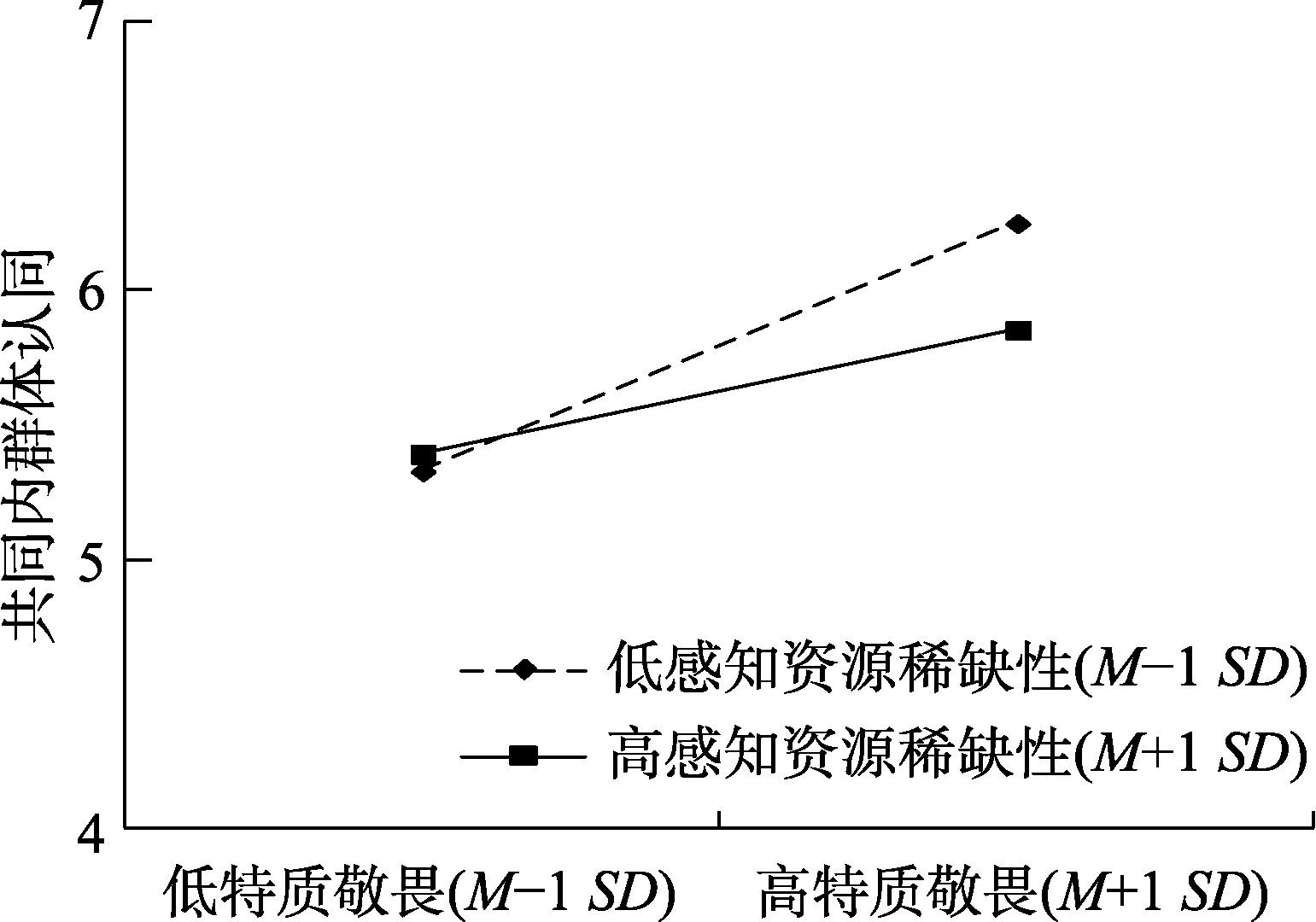
图1 感知资源稀缺性对敬畏与共同内群体认同关系的调节作用图
| 情绪 | F | p | η | 积极敬畏vs 控制组 | 基于威胁的敬畏 vs控制组 | 积极敬畏 vs基于威胁的敬畏 | 积极敬畏 M ± SD | 基于威胁的敬畏 M ± SD | 控制组 M ± SD | |||
|---|---|---|---|---|---|---|---|---|---|---|---|---|
| p | d | p | d | p | d | |||||||
| 快乐 | 15.03 | < 0.001 | 0.124 | 0.005 | 0.53 | 0.040 | 0.42 | < 0.001 | 0.89 | 4.32 ± 1.47 | 2.76 ± 2.02 | 3.51 ± 1.56 |
| 幸福 | 7.16 | < 0.001 | 0.063 | 0.134 | 0.33 | 0.169 | 0.32 | 0.001 | 0.61 | 4.09 ± 1.62 | 2.90 ± 2.20 | 3.53 ± 1.73 |
| 恐惧 | 52.55 | < 0.001, | 0.330 | 0.767 | 0.14 | < 0.001 | 1.32 | < 0.001 | 1.52 | 2.03 ± 1.29 | 4.44 ± 1.84 | 2.23 ± 1.49 |
| 焦虑 | 25.34 | < 0.001 | 0.192 | 0.999 | 0.04 | < 0.001 | 1.01 | < 0.001 | 1.01 | 2.41 ± 1.67 | 4.16 ± 1.78 | 2.47 ± 1.54 |
表3 研究2中不同敬畏条件诱发不同情绪的差异检验
| 情绪 | F | p | η | 积极敬畏vs 控制组 | 基于威胁的敬畏 vs控制组 | 积极敬畏 vs基于威胁的敬畏 | 积极敬畏 M ± SD | 基于威胁的敬畏 M ± SD | 控制组 M ± SD | |||
|---|---|---|---|---|---|---|---|---|---|---|---|---|
| p | d | p | d | p | d | |||||||
| 快乐 | 15.03 | < 0.001 | 0.124 | 0.005 | 0.53 | 0.040 | 0.42 | < 0.001 | 0.89 | 4.32 ± 1.47 | 2.76 ± 2.02 | 3.51 ± 1.56 |
| 幸福 | 7.16 | < 0.001 | 0.063 | 0.134 | 0.33 | 0.169 | 0.32 | 0.001 | 0.61 | 4.09 ± 1.62 | 2.90 ± 2.20 | 3.53 ± 1.73 |
| 恐惧 | 52.55 | < 0.001, | 0.330 | 0.767 | 0.14 | < 0.001 | 1.32 | < 0.001 | 1.52 | 2.03 ± 1.29 | 4.44 ± 1.84 | 2.23 ± 1.49 |
| 焦虑 | 25.34 | < 0.001 | 0.192 | 0.999 | 0.04 | < 0.001 | 1.01 | < 0.001 | 1.01 | 2.41 ± 1.67 | 4.16 ± 1.78 | 2.47 ± 1.54 |
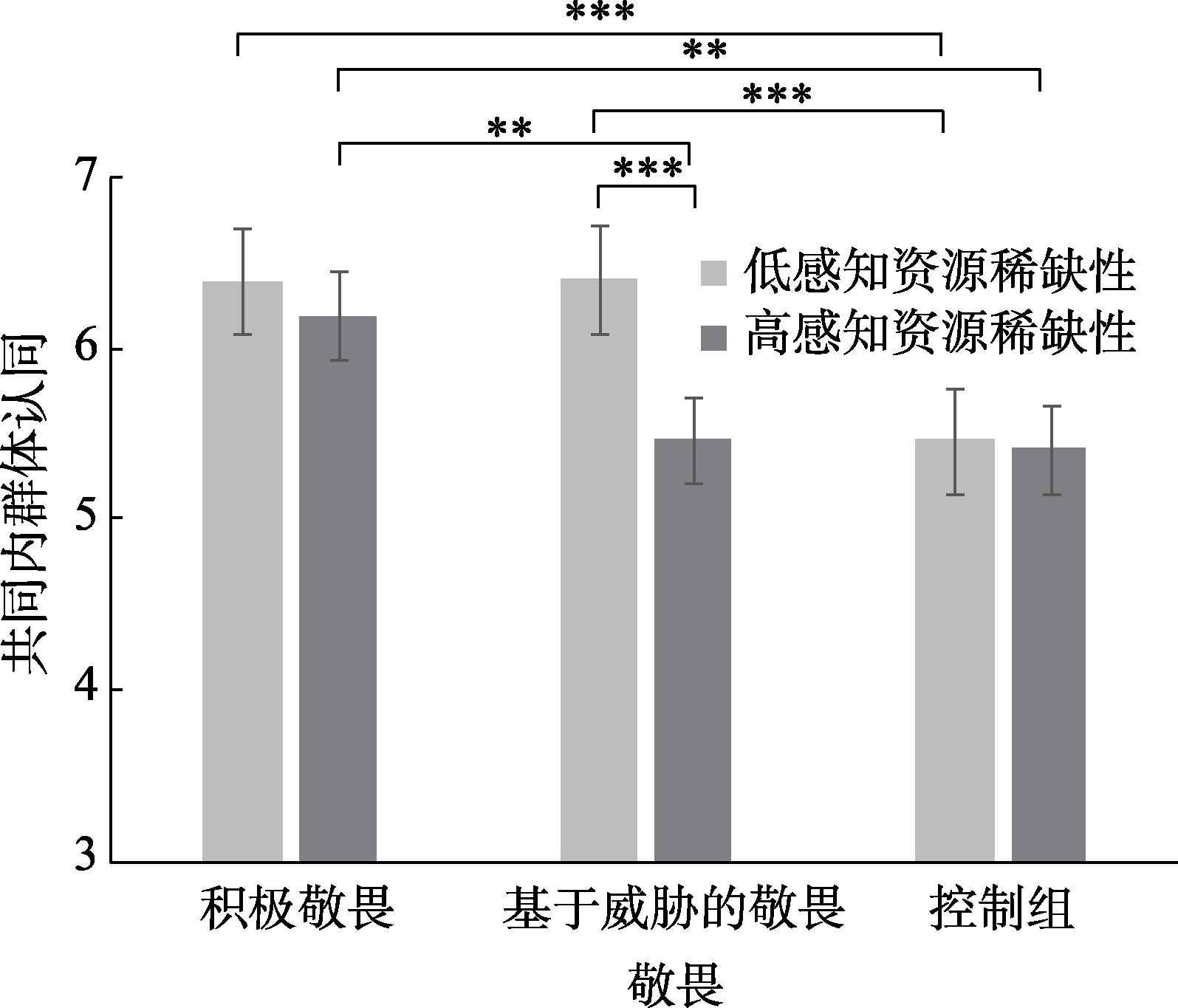
图2 基于变式的敬畏与感知资源稀缺性对共同内群体认同的影响 注:** p < 0.01, *** p < 0.001, 下同
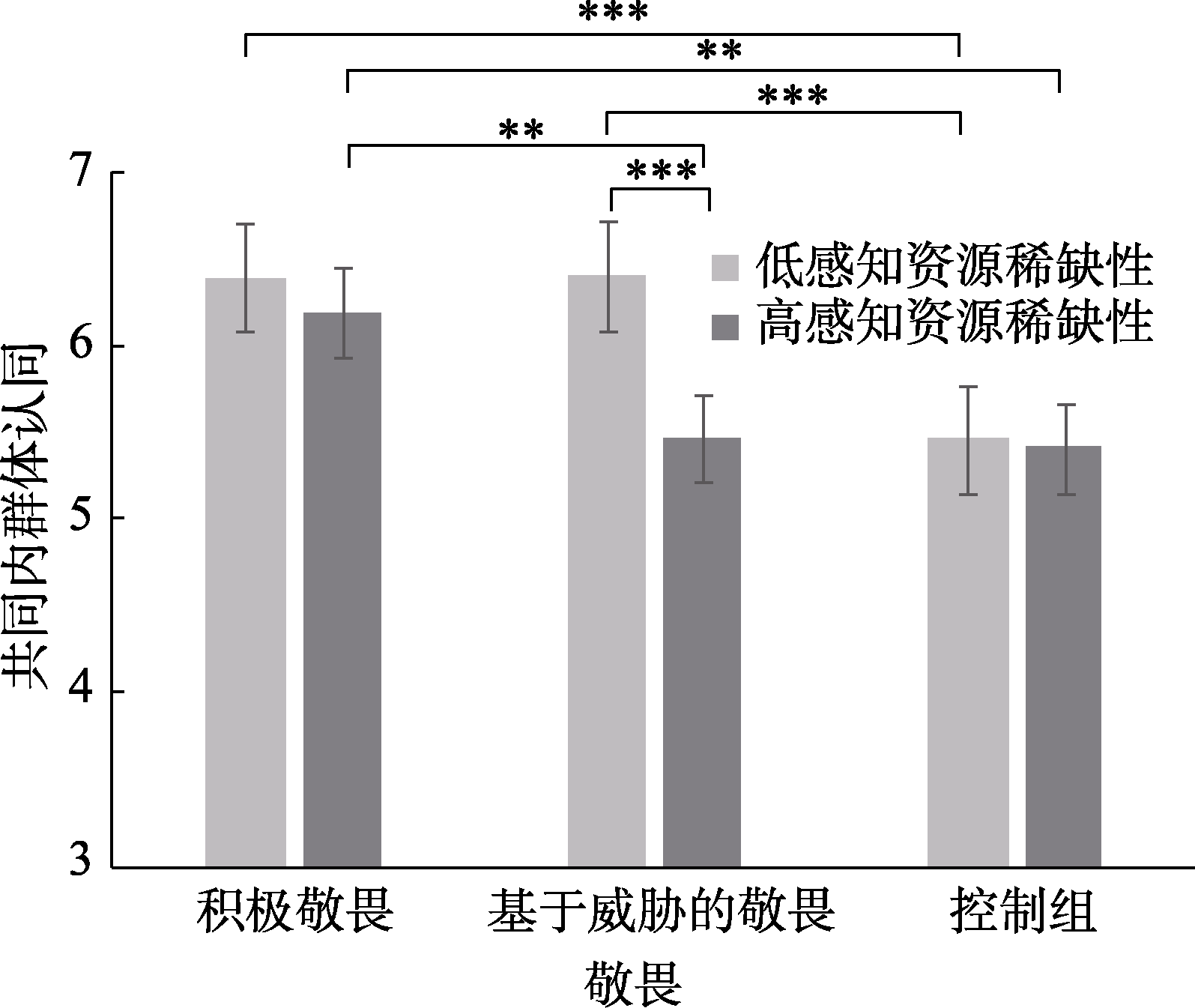
图3 基于复合情绪的敬畏与感知资源稀缺性对共同内群体认同的影响
| 情绪 | F | p | η | 积极敬畏 vs控制组 | 基于威胁的敬畏 vs控制组 | 积极敬畏vs 基于威胁的敬畏 | 积极敬畏 M ± SD | 基于威胁的 敬畏 M ± SD | 控制组 M ± SD | |||
|---|---|---|---|---|---|---|---|---|---|---|---|---|
| p | d | p | d | p | d | |||||||
| 快乐 | 32.71 | < 0.001 | 0.232 | 0.012 | 0.49 | < 0.001 | 0.81 | < 0.001 | 1.33 | 4.17 ± 1.55 | 2.07 ± 1.62 | 3.39 ± 1.63 |
| 幸福 | 19.06 | < 0.001 | 0.149 | 0.013 | 0.48 | 0.003 | 0.55 | < 0.001 | 0.97 | 3.90 ± 1.60 | 2.22 ± 1.85 | 3.15 ± 1.50 |
| 恐惧 | 88.75 | < 0.001 | 0.450 | 0.996 | 0.04 | < 0.001 | 1.75 | < 0.001 | 1.81 | 1.99 ± 1.14 | 4.71 ± 1.79 | 1.94 ± 1.33 |
| 焦虑 | 31.81 | < 0.001 | 0.227 | 0.999 | 0.05 | < 0.001 | 1.05 | < 0.001 | 1.16 | 2.18 ± 1.39 | 3.99 ± 1.71 | 2.25 ± 1.58 |
表4 研究3中不同敬畏条件诱发不同情绪的差异检验
| 情绪 | F | p | η | 积极敬畏 vs控制组 | 基于威胁的敬畏 vs控制组 | 积极敬畏vs 基于威胁的敬畏 | 积极敬畏 M ± SD | 基于威胁的 敬畏 M ± SD | 控制组 M ± SD | |||
|---|---|---|---|---|---|---|---|---|---|---|---|---|
| p | d | p | d | p | d | |||||||
| 快乐 | 32.71 | < 0.001 | 0.232 | 0.012 | 0.49 | < 0.001 | 0.81 | < 0.001 | 1.33 | 4.17 ± 1.55 | 2.07 ± 1.62 | 3.39 ± 1.63 |
| 幸福 | 19.06 | < 0.001 | 0.149 | 0.013 | 0.48 | 0.003 | 0.55 | < 0.001 | 0.97 | 3.90 ± 1.60 | 2.22 ± 1.85 | 3.15 ± 1.50 |
| 恐惧 | 88.75 | < 0.001 | 0.450 | 0.996 | 0.04 | < 0.001 | 1.75 | < 0.001 | 1.81 | 1.99 ± 1.14 | 4.71 ± 1.79 | 1.94 ± 1.33 |
| 焦虑 | 31.81 | < 0.001 | 0.227 | 0.999 | 0.05 | < 0.001 | 1.05 | < 0.001 | 1.16 | 2.18 ± 1.39 | 3.99 ± 1.71 | 2.25 ± 1.58 |
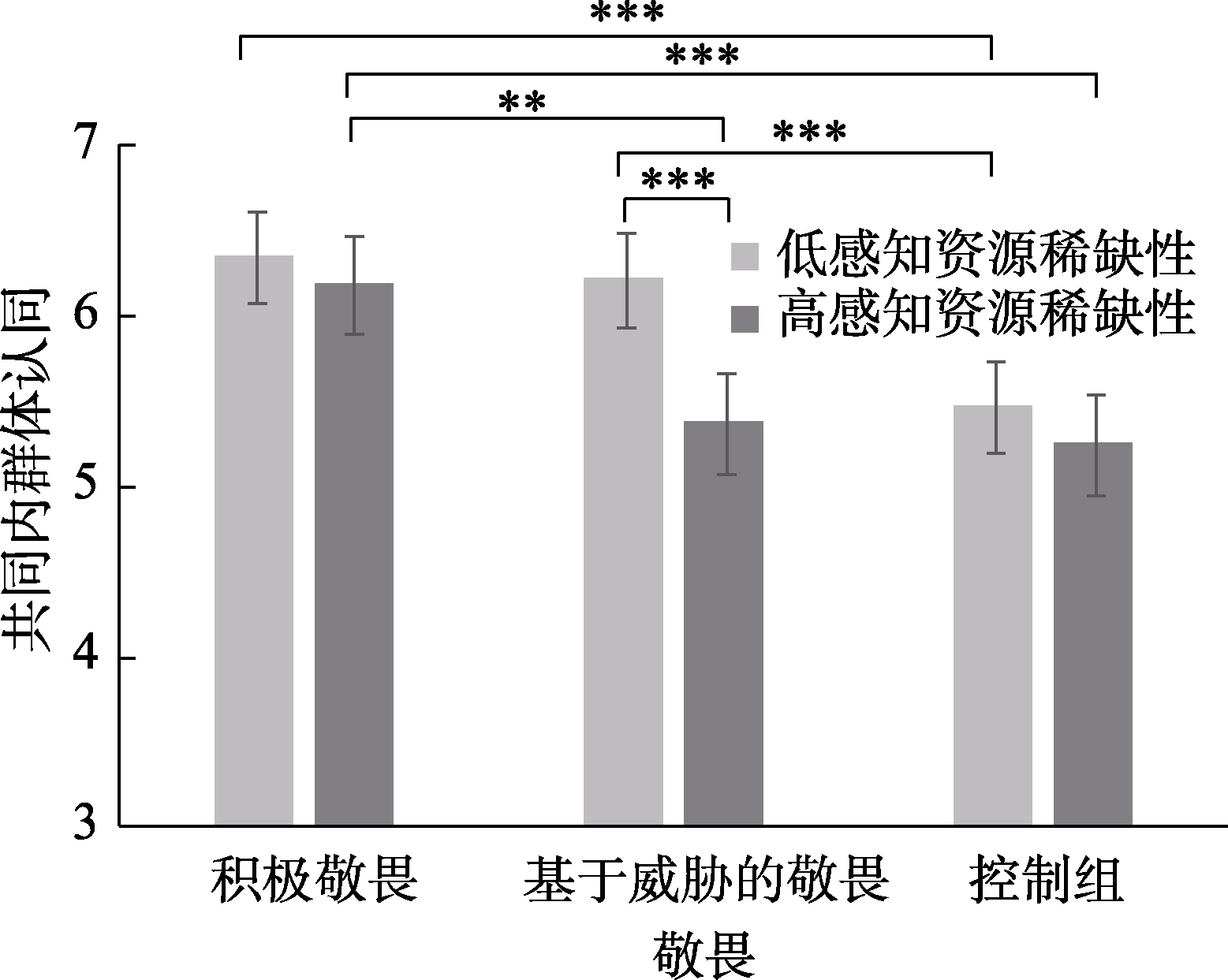
图4 敬畏与感知资源稀缺性对学生身份认同的影响
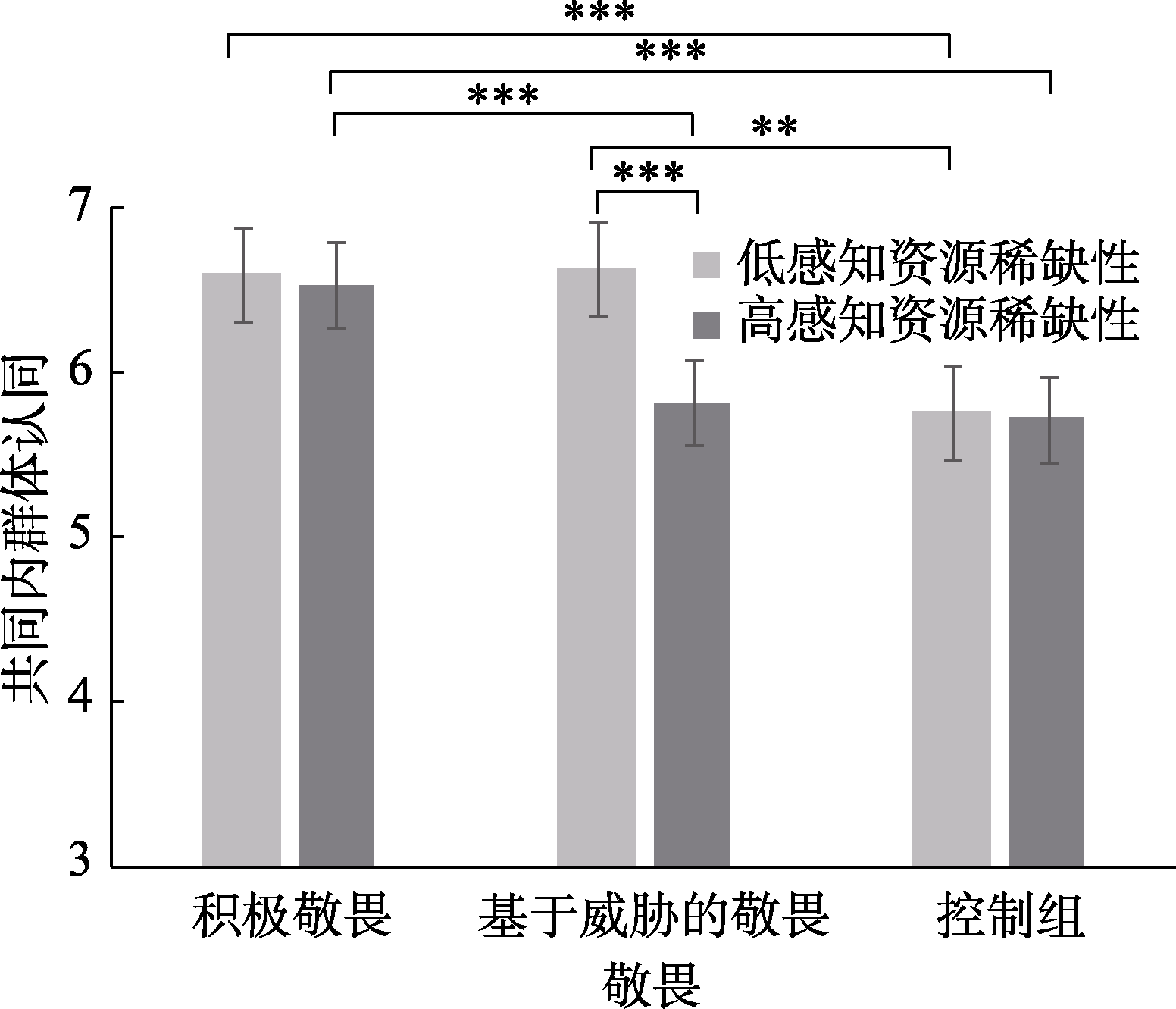
图5 敬畏与感知资源稀缺性对中华民族成员身份认同的影响
| 情绪 | F | p | η | 积极敬畏 vs控制组 | 基于威胁的敬畏 vs控制组 | 积极敬畏vs 基于威胁的敬畏 | 积极敬畏 M ± SD | 基于威胁的 敬畏 M ± SD | 控制组 M ± SD | |||
|---|---|---|---|---|---|---|---|---|---|---|---|---|
| p | d | p | d | p | d | |||||||
| 快乐 | 7.64 | < 0.001 | 0.066 | 0.001 | 0.60 | 0.989 | 0.05 | 0.005 | 0.54 | 4.41 ± 1.38 | 3.55 ± 1.80 | 3.62 ± 1.26 |
| 幸福 | 4.74, | 0.010 | 0.042 | 0.019 | 0.46 | 0.991 | 0.05 | 0.034 | 0.43 | 4.36 ± 1.51 | 3.66 ± 1.76 | 3.73 ± 1.25 |
| 恐惧 | 23.25 | < 0.001 | 0.176 | 0.186 | 0.32 | < 0.001 | 1.09 | < 0.001 | 0.77 | 2.89 ± 1.21 | 3.87 ± 1.33 | 2.51 ± 1.16 |
| 焦虑 | 5.53 | 0.005 | 0.048 | 0.999 | 0.07 | 0.007 | 0.53 | 0.025 | 0.45 | 3.52 ± 1.56 | 4.17 ± 1.33 | 3.42 ± 1.50 |
表5 研究4中不同敬畏条件诱发不同情绪的差异检验结果
| 情绪 | F | p | η | 积极敬畏 vs控制组 | 基于威胁的敬畏 vs控制组 | 积极敬畏vs 基于威胁的敬畏 | 积极敬畏 M ± SD | 基于威胁的 敬畏 M ± SD | 控制组 M ± SD | |||
|---|---|---|---|---|---|---|---|---|---|---|---|---|
| p | d | p | d | p | d | |||||||
| 快乐 | 7.64 | < 0.001 | 0.066 | 0.001 | 0.60 | 0.989 | 0.05 | 0.005 | 0.54 | 4.41 ± 1.38 | 3.55 ± 1.80 | 3.62 ± 1.26 |
| 幸福 | 4.74, | 0.010 | 0.042 | 0.019 | 0.46 | 0.991 | 0.05 | 0.034 | 0.43 | 4.36 ± 1.51 | 3.66 ± 1.76 | 3.73 ± 1.25 |
| 恐惧 | 23.25 | < 0.001 | 0.176 | 0.186 | 0.32 | < 0.001 | 1.09 | < 0.001 | 0.77 | 2.89 ± 1.21 | 3.87 ± 1.33 | 2.51 ± 1.16 |
| 焦虑 | 5.53 | 0.005 | 0.048 | 0.999 | 0.07 | 0.007 | 0.53 | 0.025 | 0.45 | 3.52 ± 1.56 | 4.17 ± 1.33 | 3.42 ± 1.50 |
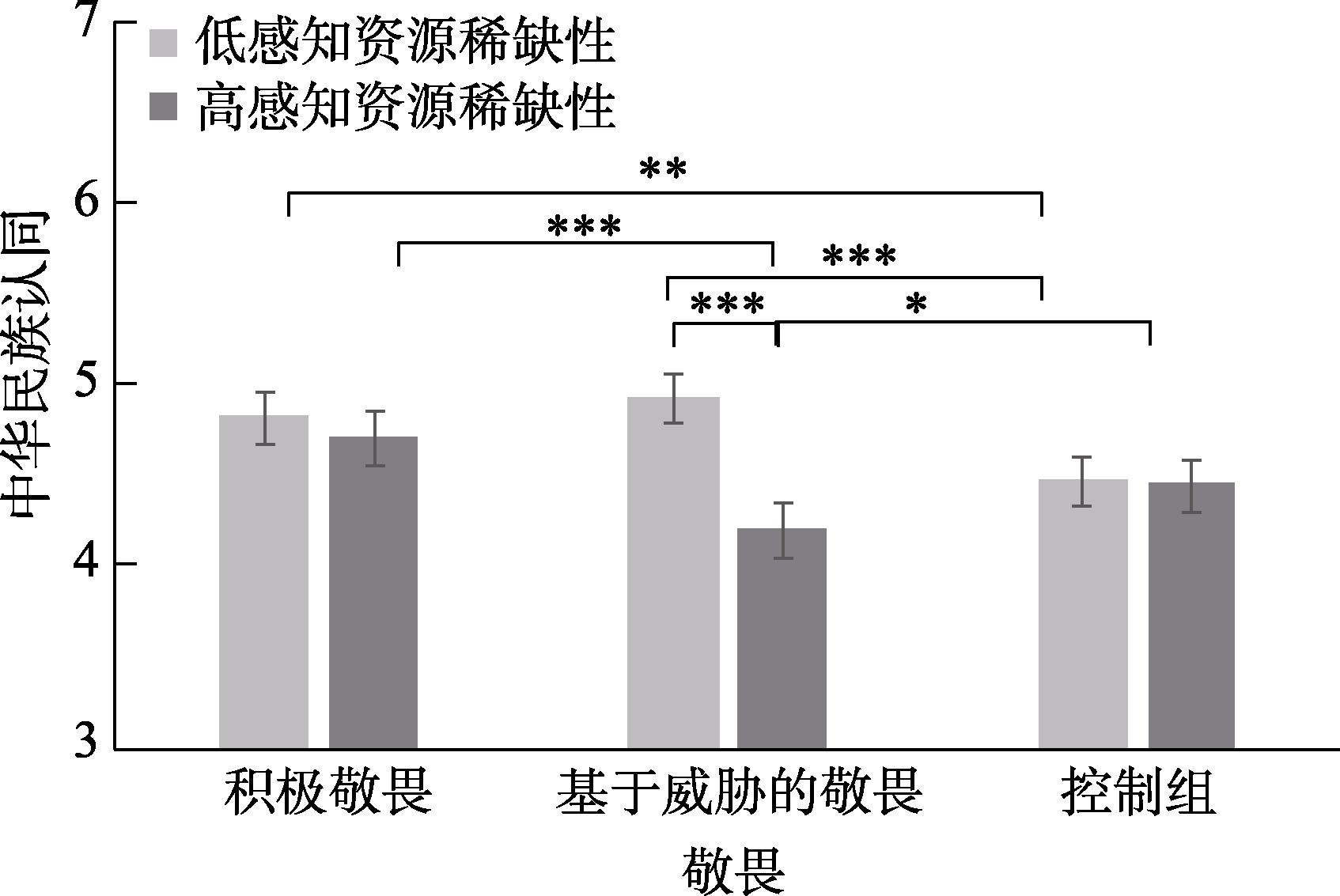
图6 敬畏与感知资源稀缺性对中华民族认同的影响 注:* p < 0.05, ** p < 0.01, *** p < 0.001
| [1] |
Adachi P. J., Hodson G., Willoughby T., Blank C., & Ha A. (2016). From outgroups to allied forces: Effect of intergroup cooperation in violent and nonviolent video games on boosting favorable outgroup attitudes. Journal of Experimental Psychology: General, 145(3), 259-265.
doi: 10.1037/xge0000145 URL |
| [2] |
Brannon T. N., & Walton G. M. (2013). Enacting cultural interests: How intergroup contact reduces prejudice by sparking interest in an out-group’s culture. Psychological Science, 24(10), 1947-1957.
doi: 10.1177/0956797613481607 URL |
| [3] |
Cakal H., Eller A., Sirlopú D., & Pérez A. (2016). Intergroup relations in Latin America: Intergroup contact, common ingroup identity, and activism among indigenous groups in Mexico and Chile. Journal of Social Issues, 72(2), 355-375.
doi: 10.1111/josi.2016.72.issue-2 URL |
| [4] |
Chaudhury S. H., Garg N., & Jiang Z. (2022). The curious case of threat-awe: A theoretical and empirical reconceptualization. Emotion, 22(7), 1653-1669.
doi: 10.1037/emo0000984 URL |
| [5] |
Chen S., & Boucher H. C. (2008). Relational selves as self-affirmational resources. Journal of Research in Personality, 42(3), 716-733.
doi: 10.1016/j.jrp.2007.09.006 URL |
| [6] |
Cui F., Huang X., Jing Y., Luo Y. -J., Liu J., & Gu R. (2022). How resource sharing resists scarcity: The role of cognitive empathy and its neurobiological mechanisms. Cerebral Cortex, 32(23), 5330-5342.
doi: 10.1093/cercor/bhac017 URL |
| [7] |
DeSousa M., & Rego K. (2022). Perceived scarcity across sociodemographic backgrounds predicts self-reported health. European Journal of Health Psychology, 30(2), 74-86.
doi: 10.1027/2512-8442/a000122 URL |
| [8] |
Dovidio J. F., Gaertner S. L., Isen A. M., & Lowrance R. (1995). Group representations and intergroup bias: Positive affect, similarity, and group size. Personality and Social Psychology Bulletin, 21(8), 856-865.
doi: 10.1177/0146167295218009 URL |
| [9] |
Faul F., Erdfelder E., Buchner A., & Lang A. -G. (2009). Statistical power analyses using G* Power 3.1: Tests for correlation and regression analyses. Behavior Research Methods, 41(4), 1149-1160.
doi: 10.3758/BRM.41.4.1149 URL |
| [10] |
Gaertner S. L., Dovidio J. F., Anastasio P. A., Bachman B. A., & Rust M. C. (1993). The common ingroup identity model: Recategorization and the reduction of intergroup bias. European Review of Social Psychology, 4(1), 1-26.
doi: 10.1080/14792779343000004 URL |
| [11] |
Gamez-Djokic M., & Waytz A. (2020). Concerns about automation and negative sentiment toward immigration. Psychological Science, 31(8), 987-1000.
doi: 10.1177/0956797620929977 pmid: 32697627 |
| [12] |
Gordon A. M., Stellar J. E., Anderson C. L., McNeil G. D., Loew D., & Keltner D. (2017). The dark side of the sublime: Distinguishing a threat-based variant of awe. Journal of Personality and Social Psychology, 113(2), 310-328.
doi: 10.1037/pspp0000120 pmid: 27929301 |
| [13] | Gross J. J., & Levenson R. W. (1995). Emotion elicitation using films. Cognition & Emotion, 9(1), 87-108. |
| [14] | Guan J., & Rong Y. (2020). The common in-group identity: Constructing a more inclusive superordinate identity. Journal of Northwest Normal University (Social Sciences), 57(1), 39-49. |
| [管健, 荣杨. (2020). 共同内群体认同: 建构包摄水平更高的上位认同. 西北师大学报(社会科学版), 57(1), 39-49.] | |
| [15] |
Jiang T., Hicks J. A., Yuan W., Yin Y., Needy L., & Vess M. (2024). The unique nature and psychosocial implications of awe. Nature Reviews Psychology, 3(7), 475-488.
doi: 10.1038/s44159-024-00322-z |
| [16] |
Jiang T., & Sedikides C. (2022). Awe motivates authenticself pursuit via self-transcendence: Implications for prosociality. Journal of Personality and Social Psychology, 123(3), 576-596.
doi: 10.1037/pspi0000381 URL |
| [17] |
Keltner D., & Haidt J. (2003). Approaching awe, a moral, spiritual, and aesthetic emotion. Cognition and Emotion, 17(2), 297-314.
doi: 10.1080/02699930302297 URL |
| [18] | Leung X. Y., Kim J., & Heitman S. (2022). Rethinking common ingroup identity model in minority restaurant messages: The moderating role of moral identity. International Journal of Hospitality Management, 107(1), 103352. |
| [19] |
Levine M., Prosser A., Evans D., & Reicher S. (2005). Identity and emergency intervention: How social group membership and inclusiveness of group boundaries shape helping behavior. Personality and Social Psychology Bulletin, 31(4), 443-453.
doi: 10.1177/0146167204271651 pmid: 15743980 |
| [20] | Li X. M., Meng Y., Yang Z. Q., & Liu X. D. (2024). The influence of awe on aggressive behavior among adolescents: Peer relationship as a moderator. Psychological Development and Education, 41(1), 117-125. |
| [李晓明, 孟员, 阳芷晴, 刘小丹. (2024). 敬畏对青少年攻击行为的影响: 同伴关系的调节作用. 心理发展与教育, 41(1), 117-125.] | |
| [21] | Liang F. M., Xiao Z. L., Bao Y., & Zhao Y. F. (2020). The promotion effect and mechanism of common ingroup identity on psychological compatibility. Journal of Psychological Science, 43(5), 1147-1153. |
| [梁芳美, 肖子伦, 包燕, 赵玉芳. (2020). 共同内群体认同对心理融合的促进效应及其机制. 心理科学, 43(5), 1147-1153.] | |
| [22] |
Lin R., Yu Q., Hu T., Zhang J., Ye Y., & Lian R. (2025). The relationship between awe and prosocial behavior: Three-level meta-analysis and meta-analytic structural equation modeling. Acta Psychologica Sinica, 57(4), 631-651.
doi: 10.3724/SP.J.1041.2025.0631 |
|
[林荣茂, 余巧华, 胡添祥, 张九妹, 叶玉珊, 连榕. (2025). 敬畏感与亲社会行为关系的三水平和结构方程模型元分析. 心理学报, 57(4), 631-651.]
doi: 10.3724/SP.J.1041.2025.0631 |
|
| [23] | Liu Z. H., Chen Y. M., Li X., Jin T. L., & Wu Y. T. N. (2022). The influence of awe on intertemporal choice: The role of time perspective and temporal distance sensitivity. Journal of Psychological Science, 45(4), 833-840. |
| [刘振会, 陈奕妙, 李鑫, 金童林, 乌云特娜. (2022). 敬畏对跨期选择的影响:时间洞察力和时距敏感度的作用. 心理科学, 45(4), 833-840.] | |
| [24] |
Luo L., Yang D., Tian Y., Gao W., Yang J., & Yuan J. (2022). Awe weakens the AIDS-related stigma: The mediation effects of connectedness and empathy. Frontiers in Psychiatry, 13, 1043101.
doi: 10.3389/fpsyt.2022.1043101 URL |
| [25] |
Luo L., Zou R., Yang D., & Yuan J. (2023). Awe experience triggered by fighting against COVID-19 promotes prosociality through increased feeling of connectedness and empathy. The Journal of Positive Psychology, 18(6), 866-882.
doi: 10.1080/17439760.2022.2131607 URL |
| [26] |
Mani A., Mullainathan S., Shafir E., & Zhao J. (2013). Poverty impedes cognitive function. Science, 341(6149), 976-980.
doi: 10.1126/science.1238041 pmid: 23990553 |
| [27] |
Miao X., Liu L., Dang J., Wei C., Huang L., & Liu Z. (2023). Unity or estrangement under crises? Perceived resource scarcity moderates the effect of a common threat on intergroup cooperation. Social Psychological and Personality Science, 15(6), 659-669.
doi: 10.1177/19485506231195501 URL |
| [28] | Mullainathan S., & Shafir E. (2013). Scarcity: Why having too little means so much. Penguin. |
| [29] | Öhman, A. (2008). Fear and anxiety:Overlaps and dissociations. In Lewis, M., Haviland-Jones, J. M., & Barrett L. F. (Eds.), Handbook of emotions (3rd ed., pp. 709-728). New York: Guilford Press. |
| [30] |
Pereira B., Fehl A. G., Finkelstein S. R., Jiga‐Boy G. M., & Caserotti M. (2022). Scarcity in COVID-19 vaccine supplies reduces perceived vaccination priority and increases vaccine hesitancy. Psychology & Marketing, 39(5), 921-936.
doi: 10.1002/mar.v39.5 URL |
| [31] |
Phinney J. S., & Ong A. D. (2007). Conceptualization and measurement of ethnic identity: Current status and future directions. Journal of Counseling Psychology, 54(3), 271-281.
doi: 10.1037/0022-0167.54.3.271 URL |
| [32] | Piff P. K., Dietze P., Feinberg M., Stancato D. M., & Keltner D. (2015). Awe, the small self, and prosocial behavior. Journal of Personality & Social Psychology, 108(6), 883-899. |
| [33] |
Pitesa M., & Thau S. (2018). Resource scarcity, effort, and performance in physically demanding jobs: An evolutionary explanation. Journal of Applied Psychology, 103(3), 237-248.
doi: 10.1037/apl0000257 pmid: 29072474 |
| [34] |
Preston J. L., & Shin F. (2017). Spiritual experiences evoke awe through the small self in both religious and non-religious individuals. Journal of Experimental Social Psychology, 70, 212-221.
doi: 10.1016/j.jesp.2016.11.006 URL |
| [35] | Roux C., Goldsmith K., & Bonezzi A. (2015). On the psychology of scarcity: When reminders of resource scarcity promote selfish (and generous) behavior. Journal of Consumer Research, 42(4), 615-631. |
| [36] |
Seo M., Yang S., & Laurent S. M. (2023). No one is an island: Awe encourages global citizenship identification. Emotion, 23(3), 601-612.
doi: 10.1037/emo0001160 URL |
| [37] |
Shah J. C., Mullainathan S., & Shafir E. (2012). Some consequences of having too little. Science, 338(6107), 682-685.
doi: 10.1126/science.1222426 pmid: 23118192 |
| [38] |
Shiota M. N., Keltner D., & John O. P. (2006). Positive emotion dispositions differentially associated with Big Five personality and attachment style. The Journal of Positive Psychology, 1(2), 61-71.
doi: 10.1080/17439760500510833 URL |
| [39] |
Stellar J. E., Gordon A. M., Piff P. K., Cordaro D., Anderson C. L., Bai Y., Maruskin L. A., & Keltner D. (2017). Self-transcendent emotions and their social functions: Compassion, gratitude, and awe bind us to others through prosociality. Emotion Review, 9(3), 200-207.
doi: 10.1177/1754073916684557 URL |
| [40] |
Ufkes E. G., Calcagno J., Glasford D. E., & Dovidio J. F. (2016). Understanding how common ingroup identity undermines collective action among disadvantaged-group members. Journal of Experimental Social Psychology, 63(5), 26-35.
doi: 10.1016/j.jesp.2015.11.006 URL |
| [41] |
Ufkes E. G., Dovidio J. F., & Tel G. (2015). Identity and collective action among European Kurds. British Journal of Social Psychology, 54(1), 176-186.
doi: 10.1111/bjso.12084 pmid: 25257157 |
| [42] |
Van Kleef G. A., & Fischer A. H. (2016). Emotional collectives: How groups shape emotions and emotions shape groups. Cognition and Emotion, 30(1), 3-19.
doi: 10.1080/02699931.2015.1081349 URL |
| [43] |
Vasey M. W., Vilensky M. R., Heath J. H., Harbaugh C. N., Buffington A. G., & Fazio R. H. (2012). It was as big as my head, I swear! Biased spider size estimation in spider phobia. Journal of Anxiety Disorders, 26(1), 20-24.
doi: 10.1016/j.janxdis.2011.08.009 pmid: 21906909 |
| [44] |
Vingerhoets A. J. J. M., van de Ven N., & van der Velden Y. (2016). The social impact of emotional tears. Motivation and Emotion, 40(3), 455-463.
doi: 10.1007/s11031-016-9543-0 URL |
| [45] | Wang G. F., Tian S. P., Xu Z. J., Chen J. Y., & Yang M. Q. (2024). The relationship between awe and helping: The mediating role of self-other overlap. Psychological Development and Education, 40(4), 499-509. |
| [王国芳, 田淑萍, 胥子健, 陈嘉晔, 杨敏齐. (2024). 敬畏与助人的关系:自我-他人重叠的中介作用. 心理发展与教育, 40(4), 499-509.] | |
| [46] |
Waugh C. E., & Fredrickson B. L. (2006). Nice to know you: Positive emotions, self-other overlap, and complex understanding in the formation of a new relationship. Journal of Positive Psychology, 1(2), 93-106.
doi: 10.1080/17439760500510569 pmid: 21691460 |
| [47] | Xin Z. Y., Du X. P., & Li B. Y. (2021). The influence of awe on conspicuous consumption: The mediating role of small self. Journal of Psychological Science, 44(3), 642-650. |
| [辛志勇, 杜晓鹏, 李冰月. (2021). 敬则不逐物——敬畏对炫耀性消费倾向的抑制:小我的中介作用. 心理科学, 44(3), 642-650.] | |
| [48] |
Yaden D. B., Kaufman S. B., Hyde E., Chirico A., Gaggioli A., Zhang J. W., & Keltner D. (2019). The development of the Awe Experience Scale (AWE-S): A multifactorial measure for a complex emotion. Journal of Positive Psychology, 14(4), 474-488.
doi: 10.1080/17439760.2018.1484940 URL |
| [49] | Zhao Y., Hu X. Y., & Ma J. X. (2023). Awe’s prosocial effect: The mediating role of the small self and the authentic self. Advances in Psychological Science, 31(11), 2171-2182. |
| [赵越, 胡小勇, 马佳馨. (2023). 敬畏的亲社会效应:小我与真我的作用. 心理科学进展, 31(11), 2171-2182.] | |
| [50] | Zhou T. F., Hu Q., & Cui L. J. (2018). Common ingroup identity and intergroup helping: The mediating effect of intergroup threat. Psychological Research, 11(4), 333-342. |
| [周天爽, 胡琴, 崔丽娟. (2018). 共同内群体认同与群际帮助意愿:群际威胁的中介作用. 心理研究, 11(4), 333-342.] | |
| [51] | Zhu T., Li L. Z., Wen F. F., Zuo B., Ju Y. Y., & Long J. H. (2024) The psychological effects and influencing factors of common ingroup identity. Journal of Psychological Science, 47(2), 440-449. |
| [祝婷, 李凌智, 温芳芳, 佐斌, 鞠一琰, 龙佳慧. (2024). 共同内群体认同的心理效应及其影响因素. 心理科学, 47(2), 440-449.] |
| [1] | 邓洵, 龙思邑, 沈依琳, 赵欢欢, 贺雯. 共同内群体认同对医患竞争受害感的影响及其机制[J]. 心理学报, 2023, 55(5): 752-765. |
| [2] | 温芳芳, 柯文琳, 何赛飞, 佐斌, 李兰心, 马书瀚, 王晶. 群体身份变换性对老年人印象更新的影响:共同内群体认同的中介作用[J]. 心理学报, 2022, 54(9): 1059-1075. |
| 阅读次数 | ||||||
|
全文 |
|
|||||
|
摘要 |
|
|||||
