

ISSN 0439-755X
CN 11-1911/B
主办:中国心理学会
中国科学院心理研究所
出版:科学出版社
CN 11-1911/B
主办:中国心理学会
中国科学院心理研究所
出版:科学出版社
心理学报 ›› 2026, Vol. 58 ›› Issue (2): 198-220.doi: 10.3724/SP.J.1041.2026.0198 cstr: 32110.14.2026.0198
• “社会治理视角下经济处境的心理影响及其干预策略”专栏 • 上一篇 下一篇
胡小勇1, 杜棠艳2, 冀月欣2, 宫文卓2, 王笛新2, 郭永玉3( )
)
收稿日期:2024-04-02
发布日期:2025-12-03
出版日期:2026-02-25
通讯作者:
郭永玉, E-mail: yyguo@njnu.edu.cn基金资助:
HU Xiaoyong1, DU Tangyan2, JI Yuexin2, GONG Wenzhuo2, WANG Dixin2, GUO Yongyu3()
Received:2024-04-02
Online:2025-12-03
Published:2026-02-25
摘要:
尽管大量研究表明, 低社会经济地位者更倾向于选择即时的小奖励而非延迟的更大回报, 但这一现象的潜在心理机制仍未得到充分研究。本研究在对跨期决策的启发式模型、单维占优模型与威胁视角下心理转变模型进行整合基础上, 提出并检验了稀缺威胁在社会经济地位影响跨期决策中的调节作用, 以及时间占优偏向对该调节效应的中介作用模型。研究结果表明: (1)低社会经济地位者比高社会经济地位者更倾向于短视决策; (2)稀缺威胁的调节作用显著, 在稀缺威胁条件下低社会经济地位者比高社会经济地位者更倾向于选择短期回报; 然而, 在非稀缺威胁条件下, 二者之间差异不显著; (3)时间占优偏向是低社会经济地位者做出“短视”决策的心理机制, 即在遭受稀缺威胁时, 低社会经济地位者比高社会经济地位者的时间占优偏向更强, 进而做出了短视决策。这些发现表明, 低社会经济地位的短视并非源于心理缺陷, 而是对稀缺威胁环境的适应性反应。本研究为降低对低社会经济地位的污名化提供了理论支撑, 并为制定促进低社会经济地位者实现共同富裕的干预策略提供了科学依据。
中图分类号:
胡小勇, 杜棠艳, 冀月欣, 宫文卓, 王笛新, 郭永玉. (2026). 稀缺威胁下低社会经济地位者的短视决策过程. 心理学报, 58(2), 198-220.
HU Xiaoyong, DU Tangyan, JI Yuexin, GONG Wenzhuo, WANG Dixin, GUO Yongyu. (2026). Myopic decision-making in lower socioeconomic status individuals under threats of scarcity. Acta Psychologica Sinica, 58(2), 198-220.
| 变量 | M | SD | 1 | 2 | 3 | 4 | 5 | 6 |
|---|---|---|---|---|---|---|---|---|
| 1性别 | - | - | 1 | |||||
| 2年龄 | 32.88 | 11.79 | −0.14** | 1 | ||||
| 3主观社会经济地位 | 4.09 | 1.87 | 0.01 | −0.11** | 1 | |||
| 4人均可支配收入 | 3.04 | 1.86 | −0.01 | −0.26** | 0.50** | 1 | ||
| 5稀缺威胁 | 3.64 | 1.00 | 0.01 | 0.19** | −0.09** | −0.16** | 1 | |
| 6延迟折扣率 | 0.06 | 0.04 | −0.06 | 0.15** | −0.22** | −0.25** | 0.23** | 1 |
表1 各变量的描述统计分析
| 变量 | M | SD | 1 | 2 | 3 | 4 | 5 | 6 |
|---|---|---|---|---|---|---|---|---|
| 1性别 | - | - | 1 | |||||
| 2年龄 | 32.88 | 11.79 | −0.14** | 1 | ||||
| 3主观社会经济地位 | 4.09 | 1.87 | 0.01 | −0.11** | 1 | |||
| 4人均可支配收入 | 3.04 | 1.86 | −0.01 | −0.26** | 0.50** | 1 | ||
| 5稀缺威胁 | 3.64 | 1.00 | 0.01 | 0.19** | −0.09** | −0.16** | 1 | |
| 6延迟折扣率 | 0.06 | 0.04 | −0.06 | 0.15** | −0.22** | −0.25** | 0.23** | 1 |
| 变量 | 因变量:延迟折扣率 | ||||
|---|---|---|---|---|---|
| β | SE | t | 95% CI | ||
| 人均可支配收入 | −0.005 | 0.001 | −6.59*** | [−0.01, −0.003] | |
| 稀缺威胁 | 0.006 | 0.001 | 4.88*** | [0.004, 0.01] | |
| 人均可支配收入×稀缺威胁 | −0.002 | 0.00 | −2.54* | [−0.003, −0.0004] | |
| 年龄 | 0.0002 | 0.0001 | 1.98* | [0.0000, 0.0004] | |
| R² | 0.33 | ||||
| F | 29.18*** | ||||
表2 客观社会经济地位与延迟折扣率之间的关系与稀缺威胁的调节效应检验(N = 971)
| 变量 | 因变量:延迟折扣率 | ||||
|---|---|---|---|---|---|
| β | SE | t | 95% CI | ||
| 人均可支配收入 | −0.005 | 0.001 | −6.59*** | [−0.01, −0.003] | |
| 稀缺威胁 | 0.006 | 0.001 | 4.88*** | [0.004, 0.01] | |
| 人均可支配收入×稀缺威胁 | −0.002 | 0.00 | −2.54* | [−0.003, −0.0004] | |
| 年龄 | 0.0002 | 0.0001 | 1.98* | [0.0000, 0.0004] | |
| R² | 0.33 | ||||
| F | 29.18*** | ||||
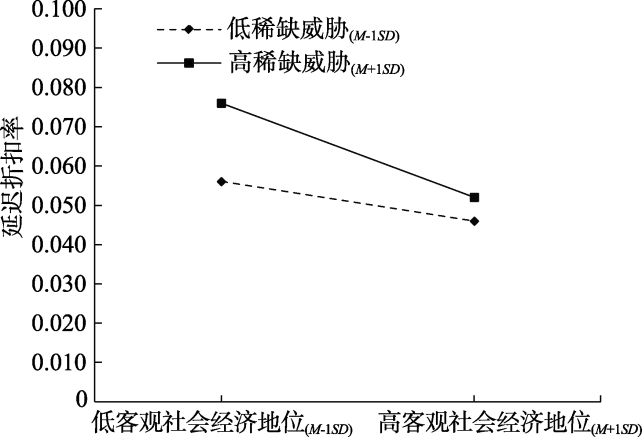
图1 稀缺威胁对客观社会经济地位与延迟折扣率的关系的调节效应检验
| 变量 | 因变量:延迟折扣率 | |||
|---|---|---|---|---|
| β | SE | t | 95% CI | |
| 主观社会经济地位 | −0.004 | 0.001 | −6.53*** | [−0.006, −0.003] |
| 稀缺威胁 | 0.01 | 0.001 | 4.97*** | [0.004, 0.009] |
| 主观社会经济地位×稀缺威胁 | −0.002 | 0.001 | −2.79** | [−0.003, −0.001] |
| 年龄 | 0.0003 | 0.0001 | 3.01** | [0.0001, 0.001] |
| R² | 0.33 | |||
| F | 29.47*** | |||
表3 主观社会经济地位与延迟折扣率之间的关系与稀缺威胁的调节效应检验(N = 971)
| 变量 | 因变量:延迟折扣率 | |||
|---|---|---|---|---|
| β | SE | t | 95% CI | |
| 主观社会经济地位 | −0.004 | 0.001 | −6.53*** | [−0.006, −0.003] |
| 稀缺威胁 | 0.01 | 0.001 | 4.97*** | [0.004, 0.009] |
| 主观社会经济地位×稀缺威胁 | −0.002 | 0.001 | −2.79** | [−0.003, −0.001] |
| 年龄 | 0.0003 | 0.0001 | 3.01** | [0.0001, 0.001] |
| R² | 0.33 | |||
| F | 29.47*** | |||
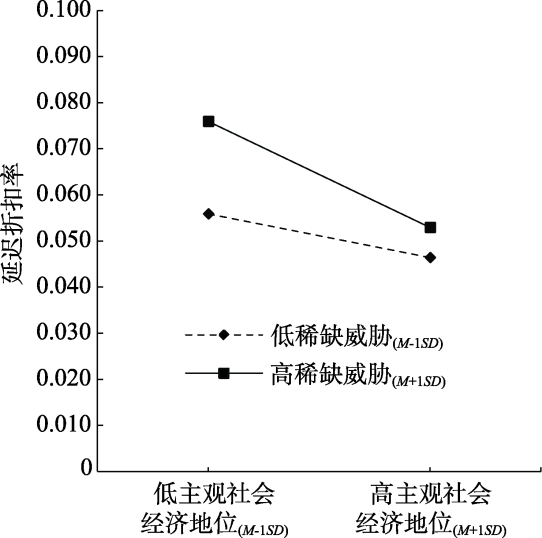
图2 稀缺威胁对主观社会经济地位与延迟折扣率的关系的调节效应检验
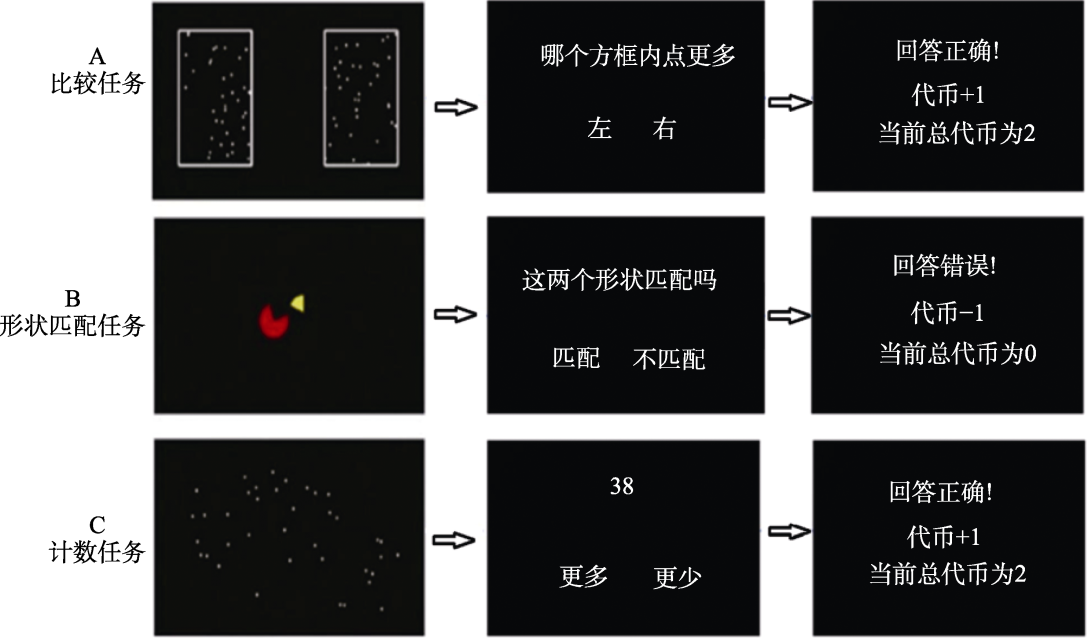
图3 阶段游戏范式的不同阶段任务及流程
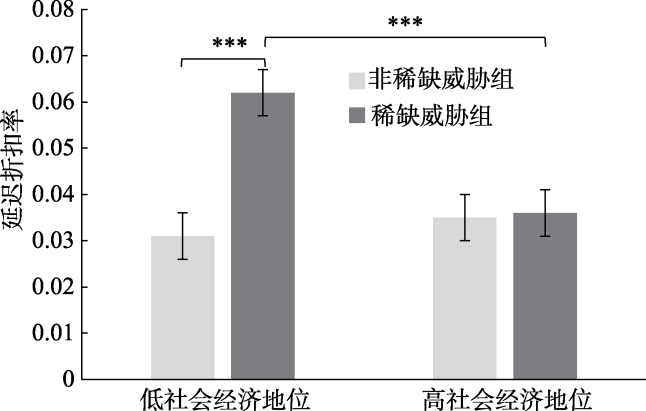
图4 稀缺威胁在社会经济地位影响延迟折扣率中的调节作用
| 变量 | M | SD | 1 | 2 | 3 | 4 | 5 | 6 |
|---|---|---|---|---|---|---|---|---|
| 性别 | - | - | 1 | |||||
| 年龄 | 37.36 | 11.97 | −0.07* | 1 | ||||
| 社会经济地位 | 0.00 | 1.71 | −0.17** | −0.04 | 1 | |||
| 时间占优偏向 | −0.01 | 0.16 | 0.04 | 0.05 | −0.10** | 1 | ||
| 稀缺威胁 | 15.13 | 5.39 | 0.05 | −0.17*** | −0.42** | −0.004 | 1 | |
| 延迟折扣率 | −3.36 | 3.14 | −0.02 | 0.08** | −0.20** | 0.14** | 0.22** | 1 |
表4 各变量描述性统计分析
| 变量 | M | SD | 1 | 2 | 3 | 4 | 5 | 6 |
|---|---|---|---|---|---|---|---|---|
| 性别 | - | - | 1 | |||||
| 年龄 | 37.36 | 11.97 | −0.07* | 1 | ||||
| 社会经济地位 | 0.00 | 1.71 | −0.17** | −0.04 | 1 | |||
| 时间占优偏向 | −0.01 | 0.16 | 0.04 | 0.05 | −0.10** | 1 | ||
| 稀缺威胁 | 15.13 | 5.39 | 0.05 | −0.17*** | −0.42** | −0.004 | 1 | |
| 延迟折扣率 | −3.36 | 3.14 | −0.02 | 0.08** | −0.20** | 0.14** | 0.22** | 1 |
| 变量 | Model 1 | Model 2 | ||||||
|---|---|---|---|---|---|---|---|---|
| (因变量:时间占优) | (因变量:延迟折扣率) | |||||||
| β | SE | t | 95% CI | β | SE | t | 95% CI | |
| 社会经济地位 | −0.07 | 0.02 | −3.85*** | [−0.10, −0.03] | −0.06 | 0.02 | −3.52*** | [−0.09, −0.03] |
| 时间占优 | 0.13 | 0.03 | 5.02*** | [0.08, 0.18] | ||||
| 稀缺威胁 | −0.05 | 0.03 | −1.55 | [−0.10, 0.01] | 0.20 | 0.03 | 6.94*** | [0.14, 0.25] |
| 社会经济地位×稀缺威胁 | 0.04 | 0.02 | 2.47* | [0.01, 0.07] | 0.03 | 0.02 | 1.70 | [−0.004, 0.05] |
| 年龄 | 0.04 | 0.03 | 1.43 | [−0.01, 0.09] | 0.10 | 0.03 | 4.08*** | [0.05, 0.15] |
| R² | 0.02 | 0.09 | ||||||
| F | 6.48*** | 29.38*** | ||||||
表5 有中介的调节效应检验
| 变量 | Model 1 | Model 2 | ||||||
|---|---|---|---|---|---|---|---|---|
| (因变量:时间占优) | (因变量:延迟折扣率) | |||||||
| β | SE | t | 95% CI | β | SE | t | 95% CI | |
| 社会经济地位 | −0.07 | 0.02 | −3.85*** | [−0.10, −0.03] | −0.06 | 0.02 | −3.52*** | [−0.09, −0.03] |
| 时间占优 | 0.13 | 0.03 | 5.02*** | [0.08, 0.18] | ||||
| 稀缺威胁 | −0.05 | 0.03 | −1.55 | [−0.10, 0.01] | 0.20 | 0.03 | 6.94*** | [0.14, 0.25] |
| 社会经济地位×稀缺威胁 | 0.04 | 0.02 | 2.47* | [0.01, 0.07] | 0.03 | 0.02 | 1.70 | [−0.004, 0.05] |
| 年龄 | 0.04 | 0.03 | 1.43 | [−0.01, 0.09] | 0.10 | 0.03 | 4.08*** | [0.05, 0.15] |
| R² | 0.02 | 0.09 | ||||||
| F | 6.48*** | 29.38*** | ||||||
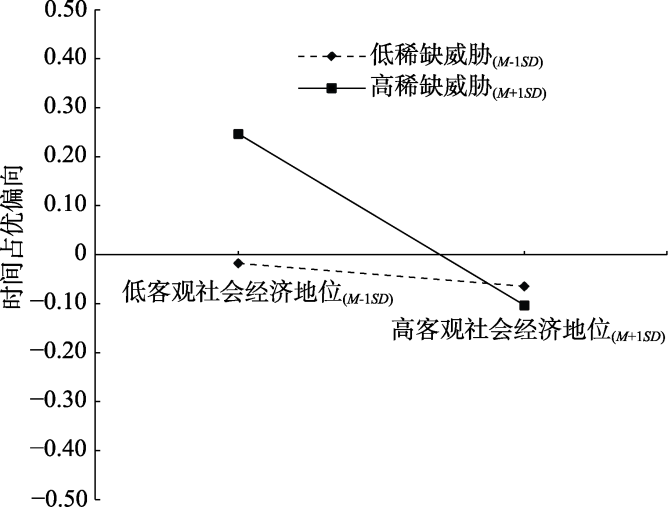
图5 稀缺威胁调节社会经济地位对时间占优偏向的预测作用
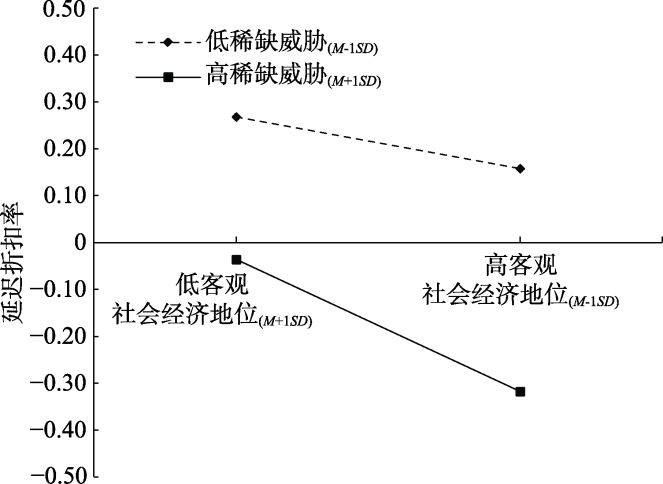
图6 稀缺威胁调节社会经济地位对延迟折扣率的预测作用

图7 直观模拟天平
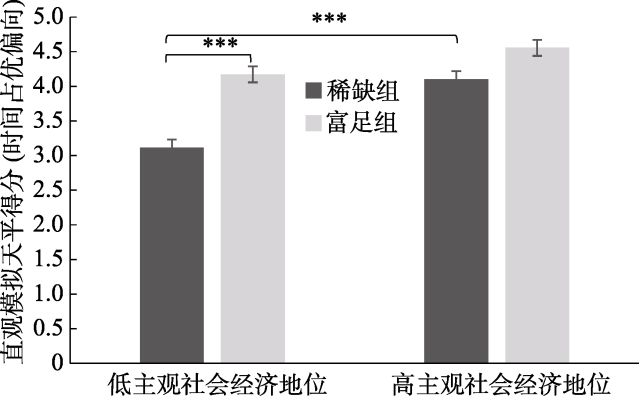
图8 稀缺威胁在社会经济地位影响时间占优偏向中的调节作用
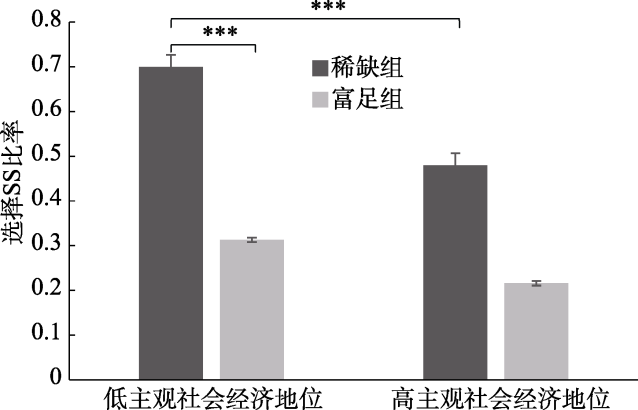
图9 稀缺威胁在社会经济地位影响选择SS比例中的调节作用
| 变量 | Model 1 | Model 2 | ||||||
|---|---|---|---|---|---|---|---|---|
| (因变量:时间占优) | (因变量:SS选择比率) | |||||||
| β | SE | t | 95% CI | β | SE | t | 95% CI | |
| 社会经济地位 | 0.36 | 0.15 | 2.42* | [0.07, 0.6] | −0.30 | 0.13 | −2.32* | [−0.55, −0.05] |
| 时间占优 | −0.16 | 0.05 | −3.20** | [−0.26, −0.06] | ||||
| 稀缺威胁 | −0.90 | 0.15 | −6.07*** | [−1.19, −0.61] | 1.21 | 0.14 | 8.94*** | [0.94, 1.47] |
| 社会经济地位×稀缺威胁 | 0.49 | 0.21 | 2.31* | [0.07, 0.90] | −0.20 | 0.18 | −2.19* | [−0.75, −0.04] |
| 年龄 | −0.07 | 0.05 | −1.23 | [−0.17, 0.04] | 0.09 | 0.05 | 1.94 | [−0.01, 0.18] |
| R² | 0.21 | 0.42 | ||||||
| F | 18.97*** | 42.42*** | ||||||
表6 有中介的调节效应检验
| 变量 | Model 1 | Model 2 | ||||||
|---|---|---|---|---|---|---|---|---|
| (因变量:时间占优) | (因变量:SS选择比率) | |||||||
| β | SE | t | 95% CI | β | SE | t | 95% CI | |
| 社会经济地位 | 0.36 | 0.15 | 2.42* | [0.07, 0.6] | −0.30 | 0.13 | −2.32* | [−0.55, −0.05] |
| 时间占优 | −0.16 | 0.05 | −3.20** | [−0.26, −0.06] | ||||
| 稀缺威胁 | −0.90 | 0.15 | −6.07*** | [−1.19, −0.61] | 1.21 | 0.14 | 8.94*** | [0.94, 1.47] |
| 社会经济地位×稀缺威胁 | 0.49 | 0.21 | 2.31* | [0.07, 0.90] | −0.20 | 0.18 | −2.19* | [−0.75, −0.04] |
| 年龄 | −0.07 | 0.05 | −1.23 | [−0.17, 0.04] | 0.09 | 0.05 | 1.94 | [−0.01, 0.18] |
| R² | 0.21 | 0.42 | ||||||
| F | 18.97*** | 42.42*** | ||||||
| [1] |
Adams J., & White M. (2009). Time perspective in socioeconomic inequalities in smoking and body mass index. Health Psychology, 28(1), 83-90.
doi: 10.1037/0278-6133.28.1.83 pmid: 19210021 |
| [2] |
Adler N. E., Epel E. S., Castellazzo G., & Ickovics J. R. (2000). Relationship of subjective and objective social status with psychological and physiological functioning: Preliminary data in healthy, White women. Health Psychology, 19(6), 586-592.
doi: 10.1037//0278-6133.19.6.586 pmid: 11129362 |
| [3] | Adler N. E., & Ostrove J. M. (1999). Socioeconomic status and health:what we know and what we don't. Annals of the New York academy of Sciences, 896(1), 3-15. |
| [4] |
Amasino D. R., Sullivan N. J., Kranton R. E., & Huettel S. A. (2019). Amount and time exert independent influences on intertemporal choice. Nature Human Behaviour, 3(4), 383-392.
doi: 10.1038/s41562-019-0537-2 pmid: 30971787 |
| [5] |
Anderson C., & Galinsky A. D. (2006). Power, optimism, and risk-taking. European Journal of Social Psychology, 36(4), 511-536.
doi: 10.1002/ejsp.v36:4 URL |
| [6] |
Anderson J. R., Bothell D., Byrne M. D., Douglass S., Lebiere C., & Qin Y. (2004). An integrated theory of the mind. Psychological Review, 111(4), 1036-1060.
pmid: 15482072 |
| [7] | Bai X., & Du J. (2017). Pedagogy. Beijing: Capital Normal University Press. |
| [白秀杰, 杜剑华. (2017). 教育学. 北京: 首都师范大学出版社.] | |
| [8] |
Berns G. S., Laibson D., & Loewenstein G. (2007). Intertemporal choice-toward an integrative framework. Trends in Cognitive Sciences, 11(11), 482-488.
doi: 10.1016/j.tics.2007.08.011 URL |
| [9] |
Blanden J., & Gregg P. (2004). Family income and educational attainment: A review of approaches and evidence for britain. Oxford Review of Economic Policy, 20(2), 245-263.
doi: 10.1093/oxrep/grh014 URL |
| [10] |
Brown J. R., Farrell A. M., & Weisbenner S. J. (2015). Decision-making approaches and the propensity to default: Evidence and implications. Journal of Financial Economics, 121(3), 477-495.
doi: 10.1016/j.jfineco.2016.05.010 URL |
| [11] |
Callan M. J., Shead N. W., & Olson J. M. (2011). Personal relative deprivation, delay discounting, and gambling. Journal of Personality and Social Psychology, 101(5), 955-973.
doi: 10.1037/a0024778 pmid: 21875231 |
| [12] |
Carvalho L. S., Meier S., & Wang S. W. (2016). Poverty and economic decision-making: Evidence from changes in financial resources at payday. The American Economic Review, 106(2), 260-284.
doi: 10.1257/aer.20140481 URL |
| [13] |
Chapman G. B. (1996). Temporal discounting and utility for health and money. Journal of Experimental Psychology: Learning, Memory, and Cognition, 22(3), 771-791.
doi: 10.1037/0278-7393.22.3.771 URL |
| [14] | Cohen J. (1988). Statistical power analysis for the behavioral sciences (2nd ed.). Hillsdale, NJ: Lawrence Erlbaum Associates. |
| [15] |
Converse P. D., Peterson M. H., & Griffith R. L. (2009). Faking on personality measures: Implications for selection involving multiple predictors. International Journal of Selection and Assessment, 17(1), 47-60.
doi: 10.1111/ijsa.2009.17.issue-1 URL |
| [16] | Cooper H., Hedges L. V., & Valentine J. C. (2019). The handbook of research synthesis and meta-analysis. Russell Sage Foundation. |
| [17] |
Curran P. G. (2016). Methods for the detection of carelessly invalid responses in survey data. Journal of Experimental Social Psychology, 66, 4-19.
doi: 10.1016/j.jesp.2015.07.006 URL |
| [18] | Dalton P. S., Nhung N., & Rüschenpöhler J. (2020). Worries of the poor: The impact of financial burden on the risk attitudes of micro-entrepreneurs. Journal of Economic Psychology,79, 102198. |
| [19] |
Dang J., Liu X., Xiao S., Mao L., Chan K. T., Li C., ... Schiöth H. B. (2021). The beauty of the zero: Replications and extensions of the hidden-zero effect in delay discounting tasks. Social Psychological and Personality Science, 12(4), 544-549.
doi: 10.1177/1948550620929454 URL |
| [20] |
Du T., Hu X., Yang J., Li L., & WANG T. (2022). Low socioeconomic status and intertemporal choice: The mechanism of “psychological-shift” from the perspective of threat. Advances in Psychological Science, 30(8), 1894-1904.
doi: 10.3724/SP.J.1042.2022.01894 URL |
|
[杜棠艳, 胡小勇, 杨静, 李兰玉, 王甜甜. (2022). 低社会经济地位与跨期决策: 威胁视角下的心理转变机制. 心理科学进展, 30(8), 1894-1904.]
doi: 10.3724/SP.J.1042.2022.01894 |
|
| [21] |
Dubois D., Rucker D. D., & Galinsky A. D. (2015). Social class, power, and selfishness: when and why upper and lower class individuals behave unethically. Journal of Personality and Social Psychology, 108(3), 436-449.
doi: 10.1037/pspi0000008 pmid: 25621858 |
| [22] |
Epper T., Fehr E., Fehr-Duda H., Kreiner C. T., Lassen D. D., Leth-Petersen S., & Rasmussen G. N. (2020). Time discounting and wealth inequality. American Economic Review, 110(4), 1177-1205.
doi: 10.1257/aer.20181096 URL |
| [23] |
Ericson K. M. M., White J. M., Laibson D., & Cohen J. D. (2015). Money earlier or later? simple heuristics explain intertemporal choices better than delay discounting does. Psychological Science, 26(6), 826-833.
doi: 10.1177/0956797615572232 pmid: 25911124 |
| [24] |
Farah M. J., & Hook C. J. (2017). Trust and the poverty trap. Proceedings of the National Academy of Sciences, 114(21), 5327-5329.
doi: 10.1073/pnas.1704798114 URL |
| [25] |
Faul F., Erdfelder E., Lang A., & Buchner A. (2007). G*Power 3: A flexible statistical power analysis program for the social, behavioral, and biomedical sciences. Behavior Research Methods, 39(2), 175-191.
doi: 10.3758/bf03193146 pmid: 17695343 |
| [26] | Frankenhuis W., Nettle D., & Dall S. R. X. (2019). A case for environmental statistics of early-life effects. Philosophical Transactions of the Royal Society B: Biological Sciences, 374(1770), 20180110. |
| [27] |
Frederick S., Loewenstein G., & O’donoghue T. (2002). Time discounting and time preference: A critical review. Journal of Economic Literature, 40(2), 351-401.
doi: 10.1257/jel.40.2.351 URL |
| [28] |
Goh J. X., Hall J. A., & Rosenthal R. (2016). Mini meta-analysis of your own studies: Some arguments on why and a primer on how. Social and Personality Psychology Compass, 10(10), 535-549.
doi: 10.1111/spc3.v10.10 URL |
| [29] |
Goldsmith K., Griskevicius V., & Hamilton R. (2020). Scarcity and consumer decision making: Is scarcity a mindset, a threat, a reference point, or a journey? Journal of the Association for Consumer Research, 5(4), 358-364.
doi: 10.1086/710531 URL |
| [30] |
Green L., Fristoe N., & Myerson J. (1994). Temporal discounting and preference reversals in choice between delayed outcomes. Psychonomic Bulletin & Review, 1(3), 383-389.
doi: 10.3758/BF03213979 URL |
| [31] |
Griskevicius V., Ackerman J. M., Cantú S. M., Delton A. W., Robertson T. E., Simpson J. A., Thompson M. E., & Tybur J. M. (2013). When the economy falters, do people spend or save? Responses to resource scarcity depend on childhood environments. Psychological Science, 24(2), 197-205.
doi: 10.1177/0956797612451471 pmid: 23302295 |
| [32] |
Griskevicius V., Tybur J. M., Delton A. W., & Robertson T. E. (2011). The influence of mortality and socioeconomic status on risk and delayed rewards: a life history theory approach. Journal of Personality and Social Psychology, 100(6), 1015-1026.
doi: 10.1037/a0022403 pmid: 21299312 |
| [33] |
Hamilton R., Thompson D., Bone S., Chaplin L., Griskevicius V., Goldsmith K., ... Zhu M. (2019). The effects of scarcity on consumer decision journeys. Journal of the Academy of Marketing Science, 47(3), 532-550.
doi: 10.1007/s11747-018-0604-7 |
| [34] |
Handa S., Seidenfeld D., & Tembo G. (2020). The impact of a large-scale poverty-targeted cash transfer program on intertemporal choice. Economic Development and Cultural Change, 69(1), 485-512.
doi: 10.1086/702997 URL |
| [35] |
Haushofer J., & Fehr E. (2014). On the psychology of poverty. Science, 344(6186), 862-867.
doi: 10.1126/science.1232491 pmid: 24855262 |
| [36] |
He G., Li S., & Liang Z. (2018). Behavioral decision-making is nudging China toward the overall revitalization. Acta Psychologica Sinic, 50(8), 803-813.
doi: 10.3724/SP.J.1041.2018.00803 URL |
|
[何贵兵, 李纾, 梁竹苑. (2018). 以小拨大:行为决策助推社会发展. 心理学报, 50(8), 803-813. ]
doi: 10.3724/SP.J.1041.2018.00803 |
|
| [37] |
Hu X., Guo Y., Li J., & Yang S. (2016). Perceived societal fairness and goal attainment: The differnet effects of social class and their mechanism. Acta Psychologica Sinica, 48(3), 271-289.
doi: 10.3724/SP.J.1041.2016.00271 |
| [胡小勇, 郭永玉, 李静, 杨沈龙. (2016). 社会公平感对不同阶层目标达成的影响及其过程. 心理学报, 48(3), 271-289.] | |
| [38] | Hu X., Li J., Lu X., & Guo Y. (2014). The psychological study of social class: Social cognitive perspective. Journal of Psychological Science, 37(6), 1509-1517. |
| [胡小勇, 李静, 芦学璋, 郭永玉. (2014). 社会阶层的心理学研究:社会认知视角. 心理科学, 37(6), 1509-1517.] | |
| [39] |
Huijsmans I., Ma I., Micheli L., Civai C., Stallen M., & Sanfey A. G. (2019). A scarcity mindset alters neural processing underlying consumer decision making. Proceedings of the National Academy of Sciences, 116(24), 11699-11704.
doi: 10.1073/pnas.1818572116 URL |
| [40] |
Jachimowicz J. M., Chafik S., Munrat S., Prabhu J. C., & Weber E. U. (2017). Community trust reduces myopic decisions of low-income individuals. Proceedings of the National Academy of Sciences, 114(21), 5401-5406.
doi: 10.1073/pnas.1617395114 URL |
| [41] |
Jiang C., Liu Z., Cai X., & Li Y. (2016). A process test of priority models of intertemporal choice. Acta Psychologica Sinica, 48(1), 59-72.
doi: 10.3724/SP.J.1041.2016.00059 |
| [江程铭, 刘洪志, 蔡晓红, 李纾. (2016). 跨期选择单维占优模型的过程检验. 心理学报, 48(1), 59-72.] | |
| [42] |
Jiang Y., Jiang C., Hu T., Sun H. (2022). Effects of emotion on intertemporal decision-making: Explanation from the single dimension priority model. Acta Psychologica Sinica, 54(2), 122-140.
doi: 10.3724/SP.J.1041.2022.00122 |
|
[蒋元萍, 江程铭, 胡天翊, 孙红月. (2022). 情绪对跨期决策的影响:来自单维占优模型的解释. 心理学报, 54(2), 122-140.]
doi: 10.3724/SP.J.1041.2022.00122 |
|
| [43] |
Johnson S., Davis M., Kaltenboeck A., Birnbaum H., Grubb E., Tarrants M., & Siderowf A. (2011). Early retirement and income loss in patients with early and advanced Parkinson’s disease. Applied Health Economics and Health Policy, 9(6), 367-376.
doi: 10.2165/11596900-000000000-00000 pmid: 21919541 |
| [44] |
Kahneman D., & Tversky A. (1979). On the interpretation of intuitive probability: A reply to Jonathan Cohen. Cognition, 7(4), 409-411.
doi: 10.1016/0010-0277(79)90024-6 URL |
| [45] | Keidel K., Murawski C., & Ettinger U. (2025). Attentional mechanisms of the date/delay effect in intertemporal choice: An eye-tracking study. Journal of Experimental Psychology: Learning, Memory, and Cognition, 51( 5), 737-754. https://doi.org/10.1037/xlm0001363 |
| [46] | Kim B. E., Seligman D., & Kable J. W. (2012). Preference reversals in decision making under risk are accompanied by changes in attention to different attributes. Frontiers in Neuroscience, 6, 109. https://doi.org/10.3389/fnins.2012.00109 |
| [47] |
Kim K. T., Wilmarth M. J., & Henager R. (2017). Poverty levels and debt indicators among low-income households before and after the great recession. Journal of Financial Counseling and Planning, 28(2), 196-212.
doi: 10.1891/1052-3073.28.2.196 URL |
| [48] |
Koffarnus M. N., & Bickel W. K. (2014). A5-trial adjusting delay discounting task: Accurate discount rates in less than 60 seconds. Experimental and Clinical Psychopharmacology, 22(3), 222-228.
doi: 10.1037/a0035973 pmid: 24708144 |
| [49] |
Kraus M. W., Côté S., & Keltner D. (2010). Social class, contextualism, and empathic accuracy. Psychological Science, 21(11), 1716-1723.
doi: 10.1177/0956797610387613 pmid: 20974714 |
| [50] |
Kraus M. W., Piff P. K., & Keltner D. (2009). Social class, sense of control, and social explanation. Journal of Personality and Social Psychology, 97(6), 992-1004.
doi: 10.1037/a0016357 pmid: 19968415 |
| [51] |
Kraus M. W., Piff P. K., Mendoza-Denton R., Rheinschmidt M. L., & Keltner D. (2012). Social class, solipsism, and contextualism: How the rich are different from the poor. Psychological Review, 119(3), 546-572.
doi: 10.1037/a0028756 pmid: 22775498 |
| [52] |
Kraus M. W., Tan J. J. X., & Tannenbaum M. B. (2013). The social ladder: A rank-based perspective on social class. Psychological Inquiry, 24(2), 81-96.
doi: 10.1080/1047840X.2013.778803 URL |
| [53] | Kundu S., Shaw S., Khan J., Chattopadhyay A., Baptista E. A., & Paswan B. (2023). Age, gender and socioeconomic patterns of awareness and usage of e-cigarettes across selected WHO region countries: Evidence from the global adult tobacco survey. BMJ Open, 13(1), e070419. |
| [54] |
Lee J. C., Hall D. L., & Wood W. (2018). Experiential or material purchases? social class determines purchase happiness. Psychological Science, 29(7), 1031-1039.
doi: 10.1177/0956797617736386 pmid: 29792773 |
| [55] | Lewis O. (1966/2010). The culture of poverty. In G. Gmelch & W. Zenner (eds.), Urban life: Readings in the anthropology of the city (5th ed., pp. 175-184). Long Grove, IL: Waveland Press. |
| [56] | Li C. (2022). China’s middle income group in the new stage of common prosperity:Growth status and policies design. Journal of Beijing University of Technology (Social Sciences Edition), 22(2), 38-48. |
| [李春玲. (2022). 迈向共同富裕阶段:我国中等收入群体成长和政策设计. 北京工业大学学报(社会科学版), 22(2), 38-48.] | |
| [57] | Li S. (2021). China’s goal and paths of common prosperity. Economic Research Journal, 11, 4-13. |
| [李实. (2021). 共同富裕的目标和实现路径选择. 经济研究, 11, 4-13.] | |
| [58] |
Li X., & Hsee C. K. (2021). The psychology of marginal utility. Journal of Consumer Research, 48(1), 169-188.
doi: 10.1093/jcr/ucaa064 URL |
| [59] | Lichand G., & Mani A. (2020). Cognitive droughts. St. Louis: Retrieved from https://www.proquest.com/working-papers/cognitive-droughts/docview/2586290205/se-2 |
| [60] | Lipsey M. W., & Wilson D. B. (2001). Practical meta-analysis. Sage Publications, Inc. |
| [61] | Little R. J. A., & Rubin D. B. (2002; 2014). Statistical analysis with missing data (2nd; ed.). John Wiley & Sons, Incorporated. |
| [62] |
Liu H., Lyu X., Wei Z., Mo W., Luo J., & Su X. (2021). Exploiting the dynamics of eye gaze to bias intertemporal choice. Journal of Behavioral Decision Making, 34(3), 419-431.
doi: 10.1002/bdm.v34.3 URL |
| [63] |
Liu H., Yang X., Li Q., & Wei Z. (2023). Preference of dimension-based difference in intertemporal choice: Eye-tracking evidence. Acta Psychologica Sinica, 55(4), 612-625.
doi: 10.3724/SP.J.1041.2023.00612 URL |
|
[刘洪志, 杨钘兰, 李秋月, 魏子晗. (2023). 跨期决策中的维度差异偏好:眼动证据. 心理学报, 55(4), 612-625.]
doi: 10.3724/SP.J.1041.2023.00612 |
|
| [64] |
Liu Z., & Liu H. (2021). The path of income flow and expanding middle-income groups: An analysis based on CFPS data. Economist, 11, 100-109.
doi: 10.1007/BF02286095 URL |
| [刘志国, 刘慧哲. (2021). 收入流动与扩大中等收入群体的路径: 基于CFPS数据的分析. 经济学家, 11, 100-109.] | |
| [65] |
Ludwig R. M., Flournoy J. C., & Berkman E. T. (2019). Inequality in personality and temporal discounting across socioeconomic status? Assessing the evidence. Journal of Research in Personality, 81, 79-87.
doi: 10.1016/j.jrp.2019.05.003 pmid: 31983786 |
| [66] | Luo Z., Yang X., & Wan H. (2022). The connotation and realization path of common prosperity: From the perspective of fiscal and tax reform. Journal of Guangdong of Finance & Economics, 37(1), 4-13. |
| [罗志恒, 杨新, 万赫. (2022). 共同富裕的现实内涵与实现路径:基于财税改革的视角. 广东财经大学学报, 37(1), 4-13.] | |
| [67] |
Loewenstein G., & Prelec D. (1992). Anomalies in intertemporal choice: Evidence and an interpretation. The Quarterly Journal of Economics, 107(2), 573-597.
doi: 10.2307/2118482 URL |
| [68] |
Loewenstein G. F. (1988). Frames of mind in intertemporal choice. Management Science, 34(2), 200-214.
doi: 10.1287/mnsc.34.2.200 URL |
| [69] |
Magen E., Dweck C. S., & Gross J. J. (2008). The hidden-zero effect: Representing a single choice as an extended sequence reduces impulsive choice. Psychological Science, 19(7), 648-649.
doi: 10.1111/j.1467-9280.2008.02137.x pmid: 18727778 |
| [70] |
Mani A., Mullainathan S., Shafir E., & Zhao J. (2013). Poverty impedes cognitive function. Science, 341(6149), 976-980.
doi: 10.1126/science.1238041 pmid: 23990553 |
| [71] |
Mazur J. E. (1984). Tests of an equivalence rule for fixed and variable reinforcer delays. Journal of Experimental Psychology: Animal Behavior Processes, 10(4), 426-436.
doi: 10.1037/0097-7403.10.4.426 URL |
| [72] |
Meissner F., Geddes-McAlister J., Mann M., & Bantscheff M. (2022). The emerging role of mass spectrometry-based proteomics in drug discovery. Nature Reviews Drug Discovery, 21(9), 637-654.
doi: 10.1038/s41573-022-00409-3 |
| [73] |
Mittal C., & Griskevicius V. (2016). Silver spoons and platinum plans: How childhood environment affects adult health care decisions. Journal of Consumer Research, 43(4), 636-656.
doi: 10.1093/jcr/ucw046 URL |
| [74] |
Moeini-Jazani M., Albalooshi S., & Seljeseth I. M. (2019). Self-affirmation reduces delay discounting of the financially deprived. Frontiers in Psychology, 10, 1729-1729.
doi: 10.3389/fpsyg.2019.01729 pmid: 31417458 |
| [75] | Mullainathan S., & Shafir E. (2013). Scarcity: Why having too little means so much. New York: Times Books. |
| [76] |
Munafò M. R., & Smith G. D. (2018). Repeating experiments is not enough. Nature, 553(7689), 399-401.
doi: 10.1038/d41586-018-01023-3 URL |
| [77] |
Ong Q., Theseira W., & Ng I. Y. H. (2019). Reducing debt improves psychological functioning and changes decision- making in the poor. Proceedings of the National Academy of Sciences, 116(15), 7244-7249.
doi: 10.1073/pnas.1810901116 URL |
| [78] |
Orquin J. L., & Loose S. M. (2013). Attention and choice: A review on eye movements in decision making. Acta Psychologica, 144(1), 190-206.
doi: 10.1016/j.actpsy.2013.06.003 pmid: 23845447 |
| [79] | Pepper G. V., & Nettle D. (2017). The behavioural constellation of deprivation: Causes and consequences. Behavioral and Brain Sciences, 40, e314. |
| [80] |
Piff P. K., Kraus M. W., Côté S., Cheng B. H., & Keltner D. (2010). Having less, giving more: the influence of social class on prosocial behavior. Journal of Personality and Social Psychology, 99(5), 771-784.
doi: 10.1037/a0020092 pmid: 20649364 |
| [81] |
Reimers S., Maylor E. A., Stewart N., & Chater N. (2009). Associations between a one-shot delay discounting measure and age, income, education and real-world impulsive behavior. Personality and Individual Differences, 47(8), 973-978.
doi: 10.1016/j.paid.2009.07.026 URL |
| [82] |
Rosenthal R. (1991). Meta-analysis: A review. Psychosomatic Medicine, 53(3), 247-271.
doi: 10.1097/00006842-199105000-00001 pmid: 1882008 |
| [83] |
Shah A. K., Zhao J., Mullainathan S., & Shafir E. (2018). Money in the mental lives of the poor. Social Cognition, 36(1), 4-19.
doi: 10.1521/soco.2018.36.1.4 URL |
| [84] |
Sharma S. N., & Khan A. (2022). Self-other differences in intertemporal decision making: An eye-tracking investigation. Consciousness and Cognition, 102, 103356.
doi: 10.1016/j.concog.2022.103356 URL |
| [85] | Sheehy-Skeffington J. (2018). Decision-Making up against the wall:A framework for understanding the behavioral dimension of low socio-economic status. In A. K. Üskül & S. Oishi (Eds.), Socio-economic environment and human psychology: Social, ecological, and cultural perspectives (pp. 105-138). New York: Oxford University Press. |
| [86] | Sheehy-Skeffington J. (2019). Inequality from the bottom up:Toward a “psychological shift” model of decision-making under socioeconomic threat. In J. Jetten, & K. Peters, (Eds.), Social psychology of inequality (pp.213-231). New York: Springer. |
| [87] |
Sheehy-Skeffington J. (2020). The effects of low socioeconomic status on decision-making processes. Current Opinion in Psychology, 33, 183-188.
doi: S2352-250X(19)30123-X pmid: 31494518 |
| [88] |
Stephens N. M., & Townsend S. S. (2013). Rank is not enough: Why we need a sociocultural perspective to understand social class. Psychological Inquiry, 24(2), 126-130.
doi: 10.1080/1047840X.2013.795099 URL |
| [89] |
Tan J. J. X., & Kraus M. W. (2015). Lay theories about social class buffer lower-class individuals against poor self-rated health and negative affect. Personality and Social Psychology Bulletin, 41(3), 446-461.
doi: 10.1177/0146167215569705 pmid: 25634909 |
| [90] |
Tan J. J. X., Kraus M. W., Carpenter N. C., & Adler N. E. (2020). The association between objective and subjective socioeconomic status and subjective well-being: A meta- analytic review. Psychological Bulletin, 146(11), 970-1020.
doi: 10.1037/bul0000258 URL |
| [91] | Tanaka T., Camerer C. F., & Nguyen Q. (2010). Risk and time preferences: Linking experimental and household survey data from vietnam. The American Economic Review, 100(1), 557-571. |
| [92] | Tomm B. M., & Zhao J. (2016). Scarcity captures attention and induces neglect:Eye-tracking and behavioral evidence. In A. Papafragou, D. Grodner, D. Mirman & J. C. Trueswell (Eds.), Proceedings of the 38th Annual Conference of the Cognitive Science Society (pp. 1199-1204). Austin, TX: Cognitive Science Society. |
| [93] |
Vohs K. D. (2013). The poor's poor mental power. Science, 341(6149), 969-970.
doi: 10.1126/science.1244172 URL |
| [94] |
Wang J., & Chen B. (2016). The influence of childhood stress and mortality threat on mating standards. Acta Psychologica Sinica, 48(7), 857-866.
doi: 10.3724/SP.J.1041.2016.00857 |
| [汪佳瑛, 陈斌斌. (2016). 童年压力及死亡威胁启动对择偶要求的影响. 心理学报, 48(7), 857-866.] | |
| [95] |
Wang X. T., & Dvorak R. D. (2010). Sweet future: Fluctuating blood glucose levels affect future discounting. Psychological Science, 21(2), 183-188.
doi: 10.1177/0956797609358096 pmid: 20424042 |
| [96] | Wen Z. (2017). Causal inference and analysis in empirical studies. Journal of Psychological Science, 40(1), 200-208. |
| [温忠麟. (2017). 实证研究中的因果推理与分析. 心理科学, 40(1), 200-208.] | |
| [97] | Xi J. P. (2021). Making solid progress toward common prosperity. Qiushi, 20, 4-8. |
| [习近平. (2021). 扎实推动共同富裕. 求是, 20, 4-8.] | |
| [98] | Xu X., Li J., & Jin L. (2020). The alleviation effect of inclusive finance on rural education poverty. Chinese Rural Economy, 9, 41-64. |
| [徐小阳, 李洁, 金丽馥. (2020). 普惠金融对农村教育贫困的纾解效应. 中国农村经济, 9, 41-64.] | |
| [99] | Yang S., Hu X., Guo Y. (2022). Social class. In Xu, Y. (Ed.), Social psychology research (pp.397-427). Shanghai: East China Normal University Press. |
| [杨沈龙, 胡小勇, 郭永玉. (2022). 社会阶层. 见: 许燕(主编). 社会心理研究 (pp.397-427), 上海: 华东师范大学出版社.] | |
| [100] | Zhang D., & Yin Z. (2018). Financial inclusion, risk coping and rural household poverty vulnerability. Chinese Rural Economy, 4, 54-73. |
| [张栋浩, 尹志超. (2018). 金融普惠、风险应对与农村家庭贫困脆弱性. 中国农村经济, 4, 54-73.] | |
| [101] | Zhang Y. (2019). The effect of poverty mindset on economic decision-making, and their psychological mechanism. [Unpublished doctorial disertation]. Wuhan: Central China Normal University. |
| [张彦驰. (2019). 贫困心态对经济决策的影响及其心理机制 (博士学位论文). 武汉: 华中师范大学.] | |
| [102] | Zhao J., Tomm B. M. (2018). Psychological responses to scarcity. In Oxford research encyclopedia of psychology. Oxford University Press. Retrieved March 20, 2024, from https://oxfordre.com/psychology/view/10.1093/acrefore/9780190236557.001.0001/acrefore-9780190236557-e-41 |
| [103] |
Zhao X., Wang Y., & Maes J. H. R. (2022). The effect of working memory capacity and training on intertemporal decision making in children from low-socioeconomic- status families. Journal of Experimental Child Psychology, 216, 105347.
doi: 10.1016/j.jecp.2021.105347 URL |
| [104] | Zhou H., & Long L. (2004). Statistical remedies for common method biases. Advances in Psychological Science, 12(6), 942-950. |
| [周浩, 龙立荣. (2004). 共同方法偏差的统计检验与控制方法. 心理科学进展, 12(6), 942-950.] | |
| [105] |
Zhou L., Li A., Zhang L., Li S., & Liang Z. (2019). Similarity in processes of risky choice and intertemporal choice: The case of certainty effect and immediacy effect. Acta Psychologica Sinica, 51(3), 337-352.
doi: 10.3724/SP.J.1041.2019.00337 |
|
[周蕾, 李爱梅, 张磊, 李纾, 梁竹苑. (2019). 风险决策和跨期决策的过程比较: 以确定效应和即刻效应为例. 心理学报, 51(3), 337-352.]
doi: 10.3724/SP.J.1041.2019.00337 |
| [1] | 杨沈龙, 胡小勇, 郭永玉. 经济处境的心理影响及其干预策略与治理启示(专栏总论)[J]. 心理学报, 2026, 58(2): 191-197. |
| [2] | 胡小勇, 赵越, 冀月欣, 马佳馨. 敬畏影响不同社会经济地位者亲社会性的心理机制[J]. 心理学报, 2025, 57(12): 2220-2241. |
| [3] | 刘洪志, 杨钘兰, 李秋月, 魏子晗. 跨期决策中的维度差异偏好:眼动证据[J]. 心理学报, 2023, 55(4): 612-625. |
| [4] | 蒋元萍, 江程铭, 胡天翊, 孙红月. 情绪对跨期决策的影响:来自单维占优模型的解释[J]. 心理学报, 2022, 54(2): 122-140. |
| [5] | 张丽锦, 暴卿, 陈蕾, 梁渊. 儿童认知发展水平诊断工具IPDT的动态化编制及其在低社会经济地位儿童中的应用[J]. 心理学报, 2021, 53(9): 960-975. |
| [6] | 宋锡妍, 程亚华, 谢周秀甜, 龚楠焰, 刘雷. 愤怒情绪对延迟折扣的影响:确定感和控制感的中介作用[J]. 心理学报, 2021, 53(5): 456-468. |
| [7] | 王琳, 陈增祥, 何云. 传承动机对金融冒险行为的影响:未来自我连续性的中介[J]. 心理学报, 2020, 52(8): 1004-1016. |
| [8] | 王盼盼, 何嘉梅. 情景预见对跨期决策的影响机制[J]. 心理学报, 2020, 52(1): 38-54. |
| [9] | 周蕾, 李爱梅, 张磊, 李纾, 梁竹苑. 风险决策和跨期决策的过程比较:以确定效应和即刻效应为例[J]. 心理学报, 2019, 51(3): 337-352. |
| [10] | 王鹏, 王晓田, 高娟, 黎夏岚, 徐静. 适应性时间管理:死亡意识对时间知觉和跨期决策的影响[J]. 心理学报, 2019, 51(12): 1341-1350. |
| [11] | 徐岚, 陈全, 崔楠, 陆凯丽. 享受当下, 还是留待未来?——时间观对跨期决策的影响[J]. 心理学报, 2019, 51(1): 96-105. |
| [12] | 李爱梅, 王海侠, 孙海龙, 熊冠星, 杨韶丽. “长计远虑”的助推效应:怀孕与环境跨期决策 *[J]. 心理学报, 2018, 50(8): 858-867. |
| [13] | 程亚华, 伍新春, 刘红云, 李虹. 小学低年级儿童口语词汇知识的发展轨迹及其影响因素[J]. 心理学报, 2018, 50(2): 206-215. |
| [14] | 顾红磊, 刘君, 夏天生. 家庭社会经济地位对小学生阅读自主性的影响: 父母鼓励和阅读动机的中介作用[J]. 心理学报, 2017, 49(8): 1063-1071. |
| [15] | 黄婷婷; 刘莉倩;王大华;张文海. 经济地位和计量地位:社会地位比较对主观幸福感的影响及其年龄差异[J]. 心理学报, 2016, 48(9): 1163-1174. |
| 阅读次数 | ||||||
|
全文 |
|
|||||
|
摘要 |
|
|||||
