

ISSN 0439-755X
CN 11-1911/B
主办:中国心理学会
中国科学院心理研究所
出版:科学出版社
心理学报 ›› 2026, Vol. 58 ›› Issue (11): 2289-2307.doi: 10.3724/SP.J.1041.2026.2289 cstr: 32110.14.2026.2289
李凌鹤1,2, 任维聪1, 韩海宾1, 王汉林1( )
收稿日期:2025-07-17
发布日期:2026-09-10
出版日期:2026-11-25
通讯作者:
王汉林, E-mail: wanghanlin@hebtu.edu.cn基金资助:
LI Linghe1,2, REN Weicong1, HAN Haibin1, WANG Hanlin1()
Received:2025-07-17
Online:2026-09-10
Published:2026-11-25
摘要:
本研究探讨了横向手部运动对面孔审美加工的具身影响及其性别差异。实验1通过操纵手部运动方向, 检验“动作−审美”具身效应的心理现实性; 实验2进一步排除“水平方向−美丑”的空间隐喻在形成该效应中的作用; 实验3操纵动作参照点, 检验接近−回避倾向如何塑造并调节“动作−审美”具身效应。利用反应时、分层漂移扩散模型(HDDM)和事件相关电位(ERP)技术分析数据, 结果发现:与“美−右移”条件相比, 被试在“美−左移”条件下对面孔美感的情绪感知、情绪体验和决策动机增强, 导致审美判断加快。该效应源于“动作−美丑”隐喻联结对审美证据积累和决策谨慎性的影响。空间经验并未影响审美判断, “动作−审美”效应主要由运动经验驱动, 其中接近−回避倾向是塑造并调节该效应的核心机制。性别差异表现在女性较男性更易受动作具身效应影响; 当动作参照点强化了接近−回避倾向后, “动作−审美”效应的性别差异减弱。结果表明, 水平动作经验会对面孔审美加工产生具身影响, 且该效应存在性别差异。
中图分类号:
李凌鹤, 任维聪, 韩海宾, 王汉林. (2026). 美感与动作的碰撞:横向运动对面孔审美的具身影响及其性别差异. 心理学报, 58(11), 2289-2307.
LI Linghe, REN Weicong, HAN Haibin, WANG Hanlin. (2026). When movement meets beauty: The embodied influence of horizontal movement on facial aesthetic judgment considering gender differences. Acta Psychologica Sinica, 58(11), 2289-2307.
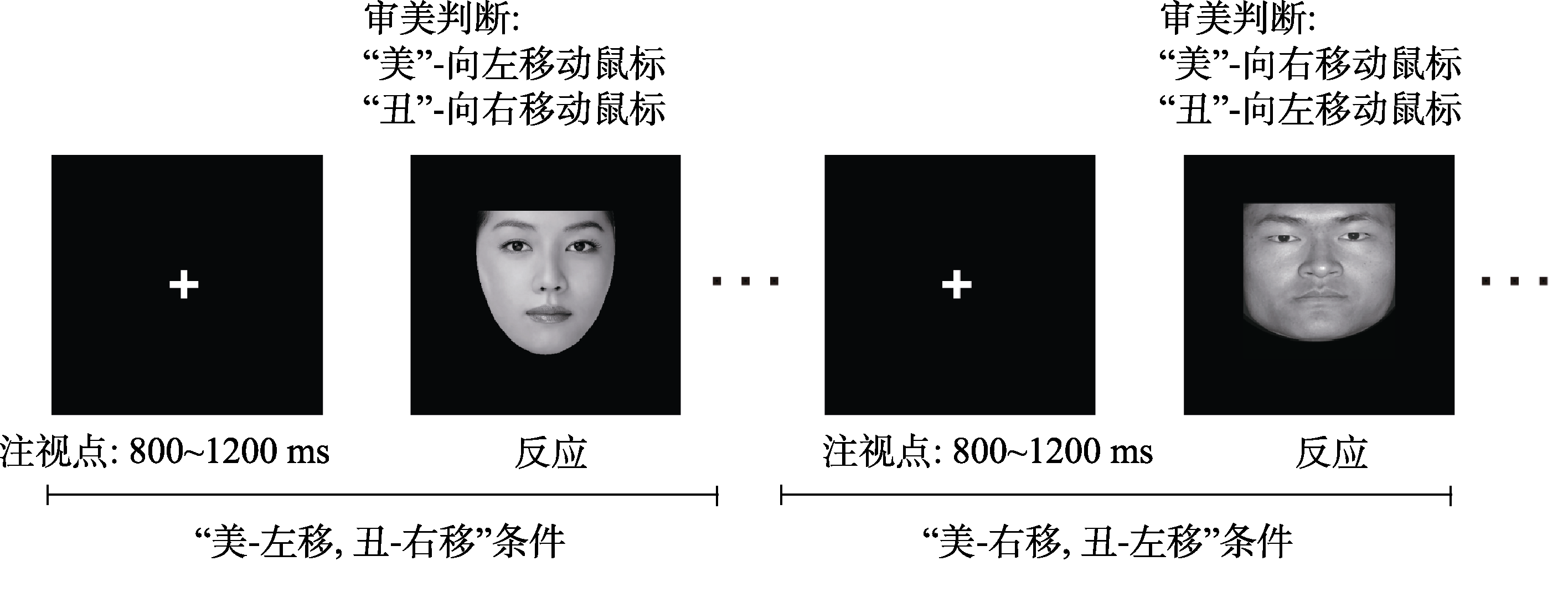
图1 实验1程序示意图
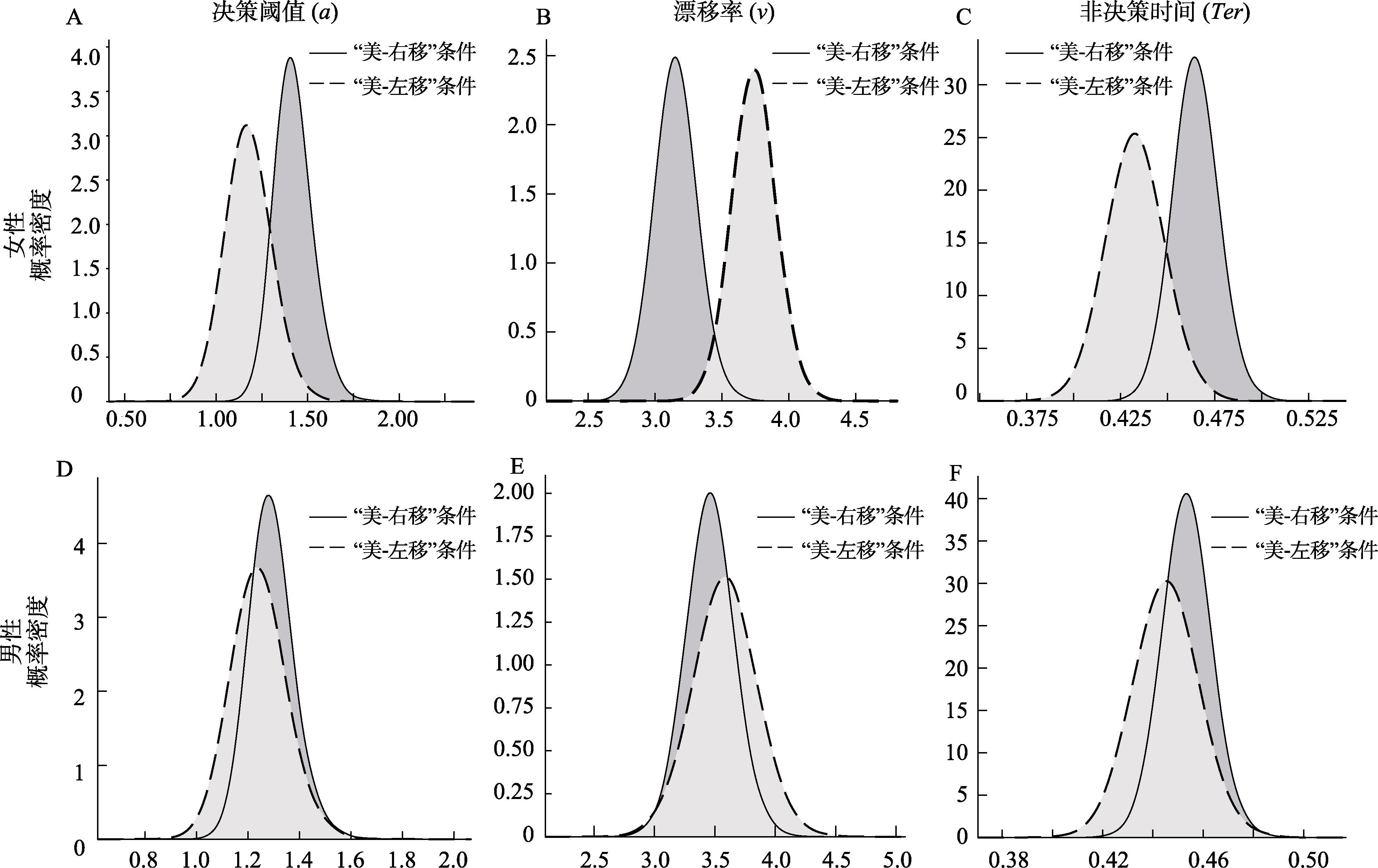
图2 被试在两种反应条件下三种HDDM参数的概率密度分布。上排(A~C)为女性数据, 下排(D~F)为男性数据。参数分别为:(A, D)决策阈值(a), (B, E)漂移率(v), (C, F) 非决策时间(Ter)。
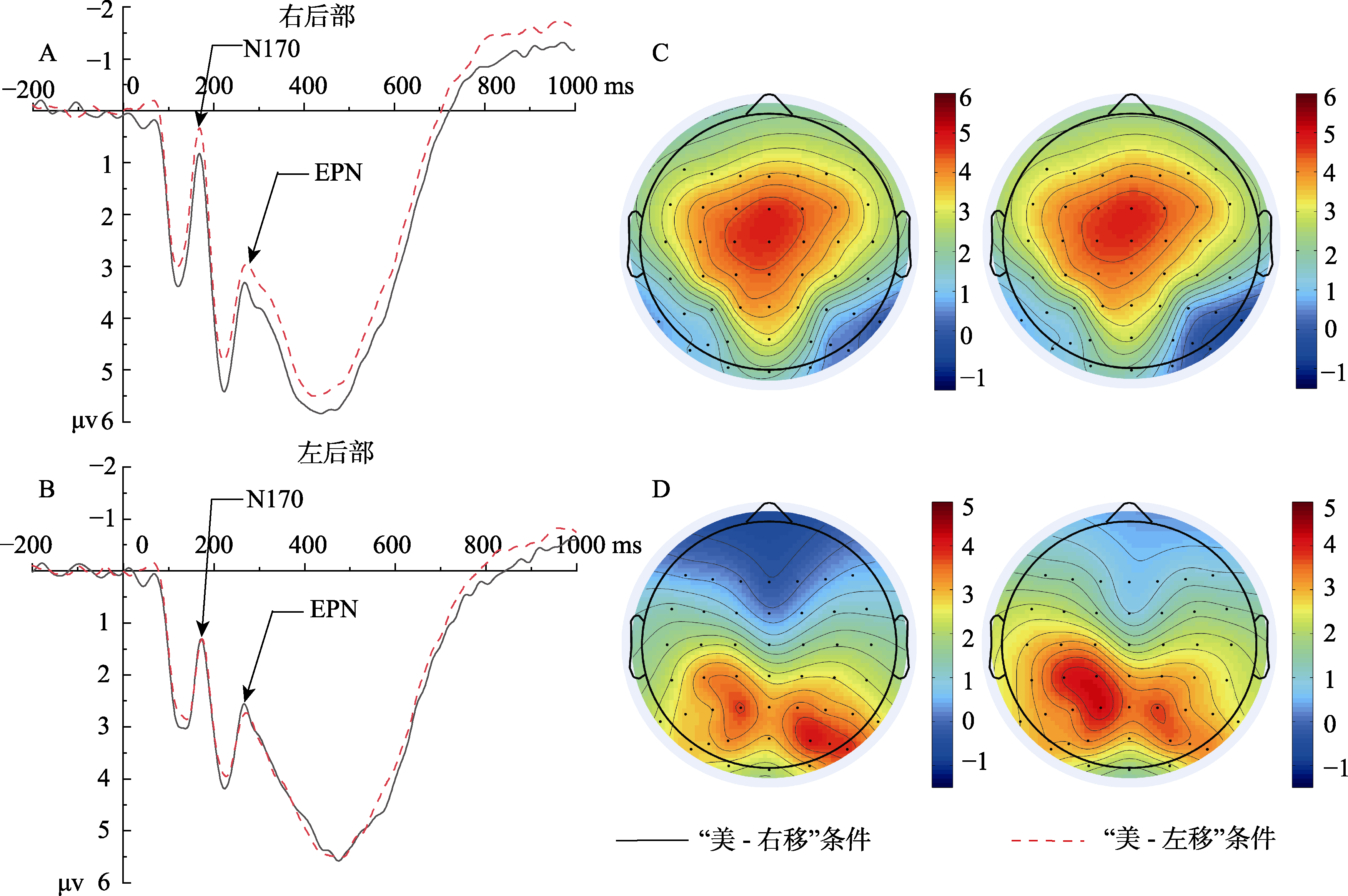
图3 (A)两种反应条件下右后区的平均波形图; (B)两种反应条件下左后区的平均波形图 注:文中报告的N170与EPN统计结果一律基于个体峰值振幅, 可能与平均波形图显示结果存在一定差异(实验2、3相关结果同此); (C) N170的地形图(“美−右移”: 峰时=168 ms; “美−左移”: 峰时=168 ms); (D) EPN的地形图(“美−右移”: 峰时=268 ms; “美−左移”: 峰时=272 ms)。彩图见电子版, 下同。

图4 (A)两种反应条件下前额区的P300波形; (B)两种反应条件下中央区的P300波形; (C)两种反应条件下顶叶区的P300波形; (D)“美−右移”条件下P300的地形图; (E)“美−左移”条件下P300的地形图。

图5 (A)被试在“美−右移”和“美−左移”条件下的P300波形; (B~E)按性别分离的“美−右移”和“美−左移”条件下P300的地形图, (B)和(D)分别显示男性被试在“美−右移”和“美−左移”条件下的地形图, (C)和(E)显示女性被试在两种条件下的地形图。
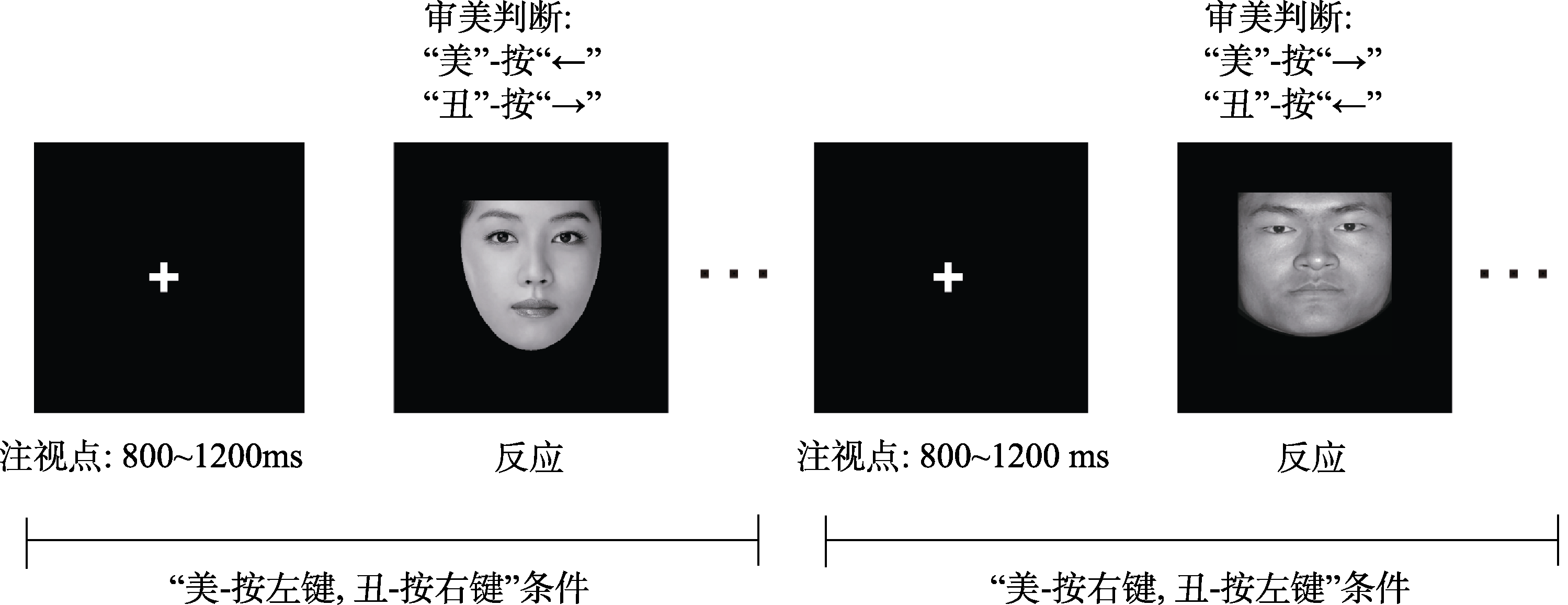
图6 实验2程序示意图
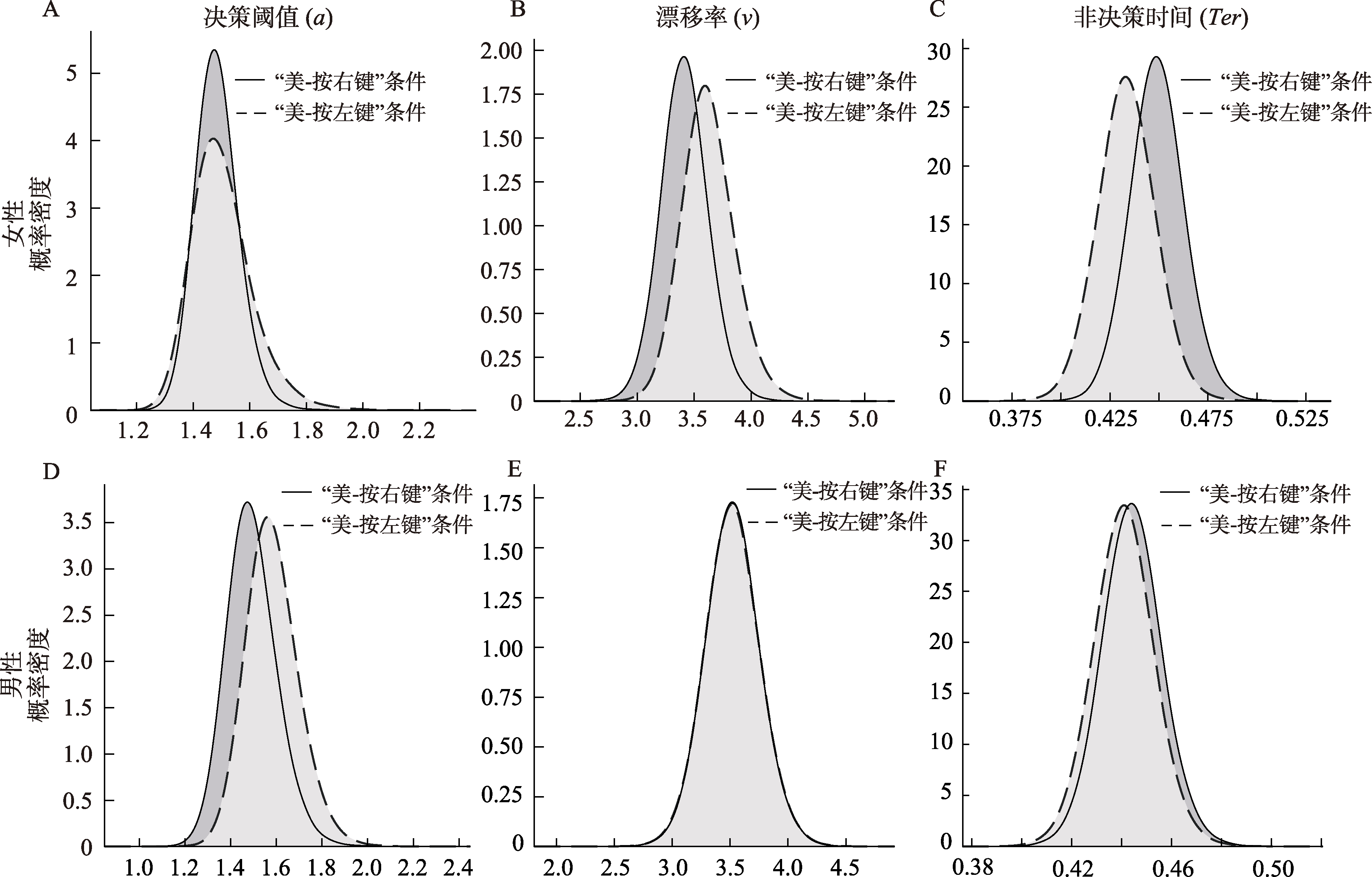
图7 被试在“美−按右键”与“美−按左键”两种反应条件下的HDDM参数概率密度分布。上排(A-C)为女性被试, 下排(D-F)为男性被试。三种参数为:(A, D)决策阈值(a), (B, E)漂移率(v), (C, F)非决策时间(Ter)。
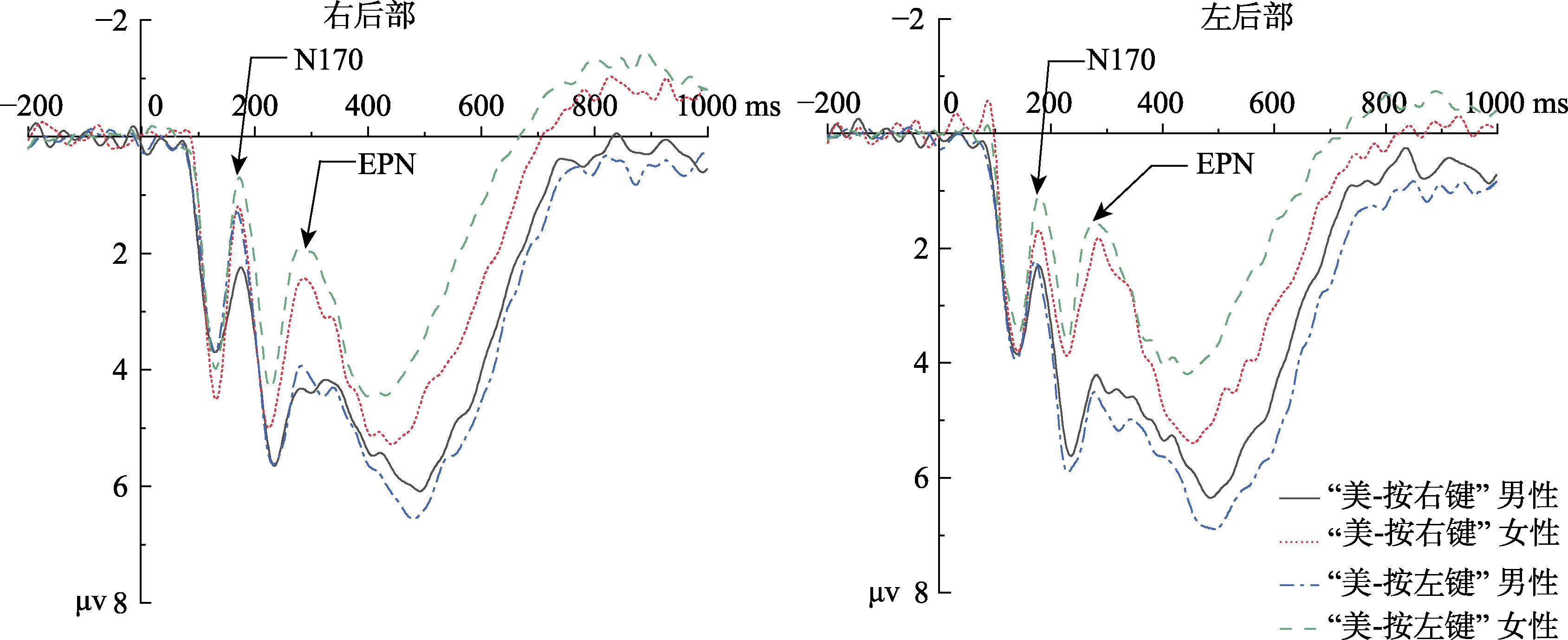
图8 在“美−按左键”和“美−按右键”条件下, 按性别分离, 在右后部(左图)与左后部(右图)记录的N170与EPN的总平均波形。

图9 (A~C)男性与女性被试在“美−按右键”和“美−按左键”条件下的前额区(A)、中央区(B)与顶叶区(C) P300波形的总平均波形; (D~G)分别展示男性与女性被试在“美−按右键”和“美−按左键”条件下的P300振幅地形图。
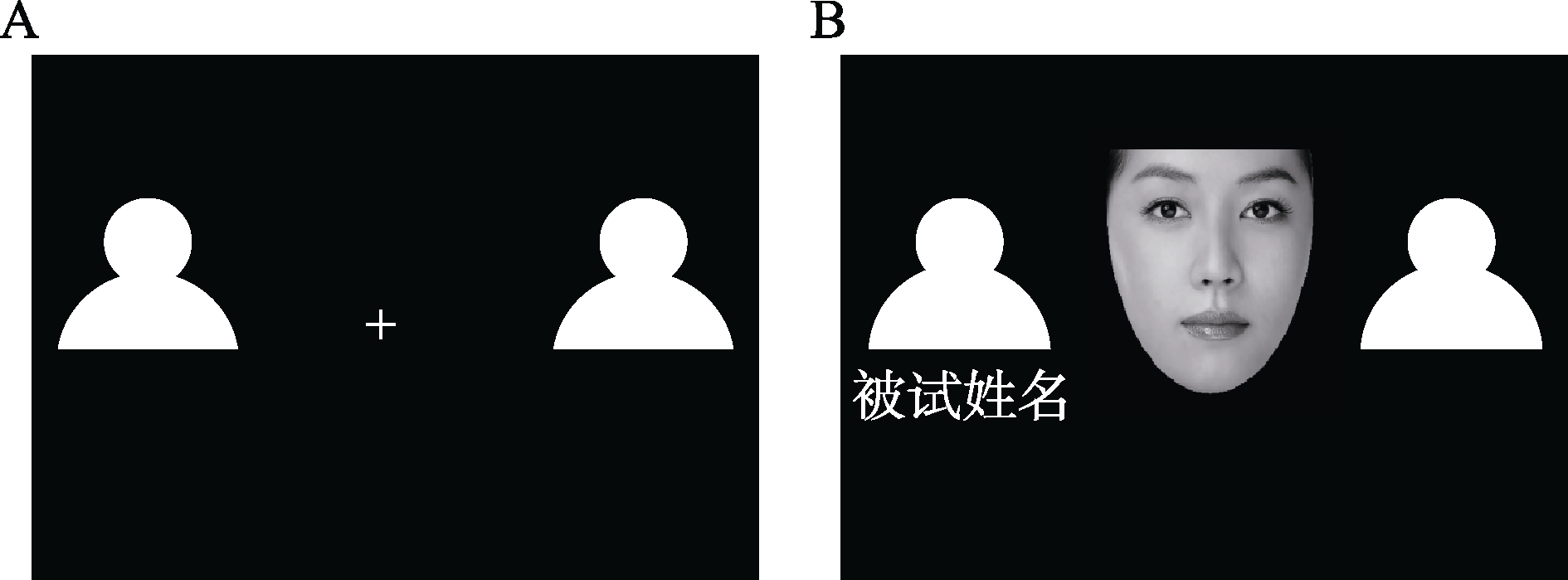
图10 (A)显示中央注视点的示例屏幕; (B)当被试的自我参照点位于左侧时, 显示的面部刺激示例。
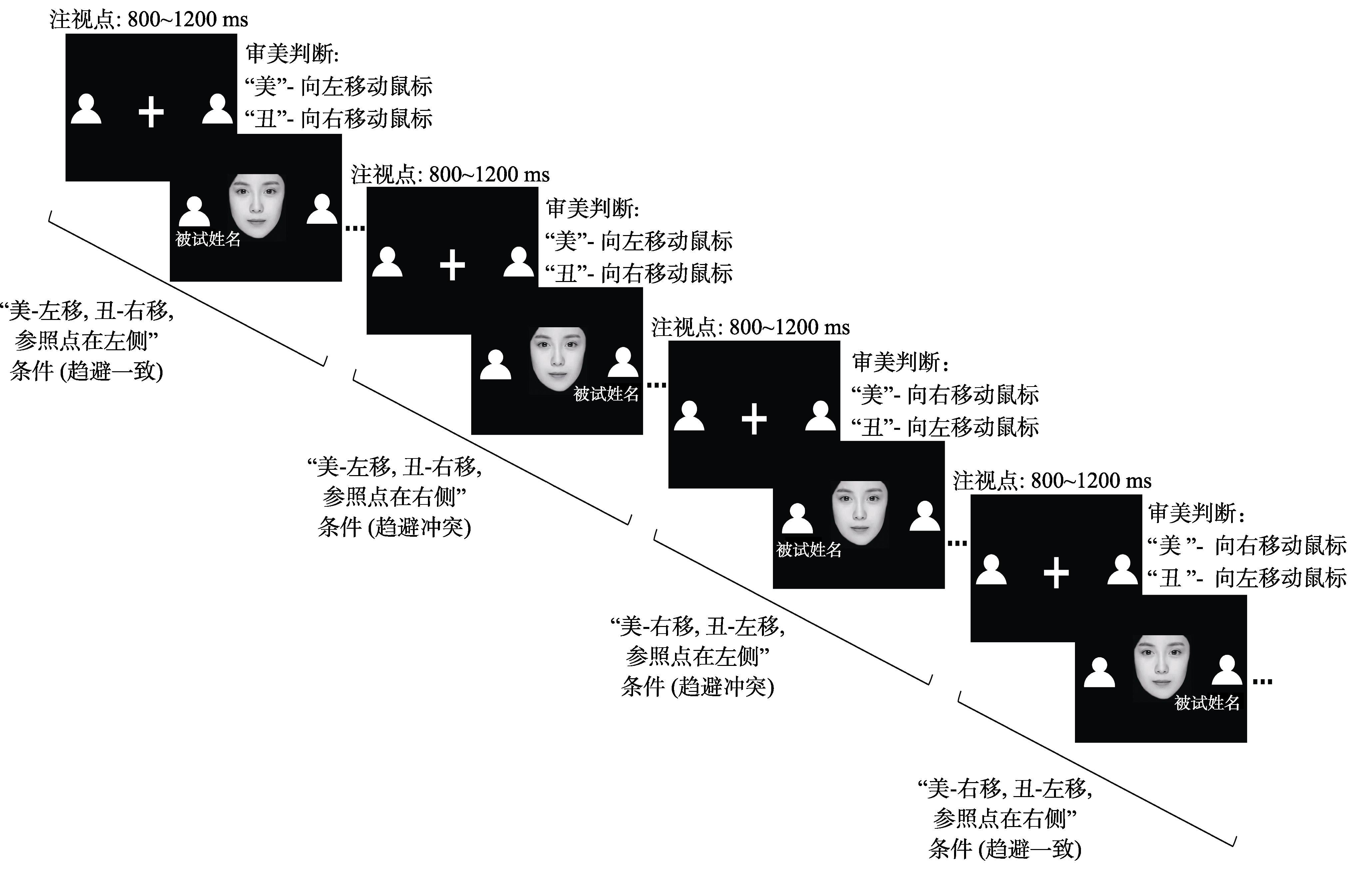
图11 实验3程序示意图
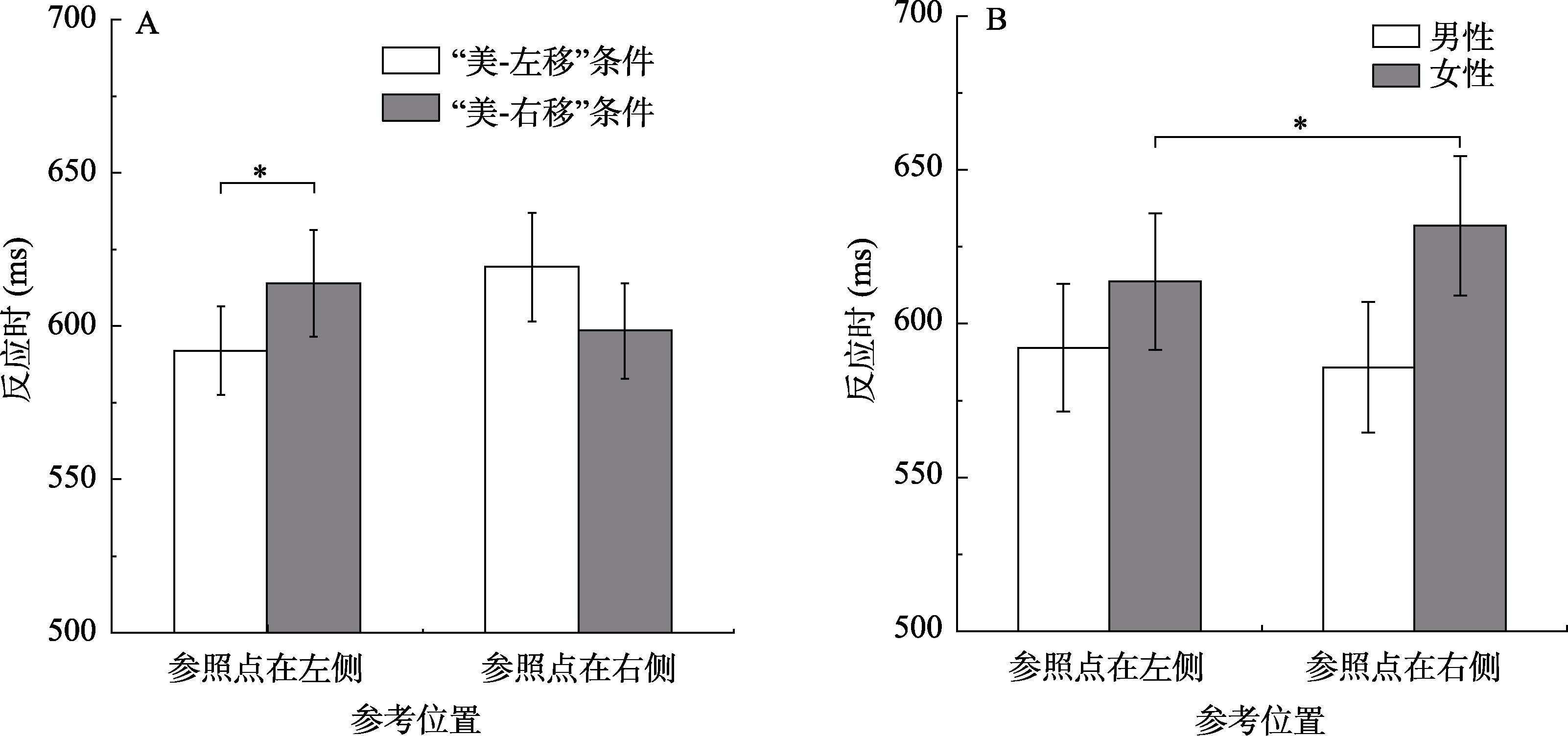
图12 实验3反应时间结果(A)在不同参照位置下两种条件的反应时间比较; (B)不同性别下, 参照位置变化时的反应时间比较(误差条表示标准误差; *表示p < 0.050)。
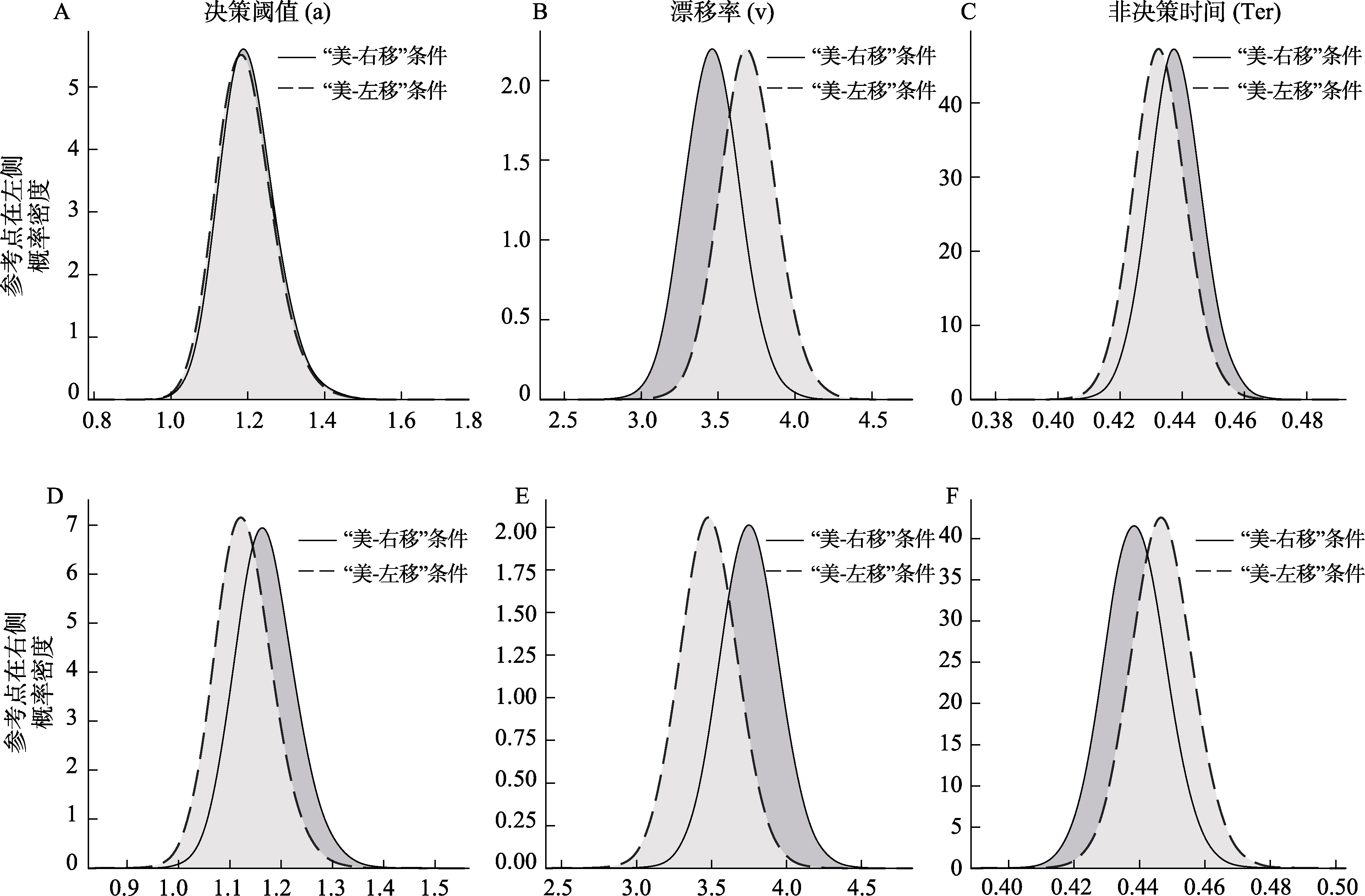
图13 两种反应条件下HDDM参数的概率密度分布:参照点在左侧(A~C)和右侧(D~F)。三个参数分别为:(A, D)决策阈值(a), (B, E)漂移率(v), (C, F)非决策时间(Ter)。
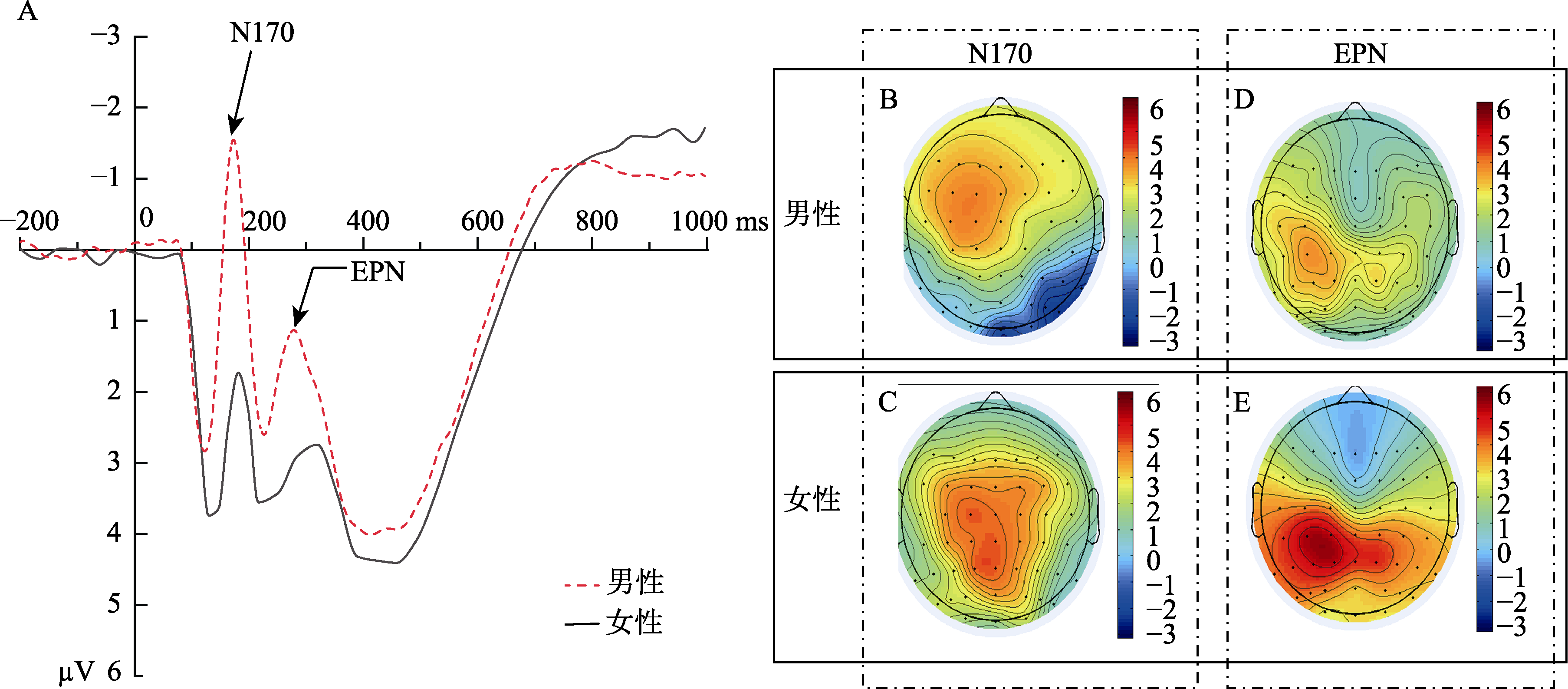
图14 (A)不同性别被试在右后区域的N170和EPN平均波形; (B)男性被试的N170地形图(峰时=172 ms); (C)女性被试的N170地形图(峰时=174 ms); (D)男性被试的EPN地形图(峰时=278 ms); (E)女性被试的EPN地形图(峰时=300 ms)。

图15 (A)参照点在左侧时两种反应条件下的前额区波形; (B)参照点在右侧时两种反应条件下的前额区波形; (C~D)当参照位置在左侧时, 两种反应条件下的P300地形图; (E~F)当参照位置在右侧时, 两种反应条件下的P300地形图。
| [1] | Almeida P. R., Ferreira-Santos F., Chaves P. L., Paiva T. O., Barbosa F., & Marques-Teixeira J. (2016). Perceived arousal of facial expressions of emotion modulates the N170, regardless of emotional category: Time domain and time-frequency dynamics. International Journal of Psychophysiology, 99, 48-56. |
| [2] | Ardizzi M., Ferroni F., Siri F., Umiltà M. A., Cotti A., Calbi M., … Gallese V. (2020). Beholders’ sensorimotor engagement enhances aesthetic rating of pictorial facial expressions of pain. Psychological Research, 84(2), 370-379. |
| [3] | Bai L., Ma H., Huang Y., & Luo Y. (2005). The development of native Chinese affective picture system-A pretest in 46 college students. Chinese Mental Health Journal, 19(11), 719-722. |
| [白露, 马慧, 黄宇霞, 罗跃嘉. (2005). 中国情绪图片系统的编制--在46名中国大学生中的试用. 中国心理卫生杂志, 19(11), 719-722.] | |
| [4] | Cazzato V., Mele S., & Urgesi C. (2016). Different contributions of visual and motor brain areas during liking judgments of same- and different-gender bodies. Brain Research, 1646, 98-108. |
| [5] | Cazzato V., Walters E. R., & Urgesi C. (2021). Associations of observer’s gender, body mass index and internalization of societal beauty ideals to visual body processing. Psychological Research, 85(8), 3026-3039. |
| [6] | Cela-Conde C. J., Ayala F. J., Munar E., Maestú F., Nadal M., Capó M. A., … Marty G. (2009). Sex-related similarities and differences in the neural correlates of beauty. Proceedings of the National Academy of Sciences, 106(10), 3847-3852. |
| [7] | Centerbar D. B., & Clore G. L. (2006). Do approach-avoidance actions create attitudes? Psychological Science, 17(1), 22-29. |
| [8] | Choi D., Egashira Y., Takakura J., Motoi M., Nishimura T., & Watanuki S. (2015). Gender difference in N170 elicited under oddball task. Journal of Physiological Anthropology, 34(1), 7. |
| [9] | Crippen M. (2021). Aesthetics and action: Situations, emotional perception and the Kuleshov effect. Synthese, 198(S9), 2345-2363. |
| [10] | Farkas A. H., & Sabatinelli D. (2023). Emotional perception: Divergence of early and late event-related potential modulation. Journal of Cognitive Neuroscience, 35(6), 941-956. |
| [11] | Faul F., Erdfelder E., Lang A.-G., & Buchner A. (2007). G*Power 3: A flexible statistical power analysis program for the social, behavioral, and biomedical sciences. Behavior Research Methods, 39(2), 175-191. |
| [12] | Forstmann B. U., Ratcliff R., & Wagenmakers E. J. (2016). Sequential sampling models in cognitive neuroscience: Advantages, applications, and extensions. Annual Review of Psychology, 67, 641-666. |
| [13] | Freedberg D., & Gallese V. (2007). Motion, emotion and empathy in esthetic experience. Trends in Cognitive Sciences, 11(5), 197-203. |
| [14] | Gattario K. H., Frisén A., Teall T. L., & Piran N. (2020). Embodiment: Cultural and gender differences and associations with life satisfaction. Body Image, 35, 1-10. |
| [15] | Gelman A., & Rubin D. B. (1992). Inference from iterative simulation using multiple sequences. Statistical Science, 7(4), 457-472. |
| [16] | Hajihosseini A., & Hutcherson C. A. (2021). Alpha oscillations and event-related potentials reflect distinct dynamics of attribute construction and evidence accumulation in dietary decision making. eLife, 10, e60874. |
| [17] | Hall J. A., & Matsumoto D. (2004). Gender differences in judgments of multiple emotions from facial expressions. Emotion, 4(2), 201-206. |
| [18] | Humphries S., Rick J., Weintraub D., & Chatterjee A. (2021). Movement in aesthetic experiences: What we can learn from parkinson disease. Journal of Cognitive Neuroscience, 33(7), 1329-1342. |
| [19] | Johnson D. J., Hopwood C. J., Cesario J., & Pleskac T. J. (2017). Advancing research on cognitive processes in social and personality psychology: A hierarchical drift diffusion model primer. Social Psychological and Personality Science, 8(4), 413-423. |
| [20] | Khatin-Zadeh O., Farsani D., Hu J., Eskandari Z., Zhu Y., & Banaruee H. (2023). A review of studies supporting metaphorical embodiment. Behavioral Sciences, 13(7), 585. |
| [21] | Klauer K. C., Voss A., Schmitz F., & Teige-Mocigemba S. (2007). Process components of the implicit association test: A diffusion model analysis. Journal of Personality and Social Psychology, 93(3), 353-368. |
| [22] | Kirsch L. P., Urgesi C., & Cross E. S. (2016). Shaping and reshaping the aesthetic brain: Emerging perspectives on the neurobiology of embodied aesthetics. Neuroscience & Biobehavioral Reviews, 62, 56-68. |
| [23] | Kostyk A., Leonhardt J. M., & Niculescu M. (2021). Processing fluency scale development for consumer research. International Journal of Market Research, 63(3), 353-367. |
| [24] | Kwon J., & Iedema A. (2022). Body and the senses in spatial experience: The implications of kinesthetic and synesthetic perceptions for design thinking. Frontiers in Psychology, 13, 864009. |
| [25] | Landwehr J. R., & Eckmann L. (2020). The nature of processing fluency: Amplification versus hedonic marking. Journal of Experimental Social Psychology, 90, 103997. |
| [26] | Li L., & Wang H. (2024). Embracing beauty through leftward movements: An ERP study on metaphorical association between hand actions and aesthetic judgments. Neuroscience Letters, 822, 137627. |
| [27] | Marshall P., Bartolacci A., & Burke D. (2020). Human face tilt is a dynamic social signal that affects perceptions of dimorphism, attractiveness, and dominance. Evolutionary Psychology, 18(1), 1-15. |
| [28] | Marzi T., & Viggiano M. P. (2010). When memory meets beauty: Insights from event-related potentials. Biological Psychology, 84(2), 192-205. |
| [29] | Meyers-Levy J., & Zhu R. (Juliet). (2010). Gender differences in the meanings consumers infer from music and other aesthetic stimuli. Journal of Consumer Psychology, 20(4), 495-507. |
| [30] | Mullet E., Cretenet J., & Dru V. (2014). Motor influences on judgment: Motor and cognitive integration. British Journal of Psychology, 105(1), 69-91. |
| [31] | Nieuwenhuis S., Aston-Jones G., & Cohen J. D. (2005). Decision making, the P3, and the locus coeruleus-Norepinephrine system. Psychological Bulletin, 131(4), 510-532. |
| [32] | Nittono H., Shibata H., Mizuhara K., & Lieber-Milo S. (2020). Which side looks better? Cultural differences in preference for left- or right-facing objects. Symmetry, 12(10), 1658. |
| [33] | Pan W., Geng H., Zhang L., Fengler A., Frank M. J., Zhang R.-Y., & Chuan-Peng H. (2025). dockerHDDM: A user- friendly environment for bayesian hierarchical drift-diffusion modeling. Advances in Methods and Practices in Psychological Science, 8(1), 1-26. |
| [34] | Ping R. M., Dhillon S., & Beilock S. L. (2009). Reach for what you like: The body’s role in shaping preferences. Emotion Review, 1(2), 140-150. |
| [35] | Polich J. (2007). UpdatingP300: An integrative theory of P3a and P3b. Clinical Neurophysiology, 118(10), 2128-2148. |
| [36] | Ratcliff R., Smith P. L., Brown S. D., & McKoon G. (2016). Diffusion decision model: Current issues and history. Trends in Cognitive Sciences, 20(4), 260-281. |
| [37] | Reber R., Schwarz N., & Winkielman P. (2004). Processing fluency and aesthetic pleasure: Is beauty in the perceiver’s processing experience? Personality and Social Psychology Review, 8(4), 364-382. |
| [38] | Rellecke J., Sommer W., & Schacht A. (2012). Does processing of emotional facial expressions depend on intention? Time-resolved evidence from event-related brain potentials. Biological Psychology, 90(1), 23-32. |
| [39] | Ren W., Li Y., & Wang H. (2021). Metaphorical representation modulates the weight-embodiment effect: Evidence from behavioral- and event-related-potential-based experiments. Journal of Neurolinguistics, 60, 101022. |
| [40] | Shang J., Zhong K., Hou X., Yao L., Shi R., & Wang Z. (2025). Invisible and visible processing of facial attractiveness in implicit tasks: Evidence from event- related potentials (ERPs). PsyCh Journal, 14(4), 573-582. |
| [41] | Song X., Yi F., Zhang J., & Proctor R. W. (2019). Left is “good”: Observed action affects the association between horizontal space and affective valence. Cognition, 193, 104030. |
| [42] | Stafford T., Pirrone A., Croucher M., & Krystalli A. (2020). Quantifying the benefits of using decision models with response time and accuracy data. Behavior Research Methods, 52(5), 2142-2155. |
| [43] | Starr G. G. (2023). Aesthetic experience models human learning. Frontiers in Human Neuroscience, 17, 1146083. |
| [44] | Sun H., & Liu D. (2021). Horizontal spatial metaphor representation of social status in Chinese culture. Frontiers in Psychology, 12, 658161. |
| [45] | Sun T., Li L., Xu Y., Zheng L., Zhang W., Zhou F. A., & Guo X. (2017). Electrophysiological evidence for women superiority on unfamiliar face processing. Neuroscience Research, 115, 44-53. |
| [46] | Wang H., Mo L., Luo Q., Xiang Y., & Hu Y. (2016). Psychological distance modulates the performance of the embodiment effect: Evidence from behavioral and ERP studies. Psychophysiology, 53(4), 527-534. |
| [47] | Wang T., Mo L., Mo C., Tan L. H., Cant J. S., Zhong L., & Cupchik G. (2015). Is moral beauty different from facial beauty? Evidence from an fMRI study. Social Cognitive and Affective Neuroscience, 10(6), 814-823. |
| [48] | Wiecki T. V., Sofer I., & Frank M. J. (2013). HDDM: Hierarchical Bayesian estimation of the drift-diffusion model in Python. Frontiers in Neuroinformatics, 7, 14. |
| [49] | Williams J. K., & Themanson J. R. (2011). Neural correlates of the implicit association test: Evidence for semantic and emotional processing. Social Cognitive and Affective Neuroscience, 6(4), 468-476. |
| [50] | Xin W., Yu R., & Zhao L. (2021). Event-related-potential based evidence of cognitive dysfunction of processing emotional faces in major depressive disorder patients. Neuroscience Letters, 742, 135545. |
| [51] | Yoo J., Jasko K., & Winkielman P. (2024). Fluency, prediction and motivation: How processing dynamics, expectations and epistemic goals shape aesthetic judgements. Philosophical Transactions of the Royal Society B: Biological Sciences, 379(1895), 20230326. |
| [52] | Zhang L., Atari M., Schwarz N., Newman E. J., & Afhami R. (2022). Conceptual metaphors, processing fluency, and aesthetic preference. Journal of Experimental Social Psychology, 98, 104247. |
| [1] | 梁星杰, 陈慧芳, 王璐瑶, 孙彦良. 意识状态调节节律性时间注意: 来自行为、分层漂移扩散模型与脑电指标的证据[J]. 心理学报, 2026, 58(3): 450-466. |
| [2] | 夏瑞雪, 张乃文, 蒋云鹤, 周爱保. 完整自我:完整线索提升自我优先性[J]. 心理学报, 2026, 58(12): 2631-2652. |
| [3] | 吴洁, 车子轩. 多通道类别学习经验对特征加工和类别选择的调控机制[J]. 心理学报, 2026, 58(11): 2251-2269. |
| [4] | 李毕琴, 张美霞, 杨少云, 黄鹏飞, 王爱君, 党君华. 秒内不同时距下自我加工优势效应[J]. 心理学报, 2025, 57(9): 1529-1539. |
| [5] | 袁博, 赵靖实, 漆丹, 赵彤, 胡佳琪. 社会奖惩对欺骗行为的影响[J]. 心理学报, 2025, 57(9): 1622-1637. |
| [6] | 吴洁, 车子轩. 多通道类别学习的认知特征与神经机制:EEG与DDM证据[J]. 心理学报, 2025, 57(10): 1715-1728. |
| [7] | 郭筱琳, 张艺凡, 关岳琳, 罗良. 亲子孝道观念冲突与青少年子女抑郁的关系[J]. 心理学报, 2025, 57(1): 58-70. |
| [8] | 袁博, 王晓萍, 尹军, 李伟强. 跨情境的刺激泛化在面孔信任形成中的作用:基于直接互动与观察学习的视角[J]. 心理学报, 2023, 55(7): 1099-1114. |
| [9] | 陈伟, 林小裔, 李俊娇, 张文曦, 孙楠, 郑希付. 条件性恐惧提取消退的性别差异[J]. 心理学报, 2021, 53(10): 1082-1093. |
| [10] | 张景焕, 付萌萌, 辛于雯, 陈佩佩, 沙莎. 小学高年级学生创造力的发展:性别差异及学校支持的作用[J]. 心理学报, 2020, 52(9): 1057-1070. |
| [11] | 陈曦梅, 罗一君, 陈红. 友谊质量与青少年直觉进食:链式中介模型及性别差异[J]. 心理学报, 2020, 52(4): 485-496. |
| [12] | 王美萍, 郑晓洁, 夏桂芝, 刘迪迪, 陈翩, 张文新. 负性生活事件与青少年早期抑郁的关系:COMT基因Val158Met多态性与父母教养行为的调节作用[J]. 心理学报, 2019, 51(8): 903-913. |
| [13] | 徐 亮, 谢晓媛, 闫 沛, 李俊娇, 郑希付. 条件性恐惧泛化的性别差异[J]. 心理学报, 2018, 50(2): 197-205. |
| [14] | 曹衍淼;王美萍;曹丛;纪林芹;张文新. DRD2基因TaqIA多态性与同伴侵害对青少年早期抑郁的交互作用[J]. 心理学报, 2017, 49(1): 28-39. |
| [15] | 侯金芹;陈祉妍. 青少年抑郁情绪的发展轨迹:界定亚群组及其影响因素[J]. 心理学报, 2016, 48(8): 957-968. |
| 阅读次数 | ||||||
|
全文 |
|
|||||
|
摘要 |
|
|||||
