

ISSN 0439-755X
CN 11-1911/B
主办:中国心理学会
中国科学院心理研究所
出版:科学出版社
CN 11-1911/B
主办:中国心理学会
中国科学院心理研究所
出版:科学出版社
心理学报 ›› 2026, Vol. 58 ›› Issue (1): 96-112.doi: 10.3724/SP.J.1041.2026.0096 cstr: 32110.14.2026.0096
向姝婷1, 周芷蕊1, 谢小云2( ), 张昱城2(), 吴珊1
收稿日期:2025-03-03
发布日期:2025-10-28
出版日期:2026-01-25
通讯作者:
谢小云, E-mail: xiexy@zju.edu.cn;基金资助:
XIANG Shuting1, ZHOU Zhirui1, XIE Xiaoyun2(), ZHANG Yucheng2(), WU Shan1
Received:2025-03-03
Online:2025-10-28
Published:2026-01-25
摘要:
基于自我概念理论, 探讨了资质过剩感对员工工作激情的非线性效应。通过对某大型国有银行856名员工和其直接领导在4个时间点的配对问卷数据分析, 发现:(1)资质过剩感与感知相对工作优势之间存在倒U型关系; (2)感知绩效评估公平弱化了资质过剩感与感知相对工作优势之间的曲线关系; (3)感知相对工作优势与员工和谐工作激情和强迫工作激情正相关; (4)存在非线性被中介的调节效应, 即员工资质过剩感与感知绩效评估公平的交互效应会通过感知相对工作优势间接影响和谐工作激情与强迫工作激情; (5)领导工作意义赋予正向调节感知相对工作优势与工作激情之间的关系; (6)和谐工作激情与员工角色内绩效和角色外绩效正相关。研究结果不仅丰富了资质过剩感的相关研究, 也对企业响应国家高质量充分就业倡导具有管理启示。
中图分类号:
向姝婷, 周芷蕊, 谢小云, 张昱城, 吴珊. (2026). 越被小用, 越失激情?员工资质过剩感对其工作激情的影响. 心理学报, 58(1), 96-112.
XIANG Shuting, ZHOU Zhirui, XIE Xiaoyun, ZHANG Yucheng, WU Shan. (2026). Underused skills lead to lost drive? The impact of employees’ perceived overqualification on work passion. Acta Psychologica Sinica, 58(1), 96-112.
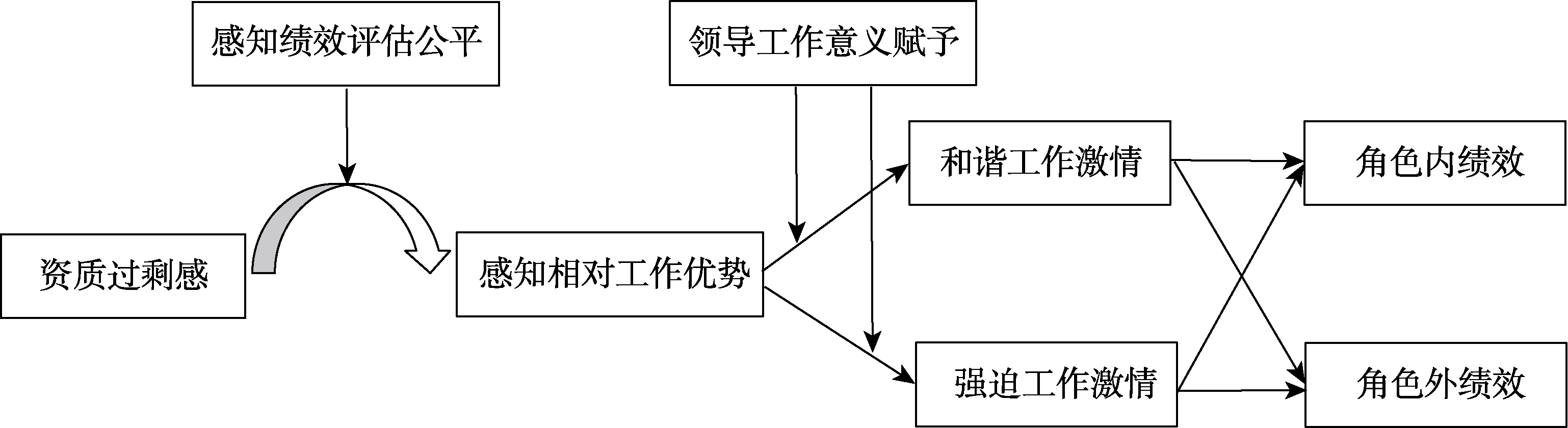
图1 研究模型
| 变量 | M | SD | 1 | 2 | 3 | 4 | 5 | 6 | 7 | 8 | 9 | 10 | 11 | 12 | 13 |
|---|---|---|---|---|---|---|---|---|---|---|---|---|---|---|---|
| 1. 性别 | − | − | |||||||||||||
| 2. 年龄(岁) | 33.40 | 9.34 | 0.20*** | ||||||||||||
| 3. 学历 | 2.85 | 0.64 | −0.14*** | −0.59*** | |||||||||||
| 4. 工作年限 | 60.16 | 94.54 | 0.14*** | 0.46*** | −0.30*** | ||||||||||
| 5. 工作类型 | 1.72 | 0.92 | 0.16*** | 0.31*** | −0.26*** | 0.23*** | |||||||||
| 6. 资质过剩感 | 3.71 | 0.88 | −0.14*** | −0.01 | 0.14*** | 0.004 | 0.01 | 0.86 | |||||||
| 7. 感知绩效评估公平 | 3.97 | 1.01 | −0.001 | −0.22*** | 0.14*** | −0.12*** | −0.17*** | −0.15*** | 0.97 | ||||||
| 8. 感知相对工作优势 | 3.56 | 1.01 | −0.14*** | −0.22*** | 0.17*** | −0.18*** | −0.11** | −0.05 | 0.30*** | 0.96 | |||||
| 9. 领导工作意义赋予 | 4.32 | 0.91 | −0.03 | −0.15*** | 0.09** | −0.10** | −0.10** | −0.08* | 0.37*** | 0.31*** | 0.97 | ||||
| 10. 和谐工作激情 | 3.83 | 0.86 | −0.05 | −0.05 | 0.02 | −0.11** | −0.04 | −0.11** | 0.34*** | 0.36*** | 0.52*** | 0.94 | |||
| 11. 强迫工作激情 | 3.58 | 0.92 | −0.01 | 0.04 | −0.04 | −0.01 | 0.03 | −0.03 | 0.21*** | 0.29*** | 0.33*** | 0.69*** | 0.94 | ||
| 12. 角色内绩效 | 4.25 | 1.04 | 0.04 | −0.04 | −0.004 | −0.03 | 0.01 | −0.02 | 0.02 | 0.03 | 0.05 | 0.10** | 0.06 | 0.94 | |
| 13. 角色外绩效 | 4.25 | 1.02 | −0.03 | −0.08* | 0.02 | −0.04 | −0.02 | 0.01 | 0.01 | 0.01 | 0.07* | 0.08* | 0.03 | 0.86*** | 0.97 |
表1 变量的均值、标准差和相关系数
| 变量 | M | SD | 1 | 2 | 3 | 4 | 5 | 6 | 7 | 8 | 9 | 10 | 11 | 12 | 13 |
|---|---|---|---|---|---|---|---|---|---|---|---|---|---|---|---|
| 1. 性别 | − | − | |||||||||||||
| 2. 年龄(岁) | 33.40 | 9.34 | 0.20*** | ||||||||||||
| 3. 学历 | 2.85 | 0.64 | −0.14*** | −0.59*** | |||||||||||
| 4. 工作年限 | 60.16 | 94.54 | 0.14*** | 0.46*** | −0.30*** | ||||||||||
| 5. 工作类型 | 1.72 | 0.92 | 0.16*** | 0.31*** | −0.26*** | 0.23*** | |||||||||
| 6. 资质过剩感 | 3.71 | 0.88 | −0.14*** | −0.01 | 0.14*** | 0.004 | 0.01 | 0.86 | |||||||
| 7. 感知绩效评估公平 | 3.97 | 1.01 | −0.001 | −0.22*** | 0.14*** | −0.12*** | −0.17*** | −0.15*** | 0.97 | ||||||
| 8. 感知相对工作优势 | 3.56 | 1.01 | −0.14*** | −0.22*** | 0.17*** | −0.18*** | −0.11** | −0.05 | 0.30*** | 0.96 | |||||
| 9. 领导工作意义赋予 | 4.32 | 0.91 | −0.03 | −0.15*** | 0.09** | −0.10** | −0.10** | −0.08* | 0.37*** | 0.31*** | 0.97 | ||||
| 10. 和谐工作激情 | 3.83 | 0.86 | −0.05 | −0.05 | 0.02 | −0.11** | −0.04 | −0.11** | 0.34*** | 0.36*** | 0.52*** | 0.94 | |||
| 11. 强迫工作激情 | 3.58 | 0.92 | −0.01 | 0.04 | −0.04 | −0.01 | 0.03 | −0.03 | 0.21*** | 0.29*** | 0.33*** | 0.69*** | 0.94 | ||
| 12. 角色内绩效 | 4.25 | 1.04 | 0.04 | −0.04 | −0.004 | −0.03 | 0.01 | −0.02 | 0.02 | 0.03 | 0.05 | 0.10** | 0.06 | 0.94 | |
| 13. 角色外绩效 | 4.25 | 1.02 | −0.03 | −0.08* | 0.02 | −0.04 | −0.02 | 0.01 | 0.01 | 0.01 | 0.07* | 0.08* | 0.03 | 0.86*** | 0.97 |
| 模型 | χ2 | df | χ2/df | RMSEA | SRMR | CFI | TLI |
|---|---|---|---|---|---|---|---|
| 八因子模型: POQ、JUS、RJA、LWMG、HP、OP、IRP、ORP | 1825.85 | 899 | 2.03 | 0.04 | 0.03 | 0.97 | 0.97 |
| 七因子模型: POQ、JUS、RJA、LWMG、HP、OP、IRP+ ORP | 2831.74 | 910 | 3.11 | 0.05 | 0.03 | 0.94 | 0.93 |
| 六因子模型: POQ、JUS、RJA、LWMG、HP+OP、IRP+ ORP | 4720.34 | 916 | 5.15 | 0.07 | 0.06 | 0.88 | 0.87 |
| 五因子模型: POQ、JUS、RJA+LWMG、HP+OP、IRP+ORP | 6909.37 | 921 | 7.50 | 0.09 | 0.09 | 0.81 | 0.79 |
| 四因子模型: POQ+JUS、RJA+LWMG、HP+OP、IRP+ ORP | 7260.30 | 925 | 7.85 | 0.09 | 0.09 | 0.79 | 0.78 |
| 三因子模型: POQ+JUS、RJA+LWMG、HP+OP+ IRP+ ORP | 16040.25 | 928 | 17.28 | 0.14 | 0.21 | 0.51 | 0.48 |
| 两因子模型: POQ+JUS、RJA+LWMG+HP+OP+ IRP+ ORP | 18164.43 | 930 | 19.53 | 0.15 | 0.22 | 0.44 | 0.40 |
| 单因子模型: POQ+JUS+RJA+LWMG+HP+OP+ IRP+ ORP | 25025.98 | 945 | 26.48 | 0.17 | 0.23 | 0.22 | 0.18 |
表2 多层次验证性因子分析结果
| 模型 | χ2 | df | χ2/df | RMSEA | SRMR | CFI | TLI |
|---|---|---|---|---|---|---|---|
| 八因子模型: POQ、JUS、RJA、LWMG、HP、OP、IRP、ORP | 1825.85 | 899 | 2.03 | 0.04 | 0.03 | 0.97 | 0.97 |
| 七因子模型: POQ、JUS、RJA、LWMG、HP、OP、IRP+ ORP | 2831.74 | 910 | 3.11 | 0.05 | 0.03 | 0.94 | 0.93 |
| 六因子模型: POQ、JUS、RJA、LWMG、HP+OP、IRP+ ORP | 4720.34 | 916 | 5.15 | 0.07 | 0.06 | 0.88 | 0.87 |
| 五因子模型: POQ、JUS、RJA+LWMG、HP+OP、IRP+ORP | 6909.37 | 921 | 7.50 | 0.09 | 0.09 | 0.81 | 0.79 |
| 四因子模型: POQ+JUS、RJA+LWMG、HP+OP、IRP+ ORP | 7260.30 | 925 | 7.85 | 0.09 | 0.09 | 0.79 | 0.78 |
| 三因子模型: POQ+JUS、RJA+LWMG、HP+OP+ IRP+ ORP | 16040.25 | 928 | 17.28 | 0.14 | 0.21 | 0.51 | 0.48 |
| 两因子模型: POQ+JUS、RJA+LWMG+HP+OP+ IRP+ ORP | 18164.43 | 930 | 19.53 | 0.15 | 0.22 | 0.44 | 0.40 |
| 单因子模型: POQ+JUS+RJA+LWMG+HP+OP+ IRP+ ORP | 25025.98 | 945 | 26.48 | 0.17 | 0.23 | 0.22 | 0.18 |
| 变量 | 感知相对工作优势 | |||||
|---|---|---|---|---|---|---|
| 模型1 | 模型2 | 模型3 | ||||
| β | β | β | ||||
| 截距 | 0.90*** | 0.05 | 0.89*** | 0.05 | 0.84*** | 0.05 |
| 性别 | −0.19* | 0.07 | −0.22** | 0.07 | −0.24** | 0.07 |
| 年龄 | −0.53** | 0.17 | −0.52** | 0.17 | −0.20 | 0.17 |
| 学历 | 0.05 | 0.07 | 0.07 | 0.07 | 0.12 | 0.06 |
| 工作年限 | −0.05* | 0.02 | −0.05* | 0.02 | −0.05* | 0.02 |
| 工作类型 | −0.03 | 0.04 | −0.03 | 0.04 | 0.003 | 0.04 |
| 资质过剩感 | −0.07 | 0.04 | −0.03 | 0.04 | ||
| 资质过剩感的平方 | −0.06* | 0.03 | −0.05* | 0.03 | ||
| 感知绩效评估公平 | 0.21*** | 0.04 | ||||
| 资质过剩感×感知绩效评估公平 | 0.01 | 0.03 | ||||
| 资质过剩感的平方×感知绩效评估公平 | 0.04* | 0.02 | ||||
| R2 | 0.07*** | 0.08*** | 0.15*** | |||
| ∆R2 | - | 0.01 | 0.07 | |||
表3 感知相对工作优势的多层次回归结果
| 变量 | 感知相对工作优势 | |||||
|---|---|---|---|---|---|---|
| 模型1 | 模型2 | 模型3 | ||||
| β | β | β | ||||
| 截距 | 0.90*** | 0.05 | 0.89*** | 0.05 | 0.84*** | 0.05 |
| 性别 | −0.19* | 0.07 | −0.22** | 0.07 | −0.24** | 0.07 |
| 年龄 | −0.53** | 0.17 | −0.52** | 0.17 | −0.20 | 0.17 |
| 学历 | 0.05 | 0.07 | 0.07 | 0.07 | 0.12 | 0.06 |
| 工作年限 | −0.05* | 0.02 | −0.05* | 0.02 | −0.05* | 0.02 |
| 工作类型 | −0.03 | 0.04 | −0.03 | 0.04 | 0.003 | 0.04 |
| 资质过剩感 | −0.07 | 0.04 | −0.03 | 0.04 | ||
| 资质过剩感的平方 | −0.06* | 0.03 | −0.05* | 0.03 | ||
| 感知绩效评估公平 | 0.21*** | 0.04 | ||||
| 资质过剩感×感知绩效评估公平 | 0.01 | 0.03 | ||||
| 资质过剩感的平方×感知绩效评估公平 | 0.04* | 0.02 | ||||
| R2 | 0.07*** | 0.08*** | 0.15*** | |||
| ∆R2 | - | 0.01 | 0.07 | |||
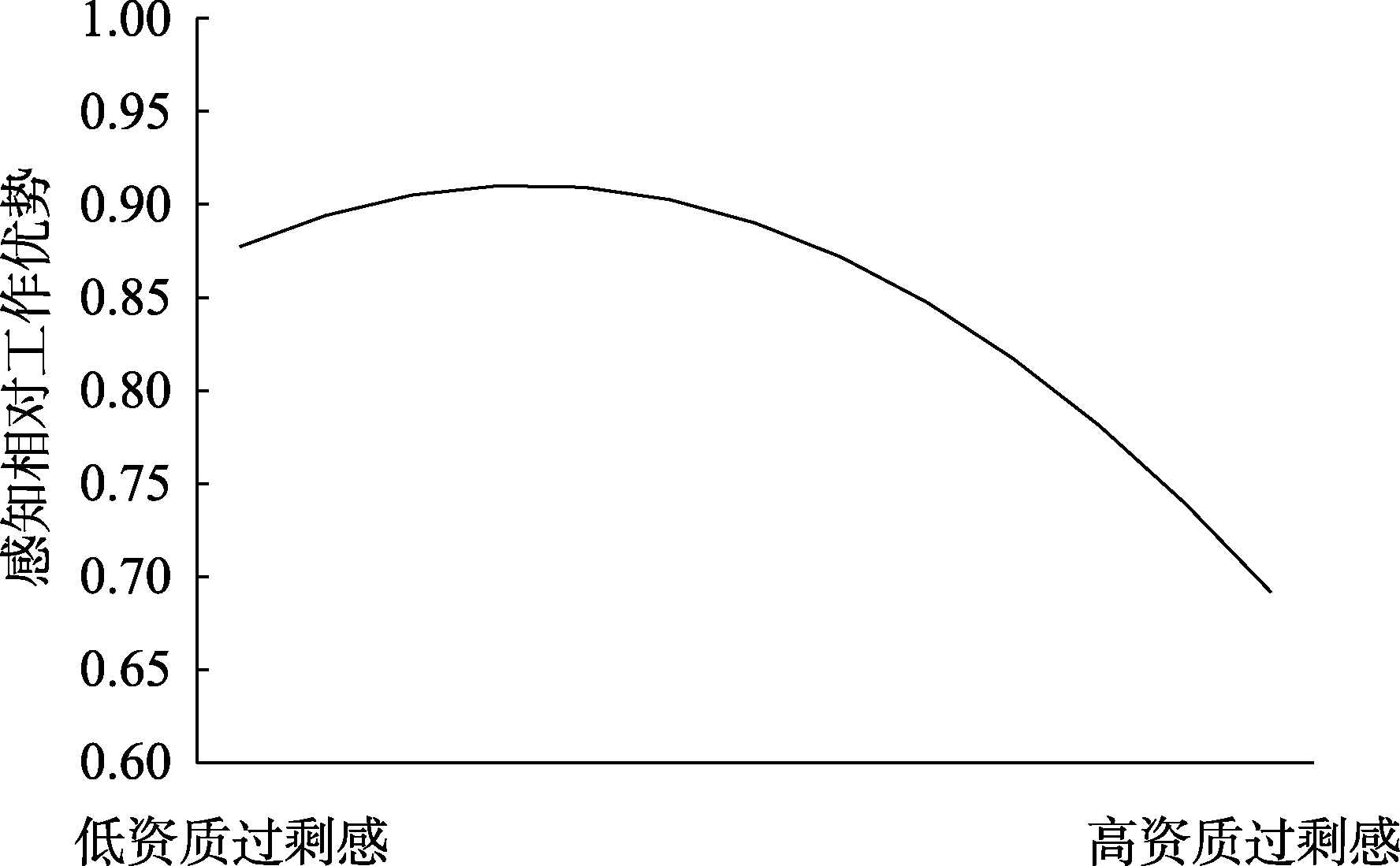
图2 资质过剩感与感知相对工作优势的倒U型关系图 注:所有数据均进行了总体均值中心化处理。
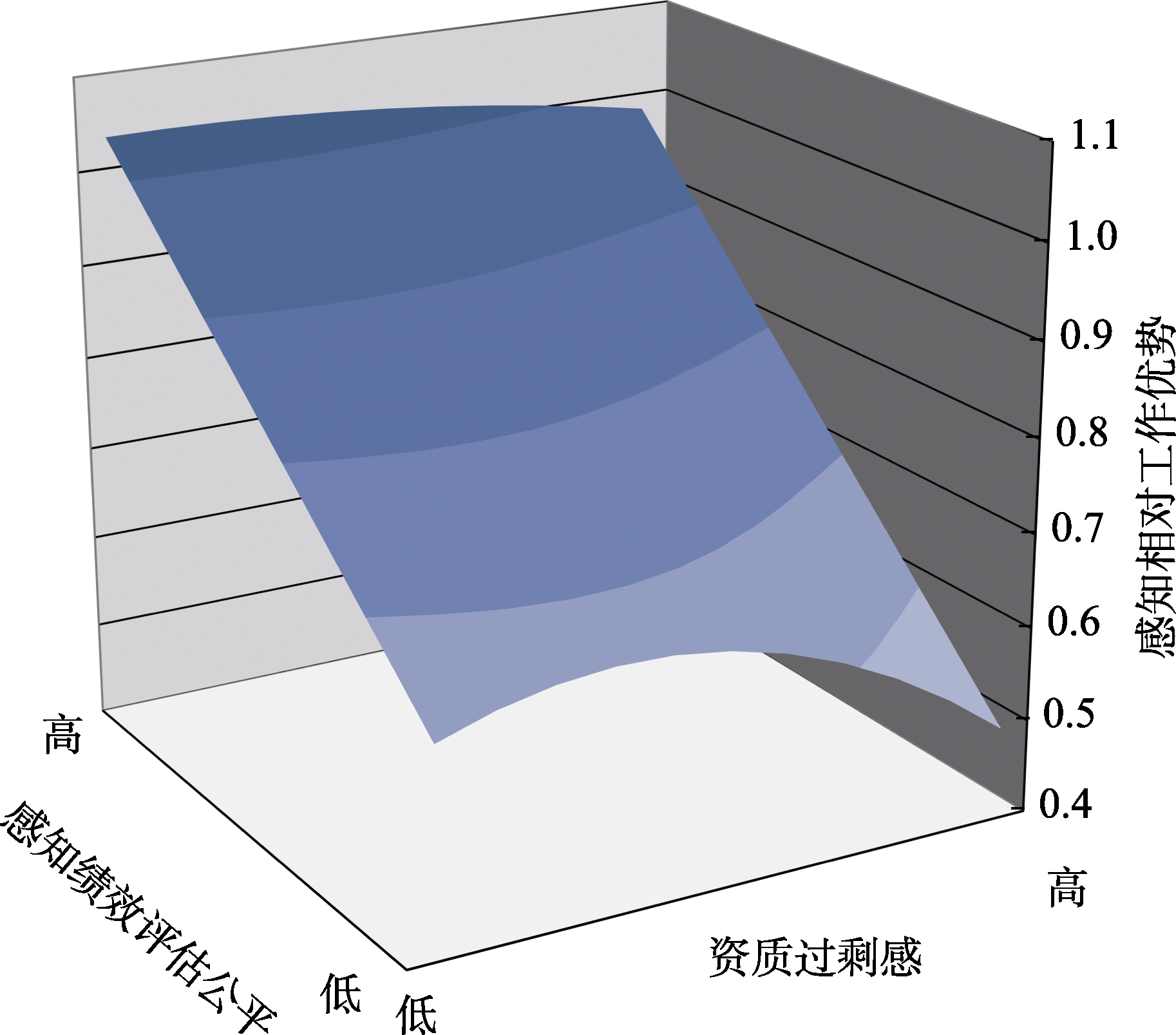
图3 感知绩效公平对资质过剩感与感知相对工作优势的倒U型关系的调节作用图 注:所有数据均进行了总体均值中心化处理。
| 变量 | 和谐工作激情 | 强迫工作激情 | ||||||
|---|---|---|---|---|---|---|---|---|
| 模型4 | 模型5 | 模型6 | 模型7 | |||||
| 截距 | 0.69*** | 0.04 | 0.47*** | 0.03 | 0.83*** | 0.05 | 0.69*** | 0.04 |
| 性别 | −0.06 | 0.06 | −0.08 | 0.05 | −0.04 | 0.07 | −0.02 | 0.07 |
| 年龄 | −0.05 | 0.15 | 0.16 | 0.12 | 0.15 | 0.16 | 0.15 | 0.15 |
| 学历 | −0.03 | 0.06 | −0.08 | 0.05 | −0.03 | 0.06 | −0.12* | 0.06 |
| 工作年限 | −0.05* | 0.02 | −0.03 | 0.02 | −0.02 | 0.02 | 0.003 | 0.02 |
| 工作类型 | −0.02 | 0.03 | 0.04 | 0.03 | 0.02 | 0.04 | 0.05 | 0.03 |
| 资质过剩感 | −0.04 | 0.03 | 0.02 | 0.03 | ||||
| 资质过剩感的平方 | −0.03 | 0.02 | 0.01 | 0.02 | ||||
| 感知绩效评估公平 | 0.12*** | 0.03 | 0.05 | 0.04 | ||||
| 资质过剩感×感知绩效评估公平 | −0.03 | 0.02 | −0.01 | 0.03 | ||||
| 资质过剩感的平方×感知绩效评估公平 | −0.003 | 0.01 | 0.02 | 0.02 | ||||
| 感知相对工作优势 | 0.17*** | 0.03 | 0.21*** | 0.03 | ||||
| 领导工作意义赋予 | 0.40*** | 0.03 | 0.26*** | 0.04 | ||||
| 感知相对工作优势×领导工作意义赋予 | 0.09*** | 0.02 | 0.06* | 0.02 | ||||
| R2 | 0.01 | 0.34*** | 0.004 | 0.16*** | ||||
| ∆R2 | - | 0.33 | - | 0.16 | ||||
表4 和谐工作激情和强迫工作激情的多层次回归结果
| 变量 | 和谐工作激情 | 强迫工作激情 | ||||||
|---|---|---|---|---|---|---|---|---|
| 模型4 | 模型5 | 模型6 | 模型7 | |||||
| 截距 | 0.69*** | 0.04 | 0.47*** | 0.03 | 0.83*** | 0.05 | 0.69*** | 0.04 |
| 性别 | −0.06 | 0.06 | −0.08 | 0.05 | −0.04 | 0.07 | −0.02 | 0.07 |
| 年龄 | −0.05 | 0.15 | 0.16 | 0.12 | 0.15 | 0.16 | 0.15 | 0.15 |
| 学历 | −0.03 | 0.06 | −0.08 | 0.05 | −0.03 | 0.06 | −0.12* | 0.06 |
| 工作年限 | −0.05* | 0.02 | −0.03 | 0.02 | −0.02 | 0.02 | 0.003 | 0.02 |
| 工作类型 | −0.02 | 0.03 | 0.04 | 0.03 | 0.02 | 0.04 | 0.05 | 0.03 |
| 资质过剩感 | −0.04 | 0.03 | 0.02 | 0.03 | ||||
| 资质过剩感的平方 | −0.03 | 0.02 | 0.01 | 0.02 | ||||
| 感知绩效评估公平 | 0.12*** | 0.03 | 0.05 | 0.04 | ||||
| 资质过剩感×感知绩效评估公平 | −0.03 | 0.02 | −0.01 | 0.03 | ||||
| 资质过剩感的平方×感知绩效评估公平 | −0.003 | 0.01 | 0.02 | 0.02 | ||||
| 感知相对工作优势 | 0.17*** | 0.03 | 0.21*** | 0.03 | ||||
| 领导工作意义赋予 | 0.40*** | 0.03 | 0.26*** | 0.04 | ||||
| 感知相对工作优势×领导工作意义赋予 | 0.09*** | 0.02 | 0.06* | 0.02 | ||||
| R2 | 0.01 | 0.34*** | 0.004 | 0.16*** | ||||
| ∆R2 | - | 0.33 | - | 0.16 | ||||
| 变量 | 角色内绩效 | 角色外绩效 | ||||||
|---|---|---|---|---|---|---|---|---|
| 模型8 | 模型9 | 模型10 | 模型11 | |||||
| 截距 | 0.67*** | 0.04 | 1.04*** | 0.06 | 0.59*** | 0.03 | 0.96*** | 0.05 |
| 性别 | 0.14* | 0.07 | 0.12 | 0.08 | −0.01 | 0.06 | −0.02 | 0.08 |
| 年龄 | −0.24 | 0.17 | −0.06 | 0.18 | −0.41* | 0.16 | −0.18 | 0.18 |
| 学历 | −0.06 | 0.06 | 0.01 | 0.07 | −0.05 | 0.06 | 0.02 | 0.07 |
| 工限 | 0.01 | 0.02 | −0.01 | 0.02 | 0.02 | 0.02 | 0.001 | 0.02 |
| 工作类型 | 0.02 | 0.04 | 0.02 | 0.04 | −0.01 | 0.04 | −0.01 | 0.04 |
| 资质过剩感 | −0.003 | 0.04 | 0.02 | 0.04 | ||||
| 资质过剩感的平方 | 0.02 | 0.03 | 0.01 | 0.03 | ||||
| 感知绩效评估公平 | −0.07 | 0.05 | −0.06 | 0.05 | ||||
| 资质过剩感×感知绩效评估公平 | 0.02 | 0.03 | 0.03 | 0.03 | ||||
| 资质过剩感的平方×感知绩效评估公平 | 0.03 | 0.02 | 0.02 | 0.02 | ||||
| 感知相对工作优势 | −0.001 | 0.04 | −0.03 | 0.04 | ||||
| 领导工作意义赋予 | −0.01 | 0.05 | 0.04 | 0.05 | ||||
| 感知相对工作优势×领导工作意义赋予 | −0.04 | 0.03 | −0.03 | 0.03 | ||||
| 和谐工作激情 | 0.14* | 0.07 | 0.13* | 0.06 | ||||
| 强迫工作激情 | −0.01 | 0.05 | −0.05 | 0.05 | ||||
| R2 | 0.01 | 0.02* | 0.01 | 0.02 | ||||
| ∆R2 | - | 0.01 | - | 0.01 | ||||
表5 角色内绩效和角色外绩效的多层次回归结果
| 变量 | 角色内绩效 | 角色外绩效 | ||||||
|---|---|---|---|---|---|---|---|---|
| 模型8 | 模型9 | 模型10 | 模型11 | |||||
| 截距 | 0.67*** | 0.04 | 1.04*** | 0.06 | 0.59*** | 0.03 | 0.96*** | 0.05 |
| 性别 | 0.14* | 0.07 | 0.12 | 0.08 | −0.01 | 0.06 | −0.02 | 0.08 |
| 年龄 | −0.24 | 0.17 | −0.06 | 0.18 | −0.41* | 0.16 | −0.18 | 0.18 |
| 学历 | −0.06 | 0.06 | 0.01 | 0.07 | −0.05 | 0.06 | 0.02 | 0.07 |
| 工限 | 0.01 | 0.02 | −0.01 | 0.02 | 0.02 | 0.02 | 0.001 | 0.02 |
| 工作类型 | 0.02 | 0.04 | 0.02 | 0.04 | −0.01 | 0.04 | −0.01 | 0.04 |
| 资质过剩感 | −0.003 | 0.04 | 0.02 | 0.04 | ||||
| 资质过剩感的平方 | 0.02 | 0.03 | 0.01 | 0.03 | ||||
| 感知绩效评估公平 | −0.07 | 0.05 | −0.06 | 0.05 | ||||
| 资质过剩感×感知绩效评估公平 | 0.02 | 0.03 | 0.03 | 0.03 | ||||
| 资质过剩感的平方×感知绩效评估公平 | 0.03 | 0.02 | 0.02 | 0.02 | ||||
| 感知相对工作优势 | −0.001 | 0.04 | −0.03 | 0.04 | ||||
| 领导工作意义赋予 | −0.01 | 0.05 | 0.04 | 0.05 | ||||
| 感知相对工作优势×领导工作意义赋予 | −0.04 | 0.03 | −0.03 | 0.03 | ||||
| 和谐工作激情 | 0.14* | 0.07 | 0.13* | 0.06 | ||||
| 强迫工作激情 | −0.01 | 0.05 | −0.05 | 0.05 | ||||
| R2 | 0.01 | 0.02* | 0.01 | 0.02 | ||||
| ∆R2 | - | 0.01 | - | 0.01 | ||||
| [1] |
Amarnani, R. K., Lajom, J. A. L., Restubog, S. L. D., & Capezio, A. (2020). Consumed by obsession: Career adaptability resources and the performance consequences of obsessive passion and harmonious passion for work. Human Relations, 73(6), 811-836.
doi: 10.1177/0018726719844812 URL |
| [2] |
Ashford, S. J., Blatt, R., & VandeWalle, D. (2003). Reflections on the looking glass: A review of research on feedback- seeking behavior in organizations. Journal of Management, 29(6), 773-799.
doi: 10.1016/S0149-2063(03)00079-5 URL |
| [3] |
Ashkanasy, N. M., Ayoko, O. B., & Jehn, K. A. (2014). Understanding the physical environment of work and employee behavior: An affective events perspective. Journal of Organizational Behavior, 35(8), 1169-1184.
doi: 10.1002/job.v35.8 URL |
| [4] |
Astakhova, M. N. (2015). The curvilinear relationship between work passion and organizational citizenship behavior. Journal of Business Ethics, 130(2), 361-374.
doi: 10.1007/s10551-014-2233-5 URL |
| [5] | Astakhova, M. N., & Ho, V. T. (2018). Chameleonic obsessive job passion: Demystifying the relationships between obsessive job passion and in-role and extra-role performance. European Journal of Work & Organizational Psychology, 27(3), 362-374. |
| [6] |
Astakhova, M. N., & Porter, G. (2015). Understanding the work passion-performance relationship: The mediating role of organizational identification and moderating role of fit at work. Human Relations, 68(8), 1315-1346.
doi: 10.1177/0018726714555204 URL |
| [7] | Barile, J. P. (2015). Multilevel structural equation modeling. In L. A. Jason, & D. S. Glenwick (Eds.), Handbook of methodological approaches to community-based research: Qualitative, quantitative, and mixed methods (pp. 365-373). Oxford University Press. |
| [8] |
Berger, S., van de Brake, H. J., & Bruch, H. (2022). Resource leverage, resource depletion: A multilevel perspective on multiple team membership. Journal of Applied Psychology, 107(2), 298-309.
doi: 10.1037/apl0000889 URL |
| [9] |
Birkeland, I. K., & Buch, R. (2015). The dualistic model of passion for work: Discriminate and predictive validity with work engagement and workaholism. Motivation and Emotion, 39(3), 392-408.
doi: 10.1007/s11031-014-9462-x URL |
| [10] |
Bochoridou, A., & Gkorezis, P. (2024). Perceived overqualification, work-related boredom, and intention to leave: Examining the moderating role of high-performance work systems. Personnel Review, 53(5), 1311-1330.
doi: 10.1108/PR-07-2022-0474 URL |
| [11] |
Borman, W. C., & Motowidlo, S. J. (1997). Task performance and contextual performance: The meaning for personnel selection research. Human Performance, 10(2), 99-109.
doi: 10.1207/s15327043hup1002_3 URL |
| [12] | Brislin, R. W. (1980). Translation and content analysis of oral and written material. In H. C. Triandis, & J. W. Berry (Eds.), Handbook of cross-cultural psychology (pp. 349-444). Boston: Allyn & Bacon. |
| [13] | Cao, X., & Wei, F. (2022). A study of the mechanism of how perceived underemployment affects employees’ engagement in hybrid entrepreneurship. Chinese Journal of Management, 19(2), 205-212. |
| [曹星, 魏峰. (2022). 不充分就业感知对员工兼职创业投入的影响机制研究. 管理学报, 19(2), 205-212.] | |
| [14] |
Chen, Y. Y., Zou, Z. M., & Pan, J. H. (2017). Effects of overqualification on employees’ organizational citizenship behavior: From the perspective of emotion. Acta Psychologica Sinica, 49(1), 72-82.
doi: 10.3724/SP.J.1041.2017.00072 URL |
| [陈颖媛, 邹智敏, 潘俊豪. (2017). 资质过剩感影响组织公民行为的情绪路径. 心理学报, 49(1), 72-82.] | |
| [15] | Cheng, B., Zhou, X., & Guo, G. X. (2021). Effects of perceived overqualification on proactive customer service performance. Journal of Management Science, 34(6), 101-112. |
| [程豹, 周星, 郭功星. (2021). 资质过剩感知对顾客服务主动性行为的影响. 管理科学, 34(6), 101-112.] | |
| [16] |
Cheng, B., Zhou, X., Guo, G., & Yang, K. (2020). Perceived overqualification and cyberloafing: A moderated-mediation model based on equity theory. Journal of Business Ethics, 164(3), 565-577.
doi: 10.1007/s10551-018-4026-8 |
| [17] | Curran, T., Hill, A. P., Appleton, P. R., Vallerand, R. J., & Standage, M. (2015). The psychology of passion: A meta-analytical review of a decade of research on intrapersonal outcomes. Motivation & Emotion, 39(5), 631-655. |
| [18] |
Debus, M. E., Börner, B., Wang, M., & Kleinmann, M. (2023). Reacting to perceived overqualification: Uniting strain-based and self-regulatory adjustment reactions and the moderating role of formal work arrangements. Journal of Business and Psychology, 38(2), 411-435.
doi: 10.1007/s10869-022-09870-8 |
| [19] |
Deng, H., Guan, Y., Wu, C. H., Erdogan, B., Bauer, T., & Yao, X. (2018). A relational model of perceived overqualification: The moderating role of interpersonal influence on social acceptance. Journal of Management, 44(8), 3288-3310.
doi: 10.1177/0149206316668237 URL |
| [20] | Ding, T. W., Yang, J. P., & Zhang, J. (2022). Influence of new generation employees’ overqualification on safety performance in manufacturing enterprise. Chinese Journal of Management, 19(8), 1173-1183. |
| [丁天维, 杨皎平, 张珺. (2022). 制造企业新生代员工资质过剩感对安全绩效的影响研究. 管理学报, 19(8), 1173-1183.] | |
| [21] | Drouvelis, M., & Paiardini, P. (2022). Feedback quality and performance in organisations. Leadership Quarterly, 33(6), 101534. |
| [22] |
Duan, J., Xia, Y., Xu, Y., & Wu, C. (2022). The curvilinear effect of perceived overqualification on constructive voice: The moderating role of leader consultation and the mediating role of work engagement. Human Resource Management, 61(4), 489-510.
doi: 10.1002/hrm.v61.4 URL |
| [23] |
Edwards, J. R., & Parry, M. E. (1993). On the use of polynomial regression equations as an alternative to difference scores in organizational research. Academy of Management Journal, 36(6), 1577-1613.
doi: 10.2307/256822 URL |
| [24] |
Erdogan, B., & Bauer, T. N. (2009). Perceived overqualification and its outcomes: The moderating role of empowerment. Journal of Applied Psychology, 94(2), 557-565.
doi: 10.1037/a0013528 pmid: 19271809 |
| [25] | Erdogan, B., Bauer, T. N., Peiró, J. M., & Truxillo, D. M. (2011). Overqualification theory, research, and practice: Things that matter. Industrial & Organizational Psychology, 4(2), 260-267. |
| [26] |
Erdogan, B., Karakitapoğlu-Aygün, Z., Caughlin, D. E., Bauer, T. N., & Gumusluoglu, L. (2020). Employee overqualification and manager job insecurity: Implications for employee career outcomes. Human Resource Management, 59(6), 555-567.
doi: 10.1002/hrm.v59.6 URL |
| [27] |
Farh, J., Hackett, R. D., & Liang, J. (2007). Individual-level cultural values as moderators of perceived organizational support-employee outcome relationships in China: Comparing the effects of power distance and traditionality. Academy of Management Journal, 50(3), 715-729.
doi: 10.5465/amj.2007.25530866 URL |
| [28] | Feldman, D. C., Leana, C. R., & Turnley, W. H. (1997). A relative deprivation approach to understanding underemployment. In C. L. Cooper & D. M. Rousseau (Eds.), Trends in organizational behavior (Vol. 4, pp. 43-60). New York: Wiley. |
| [29] |
Grant, A. M., & Shandell, M. S. (2021). Social motivation at work: The organizational psychology of effort for, against, and with others. Annual Review of Psychology, 73(1), 301-326.
doi: 10.1146/psych.2022.73.issue-1 URL |
| [30] |
Guo, Y., Wang, Y., Plummer, V., Cross, W., Lam, L., & Wang, K. (2022). Associations between perceived overqualification, organisational commitment and work passion of nurses: A multicentre cross-sectional study. Journal of Nursing Management, 30(5), 1273-1282.
doi: 10.1111/jonm.v30.5 URL |
| [31] |
Haans, R. F. J., Pieters, C., & He, Z. L. (2016). Thinking about U: Theorizing and testing U- and inverted U-shaped relationships in strategy research. Strategic Management Journal, 37(7), 1177-1195.
doi: 10.1002/smj.2016.37.issue-7 URL |
| [32] | Hayes, A. F. (2013). Introduction to mediation, moderation, and conditional process analysis: A regression-based approach. New York: Guilford Press. |
| [33] |
Hayes, A. F., & Preacher, K. J. (2010). Quantifying and testing indirect effects in simple mediation models when the constituent paths are nonlinear. Multivariate Behavioral Research, 45(4), 627-660.
doi: 10.1080/00273171.2010.498290 pmid: 26735713 |
| [34] |
He, G., & Li, W. (2024). The paradox of excess: How perceived overqualification shapes innovative behavior through self-concept. Current Psychology, 43(19), 17487-17499.
doi: 10.1007/s12144-024-05703-4 |
| [35] |
Ho, V. T., Wong, S. S., & Lee, C. H. (2011). A tale of passion: Linking job passion and cognitive engagement to employee work performance. Journal of Management Studies, 48(1), 26-47.
doi: 10.1111/j.1467-6486.2009.00878.x URL |
| [36] | Hofmann, D. A., Griffin, M. A., & Gavin, M. B. (2000). The application of hierarchical linear modeling to organizational research. In K. J. Klein & S. W. J. Kozlowski (Eds.), Multilevel theory, research, and methods in organizations: Foundations, extensions, and new directions (pp. 467-511). Jossey-Bass. |
| [37] |
Howard, E., Luksyte, A., Amarnani, R. K., & Spitzmueller, C. (2022). Perceived overqualification and experiences of incivility: Can task i-deals help or hurt? Journal of Occupational Health Psychology, 27(1), 89-103.
doi: 10.1037/ocp0000304 URL |
| [38] |
Hu, J., Erdogan, B., Bauer, T. N., Jiang, K., Liu, S., & Li, Y. (2015). There are lots of big fish in this pond: The role of peer overqualification on task significance, perceived fit, and performance for overqualified employees. Journal of Applied Psychology, 100(4), 1228-1238.
doi: 10.1037/apl0000008 pmid: 25546266 |
| [39] |
Johnson, G. J., & Johnson, W. R. (1996). Perceived overqualification and psychological well-being. The Journal of Social Psychology, 136(4), 435-445.
doi: 10.1080/00224545.1996.9714025 URL |
| [40] |
Khan, J., Saeed, I., Zada, M., Nisar, H. G., Ali, A., & Zada, S. (2023). The positive side of overqualification: Examining perceived overqualification linkage with knowledge sharing and career planning. Journal of Knowledge Management, 27(4), 993-1015.
doi: 10.1108/JKM-02-2022-0111 URL |
| [41] |
Kluger, A. N., & DeNisi, A. (1996). The effects of feedback interventions on performance: A historical review, a meta-analysis, and a preliminary feedback intervention theory. Psychological Bulletin, 119(2), 254-284.
doi: 10.1037/0033-2909.119.2.254 URL |
| [42] | Kong, Y. R., Chen, Q. S., & Zhou, X. (2025). How does perceived overqualification hinder employees' intention to share knowledge? International Journal of Human Resource Management, 36(6), 956-993. |
| [43] |
Korsgaard, M. A., & Roberson, L. (1995). Procedural justice in performance evaluation: The role of instrumental and non-instrumental voice in performance appraisal discussions. Journal of Management, 21(4), 657-669.
doi: 10.1177/014920639502100404 URL |
| [44] |
Kraimer, M. L., Shaffer, M. A., Harrison, D. A., & Ren, H. (2012). No place like home? An identity strain perspective on repatriate turnover. Academy of Management Journal, 55(2), 399-420.
doi: 10.5465/amj.2009.0644 URL |
| [45] |
Laurent, F. A., Houlfort, N., & Malchelosse, K. (2023). Interpersonal citizenship behaviors: The role of passion for work in helping behaviors towards coworkers. Current Psychology, 42(11), 9466-9484.
doi: 10.1007/s12144-021-02230-4 |
| [46] | Leonard, N. H., Beauvais, L. L., & Scholl, R. W. (1999). Work motivation: The incorporation of self-concept-based processes. Human Relations, 52(8), 969-998. |
| [47] |
Leonard, N. H., & Harvey, M. (2008). Negative perfectionism: Examining negative excessive behavior in the workplace. Journal of Applied Social Psychology, 38(3), 585-610.
doi: 10.1111/jasp.2007.38.issue-3 URL |
| [48] |
Li, C. Y., Sun, X. B., & Ding, Y. Y. (2025). How does perceived overqualification affect employees' knowledge sharing decisions in the context of digital transformation? Telematics and Informatics Reports, 18(1), 100197.
doi: 10.1016/j.teler.2025.100197 URL |
| [49] | Li, G. P., & Chen, Y. A. (2022). The influence of perceived overqualification on the innovation behavior of the new generation of employees in the post-1990s. Science Research Management, 43(1), 184-191. |
| [李广平, 陈雨昂. (2022). 资质过剩感对90后新生代员工创新行为的影响. 科研管理, 43(1), 184-191.] | |
| [50] |
Li, Y., Weng, H., Zhang, M., Zhu, T., Wang, F., Liu, H., & Das, A. K. (2022). Congruence in perceived employee-peer overqualification and organizational citizenship behavior. Journal of Personnel Psychology, 22(3), 123-135.
doi: 10.1027/1866-5888/a000310 URL |
| [51] |
Li, Y., Wu, M., Li, N., & Zhang, M. (2019). Dual relational model of perceived overqualification: Employee's self- concept and task performance. International Journal of Selection and Assessment, 27(4), 381-391.
doi: 10.1111/ijsa.v27.4 URL |
| [52] | Li, Y., Zheng, J., Hou, J., & Yang, X. (2025). I volunteer for qualification surplus: The nonlinear impact of voluntary overqualification on employee innovation performance and voice behavior. Current Psychology, 44(8), 7193-7208. |
| [53] |
Liao, M., Zhang, M. J., Carnevale, J. B., Huang, C., & Wang, L. (2024). Capable fish or deficient ponds? A meta-analysis of consequences, mechanisms, and moderators of perceived overqualification. Journal of Management, 51(7), 2729-2771.
doi: 10.1177/01492063241239298 URL |
| [54] |
Lin, B., Law, K. S., & Zhou, J. (2017). Why is underemployment related to creativity and OCB? A task-crafting explanation of the curvilinear moderated relations. Academy of Management Journal, 60(1), 156-177.
doi: 10.5465/amj.2014.0470 URL |
| [55] |
Liu, D., Chen, X. P., & Yao, X. (2010). From autonomy to creativity: A multilevel investigation of the mediating role of harmonious passion. Journal of Applied Psychology, 96(2), 294-309.
doi: 10.1037/a0021294 URL |
| [56] |
Liu, P., Mu, Y. T., & Li, X. (2025). How does perceived overqualification beget workplace incivility? A moderated mediation model based on Kahn's framework. Journal of Business Research, 186, 114961.
doi: 10.1016/j.jbusres.2024.114961 URL |
| [57] |
Liu, Z., Huang, Y., Kim, T., & Yang, J. (2024). Perceived overqualification and employee outcomes: The dual pathways and the moderating effects of dual-focused transformational leadership. Human Resource Management, 63(4), 653-671.
doi: 10.1002/hrm.v63.4 URL |
| [58] |
London, M., & Smither, J. W. (1995). Can multi-source feedback change perceptions of goal accomplishment, self- evaluations, and performance-related outcomes? Theory- based applications and directions for research. Personnel Psychology, 48(4), 803-839.
doi: 10.1111/peps.1995.48.issue-4 URL |
| [59] |
Ma, B., Zhu, S., & Jain, K. (2023). The “sense” behind proactive behaviors: Feedback seeking, meaningfulness, and personal initiative. Journal of Vocational Behavior, 144, 103896.
doi: 10.1016/j.jvb.2023.103896 URL |
| [60] |
Ma, C., Ganegoda, D. B., Chen, Z. X., Zhao, J., Jiang, X. H., & Zhang, X. (2023). To stand out or fit in? How perceived overqualification motivates proactive and affiliative performance. Human Resource Management, 62(6), 953-970.
doi: 10.1002/hrm.v62.6 URL |
| [61] |
Ma, C., Lin, X., Chen, G. Z. X., & Wei, W. (2020). Linking perceived overqualification with task performance and proactivity? An examination from self-concept-based perspective. Journal of Business Research, 118, 199-209.
doi: 10.1016/j.jbusres.2020.06.041 URL |
| [62] |
Maynard, D. C., Joseph, T. A., & Maynard, A. M. (2006). Underemployment, job attitudes, and turnover intentions. Journal of Organizational Behavior, 27(4), 509-536.
doi: 10.1002/job.v27:4 URL |
| [63] |
McKinlay, A. (2013). Banking, bureaucracy and the career: The curious case of Mr Notman. Business History, 55(3), 431-447.
doi: 10.1080/00076791.2013.773683 URL |
| [64] |
Meyers, M. C., van Woerkom, M., & Bauwens, R. (2023). Stronger together: A multilevel study of collective strengths use and team performance. Journal of Business Research, 159, 113728.
doi: 10.1016/j.jbusres.2023.113728 URL |
| [65] |
Miller, J. W., Stromeyer, W. R., & Schwieterman, M. A. (2013). Extensions of the Johnson-Neyman technique to linear models with curvilinear effects: Derivations and analytical tools. Multivariate Behavioral Research, 48(2), 267-300.
doi: 10.1080/00273171.2013.763567 pmid: 26741727 |
| [66] |
Motowidlo, S. J., Borman, W. C., & Schmit, M. J. (1997). A theory of individual differences in task and contextual performance. Human Performance, 10(2), 71-83.
doi: 10.1207/s15327043hup1002_1 URL |
| [67] | Muthén, L. K., & Muthén, B. O. (2007). Mplus user’s guide (6th ed.). Los Angeles: Muthén & Muthén. |
| [68] |
Ni, D., & Zheng, X. (2024). Does negative performance feedback always lead to negative responses? The role of trust in the leader. Journal of Occupational and Organizational Psychology, 97(2), 623-646.
doi: 10.1111/joop.v97.2 URL |
| [69] |
Pan, R., & Hou, Z. (2024). The relationship between objective overqualification, perceived overqualification and job satisfaction: Employment opportunity matters. Personnel Review, 53(8), 1925-1949.
doi: 10.1108/PR-02-2023-0080 URL |
| [70] |
Peng, X. L., Yu, K., Peng, J. F., Zhang, K. R., & Xue, H. B. (2023). Perceived overqualification and proactive behavior: The role of anger and job complexity. Journal of Vocational Behavior, 141, 103847.
doi: 10.1016/j.jvb.2023.103847 URL |
| [71] |
Perrewé, P. L., Hochwarter, W. A., Ferris, G. R., McAllister, C. P., & Harris, J. N. (2014). Developing a passion for work passion: Future directions on an emerging construct. Journal of Organizational Behavior, 35(1), 145-150.
doi: 10.1002/job.v35.1 URL |
| [72] | Perttula,, K., & Cardon, M. S. (2012). Passion. In K. S. Cameron & G. M. Spreitzer (Eds.), The Oxford handbook of positive organizational scholarship (pp. 190-200). Oxford: Oxford University Press. |
| [73] | Poethke, U., Klasmeier, K. N., Radaca, E., & Diestel, S. (2023). How modern working environments shape attendance behaviour: A longitudinal study on weekly flexibilization, boundaryless work and presenteeism. Journal of Occupational & Organizational Psychology, 96(3), 524-544. |
| [74] |
Preacher, K. J., Rucker, D. D., & Hayes, A. F. (2007). Addressing moderated mediation hypotheses: Theory, methods, and prescriptions. Multivariate Behavioral Research, 42(1), 185-227.
doi: 10.1080/00273170701341316 pmid: 26821081 |
| [75] |
Rubin, E. V., & Edwards, A. (2020). The performance of performance appraisal systems: Understanding the linkage between appraisal structure and appraisal discrimination complaints. The International Journal of Human Resource Management, 31(15), 1938-1957.
doi: 10.1080/09585192.2018.1424015 URL |
| [76] |
Russell, Z. A., Ferris, G. R., Thompson, K. W., & Sikora, D. M. (2016). Overqualified human resources, career development experiences, and work outcomes: Leveraging an underutilized resource with political skill. Human Resource Management Review, 26(2), 125-135.
doi: 10.1016/j.hrmr.2015.09.008 URL |
| [77] | Schaubroeck, J. M., Lam, S. S. K., & Peng, A. C. (2016). Can peers’ ethical and transformational leadership improve coworkers' service quality? A latent growth analysis. Organizational Behavior & Human Decision Processes, 133, 45-58. |
| [78] |
Schreurs, B., Hamstra, M. R. W., Jawahar, I. M., & Akkermans, J. (2020). Perceived overqualification and counterproductive work behavior: Testing the mediating role of relative deprivation and the moderating role of ambition. Personnel Review, 50(3), 1038-1055.
doi: 10.1108/PR-05-2019-0237 URL |
| [79] |
Smither, J. W., London, M., & Reilly, R. R. (2005). Does performance improve following multisource feedback? A theoretical model, meta-analysis, and review of empirical findings. Personnel Psychology, 58(1), 33-66.
doi: 10.1111/peps.2005.58.issue-1 URL |
| [80] | Steelman, L. A., Levy, P. E., & Snell, A. F. (2004). The feedback environment scale: Construct definition, measurement, and validation. Journal of Applied Psychology, 64(1), 165-184. |
| [81] |
Vallerand, R. J. (2008). On the psychology of passion: In search of what makes people's lives most worth living. Canadian Psychology, 49(1), 1-13.
doi: 10.1037/0708-5591.49.1.1 URL |
| [82] | Vallerand, R. J., Blanchard, C., Mageau, G. A., Koestner, R., Ratelle, C., Léonard, M., Gagné, M., & Marsolais, J. (2003). Les passions de l’âme: On obsessive and harmonious passion. Journal of Personality & Social Psychology, 85(4), 756-767. |
| [83] |
Vallerand, R. J., Chichekian, T., Verner-Filion, J., & Bélanger, J. J. (2023). The two faces of persistence: How harmonious and obsessive passion shape goal pursuit. Motivation Science, 9(3), 175-192.
doi: 10.1037/mot0000303 URL |
| [84] | Vallerand, R. J., & Houlfort, N. (2003). Passion at work:Toward a new conceptualization. In D. Skarlicki, S. Gilliland, & D. Steiner (Eds.), Emerging perspective on values in organizations (pp. 175-204). Greenwich, CT: Information Age Publishing Inc. |
| [85] | van Dierendonck, D., Lv, F., & Xiu, L. (2024). Servant leadership, meaningfulness and flow: An upward spiral. The Journal of Positive Psychology, https://doi.org/10.1080/17439760.2024.2427578 |
| [86] |
van Dijk, D., & Kluger, A. N. (2011). Task type as a moderator of positive/negative feedback effects on motivation and performance: A regulatory focus perspective. Journal of Organizational Behavior, 32(8), 1084-1105.
doi: 10.1002/job.v32.8 URL |
| [87] |
Wu, X., & Zi, C. (2024). How perceived overqualification affects creative performance: The mediating role of harmonious passion. Current Psychology, 43, 29496-29506.
doi: 10.1007/s12144-024-06586-1 |
| [88] | Wu, Z. Y., Zhou, X. H., Wang, Q., & Liu, J. J. (2025). A double-edged sword effect of differential perceived overqualification on team creativity. Journal of Industrial Engineering and Engineering Management, 39(6), 120-133. |
| [吴周玥, 周小虎, 王侨, 刘晶晶. (2025). 资质过剩感差异化对团队创造力的双刃剑效应研究. 管理工程学报, 39(6), 120-133.] | |
| [89] |
Yang, W. W., & Li, C. P. (2021). The relationship between perceived overqualification and individual performance and mediating mechanisms: A meta-analytic review and examination of emotional and cognitive processing systems and cultural contexts. Acta Psychologica Sinica, 53(5), 527-554.
doi: 10.3724/SP.J.1041.2021.00527 |
|
[杨伟文, 李超平. (2021). 资质过剩感对个体绩效的作用效果及机制: 基于情绪-认知加工系统与文化情境的元分析. 心理学报, 53(5), 527-554.]
doi: 10.3724/SP.J.1041.2021.00527 |
|
| [90] |
Yang, Y. F. (2012). Service capabilities and customer relationship management: An investigation of the banks in Taiwan. The Service Industries Journal, 32(6), 937-960.
doi: 10.1080/02642069.2010.545394 URL |
| [91] |
Zhang, F., Wang, B., Qian, J., & Parker, S. K. (2021). Job crafting towards strengths and job crafting towards interests in overqualified employees: Different outcomes and boundary effects. Journal of Organizational Behavior, 42(5), 587-603.
doi: 10.1002/job.v42.5 URL |
| [92] | Zhang, J. P., Liu, S. S., & Li, H. R. (2020). Research on the curvilinear relationship and its effect mechanism between perceived overqualification and employee intrapreneurship. Chinese Journal of Management, 17(6), 861-870. |
| [张建平, 刘善仕, 李焕荣. (2020). 资质过剩感知与员工内部创业的曲线关系及作用机制研究. 管理学报, 17(6), 861-870.] | |
| [93] |
Zhang, J. P., Zhang, G. L., Liu, S. S., Zhou, G. L., & Li, J. L. (2023). The positive effects of perceived overqualification in the team context: A research proposal with integrated composition approach and compilation approach. Advances in Psychological Science, 31(10), 1828-1842.
doi: 10.3724/SP.J.1042.2023.01828 |
| [张建平, 张光磊, 刘善仕, 周国林, 李建玲. (2023). 团队情境中资质过剩感的积极效应:综合组成型和汇编型方式的视角. 心理科学进展, 31(10), 1828-1842.] | |
| [94] |
Zhang, M. J., Law, K. S., & Lin, B. (2016). You think you are big fish in a small pond? Perceived overqualification, goal orientations, and proactivity at work. Journal of Organizational Behavior, 37(1), 61-84.
doi: 10.1002/job.2024 URL |
| [95] | Zhang, S., Ke, X., Frank Wang, X. H., & Liu, J. (2018). Empowering leadership and employee creativity: A dual-mechanism perspective. Journal of Occupational & Organizational Psychology, 91(4), 896-917. |
| [96] | Zhang, X., & Bartol, K. M. (2010). Linking empowering leadership and employee creativity: The influence of psychological empowerment, intrinsic motivation, and creative process engagement. The Academy of Management Journal, 53(1), 107-128. |
| [97] | Zhang, X., Yu, K., Li, W. D., & Zacher, H. (2023). Sustainability of passion for work? Change-related reciprocal relationships between passion and job crafting. Journal of Management, 51(4), 1349-1383. |
| [98] |
Zheng, Y., Zhang, X., & Zhu, Y. (2021). Overeducation, major mismatch, and return to higher education tiers: Evidence from novel data source of a major online recruitment platform in China. China Economic Review, 66, 101584.
doi: 10.1016/j.chieco.2021.101584 URL |
| [99] | Zhou, Y., Huang, X., & Xie, W. J. (2020). Does perceived overqualification inspire employee voice? Based on the lens of fairness heuristic. Management Review, 32(12), 192-203. |
| [周晔, 黄旭, 谢五届. (2020). 资质过剩感会激发员工建言吗?——基于公平启发视角. 管理评论, 32(12), 192-203.] |
| [1] | 王雅婷, 陈志俊, 李锐, 周明建. 掌舵者力有余, 撑船者齐创新?领导资质过剩感对团队创造力的促进机制[J]. 心理学报, 2024, 56(3): 326-338. |
| [2] | 杨伟文, 李超平. 资质过剩感对个体绩效的作用效果及机制:基于情绪-认知加工系统与文化情境的元分析[J]. 心理学报, 2021, 53(5): 527-554. |
| [3] | 陈颖媛;邹智敏;潘俊豪. 资质过剩感影响组织公民行为的情绪路径[J]. 心理学报, 2017, 49(1): 72-82. |
| 阅读次数 | ||||||
|
全文 |
|
|||||
|
摘要 |
|
|||||
