

ISSN 0439-755X
CN 11-1911/B
主办:中国心理学会
中国科学院心理研究所
出版:科学出版社
CN 11-1911/B
主办:中国心理学会
中国科学院心理研究所
出版:科学出版社
心理学报 ›› 2026, Vol. 58 ›› Issue (1): 113-129.doi: 10.3724/SP.J.1041.2026.0113 cstr: 32110.14.2026.0113
张生军1, 周建军1, 万国光2( ), 刘芳舟3, 龙立荣3, 庞旭宏1
收稿日期:2024-08-02
发布日期:2025-10-28
出版日期:2026-01-25
通讯作者:
万国光, E-mail: alanwan@swufe.edu.cn基金资助:
ZHANG Shengjun1, ZHOU Jianjun1, WAN Guoguang2(), LIU Fangzhou3, LONG Lirong3, PANG Xuhong1
Received:2024-08-02
Online:2025-10-28
Published:2026-01-25
摘要:
工作场所中员工向领导者宣泄现象非常普遍, 已成为领导者每天必须面对的管理挑战。以往的宣泄文献主要基于宣泄者或者接受者的单一视角, 探讨员工向领导者宣泄对领导者以及员工自身的影响。基于认知新联想理论和人际情绪管理相关文献, 本文解释了向领导者宣泄为何会出现自我延续效应: 即员工当日向领导者宣泄会引起员工当日愤怒情绪, 进而导致他们次日继续向领导者宣泄。同时, 采用宣泄者−接受者互动视角, 本文探讨了领导者在接受到员工宣泄后通过何种人际情绪管理策略才能有效打破这一自我延续效应。本文聚焦下属(宣泄者)与领导者(接受者)的日常成对互动过程, 采用为期10个工作日的基于时间间隔的经验取样法收集数据。来自60位领导者及其119位下属的1032个匹配样本点的数据结果显示: 在个体内层次, 员工当日向领导者宣泄会增强其当日愤怒情绪, 进而促使他们次日继续向领导者宣泄, 产生自我延续效应。当领导者在员工宣泄后采取境遇改善的人际情绪管理策略时, 自我延续效应将被打破, 而领导者采取注意力转移以及情绪抑制的人际情绪管理策略则无效。
中图分类号:
张生军, 周建军, 万国光, 刘芳舟, 龙立荣, 庞旭宏. (2026). 领导人际情绪管理策略如何打破员工向领导者宣泄的自我延续效应?宣泄者−接受者互动视角. 心理学报, 58(1), 113-129.
ZHANG Shengjun, ZHOU Jianjun, WAN Guoguang, LIU Fangzhou, LONG Lirong, PANG Xuhong. (2026). How leaders’ interpersonal emotion regulation strategies can attenuate the self-maintaining effect of employee venting? A venter−recipient interaction perspective. Acta Psychologica Sinica, 58(1), 113-129.
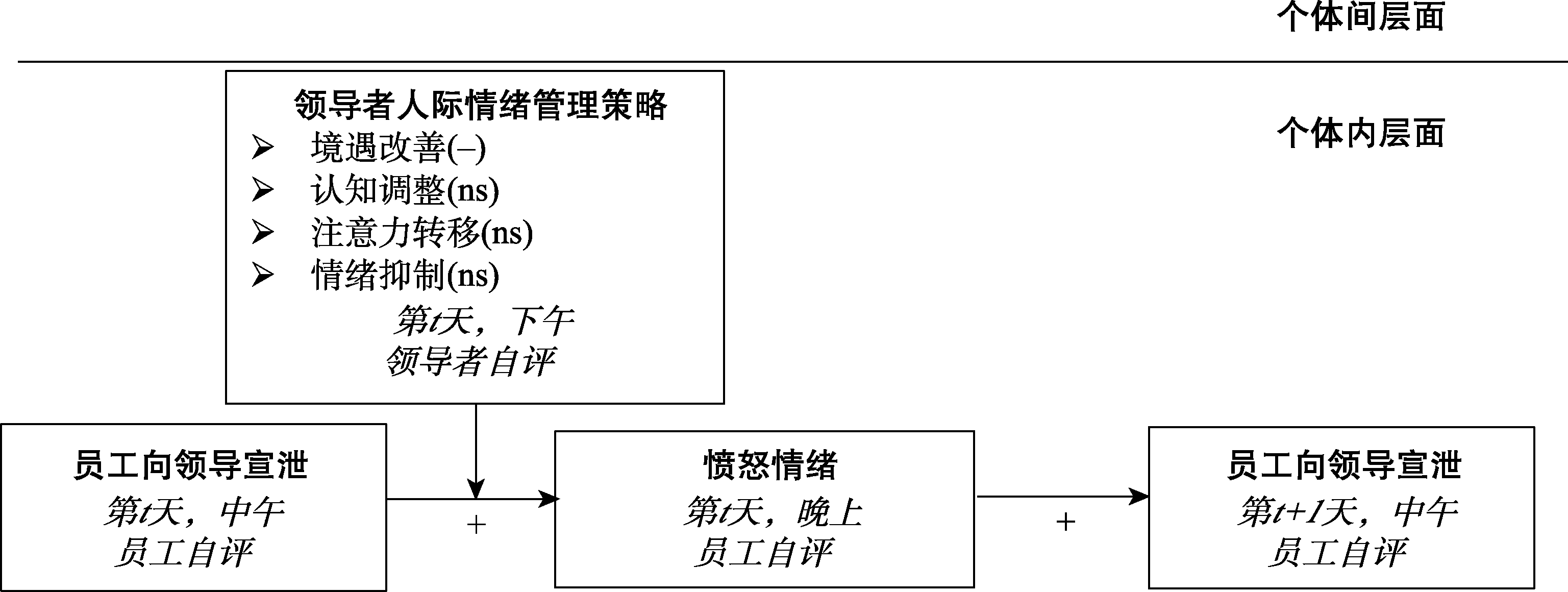
图1 研究模型 注: ns表示本文模型预测该策略的调节作用不显著。
| 模型 | χ2 | df | χ2/df | Δχ2(Δdf) | RMSEA | CFI | TLI | SRMR个体内 | SRMR个体间 |
|---|---|---|---|---|---|---|---|---|---|
| 1.八因子模型: V, A, C, VN, LSIT, LATT, LCOG, LRES | 1626.35 | 800 | 2.03 | — | 0.03 | 0.96 | 0.95 | 0.03 | 0.03 |
| 2.七因子模型: V, A+C, VN, LSIT, LATT, LCOG, LRES | 3067.79 | 814 | 3.77 | 1441.44(14) | 0.05 | 0.88 | 0.86 | 0.05 | 0.07 |
| 3.六因子模型: V, A+C, VN, LSIT+ LATT, LCOG, LRES | 5336.96 | 826 | 6.46 | 3710.61(26) | 0.07 | 0.76 | 0.63 | 0.09 | 0.07 |
| 4.五因子模型: V+A+C, VN, LSIT+ LATT, LCOG, LRES | 7202.21 | 836 | 8.62 | 5575.86(36) | 0.09 | 0.66 | 0.62 | 0.10 | 0.08 |
| 5.四因子模型: V, A+C, VN, LSIT+ LATT+LCOG+LRES | 9891.28 | 844 | 11.72 | 8264.93(44) | 0.10 | 0.52 | 0.47 | 0.11 | 0.13 |
| 6.三因子模型: V+A+C, VN, LSIT+ LATT+LCOG+LRES | 11637.60 | 850 | 13.69 | 10011.25(50) | 0.11 | 0.43 | 0.37 | 0.12 | 0.13 |
| 7.二因子模型: V+A+C+VN, LSIT+ LATT+LCOG+LRES | 12926.71 | 854 | 15.14 | 11300.36(54) | 0.12 | 0.36 | 0.30 | 0.13 | 0.13 |
表1 多层次验证性因子分析
| 模型 | χ2 | df | χ2/df | Δχ2(Δdf) | RMSEA | CFI | TLI | SRMR个体内 | SRMR个体间 |
|---|---|---|---|---|---|---|---|---|---|
| 1.八因子模型: V, A, C, VN, LSIT, LATT, LCOG, LRES | 1626.35 | 800 | 2.03 | — | 0.03 | 0.96 | 0.95 | 0.03 | 0.03 |
| 2.七因子模型: V, A+C, VN, LSIT, LATT, LCOG, LRES | 3067.79 | 814 | 3.77 | 1441.44(14) | 0.05 | 0.88 | 0.86 | 0.05 | 0.07 |
| 3.六因子模型: V, A+C, VN, LSIT+ LATT, LCOG, LRES | 5336.96 | 826 | 6.46 | 3710.61(26) | 0.07 | 0.76 | 0.63 | 0.09 | 0.07 |
| 4.五因子模型: V+A+C, VN, LSIT+ LATT, LCOG, LRES | 7202.21 | 836 | 8.62 | 5575.86(36) | 0.09 | 0.66 | 0.62 | 0.10 | 0.08 |
| 5.四因子模型: V, A+C, VN, LSIT+ LATT+LCOG+LRES | 9891.28 | 844 | 11.72 | 8264.93(44) | 0.10 | 0.52 | 0.47 | 0.11 | 0.13 |
| 6.三因子模型: V+A+C, VN, LSIT+ LATT+LCOG+LRES | 11637.60 | 850 | 13.69 | 10011.25(50) | 0.11 | 0.43 | 0.37 | 0.12 | 0.13 |
| 7.二因子模型: V+A+C+VN, LSIT+ LATT+LCOG+LRES | 12926.71 | 854 | 15.14 | 11300.36(54) | 0.12 | 0.36 | 0.30 | 0.13 | 0.13 |
| 变量 | 个体内方差(σ2) | 个体间方差(τ00) | 个体内方差占比(σ2/(σ2+τ00)) | ICC (1) |
|---|---|---|---|---|
| 1.向领导宣泄 | 1.10 | 1.47 | 42.80% | 0.59 |
| 2.愤怒情绪(晚上) | 0.69 | 1.25 | 35.57% | 0.65 |
| 3.次日向领导宣泄 | 1.01 | 1.54 | 39.61% | 0.62 |
| 4.境遇改善 | 0.43 | 0.77 | 35.83% | 0.65 |
| 5.注意力转移 | 0.19 | 0.57 | 25.00% | 0.75 |
| 6.认知调整 | 0.27 | 0.58 | 31.76% | 0.68 |
| 7.情绪抑制 | 0.48 | 3.25 | 12.87% | 0.87 |
| 8.愤怒情绪(早上) | 0.84 | 1.20 | 41.18% | 0.59 |
| 9.情绪缓释(晚上) | 0.60 | 1.25 | 32.43% | 0.68 |
表2 变量的个体内方差占比
| 变量 | 个体内方差(σ2) | 个体间方差(τ00) | 个体内方差占比(σ2/(σ2+τ00)) | ICC (1) |
|---|---|---|---|---|
| 1.向领导宣泄 | 1.10 | 1.47 | 42.80% | 0.59 |
| 2.愤怒情绪(晚上) | 0.69 | 1.25 | 35.57% | 0.65 |
| 3.次日向领导宣泄 | 1.01 | 1.54 | 39.61% | 0.62 |
| 4.境遇改善 | 0.43 | 0.77 | 35.83% | 0.65 |
| 5.注意力转移 | 0.19 | 0.57 | 25.00% | 0.75 |
| 6.认知调整 | 0.27 | 0.58 | 31.76% | 0.68 |
| 7.情绪抑制 | 0.48 | 3.25 | 12.87% | 0.87 |
| 8.愤怒情绪(早上) | 0.84 | 1.20 | 41.18% | 0.59 |
| 9.情绪缓释(晚上) | 0.60 | 1.25 | 32.43% | 0.68 |
| 变量 | 均值 | 标准差 | 1 | 2 | 3 | 4 | 5 | 6 | 7 | 8 | 9 | 10 | 11 | 12 |
|---|---|---|---|---|---|---|---|---|---|---|---|---|---|---|
| 个体内水平 | ||||||||||||||
| 1.向领导宣泄 | 2.60 | 1.60 | (0.88) | 0.81*** | 0.99*** | −0.23* | −0.26** | −0.18 | −0.07 | 0.76*** | 0.00 | −0.07 | −0.03 | −0.05 |
| 2.愤怒情绪(晚上) | 2.15 | 1.39 | 0.18*** | (0.94) | 0.80 | −0.18* | −0.23* | −0.10 | −0.06 | 0.89*** | −0.15*** | −0.23* | −0.04 | −0.08 |
| 3.次日向领导宣泄 | 2.55 | 1.59 | 0.07* | 0.23*** | (0.88) | −0.20* | −0.25** | −0.15 | −0.03 | 0.76*** | −0.01 | −0.06 | −0.02 | −0.07 |
| 4.境遇改善 | 5.93 | 1.10 | 0.01 | 0.03 | 0.01 | (0.89) | 0.90*** | 0.92*** | 0.32*** | −0.18 | 0.21*** | 0.07 | 0.38*** | 0.52*** |
| 5.注意力转移 | 6.11 | 0.88 | 0.04 | 0.05 | 0.03 | 0.40*** | (0.86) | 0.92*** | 0.32*** | −0.21* | 0.19*** | 0.11 | 0.44*** | 0.51*** |
| 6.认知调整 | 6.04 | 0.93 | 0.02 | −0.02 | −0.04 | 0.11*** | 0.38*** | (0.86) | 0.34*** | −0.12 | 0.18*** | 0.05 | 0.41*** | 0.48*** |
| 7.情绪抑制 | 4.45 | 1.94 | 0.04 | −0.02 | 0.02 | 0.03 | 0.14*** | 0.14*** | (0.81) | −0.07 | 0.12*** | −0.06 | 0.24** | 0.22 |
| 8.愤怒情绪(早上) | 2.13 | 1.42 | 0.21*** | 0.21*** | 0.19*** | 0.02 | 0.01 | −0.00 | −0.00 | (0.93) | −0.15*** | −0.17 | −0.00 | −0.01 |
| 9.情绪缓释(晚上) | 5.57 | 1.37 | −0.02 | −0.07* | −0.02 | 0.03 | 0.00 | 0.01 | −0.01 | −0.00 | (0.90) | 0.44*** | 0.17*** | 0.24*** |
| 个体间水平 | ||||||||||||||
| 10.领导成员交换 | 5.59 | 1.08 | (0.93) | 0.12 | 0.14 | |||||||||
| 11.下属特质共情 | 6.20 | 0.80 | (0.82) | 0.66*** | ||||||||||
| 12.领导情绪智力 | 5.59 | 1.02 | (0.91) |
表3 变量的均值、标准差和相关系数
| 变量 | 均值 | 标准差 | 1 | 2 | 3 | 4 | 5 | 6 | 7 | 8 | 9 | 10 | 11 | 12 |
|---|---|---|---|---|---|---|---|---|---|---|---|---|---|---|
| 个体内水平 | ||||||||||||||
| 1.向领导宣泄 | 2.60 | 1.60 | (0.88) | 0.81*** | 0.99*** | −0.23* | −0.26** | −0.18 | −0.07 | 0.76*** | 0.00 | −0.07 | −0.03 | −0.05 |
| 2.愤怒情绪(晚上) | 2.15 | 1.39 | 0.18*** | (0.94) | 0.80 | −0.18* | −0.23* | −0.10 | −0.06 | 0.89*** | −0.15*** | −0.23* | −0.04 | −0.08 |
| 3.次日向领导宣泄 | 2.55 | 1.59 | 0.07* | 0.23*** | (0.88) | −0.20* | −0.25** | −0.15 | −0.03 | 0.76*** | −0.01 | −0.06 | −0.02 | −0.07 |
| 4.境遇改善 | 5.93 | 1.10 | 0.01 | 0.03 | 0.01 | (0.89) | 0.90*** | 0.92*** | 0.32*** | −0.18 | 0.21*** | 0.07 | 0.38*** | 0.52*** |
| 5.注意力转移 | 6.11 | 0.88 | 0.04 | 0.05 | 0.03 | 0.40*** | (0.86) | 0.92*** | 0.32*** | −0.21* | 0.19*** | 0.11 | 0.44*** | 0.51*** |
| 6.认知调整 | 6.04 | 0.93 | 0.02 | −0.02 | −0.04 | 0.11*** | 0.38*** | (0.86) | 0.34*** | −0.12 | 0.18*** | 0.05 | 0.41*** | 0.48*** |
| 7.情绪抑制 | 4.45 | 1.94 | 0.04 | −0.02 | 0.02 | 0.03 | 0.14*** | 0.14*** | (0.81) | −0.07 | 0.12*** | −0.06 | 0.24** | 0.22 |
| 8.愤怒情绪(早上) | 2.13 | 1.42 | 0.21*** | 0.21*** | 0.19*** | 0.02 | 0.01 | −0.00 | −0.00 | (0.93) | −0.15*** | −0.17 | −0.00 | −0.01 |
| 9.情绪缓释(晚上) | 5.57 | 1.37 | −0.02 | −0.07* | −0.02 | 0.03 | 0.00 | 0.01 | −0.01 | −0.00 | (0.90) | 0.44*** | 0.17*** | 0.24*** |
| 个体间水平 | ||||||||||||||
| 10.领导成员交换 | 5.59 | 1.08 | (0.93) | 0.12 | 0.14 | |||||||||
| 11.下属特质共情 | 6.20 | 0.80 | (0.82) | 0.66*** | ||||||||||
| 12.领导情绪智力 | 5.59 | 1.02 | (0.91) |
| 变量 | 愤怒情绪(晚上) | 情绪缓释(晚上) | 次日向领导宣泄 | ||||||||||||||||
|---|---|---|---|---|---|---|---|---|---|---|---|---|---|---|---|---|---|---|---|
| 模型1 | 模型2 | 模型3 | 模型 4 | 模型5 | 模型6 | 模型7 | 模型8 | 模型9 | 模型10 | 模型11 | 模型12 | 模型13 | 模型14 | 模型15 | 模型16 | ||||
| 截距 | 2.15*** (0.10) | 2.15*** (0.10) | 2.15*** (0.10) | 2.15*** (0.10) | 2.15*** (0.10) | 2.15*** (0.10) | 2.15*** (0.10) | 5.58*** (0.09) | 5.58*** (0.09) | 5.58*** (0.09) | 5.58*** (0.09) | 5.58*** (0.09) | 5.58*** (0.09) | 5.58*** (0.09) | 0.08 (0.41) | 0.08 (0.41) | |||
| 控制变量 | |||||||||||||||||||
| 工作日 | 0.11 (0.08) | 0.10 (0.08) | 0.09 (0.08) | 0.10 (0.08) | 0.10 (0.08) | 0.09 (0.08) | 0.09 (0.08) | −0.04 (0.08) | −0.04 (0.08) | −0.04 (0.08) | −0.03 (0.08) | −0.04 (0.08) | −0.05 (0.08) | −0.04 (0.08) | −0.20 (0.11) | −0.20 (0.11) | |||
| 正弦 | 0.25* (0.13) | 0.24 (0.13) | 0.24 (0.12) | 0.25* (0.13) | 0.25* (0.13) | 0.23* (0.13) | 0.23 (0.13) | −0.05 (0.12) | −0.04 (0.12) | −0.04 (0.12) | −0.03 (0.12) | −0.04 (0.12) | −0.05 (0.12) | −0.04 (0.12) | −0.21 (0.16) | −0.21 (0.16) | |||
| 余弦 | 0.05 (0.08) | 0.04 (0.08) | 0.03 (0.08) | 0.04 (0.08) | 0.04 (0.08) | 0.03 (0.08) | 0.03 (0.08) | −0.05 (0.08) | −0.05 (0.08) | −0.05 (0.08) | −0.05 (0.08) | −0.05 (0.08) | −0.05 (0.08) | −0.05 (0.08) | −0.18 (0.10) | −0.18 (0.10) | |||
| 愤怒情绪(早上) | 0.18*** (0.03) | 0.16*** (0.03) | 0.15*** (0.03) | 0.15*** (0.03) | 0.16*** (0.03) | 0.15*** (0.03) | 0.15*** (0.03) | ||||||||||||
| 领导成员交换 | −0.23* (0.10) | −0.23* (0.10) | −0.23* (0.10) | −0.23* (0.10) | −0.23* (0.10) | −0.23* (0.10) | −0.23* (0.10) | 0.42*** (0.09) | 0.42*** (0.09) | 0.42*** (0.09) | 0.42*** (0.09) | 0.42*** (0.09) | 0.42*** (0.09) | 0.42*** (0.09) | 0.13 (0.07) | 0.13 (0.07) | |||
| 领导情绪智力 | −0.06 (0.10) | −0.06 (0.10) | −0.06 (0.10) | −0.06 (0.10) | −0.06 (0.10) | −0.06 (0.10) | −0.06 (0.10) | 0.21* (0.09) | 0.21* (0.09) | 0.21* (0.09) | 0.21* (0.09) | 0.21* (0.09) | 0.21* (0.09) | 0.21* (0.09) | −0.04 (0.07) | −0.04 (0.07) | |||
| 下属特质共情 | −0.12 (0.13) | −0.12 (0.13) | −0.12 (0.13) | −0.12 (0.13) | −0.12 (0.13) | −0.12 (0.13) | −0.12 (0.13) | 0.16 (0.12) | 0.16 (0.12) | 0.16 (0.12) | 0.16 (0.12) | 0.16 (0.12) | 0.16 (0.12) | 0.16 (0.12) | −0.12 (0.09) | −0.12 (0.09) | |||
| 预测变量 | |||||||||||||||||||
| 向领导宣泄 | 0.12*** (0.02) | 0.11*** (0.02) | 0.11*** (0.02) | 0.12*** (0.02) | 0.12*** (0.02) | 0.11*** (0.02) | −0.01 (0.02) | −0.02 (0.02) | −0.02 (0.02) | −0.01 (0.02) | −0.01 (0.02) | −0.01 (0.02) | 0.03 (0.03) | 0.03 (0.03) | |||||
| 境遇改善 | 0.04 (0.04) | 0.02 (0.04) | 0.04 (0.04) | 0.05 (0.04) | −0.02 (0.05) | ||||||||||||||
| 注意力转移 | 0.08 (0.06) | 0.10 (0.07) | 0.01 (0.06) | −0.03 (0.07) | 0.10 (0.09) | ||||||||||||||
| 认知调整 | −0.04 (0.05) | −0.06 (0.05) | 0.02 (0.05) | 0.03 (0.05) | −0.09 (0.07) | ||||||||||||||
| 情绪抑制 | −0.01 (0.04) | −0.02 (0.04) | −0.01 (0.04) | −0.01 (0.04) | 0.02 (0.05) | ||||||||||||||
| 交互项 | |||||||||||||||||||
| 向领导宣泄×境遇改善 | −0.13** (0.04) | −0.11* (0.05) | −0.02 (0.04) | 0.02 (0.05) | |||||||||||||||
| 向领导宣泄×注意力转移 | −0.13 (0.07) | 0.00 (0.08) | −0.12 (0.07) | −0.11 (0.08) | |||||||||||||||
| 向领导宣泄×认知调整 | −0.15* (0.06) | −0.09 (0.07) | −0.08 (0.06) | −0.04 (0.07) | |||||||||||||||
| 向领导宣泄×情绪抑制 | −0.07 (0.04) | −0.04 (0.04) | −0.04 (0.04) | −0.03 (0.04) | |||||||||||||||
| 中介变量 | |||||||||||||||||||
| 愤怒情绪(晚上) | 0.27*** (0.04) | 0.27*** (0.04) | |||||||||||||||||
| 情绪缓释(晚上) | −0.01 (0.04) | −0.01 (0.04) | |||||||||||||||||
| 个体内残差 | 0.58 | 0.57 | 0.56 | 0.56 | 0.56 | 0.56 | 0.56 | 0.53 | 0.53 | 0.53 | 0.53 | 0.53 | 0.53 | 0.53 | 0.95 | 0.94 | |||
| 个体间残差 | 1.25 | 1.25 | 1.248 | 1.25 | 1.25 | 1.25 | 1.25 | 1.01 | 1.01 | 1.01 | 1.01 | 1.01 | 1.01 | 1.01 | 0.45 | 0.45 | |||
| Pseudo R2 | 0.06 | 0.06 | 0.06 | 0.06 | 0.06 | 0.06 | 0.07 | 0.21 | 0.21 | 0.21 | 0.21 | 0.21 | 0.21 | 0.21 | 0.58 | 0.58 | |||
| 向领导宣泄 → 愤怒情绪(晚上) → 次日向领导宣泄 | |||||||||||||||||||
| 间接效应 | 95% 置信区间 | ||||||||||||||||||
| 1. 高境遇改善 | −0.00(0.02) | −0.04, 0.03 | |||||||||||||||||
| 2. 低境遇改善 | 0.06(0.02) | 0.03, 0.11 | |||||||||||||||||
| 差异 | −0.07(0.03) | −0.13, −0.008 | |||||||||||||||||
表4 多层次路径分析结果
| 变量 | 愤怒情绪(晚上) | 情绪缓释(晚上) | 次日向领导宣泄 | ||||||||||||||||
|---|---|---|---|---|---|---|---|---|---|---|---|---|---|---|---|---|---|---|---|
| 模型1 | 模型2 | 模型3 | 模型 4 | 模型5 | 模型6 | 模型7 | 模型8 | 模型9 | 模型10 | 模型11 | 模型12 | 模型13 | 模型14 | 模型15 | 模型16 | ||||
| 截距 | 2.15*** (0.10) | 2.15*** (0.10) | 2.15*** (0.10) | 2.15*** (0.10) | 2.15*** (0.10) | 2.15*** (0.10) | 2.15*** (0.10) | 5.58*** (0.09) | 5.58*** (0.09) | 5.58*** (0.09) | 5.58*** (0.09) | 5.58*** (0.09) | 5.58*** (0.09) | 5.58*** (0.09) | 0.08 (0.41) | 0.08 (0.41) | |||
| 控制变量 | |||||||||||||||||||
| 工作日 | 0.11 (0.08) | 0.10 (0.08) | 0.09 (0.08) | 0.10 (0.08) | 0.10 (0.08) | 0.09 (0.08) | 0.09 (0.08) | −0.04 (0.08) | −0.04 (0.08) | −0.04 (0.08) | −0.03 (0.08) | −0.04 (0.08) | −0.05 (0.08) | −0.04 (0.08) | −0.20 (0.11) | −0.20 (0.11) | |||
| 正弦 | 0.25* (0.13) | 0.24 (0.13) | 0.24 (0.12) | 0.25* (0.13) | 0.25* (0.13) | 0.23* (0.13) | 0.23 (0.13) | −0.05 (0.12) | −0.04 (0.12) | −0.04 (0.12) | −0.03 (0.12) | −0.04 (0.12) | −0.05 (0.12) | −0.04 (0.12) | −0.21 (0.16) | −0.21 (0.16) | |||
| 余弦 | 0.05 (0.08) | 0.04 (0.08) | 0.03 (0.08) | 0.04 (0.08) | 0.04 (0.08) | 0.03 (0.08) | 0.03 (0.08) | −0.05 (0.08) | −0.05 (0.08) | −0.05 (0.08) | −0.05 (0.08) | −0.05 (0.08) | −0.05 (0.08) | −0.05 (0.08) | −0.18 (0.10) | −0.18 (0.10) | |||
| 愤怒情绪(早上) | 0.18*** (0.03) | 0.16*** (0.03) | 0.15*** (0.03) | 0.15*** (0.03) | 0.16*** (0.03) | 0.15*** (0.03) | 0.15*** (0.03) | ||||||||||||
| 领导成员交换 | −0.23* (0.10) | −0.23* (0.10) | −0.23* (0.10) | −0.23* (0.10) | −0.23* (0.10) | −0.23* (0.10) | −0.23* (0.10) | 0.42*** (0.09) | 0.42*** (0.09) | 0.42*** (0.09) | 0.42*** (0.09) | 0.42*** (0.09) | 0.42*** (0.09) | 0.42*** (0.09) | 0.13 (0.07) | 0.13 (0.07) | |||
| 领导情绪智力 | −0.06 (0.10) | −0.06 (0.10) | −0.06 (0.10) | −0.06 (0.10) | −0.06 (0.10) | −0.06 (0.10) | −0.06 (0.10) | 0.21* (0.09) | 0.21* (0.09) | 0.21* (0.09) | 0.21* (0.09) | 0.21* (0.09) | 0.21* (0.09) | 0.21* (0.09) | −0.04 (0.07) | −0.04 (0.07) | |||
| 下属特质共情 | −0.12 (0.13) | −0.12 (0.13) | −0.12 (0.13) | −0.12 (0.13) | −0.12 (0.13) | −0.12 (0.13) | −0.12 (0.13) | 0.16 (0.12) | 0.16 (0.12) | 0.16 (0.12) | 0.16 (0.12) | 0.16 (0.12) | 0.16 (0.12) | 0.16 (0.12) | −0.12 (0.09) | −0.12 (0.09) | |||
| 预测变量 | |||||||||||||||||||
| 向领导宣泄 | 0.12*** (0.02) | 0.11*** (0.02) | 0.11*** (0.02) | 0.12*** (0.02) | 0.12*** (0.02) | 0.11*** (0.02) | −0.01 (0.02) | −0.02 (0.02) | −0.02 (0.02) | −0.01 (0.02) | −0.01 (0.02) | −0.01 (0.02) | 0.03 (0.03) | 0.03 (0.03) | |||||
| 境遇改善 | 0.04 (0.04) | 0.02 (0.04) | 0.04 (0.04) | 0.05 (0.04) | −0.02 (0.05) | ||||||||||||||
| 注意力转移 | 0.08 (0.06) | 0.10 (0.07) | 0.01 (0.06) | −0.03 (0.07) | 0.10 (0.09) | ||||||||||||||
| 认知调整 | −0.04 (0.05) | −0.06 (0.05) | 0.02 (0.05) | 0.03 (0.05) | −0.09 (0.07) | ||||||||||||||
| 情绪抑制 | −0.01 (0.04) | −0.02 (0.04) | −0.01 (0.04) | −0.01 (0.04) | 0.02 (0.05) | ||||||||||||||
| 交互项 | |||||||||||||||||||
| 向领导宣泄×境遇改善 | −0.13** (0.04) | −0.11* (0.05) | −0.02 (0.04) | 0.02 (0.05) | |||||||||||||||
| 向领导宣泄×注意力转移 | −0.13 (0.07) | 0.00 (0.08) | −0.12 (0.07) | −0.11 (0.08) | |||||||||||||||
| 向领导宣泄×认知调整 | −0.15* (0.06) | −0.09 (0.07) | −0.08 (0.06) | −0.04 (0.07) | |||||||||||||||
| 向领导宣泄×情绪抑制 | −0.07 (0.04) | −0.04 (0.04) | −0.04 (0.04) | −0.03 (0.04) | |||||||||||||||
| 中介变量 | |||||||||||||||||||
| 愤怒情绪(晚上) | 0.27*** (0.04) | 0.27*** (0.04) | |||||||||||||||||
| 情绪缓释(晚上) | −0.01 (0.04) | −0.01 (0.04) | |||||||||||||||||
| 个体内残差 | 0.58 | 0.57 | 0.56 | 0.56 | 0.56 | 0.56 | 0.56 | 0.53 | 0.53 | 0.53 | 0.53 | 0.53 | 0.53 | 0.53 | 0.95 | 0.94 | |||
| 个体间残差 | 1.25 | 1.25 | 1.248 | 1.25 | 1.25 | 1.25 | 1.25 | 1.01 | 1.01 | 1.01 | 1.01 | 1.01 | 1.01 | 1.01 | 0.45 | 0.45 | |||
| Pseudo R2 | 0.06 | 0.06 | 0.06 | 0.06 | 0.06 | 0.06 | 0.07 | 0.21 | 0.21 | 0.21 | 0.21 | 0.21 | 0.21 | 0.21 | 0.58 | 0.58 | |||
| 向领导宣泄 → 愤怒情绪(晚上) → 次日向领导宣泄 | |||||||||||||||||||
| 间接效应 | 95% 置信区间 | ||||||||||||||||||
| 1. 高境遇改善 | −0.00(0.02) | −0.04, 0.03 | |||||||||||||||||
| 2. 低境遇改善 | 0.06(0.02) | 0.03, 0.11 | |||||||||||||||||
| 差异 | −0.07(0.03) | −0.13, −0.008 | |||||||||||||||||
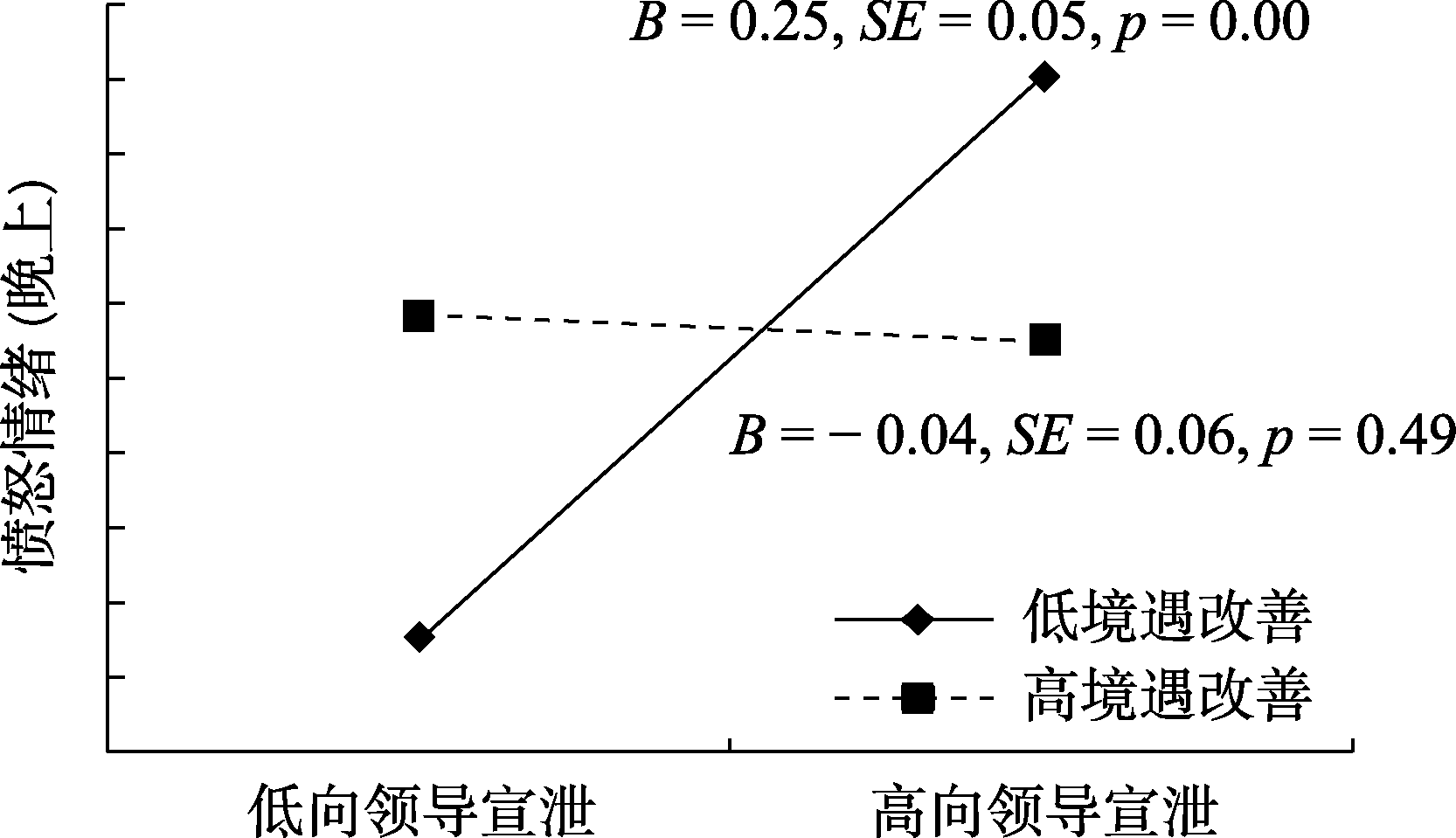
图2 境遇改善对向领导宣泄与愤怒情绪间关系的调节作用
| [1] | Baer, M. D., Rodell, J. B., Dhensa-Kahlon, R. K., Colquitt, J. A., Zipay, K. P., Burgess, R., & Outlaw, R. (2018). Pacification or aggravation? The effects of talking about supervisor unfairness. Academy of Management Journal, 61(5), 1764-1788. |
| [2] |
Bauer, T. N., & Green, S. G. (1996). Development of a leader-member exchange: A longitudinal test. Academy of Management Journal, 39(6), 1538-1567.
doi: 10.2307/257068 URL |
| [3] |
Berkowitz, L. (1990). On the formation and regulation of anger and aggression: A cognitive-neoassociationistic analysis. American Psychologist, 45(4), 494-503.
doi: 10.1037//0003-066x.45.4.494 pmid: 2186678 |
| [4] |
Berkowitz, L. (1993). Pain and aggression: Some findings and implications. Motivation and Emotion, 17, 277-293.
doi: 10.1007/BF00992223 URL |
| [5] |
Berkowitz, L. (2012). A different view of anger: The cognitive‐neoassociation conception of the relation of anger to aggression. Aggressive Behavior, 38(4), 322-333.
doi: 10.1002/ab.21432 pmid: 25363699 |
| [6] |
Berkowitz, L., & Troccoli, B. T. (1990). Feelings, direction of attention, and expressed evaluations of others. Cognition and Emotion, 4(4), 305-325.
doi: 10.1080/02699939008408080 URL |
| [7] | Bies, R. J., & Moag, J. F. (1986). Interactional justice:Communication criteria of fairness. In R. J. Lewicki, B. H. Sheppard, & M. H. Bazerman (Eds.), Research on negotiations in organizations (pp. 43-55). Greenwich, CT: Jai Press. |
| [8] |
Bliese, P. D., & Ployhart, R. E. (2002). Growth modeling using random coefficient models: Model building, testing, and illustrations. Organizational Research Methods, 5(4), 362-387.
doi: 10.1177/109442802237116 URL |
| [9] | Breuer, J., & Freud, S. (1957). Studies on hysteria. New York, NY: Basic Books. |
| [10] | Brislin, R. W. (1986). The wording and translation of research instrument. In W. Lonner., & J. Berry (Eds.), Field methods in cross-cultural research (pp.137-164). Beverly Hills: Sage. |
| [11] |
Brown, S. P., Westbrook, R. A., & Challagalla, G. (2005). Good cope, bad cope: Adaptive and maladaptive coping strategies following a critical negative work event. Journal of Applied Psychology, 90(4), 792-798.
pmid: 16060796 |
| [12] | Burleson, B. R. (2008). What counts as effective emotional support? Explorations of individual and situational differences. In M. T. Motley (Ed.), Studies in applied interpersonal communication (pp. 207-227). Thousand Oaks, CA: Sage. |
| [13] | Burleson, B. R., & Goldsmith, D. J. (1998). How the comforting process works:Alleviating emotional distress through conversationally induced reappraisals. In P. A. Anderson & L. K. Guerrero (Eds.), Handbook of communication and emotion: Research, theory, applications, and contexts (pp. 245-280). San Diego, CA: Academic Press. |
| [14] |
Bushman, B. J. (2002). Does venting anger feed or extinguish the flame? Catharsis, rumination, distraction, anger, and aggressive responding. Personality and Social Psychology Bulletin, 28(6), 724-731.
doi: 10.1177/0146167202289002 URL |
| [15] | Davis, M. H. (1980). A multidimensional approach to individual differences in empathy. Catalog of Selected Documents in Psychology, 10, 85. |
| [16] | Deffenbacher, J. L. (1993). General anger: Characteristics and clinical implications. Psicologia Conductual, 1(1), 49-67. |
| [17] |
Deffenbacher, J. L., Thwaites, G. A., Wallace, T. L., & Oetting, E. R. (1994). Social skills and cognitive-relaxation approaches to general anger reduction. Journal of Counseling Psychology, 41(3), 386-396.
doi: 10.1037/0022-0167.41.3.386 URL |
| [18] |
Farh, J. L., Hackett, R. D., & Liang, J. (2007). Individual-level cultural values as moderators of perceived organizational support-employee outcome relationships in China: Comparing the effects of power distance and traditionality. Academy of Management Journal, 50(3), 715-729.
doi: 10.5465/amj.2007.25530866 URL |
| [19] |
Gabriel, A. S., Diefendorff, J. M., & Grandey, A. A. (2023). The acceleration of emotional labor research: Navigating the past and steering toward the future. Personnel Psychology, 76(2), 511-545.
doi: 10.1111/peps.v76.2 URL |
| [20] |
Gabriel, A. S., Podsakoff, N. P., Beal, D. J., Scott, B. A., Sonnentag, S., Trougakos, J. P., & Butts, M. M. (2019). Experience sampling methods: A discussion of critical trends and considerations for scholarly advancement. Organizational Research Methods, 22(4), 969-1006.
doi: 10.1177/1094428118802626 URL |
| [21] |
Gabriel, A. S., Lee, Y. E., Koopman, J., Rosen, C. C., Dutli, A., & Bush, J. T. (2025). The receipt of venting at work: A multi‐study investigation of affective and behavioral reactions for venting recipients. Personnel Psychology, 78(2), 205-227.
doi: 10.1111/peps.v78.2 URL |
| [22] |
Geddes, D., & Callister, R. R. (2007). Crossing the line (s): A dual threshold model of anger in organizations. Academy of Management Review, 32(3), 721-746.
doi: 10.5465/amr.2007.25275495 URL |
| [23] |
Gross, J. J. (1998). The emerging field of emotion regulation: An integrative review. Review of General Psychology, 2(3), 271-299.
doi: 10.1037/1089-2680.2.3.271 URL |
| [24] |
Kim, S., Cho, S., & Chung, W. (2023). Benefits of leaders’ pleasurable recovery activities on follower performance via emotional contagion. Journal of Applied Psychology, 108(8), 1336-1355.
doi: 10.1037/apl0001076 URL |
| [25] |
Law, K. S., Wong, C. S., & Song, L. J. (2004). The construct and criterion validity of emotional intelligence and its potential utility for management studies. Journal of Applied Psychology, 89(3), 483-96.
pmid: 15161407 |
| [26] | Lazarus, R. S. (1991). Emotion and adaptation. New York: Oxford University Press. |
| [27] |
Lazarus, R. S. (1993). Coping theory and research: Past, present, and future. Psychosomatic Medicine, 55(3), 234-247.
doi: 10.1097/00006842-199305000-00002 pmid: 8346332 |
| [28] | Lazarus, R. S., & Folkman, S. (1984). Stress, appraisal, and coping. New York: Springer. |
| [29] |
Leventhal, H., Leventhal, E. A., & Contrada, R. J. (1998). Self-regulation, health, and behavior: A perceptual-cognitive approach. Psychology and Health, 13(4), 717-733.
doi: 10.1080/08870449808407425 URL |
| [30] |
Little, L. M., Gooty, J., & Williams, M. (2016). The role of leader emotion management in leader-member exchange and follower outcomes. Leadership Quarterly, 27(1), 85-97.
doi: 10.1016/j.leaqua.2015.08.007 URL |
| [31] |
Little, L. M., Kluemper, D., Nelson, D. L., & Gooty, J. (2012). Development and validation of the interpersonal emotion management scale. Journal of Occupational and Organizational Psychology, 85(2), 407-420.
doi: 10.1111/joop.2012.85.issue-2 URL |
| [32] |
Little, L. M., Kluemper, D., Nelson, D. L., & Ward, A. (2013). More than happy to help? Customer-focused emotion management strategies. Personnel Psychology, 66(1), 261-286.
doi: 10.1111/peps.2013.66.issue-1 URL |
| [33] |
Liu, D. P., Pang, X. H., Song, J., Li, J. X., Yang, Y. Y., & Zhang, S. J. (2024). How leaders reduce abusive supervision caused by subordinates’ venting through cognitive change? Acta Psychologica Sinica, 56(11), 1556-1567.
doi: 10.3724/SP.J.1041.2024.01556 URL |
|
[刘德鹏, 庞旭宏, 宋杰, 李珏兴, 杨椅伊, 张生军. (2024). 领导者如何通过认知调整减少由下属宣泄引起的辱虐管理行为? 心理学报, 56(11), 1556-1567.]
doi: 10.3724/SP.J.1041.2024.01556 |
|
| [34] |
Liu, D. Y., Strube, M. J., & Thompson, R. J. (2021). Interpersonal emotion regulation: An experience sampling study. Affective Science, 2(3), 273-288.
doi: 10.1007/s42761-021-00044-y pmid: 36059902 |
| [35] |
Liu, F., Li, P., Taris, T. W., & Peeters, M. C. (2022). Creative performance pressure as a double‐edged sword for creativity: The role of appraisals and resources. Human Resource Management, 61(6), 663-679.
doi: 10.1002/hrm.v61.6 URL |
| [36] |
Liu, W., Song, Z., Li, X., & Liao, Z. (2017). Why and when leaders’ affective states influence employee upward voice. Academy of Management Journal, 60(1), 238-263.
doi: 10.5465/amj.2013.1082 URL |
| [37] | Liu, Y. & West, S. G. (2016). Weekly cycles in daily report data: An overlooked issue. Journal of Personality, 84(5), 560-579. |
| [38] | Lohr, J. M., Olatunji, B. O., Baumeister, R. F., & Bushman, B. J. (2007). The psychology of anger venting and empirically supported alternatives that do no harm. Scientific Review of Mental Health Practice, 5(1), 553-564. |
| [39] |
Martin, R. C., & Dahlen, E. R. (2005). Cognitive emotion regulation in the prediction of depression, anxiety, stress, and anger. Personality and Individual Differences, 39(7), 1249-1260.
doi: 10.1016/j.paid.2005.06.004 URL |
| [40] |
Matta, F. K., Frank, E. L., & Muir, C. P. (2024). “Seeing eye to eye” about our relationship is good for us and everyone else: An examination of LMX agreement and views of fair treatment. Organization Science, 35(4), 1489-1511.
doi: 10.1287/orsc.2021.15475 URL |
| [41] |
Mayer, J. D., Roberts, R. D., & Barsade, S. G. (2008). Human abilities: Emotional intelligence. Annual Review of Psychology, 59(1), 507-536.
doi: 10.1146/psych.2008.59.issue-1 URL |
| [42] |
Mayer, R. C., Davis, J. H., & Schoorman, F. D. (1995). An integration model of organizational trust. Academy of Management Review, 20(3), 709-734.
doi: 10.2307/258792 URL |
| [43] |
Mitchell, M. S., Vogel, R. M., & Folger, R. (2015). Third parties’ reactions to the abusive supervision of coworkers. Journal of Applied Psychology, 100(4), 1040-1055.
doi: 10.1037/apl0000002 pmid: 25243999 |
| [44] | Muthén, L. K., & Muthén, B. O. (2012). Mplus user’s guide. Los Angeles, CA: Muthén & Muthén. |
| [45] | Niven, K., Connolly, C., Stride, C. B., & Farley, S. (2022). Daily effects of face-to-face and cyber incivility via sadness, anger and fear. Work and Stress, 36(2), 147-163. |
| [46] |
Niven, K., Totterdell, P., & Holman, D. (2009). A classification of controlled interpersonal affect regulation strategies. Emotion, 9(4), 498-509.
doi: 10.1037/a0015962 pmid: 19653772 |
| [47] |
Oh, J. K., & Farh, C. I. (2017). An emotional process theory of how subordinates appraise, experience, and respond to abusive supervision over time. Academy of Management Review, 42(2), 207-232.
doi: 10.5465/amr.2014.0347 URL |
| [48] |
Parlamis, J. D. (2012). Venting as emotion regulation: The influence of venting responses and respondent identity on anger and emotional tone. International Journal of Conflict Management, 23(1), 77-96.
doi: 10.1108/10444061211199322 URL |
| [49] |
Parlamis, J. D., Allred, K. G., & Block, C. (2010). Letting off steam or just steaming? The influence of venting target and offender status on attributions and anger. International Journal of Conflict Management, 21(3), 260-280.
doi: 10.1108/10444061011063171 URL |
| [50] |
Podsakoff, N. P., Spoelma, T. M., Chawla, N., & Gabriel, A. S. (2019). What predicts within-person variance in applied psychology constructs? An empirical examination. Journal of Applied Psychology, 104(6), 727-754.
doi: 10.1037/apl0000374 pmid: 30640492 |
| [51] |
Podsakoff, P. M., MacKenzie, S. B., Lee, J. Y., & Podsakoff, N. P. (2003). Common method biases in behavioral research: A critical review of the literature and recommended remedies. Journal of Applied Psychology, 88(5), 879-903.
doi: 10.1037/0021-9010.88.5.879 pmid: 14516251 |
| [52] |
Preacher, K. J., Zyphur, M. J., & Zhang, Z. (2010). A general multilevel SEM framework for assessing multilevel mediation. Psychological Methods, 15(3), 209-233.
doi: 10.1037/a0020141 pmid: 20822249 |
| [53] |
Raveendhran, R., & Fast, N. J. (2021). Humans judge, algorithms nudge: The psychology of behavior tracking acceptance. Organizational Behavior and Human Decision Processes, 164, 11-26.
doi: 10.1016/j.obhdp.2021.01.001 URL |
| [54] |
Rees, L., & Friedman, R. (2025). Not your garden (hose) variety emotion: An integrative review of the flows of anger and a path forward. Academy of Management Annals, 19(1), 132-179.
doi: 10.5465/annals.2022.0160 URL |
| [55] |
Richard, F. D., Bond, C. F., Jr., & Stokes-Zoota, J. J. (2003). One hundred years of social psychology quantitatively described. Review of General Psychology, 7(4), 331-363.
doi: 10.1037/1089-2680.7.4.331 URL |
| [56] | Roberts, B. L., Dunkle, R., & Haug, M. (1994). Physical, psychological, and social resources as moderators of the relationship of stress to mental health of the very old. Journal of Gerontology, 49(1), S35-S43. |
| [57] |
Roseman, I. J., Wiest, C., & Swartz, T. S. (1994). Phenomenology, behaviors, and goals differentiate discrete emotions. Journal of Personality and Social Psychology, 67(2), 206-221.
doi: 10.1037/0022-3514.67.2.206 URL |
| [58] |
Rosen, C. C., Gabriel, A. S., Lee, H. W., Koopman, J., & Johnson, R. E. (2021). When lending an ear turns into mistreatment: An episodic examination of leader mistreatment in response to venting at work. Personnel Psychology, 74(1), 175-195.
doi: 10.1111/peps.v74.1 URL |
| [59] |
Scontrino, M. P. (1972). The effects of fulfilling and violating group members' expectations about leadership style. Organizational Behavior and Human Performance, 8(1), 118-138.
doi: 10.1016/0030-5073(72)90040-2 URL |
| [60] |
Simon, L. S., Rosen, C. C., Gajendran, R. S., Ozgen, S., & Corwin, E. S. (2022). Pain or gain? Understanding how trait empathy impacts leader effectiveness following the provision of negative feedback. Journal of Applied Psychology, 107(2), 279-297.
doi: 10.1037/apl0000882 URL |
| [61] |
Smith, C. A., & Ellsworth, P. C. (1987). Patterns of appraisal and emotion related to taking an exam. Journal of Personality and Social Psychology, 52(3), 475-488.
pmid: 3572720 |
| [62] |
Tangney, J. P., Miller, R. S., Flicker, L., & Barlow, D. H. (1996). Are Shame, Guilt, and Embarrassment Distinct Emotions? Journal of Personality and Social Psychology, 70(6), 1256-1269.
doi: 10.1037//0022-3514.70.6.1256 pmid: 8667166 |
| [63] | Van Den Akker, L., Heres, L., Lasthuizen, K. M., & Six, F. E. (2009). Ethical leadership and trust: It's all about meeting expectations. International Journal of Leadership Studies, 5(2), 102-122. |
| [64] |
Walumbwa, F. O., Hartnell, C. A., & Oke, A. (2010). Servant leadership, procedural justice climate, service climate, employee attitudes, and organizational citizenship behavior: A cross-level investigation. Journal of Applied Psychology, 95(3), 517-529.
doi: 10.1037/a0018867 pmid: 20476830 |
| [65] | Wang, Q. Q., & Wang, R. Q. (2023). A study on the word class labeling and definition of Tucao. Journal of Longdong University, 34(3), 43-47. |
| [王琪琪, 王仁强. (2023). “吐槽”的词类标注与释义研究. 陇东学院学报, 34(3), 43-47.] | |
| [66] |
Watkins, E. R. (2008). Constructive and unconstructive repetitive thought. Psychological Bulletin, 134(2), 163-206.
doi: 10.1037/0033-2909.134.2.163 pmid: 18298268 |
| [67] |
Watkins, T., Kleshinski, C. E., Longmire, N. H., & He, W. (2023). Rekindling the fire and stoking the flames: How and when workplace interpersonal capitalization facilitates pride and knowledge sharing at work. Academy of Management Journal, 66(3), 953-978.
doi: 10.5465/amj.2021.1022 URL |
| [68] |
Williams, M. (2007). Building genuine trust through interpersonal emotion management: A threat regulation model of trust and collaboration across boundaries. Academy of Management Review, 32(2), 595-621.
doi: 10.5465/amr.2007.24351867 URL |
| [69] | Wilson, K. S., Sin, H., & Conlon, D. E. (2010). What about the leader in leader-member exchange? The impact of resource exchanges and substitutability on the leader. Academy of Management Review, 35(5), 358-372. |
| [70] | Yang, L. Z., Du, W. X., & Shen, Y. (2011). A review on the integrative cognitive model of trait anger and reactive aggression. Advances in Psychological Science, 19(9), 1249-1258. |
| [杨丽珠, 杜文轩, 沈悦. (2011). 特质愤怒与反应性攻击的综合认知模型述评. 心理科学进展, 19(9), 1249-1258.] | |
| [71] |
Yukl, G. (2012). Effective leadership behavior: What we know and what questions need more attention. Academy of Management Perspectives, 26(4), 66-85.
doi: 10.5465/amp.2012.0088 URL |
| [72] |
Zaccaro, S. J., Rittman, A. L., & Marks, M. A. (2001). Team leadership. Leadership Quarterly, 12(4), 451-483.
doi: 10.1016/S1048-9843(01)00093-5 URL |
| [73] |
Zhan, Y., Xu, H. F., Ren, J., & Luo, J. (2020). Is catharsis beneficial or harmful? The psychological intervention effect and potential harm of catharsis. Advances in Psychological Science, 28(1), 22-32.
doi: 10.3724/SP.J.1042.2020.00022 |
|
[詹鋆, 徐宏飞, 任俊, 罗劲. (2020). 心理宣泄究竟是有益还是有害? ——宣泄的心理干预效果及潜在危害. 心理科学进展, 28(1), 22-32.]
doi: 10.3724/SP.J.1042.2020.00022 |
|
| [74] |
Zhang, X., Yu, K., Li, W. D., & Zacher, H. (2023). Sustainability of passion for work? Change-related reciprocal relationships between passion and job crafting. Journal of Management, 51(4), 1349-1383.
doi: 10.1177/01492063231207343 URL |
| [75] | Zou, Y. C., Chen, Q. Y., Peng, J., & Zeng, X. Q. (2024). Benefits and costs of problem-focused leader interpersonal emotion management: An integrative perspective of employees and leaders. Journal of Psychological Science, 47(3), 630-638. |
| [邹艳春, 陈启瑶, 彭坚, 曾晓晴. (2024). 问题导向领导人际情绪管理的收益与代价: 基于员工与领导的差异化视角. 心理科学, 47(3), 630-638.] | |
| [76] | Zou, Y. C., Zhang, H. M., Chen, X., & Zeng, X. Q. (2022). How to manage subordinates’ emotions? The strategies and influences of leader interpersonal emotion management. Human Resources Development of China, 39(7), 88-106. |
| [邹艳春, 章惠敏, 陈晓, 曾晓晴. (2022). 如何管理下属情绪?领导者人际情绪管理的策略与影响. 中国人力资源开发, 39(7), 88-106.] |
| [1] | 刘德鹏, 庞旭宏, 宋杰, 李珏兴, 杨椅伊, 张生军. 领导者如何通过学习机会评估减少由下属宣泄引起的领导日常辱虐行为?[J]. 心理学报, 2024, 56(11): 1556-1567. |
| 阅读次数 | ||||||
|
全文 |
|
|||||
|
摘要 |
|
|||||
