

ISSN 0439-755X
CN 11-1911/B
主办:中国心理学会
中国科学院心理研究所
出版:科学出版社
CN 11-1911/B
主办:中国心理学会
中国科学院心理研究所
出版:科学出版社
心理学报 ›› 2025, Vol. 57 ›› Issue (8): 1468-1481.doi: 10.3724/SP.J.1041.2025.1468 cstr: 32110.14.2025.1468
刘盼1, 邱林2,3,4, 谢天5,6, 任孝鹏7,8( )
)
收稿日期:2022-09-01
发布日期:2025-05-22
出版日期:2025-08-25
通讯作者:
任孝鹏, E-mail: renxp@psych.ac.cn基金资助:
LIU Pan1, QIU Lin2,3,4, XIE Tian5,6, REN Xiaopeng7,8()
Received:2022-09-01
Online:2025-05-22
Published:2025-08-25
摘要: 个体主义的变迁一直广受学界关注。然而, 现有文献中关于中国个体主义变迁的研究出现了矛盾的结果。本文指出, 这可能是由于不同研究采用的个体主义测量指标不同所致。进一步, 本文认为可将人们在日常生活中的个体主义实践分为两类:个体主义重选择(high-stake choices, 涉及高机会成本)和个体主义轻选择(low-stake choices, 涉及低机会成本), 并认为现代化对个体主义重选择的影响大于对个体主义轻选择的影响。研究1通过一项问卷调查(N = 312)检验中国民众对不同生活选择重大性的主观感知。结果发现, 是否结婚、是否离婚、是否要孩子、是否与父母分开住等4项选择与给新生儿(男、女)取名等两项选择存在显著差异, 显示出前者属于个体主义重选择, 后者为个体主义轻选择。研究2通过分析中国26省30年的面板数据发现:1)中国各省的个体主义, 包括重选择和轻选择, 总体呈现上升趋势, 且现代化显著正向预测两类个体主义; 2)但相较于个体主义轻选择, 现代化对个体主义重选择的预测力更强, 预测趋势的省际差异更小。本研究通过将个体主义的测量分类, 为重新审视中国内部乃至全球的个体主义变迁研究提供了一个新的理论视角。
中图分类号:
刘盼, 邱林, 谢天, 任孝鹏. (2025). 生活选择的重与轻:现代化如何预测中国个体主义的多重变迁. 心理学报, 57(8), 1468-1481.
LIU Pan, QIU Lin, XIE Tian, REN Xiaopeng. (2025). High- vs. low-stake choices in life: How does modernization predict the multidimensional shifts of individualism in China. Acta Psychologica Sinica, 57(8), 1468-1481.
| 序号 | 量表条目内容 |
|---|---|
| 1 | ____这个选择在人的一生中很少发生 |
| 2 | ____这个选择带来的后果具有不确定性 |
| 3 | ____这个选择涉及多方面考虑 |
| 4 | ____这个选择关系到个人道德或价值观 |
| 5 | ____这个选择需要大量资源的投入 |
| 6 | ____这个选择排除了很多其他选项 |
| 7 | ____这个选择影响生活的多个方面 |
| 8 | ____这个选择对人际关系有很大影响 |
| 9 | ____这个选择对经济状况有很大影响 |
| 10 | ____这个选择对生活方式有很大影响 |
| 11 | ____这个选择影响很多人 |
| 12 | ____这个选择对生活有长期影响 |
| 13 | ____这个选择确定后就难以撤销或收回 |
表1 研究1生活选择特征量表
| 序号 | 量表条目内容 |
|---|---|
| 1 | ____这个选择在人的一生中很少发生 |
| 2 | ____这个选择带来的后果具有不确定性 |
| 3 | ____这个选择涉及多方面考虑 |
| 4 | ____这个选择关系到个人道德或价值观 |
| 5 | ____这个选择需要大量资源的投入 |
| 6 | ____这个选择排除了很多其他选项 |
| 7 | ____这个选择影响生活的多个方面 |
| 8 | ____这个选择对人际关系有很大影响 |
| 9 | ____这个选择对经济状况有很大影响 |
| 10 | ____这个选择对生活方式有很大影响 |
| 11 | ____这个选择影响很多人 |
| 12 | ____这个选择对生活有长期影响 |
| 13 | ____这个选择确定后就难以撤销或收回 |
| 生活选择类型 | 因子 | |
|---|---|---|
| 1 | 2 | |
| 是否结婚 | 0.86 | |
| 是否离婚 | 0.63 | |
| 是否要孩子 | 0.70 | |
| 是否与父母分开住 | 0.48 | |
| 给新生儿(男孩)取名 | 0.91 | |
| 给新生儿(女孩)取名 | 0.90 | |
表2 旋转后的因子矩阵
| 生活选择类型 | 因子 | |
|---|---|---|
| 1 | 2 | |
| 是否结婚 | 0.86 | |
| 是否离婚 | 0.63 | |
| 是否要孩子 | 0.70 | |
| 是否与父母分开住 | 0.48 | |
| 给新生儿(男孩)取名 | 0.91 | |
| 给新生儿(女孩)取名 | 0.90 | |
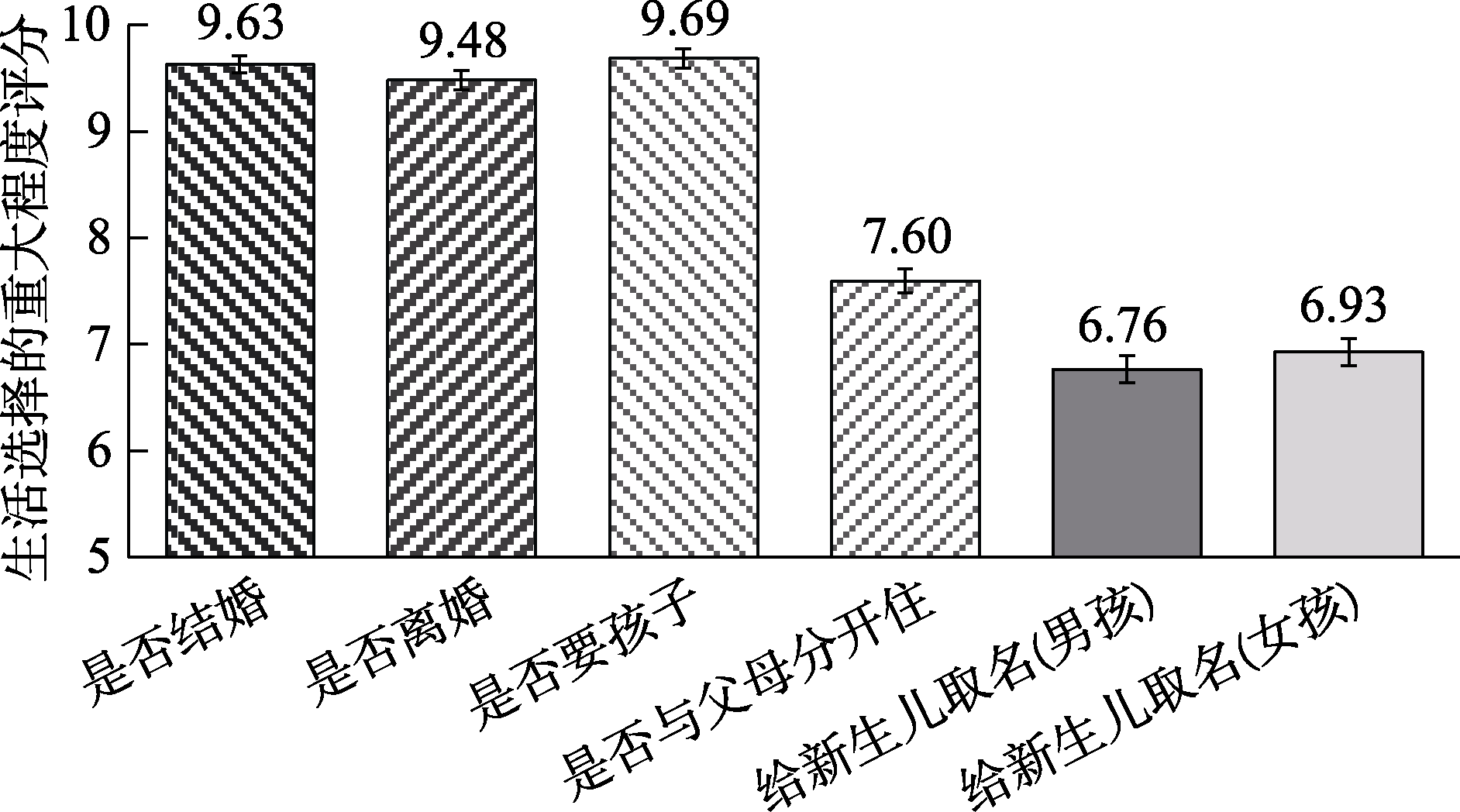
图1 六类生活选择在重大程度评分上的比较分析
| 现代化指标 | 1 | 2 | 3 | 4 | 5 | |
|---|---|---|---|---|---|---|
| 人均GDP | 1 | — | ||||
| 城镇化率 | 2 | 0.71*** | — | |||
| 高等教育人口比例 | 3 | 0.83*** | 0.77*** | — | ||
| 文盲率 | 4 | −0.56*** | −0.63*** | −0.47*** | — | |
| 综合指数 | 5 | 0.90*** | 0.90*** | 0.89*** | −0.77*** | — |
| 均值 | 9015.48 | 0.38 | 0.02 | 15.36 | 0 | |
| 标准差 | 11972.44 | 0.18 | 0.02 | 12.05 | 0.86 | |
表3 现代化及其各单项指标的简单相关分析
| 现代化指标 | 1 | 2 | 3 | 4 | 5 | |
|---|---|---|---|---|---|---|
| 人均GDP | 1 | — | ||||
| 城镇化率 | 2 | 0.71*** | — | |||
| 高等教育人口比例 | 3 | 0.83*** | 0.77*** | — | ||
| 文盲率 | 4 | −0.56*** | −0.63*** | −0.47*** | — | |
| 综合指数 | 5 | 0.90*** | 0.90*** | 0.89*** | −0.77*** | — |
| 均值 | 9015.48 | 0.38 | 0.02 | 15.36 | 0 | |
| 标准差 | 11972.44 | 0.18 | 0.02 | 12.05 | 0.86 | |
| 个体主义重 选择指标 | 1 | 2 | 3 | 4 | 5 | |
|---|---|---|---|---|---|---|
| 独居率 | 1 | — | ||||
| 离婚率 | 2 | 0.42*** | — | |||
| 家庭规模 | 3 | −0.70** | −0.54*** | — | ||
| 大家庭比例 | 4 | −0.43** | −0.35** | 0.89*** | — | |
| 综合指数 | 5 | 0.78*** | 0.71** | −0.96*** | −0.82*** | — |
| 均值 | 8.62 | 0.009 | 3.75 | 2.92 | 0 | |
| 标准差 | 3.46 | 0.005 | 0.58 | 3.31 | 0.82 | |
表4 个体主义重选择及其各单项指标的简单相关分析
| 个体主义重 选择指标 | 1 | 2 | 3 | 4 | 5 | |
|---|---|---|---|---|---|---|
| 独居率 | 1 | — | ||||
| 离婚率 | 2 | 0.42*** | — | |||
| 家庭规模 | 3 | −0.70** | −0.54*** | — | ||
| 大家庭比例 | 4 | −0.43** | −0.35** | 0.89*** | — | |
| 综合指数 | 5 | 0.78*** | 0.71** | −0.96*** | −0.82*** | — |
| 均值 | 8.62 | 0.009 | 3.75 | 2.92 | 0 | |
| 标准差 | 3.46 | 0.005 | 0.58 | 3.31 | 0.82 | |
| 个体主义轻选择指标 | 1 | 2 | 3 | |
|---|---|---|---|---|
| 重名率前10位的新生儿 名字总占比(男) | 1 | — | ||
| 重名率前10位的新生儿 名字总占比(女) | 2 | 0.90*** | — | |
| 综合指数 | 3 | −0.97*** | −0.97*** | — |
| 均值 | 6.17 | 6.86 | 0 | |
| 标准差 | 2.57 | 2.75 | 0.97 | |
表5 个体主义轻选择及其各单项指标的简单相关分析
| 个体主义轻选择指标 | 1 | 2 | 3 | |
|---|---|---|---|---|
| 重名率前10位的新生儿 名字总占比(男) | 1 | — | ||
| 重名率前10位的新生儿 名字总占比(女) | 2 | 0.90*** | — | |
| 综合指数 | 3 | −0.97*** | −0.97*** | — |
| 均值 | 6.17 | 6.86 | 0 | |
| 标准差 | 2.57 | 2.75 | 0.97 | |

图2 中国省级层面个体主义重选择(左)和轻选择(右)在1981至2010年间的变化趋势。圆圈代表各省份在对应年度的个体主义重选择/轻选择综合指数值, 虚线代表由多水平模型拟合得出的个体主义变迁走势
| 现代化指标 | 个体主义重选择 | 个体主义轻选择 | ||||
|---|---|---|---|---|---|---|
| b | 95%置信区间 | t | b | 95%置信区间 | t | |
| 人均GDP | 0.262*** (0.030) | [0.188, 0.336] | 8.84 | 0.002^ (0.032) | [−0.061, 0.065] | 0.06 |
| 城镇化率 | 0.953*** (0.106) | [0.737, 1.168] | 9.02 | 0.396** (0.115) | [0.159, 0.634] | 3.45 |
| 高等教育人口比例 | 0.855*** (0.073) | [0.705, 1.006] | 11.70 | 0.356** (0.107) | [0.130, 0.582] | 3.34 |
| 文盲率 | −0.472*** (0.045) | [−0.566, −0.378] | −10.47 | −0.366*** (0.085) | [−0.546, −0.185] | −4.28 |
| 综合指数 | 0.859*** (0.076) | [0.702, 1.015] | 11.31 | 0.303** (0.092) | [0.108, 0.498] | 3.30 |
表6 中国省级层面现代化对个体主义重选择和轻选择的影响
| 现代化指标 | 个体主义重选择 | 个体主义轻选择 | ||||
|---|---|---|---|---|---|---|
| b | 95%置信区间 | t | b | 95%置信区间 | t | |
| 人均GDP | 0.262*** (0.030) | [0.188, 0.336] | 8.84 | 0.002^ (0.032) | [−0.061, 0.065] | 0.06 |
| 城镇化率 | 0.953*** (0.106) | [0.737, 1.168] | 9.02 | 0.396** (0.115) | [0.159, 0.634] | 3.45 |
| 高等教育人口比例 | 0.855*** (0.073) | [0.705, 1.006] | 11.70 | 0.356** (0.107) | [0.130, 0.582] | 3.34 |
| 文盲率 | −0.472*** (0.045) | [−0.566, −0.378] | −10.47 | −0.366*** (0.085) | [−0.546, −0.185] | −4.28 |
| 综合指数 | 0.859*** (0.076) | [0.702, 1.015] | 11.31 | 0.303** (0.092) | [0.108, 0.498] | 3.30 |
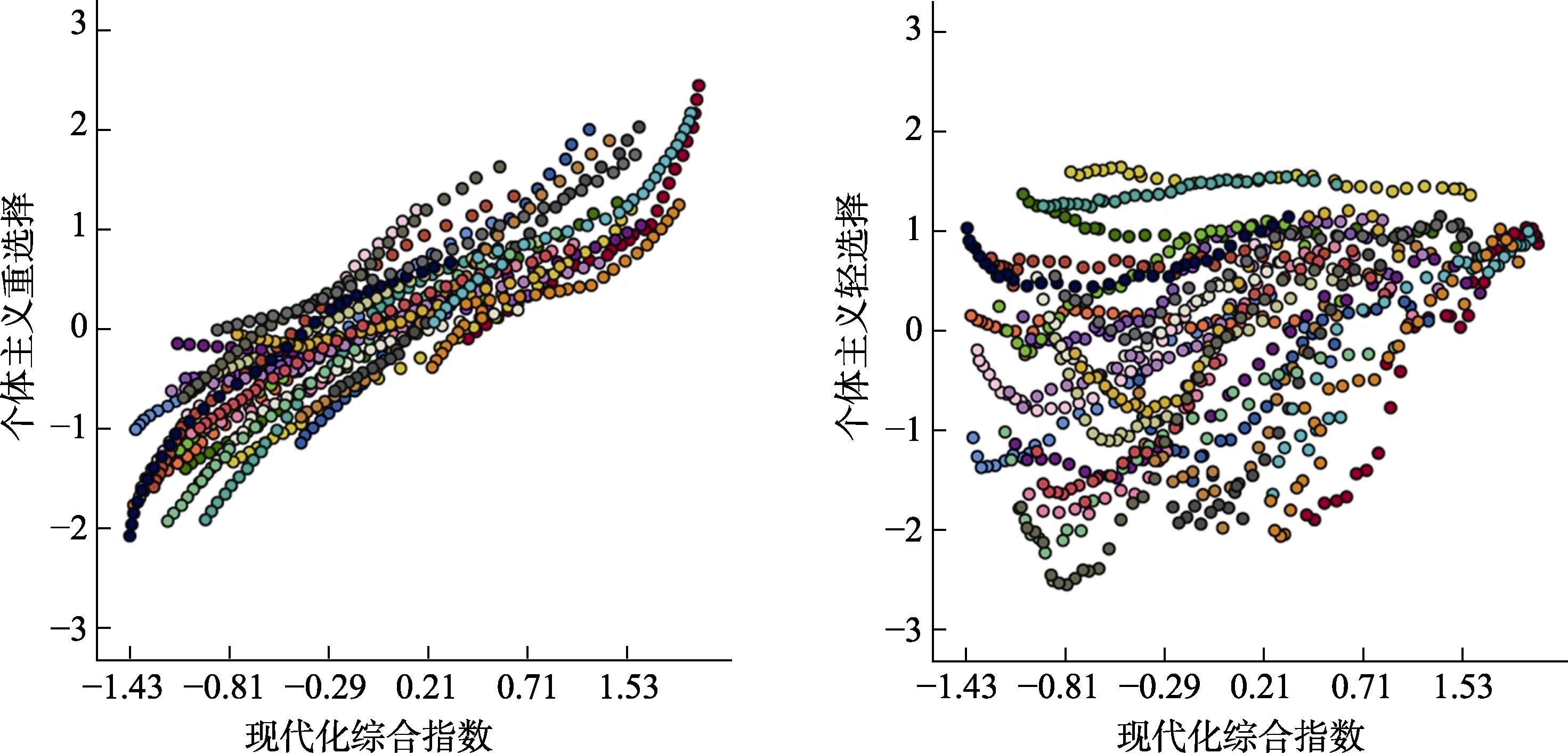
图3 中国不同省份的现代化对个体主义重选择(左)和轻选择(右)的预测模式。圆点代表各省份在对应年度的个体主义重选择/轻选择综合指数值
| 省份 | 现代化 | 个体主义 | 省份 | 现代化 | 个体主义 | ||
|---|---|---|---|---|---|---|---|
| 重选择 | 轻选择 | 重选择 | 轻选择 | ||||
| 安徽 | −0.52 | −0.15 | −0.58 | 江西 | −0.30 | −0.57^ | 0.15 |
| 北京 | 1.74# | 0.96# | −0.08 | 吉林 | 0.25 | 0.25 | −0.62 |
| 福建 | −0.08 | −0.24 | 1.05# | 辽宁 | 0.45 | 0.44 | −0.51 |
| 甘肃 | −0.58^ | −0.65^ | 0.10 | 宁夏 | −0.34 | −0.56^ | −1.21^ |
| 广东 | 0.19 | −0.24 | 1.52# | 青海 | −0.52 | −0.21 | 0.68 |
| 广西 | −0.29 | −0.48 | 1.40# | 陕西 | −0.21 | −0.13 | −0.66^ |
| 贵州 | −0.64^ | −0.31 | −0.25 | 山东 | −0.07 | −0.04 | 0.15 |
| 河北 | −0.27 | −0.17 | 0.42 | 山西 | −0.09 | 0.08 | 0.03 |
| 河南 | −0.40 | −0.43 | 0.52 | 上海 | 1.43# | 1.10# | 0.08 |
| 黑龙江 | 0.22 | 0.20 | −0.56 | 四川 | −0.35 | 0.34 | −1.15^ |
| 湖北 | −0.06 | −0.14 | −0.46 | 天津 | 1.06# | 0.40 | −0.39 |
| 湖南 | −0.21 | 0.14 | −0.39 | 云南 | −0.63^ | −0.49 | 0.70 |
| 江苏 | 0.07 | 0.20 | −0.51 | 浙江 | 0.15 | 0.69# | 0.59 |
表S1 中国各省1981~2010三十年间现代化、个体主义重选择与轻选择综合指数比较
| 省份 | 现代化 | 个体主义 | 省份 | 现代化 | 个体主义 | ||
|---|---|---|---|---|---|---|---|
| 重选择 | 轻选择 | 重选择 | 轻选择 | ||||
| 安徽 | −0.52 | −0.15 | −0.58 | 江西 | −0.30 | −0.57^ | 0.15 |
| 北京 | 1.74# | 0.96# | −0.08 | 吉林 | 0.25 | 0.25 | −0.62 |
| 福建 | −0.08 | −0.24 | 1.05# | 辽宁 | 0.45 | 0.44 | −0.51 |
| 甘肃 | −0.58^ | −0.65^ | 0.10 | 宁夏 | −0.34 | −0.56^ | −1.21^ |
| 广东 | 0.19 | −0.24 | 1.52# | 青海 | −0.52 | −0.21 | 0.68 |
| 广西 | −0.29 | −0.48 | 1.40# | 陕西 | −0.21 | −0.13 | −0.66^ |
| 贵州 | −0.64^ | −0.31 | −0.25 | 山东 | −0.07 | −0.04 | 0.15 |
| 河北 | −0.27 | −0.17 | 0.42 | 山西 | −0.09 | 0.08 | 0.03 |
| 河南 | −0.40 | −0.43 | 0.52 | 上海 | 1.43# | 1.10# | 0.08 |
| 黑龙江 | 0.22 | 0.20 | −0.56 | 四川 | −0.35 | 0.34 | −1.15^ |
| 湖北 | −0.06 | −0.14 | −0.46 | 天津 | 1.06# | 0.40 | −0.39 |
| 湖南 | −0.21 | 0.14 | −0.39 | 云南 | −0.63^ | −0.49 | 0.70 |
| 江苏 | 0.07 | 0.20 | −0.51 | 浙江 | 0.15 | 0.69# | 0.59 |
图S2.1 中国不同省份现代化水平随时间的变化趋势
图S2.2 中国不同省份个体主义重选择(左)和轻选择(右)随时间的变迁趋势
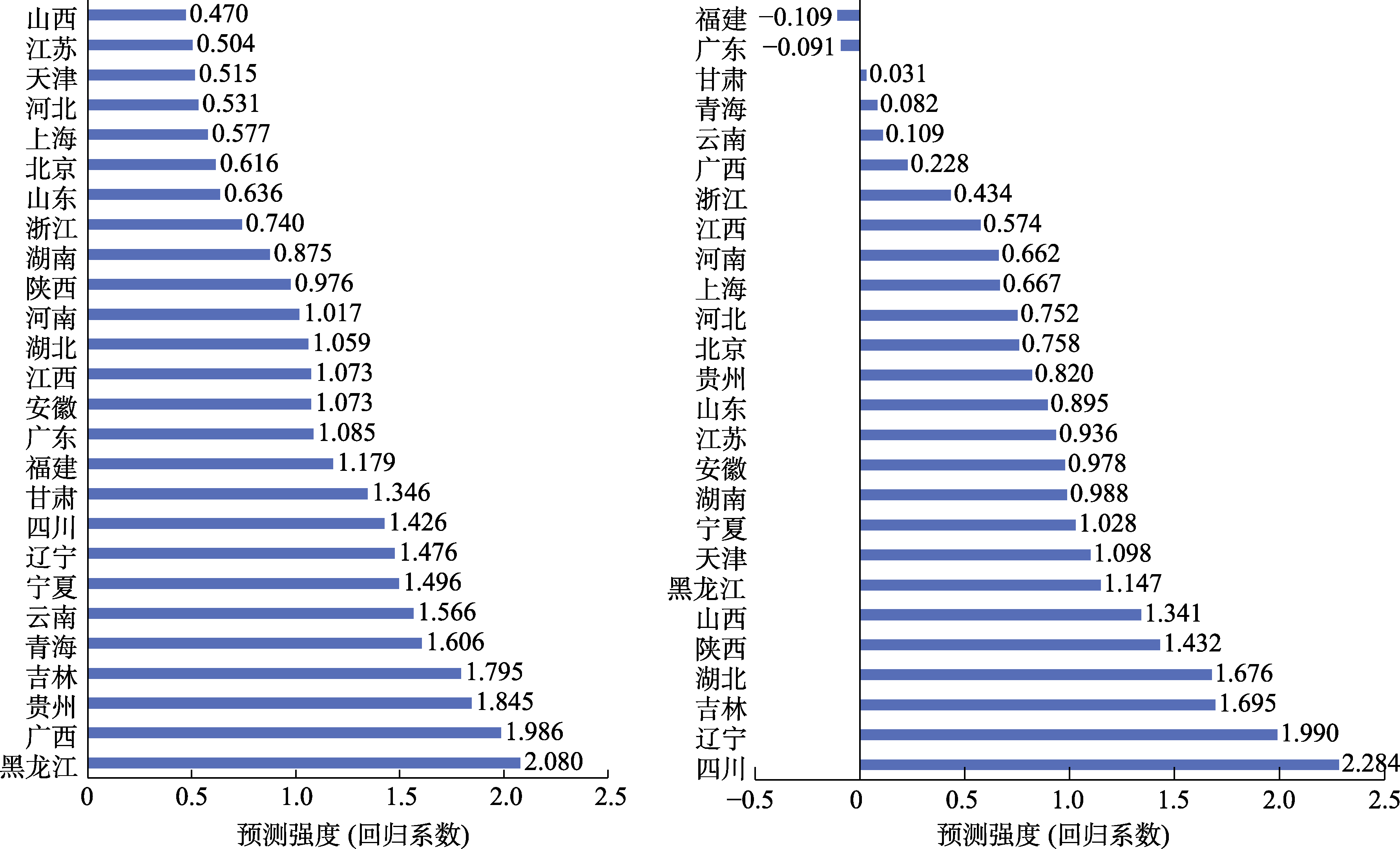
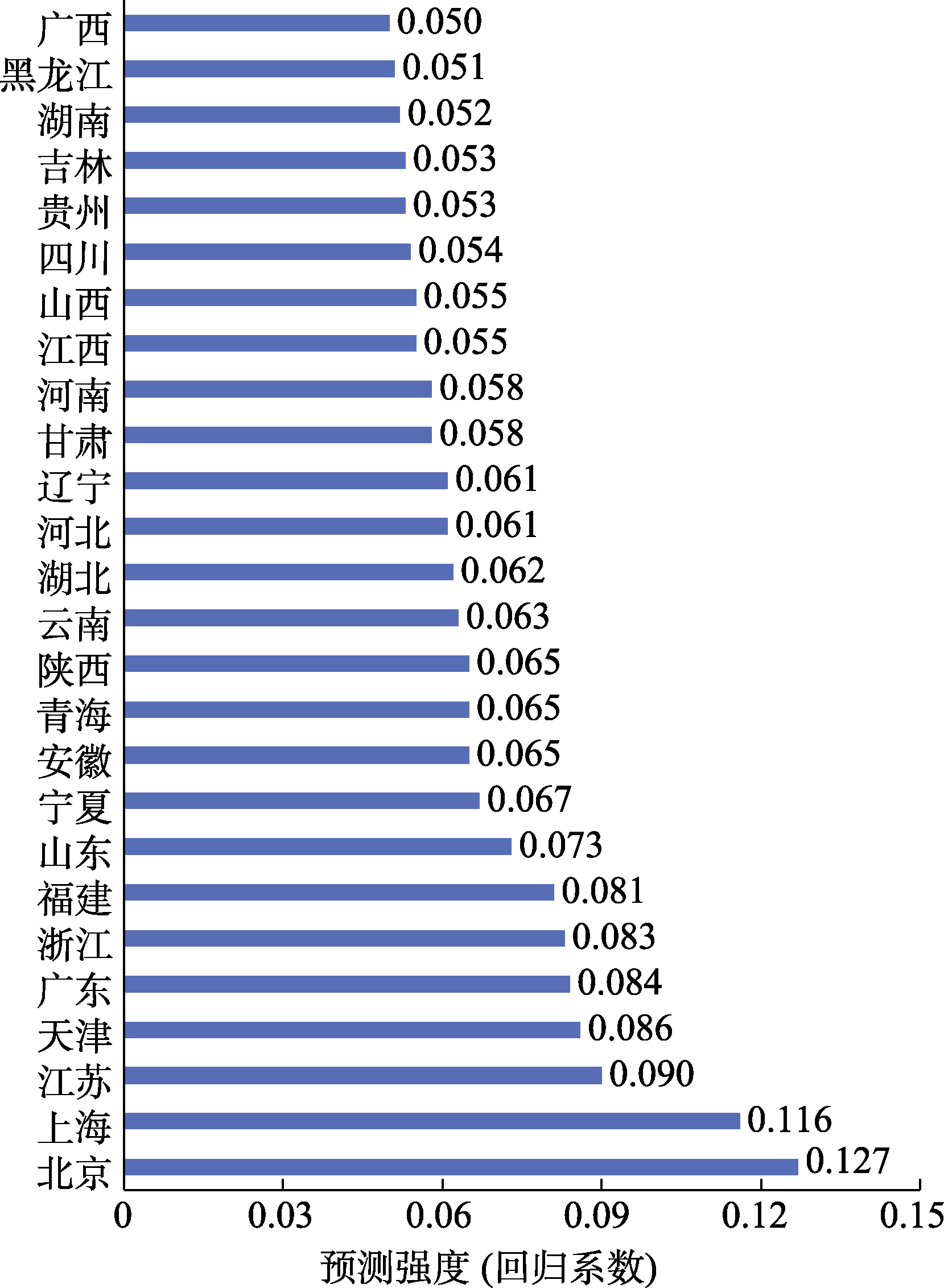
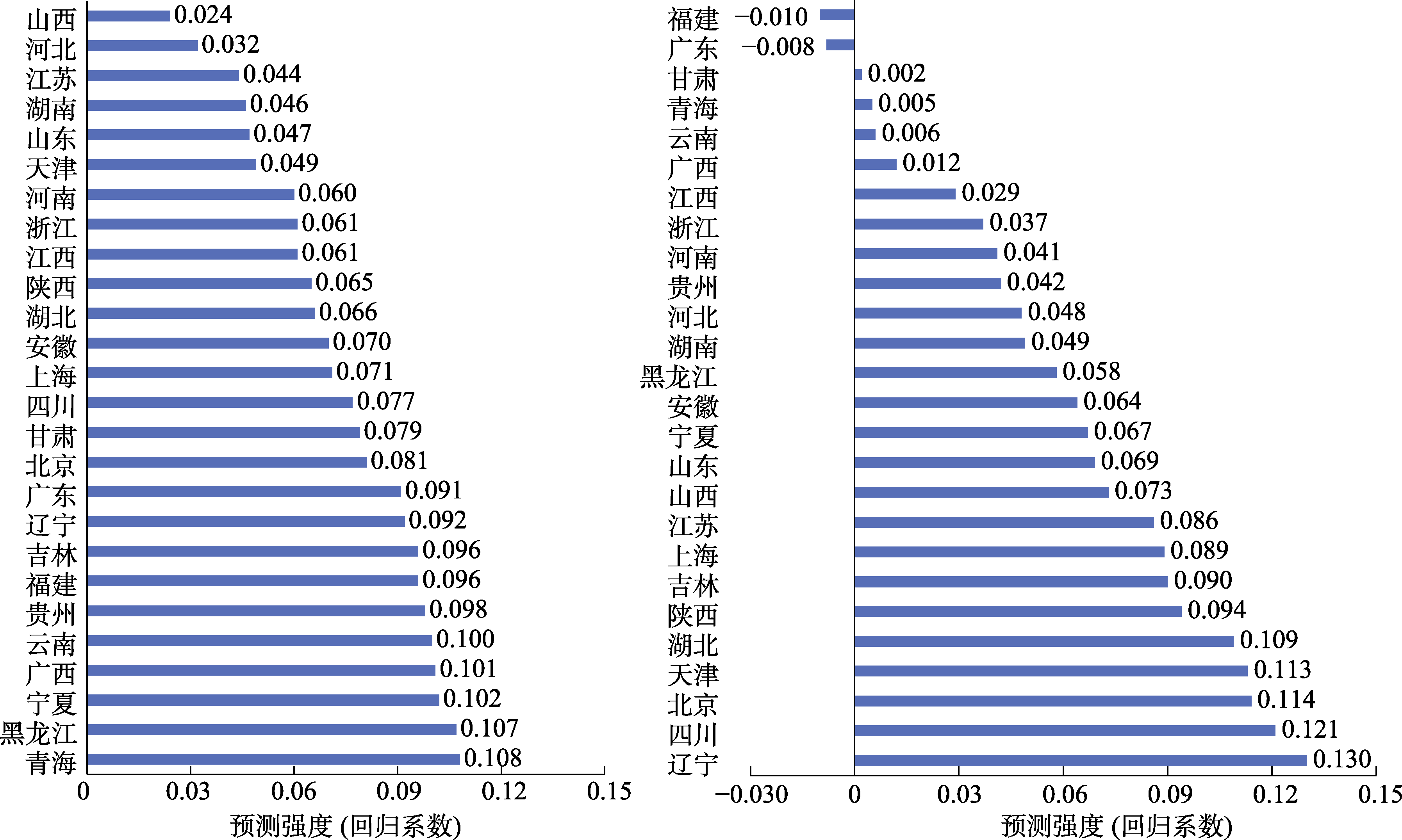
图S2.3 中国不同省份现代化水平对个体主义重选择(左)和轻选择(右)的预测强度结果
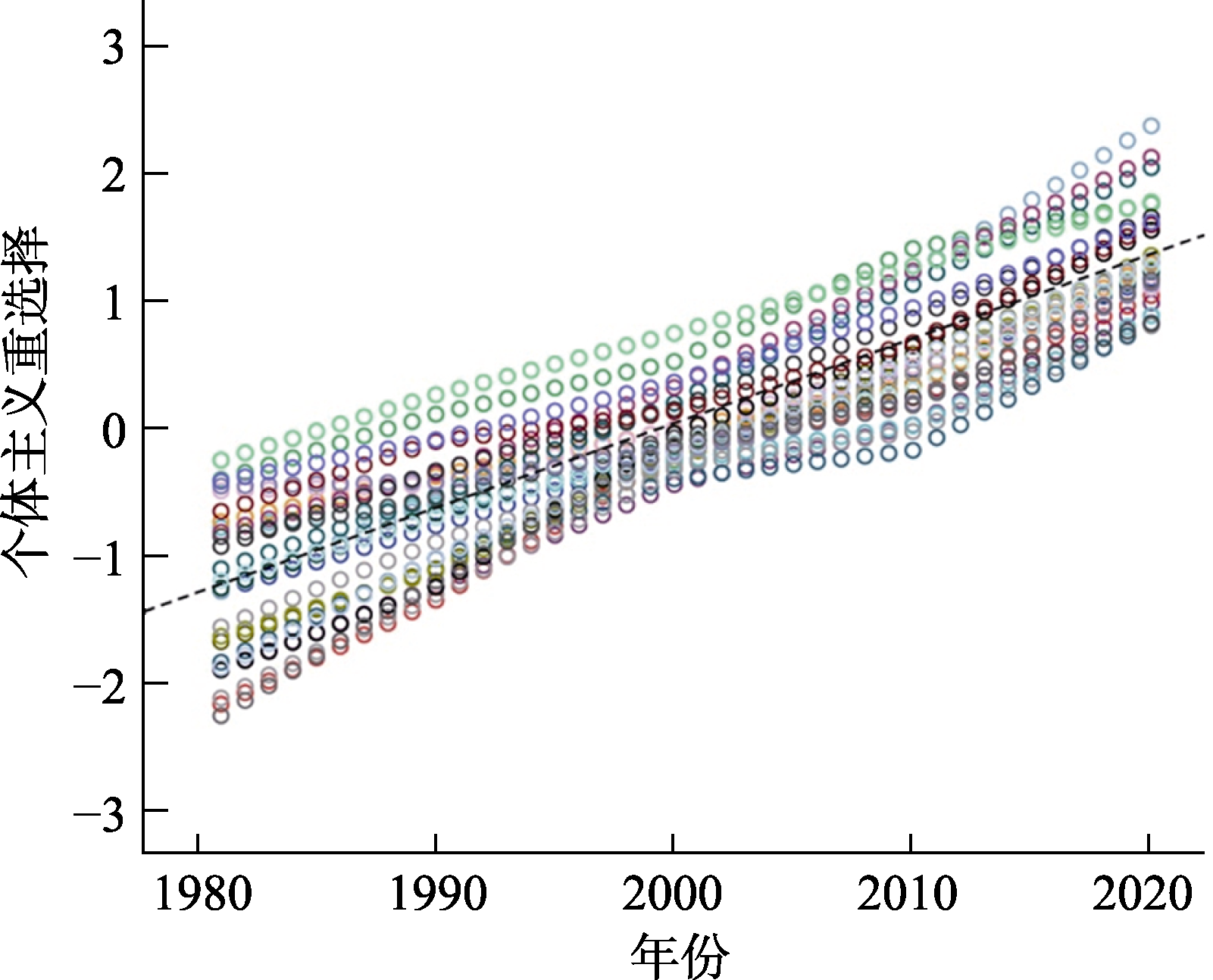
图S3 中国省级层面个体主义重选择在1981至2020年间的变化趋势。圆圈代表各省份在对应年度的个体主义重选择综合指数值, 虚线代表由多水平模型拟合得出的个体主义变迁走势
| 现代化指标 | 1981~2010三十年数据 | 1981~2020四十年数据 | ||||
|---|---|---|---|---|---|---|
| b | 95%置信区间 | t | b | 95%置信区间 | t | |
| 人均GDP | 0.262*** (0.030) | [0.188, 0.336] | 8.84 | 0.175*** (0.024) | [0.124, 0.226] | 7.19 |
| 城镇化率 | 0.953*** (0.106) | [0.737, 1.168] | 9.02 | 0.899*** (0.073) | [0.750, 1.047] | 12.36 |
| 高等教育人口比例 | 0.855*** (0.073) | [0.705, 1.006] | 11.70 | 0.429*** (0.026) | [0.376, 0.483] | 16.41 |
| 文盲率 | −0.472*** (0.045) | [−0.566, −0.378] | −10.47 | −0.449*** (0.065) | [−0.528, −0.370] | −11.97 |
| 综合指数 | 0.859*** (0.076) | [0.702, 1.015] | 11.31 | 0.796*** (0.058) | [0.676, 0.916] | 13.64 |
表S3 现代化对个体主义重选择的影响
| 现代化指标 | 1981~2010三十年数据 | 1981~2020四十年数据 | ||||
|---|---|---|---|---|---|---|
| b | 95%置信区间 | t | b | 95%置信区间 | t | |
| 人均GDP | 0.262*** (0.030) | [0.188, 0.336] | 8.84 | 0.175*** (0.024) | [0.124, 0.226] | 7.19 |
| 城镇化率 | 0.953*** (0.106) | [0.737, 1.168] | 9.02 | 0.899*** (0.073) | [0.750, 1.047] | 12.36 |
| 高等教育人口比例 | 0.855*** (0.073) | [0.705, 1.006] | 11.70 | 0.429*** (0.026) | [0.376, 0.483] | 16.41 |
| 文盲率 | −0.472*** (0.045) | [−0.566, −0.378] | −10.47 | −0.449*** (0.065) | [−0.528, −0.370] | −11.97 |
| 综合指数 | 0.859*** (0.076) | [0.702, 1.015] | 11.31 | 0.796*** (0.058) | [0.676, 0.916] | 13.64 |
| 个体主义重选择单项指标 | |||||||||
|---|---|---|---|---|---|---|---|---|---|
| 独居率 | 离婚率 | 家庭规模 | 大家庭比例 | ||||||
| b | t | b | t | b | t | b | t | ||
| 现代化综合指数 | 3.248*** (0.272) [2.693, 3.804] | 11.96 | 0.004*** (0.001) [0.003, 0.005] | 7.34 | −0.498*** (0.044) [−0.589, −0.407] | −11.21 | −2.092*** (0.327) [−2.762, −1.421] | −6.40 | |
表S4.1 现代化对个体主义重选择(单项指标)的影响
| 个体主义重选择单项指标 | |||||||||
|---|---|---|---|---|---|---|---|---|---|
| 独居率 | 离婚率 | 家庭规模 | 大家庭比例 | ||||||
| b | t | b | t | b | t | b | t | ||
| 现代化综合指数 | 3.248*** (0.272) [2.693, 3.804] | 11.96 | 0.004*** (0.001) [0.003, 0.005] | 7.34 | −0.498*** (0.044) [−0.589, −0.407] | −11.21 | −2.092*** (0.327) [−2.762, −1.421] | −6.40 | |
| 个体主义轻选择单项指标 | ||||
|---|---|---|---|---|
| 重名率前 10 位的男婴名字总占比 | 重名率前 10 位的女婴名字总占比 | |||
| b | t | b | t | |
| 现代化综合指数 | 0.632* (0.245)[−1.183, −0.207] | −2.58 | −0.752*** (0.185)[−1.115, −0.389] | −4.07 |
表S4.2 现代化对个体主义轻选择(单项指标)的影响
| 个体主义轻选择单项指标 | ||||
|---|---|---|---|---|
| 重名率前 10 位的男婴名字总占比 | 重名率前 10 位的女婴名字总占比 | |||
| b | t | b | t | |
| 现代化综合指数 | 0.632* (0.245)[−1.183, −0.207] | −2.58 | −0.752*** (0.185)[−1.115, −0.389] | −4.07 |
| [1] | Aho, K. (2024, August 21st). Existentialism.In E. N. Zalta & U. Nodelman (Eds.), The Stanford encyclopedia of philosophy. https://plato.stanford.edu/archives/sum2023/entries/existentialism/ |
| [2] | Bao H.-W.-S., Cai H., & Huang Z. (2022). Discerning cultural shifts in China? Commentary on Hamamura et al. (2021) . American Psychologist, 77(6), 786-788. |
| [3] | Bao H.-W.-S., Cai H., Jing Y., & Wang J. (2021). Novel evidence for the increasing prevalence of unique names in China: A reply to Ogihara. Frontiers in Psychology, 12, Article 731244. |
| [4] |
Berger J., Bradlow E. T., Braunstein A., & Zhang Y. (2012). From Karen to Katie: Using baby names to understand cultural evolution. Psychological Science, 23(10), 1067-1073.
doi: 10.1177/0956797612443371 pmid: 22983760 |
| [5] |
Bianchi E. C. (2016). American individualism rises and falls with the economy: Cross-temporal evidence that individualism declines when the economy falters. Journal of Personality and Social Psychology, 111(4), 567-584.
doi: 10.1037/pspp0000114 pmid: 27668894 |
| [6] |
Bianchi E. C. (2020). How the economy shapes the way we think about ourselves and others. Current Opinion in Psychology, 32, 120-123.
doi: S2352-250X(19)30078-8 pmid: 31454724 |
| [7] | Boyd R., Richerson P. J., & Henrich J. (2011). The cultural niche: Why social learning is essential for human adaptation. Proceedings of the National Academy of Sciences, 108(2), 10918-10925. |
| [8] |
Cai H., Huang Z., Lin L., Zhang M., Wang X., Zhu H.,... Jing Y. (2020). The psychological change of the Chinese people over the past half century: A literature review. Advances in Psychological Science, 28(10), 1599-1688.
doi: 10.3724/SP.J.1042.2020.01599 |
|
[蔡华俭, 黄梓航, 林莉, 张明杨, 王潇欧, 朱慧珺,... 敬一鸣. (2020). 半个多世纪来中国人的心理与行为变化——心理学视野下的研究. 心理科学进展, 28(10), 1599-1688.]
doi: 10.3724/SP.J.1042.2020.01599 |
|
| [9] | Cai H., Zhang M., Bao H. -W. -S., Zhu H., Yang Z., Cheng X., … Wang Z. (2023). Examining societal change from the perspective of psychology: Research design and analytic techniques. Advances in Psychological Science, 31(1), 159-172. |
| [蔡华俭, 张明杨, 包寒吴霜, 朱慧珺, 杨紫嫣, 程曦, …王梓西. (2023). 心理学视野下的社会变迁研究: 研究设计与分析方法. 心理科学进展, 31(1), 159-172.] | |
| [10] | Cai H., Zou X., Feng Y., Liu Y., & Jing Y. (2018). Increasing need for uniqueness in contemporary China: Empirical evidence. Frontiers in Psychology, 9, Article 554. |
| [11] | Camilleri A. R. (2023). An investigation of big life decisions. Judgment and Decision Making, 18, e32. |
| [12] | Chang R. (2017). Hard choices. Journal of the American Philosophical Association, 3(1), 1-21. |
| [13] | Chen F. F., & West S. G. (2008). Measuring individualism and collectivism: The importance of considering differential components, reference groups, and measurement invariance. Journal of Research in Personality, 42(2), 259-294. |
| [14] |
Fincher C. L., & Thornhill R. (2012). The parasite-stress theory may be a general theory of culture and sociality. Behavioral and Brain Sciences, 35(2), 99-119.
pmid: 22486004 |
| [15] |
Greenfield P. M. (2009). Linking social change and developmental change: Shifting pathways of human development. Developmental Psychology, 45(2), 401-418.
doi: 10.1037/a0014726 pmid: 19271827 |
| [16] |
Greenfield P. M. (2016). Social change, cultural evolution, and human development. Current Opinion in Psychology, 8, 84-92.
doi: S2352-250X(15)00258-4 pmid: 29506809 |
| [17] | Greenfield P. M., & Quiroz B. (2013). Context and culture in the socialization and development of personal achievement values: Comparing Latino immigrant families, European American families, and elementary school teachers. Journal of Applied Developmental Psychology, 34(2), 108-118. |
| [18] |
Grossmann I., & Varnum M. E. W. (2015). Social structure, infectious diseases, disasters, secularism, and cultural change in America. Psychological Science, 26(3), 311-324.
doi: 10.1177/0956797614563765 pmid: 25656275 |
| [19] |
Hamamura T. (2012). Are cultures becoming individualistic? A cross-temporal comparison of individualism-collectivism in the United States and Japan. Personality and Social Psychology Review, 16(1), 3-24.
doi: 10.1177/1088868311411587 pmid: 21700795 |
| [20] |
Hamamura T., Chen Z., Chan C. S., Chen S. X., & Kobayashi T. (2021). Individualism with Chinese characteristics? Discerning cultural shifts in China using 50 years of printed texts. American Psychologist, 76(6), 888-903.
doi: 10.1037/amp0000840 pmid: 34914428 |
| [21] | Hamamura T., & Xu Y. (2015). Changes in Chinese culture as examined through changes in personal pronoun usage. Journal of Cross-Cultural Psychology, 46(7), 930-941. |
| [22] | Hechter M., & Kanazawa S. (1997). Sociological rational choice theory. Annual Review of Sociology, 23(1), 191-214. |
| [23] | Hofstede G. (1980). Culture’s consequences: International differences in work-related values. Beverly Hills, CA: SAGE Publications. |
| [24] | Hofstede G., Hofstede G. J., & Minkov M. (2010). Cultures and organizations: Software of the mind (3rd ed.). New York, NY: McGrawHill. |
| [25] | Hox J. (2002). Multilevel analysis: Techniques and application. Mahwah, NJ: Erlbaum. |
| [26] | Huang Z., Wang J., Su Z., Jing Y., & Cai H. (2021). Cultural and psychological changes during the social transformation in China: Sociological research and its enlightenments to psychologists. Advances in Psychological Science, 29(12), 2246-2259. |
|
[黄梓航, 王俊秀, 苏展, 敬一鸣, 蔡华俭. (2021). 中国社会转型过程中的心理变化: 社会学视角的研究及其对心理学家的启示. 心理科学进展, 29(12), 2246-2259.]
doi: 10.3724/SP.J.1042.2021.02246 |
|
| [27] | Inglehart R., & Baker W. E. (2000). Modernization, cultural change, and the persistence of traditional values. American Sociological Review, 65(1), 19-51. |
| [28] |
Kashima Y., Kokubo T., Kashima E. S., Boxall D., Yamaguchi S., & Macrae K. (2004). Culture and self: Are there within-culture differences in self between metropolitan areas and regional cities? Personality and Social Psychology Bulletin, 30(7), 816-823.
pmid: 15200690 |
| [29] |
Kraus M. W., Piff P. K., Mendoza-Denton R., Rheinschmidt M. L., & Keltner D. (2012). Social class, solipsism, and contextualism: How the rich are different from the poor. Psychological Review, 119(3), 546-572.
doi: 10.1037/a0028756 pmid: 22775498 |
| [30] | LeFebvre R., & Franke V. (2013). Culture matters: Individualism vs. collectivism in conflict decision-making. Societies, 3(1), 128-146. |
| [31] | Liu L., Zhu T., & Ren X. (2020). The generational change of collectivism/individualism of Chinese 1949-2010: Evidence from People’s Daily. Chinese Journal of Clinical Psychology, 28(3), 542-549. |
| [刘琳琳, 朱廷劭, 任孝鹏. (2020). 个体主义/集体主义的代际变迁1949-2010: 来自《人民日报》的证据. 中国临床心理学杂志, 28(3), 542-549.] | |
| [32] | Markus H. R., & Kitayama S. (1991). Culture and the self: Implications for cognition, emotion, and motivation. Psychological Review, 98(2), 224-253. |
| [33] | Morales J. F., Gaviria E., Molero F. Arias A., & Páez D. (2000). Individualism: One or many? Psicothema, 12(Supl.), 33-44. |
| [34] | Ogihara Y. (2017). Temporal changes in individualism and their ramification in Japan: Rising individualism and conflicts with persisting collectivism. Frontiers in Psychology, 8, Article 695. |
| [35] |
Oyserman D., Coon H. M., & Kemmelmeier M. (2002). Rethinking individualism and collectivism: Evaluation of theoretical assumptions and meta-analyses. Psychological Bulletin, 128(1), 3-72.
pmid: 11843547 |
| [36] | Ren X., Yu J., Wan L., Li J., Zhang Z., & Li C. (2024). Provincial variations of “Zhaodi” and its clan cultural roots. Psychology: Techniques and Application, 12(3), 129-136. |
| [任孝鹏, 余俊霏, 万路明, 李江玥, 张子言, 李婵娟. (2024). “招娣/弟”命名偏好的省际差异及宗族文化的影响. 心理技术与应用, 12(3), 129-136.] | |
| [37] |
Santos H. C., Varnum M. E. W., & Grossmann I. (2017). Global increases in individualism. Psychological Science, 28(9), 1228-1239.
doi: 10.1177/0956797617700622 pmid: 28703638 |
| [38] | Sartre J. P. (1972). The psychology of the imagination. London, UK: Routledge. |
| [39] |
Su H., & Ren X. (2015). Psychological impact of first names: Individual level and group level evidence. Advances in Psychological Science, 23(5), 879-887.
doi: 10.3724/SP.J.1042.2015.00879 |
|
[苏红, 任孝鹏. (2015). 名字的心理效应:来自个体层面和群体层面的证据. 心理科学进展, 23(5), 879-887.]
doi: 10.3724/SP.J.1042.2015.00879 |
|
| [40] | Su H., Ren X., Lu K., & Zhang H. (2016). The evolution of given names and times change. Youth Studies, (3), 31-38. |
| [苏红, 任孝鹏, 陆柯雯, 张慧. (2016). 人名演变与时代变迁. 青年研究, (3), 31-38.] | |
| [41] | Triandis H. C., & Gelfand M. J. (1998). Converging measurement of horizontal and vertical individualism and collectivism. Journal of Personality and Social Psychology, 74(1), 118-128. |
| [42] | Twenge J. M., Abebe E. M., & Campbell W. K. (2010). Fitting in or standing out: Trends in American parents’ choices for children’s names, 1880-2007. Social Psychological and Personality Science, 1(1), 19-25. |
| [43] | Twenge J. M., Campbell W. K., & Gentile B. (2013). Changes in pronoun use in American books and the rise of individualism, 1960-2008. Journal of Cross-Cultural Psychology, 44(3), 406-415. |
| [44] | Ullmann-Margalit E. (2006). Big decisions: Opting, converting, drifting. Royal Institute of Philosophy Supplement, 81(58), 157-172. |
| [45] |
Varnum M. E. W., & Grossmann I. (2017). Cultural change: The how and the why. Perspectives on Psychological Science, 12(6), 956-972.
doi: 10.1177/1745691617699971 pmid: 28915361 |
| [46] | Varnum M. E. W., Grossmann I., Kitayama S., & Nisbett R. E. (2010). The origin of cultural differences in cognition: The social orientation hypothesis. Current Directions in Psychological Science, 19(1), 9-13. |
| [47] | Weiss, J. W., Weiss D. J., & Edwards W. (2009). Big decisions, little decisions:The hierarchy of everyday life. In J. W. Weiss & D. J. Weiss (Eds.), A science of decision making: The legacy of Ward Edwards (pp. 451-460). Oxford, UK: Oxford University Press. |
| [48] | Wu M. S., Wang W., & Peng K. (2024). More utilitarian, less rational? Social change and two types of individualism over the last 40 years in China. Acta Psychologica Sinica, 56(7), 911-925. |
|
[吴胜涛, 王予灵, 彭凯平. (2024). 理性式微、功利扩张?近40年中国社会两种个人主义的变迁. 心理学报, 56(7), 911-925.]
doi: 10.3724/SP.J.1041.2024.00911 |
|
| [49] |
Yan Y. (2010). The Chinese path to individualization. The British Journal of Sociology, 61(3), 489-512.
doi: 10.1111/j.1468-4446.2010.01323.x pmid: 20840429 |
| [50] | Yates, J. F., Veinott E., & Patalano A. L. (2003). Hard decisions, bad decisions:On decision quality and decision aiding. In S. L.Schneider & J.Shanteau (Eds.), Emerging perspectives on judgment and decision research (pp. 13-63). Cambridge, UK: Cambridge University Press. |
| [51] | Yu F., Peng T., Peng K., Tang S., Chen C. S., Qian X.,... Chai F. (2016). Cultural value shifting in pronoun use. Journal of Cross-Cultural Psychology, 47(2), 310-316. |
| [52] |
Zeng R., & Greenfield P. M. (2015). Cultural evolution over the last 40 years in China: Using the Google Ngram Viewer to study implications of social and political change for cultural values. International Journal of Psychology, 50(1), 47-55.
doi: 10.1002/ijop.12125 pmid: 25611928 |
| [1] | 张明杨, 杨盈, 包寒吴霜, 蔡华俭. 中国人的积极理想情绪:近几十年来的变迁[J]. 心理学报, 2024, 56(7): 847-858. |
| [2] | 叶浩生. 西方心理学发展中的若干倾向之我见[J]. 心理学报, 1998, 30(2): 204-210. |
| 阅读次数 | ||||||
|
全文 |
|
|||||
|
摘要 |
|
|||||
