

ISSN 0439-755X
CN 11-1911/B
主办:中国心理学会
中国科学院心理研究所
出版:科学出版社
CN 11-1911/B
主办:中国心理学会
中国科学院心理研究所
出版:科学出版社
心理学报 ›› 2025, Vol. 57 ›› Issue (8): 1482-1498.doi: 10.3724/SP.J.1041.2025.1482 cstr: 32110.14.2025.1482
• 研究报告 • 上一篇
张一杰, 郑晓明( )
)
收稿日期:2024-04-07
发布日期:2025-05-22
出版日期:2025-08-25
通讯作者:
郑晓明, E-mail: zhengxm@sem.tsinghua.edu.cn基金资助:
ZHANG Yijie, ZHENG Xiaoming()
Received:2024-04-07
Online:2025-05-22
Published:2025-08-25
摘要:
在当今充满不确定性的时代, 危机已成为常态。在此背景下, 员工主动行为在组织转危为安甚至化危为机的过程中扮演着关键角色。尽管危机事件为激发员工主动行为提供了潜在机会, 但组织在危机中也常常面临员工缺乏主动性的困境。基于此, 本研究整合了威胁−刚性与威胁−弹性假设, 探讨了危机事件强度对员工主动行为的双刃剑效应以及危机领导力在其中的调节作用。一项实地问卷调查和一项情境实验发现:当危机领导力较高时, 危机事件强度会通过增强员工认知灵活性来激发其主动行为; 而当危机领导力较低时, 危机事件强度则会通过引发员工情绪耗竭、限制认知灵活性来抑制其主动行为。本研究从危机领导力视角关注危机事件强度对员工主动行为的影响, 为危机管理研究提供了新的视角。
中图分类号:
张一杰, 郑晓明. (2025). 危机事件强度对员工主动行为的双刃剑效应:危机领导力的调节作用. 心理学报, 57(8), 1482-1498.
ZHANG Yijie, ZHENG Xiaoming. (2025). The double-edged sword effect of crisis event strengths on employee proactivity: The moderating role of crisis leadership. Acta Psychologica Sinica, 57(8), 1482-1498.
| 模型 | χ2 | df | CFI | TLI | RMSEA | SRMRwithin | SRMRbetween |
|---|---|---|---|---|---|---|---|
| 五因子模型 | 355.68 | 250 | 0.97 | 0.96 | 0.05 | 0.06 | 0.19 |
| 四因子模型1 | 591.89 | 258 | 0.90 | 0.88 | 0.08 | 0.13 | 0.40 |
| 四因子模型2 | 825.39 | 258 | 0.84 | 0.81 | 0.11 | 0.13 | 0.43 |
| 三因子模型 | 1728.19 | 264 | 0.58 | 0.52 | 0.18 | 0.17 | 0.30 |
| 二因子模型 | 1947.37 | 268 | 0.52 | 0.46 | 0.19 | 0.20 | 0.40 |
表1 验证性因子分析结果(研究1)
| 模型 | χ2 | df | CFI | TLI | RMSEA | SRMRwithin | SRMRbetween |
|---|---|---|---|---|---|---|---|
| 五因子模型 | 355.68 | 250 | 0.97 | 0.96 | 0.05 | 0.06 | 0.19 |
| 四因子模型1 | 591.89 | 258 | 0.90 | 0.88 | 0.08 | 0.13 | 0.40 |
| 四因子模型2 | 825.39 | 258 | 0.84 | 0.81 | 0.11 | 0.13 | 0.43 |
| 三因子模型 | 1728.19 | 264 | 0.58 | 0.52 | 0.18 | 0.17 | 0.30 |
| 二因子模型 | 1947.37 | 268 | 0.52 | 0.46 | 0.19 | 0.20 | 0.40 |
| 变量 | M | SD | 1 | 2 | 3 | 4 | 5 | 6 | 7 |
|---|---|---|---|---|---|---|---|---|---|
| 团队层变量(N = 80) | |||||||||
| 1. 危机客观强度(时点1) | 455.39 | 763.20 | |||||||
| 2. 危机客观强度(时点2) | 6646.69 | 17385.22 | 0.93** | ||||||
| 3. 危机客观强度(时点3) | 618.41 | 1311.94 | 0.91** | 0.96** | |||||
| 4. 团队规模 | 4.25 | 1.25 | 0.24* | 0.22* | 0.22* | ||||
| 5. 领导性别 | 0.23 | 0.42 | 0.13 | 0.06 | 0.08 | 0.06 | |||
| 6. 领导年龄 | 34.21 | 4.67 | 0.12 | 0.09 | 0.10 | −0.08 | −0.10 | ||
| 7. 危机领导力 | 5.75 | 0.92 | −0.04 | −0.03 | −0.12 | 0.08 | 0.01 | 0.03 | |
| 个体层变量(N = 340) | |||||||||
| 1. 员工性别 | 0.19 | 0.39 | |||||||
| 2. 员工学历 | 3.01 | 0.59 | −0.09 | ||||||
| 3. 员工年龄 | 29.94 | 3.91 | −0.03 | 0.19** | |||||
| 4. 员工工龄 | 3.39 | 2.69 | −0.06 | 0.00 | 0.41** | ||||
| 5. 危机事件强度 | 5.35 | 0.78 | 0.08 | 0.03 | 0.00 | 0.04 | |||
| 6. 情绪耗竭 | 2.75 | 1.20 | −0.01 | −0.05 | −0.07 | −0.02 | 0.06 | ||
| 7. 认知灵活性 | 5.19 | 0.71 | −0.06 | 0.12* | 0.10 | 0.08 | 0.14** | −0.44** | |
| 8. 员工主动行为 | 4.70 | 1.24 | 0.11* | 0.04 | 0.00 | −0.01 | 0.11* | −0.26** | 0.30** |
表2 变量的均值、标准差和相关系数(研究1)
| 变量 | M | SD | 1 | 2 | 3 | 4 | 5 | 6 | 7 |
|---|---|---|---|---|---|---|---|---|---|
| 团队层变量(N = 80) | |||||||||
| 1. 危机客观强度(时点1) | 455.39 | 763.20 | |||||||
| 2. 危机客观强度(时点2) | 6646.69 | 17385.22 | 0.93** | ||||||
| 3. 危机客观强度(时点3) | 618.41 | 1311.94 | 0.91** | 0.96** | |||||
| 4. 团队规模 | 4.25 | 1.25 | 0.24* | 0.22* | 0.22* | ||||
| 5. 领导性别 | 0.23 | 0.42 | 0.13 | 0.06 | 0.08 | 0.06 | |||
| 6. 领导年龄 | 34.21 | 4.67 | 0.12 | 0.09 | 0.10 | −0.08 | −0.10 | ||
| 7. 危机领导力 | 5.75 | 0.92 | −0.04 | −0.03 | −0.12 | 0.08 | 0.01 | 0.03 | |
| 个体层变量(N = 340) | |||||||||
| 1. 员工性别 | 0.19 | 0.39 | |||||||
| 2. 员工学历 | 3.01 | 0.59 | −0.09 | ||||||
| 3. 员工年龄 | 29.94 | 3.91 | −0.03 | 0.19** | |||||
| 4. 员工工龄 | 3.39 | 2.69 | −0.06 | 0.00 | 0.41** | ||||
| 5. 危机事件强度 | 5.35 | 0.78 | 0.08 | 0.03 | 0.00 | 0.04 | |||
| 6. 情绪耗竭 | 2.75 | 1.20 | −0.01 | −0.05 | −0.07 | −0.02 | 0.06 | ||
| 7. 认知灵活性 | 5.19 | 0.71 | −0.06 | 0.12* | 0.10 | 0.08 | 0.14** | −0.44** | |
| 8. 员工主动行为 | 4.70 | 1.24 | 0.11* | 0.04 | 0.00 | −0.01 | 0.11* | −0.26** | 0.30** |
| 变量 | 情绪耗竭 | 认知灵活性 | 员工主动行为 |
|---|---|---|---|
| 团队层变量 | |||
| 危机客观强度(时点1) | 0.14(0.16) | −0.10(0.08) | −0.25*(0.12) |
| 危机客观强度(时点2) | −0.11(0.12) | 0.09(0.09) | 0.24(0.15) |
| 危机客观强度(时点3) | 0.02(0.10) | −0.07(0.08) | −0.16(0.16) |
| 团队规模 | −0.04(0.05) | 0.01(0.03) | −0.00(0.07) |
| 领导性别 | −0.04(0.16) | 0.02(0.11) | 0.14(0.20) |
| 领导年龄 | 0.00(0.10) | −0.00(0.01) | −0.01(0.01) |
| 危机领导力 | −0.15(0.08) | 0.12*(0.05) | |
| 个体层变量 | |||
| 员工性别 | −0.09(0.16) | −0.04(0.09) | 0.30(0.16) |
| 员工学历 | 0.09(0.09) | 0.00(0.07) | −0.04(0.10) |
| 员工年龄 | −0.01(0.02) | 0.00(0.01) | −0.01(0.01) |
| 员工工龄 | 0.00(0.02) | 0.01(0.01) | −0.01(0.02) |
| 危机事件强度 | 0.25*(0.10) | 0.03(0.05) | 0.05(0.09) |
| 情绪耗竭 | −0.15**(0.05) | ||
| 认知灵活性 | 0.30*(0.12) | ||
| 跨层交互项 | |||
| 危机事件强度× 危机领导力 | −0.46**(0.10) | 0.32**(0.07) | |
| Pseudo R2 | 0.08 | 0.10 | 0.09 |
表3 多层次路径分析结果(研究1)
| 变量 | 情绪耗竭 | 认知灵活性 | 员工主动行为 |
|---|---|---|---|
| 团队层变量 | |||
| 危机客观强度(时点1) | 0.14(0.16) | −0.10(0.08) | −0.25*(0.12) |
| 危机客观强度(时点2) | −0.11(0.12) | 0.09(0.09) | 0.24(0.15) |
| 危机客观强度(时点3) | 0.02(0.10) | −0.07(0.08) | −0.16(0.16) |
| 团队规模 | −0.04(0.05) | 0.01(0.03) | −0.00(0.07) |
| 领导性别 | −0.04(0.16) | 0.02(0.11) | 0.14(0.20) |
| 领导年龄 | 0.00(0.10) | −0.00(0.01) | −0.01(0.01) |
| 危机领导力 | −0.15(0.08) | 0.12*(0.05) | |
| 个体层变量 | |||
| 员工性别 | −0.09(0.16) | −0.04(0.09) | 0.30(0.16) |
| 员工学历 | 0.09(0.09) | 0.00(0.07) | −0.04(0.10) |
| 员工年龄 | −0.01(0.02) | 0.00(0.01) | −0.01(0.01) |
| 员工工龄 | 0.00(0.02) | 0.01(0.01) | −0.01(0.02) |
| 危机事件强度 | 0.25*(0.10) | 0.03(0.05) | 0.05(0.09) |
| 情绪耗竭 | −0.15**(0.05) | ||
| 认知灵活性 | 0.30*(0.12) | ||
| 跨层交互项 | |||
| 危机事件强度× 危机领导力 | −0.46**(0.10) | 0.32**(0.07) | |
| Pseudo R2 | 0.08 | 0.10 | 0.09 |
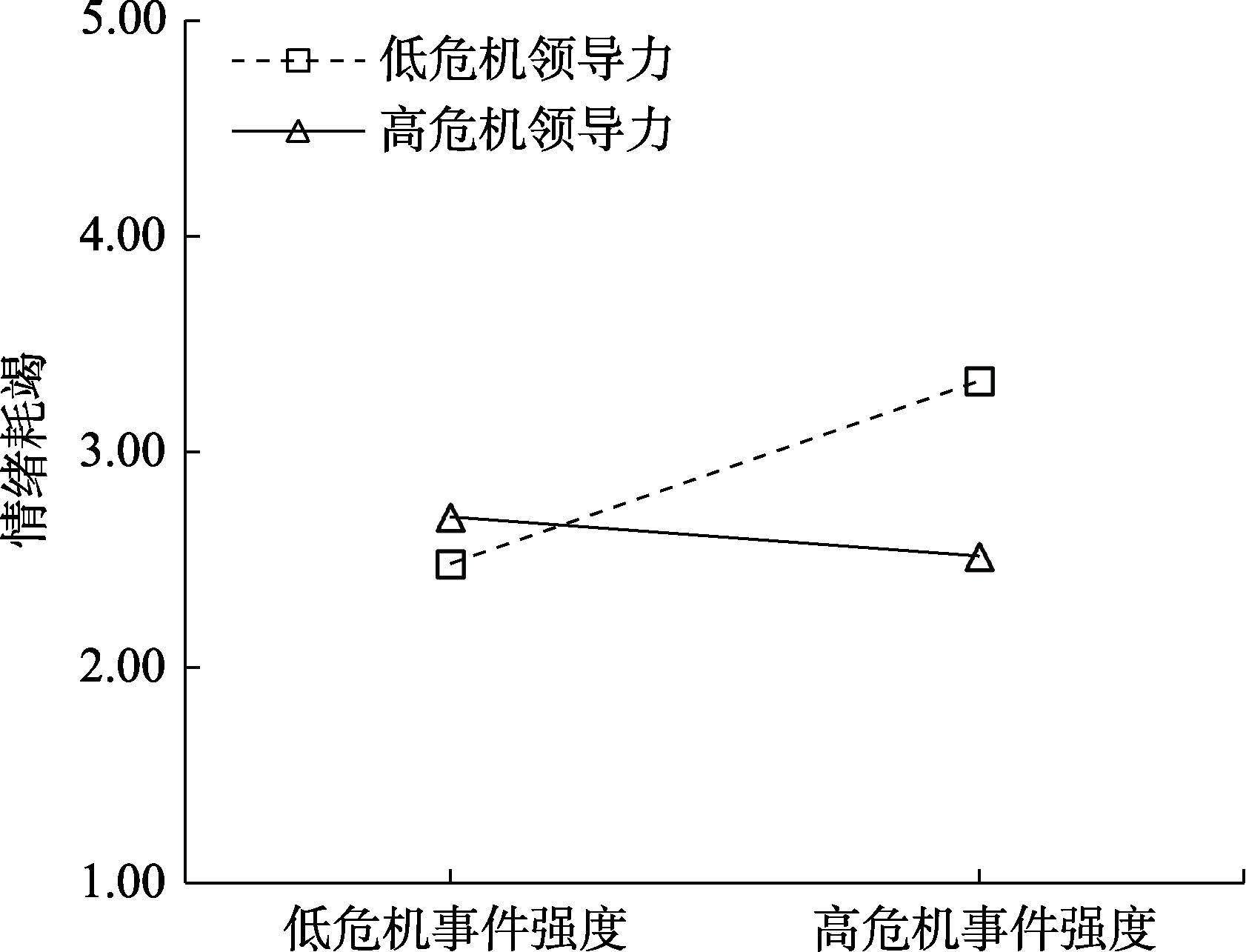
图1 危机领导力对危机事件强度与情绪耗竭关系的调节效应(研究1)
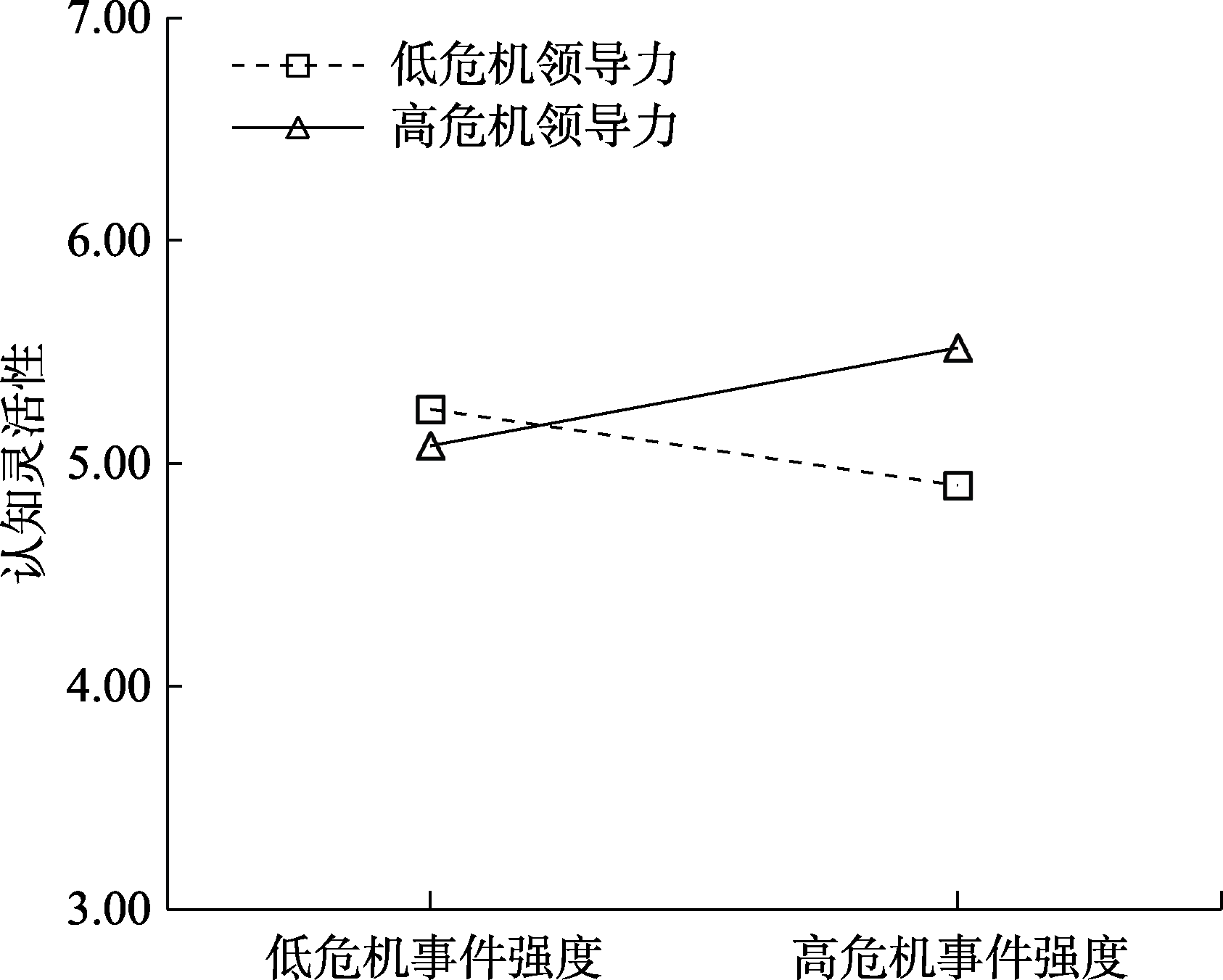
图2 危机领导力对危机事件强度与认知灵活性关系的调节效应(研究1)
| 调节变量 | 危机事件强度→情绪耗竭→员工主动行为 | 危机事件强度→认知灵活性→员工主动行为 | ||
|---|---|---|---|---|
| 间接效应 | 95%置信区间 | 间接效应 | 95%置信区间 | |
| 低危机领导力(−1 SD) | −0.102 | [−0.204, −0.022] | −0.081 | [−0.199, −0.007] |
| 高危机领导力(+1 SD) | 0.026 | [−0.015, 0.075] | 0.103 | [0.013, 0.237] |
| 组间差异 | 0.128 | [0.003, 0.249] | 0.184 | [0.026, 0.411] |
表4 有调节的中介效应分析结果(研究1)
| 调节变量 | 危机事件强度→情绪耗竭→员工主动行为 | 危机事件强度→认知灵活性→员工主动行为 | ||
|---|---|---|---|---|
| 间接效应 | 95%置信区间 | 间接效应 | 95%置信区间 | |
| 低危机领导力(−1 SD) | −0.102 | [−0.204, −0.022] | −0.081 | [−0.199, −0.007] |
| 高危机领导力(+1 SD) | 0.026 | [−0.015, 0.075] | 0.103 | [0.013, 0.237] |
| 组间差异 | 0.128 | [0.003, 0.249] | 0.184 | [0.026, 0.411] |
| 变量 | M | SD | 1 | 2 | 3 |
|---|---|---|---|---|---|
| 1. 危机事件强度操纵 | 0.50 | 0.50 | |||
| 2. 危机领导力操纵 | 0.50 | 0.50 | 0.03 | ||
| 3. 情绪耗竭 | 4.32 | 1.38 | 0.12 | −0.54** | |
| 4. 认知灵活性 | 5.23 | 0.96 | −0.01 | 0.42** | −0.27** |
表5 变量的均值、标准差和相关系数(研究2)
| 变量 | M | SD | 1 | 2 | 3 |
|---|---|---|---|---|---|
| 1. 危机事件强度操纵 | 0.50 | 0.50 | |||
| 2. 危机领导力操纵 | 0.50 | 0.50 | 0.03 | ||
| 3. 情绪耗竭 | 4.32 | 1.38 | 0.12 | −0.54** | |
| 4. 认知灵活性 | 5.23 | 0.96 | −0.01 | 0.42** | −0.27** |
| 中介变量 | 低危机事件强度组 | 高危机事件强度组 | F(1, 198) | ||||
|---|---|---|---|---|---|---|---|
| 低危机 领导力组 | 高危机 领导力组 | 低危机 领导力组 | 高危机 领导力组 | 危机事件强度 | 危机领导力 | 交互项 | |
| 情绪耗竭 | 4.70(1.21) n = 53 | 3.56(1.03) n = 49 | 5.44(0.87) n = 49 | 3.57(1.35) n = 51 | 5.49 * (η² = 0.027) | 88.32** (η² = 0.308) | 5.11* (η² = 0.025) |
| 认知灵活性 | 5.05(1.08) n = 53 | 5.44(0.81) n = 49 | 4.58(0.93) n = 49 | 5.84(0.37) n = 51 | 0.07 (η² = 0.000) | 47.99** (η² = 0.195) | 13.46** (η² = 0.064) |
表6 危机事件强度和危机领导力对情绪耗竭和认知灵活性影响的方差分析结果(研究2)
| 中介变量 | 低危机事件强度组 | 高危机事件强度组 | F(1, 198) | ||||
|---|---|---|---|---|---|---|---|
| 低危机 领导力组 | 高危机 领导力组 | 低危机 领导力组 | 高危机 领导力组 | 危机事件强度 | 危机领导力 | 交互项 | |
| 情绪耗竭 | 4.70(1.21) n = 53 | 3.56(1.03) n = 49 | 5.44(0.87) n = 49 | 3.57(1.35) n = 51 | 5.49 * (η² = 0.027) | 88.32** (η² = 0.308) | 5.11* (η² = 0.025) |
| 认知灵活性 | 5.05(1.08) n = 53 | 5.44(0.81) n = 49 | 4.58(0.93) n = 49 | 5.84(0.37) n = 51 | 0.07 (η² = 0.000) | 47.99** (η² = 0.195) | 13.46** (η² = 0.064) |
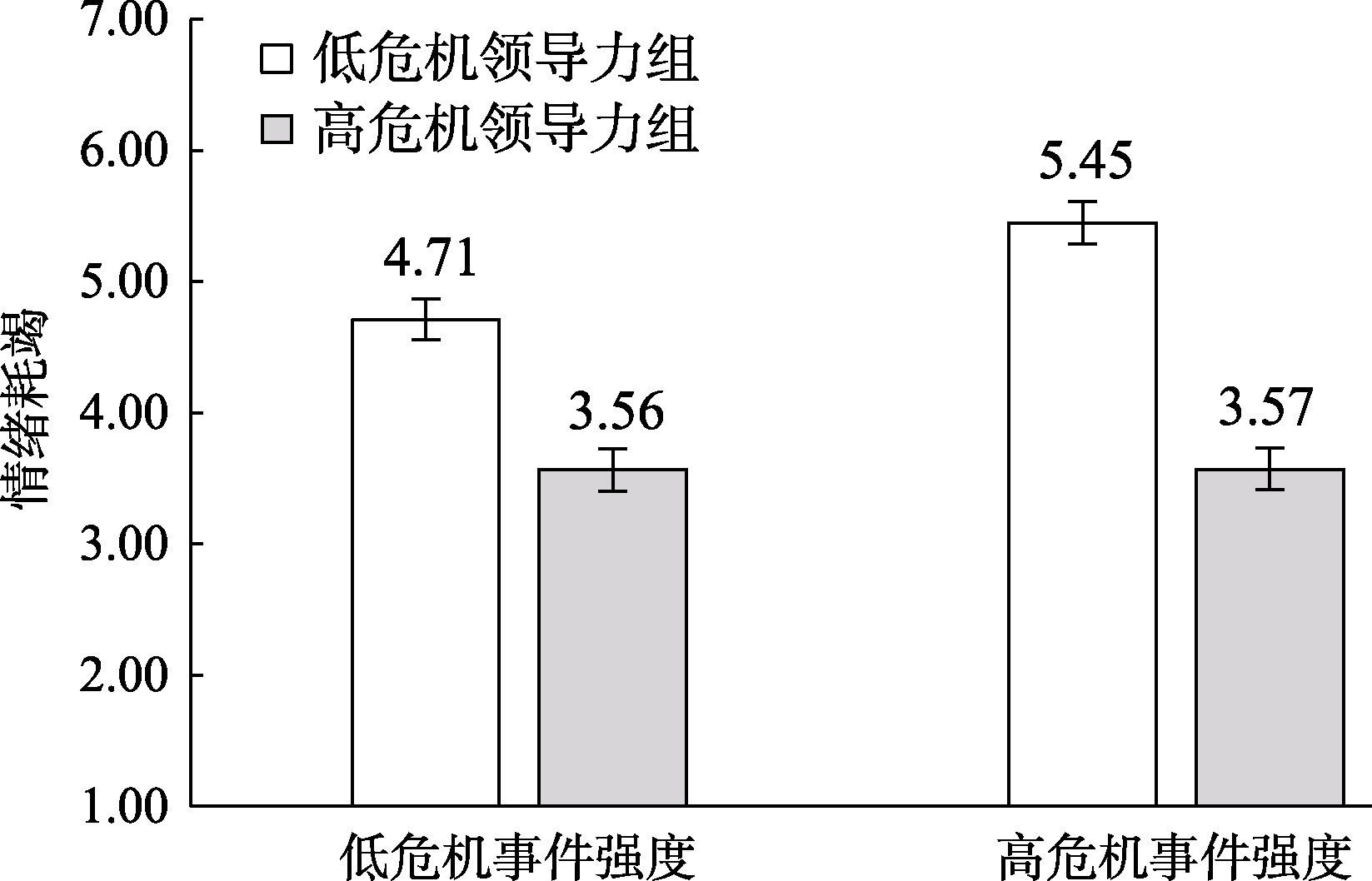
图3 危机领导力在危机事件强度与情绪耗竭间的调节作用(研究2) 注: 误差线表示标准误, 后图同。
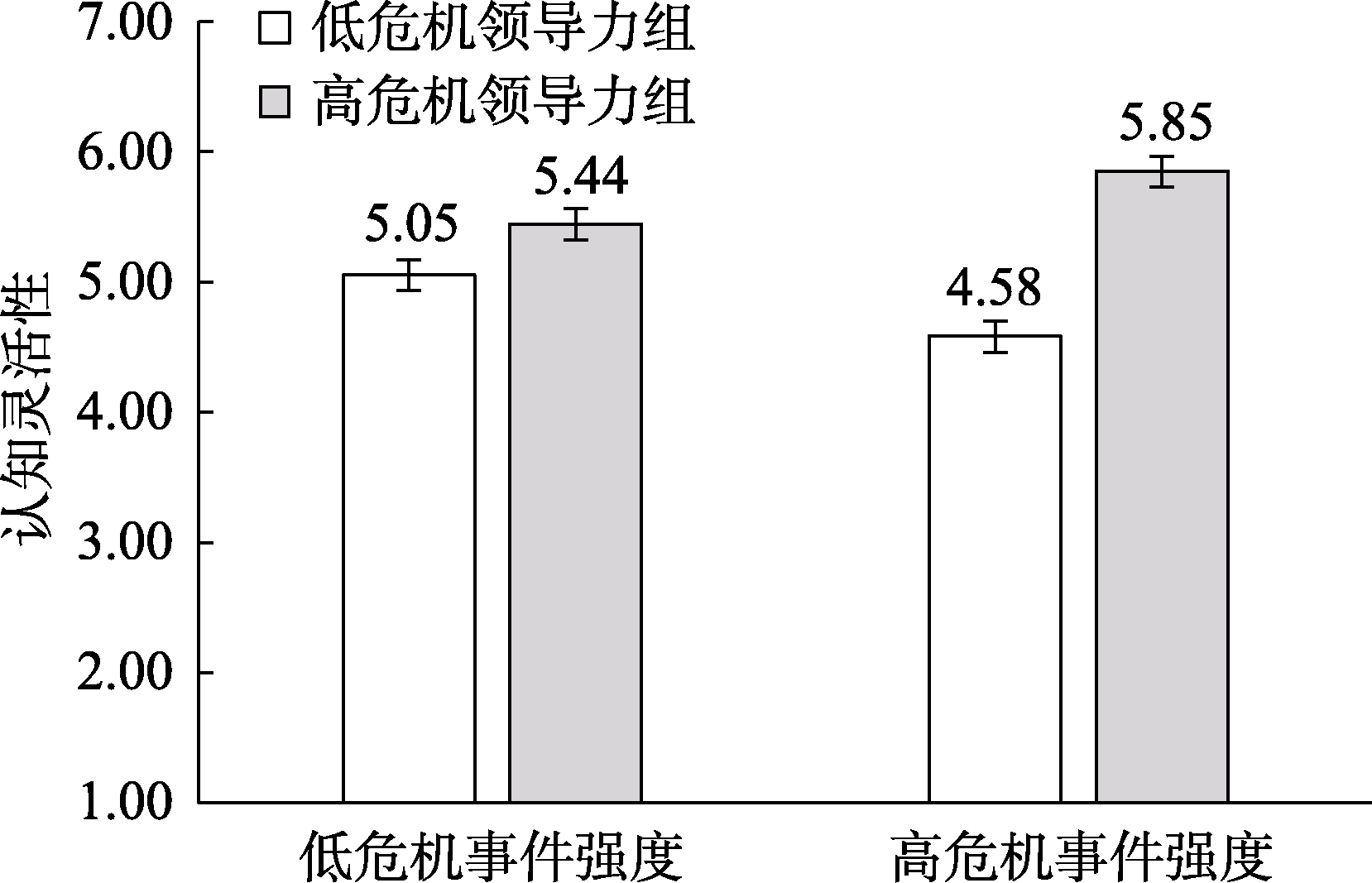
图4 危机领导力在危机事件强度与认知灵活性间的调节作用(研究2)
| [1] | Barnett C. K., & Pratt M. G. (2000). From threat-rigidity to flexibility-Toward a learning model of autogenic crisis in organizations. Journal of Organizational Change Management, 13(1), 74-88. https://doi.org/10.1108/09534810010310258 |
| [2] |
Belcastro P. A., Hays L. C., & Gold R. S. (1983). Maslach Burnout Inventory: Factor structures for samples of teachers. Psychological Reports, 53(2), 364-366. https://doi.org/10.2466/pr0.1983.53.2.364
URL pmid: 6647683 |
| [3] | Bennett N., & Lemoine J. (2014). What VUCA really means for you. Harvard Business Review, 92(1/2). https://hbr.org/2014/01/what-vuca-really-means-for-you |
| [4] | Bernerth J. B., & Aguinis H. (2016). A critical review and best-practice recommendations for control variable usage. Personnel Psychology, 69(1), 229-283. https://doi.org/10.1111/peps.12103 |
| [5] | Bindl, U. K., & Parker S. K. (2011). Proactive work behavior:Forward-thinking and change-oriented action in organizations. In S. Zedeck (Ed.), APA handbook of industrial and organizational psychology, Vol 2: Selecting and developing members for the organization. (pp. 567-598). American Psychological Association. https://doi.org/10.1037/12170-019. |
| [6] | Bliese, P. D. (2000). Within-group agreement, non- independence, and reliability:Implications for data aggregation and analysis. In K. J. Klein & S. W. J. Kozlowski (Eds.), Multilevel theory, research, and methods in organizations: Foundations, extensions, and new directions (pp. 349-381). Jossey-Bass. |
| [7] | Boswell W. R., Olson-Buchanan J. B., & LePine M. A. (2004). Relations between stress and work outcomes: The role of felt challenge, job control, and psychological strain. Journal of Vocational Behavior, 64(1), 165-181. https://doi.org/10.1016/S0001-8791(03)00049-6 |
| [8] |
Brown S. P., Westbrook R. A., & Challagalla G. (2005). Good cope, bad cope: Adaptive and maladaptive coping strategies following a critical negative work event. Journal of Applied Psychology, 90(4), 792-798. https://doi.org/10.1037/0021-9010.90.4.792
URL pmid: 16060796 |
| [9] | Bundy J., Pfarrer M. D., Short C. E., & Coombs W. T. (2017). Crises and crisis management: Integration, interpretation, and research development. Journal of Management, 43(6), 1661-1692. https://doi.org/10.1177/0149206316680030 |
| [10] | Cai Z., Parker S. K., Chen Z., & Lam W. (2019). How does the social context fuel the proactive fire? A multilevel review and theoretical synthesis. Journal of Organizational Behavior, 40(2), 209-230. https://doi.org/10.1002/job.2347 |
| [11] | Chen N., Crant J. M., Wang N., Kou Y., Qin Y., Yu J., & Sun R. (2021). When there is a will there is a way: The role of proactive personality in combating COVID-19. Journal of Applied Psychology, 106(2), 199-213. https://doi.org/10.1037/apl0000865 |
| [12] | Chong S., Huang Y., & Chang C. -H.(D.).(2020). Supporting interdependent telework employees: A moderated- mediation model linking daily COVID-19 task setbacks to next-day work withdrawal. Journal of Applied Psychology, 105(12), 1408-1422. https://doi.org/10.1037/apl0000843 |
| [13] | Collins M. D., Dasborough M. T., Gregg H. R., Xu C., Deen C. M., He Y., & Restubog S. L. D. (2022). Traversing the storm: An interdisciplinary review of crisis leadership. The Leadership Quarterly, 101661. https://doi.org/10.1016/j.leaqua.2022.101661 |
| [14] | Coombs, W. T., & Holladay S. J. (2005). An exploratory study of stakeholder emotions:Affect and crises. In Ashkanasy, N. M., Zerbe, W. J., & Härtel, C. E. J. (Eds.), Research on Emotion in Organizations (Vol. 1, pp. 263-280). Emerald (MCB UP). https://doi.org/10.1016/S1746-9791(05)01111-9. |
| [15] |
Crum A. J., Salovey P., & Achor S. (2013). Rethinking stress: The role of mindsets in determining the stress response. Journal of Personality and Social Psychology, 104(4), 716-733. https://doi.org/10.1037/a0031201
doi: 10.1037/a0031201 URL pmid: 23437923 |
| [16] | El Baroudi S., Khapova S. N., Jansen P. G. W., & Richardson J. (2019). Individual and contextual predictors of team member proactivity: What do we know and where do we go from here? Human Resource Management Review, 29(4), 100671. https://doi.org/10.1016/j.hrmr.2018.10.004 |
| [17] |
Enders C. K., & Tofighi D. (2007). Centering predictor variables in cross-sectional multilevel models: A new look at an old issue. Psychological Methods, 12(2), 121-138. https://doi.org/10.1037/1082-989X.12.2.121
doi: 10.1037/1082-989X.12.2.121 URL pmid: 17563168 |
| [18] |
Faul F., Erdfelder E., Buchner A., & Lang A. -G. (2009). Statistical power analyses using G*Power 3.1: Tests for correlation and regression analyses. Behavior Research Methods, 41(4), 1149-1160. https://doi.org/10.3758/BRM.41.4.1149
doi: 10.3758/BRM.41.4.1149 URL pmid: 19897823 |
| [19] | Felin T., Foss N., & Ployhart R. (2015). The microfoundations movement in strategy and organization theory. Academy of Management Annals, 9(1), 575-632. https://doi.org/10.1080/19416520.2015.1007651 |
| [20] |
Fu , S. (Q.), Greco L. M., Lennard A. C., & Dimotakis N. (2021). Anxiety responses to the unfolding COVID-19 crisis: Patterns of change in the experience of prolonged exposure to stressors. Journal of Applied Psychology, 106(1), 48-61. https://doi.org/10.1037/apl0000855
doi: 10.1037/apl0000855 URL pmid: 33271021 |
| [21] | Grant A. M., & Ashford S. J. (2008). The dynamics of proactivity at work. Research in Organizational Behavior, 28, 3-34. https://doi.org/10.1016/j.riob.2008.04.002 |
| [22] |
Grant A. M., & Rothbard N. P. (2013). When in doubt, seize the day? Security values, prosocial values, and proactivity under ambiguity. Journal of Applied Psychology, 98(5), 810-819. https://doi.org/10.1037/a0032873
doi: 10.1037/a0032873 URL pmid: 23627604 |
| [23] | Gregg H. R., Restubog S. L., Dasborough M., Xu C., Deen C. M., & He Y. (2022). When disaster strikes! An interdisciplinary review of disasters and their organizational consequences. Journal of Management, 48(6), 1382-1429. https://doi.org/10.1177/01492063221076808 |
| [24] | Griffin M. A., Neal A., & Parker S. K. (2007). A new model of work role performance: Positive behavior in uncertain and interdependent contexts. Academy of Management Journal, 50(2), 327-347. https://doi.org/10.5465/amj.2007.24634438 |
| [25] |
Halbesleben J. R. B., & Bowler W. M. (2007). Emotional exhaustion and job performance: The mediating role of motivation. Journal of Applied Psychology, 92(1), 93-106. https://doi.org/10.1037/0021-9010.92.1.93
URL pmid: 17227154 |
| [26] | Hu J., He W., & Zhou K. (2020). The mind, the heart, and the leader in times of crisis: How and when COVID-19- triggered mortality salience relates to state anxiety, job engagement, and prosocial behavior. Journal of Applied Psychology, 105(11), 1218-1233. https://doi.org/10.1037/apl0000620 |
| [27] | Isabella L. A. (1990). Evolving interpretations as a change unfolds: How managers construe key organizational events. Academy of Management Journal, 33(1), 7-41. |
| [28] | James E. H., & Wooten L. P. (2005). Leadership as (Un) usual: How to display competence in times of crisis. Organizational Dynamics, 34(2), 141-152. |
| [29] | James E. H., Wooten L. P., & Dushek K. (2011). Crisis management: Informing a new leadership research agenda. Academy of Management Annals, 5(1), 455-493.https://doi.org/10.5465/19416520.2011.589594 |
| [30] | James L. R. (1982). Aggregation bias in estimates of perceptual agreement. Journal of Applied Psychology, 67(2), 219-229. https://doi.org/10.1037/0021-9010.67.2.219 |
| [31] | Jeong I., Gong Y., & Zhong B. (2022). Does an employee-experienced crisis help or hinder creativity? An integration of threat-rigidity and implicit theories. Journal of Management, 49(4). https://doi.org/10.1177/01492063221082537 |
| [32] | Kiss A. N., Libaers D., Barr P. S., Wang T., & Zachary M. A. (2020). CEO cognitive flexibility, information search, and organizational ambidexterity. Strategic Management Journal, 41(12), 2200-2233. https://doi.org/10.1002/smj.3192 |
| [33] | Koehn N. (2020). Real leaders are forged in crisis. Harvard Business Review, 3. https://hbr.org/2020/04/real-leaders-are-forged-in-crisis |
| [34] | König A., Graf-Vlachy L., Bundy J., & Little L. M. (2020). A blessing and a curse: How CEOs’ trait empathy affects their management of organizational crises. Academy of Management Review, 45(1), 130-153. |
| [35] | Lampel J., Shamsie J., & Shapira Z. (2009). Experiencing the improbable: Rare events and organizational learning. Organization Science, 20(5), 835-845. https://doi.org/10.1287/orsc.1090.0479 |
| [36] | Li A. N., & Tangirala S. (2022). How employees’ voice helps teams remain resilient in the face of exogenous change. Journal of Applied Psychology, 107(4), 668-692. https://doi.org/10.1037/apl0000874 |
| [37] | Lin W., & Feng B. (2022). Curvilinear effect and statistical test method in the management research. Nankai Business Review, 25(1), 155-166. |
| [林伟鹏, 冯保艺. (2022). 管理学领域的曲线效应及统计检验方法. 南开管理评论, 25(1), 155-166.] | |
| [38] |
Lin W., Shao Y., Li G., Guo Y., & Zhan X. (2021). The psychological implications of COVID-19 on employee job insecurity and its consequences: The mitigating role of organization adaptive practices. Journal of Applied Psychology, 106(3), 317-329. https://doi.org/10.1037/apl0000896
doi: 10.1037/apl0000896 URL pmid: 33871269 |
| [39] | Little T. D., Cunningham W. A., Shahar G., & Widaman K. F. (2002). To parcel or not to parcel: Exploring the question, weighing the merits. Structural Equation Modeling: A Multidisciplinary Journal, 9(2), 151-173. https://doi.org/10.1207/S15328007SEM0902_1 |
| [40] |
Liu D., Chen Y., & Li N. (2021). Tackling the negative impact of COVID-19 on work engagement and taking charge: A multi-study investigation of frontline health workers. Journal of Applied Psychology, 106(2), 185-198. https://doi.org/10.1037/apl0000866
doi: 10.1037/apl0000866 URL pmid: 33600192 |
| [41] | Liu D., & Liu J. (2017). Dissecting event system theory: Tenets and opportunities for research and practice. Quarterly Journal of Management, 2(2), 64-80. |
| [刘东, 刘军. (2017). 事件系统理论原理及其在管理科研与实践中的应用分析. 管理学季刊, 2(2), 64-80.] | |
| [42] | Maitlis S., & Sonenshein S. (2010). Sensemaking in crisis and change: Inspiration and insights from Weick (1988). Journal of Management Studies, 47(3), 551-580. https://doi.org/10.1111/j.1467-6486.2010.00908.x |
| [43] | March J. G., & Shapira Z. (1987). Managerial perspectives on risk and risk taking. Management Science, 33(11), 1367-1509. https://doi.org/10.1287/mnsc.33.11.1404 |
| [44] | Martin M. M., & Rubin R. B. (1995). A new measure of cognitive flexibility. Psychological Reports, 76(2), 623-626. https://doi.org/10.2466/pr0.1995.76.2.623 |
| [45] | Martin M. M., Staggers S. M., & Anderson C. M. (2011). The relationships between cognitive flexibility with dogmatism, intellectual flexibility, preference for consistency, and self-compassion. Communication Research Reports, 28(3), 275-280. https://doi.org/10.1080/08824096.2011.587555. |
| [46] | Mitroff I. I. (2005). Why some companies emerge stronger and better from a crisis: 7 essential lessons for surviving disaster. Amacom Books. |
| [47] |
Mogg K., & Bradley B. P. (1998). A cognitive-motivational analysis of anxiety. Behaviour Research and Therapy, 36(9), 809-848. https://doi.org/10.1016/S0005-7967(98)00063-1
doi: 10.1016/s0005-7967(98)00063-1 URL pmid: 9701859 |
| [48] | Morgeson F. P. (2005). The external leadership of self- managing teams: Intervening in the context of novel and disruptive events. Journal of Applied Psychology, 90(3), 497-508. https://doi.org/10.1037/0021-9010.90.3.497 |
| [49] | Morgeson F. P., & DeRue D. S. (2006). Event criticality, urgency, and duration: Understanding how events disrupt teams and influence team leader intervention. Leadership Quarterly, 17(3), 271-287. https://doi.org/10.1016/j.leaqua.2006.02.006 |
| [50] | Morgeson F. P., Mitchell T. R., & Liu D. (2015). Event system theory: An event-oriented approach to the organizational sciences. Academy of Management Review, 40(4), 515-537. https://doi.org/10.5465/amr.2012.0099 |
| [51] | Mumford M. D., Friedrich T. L., Caughron J. J., & Byrne C. L. (2007). Leader cognition in real-world settings: How do leaders think about crises? The Leadership Quarterly, 18(6), 515-543. https://doi.org/10.1016/j.leaqua.2007.09.002 |
| [52] | Oen V. D., Svihus J., Solberg S. H. R., Harris A., & Eid J. (2022). Crisis leadership in COVID-19: A qualitative study of Norwegian business leaders. Frontiers in Psychology, 13, 93793. https://doi.org/10.3389/fpsyg.2022.937935 |
| [53] | Osborn R. N., Hunt J. G., & Jauch L. R. (2002). Toward a contextual theory of leadership. The Leadership Quarterly, 13(6), 797-837. https://doi.org/10.1016/S1048-9843(02)00154-6. |
| [54] | Parker S. (2000). From passive to proactive motivation: The importance of flexible role orientations and role breadth self‐efficacy. Applied Psychology, 49(3), 447-469. https://doi.org/10.1111/1464-0597.00025 |
| [55] | Parker S. K., Bindl U. K., & Strauss K. (2010). Making things happen: A model of proactive motivation. Journal of Management, 36(4), 827-856. https://doi.org/10.1177/0149206310363732 |
| [56] | Pearson C. M., & Clair J. A. (1998). Reframing crisis management. Academy of Management Review, 23(1), 59-76. https://doi.org/10.5465/amr.1998.192960 |
| [57] | Pillai R. (2013). Transformational leadership for crisis management. In Dubrin, A. J. (Ed.), Handbook of research on crisis leadership in organizations (pp. 47-66). Edward Elgar Publishing. |
| [58] | Pink J., Gray N. S., O’Connor C., Knowles J. R., Simkiss N. J., & Snowden R. J. (2021). Psychological distress and resilience in first responders and health care workers during the COVID-19 pandemic. Journal of Occupational and Organizational Psychology, 94(4), 789-807.https://doi.org/10.1111/joop.12364 |
| [59] | Plotnick, L., & Turoff M. (2010). Mitigating maladaptive threat rigidity responses to crisis. In van de Walle, B., Turoff, M. & Hiltz, S.R. (Eds.), Information Systems for Emergency Management(pp.65-94). Routledge. |
| [60] | Podsakoff N. P., Freiburger K. J., Podsakoff P. M., & Rosen C. C. (2023). Laying the foundation for the challenge- hindrance stressor Framework 2.0. Annual Review of Organizational Psychology and Organizational Behavior, 10(1), 165-199. https://doi.org/10.1146/annurev-orgpsych-080422-052147 |
| [61] | Pratt M. G., & Barnett C. K. (1997). Emotions and unlearning in Amway recruiting techniques: Promoting change through ‘safe’ ambivalence. Management Learning, 28(1), 65-88. https://doi.org/10.1177/1350507697281005 |
| [62] |
Preacher K. J., Zyphur M. J., & Zhang Z. (2010). A general multilevel SEM framework for assessing multilevel mediation. Psychological Methods, 15(3), 209-223. https://doi.org/10.1037/a0020141
doi: 10.1037/a0020141 URL pmid: 20822249 |
| [63] | Raki A., Nayer D., Nazifi A., Alexander M., & Seyfi S. (2021). Tourism recovery strategies during major crises: The role of proactivity. Annals of Tourism Research, 90, 103144. https://doi.org/10.1016/j.annals.2021.103144 |
| [64] | Riggio R. E., & Newstead T. (2022). Crisis leadership. Annual Review of Organizational Psychology and Organizational Behavior, 10, 201-224. |
| [65] | Sarkar S., & Osiyevskyy O. (2018). Organizational change and rigidity during crisis: A review of the paradox. European Management Journal, 36(1), 47-58. https://doi.org/10.1016/j.emj.2017.03.007 |
| [66] | Schakel J. K., & Wolbers J. (2021). To the edge and beyond: How fast-response organizations adapt in rapidly changing crisis situations. Human Relations, 74(3), 405-436. https://doi.org/10.1177/0018726719893450 |
| [67] | Shao R., He L., Chang C. -H., Wang M., Baker N., Pan J., & Jin Y. (2021). Employees’ reactions toward COVID-19 information exposure: Insights from terror management theory and generativity theory. Journal of Applied Psychology, 106(11), 1601-1614. https://doi.org/10.1037/apl0000983 |
| [68] | Snijders T. A. B., & Bosker R. J. (1994). Modeled variance in two-level models. Sociological Methods & Research, 22(3), 342-363. https://doi.org/10.1177/0049124194022003004 |
| [69] | Song Q., Guo P., Fu R., Cooke F. L., & Chen Y. (2023). Does human resource system strength help employees act proactively? The roles of crisis strength and work engagement. Human Resource Management, 62(2), 213-228.https://doi.org/10.1002/hrm.22145 |
| [70] | Staw B. M., Sandelands L. E., & Dutton J. E. (1981). Threat rigidity effects in organizational behavior: A multilevel analysis. Administrative Science Quarterly, 26(4), 501-524. https://doi.org/10.2307/2392337 |
| [71] | Trougakos J. P., Chawla N., & McCarthy J. M. (2020). Working in a pandemic: Exploring the impact of COVID- 19 health anxiety on work, family, and health outcomes. Journal of Applied Psychology, 105(11), 1234-1245. https://doi.org/10.1037/apl0000739 |
| [72] | Van Gils S., Van Quaquebeke N., van Knippenberg D., Van Dijke M., & De Cremer D. (2015). Ethical leadership and follower organizational deviance: The moderating role of follower moral attentiveness. The Leadership Quarterly, 26(2), 190-203. https://doi.org/10.1016/j.leaqua.2014.08.005. |
| [73] |
Vroom V. H., & Jago A. G. (2007). The role of the situation in leadership. American Psychologist, 62(1), 17-24. https://doi.org/10.1037/0003-066X.62.1.17
doi: 10.1037/0003-066X.62.1.17 URL pmid: 17209676 |
| [74] | Wang L., Long J., & Liu H. (2011). An empirical research on LMX, TMX influencing employee innovation in mergers and acquisitions: Based on threat-rigidity theory. Science of Science and Management of S.& T, 32(6), 166-171. |
| [王陵峰, 龙静, 刘海建. (2011). 并购中组织的LMX, TMX对员工创新影响的实证研究——基于威胁刚性理论的视角. 科学学与科学技术管理, 32(6), 166-171.] | |
| [75] |
Wee E. X., & Fehr R. (2021). Compassion during difficult times: Team compassion behavior, suffering, supervisory dependence, and employee voice during COVID-19. Journal of Applied Psychology, 106(12), 1805-1820.https://doi.org/10.1037/apl0001001
doi: 10.1037/apl0001001 URL pmid: 34968091 |
| [76] | Weick K. E. (1993). The collapse of sensemaking in organizations: The Mann Gulch disaster. Administrative Science Quarterly, 38(4), 628-652. https://doi.org/10.2307/2393339 |
| [77] | Wheeless L. R., & Schrodt P. (2001). An examination of cognitive foundations of informational reception apprehension: Political identification, religious affiliation, and family environment. Communication Research Reports, 18(1), 1-10. https://doi.org/10.1080/08824090109384777 |
| [78] | Wu Y. L., Shao B., Newman A., & Schwarz G. (2021). Crisis leadership: A review and future research agenda. The Leadership Quarterly, 32(6), 101518. https://doi.org/10.1016/j.leaqua.2021.101518 |
| [79] |
Xing Z., He W., Zhang Z., & Jiang X. (2022). The impact of ethical leadership prototype on the effectiveness of ethical leadership: The mediating role of elevation. Acta Psychologica Sinica, 54(9), 1093-1105.
doi: 10.3724/SP.J.1041.2022.01093 |
|
[邢志杰, 贺伟, 张正堂, 蒋旭婷. (2022). 员工伦理型领导原型对伦理型领导有效性的影响: 员工崇敬感的中介作用. 心理学报, 54(9), 1093-1105.]
doi: 10.3724/SP.J.1041.2022.01093 |
|
| [80] | Yam K. C., Jackson J. C., Barnes C. M., Lau J., Qin X., & Lee H. Y. (2020). The rise of COVID-19 cases is associated with support for world leaders. Proceedings of the National Academy of Sciences, 117(41), 25429-25433. https://doi.org/10.1073/pnas.2009252117 |
| [81] | Yu T., Sengul M., & Lester R. H. (2008). Misery loves company: The spread of negative impacts resulting from an organizational crisis. Academy of Management Review, 33(2), 452-472. https://doi.org/10.5465/amr.2008.31193499. |
| [82] | Zhang Y., Zheng X., Guo Y., Liu Z., & Li X. (2023). Leading through the crisis: Conceptualization and scale development of crisis leadership. Academy of Management Proceedings, 2023(1), 13718. https://doi.org/10.5465/AMPROC.2023.87bp |
| [83] | Zhang Z., Jia M., & Gu L. (2012). Transformational leadership in crisis situations: Evidence from the People’s Republic of China. The International Journal of Human Resource Management, 23(19), 4085-4109. |
| [84] | Zhu Y., Chen T., Wang J., Wang M., Johnson R. E., & Jin Y. (2021). How critical activities within COVID-19 intensive care units increase nurses’ daily occupational calling. Journal of Applied Psychology, 106(1), 4-14. https://doi.org/10.1037/apl0000853 |
| [85] | Zhang Y., Duan J., Wang F., Qu J., & Peng X. (2022). “Attraction of the like”: How does coworker proactive behavior stimulate employees’ motivation and job performance? Acta Psychologica Sinica, 54(5), 516-527. https://doi.org/10.3724/SP.J.1041.2022.00516 |
|
[张颖, 段锦云, 王甫希, 屈金照, 彭雄良. (2022). “近朱者赤”:同事主动行为如何激发员工动机和绩效. 心理学报, 54(5), 516-527. https://doi.org/10.3724/SP.J.1041.2022.00516.]
doi: 10.3724/SP.J.1041.2022.00516 URL |
|
| [86] | Zheng X., Guo Y., & Liu Z. (2021). Constructing the conceptual model of crisis leadership: A qualitative study based on the case of Chinese flight captain LIU Chuanjian. Chinese Journal of Management, 18(1), 12-21. |
| [郑晓明, 郭一蓉, 刘争光. (2021). 危机领导力的理论模型构建: 基于中国机长刘传健案例的质性研究. 管理学报, 18(1), 12-21.] |
| [1] | 农梅兰, 朱瑜, 王雁飞. 以家庭之名行不义之事: 不道德亲家庭行为的影响及其机制[J]. 心理学报, 2025, 57(7): 1262-1280. |
| [2] | 王永跃, 王静, 刘军, 金杨华. 辱虐管理变化的动态前因:一个潜变化分数模型[J]. 心理学报, 2025, 57(3): 479-494. |
| [3] | 王国轩, 龙立荣, 李绍龙, 孙芳, 望家晴, 黄世英子. 负面绩效反馈下员工绩效改进动机的人机比较[J]. 心理学报, 2025, 57(2): 298-314. |
| [4] | 徐世勇, 杨春梦, 李超平, 李海蓉. “摸鱼”如何带来创新?恢复体验曲线中介效应的情景实验与调查证据[J]. 心理学报, 2025, 57(1): 135-151. |
| [5] | 李其容, 王春淼, 孙明慧. 创业激情的“错位”对创业努力和创业成瘾的影响机制[J]. 心理学报, 2024, 56(11): 1568-1584. |
| [6] | 贾建锋, 刘伟鹏, 段锦云, 赵洋. 妒忌还是钦佩: 员工对同事被授权的心理与行为反应[J]. 心理学报, 2024, 56(10): 1401-1416. |
| [7] | 赵晨, 林晨, 周锦来, 高中华. 愿景沟通中负面反馈的解释水平对下属愿景追逐行为的影响[J]. 心理学报, 2024, 56(10): 1417-1430. |
| [8] | 赵富强, 祝含秋, 陈耘, 陈祝慧. 员工跨界何以影响上司支持:上司信任与向上建议寻求的作用[J]. 心理学报, 2024, 56(10): 1431-1447. |
| [9] | 倪丹, 郑晓明. 同事帮助行为对观察者的人际影响:基于社会比较理论[J]. 心理学报, 2024, 56(8): 1125-1140. |
| [10] | 赵锴, 俞溪, 张山杉. 委以重任还是排斥打压?明星员工与团队领导的人际互动后果[J]. 心理学报, 2024, 56(5): 630-649. |
| [11] | 李其容, 李春萱. 团队反思训练对团队双元发展的影响及机制[J]. 心理学报, 2024, 56(3): 311-325. |
| [12] | 王雅婷, 陈志俊, 李锐, 周明建. 掌舵者力有余, 撑船者齐创新?领导资质过剩感对团队创造力的促进机制[J]. 心理学报, 2024, 56(3): 326-338. |
| [13] | 邹艳春, 章惠敏, 彭坚, 聂琦, 王震. 变革还是拖延?员工对不合规任务的差异化应对[J]. 心理学报, 2023, 55(9): 1529-1541. |
| [14] | 徐敏亚, 刘贝妮, 徐振宇. 失却锋芒:父母性别偏见对女性职场表现的负面影响[J]. 心理学报, 2023, 55(7): 1148-1159. |
| [15] | 祝养浩, 龙立荣, 刘文兴. 领导感激表达能提高员工的追随行为吗?情绪表达真诚性的作用[J]. 心理学报, 2023, 55(7): 1160-1175. |
| 阅读次数 | ||||||
|
全文 |
|
|||||
|
摘要 |
|
|||||
