

ISSN 0439-755X
CN 11-1911/B
主办:中国心理学会
中国科学院心理研究所
出版:科学出版社
CN 11-1911/B
主办:中国心理学会
中国科学院心理研究所
出版:科学出版社
心理学报 ›› 2025, Vol. 57 ›› Issue (12): 2083-2099.doi: 10.3724/SP.J.1041.2025.2083 cstr: 32110.14.2025.2083
• 研究报告 • 下一篇
南瑜1, 孙栋林2, 周晓林1,2, 高晓雪1( )
)
收稿日期:2025-07-16
发布日期:2025-09-28
出版日期:2025-12-25
通讯作者:
高晓雪, E-mail: xxgao@psy.ecnu.edu.cn基金资助:
NAN Yu1, SUN Donglin2, ZHOU Xiaolin1,2, GAO Xiaoxue1()
Received:2025-07-16
Online:2025-09-28
Published:2025-12-25
摘要:
研究表明, 受助者的回馈行为来自对两种情感动机的权衡:感激和内疚作为交往动机促进回馈, 义务感作为义务动机促进回馈; 回馈中过多偏好义务动机或交往动机均可能带来负面社会问题。揭示个体回馈偏好的关键影响因素是对相关负面社会问题进行针对性干预的重要前提。本文通过两个行为实验和计算建模发现, 对于义务动机偏好型和交往动机偏好型个体, 观察学习(即个体通过观察他人行为来调整自身行为的过程)均能够促进回馈行为及其情感动机向被观察者趋同。两类个体对观察学习的敏感性存在差异且受到被观察者身份权威性的调节:义务型个体观察学习效应更强, 受被观察者身份权威性调节较弱; 交往型个体观察学习效应较弱, 且受被观察者身份权威性显著调节。本研究为理解回馈行为的动态性提供了新证据, 为社会政策制定和相关问题干预奠定了重要的理论基础。
中图分类号:
南瑜, 孙栋林, 周晓林, 高晓雪. (2025). 观察学习下回馈动机趋同的个体差异与身份权威性的调节. 心理学报, 57(12), 2083-2099.
NAN Yu, SUN Donglin, ZHOU Xiaolin, GAO Xiaoxue. (2025). The convergence of reciprocity motivation through observational learning: Individual differences and the role of social authority. Acta Psychologica Sinica, 57(12), 2083-2099.
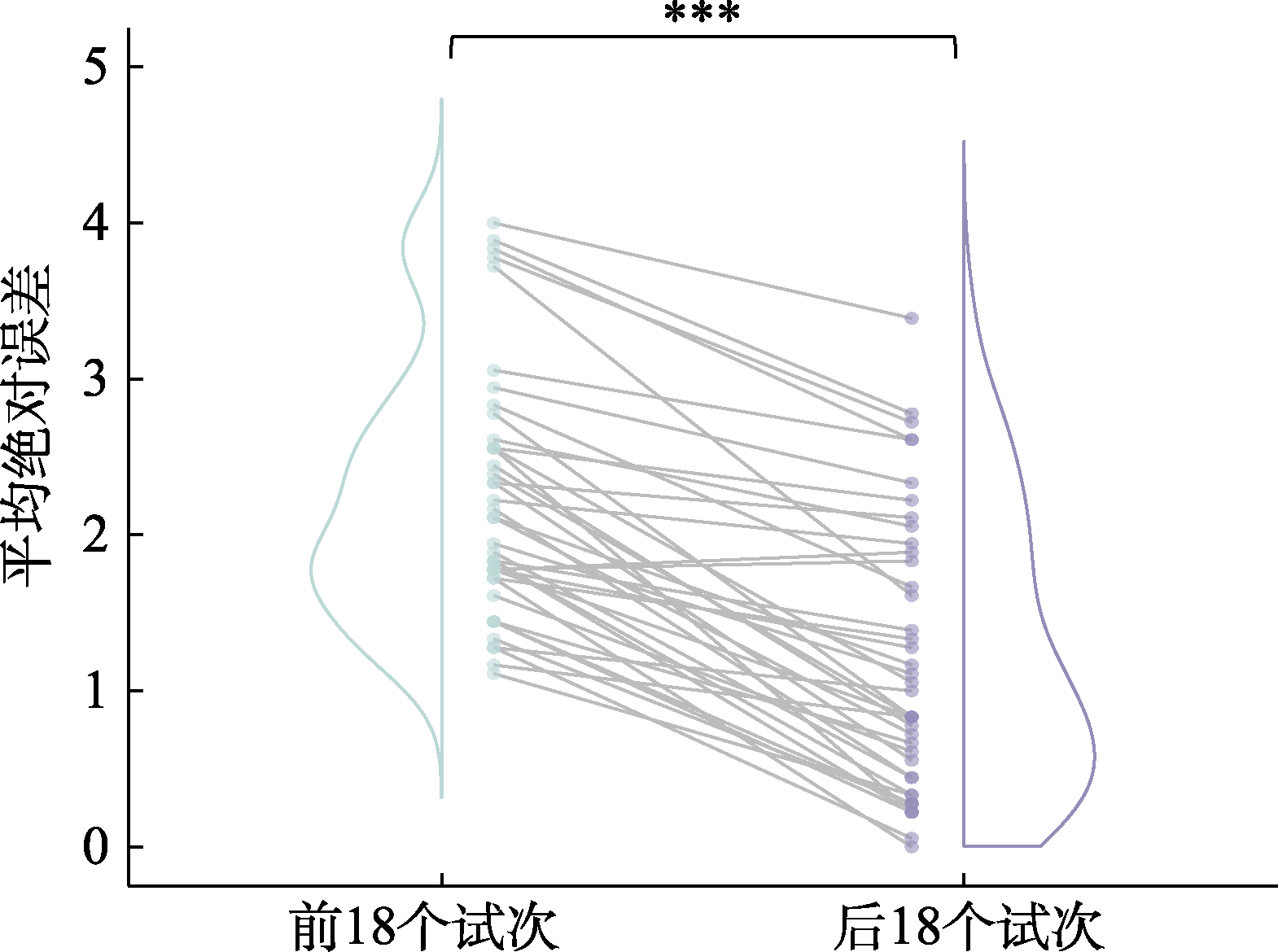
图1 困境-受助范式流程图
图2 实验1观察学习操纵检验结果。每个试次中, 被试预测受惠者B的回馈金额和B角色实际回馈的代币数之差的绝对值为绝对误差。绝对误差越大代表被试预测金额和受惠者B实际回馈金额差异越大, 即被试预测准确度越低; 反之, 绝对误差越小预测差异越小, 准确度越高。结果表明, 被试在后半部分试次中的预测准确率显著提升。*** p < 0.001
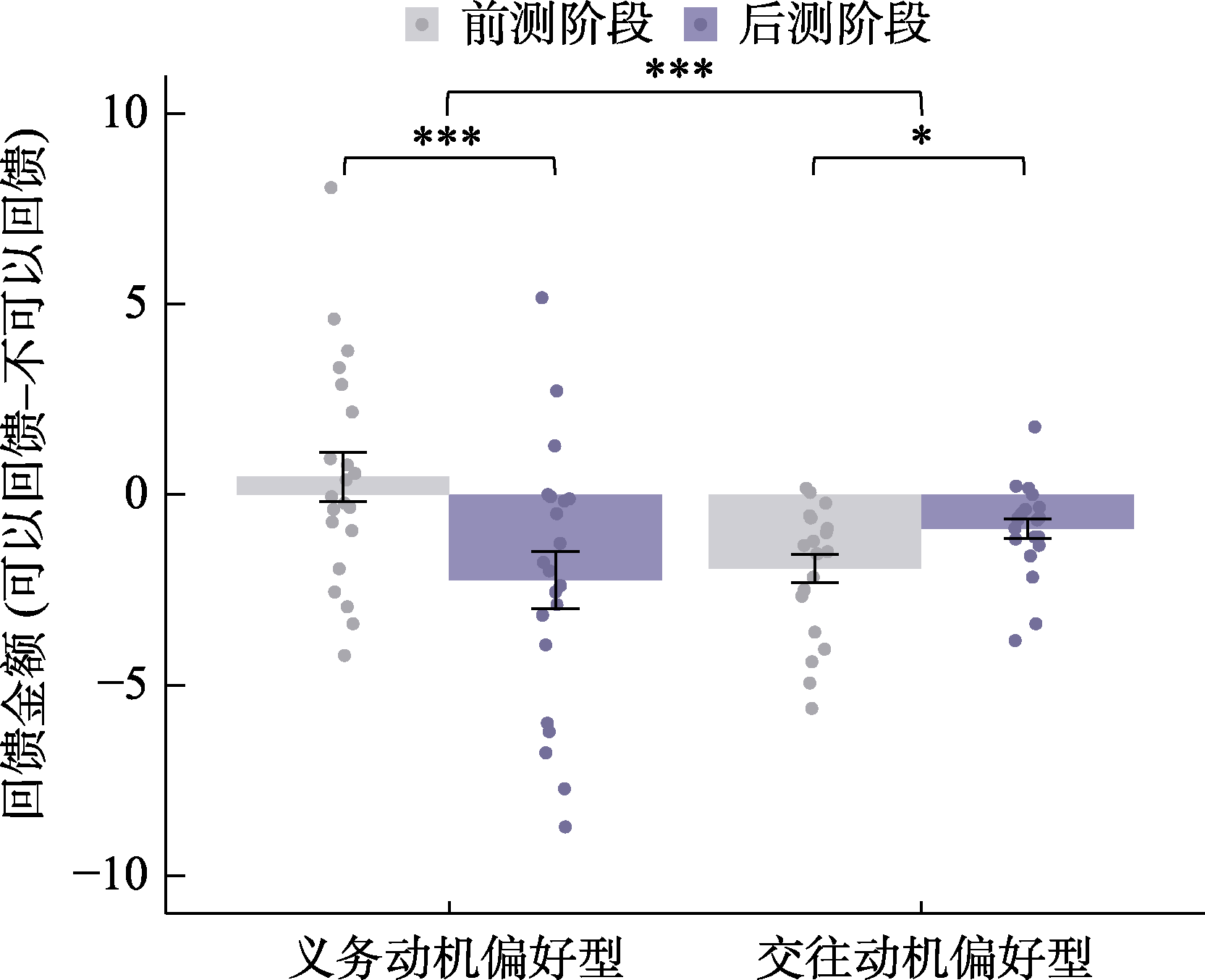
图3 实验1回馈行为结果。在观察学习前后, 不同初始回馈偏好(义务动机偏好型 vs. 交往动机偏好型)被试回馈金额差异。*** p < 0.001; * p < 0.05
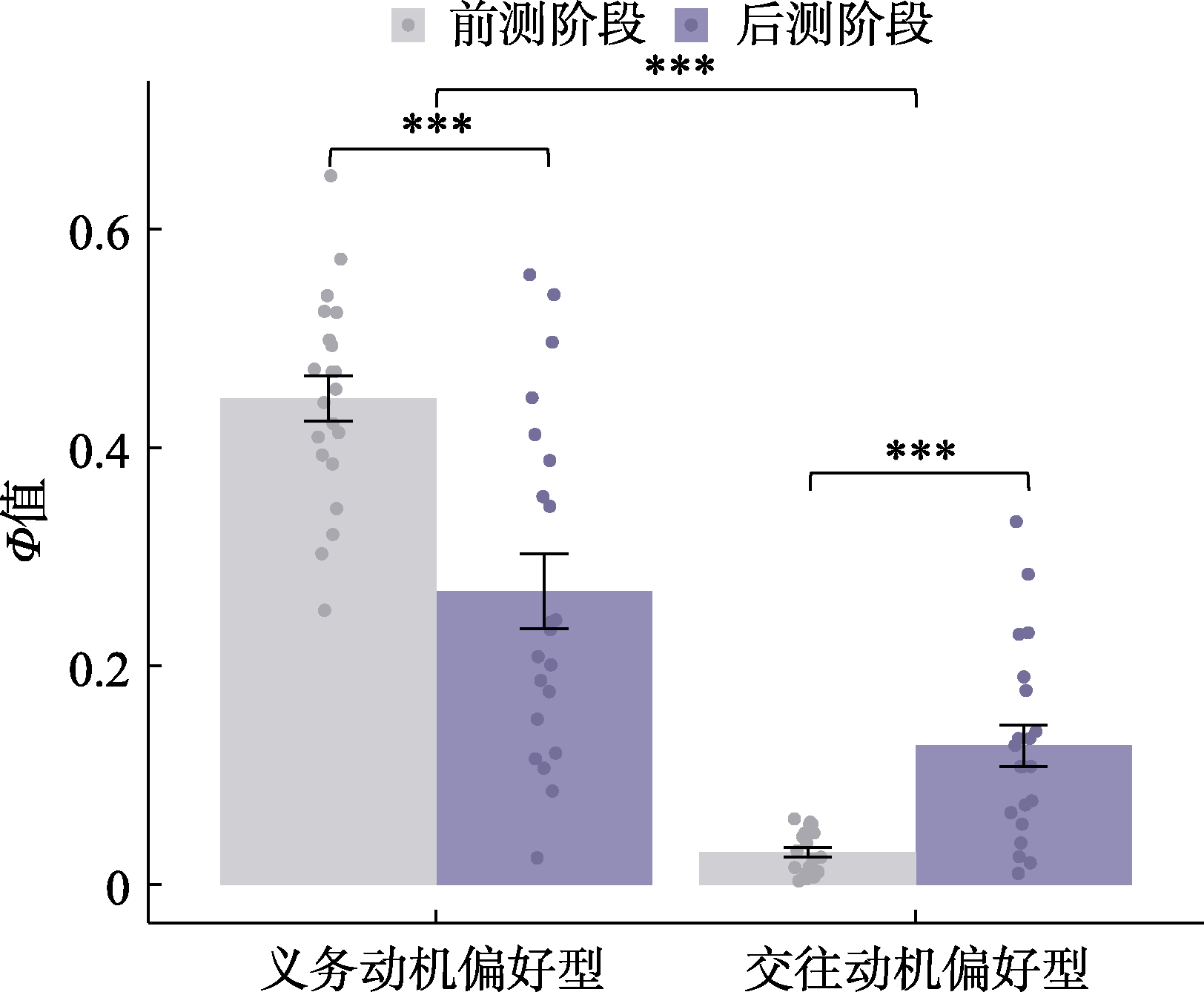
图4 实验1情感动机参数结果。不同初始回馈偏好(义务动机偏好型 vs. 交往动机偏好型)被试在观察学习前后自身回馈偏好的差异。*** p < 0.001
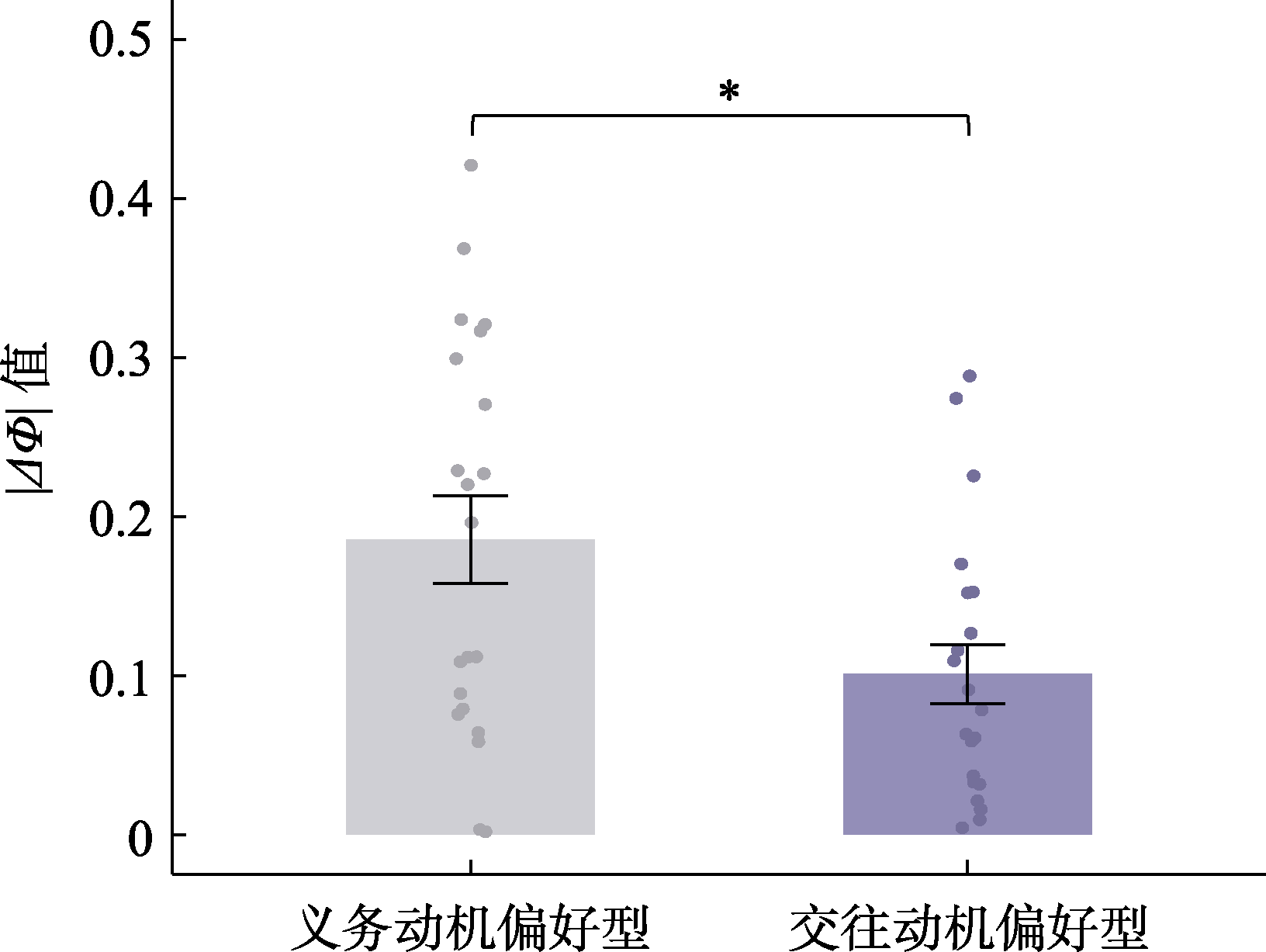
图5 实验1情感动机参数改变程度的结果。不同初始回馈偏好(义务动机偏好型 vs. 交往动机偏好型)被试在观察学习后回馈偏好改变程度的差异。* p < 0.05
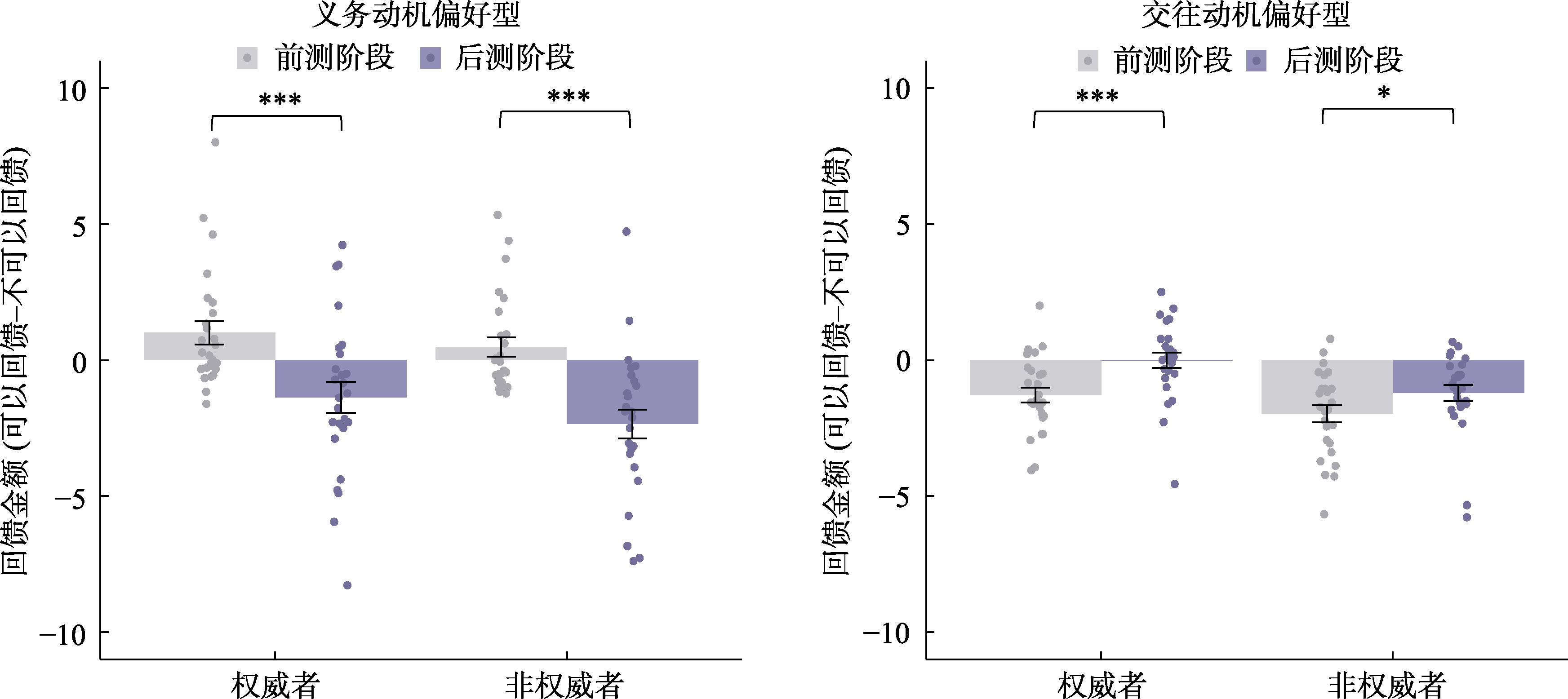
图6 实验2回馈行为结果。义务动机偏好型被试(左图)和交往动机偏好型被试(右图)观察两类权威身份(权威者 vs. 非权威者)的被观察者前后回馈金额的差异。*** p < 0.001; * p < 0.05
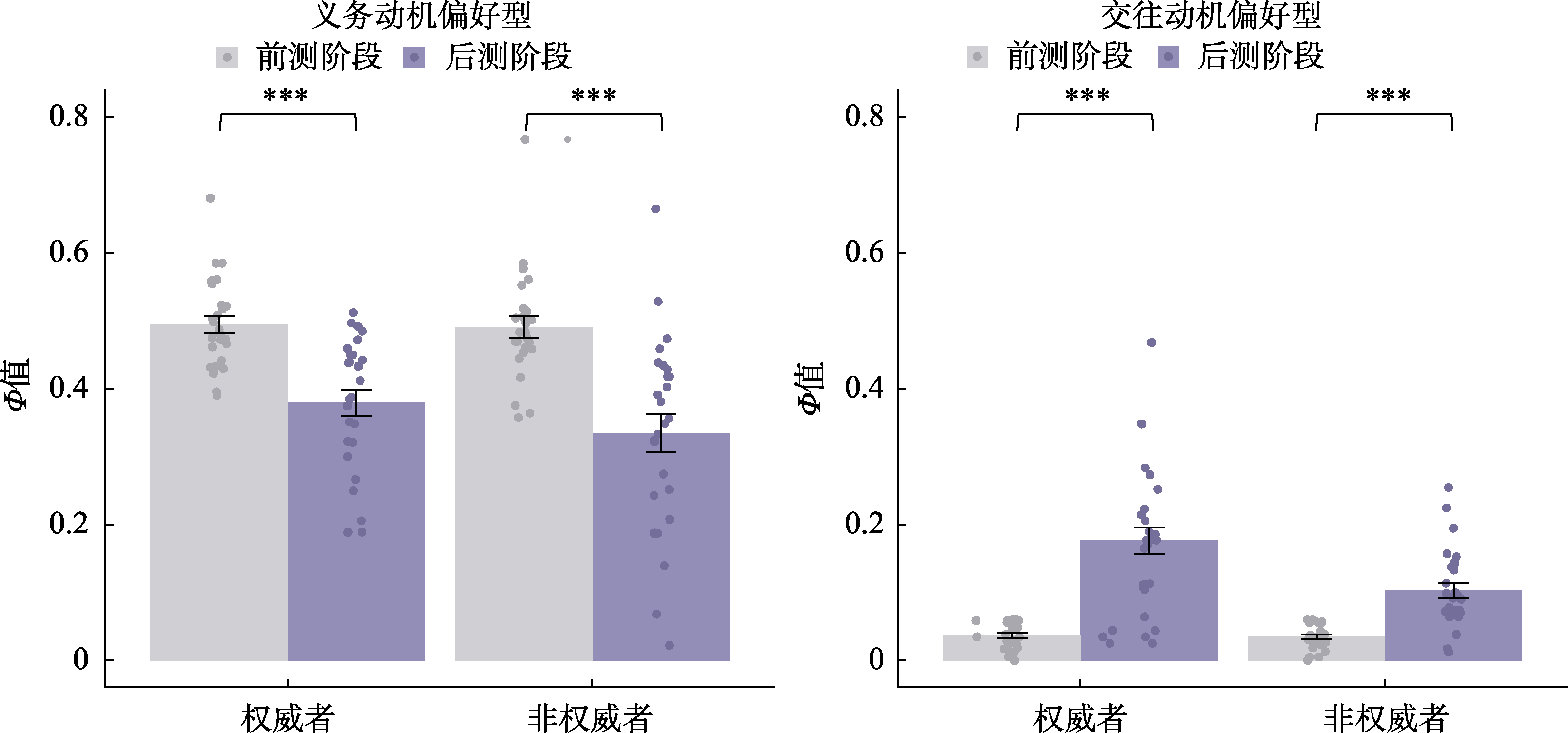
图7 实验2情感动机参数结果。义务动机偏好型被试(左图)和交往动机偏好型被试(右图)观察两类权威身份(权威者vs. 非权威者)的被观察者前后自身回馈偏好的差异。*** p < 0.001
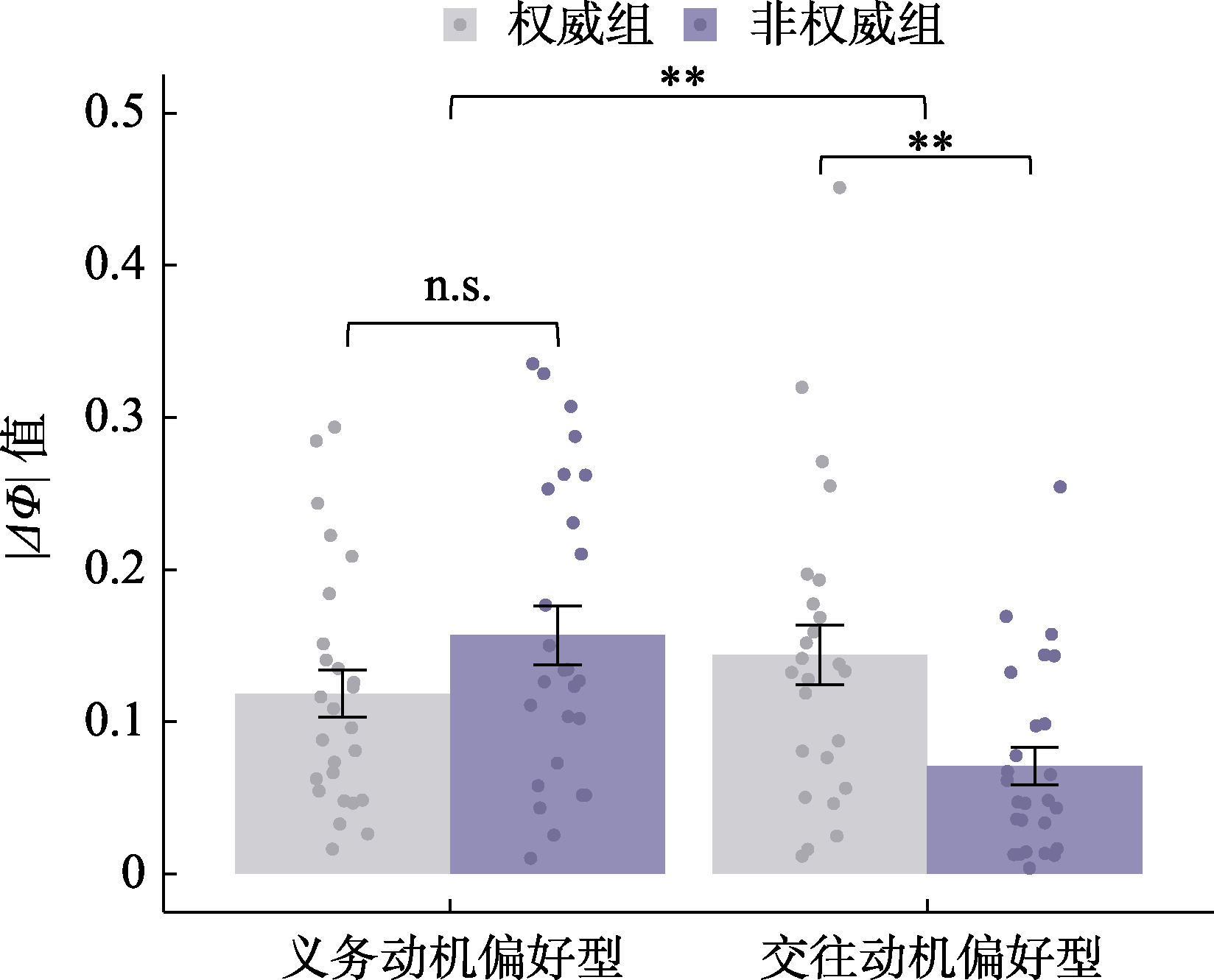
图8 实验2情感动机参数改变程度的结果。不同初始回馈偏好(义务动机偏好型 vs. 交往动机偏好型)被试在观察学习两类权威身份(权威者vs. 非权威者)被观察者后, 自身回馈偏好改变程度的差异。** p < 0.01
| 情绪类型 | 知道被试可以回馈 | 知道被试不能回馈 | t | p | Cohen’s d | [95% CI] |
|---|---|---|---|---|---|---|
| 感激 | 48.94 ± 18.70 | 70.19 ± 15.43 | -10.84 | <0.001 | -0.74 | [-0.88, -0.61] |
| 内疚 | 23.05 ± 23.51 | 41.99 ± 28.56 | -6.94 | <0.001 | -0.66 | [-0.85, -0.47] |
| 偿还压力 | 32.38 ± 27.14 | 25.70 ± 28.36 | 2.20 | 0.031 | 0.23 | [0.02, 0.44] |
| 负债感 | 29.66 ± 24.77 | 36.81 ± 31.17 | -2.12 | 0.037 | -0.25 | [-0.48, -0.02] |
附表1 情绪操作检验结果(M ± SD)
| 情绪类型 | 知道被试可以回馈 | 知道被试不能回馈 | t | p | Cohen’s d | [95% CI] |
|---|---|---|---|---|---|---|
| 感激 | 48.94 ± 18.70 | 70.19 ± 15.43 | -10.84 | <0.001 | -0.74 | [-0.88, -0.61] |
| 内疚 | 23.05 ± 23.51 | 41.99 ± 28.56 | -6.94 | <0.001 | -0.66 | [-0.85, -0.47] |
| 偿还压力 | 32.38 ± 27.14 | 25.70 ± 28.36 | 2.20 | 0.031 | 0.23 | [0.02, 0.44] |
| 负债感 | 29.66 ± 24.77 | 36.81 ± 31.17 | -2.12 | 0.037 | -0.25 | [-0.48, -0.02] |
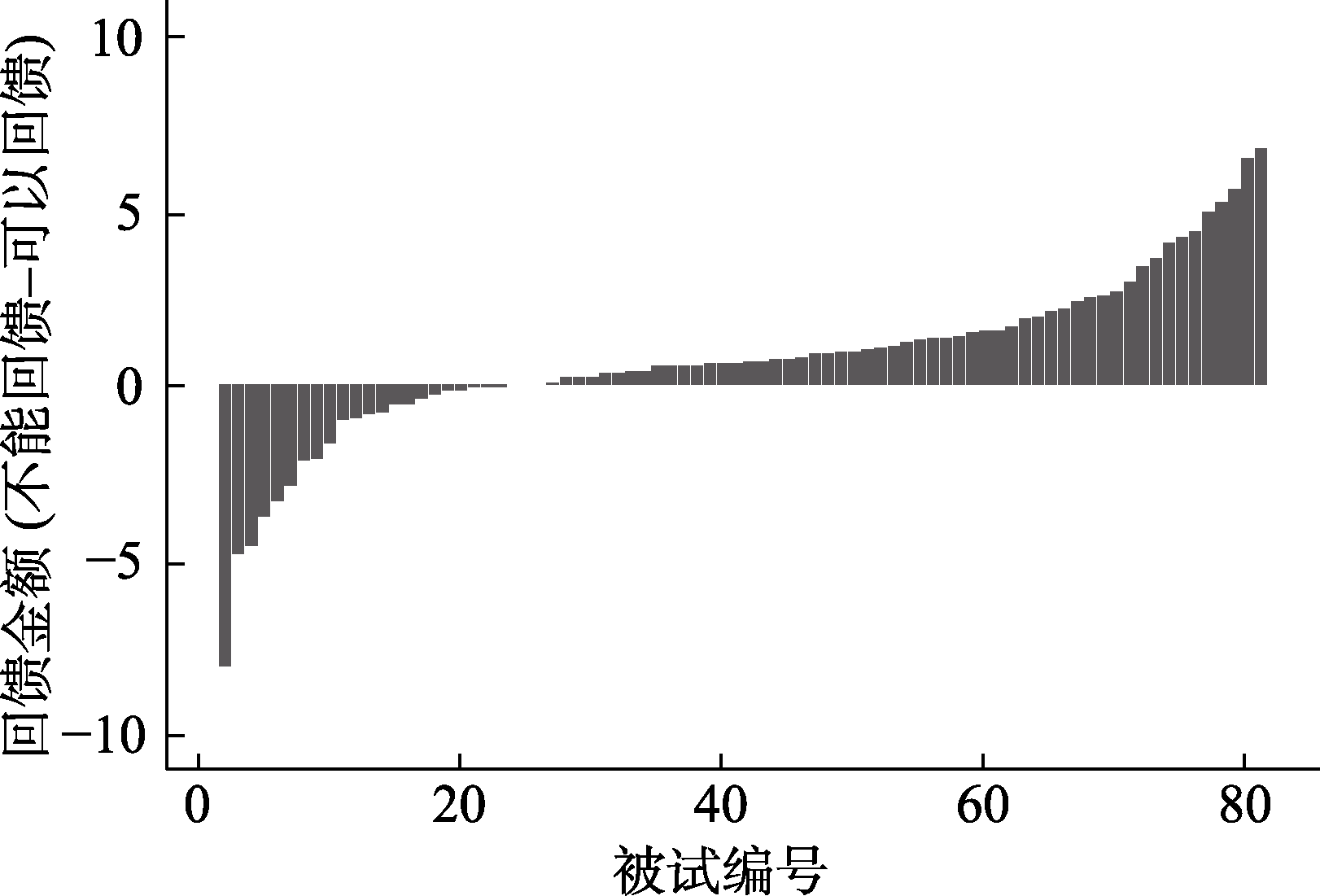
附图1 实验1个体差异结果。所有被试在不同帮助意图条件下(善意意图 vs. 策略意图)回馈金额及个体差异。回馈金额差值越大, 代表被试倾向于向善意意图的施惠者进行更多回馈; 反之, 则倾向于向策略意图被试进行更多回馈。
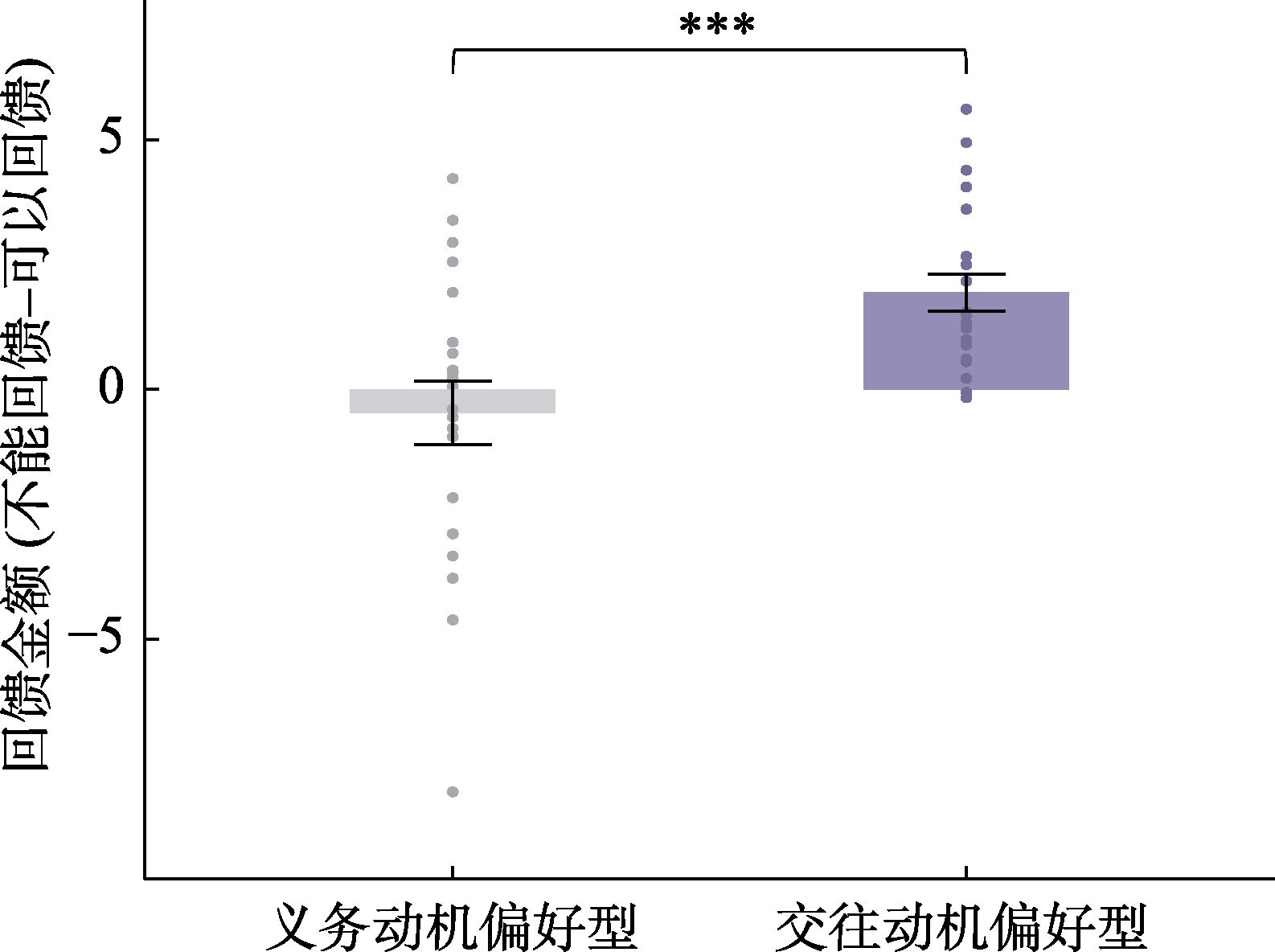
附图2 实验1回馈金额结果。不同初始回馈偏好(义务动机偏好型 vs. 交往动机偏好型)被试在两种帮助意图条件下(善意意图 vs. 策略意图)回馈金额的差异。
| 条目 | 知道被试可以回馈 | 知道被试不能回馈 | t | p | Cohen’s d | 95% CI |
|---|---|---|---|---|---|---|
| 感激 | 49.21 ± 17.92 | 67.82 ± 16.13 | -14.78 | < 0.001 | -0.71 | [-0.79, -0.56] |
| 内疚 | 23.13 ± 22.06 | 40.61 ± 28.79 | -9.53 | < 0.001 | -0.67 | [-0.84, -0.53] |
| 偿还压力 | 25.91 ± 24.36 | 22.05 ± 22.20 | 2.49 | 0.014 | 0.15 | [0.07, 0.34] |
| 负债感 | 30.13 ± 24.65 | 38.96 ± 28.63 | -5.05 | < 0.001 | -0.34 | [-0.43, -0.11] |
附表2 情绪操作检验结果(M ± SD)
| 条目 | 知道被试可以回馈 | 知道被试不能回馈 | t | p | Cohen’s d | 95% CI |
|---|---|---|---|---|---|---|
| 感激 | 49.21 ± 17.92 | 67.82 ± 16.13 | -14.78 | < 0.001 | -0.71 | [-0.79, -0.56] |
| 内疚 | 23.13 ± 22.06 | 40.61 ± 28.79 | -9.53 | < 0.001 | -0.67 | [-0.84, -0.53] |
| 偿还压力 | 25.91 ± 24.36 | 22.05 ± 22.20 | 2.49 | 0.014 | 0.15 | [0.07, 0.34] |
| 负债感 | 30.13 ± 24.65 | 38.96 ± 28.63 | -5.05 | < 0.001 | -0.34 | [-0.43, -0.11] |
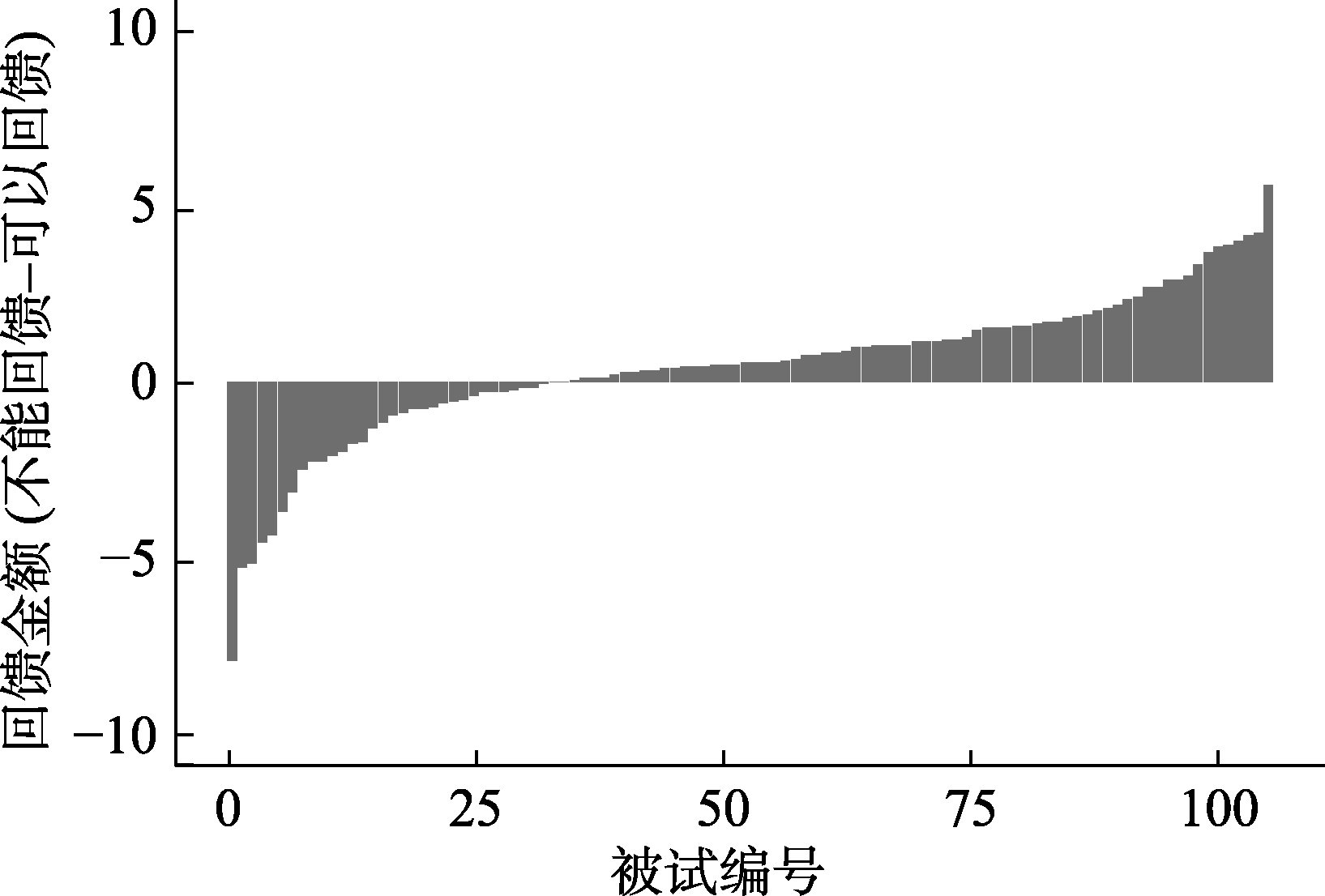
附图3 实验2个体差异结果。所有被试在不同帮助意图条件下(善意意图 vs. 策略意图)回馈金额及个体差异。回馈金额差值越大, 代表被试倾向于向善意意图的施惠者进行更多回馈; 反之, 则倾向于向策略意图被试进行更多回馈。
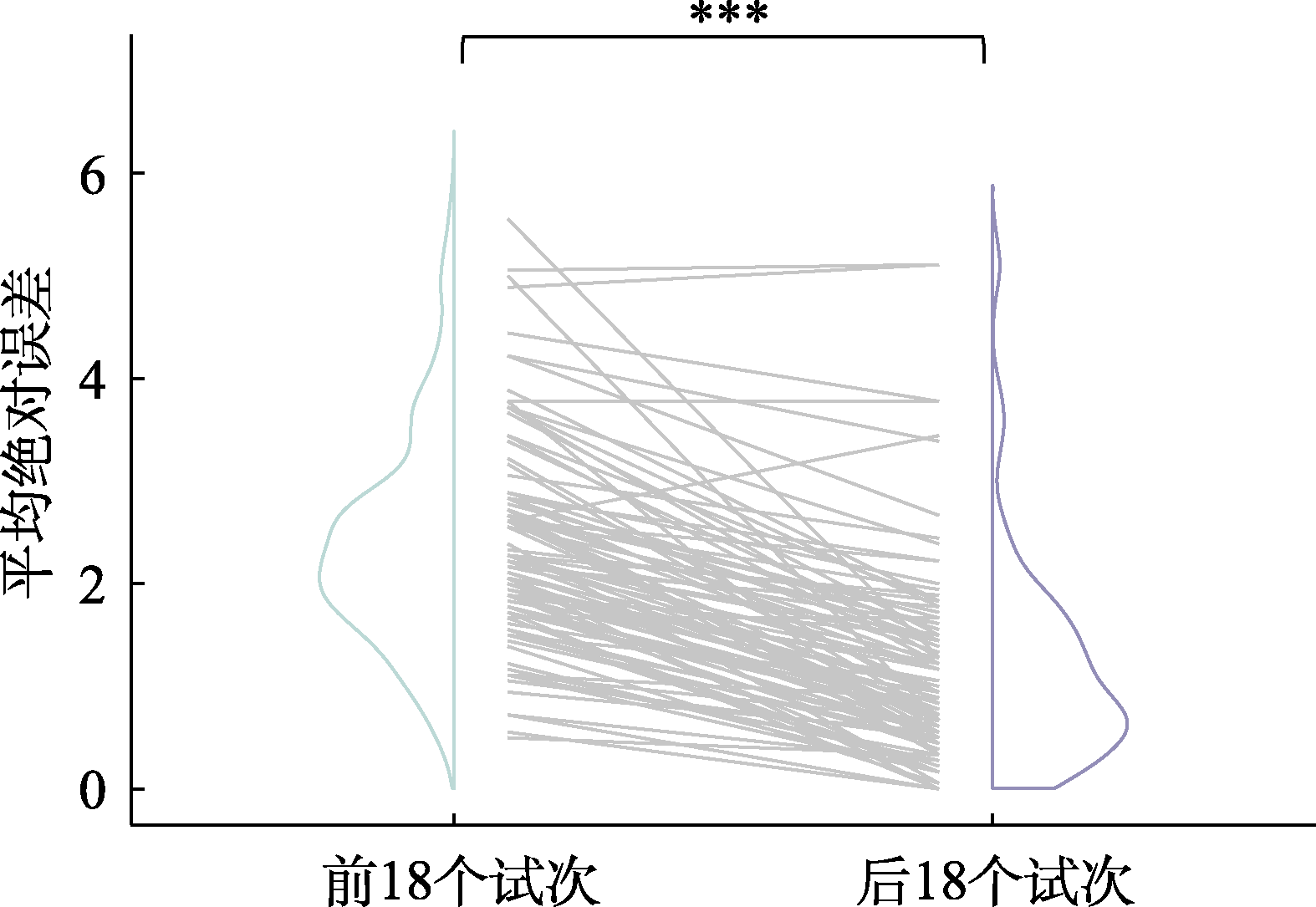
附图4 实验2观察学习操纵检验结果。每个试次中, 被试预测受惠者B的回馈金额和B角色实际回馈的代币数之差的绝对值为绝对误差。绝对误差越大代表被试预测金额和受惠者B实际回馈金额差异越大, 即被试预测准确度越低; 反之, 绝对误差越小预测差异越小, 准确度越高。结果表明, 被试在后半部分试次中的预测准确率显著提升。*** p < 0.001
| [1] |
Baldwin M. W., Carrell S. E., & Lopez D. F. (1990). Priming relationship schemas: My advisor and the Pope are watching me from the back of my mind. Journal of Experimental Social Psychology, 26(5), 435-454.
doi: 10.1016/0022-1031(90)90068-W URL |
| [2] | Bandura, A. (1969). Social-learning theory of identificatory processes. In D. A.Goslin (Ed.), Handbook of socialization theory and research (pp. 213-262). Rand McNally. |
| [3] | Bandura A. (1977). Social learning theory. Englewood Cliffs, NJ: Prentice Hall. |
| [4] |
Bandura A. (2001). Social cognitive theory: An agentic perspective. Annual Review of Psychology, 52, 1-26.
pmid: 11148297 |
| [5] |
Bandura A., Ross D., & Ross S. A. (1961). Transmission of aggression through imitation of aggressive models. The Journal of Abnormal and Social Psychology, 63(3), 575.
doi: 10.1037/h0045925 URL |
| [6] | Batson C. D. (2011). Altruism in humans. Oxford University Press. |
| [7] | Benedict R. (1946). Chrysanthemum and the sword. Patterns of Japanese culture. Cleveland, New York (The World Publishing Company). |
| [8] | Bolton G. E., & Ockenfels A. (2000). ERC: A theory of equity, reciprocity, and competition. American Economic Review, 91(1), 166-193. |
| [9] |
Buchsbaum D., Gopnik A., Griffiths T. L., & Shafto P. (2011). Children’s imitation of causal action sequences is influenced by statistical and pedagogical evidence. Cognition, 120(3), 331-340.
doi: 10.1016/j.cognition.2010.12.001 pmid: 21338983 |
| [10] |
Charness G., & Rabin M. (2002). Understanding social preferences with simple tests. The Quarterly Journal of Economics, 117(3), 817-869.
doi: 10.1162/003355302760193904 URL |
| [11] | Chen C., Liao M., & Sundar S. S. (2024, September). When to explain? Exploring the effects of explanation timing on user perceptions and trust in AI systems. In Proceedings of the Second International Symposium on Trustworthy Autonomous Systems (pp. 1-17). Association for Computing Machinery. |
| [12] |
Chierchia G., Piera Pi-Sunyer B., & Blakemore S.-J. (2020). Prosocial influence and opportunistic conformity in adolescents and young adults. Psychological Science, 31(12), 1585-1601.
doi: 10.1177/0956797620957625 pmid: 33226891 |
| [13] |
Chudek M., Heller S., Birch S., & Henrich J. (2012). Prestige-biased cultural learning: Bystander's differential attention to potential models influences children's learning. Evolution and Human Behavior, 33(1), 46-56.
doi: 10.1016/j.evolhumbehav.2011.05.005 URL |
| [14] | Cialdini R. B. (1993). Influence: The psychology of persuasion. William Morrow, New York, USA. |
| [15] |
Cialdini R. B., & Goldstein N. J. (2004). Social influence: Compliance and conformity. Annual Review of Psychology, 55, 591-621.
pmid: 14744228 |
| [16] |
Cialdini R. B., Reno R. R., & Kallgren C. A. (1990). A focus theory of normative conduct: Recycling the concept of norms to reduce littering in public places. Journal of Personality and Social Psychology, 58(6), 1015.
doi: 10.1037/0022-3514.58.6.1015 URL |
| [17] | Crocker L., & Algina J. (1986). Introduction to classical and modern test theory. Holt, Rinehart and Winston. |
| [18] |
de Leeuw R. N., & van der Laan C. A. (2018). Helping behavior in Disney animated movies and children’s helping behavior in the Netherlands. Journal of Children and Media, 12(2), 159-174.
doi: 10.1080/17482798.2017.1409245 URL |
| [19] |
Deci E. L., & Ryan R. M. (1985). The general causality orientations scale: Self-determination in personality. Journal of Research in Personality, 19(2), 109-134.
doi: 10.1016/0092-6566(85)90023-6 URL |
| [20] |
Deci E. L., & Ryan R. M. (2000). The "what" and "why" of goal pursuits: Human needs and the self-determination of behavior. Psychological Inquiry, 11(4), 227-268.
doi: 10.1207/S15327965PLI1104_01 URL |
| [21] |
Dimant E. (2019). Contagion of pro-and anti-social behavior among peers and the role of social proximity. Journal of Economic Psychology, 73, 66-88.
doi: 10.1016/j.joep.2019.04.009 |
| [22] |
Fabbri M., & Carbonara E. (2017). Social influence on third-party punishment: An experiment. Journal of Economic Psychology, 62, 204-230.
doi: 10.1016/j.joep.2017.07.003 URL |
| [23] |
Fehr E., & Fischbacher U. (2004). Third-party punishment and social norms. Evolution and Human Behavior, 25(2), 63-87
doi: 10.1016/S1090-5138(04)00005-4 URL |
| [24] |
Fehr E., & Schmidt K. M. (1999). A theory of fairness, competition, and cooperation. The Quarterly Journal of Economics, 114(3), 817-868.
doi: 10.1162/003355399556151 URL |
| [25] |
FeldmanHall O., Otto A. R., & Phelps E. A. (2018). Learning moral values: Another’s desire to punish enhances one’s own punitive behavior. Journal of Experimental Psychology: General, 147(8), 1211.
doi: 10.1037/xge0000405 URL |
| [26] |
Feng X., Han Z., & Zheng S. (2023). Peer influence on prosocial behavior in adolescence. Journal of Education, Humanities and Social Sciences, 8, 1879-1885.
doi: 10.54097/ehss.v8i.4604 URL |
| [27] |
Gächter S., Renner E., & Sefton M. (2008). The long-run benefits of punishment. Science, 322(5907), 1510-1510.
doi: 10.1126/science.1164744 pmid: 19056978 |
| [28] |
Gao X., Jolly E., Yu H., Liu H., Zhou X., & Chang L. J. (2024). The psychological, computational, and neural foundations of indebtedness. Nature Communications, 15(1), 68.
doi: 10.1038/s41467-023-44286-9 pmid: 38167846 |
| [29] |
Gelfand M. J., & Harrington J. R. (2015). The motivational force of descriptive norms: For whom and when are descriptive norms most predictive of behavior? Journal of Cross-Cultural Psychology, 46(10), 1273-1278.
doi: 10.1177/0022022115600796 URL |
| [30] |
Gino F., Ayal S., & Ariely D. (2009). Contagion and differentiation in unethical behavior: The effect of one bad apple on the barrel. Psychological Science, 20(3), 393-398.
doi: 10.1111/j.1467-9280.2009.02306.x pmid: 19254236 |
| [31] |
Glickman M., & Sharot T. (2025). How human-AI feedback loops alter human perceptual, emotional and social judgements. Nature Human Behaviour, 9(2), 345-359.
doi: 10.1038/s41562-024-02077-2 pmid: 39695250 |
| [32] |
Goette L., & Tripodi E. (2021). Social influence in prosocial behavior: Evidence from a large-scale experiment. Journal of the European Economic Association, 19(4), 2373-2398.
doi: 10.1093/jeea/jvaa054 URL |
| [33] | Greenberg M. S. (1980). A theory of indebtedness. Social exchange: Advances in Theory and Research, 3-26. |
| [34] | Greenberg M., Bar-Tal D., Mowrey J., & Steinberg R. (1982). Cross-cultural comparisons in the perception of indebtedness [Unpublished manuscript]. University of Pittsburgh. |
| [35] | Greenberg M. S., & Westcott D. R. (1983). Indebtedness as a mediator of reactions to aid. New Directions in Helping, 1, 85-112. |
| [36] |
Haun D. B., & Tomasello M. (2011). Conformity to peer pressure in preschool children. Child Development, 82(6), 1759-1767.
doi: 10.1111/j.1467-8624.2011.01666.x pmid: 22023172 |
| [37] |
Hein G., Morishima Y., Leiberg S., Sul S., & Fehr E. (2016). The brain’s functional network architecture reveals human motives. Science, 351(6277), 1074-1078.
doi: 10.1126/science.aac5082 |
| [38] |
Hitokoto H. (2016). Indebtedness in cultural context: The role of culture in the felt obligation to reciprocate. Asian Journal of Social Psychology, 19(1), 16-25.
doi: 10.1111/ajsp.v19.1 URL |
| [39] |
Jung H., Seo E., Han E., Henderson M. D., & Patall E. A. (2020). Prosocial modeling: A meta-analytic review and synthesis. Psychological Bulletin, 146(8), 635.
doi: 10.1037/bul0000235 pmid: 32406697 |
| [40] |
Kim H. S., Sherman D. K., Ko D., & Taylor S. E. (2006). Pursuit of comfort and pursuit of harmony: Culture, relationships, and social support seeking. Personality and Social Psychology Bulletin, 32(12), 1595-1607.
doi: 10.1177/0146167206291991 pmid: 17122173 |
| [41] | Laursen, B. (2018). Peer influence. In W. M.Bukowski, B.Laursen, & K. H.Rubin (Eds.), Handbook of peer interactions, relationships, and groups (2nd ed., pp. 447-469). Guilford Press. |
| [42] |
Lindenberg S., & Steg L. (2007). Normative, gain and hedonic goal frames guiding environmental behavior. Journal of Social Issues, 63(1), 117-137.
doi: 10.1111/josi.2007.63.issue-1 URL |
| [43] |
Malmendier U., te Velde V. L., & Weber R. A. (2014). Rethinking reciprocity. Annual Review of Economics, 6, 849-874.
doi: 10.1146/annurev-economics-080213-041312 |
| [44] |
Mares M.-L., & Woodard E. (2005). Positive effects of television on children's social interactions: A meta-analysis. Media Psychology, 7(3), 301-322.
doi: 10.1207/S1532785XMEP0703_4 URL |
| [45] | Master, A., Cheryan S., & Meltzoff A. N. (2016). Motivation and identity. In K. R.Wentzel & D. B.Miele (Eds.), Handbook of motivation at school (pp. 300-319). Routledge. |
| [46] |
Meltzoff A. N. (1995). Understanding the intentions of others: re-enactment of intended acts by 18-month-old children. Developmental Psychology, 31(5), 838-850.
doi: 10.1037/0012-1649.31.5.838 pmid: 25147406 |
| [47] |
Meltzoff A. N., Waismeyer A., & Gopnik A. (2012). Learning about causes from people: observational causal learning in 24-month-old infants. Developmental Psychology, 48(5), 1215-1228.
doi: 10.1037/a0027440 pmid: 22369335 |
| [48] |
Miller J. G., Das R., & Chakravarthy S. (2011). Culture and the role of choice in agency. Journal of Personality and Social Psychology, 101(1), 46-61.
doi: 10.1037/a0023330 pmid: 21480735 |
| [49] |
Naito T., & Sakata Y. (2010). Gratitude, indebtedness, and regret on receiving a friend’s favor in Japan. Psychologia, 53(3), 179-194.
doi: 10.2117/psysoc.2010.179 URL |
| [50] | Nass C., Steuer J., & Tauber E. R. (1994, April). Computers are social actors. In Proceedings of the SIGCHI conference on Human factors in computing systems (pp. 72-78). ACM Press. |
| [51] |
Nielsen M., & Tomaselli K. (2010). Overimitation in Kalahari Bushman children and the origins of human cultural cognition. Psychological Science, 21(5), 729-736.
doi: 10.1177/0956797610368808 pmid: 20483853 |
| [52] |
Okumura Y., Kanakogi Y., Kanda T., Ishiguro H., & Itakura S. (2013). Infants understand the referential nature of human gaze but not robot gaze. Journal of Experimental Child Psychology, 116(1), 86-95.
doi: 10.1016/j.jecp.2013.02.007 pmid: 23660178 |
| [53] |
Olsson A., & Phelps E. A. (2007). Social learning of fear. Nature Neuroscience, 10(9), 1095-1102.
pmid: 17726475 |
| [54] |
Over H., & Carpenter M. (2012). Putting the social into social learning: explaining both selectivity and fidelity in children's copying behavior. Journal of Comparative Psychology, 126(2), 182-192.
doi: 10.1037/a0024555 pmid: 21767011 |
| [55] |
Paluck E. L., Shepherd H., & Aronow P. M. (2016). Changing climates of conflict: A social network experiment in 56 schools. Proceedings of the National Academy of Sciences, 113(3), 566-571.
doi: 10.1073/pnas.1514483113 URL |
| [56] |
Park L. E., Kondrak C. L., Ward D. E., & Streamer L. (2018). Positive feedback from male authority figures boosts women’s math outcomes. Personality and Social Psychology Bulletin, 44(3), 359-383.
doi: 10.1177/0146167217741312 URL |
| [57] |
Perugini M., Gallucci M., Presaghi F., & Ercolani A. P. (2003). The personal norm of reciprocity. European Journal of Personality, 17(4), 251-283.
doi: 10.1002/per.474 URL |
| [58] | Preacher, K. J. (2015). Extreme groups designs. In R. L.Cautin & S. O.Lilienfeld (Eds.), The encyclopedia of clinical psychology (Vol. 2, pp 1189-1192). Wiley. |
| [59] | Rabin M. (1992). Incorporating fairness into game theory and economics. University of California at Berkeley, Department of Economics. |
| [60] |
Raees M., Meijerink I., Lykourentzou I., Khan V. J., & Papangelis K. (2024). From explainable to interactive AI: A literature review on current trends in human-AI interaction. International Journal of Human-Computer Studies, 189, 103301.
doi: 10.1016/j.ijhcs.2024.103301 URL |
| [61] |
Rendell L., Fogarty L., Hoppitt W. J., Morgan T. J., Webster M. M., & Laland K. N. (2011). Cognitive culture: theoretical and empirical insights into social learning strategies. Trends in Cognitive Sciences, 15(2), 68-76.
doi: 10.1016/j.tics.2010.12.002 pmid: 21215677 |
| [62] |
Ryan R. M., & Connell J. P. (1989). Perceived locus of causality and internalization: examining reasons for acting in two domains. Journal of Personality and Social Psychology, 57(5), 749.
doi: 10.1037//0022-3514.57.5.749 pmid: 2810024 |
| [63] |
Ryan R. M., & Deci E. L. (2000). Self-determination theory and the facilitation of intrinsic motivation, social development, and well-being. American Psychologist, 55(1), 68-78.
doi: 10.1037//0003-066x.55.1.68 pmid: 11392867 |
| [64] |
Ryan R. M., & Deci E. L. (2020). Intrinsic and extrinsic motivation from a self-determination theory perspective: Definitions, theory, practices, and future directions. Contemporary Educational Psychology, 61, 101860.
doi: 10.1016/j.cedpsych.2020.101860 URL |
| [65] | Savani K., Morris M. W., & Naidu N. (2012). Deference in indians' decision making: introjected goals or injunctive norms? Journal of Personality & Social Psychology, 102(4), 685-699. |
| [66] |
Son J.-Y., Bhandari A., & FeldmanHall O. (2019). Crowdsourcing punishment: Individuals reference group preferences to inform their own punitive decisions. Scientific Reports, 9(1), 11625.
doi: 10.1038/s41598-019-48050-2 |
| [67] | Strouse G. A., & Samson J. E. (2021). Learning from video: A meta-analysis of the video deficit in children ages 0 to 6 years. Child Development, 92(1), e20-e38. |
| [68] | Sutton R. S., & Barto A. G. (1999). Reinforcement learning: An introduction. Robotica, 17(2), 229-235. |
| [69] | Tajfel H., Turner J. C., Austin W. G., & Worchel S. (1979). An integrative theory of intergroup conflict. Organizational Identity: A Reader, 56(65), 9780203505984-16. |
| [70] |
Taylor S. E., Sherman D. K., Kim H. S., Jarcho J., Takagi K., & Dunagan M. S. (2004). Culture and social support: who seeks it and why? Journal of Personality and Social Psychology, 87(3), 354-362.
doi: 10.1037/0022-3514.87.3.354 pmid: 15382985 |
| [71] |
Van Hoorn J., van Dijk E., Meuwese R., Rieffe C., & Crone E. A. (2016). Peer influence on prosocial behavior in adolescence. Journal of Research on Adolescence, 26(1), 90-100.
doi: 10.1111/jora.2016.26.issue-1 URL |
| [72] | Wagner, A. R., & Rescorla R. A. (1972). Inhibition in Pavlovian conditioning:Application of a theory. In R. A.Boakes & M. S.Halliday (Eds.), Inhibition and learning (pp. 301-336). Academic Press. |
| [73] |
West S. A., Griffin A. S., & Gardner A. (2007). Social semantics: altruism, cooperation, mutualism, strong reciprocity and group selection. Journal of Evolutionary Biology, 20(2), 415-432.
doi: 10.1111/j.1420-9101.2006.01258.x pmid: 17305808 |
| [74] |
Wolpert D. M., Diedrichsen J., & Flanagan J. R. (2011). Principles of sensorimotor learning. Nature Reviews Neuroscience, 12(12), 739-751.
doi: 10.1038/nrn3112 pmid: 22033537 |
| [75] |
Yu H., Siegel J. Z., Clithero J. A., & Crockett M. J. (2021). How peer influence shapes value computation in moral decision-making. Cognition, 211, 104641.
doi: 10.1016/j.cognition.2021.104641 URL |
| [76] |
Zonca J., Vostroknutov A., Coricelli G., & Polonio L. (2021). Timing of social feedback shapes observational learning in strategic interaction. Scientific Reports, 11(1), 21972.
doi: 10.1038/s41598-021-01466-1 pmid: 34754038 |
| [1] | 贾建锋, 刘伟鹏, 段锦云, 赵洋. 妒忌还是钦佩: 员工对同事被授权的心理与行为反应[J]. 心理学报, 2024, 56(10): 1401-1416. |
| [2] | 宋晓蕾, 李洋洋, 杨倩, 游旭群. 反应手的不同状态对联合任务中观察学习的影响 *[J]. 心理学报, 2018, 50(9): 975-984. |
| [3] | 徐芬,荆春燕,刘英,包雪华. 交往情景下个体对说谎的理解及其道德评价[J]. 心理学报, 2002, 34(01): 75-81. |
| [4] | 叶浩生. 论班图拉观察学习理论的特征及其历史地位[J]. 心理学报, 1994, 26(2): 201-207. |
| 阅读次数 | ||||||
|
全文 |
|
|||||
|
摘要 |
|
|||||
