

ISSN 1671-3710
CN 11-4766/R
主办:中国科学院心理研究所
出版:科学出版社
CN 11-4766/R
主办:中国科学院心理研究所
出版:科学出版社
Advances in Psychological Science ›› 2026, Vol. 34 ›› Issue (9): 1629-1645.doi: 10.3724/SP.J.1042.2026.1629
• Research Method • Previous Articles Next Articles
SANG Jieyu, LIU Yuan( ), WEI Dongtao
Received:2025-08-09
Online:2026-09-15
Published:2026-07-20
Contact:
LIU Yuan
E-mail:lyuuan@swu.edu.cn
CLC Number:
SANG Jieyu, LIU Yuan, WEI Dongtao. Time scales in intensive longitudinal data: Modeling, comparison and application of discrete time and continuous time[J]. Advances in Psychological Science, 2026, 34(9): 1629-1645.
| 实际测量时间 | 波次(Wave) | 自然 时间(Hour) | DT 时间 | CT时间 | ||
|---|---|---|---|---|---|---|
| Δt = 1小时 | Δt = 3小时 | |||||
| 第一天 | 10:01:03 | 1 | 10 | 1 | 1 | 1 |
| 第一天 | 12:52:13 | 2 | 13 | 2 | 4 | 2 |
| 第一天 | 16:02:54 | 3 | 16 | 3 | 7 | 3 |
| 第一天 | 18:59:40 | 4 | 19 | 4 | 10 | 4 |
| 第一天 | 22:04:19 | 5 | 22 | 5 | 13 | 5 |
| 第二天 | 9:50:47 | 6 | 34 | 9 | 25 | 9 |
| 第二天 | 12:51:59 | 7 | 37 | 10 | 28 | 10 |
| 第二天 | 15:53:14 | 8 | 40 | 11 | 31 | 11 |
| 第二天 | 19:06:56 | 9 | 43 | 12 | 34 | 12 |
| 第二天 | 21:59:02 | 10 | 46 | 13 | 37 | 13 |
| 实际测量时间 | 波次(Wave) | 自然 时间(Hour) | DT 时间 | CT时间 | ||
|---|---|---|---|---|---|---|
| Δt = 1小时 | Δt = 3小时 | |||||
| 第一天 | 10:01:03 | 1 | 10 | 1 | 1 | 1 |
| 第一天 | 12:52:13 | 2 | 13 | 2 | 4 | 2 |
| 第一天 | 16:02:54 | 3 | 16 | 3 | 7 | 3 |
| 第一天 | 18:59:40 | 4 | 19 | 4 | 10 | 4 |
| 第一天 | 22:04:19 | 5 | 22 | 5 | 13 | 5 |
| 第二天 | 9:50:47 | 6 | 34 | 9 | 25 | 9 |
| 第二天 | 12:51:59 | 7 | 37 | 10 | 28 | 10 |
| 第二天 | 15:53:14 | 8 | 40 | 11 | 31 | 11 |
| 第二天 | 19:06:56 | 9 | 43 | 12 | 34 | 12 |
| 第二天 | 21:59:02 | 10 | 46 | 13 | 37 | 13 |
| DT模型 | CT模型 | |
|---|---|---|
| 研究假设 | 测量之间时间间隔相等 | 存在潜在的基本连续函数, 变量随时间连续变化, 测量之间无固定测量间隔 |
| 对时间的定义 | 按测量发生的先后顺序, 对时间进行隐含建模 | 对时间进行显性建模, 通过设定基础时间间隔, 将所有的测量时间以基础时间间隔为参照, 重新在相同的时间尺度上划分, 通过微分方程直接对时间建模 |
| 参数设定 | 动态参数:Φ 误差参数:ε~N (0, Σ) | 动态参数(漂移矩阵):A 误差参数(扩散矩阵):GG′ = Q |
| 动态效应的解释 | 基于特定时间间隔的前后两个时间点数据的动态效应, 不考虑两个时间点之间的动态过程 | 通过积分获得任意时间间隔之间的动态效应, 估计的是两个时间点之间动态的瞬时变化的累积动态效应 |
| 对不等间隔的处理 | 将测量之间不等间隔视为未观测时间点数据的缺失, 一般通过卡尔曼滤波进行缺失值插补, 从而满足等间隔假设 | 将原始的不等间隔的离散测量点视为潜在连续轨迹的信息, 直接对数据分析 |
| 优点 | (1)基于特定测量时间间隔的动态参数更容易解释; (2)建模更加简约。 | (1)对观测数据的时间间隔无特定要求, 可以获得独立于时间间隔的动态参数; (2)可以灵活缩放到其它特定的离散时间间隔上得到研究者想获得的动态效应的相对尺度 (3)实现跨研究可比性; (4)对高阶动态等一些复杂时间序列建模(如阻尼振动描述了周期性的有衰减的变化轨迹, 基于微分方程建模); (5)预计交叉滞后效应达到最大值的时间间隔。 |
| 缺点 | (1)难以有效处理数据收集时间点随机或大量不等间隔的情形; (2)无法使用特定测量间隔以外的间隔长度插补数据, 只能在特定的研究间隔下解释动态效应, 不能推广到其他的间隔上; (3)对同一个感兴趣变量进行密集追踪研究时, 不同测量间隔设计得到的动态效应, 缺乏跨研究可比性; (4)无法对一些特定的复杂时间序列建模。 | (1)建模更加复杂; (2)模型直接获得的动态参数不便解释, 仍然需要合理地转换到离散的特定时间间隔上解读。 |
| DT模型 | CT模型 | |
|---|---|---|
| 研究假设 | 测量之间时间间隔相等 | 存在潜在的基本连续函数, 变量随时间连续变化, 测量之间无固定测量间隔 |
| 对时间的定义 | 按测量发生的先后顺序, 对时间进行隐含建模 | 对时间进行显性建模, 通过设定基础时间间隔, 将所有的测量时间以基础时间间隔为参照, 重新在相同的时间尺度上划分, 通过微分方程直接对时间建模 |
| 参数设定 | 动态参数:Φ 误差参数:ε~N (0, Σ) | 动态参数(漂移矩阵):A 误差参数(扩散矩阵):GG′ = Q |
| 动态效应的解释 | 基于特定时间间隔的前后两个时间点数据的动态效应, 不考虑两个时间点之间的动态过程 | 通过积分获得任意时间间隔之间的动态效应, 估计的是两个时间点之间动态的瞬时变化的累积动态效应 |
| 对不等间隔的处理 | 将测量之间不等间隔视为未观测时间点数据的缺失, 一般通过卡尔曼滤波进行缺失值插补, 从而满足等间隔假设 | 将原始的不等间隔的离散测量点视为潜在连续轨迹的信息, 直接对数据分析 |
| 优点 | (1)基于特定测量时间间隔的动态参数更容易解释; (2)建模更加简约。 | (1)对观测数据的时间间隔无特定要求, 可以获得独立于时间间隔的动态参数; (2)可以灵活缩放到其它特定的离散时间间隔上得到研究者想获得的动态效应的相对尺度 (3)实现跨研究可比性; (4)对高阶动态等一些复杂时间序列建模(如阻尼振动描述了周期性的有衰减的变化轨迹, 基于微分方程建模); (5)预计交叉滞后效应达到最大值的时间间隔。 |
| 缺点 | (1)难以有效处理数据收集时间点随机或大量不等间隔的情形; (2)无法使用特定测量间隔以外的间隔长度插补数据, 只能在特定的研究间隔下解释动态效应, 不能推广到其他的间隔上; (3)对同一个感兴趣变量进行密集追踪研究时, 不同测量间隔设计得到的动态效应, 缺乏跨研究可比性; (4)无法对一些特定的复杂时间序列建模。 | (1)建模更加复杂; (2)模型直接获得的动态参数不便解释, 仍然需要合理地转换到离散的特定时间间隔上解读。 |
| 参数 | DT模型 | CT模型 | ||||
|---|---|---|---|---|---|---|
| Est. | 后验S.D. | 95% CI | Est. | 后验S.D. | 95% CI | |
| 固定效应 | ||||||
| 害怕截距(μ1) | 1.32 | 0.04 | [1.23, 1.40] | 1.32 | 0.04 | [1.24, 1.40] |
| 开心截距(μ2) | 2.04 | 0.08 | [1.87, 2.19] | 2.04 | 0.10 | [1.86, 2.22] |
| 害怕自回归(φ1) | 0.22 | 0.01 | [0.19, 0.24] | 0.20 | 0.02 | [0.18, 0.23] |
| 开心自回归(φ2) | 0.19 | 0.02 | [0.16, 0.21] | 0.18 | 0.02 | [0.15, 0.21] |
| 害怕→开心(φ3) | 0.14 | 0.03 | [0.08, 0.20] | 0.17 | 0.03 | [0.11, 0.23] |
| 开心→害怕(φ4) | 0.03 | 0.01 | [0.01, 0.04] | 0.03 | 0.01 | [0.01, 0.05] |
| 害怕斜率(γ1) | −0.01 | 0.00 | [−0.02, −0.01] | −0.01 | 0.00 | [−0.02, −0.01] |
| 开心斜率(γ2) | −0.02 | 0.01 | [−0.03, −0.01] | −0.02 | 0.01 | [−0.03, −0.01] |
| 随机效应 | ||||||
| 个体内害怕残差方差(σ12) | 0.35 | 0.01 | [0.34, 0.36] | 0.35 | 0.01 | [0.34, 0.36] |
| 开心残差方差(σ22) | 1.48 | 0.03 | [1.42, 1.52] | 1.49 | 0.02 | [1.45, 1.54] |
| 个体间害怕截距方差(τ12) | 0.13 | 0.02 | [0.10, 0.17] | 0.13 | 0.02 | [0.10, 0.18] |
| 开心截距方差(τ22) | 0.56 | 0.09 | [0.42, 0.77] | 0.58 | 0.10 | [0.43, 0.79] |
| 参数 | DT模型 | CT模型 | ||||
|---|---|---|---|---|---|---|
| Est. | 后验S.D. | 95% CI | Est. | 后验S.D. | 95% CI | |
| 固定效应 | ||||||
| 害怕截距(μ1) | 1.32 | 0.04 | [1.23, 1.40] | 1.32 | 0.04 | [1.24, 1.40] |
| 开心截距(μ2) | 2.04 | 0.08 | [1.87, 2.19] | 2.04 | 0.10 | [1.86, 2.22] |
| 害怕自回归(φ1) | 0.22 | 0.01 | [0.19, 0.24] | 0.20 | 0.02 | [0.18, 0.23] |
| 开心自回归(φ2) | 0.19 | 0.02 | [0.16, 0.21] | 0.18 | 0.02 | [0.15, 0.21] |
| 害怕→开心(φ3) | 0.14 | 0.03 | [0.08, 0.20] | 0.17 | 0.03 | [0.11, 0.23] |
| 开心→害怕(φ4) | 0.03 | 0.01 | [0.01, 0.04] | 0.03 | 0.01 | [0.01, 0.05] |
| 害怕斜率(γ1) | −0.01 | 0.00 | [−0.02, −0.01] | −0.01 | 0.00 | [−0.02, −0.01] |
| 开心斜率(γ2) | −0.02 | 0.01 | [−0.03, −0.01] | −0.02 | 0.01 | [−0.03, −0.01] |
| 随机效应 | ||||||
| 个体内害怕残差方差(σ12) | 0.35 | 0.01 | [0.34, 0.36] | 0.35 | 0.01 | [0.34, 0.36] |
| 开心残差方差(σ22) | 1.48 | 0.03 | [1.42, 1.52] | 1.49 | 0.02 | [1.45, 1.54] |
| 个体间害怕截距方差(τ12) | 0.13 | 0.02 | [0.10, 0.17] | 0.13 | 0.02 | [0.10, 0.18] |
| 开心截距方差(τ22) | 0.56 | 0.09 | [0.42, 0.77] | 0.58 | 0.10 | [0.43, 0.79] |
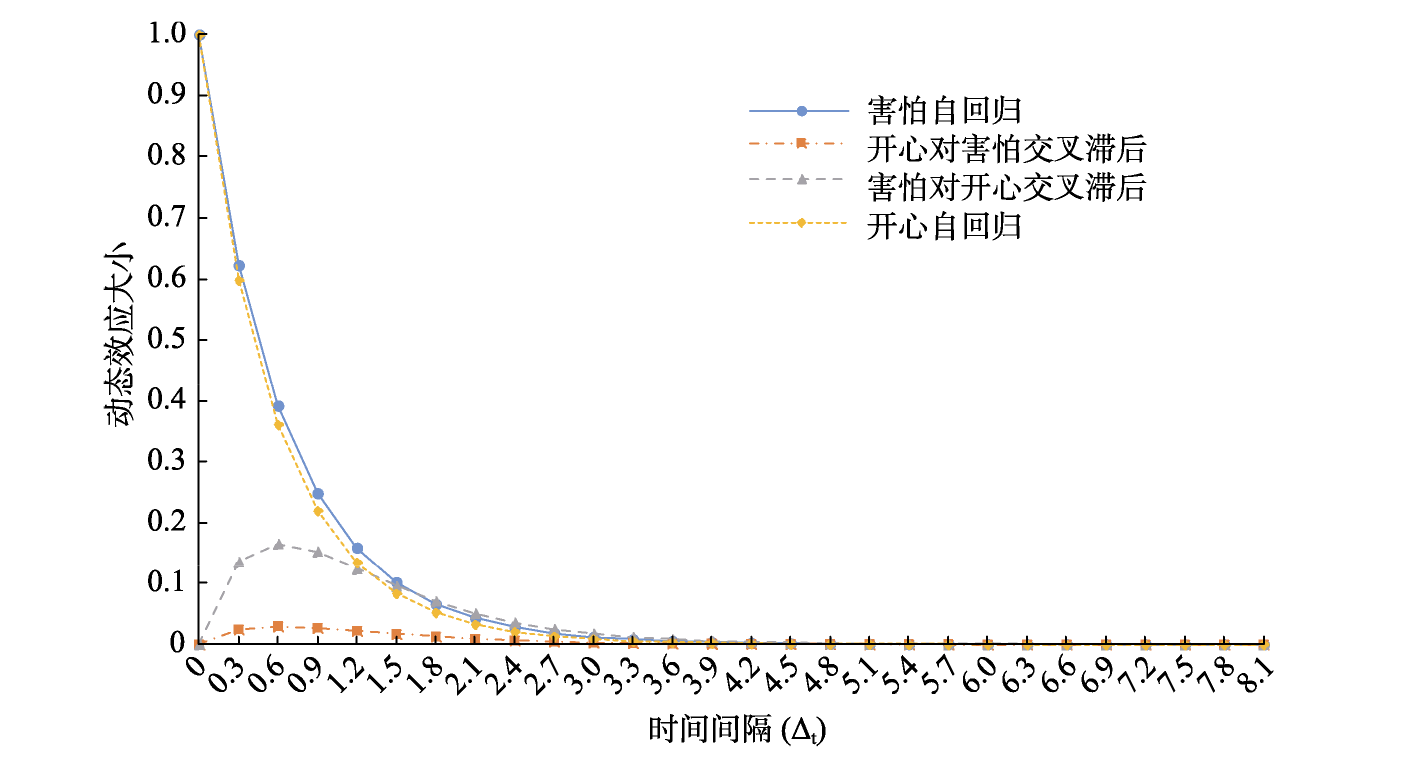
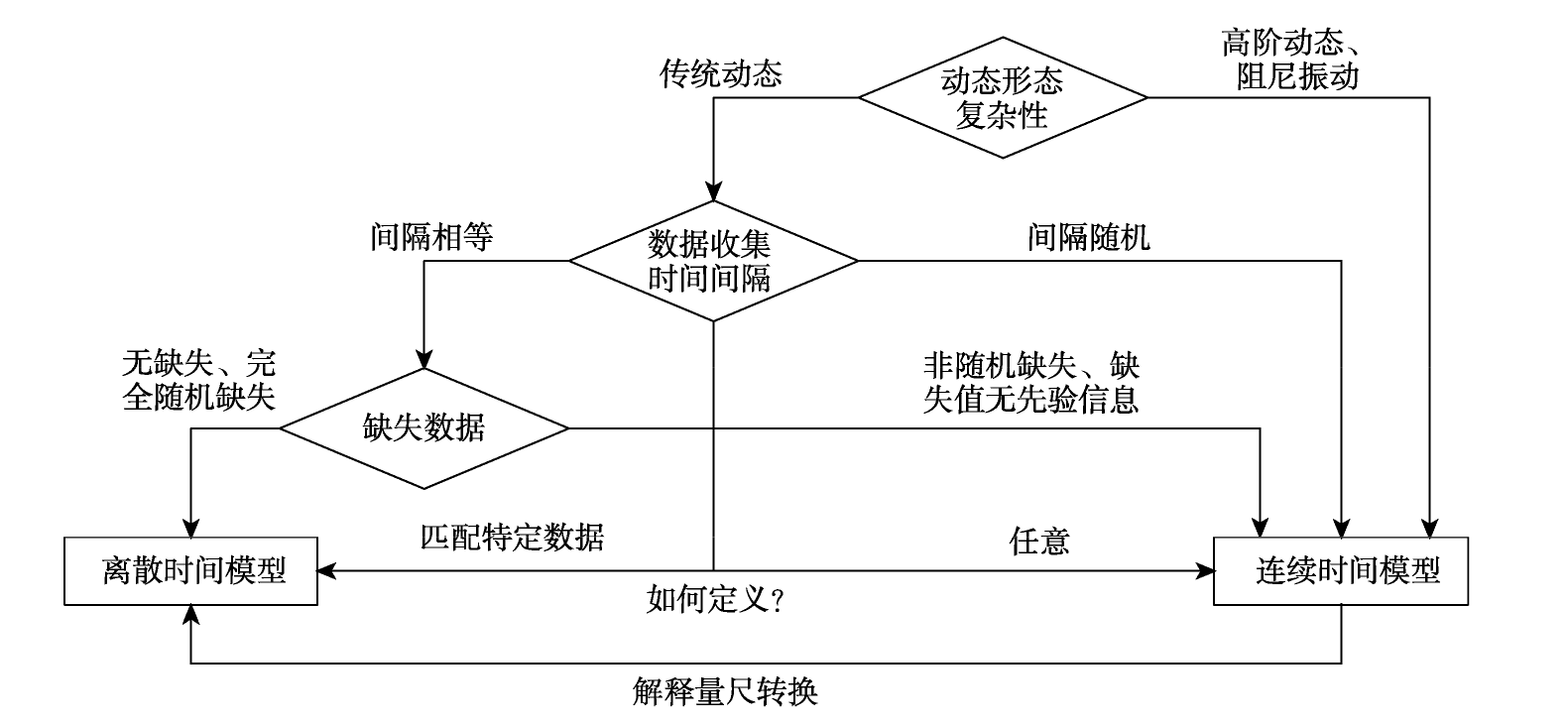
| 时间点数量 | 被试编号 | |
|---|---|---|
| CT模型 | DT模型 | |
| 24 | 23 | |
| 27 | 77 | |
| 28 | 26 | |
| 38 | 12 | |
| 51 | 23 | |
| 52 | 30 | |
| 54 | 24 | |
| 55 | 7 84 | |
| 56 | 38 | |
| 57 | 68 | |
| 58 | 27 13 89 | |
| 59 | 20 37 71 | |
| 60 | 72 91 | |
| 61 | 82 78 | |
| 62 | 57 | |
| 63 | 8 | |
| 64 | 48 | |
| 65 | 56 44 67 10 | |
| 66 | 54 76 4 17 93 | |
| 67 | 70 52 58 73 29 35 | |
| 68 | 34 90 39 42 | |
| 69 | 53 40 | |
| 70 | 1 86 | |
| 71 | 33 65 83 | |
| 72 | 32 9 31 80 | |
| 73 | 16 74 | |
| 74 | 81 14 64 | |
| 75 | 41 2 69 | |
| 76 | 88 43 21 66 6 | |
| 77 | 50 | |
| 78 | 61 11 36 45 47 59 92 75 | |
| 79 | 22 55 63 51 3 18 | |
| 80 | 46 15 5 | |
| 81 | 60 28 79 49 25 | |
| 82 | 85 19 87 | |
| 83 | 62 | |
| 98 | 12 26 | |
| 109 | 20 10 24 13 29 30 38 39 42 52 53 54 57 67 70 76 77 82 89 91 93 | |
| 114 | 44 71 72 | |
| 116 | 4 | |
| 121 | 27 | |
| 122 | 7 | |
| 130 | 40 | |
| 132 | 37 69 84 | |
| 133 | 60 1 68 8 32 55 48 | |
| 137 | 2 43 21 45 46 47 22 49 50 51 9 5 25 11 56 6 58 59 28 61 62 63 64 65 66 3 14 31 15 33 34 73 74 75 35 36 78 79 80 81 16 83 17 85 86 87 88 18 90 19 92 41 | |
| 时间点数量 | 被试编号 | |
|---|---|---|
| CT模型 | DT模型 | |
| 24 | 23 | |
| 27 | 77 | |
| 28 | 26 | |
| 38 | 12 | |
| 51 | 23 | |
| 52 | 30 | |
| 54 | 24 | |
| 55 | 7 84 | |
| 56 | 38 | |
| 57 | 68 | |
| 58 | 27 13 89 | |
| 59 | 20 37 71 | |
| 60 | 72 91 | |
| 61 | 82 78 | |
| 62 | 57 | |
| 63 | 8 | |
| 64 | 48 | |
| 65 | 56 44 67 10 | |
| 66 | 54 76 4 17 93 | |
| 67 | 70 52 58 73 29 35 | |
| 68 | 34 90 39 42 | |
| 69 | 53 40 | |
| 70 | 1 86 | |
| 71 | 33 65 83 | |
| 72 | 32 9 31 80 | |
| 73 | 16 74 | |
| 74 | 81 14 64 | |
| 75 | 41 2 69 | |
| 76 | 88 43 21 66 6 | |
| 77 | 50 | |
| 78 | 61 11 36 45 47 59 92 75 | |
| 79 | 22 55 63 51 3 18 | |
| 80 | 46 15 5 | |
| 81 | 60 28 79 49 25 | |
| 82 | 85 19 87 | |
| 83 | 62 | |
| 98 | 12 26 | |
| 109 | 20 10 24 13 29 30 38 39 42 52 53 54 57 67 70 76 77 82 89 91 93 | |
| 114 | 44 71 72 | |
| 116 | 4 | |
| 121 | 27 | |
| 122 | 7 | |
| 130 | 40 | |
| 132 | 37 69 84 | |
| 133 | 60 1 68 8 32 55 48 | |
| 137 | 2 43 21 45 46 47 22 49 50 51 9 5 25 11 56 6 58 59 28 61 62 63 64 65 66 3 14 31 15 33 34 73 74 75 35 36 78 79 80 81 16 83 17 85 86 87 88 18 90 19 92 41 | |
| 参数 | DT模型 | CT模型 | ||||
|---|---|---|---|---|---|---|
| Est. | 后验S.D. | 95% CI | Est. | 后验S.D. | 95% CI | |
| 固定效应 | ||||||
| 害怕截距(μ1) | 1.28 | 0.04 | [1.20, 1.35] | 1.29 | 0.04 | [1.20, 1.37] |
| 开心截距(μ2) | 1.96 | 0.09 | [1.78, 2.12] | 1.97 | 0.09 | [1.80, 2.14] |
| 害怕自回归(φ1) | 0.21 | 0.01 | [0.19, 0.24] | 0.20 | 0.02 | [0.17, 0.23] |
| 开心自回归(φ2) | 0.20 | 0.02 | [0.17, 0.23] | 0.19 | 0.02 | [0.16, 0.22] |
| 害怕→开心(φ3) | 0.12 | 0.03 | [0.07, 0.17] | 0.16 | 0.03 | [0.09, 0.21] |
| 开心→害怕(φ4) | 0.02 | 0.01 | [0.01, 0.04] | 0.03 | 0.01 | [0.01, 0.05] |
| 害怕斜率(γ1) | -0.01 | 0.00 | [-0.01, -0.00] | -0.01 | 0.00 | [-0.01, -0.00] |
| 开心斜率(γ2) | -0.01 | 0.00 | [-0.01, 0.00] | -0.01 | 0.00 | [-0.02, 0.00] |
| 随机效应 | ||||||
| 个体内害怕残差方差(σ12) | 0.36 | 0.01 | [0.35, 0.37] | 0.36 | 0.01 | [0.35, 0.37] |
| 开心残差方差(σ22) | 1.55 | 0.03 | [1.49, 1.60] | 1.56 | 0.03 | [1.51, 1.63] |
| 个体间害怕截距方差(τ12) | 0.13 | 0.02 | [0.10, 0.19] | 0.13 | 0.02 | [0.10, 0.18] |
| 开心截距方差(τ22) | 0.55 | 0.08 | [0.41, 0.73] | 0.54 | 0.09 | [0.39, 0.75] |
| 参数 | DT模型 | CT模型 | ||||
|---|---|---|---|---|---|---|
| Est. | 后验S.D. | 95% CI | Est. | 后验S.D. | 95% CI | |
| 固定效应 | ||||||
| 害怕截距(μ1) | 1.28 | 0.04 | [1.20, 1.35] | 1.29 | 0.04 | [1.20, 1.37] |
| 开心截距(μ2) | 1.96 | 0.09 | [1.78, 2.12] | 1.97 | 0.09 | [1.80, 2.14] |
| 害怕自回归(φ1) | 0.21 | 0.01 | [0.19, 0.24] | 0.20 | 0.02 | [0.17, 0.23] |
| 开心自回归(φ2) | 0.20 | 0.02 | [0.17, 0.23] | 0.19 | 0.02 | [0.16, 0.22] |
| 害怕→开心(φ3) | 0.12 | 0.03 | [0.07, 0.17] | 0.16 | 0.03 | [0.09, 0.21] |
| 开心→害怕(φ4) | 0.02 | 0.01 | [0.01, 0.04] | 0.03 | 0.01 | [0.01, 0.05] |
| 害怕斜率(γ1) | -0.01 | 0.00 | [-0.01, -0.00] | -0.01 | 0.00 | [-0.01, -0.00] |
| 开心斜率(γ2) | -0.01 | 0.00 | [-0.01, 0.00] | -0.01 | 0.00 | [-0.02, 0.00] |
| 随机效应 | ||||||
| 个体内害怕残差方差(σ12) | 0.36 | 0.01 | [0.35, 0.37] | 0.36 | 0.01 | [0.35, 0.37] |
| 开心残差方差(σ22) | 1.55 | 0.03 | [1.49, 1.60] | 1.56 | 0.03 | [1.51, 1.63] |
| 个体间害怕截距方差(τ12) | 0.13 | 0.02 | [0.10, 0.19] | 0.13 | 0.02 | [0.10, 0.18] |
| 开心截距方差(τ22) | 0.55 | 0.08 | [0.41, 0.73] | 0.54 | 0.09 | [0.39, 0.75] |
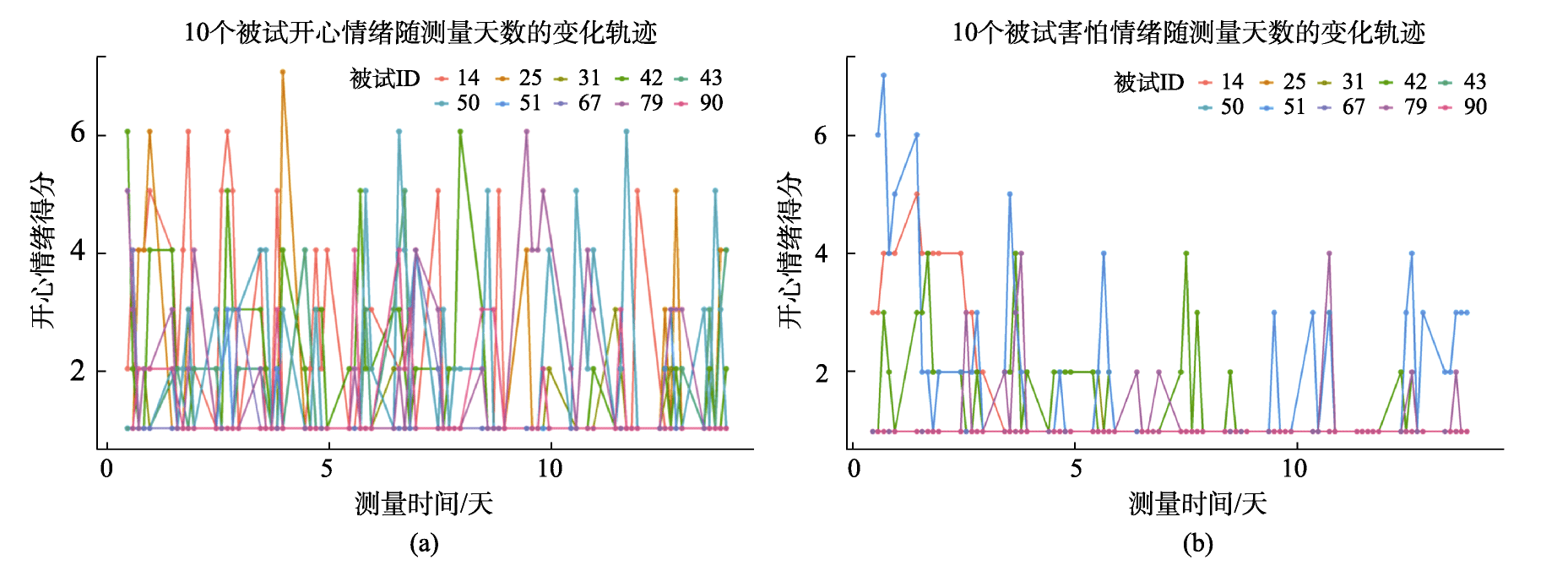
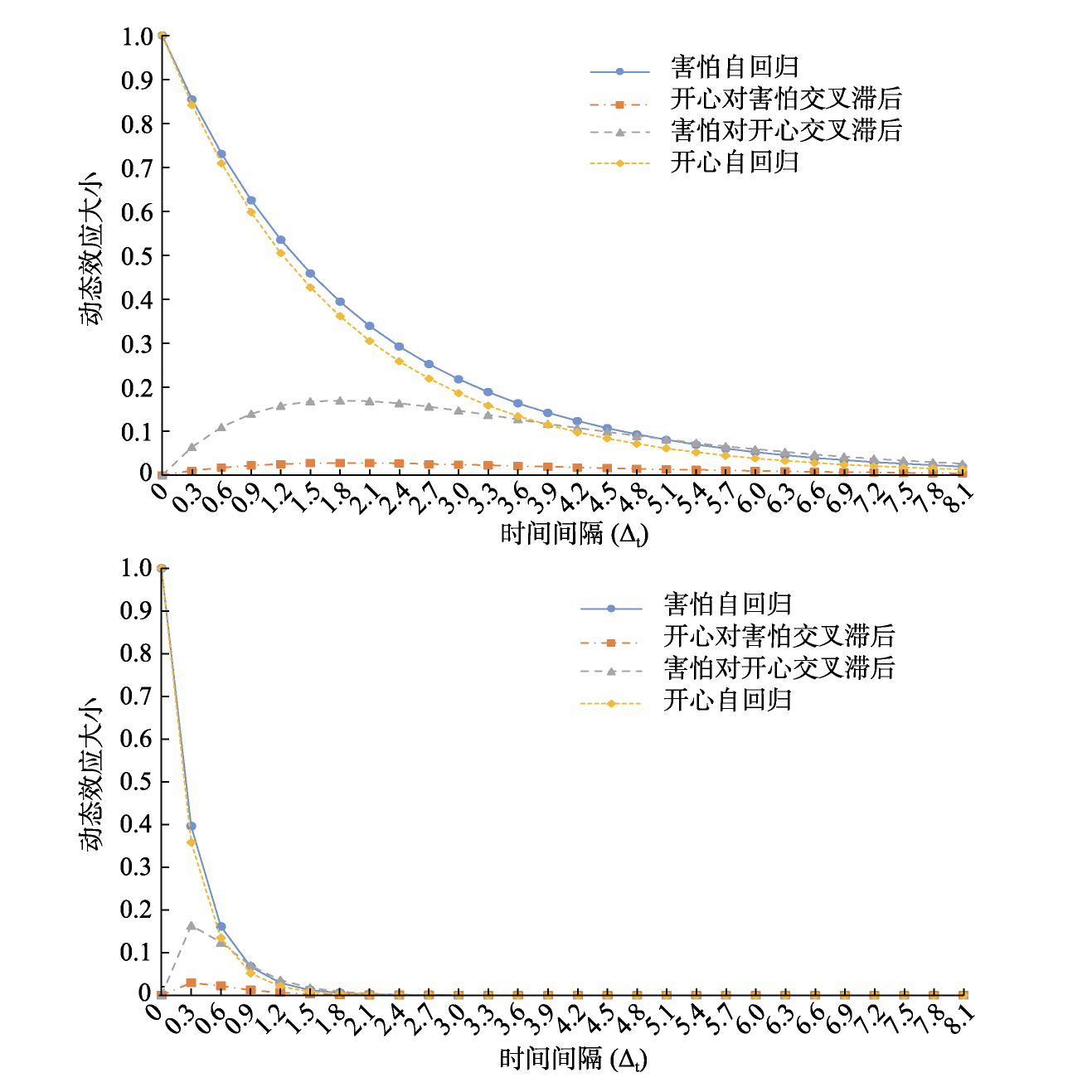
| 时间点数量 | 被试编号 | |
|---|---|---|
| CT模型 | DT模型 | |
| 24 | 23 | |
| 27 | 77 | |
| 28 | 26 | |
| 38 | 12 | |
| 45 | 84 | |
| 46 | 68 | |
| 47 | 78 | |
| 50 | 37 48 7 | |
| 51 | 23 | |
| 52 | 8 30 | |
| 53 | 35 | |
| 54 | 27 24 17 90 | |
| 55 | 58 34 | |
| 56 | 38 83 | |
| 57 | 56 86 33 | |
| 58 | 71 16 13 89 80 | |
| 59 | 72 20 65 | |
| 60 | 14 73 41 31 1 91 | |
| 61 | 82 32 64 43 9 21 81 | |
| 62 | 74 66 57 88 6 40 2 | |
| 63 | 45 36 75 50 11 92 | |
| 64 | 61 63 47 44 4 59 | |
| 65 | 46 18 3 10 67 51 | |
| 66 | 54 49 79 25 22 69 76 93 | |
| 67 | 15 5 85 28 87 29 60 70 52 19 55 | |
| 68 | 42 62 39 | |
| 69 | 53 | |
| 98 | 12 26 | |
| 106 | 48 | |
| 107 | ||
| 108 | 41 34 68 85 | |
| 109 | 9 10 11 1 13 14 15 16 17 18 19 20 21 22 2 24 25 3 27 28 29 30 31 32 33 4 35 36 37 38 39 40 5 42 43 44 45 46 47 6 49 50 51 52 53 54 55 56 57 58 59 60 61 62 63 64 65 66 67 7 69 70 71 72 73 74 75 76 77 78 79 80 81 82 83 84 8 86 87 88 89 90 91 92 93 | |
| 时间点数量 | 被试编号 | |
|---|---|---|
| CT模型 | DT模型 | |
| 24 | 23 | |
| 27 | 77 | |
| 28 | 26 | |
| 38 | 12 | |
| 45 | 84 | |
| 46 | 68 | |
| 47 | 78 | |
| 50 | 37 48 7 | |
| 51 | 23 | |
| 52 | 8 30 | |
| 53 | 35 | |
| 54 | 27 24 17 90 | |
| 55 | 58 34 | |
| 56 | 38 83 | |
| 57 | 56 86 33 | |
| 58 | 71 16 13 89 80 | |
| 59 | 72 20 65 | |
| 60 | 14 73 41 31 1 91 | |
| 61 | 82 32 64 43 9 21 81 | |
| 62 | 74 66 57 88 6 40 2 | |
| 63 | 45 36 75 50 11 92 | |
| 64 | 61 63 47 44 4 59 | |
| 65 | 46 18 3 10 67 51 | |
| 66 | 54 49 79 25 22 69 76 93 | |
| 67 | 15 5 85 28 87 29 60 70 52 19 55 | |
| 68 | 42 62 39 | |
| 69 | 53 | |
| 98 | 12 26 | |
| 106 | 48 | |
| 107 | ||
| 108 | 41 34 68 85 | |
| 109 | 9 10 11 1 13 14 15 16 17 18 19 20 21 22 2 24 25 3 27 28 29 30 31 32 33 4 35 36 37 38 39 40 5 42 43 44 45 46 47 6 49 50 51 52 53 54 55 56 57 58 59 60 61 62 63 64 65 66 67 7 69 70 71 72 73 74 75 76 77 78 79 80 81 82 83 84 8 86 87 88 89 90 91 92 93 | |
| [1] | 方杰, 温忠麟. (2023). 中介效应和调节效应模型进阶. 教育科学出版社. |
| [2] |
方杰, 温忠麟, 董育铭, 王晓洁. (2025). 密集追踪数据的中介效应分析. 心理科学进展, 33(4), 717-728.
doi: 10.3724/SP.J.1042.2025.0717 |
| [3] |
刘红云, 窦佳宁, 徐永泽. (2025). 密集追踪数据的收集方案优化和分析方法改进. 心理科学进展, 33(9), 1558-1574.
doi: 10.3724/SP.J.1042.2025.1558 |
| [4] |
刘源, 都弘彦, 方杰, 温忠麟. (2022). 国内追踪数据分析方法研究与模型发展. 心理科学进展, 30(8), 1734-1746.
doi: 10.3724/SP.J.1042.2022.01734 |
| [5] |
刘源, 姚志晨. (2025). 追踪研究中的趋势与动态:模型发展、整合与分化. 心理科学进展, 33(7), 1181-1198.
doi: 10.3724/SP.J.1042.2025.1181 |
| [6] |
刘玥, 徐雷, 刘红云, 韩雨婷, 游晓锋, 万志林. (2024). 置信区间宽度等高线图在线性混合效应模型样本量规划中的应用. 心理学报, 56(1), 124-138.
doi: 10.3724/SP.J.1041.2024.00124 |
| [7] |
罗晓慧, 刘红云. (2024). 密集追踪研究中测验信度的估计:多层结构和动态特性的视角. 心理科学进展, 32(4), 700-714.
doi: 10.3724/SP.J.1042.2024.00700 |
| [8] |
张银普, 骆南峰, 石伟. (2016). 经验取样法——一种收集“真实”数据的新方法. 心理科学进展, 24(2), 305-316.
doi: 10.3724/SP.J.1042.2016.00305 |
| [9] |
郑舒方, 张沥今, 乔欣宇, 潘俊豪. (2021). 密集追踪数据分析:模型及其应用. 心理科学进展, 29(11), 1948-1972.
doi: 10.3724/SP.J.1042.2021.01948 |
| [10] |
Asparouhov, T., Hamaker, E. L., & Muthén, B. (2018). Dynamic structural equation models. Structural Equation Modeling: A Multidisciplinary Journal, 25(3), 359-388.
doi: 10.1080/10705511.2017.1406803 URL |
| [11] |
Asparouhov, T., & Muthén, B. (2020). Comparison of models for the analysis of intensive longitudinal data. Structural Equation Modeling: A Multidisciplinary Journal, 27(2), 275-297.
doi: 10.1080/10705511.2019.1626733 URL |
| [12] |
Asparouhov, T., & Muthén, B. (2023). Residual structural equation models. Structural Equation Modeling: A Multidisciplinary Journal, 30(1), 1-31.
doi: 10.1080/10705511.2022.2074422 URL |
| [13] | Asparouhov, T., & Muthén, B. (2024). Continuous time dynamic structural equation models [Technical report]. Muthén & Muthén. https://www.statmodel.com/download/CTRDSEM.pdf |
| [14] |
Batra, R., Johal, S. K., Chen, M., & Ferrer, E. (2025). Consequences of sampling frequency on the estimated dynamics of AR processes using continuous-time models. Psychological Methods, 30(4), 843-865.
doi: 10.1037/met0000595 URL |
| [15] | Berkhout, S. W., Schuurman, N. K., & Hamaker, E. L. (2025). Let sleeping dogs lie? How to deal with the night gap problem in experience sampling method data. Psychological Methods. Advance online publication. https://doi.org/10.1037/met0000762 |
| [16] |
Boker, S. M., & Nesselroade, J. R. (2002). A method for modeling the intrinsic dynamics of intraindividual variability: Recovering the parameters of simulated oscillators in multi-wave panel data. Multivariate Behavioral Research, 37(1), 127-160.
doi: 10.1207/S15327906MBR3701_06 pmid: 26824172 |
| [17] | Boker, S., M., Tiberio, S. S., & Moulder, R. G. (2018). Robustness of time delay embedding to sampling interval misspecification. In K. van Montfort, J. H. L. Oud, & M. C. Voelkle (Eds.), Continuous time modeling in the behavioral and related sciences (pp. 239-258). Springer International Publishing. |
| [18] | Bolger, N., & Laurenceau, J.-P. (2013). Intensive longitudinal methods: An introduction to diary and experience sampling research. Guilford Press. |
| [19] |
Bringmann, L. F., Hamaker, E. L., Vigo, D. E., Aubert, A., Borsboom, D., & Tuerlinckx, F. (2017). Changing dynamics: Time-varying autoregressive models using generalized additive modeling. Psychological Methods, 22(3), 409-425. https://doi.org/10.1037/met0000085
doi: 10.1037/met0000085 URL pmid: 27668421 |
| [20] | Bringmann, L. F., Vissers, N., Wichers, M., Geschwind, N., Kuppens, P., Peeters, F.,... Tuerlinckx, F. (2013). A network approach to psychopathology: New insights into clinical longitudinal data. PLOS ONE, 8(4), Article e60188. https://doi.org/10.1371/journal.pone.0060188 |
| [21] | Chatfield, C. (2013). The analysis of time series: Theory and practice. Springer New York, NY. |
| [22] |
Chow, S. M., Ram, N., Boker, S. M., Fujita, F., & Clore, G. (2005). Emotion as a thermostat: Representing emotion regulation using a damped oscillator model. Emotion, 5(2), 208-225. https://doi.org/10.1037/1528-3542.5.2.208
doi: 10.1037/1528-3542.5.2.208 URL |
| [23] |
Courvoisier, D. S., Eid, M., & Lischetzke, T. (2012). Compliance to a cell phone-based ecological momentary assessment study: The effect of time and personality characteristics. Psychological Assessment, 24(3), 713-720. https://doi.org/10.1037/a0026733
doi: 10.1037/a0026733 URL pmid: 22250597 |
| [24] | de Haan-Rietdijk, S., Voelkle, M. C., Keijsers, L., & Hamaker, E. L. (2017). Discrete-vs. continuous-time modeling of unequally spaced experience sampling method data. Frontiers in Psychology, 8, Article 1849. https://doi.org/10.3389/fpsyg.2017.01849 |
| [25] |
Deboeck, P. R., & Boulton, A. J. (2016). Integration of stochastic differential equations using structural equation modeling: A method to facilitate model fitting and pedagogy. Structural Equation Modeling: A Multidisciplinary Journal, 23(6), 888-903.
doi: 10.1080/10705511.2016.1218763 URL |
| [26] |
Deboeck, P. R., & Preacher, K. J. (2016). No need to be discrete: A method for continuous time mediation analysis. Structural Equation Modeling: A Multidisciplinary Journal, 23(1), 61-75.
doi: 10.1080/10705511.2014.973960 URL |
| [27] |
Delsing, M. J. M. H., Oud, J. H. L., & De Bruyn, E. E. J. (2005). Assessment of bidirectional influences between family relationships and adolescent problem behavior. European Journal of Psychological Assessment, 21(4), 226-231.
doi: 10.1027/1015-5759.21.4.226 URL |
| [28] |
Dormann, C., & Griffin, M. A. (2015). Optimal time lags in panel studies. Psychological Methods, 20(4), 489-505. https://doi.org/10.1037/met0000041
doi: 10.1037/met0000041 URL pmid: 26322999 |
| [29] | Driver, C. C., Oud, J. H. L., & Voelkle, M. C. (2017). Continuous time structural equation modeling with R package ctsem. Journal of Statistical Software, 77(5), 1-35. https://doi.org/10.18637/jss.v077.i05 |
| [30] |
Driver, C. C., & Voelkle, M. C. (2018). Hierarchical Bayesian continuous time dynamic modeling. Psychological Methods, 23(4), 774-799. https://doi.org/10.1037/met0000168
doi: 10.1037/met0000168 URL pmid: 29595295 |
| [31] |
Fang, Y., & Wang, L. (2024). Dynamic structural equation models with missing data: Data requirements on N and T. Structural Equation Modeling: A Multidisciplinary Journal, 31(5), 891-908. https://doi.org/10.1080/10705511. 2023.2287967
doi: 10.1080/10705511.2023.2287967 URL |
| [32] | Gasimova, F., Robitzsch, A., Wilhelm, O., Boker, S. M., Hu, Y., & Hülür, G. (2014). Dynamical systems analysis applied to working memory data. Frontiers in Psychology, 5, Article 687. https://doi.org/10.3389/fpsyg.2014.00687 |
| [33] |
Gates, K. M., & Molenaar, P. C. M. (2012). Group search algorithm recovers effective connectivity maps for individuals in homogeneous and heterogeneous samples. NeuroImage, 63(1), 310-319.
doi: 10.1016/j.neuroimage.2012.06.026 pmid: 22732562 |
| [34] |
Gollob, H. F., & Reichardt, C. S. (1987). Taking account of time lags in causal models. Child Development, 58(1), 80-92. https://doi.org/10.2307/1130293
URL pmid: 3816351 |
| [35] | Grasman, J., Grasman, R. P. P. P., & van der Maas, H. L. J. (2016). The dynamics of addiction: Craving versus self-control. PLOS ONE, 11(6), Article e0158323. https://doi.org/10.1371/journal.pone.0158323 |
| [36] |
Hamaker, E. L. (2026). The within-between dispute in cross-lagged panel research and how to move forward. Psychological Methods, 31(1), 56-76. https://doi.org/ 10.1037/met0000600
doi: 10.1037/met0000600 URL |
| [37] |
Hamaker, E. L., Asparouhov, T., Brose, A., Schmiedek, F., & Muthén, B. (2018). At the frontiers of modeling intensive longitudinal data: Dynamic structural equation models for the affective measurements from the COGITO study. Multivariate Behavioral Research, 53(6), 820-841. https://doi.org/10.1080/00273171.2018.1446819
doi: 10.1080/00273171.2018.1446819 URL pmid: 29624092 |
| [38] | Hamaker, E., L., Asparouhov, T., & Muthén, B. (2021). Dynamic structural equation modeling as a combination of time series modeling, multilevel modeling, and structural equation modeling. In R. H. Hoyle (Ed.), Handbook of structural equation modeling (2nd ed., pp. 576-596). Guilford Press. |
| [39] |
Hamaker, E. L., Ceulemans, E., Grasman, R. P. P. P., & Tuerlinckx, F. (2015). Modeling affect dynamics: State of the art and future challenges. Emotion Review, 7(4), 316-322.
doi: 10.1177/1754073915590619 URL |
| [40] |
Hamaker, E. L., & Grasman, R. P. P. P. (2012). Regime switching state-space models applied to psychological processes: Handling missing data and making inferences. Psychometrika, 77(2), 400-422.
doi: 10.1007/s11336-012-9254-8 URL |
| [41] |
Hamaker, E. L., & Wichers, M. (2017). No time like the present: Discovering the hidden dynamics in intensive longitudinal data. Current Directions in Psychological Science, 26(1), 10-15.
doi: 10.1177/0963721416666518 URL |
| [42] | Hamilton, J. D. (1994). Time series analysis. Princeton University Press. |
| [43] | Harvey, A. C. (1990). Forecasting, structural time series models and the Kalman filter. Cambridge University Press. |
| [44] |
Hecht, M., Hardt, K., Driver, C. C., & Voelkle, M. C. (2019). Bayesian continuous-time Rasch models. Psychological Methods, 24(4), 516-537. https://doi.org/10.1037/met0000205
doi: 10.1037/met0000205 URL pmid: 31008622 |
| [45] |
Hecht, M., Walther, J. K., Arnold, M., & Zitzmann, S. (2024). Finding the optimal number of persons (N) and time points (T) for maximal power in dynamic longitudinal models given a fixed budget. Structural Equation Modeling: A Multidisciplinary Journal, 31(3), 535-551.
doi: 10.1080/10705511.2023.2230520 URL |
| [46] |
Hecht, M., & Zitzmann, S. (2021). Exploring the unfolding of dynamic effects with continuous-time models: Recommendations concerning statistical power to detect peak cross-lagged effects. Structural Equation Modeling: A Multidisciplinary Journal, 28(6), 894-902.
doi: 10.1080/10705511.2021.1914627 URL |
| [47] | Hsiao, C. (2022). Analysis of panel data (4th ed.). Cambridge University Press. |
| [48] |
Ji, L., Chow, S. M., Schermerhorn, A. C., Jacobson, N. C., & Cummings, E. M. (2018). Handling missing data in the modeling of intensive longitudinal data. Structural Equation Modeling: A Multidisciplinary Journal, 25(5), 715-736.
doi: 10.1080/10705511.2017.1417046 URL |
| [49] |
Jongerling, J., Laurenceau, J.-P., & Hamaker, E. L. (2015). A multilevel AR (1) model: Allowing for inter-individual differences in trait-scores, inertia, and innovation variance. Multivariate Behavioral Research, 50(3), 334-349. https://doi.org/10.1080/00273171.2014.1003772
doi: 10.1080/00273171.2014.1003772 URL pmid: 26610033 |
| [50] |
Kuiper, R. M., & Ryan, O. (2018). Drawing conclusions from cross-lagged relationships: Reconsidering the role of the time interval. Structural Equation Modeling: A Multidisciplinary Journal, 25(5), 809-823.
doi: 10.1080/10705511.2018.1431046 URL |
| [51] |
Lampe, E. W., Velkoff, E. A., & Manasse, S. M. (2026). Characterizing emotional inertia and its relation to eating disorder behaviors in patients seeking treatment for binge-spectrum eating disorders. International Journal of Eating Disorders, 59(3), 607-614. https://doi.org/10. 1002/eat.24602
doi: 10.1002/eat.v59.3 URL |
| [52] |
Liu, M., Stella, F., Hommersom, A., Lucas, P. J. F., Boer, L., & Bischoff, E. W. M. (2019). A comparison between discrete and continuous time Bayesian networks in learning from clinical time series data with irregularity. Artificial Intelligence in Medicine, 95, 104-117.
doi: S0933-3657(17)30492-X pmid: 30683464 |
| [53] |
Liu, S. (2017). Person-specific versus multilevel autoregressive models: Accuracy in parameter estimates at the population and individual levels. British Journal of Mathematical and Statistical Psychology, 70(3), 480-498.
doi: 10.1111/bmsp.2017.70.issue-3 URL |
| [54] |
Liu, S., & Molenaar, P. C. M. (2014). iVAR: A program for imputing missing data in multivariate time series using vector autoregressive models. Behavior Research Methods, 46(4), 1138-1148.
doi: 10.3758/s13428-014-0444-4 pmid: 24515888 |
| [55] |
Lohmann, J. F., Zitzmann, S., & Hecht, M. (2024). Studying between-subject differences in trends and dynamics: Introducing the random coefficients continuous-time latent curve model with structured residuals. Structural Equation Modeling: A Multidisciplinary Journal, 31(1), 151-164.
doi: 10.1080/10705511.2023.2192889 URL |
| [56] | Lohmann, J. F., Zitzmann, S., Voelkle, M. C., & Hecht, M. (2022). A primer on continuous-time modeling in educational research: An exemplary application of a continuous-time latent curve model with structured residuals (CT-LCM-SR) to PISA data. Large-scale Assessments in Education, 10(1), Article 5. |
| [57] | Luo, X., Hu, Y., & Liu, H. (2025). Timescale mismatch in intensive longitudinal data: Current issues and possible solutions based on dynamic structural equation models. Psychological Methods. Advance online publication. https://doi.org/10.1037/met0000749 |
| [58] | Lütkepohl,, H. (2013). Vector autoregressive models. In N. Hashimzade & M. A. Thornton (Eds.), Handbook of research methods and applications in empirical macroeconomics (pp. 139-164). Edward Elgar Publishing. |
| [59] | McNeish, D. (2025). Missing not at random intensive longitudinal data with dynamic structural equation models. Psychological Methods. Advance online publication. https://doi.org/10.1037/met0000742 |
| [60] |
McNeish, D., & Hamaker, E. L. (2020). A primer on two- level dynamic structural equation models for intensive longitudinal data in Mplus. Psychological Methods, 25(5), 610-635. https://doi.org/10.1037/met0000250
doi: 10.1037/met0000250 URL |
| [61] |
Messiah, A., Grondin, O., & Encrenaz, G. (2011). Factors associated with missing data in an experience sampling investigation of substance use determinants. Drug and Alcohol Dependence, 114(2-3), 153-158.
doi: 10.1016/j.drugalcdep.2010.09.016 URL |
| [62] |
Molenaar, P. C. M., & Campbell, C. G. (2009). The new person-specific paradigm in psychology. Current Directions in Psychological Science, 18(2), 112-117.
doi: 10.1111/j.1467-8721.2009.01619.x URL |
| [63] | Muthén, B., & Asparouhov, T. (2023). Using Mplus to do dynamic structural equation modeling. Mplus Web Talks, 6. |
| [64] |
Muthén, B., Asparouhov, T., & Keijsers, L. (2025). Dynamic structural equation modeling with cycles. Structural Equation Modeling: A Multidisciplinary Journal, 32(2), 264-286. https://doi.org/10.1080/10705511.2024.2406510
doi: 10.1080/10705511.2024.2406510 URL |
| [65] |
Oravecz, Z., Tuerlinckx, F., & Vandekerckhove, J. (2011). A hierarchical latent stochastic differential equation model for affective dynamics. Psychological Methods, 16(4), 468-490. https://doi.org/10.1037/a0024375
doi: 10.1037/a0024375 URL pmid: 21823796 |
| [66] | Oud, J. H., L., & Delsing, M. J. M. H. (2010). Continuous time modeling of panel data by means of SEM. In K. van Montfort, J. H. L. Oud, & A. Satorra (Eds.), Longitudinal research with latent variables (pp. 201-244). Springer, Berlin, Heidelberg. |
| [67] |
Ployhart, R. E., Bliese, P. D., & Strizver, S. D. (2025). Intensive longitudinal models. Annual Review of Organizational Psychology and Organizational Behavior, 12(1), 343-367.
doi: 10.1146/orgpsych.2025.12.issue-1 URL |
| [68] |
Posner, J., Russell, J. A., & Peterson, B. S. (2005). The circumplex model of affect: An integrative approach to affective neuroscience, cognitive development, and psychopathology. Development and Psychopathology, 17(3), 715-734.
doi: 10.1017/S0954579405050340 pmid: 16262989 |
| [69] |
Ram, N., & Gerstorf, D. (2009). Time-structured and net intraindividual variability: Tools for examining the development of dynamic characteristics and processes. Psychology and Aging, 24(4), 778-791.
doi: 10.1037/a0017915 pmid: 20025395 |
| [70] | Raudenbush, S. W., & Bryk, A. S. (2002). Hierarchical linear models: Applications and data analysis methods (2nd ed.). Sage. |
| [71] | Revol, J., Ariens, S., Lafit, G., Adolf, J., & Ceulemans, E. (2025). Episode-contingent experience-sampling designs for accurate estimates of autoregressive dynamics. Psychological Methods. Advance online publication. https://doi.org/10.1037/met0000758 |
| [72] |
Rindskopf, D. (1984). Using phantom and imaginary latent variables to parameterize constraints in linear structural models. Psychometrika, 49(1), 37-47.
doi: 10.1007/BF02294204 URL |
| [73] | Ringwald, W. R., Feltman, S., Cloutson, S. A., Mann, F., Ruggero, C., Bromet, E., Luft, B. J., & Kotov, R. (2025). Stress dynamics that maintain posttraumatic stress disorder across 20 years. Psychological Medicine, 55, Article e151. https://doi.org/10.1017/S0033291725000686 |
| [74] |
Russell, J. A. (1980). A circumplex model of affect. Journal of Personality and Social Psychology, 39(6), 1161-1178.
doi: 10.1037/h0077714 URL |
| [75] |
Ryan, O., & Hamaker, E. L. (2022). Time to intervene: A continuous-time approach to network analysis and centrality. Psychometrika, 87(1), 214-252.
doi: 10.1007/s11336-021-09767-0 URL |
| [76] | Ryan,, O., Kuiper, R. M., & Hamaker, E. L. (2018). A continuous-time approach to intensive longitudinal data:What, why, and how? In K. van Montfort, J. H. L. Oud, & M. C. Voelkle (Eds.), Continuous time modeling in the behavioral and related sciences (pp. 27-54). Springer International Publishing. |
| [77] |
Schultzberg, M., & Muthén, B. (2018). Number of subjects and time points needed for multilevel time-series analysis: A simulation study of dynamic structural equation modeling. Structural Equation Modeling: A Multidisciplinary Journal, 25(4), 495-515.
doi: 10.1080/10705511.2017.1392862 URL |
| [78] | Schuurman, N. K., Houtveen, J. H., & Hamaker, E. L. (2015). Incorporating measurement error in n = 1 psychological autoregressive modeling. Frontiers in Psychology, 6, Article 1038. https://doi.org/10.3389/fpsyg.2015.01038 |
| [79] |
Silvia, P. J., Kwapil, T. R., Eddington, K. M., & Brown, L. H. (2013). Missed beeps and missing data: Dispositional and situational predictors of nonresponse in experience sampling research. Social Science Computer Review, 31(4), 471-481.
doi: 10.1177/0894439313479902 URL |
| [80] | Solanas, A., Manolov, R., & Sierra, V. (2010). Lag-one autocorrelation in short series: Estimation and hypothesis testing. Psicológica, 31(2), 357-381. |
| [81] | van der, Krieke, L.,Emerencia, A. C., Bos, E. H., Rosmalen, J. G. M., Riese, H., Aiello, M.,... de Jonge, P. (2015). Ecological momentary assessments and automated time series analysis to promote tailored health care: A proof-of-principle study. JMIR Research Protocols, 4(3), Article e100. |
| [82] | van Montfort, K., Oud, J. H. L., & Voelkle, M. C. (Eds.). (2018). Continuous time modeling in the behavioral and related sciences. Springer International Publishing. |
| [83] |
Voelkle, M. C., Gische, C., Driver, C. C., & Lindenberger, U. (2018). The role of time in the quest for understanding psychological mechanisms. Multivariate Behavioral Research, 53(6), 782-805.
doi: 10.1080/00273171.2018.1496813 pmid: 30668172 |
| [84] |
Voelkle, M. C., & Oud, J. H. L. (2013). Continuous time modelling with individually varying time intervals for oscillating and non-oscillating processes. British Journal of Mathematical and Statistical Psychology, 66(1), 103-126.
doi: 10.1111/bmsp.2013.66.issue-1 URL |
| [85] |
Voelkle, M. C., Oud, J. H. L., Davidov, E., & Schmidt, P. (2012). An SEM approach to continuous time modeling of panel data: Relating authoritarianism and anomia. Psychological Methods, 17(2), 176-192. https://doi.org/10. 1037/a0027543
doi: 10.1037/a0027543 URL pmid: 22486576 |
| [86] |
Walther, J. K., Hecht, M., Nagengast, B., & Zitzmann, S. (2024). To be long or to be wide: How data format influences convergence and estimation accuracy in multilevel structural equation modeling. Structural Equation Modeling: A Multidisciplinary Journal, 31(5), 759-774.
doi: 10.1080/10705511.2024.2320050 URL |
| [87] |
Ward, M. K., & Meade, A. W. (2023). Dealing with careless responding in survey data: Prevention, identification, and recommended best practices. Annual Review of Psychology, 74(1), 577-596.
doi: 10.1146/psych.2023.74.issue-1 URL |
| [88] |
Zhang, Z., & Nesselroade, J. R. (2007). Bayesian estimation of categorical dynamic factor models. Multivariate Behavioral Research, 42(4), 729-756.
doi: 10.1080/00273170701715998 URL |
| [1] | SUN Huanxiang, ZHANG Fan, LI Sijia, ZHANG Xiuling, JIANG Yi. Simplify complexity: The neural mechanisms underlying ensemble perception [J]. Advances in Psychological Science, 2026, 34(2): 251-270. |
| [2] | SONG Yu, HU Xiaoran. The dynamics of human trust in AI from the instrumental and value perspectives [J]. Advances in Psychological Science, 2026, 34(11): 1908-1932. |
| [3] | LIU Yuan, YAO Zhichen. Trends and dynamics in longitudinal research: Model development, integration, and differentiation [J]. Advances in Psychological Science, 2025, 33(7): 1181-1198. |
| [4] | FANG Jie, WEN Zhonglin, DONG Yuming, WANG Xiaojie. Mediation analysis of intensive longitudinal data [J]. Advances in Psychological Science, 2025, 33(4): 717-728. |
| [5] | XIAO Yue, LIU Hongyun, XU Yongze. Model construction for intensive longitudinal dyadic data analysis [J]. Advances in Psychological Science, 2024, 32(9): 1450-1462. |
| [6] | WU Chaoyi, WANG Zhen. The dynamic features of emotion dysregulation in major depressive disorder: An emotion dynamics perspective [J]. Advances in Psychological Science, 2024, 32(2): 364-385. |
| [7] | DANG Min, CAI Wenqi, CHEN Fakun, WANG Xiaojuan, YANG Jianfeng. Dynamic collaboration of reading neural pathways driven by the processing demands [J]. Advances in Psychological Science, 2024, 32(1): 118-130. |
| [8] | WU Fan, HU Yueqin. Personality dynamics: The integration of process and trait [J]. Advances in Psychological Science, 2023, 31(7): 1269-1287. |
| [9] | ZHANG Yakun, CHEN Ning, CHEN Lung An, SHI Jiannong. Wisdom minds with creative wings: Igniting creative dynamics focusing on its interest cultivation [J]. Advances in Psychological Science, 2021, 29(4): 707-722. |
| [10] | REN Xiaoyun, DUAN Jinyun, FENG Chengzhi. Individuals vs groups: Advice-taking in decision making [J]. Advances in Psychological Science, 2021, 29(3): 549-559. |
| [11] | ZHENG Shufang, ZHANG Lijin, QIAO Xinyu, PAN Junhao. Intensive longitudinal data analysis: Models and application [J]. Advances in Psychological Science, 2021, 29(11): 1948-1969. |
| [12] | WANG Biying, GAO Riguang, SHU Xiajun. Workplace status: The multifaceted characteristics and dynamic influence mechanism [J]. Advances in Psychological Science, 2020, 28(6): 904-923. |
| [13] | JIA Huibin;ZHAO Qingbai;ZHOU Zhijin. Mental Workload Assessment: From the Perspective of Neuroergonomics [J]. Advances in Psychological Science, 2013, 21(8): 1390-1399. |
| [14] | LI Gai;FANG Ping;JIANG Yuan. The Advance of the Temporal Dynamics of Affective Responding [J]. , 2008, 16(2): 290-294. |
| [15] | An Jinghui,Zhang Jianxin. The Simulated Situation Approach in Personality Psychology [J]. , 2004, 12(3): 402-408. |
| Viewed | ||||||
|
Full text |
|
|||||
|
Abstract |
|
|||||
