

ISSN 1671-3710
CN 11-4766/R
主办:中国科学院心理研究所
出版:科学出版社
CN 11-4766/R
主办:中国科学院心理研究所
出版:科学出版社
Advances in Psychological Science ›› 2026, Vol. 34 ›› Issue (9): 1514-1528.doi: 10.3724/SP.J.1042.2026.1514
• Conceptual Framework • Previous Articles Next Articles
ZHANG Hejing1,2, CHEN Yiming1, MA Yina2,3( )
)
Received:2025-12-05
Online:2026-09-15
Published:2026-07-20
Contact:
MA Yina
E-mail:yma@bnu.edu.cn
CLC Number:
ZHANG Hejing, CHEN Yiming, MA Yina. Neural computations of ingroup−outgroup subjective value: Toward precise prediction and intervention in intergroup cooperation and conflict[J]. Advances in Psychological Science, 2026, 34(9): 1514-1528.
| 核心术语 | 心理学概念 | 本研究中的操作性定义 |
|---|---|---|
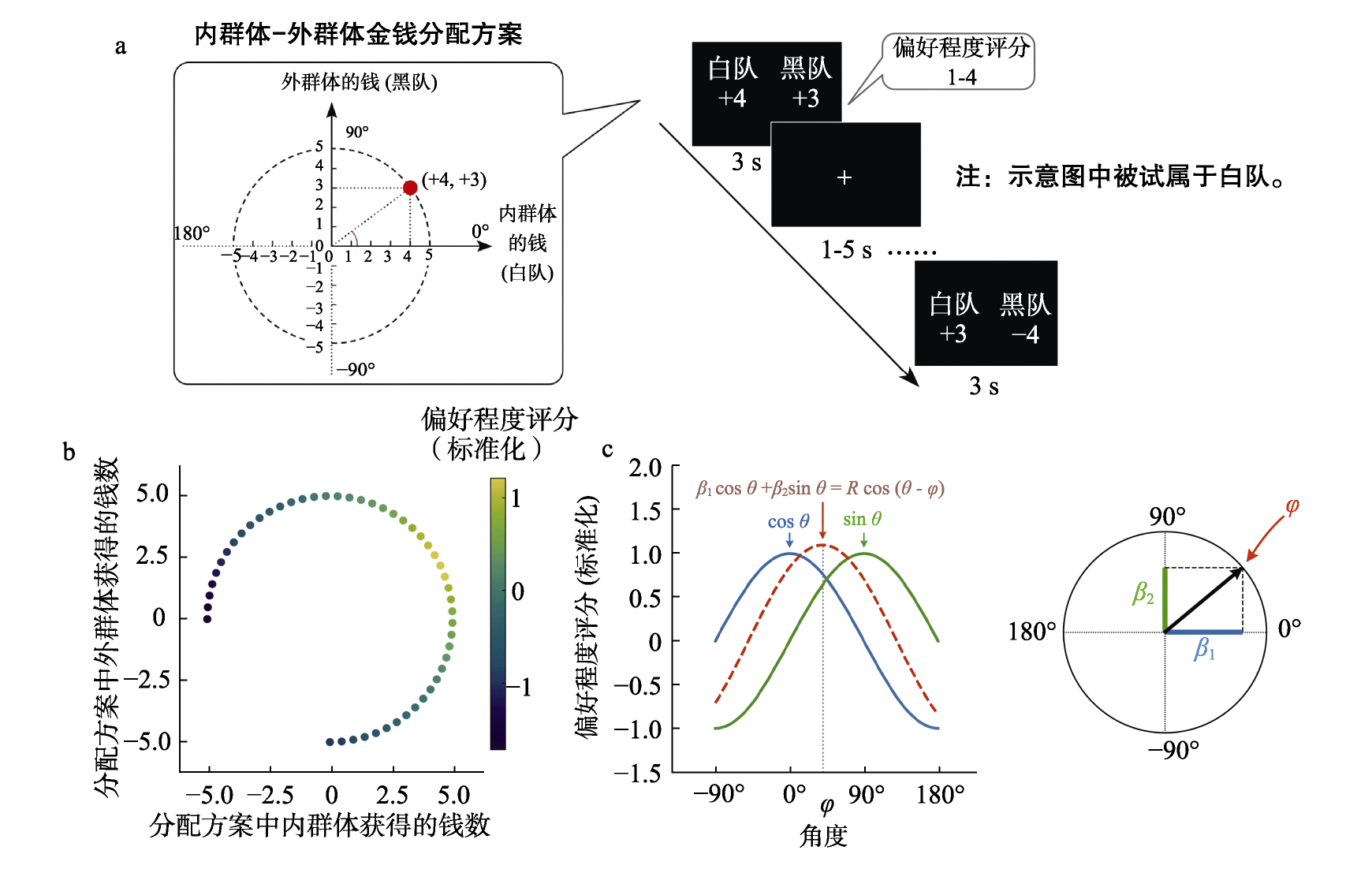
| 价值权重 | 价值权重指个体在群际资源分配判断中, 对不同受益对象(例如: 内群体 vs 外群体)得失信息的主观赋权强度, 可理解为在形成偏好/满意度时, 内群体利益与外群体利益各自被纳入决策的相对重要性。 | 在“内群体−外群体利益分配任务”中, 将每一试次的分配方案表示为角度 |
| 主观价值表征或价值表征 | 主观价值表征指个体在特定情境与目标约束下, 将客观结果及其不确定性(如不同对象的收益/损失、成本与风险)结合个体的偏好权重与主观信念进行赋权整合, 映射为可比较的内部效用变量, 并在认知计算与神经活动层面被编码, 以支持偏好表达与决策选择。 | 在行为建模中, 我们将方案的客观结果映射为共同尺度的内部效用变量, 如: 在神经层面, 在fMRI中将这些变量用于参数调节与多变量模式表征分析, 以检验这些价值量在脑内如何被编码与分布式表征。 |
| 群际参照点 | 群际参照点描述了个体主观最优的内−外群体分配方案, 即主观的群际赋权差异, 它能够连续、精准且个性化地刻画群际决策中个体对内−外群体利益的相对重视程度及其偏向。 | 群际参照点 |
| 核心术语 | 心理学概念 | 本研究中的操作性定义 |
|---|---|---|
| 价值权重 | 价值权重指个体在群际资源分配判断中, 对不同受益对象(例如: 内群体 vs 外群体)得失信息的主观赋权强度, 可理解为在形成偏好/满意度时, 内群体利益与外群体利益各自被纳入决策的相对重要性。 | 在“内群体−外群体利益分配任务”中, 将每一试次的分配方案表示为角度 |
| 主观价值表征或价值表征 | 主观价值表征指个体在特定情境与目标约束下, 将客观结果及其不确定性(如不同对象的收益/损失、成本与风险)结合个体的偏好权重与主观信念进行赋权整合, 映射为可比较的内部效用变量, 并在认知计算与神经活动层面被编码, 以支持偏好表达与决策选择。 | 在行为建模中, 我们将方案的客观结果映射为共同尺度的内部效用变量, 如: 在神经层面, 在fMRI中将这些变量用于参数调节与多变量模式表征分析, 以检验这些价值量在脑内如何被编码与分布式表征。 |
| 群际参照点 | 群际参照点描述了个体主观最优的内−外群体分配方案, 即主观的群际赋权差异, 它能够连续、精准且个性化地刻画群际决策中个体对内−外群体利益的相对重视程度及其偏向。 | 群际参照点 |
| [1] |
Allidina, S., & Cunningham, W. (2024). If not me then we: Goal tradeoffs in decision-making for the self, ingroup, and outgroup. Journal of Experimental Social Psychology, 113, 104625.
doi: 10.1016/j.jesp.2024.104625 URL |
| [2] | Amodio, D. M., & Berg, J. J. (2022). The neural underpinnings of intergroup bias. In The neuroscience of intergroup relations (pp. 3-15). Routledge. |
| [3] |
Banerjee, A., Parente, G., Teutsch, J., Lewis, C., Voigt, F. F., & Helmchen, F. (2020). Value-guided remapping of sensory cortex by lateral orbitofrontal cortex. Nature, 585(7824), 245-250.
doi: 10.1038/s41586-020-2704-z |
| [4] |
Bernhard, H., Fischbacher, U., & Fehr, E. (2006). Parochial altruism in humans. Nature, 442(7105), 912-915.
doi: 10.1038/nature04981 |
| [5] | Burkhart, J. C., Gupta, S., Borrego, N., Heilbronner, S. R., & Packer, C. (2022). Oxytocin promotes social proximity and decreases vigilance in groups of African lions. iScience, 25(4), 104049. |
| [6] |
Cikara, M., & Van Bavel, J. J. (2014). The neuroscience of intergroup relations: An integrative review. Perspectives on Psychological Science, 9(3), 245-274.
doi: 10.1177/1745691614527464 pmid: 26173262 |
| [7] |
De Dreu, C. K. W., Greer, L. L., Handgraaf, M. J. J., Shalvi, S., Van Kleef, G. A., Baas, M.,... Feith, S. W. W. (2010). The neuropeptide oxytocin regulates parochial altruism in intergroup conflict among humans. Science, 328(5984), 1408-1411.
doi: 10.1126/science.1189047 pmid: 20538951 |
| [8] |
De Dreu, C. K. W., Greer, L. L., Van Kleef, G. A., Shalvi, S., Handgraaf, M. J. J., & Massey, D. S. (2011). Oxytocin promotes human ethnocentrism. Proceedings of the National Academy of Sciences, 108(4), 1262-1266.
doi: 10.1073/pnas.1015316108 URL |
| [9] |
De Dreu, C. K. W., Gross, J., Fariña, A., & Ma, Y. (2020). Group cooperation, carrying-capacity stress, and intergroup conflict. Trends in Cognitive Sciences, 24(9), 760-776.
doi: S1364-6613(20)30146-7 pmid: 32620334 |
| [10] | De Dreu, C. K. W., Shalvi, S., Greer, L. L., Van Kleef, G. A., & Handgraaf, M. J. J. (2012). Oxytocin motivates non- cooperation in intergroup conflict to protect vulnerable in-group members. PLOS ONE, 7(11), e46751. |
| [11] |
Dunham, Y. (2018). Mere membership. Trends in Cognitive Sciences, 22(9), 780-793.
doi: S1364-6613(18)30144-X pmid: 30119749 |
| [12] |
Friston, K. J., Preller, K. H., Mathys, C., Cagnan, H., Heinzle, J., Razi, A., & Zeidman, P. (2019). Dynamic causal modelling revisited. NeuroImage, 199, 730-744.
doi: S1053-8119(17)30156-8 pmid: 28219774 |
| [13] |
Gangopadhyay, P., Chawla, M., Dal Monte, O., & Chang, S. W. C. (2021). Prefrontal-amygdala circuits in social decision-making. Nature Neuroscience, 24(1), 5-18.
doi: 10.1038/s41593-020-00738-9 pmid: 33169032 |
| [14] | Glynatsi, N. E., McAvoy, A., & Hilbe, C. (2024). Evolution of reciprocity with limited payoff memory. Proceedings of the Royal Society B: Biological Sciences, 291(2025), 20232493. |
| [15] |
Han, S. (2018). Neurocognitive basis of racial ingroup bias in empathy. Trends in Cognitive Sciences, 22(5), 400-421.
doi: S1364-6613(18)30049-4 pmid: 29563059 |
| [16] |
Han, X., Gelfand, M. J., Wu, B., Zhang, T., Li, W., Gao, T.,... Han, S. (2020). A neurobiological association of revenge propensity during intergroup conflict. eLife, 9, e52014.
doi: 10.7554/eLife.52014 URL |
| [17] | Homans, G. C. (2017). The human group. Routledge. |
| [18] |
Huang, Y., Kendrick, K., Zheng, H., & Yu, R. (2015). Oxytocin enhances implicit social conformity to both in-group and out-group opinions. Psychoneuroendocrinology, 60, 114-119.
doi: 10.1016/j.psyneuen.2015.06.003 pmid: 26143536 |
| [19] | Imada, H., Mifune, N., & Shimizu, H. (2024). Psychological mechanisms underlying ingroup favouritism in cooperation: Revisiting the reputation management and expectation hypotheses. Group Processes & Intergroup Relations, 27(8), 1914-1930. |
| [20] |
Jocham, G., Klein, T. A., & Ullsperger, M. (2011). Dopamine- mediated reinforcement learning signals in the striatum and ventromedial prefrontal cortex underlie value-based choices. The Journal of Neuroscience, 31(5), 1606-1613.
doi: 10.1523/JNEUROSCI.3904-10.2011 URL |
| [21] | Kay, T., Lehmann, L., & Keller, L. (2019). Kin selection and altruism. Current Biology, 29(11), R438-R442. |
| [22] |
Knudsen, E. B., & Wallis, J. D. (2022). Taking stock of value in the orbitofrontal cortex. Nature Reviews Neuroscience, 23(7), 428-438.
doi: 10.1038/s41583-022-00589-2 pmid: 35468999 |
| [23] |
Kredlow, M. A., Fenster, R. J., Laurent, E. S., Ressler, K. J., & Phelps, E. A. (2022). Prefrontal cortex, amygdala, and threat processing: Implications for PTSD. Neuropsychopharmacology, 47(1), 247-259.
doi: 10.1038/s41386-021-01155-7 |
| [24] |
Li, H., Namburi, P., Olson, J. M., Borio, M., Lemieux, M. E., Beyeler, A.,... Tye, K. M. (2022). Neurotensin orchestrates valence assignment in the amygdala. Nature, 608(7923), 586-592.
doi: 10.1038/s41586-022-04964-y |
| [25] |
Liu, Y., Li, S., Lin, W., Li, W., Yan, X., Wang, X.,... Ma, Y. (2019). Oxytocin modulates social value representations in the amygdala. Nature Neuroscience, 22(4), 633-641.
doi: 10.1038/s41593-019-0351-1 pmid: 30911182 |
| [26] |
Luo, R., Xu, L., Zhao, W., Ma, X., Xu, X., Kou, J.,... Kendrick, K. (2017). Oxytocin facilitation of acceptance of social advice is dependent upon the perceived trustworthiness of individual advisors. Psychoneuroendocrinology, 83, 1-8.
doi: S0306-4530(17)30240-8 pmid: 28554166 |
| [27] |
Ma, Y., Shamay-Tsoory, S., Han, S., & Zink, C. F. (2016). Oxytocin and social adaptation: Insights from neuroimaging studies of healthy and clinical populations. Trends in Cognitive Sciences, 20(2), 133-145.
doi: S1364-6613(15)00275-2 pmid: 26616296 |
| [28] | Madden, J. R., & Clutton-Brock, T. H. (2011). Experimental peripheral administration of oxytocin elevates a suite of cooperative behaviours in a wild social mammal. Proceedings of the Royal Society B : Biological Sciences, 278(1709), 1189-1194. |
| [29] |
Marchlewska, M., Cichocka, A., Jaworska, M., Golec de Zavala, A., & Bilewicz, M. (2020). Superficial ingroup love? Collective narcissism predicts ingroup image defense, outgroup prejudice, and lower ingroup loyalty. British Journal of Social Psychology, 59(4), 857-875.
doi: 10.1111/bjso.v59.4 URL |
| [30] |
Molenberghs, P., Bosworth, R., Nott, Z., Louis, W. R., Smith, J. R., Amiot, C. E.,... Decety, J. (2014). The influence of group membership and individual differences in psychopathy and perspective taking on neural responses when punishing and rewarding others. Human Brain Mapping, 35(10), 4989-4999.
doi: 10.1002/hbm.22527 pmid: 24753026 |
| [31] |
Papo, D., & Buldú, J. M. (2024). Does the brain behave like a (complex) network? I. Dynamics. Physics of Life Reviews, 48, 47-98.
doi: 10.1016/j.plrev.2023.12.006 URL |
| [32] | Rivera, L., Vu, H., & Backstrom, V. (2024). Self-esteem, ingroup favoritism, and outgroup evaluations: A meta-analysis. Group Processes & Intergroup Relations, 27(7), 1569-1588. |
| [33] |
Saarinen, A., Jääskeläinen, I. P., Harjunen, V., Keltikangas- Järvinen, L., Jasinskaja-Lahti, I., & Ravaja, N. (2021). Neural basis of in-group bias and prejudices: A systematic meta-analysis. Neuroscience and Biobehavioral Reviews, 131, 1214-1227.
doi: 10.1016/j.neubiorev.2021.10.027 pmid: 34715150 |
| [34] | Smith, D. (2020). Cultural group selection and human cooperation: A conceptual and empirical review. Evolutionary Human Sciences, 2, e2. |
| [35] | Tajfel,, H., & Turner, J. C. (2004). The social identity theory of intergroup behavior. In Jost, J. T. & Sidanius, J. (Eds.), Political psychology: Key readings (pp. 276-293). Psychology Press. |
| [36] |
Ten Velden, F. S., Baas, M., Shalvi, S., Kret, M. E., & De Dreu, C. K. W. (2014). Oxytocin differentially modulates compromise and competitive approach but not withdrawal to antagonists from own vs. rivaling other groups. Brain Research, 1580, 172-179.
doi: 10.1016/j.brainres.2013.09.013 pmid: 24055737 |
| [37] | Thorson, K. R., McKernan, S. M., West, T. V., Woolley, J. D., Mendes, W. B., & Stauffer, C. S. (2021). Oxytocin increases physiological linkage during group therapy for methamphetamine use disorder: A randomized clinical trial. Scientific Reports, 11(1), 21004. |
| [38] | Triki, Z., Daughters, K., & De Dreu, C. K. W. (2022). Oxytocin has ‘tend-and-defend’ functionality in group conflict across social vertebrates. Philosophical Transactions of the Royal Society of London. Series B. Biological Sciences, 377(1851), 20210137. |
| [39] |
Verkuyten, M. (2021). Group identity and ingroup bias: The social identity approach. Human Development, 65(5-6), 311-324.
doi: 10.1159/000519089 URL |
| [40] | Xia, X., Li, Y., Wang, Y., Xia, J., Lin, Y., Zhang, X.,... Zhang, J. (2021). Functional role of dorsolateral prefrontal cortex in the modulation of cognitive bias. Psychophysiology, 58(10), e13894. |
| [41] |
Xu, L., Becker, B., & Kendrick, K. M. (2019). Oxytocin facilitates social learning by promoting conformity to trusted individuals. Frontiers in Neuroscience, 13, 56.
doi: 10.3389/fnins.2019.00056 pmid: 30787864 |
| [42] |
Yao, S., & Kendrick, K. M. (2025). How does oxytocin modulate human behavior? Molecular Psychiatry, 30(4), 1639-1651.
doi: 10.1038/s41380-025-02898-1 pmid: 39827220 |
| [43] | Zhang, H., Gross, J., De Dreu, C., & Ma, Y. (2019). Oxytocin promotes coordinated out-group attack during intergroup conflict in humans. eLife, 8, e40698. |
| [1] | WANG Pengcheng, PENG Juan, QIN Chuanyan, LIU Shanshi. The formation and mitigation mechanisms of cooperation dilemmas in hybrid employment teams: Balancing strategies under power asymmetry [J]. Advances in Psychological Science, 2026, 34(7): 1138-1153. |
| [2] | GAO Yuhui, LIU Feiyi, WANG Jinpeng, MENG Guangteng, LIU Xun. A two-dimensional dynamic model of interpersonal co-opetition: The driving role of social comparison [J]. Advances in Psychological Science, 2026, 34(7): 1269-1283. |
| [3] | CHENG Jialin, LI Jinsong. Driving mechanisms and impacts of stretch goals: An AI-enabled perspective [J]. Advances in Psychological Science, 2026, 34(10): 1733-1748. |
| [4] | LI Aimei, KE Zhengnan, YAO Xinyan, ZHU Qiaowei, SUN Hailong. Decision-making mechanisms and facilitation strategies for intergenerational cooperation: A perspective from the integration of temporal and social discounts [J]. Advances in Psychological Science, 2025, 33(1): 136-145. |
| [5] | CHEN Yan, LI Jing. The impact of interpersonal synchronization on autistic children’s cooperative behavior and its intervention promotion [J]. Advances in Psychological Science, 2024, 32(4): 639-653. |
| [6] | CHEN Yanyan, WU Junhui, LUAN Shenghua. The mechanisms and promotion strategies of cooperation in the intergenerational dilemma [J]. Advances in Psychological Science, 2023, 31(9): 1728-1741. |
| [7] | HUANG Yujie, ZHAO Rong, KE Libinuer·aierken, LI Jingjing, WANG Junqi, PAN Haiping, GAO Jun. Social dysfunction in autism spectrum disorder: Tactility and oxytocin [J]. Advances in Psychological Science, 2023, 31(5): 800-814. |
| [8] | CAO Man, ZHAO Shuming, ZHANG Qiuping, LÜ Hongjiang. The effect of team leaders’ Simmelian brokerage on team cooperation from the social network perspective [J]. Advances in Psychological Science, 2023, 31(11): 1994-2004. |
| [9] | MA Yuanxiao, CHEN Xu. The functional mechanism of oxytocin in anxiety detection and extinction among anxiety-susceptible groups [J]. Advances in Psychological Science, 2023, 31(1): 10-19. |
| [10] | MA Xinyue, CUI Liying. Mechanisms and models of interpersonal synchrony in promoting cooperation [J]. Advances in Psychological Science, 2022, 30(6): 1317-1326. |
| [11] | FENG Pan, YANG Ke, FENG Tingyong. Cognitive neural mechanisms underlying the impact of oxytocin on fear acquisition and extinction [J]. Advances in Psychological Science, 2022, 30(2): 365-374. |
| [12] | CHEN Jing, ZHANG Rong, YUAN Jiaqi, SHE Shengxiang. Antisocial punishment in the game [J]. Advances in Psychological Science, 2022, 30(2): 436-448. |
| [13] | ZHANG Xia, LEI Yi, WANG Fushun. The influence of oxytocin, progesterone and estrogen on disgust and its neurophysiological mechanism [J]. Advances in Psychological Science, 2022, 30(1): 85-97. |
| [14] | LIU Xiaolang, LIU Shanshi, ZHAO Yu, QIN Chuanyan, LU Wenzhu. The temporary knowledge workers’ autonomous motivation: Relationship-oriented human resource management construction and its mechanism [J]. Advances in Psychological Science, 2021, 29(9): 1534-1550. |
| [15] | XUE Bing, WANG Xuejiao, MA Ning, GAO Jun. Effects of oxytocin on psychological resilience: The neurochemical mechanisms in the hippocampus [J]. Advances in Psychological Science, 2021, 29(2): 311-322. |
| Viewed | ||||||
|
Full text |
|
|||||
|
Abstract |
|
|||||
