

ISSN 1671-3710
CN 11-4766/R
主办:中国科学院心理研究所
出版:科学出版社
CN 11-4766/R
主办:中国科学院心理研究所
出版:科学出版社
心理科学进展 ›› 2026, Vol. 34 ›› Issue (1): 157-174.doi: 10.3724/SP.J.1042.2026.0157 cstr: 32111.14.2026.0157
侯旻1, 张培镇1, 李志文1, 顾春梅1, 李芳洲2( )
)
收稿日期:2025-02-09
出版日期:2026-01-15
发布日期:2025-11-10
通讯作者:
李芳洲, E-mail: k331804@kansai-u.ac.jp基金资助:
HOU Min1, ZHANG Peizhen1, LI Zhiwen1, GU Chunmei1, LI Fangzhou2()
Received:2025-02-09
Online:2026-01-15
Published:2025-11-10
摘要:
随着消费者对多样性和平等的关注不断提升, 反刻板印象逐渐成为营销领域尤其是广告传播的重要实践。但现有研究对反刻板印象的动态作用机制及其媒体情境差异尚缺乏系统性整合。结合营销学SOR (Stimulus-Organism-Response)理论和ADO (Antecedents-Decisions-Outcomes)分析框架, 可系统解析反刻板印象的广告传播效应, 同时明确反刻板印象干预的“双刃剑”特征和信息接受阈值效应。研究着重探讨反刻板印象广告传播效应的媒介差异, 揭示传统媒体和新媒体在进行反刻板印象传播时存在的媒体适配性差异。未来研究应注意如何利用反刻板印象来改善社会偏见, 及其在人工智能领域的应用对广告传播的影响, 同时促进反刻板印象研究的跨学科合作。
中图分类号:
侯旻, 张培镇, 李志文, 顾春梅, 李芳洲. (2026). 反刻板印象的广告传播效应:前因、作用机制和结果. 心理科学进展 , 34(1), 157-174.
HOU Min, ZHANG Peizhen, LI Zhiwen, GU Chunmei, LI Fangzhou. (2026). The communication effects of counter-stereotypical advertising: Antecedents, mechanisms, and outcomes. Advances in Psychological Science, 34(1), 157-174.

图1 反刻板印象综述SOR框架图
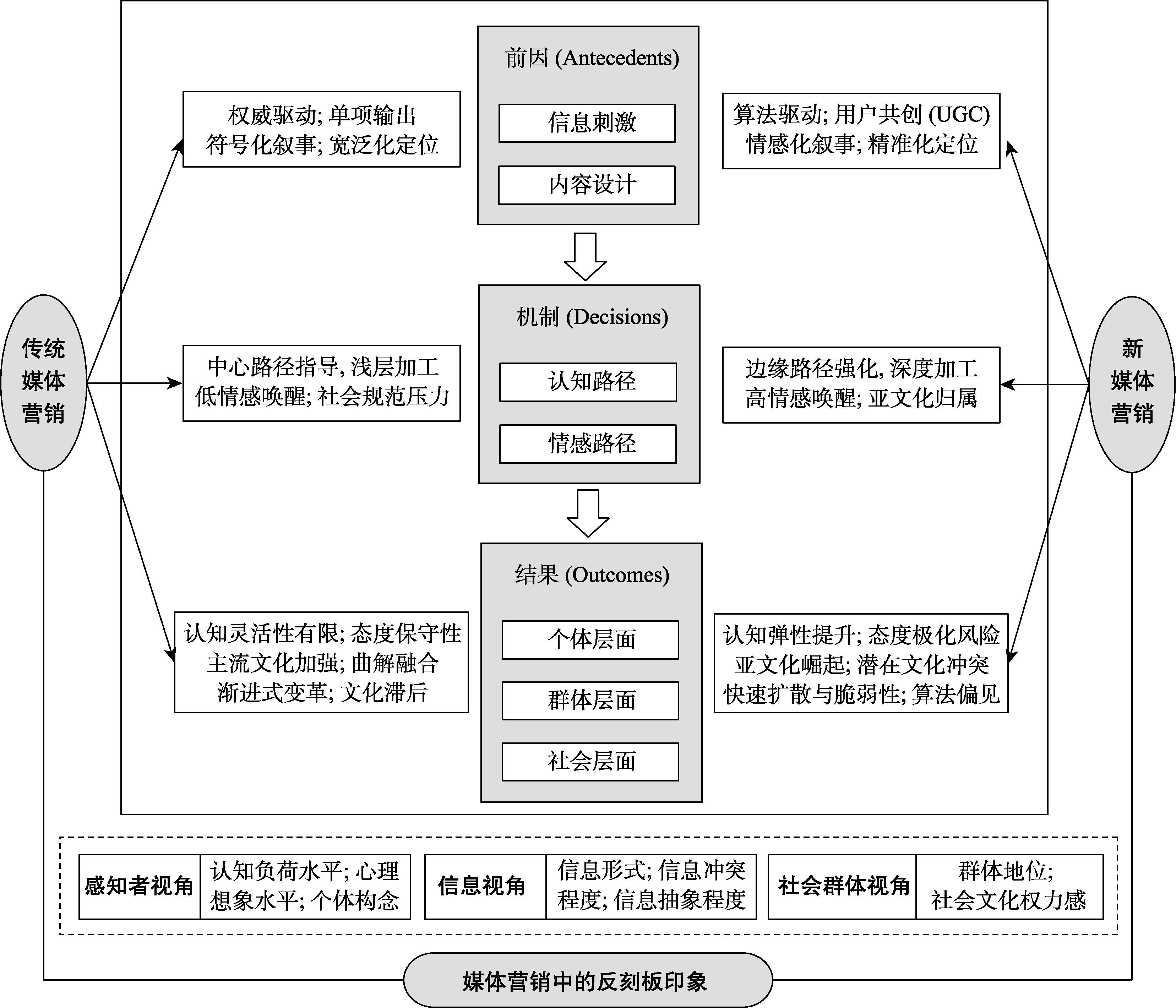
图2 媒体营销广告传播中的反刻板印象ADO框架图
| 维度 | 细分类别 | 具体示例 | 文献来源 |
|---|---|---|---|
| 内容属性 | 角色信息 | 性别(男vs.女) 外貌(典型职业外貌vs.非典型职业外貌) 年龄(高龄高调vs.高龄低调) | (江红艳 等, (Dean, (叶龙 等, |
| 叙事信息 | 人称视角(第一人称vs.第三人称) 叙事情感(强度过载vs.强度不过载) | (Gan et al., (Cao et al., | |
| 感官信息 | 视觉(冷色vs.暖色) 听觉(人工vs.AI画外音) 多模态融合(文本vs.音频vs.文本+音频) | (Wen et al., (Wang et al., | |
| 形式属性 | 媒介形式 | 短视频vs.直播vs.社交媒体(User Generated Content, UGC) 视频框架方向(横向vs.纵向) | (Choi et al., (Li & Sun, |
| 互动形式 | 互动方式(实时互动vs.弹幕互动) 互动人数(一人互动vs.多人互动) 互动主体(品牌自播vs.代言直播) 互动强度(高强度vs.低强度) | 刘鲁川, 张蕾, (冯蛟 等, (邹玉凤 等, (Han et al., | |
| 技术实现形式 | 算法推荐vs.KOL合作vs.平台联动 | (Qian et al., |
表1 新媒体营销广告传播中的反刻板印象
| 维度 | 细分类别 | 具体示例 | 文献来源 |
|---|---|---|---|
| 内容属性 | 角色信息 | 性别(男vs.女) 外貌(典型职业外貌vs.非典型职业外貌) 年龄(高龄高调vs.高龄低调) | (江红艳 等, (Dean, (叶龙 等, |
| 叙事信息 | 人称视角(第一人称vs.第三人称) 叙事情感(强度过载vs.强度不过载) | (Gan et al., (Cao et al., | |
| 感官信息 | 视觉(冷色vs.暖色) 听觉(人工vs.AI画外音) 多模态融合(文本vs.音频vs.文本+音频) | (Wen et al., (Wang et al., | |
| 形式属性 | 媒介形式 | 短视频vs.直播vs.社交媒体(User Generated Content, UGC) 视频框架方向(横向vs.纵向) | (Choi et al., (Li & Sun, |
| 互动形式 | 互动方式(实时互动vs.弹幕互动) 互动人数(一人互动vs.多人互动) 互动主体(品牌自播vs.代言直播) 互动强度(高强度vs.低强度) | 刘鲁川, 张蕾, (冯蛟 等, (邹玉凤 等, (Han et al., | |
| 技术实现形式 | 算法推荐vs.KOL合作vs.平台联动 | (Qian et al., |
| [1] | 白红义. (2013). 塑造新闻权威: 互联网时代中国新闻职业再审视. 新闻与传播研究, 20(1), 26-36+126. |
| [2] |
曾昭携, 白洁, 郭永玉, 张跃, 顾玉婷. (2022). 越富有越不支持再分配?——社会阶层与再分配偏向的关系及其心理机制. 心理科学进展, 30(6), 1336-1349.
doi: 10.3724/SP.J.1042.2022.01336 |
| [3] | 陈彤旭. (1998). 改变性别刻板成见——美国电视中的女科学家形象对女孩的影响. 国际新闻界, (Z1), 75-77+115. |
| [4] |
崔诣晨, 王沛, 崔亚娟. (2019). 知觉冲突印象形成的认知控制策略: 以刻板化信息与反刻板化信息为例. 心理学报, 51(10), 1157-1170.
doi: 10.3724/SP.J.1041.2019.01157 |
| [5] | 戴鑫. (2020). 社会化媒体营销.机械工业出版社. |
| [6] |
董天天, 徐璐璐, 贺雯. (2023). 积极总是好的吗?积极元刻板印象对工作记忆的影响及其机制. 心理学报, 55(8), 1344-1357.
doi: 10.3724/SP.J.1041.2023.01344 |
| [7] | 段鹏. (2018). 智能媒体语境下的未来影像: 概念、现状与前景. 现代传播(中国传媒大学学报), 40(10), 1-6. |
| [8] | 冯蛟, 于恒, 薛梅, 虎娜娜, 潘姿伊. (2024). 主播人数与产品类型对消费者购买意愿的交互影响. 管理科学, 37(1), 120-133. |
| [9] | 韩召, 杜刚, 熊爱华, 张涵. (2022). 明星代言还是主播“场外代言”? ——两种代言类型对购买意愿的影响机制研究. 外国经济与管理, 44(3), 53-68. |
| [10] | 何光喜, 朱依娜. (2014). 乏味的“书呆子”们? ——城镇公众对科学家的刻板印象及其影响因素. 科学学研究, 32(8), 1121-1128. |
| [11] | 江红艳, 许梦梦, 陈红, 刘邦舜. (2022). 反性别刻板印象代言人性别气质和产品信号对广告效果的影响——基于男明星代言女性产品的情境. 管理评论, 34(7), 175-188. |
| [12] | 江晓东, 邹健. (2023). 表情符号多余吗? ——表情符号对在线产品评论感知有用性的影响研究. 管理工程学报, 37(1), 66-77. |
| [13] |
金静, 胡金生. (2015). 消极情绪对优势认知加工的抑制. 心理科学进展, 23(1), 61-71.
doi: 10.3724/SP.J.1042.2015.00061 |
| [14] | 李娜, 姚曦. (2022). 情绪引导与情感再造:突发公共事件中公益广告情感动员机制探析. 青年记者, 29(22), 53-55. |
| [15] | 李琪, 李欣, 魏修建. (2020). 整合SOR和承诺信任理论的消费者社区团购研究. 西安交通大学学报(社会科学版), 40(2), 25-35. |
| [16] | 刘鲁川, 张蕾. (2024). “王婆卖瓜, 该不该自夸?” ——直播带货中主播过度夸赞行为对消费者购买意愿的影响. 管理评论, 36(4), 130-141. |
| [17] | 刘晅, 佐斌. (2006). 性别刻板印象维护的心理机制. 心理科学进展, 14(3), 456-461. |
| [18] | 刘雪峰, 张志学, 梁钧平. (2007). 认知闭合需要、框架效应与决策偏好. 心理学报, 39(4), 611-618. |
| [19] | 卢岳, 雷希, 郑敏霞, 杨德锋. (2022). 来杯丧茶?!不同情感诉求广告对消费者产品偏好的影响. 营销科学学报, 2(3), 119-135. |
| [20] | 聂烜, 许基南, 沈鹏熠. (2024). 网红代言人温暖特质对品牌幸福感的影响. 经济与管理, 38(2), 58-67. |
| [21] | 潘子成, 易志高, 潘镇. (2023). 中国存在“玻璃悬崖”现象吗? ——基于经营危机与女性高管职位晋升的实证研究. 管理工程学报, 37(4), 40-56. |
| [22] | 庞小佳, 张大均, 王鑫强, 王金良. (2011). 刻板印象干预策略研究述评. 心理科学进展, 19(2), 243-250. |
| [23] | 宋淑娟, 刘华山. (2014). 反刻板印象信息对减弱数学——性别刻板印象威胁效应的作用. 中国临床心理学杂志, 22(3), 386-389. |
| [24] | 王长征, 武晶晶, 蔡爱新, 张溪溪, 蔡文培. (2024). 专业还是通俗——创新型产品的广告语体风格对消费者产品采用的影响. 营销科学学报, 4(1), 121-138. |
| [25] | 王汉瑛, 邢红卫, 田虹. (2018). 定位绿色消费的“黄金象限”: 基于刻板印象内容模型的响应面分析. 南开管理评论, 21(3), 203-214. |
| [26] |
王丽丽, 董梦璐. (2022). “美男诱惑”真的奏效吗: 男性代言女性产品对女性消费者产品评价的影响. 心理学报, 54(2), 192-204.
doi: 10.3724/SP.J.1041.2022.00192 |
| [27] | 汪涛, 吴得远, 崔楠. (2019). 移动广告内容特征对消费者态度的影响——基于Meta分析. 营销科学学报, 15(4), 107-127. |
| [28] | 王永贵, 张二伟, 张思祺. (2023). 数字营销研究的整合框架和未来展望——基于TCCM框架和ADO框架的研究. 商业经济与管理, 43(7), 5-27. |
| [29] | 王宇翔. (2024). 拟人化广告代言人的营销效果及其影响机制. 商业经济研究, 43(10), 84-87. |
| [30] |
王祯. (2021). 儿童的性别刻板印象威胁及其干预. 心理科学进展, 29(2), 276-285.
doi: 10.3724/SP.J.1042.2021.00276 |
| [31] |
王祯, 管健. (2024). 性别刻板印象的变与不变?来自内容、方法与影响的证据. 心理科学进展, 32(6), 939-950.
doi: 10.3724/SP.J.1042.2024.00939 |
| [32] | 吴志琴. (2007). 广告传播中情感诉求的运用与受众互动的初探. 苏州大学学报(哲学社会科学版), 46(5), 126-128. |
| [33] | 夏沁盈, 徐岚, 崔楠, 程文姝, 曾仟怡. (2024). 逆性别代言人对消费者性别化产品态度及购买意愿的影响. 管理学报, 21(2), 251-260. |
| [34] | 许晟, 余明阳, 薛可, 周光. (2021). 新媒体情境下品牌体验对消费者反应的影响机理研究. 管理评论, 33(5), 341-352. |
| [35] | 叶龙, 刘怡彤, 郭名, 杨松林. (2023). 年长员工相对剥夺感对知识隐藏行为的影响:组织心理所有权和年龄刻板印象威胁的作用. 中国人力资源开发, 8(8), 6-22. |
| [36] | 翟成蹊, 李岩梅, 李纾. (2010). 沟通与刻板印象的维持、变化和抑制. 心理科学进展, 18(3), 487-495. |
| [37] | 张红霞, 张益. (2010). 国别属性重要吗?代言人与广告效果关系研究的新视角. 心理学报, 42(2), 304-316. |
| [38] | 朱华伟, 苏羽, 冯靖元. (2022). 代言人类型和产品创新类型对创新产品购买意愿的交互影响. 南开管理评论, 25(6), 118-127+158+128-129. |
| [39] | 朱楠, 蔡永华, 孙发伟, 杨杨一帆, 李其维. (2015). 具身厌恶情绪会降低对中性材料的喜好评价. 心理与行为研究, 13(4), 441-448. |
| [40] | 邹玉凤, 卢向华, 李凤瑶. (2023). 网红直播电商能带来忠诚消费者吗? ——来自某化妆品品牌消费者购买的证据. 外国经济与管理, 45(5), 134-152. |
| [41] | Åkestam N., Rosengren S., Dahlén M., Liljedal K. T., & Berg H. (2021). Gender stereotypes in advertising have negative cross-gender effects. European Journal of Marketing, 55(13), 63-93. |
| [42] |
Ashby F. G., Isen A. M., & Turken A. U. (1999). A neuropsychological theory of positive affect and its influence on cognition. Psychological Review, 106(3), 529-550.
doi: 10.1037/0033-295x.106.3.529 pmid: 10467897 |
| [43] | Banchefsky S., Westfall J., Park B., & Judd C. M. (2016). But you don’t look like a scientist!: Women scientists with feminine appearance are deemed less likely to be scientists. Sex Roles, 75(3), 95-109. |
| [44] |
Bartholow B. D., Dickter C. L., & Sestir M. A. (2006). Stereotype activation and control of race bias: Cognitive control of inhibition and its impairment by alcohol. Journal of Personality and Social Psychology, 90(2), 272-287.
doi: 10.1037/0022-3514.90.2.272 pmid: 16536651 |
| [45] | Berger J., & Fitzsimons G. (2008). Dogs on the street, pumas on your feet: How cues in the environment influence product evaluation and choice. Journal of Marketing Research, 45(1), 1-14. |
| [46] |
Blackwell L. S., Trzesniewski K. H., & Dweck C. S. (2007). Implicit theories of intelligence predict achievement across an adolescent transition: A longitudinal study and an intervention. Child Development, 78(1), 246-263.
doi: 10.1111/j.1467-8624.2007.00995.x pmid: 17328703 |
| [47] | Brengman M., Willems K., & De Gauquier L. (2022). Customer engagement in multi-sensory virtual reality advertising: the effect of sound and scent congruence. Frontiers in Psychology, 13(3), 747456. |
| [48] | Cao J., Zhong L., Liu D., Zhang G., & Shang M. (2024). Offense and defense between streamers and customers in live commerce marketing: Protection motivation and information overload. Plos One, 19(9), e0305585. |
| [49] | Chang J. -H., & Chen J. -Y. (2022). Let the sports endorser speak: Combination of endorser type, color, and copy. Journal of Business Research, 144(5), 939-950. |
| [50] | Cheng H. (1997). ‘Holding up half of the sky’? A sociocultural comparison of gender-role portrayals in Chinese and US advertising. International Journal of Advertising, 16(4), 295-319. |
| [51] | Choi Y. S., Wu Q., & Lee J. Y. (2025). Can you tolerate influencer marketing? An empirical investigation of live streaming viewership reduction related to influencer marketing. Journal of Business Research, 188(2), 115094. |
| [52] | Chu K., Lee D. -H., & Kim J. Y. (2016). The effect of non- stereotypical gender role advertising on consumer evaluation. International Journal of Advertising: The Review of Marketing Communications, 35(1), 106-134. |
| [53] |
Coelho H., Melo M., Martins J., & Bessa M. (2019). Collaborative immersive authoring tool for real-time creation of multisensory VR experiences. Multimedia Tools and Applications, 78(14), 19473-19493.
doi: 10.1007/s11042-019-7309-x |
| [54] | Crisp R. J., & Hewstone M. (2007). Multiple social categorization. Advances in Experimental Social Psychology, 39(5), 163-254. |
| [55] | Damer E., Webb T. L., & Crisp R. J. (2019). Diversity may help the uninterested: Evidence that exposure to counter- stereotypes promotes cognitive reflection for people low (but not high) in need for cognition. Group Processes Intergroup Relations, 22(8), 1079-1093. |
| [56] | Dean D. H. (2021). Physical appearance stereotypes for service occupations. Journal of Consumer Marketing, 38(1), 39-46. |
| [57] | Debevec K., & Iyer E. (1986). The influence of spokespersons in altering a product's gender image: Implications for advertising effectiveness. Journal of Advertising, 15(4), 12-20. |
| [58] |
Del Giudice M. (2017). Pink, blue, and gender: An update. Archives of Sexual Behavior, 46(6), 1555-1563.
doi: 10.1007/s10508-017-1024-3 pmid: 28664466 |
| [59] | Dens N., & De Pelsmacker P. (2010). Consumer response to different advertising appeals for new products: The moderating influence of branding strategy and product category involvement. Journal of Brand Management, 18(6), 50-65. |
| [60] | Duker J. M., & Tucker Jr L. R. (1977). “Women's lib-ers” versus independent women: A study of preferences for women's roles in advertisements. Journal of Marketing Research, 14(4), 469-475. |
| [61] | Dweck C. S., & Leggett E. L. (1988). A social-cognitive approach to motivation and personality. Psychological Review, 95(2), 256-273. |
| [62] | Epstein S., Lipson A., Holstein C., & Huh E. J. (1992). Irrational reactions to negative outcomes: Evidence for two conceptual systems. Journal of Personality Social Psychology, 62(2), 328-339. |
| [63] | Finnegan E., Oakhill J., & Garnham A. (2015). Counter- stereotypical pictures as a strategy for overcoming spontaneous gender stereotypes. Frontiers in Psychology, 6(4), 1291-1302. |
| [64] | Fiske S. T., Cuddy A. J., Glick P., & Xu J. (2018). A model of (often mixed) stereotype content: Competence and warmth respectively follow from perceived status and competition. In Social cognition (Vol. 16, pp. 162-214). Routledge. |
| [65] | Fiske S. T., & Neuberg S. L. (1990). A continuum of impression formation, from category-based to individuating processes: Influences of information and motivation on attention and interpretation. Advances in experimental social psychology, 23, 1-74. |
| [66] | Forouzandeh S., Rostami M., & Berahmand K. (2021). Presentation a Trust Walker for rating prediction in recommender system with Biased Random Walk: Effects of H-index centrality, similarity in items and friends. Engineering Applications of Artificial Intelligence, 104(9), 104325. |
| [67] | Galdi S., Guizzo F., & Fasoli F. (2023). Media representation matters: The effects of exposure to counter-stereotypical gay male characters on heterosexual men’s expressions of discrimination. Group Processes & Intergroup Relations, 26(6), 1329-1350. |
| [68] | Gan J., Shi S., Filieri R., & Leung W. K. (2023). Short video marketing and travel intentions: The interplay between visual perspective, visual content, and narration appeal. Tourism Management, 99(12), 104795. |
| [69] | Gao P., Zeng Y., & Cheng Y. (2022). The formation mechanism of impulse buying in short video scenario: Perspectives from presence and customer inspiration. Frontiers in Psychology, 13(4), 870635. |
| [70] | Garst J., & Bodenhausen G. V. (1997). Advertising's effects on men's gender role attitudes. Sex Roles, 36(5), 551-572. |
| [71] |
Gasper K., & Clore G. L. (2002). Attending to the big picture: Mood and global versus local processing of visual information. Psychological Science, 13(1), 34-40.
doi: 10.1111/1467-9280.00406 pmid: 11892776 |
| [72] | Gill T., & Lei J. (2018). Counter‐stereotypical products: Barriers to their adoption and strategies to overcome them. Psychology Marketing, 35(7), 493-510. |
| [73] | Gocłowska M. A., Crisp R. J., & Labuschagne K. (2013). Can counter-stereotypes boost flexible thinking? Group Processes Intergroup Relations, 16(2), 217-231. |
| [74] |
Gonzalez A. M., Steele J. R., Chan E. F., Lim S. A., & Baron A. S. (2021). Developmental differences in the malleability of implicit racial bias following exposure to counterstereotypical exemplars. Developmental Psychology, 57(1), 102-113.
doi: 10.1037/dev0001128 pmid: 33252922 |
| [75] | Han S. -P., & Shavitt S. (1994). Persuasion and culture: Advertising appeals in individualistic and collectivistic societies. Journal of Experimental Social Psychology, 30(4), 326-350. |
| [76] | Han T., Han J., Liu J., & Li W. (2024). Effect of emotional factors on purchase intention in live streaming marketing of agricultural products: A moderated mediation model. Plos One, 19(4), e0298388. |
| [77] |
Harrits G. S. (2019). Stereotypes in context: How and when do street‐level bureaucrats use class stereotypes? Public Administration Review, 79(1), 93-103.
doi: 10.1111/puar.12952 |
| [78] | He W., Zhang Y., Zhu J., Xu Y., Yu W., Chen W., Liu Y., & Wang W. (2011). Could sex difference in color preference and its personality correlates fit into social theories? Let Chinese university students tell you. Personality and Individual Differences, 51(2), 154-159. |
| [79] | Hewstone M., Macrae C. N., Griffiths R., Milne A. B., & Brown R. (1994). Cognitive models of stereotype change: (5). Measurement, development, and consequences of subtyping. Journal of Experimental Social Psychology, 30(6), 505-526. |
| [80] | Howard J. A. (2000). Social psychology of identities. Annual Review of Sociology, 26(1), 367-393. |
| [81] | Hu B., Yan L., Zheng C., Tang Y., Lin Q., Xia W., & Wang Z. (2022). Inter-group face recognition bias was modulated by the group status. Frontiers in Psychology, 13(5), 837836. |
| [82] | Huber F., Meyer F., Vogel J., Weihrauch A., & Hamprecht J. (2013). Endorser age and stereotypes: Consequences on brand age. Journal of Business Research, 66(2), 207-215. |
| [83] |
Huntsinger J. R., Sinclair S., Dunn E., & Clore G. L. (2010). Affective regulation of stereotype activation: It’s the (accessible) thought that counts. Personality and Social Psychology Bulletin, 36(4), 564-577.
doi: 10.1177/0146167210363404 pmid: 20363909 |
| [84] | Ito T. A., & Urland G. R. (2003). Race and gender on the brain: Electrocortical measures of attention to the race and gender of multiply categorizable individuals. Journal of Personality Social Psychology, 85(4), 616-626. |
| [85] | Jussim L. (1991). Cognitive Structure Activation: Zealous Enforcement of the Law? Psychological Inquiry, 2(2), 194-195. |
| [86] | Kim S. -H., & Nam S. (2004). Across the threshold: Role of performance and compatibility in innovative new products' market penetration. Industrial Marketing Management, 33(8), 689-699. |
| [87] | Krakow M. M., Yale R. N., Jensen J. D., Carcioppolo N., & Ratcliff C. L. (2018). Comparing mediational pathways for narrative- and argument-based messages: Believability, counterarguing, and emotional reaction. Human Communication Research, 44(3), 299-321. |
| [88] | Lai C. K., Marini M., Lehr S. A., Cerruti C., Shin J. -E. L., Joy-Gaba J. A., … Nosek B. A. (2014). Reducing implicit racial preferences: I. A comparative investigation of 17 interventions. Journal of Experimental Psychology, 143(4), 1765-1785. |
| [89] | Leicht C., Gocłowska M. A., Van Breen J. A., de Lemus S., & de Moura G. R. (2017). Counter-stereotypes and feminism promote leadership aspirations in highly identified women. Frontiers in Psychology, 8(4), 883-892. |
| [90] | Li A., Ding Z., Sun C., & Liu Y. (2024). Recommending AI based on Quantified Self: Investigating the mechanism of consumer acceptance of AI recommendations. Electronic Markets, 34(1), 1-15. |
| [91] | Li P., & Sun Y. (2024). Impact of internet celebrities’ short videos on audiences’ visit intentions: Is beauty power? Humanities Social Sciences Communications, 11(1), 1-11. |
| [92] | Liu X., & Zuo B. (2006). Psychological mechanism of maintaining gender stereotypes. Advances in Psychological Science, 14(3), 456-461. |
| [93] | Luong K. T., & Knobloch-Westerwick S. (2017). Can the media help women be better at math? Stereotype threat, selective exposure, media effects, and women's math performance. Human Communication Research, 43(2), 193-213. |
| [94] |
Matthes J., Prieler M., & Adam K. (2016). Gender-role portrayals in television advertising across the globe. Sex Roles, 75(7), 314-327.
pmid: 27688526 |
| [95] | McCormick K. (2016). Celebrity endorsements: Influence of a product-endorser match on Millennials attitudes and purchase intentions. Journal of Retailing and Consumer Services, 32(9), 39-45. |
| [96] | Mehrabian A., & Russell J. A. (1974). An approach to environmental psychology. The MIT Press. |
| [97] | Mohan M., Ferguson J. L., & Huhmann B. A. (2022). Endorser gender and age effects in B2B advertising. Journal of Business Research, 148(9), 60-75. |
| [98] | Money R. B., Shimp T. A., & Sakano T. (2006). Celebrity endorsements in Japan and the United States: Is negative information all that harmful? Journal of Advertising Research, 46(1), 113-123. |
| [99] | Noseworthy T. J., Cotte J., & Lee S. H. (2011). The effects of ad context and gender on the identification of visually incongruent products. Journal of Consumer Research, 38(2), 358-375. |
| [100] | Noseworthy T. J., Di Muro F., & Murray K. B. (2014). The role of arousal in congruity-based product evaluation. Journal of Consumer Research, 41(4), 1108-1126. |
| [101] | Paul J., Lim W. M., O’Cass A., Hao A. W., & Bresciani S. (2021). Scientific procedures and rationales for systematic literature reviews (SPAR-4-SLR). International Journal of Consumer Studies, 45(4), 1-16. |
| [102] |
Pearl R. L. (2020). Weight stigma and the "Quarantine-15". Obesity, 28(7), 1180-1181.
doi: 10.1002/oby.22850 pmid: 32324954 |
| [103] | Peirce K. (2001). What if the energizer bunny were female? Importance of gender in perceptions of advertising spokes- character effectiveness. Sex Roles, 45(12), 845-858. |
| [104] |
Plaks J. E., Stroessner S. J., Dweck C. S., & Sherman J. W. (2001). Person theories and attention allocation: Preferences for stereotypic versus counterstereotypic information. Journal of Personality and Social Psychology, 80(6), 876-893.
pmid: 11414372 |
| [105] | Pounders K. (2018). Are portrayals of female beauty in advertising finally changing? Journal of Advertising Research, 58(2), 133-137. |
| [106] | Prati F., Crisp R. J., & Rubini M. (2015). Counter-stereotypes reduce emotional intergroup bias by eliciting surprise in the face of unexpected category combinations. Journal of Experimental Social Psychology, 61(11), 31-43. |
| [107] | Pugh R. (1998). Attitudes, stereotypes and anti-discriminatory education: Developing themes from Sullivan. The British Journal of Social Work, 28(6), 939-959. |
| [108] | Qian Z., Day S. J., Ignatius J., Dhamotharan L., & Chai J. (2024). Digital advertising spillover, online-exclusive product launches, and manufacturer-remanufacturer competition. European Journal of Operational Research, 313(2), 565-586. |
| [109] | Rakić T., & Chambers D. (2012). Rethinking the consumption of places. Annals of Tourism Research, 39(3), 1612-1633. |
| [110] | Ramasubramanian S. (2015). Using celebrity news stories to effectively reduce racial/ethnic prejudice. Journal of Social Issues, 71(1), 123-138. |
| [111] | Ramasubramanian S., & Oliver M. B. (2007). Activating and suppressing hostile and benevolent racism: Evidence for comparative media stereotyping. Media Psychology, 9(3), 623-646. |
| [112] | Ramasubramanian S. (2011). The impact of stereotypical versus counterstereotypical media exemplars on racial attitudes, causal attributions, and support for affirmative action. Communication Research, 38(4), 497-516. |
| [113] | Richeson J. A., & Pollydore C. -A. (2002). Affective reactions of African American students to stereotypical and counterstereotypical images of Blacks in the media. Journal of Black Psychology, 28(3), 261-275. |
| [114] | Roth-Cohen O., Kanevska H. S., & Eisend M. (2023). Gender roles in online advertising. Journal of Gender Studies, 32(2), 186-200. |
| [115] |
Rudman L. A., & Fairchild K. (2004). Reactions to counterstereotypic behavior: The role of backlash in cultural stereotype maintenance. Journal of Personality and Social Psychology, 87(2), 157-176.
pmid: 15301625 |
| [116] | Santos A. S., Garcia-Marques L., Palma T., & Reese J. (2024). Inducing perceived group variability triggers the incorporation of counter-stereotypic information into a generalized stereotype change. Scientific Reports, 14(1), 9214. |
| [117] | Schimmelpfennig C. (2018). Who is the celebrity endorser? A content analysis of celebrity endorsements. Journal of International Consumer Marketing, 30(4), 220-234. |
| [118] | Shao Y., Desmarais F., & Kay Weaver C. (2014). Chinese advertising practitioners’ conceptualisation of gender representation. International Journal of Advertising, 33(2), 329-350. |
| [119] | Shi P., Lu X., Zhou Y., Sun C., Wang L., & Geng B. (2021). Online star vs. celebrity endorsements: The role of self-concept and advertising appeal in influencing purchase intention. Frontiers in Psychology, 12(3), 736883. |
| [120] | Skočajić M. M., Radosavljević J. G., Okičić M. G., Janković I. O., & Žeželj I. L. (2020). Boys just don’t! Gender stereotyping and sanctioning of counter-stereotypical behavior in preschoolers. Sex Roles, 82(3-4), 163-172. |
| [121] | Song X., Lu Y., & Yang Q. (2024). The negative effect of virtual endorsers on brand authenticity and potential remedies. Journal of Business Research, 185(12), 114898. |
| [122] | Tan N., Parashar N., Ahmetoglu G., & Harris L. T. (2024). Investigating the relationship between stereotyping and creativity during marketing campaigns in marketeers and audiences. Scientific Reports, 14(1), 20611. |
| [123] | Teng L., Wang H., Wang X., & Foti L. (2025). Unlocking the potential of virtual endorsers: The role of brand-owned and brand-non-owned virtual endorsers in shaping brand attitude. International Journal of Information Management, 81(4), 102864. |
| [124] | Turner J. C., Brown R. J., & Tajfel H. (1979). Social comparison and group interest in ingroup favouritism. European journal of Social Psychology, 9(2), 187-204. |
| [125] | Von Hippel W., Hawkins C., & Schooler J. W. (2001). Stereotype distinctiveness: How counterstereotypic behavior shapes the self-concept. Journal of Personality Social Psychology, 81(2), 193-205. |
| [126] | Wang C., Wang K., Bian A., Islam R., Keya K. N., Foulds J., & Pan S. (2021). User acceptance of gender stereotypes in automated career recommendations. arXiv preprint arXiv, (7), 07112. |
| [127] | Wang X., Zhang Z., & Jiang Q. (2024). The effectiveness of human vs. AI voice-over in short video advertisements: A cognitive load theory perspective. Journal of Retailing and Consumer Services, 81(11), 104005. |
| [128] | Wen F., Zuo B., Wang Y., Wu Y., Fang Z., & Ma S. (2020). The (continuous) nature of perceived gender counter- stereotype: A threshold model of gender stereotype maintenance. Archives of Sexual Behavior, 49(7), 2511-2530. |
| [129] | Wen X., Niu Y., & Liao C. (2025). U-shaped effect of color in short-form video: Combination of text, audio, image ml and generative AI. Journal of Business Research, 192(4), 115278. |
| [130] | Westover M. L., & Randle Q. (2009). Endorser weight and perceptions of brand attitude and intent to purchase. Journal of Promotion Management, 15(1-2), 57-73. |
| [131] |
Wittenbrink B., Judd C. M., & Park B. J. (2001). Spontaneous prejudice in context: Variability in automatically activated attitudes. Journal of Personality and Social Psychology, 81(5), 815-827.
doi: 10.1037//0022-3514.81.5.815 pmid: 11708559 |
| [132] | You L., & Liu F. (2024). From virtual voices to real impact: Authenticity, altruism, and egoism in social advocacy by human and virtual influencers. Technological Forecasting and Social Change, 207(10), 123650. |
| [133] | Zhang J., & Nelson M. R. (2016). The effects of vertical individualism on status consumer orientations and behaviors. Psychology & Marketing, 33(5), 318-330. |
| [134] | Zuo B., Wen F., Wang M., & Wang Y. (2019). The mediating role of cognitive flexibility in the influence of counter- stereotypes on creativity. Frontiers in Psychology, 10(5), 105-117. |
| [1] | 裴冠雄, 董波, 金佳, 孟亮, 张加林. 营销数字人对话智能特征的动态加工与神经机制[J]. 心理科学进展, 2026, 34(2): 227-238. |
| [2] | 肖婷文, 谌飞龙, 关碧瑜. “既往不咎”还是“耿耿于怀”: 品牌违规效应及其心理机制[J]. 心理科学进展, 2026, 34(1): 175-190. |
| [3] | 卢俊阳, 邓爱民, 韦俊峰, 龙潜颖. 文旅“流量”如何变“留量”?基于过程视角的旅游者仪式感知及作用机制[J]. 心理科学进展, 2025, 33(12): 2054-2068. |
| [4] | 王艳, 蒋晶. 极简主义设计对可持续消费行为的影响[J]. 心理科学进展, 2025, 33(9): 1541-1557. |
| [5] | 凌斌, 刘莺恺. 广告营销中的方言刻板印象效应及其理论机制[J]. 心理科学进展, 2025, 33(8): 1408-1424. |
| [6] | 李研, 陈维, 武瑞娟. AI技术背景下虚拟影响者营销效应及其作用机制[J]. 心理科学进展, 2025, 33(8): 1425-1442. |
| [7] | 戴佳彤, 杨璐. 信息助推策略对消费者食物浪费行为的干预效果及机制[J]. 心理科学进展, 2025, 33(7): 1155-1169. |
| [8] | 邓年奇, 唐一凡, 范秀成, 蒋欣羽. 虚拟现实服务中具身参与对数字共情的影响[J]. 心理科学进展, 2025, 33(7): 1140-1154. |
| [9] | 任星耀, 吴慧超, 陈飞燕, 徐环宇, 张文靖. 人机如何协同?销售场景中智能化数据分析为多方创造价值的机理[J]. 心理科学进展, 2025, 33(6): 984-1005. |
| [10] | 秦环宇, 刘展呈, 谢志鹏, 吕林祥. 以“手”为攻, 匠心独具: 营销中的手工制作效应[J]. 心理科学进展, 2025, 33(2): 362-380. |
| [11] | 柴民权, 刘可欣, 靳菲. 更道德抑或更社会: 绿色消费的自我建构机制[J]. 心理科学进展, 2024, 32(10): 1726-1735. |
| [12] | 陈斯允, 徐惠琪, 李诗颖, 牛小曼, 许丽颖. 俭以养德?节俭对亲社会行为的双刃剑效应及其理论解释[J]. 心理科学进展, 2024, 32(10): 1680-1696. |
| [13] | 刘红艳, 周泳含, 陈艳霞. 次优食品营销干预策略的有效性探究:来自元分析的证据[J]. 心理科学进展, 2024, 32(10): 1640-1658. |
| [14] | 李世豪, 张文悦, 符国群. 刷碗少的人请买花: 夫妻贡献不均与家庭享乐性消费[J]. 心理科学进展, 2024, 32(8): 1250-1264. |
| [15] | 沈曼琼, 廖建财, 王海忠. 消费者用药依从行为探析:基于两阶段理论模型[J]. 心理科学进展, 2024, 32(5): 859-872. |
| 阅读次数 | ||||||
|
全文 |
|
|||||
|
摘要 |
|
|||||
