

ISSN 1671-3710
CN 11-4766/R
主办:中国科学院心理研究所
出版:科学出版社
CN 11-4766/R
主办:中国科学院心理研究所
出版:科学出版社
心理科学进展 ›› 2025, Vol. 33 ›› Issue (9): 1457-1471.doi: 10.3724/SP.J.1042.2025.1457 cstr: 32111.14.2025.1457
• 研究构想 • 下一篇
黄建平1,2( ), 陈纯纯1, 刘梦颖3
收稿日期:2025-02-13
出版日期:2025-09-15
发布日期:2025-06-26
通讯作者:
黄建平, E-mail: jphuang@suda.edu.cn基金资助:
HUANG Jianping1,2(), CHEN Chunchun1, LIU Mengying3
Received:2025-02-13
Online:2025-09-15
Published:2025-06-26
摘要:
环境中的视觉、听觉、嗅觉等单感官信息会通过多感官加工形成多感官线索, 从而影响消费者对食物的享乐预期, 并指导其饮食决策。人们依赖多感官线索形成食物享乐价值的统一表征, 因此对多感官线索的操纵可成为助推健康饮食决策的有效手段。本研究运用脑电图(electroencephalography, EEG)和功能磁共振成像(functional magnetic resonance imaging, fMRI)技术并结合计算建模方法, 关注多感官线索组合如何增强食物的奖赏表征, 进而提高健康价值决策的流畅性。首先, 探讨多感官线索组合与健康饮食选择和体验的因果联系; 其次, 探究多感官组合影响饮食决策的计算机制与神经基础; 最后, 研究如何利用多感官组合促进个体对健康食物的价值学习。研究将揭示多感官组合如何为消费者提供超加性的健康饮食享乐体验, 为理解多感官组合的内在积极影响提供系统性的理论解释; 此外, 还将探讨多感官组合重复暴露与意象训练在提升消费者健康饮食乐趣以及建立长期健康饮食习惯的重要作用。
中图分类号:
黄建平, 陈纯纯, 刘梦颖. (2025). 多感官线索助推健康价值决策的计算和神经机制. 心理科学进展 , 33(9), 1457-1471.
HUANG Jianping, CHEN Chunchun, LIU Mengying. (2025). Computational and neural mechanisms underlying healthy food decisions nudged by multisensory cues. Advances in Psychological Science, 33(9), 1457-1471.
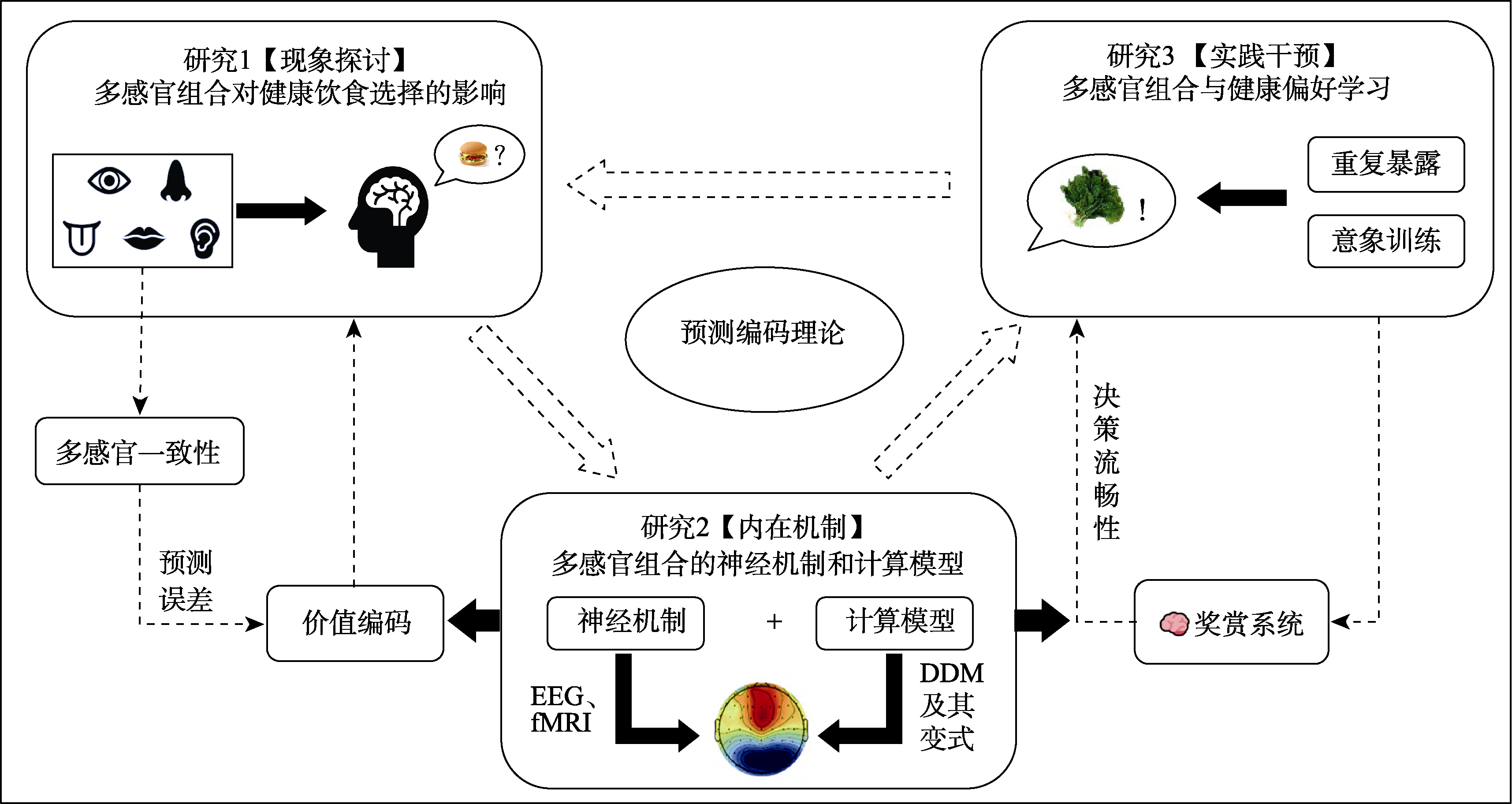
图1 整体研究框架
| [1] |
耿晓伟, 张峰, 王艳净, 范琳琳, 姚艳. (2018). 健康目标启动降低高热量食物消费. 心理学报, 50(8), 840-847.
doi: 10.3724/SP.J.1041.2018.00840 |
| [2] |
何贵兵, 李纾, 梁竹苑. (2018). 以小拨大: 行为决策助推社会发展. 心理学报, 50(8), 803-813.
doi: 10.3724/SP.J.1041.2018.00803 |
| [3] |
李佳洁, 于彤彤. (2020). 基于助推的健康饮食行为干预策略. 心理科学进展, 28(12), 2052-2063.
doi: 10.3724/SP.J.1042.2020.02052 |
| [4] |
刘梦颖, 蒋婧怡, 杨依琳, 江波, 黄建平. (2024). 古典美还是表现美:摆盘美学影响健康饮食决策的计算与神经机制. 心理学报, 56(8), 1061-1075.
doi: 10.3724/SP.J.1041.2024.01061 |
| [5] | 刘逸康, 胡传鹏. (2023). 证据积累模型的行为与认知神经证据. 科学通报, 69(8), 1068-1081. |
| [6] | Ahern, S. M., Caton, S. J., Bouhlal, S., Hausner, H., Olsen, A., Nicklaus, S.,... Hetherington, M. M. (2014). Eating a rainbow. Introducing vegetables in the first years of life in 3 European countries. Appetite, 71, 48-56. |
| [7] |
Albers, A. M., Kok, P., Toni, I., Dijkerman, H. C., & De Lange, F. P. (2013). Shared representations for working memory and mental imagery in early visual cortex. Current Biology, 23(15), 1427-1431.
doi: 10.1016/j.cub.2013.05.065 pmid: 23871239 |
| [8] |
Andrade, J., May, J., Deeprose, C., Baugh, S. J., & Ganis, G. (2014). Assessing vividness of mental imagery: The Plymouth sensory imagery questionnaire. British Journal of Psychology, 105(4), 547-563.
doi: 10.1111/bjop.12050 pmid: 24117327 |
| [9] |
Appleton, K. M., Hemingway, A., Rajska, J., & Hartwell, H. (2018). Repeated exposure and conditioning strategies for increasing vegetable liking and intake: Systematic review and meta-analyses of the published literature. American Journal of Clinical Nutrition, 108(4), 842-856.
doi: 10.1093/ajcn/nqy143 pmid: 30321277 |
| [10] |
Auchincloss, A. H., Young, C., Davis, A. L., Wasson, S., Chilton, M., & Karamanian, V. (2013). Barriers and facilitators of consumer use of nutrition labels at sit-down restaurant chains. Public Health Nutrition, 16(12), 2138-2145.
doi: 10.1017/S1368980013000104 pmid: 23388204 |
| [11] |
Avanzino, L., Gueugneau, N., Bisio, A., Ruggeri, P., Papaxanthis, C., & Bove, M. (2015). Motor cortical plasticity induced by motor learning through mental practice. Frontiers in Behavioral Neuroscience, 9, 105.
doi: 10.3389/fnbeh.2015.00105 pmid: 25972791 |
| [12] | Bédard, A., Lamarche, P.-O., Grégoire, L.-M., Trudel-Guy, C., Provencher, V., Desroches, S., & Lemieux, S. (2020). Can eating pleasure be a lever for healthy eating? A systematic scoping review of eating pleasure and its links with dietary behaviors and health. PLoS One, 15(12), e0244292. |
| [13] | Bierley, C., McSweeney, F. K., & Vannieuwkerk, R. (1985). Classical conditioning of preferences for stimuli. Journal of Consumer Rresearch, 12(3), 316-323. |
| [14] |
Birch, L. L. (1999). Development of food preferences. Annual Review of Nutrition, 19, 41-62.
pmid: 10448516 |
| [15] |
Birch, L. L., McPhee, L., Shoba, B. C., Pirok, E., & Steinberg, L. (1987). What kind of exposure reduces children's food neophobia?: Looking vs. tasting. Appetite, 9(3), 171-178.
pmid: 3435134 |
| [16] | Biswas, D., Labrecque, L. I., & Lehmann, D. R. (2021). Effects of sequential sensory cues on food taste perception: Cross-modal interplay between visual and olfactory stimuli. Journal of Consumer Psychology, 31(4), 746-764. |
| [17] | Biswas, D., Lund, K., & Szocs, C. (2019). Sounds like a healthy retail atmospheric strategy: Effects of ambient music and background noise on food sales. Journal of the Academy of Marketing Science, 47(1), 37-55. |
| [18] | Blechert, J., Michael, T., Vriends, N., Margraf, J., & Wilhelm, F. H. (2008). Fear conditioning in posttraumatic stress disorder: Evidence for delayed extinction of autonomic, experiential, and behavioural responses. Behaviour Research and Therapy, 45(9), 2019-2033. |
| [19] | Boesveldt, S., Bobowski, N., McCrickerd, K., Maître, I., Sulmont-Rossé, C., & Forde, C. G. (2018). The changing role of the senses in food choice and food intake across the lifespan. Food Quality and Preference, 68, 80-89. |
| [20] | Bschaden, A., Dörsam, A. F., Cvetko, K., Kalamala, T., & Stroebele-Benschop, N. (2020). The impact of lighting and table linen as ambient factors on meal intake and taste perception. Food Quality and Preference, 79, 103797. |
| [21] |
Bui, E. T., & Fazio, R. H. (2016). Generalization of evaluative conditioning toward foods: Increasing sensitivity to health in eating intentions. Health Psychology, 35(8), 852-855.
doi: 10.1037/hea0000339 pmid: 27505206 |
| [22] | Cadario, R., & Chandon, P. (2020). Which healthy eating nudges work best? A meta-analysis of field experiments. Marketing Science, 39(3), 465-486. |
| [23] |
Cawley, J., Sweeney, M. J., Sobal, J., Just, D. R., Kaiser, H. M., Schulze, W. D., Wethington, E., & Wansink, B. (2015). The impact of a supermarket nutrition rating system on purchases of nutritious and less nutritious foods. Public Health Nutrition, 18(1), 8-14.
doi: 10.1017/S1368980014001529 pmid: 25083948 |
| [24] |
Chandrasekaran, C. (2017). Computational principles and models of multisensory integration. Current Opinion in Neurobiology, 43, 25-34.
doi: S0959-4388(16)30222-7 pmid: 27918886 |
| [25] | Chatterjee, A., Mazumder, S., & Das, K. (2023). Reversing food preference through multisensory exposure. PLoS One, 18(7), e0288695. |
| [26] | Cheng, F. P.-H., Saglam, A., André, S., & Pooresmaeili, A. (2020). Cross-modal integration of reward value during oculomotor planning. eNeuro, 7(1), ENEURO. 0381-19.2020. |
| [27] |
Clark, A. (2013). Whatever next? Predictive brains, situated agents, and the future of cognitive science. Behavioral and Brain Sciences, 36(3), 181-204.
doi: 10.1017/S0140525X12000477 pmid: 23663408 |
| [28] |
Corneille, O., & Stahl, C. (2019). Associative Attitude Learning: A Closer Look at Evidence and How It Relates to Attitude Models. Personality and Social Psychology Review, 23(2), 161-189.
doi: 10.1177/1088868318763261 pmid: 29575983 |
| [29] | Cornil, Y., & Chandon, P. (2016a). Pleasure as an ally of healthy eating? Contrasting visceral and Epicurean eating pleasure and their association with portion size preference and wellbeing. Appetite, 104, 52-59. |
| [30] | Cornil, Y., & Chandon, P. (2016b). Pleasure as a substitute for size: How multisensory imagery can make people happier with smaller food portions. Journal of Marketing Research, 53(5), 847-864. |
| [31] | Di Lorenzo, P. M. (2021). Neural Coding of Food Is a Multisensory, Sensorimotor Function. Nutrients, 13(2), 398. |
| [32] | Díaz, E., Ruiz, G., & Baeyens, F. (2005). Resistance to extinction of human evaluative conditioning using a between-subjects design. Cognition and Emotion, 19(2), 245-268. |
| [33] | Engelen, L., de Wijk, R. A., Prinz, J. F., van der Bilt, A., & Bosman, F. (2003). The relation between saliva flow after different stimulations and the perception of flavor and texture attributes in custard desserts. Physiology & Behavior, 78(1), 165-169. |
| [34] |
Ernst, M. O., & Bülthoff, H. H. (2004). Merging the senses into a robust percept. Trends in Cognitive Sciences, 8(4), 162-169.
doi: 10.1016/j.tics.2004.02.002 pmid: 15050512 |
| [35] |
Farovik, A., Place, R. J., McKenzie, S., Porter, B., Munro, C. E., & Eichenbaum, H. (2015). Orbitofrontal cortex encodes memories within value-based schemas and represents contexts that guide memory retrieval. Journal of Neuroscience, 35(21), 8333-8344.
doi: 10.1523/JNEUROSCI.0134-15.2015 pmid: 26019346 |
| [36] |
Ferriday, D., & Brunstrom, J.M. (2011). ‘I just can’t help myself’: Effects of food-cue exposure in overweight and lean individuals. International Journal of Obesity, 35(1), 142-149.
doi: 10.1038/ijo.2010.117 pmid: 20548302 |
| [37] |
Fondberg, R., Lundström, J. N., Blöchl, M., Olsson, M. J., & Seubert, J. (2018). Multisensory flavor perception: The relationship between congruency, pleasantness, and odor referral to the mouth. Appetite, 125, 244-252.
doi: S0195-6663(17)31464-2 pmid: 29447997 |
| [38] | Forstmann, B. U., Ratcliff, R., & Wagenmakers, E.-J. (2016). Sequential sampling models in cognitive neuroscience: Advantages, applications, and extensions. Annual Review of Psychology, 67(1), 641-666. |
| [39] |
Frömer, R., Nassar, M. R., Ehinger, B. V., & Shenhav, A. (2024). Common neural choice signals can emerge artefactually amid multiple distinct value signals. Nature Human Behaviour, 8(11), 2194-2208.
doi: 10.1038/s41562-024-01971-z pmid: 39242928 |
| [40] |
Garlasco, P., Osimo, S. A., Rumiati, R. I., & Parma, V. (2019). A hierarchical-drift diffusion model of the roles of hunger, caloric density and valence in food selection. Appetite, 138, 52-59.
doi: S0195-6663(18)31438-7 pmid: 30880086 |
| [41] |
Glaser, T., & Kuchenbrandt, D. (2017). Generalization effects in evaluative conditioning: Evidence for attitude transfer effects from single exemplars to social categories. Frontiers in Psychology, 8, 103.
doi: 10.3389/fpsyg.2017.00103 pmid: 28197118 |
| [42] | Gold, J. I., & Shadlen, M. N. (2007). The neural basis of decision making. Annual Review of Neuroscience, 30(1), 535-574. |
| [43] |
Grabenhorst, F., & Rolls, E. T. (2011). Value, pleasure and choice in the ventral prefrontal cortex. Trends in Cognitive Sciences, 15(2), 56-67.
doi: 10.1016/j.tics.2010.12.004 pmid: 21216655 |
| [44] |
Greene, K. N., Gabrielyan, G., Just, D. R., & Wansink, B. (2017). Fruit-promoting smarter lunchrooms interventions: Results from a cluster RCT. American Journal of Preventive Medicine, 52(4), 451-458.
doi: S0749-3797(16)30696-1 pmid: 28214248 |
| [45] | Guo, X., Huang, J., & Wan, X. (2024). Influence of exposure to novel food packaging on consumers’ adoption of innovative products. Food Quality and Preference, 119, 105230. |
| [46] | Hagen, L. (2021). Pretty healthy food: How and when aesthetics enhance perceived healthiness. Journal of Marketing, 85(2), 129-145. |
| [47] | HajiHosseini, A., & Hutcherson, C. A. (2021). Alpha oscillations and event-related potentials reflect distinct dynamics of attribute construction and evidence accumulation in dietary decision making. eLife, 10, e60874. |
| [48] | Halbeisen, G., Schneider, M., & Walther, E. (2021). Liked for their looks: Evaluative conditioning and the generalisation of conditioned attitudes in early childhood. Cognition and Emotion, 35(4), 607-618. |
| [49] | Hanks, A. S., Just, D. R., Smith, L. E., & Wansink, B. (2013). Healthy convenience: Nudging students toward healthier choices in the lunchroom. Journal of Public Health, 34(3), 370-376. |
| [50] | Harris, A., & Hutcherson, C. A. (2022). Temporal dynamics of decision making: A synthesis of computational and neurophysiological approaches. Wiley Interdisciplinary Reviews: Cognitive Science, 13(3), e1586. |
| [51] |
Haxby, J. V. (2012). Multivariate pattern analysis of fMRI: The early beginnings. Neuroimage, 62(2), 852-855.
doi: 10.1016/j.neuroimage.2012.03.016 pmid: 22425670 |
| [52] |
Hofmann, W., De Houwer, J., Perugini, M., Baeyens, F., & Crombez, G. (2010). Evaluative conditioning in humans: A meta-analysis. Psychological Bulletin, 136(3), 390-421.
doi: 10.1037/a0018916 pmid: 20438144 |
| [53] | Högden, F., Stahl, C., & Unkelbach, C. (2019). Similarity- based and rule-based generalisation in the acquisition of attitudes via evaluative conditioning. Cognition and Emotion, 34(1), 105-127. |
| [54] | Hohwy, J. (2007). The Search for Neural Correlates of Consciousness. Philosophy Compass, 2(3), 461-474. |
| [55] |
Holmes, E. A., Mathews, A., Dalgleish, T., & Mackintosh, B. (2006). Positive interpretation training: Effects of mental imagery versus verbal training on positive mood. Behavior Therapy, 37(3), 237-247.
doi: 10.1016/j.beth.2006.02.002 pmid: 16942975 |
| [56] | Huang, F., Huang, J., & Wan, X. (2019). Influence of virtual color on taste: Multisensory integration between virtual and real worlds. Computers in Human Behavior, 95, 168-174. |
| [57] | Huang, J., Zhao, P., & Wan, X. (2021). From brain variations to individual differences in the color-flavor incongruency effect: A combined virtual reality and resting-state fMRI study. Journal of Business Research, 123, 604-612. |
| [58] | Huang, Y., & Wu, J. (2016). Food pleasure orientation diminishes the “healthy = less tasty” intuition. Food Quality and Preference, 54, 75-78. |
| [59] | Huseynov, S., & Palma, M. A. (2021). Food decision-making under time pressure. Food Quality and Preference, 88, 104072. |
| [60] | Ishai, A. (2010). Seeing faces and objects with the “mind’s eye”. Archives Italiennes de Biologie, 148(1), 1-9. |
| [61] | Ju, Q., Wu, X., Li, B., Peng, H., Lippke, S., & Gan, Y. (2024). Regulation of craving training to support healthy food choices under stress: A randomized control trial employing the hierarchical drift-diffusion model. Applied Psychology: Health and Well-Being, 16(3), 1159-1177. |
| [62] | Jürkenbeck, K., & Spiller, A. (2021). Importance of sensory quality signals in consumers’ food choice. Food Quality and Preference, 90, 104155. |
| [63] | Kantono, K., Hamid, N., Shepherd, D., Yoo, M. J. Y., Carr, B. T., & Grazioli, G. (2016). The effect of background music on food pleasantness ratings. Psychology of Music, 44(5), 1111-1125. |
| [64] |
Kersten, D., Mamassian, P., & Yuille, A. (2004). Object perception as Bayesian inference. Annual Review of Psychology, 55, 271-304.
pmid: 14744217 |
| [65] |
Koehlmoos, T. P., Anwar, S., & Cravioto, A. (2011). Global health: Chronic diseases and other emergent issues in global health. Infectious Disease Clinics of North America, 25(3), 623-638.
doi: 10.1016/j.idc.2011.05.008 pmid: 21896363 |
| [66] |
Kraak, V. I., Englund, T., Misyak, S., & Serrano, E. L. (2017). A novel marketing mix and choice architecture framework to nudge restaurant customers toward healthy food environments to reduce obesity in the United States. Obesity Reviews, 18(8), 852-868.
doi: 10.1111/obr.12553 pmid: 28560794 |
| [67] | Krajbich, I., Bartling, B., Hare, T., & Fehr, E. (2015). Rethinking fast and slow based on a critique of reaction- time reverse inference. Nature Communications, 6(1), 7455. |
| [68] |
Laureati, M., Bergamaschi, V., & Pagliarini, E. (2014). School-based intervention with children. Peer-modeling, reward and repeated exposure reduce food neophobia and increase liking of fruits and vegetables. Appetite, 83, 26-32.
doi: 10.1016/j.appet.2014.07.031 pmid: 25106091 |
| [69] | Lin, X., Liu, Y., & Huang, J. (2024). Reducing sweetness expectation in milk tea by crossmodal visuo-auditory interaction. Appetite, 192, 107107. |
| [70] | Liu, M., Ji, S., Jiang, B., & Huang, J. (2023). Plating for health: A cross-cultural study of the influence of aesthetics characteristics on food evaluation. International Journal of Gastronomy and Food Science, 33, 100785. |
| [71] |
Maier, A., Chabanet, C., Schaal, B., Leathwood, P., & Issanchou, S. (2008). Breastfeeding and experience with variety early in weaning increase infants' acceptance of new foods for up to two months. Clinical Nutrition, 27(6), 849-857.
doi: 10.1016/j.clnu.2008.08.002 pmid: 18838198 |
| [72] | Mann, K. D., Pearce, M. S., McKevith, B., Thielecke, F., & Seal, C. J. (2015). Low whole grain intake in the UK: Results from the National Diet and Nutrition Survey rolling programme 2008-11. British Journal of Nutrition, 113(10), 1643-1651. |
| [73] |
Marty, L., Chambaron, S., Nicklaus, S., & Monnery-Patris, S. (2018). Learned pleasure from eating: An opportunity to promote healthy eating in children? Appetite, 120, 265-274.
doi: S0195-6663(17)30223-4 pmid: 28890391 |
| [74] |
Mazza, M. C., Dynan, L., Siegel, R. M., & Tucker, A. L. (2018). Nudging healthier choices in a hospital cafeteria: Results from a field study. Health Promotion Practice, 19(6), 925-934.
doi: 10.1177/1524839917740119 pmid: 29169270 |
| [75] |
McCrickerd, K., & Forde, C. G. (2016). Sensory influences on food intake control: Moving beyond palatability. Obesity Reviews, 17(1), 18-29.
doi: 10.1111/obr.12340 pmid: 26662879 |
| [76] |
McNamee, D., Rangel, A., & O'Doherty, J. P. (2013). Category-dependent and category-independent goal-value codes in human ventromedial prefrontal cortex. Nature Neuroscience, 16(4), 479-485.
doi: 10.1038/nn.3337 pmid: 23416449 |
| [77] | Mehraliyev, F., Kirilenko, A. P., & Choi, Y. (2020). From measurement scale to sentiment scale: Examining the effect of sensory experiences on online review rating behavior. Tourism Management, 79, 104096. |
| [78] | Mercier, M. R., & Cappe, C. (2020). The interplay between multisensory integration and perceptual decision making. NeuroImage, 222, 116970. |
| [79] |
Nekitsing, C., Blundell-Birtill, P., Cockroft, J. E., & Hetherington, M. M. (2018). Systematic review and meta- analysis of strategies to increase vegetable consumption in preschool children aged 2-5 years. Appetite, 127, 138-154.
doi: S0195-6663(17)31323-5 pmid: 29702128 |
| [80] |
Nicklaus, S. (2016). The role of food experiences during early childhood in food pleasure learning. Appetite, 104, 3-9.
doi: 10.1016/j.appet.2015.08.022 pmid: 26298009 |
| [81] | Novemsky, N., Dhar, R., Schwarz, N., & Simonson, I. (2007). Preference fluency in choice. Journal of Marketing Research, 44(3), 347-356. |
| [82] |
O’Connell, R. G., Dockree, P. M., & Kelly, S. P.(2012). A supramodal accumulation-to-bound signal that determines perceptual decisions in humans. Nature Neuroscience, 15(12), 1729-1735.
doi: 10.1038/nn.3248 pmid: 23103963 |
| [83] |
Öngür, D., & Price, J. L. (2000). The organization of networks within the orbital and medial prefrontal cortex of rats, monkeys and humans. Cerebral Cortex, 10(3), 206-219.
doi: 10.1093/cercor/10.3.206 pmid: 10731217 |
| [84] |
Pearson, J. (2019). The human imagination: The cognitive neuroscience of visual mental imagery. Nature Reviews Neuroscience, 20(10), 624-634.
doi: 10.1038/s41583-019-0202-9 pmid: 31384033 |
| [85] |
Pearson, J., Naselaris, T., Holmes, E. A., & Kosslyn, S. M. (2015). Mental imagery: Functional mechanisms and clinical applications. Trends in Cognitive Sciences, 19(10), 590-602.
doi: S1364-6613(15)00180-1 pmid: 26412097 |
| [86] |
Pelchat, M. L., Johnson, A., Chan, R., Valdez, J., & Ragland, J. D. (2004). Images of desire: Food-craving activation during fMRI. Neuroimage, 23(4), 1486-1493.
pmid: 15589112 |
| [87] | Petit, O., Basso, F., Merunka, D., Spence, C., Cheok, A. D., & Oullier, O. (2016). Pleasure and the control of food intake: An embodied cognition approach to consumer self-regulation. Psychology & Marketing, 33(8), 608-619. |
| [88] |
Piqueras-Fiszman, B., & Spence, C. (2014). Colour, pleasantness, and consumption behaviour within a meal. Appetite, 75, 165-172.
doi: 10.1016/j.appet.2014.01.004 pmid: 24462488 |
| [89] | Piqueras-Fiszman, B., & Spence, C. (2015). Sensory expectations based on product-extrinsic food cues: An interdisciplinary review of the empirical evidence and theoretical accounts. Food Quality and Preference, 40, 165-179. |
| [90] |
Polanía, R., Krajbich, I., Grueschow, M., & Ruff, C. C. (2014). Neural oscillations and synchronization differentially support evidence accumulation in perceptual and value- based decision making. Neuron, 82(3), 709-720.
doi: 10.1016/j.neuron.2014.03.014 pmid: 24811387 |
| [91] |
Pooresmaeili, A., Poort, J., & Roelfsema, P. R. (2014). Simultaneous selection by object-based attention in visual and frontal cortex. Proceedings of the National Academy of Sciences of the United States of America, 111(17), 6467-6472.
doi: 10.1073/pnas.1316181111 pmid: 24711379 |
| [92] |
Quiles Marcos, Y., Quiles Sebastián, M. J., Pamies Aubalat, L., Botella Ausina, J., & Treasure, J. (2013). Peer and family influence in eating disorders: A meta-analysis. European Psychiatry, 28(4), 199-206.
doi: 10.1016/j.eurpsy.2012.03.005 pmid: 22944338 |
| [93] |
Rademaker, R. L., & Pearson, J. (2012). Training visual imagery: Improvements of metacognition, but not imagery strength. Frontiers in Psychology, 3, 224.
doi: 10.3389/fpsyg.2012.00224 pmid: 22787452 |
| [94] | Raghunathan, R., Naylor, R. W., & Hoyer, W. D. (2006). The unhealthy = tasty intuition and its effects on taste inferences, enjoyment, and choice of food products. Journal of Marketing, 70(4), 170-184. |
| [95] |
Rangel, A., Camerer, C., & Montague, P. R. (2008). A framework for studying the neurobiology of value-based decision making. Nature Reviews Neuroscience, 9(7), 545-556.
doi: 10.1038/nrn2357 pmid: 18545266 |
| [96] |
Ratcliff, R., & Smith, P. L. (2004). A comparison of sequential sampling models for two-choice reaction time. Psychological Review, 111(2), 333-367.
doi: 10.1037/0033-295X.111.2.333 pmid: 15065913 |
| [97] |
Ratcliff, R., Smith, P. L., Brown, S. D., & McKoon, G. (2016). Diffusion decision model: Current issues and history. Trends in Cognitive Sciences, 20(4), 260-281.
doi: S1364-6613(16)00025-5 pmid: 26952739 |
| [98] |
Rich, E. L., & Wallis, J. D. (2016). Decoding subjective decisions from orbitofrontal cortex. Nature Neuroscience, 19(7), 973-980.
doi: 10.1038/nn.4320 pmid: 27273768 |
| [99] | Rozin, P., Scott, S., Dingley, M., Urbanek, J. K., Jiang, H., & Kaltenbach, M. (2011). Nudge to nobesity I: Minor changes in accessibility decrease food intake. Judgment and Decision Making, 6(4), 323-332. |
| [100] | Schifferstein, H. N. (2021). Designing food experiences:a multisensory approach. In S. Massari (Ed.), Transdisciplinary case studies on design for food and sustainability (pp. 115-130). Woodhead Publishing. |
| [101] |
Schröger, E., Marzecová, A., & SanMiguel, I. (2015). Attention and prediction in human audition: A lesson from cognitive psychophysiology. European Journal of Neuroscience, 41(5), 641-664.
doi: 10.1111/ejn.12816 pmid: 25728182 |
| [102] |
Shadlen, M. N., & Shohamy, D. (2016). Decision making and sequential sampling from memory. Neuron, 90(5), 927-939.
doi: 10.1016/j.neuron.2016.04.036 pmid: 27253447 |
| [103] | Shams, L., & Beierholm, U. (2011). Humans’ multisensory perception, from integration to segregation, follows bayesian inference. In J. Trommershäuser, K. Kording, & M. S. Landy (Eds.), Sensory cue integration (pp. 251- 262). Oxford University Press. |
| [104] |
Skodzik, T., Adelt, M. H., Nossek, V. A., Kuck, S. T., & Ehring, T. (2018). Does a novel training in mental imagery reduce pathological worry?. Behaviour Research and Therapy, 109, 56-67.
doi: S0005-7967(18)30108-6 pmid: 30118887 |
| [105] | Speed, L. J., Papies, E. K., & Majid, A. (2023). Mental simulation across sensory modalities predicts attractiveness of food concepts. Journal of Experimental Psychology: Applied, 29(3), 557-571. |
| [106] | Spence, C. (2012). Auditory contributions to flavour perception and feeding behaviour. Physiology & Behavior, 107(4), 505-515. |
| [107] |
Spence, C. (2015). Multisensory flavor perception. Cell, 161(1), 24-35.
doi: S0092-8674(15)00260-3 pmid: 25815982 |
| [108] | Spence, C. (2020). Multisensory flavour perception: Blending, mixing, fusion, and pairing within and between the senses. Foods, 9(4), 407. |
| [109] | Spence, C. (2021). The scent of attraction and the smell of success: Crossmodal influences on person perception. Cognitive Research: Principles and Implications, 6(1), 46. |
| [110] |
Spence, C. (2023). Explaining visual shape-Taste crossmodal correspondences. Multisensory Research, 36(4), 313-345.
doi: 10.1163/22134808-bja10096 pmid: 37080553 |
| [111] | Spence, C., & Deroy, O. (2013). Crossmodal mental imagery. In S. Lacey & R. Lawson (Eds.), Multisensory imagery (pp. 157-183). Springer. |
| [112] |
Stein, B. E., & Stanford, T. R. (2008). Multisensory integration: Current issues from the perspective of the single neuron. Nature Reviews Neuroscience, 9(4), 255-266.
doi: 10.1038/nrn2331 pmid: 18354398 |
| [113] |
Sullivan, N. J., & Huettel, S. A. (2021). Healthful choices depend on the latency and rate of information accumulation. Nature Human Behaviour, 5(12), 1698-1706.
doi: 10.1038/s41562-021-01154-0 pmid: 34226708 |
| [114] |
Summerfield, C., & Egner, T. (2009). Expectation (and attention) in visual cognition. Trends in Cognitive Sciences, 13(9), 403-409.
doi: 10.1016/j.tics.2009.06.003 pmid: 19716752 |
| [115] |
Summerfield, C., & Koechlin, E. (2008). A neural representation of prior information during perceptual inference. Neuron, 59(2), 336-347.
doi: 10.1016/j.neuron.2008.05.021 pmid: 18667160 |
| [116] | Suzuki, S. (2022). Constructing value signals for food rewards: Determinants and the integration. Current Opinion in Behavioral Sciences, 46, 101178. |
| [117] |
Suzuki, S., Cross, L., & O'Doherty, J. P. (2017). Elucidating the underlying components of food valuation in the human orbitofrontal cortex. Nature Neuroscience, 20(12), 1780-1786.
doi: 10.1038/s41593-017-0008-x pmid: 29184201 |
| [118] | Tandon, P. S., Wright, J., Zhou, C., Rogers, C. B., & Christakis, D. A. (2011). Nutrition menu labeling may lead to lower-calorie restaurant meal choices for children. Pediatrics, 125(2), 244-248. |
| [119] |
Tartaglia, E. M., Bamert, L., Mast, F. W., & Herzog, M. H. (2009). Human perceptual learning by mental imagery. Current Biology, 19(24), 2081-2085.
doi: 10.1016/j.cub.2009.10.060 pmid: 19962313 |
| [120] | Togawa, M., Oktavianty, O., Haruyama, S., & Ishii, Y. (2019). Product architecture analysis of projector and strategy for gaining the competitive advantage. IOP Conference Series: Materials Science and Engineering, 494(1), 012046. |
| [121] | Trapp, S., Shenhav, A., Bitzer, S., & Bar, M. (2015). Human preferences are biased towards associative information. Cognition and Emotion, 29(6), 1054-1068. |
| [122] |
Twomey, D. M., Murphy, P. R., Kelly, S. P., & O’Connell, R. G. (2015). The classic P300 encodes a build-to-threshold decision variable. European Journal of Neuroscience, 42(1), 1636-1643.
doi: 10.1111/ejn.12936 pmid: 25925534 |
| [123] | Vakhrushev, R., Cheng, F. P. H., Schacht, A., & Pooresmaeili, A. (2023). Differential effects of intra-modal and cross-modal reward value on perception: ERP evidence. PLoS One, 18(6), e0287900. |
| [124] | Van Honk, J., Montoya, E. R., Bos, P. A., Van Vugt, M., & Terburg, D. (2012). New evidence on testosterone and cooperation. Nature, 485(7399), E4-E5. |
| [125] |
Vasiljevic, M., Pechey, R., & Marteau, T. M. (2015). Making food labels social: The impact of colour of nutritional labels and injunctive norms on perceptions and choice of snack foods. Appetite, 91, 56-63.
doi: 10.1016/j.appet.2015.03.034 pmid: 25841647 |
| [126] | Werle, C. O., Trendel, O., & Ardito, G. (2013). Unhealthy food is not tastier for everybody: The “healthy = tasty” French intuition. Food Quality and Preference, 28(1), 116-121. |
| [127] |
Wiecki, T., Sofer, I., & Frank, M. (2013). HDDM: Hierarchical Bayesian estimation of the drift-diffusion model in Python. Frontiers in Neuroinformatics, 7, 14.
doi: 10.3389/fninf.2013.00014 pmid: 23935581 |
| [128] | Wilson, A. L., Buckley, E., Buckley, J. D., & Bogomolova, S. (2017). Nudging healthier food and beverage choices through salience and priming. Evidence from a systematic review. Food Quality and Preference, 51, 47-64. |
| [129] |
Winkielman, P., & Cacioppo, J. T. (2001). Mind at ease puts a smile on the face: Psychophysiological evidence that processing facilitation elicits positive affect. Journal of Personality and Social Psychology, 81(6), 989-1000.
pmid: 11761320 |
| [130] | Xu, J., Guo, X., Liu, M., Xu, H., & Huang, J. (2023). Self-construal priming modulates sonic seasoning. Frontiers in Psychology, 14, 1041202. |
| [131] | Zajonc, R. B. (1968). Attitudinal effects of mere exposure. Journal of Personality and Social Psychology, 9(2, Pt.2), 1-27. |
| [132] | Zhang, C., Han, J., Guo, X., & Huang, J. (2023). Influence of healthy brand and diagnosticity of brand name on subjective ratings of high- and low-calorie food. Behavioral Sciences, 13(1), 70. |
| [1] | 戴佳彤, 杨璐. 信息助推策略对消费者食物浪费行为的干预效果及机制[J]. 心理科学进展, 2025, 33(7): 1155-1169. |
| [2] | 金乐帆, 张宁. 提升癌症筛查率的行为助推干预策略[J]. 心理科学进展, 2025, 33(2): 336-350. |
| [3] | 邢采, 刘志飞, 曹福娴, 苗萌, 鲁宇涛, 丁晓彤, 付祝师. 医疗决策中的概率忽视: 内在机制及干预[J]. 心理科学进展, 2025, 33(10): 1731-1744. |
| [4] | 李爱梅, 柯正南, 姚心妍, 朱乔薇, 孙海龙. 代际合作的决策机制与助推策略:时间折扣和社会折扣整合的理论视角[J]. 心理科学进展, 2025, 33(1): 136-145. |
| [5] | 匡仪, 黄元娜, 马家涛, 尹述飞. 时空框架效应的理论与应用探索[J]. 心理科学进展, 2024, 32(9): 1416-1429. |
| [6] | 周蕾, 林浇敏, 陈艺琦, 梁泳超, 古晨妍, 孙祺章. 不确定性跨期决策视角下绿色行为的心理机制及干预[J]. 心理科学进展, 2024, 32(7): 1048-1056. |
| [7] | 陈妍妍, 伍俊辉, 栾胜华. 代际困境中合作行为的发生机制及促进策略[J]. 心理科学进展, 2023, 31(9): 1728-1741. |
| [8] | 张宁, 王安然. 助推戒烟的行为干预策略[J]. 心理科学进展, 2023, 31(4): 684-696. |
| [9] | 李燕, 陈文进, 张书维. 基于元分析的助推效果研究:“认知路径”与“透明性”的二维视角[J]. 心理科学进展, 2023, 31(12): 2275-2294. |
| [10] | 赵宁, 刘鑫, 李纾, 郑蕊. 默认选项设置的助推效果:来自元分析的证据[J]. 心理科学进展, 2022, 30(6): 1230-1241. |
| [11] | 李爱梅, 车敬上, 刘楠, 孙海龙, 周玮. 海量信息如何影响跨期决策?基于注意资源的理论视角[J]. 心理科学进展, 2021, 29(9): 1521-1533. |
| [12] | 陈彦垒, 胡志坚. 傅斯年的心理学探索及其贡献[J]. 心理科学进展, 2021, 29(6): 1131-1140. |
| [13] | 黄元娜, 李云箫, 李纾. 为什么被选的和被拒的会是同一个备择选项?[J]. 心理科学进展, 2021, 29(6): 1010-1021. |
| [14] | 李佳洁, 于彤彤. 基于助推的健康饮食行为干预策略[J]. 心理科学进展, 2020, 28(12): 2052-2063. |
| [15] | 徐富明, 黄龙, 张慧. 随机控制实验:助推脱贫的现场干预研究[J]. 心理科学进展, 2020, 28(11): 1953-1960. |
| 阅读次数 | ||||||
|
全文 |
|
|||||
|
摘要 |
|
|||||
