

ISSN 1671-3710
CN 11-4766/R
主办:中国科学院心理研究所
出版:科学出版社
CN 11-4766/R
主办:中国科学院心理研究所
出版:科学出版社
心理科学进展 ›› 2026, Vol. 34 ›› Issue (2): 299-312.doi: 10.3724/SP.J.1042.2026.0299 cstr: 32111.14.2026.0299
周兴攀, 刘沛菡, 吴奇, 雷怡( )
)
收稿日期:2025-05-19
出版日期:2026-02-15
发布日期:2025-12-15
通讯作者:
雷怡, E-mail: leiyi821@vip.sina.com基金资助:
ZHOU Xingpan, LIU Peihan, WU Qi, LEI Yi()
Received:2025-05-19
Online:2026-02-15
Published:2025-12-15
摘要:
情绪体味(emotional body odors)是由情绪唤起时交感神经系统激活外分泌腺分泌的物质, 经皮肤微生物分解后产生的挥发性化合物。这些化合物以化学信号的形式编码并传递情绪信息。当个体嗅到情绪体味时, 通常可诱发相似的情绪状态, 实现嗅觉情绪交流, 但其作用机制与生物学意义却不清晰。研究发现消极情绪体味改变接收者的生理唤醒、认知偏向和行为反应, 介导不同的防御性功能; 积极情绪体味促进情绪感染和社交联结, 增强生理适应性和认知功能。两者共同构成生物进化中“防御−联结”的双向调控体系, 提高社会生存适应性。为明确情绪体味调控功能在群体进化中的意义, 本文提出“交际化学演化假说”, 通过解构情绪体味从化学线索(代谢副产物化)、化学信号(社会适应工具)到信息素(进化稳定策略)的功能层级跃迁, 为人类情绪体味的生物学意义提供了时间维度与选择机制的解释框架。未来研究可以采用社会交互实验范式、双生子研究和虚拟现实技术, 结合高级化学分析技术进一步揭示情绪体味的社交功能和生物学意义, 为情绪障碍患者的情绪识别和表达缺陷提供嗅觉干预新靶点。
中图分类号:
周兴攀, 刘沛菡, 吴奇, 雷怡. (2026). 体味传递情绪: 情绪体味影响情绪交流的作用机制及其生物学意义. 心理科学进展 , 34(2), 299-312.
ZHOU Xingpan, LIU Peihan, WU Qi, LEI Yi. (2026). Emotional body odor: Mechanisms in emotional communication and biological significance. Advances in Psychological Science, 34(2), 299-312.
| 情绪体味 | 诱导方式 | 产生者 | 接收者 | 性别差异 | 研究 |
|---|---|---|---|---|---|
| 恐惧体味 | 恐怖视频 | 13女/13男 | 26女/26男 | 女性接收者: 皱眉肌和额肌激活↑, 与产生者性别无关 男性接收者: 对女性发送者的汗液面部肌肉反应↑, 无论情绪 | de Groot et al., |
| 焦虑体味 | 口语考试 | 13女/13男 | 非社交焦虑组: 12女/16男 社交焦虑组: 8女/8男 | 女性(非社交焦虑): 内侧前额叶P3波幅↑ 男性(非社交焦虑): 焦虑体味与中性体味认知反应无差异 女性(社交焦虑): N1波幅↑ 男性(社交焦虑): N1潜伏期↓ | Pause et al., |
| 特里尔社会压力测试 | 19女/20男 | 健康组: 20女/20男 抑郁组: 24女/13男 | 产生者皮质醇: 男性>女性 | Wunder et al., | |
| 愤怒体味 | 点减法攻击范式 | 17女/17男 | 25女/23男 | 体味识别率: 男性体味>女性体味(无论情绪) 异性愤怒体味识别率: 女性>男性 女性接收者p3波幅和背内侧前额叶激活: 男性愤怒体味>男性中性体味和女性愤怒体味 | Pause et al., |
| 点减法攻击范式 | 17女/17男 均为异性恋 | 同性恋: 19女/17男 异性恋: 25女/23男 | 女性P3-1波幅: 愤怒体味>中性体味 男性愤怒体味诱发的的P3-1波幅: 同性恋男性显>异性恋男性, 特异性激活双侧额下回, 女性无此差异 体味诱导的P2和P3-2波幅: 同性恋男性>异性恋男性 | Lübke et al., |
表1 情绪体味作用的性别差异
| 情绪体味 | 诱导方式 | 产生者 | 接收者 | 性别差异 | 研究 |
|---|---|---|---|---|---|
| 恐惧体味 | 恐怖视频 | 13女/13男 | 26女/26男 | 女性接收者: 皱眉肌和额肌激活↑, 与产生者性别无关 男性接收者: 对女性发送者的汗液面部肌肉反应↑, 无论情绪 | de Groot et al., |
| 焦虑体味 | 口语考试 | 13女/13男 | 非社交焦虑组: 12女/16男 社交焦虑组: 8女/8男 | 女性(非社交焦虑): 内侧前额叶P3波幅↑ 男性(非社交焦虑): 焦虑体味与中性体味认知反应无差异 女性(社交焦虑): N1波幅↑ 男性(社交焦虑): N1潜伏期↓ | Pause et al., |
| 特里尔社会压力测试 | 19女/20男 | 健康组: 20女/20男 抑郁组: 24女/13男 | 产生者皮质醇: 男性>女性 | Wunder et al., | |
| 愤怒体味 | 点减法攻击范式 | 17女/17男 | 25女/23男 | 体味识别率: 男性体味>女性体味(无论情绪) 异性愤怒体味识别率: 女性>男性 女性接收者p3波幅和背内侧前额叶激活: 男性愤怒体味>男性中性体味和女性愤怒体味 | Pause et al., |
| 点减法攻击范式 | 17女/17男 均为异性恋 | 同性恋: 19女/17男 异性恋: 25女/23男 | 女性P3-1波幅: 愤怒体味>中性体味 男性愤怒体味诱发的的P3-1波幅: 同性恋男性显>异性恋男性, 特异性激活双侧额下回, 女性无此差异 体味诱导的P2和P3-2波幅: 同性恋男性>异性恋男性 | Lübke et al., |
| 情绪体味 | 来源 | 生理活动 | 认知加工 | 神经机制 | 潜在的生物学意义 |
|---|---|---|---|---|---|
| 恐惧体味 | 汗液 | 面部肌肉收缩(眼轮匝肌、皱眉肌); 交感神经激活(降低心率变异性, 抑制迷走神经张力) | 加速恐惧面孔处理; 恐惧感知偏向; 提高意外刺激检测率(约10%); 加快威胁反应速度 | 激活杏仁核−梭状回−腹内侧前额叶通路; 杏仁核评估威胁; 梭状回提取威胁特征; 腹内侧前额叶调节注意分配 | 警报信息素: 当个体遭遇捕食者或危险时, 向同种个体传递危险信息, 触发防御和提高警惕 |
| 焦虑体味 | 汗液 | 降低迷走神经张力; 增强惊吓反射; 提高主观焦虑水平 | 增加风险偏好; 偏向恐惧表情归类; 减少信任和投资意愿 | 增强早期视觉处理(N1、P1、N170); 激活社会情绪区(梭状回、脑岛); 抑制社会排斥相关区(颞中回、额下回) | |
| 愤怒体味 | 汗液 | 增强皮肤电反应 | 威胁认知偏向; 减慢愤怒和焦虑词处理 | 激活丘脑、下丘脑、脑岛、杏仁核−扣带回网络 | |
| 悲伤体味 | 泪液 | 降低性唤起; 减少睾酮水平; 减少攻击性 | 改变吸引力感知; 降低攻击行为 | 抑制丘脑、梭状回、脑岛、前额叶、杏仁核; 增强脑岛−杏仁核/颞极连接 | 安抚信息素:调节接收者的情绪状态和行为倾向来保障释放者的安全 |
| 快乐体味 | 汗液 | 诱导杜氏微笑; 降低心率; 增强心率变异性 | 提升创造力(流畅性、灵活性); 优化决策合理性 | 更大LPP振幅, 持续关注积极刺激 | 聚集信息素:促进社会联结、合作, 信号安全环境, 增强群体凝聚力 |
表2 不同情绪体味的功能
| 情绪体味 | 来源 | 生理活动 | 认知加工 | 神经机制 | 潜在的生物学意义 |
|---|---|---|---|---|---|
| 恐惧体味 | 汗液 | 面部肌肉收缩(眼轮匝肌、皱眉肌); 交感神经激活(降低心率变异性, 抑制迷走神经张力) | 加速恐惧面孔处理; 恐惧感知偏向; 提高意外刺激检测率(约10%); 加快威胁反应速度 | 激活杏仁核−梭状回−腹内侧前额叶通路; 杏仁核评估威胁; 梭状回提取威胁特征; 腹内侧前额叶调节注意分配 | 警报信息素: 当个体遭遇捕食者或危险时, 向同种个体传递危险信息, 触发防御和提高警惕 |
| 焦虑体味 | 汗液 | 降低迷走神经张力; 增强惊吓反射; 提高主观焦虑水平 | 增加风险偏好; 偏向恐惧表情归类; 减少信任和投资意愿 | 增强早期视觉处理(N1、P1、N170); 激活社会情绪区(梭状回、脑岛); 抑制社会排斥相关区(颞中回、额下回) | |
| 愤怒体味 | 汗液 | 增强皮肤电反应 | 威胁认知偏向; 减慢愤怒和焦虑词处理 | 激活丘脑、下丘脑、脑岛、杏仁核−扣带回网络 | |
| 悲伤体味 | 泪液 | 降低性唤起; 减少睾酮水平; 减少攻击性 | 改变吸引力感知; 降低攻击行为 | 抑制丘脑、梭状回、脑岛、前额叶、杏仁核; 增强脑岛−杏仁核/颞极连接 | 安抚信息素:调节接收者的情绪状态和行为倾向来保障释放者的安全 |
| 快乐体味 | 汗液 | 诱导杜氏微笑; 降低心率; 增强心率变异性 | 提升创造力(流畅性、灵活性); 优化决策合理性 | 更大LPP振幅, 持续关注积极刺激 | 聚集信息素:促进社会联结、合作, 信号安全环境, 增强群体凝聚力 |
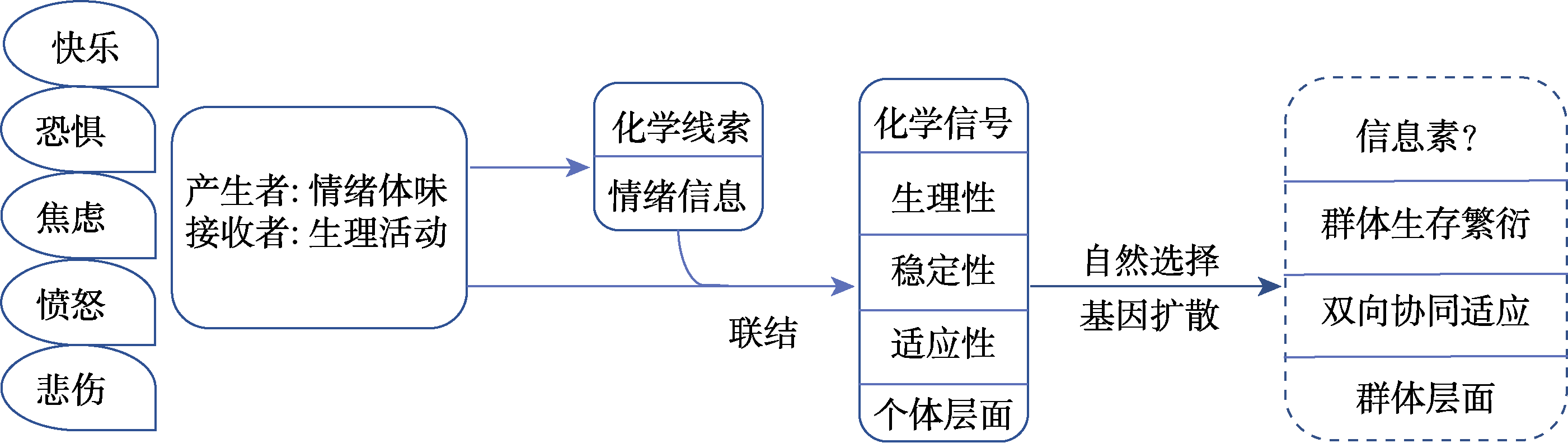
图1 化学线索: 个体从他人情绪体味中读出情绪信息并通过感知这些线索来做出反应; 化学信号: 情绪体味稳定地诱导接受者特定的生理反应, 提高个体环境适应性; 信息素: 同一物种间有目的释放的化学信号, 提升种群生存与繁衍能力。
| [1] |
Adolph D., Meister L., & Pause B. M. (2013). Context counts! Social anxiety modulates the processing of fearful faces in the context of chemosensory anxiety signals. Frontiers in Human Neuroscience, 7, 283.
doi: 10.3389/fnhum.2013.00283 pmid: 23801951 |
| [2] |
Adolph D., Schlösser S., Hawighorst M., & Pause B. M. (2010). Chemosensory signals of competition increase the skin conductance response in humans. Physiology & Behavior, 101(5), 666-671.
doi: 10.1016/j.physbeh.2010.08.004 URL |
| [3] | Agron S., de March C. A., Weissgross R., Mishor E., Gorodisky L., Weiss T.,... Sobel N. (2023). A chemical signal in human female tears lowers aggression in males. PLoS Biology, 21(12), e3002442. |
| [4] |
Albrecht J., Demmel M., Schöpf V., Kleemann A. M., Kopietz R., May J.,... Wiesmann M. (2011). Smelling chemosensory signals of males in anxious versus nonanxious condition increases state anxiety of female subjects. Chemical Senses, 36(1), 19-27.
doi: 10.1093/chemse/bjq087 pmid: 20929974 |
| [5] | Alcañiz M., Giglioli I. A. C., Carrasco-ribelles L. A., Minissi M. E., López C. G., & Semin G. R. (2023). How priming with body odors affects decision speeds in consumer behavior. Scientific Reports, 13(1), 609. |
| [6] |
Alexandra Kredlow M., Fenster R. J., Laurent E. S., Ressler K. J., & Phelps E. A. (2022). Prefrontal cortex, amygdala, and threat processing: Implications for PTSD. Neuropsychopharmacology, 47(1), 247-259.
doi: 10.1038/s41386-021-01155-7 |
| [7] |
Barson J. R., Mack N. R., & Gao W. J. (2020). The paraventricular nucleus of the thalamus is an important node in the emotional processing network. Frontiers in Behavioral Neuroscience, 14, 598469.
doi: 10.3389/fnbeh.2020.598469 URL |
| [8] |
Behnke M., Kreibig S. D., Kaczmarek L. D., Assink M., & Gross J. J. (2022). Autonomic nervous system activity during positive emotions: A meta-analytic review. Emotion Review, 14(2), 132-160.
doi: 10.1177/17540739211073084 URL |
| [9] |
Bensafi M., Tsutsui T., Khan R., Levenson R. W., & Sobel N. (2004). Sniffing a human sex-steroid derived compound affects mood and autonomic arousal in a dose-dependent manner. Psychoneuroendocrinology, 29(10), 1290-1299.
pmid: 15288708 |
| [10] |
Bylsma L. M., Gračanin A., & Vingerhoets A. J. (2019). The neurobiology of human crying. Clinical Autonomic Research, 29, 63-73.
doi: 10.1007/s10286-018-0526-y pmid: 29687400 |
| [11] | Callara A. L., Cecchetto C., Dal Bò E., Citi L., Gentili C., Vanello N.,... Greco A. (2022, July). Human body odors of happiness and fear modulate the late positive potential component during neutral face processing: A preliminary ERP study on healthy subjects. In 2022 44th Annual International Conference of the IEEE Engineering in Medicine & Biology Society (EMBC) (pp. 4093-4096). |
| [12] | Calvi E., Quassolo U., Massaia M., Scandurra A., D'Aniello B., & D'Amelio P. (2020). The scent of emotions: A systematic review of human intra‐and interspecific chemical communication of emotions. Brain and Behavior, 10(5), e01585. |
| [13] |
Cecchetto C., Dal Bò E., Eliasson E. T., Vigna E., Natali L., Scilingo E. P.,... Gentili C. (2025). Sniffing out a solution: How emotional body odors can improve mindfulness therapy for social anxiety. Journal of Affective Disorders, 369, 1082-1089.
doi: 10.1016/j.jad.2024.10.088 URL |
| [14] |
Chen D., & Haviland-Jones J. (2000). Human olfactory communication of emotion. Perceptual and Motor Skills, 91(3), 771-781.
doi: 10.2466/pms.2000.91.3.771 URL |
| [15] |
Chen R., Zhu Z., Ji S., Geng Z., Hou Q., Sun X., & Fu X. (2020). Sweat gland regeneration: Current strategies and future opportunities. Biomaterials, 255, 120201.
doi: 10.1016/j.biomaterials.2020.120201 URL |
| [16] |
D’Aniello, B., Pinelli, C., Scandurra, A., Di Lucrezia, A., Aria, M., & Semin, G. R. (2023). When are puppies receptive to emotion-induced human chemosignals? The cases of fear and happiness. Animal Cognition, 26(4), 1241-1250.
doi: 10.1007/s10071-023-01771-4 pmid: 37010698 |
| [17] |
D’Aniello, B., Semin, G. R., Alterisio, A., Aria, M., & Scandurra, A. (2018). Interspecies transmission of emotional information via chemosignals: From humans to dogs (Canis lupus familiaris). Animal Cognition, 21, 67-78.
doi: 10.1007/s10071-017-1139-x pmid: 28988316 |
| [18] | d’Ingeo, S., Siniscalchi, M., Straziota, V., Ventriglia, G., Sasso, R., & Quaranta, A. (2023). Relationship between asymmetric nostril use and human emotional odours in cats. Scientific Reports, 13(1), 10982. |
| [19] | Dal Bò E., Cecchetto C., Callara A. L., Greco A., Mura F., Vanello N.,... Gentili C. (2024). Emotion perception through the nose: How olfactory emotional cues modulate the perception of neutral facial expressions in affective disorders. Translational Psychiatry, 14(1), 342. |
| [20] | de Groot J. H., Haertl T., Loos H. M., Bachmann C., Kontouli A., & Smeets M. A. (2023). Unraveling the universality of chemical fear communication: Evidence from behavioral, genetic, and chemical analyses. Chemical Senses, 48, bjad046. |
| [21] | de Groot J. H., Kirk P. A., & Gottfried J. A. (2020). Encoding fear intensity in human sweat. Philosophical Transactions of the Royal Society B, 375(1800), 20190271. |
| [22] |
de Groot J. H., Kirk P. A., & Gottfried J. A. (2021). Titrating the smell of fear: Initial evidence for dose-invariant behavioral, physiological, and neural responses. Psychological Science, 32(4), 558-572.
doi: 10.1177/0956797620970548 URL |
| [23] |
de Groot J. H., Semin G. R., & Smeets M. A. (2014). Chemical communication of fear: A case of male-female asymmetry. Journal of Experimental Psychology: General, 143(4), 1515-1525.
doi: 10.1037/a0035950 URL |
| [24] |
de Groot J. H., Semin G. R., & Smeets M. A. (2017). On the communicative function of body odors: A theoretical integration and review. Perspectives on Psychological Science, 12(2), 306-324.
doi: 10.1177/1745691616676599 pmid: 28346117 |
| [25] | de Groot J. H., Smeets M. A., & Semin G. R. (2015). Rapid stress system drives chemical transfer of fear from sender to receiver. PLoS One, 10(2), e0118211. |
| [26] |
de Groot J. H., Smeets M. A., Kaldewaij A., Duijndam M. J., & Semin G. R. (2012). Chemosignals communicate human emotions. Psychological Science, 23(11), 1417-1424.
doi: 10.1177/0956797612445317 pmid: 23019141 |
| [27] |
de Groot J. H., Smeets M. A., Rowson M. J., Bulsing P. J., Blonk C. G., Wilkinson J. E., & Semin G. R. (2015). A sniff of happiness. Psychological Science, 26(6), 684-700.
doi: 10.1177/0956797614566318 pmid: 25870406 |
| [28] |
de Groot J. H., van Houtum L. A., Gortemaker I., Ye Y., Chen W., Zhou W., & Smeets M. A. (2018). Beyond the west: Chemosignaling of emotions transcends ethno-cultural boundaries. Psychoneuroendocrinology, 98, 177-185.
doi: S0306-4530(18)30456-6 pmid: 30193224 |
| [29] |
Destrez A., Costes-Thiré M., Viart A. S., Prost F., Patris B., & Schaal B. (2021). Male mice and cows perceive human emotional chemosignals: A preliminary study. Animal Cognition, 24(6), 1205-1214.
doi: 10.1007/s10071-021-01511-6 |
| [30] |
Di Cicco F., Evans R. L., James A. G., Weddell I., Chopra A., & Smeets M. A. (2023). Intrinsic and extrinsic factors affecting axillary odor variation. A comprehensive review. Physiology & Behavior, 270, 114307.
doi: 10.1016/j.physbeh.2023.114307 URL |
| [31] |
Dimitroff S. J., Kardan O., Necka E. A., Decety J., Berman M. G., & Norman G. J. (2017). Physiological dynamics of stress contagion. Scientific Reports, 7, 6168.
doi: 10.1038/s41598-017-05811-1 pmid: 28733589 |
| [32] | Ekman P., & Friesen W. V. (2003). Unmasking the face: A guide to recognizing emotions from facial clues. (Vol 10). Ishk. |
| [33] |
Endevelt-Shapira Y., Perl O., Ravia A., Amir D., Eisen A., Bezalel V.,... Sobel N. (2018). Altered responses to social chemosignals in autism spectrum disorder. Nature Neuroscience, 21(1), 111-119.
doi: 10.1038/s41593-017-0024-x pmid: 29180748 |
| [34] |
Feldt-Rasmussen U., Effraimidis G., & Klose M. (2021). The hypothalamus-pituitary-thyroid (HPT)-axis and its role in physiology and pathophysiology of other hypothalamus- pituitary functions. Molecular and Cellular Endocrinology, 525, 111173.
doi: 10.1016/j.mce.2021.111173 URL |
| [35] | Ferdowsi S., Ognibene D., Foulsham T., Abolghasemi V., Li W., & Citi L. (2020, October). Human chemosignals modulate interactions between social and emotional brain areas. In 2020 IEEE 20th International Conference on Bioinformatics and Bioengineering (BIBE) (pp. 513-518). |
| [36] |
Ferreira J., Parma V., Alho L., Silva C. F., & Soares S. C. (2018). Emotional body odors as context: Effects on cardiac and subjective responses. Chemical Senses, 43(5), 347-355.
doi: 10.1093/chemse/bjy021 pmid: 29617740 |
| [37] |
Ferrero D. M., Moeller L. M., Osakada T., Horio N., Li Q., Roy D. S.,... Liberles S. D. (2013). A juvenile mouse pheromone inhibits sexual behaviour through the vomeronasal system. Nature, 502(7471), 368-371.
doi: 10.1038/nature12579 |
| [38] |
Fox A. S., Oler J. A., Tromp D. P., Fudge J. L., & Kalin N. H. (2015). Extending the amygdala in theories of threat processing. Trends in Neurosciences, 38(5), 319-329.
doi: 10.1016/j.tins.2015.03.002 pmid: 25851307 |
| [39] | Futuyma D. J., & Kirkpatrick M. (2023). Evolution (5th ed.). Oxford University Press. |
| [40] |
Gelstein S., Yeshurun Y., Rozenkrantz L., Shushan S., Frumin I., Roth Y., & Sobel N. (2011). Human tears contain a chemosignal. Science, 331(6014), 226-230.
doi: 10.1126/science.1198331 pmid: 21212322 |
| [41] | Gioia F., Callara A. L., Bruderer T., Ripszam M., Di Francesco F., Scilingo E. P., & Greco A. (2022, June). Potential physiological stress biomarkers in human sweat. In 2022 IEEE International Symposium on Medical Measurements and Applications (MeMeA) (pp. 01-06). |
| [42] | Gomes N., & Semin G. R. (2021). The function of fear chemosignals: Preparing for danger. Chemical Senses, 46, bjab005. |
| [43] | Gomes N., Pause B. M., Smeets M. A., & Semin G. R. (2023). Comparing fear and anxiety chemosignals: Do they modulate facial muscle activity and facilitate identifying facial expressions? Chemical Senses, 48, bjad016. |
| [44] |
Gomes N., Silva F., & Semin G. R. (2020). The lasting smell of emotions: The effects of reutilizing fear sweat samples. Behavior Research Methods, 52(6), 2438-2451.
doi: 10.3758/s13428-020-01412-5 |
| [45] |
Gračanin A., Bylsma L. M., & Vingerhoets A. J. (2018). Why only humans shed emotional tears: Evolutionary and cultural perspectives. Human Nature, 29(2), 104-133.
doi: 10.1007/s12110-018-9312-8 |
| [46] |
Gračanin A., Van Assen M. A., Omrčen V., Koraj I., & Vingerhoets A. J. (2017). Chemosignalling effects of human tears revisited: Does exposure to female tears decrease males’ perception of female sexual attractiveness? Cognition and Emotion, 31(1), 139-150.
doi: 10.1080/02699931.2016.1151402 URL |
| [47] |
Guo X., He H., Sun J., & Kang L. (2023). Plasticity of aggregation pheromones in insects. Current Opinion in Insect Science, 59, 101098.
doi: 10.1016/j.cois.2023.101098 URL |
| [48] |
Hadjikhani N., & de Gelder B. (2003). Seeing fearful body expressions activates the fusiform cortex and amygdala. Current Biology, 13(24), 2201-2205.
pmid: 14680638 |
| [49] |
Haegler K., Zernecke R., Kleemann A. M., Albrecht J., Pollatos O., Brückmann H., & Wiesmann M. (2010). No fear no risk! Human risk behavior is affected by chemosensory anxiety signals. Neuropsychologia, 48(13), 3901-3908.
doi: 10.1016/j.neuropsychologia.2010.09.019 pmid: 20875438 |
| [50] | Hare R. M., Schlatter S., Rhodes G., & Simmons L. W. (2017). Putative sex-specific human pheromones do not affect gender perception, attractiveness ratings or unfaithfulness judgements of opposite sex faces. Royal Society Open Science, 4(3), 160831. |
| [51] |
Heiss S., Vaschillo B., Vaschillo E. G., Timko C. A., & Hormes J. M. (2021). Heart rate variability as a biobehavioral marker of diverse psychopathologies: A review and argument for an “ideal range”. Neuroscience & Biobehavioral Reviews, 121, 144-155.
doi: 10.1016/j.neubiorev.2020.12.004 URL |
| [52] |
Holton E., Grohn J., Ward H., Manohar S. G., O’reilly J. X., & Kolling N. (2024). Goal commitment is supported by vmPFC through selective attention. Nature Human Behaviour, 8(7), 1351-1365.
doi: 10.1038/s41562-024-01844-5 pmid: 38632389 |
| [53] |
Howard J. D., & Gottfried J. A. (2014). Configural and elemental coding of natural odor mixture components in the human brain. Neuron, 84(4), 857-869.
doi: 10.1016/j.neuron.2014.10.012 pmid: 25453843 |
| [54] |
Jabbi M., Swart M., & Keysers C. (2007). Empathy for positive and negative emotions in the gustatory cortex. Neuroimage, 34(4), 1744-1753.
pmid: 17175173 |
| [55] |
Kamiloğlu R. G., Smeets M. A., de Groot J. H., & Semin G. R. (2018). Fear odor facilitates the detection of fear expressions over other negative expressions. Chemical Senses, 43(6), 419-426.
doi: 10.1093/chemse/bjy029 pmid: 29796589 |
| [56] |
Karlson P., & Lüscher M. (1959). ‘Pheromones’: A new term for a class of biologically active substances. Nature, 183(4653), 55-56.
doi: 10.1038/183055a0 |
| [57] | Lanata A., Nardelli M., Valenza G., Baragli P., D’Aniello B., Alterisio A.,... Scilingo E. P. (2018, July). A case for the interspecies transfer of emotions: A preliminary investigation on how humans odors modify reactions of the autonomic nervous system in horses. In 2018 40th Annual International Conference of the IEEE Engineering in Medicine and Biology Society (EMBC) (pp. 522-525). |
| [58] | Larrigaldie I., Damon F., Mousqué S., Patris B., Lansade L., Schaal B., & Destrez A. (2024). Do sheep (Ovis aries) discriminate human emotional odors? Animal Cognition, 27(1), 51. |
| [59] |
LeDoux J. E., & Pine D. S. (2016). Using neuroscience to help understand fear and anxiety: A two-system framework. American Journal of Psychiatry, 173(11), 1083-1093.
pmid: 27609244 |
| [60] |
Leung F. Y. N., Sin J., Dawson C., Ong J. H., Zhao C., Veić A., & Liu F. (2022). Emotion recognition across visual and auditory modalities in autism spectrum disorder: A systematic review and meta-analysis. Developmental Review, 63, 101000.
doi: 10.1016/j.dr.2021.101000 URL |
| [61] |
Liberles S. D. (2014). Mammalian pheromones. Annual Review of Physiology, 76, 151-175.
doi: 10.1146/annurev-physiol-021113-170334 pmid: 23988175 |
| [62] | Lu J., Ye Y., & Wu Y. (2024). Little evidence that androstadienone affects social distance-dependent prosocial behaviour: A pre-registered study. Royal Society Open Science, 11(5), 240004. |
| [63] |
Lübke K. T., Storch D., & Pause B. M. (2024). Sexual orientation affects neural responses to subtle social aggression signals. Archives of Sexual Behavior, 53(1), 153-175.
doi: 10.1007/s10508-023-02661-z |
| [64] |
Maier A., Scheele D., Spengler F. B., Menba T., Mohr F., Güntürkün O.,... Hurlemann R. (2019). Oxytocin reduces a chemosensory-induced stress bias in social perception. Neuropsychopharmacology, 44(2), 281-288.
doi: 10.1038/s41386-018-0063-3 pmid: 29703998 |
| [65] | Mazzola V., Arciero G., Fazio L., Lanciano T., Gelao B., Bertolino A., & Bondolfi G. (2020). Emotion-body connection dispositions modify the insulae-midcingulate effective connectivity during anger processing. PloS One, 15(2), e0228404. |
| [66] |
Meister L., & Pause B. M. (2021). It’s trust or risk? Chemosensory anxiety signals affect bargaining in women. Biological Psychology, 162, 108114.
doi: 10.1016/j.biopsycho.2021.108114 URL |
| [67] | Miranda J. A., Canabal M. F., Gutiérrez-Martín L., Lanza- Gutierrez J. M., Portela-García M., & López-Ongil C. (2021). Fear recognition for women using a reduced set of physiological signals. Sensors, 21(5), 1587. |
| [68] | Moore B. C. (2012). An introduction to the psychology of hearing (Chapter 2, pp.57-64). Brill. |
| [69] |
Motzkin J. C., Philippi C. L., Wolf R. C., Baskaya M. K., & Koenigs M. (2015). Ventromedial prefrontal cortex is critical for the regulation of amygdala activity in humans. Biological Psychiatry, 77(3), 276-284.
doi: S0006-3223(14)00109-7 pmid: 24673881 |
| [70] | Mujica-Parodi L. R., Strey H. H., Frederick B., Savoy R., Cox D., Botanov Y.,... Weber J. (2009). Chemosensory cues to conspecific emotional stress activate AMYgdala in humans. PloS One, 4(7), e6415. |
| [71] |
Mutic S., Brünner Y. F., Rodriguez-Raecke R., Wiesmann M., & Freiherr J. (2017). Chemosensory danger detection in the human brain: Body odor communicating aggression modulates limbic system activation. Neuropsychologia, 99, 187-198.
doi: S0028-3932(17)30064-7 pmid: 28254652 |
| [72] |
Mutic S., Parma V., Brünner Y. F., & Freiherr J. (2016). You smell dangerous: Communicating fight responses through human chemosignals of aggression. Chemical Senses, 41(1), 35-43.
doi: 10.1093/chemse/bjv058 pmid: 26453051 |
| [73] |
Ortegón S. R., Carlos O., Robert-Hazotte A., Lelgouarch A., Desoche C., Duncan K. K.,... Ferdenzi C. (2023). Investigating the human chemical communication of positive emotions using a virtual reality-based mood induction. Physiology & Behavior, 264, 114147.
doi: 10.1016/j.physbeh.2023.114147 URL |
| [74] |
Pause B. M., Adolph D., Prehn-Kristensen A., & Ferstl R. (2009). Startle response potentiation to chemosensory anxiety signals in socially anxious individuals. International Journal of Psychophysiology, 74(2), 88-92.
doi: 10.1016/j.ijpsycho.2009.07.008 pmid: 19666058 |
| [75] | Pause B. M., Lübke K., Laudien J. H., & Ferstl R. (2010). Intensified neuronal investment in the processing of chemosensory anxiety signals in non-socially anxious and socially anxious individuals. PloS One, 5(4), e10342. |
| [76] | Pause B. M., Storch D., & Lübke K. T. (2020). Chemosensory communication of aggression: Women's fine-tuned neural processing of male aggression signals. Philosophical Transactions of the Royal Society B, 375(1800), 20190270. |
| [77] |
Prehn A., Ohrt A., Sojka B., Ferstl R., & Pause B. M. (2006). Chemosensory anxiety signals augment the startle reflex in humans. Neuroscience Letters, 394(2), 127-130.
pmid: 16257486 |
| [78] | Prehn-Kristensen A., Wiesner C., Bergmann T. O., Wolff S., Jansen O., Mehdorn H. M.,... Pause B. M. (2009). Induction of empathy by the smell of anxiety. PloS One, 4(6), e5987. |
| [79] |
Quintana P., Nolet K., Baus O., & Bouchard S. (2019). The effect of exposure to fear-related body odorants on anxiety and interpersonal trust toward a virtual character. Chemical Senses, 44(9), 683-692.
doi: 10.1093/chemse/bjz063 pmid: 31504295 |
| [80] |
Regnier F. E., & Law J. H. (1968). Insect pheromones. Journal of Lipid Research, 9(5), 541-551.
pmid: 4882034 |
| [81] |
Ressler K. J., Berretta S., Bolshakov V. Y., Rosso I. M., Meloni E. G., Rauch S. L., & Carlezon Jr W. A. (2022). Post-traumatic stress disorder: Clinical and translational neuroscience from cells to circuits. Nature Reviews Neurology, 18(5), 273-288.
doi: 10.1038/s41582-022-00635-8 pmid: 35352034 |
| [82] | Richard Ortegón S., Fournel A., Carlos O., Kawabata Duncan K., Hirabayashi K., Tagai K.,... Ferdenzi C. (2022). And I’m feeling good: Effect of emotional sweat and perfume on others’ physiology, verbal responses, and creativity. Chemical Senses, 47, bjac012. |
| [83] | Riddell P., Paris M. C., Joonè C. J., Pageat P., & Paris D. B. (2021). Appeasing pheromones for the management of stress and aggression during conservation of wild canids: Could the solution be right under our nose? Animals, 11(6), 1574. |
| [84] |
Rocha M., Parma V., Lundström J. N., & Soares S. C. (2018). Anxiety body odors as context for dynamic faces: Categorization and psychophysiological biases. Perception, 47(10-11), 1054-1069.
doi: 10.1177/0301006618797227 pmid: 30231844 |
| [85] |
Rodriguez I., Greer C. A., Mok M. Y., & Mombaerts P. (2000). A putative pheromone receptor gene expressed in human olfactory mucosa. Nature Genetics, 26(1), 18-19.
pmid: 10973240 |
| [86] | Roseman I. J. (2018). Functions of anger in the emotion system. In: Lench, H. (Eds.), The function of emotions: When and why emotions help us (pp.141-173). Springer, Cham. |
| [87] |
Rubin D., Botanov Y., Hajcak G., & Mujica-Parodi L. R. (2012). Second-hand stress: Inhalation of stress sweat enhances neural response to neutral faces. Social Cognitive and Affective Neuroscience, 7(2), 208-212.
doi: 10.1093/scan/nsq097 pmid: 21208988 |
| [88] |
Sabiniewicz A., Tarnowska K., Świątek R., Sorokowski P., & Laska M. (2020). Olfactory-based interspecific recognition of human emotions: Horses (Equus ferus caballus) can recognize fear and happiness body odour from humans (Homo sapiens). Applied Animal Behaviour Science, 230, 105072.
doi: 10.1016/j.applanim.2020.105072 URL |
| [89] |
Sakamoto K., Butera M. A., Zhou C., Maurizi G., Chen B., Ling L.,... Buettner C. (2025). Overnutrition causes insulin resistance and metabolic disorder through increased sympathetic nervous system activity. Cell Metabolism, 37(1), 121-137.
doi: 10.1016/j.cmet.2024.09.012 URL |
| [90] | Science. (2005). So much more to know. Science, 309(5731), 78-102. |
| [91] |
Semin G. R., DePhillips M., & Gomes N. (2024). Investigating inattentional blindness through the lens of fear chemosignals. Psychological Science, 35(1), 72-81.
doi: 10.1177/09567976231213572 pmid: 38019589 |
| [92] |
Silva F., Gomes N., Korb S., & Semin G. R. (2020). Not all emotions are equal: Fear chemosignals lower awareness thresholds only for fearful faces. Chemical Senses, 45(7), 601-608.
doi: 10.1093/chemse/bjaa047 pmid: 32604414 |
| [93] |
Simpson G. G. (1953). The Baldwin effect. Evolution, 7(2), 110-117.
doi: 10.1111/evo.1953.7.issue-2 URL |
| [94] |
Singh P. B., Young A., Lind S., Leegaard M. C., Capuozzo A., & Parma V. (2018). Smelling anxiety chemosignals impairs clinical performance of dental students. Chemical Senses, 43(6), 411-417.
doi: 10.1093/chemse/bjy028 pmid: 29767685 |
| [95] | Smeets M. A., Rosing E. A., Jacobs D. M., van Velzen E., Koek J. H., Blonk C.,... Semin G. R. (2020). Chemical fingerprints of emotional body odor. Metabolites, 10(3), 84. |
| [96] |
Smith E. R., & Semin G. R. (2007). Situated social cognition. Current Directions in Psychological Science, 16(3), 132-135.
doi: 10.1111/j.1467-8721.2007.00490.x URL |
| [97] |
Sorokowski P., Karwowski M., Misiak M., Marczak M. K., Dziekan M., Hummel T., & Sorokowska A. (2019). Sex differences in human olfaction: A meta-analysis. Frontiers in Psychology, 10, 242.
doi: 10.3389/fpsyg.2019.00242 pmid: 30814965 |
| [98] |
Steiger S., Schmitt T., & Schaefer H. M. (2011). The origin and dynamic evolution of chemical information transfer. Proceedings of the Royal Society B: Biological Sciences, 278(1708), 970-979.
doi: 10.1098/rspb.2010.2285 URL |
| [99] |
Stökl J., & Steiger S. (2017). Evolutionary origin of insect pheromones. Current Opinion in Insect Science, 24, 36-42
doi: S2214-5745(17)30029-9 pmid: 29208221 |
| [100] |
Susskind J. M., Lee D. H., Cusi A., Feiman R., Grabski W., & Anderson A. K. (2008). Expressing fear enhances sensory acquisition. Nature Neuroscience, 11(7), 843-850.
doi: 10.1038/nn.2138 pmid: 18552843 |
| [101] |
Van Kleef G. A., & Côté S. (2022). The social effects of emotions. Annual Review of Psychology, 73(1), 629-658.
doi: 10.1146/psych.2022.73.issue-1 URL |
| [102] | Verheggen F. J., Haubruge E., & Mescher M. C. (2010). Alarm pheromones-chemical signaling in response to danger. Vitamins & Hormones, 83, 215-239. |
| [103] |
Voznessenskaya V. V., Klyuchnikova M. A., & Laktionova T. K. (2022). Evolution of pheromones in mammals. Biology Bulletin Reviews, 12(1), 49-64.
doi: 10.1134/S2079086422010091 |
| [104] |
Williams R. (2017). Anger as a basic emotion and its role in personality building and pathological growth: The neuroscientific, developmental and clinical perspectives. Frontiers in Psychology, 8, 1950.
doi: 10.3389/fpsyg.2017.01950 pmid: 29163318 |
| [105] | Wilson C., Campbell K., Petzel Z., & Reeve C. (2022). Dogs can discriminate between human baseline and psychological stress condition odours. PLoS One, 17(9), e0274143. |
| [106] |
Wu Y., Chen K., Xing C., Huang M., Zhao K., & Zhou W. (2024). Human olfactory perception embeds fine temporal resolution within a single sniff. Nature Human Behaviour, 8, 2168-2178.
doi: 10.1038/s41562-024-01984-8 |
| [107] |
Wudarczyk O. A., Kohn N., Bergs R., Goerlich K. S., Gur R. E., Turetsky B.,... Habel U. (2016). Chemosensory anxiety cues enhance the perception of fearful faces-An fMRI study. Neuroimage, 143, 214-222.
doi: S1053-8119(16)30463-3 pmid: 27592811 |
| [108] |
Wudarczyk O. A., Kohn N., Bergs R., Gur R. E., Turetsky B., Schneider F., & Habel U. (2015). Chemosensory anxiety cues moderate the experience of social exclusion - An fMRI investigation with Cyberball. Frontiers in Psychology, 6, 1475.
doi: 10.3389/fpsyg.2015.01475 pmid: 26500572 |
| [109] |
Wunder A., Ludwig J., Haertl T., Arnhardt S., Schwinn L., Chellapandian D. C.,... Freiherr J. (2023). Can you smell my stress? Influence of stress chemosignals on empathy and emotion recognition in depressed individuals and healthy controls. Physiology & Behavior, 270, 114309.
doi: 10.1016/j.physbeh.2023.114309 URL |
| [110] | Wyatt T. D. (2020). Reproducible research into human chemical communication by cues and pheromones: Learning from psychology's renaissance. Philosophical Transactions of the Royal Society B, 375(1800), 20190262. |
| [111] |
Zhou W., & Chen D. (2009). Fear-related chemosignals modulate recognition of fear in ambiguous facial expressions. Psychological Science, 20(2), 177-183.
doi: 10.1111/j.1467-9280.2009.02263.x pmid: 19170944 |
| [1] | 王羽凌, 陆晓伟, 武宗杰, 李国根, 张林. 面孔吸引力判断中的跨通道整合过程[J]. 心理科学进展, 2024, 32(5): 790-799. |
| [2] | 刘文彬, 漆正堂, 刘微娜. 不同感觉功能对抑郁的影响及其神经机制[J]. 心理科学进展, 2023, 31(4): 641-656. |
| [3] | 陈诗婷, 杨文登. 嗅觉影响社会判断与决策的作用与机制[J]. 心理科学进展, 2023, 31(10): 1899-1911. |
| [4] | 周雯;冯果. 嗅知觉及其与情绪系统的交互[J]. 心理科学进展, 2012, 20(1): 2-9. |
| [5] | 卿英迪;高金金;陈毅文. 香气在营销中的应用[J]. 心理科学进展, 2011, 19(3): 449-458. |
| 阅读次数 | ||||||
|
全文 |
|
|||||
|
摘要 |
|
|||||
