

ISSN 1671-3710
CN 11-4766/R
主办:中国科学院心理研究所
出版:科学出版社
CN 11-4766/R
主办:中国科学院心理研究所
出版:科学出版社
心理科学进展 ›› 2026, Vol. 34 ›› Issue (2): 271-282.doi: 10.3724/SP.J.1042.2026.0271 cstr: 32111.14.2026.0271
李沛祺1, 张毓1, 田梦雨2( )
)
收稿日期:2025-04-21
出版日期:2026-02-15
发布日期:2025-12-15
通讯作者:
田梦雨, E-mail: mengyutian@bnu.edu.cn基金资助:
LI Peiqi1, ZHANG Yu1, TIAN Mengyu2()
Received:2025-04-21
Online:2026-02-15
Published:2025-12-15
摘要: 感知觉经验缺失和阅读等文化技能的习得, 都会引发脑的可塑性改变。研究盲人阅读触觉盲文的神经基础为理解这一机制提供了独特视角。本文综述了近年的神经影像学证据, 聚焦三个核心问题:1)早期视觉皮层是否存在阅读特异性表征; 2)腹侧枕颞皮层“视觉词形区”是否保留跨通道词形加工功能; 3)顶叶是否存在“触觉词形区”。结果发现, 早期视觉皮层和腹侧枕颞皮层的功能仍存在争议, 而顶叶在触觉词形加工中可能发挥重要作用。未来研究应进一步揭示盲人“视觉”皮层在盲文阅读中表征的具体信息, 并检验“触觉词形区”的存在。同时, 还需要探讨盲文阅读水平的神经基础。这将深化我们对脑可塑性机制的理解, 并为盲文阅读教育提供理论依据。
中图分类号:
李沛祺, 张毓, 田梦雨. (2026). 感觉通道与经验剥夺对阅读神经基础的影响——来自盲文触觉阅读的证据. 心理科学进展 , 34(2), 271-282.
LI Peiqi, ZHANG Yu, TIAN Mengyu. (2026). The influence of sensory modalities and experience deprivation on the neural basis of reading: Evidence from tactile Braille reading. Advances in Psychological Science, 34(2), 271-282.
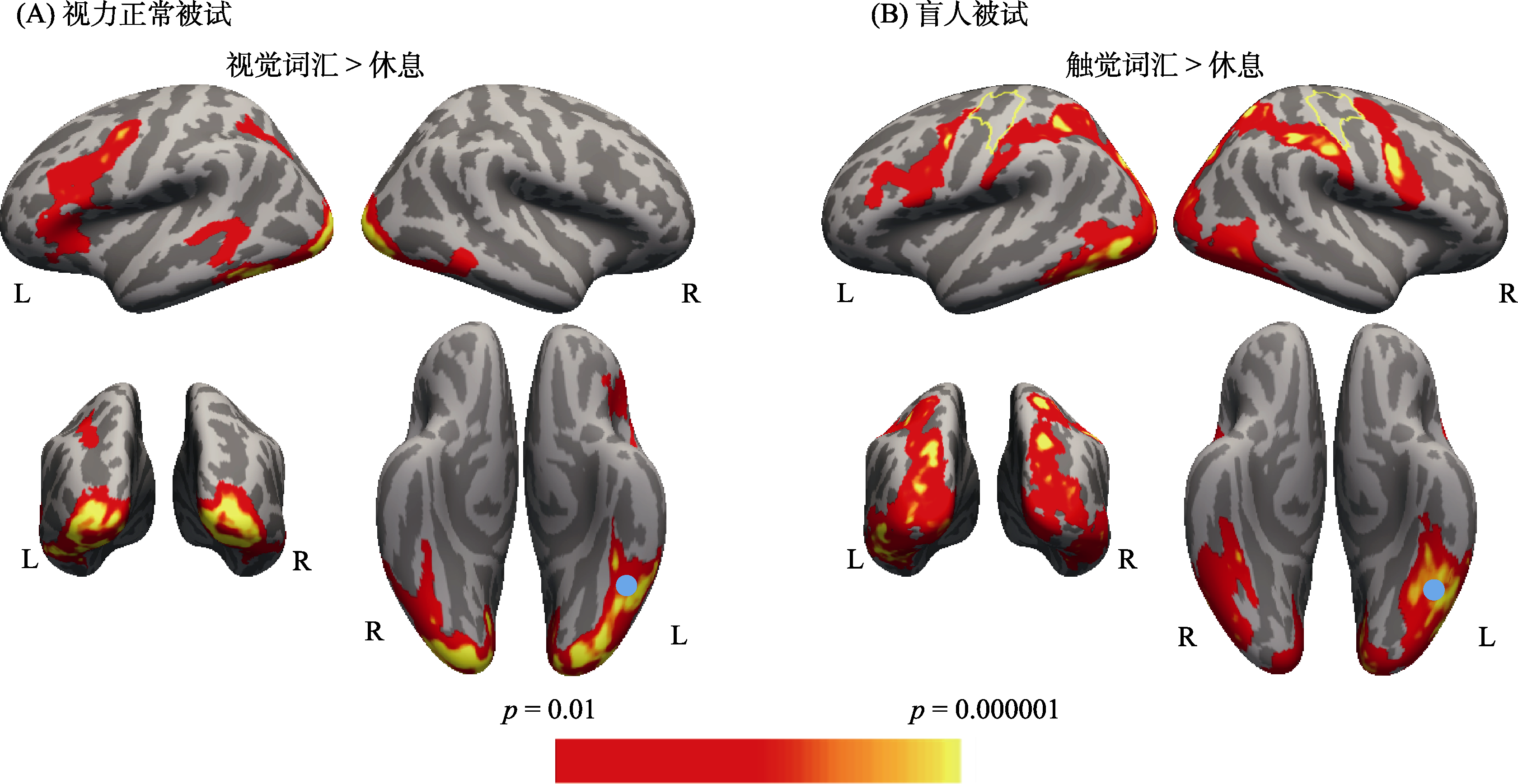
图1 视力正常被试(A)和盲人(B)在视觉/触觉阅读任务中的全脑激活图。蓝色圆点标记了以往文献中报告视觉词形区(VWFA)的位置(MNI coordinate: −46, −53, −20) (McCandliss et al., 2003)。黄色轮廓标记了手部初级感觉运动区(S1/M1)的位置。改编自Tian等人(2023)。彩图见电子版。
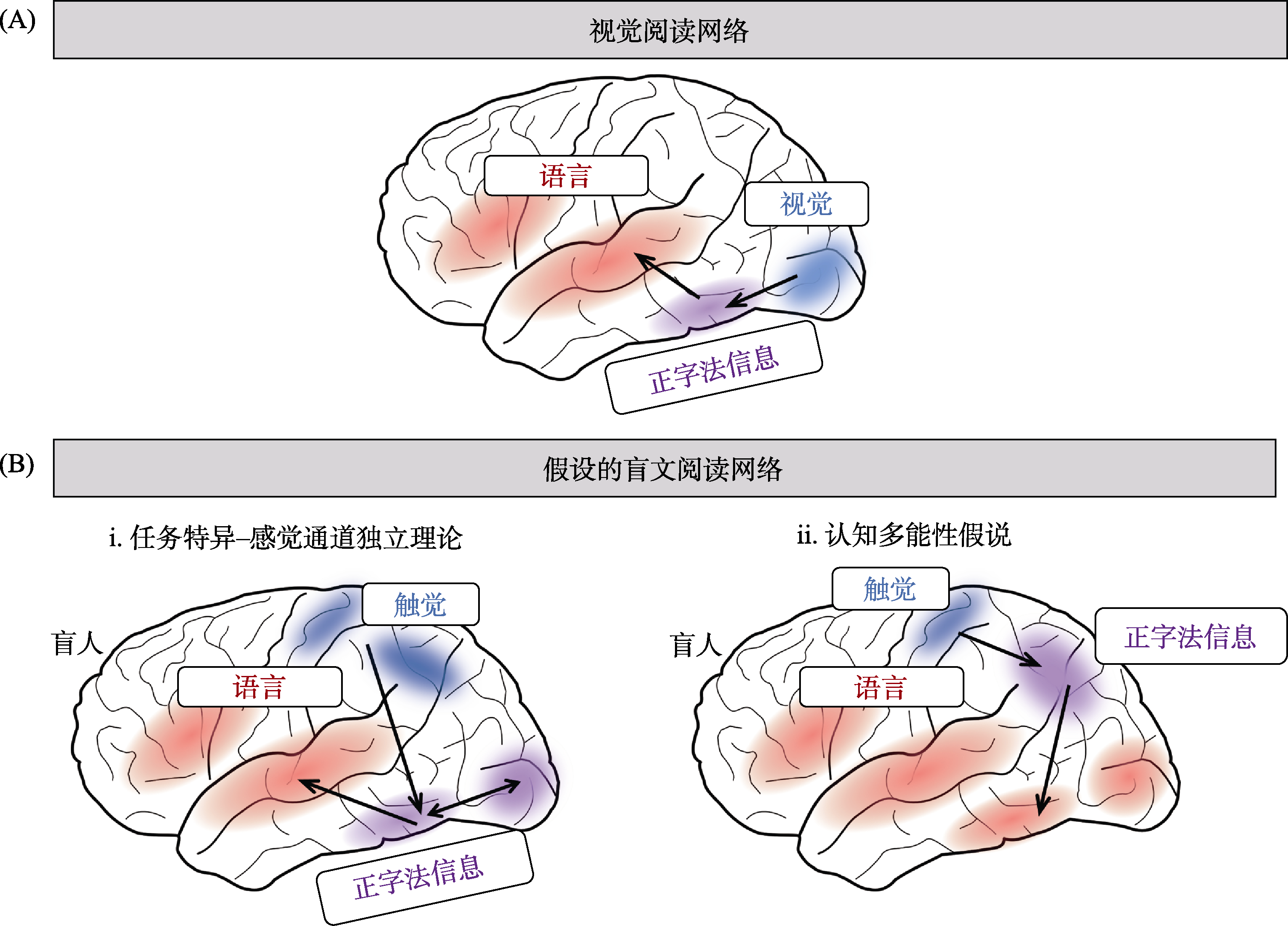
图2 (A) 视觉阅读网络; (B) 假设的盲文阅读网络。
| [1] |
Abboud S., & Cohen L. (2019). Distinctive interaction between cognitive networks and the visual cortex in early blind individuals. Cerebral Cortex, 29(11), 4725-4742. https://doi.org/10.1093/cercor/bhz006
doi: 10.1093/cercor/bhz006 URL |
| [2] |
Amedi A., Raz N., Azulay H., Malach R., & Zohary E. (2010). Cortical activity during tactile exploration of objects in blind and sighted humans. Restorative Neurology and Neuroscience, 28(2), 143-156. https://doi.org/10.3233/RNN-2010-0503
doi: 10.3233/RNN-2010-0503 URL pmid: 20404404 |
| [3] |
Baeck A., Kravitz D., Baker C., & Op De Beeck H. P. (2015). Influence of lexical status and orthographic similarity on the multi-voxel response of the visual word form area. NeuroImage, 111, 321-328. https://doi.org/10.1016/j.neuroimage.2015.01.060
doi: 10.1016/j.neuroimage.2015.01.060 URL pmid: 25665965 |
| [4] |
Baker C. I., Liu J., Wald L. L., Kwong K. K., Benner T., & Kanwisher N. (2007). Visual word processing and experiential origins of functional selectivity in human extrastriate cortex. Proceedings of the National Academy of Sciences, 104(21), 9087-9092. https://doi.org/10.1073/pnas.0703300104
doi: 10.1073/pnas.0703300104 URL |
| [5] |
Bauer C., Yazzolino L., Hirsch G., Cattaneo Z., Vecchi T., & Merabet L. B. (2015). Neural correlates associated with superior tactile symmetry perception in the early blind. Cortex, 63, 104-117. https://doi.org/10.1016/j.cortex.2014.08.003
doi: 10.1016/j.cortex.2014.08.003 URL pmid: 25243993 |
| [6] |
Beck J., Dzięgiel-Fivet G., & Jednoróg K. (2023). Similarities and differences in the neural correlates of letter and speech sound integration in blind and sighted readers. NeuroImage, 278, 120296. https://doi.org/10.1016/j.neuroimage.2023.120296
doi: 10.1016/j.neuroimage.2023.120296 URL |
| [7] |
Bedny M. (2017). Evidence from blindness for a cognitively pluripotent cortex. Trends in Cognitive Sciences, 21(9), 637-648. https://doi.org/10.1016/j.tics.2017.06.003
doi: S1364-6613(17)30127-4 URL pmid: 28821345 |
| [8] |
Bedny M., Konkle T., Pelphrey K., Saxe R., & Pascual- Leone A. (2010). Sensitive period for a multimodal response in human visual motion area MT/MST. Current Biology, 20(21), 1900-1906. https://doi.org/10.1016/j.cub.2010.09.044
doi: 10.1016/j.cub.2010.09.044 URL pmid: 20970337 |
| [9] |
Bedny M., Pascual-Leone A., Dodell-Feder D., Fedorenko E., & Saxe R. (2011). Language processing in the occipital cortex of congenitally blind adults. Proceedings of the National Academy of Sciences of the United States of America, 108(11), 4429-4434. https://doi.org/10.1073/pnas.1014818108
doi: 10.1073/pnas.1014818108 URL pmid: 21368161 |
| [10] |
Bolger D. J., Perfetti C. A., & Schneider W. (2005). Cross-cultural effect on the brain revisited: Universal structures plus writing system variation. Human Brain Mapping, 25(1), 92-104. https://doi.org/10.1002/hbm.20124
doi: 10.1002/hbm.20124 URL pmid: 15846818 |
| [11] |
Bouhali F., de Schotten M. T., Pinel P., Poupon C., Mangin J. F., Dehaene S., & Cohen L. (2014). Anatomical connections of the visual word form area. Journal of Neuroscience, 34(46), 15402-15414. https://doi.org/10.1523/JNEUROSCI.4918-13.2014
doi: 10.1523/JNEUROSCI.4918-13.2014 URL pmid: 25392507 |
| [12] |
Buchel C. (1998). Different activation patterns in the visual cortex of late and congenitally blind subjects. Brain, 121(3), 409-419. https://doi.org/10.1093/brain/121.3.409
doi: 10.1093/brain/121.3.409 URL |
| [13] |
Burks J. D., Boettcher L. B., Conner A. K., Glenn C. A., Bonney P. A., Baker C. M., … Sughrue M. E. (2017). White matter connections of the inferior parietal lobule: A study of surgical anatomy. Brain and Behavior, 7(4), e00640. https://doi.org/10.1002/brb3.640
doi: 10.1002/brb3.2017.7.issue-4 URL |
| [14] |
Burton H., Sinclair R. J., & Agato A. (2012). Recognition memory for Braille or spoken words: An fMRI study in early blind. Brain Research, 1438, 22-34. https://doi.org/10.1016/j.brainres.2011.12.032
doi: 10.1016/j.brainres.2011.12.032 URL pmid: 22251836 |
| [15] |
Burton H., Snyder A. Z., Conturo T. E., Akbudak E., Ollinger J. M., & Raichle M. E. (2002). Adaptive changes in early and late blind: A fMRI study of Braille reading. Journal of Neurophysiology, 87(1), 589-607. https://doi.org/10.1152/jn.00285.2001
doi: 10.1152/jn.00285.2001 URL pmid: 11784773 |
| [16] |
Cohen L. G., Celnik P., Pascual-Leone A., Corwell B., Faiz L., Dambrosia J., … Hallett M. (1997). Functional relevance of cross-modal plasticity in blind humans. Nature, 389(6647), 180-183. https://doi.org/10.1038/38278
doi: 10.1038/38278 URL |
| [17] |
Cohen L., Dehaene S., Naccache L., Lehericy S., Dehaene-Lambertz G., Henaff M.-A., & Michel F. (2000). The visual word form area: Spatial and temporal characterization of an initial stage of reading in normal subjects and posterior split-brain patients. Brain, 123(2), 291-307. https://doi.org/10.1093/brain/123.2.291
doi: 10.1093/brain/123.2.291 URL |
| [18] |
Cohen L. G. Robert A. Weeks, Sadato N., Celnik P., Ishii K., & Hallett M. (1999). Period of susceptibility for cross- modal plasticity in the blind. Annals of Neurology, 45(4), 451-460. https://doi.org/10.1002/1531-8249(199904)45:4<451::AID-ANA6>3.0.CO;2-B
URL pmid: 10211469 |
| [19] |
Collignon O., Vandewalle G., Voss P., Albouy G., Charbonneau G., Lassonde M., & Lepore F. (2011). Functional specialization for auditory-spatial processing in the occipital cortex of congenitally blind humans. Proceedings of the National Academy of Sciences, 108(11), 4435-4440. https://doi.org/10.1073/pnas.1013928108
doi: 10.1073/pnas.1013928108 URL |
| [20] | Debowska W., Wolak T., Nowicka A., Kozak A., Szwed M., & Kossut M. (2016). Functional and structural neuroplasticity induced by short-term tactile training based on Braille reading. Frontiers in Neuroscience, 10(OCT), 1-13. https://doi.org/10.3389/fnins.2016.00460 |
| [21] |
Dȩbska A., Wójcik M., Chyl K., Dziȩgiel-Fivet G., & Jednoróg K. (2023). Beyond the visual word form area - A cognitive characterization of the left ventral occipitotemporal cortex. Frontiers in Human Neuroscience, 17, 1199366. https://doi.org/10.3389/fnhum.2023.1199366
doi: 10.3389/fnhum.2023.1199366 URL |
| [22] |
Deen B., Saxe R., & Bedny M. (2015). Occipital cortex of blind individuals is functionally coupled with executive control areas of frontal cortex. Journal of Cognitive Neuroscience, 27(8), 1633-1647. https://doi.org/10.1162/jocn_a_00807
doi: 10.1162/jocn_a_00807 URL pmid: 25803598 |
| [23] |
Dehaene S., & Cohen L. (2007). Cultural recycling of cortical maps. Neuron, 56(2), 384-398. https://doi.org/10.1016/j.neuron.2007.10.004
doi: 10.1016/j.neuron.2007.10.004 URL pmid: 17964253 |
| [24] |
Dehaene S., & Cohen L. (2011). The unique role of the visual word form area in reading. Trends in Cognitive Sciences, 15(6), 254-262. https://doi.org/10.1016/j.tics.2011.04.003
doi: 10.1016/j.tics.2011.04.003 URL pmid: 21592844 |
| [25] |
Dehaene S., Cohen L., Sigman M., & Vinckier F. (2005). The neural code for written words: A proposal. Trends in Cognitive Sciences, 9(7), 335-341. https://doi.org/10.1016/j.tics.2005.05.004
doi: 10.1016/j.tics.2005.05.004 URL pmid: 15951224 |
| [26] |
Dehaene S., Jobert A., Naccache L., Ciuciu P., Poline J.-B., Le Bihan D., & Cohen L. (2004). Letter binding and invariant recognition of masked words: Behavioral and neuroimaging evidence. Psychological Science, 15(5), 307-313. https://doi.org/10.1111/j.0956-7976.2004.00674.x
URL pmid: 15102139 |
| [27] |
Dehaene S., Le Clec’H G., Poline J.-B., Le Bihan D., & Cohen L. (2002). The visual word form area: A prelexical representation of visual words in the fusiform gyrus. Neuroreport, 13(3), 321-325. https://doi.org/10.1097/00001756-200203040-00015
doi: 10.1097/00001756-200203040-00015 URL pmid: 11930131 |
| [28] |
Dehaene S., Pegado F., Braga L. W., Ventura P., Filho G. N., Jobert A., … Cohen L. (2010). How learning to read changes the cortical networks for vision and language. Science, 330(6009), 1359-1364. https://doi.org/10.1126/science.1194140
doi: 10.1126/science.1194140 URL pmid: 21071632 |
| [29] | Dehaene-Lambertz G., Monzalvo K., & Dehaene S. (2018). The emergence of the visual word form: Longitudinal evolution of category-specific ventral visual areas during reading acquisition. PLoS Biology, 16(3), e2004103-e2004103. https://doi.org/10.1371/journal.pbio.2004103 |
| [30] |
Duhamel J. R., Colby C. L., & Goldberg M. E. (1998). Ventral intraparietal area of the macaque: Congruent visual and somatic response properties. Journal of Neurophysiology, 79(1), 126-136. https://doi.org/10.1152/jn.1998.79.1.126
URL pmid: 9425183 |
| [31] |
Dzięgiel-Fivet G., Plewko J., Szczerbiński M., Marchewka A., Szwed M., & Jednoróg K. (2021). Neural network for Braille reading and the speech-reading convergence in the blind: Similarities and differences to visual reading. NeuroImage, 231(February), 117851-117851. https://doi.org/10.1016/j.neuroimage.2021.117851
doi: 10.1016/j.neuroimage.2021.117851 URL |
| [32] |
Feng X., Altarelli I., Monzalvo K., Ding G., Ramus F., Shu H., … Dehaene-Lambertz G. (2020). A universal reading network and its modulation by writing system and reading ability in French and Chinese children. eLife, 9, e54591. https://doi.org/10.7554/eLife.54591
doi: 10.7554/eLife.54591 URL |
| [33] |
Fischer-Baum S., Bruggemann D., Gallego I. F., Li D. S. P., & Tamez E. R. (2017). Decoding levels of representation in reading: A representational similarity approach. Cortex, 90, 88-102. https://doi.org/10.1016/j.cortex.2017.02.017
doi: S0010-9452(17)30076-X URL pmid: 28384482 |
| [34] |
Glezer L. S., Jiang X., & Riesenhuber M. (2009). Evidence for highly selective neuronal tuning to whole words in the “visual word form area”. Neuron, 62(2), 199-204. https://doi.org/10.1016/j.neuron.2009.03.017
doi: 10.1016/j.neuron.2009.03.017 URL |
| [35] |
Glezer L. S., Kim J., Rule J., Jiang X., & Riesenhuber M. (2015). Adding words to the brain’s visual dictionary: Novel word learning selectively sharpens orthographic representations in the VWFA. Journal of Neuroscience, 35(12), 4965-4972. https://doi.org/10.1523/JNEUROSCI.4031-14.2015
doi: 10.1523/JNEUROSCI.4031-14.2015 URL |
| [36] |
Hamilton R., Keenan J. P., Catala M., & Pascual-Leone A. (2000). Alexia for Braille following bilateral occipital stroke in an early blind woman. NeuroReport, 11(2), 237-240. https://doi.org/10.1097/00001756-200002070-00003
URL pmid: 10674462 |
| [37] | Hannagan T., Agrawal A., Cohen L., & Dehaene S. (2021). Emergence of a compositional neural code for written words: Recycling of a convolutional neural network for reading. Proceedings of the National Academy of Sciences, 118(46), e2104779118. https://doi.org/10.1073/pnas.2104779118 |
| [38] |
Hannagan T., Amedi A., Cohen L., Dehaene-Lambertz G., & Dehaene S. (2015). Origins of the specialization for letters and numbers in ventral occipitotemporal cortex. Trends in Cognitive Sciences, 19(7), 374-382. https://doi.org/10.1016/j.tics.2015.05.006
doi: 10.1016/j.tics.2015.05.006 URL pmid: 26072689 |
| [39] |
Hasson U., Levy I., Behrmann M., Hendler T., & Malach R. (2002). Eccentricity bias as an organizing principle for human high-order object areas. Neuron, 34(3), 479-490. https://doi.org/10.1016/S0896-6273(02)00662-1
doi: 10.1016/s0896-6273(02)00662-1 URL pmid: 11988177 |
| [40] |
Haupt M., Graumann M., Teng S., Kaltenbach C., & Cichy R. (2024). The transformation of sensory to perceptual Braille letter representations in the visually deprived brain. eLife, 13, RP98148. https://doi.org/10.7554/eLife.98148
doi: 10.7554/eLife.98148.3 URL |
| [41] |
Hegner Y. L., Lee Y., Grodd W., & Braun C. (2010). Comparing tactile pattern and vibrotactile frequency discrimination: A human fMRI study. Journal of Neurophysiology, 103(6), 3115-3122. https://doi.org/10.1152/jn.00940.2009
doi: 10.1152/jn.00940.2009 URL pmid: 20457848 |
| [42] |
Heimler B., Striem-Amit E., & Amedi A. (2015). Origins of task-specific sensory-independent organization in the visual and auditory brain: Neuroscience evidence, open questions and clinical implications. Current Opinion in Neurobiology, 35, 169-177. https://doi.org/10.1016/j.conb.2015.09.001
doi: 10.1016/j.conb.2015.09.001 URL pmid: 26469211 |
| [43] | Kaas J. H. (2012). Somatosensory system.In J. K. Mai, & G. Paxinos (Eds.), The human nervous system (3rd ed., pp. 1074-1109). Academic Press.https://doi.org/10.1016/B978- 0-12-374236-0.10030-6 |
| [44] |
Kanjlia S., Lane C., Feigenson L., & Bedny M. (2016). Absence of visual experience modifies the neural basis of numerical thinking. Proceedings of the National Academy of Sciences of the United States of America, 113(40), 11172-11177. https://doi.org/10.1073/pnas.1524982113
URL pmid: 27638209 |
| [45] |
Kanjlia S., Loiotile R. E., Harhen N., & Bedny M. (2021). ‘Visual’ cortices of congenitally blind adults are sensitive to response selection demands in a go/no-go task. NeuroImage, 236(April), 118023. https://doi.org/10.1016/j.neuroimage.2021.118023
doi: 10.1016/j.neuroimage.2021.118023 URL |
| [46] |
Kanjlia S., Pant R., & Bedny M. (2019). Sensitive period for cognitive repurposing of human visual cortex. Cerebral Cortex, 29(9), 3993-4005. https://doi.org/10.1093/cercor/bhy280
doi: 10.1093/cercor/bhy280 URL |
| [47] |
Kim J. S., Kanjlia S., Merabet L. B., & Bedny M. (2017). Development of the visual word form area requires visual experience: Evidence from blind Braille readers. Journal of Neuroscience, 37(47), 11495-11504. https://doi.org/10.1523/JNEUROSCI.0997-17.2017
doi: 10.1523/JNEUROSCI.0997-17.2017 URL pmid: 29061700 |
| [48] |
Krafnick A. J., Tan L. H., Flowers D. L., Luetje M. M., Napoliello E. M., Siok W. T.,... Eden G. F. (2016). Chinese Character and English Word processing in children’s ventral occipitotemporal cortex: fMRI evidence for script invariance. NeuroImage, 133, 302-312. https://doi.org/10.1016/j.neuroimage.2016.03.021
doi: S1053-8119(16)00219-6 URL pmid: 27012502 |
| [49] |
Kubota E., Grotheer M., Finzi D., Natu V. S., Gomez J., & Grill-Spector K. (2023). White matter connections of high-level visual areas predict cytoarchitecture better than category-selectivity in childhood, but not adulthood. Cerebral Cortex, 33(6), 2485-2506. https://doi.org/10.1093/cercor/bhac221
doi: 10.1093/cercor/bhac221 URL |
| [50] |
Kupers R., Pappens M., De Noordhout A. M., Schoenen J., Ptito M., & Fumal A. (2007). rTMS of the occipital cortex abolishes Braille reading and repetition priming in blind subjects. Neurology, 68(9), 691-693. https://doi.org/10.1212/01.wnl.0000255958.60530.11
pmid: 17325278 |
| [51] |
Lane C., Kanjlia S., Omaki A., & Bedny M. (2015). “Visual” cortex of congenitally blind adults responds to syntactic movement. Journal of Neuroscience, 35(37), 12859-12868. https://doi.org/10.1523/JNEUROSCI.1256-15.2015
doi: 10.1523/JNEUROSCI.1256-15.2015 URL |
| [52] |
Lane C., Kanjlia S., Richardson H., Fulton A., Omaki A., & Bedny M. (2017). Reduced left lateralization of language in congenitally blind individuals. Journal of Cognitive Neuroscience, 29(1), 65-78. https://doi.org/10.1162/jocn_a_01045
URL pmid: 27647280 |
| [53] | Lerma-Usabiaga G., Carreiras M., & Paz-Alonso P. M. (2018). Converging evidence for functional and structural segregation within the left ventral occipitotemporal cortex in reading. Proceedings of the National Academy of Sciences, 115(42), E9981-E9990. https://doi.org/10.1073/pnas.1803003115 |
| [54] |
Lewis J. W., & Van Essen D. C. (2000). Corticocortical connections of visual, sensorimotor, and multimodal processing areas in the parietal lobe of the macaque monkey. Journal of Comparative Neurology, 428(1), 112-137. https://doi.org/10.1002/1096-9861(20001204)428:1<112::AID-CNE8>3.0.CO;2-9
doi: 10.1002/1096-9861(20001204)428:1<112::aid-cne8>3.0.co;2-9 URL pmid: 11058227 |
| [55] |
Liu Y.-F., Rapp B., & Bedny M. (2023). Reading Braille by touch recruits posterior parietal cortex. Journal of Cognitive Neuroscience, 35(10), 1593-1616. https://doi.org/10.1162/jocn_a_02041
doi: 10.1162/jocn_a_02041 URL |
| [56] |
Malach R., Levy I., & Hasson U. (2002). The topography of high-order human object areas. Trends in Cognitive Sciences, 6(4), 176-184. https://doi.org/10.1016/S1364-6613(02)01870-3
URL pmid: 11912041 |
| [57] |
Matuszewski J., Kossowski B., Bola Ł., Banaszkiewicz A., Paplińska M., Gyger L., … Marchewka A. (2021). Brain plasticity dynamics during tactile Braille learning in sighted subjects: Multi-contrast MRI approach. NeuroImage, 227, 117613. https://doi.org/10.1016/j.neuroimage.2020.117613
doi: 10.1016/j.neuroimage.2020.117613 URL |
| [58] |
McCandliss B. D., Cohen L., & Dehaene S. (2003). The visual word form area: Expertise for reading in the fusiform gyrus. Trends in Cognitive Sciences, 7(7), 293-299. https://doi.org/10.1016/S1364-6613(03)00134-7
doi: 10.1016/s1364-6613(03)00134-7 URL pmid: 12860187 |
| [59] |
Nakamura K., Kuo W. J., Pegado F., Cohen L., Tzeng O. J. L., & Dehaene S. (2012). Universal brain systems for recognizing word shapes and handwriting gestures during reading. Proceedings of the National Academy of Sciences of the United States of America, 109(50), 20762-20767. https://doi.org/10.1073/pnas.1217749109
doi: 10.1073/pnas.1217749109 URL pmid: 23184998 |
| [60] |
Oshima K., Arai T., Ichihara S., & Nakano Y. (2014). Tactile sensitivity and Braille reading in people with early blindness and late blindness. Journal of Visual Impairment and Blindness, 108(2), 122-131. https://doi.org/10.1177/0145482x1410800204
doi: 10.1177/0145482X1410800204 URL |
| [61] |
Ptito M., Fumal A., De Noordhout A. M., Schoenen J., Gjedde A., & Kupers R. (2008). TMS of the occipital cortex induces tactile sensations in the fingers of blind Braille readers. Experimental Brain Research, 184(2), 193-200. https://doi.org/10.1007/s00221-007-1091-0
URL pmid: 17717652 |
| [62] |
Rączy K., Urbańczyk A., Korczyk M., Szewczyk J. M., Sumera E., & Szwed M. (2019). Orthographic priming in Braille reading as evidence for task-specific reorganization in the ventral visual cortex of the congenitally blind. Journal of Cognitive Neuroscience, 31(7), 1065-1078. https://doi.org/10.1162/jocn_a_01407
doi: 10.1162/jocn_a_01407 URL pmid: 30938589 |
| [63] |
Raz N., Amedi A., & Zohary E. (2005). V1 activation in congenitally blind humans is associated with episodic retrieval. Cerebral Cortex, 15(9), 1459-1468. https://doi.org/10.1093/cercor/bhi026
URL pmid: 15647525 |
| [64] |
Reich L., Szwed M., Cohen L., & Amedi A. (2011). A ventral visual stream reading center independent of visual experience. Current Biology, 21(5), 363-368. https://doi.org/10.1016/j.cub.2011.01.040
doi: 10.1016/j.cub.2011.01.040 URL pmid: 21333539 |
| [65] |
Röder B., Kekunnaya R., & Guerreiro M. J. S. (2021). Neural mechanisms of visual sensitive periods in humans. Neuroscience & Biobehavioral Reviews, 120, 86-99. https://doi.org/10.1016/j.neubiorev.2020.10.030
doi: 10.1016/j.neubiorev.2020.10.030 URL |
| [66] |
Rothlein D., & Rapp B. (2014). The similarity structure of distributed neural responses reveals the multiple representations of letters. NeuroImage, 89, 331-344. https://doi.org/10.1016/j.neuroimage.2013.11.054
doi: 10.1016/j.neuroimage.2013.11.054 URL pmid: 24321558 |
| [67] |
Rueckl J. G., Paz-Alonso P. M., Molfese P. J., Kuo W. J., Bick A., Frost S. J., … Frost R. (2015). Universal brain signature of proficient reading: Evidence from four contrasting languages. Proceedings of the National Academy of Sciences of the United States of America, 112(50), 15510-15515. https://doi.org/10.1073/pnas.1509321112
doi: 10.1073/pnas.1509321112 URL pmid: 26621710 |
| [68] |
Ruschel M., Knösche T. R., Friederici A. D., Turner R., Geyer S., & Anwander A. (2014). Connectivity architecture and subdivision of the human inferior parietal cortex revealed by diffusion MRI. Cerebral Cortex, 24(9), 2436-2448. https://doi.org/10.1093/cercor/bht098
doi: 10.1093/cercor/bht098 URL |
| [69] |
Sadato N., Pascual-Leone A., Grafman J., Deiber M. P., Ibañez V., & Hallett M. (1998). Neural networks for Braille reading by the blind. Brain, 121(7), 1213-1229. https://doi.org/10.1093/brain/121.7.1213
doi: 10.1093/brain/121.7.1213 URL |
| [70] |
Sadato N., Pascual-Leone A., Grafman J., Ibañez V., Deiber M., Dold G., & Hallett M. (1996). Activation of the primary visual cortex by Braille reading in blind subjects. Nature, 380(6574), 526-528. https://doi.org/10.1038/380526a0
doi: 10.1038/380526a0 URL |
| [71] |
Schlaggar B. L., & McCandliss B. D. (2007). Development of neural systems for reading. Annual Review of Neuroscience, 30(1), 475-503. https://doi.org/10.1146/annurev.neuro.28.061604.135645
doi: 10.1146/neuro.2007.30.issue-1 URL |
| [72] |
Siuda-Krzywicka K., Bola Ł., Paplińska M., Sumera E., Jednoróg K., Marchewka A., … Szwed M. (2016). Massive cortical reorganization in sighted Braille readers. eLife, 5, e10762. https://doi.org/10.7554/eLife.10762
doi: 10.7554/eLife.10762 URL |
| [73] |
Stevens W. D., Kravitz D. J., Peng C. S., Tessler M. H., & Martin A. (2017). Privileged functional connectivity between the visual word form area and the language system. Journal of Neuroscience, 37(21), 5288-5297. https://doi.org/10.1523/JNEUROSCI.0138-17.2017
doi: 10.1523/JNEUROSCI.0138-17.2017 URL pmid: 28450544 |
| [74] |
Szwed M., Cohen L., Qiao E., & Dehaene S. (2009). The role of invariant line junctions in object and visual word recognition. Vision Research, 49(7), 718-725. https://doi.org/10.1016/j.visres.2009.01.003
doi: 10.1016/j.visres.2009.01.003 URL pmid: 19200808 |
| [75] |
Szwed M., Dehaene S., Kleinschmidt A., Eger E., Valabrègue R., Amadon A., & Cohen L. (2011). Specialization for written words over objects in the visual cortex. NeuroImage, 56(1), 330-344. https://doi.org/10.1016/j.neuroimage.2011.01.073
doi: 10.1016/j.neuroimage.2011.01.073 URL pmid: 21296170 |
| [76] |
Tian M., Saccone E. J., Kim J. S., Kanjlia S., & Bedny M. (2023). Sensory modality and spoken language shape reading network in blind readers of Braille. Cerebral Cortex, 33(6), 2426-2440. https://doi.org/10.1093/cercor/bhac216
doi: 10.1093/cercor/bhac216 URL |
| [77] |
Vinckier F., Dehaene S., Jobert A., Dubus J. P., Sigman M., & Cohen L. (2007). Hierarchical coding of letter strings in the ventral stream: Dissecting the inner organization of the visual word-form system. Neuron, 55(1), 143-156. https://doi.org/10.1016/j.neuron.2007.05.031
URL pmid: 17610823 |
| [78] | Voss P., Alary F., Lazzouni L., Chapman C. E., Goldstein R., Bourgoin P., & Lepore F. (2016). Crossmodal processing of haptic inputs in sighted and blind individuals. Frontiers in Systems Neuroscience, 10, 62. https://doi.org/10.3389/fnsys.2016.00062 |
| [79] |
Wang R., Gong J., Zhao C., Xu Y., & Hong B. (2024). Distinct neural pathway and its information flow for blind individual’s Braille reading. NeuroImage, 300, 120852. https://doi.org/10.1016/j.neuroimage.2024.120852
doi: 10.1016/j.neuroimage.2024.120852 URL |
| [80] |
Wang X., Peelen M. V., Han Z., He C., Caramazza A., & Bi Y. (2015). How visual is the visual cortex? Comparing connectional and functional fingerprints between congenitally blind and sighted individuals. Journal of Neuroscience, 35(36), 12545-12559. https://doi.org/10.1523/JNEUROSCI.3914-14.2015
doi: 10.1523/JNEUROSCI.3914-14.2015 URL pmid: 26354920 |
| [81] |
Watkins K. E., Cowey A., Alexander I., Filippini N., Kennedy J. M., Smith S. M., … Bridge H. (2012). Language networks in anophthalmia: Maintained hierarchy of processing in “visual” cortex. Brain, 135(5), 1566-1577. https://doi.org/10.1093/brain/aws067
doi: 10.1093/brain/aws067 URL |
| [82] |
Weiner K. S., Barnett M. A., Lorenz S., Caspers J., Stigliani A., Amunts K., … Grill-Spector K. (2017). The cytoarchitecture of domain-specific regions in human high-level visual cortex. Cerebral Cortex, 27(1), 146-161. https://doi.org/10.1093/cercor/bhw361
doi: 10.1093/cercor/bhw361 URL |
| [83] |
White A. L., Palmer J., Boynton G. M., & Yeatman J. D. (2019). Parallel spatial channels converge at a bottleneck in anterior word-selective cortex. Proceedings of the National Academy of Sciences, 116(20), 10087-10096. https://doi.org/10.1073/pnas.1822137116
doi: 10.1073/pnas.1822137116 URL |
| [84] |
Yablonski M., Karipidis I. I., Kubota E., & Yeatman J. D. (2024). The transition from vision to language: Distinct patterns of functional connectivity for subregions of the visual word form area. Human Brain Mapping, 45(4), e26655. https://doi.org/10.1002/hbm.26655
doi: 10.1002/hbm.v45.4 URL |
| [85] |
Yeatman J. D., Rauschecker A. M., & Wandell B. A. (2013). Anatomy of the visual word form area: Adjacent cortical circuits and long-range white matter connections. Brain and Language, 125(2), 146-155. https://doi.org/10.1016/j.bandl.2012.04.010
doi: 10.1016/j.bandl.2012.04.010 URL pmid: 22632810 |
| [86] |
Zhan M., Pallier C., Agrawal A., Dehaene S., & Cohen L. (2023). Does the visual word form area split in bilingual readers? A millimeter-scale 7-T fMRI study. Science Advances, 9(14), eadf6140. https://doi.org/10.1126/sciadv.adf6140
doi: 10.1126/sciadv.adf6140 URL |
| [87] |
Zhou W., Pang W., Zhang L., Xu H., Li P., & Shu H. (2020). Altered connectivity of the visual word form area in the low-vision population: A resting-state fMRI study. Neuropsychologia, 137, 107302. https://doi.org/10.1016/j.neuropsychologia.2019.107302
doi: 10.1016/j.neuropsychologia.2019.107302 URL |
| [1] | 高飞, 蔡厚德, 齐星亮. 文字与面孔识别的半球偏侧化互补模式的竞争性发展机制[J]. 心理科学进展, 2023, 31(11): 2063-2077. |
| [2] | 赵冰洁, 张琪涵, 陈怡馨, 章鹏, 白学军. 智力运动专家领域内知觉与记忆的加工特点及其机制[J]. 心理科学进展, 2022, 30(9): 1993-2003. |
| [3] | 明莉莉, 胡学平. 人类嗓音加工的神经机制——来自正常视力者和盲人的脑神经证据[J]. 心理科学进展, 2021, 29(12): 2147-2160. |
| [4] | 冯杰, 徐娟, 伍新春. 视觉经验缺失对盲人听觉词汇识别的影响[J]. 心理科学进展, 2021, 29(12): 2131-2146. |
| [5] | 齐星亮, 蔡厚德. 镜像等效或守恒及其打破:从行为到认知神经机制的研究证据[J]. 心理科学进展, 2021, 29(10): 1855-1865. |
| [6] | 张畅芯. 早期听觉剥夺后的大脑可塑性:来自先天性听力障碍群体的证据[J]. 心理科学进展, 2019, 27(2): 278-288. |
| [7] | 程凯文, 邓颜蕙, 颜红梅. 第二语言学习与脑可塑性[J]. 心理科学进展, 2019, 27(2): 209-220. |
| [8] | 霍丽娟, 郑志伟, 李瑾, 李娟. 老年人的脑可塑性:来自认知训练的证据[J]. 心理科学进展, 2018, 26(5): 846-858. |
| [9] | 丁国盛;李妍妍. 聋人早期手语经验对脑功能及结构的塑造作用[J]. 心理科学进展, 2012, 20(3): 328-337. |
| [10] | 陶维东;孙弘进;张旭东;郑剑虹. 非面孔物体倒置效应形成过程的认知神经机制[J]. 心理科学进展, 2011, 19(8): 1104-1114. |
| [11] | 王小娟;舒华;杨剑峰. 大脑视觉词形区及其在阅读神经网络中的作用[J]. 心理科学进展, 2010, 18(8): 1199-1207. |
| [12] | 李艳玮;李燕芳. 儿童青少年认知能力发展与脑发育[J]. 心理科学进展, 2010, 18(11): 1700-1706. |
| [13] | 单春雷;李静薇;翁旭初. 视觉词形加工:从脑区到神经通路[J]. 心理科学进展, 2008, 16(3): 441-445. |
| [14] | 吴健辉,罗跃嘉. 盲人的跨感觉通道重组[J]. 心理科学进展, 2005, 13(4): 406-412. |
| 阅读次数 | ||||||
|
全文 |
|
|||||
|
摘要 |
|
|||||
