

ISSN 1671-3710
CN 11-4766/R
主办:中国科学院心理研究所
出版:科学出版社
CN 11-4766/R
主办:中国科学院心理研究所
出版:科学出版社
心理科学进展 ›› 2026, Vol. 34 ›› Issue (2): 227-238.doi: 10.3724/SP.J.1042.2026.0227 cstr: 32111.14.2026.0227
裴冠雄1, 董波1( ), 金佳2, 孟亮2, 张加林3,4
收稿日期:2025-07-08
出版日期:2026-02-15
发布日期:2025-12-15
通讯作者:
董波, E-mail: dongb@zhejianglab.org基金资助:
PEI Guanxiong1, DONG Bo1(), JIN Jia2, MENG Liang2, ZHANG Jialin3,4
Received:2025-07-08
Online:2026-02-15
Published:2025-12-15
摘要:
营销数字人智能对话系统作为数字营销的新型交互入口, 正成为推动消费扩容升级和培育数字经济新场景新业态的重要引擎。然而由于多维对话智能特征的复杂性、多轮交互模式的动态性和双重信任作用剥离的困难性, 使得营销数字人对话智能特征影响消费行为的机理尚待厘清, 阻碍了营销数字人行业的健康发展。本研究基于认知−情感信任理论, 重点关注:(1)多维对话智能特征和多元外在因素交互影响下的消费行为现象; (2)双重信任受到对话智能特征影响后的动态编码心理过程; (3)营销数字人双重信任的认知神经机制; (4)营销数字人对话智能特征优化与应用验证。基于上述研究成果探索数字人智能对话系统赋能应用的有效路径, 促进消费体验优化和企业降本增效。
中图分类号:
裴冠雄, 董波, 金佳, 孟亮, 张加林. (2026). 营销数字人对话智能特征的动态加工与神经机制. 心理科学进展 , 34(2), 227-238.
PEI Guanxiong, DONG Bo, JIN Jia, MENG Liang, ZHANG Jialin. (2026). Dynamic processing of conversational intelligence features in marketing digital humans and its neural mechanisms. Advances in Psychological Science, 34(2), 227-238.
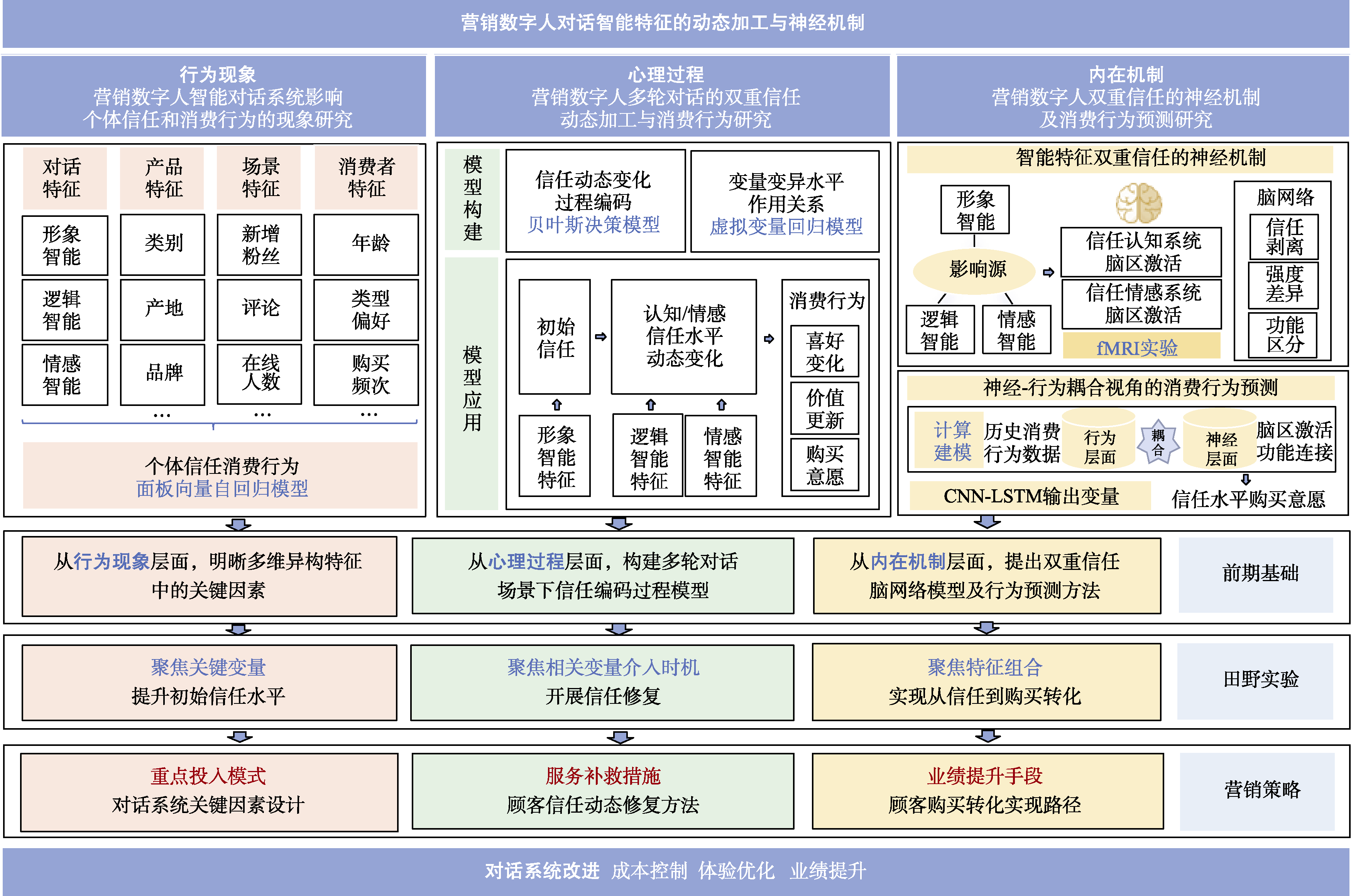
图1 研究框架图
| [1] |
陈瀛, 徐敏霞, 汪新建. (2020). 信任的认知神经网络模型. 心理科学进展, 28(5), 800-809.
doi: 10.3724/SP.J.1042.2020.00800 |
| [2] |
项典典, 尹雨乐, 葛梦琦, 王子涵. (2025). 自建IP还是合作IP:虚拟影响者代言人选择策略对消费者融入的影响. 心理科学进展, 33(6), 965-983.
doi: 10.3724/SP.J.1042.2025.0965 |
| [3] | 张紫琼, 吴玉婵, 叶强, 吴少辉. (2025). 数字人营销:理论框架、研究进展与未来方向. 中国管理科学, 33(1), 259-272. |
| [4] |
Afroogh S., Akbari A., Malone E., Kargar M., & Alambeigi H. (2024). Trust in AI: Progress, challenges, and future directions. Humanities and Social Sciences Communications, 11(1), 1-30.
doi: 10.1057/s41599-023-02237-1 |
| [5] |
Agnihotri D., Chaturvedi P., & Tripathi V. (2025). “Virtual bonds and actual transactions”: Investigating the impact of virtual influencers' credibility on buying behavior through virtual engagement. Journal of Communication Management, 29(1), 35-52.
doi: 10.1108/JCOM-02-2024-0035 URL |
| [6] |
Akhtar N., Hameed Z., Islam T., Pant M. K., Sharma A., Rather R. A., & Kuzior A. (2024). Avatars of influence: Understanding how virtual influencers trigger consumer engagement on online booking platforms. Journal of Retailing and Consumer Services, 78, 103742.
doi: 10.1016/j.jretconser.2024.103742 URL |
| [7] |
Angmo P., & Mahajan R. (2024). Virtual influencer marketing: A study of millennials and gen Z consumer behaviour. Qualitative Market Research: An International Journal, 27(2), 280-300.
doi: 10.1108/QMR-01-2023-0009 URL |
| [8] |
Bellucci G., Chernyak S. V., Goodyear K., Eickhoff S. B., & Krueger F. (2017). Neural signatures of trust in reciprocity: A coordinate‐based meta‐analysis. Human Brain Mapping, 38(3), 1233-1248.
doi: 10.1002/hbm.v38.3 URL |
| [9] |
Bressler S. L., & Menon V. (2010). Large-scale brain networks in cognition: Emerging methods and principles. Trends in Cognitive Sciences, 14(6), 277-290.
doi: 10.1016/j.tics.2010.04.004 pmid: 20493761 |
| [10] |
Campbell C., & Farrell J. R. (2020). More than meets the eye: The functional components underlying influencer marketing. Business Horizons, 63(4), 469-479.
doi: 10.1016/j.bushor.2020.03.003 URL |
| [11] |
Casado-Aranda L. -A., Dimoka A., & Sánchez-Fernández J. (2019). Consumer processing of online trust signals: A neuroimaging study. Journal of Interactive Marketing, 47(1), 159-180.
doi: 10.1016/j.intmar.2019.02.006 URL |
| [12] |
Castelo N., Boegershausen J., Hildebrand C., & Henkel A. P. (2023). Understanding and improving consumer reactions to service bots. Journal of Consumer Research, 50(4), 848-863.
doi: 10.1093/jcr/ucad023 URL |
| [13] | Chaihanchanchai P., Anantachart S., & Ruangthanakorn N. (2024). Unlocking the persuasive power of virtual influencer on brand trust and purchase intention: A parallel mediation of source credibility. Journal of Marketing Communications, 1-23. |
| [14] |
Chattaraman V., Kwon W. -S., E. Gilbert J., & Li Y. (2014). Virtual shopping agents: Persona effects for older users. Journal of Research in Interactive Marketing, 8(2), 144-162.
doi: 10.1108/JRIM-08-2013-0054 URL |
| [15] |
Crolic C., Thomaz F., Hadi R., & Stephen A. T. (2022). Blame the bot: Anthropomorphism and anger in customer- chatbot interactions. Journal of Marketing, 86(1), 132-148.
doi: 10.1177/00222429211045687 URL |
| [16] |
De Ruyter K., Keeling D. I., Plangger K., Montecchi M., Scott M. L., & Dahl D. W. (2022). Reimagining marketing strategy: Driving the debate on grand challenges. Journal of the Academy of Marketing Science, 50(1), 13-21.
doi: 10.1007/s11747-021-00806-x |
| [17] | Duffett R. (2020). The YouTube marketing communication effect on cognitive, affective and behavioural attitudes among Generation Z consumers. Sustainability, 12(12), 5075. |
| [18] |
Gao B., Yan J., & Zhong R. (2025). How digital teacher appearance anthropomorphism impacts digital learning satisfaction and intention to use: Interaction with knowledge type. IEEE Transactions on Learning Technologies, 18, 438-457.
doi: 10.1109/TLT.2025.3560032 URL |
| [19] |
Gillath O., Ai T., Branicky M. S., Keshmiri S., Davison R. B., & Spaulding R. (2021). Attachment and trust in artificial intelligence. Computers in Human Behavior, 115, 106607.
doi: 10.1016/j.chb.2020.106607 URL |
| [20] |
Glikson E., & Woolley A. W. (2020). Human trust in artificial intelligence: Review of empirical research. Academy of Management Annals, 14(2), 627-660.
doi: 10.5465/annals.2018.0057 URL |
| [21] |
Grewal D., Kroschke M., Mende M., Roggeveen A. L., & Scott M. L. (2020). Frontline cyborgs at your service: How human enhancement technologies affect customer experiences in retail, sales, and service settings. Journal of Interactive Marketing, 51(1), 9-25.
doi: 10.1016/j.intmar.2020.03.001 URL |
| [22] |
Guo Y., & Yang X. J. (2021). Modeling and predicting trust dynamics in human-robot teaming: A Bayesian inference approach. International Journal of Social Robotics, 13(8), 1899-1909.
doi: 10.1007/s12369-020-00703-3 |
| [23] | Guo Y., Zhang Y., Goh K. -Y., & Peng X. (2024). Can social technologies drive purchases in e-commerce live streaming? An empirical study of broadcasters’ cognitive and affective social call-to-actions. Production and Operations Management. https://doi.org/10.2139/ssrn.4850732 |
| [24] |
Haas B. W., Ishak A., Anderson I. W., & Filkowski M. M. (2015). The tendency to trust is reflected in human brain structure. NeuroImage, 107, 175-181.
doi: S1053-8119(14)00990-2 pmid: 25485710 |
| [25] |
Ham J., Li S., Shah P., & Eastin M. S. (2023). The “mixed” reality of virtual brand endorsers: Understanding the effect of brand engagement and social cues on technological perceptions and advertising effectiveness. Journal of Interactive Advertising, 23(2), 98-113.
doi: 10.1080/15252019.2023.2185557 URL |
| [26] |
Hopko S. K., & Mehta R. K. (2024). Trust in shared-space collaborative robots: Shedding light on the human brain. Human Factors, 66(2), 490-509.
doi: 10.1177/00187208221109039 URL |
| [27] | Hortensius R., & Wiese E. (2023). A neurocognitive view on the depiction of social robots. Behavioral & Brain Sciences, 46, 1-65. |
| [28] |
Huang M. -H., & Rust R. T. (2018). Artificial intelligence in service. Journal of service research, 21(2), 155-172.
doi: 10.1177/1094670517752459 URL |
| [29] |
Khan R. F., & Sutcliffe A. (2014). Attractive agents are more persuasive. International Journal of Human- Computer Interaction, 30(2), 142-150.
doi: 10.1080/10447318.2013.839904 URL |
| [30] |
Kim H., & Park M. (2024). When digital celebrity talks to you: How human-like virtual influencers satisfy consumer's experience through social presence on social media endorsements. Journal of Retailing and Consumer Services, 76, 103581.
doi: 10.1016/j.jretconser.2023.103581 URL |
| [31] | Kim T., Lee O. -K. D., & Kang J. (2025). Why people trust AI software robots: A mediated moderation perspective on the interaction between their intelligence and appearance. Industrial Management & Data Systems. Advance online publication. https://doi.org/10.1108/IMDS-04-2024-0329 |
| [32] |
Klingbeil A., Grützner C., & Schreck P. (2024). Trust and reliance on AI—An experimental study on the extent and costs of overreliance on AI. Computers in Human Behavior, 160, 108352.
doi: 10.1016/j.chb.2024.108352 URL |
| [33] |
Koscik T. R., & Tranel D. (2011). The human amygdala is necessary for developing and expressing normal interpersonal trust. Neuropsychologia, 49(4), 602-611.
doi: 10.1016/j.neuropsychologia.2010.09.023 pmid: 20920512 |
| [34] | Kox E. S., Kerstholt J. H., Hueting T. F., & de Vries P. W. (2021). Trust repair in human-agent teams: The effectiveness of explanations and expressing regret. Autonomous Agents and Multi-agent Systems, 35(2), 30. |
| [35] |
Lewis J. D., & Weigert A. (1985). Trust as a social reality. Social Forces, 63(4), 967-985.
doi: 10.2307/2578601 URL |
| [36] |
Li J., Huang J., & Li Y. (2023). Examining the effects of authenticity fit and association fit: A digital human avatar endorsement model. Journal of Retailing and Consumer Services, 71, 103230.
doi: 10.1016/j.jretconser.2022.103230 URL |
| [37] |
Li P., & Lan Y. -J. (2022). Digital language learning (DLL): Insights from behavior, cognition, and the brain. Bilingualism: Language and Cognition, 25(3), 361-378.
doi: 10.1017/S1366728921000353 URL |
| [38] |
Lim R. E., & Lee S. Y. (2023). “You are a virtual influencer!”: Understanding the impact of origin disclosure and emotional narratives on parasocial relationships and virtual influencer credibility. Computers in Human Behavior, 148, 107897.
doi: 10.1016/j.chb.2023.107897 URL |
| [39] |
Lin Y., Yao D., & Chen X. (2021). Happiness begets money: Emotion and engagement in live streaming. Journal of Marketing Research, 58(3), 417-438.
doi: 10.1177/00222437211002477 URL |
| [40] |
Llanes-Jurado J., Gómez-Zaragozá L., Minissi M. E., Alcañiz M., & Marín-Morales J. (2024). Developing conversational virtual humans for social emotion elicitation based on large language models. Expert Systems with Applications, 246, 123261.
doi: 10.1016/j.eswa.2024.123261 URL |
| [41] | Luo X., Tong S., Fang Z., & Qu Z. (2019). Frontiers: Machines vs. humans: The impact of artificial intelligence chatbot disclosure on customer purchases. Marketing Science, 38(6), 937-947. |
| [42] | Mehrotra S., Degachi C., Vereschak O., Jonker C. M., & Tielman M. L. (2024). A systematic review on fostering appropriate trust in Human-AI interaction: Trends, opportunities and challenges. ACM Journal on Responsible Computing, 1(4), 1-45. |
| [43] |
Menon V. (2023). 20 years of the default mode network: A review and synthesis. Neuron, 111(16), 2469-2487.
doi: 10.1016/j.neuron.2023.04.023 pmid: 37167968 |
| [44] |
Miao F., Kozlenkova I. V., Wang H., Xie T., & Palmatier R. W. (2022). An emerging theory of avatar marketing. Journal of Marketing, 86(1), 67-90.
doi: 10.1177/0022242921996646 URL |
| [45] |
Miao M., Jalees T., Zaman S. I., Khan S., Hanif N. -u. -A., & Javed M. K. (2022). The influence of e-customer satisfaction, e-trust and perceived value on consumer's repurchase intention in B2C e-commerce segment. Asia Pacific Journal of Marketing and Logistics, 34(10), 2184-2206.
doi: 10.1108/APJML-03-2021-0221 URL |
| [46] |
Mirnig N., Stollnberger G., Miksch M., Stadler S., Giuliani M., & Tscheligi M. (2017). To err is robot: How humans assess and act toward an erroneous social robot. Frontiers in Robotics and AI, 4, 21.
doi: 10.3389/frobt.2017.00021 URL |
| [47] |
Park S., Wei X., & Lee H. (2024). Revisiting the elaboration likelihood model in the context of a virtual influencer: A comparison between high‐ and low‐ involvement products. Journal of Consumer Behaviour, 23(4), 1638-1652.
doi: 10.1002/cb.v23.4 URL |
| [48] |
Pelau C., Dabija D. -C., & Ene I. (2021). What makes an AI device human-like? The role of interaction quality, empathy and perceived psychological anthropomorphic characteristics in the acceptance of artificial intelligence in the service industry. Computers in Human Behavior, 122, 106855.
doi: 10.1016/j.chb.2021.106855 URL |
| [49] |
Porra J., Lacity M., & Parks M. S. (2020). “Can computer based human-likeness endanger humanness?” - A philosophical and ethical perspective on digital assistants expressing feelings they can’t have. Information Systems Frontiers, 22, 533-547.
doi: 10.1007/s10796-019-09969-z |
| [50] |
Prakash A., & Rogers W. A. (2015). Why some humanoid faces are perceived more positively than others: Effects of human-likeness and task. International Journal of Social Robotics, 7(2), 309-331.
pmid: 26294936 |
| [51] |
Prentice C., & Nguyen M. (2020). Engaging and retaining customers with AI and employee service. Journal of Retailing and Consumer Services, 56, 102186.
doi: 10.1016/j.jretconser.2020.102186 URL |
| [52] |
Puntoni S., Reczek R. W., Giesler M., & Botti S. (2021). Consumers and artificial intelligence: An experiential perspective. Journal of Marketing, 85(1), 131-151.
doi: 10.1177/0022242920953847 URL |
| [53] |
Rousseau D. M., Sitkin S. B., Burt R. S., & Camerer C. (1998). Not so different after all: A cross-discipline view of trust. Academy of Management Review, 23(3), 393-404.
doi: 10.5465/amr.1998.926617 URL |
| [54] |
Sands S., Ferraro C., Demsar V., & Chandler G. (2022). False idols: Unpacking the opportunities and challenges of falsity in the context of virtual influencers. Business Horizons, 65(6), 777-788.
doi: 10.1016/j.bushor.2022.08.002 URL |
| [55] |
Sato W., Kochiyama T., Uono S., Sawada R., Kubota Y., Yoshimura S., & Toichi M. (2019). Widespread and lateralized social brain activity for processing dynamic facial expressions. Human Brain Mapping, 40(13), 3753-3768.
doi: 10.1002/hbm.24629 pmid: 31090126 |
| [56] |
Shen H., & Wang M. (2023). Effects of social skills on lexical alignment in human-human interaction and human- computer interaction. Computers in Human Behavior, 143, 107718.
doi: 10.1016/j.chb.2023.107718 URL |
| [57] |
Sherman L. E., Rudie J. D., Pfeifer J. H., Masten C. L., McNealy K., & Dapretto M. (2014). Development of the default mode and central executive networks across early adolescence: A longitudinal study. Developmental Cognitive Neuroscience, 10, 148-159.
doi: 10.1016/j.dcn.2014.08.002 pmid: 25282602 |
| [58] |
Silva E. S., & Bonetti F. (2021). Digital humans in fashion: Will consumers interact? Journal of Retailing and Consumer Services, 60, 102430.
doi: 10.1016/j.jretconser.2020.102430 URL |
| [59] |
Solnais C., Andreu-Perez J., Sánchez-Fernández J., & Andréu-Abela J. (2013). The contribution of neuroscience to consumer research: A conceptual framework and empirical review. Journal of Economic Psychology, 36, 68-81.
doi: 10.1016/j.joep.2013.02.011 URL |
| [60] |
Song Y., Wang L., Zhang Z., & Hikkerova L. (2024). AI or human: How endorser shapes online purchase intention? Computers in Human Behavior, 158, 108300.
doi: 10.1016/j.chb.2024.108300 URL |
| [61] |
Strohmann T., Siemon D., Khosrawi-Rad B., & Robra- Bissantz S. (2023). Toward a design theory for virtual companionship. Human-Computer Interaction, 38(3-4), 194-234.
doi: 10.1080/07370024.2022.2084620 URL |
| [62] |
Vuong Q. -H., La V. -P., Nguyen M. -H., Jin R., La M. -K., & Le T. -T. (2024). AI’s humanoid appearance can affect human perceptions of its emotional capability: Evidence from self-reported data in the U.S. International Journal of Human-Computer Interaction, 40(17), 4906-4917.
doi: 10.1080/10447318.2023.2227828 URL |
| [63] |
Willems K., Smolders A., Brengman M., Luyten K., & Schöning J. (2017). The path-to-purchase is paved with digital opportunities: An inventory of shopper-oriented retail technologies. Technological Forecasting and Social Change, 124, 228-242.
doi: 10.1016/j.techfore.2016.10.066 URL |
| [64] |
Wu Y., Veerareddy A., Lee M. R., Bellucci G., Camilleri J. A., Eickhoff S. B., & Krueger F. (2021). Understanding identification-based trust in the light of affiliative bonding: Meta-analytic neuroimaging evidence. Neuroscience & Biobehavioral Reviews, 131, 627-641.
doi: 10.1016/j.neubiorev.2021.09.053 URL |
| [65] | Xu Y., Dai H., & Yan W. (2024). Identity disclosure and anthropomorphism in voice chatbot design: A field experiment. Management Science. Advance online publication. https://doi.org/10.1287/mnsc.2022.03833 |
| [66] |
Yang J., Chuenterawong P., Lee H., & Chock T. M. (2023). Anthropomorphism in CSR endorsement: A comparative study on humanlike vs. cartoonlike virtual influencers’ climate change messaging. Journal of Promotion Management, 29(5), 705-734.
doi: 10.1080/10496491.2022.2163041 URL |
| [67] | Yang X. J., Guo Y., & Schemanske C. (2022). From trust to trust dynamics:Combining empirical and computational approaches to model and predict trust dynamics in human-autonomy interaction. In Human-Automation Interaction:Transportation (pp. 253-265). Cham: Springer International Publishing. |
| [68] |
Zhang G., Chong L., Kotovsky K., & Cagan J. (2023). Trust in an AI versus a human teammate: The effects of teammate identity and performance on human-AI cooperation. Computers in Human Behavior, 139, 107536.
doi: 10.1016/j.chb.2022.107536 URL |
| [1] | 王鲁晓, 辛自强. 债务的心理和行为后果及其机制[J]. 心理科学进展, 2024, 32(1): 177-188. |
| [2] | 李婷, 孔祥博, 王风华. 孤独感对消费行为的影响及其理论解释[J]. 心理科学进展, 2023, 31(6): 1078-1093. |
| [3] | 熊素红, 孙洪杰, 陆佶, 姚琦, 张全成. 具身认知视角的饮食消费行为——基于心理模拟“具身”方式[J]. 心理科学进展, 2020, 28(3): 486-496. |
| [4] | 戚海峰, 于辉, 向伟林, 孙韵益, 徐昌皓. 绿色消费情境下消费者为什么会言行不一?[J]. 心理科学进展, 2019, 27(7): 1307-1319. |
| [5] | 江红艳, 刘邦舜, 孙配贞. 权力感对消费行为的影响及其理论解释[J]. 心理科学进展, 2018, 26(1): 156-168. |
| [6] | 吴丽丽, 石筱璇, 王贝依, 张建新. 品牌依恋:理论、测量及与相关变量的关系[J]. 心理科学进展, 2017, 25(8): 1411-1422. |
| [7] | 尹非凡;王詠. 消费行为领域中的调节定向[J]. 心理科学进展, 2013, 21(2): 347-357. |
| [8] | 景奉杰;熊素红. 冲动性消费行为内在机制研究述评 ———提升调节点在冲动性消费行为中所起作用 [J]. 心理科学进展, 2008, 16(5): 789-795. |
| [9] | 徐金灿. 消费者满意度研究综述[J]. 心理科学进展, 1998, 6(3): 43-47. |
| 阅读次数 | ||||||
|
全文 |
|
|||||
|
摘要 |
|
|||||
