

ISSN 0439-755X
CN 11-1911/B
CN 11-1911/B
Acta Psychologica Sinica ›› 2026, Vol. 58 ›› Issue (7): 1428-1443.doi: 10.3724/SP.J.1041.2026.1428
• Reports of Empirical Studies • Previous Articles Next Articles
LIU Yongfang( ), SUN Yue, LIAN Jinjing
Received:2025-03-02
Published:2026-07-25
Online:2026-05-15
Contact:
LIU Yongfang
E-mail:yfliu@psy.ecnu.edu.cn
Supported by:LIU Yongfang, SUN Yue, LIAN Jinjing. (2026). Fast = Sincere: The Effect of Interactive Partner Decision Time in Social Dilemmas. Acta Psychologica Sinica, 58(7), 1428-1443.
Add to citation manager EndNote|Ris|BibTeX
URL: https://journal.psych.ac.cn/acps/EN/10.3724/SP.J.1041.2026.1428
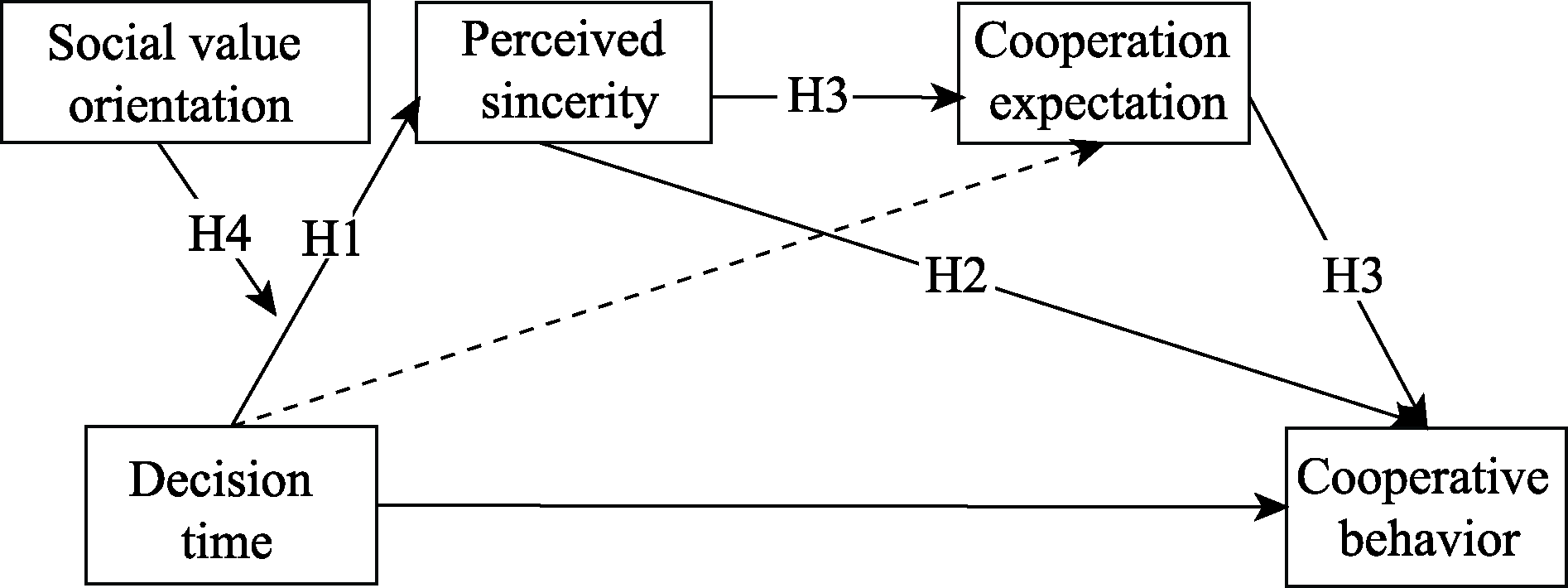
Figure 1. Conceptual model.
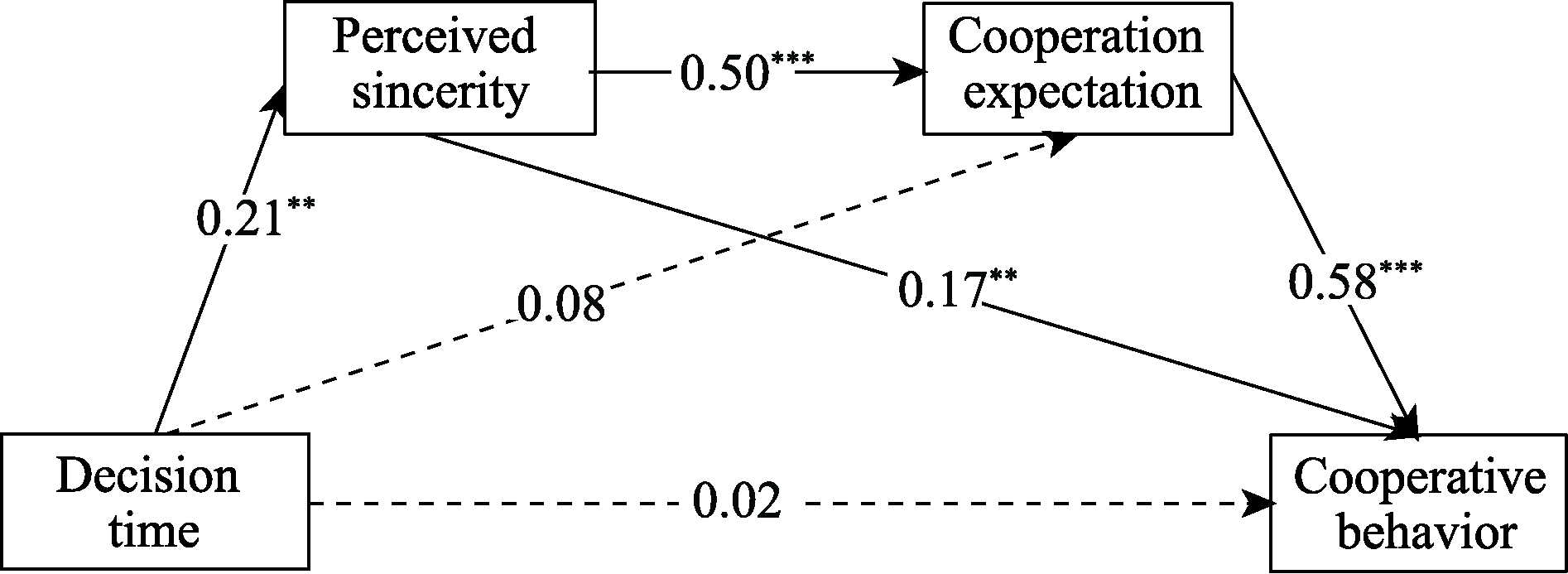
Figure 2. Mediation model of the effect of decision time on cooperative behavior in the public goods game. Note: **p < 0.01, *** p < 0.001. The path coefficients are all standardized. The dashed line indicates that the path coefficient is not significant.
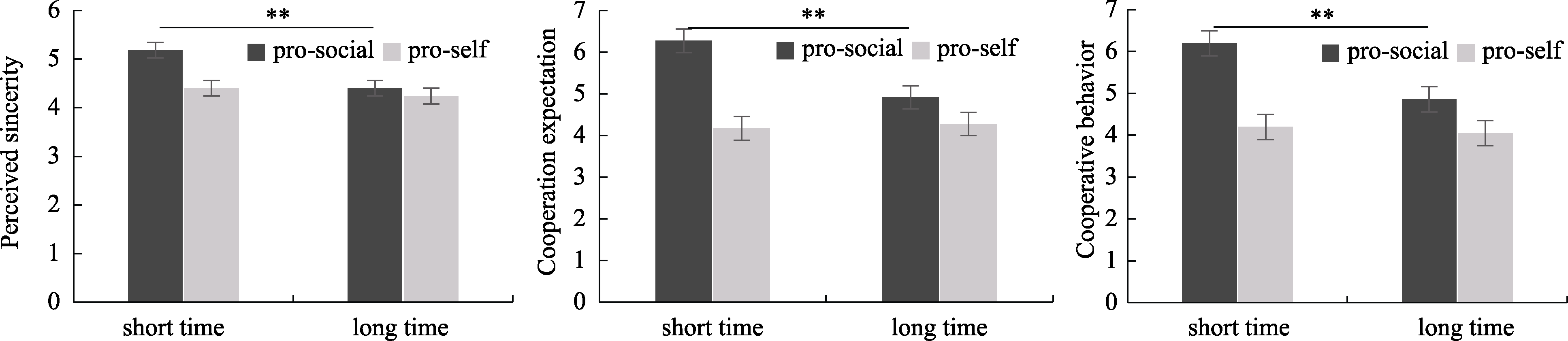
Figure 3. Interaction effects of decision time and social value orientation on perceived sincerity, cooperation expectation, and cooperative behavior. Note. **p < 0.01. Error bars represent standard errors.
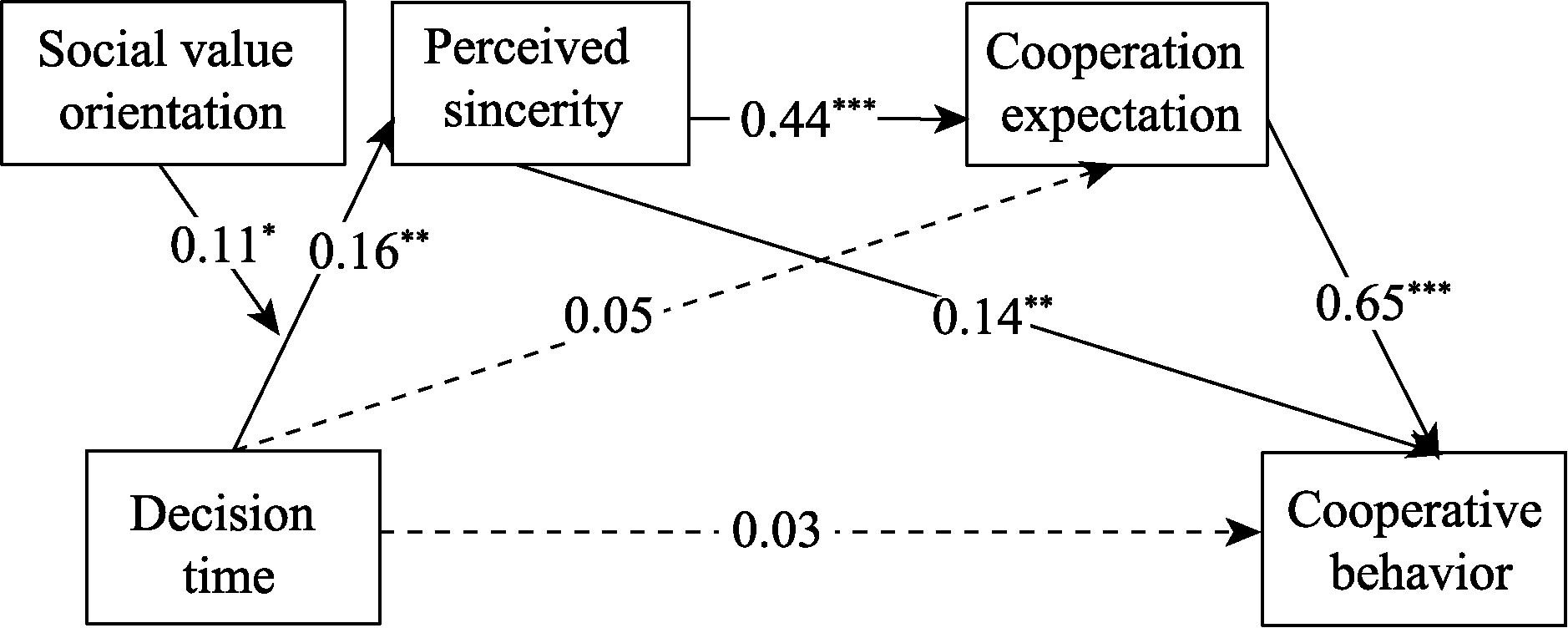
Figure 4. Moderated mediation model. Note. *p < 0.05, **p < 0.01, *** p < 0.001. The path coefficients are all standardized. The dashed line indicates that the path coefficient is not significant.
| variable | perceived sincerity | cooperation expectation | cooperative behavior | |||||||||
|---|---|---|---|---|---|---|---|---|---|---|---|---|
| β | t | LLCI | ULCI | β | t | LLCI | ULCI | β | t | LLCI | ULCI | |
| Experiment 1 | ||||||||||||
| gender | 0.12 | 1.53 | ?0.09 | 0.73 | — | — | — | — | — | — | — | — |
| age | ?0.07 | ?0.84 | ?0.04 | 0.02 | — | — | — | — | — | — | — | — |
| education | 0.09 | 1.19 | ?0.16 | 0.64 | — | — | — | — | — | — | — | — |
| Experiment 2a | ||||||||||||
| gender | 0.09 | 1.15 | ?0.18 | 0.69 | ?0.05 | ?0.66 | ?0.95 | 0.47 | ?0.04 | ?0.46 | ?0.99 | 0.62 |
| age | 0.14 | 1.83 | ?0.002 | 0.05 | ?0.03 | ?0.41 | ?0.05 | 0.03 | 0.04 | 0.53 | ?0.04 | 0.06 |
| education | ?0.003 | ?0.03 | ?0.35 | 0.34 | ?0.04 | ?0.56 | ?0.72 | 0.40 | ?0.005 | ?0.07 | ?0.65 | 0.61 |
| Experiment 2b | ||||||||||||
| gender | ?0.04 | ?0.61 | ?0.44 | 0.23 | ?0.08 | ?1.13 | ?0.94 | 0.25 | ?0.08 | ?1.13 | ?1.18 | 0.32 |
| age | ?0.001 | ?0.02 | ?0.02 | 0.02 | ?0.01 | ?0.11 | ?0.04 | 0.04 | 0.02 | 0.23 | ?0.04 | 0.05 |
| education | 0.07 | 0.93 | ?0.19 | 0.54 | 0.11 | 1.49 | ?0.16 | 1.13 | 0.02 | 0.29 | ?0.69 | 0.93 |
| Experiment 2c | ||||||||||||
| gender | 0.08 | 1.03 | ?0.20 | 0.63 | ?0.003 | ?0.05 | ?0.76 | 0.73 | ?0.06 | ?0.73 | ?1.02 | 0.47 |
| age | 0.05 | 0.64 | ?0.02 | 0.04 | 0.04 | 0.52 | ?0.04 | 0.07 | 0.09 | 1.25 | ?0.02 | 0.08 |
| education | 0.05 | 0.64 | ?0.26 | 0.50 | 0.04 | 0.57 | ?0.49 | 0.88 | 0.002 | 0.02 | ?0.68 | 0.70 |
| Experiment 3 | ||||||||||||
| gender | 0.02 | 0.27 | ?0.28 | 0.37 | ?0.04 | ?0.70 | ?0.82 | 0.39 | ?0.05 | ?0.98 | ?0.96 | 0.32 |
| age | ?0.07 | ?1.28 | ?0.04 | 0.01 | 0.02 | 0.40 | ?0.03 | 0.05 | ?0.05 | ?0.93 | ?0.06 | 0.02 |
| education | ?0.04 | ?0.70 | ?0.40 | 0.19 | ?0.02 | ?0.41 | ?0.67 | 0.43 | ?0.05 | ?0.97 | ?0.86 | 0.29 |
Appendix 1 Regression analysis results for the effects of demographic variables on the main dependent variables
| variable | perceived sincerity | cooperation expectation | cooperative behavior | |||||||||
|---|---|---|---|---|---|---|---|---|---|---|---|---|
| β | t | LLCI | ULCI | β | t | LLCI | ULCI | β | t | LLCI | ULCI | |
| Experiment 1 | ||||||||||||
| gender | 0.12 | 1.53 | ?0.09 | 0.73 | — | — | — | — | — | — | — | — |
| age | ?0.07 | ?0.84 | ?0.04 | 0.02 | — | — | — | — | — | — | — | — |
| education | 0.09 | 1.19 | ?0.16 | 0.64 | — | — | — | — | — | — | — | — |
| Experiment 2a | ||||||||||||
| gender | 0.09 | 1.15 | ?0.18 | 0.69 | ?0.05 | ?0.66 | ?0.95 | 0.47 | ?0.04 | ?0.46 | ?0.99 | 0.62 |
| age | 0.14 | 1.83 | ?0.002 | 0.05 | ?0.03 | ?0.41 | ?0.05 | 0.03 | 0.04 | 0.53 | ?0.04 | 0.06 |
| education | ?0.003 | ?0.03 | ?0.35 | 0.34 | ?0.04 | ?0.56 | ?0.72 | 0.40 | ?0.005 | ?0.07 | ?0.65 | 0.61 |
| Experiment 2b | ||||||||||||
| gender | ?0.04 | ?0.61 | ?0.44 | 0.23 | ?0.08 | ?1.13 | ?0.94 | 0.25 | ?0.08 | ?1.13 | ?1.18 | 0.32 |
| age | ?0.001 | ?0.02 | ?0.02 | 0.02 | ?0.01 | ?0.11 | ?0.04 | 0.04 | 0.02 | 0.23 | ?0.04 | 0.05 |
| education | 0.07 | 0.93 | ?0.19 | 0.54 | 0.11 | 1.49 | ?0.16 | 1.13 | 0.02 | 0.29 | ?0.69 | 0.93 |
| Experiment 2c | ||||||||||||
| gender | 0.08 | 1.03 | ?0.20 | 0.63 | ?0.003 | ?0.05 | ?0.76 | 0.73 | ?0.06 | ?0.73 | ?1.02 | 0.47 |
| age | 0.05 | 0.64 | ?0.02 | 0.04 | 0.04 | 0.52 | ?0.04 | 0.07 | 0.09 | 1.25 | ?0.02 | 0.08 |
| education | 0.05 | 0.64 | ?0.26 | 0.50 | 0.04 | 0.57 | ?0.49 | 0.88 | 0.002 | 0.02 | ?0.68 | 0.70 |
| Experiment 3 | ||||||||||||
| gender | 0.02 | 0.27 | ?0.28 | 0.37 | ?0.04 | ?0.70 | ?0.82 | 0.39 | ?0.05 | ?0.98 | ?0.96 | 0.32 |
| age | ?0.07 | ?1.28 | ?0.04 | 0.01 | 0.02 | 0.40 | ?0.03 | 0.05 | ?0.05 | ?0.93 | ?0.06 | 0.02 |
| education | ?0.04 | ?0.70 | ?0.40 | 0.19 | ?0.02 | ?0.41 | ?0.67 | 0.43 | ?0.05 | ?0.97 | ?0.86 | 0.29 |
| [1] |
Baumard, N., Andre, J. B., & Sperber, D. (2013). A mutualistic approach to morality: The evolution of fairness by partner choice. Behavioral and Brain Sciences, 36(1), 59-78. https://doi.org/10.1017/S0140525X11002202
doi: 10.1017/S0140525X11002202 URL pmid: 23445574 |
| [2] |
Capraro, V. (2013). A model of human cooperation in social dilemmas. Plos One, 8(8), e72427. https://doi.org/10.1371/journal.pone.0072427
doi: 10.1371/journal.pone.0072427 URL |
| [3] |
Centorrino, S., Djemaï, E., Hopfensitz, A., Milinski, M., & Seabright, P. (2015). Honest signaling in trust interactions: Smiles rated as genuine induce trust and signal higher earning opportunities. Evolution and Human Behavior, 36(1), 8-16. https://doi.org/10.1016/j.evolhumbehav.2014.08.001
doi: 10.1016/j.evolhumbehav.2014.08.001 URL |
| [4] |
Chen, F., & Krajbich, I. (2018). Biased sequential sampling underlies the effects of time pressure and delay in social decision making. Nature Communications, 9, 3557. https://doi.org/10.1038/s41467-018-05994-9
doi: 10.1038/s41467-018-05994-9 URL pmid: 30177719 |
| [5] |
Christ, S. E., Van Essen, D. C., Watson, J. M., Brubaker, L. E., & McDermott, K. B. (2009). The contributions of prefrontal cortex and executive control to deception: Evidence from activation likelihood estimate meta-analyses. Cerebral Cortex, 19(7), 1557-1566. https://doi.org/10.1093/cercor/bhn189
doi: 10.1093/cercor/bhn189 URL |
| [6] |
Critcher, C. R., Inbar, Y., & Pizarro, D. A. (2012). How quick decisions illuminate moral character. Social Psychological and Personality Science, 4(3), 308-315. https://doi.org/10.1177/1948550612457688
doi: 10.1177/1948550612457688 URL |
| [7] |
Declerck, C. H., & Bogaert, S. (2008). Social value orientation: Related to empathy and the ability to read the mind in the eyes. The Journal of Social Psychology, 148(6), 711-726. https://doi.org/10.3200/SOCP.148.6.711-726
doi: 10.3200/SOCP.148.6.711-726 URL |
| [8] |
De Freitas, J., & Hafri, A. (2024). Moral thin-slicing: Forming moral impressions from a brief glance. Journal of Experimental Social Psychology, 112, 104588. https://doi.org/10.1016/j.jesp.2023.104588
doi: 10.1016/j.jesp.2023.104588 URL |
| [9] |
Demmers, J., Weihrauch, A. N., & Thompson, F. H. M.(2022). Your data are (not) my data: The role of social value orientation in sharing data about others. Journal of Consumer Psychology, 32(3), 500-508. https://doi.org/10.1002/jcpy.1255
doi: 10.1002/jcpy.v32.3 URL |
| [10] |
Dhaliwal, N. A., Martin, J. W., Barclay, P., & Young, L. L. (2022). Signaling benefits of partner choice decisions. Journal of Experimental Psychology: General, 151(6), 1446-1472. https://doi.org/10.1037/xge0001137
doi: 10.1037/xge0001137 URL |
| [11] |
Efendić, E., van de Calseyde, P. P. F. M., & Evans, A. M. (2020). Slow response times undermine trust in algorithmic (but not human) predictions. Organizational Behavior and Human Decision Processes, 157, 103-114. https://doi.org/10.1016/j.obhdp.2020.01.008
doi: 10.1016/j.obhdp.2020.01.008 URL |
| [12] |
Eisenbruch, A. B., & Krasnow, M. M. (2022). Why warmth matters more than competence: A new evolutionary approach. Perspectives on Psychological Science, 17(6), 1604-1623. https://doi.org/10.1177/17456916211071087
doi: 10.1177/17456916211071087 URL |
| [13] |
Evans, A. M., Dillon, K. D., & Rand, D. G. (2015). Fast but not intuitive, slow but not reflective: Decision conflict drives reaction times in social dilemmas. Journal of Experimental Psychology: General, 144(5), 951-966. https://doi.org/10.1037/xge0000107
doi: 10.1037/xge0000107 URL |
| [14] |
Evans, A. M., & Rand, D. G. (2019). Cooperation and decision time. Current Opinion in Psychology, 26, 67-71. https://doi.org/10.1016/j.copsyc.2018.05.007
doi: S2352-250X(18)30074-5 URL pmid: 29879640 |
| [15] |
Evans, A. M., & van de Calseyde, P. P. F. M.(2017). The effects of observed decision time on expectations of extremity and cooperation. Journal of Experimental Social Psychology, 68, 50-59. https://doi.org/10.1016/j.jesp.2016.05.009
doi: 10.1016/j.jesp.2016.05.009 URL |
| [16] |
Faul, F., Erdfelder, E., Lang, A. G., & Buchner, A. (2007). G*power 3: A flexible statistical power analysis program for the social, behavioral, and biomedical sciences. Behavior Research Methods, 39(2), 175-191. https://doi.org/10.3758/BF03193146
doi: 10.3758/bf03193146 URL pmid: 17695343 |
| [17] |
Fiske, S. T., Cuddy, A. J., & Glick, P. (2007). Universal dimensions of social cognition: Warmth and competence. Trends in Cognitive Sciences, 11(2), 77-83. https://doi.org/10.1016/j.tics.2006.11.005
doi: 10.1016/j.tics.2006.11.005 URL pmid: 17188552 |
| [18] |
Fiske, S. T., Cuddy, A. J., Glick, P., & Xu, J. (2002). A model of (often mixed) stereotype content: Competence and warmth respectively follow from perceived status and competition. Journal of Personality and Social Psychology, 82(6), 878-902. https://doi.org/10.1037/0022-3514.82.6.878
URL pmid: 12051578 |
| [19] |
Goodwin, G. P., Piazza, J., & Rozin, P. (2014). Moral character predominates in person perception and evaluation. Journal of Personality and Social Psychology, 106(1), 148-168. https://doi.org/10.1037/A0034726
doi: 10.1037/a0034726 URL |
| [20] |
Hackel, L. M., & Zaki, J. (2018). Propagation of economic inequality through reciprocity and reputation. Psychological Science, 29(4), 604-613. https://doi.org/10.1177/0956797617741720
doi: 10.1177/0956797617741720 URL pmid: 29474134 |
| [21] | Hayes, A. F. (2018). Introduction to mediation, moderation, and conditional process analysis: A regression-based approach (2nd ed.). New York: Guilford Press. |
| [22] |
Hu, X., Xu, Z., & Mai, X. (2017). Social value orientation modulates the processing of outcome evaluation involving others. Social Cognitive and Affective Neuroscience, 12(11), 1730-1739. https://doi.org/10.1093/scan/nsx102
doi: 10.1093/scan/nsx102 URL pmid: 28981906 |
| [23] |
Iwai, T., & Tavares, G. M. (2024). When prosocial motives matter most: The interactive effects of social value orientation, message framing, and helping costs on helping behavior. Journal of Behavioral Decision Making, 37(2), e2384. https://doi.org/10.1002/bdm.2384
doi: 10.1002/bdm.v37.2 URL |
| [24] |
Johnson, H. H., Bluhm, D., Hannah, S., Avolio, B., & Lester, P. (2023). Authentic leadership’s impact on follower psychological capital and performance through organizational identification and role clarity. Human Performance, 36(5), 219-248. https://doi.org/10.1080/08959285.2023.2261002
doi: 10.1080/08959285.2023.2261002 URL |
| [25] |
Jordan, J. J., Hoffman, M., Nowak, M. A., & Rand, D. G. (2016). Uncalculating cooperation is used to signal trustworthiness. Proceedings of the National Academy of Sciences of the United States of America, 113(31), 8658-8663. https://doi.org/10.1073/pnas.1601280113
doi: 10.1073/pnas.1601280113 URL pmid: 27439873 |
| [26] | Kahneman, D. (2011). Thinking, fast and slow. New York: Farrar, Straus and Giroux. |
| [27] |
Kang, P., Anand, K., Feldman, P., & Schweitzer, M. E. (2020). Insincere negotiation: Using the negotiation process to pursue non-agreement motives. Journal of Experimental Social Psychology, 89, 103981. https://doi.org/10.1016/j.jesp.2020.103981
doi: 10.1016/j.jesp.2020.103981 URL |
| [28] | Kernis, M. H., & Goldman, B. M. (2006). A multicomponent conceptualization of authenticity: Theory and research. Advances in Experimental Social Psychology, 38, 283-357. https://doi.org/10.1016/S0065-2601(06)38006-9 |
| [29] |
Krajbich, I., Bartling, B., Hare, T., & Fehr, E. (2015). Rethinking fast and slow based on a critique of reaction-time reverse inference. Nature Communications, 6, 7455. https://doi.org/10.1038/ncomms8455
doi: 10.1038/ncomms8455 URL pmid: 26135809 |
| [30] |
Krueger, J. I. (2013). Social projection as a source of cooperation. Current Directions in Psychological Science, 22(4), 289-294. https://doi.org/10.1177/0963721413481352
doi: 10.1177/0963721413481352 URL |
| [31] |
Kupor, D. M., Tormala, Z. L., Norton, M. I., & Rucker, D. D. (2014). Thought calibration: How thinking just the right amount increases one’s influence and appeal. Social Psychological and Personality Science, 5(3), 263-270. https://doi.org/10.1177/1948550613499940
doi: 10.1177/1948550613499940 URL |
| [32] |
Li, J., Sun, Y., Yang, Z. L., & Zhong, Y. P. (2020). Social value orientation modulates the processing of social rewards for self: Evidence from ERPs study. Acta Psychologica Sinica, 52(6), 786-800. https://doi.org/10.3724/SP.J.1041.2020.00786
doi: 10.3724/SP.J.1041.2020.00786 URL |
| [33] |
Liviatan, I., Trope, Y., & Liberman, N. (2008). Interpersonal similarity as a social distance dimension: Implications for perception of others’ action. Journal of Experimental Social Psychology, 44(5), 1256-1269. https://doi.org/10.1016/j.jesp.2008.04.007
doi: 10.1016/j.jesp.2008.04.007 URL pmid: 19352440 |
| [34] |
McEllin, L., Felber, A., & Michael, J. (2023). Action planning and execution cues influence economic partner choice. Cognition, 241, 105632. https://doi.org/10.1016/j.cognition.2023.105632
doi: 10.1016/j.cognition.2023.105632 URL |
| [35] |
Meyer, D. E., & Schvaneveldt, R. W. (1976). Meaning, memory structure, and mental processes. Science, 192(4234), 27-33. https://doi.org/10.1126/science.1257753
URL pmid: 1257753 |
| [36] |
Molenmaker, W. E., Lelieveld, G. J., De Kwaadsteniet, E. W., & Van Dijk, E. (2022). Applying a logic of appropriateness to understand behavioral differences between common resource dilemmas and public good dilemmas. Journal of Behavioral Decision Making, 35(1), e2243. https://doi.org/10.1002/bdm.2243
doi: 10.1002/bdm.v35.1 URL |
| [37] |
Moore, C., Lee, S. Y., Kim, K., & Cable, D. M. (2017). The advantage of being oneself: The role of applicant self-verification in organizational hiring decisions. Journal of Applied Psychology, 102(11), 1493-1513. https://doi.org/10.1037/APL0000223
doi: 10.1037/apl0000223 URL pmid: 28639809 |
| [38] |
Pletzer, J. L., Balliet, D., Joireman, J., Kuhlman, D. M., Voelpel, S. C., & Van Lange, P. A. M.(2018). Social value orientation, expectations, and cooperation in social dilemmas: A meta-analysis. European Journal of Personality, 32(1), 62-83. https://doi.org/10.1002/per.2139
doi: 10.1002/per.2139 URL |
| [39] |
Pruitt, D. G., & Kimmel, M. J. (1977). Twenty years of experimental gaming: Critique, synthesis, and suggestions for the future. Annual Review of Psychology, 28, 363-392. https://doi.org/10.1146/annurev.ps.28.020177.002051
doi: 10.1146/psych.1977.28.issue-1 URL |
| [40] |
Rand, D. G., Greene, J. D., & Nowak, M. A. (2012). Spontaneous giving and calculated greed. Nature, 489, 427-430. http://doi.org/10.1038/nature11467
doi: 10.1038/nature11467 URL |
| [41] |
Rand, D. G. (2016). Cooperation, fast and slow: Meta-analytic evidence for a theory of social heuristics and self-interested deliberation. Psychological Science, 27(9), 1192-1206. http://doi.org/10.1177/0956797616654455
doi: 10.1177/0956797616654455 URL pmid: 27422875 |
| [42] |
Scopelliti, I., Min, H. L., McCormick, E., Kassam, K. S., & Morewedge, C. K. (2017). Individual differences in correspondence bias: Measurement, consequences, and correction of biased interpersonal attributions. Management Science, 64(4), 1477-1973. https://doi.org/10.1287/mnsc.2016.2668
doi: 10.1287/mnsc.2016.2630 URL |
| [43] |
Spence, S. A., Farrow, T., F. D., Herford, A. E., Wilkinson, I. D., Zheng, Y., & Woodruff, P. W. R.(2001). Behavioural and functional anatomical correlates of deception in humans. NeuroReport, 12(13), 2849-2853. https://doi.org/10.1097/00001756-200109170-00019
URL pmid: 11588589 |
| [44] |
Sutton, A. (2020). Living the good life: A meta-analysis of authenticity, well-being and engagement. Personality and Individual Differences, 153, 109645. https://doi.org/10.1016/j.paid.2019.109645
doi: 10.1016/j.paid.2019.109645 URL |
| [45] |
Tang, Y., Ren, Z., Pu, X., & Han, W. (2021). The effect of interpersonal authenticity on coworker interactions within work team. Advances in Psychological Science, 29(4), 597-609. https://doi.org/10.3724/SP.J.1042.2021.00597
doi: 10.3724/SP.J.1042.2021.00597 URL |
| [46] |
Tastemirova, A., Schneider, J., Kruse, L. C., Heinzle, S., & vom Brocke, J. (2022). Microexpressions in digital humans: Perceived affect, sincerity, and trustworthiness. Electron Markets, 32, 1603-1620. https://doi.org/10.1007/s12525-022-00563-x
doi: 10.1007/s12525-022-00563-x URL |
| [47] |
Trifonova, I. V., McCall, C., Fysh, M. C., Bindemann, M., & Burton, A. M. (2024). First impressions from faces in dynamic approach-avoidance contexts. Journal of Experimental Psychology: Human Perception and Performance, 50(6), 570-586. https://doi.org/10.1037/xhp0001197
doi: 10.1037/xhp0001197 URL pmid: 38635225 |
| [48] |
Van de Calseyde, P. P. F. M., Keren, G., & Zeelenberg, M. (2014). Decision time as information in judgment and choice. Organizational Behavior and Human Decision Processes, 125(2), 113-122. https://doi.org/10.1016/j.obhdp.2014.07.001
doi: 10.1016/j.obhdp.2014.07.001 URL |
| [49] |
Van Den, B. W., van Dijk, E., Westenberg, M., Rombouts, S. A. R. B., & Crone, E. A. (2009). What motivates repayment? Neural correlates of reciprocity in the trust game. Social Cognitive and Affective Neuroscience, 4(3), 294-304. https://doi.org/10.1093/scan/nsp009
doi: 10.1093/scan/nsp009 URL pmid: 19304843 |
| [50] |
Van Lange, P. A. M. (1999). The pursuit of joint outcomes and equality in outcomes: An integrative model of social value orientation. Journal of Personality and Social Psychology, 77(2), 337-349. https://doi.org/10.1037/0022-3514.77.2.337
doi: 10.1037/0022-3514.77.2.337 URL |
| [51] |
Van Lange, P. A. M., Agnew, C. R., Harinck, F., &, Steemers, G. E. M.(1997). From game theory to real life: How social value orientation affects willingness to sacrifice in ongoing close relationships. Journal of Personality and Social Psychology, 73(6), 1330-1344. https://doi.org/10.1037/0022-3514.73.6.1330
doi: 10.1037/0022-3514.73.6.1330 URL |
| [52] | Van Lange, P. A. M., Joireman, J., Parks, C. D., & Van Dijk, E. (2013). The psychology of social dilemmas: A review. Organizational Behavior and Human Decision Processes, 120(2), 125-141. http://dx.10.1016/j.obhdp.2012.11.003 |
| [53] |
Wang, D., & Ziano, I. (2022). Faster responders are perceived as more extraverted. Journal of Experimental Psychology: General, 151(12), 3177-3197. https://doi.org/10.1037/xge0001254
doi: 10.1037/xge0001254 URL |
| [54] |
Wang, Y., Kuhlman, D. M., Roberts, K., Yuan, B., Zhang, Z., Zhang, W., & Simons, R. F. (2017). Social value orientation modulates the FRN and P300 in the chicken game. Biological Psychology, 127, 89-98. https://doi.org/10.1016/j.biopsycho.2017.04.012
doi: S0301-0511(17)30081-9 URL pmid: 28465046 |
| [55] |
Witkin, H. A., Moore, C. A., Goodenough, D. R., & Cox, P. W. (1977). Field-dependent and field-independent cognitive styles and their educational implications. Review of Educational Research, 47(1), 1-64.
doi: 10.3102/00346543047001001 URL |
| [56] |
Zhang, H., Chen, K., Schlegel, R. J., Hicks, J. A., & Chen, C. (2019). The authentic moral self: Dynamic interplay between perceived authenticity and moral behaviors in the workplace. Collabra-Psychology, 5(1), 48. https://doi.org/10.1525/collabra.260
doi: 10.1525/collabra.260 URL |
| [57] |
Zhang, Y., Yu, Z., & Mai, X. (2020). The influence of social value orientation on self-other risk decision-making and its mechanisms. Acta Psychologica Sinica, 52(7), 895-908. https://doi.org/10.3724/SP.J.1041.2020.00895
doi: 10.3724/SP.J.1041.2020.00895 URL |
| [58] |
Ziano, I., & Wang, D. (2021). Slow lies: Response delays promote perceptions of insincerity. Journal of Personality and Social Psychology, 120(6), 1457-1479. https://doi.org/10.1037/pspa0000250
doi: 10.1037/pspa0000250 URL pmid: 33591774 |
| [1] | XIONG Chengqing, XU Jiaying, MA Danyang, LIU Yongfang. The effect of opponent’s emotional facial expressions on individuals’ cooperation and underlying mechanism in prisoner’s dilemma game [J]. Acta Psychologica Sinica, 2021, 53(8): 919-932. |
| [2] | LIU Chang-Jiang,HAO Fang. Social Value Orientation and Cooperation in Asymmetric Social Dilemmas [J]. , 2011, 43(04): 432-441. |
| [3] | Yan-Jin,Wang-Zhongming. THE DEVELOPMENT OF COOPERATIVE BEHAVIORS IN RESOURCE DILEMMAS [J]. , 2003, 35(04): 499-503. |
| [4] | Yan Jin, Wang Zhongming (School of Management, ZhejiangUniversity, Hangzhou 310028). THE UTILITY TRANSFORMATION OF TASK STRUCTURE AND VALUES IN SOCIAL DILEMMAS [J]. , 2002, 34(05): 87-91. |
| [5] | Yan Jin, Wang Zhongming(School of Management, Zhejiang University, Hangzhou 310028). THE EFFECTS OF VALUES ORIENTATION ON GROUP COOPERATION IN SOCIAL DILEMMAS [J]. , 2000, 32(03): 332-336. |
| Viewed | ||||||
|
Full text |
|
|||||
|
Abstract |
|
|||||
