

ISSN 0439-755X
CN 11-1911/B
CN 11-1911/B
Acta Psychologica Sinica ›› 2026, Vol. 58 ›› Issue (6): 1132-1142.doi: 10.3724/SP.J.1041.2026.1132
• Reports of Empirical Studies • Previous Articles Next Articles
Liu Cong1, Liu Qiuxia1, Zhu Mengrui2, Jiao Lu1, Wang Ruiming3( )
)
Published:2026-06-25
Online:2026-04-28
Contact:
Wang Ruiming
E-mail:wangrm@scnu.edu.cn
Supported by:Liu Cong, Liu Qiuxia, Zhu Mengrui, Jiao Lu, Wang Ruiming. (2026). Effects of Virtual Reality Learning Contexts on Foreign Language Words Production: Behavioral and EEG Evidence. Acta Psychologica Sinica, 58(6), 1132-1142.
Add to citation manager EndNote|Ris|BibTeX
URL: https://journal.psych.ac.cn/acps/EN/10.3724/SP.J.1041.2026.1132

Figure 1. Schematic Diagram of the VR context.
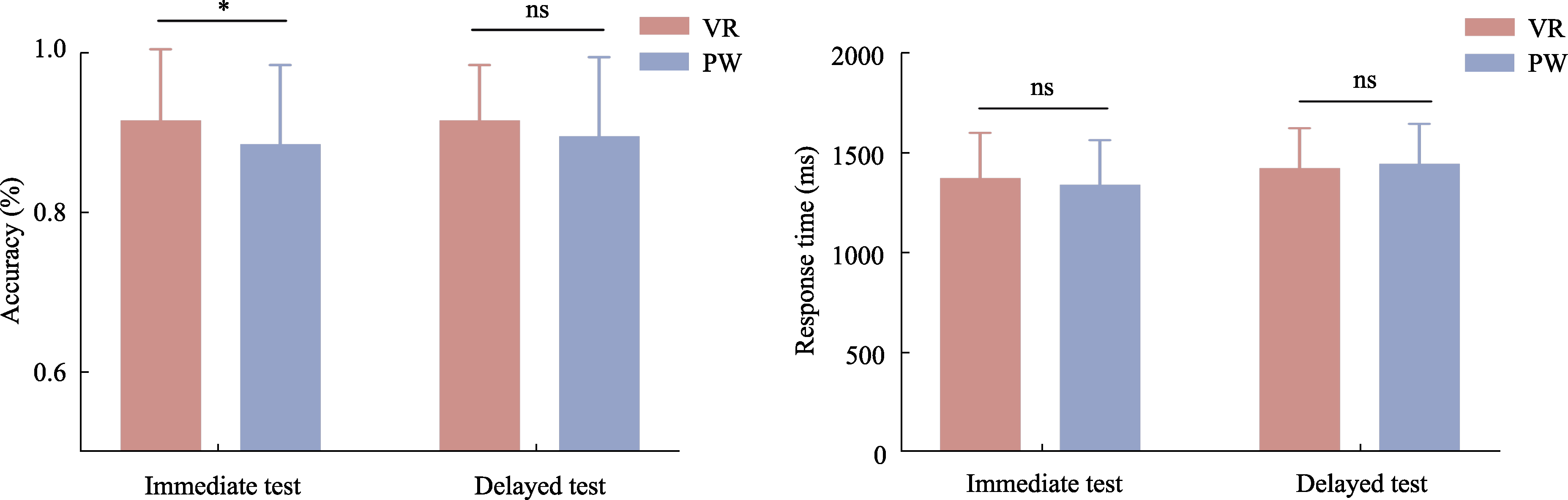
Figure 2. Naming accuracy (left panel) and reaction time (right panel) for foreign vocabulary learned in the VR and PW contexts. Note. * p < 0.05; ns = non-significant.
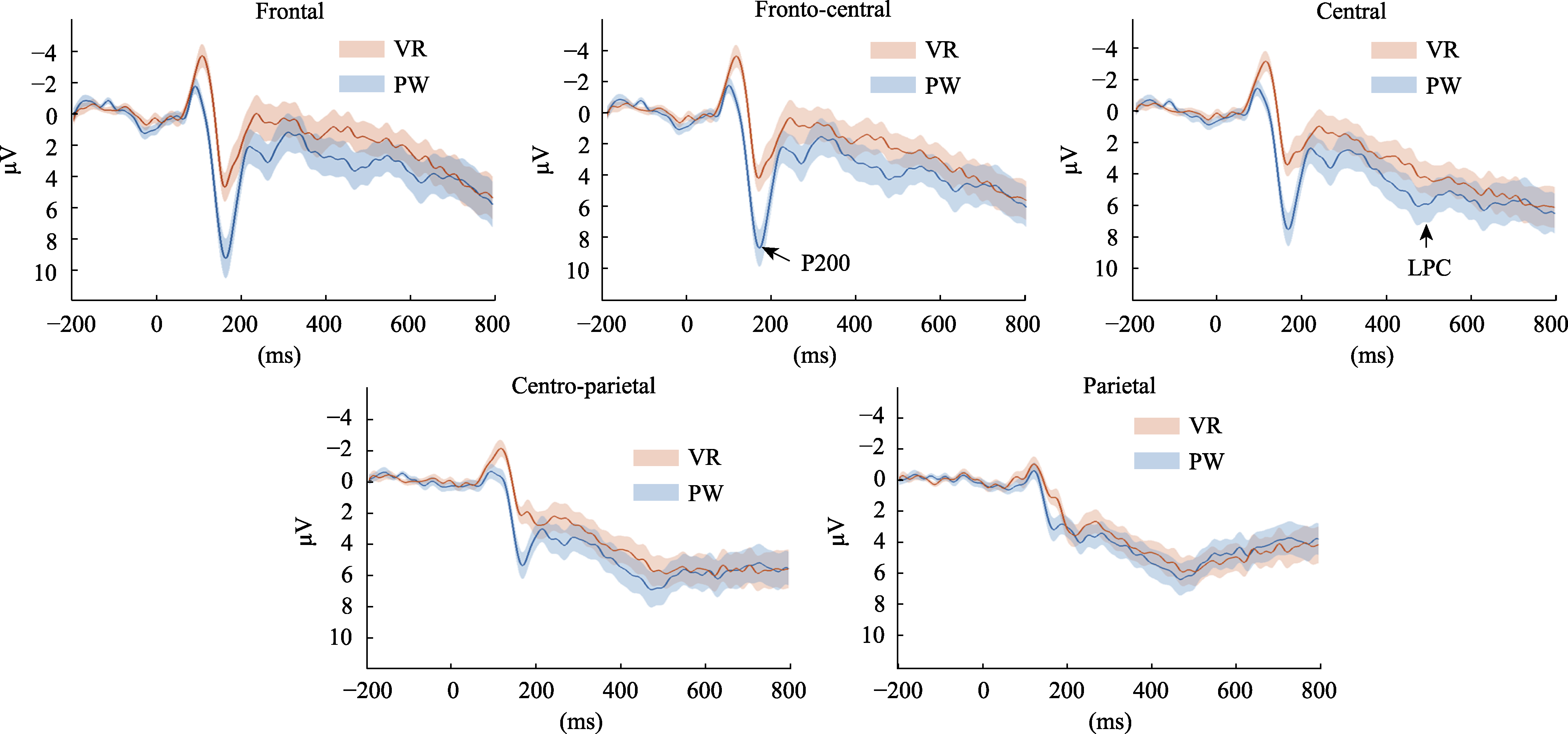
Figure 3. P200 and LPC waveforms elicited by vocabulary naming in the VR and PW contexts.

Figure 4. Time-frequency bands and time-frequency spectrograms elicited by vocabulary naming in the VR and PW contexts.
| [1] |
Barsalou, L. W. (2008). Grounded cognition. Annual Review of Psychology, 59(1), 617-645.
doi: 10.1146/psych.2008.59.issue-1 URL |
| [2] | Bastiaansen,, M., Mazaheri, A., & Jensen, O. (2012). Beyond ERPs:Oscillatory neuronal dynamics. In S. J. Luck & E. S. Kappenman (Eds.), The Oxford handbook of event-related potential components (pp.31-50). Oxford University Press. |
| [3] |
Brunsdon, V. E., Bradford, E. E., & Ferguson, H. J. (2019). Sensorimotor mu rhythm during action observation changes across the lifespan independently from social cognitive processes. Developmental Cognitive Neuroscience, 38, 100659.
doi: 10.1016/j.dcn.2019.100659 URL |
| [4] |
Che, X., Xu, H., Wang, K., Zhang, Q., & Li, S. (2021). Precision requirement of working memory representations influences attentional guidance. Acta Psychologica Sinica, 53(7), 694-713.
doi: 10.3724/SP.J.1041.2021.00694 |
| [5] | Essoe, J. K. Y., Reggente, N., Ohno, A. A., Baek, Y. H., Dell'Italia, J., & Rissman, J. (2022). Enhancing learning and retention with distinctive virtual reality environments and mental context reinstatement. NPJ Science of Learning, 7(1), 31. |
| [6] |
Faul, F., Erdfelder, E., Lang, A. G., & Buchner, A. (2007). G* Power 3: A flexible statistical power analysis program for the social, behavioral, and biomedical sciences. Behavior Research Methods, 39(2), 175-191.
doi: 10.3758/BF03193146 URL |
| [7] |
Fernandez, C. B., Litcofsky, K. A., & Van Hell, J. G. (2019). Neural correlates of intra-sentential code-switching in the auditory modality. Journal of Neurolinguistics, 51, 17-41.
doi: 10.1016/j.jneuroling.2018.10.004 |
| [8] |
Fuhrman, O., Eckerling, A., Friedmann, N., Tarrasch, R., & Raz, G. (2021). The moving learner: Object manipulation in virtual reality improves vocabulary learning. Journal of Computer Assisted Learning, 37(3), 672-683.
doi: 10.1111/jcal.v37.3 URL |
| [9] | Gao, Y., Liu, D. J., Huang, Z. Z., & Huang, R. H. (2016). The core factors and challenges of virtual reality technology enhanced learning. Journal of Educational Technology & Research, 37(10), 77-87+103. |
| [10] |
Herweg, N. A., Solomon, E. A., & Kahana, M. J. (2020). Theta oscillations in human memory. Trends in Cognitive Sciences, 24(3), 208-227.
doi: S1364-6613(19)30294-3 pmid: 32029359 |
| [11] |
Hu, C. P., Kong, X., Wagenmakers, E. J., Ly, A., & Peng, K. (2018). The Bayes factor and its implementation in JASP: A practical primer. Advances in Psychological Science, 26(6), 951-965.
doi: 10.3724/SP.J.1042.2018.00951 URL |
| [12] | Jeffreys, H. (1961). Theory of probability (3rd ed.). Oxford University Press. |
| [13] |
Jiang, Y., Cai, X., & Zhang, Q. (2020). Theta band (4-8 Hz) oscillations reflect syllables processing in Chinese spoken word production. Acta Psychologica Sinica, 52(10), 1199-1211.
doi: 10.3724/SP.J.1041.2020.01199 URL |
| [14] |
Jiao, L., Lin, Y., Schwieter, J. W., & Liu, C. (2026). Learning novel words in an immersive virtual-reality context: Tracking lexicalization through behavioral and event- related-potential measures. Language Learning, 76(1), 5-27.
doi: 10.1111/lang.v76.1 URL |
| [15] |
Jiao, L., Schwieter, J. W., & Liu, C. (2025). Comprehension- based language switching in experienced and newly learned languages: Evidence from induced brain oscillations. Journal of Neurolinguistics, 73, 101232.
doi: 10.1016/j.jneuroling.2024.101232 URL |
| [16] |
Jiao, L., Zhu, M., Xu, Z., Zhou, G., Schwieter, J. W., & Liu, C. (2024). An ERP study on novel word learning in an immersive virtual reality context. Bilingualism: Language and Cognition, 27(1), 128-136.
doi: 10.1017/S136672892300038X URL |
| [17] |
Kutas, M., & Federmeier, K. D. (2011). Thirty years and counting: Finding meaning in the N400 component of the event-related brain potential (ERP). Annual Review of Psychology, 62(1), 621-647.
doi: 10.1146/psych.2011.62.issue-1 URL |
| [18] |
Legault, J., Fang, S. Y., Lan, Y. J., & Li, P. (2019). Structural brain changes as a function of second language vocabulary training: Effects of learning context. Brain and Cognition, 134, 90-102.
doi: S0278-2626(17)30458-X pmid: 30429056 |
| [19] | Legault, J., Zhao, J., Chi, Y. A., Chen, W., Klippel, A., & Li, P. (2019). Immersive virtual reality as an effective tool for second language vocabulary learning. Languages, 4(1), 13. |
| [20] |
Lei, D., Liu, Y., & van Hell, J. G. (2022). Novel word learning with verbal definitions and images: Tracking consolidation with behavioral and event-related potential measures. Language Learning, 72(4), 941-979.
doi: 10.1111/lang.v72.4 URL |
| [21] | Li, P., & Jeong, H. (2020). The social brain of language: Grounding second language learning in social interaction. npj Science of Learning, 5(1), 8. |
| [22] |
Lijffijt, M., Lane, S. D., Meier, S. L., Boutros, N. N., Burroughs, S., Steinberg, J. L.,... Swann, A. C. (2009). P50, N100, and P200 sensory gating: Relationships with behavioral inhibition, attention, and working memory. Psychophysiology, 46(5), 1059-1068.
doi: 10.1111/j.1469-8986.2009.00845.x pmid: 19515106 |
| [23] |
Linck, J. A., Kroll, J. F., & Sunderman, G. (2009). Losing access to the native language while immersed in a second language: Evidence for the role of inhibition in second- language learning. Psychological Science, 20(12), 1507-1515.
doi: 10.1111/j.1467-9280.2009.02480.x URL |
| [24] |
Liu, C., de Bruin, A., Jiao, L., Li, Z., & Wang, R. (2021). Second language learning tunes the language control network: A longitudinal fMRI study. Language, Cognition and Neuroscience, 36(4), 462-473.
doi: 10.1080/23273798.2020.1856898 URL |
| [25] |
Liu, C., Feng, J., Schwieter, J. W., Geng, J., & Jiao, L. (2026). Neural correlates of novel word learning in an immersive virtual reality environment. Journal of Neurolinguistics, 78, 101300.
doi: 10.1016/j.jneuroling.2025.101300 URL |
| [26] |
Liu, C., Mao, Y., Wang, X., Schwieter, J. W., & Jiao, L. (2024). Sleep-dependent consolidation effects on foreign language word acquisition in a virtual reality environment. Memory & Cognition, 52(2), 302-311.
doi: 10.3758/s13421-023-01461-z |
| [27] |
Liu, H., Liang, L., Zhang, L., Lu, Y., & Chen, B. (2017). Modulatory role of inhibition during language switching: Evidence from evoked and induced oscillatory activity. International Journal of Bilingualism, 21(1), 57-80.
doi: 10.1177/1367006915600800 URL |
| [28] |
Makransky, G., & Petersen, G. B. (2021). The cognitive affective model of immersive learning (Camil): A theoretical research- based model of learning in immersive virtual reality. Educational Psychology Review, 33(3), 937-958.
doi: 10.1007/s10648-020-09586-2 |
| [29] |
Martin, C. D., Strijkers, K., Santesteban, M., Escera, C., Hartsuiker, R. J., & Costa, A. (2013). The impact of early bilingualism on controlling a language learned late: An ERP study. Frontiers in Psychology, 4, 815.
doi: 10.3389/fpsyg.2013.00815 pmid: 24204355 |
| [30] | Mayer, R. E. (2005). Cognitive theory of multimedia learning. In R. E. Mayer (Ed.), The Cambridge handbook of multimedia learning (2nd ed., pp. 43-71). Cambridge University Press. |
| [31] |
Midgley, K. J., Holcomb, P. J., & Grainger, J. (2009). Masked repetition and translation priming in second language learners: A window on the time-course of form and meaning activation using ERPs. Psychophysiology, 46(3), 551-565.
doi: 10.1111/j.1469-8986.2009.00784.x pmid: 19298629 |
| [32] |
Papin, K., & Kaplan-Rakowski, R. (2024). A study of vocabulary learning using annotated 360° pictures. Computer Assisted Language Learning, 37(5-6), 1108-1135.
doi: 10.1080/09588221.2022.2068613 URL |
| [33] |
Peeters, D. (2018). A standardized set of 3-D objects for virtual reality research and applications. Behavior Research Methods, 50(3), 1047-1054.
doi: 10.3758/s13428-017-0925-3 pmid: 28646401 |
| [34] | Peng, D. L. (2004). General psychology. Beijing: Beijing Normal University Press. |
| [35] |
Ren, W., Yang, T., & Wang, H. (2024). Different effects of linguistic and perceptual symbolic representations on foreign language vocabulary learning: Evidence from behavioral and EEG data. Acta Psychologica Sinica, 56(5), 542-554.
doi: 10.3724/SP.J.1041.2024.00542 |
| [36] |
Rugg, M. D., & Curran, T. (2007). Event-related potentials and recognition memory. Trends in Cognitive Sciences, 11(6), 251-257.
doi: 10.1016/j.tics.2007.04.004 pmid: 17481940 |
| [37] |
Schneider, J. M., Abel, A. D., Momsen, J., Melamed, T. C., & Maguire, M. J. (2021). Neural oscillations reveal differences in the process of word learning among school-aged children from lower socioeconomic status backgrounds. Neurobiology of Language, 2(3), 372-388.
doi: 10.1162/nol_a_00040 pmid: 34447943 |
| [38] |
Shi, R., Xie, J., Yang, M., & Wang, R. (2022). The influence of language and context on sensorimotor simulation of concrete concepts. Acta Psychologica Sinica, 54(6), 583-594.
doi: 10.3724/SP.J.1041.2022.00583 |
| [39] | Sweller,, J. (2011). Cognitive load theory. In J. M. Spector & S. P. Lajoie (Eds.), Psychology of learning and motivation (Vol. 55, pp. 37-76). Academic Press. |
| [40] |
Tai, T. Y., Chen, H. H. J., & Todd, G. (2022). The impact of a virtual reality app on adolescent EFL learners' vocabulary learning. Computer Assisted Language Learning, 35(4), 892-917.
doi: 10.1080/09588221.2020.1752735 URL |
| [41] |
Tulving, E., & Thomson, D. M. (1973). Encoding specificity and retrieval processes in episodic memory. Psychological Review, 80(5), 352-373.
doi: 10.1037/h0020071 URL |
| [42] |
Wagenmakers, E. J., Love, J., Marsman, M., Jamil, T., Ly, A., Verhagen, J.,... Morey, R. D. (2018). Bayesian inference for psychology. Part II: Example applications with JASP. Psychonomic Bulletin & Review, 25(1), 58-76.
doi: 10.3758/s13423-017-1323-7 URL |
| [43] | Wallace, M. J. (1982). Teaching vocabulary. London: Heinemann Educational Books. |
| [44] |
Ward, L. M. (2003). Synchronous neural oscillations and cognitive processes. Trends in Cognitive Sciences, 7(12), 553-559.
doi: 10.1016/j.tics.2003.10.012 pmid: 14643372 |
| [45] | Yang, J., & Wang, X. C. (2023). Past, present, and future: Seventy years of bilingual lexical access models. Journal of PLA University of Foreign Languages, 46(02), 1-10+160. |
| [46] |
Zappa, A., Bolger, D., Pergandi, J. M., Fargier, R., Mestre, D., & Frenck-Mestre, C. (2024). The neural correlates of embodied L2 learning: Does embodied L2 verb learning affect representation and retention? Neurobiology of Language, 5(2), 360-384.
doi: 10.1162/nol_a_00132 pmid: 38911460 |
| [47] | Zhang, Q., & Yang, Y. (2003). The determiners of picture- naming latency. Acta Psychologica Sinica, 35(4), 447-454. |
| [1] | ZHANG Jingjing, SHI Ying, DENG Shanwen, LI Jiabin, CHEN Qingrong. Cognitive neural mechanisms of tonal patterns and semantic processing in poetry [J]. Acta Psychologica Sinica, 2026, 58(3): 437-449. |
| [2] | WU Jie, CHE Zixuan. The cognitive characteristics and neural mechanisms of multisensory category learning: EEG and drift-diffusion model evidence [J]. Acta Psychologica Sinica, 2025, 57(10): 1715-1728. |
| [3] | XIE Hui, LIN Xuanyi, HU Wanrou, HU Xiaoqing. Emotion regulation promotes forgetting of negative social feedback: Behavioral and EEG evidence [J]. Acta Psychologica Sinica, 2023, 55(6): 905-919. |
| [4] | QIN Huiyi, DING Lihong, DUAN Wei, LEI Xu. Test-retest reliability of EEG: A comparison across multiple resting-state and task-state experiments [J]. Acta Psychologica Sinica, 2023, 55(10): 1587-1596. |
| [5] | HU Xiaofei, WANG Jiawei, LIU Hanyu, SONG Xiaolei. Effect of auditory stimulus on distance compression in virtual reality [J]. Acta Psychologica Sinica, 2023, 55(1): 1-8. |
| [6] | SUN Fang, SONG Wei, WEN Xiaotong, LI Huanhuan, OUYANG Lisheng, WEI Shijie. Efficacy of suicide ideation classification based on pain avoidance and the EEG characteristics under self-referential punishment [J]. Acta Psychologica Sinica, 2022, 54(9): 1031-1047. |
| [7] | ZHOU Yuxi, LIU Yuhao, ZHANG Qingfang. The influence of stimulus onset asynchrony on semantic effect in spoken word production: A picture-word interference paradigm study [J]. Acta Psychologica Sinica, 2022, 54(5): 453-465. |
| [8] | KE Xiaoxiao, QI Huizi, LIANG Jiahui, JIN Xinyuan, GAO Jie, ZHANG Mingxia, WANG Yamin. Situational assessment method of the Chinese people’s holistic thinking characteristics and their application [J]. Acta Psychologica Sinica, 2021, 53(12): 1299-1309. |
| [9] | ZHANG Qingfang, QIAN Zongyu, ZHU Xuebing. The multiple phonological activation in Chinese spoken word production: An ERP study in a word translation task [J]. Acta Psychologica Sinica, 2021, 53(1): 1-14. |
| [10] | LIU Jie, LI Jinqi, SHEN Chaoran, HU Xiaohui, ZHAO Tinghao, GUAN Qing, LUO Yuejia. The neural mechanism of approximate number processing for mathematical anxious individuals: An EEG study [J]. Acta Psychologica Sinica, 2020, 52(8): 958-970. |
| [11] | HOU Lulu, CHEN Lirong, ZHOU Renlai. Altered reward processing in women with premenstrual syndrome: Evidence from ERPs and time-frequency analysis [J]. Acta Psychologica Sinica, 2020, 52(6): 742-757. |
| [12] | ZHANG Qingfang, WANG Xuejiao. Primary phonological planning units in Chinese spoken word production: Evidence from an ERP study with implicit priming paradigm [J]. Acta Psychologica Sinica, 2020, 52(4): 414-425. |
| [13] | JIANG Yuchen, CAI Xiao, ZHANG Qingfang. Theta band (4-8 Hz) oscillations reflect syllables processing in Chinese spoken word production [J]. Acta Psychologica Sinica, 2020, 52(10): 1199-1211. |
| [14] | LOU Hao, LI Cong, ZHANG Qingfang. Distinct effects of age of acquisition in Chinese object and action picture naming: An ERP study [J]. Acta Psychologica Sinica, 2019, 51(2): 143-153. |
| [15] | GUO Jichengsi,HUANG Jianping,WAN Xiaoang. The influence of target knowledge on path integration [J]. Acta Psychologica Sinica, 2019, 51(2): 188-195. |
| Viewed | ||||||
|
Full text |
|
|||||
|
Abstract |
|
|||||
