

ISSN 0439-755X
CN 11-1911/B
CN 11-1911/B
Acta Psychologica Sinica ›› 2026, Vol. 58 ›› Issue (6): 1143-1159.doi: 10.3724/SP.J.1041.2026.1143
• Reports of Empirical Studies • Previous Articles Next Articles
ZHANG Wenjie1,2,3, LONG Ruyi1, LI Miaoqing1, FAN Wei1,2,3, FU Xiaolan4( )
)
Published:2026-06-25
Online:2026-04-28
Contact:
FU Xiaolan
E-mail:fuxiaolan@sjtu.edu.cn
ZHANG Wenjie, LONG Ruyi, LI Miaoqing, FAN Wei, FU Xiaolan. (2026). The Impact of Emotional Valence and Response Orientation on Helping Behavior in Young Children: Evidence from Behavior and fNIRS. Acta Psychologica Sinica, 58(6), 1143-1159.
Add to citation manager EndNote|Ris|BibTeX
URL: https://journal.psych.ac.cn/acps/EN/10.3724/SP.J.1041.2026.1143
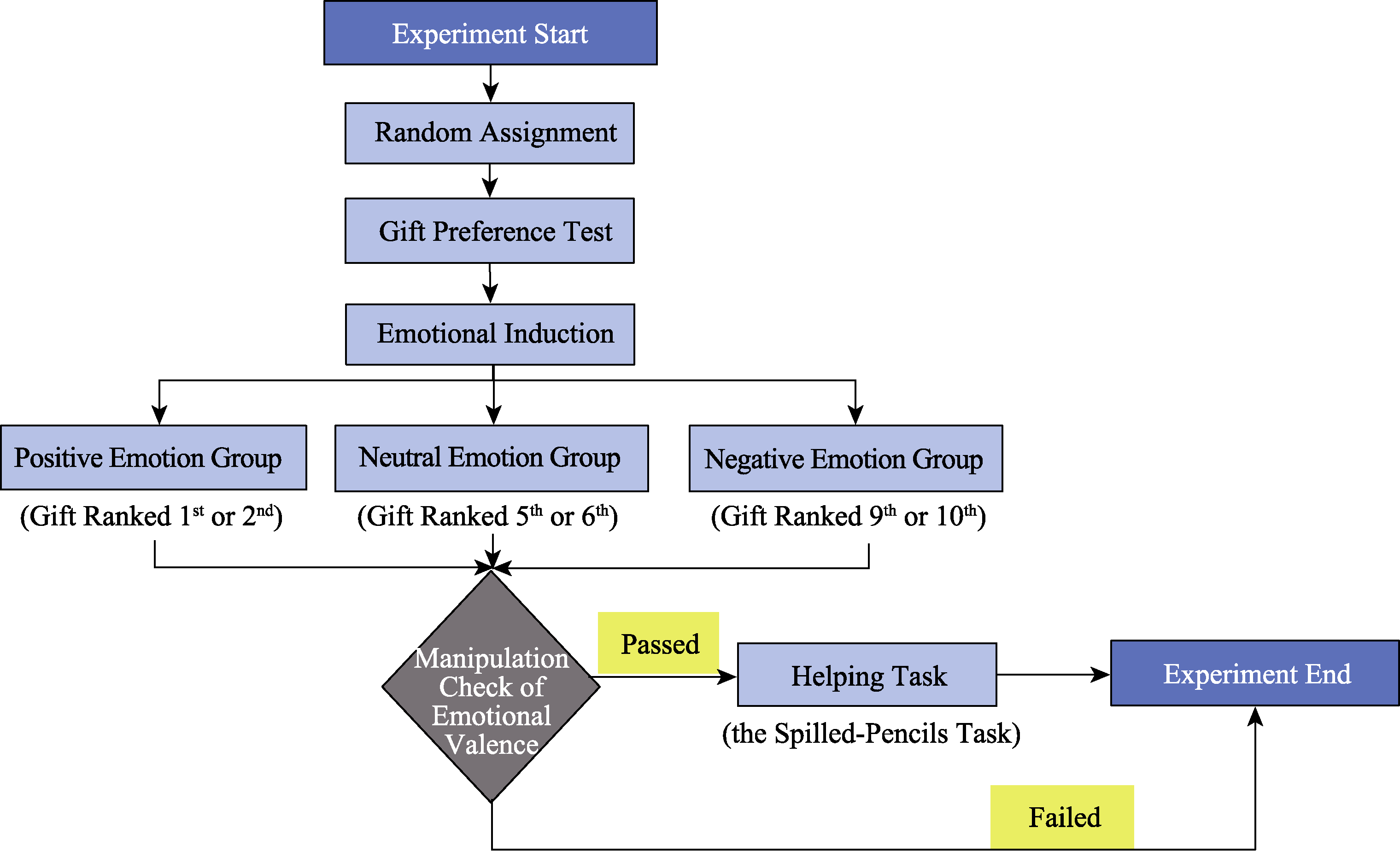
Figure 1. Flowchart of Experiment 1.
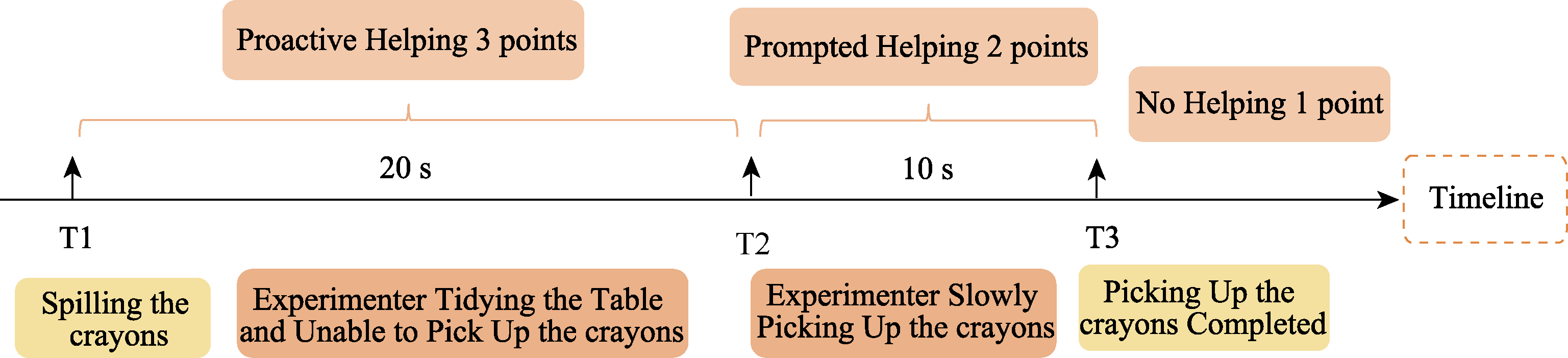
Figure 2. Data coding for the helping task in the spilled-pencils task.
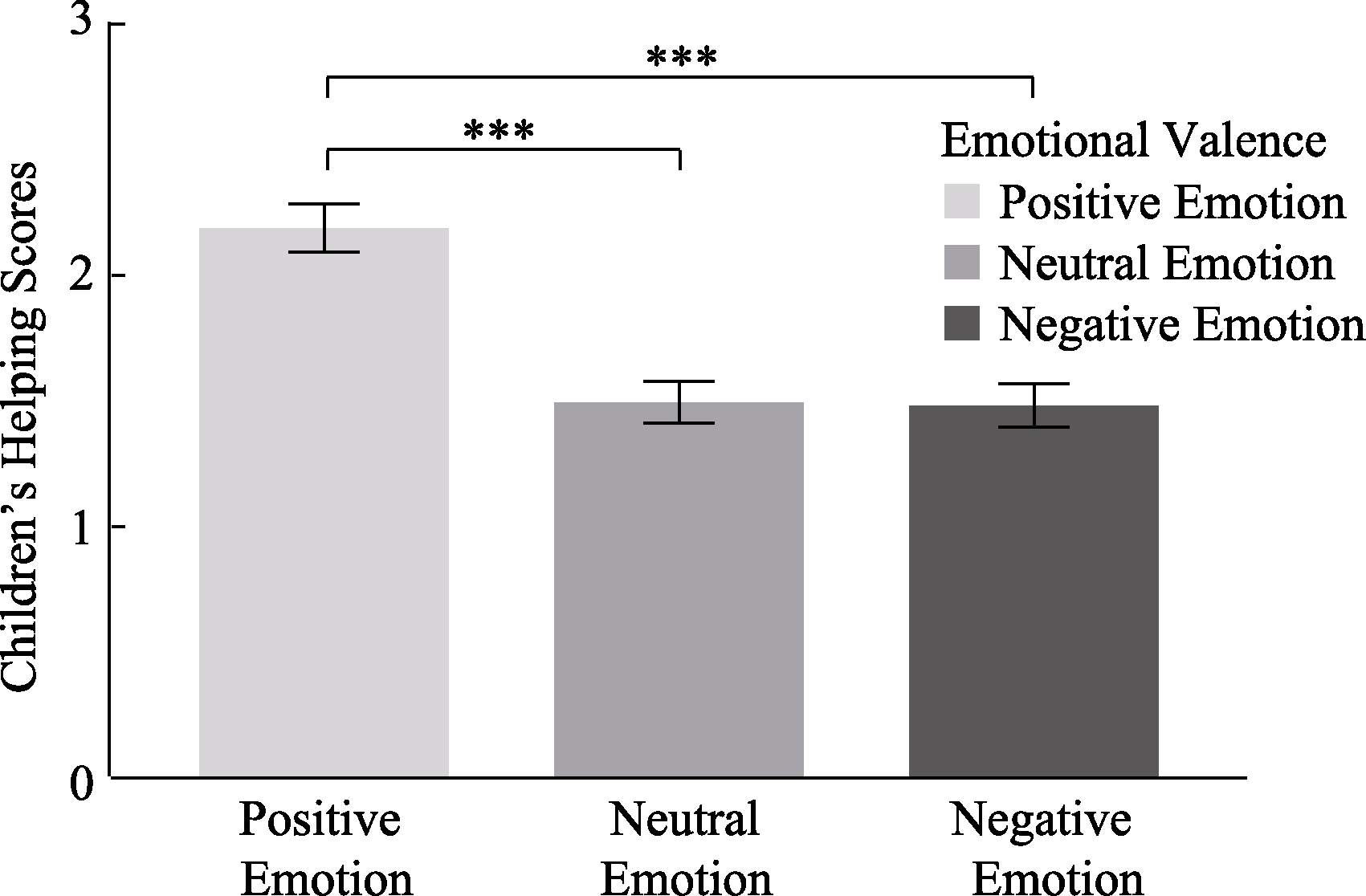
Figure 3. The effect of emotional valence on children’s helping scores. Note. Error bars represent standard errors. Positive emotion group (n = 85), neutral emotion group (n = 91), and negative emotion group (n = 83).

Figure 4. Flowchart of Experiment 2.
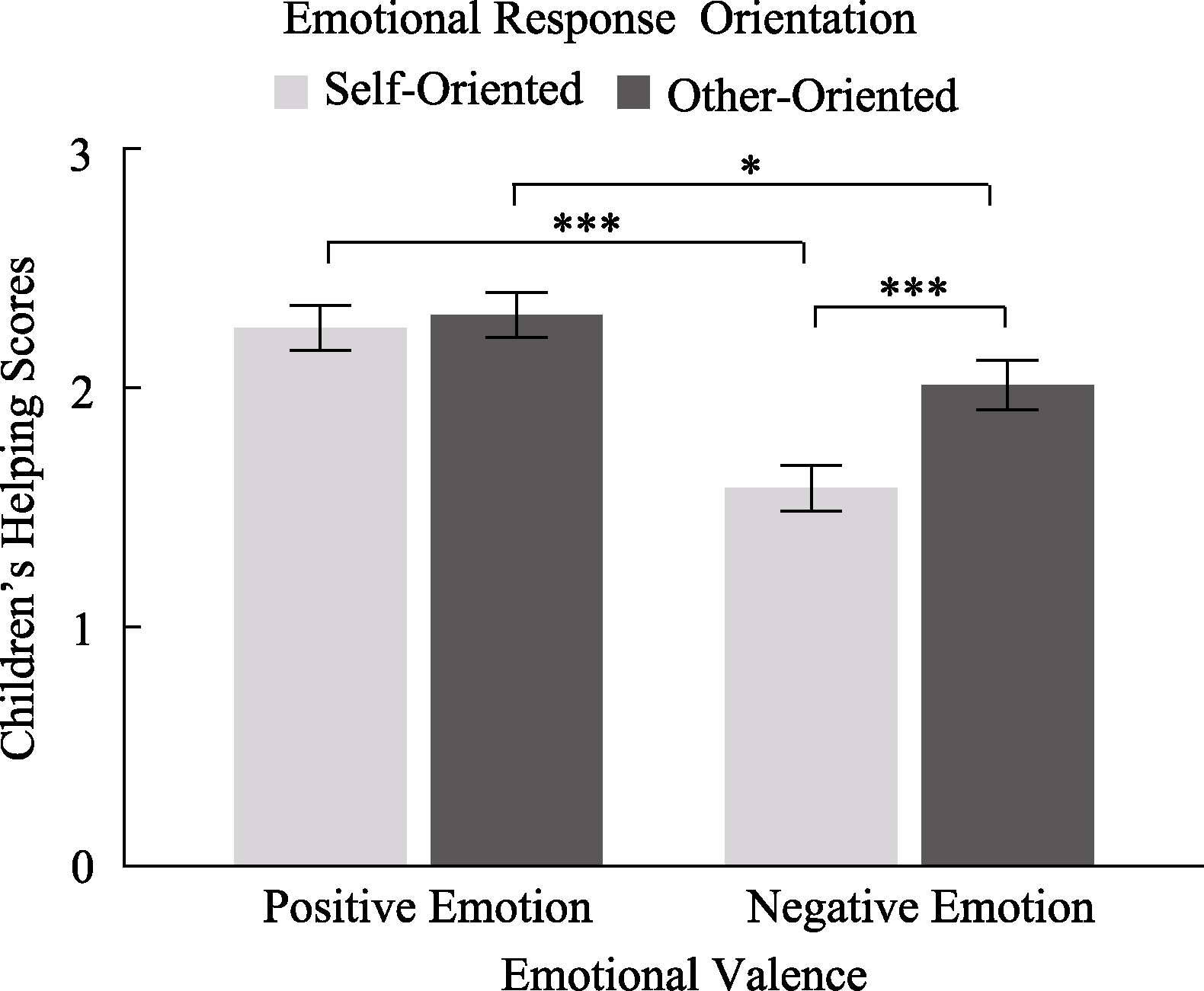
Figure 5. The effects of emotional valence and emotional response orientation on children’s helping scores. Note. Error bars represent standard errors. Self-oriented positive emotion group (n = 92), other-oriented positive emotion group (n = 92), self-oriented negative emotion group (n = 88), and other-oriented negative emotion group (n = 88).
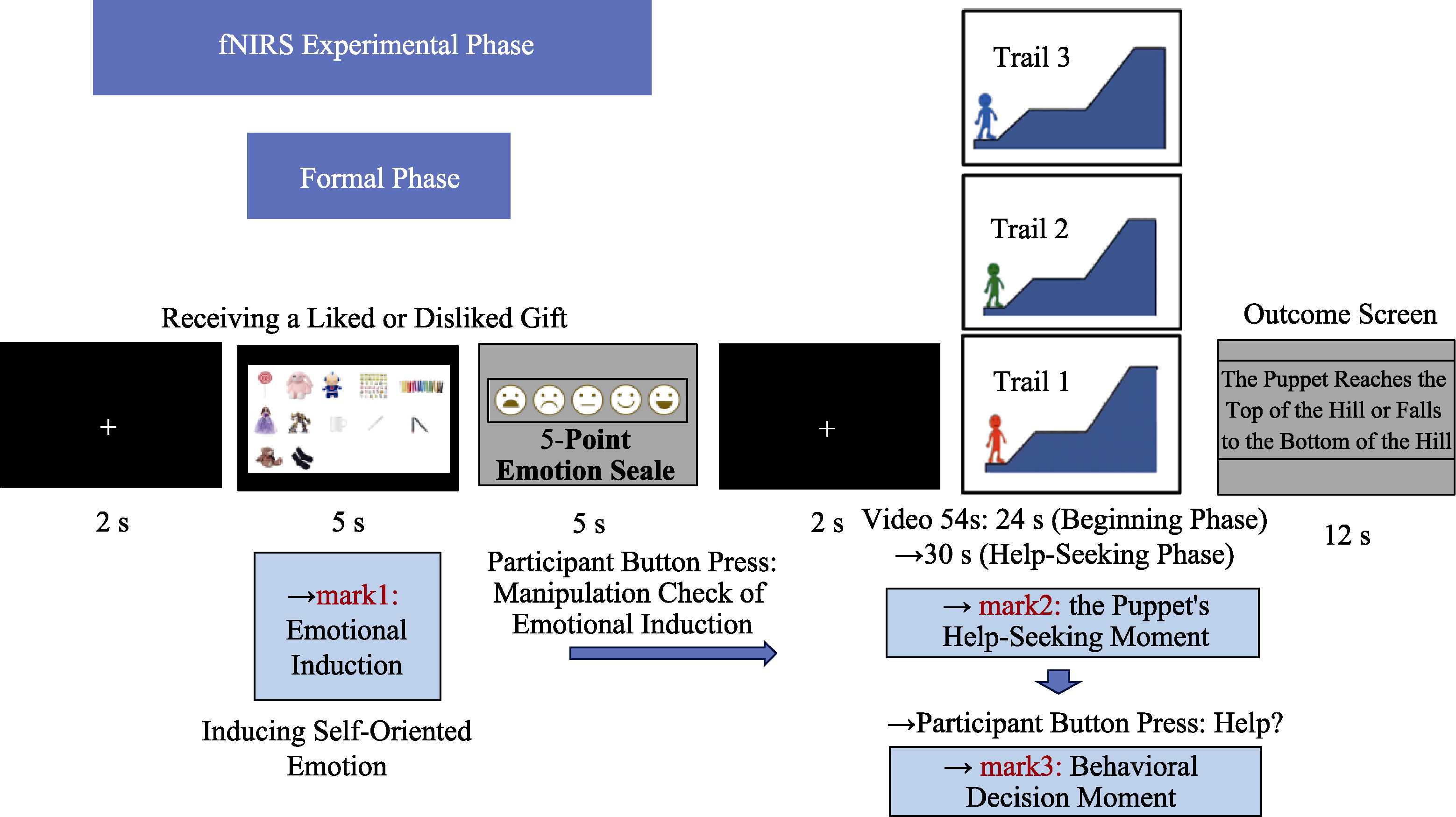
Figure 6. Flowchart of the formal phase of Experiment 3 with fNIRS.
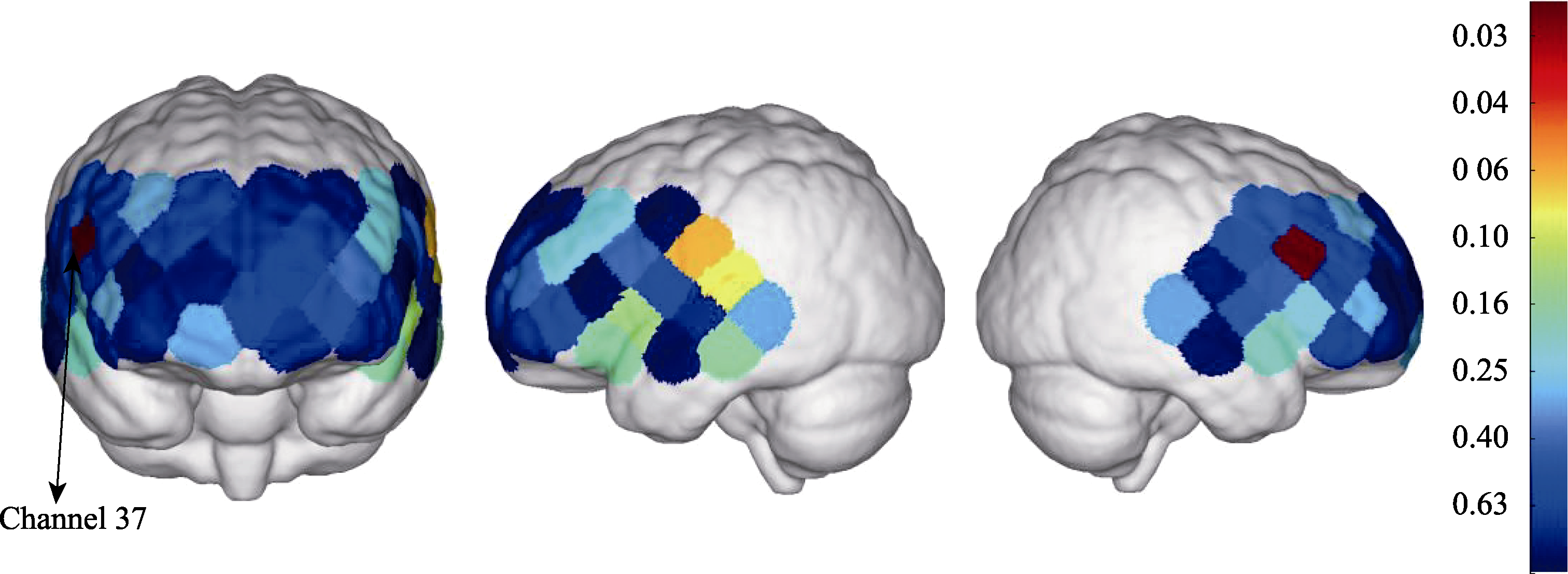
Figure 7. Differences in brain activation between children induced with positive emotions and those induced with negative emotions. Note. Channel 37 corresponds to the Pre-Motor and Supplementary Motor Cortex.

Figure 8. Differences in brain activation associated with helping decisions under different emotional conditions. Note. Channel 6 corresponds to the dorsolateral prefrontal cortex (DLPFC); Channel 15 corresponds to the middle temporal gyrus (MTG).
| [1] | Aknin, L. B., Hamlin, J. K., & Dunn, E. W. (2012). Giving leads to happiness in young children. Plos One, 7(6), e39211. |
| [2] |
Barnett, M. A., Howard, J. A., Melton, E. M., & Dino, G. A. (1982). Effect of inducing sadness about self or other on helping behavior in high-and low-empathic children. Child Development, 53(4), 920-923.
doi: 10.2307/1129128 URL |
| [3] |
Bar-Tal, D., Raviv, A., & Goldberg, M. (1982). Helping behavior among preschool children: An observational study. Child Development, 53(2), 396-402.
doi: 10.2307/1128982 URL |
| [4] |
Bellucci, G., Camilleri, J. A., Iyengar, V., Eickhoff, S. B., & Krueger, F. (2020). Neural signatures of prosocial behaviors. Neuroscience & Biobehavioral Reviews, 118, 186-195.
doi: 10.1016/j.neubiorev.2020.07.006 URL |
| [5] |
Bishop, S., Duncan, J., Brett, M., & Lawrence, A. D. (2004). Prefrontal cortical function and anxiety: Controlling attention to threat-related stimuli. Nature Neuroscience, 7(2), 184-188.
doi: 10.1038/nn1173 pmid: 14703573 |
| [6] |
Brigadoi, S., Ceccherini, L., Cutini, S., Scarpa, F., Scatturin, P., Selb, J., … Cooper, R. J. (2014). Motion artifacts in functional near-infrared spectroscopy: A comparison of motion correction techniques applied to real cognitive data. Neuroimage, 85(1), 181-191.
doi: 10.1016/j.neuroimage.2013.04.082 URL |
| [7] |
Buhle, J. T., Silvers, J. A., Wager, T. D., Lopez, R., Onyemekwu, C., Kober, H., Weber, J., & Ochsner, K. N. (2014). Cognitive reappraisal of emotion: A meta-analysis of human neuroimaging studies. Cerebral Cortex, 24(11), 2981-2990.
doi: 10.1093/cercor/bht154 URL |
| [8] |
Carver, L. J., & Vaccaro, B. G. (2007). 12-month-old infants allocate increased neural resources to stimuli associated with negative adult emotion. Developmental Psychology, 43(1), 54-69.
pmid: 17201508 |
| [9] |
Caspers, S., Zilles, K., Laird, A. R., & Eickhoff, S. B. (2010). ALE meta-analysis of action observation and imitation in the human brain. Neuroimage, 50(3), 1148-1167.
doi: 10.1016/j.neuroimage.2009.12.112 pmid: 20056149 |
| [10] | Cha, M., & Song, H. J. (2024). Focusing attention on others’ negative emotions reduces the effect of social relationships on children’s distributive behaviors. Plos One, 19(2), e0295642. |
| [11] |
Chen, Y. Q., Han, S., & Yin, B. (2023). Why help others? Insights from rodent to human early childhood research. Frontiers in Behavioral Neuroscience, 17, 1058352.
doi: 10.3389/fnbeh.2023.1058352 URL |
| [12] | Decety,, J., & Cowell, J. M. (2018). The social neuroscience of empathy and its relationship to moral behavior. In A. R. Beech, A. J. Carter, R. E. Mann, & P. Rotshtein (Eds.), The Wiley Blackwell handbook of forensic neuroscience (pp. 145-169). Wiley Blackwell. |
| [13] |
De Waal, F. B. (2008). Putting the altruism back into altruism: The evolution of empathy. Annual Review of Psychology, 59(1), 279-300.
doi: 10.1146/psych.2008.59.issue-1 URL |
| [14] | Deng, H. Q. (2018). The effect of sadness and anger on pro-social decision making: The role of the interpersonal attribution of responsibility[Unpublished master’s thesis]. Sichuan Normal University, China. |
| [15] |
Deng, L., Luo, P. C., Wang, J. F., Fang, J. C., Zheng, X. C., Li, Y., & Zheng, X. F. (2014). The enhancement of self-orientation on counterempathy. Acta Psychologica Sinica, 46(8), 1103-1111.
doi: 10.3724/SP.J.1041.2014.01103 |
| [16] |
Donohue, M. R., & Tully, E. C. (2019). Reparative prosocial behaviors alleviate children’s guilt. Developmental Psychology, 55(10), 2102-2113.
doi: 10.1037/dev0000788 pmid: 31343231 |
| [17] |
Eisenberg, N. (2000). Emotion, regulation, and moral development. Annual Review of Psychology, 51(1), 665-697.
doi: 10.1146/psych.2000.51.issue-1 URL |
| [18] | Ekman, P. (1992). An argument for basic emotions. Cognition & Emotion, 6(3-4), 169-200. |
| [19] |
Fehlbaum, L. V., Borbás, R., Paul, K., Eickhoff, S. B., & Raschle, N. M. (2022). Early and late neural correlates of mentalizing: ALE meta-analyses in adults, children and adolescents. Social Cognitive and Affective Neuroscience, 17(4), 351-366.
doi: 10.1093/scan/nsab105 URL |
| [20] | Feng, L. L., Zhong, H., & Zhang, L. L. (2021). Influence of emotional response on state empathy and helping behavior during emotion induction. China Journal of Health Psychology, 29(7), 1085-1091. |
| [21] |
Forgas, J. P., Dunn, E., & Granland, S. (2008). Are you being served…? An unobtrusive experiment of affective influences on helping in a department store. European Journal of Social Psychology, 38(2), 333-342.
doi: 10.1002/ejsp.v38:2 URL |
| [22] |
Fredrickson, B. L. (1998). What good are positive emotions? Review of General Psychology, 2(3), 300-319.
doi: 10.1037/1089-2680.2.3.300 pmid: 21850154 |
| [23] |
Fredrickson, B. L. (2001). The role of positive emotions in positive psychology: The broaden-and-build theory of positive emotions. American Psychologist, 56(3), 218-226.
doi: 10.1037//0003-066x.56.3.218 pmid: 11315248 |
| [24] |
Gori, M., Schiatti, L., & Amadeo, M. B. (2021). Masking emotions: Face masks impair how we read emotions. Frontiers in Psychology, 12, 669432.
doi: 10.3389/fpsyg.2021.669432 URL |
| [25] |
Grabell, A. S., Huppert, T. J., Fishburn, F. A., Li, Y., Hlutkowsky, C. O., Jones, H. M., Wakschlag, L. S., & Perlman, S. B. (2019). Neural correlates of early deliberate emotion regulation: Young children’s responses to interpersonal scaffolding. Developmental Cognitive Neuroscience, 40, 100708.
doi: 10.1016/j.dcn.2019.100708 URL |
| [26] |
Gross, J., Emmerling, F., Vostroknutov, A., & Sack, A. T. (2018). Manipulation of pro-sociality and rule-following with non-invasive brain stimulation. Scientific Reports, 8(1), 1827.
doi: 10.1038/s41598-018-19997-5 pmid: 29379072 |
| [27] | Guo, X. Y., & Wang, Z. H. (2007). Concept, function and meaning of positive emotion. Advances in Psychological Science, 15(5), 810-815. |
| [28] | Huang, R., Liu, X. Q., & Xue, Y. Z. (2023). An experimental study of pro-social behavior among college students in different emotional validity contexts: Evidence based on the Vibraimage Test. Psychologies Magazine, 18(6), 72-75. |
| [29] |
Isen, A. M., & Levin, P. F. (1972). Effect of feeling good on helping: Cookies and kindness. Journal of Personality and Social Psychology, 21(3), 384-388.
doi: 10.1037/h0032317 pmid: 5060754 |
| [30] | Kang, D., Wen, M., & Cai, S. (2023). Relationship between sharing behavior and emotional state in 4-6-year-old children. Chinese Mental Health Journal, 37(4), 326-331. |
| [31] |
Knoch, D., Pascual-Leone, A., Meyer, K., Treyer, V., & Fehr, E. (2006). Diminishing reciprocal fairness by disrupting the right prefrontal cortex. Science, 314(5800), 829-832.
doi: 10.1126/science.1129156 pmid: 17023614 |
| [32] |
Lamy, L., Fischer-Lokou, J., & Guéguen, N. (2012). Priming emotion concepts and helping behavior: How unlived emotions can influence action. Social Behavior and Personality: An International Journal, 40(1), 55-62.
doi: 10.2224/sbp.2012.40.1.55 URL |
| [33] | Lee, Y. E., Yun, J., E. E., Kim, E. Y., & Song, H. J. (2015). The development of infants’ sensitivity to behavioral intentions when inferring others’ social preferences. Plos One, 10(9), e0135588. |
| [34] | Longard, J. (2018). Relations between positive affect and sharing behaviour in early childhood [Unpublished doctorial dissertation]. Dalhousie University Halifax. |
| [35] |
Luo, J. (2018). The neural basis of and a common neural circuitry in different types of pro-social behavior. Frontiers in Psychology, 9, 859.
doi: 10.3389/fpsyg.2018.00859 pmid: 29922197 |
| [36] |
MacGowan, T. L., & Schmidt, L. A. (2021). Helping as prosocial practice: Longitudinal relations among children’s shyness, helping behavior, and empathic response. Journal of Experimental Child Psychology, 209, 105154.
doi: 10.1016/j.jecp.2021.105154 URL |
| [37] |
Misgav, K., Shachnai, R., Abramson, L., Knafo-Noam, A., & Daniel, E. (2023). Personal values and sustained attention as predictors of children’s helping behavior in middle childhood. Journal of Personality, 91(3), 773-788.
doi: 10.1111/jopy.v91.3 URL |
| [38] |
Moore, B. S., Underwood, B., & Rosenhan, D. L. (1973). Affect and altruism. Developmental Psychology, 8(1), 99-104.
doi: 10.1037/h0033847 URL |
| [39] |
Noble, W. S. (2009). How does multiple testing correction work? Nature Biotechnology, 27(12), 1135-1137.
doi: 10.1038/nbt1209-1135 pmid: 20010596 |
| [40] |
Ochsner, K. N., & Gross, J. J. (2005). The cognitive control of emotion. Trends in Cognitive Sciences, 9(5), 242-249.
doi: 10.1016/j.tics.2005.03.010 pmid: 15866151 |
| [41] |
Passarotti, A. M., Sweeney, J. A., & Pavuluri, M. N. (2010). Differential engagement of cognitive and affective neural systems in pediatric bipolar disorder and attention deficit hyperactivity disorder. Journal of the International Neuropsychological Society, 16(1), 106-117.
doi: 10.1017/S1355617709991019 URL |
| [42] | Petkova, A. V., & Brownell, C. A. (2022). I feel, you feel, we feel: The role of emotion in early prosocial behavior. Oxford University Press. |
| [43] |
Phan, K. L., Wager, T., Taylor, S. F., & Liberzon, I. (2002). Functional neuroanatomy of emotion: A meta-analysis of emotion activation studies in PET and fMRI. Neuroimage, 16(2), 331-348.
doi: 10.1006/nimg.2002.1087 pmid: 12030820 |
| [44] |
Pinti, P., Scholkmann, F., Hamilton, A., Burgess, P., & Tachtsidis, I. (2019). Current status and issues regarding pre-processing of fNIRS neuroimaging data: An investigation of diverse signal filtering methods within a general linear model framework. Frontiers in Human Neuroscience, 12, 505.
doi: 10.3389/fnhum.2018.00505 URL |
| [45] | Pinti, P., Tachtsidis, I., Hamilton, A., Hirsch, J., Aichelburg, C., Gilbert, S., & Burgess, P. W. (2020). The present and future use of functional near-infrared spectroscopy (fNIRS) for cognitive neuroscience. Annals of the New York Academy of Sciences, 1464(1), 5-29. |
| [46] | Piretti, L., Pappaianni, E., Gobbo, S., Rumiati, R. I., Job, R., & Grecucci, A. (2022). Dissociating the role of dACC and dlPFC for emotion appraisal and mood regulation using cathodal tDCS. Cognitive, Affective, & Behavioral Neuroscience, 22(2), 304-315. |
| [47] |
Rosenhan, D. L., Salovey, P., & Hargis, K. (1981). The joys of helping: Focus of attention mediates the impact of positive affect on altruism. Journal of Personality and Social Psychology, 40(5), 899-905.
doi: 10.1037/0022-3514.40.5.899 URL |
| [48] |
Sallquist, J., Eisenberg, N., Spinrad, T. L., Eggum, N. D., & Gaertner, B. M. (2009). Assessment of preschoolers’ positive empathy: Concurrent and longitudinal relations with positive emotion, social competence, and sympathy. The Journal of Positive Psychology, 4(3), 223-233.
doi: 10.1080/17439760902819444 URL |
| [49] |
Schurz, M., Radua, J., Aichhorn, M., Richlan, F., & Perner, J. (2014). Fractionating theory of mind: A meta-analysis of functional brain imaging studies. Neuroscience & Biobehavioral Reviews, 42, 9-34.
doi: 10.1016/j.neubiorev.2014.01.009 URL |
| [50] |
Siegler, R. S. (2005). Children’s learning. American Psychologist, 60(8), 769-778.
pmid: 16351402 |
| [51] |
Siu, T. S. C., & Ho, C. I. (2022). Engaging with happy-sounding music promotes helping behavior in 18-month-olds. Infancy, 27(1), 197-206.
doi: 10.1111/infa.v27.1 URL |
| [52] |
Snippe, E., Jeronimus, B. F., Aan Het Rot, M., Bos, E. H., de Jonge, P., & Wichers, M. (2018). The reciprocity of prosocial behavior and positive affect in daily life. Journal of Personality, 86(2), 139-146.
doi: 10.1111/jopy.12299 pmid: 28093772 |
| [53] |
Steinbeis, N. (2018). Neurocognitive mechanisms of prosociality in childhood. Current Opinion in Psychology, 20, 30-34.
doi: S2352-250X(17)30158-6 pmid: 28830003 |
| [54] |
Strang, S., Gross, J., Schuhmann, T., Riedl, A., Weber, B., & Sack, A. T. (2015). Be nice if you have to—the neurobiological roots of strategic fairness. Social Cognitive and Affective Neuroscience, 10(6), 790-796.
doi: 10.1093/scan/nsu114 URL |
| [55] |
Svetlova, M., Nichols, S. R., & Brownell, C. A. (2010). Toddlers’ prosocial behavior: From instrumental to empathic to altruistic helping. Child Development, 81(6), 1814-1827.
doi: 10.1111/j.1467-8624.2010.01512.x URL |
| [56] |
Telzer, E. H., Masten, C. L., Berkman, E. T., Lieberman, M. D., & Fuligni, A. J. (2011). Neural regions associated with self control and mentalizing are recruited during prosocial behaviors towards the family. Neuroimage, 58(1), 242-249.
doi: 10.1016/j.neuroimage.2011.06.013 pmid: 21703352 |
| [57] | Thiede, N., Stengelin, R., Seibold, A., & Haun, D. B. M. (2023). Testing causal effects of empathy on children’s prosociality in politeness dilemmas - an intervention study. Open Mind: Discoveries in Cognitive Science, 20(7), 691-710. |
| [58] |
Thompson, R. A., & Newton, E. K. (2013). Baby altruists? Examining the complexity of prosocial motivation in young children. Infancy, 18(1), 120-133.
doi: 10.1111/infa.2012.18.issue-1 URL |
| [59] |
Thompson, W. C., Cowan, C. L., & Rosenhan, D. L. (1980). Focus of attention mediates the impact of negative affect on altruism. Journal of Personality and Social Psychology, 38(2), 291-300.
doi: 10.1037/0022-3514.38.2.291 URL |
| [60] |
Underwood, B., Froming, W. J., & Moore, B. S. (1977). Mood, attention, and altruism: A search for mediating variables. Developmental Psychology, 13(5), 541-542.
doi: 10.1037/0012-1649.13.5.541 URL |
| [61] | Van der Meulen, M., & Crone, E. A. (2016). Neural correlates of prosocial behavior: Compensating social exclusion in a four-player cyberball game. Plos One, 11(7), e0159045. |
| [62] |
Van Kleef, G. A., & Lelieveld, G. J. (2022). Moving the self and others to do good: The emotional underpinnings of prosocial behavior. Current Opinion in Psychology, 44, 80-88.
doi: 10.1016/j.copsyc.2021.08.029 URL |
| [63] |
Wang, J., Yang, Z., Klugah-Brown, B., Zhang, T., Yang, J., Yuan, J., & Biswal, B. B. (2024). The critical mediating roles of the middle temporal gyrus and ventrolateral prefrontal cortex in the dynamic processing of interpersonal emotion regulation. Neuroimage, 300, 120789.
doi: 10.1016/j.neuroimage.2024.120789 URL |
| [64] | Ward, R., & Ramsey, R. (2024). Integrating social cognition into domain-general control: Interactive activation and competition for the control of action (ICON). Cognitive Science, 48(2), e13415. |
| [65] |
Warneken, F. (2015). Precocious prosociality: Why do young children help? Child Development Perspectives, 9(1), 1-6.
doi: 10.1111/cdep.12101 URL |
| [66] |
Widen, S. C. (2013). Children’s interpretation of facial expressions: The long path from valence-based to specific discrete categories. Emotion Review, 5(1), 72-77.
doi: 10.1177/1754073912451492 URL |
| [67] |
Yamamoto, E., Hirokawa, M., Nunez, E., Hakuno, Y., Sekine, K., Miyahara, S., Suzuki, K., & Minagawa, Y. (2024). Neural and physiological correlates of prosocial behavior: Temporoparietal junction activity in 3-year-old Children. Journal of Cognitive Neuroscience, 36(9), 1977-1994.
doi: 10.1162/jocn_a_02199 URL |
| [68] |
Yang, Z. N., Gu, Z. B., Wang, D. J., Tan, X. Y., & Wang, X. M. (2017). The effect of anger and sadness on prosocial decision making: The role of the interpersonal attribution of responsibility. Acta Psychologica Sinica, 49(3), 393-403.
doi: 10.3724/SP.J.1041.2017.00393 |
| [69] | Yao, X. J. (2015). A study of 3-6 years old children helping behavior in kindergarten (Unpublished master’s thesis). Central China Normal University, Wu Han. |
| [70] |
Yeung, M. K. (2021). An optical window into brain function in children and adolescents: A systematic review of functional near-infrared spectroscopy studies. Neuroimage, 227, 117672.
doi: 10.1016/j.neuroimage.2020.117672 URL |
| [71] |
Zahn-Waxler, C., Radke-Yarrow, M., Wagner, E., & Chapman, M. (1992). Development of concern for others. Developmental Psychology, 28(1), 126-136.
doi: 10.1037/0012-1649.28.1.126 URL |
| [72] |
Zelazo, P. D., & Carlson, S. M. (2012). Hot and cool executive function in childhood and adolescence: Development and plasticity. Child Development Perspectives, 6(4), 354-360.
doi: 10.1111/j.1750-8606.2012.00246.x URL |
| [73] | Zeng, M. C., Li, M. X., Li, W. J., & Sun, X. H. (2022). Application of fNIRS hyperscanning in the study of brain mechanism of parent-child Interaction. Journal of Shaanxi Xueqian Normal University, 38(12), 59-67. |
| [74] | Zhong, Y. P., Yang., Z. L., & Fan, W. (2015). The effects of self-other overlap and perspective taking categories on willingness for help. Chinese Journal of Clinical Psychology, 23(1), 63-66. |
| [75] | Zinchenko, O., Savelo, O., & Klucharev, V. (2021). Role of the prefrontal cortex in prosocial and self-maximization motivations: An rTMS study. Scientific Reports, 11(1), 22334. |
| [76] |
Zinchenko, O., Yaple, Z. A., & Arsalidou, M. (2018). Brain responses to dynamic facial expressions: A normative meta-analysis. Frontiers in Human Neuroscience, 12, 227.
doi: 10.3389/fnhum.2018.00227 pmid: 29922137 |
| [1] | HUANG Xinjie, ZHANG Chi, WAN Huagen, ZHANG Lingcong. Effect of predictability of emotional valence on temporal binding [J]. Acta Psychologica Sinica, 2023, 55(1): 36-44. |
| [2] | Xiaolei SONG, Xiaoqian JIA, Yuan ZHAO, Jingjing GUO. The underlying mechanism of emotions on co-representation in joint actions [J]. Acta Psychologica Sinica, 2020, 52(3): 269-282. |
| [3] | YIN Xile, LI Jianbiao, CHEN Siyu, LIU Xiaoli, HAO Jie. Neural mechanisms of third-party punishment: Evidence from transcranial direct current stimulation [J]. Acta Psychologica Sinica, 2019, 51(5): 571-583. |
| [4] | Hui Hui WANG, Yu Dan LUO, Bing SHI, Feng Qiong YU, Kai WANG. Excitation of the right dorsolateral prefrontal cortex with transcranial direct current stimulation influences response inhibition [J]. Acta Psychologica Sinica, 2018, 50(6): 647-654. |
| [5] | SONG Xiaolei, ZHANG Junting, SHI Jie, YOU Xuqun. Influence of emotional valence on the spatial simon effect under the vocal response mode [J]. Acta Psychologica Sinica, 2017, 49(8): 1031-1040. |
| [6] | KE Chunchun, NIE Aiqing, ZHANG Ruiqing. The modulation of recall task on collaborative inhibition and error pruning: The influence of emotional valence and level of processing [J]. Acta Psychologica Sinica, 2017, 49(6): 733-744. |
| [7] | BAI Xuejun, ZHANG Qihan, ZHANG Peng, ZHOU Song, LIU Ying, SONG Xing, PENG Guohui. Comparison of motor execution and motor imagery brain activation patterns: A fNIRS Study [J]. Acta Psychologica Sinica, 2016, 48(5): 495-508. |
| [8] | XIAO Hongrui, HUANG Yifan, GONG Xianmin, WANG Dahua. Age Alters the Effects of Emotional Valence on False Memory: Using the Simplified Conjoint Recognition Paradigm [J]. Acta Psychologica Sinica, 2015, 47(1): 19-28. |
| [9] | XIAO Hongrui;GONG Xianmin;WANG Dahua. Effect of Emotional Valence and Time Interval on the False Memory of Pictures among Older Adults [J]. Acta Psychologica Sinica, 2014, 46(7): 922-930. |
| [10] | DENG Xiao-Hong,ZHANG De-Xuan,HUANG Shi-Xue,YUAN Wen,ZHOU Xiao-Lin. Effects of Supra- and Sub-liminal Emotional Cues on Inhibition of Return [J]. , 2010, 42(03): 325-333. |
| Viewed | ||||||
|
Full text |
|
|||||
|
Abstract |
|
|||||
