ISSN 0439-755X
CN 11-1911/B

Acta Psychologica Sinica ›› 2026, Vol. 58 ›› Issue (4): 618-633.doi: 10.3724/SP.J.1041.2026.0618

• Reports of Empirical Studies • Previous Articles     Next Articles

The mental representation and inference patterns of facial social exclusion

HOU Chunna1, MA Yisheng1, WU Lin2, LIU Zhijun3   

  1. 1School of Psychology, Northeast Normal University, Changchun 130024, China;
    2School of Sociology, Wuhan University, Wuhan 430072, China;
    3Department of Sociology, Changchun University of Science and Technology, Changchun 130022, China
  • Received:2025-02-11 Published:2026-04-25 Online:2026-01-16

Abstract: As social beings, humans rely on social relationships for survival and reproduction. Successful adaptation to the social environment leads to acceptance, while failure may result in social exclusion. The mechanisms of exclusion behavior are a key academic focus. Unjustified exclusion not only threatens the mental health of the excluded, but may also cause distress to the excluders. Rudert et al. (2017) emphasized that facial features significantly influence decisions about exclusion. Based on the Big Two model of trait attribution, this study employed reverse correlation image classification techniques to explore the facial mental representations and trait inference patterns that trigger social exclusion.
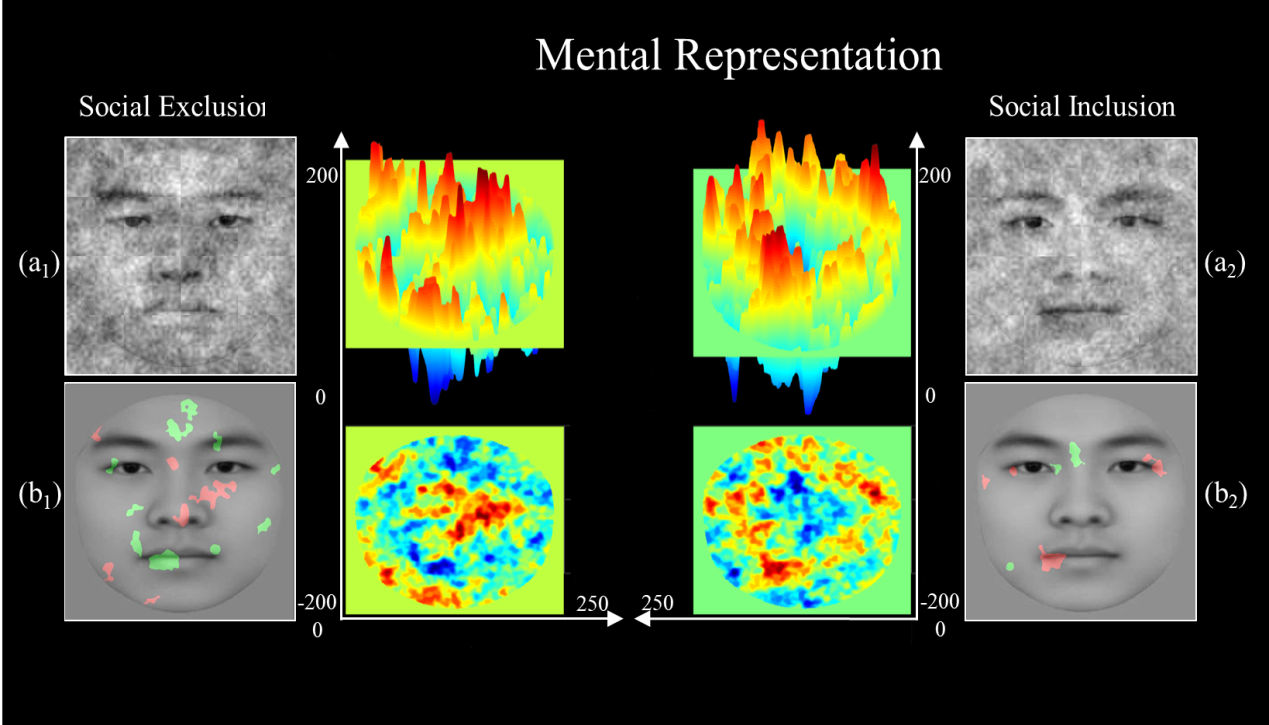
Study 1 involved 81 Chinese college students as participants and employed a two-image forced-choice task after inducing a social exclusion scenario. The results revealed differences in the mental representations of faces between those who were excluded and those who were accepted, as well as varying diagnostic criteria. Pixel test analysis showed that the diagnostic information for social exclusion included most of the key areas of the face: the forehead, eyes, nose, mouth, and the peripheral facial contour.
Study 2 examined the role of different facial traits in social exclusion, utilizing both objective measurements and subjective evaluations. Study 2a adopted an objective measurement approach, with the independent variables being the different trait-based mental representations generated in a pilot study (high trustworthiness, low trustworthiness, high dominance, low dominance), and the dependent variables being the two types of facial mental representations (social exclusion and social inclusion) identified in Study 1. A pixel regression model using pixel brightness values analyzed facial traits to predict the mental representation of social exclusion. The pixel regression analysis revealed that low trustworthiness strongly and positively predicted social exclusion, with the largest effect among all traits. Trustworthiness is a key dimension in shaping the mental representation of social exclusion. High trustworthiness had a negative predictive effect, indicating that the trustworthiness dimension has a discriminative impact on social exclusion. However, the discriminative effect of the dominance dimension is less clear. Study 2b conducted a subjective evaluation of the inference patterns of facial traits in the social exclusion process. The study utilized six facial mental representations as stimuli, including the two images of excluded and included individuals generated in Study 1, as well as the four images representing low trustworthiness, high trustworthiness, low dominance, and high dominance generated from Study 2a. A total of 153 college students participated in the study. The results showed that for the mental representation of social exclusion, low trustworthiness had a significant positive predictive effect, and low dominance similarly contributed to social exclusion.
Both objective and subjective studies indicated that trustworthiness was a key predictor of social exclusion, while the role of dominance remains inconclusive and warrants further investigation. Both assessments indicated that low trustworthiness and low dominance were typical features of social exclusion. In the trait inference process underlying social exclusion, both trustworthiness and dominance play crucial roles, but low trustworthiness carries greater weight, thereby supporting the primacy of trustworthiness hypothesis.

Key words: face, social exclusion, mental representation