

ISSN 0439-755X
CN 11-1911/B
CN 11-1911/B
Acta Psychologica Sinica ›› 2021, Vol. 53 ›› Issue (12): 1348-1360.doi: 10.3724/SP.J.1041.2021.01348
• Reports of Empirical Studies • Previous Articles Next Articles
LIN Rang1,2( ), YANG Yimiao2
Received:2020-10-22
Published:2021-12-25
Online:2021-10-26
Contact:
LIN Rang
E-mail:linrang_dufe@163.com
Supported by:LIN Rang, YANG Yimiao. (2021). Effect of ambivalent attitudes on post-decision self-evaluation: Two-stage moderation effect with a mediator. Acta Psychologica Sinica, 53(12), 1348-1360.
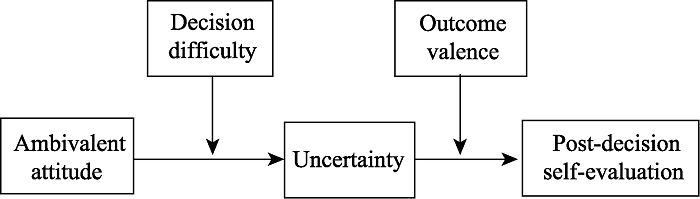
Figure 1. Theoretical model.
| Dimensions | University A | University B |
|---|---|---|
| Monthly salary after graduation | 5000~9000 | 4000~6000 |
| Employment rate | 87% | 93% |
| The city where the school is | First line | Second line |
| Average teacher level (maximum 5 points) | 4.4 | 4.8 |
Table 1 Compare the two universities
| Dimensions | University A | University B |
|---|---|---|
| Monthly salary after graduation | 5000~9000 | 4000~6000 |
| Employment rate | 87% | 93% |
| The city where the school is | First line | Second line |
| Average teacher level (maximum 5 points) | 4.4 | 4.8 |
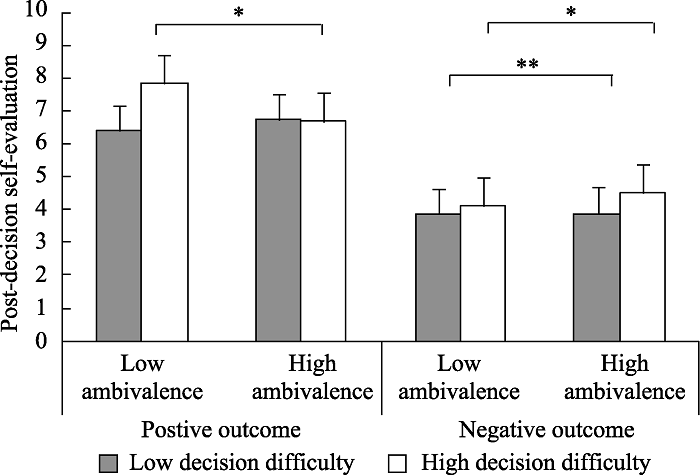
Figure 2. Experiment 1 interaction of ambivalent attitude, decision difficulty and outcome valence.
| Dimensions | Enterprise A | Enterprise B |
|---|---|---|
| Monthly salary after graduation | 6000~10000 | 4000~6000 |
| Number of employees | 5387 | 30592 |
| City | First line | Second line |
| Brand Value Ranking | 55 | 9 |
Table 2 Compare the two companies
| Dimensions | Enterprise A | Enterprise B |
|---|---|---|
| Monthly salary after graduation | 6000~10000 | 4000~6000 |
| Number of employees | 5387 | 30592 |
| City | First line | Second line |
| Brand Value Ranking | 55 | 9 |

Figure 3. Interaction of ambivalent attitude, decision difficulty level and outcome valence in Experiment 2.
| Variable: Post-decision self-evaluation | Coeff. | SE | t | p | LLCI | ULCI |
|---|---|---|---|---|---|---|
| Constant | 15.63 | 0.57 | 27.37 | 0.00 | 14.51 | 16.76 |
| Outcome Valence | -7.09 | 0.35 | -20.1 | 0.00 | -7.78 | -6.40 |
| Uncertainty | -1.44 | 0.11 | -12.9 | 0.00 | -1.66 | -1.22 |
| Outcome valence × uncertainty | 1.06 | 0.07 | 15.2 | 0.00 | 0.92 | 1.20 |
Table 3 The moderating effect of uncertainty
| Variable: Post-decision self-evaluation | Coeff. | SE | t | p | LLCI | ULCI |
|---|---|---|---|---|---|---|
| Constant | 15.63 | 0.57 | 27.37 | 0.00 | 14.51 | 16.76 |
| Outcome Valence | -7.09 | 0.35 | -20.1 | 0.00 | -7.78 | -6.40 |
| Uncertainty | -1.44 | 0.11 | -12.9 | 0.00 | -1.66 | -1.22 |
| Outcome valence × uncertainty | 1.06 | 0.07 | 15.2 | 0.00 | 0.92 | 1.20 |
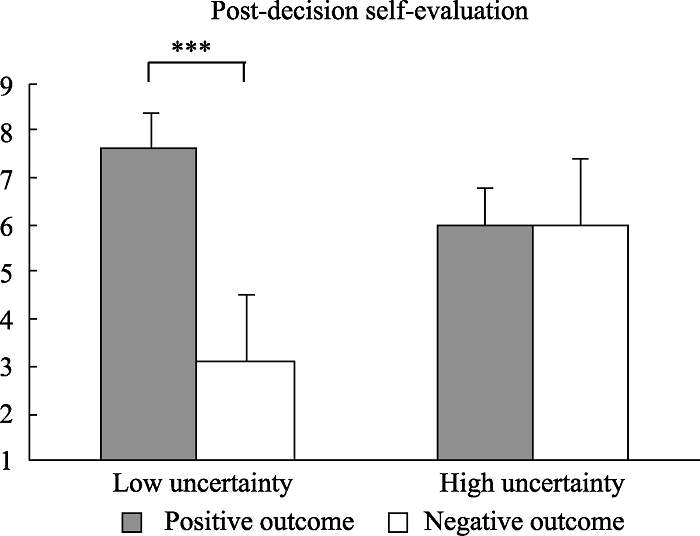
Figure 4. The effects of uncertainty and outcome valence on Post-decision Self-evaluation
| Variable: uncertainty | Coeff. | SE | t | p | LLCI | ULCI |
|---|---|---|---|---|---|---|
| Constant | 8.87 | 1.07 | 8.23 | 0.00 | 6.75 | 11.0 |
| Ambivalence | -3.45 | 0.64 | -5.31 | 0.00 | -4.72 | -2.17 |
| Level of decision difficulty | -3.35 | 0.69 | -4.80 | 0.00 | -4.72 | -1.97 |
| Ambivalence × difficulty level in decision making | 2.62 | 0.42 | 6.21 | 0.00 | 1.79 | 3.45 |
Table 4 The influence of ambivalent attitude and decision difficulty level on uncertainty
| Variable: uncertainty | Coeff. | SE | t | p | LLCI | ULCI |
|---|---|---|---|---|---|---|
| Constant | 8.87 | 1.07 | 8.23 | 0.00 | 6.75 | 11.0 |
| Ambivalence | -3.45 | 0.64 | -5.31 | 0.00 | -4.72 | -2.17 |
| Level of decision difficulty | -3.35 | 0.69 | -4.80 | 0.00 | -4.72 | -1.97 |
| Ambivalence × difficulty level in decision making | 2.62 | 0.42 | 6.21 | 0.00 | 1.79 | 3.45 |
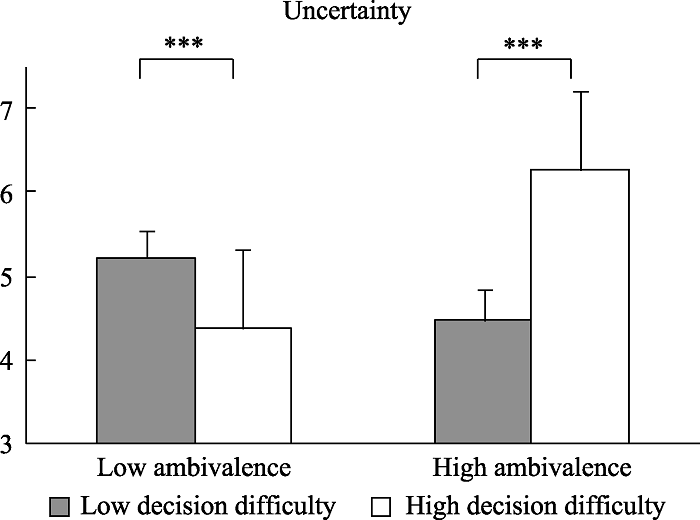
Figure 5. The influence of ambivalent attitude and decision difficulty level on uncertainty.
| Outcome Valence | Level of decision difficulty | Effect | SE | LLCI | ULCI |
|---|---|---|---|---|---|
| Positive outcome | low | 0.24 | 0.08 | 0.09 | 0.43 |
| Positive outcome | high | -0.45 | 0.19 | -0.83 | -0.09 |
| Negative outcome | low | 0.23 | 0.25 | -0.73 | 0.28 |
| Negative outcome | high | 1.60 | 0.32 | 0.98 | 2.28 |
Table 5 The mediating role of uncertainty
| Outcome Valence | Level of decision difficulty | Effect | SE | LLCI | ULCI |
|---|---|---|---|---|---|
| Positive outcome | low | 0.24 | 0.08 | 0.09 | 0.43 |
| Positive outcome | high | -0.45 | 0.19 | -0.83 | -0.09 |
| Negative outcome | low | 0.23 | 0.25 | -0.73 | 0.28 |
| Negative outcome | high | 1.60 | 0.32 | 0.98 | 2.28 |
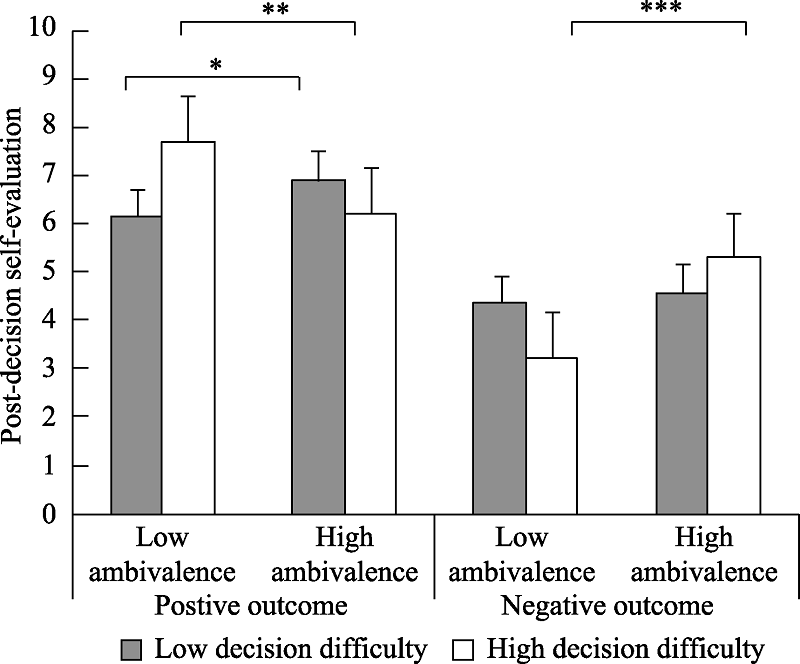
Figure 6. Experiment 3 interaction of ambivalent attitude, decision difficulty level and outcome valence.
| [1] |
Alicke, M. D., & Sedikides, C. (2009). Self-enhancement and self-protection: What they are and what they do. European Review of Social Psychology, 20(1), 1-48.
doi: 10.1080/10463280802613866 URL |
| [2] |
Anderson, C. J. (2003). The psychology of doing nothing: Forms of decision avoidance result from reason and emotion. Psychological Bulletin, 129(1), 139-167.
doi: 10.1037/0033-2909.129.1.139 URL |
| [3] |
Armitage, C. J., & Arden, M. A. (2007). Felt and potential ambivalence across the stages of change. Journal of Health Psychology, 12(1), 149-158.
doi: 10.1177/1359105307071749 URL |
| [4] |
Bee, C. C., & Madrigal, R. (2013). Consumer uncertainty: The influence of anticipatory emotions on ambivalence, attitudes, and intentions. Journal of Consumer Behaviour, 12(5), 370-381.
doi: 10.1002/cb.v12.5 URL |
| [5] | Brown, J. D., Dutton, K. A., & Cook, K. E. (2001). From the top down: Self-esteem and self-evaluation. Cognition & Emotion, 15(5), 615-631. |
| [6] |
Chernev, A. (2006). Decision focus and consumer choice among assortments. Journal of Consumer Research, 33(1), 50-59.
doi: 10.1086/jcr.2006.33.issue-1 URL |
| [7] | Clark, J. K., Wegener, D. T., & Fabrigar, L. R. (2008). Attitudinal ambivalence and message-based persuasion: Motivated processing of proattitudinal information and avoidance of counterattitudinal information. Personality & Social Psychology Bulletin, 34(4), 565-577. |
| [8] |
de Liver, Y., van der Pligt, J., & Wigboldus, D. H. J. (2007). Positive and negative associations underlying ambivalent attitudes. Journal of Experimental Social Psychology, 43(2), 319-326.
doi: 10.1016/j.jesp.2006.02.012 URL |
| [9] | Engel, J. F., Kollat, D. T., & Blackwell, R. D. (1978). Consumer behavior. 3rd ed. Hinsdale, IL: Dryden. |
| [10] |
Förster, J., & Higgins, E. T. (2005). How global versus local perception fits regulatory focus. Psychological Science, 16(8), 631-636.
pmid: 16102066 |
| [11] |
Grant, S. J., & Tybout, A. M. (2008). The effect of temporal frame on information considered in new product evaluation: The role of uncertainty. Journal of Consumer Research, 34(6), 897-913.
doi: 10.1086/527342 URL |
| [12] | Hanselmann, M., & Tanner, C. (2008). Taboos and conflicts in decision making: Sacred values, decision difficulty, and emotions. Judgment and Decision Making, 3(1), 51-63. |
| [13] |
Howe, L. C., & Krosnick, J. A. (2017). Attitude strength. Annual review of psychology, 68(1), 327-352.
doi: 10.1146/psych.2017.68.issue-1 URL |
| [14] |
Huang, M. X., Xie, T. T., & Feng, X. L. (2010). How do ambivalent consumers interpret diversified word-of-mouth information? Acta Psychologica Sinica, 42(10), 998-1010.
doi: 10.3724/SP.J.1041.2010.00998 URL |
| [15] |
Jiang, H., Liang, J., Wang, H., & Sun, P. (2016). The interplay of emotions, elaboration, and ambivalence on attitude-behavior consistency. Journal of Consumer Behaviour, 15(2), 126-135.
doi: 10.1002/cb.v15.2 URL |
| [16] |
Jonas, K., Broemer, P., & Diehl, M. (2000). Attitudinal ambivalence. European Review of Social Psychology, 11(1), 35-74.
doi: 10.1080/14792779943000125 URL |
| [17] |
Kahn, B. E., & Meyer, R. J. (1991). Consumer multi-attribute judgments under attribute-weight uncertainty. Journal of Consumer Research, 17(4), 508-522.
doi: 10.1086/jcr.1991.17.issue-4 URL |
| [18] |
Kahneman, D., & Tversky, A. (2000). Choices, values, and frames. American Psychologist, 39(4), 341-350.
doi: 10.1037/0003-066X.39.4.341 URL |
| [19] |
Kaplan, K. J. (1972). On the ambivalence-indifference problem in attitude theory and measurement: A suggested modification of the semantic differential technique. Psychological Bulletin, 77(5), 361-372.
doi: 10.1037/h0032590 URL |
| [20] |
Koller, M., & Salzberger, T. (2007). Cognitive dissonance as a relevant construct throughout the decision-making and consumption process: An empirical investigation related to a package tour. Journal of Customer Behaviour, 6(3), 217-227.
doi: 10.1362/147539207X251022 URL |
| [21] | Krosnick, J. A., & Petty, R. E. (1995). Attitude strength: An overview. In R.E. Petty & J. A. Krosnick (Eds.), Attitude strength: Antecedents and consequences. Mahwah, NJ: Lawrence Erlbaum, 1-24. |
| [22] | Lin, R., Yang, Y. M., & Xia, C. Y. (2020). The effect of ambivalent attitude on selective exposure—The moderated role of elaboration. China Business and Market, 34(6), 51-62. |
| [23] |
Lipshitz, R., & Strauss, O. (1997). Coping with uncertainty: A naturalistic decision making analysis. Organizational Behavior and Human Decision Processes, 69(2), 149-163.
doi: 10.1006/obhd.1997.2679 URL |
| [24] |
Mcgraw, K. M., Hasecke, E., & Conger, K. (2003). Ambivalence, uncertainty, and processes of candidate evaluation. Political Psychology, 24(3), 421-448.
doi: 10.1111/pops.2003.24.issue-3 URL |
| [25] | Moody, G. D., Galletta, D. F., & Lowry, P. B. (2014). When trust and distrust collide online: The engenderment and role of consumer ambivalence in online consumer behavior. Electronic Commerce Research & Applications, 13(4), 266-282. |
| [26] |
Newby-Clark, I. R., Mcgregor, I., & Zanna, M. P. (2002). Thinking and caring about cognitive inconsistency: When and for whom does attitudinal ambivalence feel uncomfortable? Journal of Personality and Social Psychology, 82(2), 157-166.
pmid: 11831406 |
| [27] |
Nohlen, H. U., van Harreveld, F., Rotteveel, M., Barends, A. J., & Larsen, J. T. (2016). Affective responses to ambivalence are context-dependent: A facial EMG study on the role of inconsistency and evaluative context in shaping affective responses to ambivalence. Journal of Experimental Social Psychology, 65, 42-51.
doi: 10.1016/j.jesp.2016.02.001 URL |
| [28] |
Priester, J. R., & Petty, R. E. (1996). The gradual threshold model of ambivalence: Relating the positive and negative bases of attitudes to subjective ambivalence. Journal of Personality and Social Psychology, 71(3), 431-449.
pmid: 8831157 |
| [29] |
Reich, T., & Wheeler, S. C. (2016). The good and bad of ambivalence: Desiring ambivalence under outcome uncertainty. Journal of Personality and Social Psychology, 110(4), 493-508.
doi: 10.1037/pspa0000047 pmid: 27078506 |
| [30] |
Rothman, N. B., Pratt, M. G., Rees, L., & Vogus, T. J. (2017). Understanding the dual nature of ambivalence: Why and when ambivalence leads to good and bad outcomes. Academy of Management Annals, 11(1), 33-72.
doi: 10.5465/annals.2014.0066 URL |
| [31] |
Sawicki, V., Wegener, D. T., Clark, J. K., Fabrigar, L. R., Smith, S. M., & Durso, G. R. O. (2013). Feeling conflicted and seeking information: When ambivalence enhances and diminishes selective exposure to attitude-consistent information. Personality and Social Psychology Bulletin, 39(6), 735-747.
doi: 10.1177/0146167213481388 URL |
| [32] |
Sengupta, J., & Johar, G. V. (2002). Effects of inconsistent attribute information on the predictive value of product attitudes: Toward a resolution of opposing perspectives. Journal of Consumer Research, 29(1), 39-56.
doi: 10.1086/339920 URL |
| [33] | Shan, C. L., & Zhao, H. Y. (2017). Study on the impact paths of electronic word of mouth on consumer attitudes—From the perspective of ambivalence attitude. Soft Science, 31(4), 108-111. |
| [34] |
Sincoff, J. B. (1990). The psychological characteristics of ambivalent people. Clinical Psychology Review, 10(1), 43-68.
doi: 10.1016/0272-7358(90)90106-K URL |
| [35] |
Soutar, G. N., & Sweeney, J. C. (2016). Are there cognitive dissonance segments? Australian Journal of Management, 28(3), 227-249.
doi: 10.1177/031289620302800301 URL |
| [36] |
Tudoran, A. A., Olsen, S. O., & Dopico, D. C. (2012). Satisfaction strength and intention to purchase a new product. Journal of Consumer Behaviour, 11(5), 391-405.
doi: 10.1002/cb.v11.5 URL |
| [37] |
van Dijk, E., & Zeelenberg, M. (2003). The discounting of ambiguous information in economic decision making. Journal of Behavioral Decision Making, 16(5), 341-352.
doi: 10.1002/(ISSN)1099-0771 URL |
| [38] |
van Dijk, E., & Zeelenberg, M. (2006). The dampening effect of uncertainty on positive and negative emotions. Journal of Behavioral Decision Making, 19(2), 171-176.
doi: 10.1002/(ISSN)1099-0771 URL |
| [39] |
van Harreveld, F., van der Pligt, J., & de Liver, Y. N. (2009). The agony of ambivalence and ways to resolve it: Introducing the MAID model. Personality and Social Psychology Review, 13(1), 45-61.
doi: 10.1177/1088868308324518 pmid: 19144904 |
| [40] | Visser, P. S., Bizer, G. Y., & Krosnick, J. A. (2004). Exploring the latent structure of strength–related attitude attributes. Advances in Experimental Social Psychology, 38, 1-67. |
| [41] | Wei, J., & Zuo, B. (2013). Attitude certainty: The strength index of the knowing and doing Consistency. Psychological Research, 6(5), 51-56. |
| [42] | Wu, R. J., & Li, D. J. (2014). The outcome valence, mental simulation and regret. Journal of Making Science, 10(3), 51-61. |
| [43] | Xia, C. Y., Lin, R., & Yang, Y. M. (2020). Effect of option number on satisfaction: A moderated mediation model. Journal of Business Economics, 40(1), 5-14. |
| [44] |
Xu, Z. F., & Xi, J. Z. (2018). Attitudinal ambivalence: Origins and coping strategies. Advances in Psychological Science, 26(2), 331-343.
doi: 10.3724/SP.J.1042.2018.00331 URL |
| [45] |
Yang, L. F., & Unnava, H. R. (2016). Ambivalence, selective exposure, and negativity effect. Psychology & marketing, 33(5), 331-343.
doi: 10.1002/mar.20878 URL |
| [46] |
Yeung, N., & Summerfield, C. (2012). Metacognition in human decision-making: Confidence and error monitoring. Philosophical Transactions of the Royal Society B: Biological Sciences, 367(1594), 1310-1321.
doi: 10.1098/rstb.2011.0416 URL |
| [47] |
Zemborain, M. R., & Johar, G. V. (2007). Attitudinal ambivalence and openness to persuasion: A framework for interpersonal influence. Journal of Consumer Research, 33(4), 506-514.
doi: 10.1086/502810 URL |
| [48] |
Zhang, Y., & Mittal, V. (2005). Decision difficulty: Effects of procedural and outcome accountability. Journal of Consumer Research, 32(3), 465-472.
doi: 10.1086/jcr.2005.32.issue-3 URL |
| [49] | Zhang, Q. Y., & Sun, X. X. (2018). The research on effect of consumer confusion on green brand purchase intention—The mediating role of ambivalent attitude. Consumer Economics, 34(3), 82-89. |
| [50] |
Zhu, D. Q., & Xie, X. F. (2013). Which one is better, maximizing or satisficing? Advances in Psychological Science, 21(2), 309-316.
doi: 10.3724/SP.J.1042.2013.00309 URL |
| Viewed | ||||||
|
Full text |
|
|||||
|
Abstract |
|
|||||
