


1 前言
人类对高热量食物的天然偏好与高味觉享乐预期是健康饮食干预策略有效性的首要挑战。研究表明, 对高热量食物的趋近动机是人类进化适应的结果(Hall, 2016), 在食物匮乏的环境下, 迅速识别和接近高热量食物为人类生存提供了机会, 因此高热量食物往往比低热量食物更能产生内在愉悦和满足(Berthoud, 2012)。此外, 热量信息会影响人们对食物适口性与享乐体验的预期, 与高热量食物相比, 低热量总与相对较次的口感、更低的美味体验与享乐价值挂钩(Zheng et al., 2022)。而低热量食物这种较低的享乐价值与现代社会人类享乐进食模式的冲突可能是以往仅强调低热量食物健康益处的认知干预策略成效甚微的重要原因之一(Cadario & Chandon, 2020)。因此, 近期研究者们开始探索情感干预策略的有效性, 包括利用食物的视觉呈现美感来提升低热量食物的享乐价值并促进更健康的饮食选择(如Cornil & Chandon, 2016; Peng & Jemmott, 2018)。事实上, 美学的提升效果是显著的。人们倾向于认为外形更漂亮的水果和蔬菜口感更好, 而形状奇特、丑陋的食物则会提高感知食用风险(Qi et al., 2022); 摆盘艺术、美观的餐食也会导致更高的美味评价及支付意愿(Michel et al., 2014, 2015), 表明视觉审美的愉悦能够正向影响食物的享乐体验预期。
然而, 美不仅是单一连续体上的不同美感等级, 审美特征也会影响人们对审美对象的感知与判断(例如, 紫禁城与卢浮宫)。根据Lavie和Tractinsky (2004)的审美维度理论, 视觉美学可以依据对象的设计特征和感知者的主观感知划分为两个维度——古典美(Classical aesthetics)和表现美(Expressive aesthetics)。具体而言, 古典美由构成良好设计的许多一般性原则组成, 强调视觉元素组织的清晰、对称、平衡、秩序、统一、和谐, 与传统美学概念密切相关。例如, 高度平衡有序的故宫、金字塔群落; 拥有双边对称性的蝴蝶、花朵等。表现美代表设计的新颖性与复杂性, 强调创意、迷人、精致和独特, 着眼于设计的创造力与表现力。在古典美设计中, 各种视觉元素连贯、清晰的组织, 形成和谐统一的整体, 因此, 人们往往可以在花费较少认知努力的情况下迅速识别和理解这些视觉对象(Hoffmann & Krauss, 2004)。与古典美不同, 表现美的特点是打破一般的设计惯例, 旨在激发情绪唤醒与卷入, 并提供设计的享乐价值与审美意趣(Lavie & Tractinsky, 2004)。复杂精致的游戏界面、抽象艺术等均可视作高表现美设计。富有表现美的设计往往具有丰富多样的视觉元素, 能够吸引注意, 调动感知者的能量以及认知资源投入(Chang et al., 2014)。一般来说, 在审美设计中, 当秩序性或复杂性的审美特征占据视觉主导, 且整体上令人感到和谐统一或复杂新颖时, 形成设计的古典美或表现美(Deng & Poole, 2012)。
古典美和表现美对视觉对象的属性感知存在不同影响(Casey & Poropat, 2014)。一般而言, 设计的古典美能够提升人们对产品功利价值(即效率性、有用性、易用性、可预测性等实用品质)的推断(Casey & Poropat, 2014; Robins & Holmes, 2008)。此外, 在旨在提高食物的感知健康与安全性的营销研究中, 也发现古典美食物视觉呈现的潜在益处(Hagen, 2021)。相较而言, 享乐型产品(例如, 游戏产品、文化产品)通常使用表现美设计来提高情绪唤醒, 提升有趣、新奇、刺激的体验(Hassenzahl et al., 2010)。在食物感官营销中, 表现美也被证明能够提高饮食享乐, 如Michel等人(2014, 2015)分别通过实验室研究和现场研究证明了人们对艺术性摆盘的沙拉有更高的美味评价及支付意愿。
食物是一种属性复杂的刺激对象, 它既为身体机能的正常运转提供能量, 从而具有功利属性; 也提供美味体验、感官享乐等额外奖赏价值, 从而被赋予享乐属性。那么在食物的摆盘视觉设计中, 人们会更偏好古典美还是表现美?换言之, 在美感相同的前提下, 哪种审美设计特征能够最大化食物的审美价值, 进而调节热量对食物选择的影响?在不改变视觉美感的前提下, 辨别不同审美特征诱发的食欲价值是重要的。因为对于餐饮行业而言, 虽然提高健康食物的视觉美感来提升其饮食体验是常用的健康饮食助推方式(Cadario & Chandon, 2020; Cornil & Chandon, 2016), 但很少有餐厅使用低视觉美感呈现不健康食物来达到减少消费者不健康食物选择率的目的。由于视觉美感往往影响产品质量感知(Pombo & Velasco, 2021), 低美感的食物呈现方式可能会对餐饮企业的品牌形象造成威胁(Jin et al., 2015)。然而, 通过鉴别相同美感、不同审美价值的摆盘审美特征设计将有助于在不影响品牌形象和食物质量感知的前提下, 为餐饮商提供助推消费者健康食物选择的两种并行路径——将健康食物以高食欲价值的审美特征摆盘, 同时将不健康食物以低食欲价值的审美特征摆盘。
本研究使用基于价值的饮食决策范式(Hajihosseini & Hutcherson, 2021; Harris et al., 2013)来检验人们对食物视觉审美价值的计算依据与内在机制, 并探究审美如何调节热量的奖赏价值以及这种调节作用如何在决策的认知与神经过程上展开。决策的神经经济学理论表明, 价值决策遵循序列抽样模型(sequential sampling model, SSM), 人们通过逐渐积累噪声信息, 直到达到做出决策的证据阈值(Forstmann et al., 2016)。漂移扩散模型(drift-diffusion models, DDM)作为其中有效的标准模型, 被广泛应用于食物价值决策的过程构建(Krajbich et al., 2015)。具体而言, DDM依据反应时、准确率等指标将决策分解为一系列潜在的过程, 包括信息处理的质量, 即证据积累速度(漂移率, drift rate, v); 反应谨慎性, 即做出决策所需要的信息量(阈值/边界, boundary, a); 先验偏差, 即决策偏见(偏见, bias, z)和与决策处理无关的时间——如, 运动准备、运动执行(非决策时间, non-decision time, t)。因此, 本研究使用DDM探究审美调节热量奖赏价值的过程机制。此外, 为了提供审美价值计算与调节效应的多模态证据, 除客观行为指标外, 利用脑电事件相关电位(event- related potential, ERP)的高时间解析度来梳理审美价值与饮食决策形成的认知神经决定因素。首先, 假设将EEG锁时到刺激呈现, 允许检测审美价值处理的神经信号(即N300/N400, 指标介绍见脑电记录与处理章节); 其次, 通过反应锁时定位EEG的决策点, 假设与决策感官信号积累相关的中央顶叶正波(centroparietal positivity, CPP)ERP指标能够反映饮食决策中审美价值与热量价值的协同与竞争过程。
2 方法
2.1 被试
根据G-Power 3.17, 以中等效应量f = 0.25, 设置统计检验力为0.9, α水平为0.05, 计算所得被试量为30人。招募来自苏州大学的学生34名(9名男性, 25名女性, 其中文科生20名, 理科生14名, 所有被试平均年龄为21.1 ± 1.86岁)。所有被试平均BMI为21.82 ± 3.65, 均在标准范围内, 实验前所有被试平均饥饿度为4.00 ± 0.34, 被试没有在饥饿或饱腹状态下完成实验。所有被试均为右利手, 裸眼或矫正视力正常, 无饮食失调, 非素食主义者, 并且此前从未参加过类似实验。该研究已通过苏州大学伦理委员会的审批, 并按照《赫尔辛基宣言》规定的伦理标准进行。所有被试在实验前均已知情同意。
2.2 仪器与材料
使用标准公式即体重(千克)除以身高(米)的平方(BMI = 体重/身高2)来计算被试的BMI; 此外, 被试的饥饿状况用“请为自己当前的饥饿程度打分”单个项目的7点量表衡量, 其中1-非常饿, 7-非常饱。
实验材料选自网络图片库, 从中选择了53种常见的亚洲餐食, 根据其主要成分的卡路里含量分成25种低热量食物和28种高热量食物。随后使用Adobe Photoshop CC 2019对食物图像进行后期处理和设计, 使其在相同白色餐盘上以相同45°视角
呈现。此外, 依据美学的二维概念, 古典美摆盘被操纵为摆盘平衡、对称、秩序; 表现美摆盘被操纵为摆盘创意、有趣、复杂(Hagen, 2021)。随后开展食物材料评定的预实验(n = 30), 根据预实验结果, 筛选出两种摆盘美感评分无显著差异、且古典美摆盘的古典美感显著高于表现美、表现美摆盘的表现美感显著高于古典美的食物刺激。此外, 高、低热量分组食物的主观热量差异显著; 两种摆盘设计的同一食物均能被识别为相同食物(预实验程序与数据见网络版附录1)。最终选定36种食物, 其中高、低热量食物各18种, 共72张(36种食物×2种摆盘)刺激图片。所有图片大小统一为397×307 像素, 视角为4.36°× 3.37°, 实验材料示例见图1。
图1
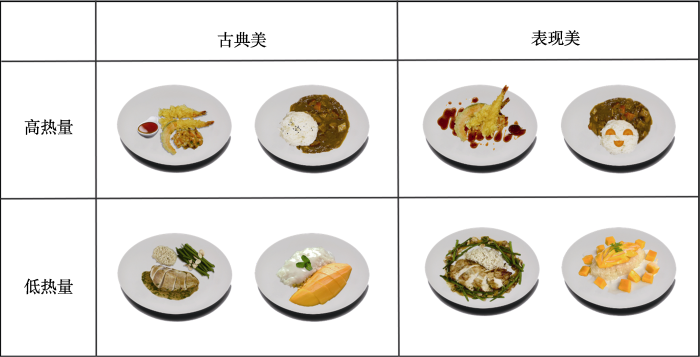
整个实验过程在隔音且较暗的室内环境里实施。所有刺激呈现在27英寸的ASUS-GTX1060型号显示器上, 分辨率为1920×1080, 刷新率为60 Hz。实验过程中保持被试的双眼距离显示器屏幕中央约为75 cm。采用BP ERP记录、分析系统, 通过国际10-20系统扩展的EasyCap 64导电极帽收集脑电信号。其中, 参考电极与接地电极的位置分别位于FCz和AFz点处, 水平眼电(HEOG)为双眼外侧位置的电极, 垂直眼电(VEOG)为左眼上下位置的电极, 原始采样率为5000 Hz, 头皮阻抗小于5 kΩ。使用Lab Stream Layer同步实验过程中的行为与脑电数据。该实验在MATLAB PsychToolbox 中完成程序的编写、呈现和数据记录。
2.3 设计与程序
在实验开始前, 被试被告知自己需要对屏幕上出现的食物图片进行想要和不想要的评价, 且反应必须迅速准确。每张食物图片重复呈现3次, 共216个试次, 连续试次中图片呈现顺序随机。对于每个试次, 首先出现500 ms的注视点, 接着屏幕中央呈现食物图片, 被试通过按键(d, f, j, k)来表明他们对该食物的选择偏好(非常不想要, 不想要, 想要, 非常想要), 按键顺序在被试间平衡。这种评级方式能够区分被试是否愿意选择食物(是/否)以及选择偏好的强度(强/弱)。被试做出反应后(或在4 s内没有做出反应)呈现空屏1~2 s, 随即进入下一个试次。试次内流程见图2。整个实验分为15个block, 每个block包含15个试次, 最后一个block内包含6个试次。被试每完成一个block均可休息一段时间。在正式实验开始前, 被试完成了6个练习试次以了解实验要求并熟悉按键位置。
图2
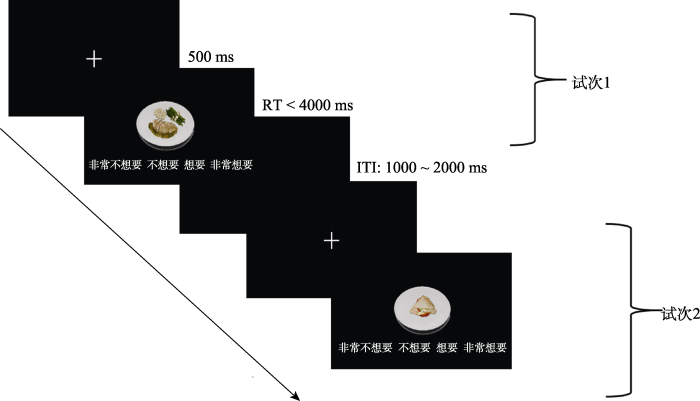
2.4 数据记录与处理
2.4.1 脑电记录与处理
基于MATLAB EEGLAB工具箱(Delorme & Makeig, 2004)分析离线EEG数据。首先将脑电数据采样率降至500 Hz, 随后进行0.5 Hz的高通滤波和35 Hz的低通滤波。根据实验过程中的记录以及肉眼识别连续数据的方式识别坏导、插值坏导, 并在排除坏导和眼电导联后将连续数据转换为全脑平均参考。在剔除EEG数据中的高频肌电、心电活动等伪迹试次后, 使用独立成分分析(Independent Components Analysis, ICA)矫正眼动伪迹。采取两种分段方式, 刺激锁时分段为目标刺激呈现前200 ms至呈现后2000 ms, 基线矫正时段为−200 ms至0 ms; 反应锁时分段为反应前1500 ms至后700 ms, 基线矫正时段为500 ms到700 ms。对分段数据以 ± 80 μV作为绝对阈值进行自动去噪。在此过程中, 删除试次去噪率高于30%的被试数据(n = 3), 剩余被试31名(8名男性, 23名女性, 平均年龄为21.2 ± 1.92岁, 平均BMI为21.70 ± 3.44, 平均饥饿度为4.03 ± 0.31)。
当前研究主要关注三个ERP成分:N300、N400与CPP。鉴于审美经验通常涉及从环境中提取意义(Bara et al., 2022), 本研究在语义认知框架内探讨饮食决策中审美意义的积累。以往研究表明, N400成分对包含物体感知在内的语言与非语言刺激的违规效应敏感(Lauer et al., 2021)。例如, 当食物真实味觉与视觉呈现所诱发的味觉预期不一致(vs.一致)时, 会导致显著更高的负性偏转N400 (Domracheva & Kulikova, 2020), 验证了N400在表征食物的跨通道概念信息方面的潜力; 此外, 在对其它意义刺激的识别任务中, 当先前重复暴露使当前刺激的语义处理更容易时, N400振幅更低, 表明N400对概念加工流畅性敏感(Voss & Paller, 2006, 2007)。因此, N400与意义加工、概念表征以及基于上下文的信息检索有关, 并能通过加工流畅性调制振幅高低。N300在功能意义上部分与N400重合, 是与语义期望和识别过程相关的较早期负性偏转, 并对有意义刺激的识别难度敏感(Lauer et al., 2018)。最新一项研究表明, N300和N400可能反映了相同皮层基底所映射的连续过程上不同的认知计算时段(Draschkow et al., 2018)。根据以往研究, 物体识别 N300以及意义处理与整合N400具有较多的枕叶分布(Huang et al., 2010; Kutas & Federmeier, 2011; Truman & Mudrik, 2018)。因此, 在现有文献基础上, 根据广义平均波形图和全脑地形图分布, 在刺激呈现后枕叶电极团(PO3、PO4、POz、O1、O2、Oz) 380~500 ms间提取N400平均振幅。此外, 在相同脑区较早时间窗(240~320 ms)提取N300的平均振幅进行分析。N300/N400全导联包络图见图3A。
图3
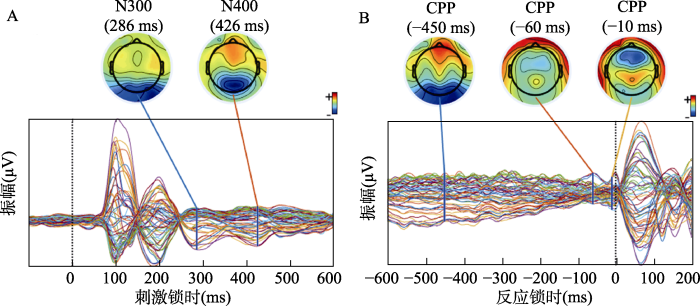
图3
所有试次、所有被试(n = 31)的刺激锁时(A)与反应锁时(B)的广义平均波形。线条颜色代表不同电极点, 峰值活动时间点的头皮拓扑图绘制在波形图上方。彩图见电子版, 下同
不同于一般的ERP成分, CPP表征渐进信号, 随感觉证据的累计输入增加, 并在接近决策执行时达到峰值。这种渐进上升到阈值的活动能量与刺激特征以及运动准备无关(O'Connell et al., 2012), 而与DDM中的漂移率v类似, 因此可以跟踪决策的证据积累过程(Steinemann et al., 2018)。此外, 锁时到反应的CPP活动与决策证据的强度有关, 当决策相关的证据更弱时, CPP活动更大。因此, CPP也作为反映价值决策难度的潜在指标(Frömer et al., 2023)。借鉴O'Connell等人(2012)的研究, 通过数据驱动确定CPP所在时窗。即以反应前1000 ms为起点, 以反应执行(0ms)为终点, 在每100 ms的移动窗口中, 以10 ms为单位, 计算每位被试在Pz电极处平均波形活动的时间斜率。信号积累率即每个滑动窗口内Pz电极捕获的未过滤信号的直线斜率, 随后通过mne.stats.permutation_t_test实施单尾permutation t 检验, 并进行5000次迭代计算, 以确定在所有被试中与0有显著正向差异的信号积累率, 这可以表明CPP活动正在加速。计算所得加速积累的CPP信号从反应前450 ms处开始, 到反应前10 ms处结束, 且每个自变量条件下CPP时间窗不完全一致, 取累加信号积累率作为当前研究中计算的CPP值(Steinemann et al., 2018)。CPP全导联包络图见图3B。
2.4.2 建模数据预处理
剔除了脑电任务中EEG数据伪迹过多(ICA去除伪迹后, 以80 μV为绝对阈值且去噪率仍超过30%)的3名被试, 剩余31名被试的反应时和选择数据被纳入决策建模。由于DDM仅接受二元反应的变量输入, 将选择数据划为二分变量:1-想吃、非常想吃; 0-不想吃、非常不想吃。使用了漂移扩散模型的贝叶斯变式——层级漂移扩散模型(HDDM)——进行决策建模。HDDM利用贝叶斯算法估计模型参数, 具有更高的估计可靠性(Vandekerckhove et al., 2011); 此外, HDDM通过计算群体层面的超参数以约束个体差异对决策参数估计的影响(Regenbogen et al., 2016); 另外, 为了控制噪音, HDDM根据参数特征匹配算法, 通过似然函数分别整合漂移率、非决策时间以及反应偏差的变异, 从而使决策参数的估计更加精确、稳定(Ratcliff & Tuerlinckx, 2002)。考虑到审美体验的主观性, 选择HDDM控制个体差异对参数估计导致的额外影响。最后, 分别以无变量、热量、审美特征、热量×审美特征为参数估计的依赖条件构建HDDM, 旨在通过模型比较确定对饮食决策过程最具解释力的变量组合。具体而言, 利用偏差信息量准则(Deviance Information Criterion, DIC)对拟合的上述模型进行比较。一般而言, DIC越低, 模型拟合度越高; 当DIC的差异大于10时, 说明两个模型的拟合度差异显著(Spiegelhalter et al., 2002)。本研究借助Python 3.8的HDDM 0.8 package (Wiecki et al., 2013)完成模型数据分析。其中, 设定“想要”为决策的上边界(漂移率为正), 而将“不想要”设为下边界(漂移率为负)。另外, 由于所有试次中刺激均为随机呈现, 被试不太可能事先做出预测并确定反应偏好, 因此, 设定反应偏差z = 0.5, 即决策上下边界的中点。使用蒙特卡洛马尔科夫链拟合(Monte-Carlo Markov Chain simulation, MCMC)与梯度上升优化以估计参数a-posteriori的模型后验分布; 抽取11000个样本, 并舍弃前1000个数值以稳定模型(Hajihosseini & Hutcherson, 2021)。为了进行模型的收敛性分析, 对每个模型重复拟合了5次, 将最终拟合值纳入分析(Wiecki et al., 2013)。Gelman-Rubin Rˆ值被选作模型收敛性估计的量化指标(Gelman & Rubin, 1992)。Rˆ值越接近于1, 不同分布的样本估计值之间的差异越小, 模型越可靠。
2.4.3 行为数据预处理
与决策建模相同, 剔除了脑电任务中因EEG数据伪迹过多的3名被试, 剩余31名被试的行为数据剔除标准为:(1)未反应; (2)反应时低于0.15或高于M + 3 SD; (3)选择数据在M ± 3 SD以外。经预处理后, 剩余有效试次量为6657。
2.5 统计方法
以食物热量(高、低)和审美特征(古典美、表现美)为自变量, 分别以决策任务中的行为表现指标(选择率)、ERP成分(N300、N400平均振幅值, CPP)、决策参数变量(漂移率v、决策阈值a、非决策时间t)为因变量, 进行两因素重复测量方差分析, 显著性水平为0.05, 以ηp2作为效应大小的衡量标准, 事后比较均报告Bonferroni校正值。此外, 为了确定热量和审美对食物选择率的相对贡献差异, 以热量和审美作为固定因子, 以被试ID作为随机因子, 以食物的二元选择(0, 1)作为预测因子, 构建了广义线性混合模型(Generalized Linear Mixed Models, GLMM)。随后, 使用Wald检验进一步分析热量和审美价值的β系数差异。最后, 为了评估各个自变量处理水平下证据积累的方向, 计算了漂移率后验分布大于0或小于0的概率(Wiecki et al., 2013)。, 当漂移率为正时, 表明被试积累与“接受”决策相关的证据; 相反, 则积累与“拒绝”决策相关的证据(Ratcliff & McKoon, 2008)。如果后验分布不等于0的概率超过95%, 则认为被试稳定的向某个决策方向积累证据。本研究中所有统计分析在SPSS 27.0和Python 3.8的HDDM 0.8以及R 4.3的lme4 1.1中进行, 且当前所有分析数据及实验程序已上传至开放科学框架OSF (
3 结果
3.1 行为结果
对选择模式的逐试次分析发现, 高热量古典美总是对应较积极的选择意愿, 而被试对低热量表现美的选择意愿最低(见图4A); 进一步对食物选择率进行两因素重复测量方差分析, 结果表明, 审美特征对选择率影响的主效应显著, F(1, 30) = 18.55, p < 0.001, ηp2 = 0.38, 古典美摆盘的选择率高于表现美学(M古典 = 0.59 vs. M表现 = 0.52); 热量的主效应也显著, F(1, 30) = 25.90, p < 0.001, ηp2 = 0.46, 高热量食物选择率显著高于低热量(M高热量 = 0.63 vs. M低热量 = 0.48)。此外, 食物热量和审美特征的交互效应显著(见图4B), F(1, 30) = 6.37, p = 0.017, ηp2 = 0.108。简单效应分析表明, 无论是高热量食物还是低热量食物, 古典美摆盘都会引发更多的食物选择, 即食物趋近反应。具体而言, 对于高热量食物, 被试更愿意选择古典美(vs.表现美)摆盘(M古典 = 0.68; M表现 = 0.58), t(30) = 5.29, p < 0.001, Cohen’s d = 0.95, 95% CI = [0.52,1.37]; 对于低热量食物, 古典美摆盘的选择率也显著高于表现美(M古典 = 0.50; M表现 = 0.46), t(30) = 2.29, p = 0.029, Cohen's d = 0.41, 95% CI = [0.04,0.78]。
图4
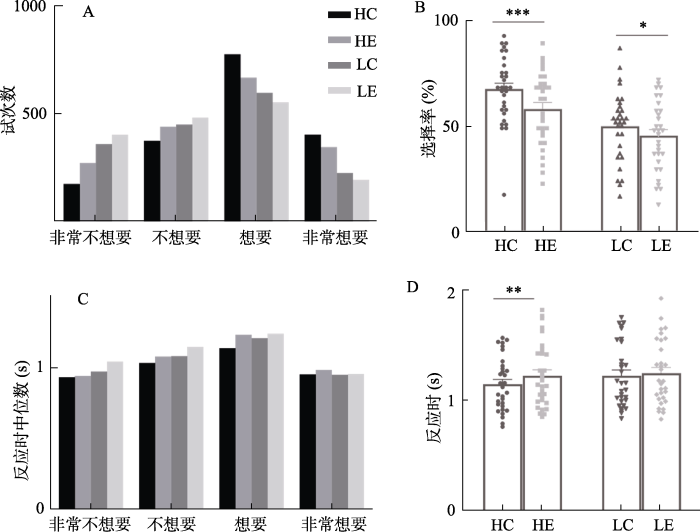
图4
食物热量与摆盘美学的描述性统计值。
A)不同条件下不同食物选择模式的总试次分布; B)不同条件下食物选择率均值; C)不同条件下不同食物选择模式所对应的反应时中位数; D)不同条件下的反应时均值。注:误差棒为SE, ***为p < 0.001, **为p < 0.01, *为p < 0.05
此外, 在总试次数据基础上, 使用GLMM分析的结果进一步表明, 热量价值对食物选择的影响显著, 低热量相比高热量显著降低了食物选择率, β热量 = −0.60, z(6654) = −11.57, p < 0.001; 95% CI = [ −0.70, −0.50]; 此外, 审美价值对食物选择的影响也显著, 表现美相比于古典美显著降低了食物选择率, β审美 = −0.31, z(6654) = −5.97, p < 0.001; 95% CI = [ −0.41, −0.21]。对审美价值和热量价值β系数差异的Wald检验结果表明, 热量价值对食物选择的影响显著高于审美价值, χ²(1) = 16.27, p < 0.001
在不同选择模式上, 分析了条件间的反应时中位数, 发现极端选择意愿(非常不想要/非常想要)对应的反应时均较低(见图4C); 对反应时数据进行了进一步的重复测量方差分析。结果表明, 审美特征对反应时的主效应显著, F(1, 30) = 18.41, p < 0.001, ηp2 = 0.38, 古典美摆盘的反应速度快于表现美(M古典 = 1.19 vs. M表现 = 1.27); 此外, 热量的主效应也显著, F(1, 30) = 9.04, p = 0.005, ηp2 = 0.23, 对高热量食物的反应速度显著高于低热量(M高热量 = 1.19 vs. M低热量 =1.24)。此外, 食物热量和审美特征的交互效应显著(见图4D), F(1, 30) = 7.99, p = 0.008, ηp2 = 0.21。简单效应分析表明, 对于高热量食物而言, 对古典美摆盘的反应速度显著快于表现美(M古典 = 1.15; M表现 = 1.23), t(30) = −4.95, p < 0.001, Cohen's d = −0.89, 95% CI = [−0.30, −0.47]; 对于低热量食物, 两者的反应速度差异不显著(M古典 = 1.22; M表现 = 1.23), t(30) = −1.62, p = 0.70。
3.2 HDDM
3.2.1 模型收敛与比较
根据对决策阈值参数a收敛相关图的目视检验, 模型收敛良好。最后一百个试次的自相关性接近于0 (见图5B), 表明数据来自于后验分布的独立抽样; 对于10000次迭代计算, 每次迭代的a估计值均未过分偏离整体分布的均值(即后验最高概率点:1.6~1.7, 见图5A); 与图5A一致, 阈值估计直方图(见图5C)表明估计值概率在1.6~1.7处最高, 在其他概率点较低, 表明模型收敛性良好。此外, 四个模型的Gelman-Rubin Rˆ均接近于1 (M = 1.000006), 即模型估计稳健, 模型收敛性较优。对已运行的四个HDDM (model1:热量 × 审美特征; model2:热量; model3:审美特征; model4:无)进行模型比较(见表1)。结果表明, 热量 × 审美特征的模型最可靠, 即食物热量和审美特征均影响食物选择。
图5
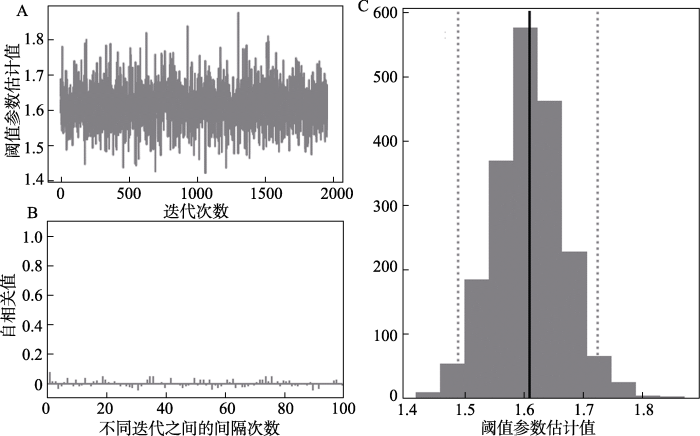
图5
决策模型中代表阈值a参数的收敛相关图。
A) 所有迭代的轨迹图(10000次, 前1100次被舍弃); B) 拟合的最后100次迭代自相关; C) 阈值的估计直方图, 在算法收敛的数值周围呈正态分布。直方图显示了算法每次迭代的估计值频率
表1 四个HDDM的DIC值
| 模型 | DIC |
|---|---|
| 热量◊审美特征 | 13623 |
| 热量 | 13652 |
| 审美特征 | 14015 |
| 无 | 14197 |
注:值越低代表拟合度越高, “热量×审美特征”代表依赖热量和审美特征估计的模型; “热量”代表仅依赖热量估计的模型; “审美特征” 代表仅依赖审美特征估计的模型
3.2.2 模型结果
(1) 决策阈值
对决策阈值(a)的重复测量方差分析没有发现任何显著的自变量主效应及交互效应。具体而言, 热量的主效应不显著, F(1, 30) = 0.3, p = 0.59; 审美特征的主效应不显著, F(1, 30) = 2.68, p = 0.11; 热量与审美特征的交互效应不显著, F(1, 30) = 0.05, p = 0.82。参数估计的后验分布见图6A, 对4个条件决策阈值的贝叶斯估计值分布几乎重叠, 即热量、审美特征及其交互对决策阈值的影响在统计学上是等价的。
图6
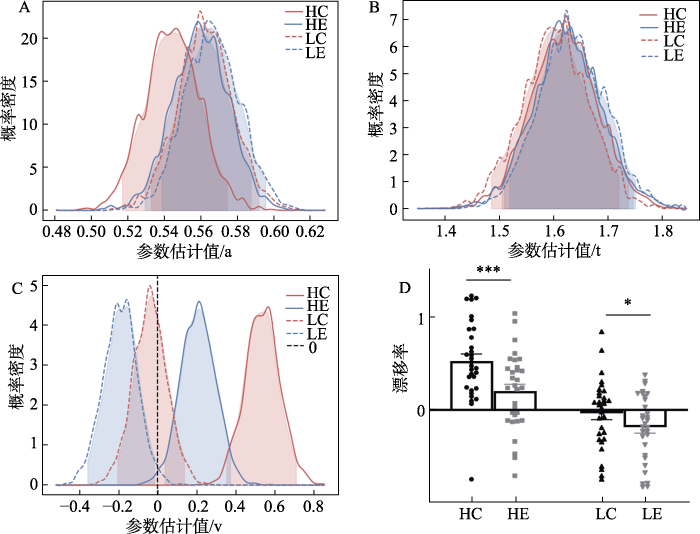
图6
决策参数估计的后验分布A) 决策阈值a; B) 非决策时间t; C) 漂移率v; D) 不同条件下漂移率v的平均数和数据分布, 误差棒反映标准误SE。
注: HC为高热量古典美摆盘; HE为高热量表现美; LC为低热量古典美; LE为低热量表现美, 误差棒为SE, ***为p < 0.001, **为p < 0.01
(2) 非决策时间
非决策时间(t)均值为0.572, 参数估计的后验分布见图6B。此外, 重复测量方差分析结果表明条件间差异不显著。具体而言, 热量主效应不显著, F(1, 30) = 1.67, p = 0.21; 审美特征主效应不显著, F(1, 30) = 1.49, p = 0.23; 热量与审美特征的交互效应不显著, F(1, 30) = 0.95, p = 0.34。由于非决策时间在不同条件下的差异较小, 不认为其与条件间潜在的心理过程差异相联系。
(3) 漂移率
重复测量方差分析结果表明, 热量对漂移率的主效应显著, 相比于低热量食物, 被试对高热量食物的决策证据积累速度更快(M高热量 = 0.37 vs. M低热量 = − 0.11), F(1, 30) = 33.65, p < 0.001, ηp2 = 0.53; 审美特征对漂移率的主效应也显著, 相比于表现美, 古典美摆盘引起的决策速度更快(M古典 = 0.25 vs. M表现 = 0.01), F(1, 30) = 32.34, p < 0.001, ηp2 = 0.52; 此外, 审美特征与热量的交互效应显著, F(1, 30) = 10.11, p = 0.003, ηp2 = 0.26。简单效应分析(见图6D)表明, 对于高热量食物, 被试对古典美(vs.表现美)摆盘的决策速度更快(M古典 = 0.53; M表现 = 0.20), t(30) = 6.27, p < 0.001, Cohen's d = 1.14, 95% CI = [0.22,0.43]。相反, 对于低热量食物, 被试对表现美(vs.古典美)摆盘的决策速度更快(M古典 = − 0.04; M表现 = − 0.19), t(30) = 2.98, p = 0.03, Cohen's d = 0.54, 95% CI = [0.05,0.25]。
漂移率v的贝叶斯后验估计分布见图6C, 表2显示了不同条件下漂移率后验分布概率差异比较。从决策证据积累方向上来看, 无论高热量食物以何种方式摆盘, 被试均会稳定的积累与“接受”决策相关的证据, P (HC > 0) = 100%, P (HE > 0) = 98.88%; 然而, 相比于古典美, 表现美显著降低了被试对高热量食物向“接受”决策方向积累证据的速度, P (HC > HE) = 99.56%。同时, 审美价值对低热量食物证据积累方向的影响更大, 当低热量食物以表现美摆盘时, 被试稳定的向“拒绝”方向积累证据P (LE < 0) = 98.36%; 而当低热量食物以古典美摆盘时, 被试积累“拒绝”证据的概率不再显著P (LC < 0) = 65.66%。表明古典美对低热量食物的食欲价值具有一定的提升作用。
表2 后验分布概率差异比较
| 变量 | 配对 | P (%) |
|---|---|---|
| 热量 | P (HC > LC) | 100 |
| P (HE > LE) | 99.86 | |
| 审美 | P (HC > HE) | 99.56 |
| P (LC > LE) | 89.08 | |
| 热量×审美 | P (HC > LE) | 100 |
| P (HE > LC) | 97.28 | |
| 方向 | P (HE > 0) | 98.88 |
| P (HC > 0) | 100 | |
| P (LE < 0) | 98.36 | |
| P (LC < 0) | 65.66 |
注:HC为高热量古典美摆盘; HE为高热量表现美; LC为低热量古典美; LE为低热量表现美; P为后验分布的概率差异, 当P > 95%时, 条件间差异显著。
3.3 脑电结果
(1) N300
热量对N300的主效应显著, 相比于高热量食物, 低热量食物诱发更大的N300振幅(M高热量 = −0.91 vs. M低热量 = −1.16), F(1, 30) = 9.64, p = 0.004, ηp2 = 0.24, 见图7A。然而, 审美特征对N300的主效应不显著, F(1, 30) = 1.43, p = 0.242; 此外, 热量与审美特征的交互效应也不显著, F(1, 30) = 0.21, p = 0.651。
图7
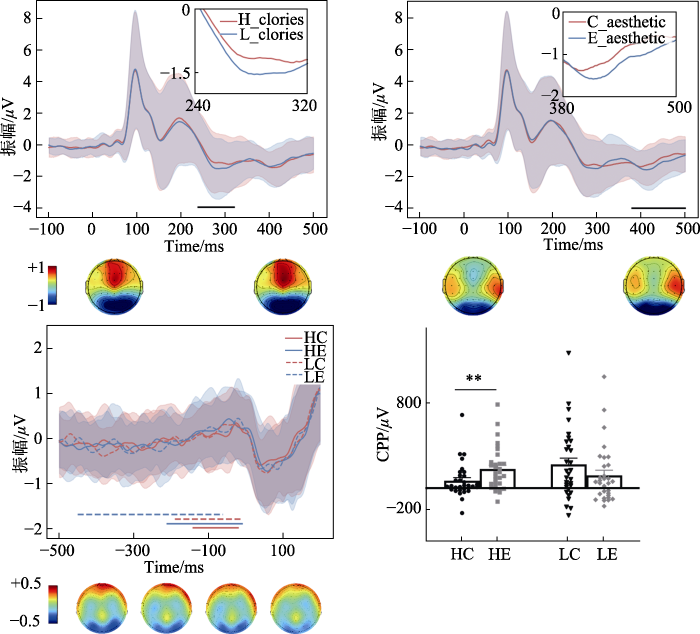
图7
刺激锁时与反应锁时ERP波形图与不同条件在CPP上的描述性统计。
A)刺激锁时枕叶皮层电极团的N300成分波形图及其对应地形图, 图下横线代表N300时间窗, 图右上方为局部放大的N300时间窗波形图; B) 刺激锁时枕叶皮层电极团的N400成分波形图及其对应地形图, 图下横线代表N400时间窗, 图右上方为局部放大的N400时间窗波形图; C) 反应锁时Pz点波形图, 波形图下横线代表不同条件信号积累加速的时间窗; D)各条件在CPP上的均值。注:HC为高热量古典美; HE为高热量表现美; LC为低热量古典美; LE为低热量表现美, 误差棒为SE, **为p < 0.01
(2) N400
重复测量方差分析结果表明, 审美特征对N400的主效应显著, 相比于古典美摆盘, 表现美摆盘诱发更大的N400振幅(M古典美 = − 2.11 vs. M表现美 = − 2.31), F(1, 30) = 8.17, p = 0.008, ηp2 = 0.21; 见图7B。然而, 热量对N400的主效应不显著, F(1, 30) = 1.28, p = 0.27; 此外, 热量与审美特征的交互效应也不显著, F(1, 30) = 0.27, p = 0.61。
(3) CPP
热量与审美特征对CPP的主效应均不显著, F热量 (1, 30) = 1.25, p = 0.27; F美学 (1, 30) = 0.01, p = 0.92。然而, 热量与审美特征的交互效应在CPP上显著(见图7C), F (1, 30) = 9.38, p = 0.005, ηp2 = 0.24。简单效应分析(见图7D)表明, 对于高热量食物, 被试对古典美(vs.表现美)摆盘的决策信号积累率更低(M古典 = 70.37; M表现 = 179.69), t(30) = − 3.2, p = 0.003, Cohen's d = − 0.58, 95% CI = [− 0.95, − 0.19]。相反, 在低热量食物条件下, 被试对古典美和表现美摆盘的信号积累率统计上差异并不显著(M古典 = 222.84; M表现 = 120.66), t(30) = 1.73, p = 0.09。
4 讨论
本研究使用价值决策范式, 通过分离计算模型参数与脑电指标来探究审美价值计算的内在机制、审美价值对热量价值的调节效应及其认知与神经过程基础。研究发现古典美(vs. 表现美)能够提高食物选择率, 具有更高的审美价值。高审美价值导致更大的决策漂移率(v)以及更低的N400振幅; 审美调节食物的奖赏价值, 高审美价值能够提高热量的奖赏价值并提高食物选择率, 而低审美价值则导致更大的热量奖赏价值折扣并降低食物选择率。然而, 热量奖赏价值的突显性高于审美, 且热量信息的认知神经处理相对更早(240~320 ms); 最后, 在饮食决策中, 热量价值与审美价值的协同与竞争效应发生在决策证据积累过程中, 影响决策漂移率(v)以及与决策相关神经信号强度(CPP)。
4.1 审美价值的计算依据与内在机制
当前研究表明, 与表现美相比, 古典美导致更大的食物选择偏好, 即对于食物摆盘设计而言, 古典美具有更高的审美价值。模型参数分析表明, 古典美比表现美的漂移率更大。一般来说, 漂移率代表单位时间内累积的平均证据量, 是决策任务难度或个体信息处理能力的指标(Forstmann et al., 2016)。因此, 当前结果表明被试对古典美(vs.表现美)设计的决策证据积累速度更快, 即被试更容易从古典美的视觉摆盘中提取和处理食物的价值信息。这一参数结果与电生理指标N400的结果模式相对应, ERP分析表明, 古典美诱发的N400振幅更低, 表明被试对古典美视觉摆盘食物的意义加工更流畅, 而表现美则诱发了更大的语义违规效应, 被试计算和处理表现美摆盘食物价值信息的难度更大。以往研究认为, 对刺激对象审美价值的评估根植于该对象能否满足人们的内稳态需求, 更有用的审美组织形式意味着更高的审美价值(Brown et al., 2011)。在自然界中, 古典美的设计特征(即, 秩序, 对称, 平衡, 和模式重复)往往作为衡量遗传质量的重要指标, 表征体征美、发育稳定和基因优良(Thornhill & Møller, 2007)。此外, 食物感官营销的相关研究也证实了古典美与食物安全、健康、营养等功能价值相关(Hagen, 2021; Liu et al., 2023)。古典美能够通过提示食物来源的安全性以提高食物对象的质量评价、满足饮食相关的自我平衡需求, 从而获得更高的审美价值。相反, 表现美作为一种人造美学, 以艺术、复杂与新颖作为设计原则, 主要通过满足人们的社会需求(例如, 自我表达、建立关系等)而被赋予奖赏价值(Brown et al., 2011)。由于当前研究主要关注日常熟悉餐食的快速选择及非社会性进食环境, 表现美可能因为无法满足被试对食物的基本需求而导致更低的审美价值。总之, 当前研究表明食物审美价值的高低取决于该视觉组织形式能否传递与饮食需求满足相关的信息线索。
此外, 进化压力塑造了大脑对生存优势相关信息迅速处理的能力, 且大脑网络对自然场景中的图像信息处理更为流畅(Grzywacz & Aleem, 2022)。事实上, 在自然界中迅速识别和处理食物信息能够最大程度降低觅食行为的心理成本, 提升能量获取效率并提高生存适应性(de Vries et al., 2020)。如前所述, 高审美价值意味着该食物的视觉组织形式能够满足身体平衡需求从而传递生存优势信息。因而导致较为流畅的神经信息处理与决策证据加工, 即更低的N400振幅和更高的决策漂移率。表明被试能够在较低认知资源投入的神经生理学背景下迅速积累食物意义的价值信号。相反, 低审美价值导致相对更高的N400振幅, 一方面是因其难以满足人们对食物功能的基本需求从而携带更低的生存优势信息; 另一方面, 该视觉设计的复杂性与新颖性加大了食物意义信息的提取难度, 从而导致了概念加工的低流畅性。总之, 当前研究表明审美价值以意义处理和加工流畅性为其计算依据。
4.2 审美价值对热量价值的调节效应及其认知神经过程基础
当前研究发现审美价值能够调节热量对食物选择率的影响。具体来说, 对于高热量食物而言, 表现美(vs. 古典美)降低了食物的选择率; 而对于低热量食物而言, 古典美(vs. 表现美)则提高了食物选择率。即表现美增加了高热量食物奖赏价值折扣, 而古典美显著提高了低热量食物的价值估计。此外, 对漂移率的后验分布概率检验表明, 对低热量食物而言, 古典美(vs.表现美)降低了被试积累“拒绝”决策相关的证据的概率; 对高热量食物而言, 表现美(vs.古典美)则降低了被试积累“接受”决策相关的证据的速度。从而进一步验证了审美价值对热量奖赏价值加工的调节作用。然而, 虽然审美价值能够调节热量对食物选择和决策加工过程的影响, 但当前研究发现, 热量对饮食决策的影响显著大于审美, 且热量信息的神经处理时间(240~320 ms)早于审美意义整合(380~500 ms), 表明热量价值的突显性高于视觉审美, 被试对食物热量具有相对更高的检测敏感度和价值分配权重。质量感知的线索利用理论(Olson & Jacoby, 1972)认为, 人们利用各种内在和外在信息线索来评估产品(本研究中为食物)质量。其中, 内在线索是评估对象本身固有的, 例如, 能量、热量、质地等; 而外在线索则是与评估对象相关但非其物理组成部分的要素, 例如, 标签、包装、营销信息、摆盘设计等。内外线索都可以影响人们对食物的价值预期, 并决定他们对体验质量的判断。然而, 内在线索比外在线索更具诊断性, 外在线索对基于食物内在线索的价值判断起调节作用(Chonpracha et al., 2020)。因此, 对于食物价值评估而言, 作为内在线索的热量信息比作为外在线索的审美信息更重要, 从而导致相对更高的决策权重以及更早的意义处理与加工。
模型与脑电结果提供了审美与热量价值的动态作用是如何在决策过程中展开的认知与神经生理学证据。当前研究发现, 审美对热量价值的调节发生在决策的信息处理阶段, 影响决策证据积累速度(v)以及决策相关的大脑神经信号强弱(CPP)。如前所述, 高热量(vs.低热量)以及古典美(vs.表现美)导致更高的食物选择率, 相对而言, 低热量(vs.高热量)和表现美(vs.古典美)引起的食物拒绝率更高。而当热量价值和审美价值方向相同时(即高热量食物以古典美摆盘或低热量食物以表现美摆盘), 与方向不一致时相比(即高热量食物以表现美摆盘或低热量食物以古典美摆盘), 被试的漂移率(v)更高, 即证据积累速度更快; 同时, 决策神经信号积累(CPP)更大, 即决策难度更低。这一结果模式与趋避冲突条件下的决策过程相同。例如, Garcia-Guerrero等人(2023)通过两项鼠标追踪实验发现, 决策的趋避冲突越大, 鼠标响应越慢、轨迹偏转越大、决策前动摇越多; 此外, 根据Choi等人(2022)的研究, 决策冲突会导致更谨慎的应对策略, 即通过牺牲决策速度来换取选择的安全性。因此, 在饮食决策中, 当热量价值和审美价值方向不一致(vs.一致)时, 被试将体验到更高的趋避冲突, 此时决策难度更高、证据积累速度更慢。换言之, 审美/热量价值的高低均能诱发食物的接近与回避动机, 两者价值方向的协同(一致)与竞争(不一致)反映了决策趋避冲突的强弱, 并导致决策速度与决策难度的动态变化。
4.4 研究创新与局限
本研究首次在相同美感的前提下, 验证了食物摆盘的不同审美特征具有相异的审美价值, 表明对于日常熟悉食物的选择而言, 古典美比表现美具有更高的审美价值, 拓展了食物呈现美学的研究边界。此外, 本研究验证了摆盘审美价值作为一项低成本且有效的健康饮食助推策略的潜力——通过调节热量的奖赏价值作用于更健康的饮食选择。具体而言, 古典美能够提升食物的价值评估, 从而提高低热量食物的选择率; 相反, 表现美能够降低食物热量的奖赏价值, 从而抑制对高热量食物的选择。同时, 这种调节不以牺牲食物视觉美感为代价。最重要的是, 本研究通过多模态数据, 结合计算建模与EEG技术, 首次探讨了审美价值的计算机制, 表明流畅的信息处理与意义加工是审美价值评估的内在基础。以往研究认为, 进化塑造了人类高效获取能量的食物搜索能力(de Vries et al., 2020), 当前研究进一步表明, 有利于增强这种食物搜索能力的视觉组织形式可能是偏好产生的内在前提。未来研究可以探索影响食物价值处理效率或流畅性的跨通道信息是否也能调节食物选择偏好, 从而有利于助推健康饮食选择。此外, 本研究首次探讨了审美价值对饮食决策过程的作用机制, 表明审美价值的调节效应发生在决策信息处理阶段, 影响决策价值计算的速度与难度。基于此, 本研究提供了审美价值对健康饮食决策结果与过程影响的全面理解。
当前研究存在一些局限性。首先, 由于实际条件限制, 本研究未引入决策激励兼容策略, 这在一定程度上可能会影响被试食物选择的准确性。此外, 由于审美特征的操纵难度, 本研究中使用的食物图像取自网络图库而非标准化图库, 因此缺乏食物的实际热量值测量。高、低热量分组是基于预实验被试主观评价的结果, 未来研究可以在依据食物实际热量分组的背景下再次验证本研究结论的稳健性。另外, 受限于有效实验材料的数量, 当前研究的试次量偏小, 虽然不会影响当前主要的研究发现, 但可能无法充分揭示审美价值对食物选择的潜在影响, 未来研究应在扩大实验材料数量的基础上进一步深入分析。最后, 当前研究未能实现性别比例平衡, 可能会在一定程度上影响本研究结论。尤其当考虑热量对食物选择影响的性别差异时(Heiman & Lowengart, 2014), 在广泛的消费群体中推广本研究结论还需谨慎。
5 结论
(1)在饮食决策中, 古典美(vs. 表现美)具有相对更高的审美价值; 审美价值计算的直接依据在于视觉组织形式能否满足个体的饮食需求; 其内在认知神经基础在于意义处理的流畅性;
(2)审美价值能够调节热量的奖赏价值。高审美价值提高热量的奖赏价值, 低审美价值则提高热量奖赏价值折扣; 热量价值的突显性高于审美, 具有相对更高的信息检测敏感度和决策价值分配权重;
(3)热量价值与审美价值的协同与竞争效应发生在决策证据积累过程中, 反映动机冲突强度, 并影响决策速度(v)和决策难度(CPP)。
附录:预实验方法与结果
预实验方法
预实验共招募被试30名(10名男性, 20名女性), 所有被试平均年龄为21.27 ± 2.34, 平均BMI为21.30 ± 3.21, 平均饥饿度为3.83 ± 0.69。经独立样本t检验, 预实验招募的被试特征(年龄、BMI、饥饿程度)与正式实验保留的有效被试特征无显著差异, 所有ts > 0.19, ps > 0.16。预实验数据以问卷形式(Qualtrics)在线收集, 共包含两部分评价内容。首先, 被试需要对以随机顺序呈现的106张食物图片(53种食物 × 2种摆盘)进行4个项目的评价。其中, 食物的主观热量使用“您认为这个食物的主观热量如何?1-非常低, 7-非常高”单一项目测量; 此外, 食物摆盘的整体美感、古典美感和表现美感的测量借鉴Hagen等人(2021)的研究以及Lavie和Tractinsky (2004)对古典美和表现美的定义。具体而言, 食物的美感评级使用“您觉得这个食物摆盘是美观的”、古典美感评级使用“您觉得这个食物摆盘看起来对称、比例平衡、整齐有序”、表现美感评级使用“您觉得这个食物摆盘看起来新颖、复杂、富有创意”7点李克特测量。在预实验的第二个部分, 同一食物两种版本的摆盘图片将同时呈现, 被试被要求对“您认为以上两张图片中的食物是同一食物”单一7点李克特量表进行评级 (1-非常不同意; 4-既不同意也不反对; 7-非常同意)。
操纵检验结果
附表1 美学维度操纵检验
| 古典美 | 表现美 | t | df | p | 95% Confidence Interval | 效应量Cohen's d | |
|---|---|---|---|---|---|---|---|
| Lower | Upper | ||||||
| 美感 | 美感 | −1.69 | 29 | 0.102 | −0.342 | 0.0326 | −0.31 |
| 古典美感 | 古典美感 | 3.76 | 29 | <0 .001 | 0.225 | 0.7617 | 0.687 |
| 表现美感 | 表现美感 | −13.7 | 29 | < 0.001 | −1.888 | −1.3974 | −2.5 |
附表2 食物热量操纵检验
| 高热量 | 低热量 | t | df | p | 95% Confidence Interval | 效应量Cohen's d | |
|---|---|---|---|---|---|---|---|
| Lower | Upper | ||||||
| 热量 | 热量 | 16.62 | 29 | <0 .001 | 1.51 | 1.9341 | 3.035 |
附表3 不同摆盘的同种食物可被识别为相同食物的操纵检验
| t | df | p | 95% Confidence Interval | 效应量Cohen's d | ||
|---|---|---|---|---|---|---|
| Lower | Upper | |||||
| 比较 | 13.3 | 29 | < 0.001 | 1.59 | 2.18 | 2.42 |
参考文献
A generalised semantic cognition account of aesthetic experience
The neurobiology of food intake in an obesogenic environment
Naturalizing aesthetics: Brain areas for aesthetic appraisal across sensory modalities
DOI:10.1016/j.neuroimage.2011.06.012
URL
PMID:21699987
[本文引用: 2]

We present here the most comprehensive analysis to date of neuroaesthetic processing by reporting the results of voxel-based meta-analyses of 93 neuroimaging studies of positive-valence aesthetic appraisal across four sensory modalities. The results demonstrate that the most concordant area of activation across all four modalities is the right anterior insula, an area typically associated with visceral perception, especially of negative valence (disgust, pain, etc.). We argue that aesthetic processing is, at its core, the appraisal of the valence of perceived objects. This appraisal is in no way limited to artworks but is instead applicable to all types of perceived objects. Therefore, one way to naturalize aesthetics is to argue that such a system evolved first for the appraisal of objects of survival advantage, such as food sources, and was later co-opted in humans for the experience of artworks for the satisfaction of social needs.Copyright © 2011 Elsevier Inc. All rights reserved.
Which healthy eating nudges work best? A meta-analysis of field experiments
Beauty is more than screen deep: Improving the web survey respondent experience through socially-present and aesthetically-pleasing user interfaces
The influence of web aesthetics on customers’ PAD.
A corticothalamic circuit trades off speed for safety during decision-making under motivational conflict
DOI:10.1523/JNEUROSCI.0088-22.2022
URL
PMID:35273082
[本文引用: 1]
Decisions to act while pursuing goals in the presence of danger must be made quickly but safely. Premature decisions risk injury or death, whereas postponing decisions risk goal loss. Here we show how mice resolve these competing demands. Using microstructural behavioral analyses, we identified the spatiotemporal dynamics of approach-avoidance decisions under motivational conflict in male mice. Then we used cognitive modeling to show that these dynamics reflect the speeded decision-making mechanisms used by humans and nonhuman primates, with mice trading off decision speed for safety of choice when danger loomed. Using calcium imaging in paraventricular thalamus and optogenetic inhibition of the prelimbic cortex to paraventricular thalamus pathway, we show that this speed-safety trade off occurs because increases in paraventricular thalamus activity increase decision caution, thereby increasing approach-avoid decision times in the presence of danger. Our findings demonstrate that a discrete brain circuit involving the paraventricular thalamus and its prefrontal input adjusts decision caution during motivational conflict, trading off decision speed for decision safety when danger is close. We identify the corticothalamic pathway as central to cognitive control during decision-making under conflict. Foraging animals balance the need to seek food and energy against the conflicting needs to avoid injury and predation. This competition is fundamental to survival but rarely has a stable, correct solution. Here we show that approach-avoid decisions under motivational conflict involve strategic adjustments in decision caution controlled via a top-down corticothalamic pathway from the prelimbic cortex to the paraventricular thalamus. We identify a novel corticothalamic mechanism for cognitive control that is applicable across a range of motivated behaviors and mark paraventricular thalamus and its prefrontal cortical input as targets to remediate the deficits in decision caution characteristic of unsafe and impulsive choices.Copyright © 2022 Choi, Husić et al.
Effects of intrinsic and extrinsic visual cues on consumer emotion and purchase intent: A case of ready-to-eat salad
Pleasure as an ally of healthy eating? Contrasting visceral and Epicurean eating pleasure and their association with portion size preferences and wellbeing
DOI:10.1016/j.appet.2015.08.045
URL
PMID:26363419
[本文引用: 2]
Research on overeating and self-regulation has associated eating pleasure with short-term visceral impulses triggered by hunger, external cues, or internal emotional urges. Drawing on research on the social and cultural dimensions of eating, we contrast this approach with what we call "Epicurean" eating pleasure, which is the enduring pleasure derived from the aesthetic appreciation of the sensory and symbolic value of the food. To contrast both approaches, we develop and test a scale measuring Epicurean eating pleasure tendencies and show that they are distinct from the tendency to experience visceral pleasure (measured using the external eating and emotional eating scales). We find that Epicurean eating pleasure is more prevalent among women than men but is independent of age, income and education. Unlike visceral eating pleasure tendencies, Epicurean eating tendencies are associated with a preference for smaller food portions and higher wellbeing, and not associated with higher BMI. Overall, we argue that the moralizing approach equating the pleasure of eating with 'low-level' visceral urges should give way to a more holistic approach which recognizes the positive role of Epicurean eating pleasure in healthy eating and wellbeing.Copyright © 2015 Elsevier Ltd. All rights reserved.
Human spatial memory implicitly prioritizes high-calorie foods
EEGLAB: An open source toolbox for analysis of single-trial EEG dynamics including independent component analysis
DOI:10.1016/j.jneumeth.2003.10.009
URL
PMID:15102499
[本文引用: 1]
We have developed a toolbox and graphic user interface, EEGLAB, running under the crossplatform MATLAB environment (The Mathworks, Inc.) for processing collections of single-trial and/or averaged EEG data of any number of channels. Available functions include EEG data, channel and event information importing, data visualization (scrolling, scalp map and dipole model plotting, plus multi-trial ERP-image plots), preprocessing (including artifact rejection, filtering, epoch selection, and averaging), independent component analysis (ICA) and time/frequency decompositions including channel and component cross-coherence supported by bootstrap statistical methods based on data resampling. EEGLAB functions are organized into three layers. Top-layer functions allow users to interact with the data through the graphic interface without needing to use MATLAB syntax. Menu options allow users to tune the behavior of EEGLAB to available memory. Middle-layer functions allow users to customize data processing using command history and interactive 'pop' functions. Experienced MATLAB users can use EEGLAB data structures and stand-alone signal processing functions to write custom and/or batch analysis scripts. Extensive function help and tutorial information are included. A 'plug-in' facility allows easy incorporation of new EEG modules into the main menu. EEGLAB is freely available (http://www.sccn.ucsd.edu/eeglab/) under the GNU public license for noncommercial use and open source development, together with sample data, user tutorial and extensive documentation.
Aesthetic design of e-commerce web pages—webpage complexity, order and preference
EEG correlates of perceived food product similarity in a cross-modal taste-visual task
No evidence from MVPA for different processes underlying the N300 and N400 incongruity effects in object-scene processing
DOI:S0028-3932(18)30327-0
URL
PMID:30261162
[本文引用: 1]
Attributing meaning to diverse visual input is a core feature of human cognition. Violating environmental expectations (e.g., a toothbrush in the fridge) induces a late event-related negativity of the event-related potential/ERP. This N400 ERP has not only been linked to the semantic processing of language, but also to objects and scenes. Inconsistent object-scene relationships are additionally associated with an earlier negative deflection of the EEG signal between 250 and 350 ms. This N300 is hypothesized to reflect pre-semantic perceptual processes. To investigate whether these two components are truly separable or if the early object-scene integration activity (250-350 ms) shares certain levels of processing with the late neural correlates of meaning processing (350-500 ms), we used time-resolved multivariate pattern analysis (MVPA) where a classifier trained at one time point in a trial (e.g., during the N300 time window) is tested at every other time point (i.e., including the N400 time window). Forty participants were presented with semantic inconsistencies, in which an object was inconsistent with a scene's meaning. Replicating previous findings, our manipulation produced significant N300 and N400 deflections. MVPA revealed above chance decoding performance for classifiers trained during time points of the N300 component and tested during later time points of the N400, and vice versa. This provides no evidence for the activation of two separable neurocognitive processes following the violation of context-dependent predictions in visual scene perception. Our data supports the early appearance of high-level, context-sensitive processes in visual cognition.Copyright © 2018 Elsevier Ltd. All rights reserved.
Sequential sampling models in cognitive neuroscience: Advantages, applications, and extensions
Common neural choice signals emerge artifactually amidst multiple distinct value signals
The action dynamics of approach-avoidance conflict during decision-making
Inference from iterative simulation using multiple sequences
Does amount of information support aesthetic values?
Pretty healthy food: How and when aesthetics enhance perceived healthiness
Alpha oscillations and event-related potentials reflect distinct dynamics of attribute construction and evidence accumulation in dietary decision making
Executive-control processes in high-calorie food consumption
Temporally dissociable mechanisms of self-control: Early attentional filtering versus late value modulation
DOI:10.1523/JNEUROSCI.5816-12.2013
URL
PMID:24285897
[本文引用: 2]
Optimal decision-making often requires exercising self-control. A growing fMRI literature has implicated the dorsolateral prefrontal cortex (dlPFC) in successful self-control, but due to the limitations inherent in BOLD measures of brain activity, the neurocomputational role of this region has not been resolved. Here we exploit the high temporal resolution and whole-brain coverage of event-related potentials (ERPs) to test the hypothesis that dlPFC affects dietary self-control through two different mechanisms: attentional filtering and value modulation. Whereas attentional filtering of sensory input should occur early in the decision process, value modulation should occur later on, after the computation of stimulus values begins. Hungry human subjects were asked to make food choices while we measured neural activity using ERP in a natural condition, in which they responded freely and did not exhibit a tendency to regulate their diet, and in a self-control condition, in which they were given a financial incentive to lose weight. We then measured various neural markers associated with the attentional filtering and value modulation mechanisms across the decision period to test for changes in neural activity during the exercise of self-control. Consistent with the hypothesis, we found evidence for top-down attentional filtering early on in the decision period (150-200 ms poststimulus onset) as well as evidence for value modulation later in the process (450-650 ms poststimulus onset). We also found evidence that dlPFC plays a role in the deployment of both mechanisms.
Needs, affect, and interactive products—Facets of user experience
Calorie information effects on consumers’ food choices: Sources of observed gender heterogeneity
A critical evaluation of literature on visual aesthetics for the web
Imagine that! ERPs provide evidence for distinct hemispheric contributions to the processing of concrete and abstract concepts
Predictors and outcomes of perceived image of restaurant innovativeness in fine-dining restaurants
A common mechanism underlying food choice and social decisions
Thirty years and counting: Finding meaning in the N400 component of the event- related brain potential (ERP)
The role of scene summary statistics in object recognition
DOI:10.1038/s41598-018-32991-1
URL
PMID:30279431
[本文引用: 1]
Objects that are semantically related to the visual scene context are typically better recognized than unrelated objects. While context effects on object recognition are well studied, the question which particular visual information of an object's surroundings modulates its semantic processing is still unresolved. Typically, one would expect contextual influences to arise from high-level, semantic components of a scene but what if even low-level features could modulate object processing? Here, we generated seemingly meaningless textures of real-world scenes, which preserved similar summary statistics but discarded spatial layout information. In Experiment 1, participants categorized such textures better than colour controls that lacked higher-order scene statistics while original scenes resulted in the highest performance. In Experiment 2, participants recognized briefly presented consistent objects on scenes significantly better than inconsistent objects, whereas on textures, consistent objects were recognized only slightly more accurately. In Experiment 3, we recorded event-related potentials and observed a pronounced mid-central negativity in the N300/N400 time windows for inconsistent relative to consistent objects on scenes. Critically, inconsistent objects on textures also triggered N300/N400 effects with a comparable time course, though less pronounced. Our results suggest that a scene's low-level features contribute to the effective processing of objects in complex real-world environments.
The role of contextual materials in object recognition
DOI:10.1038/s41598-021-01406-z
URL
PMID:34753999
[本文引用: 1]
While scene context is known to facilitate object recognition, little is known about which contextual "ingredients" are at the heart of this phenomenon. Here, we address the question of whether the materials that frequently occur in scenes (e.g., tiles in a bathroom) associated with specific objects (e.g., a perfume) are relevant for the processing of that object. To this end, we presented photographs of consistent and inconsistent objects (e.g., perfume vs. pinecone) superimposed on scenes (e.g., a bathroom) and close-ups of materials (e.g., tiles). In Experiment 1, consistent objects on scenes were named more accurately than inconsistent ones, while there was only a marginal consistency effect for objects on materials. Also, we did not find any consistency effect for scrambled materials that served as color control condition. In Experiment 2, we recorded event-related potentials and found N300/N400 responses-markers of semantic violations-for objects on inconsistent relative to consistent scenes. Critically, objects on materials triggered N300/N400 responses of similar magnitudes. Our findings show that contextual materials indeed affect object processing-even in the absence of spatial scene structure and object content-suggesting that material is one of the contextual "ingredients" driving scene context effects.© 2021. The Author(s).
Assessing dimensions of perceived visual aesthetics of web sites
Plating for health: A cross-cultural study of the influence of aesthetics characteristics on food evaluation
Studying the impact of plating on ratings of the food served in a naturalistic dining context
DOI:10.1016/j.appet.2015.02.030
URL
PMID:25728885
[本文引用: 2]
An experiment conducted in a naturalistic dining context is reported, in which the impact of different styles of plating on diners' experience of the food was assessed. A hundred and sixty three diners were separated into two groups during a luncheon event held in a large dining room. Each group of diners was served the same menu, with a variation in the visual presentation of the ingredients on the plate. The results revealed that the diners were willing to pay significantly more for the appetizer (a salad), when arranged in an artistically-inspired manner (M = £5.94 vs. £4.10). The main course was liked more, and considered more artistic, when the various elements were presented in the centre of the plate, rather than placed off to one side. The participants also reported being willing to pay significantly more for the centred than for the offset plating (M = £15.35 vs. £11.65). These results are consistent with the claim that people "eat first with their eyes", and that a diner's experience of the very same ingredients can be significantly enhanced (or diminished) simply by changing the visual layout of the food elements of the dish. Results such as these suggest that theories regarding the perception of food can potentially be confirmed (or disconfirmed) outside of the confines of the laboratory (i.e., in naturalistic dining settings).Copyright © 2015 Elsevier Ltd. All rights reserved.
A taste of Kandinsky: Assessing the influence of the artistic visual presentation of food on the dining experience
A supramodal accumulation-to-bound signal that determines perceptual decisions in humans
DOI:10.1038/nn.3248
URL
PMID:23103963
[本文引用: 2]
In theoretical accounts of perceptual decision-making, a decision variable integrates noisy sensory evidence and determines action through a boundary-crossing criterion. Signals bearing these very properties have been characterized in single neurons in monkeys, but have yet to be directly identified in humans. Using a gradual target detection task, we isolated a freely evolving decision variable signal in human subjects that exhibited every aspect of the dynamics observed in its single-neuron counterparts. This signal could be continuously tracked in parallel with fully dissociable sensory encoding and motor preparation signals, and could be systematically perturbed mid-flight during decision formation. Furthermore, we found that the signal was completely domain general: it exhibited the same decision-predictive dynamics regardless of sensory modality and stimulus features and tracked cumulative evidence even in the absence of overt action. These findings provide a uniquely clear view on the neural determinants of simple perceptual decisions in humans.
Cue utilization in the quality perception process
Feast for the eyes: Effects of food perceptions and computer vision features on food photo popularity
How aesthetic features convey the concept of brand premiumness
Global nutrition transition and the pandemic of obesity in developing countries
DOI:10.1111/j.1753-4887.2011.00456.x
URL
PMID:22221213
[本文引用: 1]
Decades ago, discussion of an impending global pandemic of obesity was thought of as heresy. But in the 1970s, diets began to shift towards increased reliance upon processed foods, increased away-from-home food intake, and increased use of edible oils and sugar-sweetened beverages. Reductions in physical activity and increases in sedentary behavior began to be seen as well. The negative effects of these changes began to be recognized in the early 1990s, primarily in low- and middle-income populations, but they did not become clearly acknowledged until diabetes, hypertension, and obesity began to dominate the globe. Now, rapid increases in the rates of obesity and overweight are widely documented, from urban and rural areas in the poorest countries of sub-Saharan Africa and South Asia to populations in countries with higher income levels. Concurrent rapid shifts in diet and activity are well documented as well. An array of large-scale programmatic and policy measures are being explored in a few countries; however, few countries are engaged in serious efforts to prevent the serious dietary challenges being faced.© 2012 International Life Sciences Institute.
Winning ugly: Profit maximizing marketing strategies for ugly foods
The diffusion decision model: Theory and data for two-choice decision tasks
DOI:10.1162/neco.2008.12-06-420
URL
PMID:18085991
[本文引用: 1]
The diffusion decision model allows detailed explanations of behavior in two-choice discrimination tasks. In this article, the model is reviewed to show how it translates behavioral data-accuracy, mean response times, and response time distributions-into components of cognitive processing. Three experiments are used to illustrate experimental manipulations of three components: stimulus difficulty affects the quality of information on which a decision is based; instructions emphasizing either speed or accuracy affect the criterial amounts of information that a subject requires before initiating a response; and the relative proportions of the two stimuli affect biases in drift rate and starting point. The experiments also illustrate the strong constraints that ensure the model is empirically testable and potentially falsifiable. The broad range of applications of the model is also reviewed, including research in the domains of aging and neurophysiology.
Estimating parameters of the diffusion model: Approaches to dealing with contaminant reaction times and parameter variability
Bayesian-based integration of multisensory naturalistic perithreshold stimuli
DOI:S0028-3932(15)30251-7
URL
PMID:26719235
[本文引用: 1]
Most studies exploring multisensory integration have used clearly perceivable stimuli. According to the principle of inverse effectiveness, the added neural and behavioral benefit of integrating clear stimuli is reduced in comparison to stimuli with degraded and less salient unisensory information. Traditionally, speed and accuracy measures have been analyzed separately with few studies merging these to gain an understanding of speed-accuracy trade-offs in multisensory integration. In two separate experiments, we assessed multisensory integration of naturalistic audio-visual objects consisting of individually-tailored perithreshold dynamic visual and auditory stimuli, presented within a multiple-choice task, using a Bayesian Hierarchical Drift Diffusion Model that combines response time and accuracy. For both experiments, unisensory stimuli were degraded to reach a 75% identification accuracy level for all individuals and stimuli to promote multisensory binding. In Experiment 1, we subsequently presented uni- and their respective bimodal stimuli followed by a 5-alternative-forced-choice task. In Experiment 2, we controlled for low-level integration and attentional differences. Both experiments demonstrated significant superadditive multisensory integration of bimodal perithreshold dynamic information. We present evidence that the use of degraded sensory stimuli may provide a link between previous findings of inverse effectiveness on a single neuron level and overt behavior. We further suggest that a combined measure of accuracy and reaction time may be a more valid and holistic approach of studying multisensory integration and propose the application of drift diffusion models for studying behavioral correlates as well as brain-behavior relationships of multisensory integration.Copyright © 2015 Elsevier Ltd. All rights reserved.
Aesthetics and credibility in web site design
Bayesian measures of model complexity and fit.
Decisions are expedited through multiple neural adjustments spanning the sensorimotor hierarchy
DOI:10.1038/s41467-018-06117-0
URL
PMID:30194305
[本文引用: 2]
When decisions are made under speed pressure, "urgency" signals elevate neural activity toward action-triggering thresholds independent of the sensory evidence, thus incurring a cost to choice accuracy. While urgency signals have been observed in brain circuits involved in preparing actions, their influence at other levels of the sensorimotor pathway remains unknown. We used a novel contrast-comparison paradigm to simultaneously trace the dynamics of sensory evidence encoding, evidence accumulation, motor preparation, and muscle activation in humans. Results indicate speed pressure impacts multiple sensorimotor levels but in crucially distinct ways. Evidence-independent urgency was applied to cortical action-preparation signals and downstream muscle activation, but not directly to upstream levels. Instead, differential sensory evidence encoding was enhanced in a way that partially countered the negative impact of motor-level urgency on accuracy, and these opposing sensory-boost and motor-urgency effects had knock-on effects on the buildup and pre-response amplitude of a motor-independent representation of cumulative evidence.
Developmental stability, disease and medicine
Are incongruent objects harder to identify? The functional significance of the N300 component
DOI:S0028-3932(18)30273-2
URL
PMID:29885960
[本文引用: 1]
Objects in the real world typically appear within a broader context, having relationships with the environment. Do these relations between objects and the contexts in which they appear affect object identification? Previous findings of an N300 component evoked by scene-incongruent objects were taken as evidence for such an effect, since N300 is held to reflect object identification processes. Yet this conjuncture was never directly tested, and ignores differences between the fronto-central incongruency-evoked N300 and the typically bi-polar fronto-occipital identification-related N300. Here, the possible influence of context on object identification was examined by manipulating both object-scene congruency and object identifiability. N300 effects were found both for incongruity and for identifiability, in line with previous studies. Critically, a comparison of divergence times of waveforms evoked by congruent/incongruent objects and waveforms evoked by unidentifiable objects showed that incongruent objects started to diverge from unidentifiable ones later than congruent objects did. This provides first direct evidence for the effect of scene context on object identification; arguably, rapidly extracted gist activates scene-congruent schemas which facilitate the identification of congruent objects in comparison to incongruent ones.Copyright © 2018 The Authors. Published by Elsevier Ltd.. All rights reserved.
Hierarchical diffusion models for two-choice response times
DOI:10.1037/a0021765
URL
PMID:21299302
[本文引用: 1]
Two-choice response times are a common type of data, and much research has been devoted to the development of process models for such data. However, the practical application of these models is notoriously complicated, and flexible methods are largely nonexistent. We combine a popular model for choice response times-the Wiener diffusion process-with techniques from psychometrics in order to construct a hierarchical diffusion model. Chief among these techniques is the application of random effects, with which we allow for unexplained variability among participants, items, or other experimental units. These techniques lead to a modeling framework that is highly flexible and easy to work with. Among the many novel models this statistical framework provides are a multilevel diffusion model, regression diffusion models, and a large family of explanatory diffusion models. We provide examples and the necessary computer code.(c) 2011 APA, all rights reserved
Fluent conceptual processing and explicit memory for faces are electrophysiologically distinct
DOI:10.1523/JNEUROSCI.3931-05.2006
URL
PMID:16421312
[本文引用: 1]
Implicit memory and explicit memory are fundamentally different manifestations of memory storage in the brain. Yet, conceptual fluency driven by previous experience could theoretically be responsible for both conceptual implicit memory and aspects of explicit memory. For example, contemplating the meaning of a word might serve to speed subsequent processing of that word and also make it seem familiar. We examined electrophysiological correlates of conceptual priming with 180 celebrity faces to determine whether or not they resemble electrophysiological correlates of explicit memory. Celebrity faces are ideal for this purpose because they carry with them preexisting conceptual information (i.e., biographical facts) that can selectively be brought to mind such that conceptual processing can be manipulated systematically. In our experiment, exposure to biographical information associated with only one-half of the celebrities yielded conceptual priming for those faces, whereas all faces were perceptually primed. Conceptual priming was indexed by positive brain potentials over frontal regions from approximately 250 to 500 ms. Explicit memory retrieval was associated with later brain potentials over posterior regions that were strikingly similar to potentials previously associated with pure familiarity for faces (when a face seems familiar in the absence of retrieval of any specific information about previous occurrence). Furthermore, the magnitude of conceptual priming was correlated across subjects with the amplitude of frontal but not posterior potentials, whereas the opposite was true for explicit memory. Distinct brain processes were thus associated with conceptual priming and conscious recognition of faces, thus providing a sharper focus on the border between implicit and explicit memory.
Neural correlates of conceptual implicit memory and their contamination of putative neural correlates of explicit memory
HDDM: Hierarchical Bayesian estimation of the drift-diffusion model in Python
DOI:10.3389/fninf.2013.00014
URL
PMID:23935581
[本文引用: 3]
The diffusion model is a commonly used tool to infer latent psychological processes underlying decision-making, and to link them to neural mechanisms based on response times. Although efficient open source software has been made available to quantitatively fit the model to data, current estimation methods require an abundance of response time measurements to recover meaningful parameters, and only provide point estimates of each parameter. In contrast, hierarchical Bayesian parameter estimation methods are useful for enhancing statistical power, allowing for simultaneous estimation of individual subject parameters and the group distribution that they are drawn from, while also providing measures of uncertainty in these parameters in the posterior distribution. Here, we present a novel Python-based toolbox called HDDM (hierarchical drift diffusion model), which allows fast and flexible estimation of the the drift-diffusion model and the related linear ballistic accumulator model. HDDM requires fewer data per subject/condition than non-hierarchical methods, allows for full Bayesian data analysis, and can handle outliers in the data. Finally, HDDM supports the estimation of how trial-by-trial measurements (e.g., fMRI) influence decision-making parameters. This paper will first describe the theoretical background of the drift diffusion model and Bayesian inference. We then illustrate usage of the toolbox on a real-world data set from our lab. Finally, parameter recovery studies show that HDDM beats alternative fitting methods like the χ(2)-quantile method as well as maximum likelihood estimation. The software and documentation can be downloaded at: http://ski.clps.brown.edu/hddm_docs/


