


1 问题提出
青少年心理问题因其高发性和高危险性一直是各国政府、心理学、社会学和医学研究者所关心的话题和研究热点, 其中青少年抑郁、自伤和自杀意念不仅会对个体社会功能造成严重影响, 而且事发后所导致的疾病负担和经济压力更是使得探究其因素和发展机制变得刻不容缓(Becker & Correll, 2020; Brown & Plener, 2017; Salk et al., 2017)。据2020中国心理健康蓝皮书报告, 2020我国青少年抑郁的检出率为24.6%, 其中重症抑郁检出率为7.4%, 而且青少年抑郁还会增加成年期罹患相关精神疾病风险(Weersing et al., 2017)。而有关自伤检出率的研究结果显示, 青少年至少发生一种自伤行为的国际间终生检出率为17%~18% (Muehlenkamp et al., 2012; Swannell et al., 2014), 而在我国青少年自伤检出率为14%~32% (Han et al., 2018; Li et al., 2020)。不仅如此, 在15~19岁青少年群体中, 自杀已成为青少年死亡的第二大原因(Breslin et al., 2020; Thompson et al., 2018), 而自杀意念一方面作为自杀企图和自杀行为的危险因素, 可以显著预测自杀, 但另一方面也是自杀行为防控与干预的关键时期, 因而受到研究者的重点关注(Zhu et al., 2019)。此外, 以抑郁、自残和自杀为关键词在百度指数上进行检索, 2021年8月份抑郁、自残和自杀偏好度指数(Target group index, TGI)各年龄分段依次为<19岁(154.0; 305.0; 245.6), 20~19岁(121.7; 73.1; 177.7); 30~39岁(91.2; 93.5; 69.9); 40~49岁(69.0; 66.0; 52.3); > 50岁(53.8; 26.7; 19.6), TGI指数显示低龄段群体搜索这些内容占比更大。与此同时, 新冠疫情大流行爆发不仅是全球公民生理上的危机, 也对心理健康造成巨大影响, 各种心理障碍和精神疾病检出率也显著增加(Choi et al., 2020; Gunnell et al., 2020)。且不论是横断面或是纵向研究结果都一致发现抑郁、自伤和自杀意念之间存在高相关和共病性(Hawton et al., 2012; Rotenstein et al., 2016; Wang & Liu, 2019), 因此本研究拟同时探究青少年抑郁、自伤和自杀意念的发展机制以丰富相关理论和为有关实践提供指导。
1.1 亲子关系与父母教育卷入对青少年抑郁、自伤和自杀意念的影响
生态系统理论(Bronfenbrenner, 1979)强调环境在个体发展过程中的作用与意义, 认为个体发展是其与周围环境相互作用的结果, 而生态环境是一个包含4层的网状结构, 其中最内层微系统——家庭, 是与个体最为相关且影响最大的环境。作为家庭生态环境中重要组成部分的亲子关系, 过往研究表明相比不健康、消极的亲子关系, 有着亲密、积极亲子关系的个体其情感功能和适应能力有着显著提高, 并且表现出较高的心理健康水平(Hazel et al., 2014)。Hammen (2018)在其有关抑郁的危险因素自传体综述中提出, 个体经历较多拒绝、排斥和冲突的人际交往经历尤其是亲子关系, 会形成消极的认知图式和自我评价, 从而导致更高水平的抑郁风险。而且, 有研究显示稳定、温暖的亲子关系可以作为面临压力时的一种保护因素减少其消极影响(Cummings & Schatz, 2012)。与此同时, 不论是抑郁的进化理论(Price et al., 1994)还是自伤的功能理论(Nock, 2010)均提出, 处于从属地位或社交失败的个体可以通过下调情绪即抑郁或自伤行为, 来增加他人关注与支持。在一项探究父母照顾不足和过度控制与青少年自杀意念关系的元分析研究中, Goschin等人(2013)发现缺乏母亲照顾与母亲过度保护和自杀显著相关, 而在父亲与子女关系中, 只有缺乏照顾与自杀显著相关。因此, 本研究认为亲子关系可以显著影响青少年抑郁、自伤和自杀意念。然而, 亲子关系分为子女体验和父母感受的亲子关系, 而以往研究往往选择子女自身体验到的亲子关系(Sampasa-Kanyinga et al., 2018)。
在我国社会背景下不论是古时候广为流传的“孟母三迁”的故事, 或是现时代一个家庭为教育资源投入大量心血, 父母常常说的一句话“你看我多爱你, 什么都是给你最好的”, 教育卷入成为父母之间比拼的重要内容。父母教育卷入(Parents' educational involvement)指父母自身对孩子教育理念与发展的期望, 在家庭和学校中, 为促使孩子取得更好学业成就和心理发展所做出的多种教育参与行为的总和。研究结果显示教育卷入可以通过提高孩子心理素质从而降低其问题行为(程刚 等, 2019), 此外低水平的教育卷入也与更低水平心理健康和自杀意念与行为有关(Wang et al., 2019)。因此, 父母教育卷入亦能显著影响青少年抑郁、自伤和自杀意念。在一项探究父母教育卷入对儿童社会创造力影响研究中, Diarra等人(2017)发现教育卷入水平较高的父母重视为孩子营造自主学习的良好家庭教育氛围, 孩子可以在相对自由的环境中自由探索, 具有更高的创造力和良好的学习习惯。不仅如此, 2021年9月1号我国“双减政策”正式落地, 学生学习压力减少以及有偿支付的校外教育服务“课外补习”也愈发规范, 孩子可支配时间增加, 亲子沟通、亲子活动和亲子监督也越来越频繁与重要, 父母教育卷入对青少年身心发展影响更大。然而, 孩子体验到亲子关系与父母教育卷入对青少年抑郁、自伤和自杀意念的综合影响并不清楚。综上, 本研究总结孩子体验到亲子关系与父母教育卷入4种情形:(1)一致情况(congruence): ①高亲子关系和高教育卷入的“安全”状态和②低亲子关系和低教育卷入的“高危”状态; (2)不一致情况(in-congruence): ③高亲子关系和低教育卷入和④低亲子关系和高教育卷入状态。在处理一致性研究问题时, 多项式回归与响应面分析(Polynomial Regression and Response Surface Analysis)可以更加深入并详细展示两个变量间的复杂关系, 但多项式回归与响应面分析多见于组织行为与人力资源管理领域研究, 在心理学领域是一个较为新兴的研究方法, 因此本研究拟使用多项式回归与响应面分析探究孩子体验到的亲子关系与父母教育卷入的综合影响, 并提出假设H1:亲子关系与父母教育卷入的综合影响可以显著预测青少年抑郁、自伤和自杀意念。
1.2 亲子关系−教育卷入匹配对挫败感的影响及其中介效应
动机−意志整合模型(Integrated motivational- volitional model, IMV)通过整合多种主流自杀理论和大量实证研究提出, 自杀意念的产生是由前动机阶段的诱发因素如消极环境、易感素质和生活事件等, 使得个体进入动机阶段产生挫败感、羞耻感和迷失感后, 进而导致自杀意念的产生(O’Connor, 2011)。挫败感(defeat)最初是来源于抑郁的进化理论(volutionary theories of depression, Price et al., 1994), 是指由于社会地位、等级和身份受到严重破坏或丧失时引发的一种斗争失败和无力感(Gilbert & Allan, 1998), 作为一种严重影响个体身心健康发展的因素, 近年来受到越来越多的关注(Carnevali et al., 2020; Shimamoto, 2018)。过往研究显示, 在个体抑郁和自我伤害的发生期间, 挫败、自我批评和绝望的感觉是最为强烈的(McEvoy et al., 2017; Price et al., 1994)。在一项探究挫败感和抑郁之间关系的12个月纵向研究中, 结果显示挫折感可以显著预测T1和T2之间抑郁和焦虑的变化(Griffiths et al., 2014)。此外, Kopetz和Orehek (2015)提出社交受挫的个体, 无法实现自身目标, 因此选择吸毒、暴饮暴食、自残等方式作为实现个体目标的手段, 并且随着受挫的程度和频率增加, 引发的行为后果更为严重。不仅如此, 在一项探究早期逆境与社交挫败对大脑小胶质细胞发育水平的动物实验中, 结果发现在母亲忽视模型中(幼崽与母猪每天隔离15分钟), 成年期后小猪更容易出现社交挫败, 从而出现更多的神经炎症。Zortea等人(2019)使用解释性现象学分析方法对9名企图自杀者半结构式面对面访谈, 结果也显示不良的亲子依恋可以通过挫败感、受困感和归属受挫等增加个体自杀想法与行为, 而且受到尊重、关怀等可以提高个体复原力因素的影响从而减低其消极影响。van Petegem等人(2020)在调查母亲−孩子对母亲过度保护养育方式的评价对青少年内外化问题的研究中发现, 青少年和母亲对过度保护养育方式的评分越高, 就越容易出现适应不良和挫败感, 且青少年和母亲报告之间的不一致与更多的外化问题以及挫折有关, 尤其是当青少年比母亲报告的过度保护水平更高时。因此, 本研究提出假设H2:亲子关系与父母教育卷入是通过挫败感来影响青少年抑郁、自伤和自杀意念。此外, IMV模型也明确指出自杀意念不是挫败感的必然的结果, 两者之间关系会受到其他调节因素的缓冲, 因此本研究拟同时探究该中介模型中的调节效应。
1.3 人生意义感的调节作用
IMV模型的理论基础来源于素质−应激模型(diathesis-stress model) (O'Connor & Kirtley, 2018), 该模型最初是由Rosenthal (1963)提出并解释精神分裂症的发病原因, 该模型认为相比“弹性”素质个体, 携带“脆弱性”素质的个体遭受应激时, 其相关心理障碍和疾病的风险会显著上升。人生意义感(meaning in life)是指个体对其当下所拥有的生命意念和价值的感知, 以及对未来生活意义和目标的追寻(Steger et al., 2008), 作为一种重要心理资源, 人生意义感与个体生活质量, 社会行为和身心健康水平存在密切联系(Czekierda et al., 2017; Kim et al., 2019), 且人生意义感也可以改善个体健康水平, 在面对逆境时, 个体可以通过追求生活的目标感来减少消极影响, 进而降低心理障碍的发生风险(Du et al., 2017)。在一项对戒烟患者抑郁与焦虑的干预研究中, 结果显示通过提高个体人生意义感可以减低戒烟患者的抑郁与焦虑情绪, 也可以显著预测其社会支持得分(Steger et al., 2009)。不仅如此, Marco等人(2015)在对80名诊断为边缘性人格障碍(Borderline personality disorder, BPD)患者自伤行为的一年随访研究中发现, 低水平人生意义感患者在基线时出现自伤、抑郁和绝望的频率更高, 并且在随访期间发生自伤的频率高于高水平人生意义感的参与者。鉴于此, 本研究提出假设H3:人生意义感调节该中介模型的后半段, 即挫败感对青少年抑郁、自伤和自杀意念的影响。
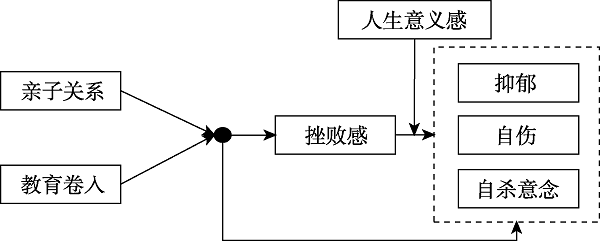
综上所述, 本研究将在前述研究的基础上探究青少年抑郁、自伤和自杀意念的发展机制并提出一个有调节的中介模型(如图1), 主要探究三个问题:(1)以多项式回归与响应面分析探究孩子体验的亲子关系与父母教育卷入对挫败感的影响; (2)挫败感的中介作用; (3)人生意义感能否调节挫败感对青少年抑郁、自伤和自杀意念的影响。
图1
2 方法
2.1 研究对象和程序
本研究数据来自国内一项大型流行调查的一部分, 以湖南某所初中学生为被试, 由于初三学生有着升学压力未参与调查, 按班级采取整群抽样的方式, 所有项目均获得被试、家长和学校的知情同意, 为获得学校更有力的帮助, 问卷收集前答应给与学校各个班级总体和学生个人心理反馈, 以及后续的干预合作。学生问卷由严格训练的心理学教师和研究生担任主试, 保证每个班级两名主试配合, 采用相同的指导语进行集体施测, 并且由各班班主任在旁辅助调查, 要求学生仔细阅读问题指导语, 并按要求作答, 问卷收集后给与一定小礼品奖励, 共收集1123份学生样本。为了保证数据质量和时间纵向变化的影响, 问卷收集后一周紧急整理和撰写反馈, 考虑到纸质问卷发放的难度和学校的工作量, 且有研究表明线上电子问卷与传统的纸质问卷填写时没有很大差异(陈永泰, 何有世, 2008), 符合测量不变性要求(于洪彦, 黄晓治, 2011), 多次强调家长问卷的重要性后由班主任在班级微信群中使用问卷星发布问卷, 共收集1020份家长数据。后经匹配共获得学生家长匹配数据930份, 有效回收率为82.8%。由于样本来源于自我报告因此往往存在缺失值, 通过统计分析得出孩子问卷:变量缺失0, 不完整个案208 (22.37%), 值缺失649 (1.04%), 缺失率较小, 家长数据无缺失。本研究使用的缺失数据插补方法为:EM插补(Expectation Maximization Imputation)。EM假设数据缺失类型为随机缺失, 并使用当前数据信息和指定模型对缺失数据进行“最佳猜测” (Bennett, 2001), 适用于连续变量。学生平均年龄15.24岁(SD = 1.66), 其中男生501 (53.9%)名, 女生429 (46.1%)名; 独生子女491 (52.8%)名, 非独生子女439 (47.2%)名; 父母的婚姻状况情况:初婚777 (83.5%)名, 离异47 (5.1%)名, 再婚31 (3.3%)名, 其他类型75 (8.1%)名; 家庭经济水平情况:很好128 (13.7%)名, 较好530 (57.0%)名, 一般234 (25.2%)名, 不太好16 (1.7%)名, 非常不好22 (2.4%)名。
2.2 分析方法
Z(挫败感) = b0 + b1(PR) + b2 (EI) + b3 (PR)2 + b4 (PR) × (EI) + b5 (EI)2 + e
其中PR表示孩子体验到的亲子关系、EI表示父母的教育卷入行为、(PR)×(EI)为二者交叉项、加上二者的平方项; b0代表了截距、b1为PR的系数、b2为EI的系数、b3为PR2的系数、b4为交叉项的系数、b5为EI2的系数、e为误差项。本文首先对测量指标PR与EI进行尺度中心化处理, 再将各项进行回归, 并通过绘制三维图形将结果呈现。在三维图形中, 我们主要通过计算“PR = EI”匹配曲线的斜率a1 = b1 + b2和曲率a2 = b3 + b4 + b5 的值以及“PR = −EI”的不匹配曲线的斜率a3 = b1 − b2和曲率a4 = b3 − b4+ b5的值及其显著性来判断对结果变量的影响。
其次有关有调节的中介效应检验, 使用上述多项式回归系数构建亲子关系与父母教育卷入一致的区集变量——块变量(block variable, Edwards & Cable, 2009), 进而以块变量为自变量进行有调节的中介效应检验。参照温忠麟和叶宝娟(2014)提出检验有调节的中介效应方法, 考察块变量(亲子关系和父母教育卷入)对青少年抑郁、自伤和自杀意念的影响, 挫败感的中介效应以及人生意义感对该中介作用的调节效应, 并构建3个方程。方程1估计自变量块变量对因变量青少年抑郁、自伤和自杀意念的预测; 方程2估计块变量对中介变量挫败感的预测; 方程3估计调节变量人生意义感对挫败感与青少年抑郁、自伤和自杀意念之间关系的调节效应, 以及块变量对青少年抑郁、自伤和自杀意念残余效应检验, 标准化处理所有连续变量。
2.3 研究工具
2.3.1 抑郁
采用Andresen等人(1994)编制简版流调中心抑郁量表(Short Form of the Center for Epidemiological Studies Depression Scale, SF-CES-D), 在中国青少年中有着较好的信效度(Yang et al., 2018), 为单维量表, 有10个条目(如, 我没有工作/学习的动力), 采用4级(0~3)评分, 从0为“没有或很少有”到3为“绝大多数或全部”, 得分越高表明抑郁症状越严重, 该量表的总分在0~30分之间。研究证明Guttman’s lambda系数有着比Cronbach’s α更好的信度估计下限(Sijtsma, 2009), 本研究中简版流调中心抑郁量表的Guttman’s lambda系数为0.78, 大于0.7信度较好(Bland & Altman, 1997)。量表结构效度良好, 验证性因素分析的拟合指数:χ2 = 338.90, df = 35, CFI = 0.86, TLI = 0.82, RMSEA = 0.09, SRMR = 0.06。
2.3.2 自伤
采用简版自我伤害问卷(Deliberate Self-Harm Inventory, DSHI; Gratz, 2001)测量青少年的自我伤害行为, 在中国青少年中有着较好的信效度(Lan et al., 2019), 为单维量表, 有9个条目(如, 用锐利的东西戳进皮肤), 采用6级(0~5)评分, 从0为“没有”到5为“5次及以上”, 得分越高表明青少年自伤行为越严重, 该量表的总分在0~45分之间。本研究中简版自我伤害问卷的Guttman’s lambda系数为0.85。量表结构效度良好, 验证性因素分析的拟合指数:χ2 = 288.45, df = 27, CFI = 0.92, TLI = 0.90, RMSEA = 0.10, SRMR = 0.04。
2.3.3 自杀意念
使用自杀意念亚量表(The 4-item Depressive Symptom Index − Suicidality Subscale; Joiner et al., 2002)来测量过去两周的青少年自杀意念的频率与强度, 包含4个题目(如, 我有想要自杀的倾向), 采用4级(0~3)评分, 从0为“没有”到3为“总是”, 得分越高表示个体自杀意念越严重。本研究中自杀意念亚量表Guttman’s lambda系数为0.87, 验证性因素分析的拟合指数:χ2 = 17.38, df = 2, CFI = 0.99, TLI = 0.98, RMSEA = 0.09, SRMR = 0.01, 量表有着较好的结构效度。
2.3.4 孩子体验到亲子关系
使用Buchanan等人(1991)编制亲子亲密度量表(Parent-child Intimacy Questionnaire), 分别对父子和母子的关系进行评述, 各9个条目(如, 你感觉和父/母亲很亲密), 采用5点评分, 从1为“完全不符合”到5为“完全符合”。量表得分越高表示青少年与父亲(或母亲)的关系越紧密。本研究中父子关系部分的Guttman’s lambda系数为0.84, 母子关系部分Guttman’s lambda系数为0.85。量表结构效度良好, 父子部分验证性因素分析的拟合指数:χ2 = 170.67, df = 27, CFI = 0.96, TLI = 0.94, RMSEA = 0.08, SRMR = 0.04; 母子部分验证性因素分析的拟合指数:χ2 = 187.62, df = 27, CFI = 0.94, TLI = 0.93, RMSEA = 0.08, SRMR = 0.05, 以往研究多以二者均值作为亲子关系得分(Bi et al., 2021), 并且配对样本t检验得分显示未发现显著差异(M ± SD父子 = 30.27 ± 8.40, M ± SD母子 = 30.28 ± 8.39), t = 0.01, p = 0.99。
2.3.5 父母教育卷入
采用吴艺方等人(2013)编制的《小学生父母教育卷入行为量表》, 用以测量父母对孩子教育卷入程度, 量表有5个维度共29个条目(如, 我会帮助孩子解决学习上遇到的困难), 采用4点评分, 从1为“从不”到4为“经常”。虽然问卷开发时被试对象为小学生父母教育卷入, 但本研究被试为初一初二学生年级跨度较小, 且在实验开始之前由10位心理学从业者和初中教师对条目一一进行评判能较为满足实际情况。本研究中父母教育卷入行为量表Guttman’s lambda系数为0.87, 量表结构效度较好, 验证性因素分析的拟合指数:χ2 = 2911.41, df = 368, CFI = 0.86, TLI = 0.85, RMSEA = 0.07, SRMR = 0.22。由于本研究在测量时仅要求一名家长进行回答, 为防止存在父母之间差异进行配对样本t检验, 父亲教育卷入得分为3.02 ± 0.45, 母亲教育卷入得分为3.05 ± 0.43, t = −1.20, p = 0.23, 父母之间教育卷入得分不存在显著差异。
2.3.6 挫败感
2.3.7 人生意义感
使用王孟成和戴晓阳(2008)修订Steger等人(2006)编制的中文人生意义问卷(Chinese Meaning in Life Questionnaire, C-MLQ), 量表分为两个维度包含10道题(如, 我很了解自己的人生意义), 采用7级计分, 1代表“完全不同意”, 7代表“完全同意”, 用以评估个体有关人生意义感的看法, 本研究中文人生意义问卷的Guttman’s lambda系数为0.77, 量表结构效度良好, 验证性因素分析的拟合指数:χ2 = 273.25, df = 34, CFI = 0.94, TLI = 0.92, RMSEA = 0.09, SRMR = 0.07。
3 结果
3.1 共同方法偏差检验
由于学生数据均来自于被试的自我报告, 存在无法规避的共同方法偏差问题。首先, 使用Harman单因子法对6个问卷全部题项进行探索性因素分析, 采用未旋转的主成分分析法, 分析结果显示:共有12个因子的特征根大于1, 第一个因子的方差解释率为 24.89% (低于临界指标40%)。其次, 打包各个量表3个因子载荷最大的条目作为对应潜变量指标(吴艳, 温忠麟, 2011), 使用AMOS设定单因子模型的验证性因素分析结果显示模型拟合很差:χ2 = 4235.77, df = 189, CFI = 0.50, TLI = 0.45, RMSEA = 0.15, SRMR = 0.14。最后, 使用潜在误差变量可控制法, 在引入共同方法偏差之前, 7因子模型拟合结果较好:χ2 = 370.95, df = 168, CFI = 0.98, TLI = 0.97, RMSEA = 0.04, SRMR = 0.04, 引入共同方法偏差后:χ2 = 225.07, df = 147, CFI = 0.98, TLI = 0.98, RMSEA = 0.02, SRMR = 0.02, 前后差异不大, 因此结果表明不存在严重的共同方法偏差问题。
3.2 各变量之间的描述统计以及相关分析
表1列出各研究变量平均数、标准差以及相关矩阵, 结果显示仅有青少年抑郁与父母教育卷入之间不存在显著相关, 其余变量两两之间存在显著相关。此外, 本研究中青少年至少发生一种自伤行为的检出率为34.1%。
表1 描述统计量及相关分析结果
| 变量 | 1 | 2 | 3 | 4 | 5 | 6 | 7 |
|---|---|---|---|---|---|---|---|
| 抑郁 | 1 | ||||||
| 自伤 | 0.44** | 1 | |||||
| 自杀意念 | 0.53** | 0.61** | 1 | ||||
| 亲子关系 | −0.42** | −0.28** | −0.36** | 1 | |||
| 教育卷入 | −0.04 | −0.08* | −0.12** | 0.09** | 1 | ||
| 挫败感 | 0.64** | 0.36** | 0.45** | −0.36** | −0.09** | 1 | |
| 人生意义感 | −0.22** | −0.13** | −0.12** | 0.33** | 0.09** | −0.16** | 1 |
| M ± SD | 18.63 ± 6.05 | 3.58 ± 7.24 | 2.69 ± 3.39 | 30.27 ± 8.40 | 3.04 ± 0.44 | 33.55 ± 11.12 | 47.64 ± 11.91 |
注:1抑郁; 2为自伤; 3为自杀意念; 4为亲子关系关系; 5为教育卷入; 6为挫败感; 7为人生意义感。
*p < 0.05, **p < 0.01, ***p < 0.001, 下同。
3.3 亲子关系−教育卷入匹配对青少年挫败感的影响
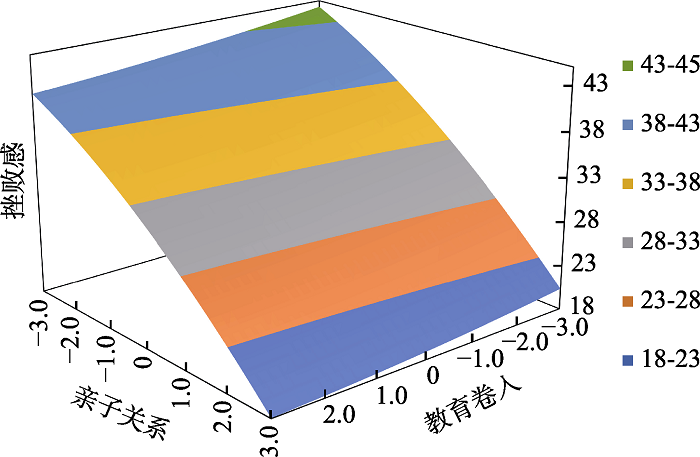
研究采用响应面分析检验亲子关系(Parent-child relationship, PR)−教育卷入(Education involvement, EI)匹配对青少年挫败感的影响, 在分析之前, 应先对样本应答比例进行分析, 以判断是否适合多项式回归与响应面分析。结果显示, 在统一尺度后, 亲子关系与教育卷入一致的样本比例为31.83% (296名), 亲子关系大于父母教育卷入的样本比例为34.62% (322名), 亲子关系小于父母教育卷入的样本比例为33.55% (312名), 满足分析要求(各类别大于10%)。多项式回归与响应面分析结果显示:沿一致线(PR = EI), 横截面的斜率(slope, S)显著(S = −4.37, p < 0.001, 95% CI= [−5.57, −3.32]), 说明相比于低亲子关系−低教育卷入一致的个体, 高亲子关系−高教育卷入的青少年有着更低水平的挫败感; 沿不一致线(PR = −EI), 横截面的斜率显著(S = −3.40, p < 0.001, 95% CI = [−4.53, −2.21]), 说明相比于低亲子关系−高教育卷入的青少年, 有着高亲子关系−低教育卷入的个体表现出更低水平的挫败感。此外, 响应面一致线曲率和不一致线曲率均不显著, 表明亲子关系−教育卷入与青少年挫败感之间为线性关系。
为进一步探究孩子体验到的亲子关系与父母教育卷入程度对青少年挫败感的影响, 以亲子关系为X轴, 父母教育卷入为Y轴, 青少年挫败感为Z轴, 拟合得出亲子关系−教育卷入与青少年挫败感的三维响应图2, 此外采用选点法, 沿一致线和非一致线正负1个标准差选择的4个点:Z1 (1.22, 1.22, 27.19), Z2 (−0.95, −0.95, 36.81), Z3 (1.22, −0.95, 28.13), Z4 (−0.95, 1.22, 35.70)。计算z-hat值, 一致线Z1和Z2的差为−9.62, 95% CI为[−11.94, −7.15], 不一致线Z3和Z4的差为−7.57, 95% CI为[−10.44, −4.98], 结果也支持上述结论。
图2
3.4 有调节的中介效应检验
在上述分析的基础上, 考察块变量(亲子关系和父母教育卷入)对青少年抑郁、自伤和自杀意念的影响, 挫败感的中介效应以及人生意义感对该中介作用的调节效应, 由于多项式回归与响应面分析将性别、是否独生、父母婚姻状况和家庭经济水平纳入分析, 此外许多研究发现这些因素对抑郁、自伤和自杀存在影响(Rice et al., 2002), 本研究将其作为控制变量纳入方程。将所有变量做标准化处理, 所有运算均通过Hayes编制的SPSS 26.0宏程序PROCESS 3.3完成。
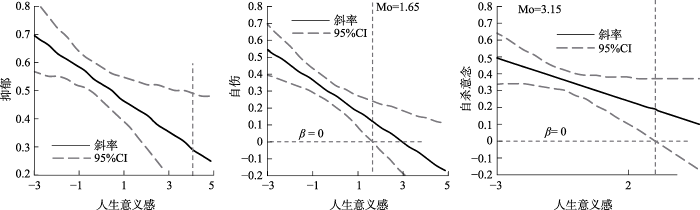
结果见表2~表4所示, 方程1显示:性别和块变量可以显著预测青少年抑郁、自伤和自杀意念(β抑郁 = 0.13, p = 0.01; β抑郁 = 0.63, p < 0.001; β自伤 = 0.22, p < 0.001; β自伤 = 0.36, p < 0.001; β自杀 = 0.21, p < 0.001; β自杀 = 0.44, p < 0.001), 此外父母婚姻状况也可以正向预测青少年自伤(β自伤 = 0.07, p = 0.004); 方程2结果发现, 家庭经济状况和块变量对挫败感有显著影响(β = 0.16, p < 0.001; β = 0.35, p < 0.001); 方程3显示, 性别、块变量和挫败感可以显著预测青少年抑郁、自伤和自杀意念(β抑郁 = 0.18, p < 0.001; β抑郁 = 0.22, p < 0.001; β抑郁 = 0.52, p < 0.001; β自伤 = 0.26, p < 0.001; β自伤 = 0.14, p < 0.001; β自伤 = 0.27, p < 0.001;β自杀 = 0.25, p < 0.001; β自杀 = 0.21, p < 0.001; β自杀 = 0.34, p < 0.001), 父母婚姻状况对青少年自伤行为有显著影响(β自伤 = 0.07, p = 0.04), 此外, 挫败感和人生意义感的交互项对青少年抑郁和自伤有着显著影响, 且对青少年自杀意念边缘显著(β抑郁 = −0.06, p < 0.001; β自伤 = −0.09, p < 0.001; β自杀 = −0.05, p = 0.05)。这表明, 块变量(亲子关系和父母教育卷入)、挫败感、青少年抑郁、自伤、自杀和人生意义感分别构成一个有调节的中介模型, 挫败感起部分中介作用, 人生意义感调节中介路径后半段, 即挫败感对青少年抑郁、自伤和自杀的影响。此外, 表5列出了人生意义感在均值和正负1个标准差水平的中介效应值, 结果显示在各个回归模型中, 随着人生意义感的增加, 中介效应占比逐渐减少。
表2 有调节的中介效应检验(因变量Y1: 抑郁)
| 变量 | 方程1 (因变量: Y1) | 方程2 (因变量: M) | 方程3 (因变量: Y1) | |||||||||
|---|---|---|---|---|---|---|---|---|---|---|---|---|
| β | t | p | 95% CI | β | t | p | 95% CI | β | t | p | 95% CI | |
| 1 | 0.13 | 2.55 | 0.01 | [0.04, 0.24] | 0.10 | 1.63 | 0.10 | [−0.02, 0.23] | 0.18 | 3.56 | <0.001 | [0.08, 0.28] |
| 2 | 0.08 | 1.59 | 0.11 | [−0.03, 0.19] | −0.06 | −0.93 | 0.35 | [−0.18, 0.06] | 0.03 | 0.55 | 0.58 | [−0.07, 0.13] |
| 3 | 0.03 | 1.05 | 0.29 | [−0.03, 0.09] | 0.05 | 1.35 | 0.18 | [−0.02, 0.12] | 0.03 | 1.05 | 0.29 | [−0.03, 0.09] |
| 4 | 0.01 | 0.41 | 0.69 | [−0.07, 0.10] | 0.16 | 4.00 | <0.001 | [0.08, 0.24] | 0.01 | 0.23 | 0.82 | [−0.06, 0.07] |
| X | 0.63 | 23.6 | <0.001 | [0.55, 0.70] | 0.35 | 11.20 | <0.001 | [0.29, 0.42] | 0.22 | 7.68 | <0.001 | [0.16, 0.27] |
| M | 0.52 | 18.61 | <0.001 | [0.47, 0.58] | ||||||||
| W | −0.05 | −1.89 | 0.06 | [−0.10, 0.01] | ||||||||
| MW | −0.06 | −2.57 | 0.01 | [−0.10, −0.01] | ||||||||
| R2 | 0.41 | 0.15 | 0.46 | |||||||||
| F | 118.76*** | 30.70*** | 90.94*** | |||||||||
注:1 是性别1为“男”, 2为“女”; 2是是否独生子女1为“是”, 2为“否”; 3是父母婚姻状况1为“初婚”, 2为“离异”, 3为“再婚”, 4为“其他”; 4是家庭经济水平1为“很好”, 2为“较好”, 3为“一般”, 4为“不太好”, 5为“很差”; X为自变量亲子关系与教育卷入的块变量; M为中介变量挫败感; 因变量为青少年抑郁(Y1)、自伤(Y2)和自杀意念(Y3), 下同。
表3 有调节的中介效应检验(因变量Y2: 自伤)
| 变量 | 方程1 (因变量: Y2) | 方程2 (因变量: M) | 方程3 (因变量: Y2) | |||||||||
|---|---|---|---|---|---|---|---|---|---|---|---|---|
| β | t | p | 95% CI | β | t | p | 95% CI | β | t | p | 95% CI | |
| 1 | 0.22 | 3.62 | <0.001 | [0.11, 0.35] | 0.10 | 1.63 | 0.10 | [−0.02, 0.23] | 0.26 | 4.24 | <0.001 | [0.14, 0.38] |
| 2 | 0.07 | 1.17 | 0.24 | [−0.05, 0.19] | −0.06 | −0.93 | 0.35 | [−0.18, 0.06] | 0.03 | 0.53 | 0.59 | [−0.09, 0.15] |
| 3 | 0.07 | 2.05 | 0.04 | [−0.01, 0.16] | 0.05 | 1.35 | 0.18 | [−0.02, 0.12] | 0.07 | 2.04 | 0.04 | [0.01, 0.14] |
| 4 | 0.02 | 0.40 | 0.69 | [−0.09, 0.15] | 0.16 | 4.00 | <0.001 | [0.08, 0.24] | 0.02 | 0.40 | 0.69 | [−0.06, 0.09] |
| X | 0.36 | 11.5 | <0.001 | [0.27, 0.45] | 0.35 | 11.20 | <0.001 | [0.29, 0.42] | 0.14 | 4.05 | <0.001 | [0.07, 0.20] |
| M | 0.27 | 8.05 | <0.001 | [0.21, 0.34] | ||||||||
| W | −0.06 | −1.81 | 0.07 | [−0.12, 0.01] | ||||||||
| MW | −0.09 | −3.46 | <0.001 | [−0.14, −0.04] | ||||||||
| R2 | 0.16 | 0.15 | 0.19 | |||||||||
| F | 32.24*** | 30.70*** | 25.45*** | |||||||||
表4 有调节的中介效应检验(因变量Y3: 自杀意念)
| 变量 | 方程1 (因变量: Y3) | 方程2 (因变量: M) | 方程3 (因变量: Y3) | |||||||||
|---|---|---|---|---|---|---|---|---|---|---|---|---|
| β | t | p | 95% CI | β | t | p | 95% CI | β | t | p | 95% CI | |
| 1 | 0.21 | 3.51 | <0.001 | [0.10, 0.33] | 0.10 | 1.63 | 0.10 | [−0.02, 0.23] | 0.25 | 4.23 | <0.001 | [0.13, 0.37] |
| 2 | 0.07 | 1.27 | 0.20 | [−0.04, 0.18] | −0.06 | −0.93 | 0.35 | [−0.18, 0.06] | 0.03 | 0.44 | 0.66 | [−0.09, 0.14] |
| 3 | 0.03 | 0.94 | 0.35 | [−0.04, 0.10] | 0.05 | 1.35 | 0.18 | [−0.02, 0.12] | 0.03 | 0.95 | 0.34 | [−0.03, 0.10] |
| 4 | 0.01 | 0.02 | 0.99 | [−0.10, 0.10] | 0.16 | 4.00 | <0.001 | [0.08, 0.24] | 0.00 | −0.09 | 0.92 | [−0.08, 0.07] |
| X | 0.44 | 14.3 | <0.001 | [0.36, 0.52] | 0.35 | 11.20 | <0.001 | [0.29, 0.42] | 0.21 | 6.54 | <0.001 | [0.15, 0.28] |
| M | 0.34 | 10.43 | <0.001 | [0.28, 0.41] | ||||||||
| W | −0.01 | −0.37 | 0.71 | [−0.07, 0.05] | ||||||||
| MW | −0.05 | −1.93 | 0.05 | [−0.10, 0.001] | ||||||||
| R2 | 0.21 | 0.15 | 0.25 | |||||||||
| F | 46.12*** | 30.70*** | 36.65*** | |||||||||
表5 人生意义感不同水平的挫败感的中介效应
| 因变量 | 水平 | 中介效应值 | Bootstrap SE | 95% CI | 直接效应 | Bootstrap SE | 95% CI | 中介效应占比 |
|---|---|---|---|---|---|---|---|---|
| 抑郁 | −1水平 | 0.21 | 0.03 | [0.16, 0.26] | 0.22 | 0.03 | [0.16, 0.27] | 49% |
| 均值 | 0.19 | 0.02 | [0.14, 0.24] | 46% | ||||
| 1水平 | 0.17 | 0.03 | [0.12, 0.23] | 44% | ||||
| 自伤 | −1水平 | 0.13 | 0.03 | [0.08, 0.18] | 0.14 | 0.03 | [0.07, 0.20] | 48% |
| 均值 | 0.10 | 0.02 | [0.06, 0.14] | 42% | ||||
| 1水平 | 0.06 | 0.02 | [0.02, 0.12] | 30% | ||||
| 自杀意念 | −1水平 | 0.14 | 0.02 | [0.10, 0.19] | 0.21 | 0.03 | [0.15, 0.28] | 40% |
| 均值 | 0.12 | 0.02 | [0.08, 0.17] | 36% | ||||
| 1水平 | 0.10 | 0.03 | [0.06, 0.16] | 32% |
图3
4 讨论
青春期是个体发展的关键时期, 但生理成熟与心理发展之间的差距使得处于该时期的青少年更容易产生抑郁、焦虑等情绪(Salk et al., 2017), 其自伤和自杀意念等相关心理危机的风险也更高(Brown & Plener, 2017; Swannell et al., 2014), 由于抑郁与自杀意念量表未有标准化常模无法进行探讨, 但本研究中青少年至少有过一次自伤行为的检出率为34.1%, 略高于以往研究(Han et al., 2018; Li et al., 2020)。此外, 本研究基于生态系统理论和动机−意志整合模型, 创新性的使用多项式回归与响应面分析考察亲子关系与父母教育卷入对青少年抑郁、自伤和自杀意念的影响, 以及挫败感与人生意义感在其间的中介与调节作用, 为抑郁、自伤和自杀意念的相关发展理论补充了证据, 也对相关心理危机行为干预具有一定的启示作用。
4.1 挫败感的中介作用
家庭系统理论(Bowen, 1998)认为家庭是由具有亲属关系的家庭成员组成的系统, 处于该系统的每个成员之间相互影响, 稳定、和谐、健康的家庭系统对孩子健康成长具有重要影响。而作为家庭系统中的重要一环亲子系统, 过往研究显示亲密和谐的亲子关系可以提高孩子主观幸福感(Jia et al., 2018), 增加亲社会行为(Kärtner et al., 2010), 并且使得同伴关系和师生关系更为和谐(陈欣银 等, 1995), 从而降低个体心理问题和障碍发生风险。反之, 消极、不安全的亲子关系则会导致孩子问题行为和消极情绪体验增加(Jouriles et al., 2014), 甚至更为严重的心理障碍与疾病(Goschin et al., 2013)。本研究纳入亲子系统中重要的内容(孩子体验到亲子关系与父母教育卷入)探究其对青少年抑郁、自伤和自杀意念的影响, 结果显示亲子关系−教育卷入的块变量不仅可以直接预测青少年抑郁、自伤和自杀意念, 也发现了挫败感在其间的中介作用。在一项以730名成年人为被试探究过去养育和当前依恋取向的看法对自杀意念的影响的研究, Zortea等人(2019)也发现挫败感在消极教育方式与自杀意念中起中介作用, 心理韧性缓冲这一中介影响。
然而, 以往研究大多采用父母或孩子单视角去探究亲子关系对青少年心理健康的影响, 又或者测量父母与孩子感受的亲子关系得分, 却以简单的总分或按某一比例加权求和忽视了父母与孩子身份差异与地位的不对等。在一项父母−青少年对家庭氛围看法匹配影响青少年抑郁症状和压力的研究中, 结果显示当父母−青少年一致认为家庭混乱时, 青少年症状与压力得分最高; 而当不一致情况即青少年感知家庭混乱高−父母感知低时, 青少年抑郁症状和压力得分最高(Human et al., 2016)。本研究创新性的使用多项式回归与响应面分析探究亲子关系−教育卷入匹配的效应, 结果显示相比于低亲子关系−低教育卷入一致的个体, 高亲子关系−高教育卷入的青少年有着更低水平的挫败感; 且相比于低亲子关系−高教育卷入的青少年, 有着高亲子关系−低教育卷入的个体表现出更低水平的挫败感, 这表明要预防或解决青少年所出现的心理问题, 促进其身心健康发展, 相比投入更多的教育资源投入, 父母应更加注重与子女之间的关系, 让孩子体验到安全温暖的环境更为重要。众多现实情况也支持这一结论, 当优秀的孩子出现心理问题甚至产生严重心理危机事件后, 父母往往事后才感叹不求孩子成绩多好多优秀, 只要能健康成长就好。不仅如此, 挫败感的中介效应也提示, 外界压力与应激事件可能是通过引起个体挫败感体验, 从而导致相关心理问题与障碍, 这与以往研究结果一致(Griffiths et al., 2014; Taylor et al., 2011)。
4.2 人生意义感的调节作用
素质−压力模型与动机−意志整合模型均认为, 抑郁、焦虑、自伤和自杀等心理问题与障碍的产生是外界压力与内在“易感性”素质共同作用的结果。人生意义感作为一种个体对人生意义和目的的知觉与感受程度(Crumbaugh, 1968), 对个体的身心健康发展具有重要影响(Czekierda et al., 2017)。在一项探究人生意义感与抑郁、焦虑、成瘾、绝望和自杀等相关精神疾病的元分析中, Glaw等人(2017)发现帮助患者寻找人生意义和信念, 有助于减少其相关症状, 并增加幸福感和生活满意度。此外, 在有关青少年自杀心理解剖与新闻报道中, “活得没有意思”成为一个经常出现的原因, 在对湖南某所中学班级有关“你认为一个人在什么情况下会自杀?”主题讨论中, 整理相关答案后, “觉得自己活在这个世界可有可无”的排名第一, 且在14个原因中有6个均与人生意义感相关。因此, 本研究亦引入人生意义感, 探究其对该中介模型的影响, 结果显示, 人生意义感调节该中介模型后半段, 即挫败感对青少年抑郁、自伤和自杀意念的影响, 具体表现为随着人生意义感的增加, 挫败感对青少年抑郁、自伤和自杀意念的影响逐渐减小, 且当人生意义感在正1.65个标准差和3.15个标准差时, 挫败感对青少年自伤和自杀意念的预测不显著, 此外, 表5的结果也显示随着人生意义感的增加, 挫败感的中介效应占比也逐渐减少, 上述结果均表明人生意义感可以缓冲压力的消极影响。
4.3 研究的意义与不足
最后需要指出是, 本研究使用多项式回归与响应面分析探究孩子体验到的亲子关系与父母教育卷入的综合影响, 同时发现挫败感与人生意义感的中介和调节作用, 丰富了青少年抑郁、自伤和自杀意念发展理论, 也为相关干预提供一定的启示。然而, 本研究采用的是横断面研究方法, 在一定程度上不能很好的反映其间的因果关系, 且本研究被试为一所学校的初二初三学生, 在样本代表性方面存在不足, 我们计划在之后的研究中采用更大的样本量使用多时间点的追踪数据对青少年心理健康发展进行探究。其次, 本研究虽然发现了挫败感的中介效应, 但O'Connor和Kirtley (2018)明确提出迷失感(entrapment)是挫败感与自杀意念的桥梁, 迷失感最初来源于Williams (2001)的痛哭自杀理论(Cry of pain theory of suicide)中的“被捕逃亡(arrested flight)”的概念, 其最初是用以解释抑郁患者所表现的日常行为, 描述一个人被打倒了(挫折), 而且没有逃脱的希望(迷失)的感觉。这些概念很好地描述了在经历自杀痛苦的个体中所经常观察的“隧道视野” (tunnel vision)现象, 即自杀成为唯一的逃避路径, 而且获得国外大量研究的证实, 却在我国研究较少。最后, 本研究虽然验证了素质−压力模型, 但大量研究发现个体心理问题和障碍是由易感性基因和外界环境作用的结果(Park et al., 2019; 田相娟, 2020), 因此未来的研究可以采用基因与遗传的研究范式探究青少年心理问题与障碍的发展机制。
5 结论
综上所述, 本研究发现:(1)相比低亲子关系−低教育卷入一致的个体, 高亲子关系−高教育卷入的青少年有着更低水平的挫败感; 且相比于低亲子关系−高教育卷入的青少年, 有着高亲子关系−低教育卷入的个体表现出更低水平的挫败感; (2)挫败感在亲子关系−教育卷入与青少年抑郁、自伤和自杀意念之间起部分中介作用; (3)人生意义感调节该中介模型后半段, 即挫败感对青少年抑郁、自伤和自杀意念的影响, 具体表现为随着人生意义感的增加, 挫败感对抑郁、自伤和自杀意念的影响逐渐减小。
参考文献
Screening for depression in well older adults: Evaluation of a short form of the CES-D (Center for Epidemiologic Studies Depression Scale)
We derived and tested a short form of the Center for Epidemiologic Studies Depression Scale (CES-D) for reliability and validity among a sample of well older adults in a large Health Maintenance Organization. The 10-item screening questionnaire, the CESD-10, showed good predictive accuracy when compared to the full-length 20-item version of the CES-D (kappa =.97, P <.001). Cutoff scores for depressive symptoms were > or = 16 for the full-length questionnaire and > or = 10 for the 10-item version. We discuss other potential cutoff values. The CESD-10 showed an expected positive correlation with poorer health status scores (r =.37) and a strong negative correlation with positive affect (r = -.63). Retest correlations for the CESD-10 were comparable to those in other studies (r =.71). We administered the CESD-10 again after 12 months, and scores were stable with strong correlation of r =.59.
Suicidality in Childhood and Adolescence
DOI:10.3238/arztebl.2020.0261
PMID:32449889
[本文引用: 1]

The suicide of minors in Germany is rare in absolute numbers: there were only 212 suicides among persons aged 10 to 20 in Germany in 2017. Nonetheless, in school surveys, 36.4-39.4% of those surveyed reported suicidal ideation, and 6.5-9% reported suicide attempts. Suicide among children and adolescents is thus a clinically and societally relevant problem.This review is based on pertinent articles retrieved by a selective literature search in the PubMed and PsycInfo databases (April 2019) employing the search terms "suicidality," "suicidal*," and "suicide," and on further information from several textbooks (1991-2017).In children and adolescents with a mental illness, the risk of suicide is higher by a factor of 3 to 12. Mobbing experiences increase the suicide risk as well (odds ratio [OR] = 2.21, p <0.05). Non-suicidal self-injurious behavior (NSSB) is also a risk factor for both suicidal ideation (OR = 2.95) and suicide attempts (hazard ratio [HR] = 2.00). Intoxication with medications is the most common method of attempted suicide (67.7%). Most suicides are preceded by early warning signs. Psychiatric hospitalization is indicated for children and adolescents who are in acute danger of doing harm to themselves. Specific types of treatment, family-centered methods in particular, have been found to lessen the frequency of suicidal ideation and suicide attempts. The administration of antidepressant drugs to children and adolescents is controversial, as there is evidence of increased suicidality (but not mortality) for single medications. Antidepressant drugs should not, however, be withheld for this reason, if indicated. The prerequisite in all cases is close observation.To prevent suicide and improve outcomes, risk factors for suicide must be considered, and the indications for primary and secondary preventive and therapeutic measures must be established. Online therapeutic modalities may become more widely used in the near future, particularly among young patients, who are well versed in the use of the Internet.
How can I deal with missing data in my study
Sibling relationships and civic engagement: A longitudinal study of Chinese young adults
DOI:10.1002/ijop.12685 URL [本文引用: 1]
Statistics notes: Cronbach's alpha
Adolescent suicide: what can pediatricians do
DOI:10.1097/MOP.0000000000000916
PMID:32618792
[本文引用: 1]
Suicide is a major public health concern and the second leading cause of death for adolescents. Faced with an already-high prevalence and increasing rates over the past decade, pediatricians feel inadequately prepared to manage a suicidal patient. This article will review the changing rates of suicide, discuss recent literature on risk factors, identify methods to screen for suicidal thoughts and suggest an approach to counseling a suicidal patient. Finally, there will be a brief discussion on safety planning and public health measures to help reduce suicide rates.Rates of attempted suicide and death by suicide have been increasing for more than a decade. Risk assessment of potential suicidality remains very challenging, as the risk factors are multifactorial. However, some common risk factors persist including sexual minority identification and family or personal history of mental health issues. Although keeping these and other risk factors in mind, regular screening of adolescents for depression and self-harm is important. Finally, the best safety plans and treatment methods appear to be team-based.It remains the responsibility of pediatricians to stay aware of risk factors, regularly screen adolescents and prioritize collaborative safety planning for suicidal patients.
Non-suicidal self-injury in adolescence
DOI:10.1007/s11920-017-0767-9
URL
PMID:28315191
[本文引用: 2]
Non-suicidal self-injury (NSSI) is a common mental health threat among adolescents. This review aims to present the current literature on epidemiology, etiology, and therapeutic approaches with a focus on the period of adolescence.NSSI is widespread among adolescents both in community as well as in clinical settings with lifetime prevalence rates between 17 and 60% in recent studies. It is influenced by multiple factors including social contagion, interpersonal stressors, neurobiological background, as well as emotional dysregulation and adverse experiences in childhood. There is still a lack of studies regarding the psychotherapeutic as well as the psychopharmacological treatment of NSSI in adolescence. Furthermore, sufficient evidence for prevention programs is missing.
Caught between parents: Adolescents' experience in divorced homes
This study examined adolescents' feelings of being caught between parents to see whether this construct helps to explain (1) variability in their postdivorce adjustment and (2) associations between family/child characteristics and adolescent adjustment. Adolescents 10 to 18 years old (N = 522) were interviewed by telephone 4 1/2 years after their parents' separation. Feeling caught between parents was related to high parental conflict and hostility and low parental cooperation. Being close to both parents was associated with low feelings of being caught. The relation between time spent with each parent and feeling caught depended on the coparenting relationship. Adolescents in dual residence were especially likely to feel caught when parents were in high conflict, and especially unlikely to feel caught when parents cooperated. Feeling caught was related to poor adjustment outcomes. Parental conflict was only related to adjustment outcomes indirectly, through adolescents' feelings of being caught.
The contagion of social defeat stress: Insights from rodent studies
DOI:10.1016/j.neubiorev.2020.01.011 URL [本文引用: 1]
Mother-child relationship, social behavior and peer acceptance in Chinese children
中国儿童的亲子关系, 社会行为及同伴接受性的研究
Research on the difference between network survey and traditional paper survey
网络调查和传统纸质调查的差异性研究
The mediation effect of psychological quality of primary school students between their problem behaviors and parents’ educational involvement—The regulating effect of family socioeconomic status
小学生心理素质在父母教育卷入与问题行为间的中介作用——家庭社会经济地位的调节效应
Cross-validation of purpose-in-life test based on Frankl's concepts
Family conflict, emotional security, and child development: Translating research findings into a prevention program for community families
DOI:10.1007/s10567-012-0112-0
PMID:22311087
[本文引用: 1]
The social problem posed by family conflict to the physical and psychological health and well-being of children, parents, and underlying family relationships is a cause for concern. Inter-parental and parent-child conflict are linked with children's behavioral, emotional, social, academic, and health problems, with children's risk particularly elevated in distressed marriages. Supported by the promise of brief psycho-educational programs (e.g., Halford et al. in Journal of Family Psychology 22:497-505, 2008; Sanders in Journal of Family Psychology 22:506-517, 2008), the present paper presents the development and evaluation of a prevention program for community families with children, concerned with family-wide conflict and relationships, and building on Emotional Security Theory (Davies and Cummings in Psychological Bulletin 116:387-411, 1994). This program uniquely focuses on translating research and theory in this area into brief, engaging programs for community families to improve conflict and emotional security for the sake of the children. Evaluation is based on multi-domain and multi-method assessments of family-wide and child outcomes in the context of a randomized control design. A series of studies are briefly described in the programmatic development of a prevention program for conflict and emotional security for community families, culminating in a program for family-wide conflict and emotional security for families with adolescents. With regard to this ongoing program, evidence is presented at the post-test for improvements in family-wide functioning, consideration of the relative benefits for different groups within the community, and preliminary support for the theoretical bases for program outcomes.
Meaning in life and physical health: Systematic review and meta-analysis
DOI:10.1080/17437199.2017.1327325
PMID:28488471
[本文引用: 2]
This systematic review and meta-analysis aimed to clarify the associations between meaning in life and physical health using random-effects models. Conceptualisation of meaning (order in world vs. purpose in life), type of health indicators, participants' health status, and age issues were investigated as moderators. Systematic searches of six databases resulted in inclusion of k = 66 studies (total N = 73,546). Findings indicated that meaning in life and physical health formed weak-to-moderate associations (the overall estimate of the average effect = 0.258). Conceptualisation of meaning, participants' health status, and their age did not moderate these associations. Operationalisation of health moderated the relationship between meaning in life and health. The strongest associations were found for subjective indicators of physical health. Significant albeit weak associations between meaning in life and objective indices of health were found. Furthermore, stronger effects were observed when the measures of meaning combined items referring to meaning in life and meaning-related sense of harmony, peace, and well-being, compared to measures focusing solely on meaning in life. Overall, the results point to the potential role of meaning in life in explaining physical health.
The effect of social economic status and parents’ rearing behavior on social creativity of children in Mali
DOI:10.4236/ce.2017.86060 URL [本文引用: 1]
Meaning in life, resilience, and psychological well-being among children affected by parental HIV
DOI:10.1080/09540121.2017.1307923
PMID:28343403
[本文引用: 1]
Meaning in life has been posited to improve psychological well-being. People facing adversities can reduce psychological distress through pursuing a sense of purpose in life. However, the effectiveness of meaning in life in promoting psychological well-being has been found varied, and what factors may affect the function of meaning in life remain unclear. In this paper, the authors suggest that resilience, the positive adaptation during or following significant adversity, can strengthen the protective effects of meaning in life on psychological well-being. To test this hypothesis, we analyzed data from a sample of 518 vulnerable children of parents living with HIV about their meaning in life, resilience, depression, and loneliness. Results showed that resilience moderated the relationship between meaning in life and depression, and between meaning in life and loneliness. Meaning in life was associated with lower levels of depression and loneliness among children high in resilience, in comparison to children low in resilience. Future interventions targeting meaning in life and well-being should consider children's resilience, which can allow for better individualization of the treatment.
The value of value congruence
DOI:10.1037/a0014891
PMID:19450005
[本文引用: 1]
Research on value congruence has attempted to explain why value congruence leads to positive outcomes, but few of these explanations have been tested empirically. In this article, the authors develop and test a theoretical model that integrates 4 key explanations of value congruence effects, which are framed in terms of communication, predictability, interpersonal attraction, and trust. These constructs are used to explain the process by which value congruence relates to job satisfaction, organizational identification, and intent to stay in the organization, after taking psychological need fulfillment into account. Data from a heterogeneous sample of employees from 4 organizations indicate that the relationships that link individual and organizational values to outcomes are explained primarily by the trust that employees place in the organization and its members, followed by communication, and, to a lesser extent, interpersonal attraction. Polynomial regression analyses reveal that the relationships emanating from individual and organizational values often deviated from the idealized value congruence relationship that underlies previous theory and research. The authors' results also show that individual and organizational values exhibited small but significant relationships with job satisfaction and organizational identification that bypassed the mediators in their model, indicating that additional explanations of value congruence effects should be pursued in future research.(c) 2009 APA, all rights reserved.
On the use of polynomial regression equations as an alternative to difference scores in organizational research
DOI:10.2307/256822 URL [本文引用: 1]
The role of defeat and entrapment (arrested flight) in depression: An exploration of an evolutionary view
The social rank theory of psychopathology suggests that with the evolution of social hierarchies various psychobiological mechanisms became attuned to the success or failure in conflict situations. Specifically, subordinates and those who have lost status are at greater risk of pathology than winners and those of higher status. In this theory concepts of defeat and entrapment are seen to be of special relevance to the study of depression. We outline the role of defeat and entrapment within the social rank theory of depression.New self-report measures of entrapment and defeat were developed and used to test predictions of the social rank theory of depression. Both a sample of students and depressed patients were assessed with these new scales and other social rank measures (e.g. social comparison and submissive behaviour).The entrapment and defeat measures were found to have good psychometric properties and significantly correlated with depression. They were also strongly associated with other rank variables. Defeat maintained a strong association with depression even after controlling for hopelessness (r = 0.62), whereas the relationship between hopelessness and depression was substantially reduced when controlling for defeat. Entrapment and defeat added substantially to the explained variance of depression after controlling for the other social rank variables.Defeat and entrapment appear to be promising variables for the study of depression. These variables may also help to develop linkages between human and animal models of psychopathology.
Meaning in life and meaning of life in mental health care: An integrative literature review
DOI:10.1080/01612840.2016.1253804
PMID:27929687
[本文引用: 1]
The aim of this integrative literature review was to identify high quality empirical research and theoretical literature on the sources of meaning in life and people's beliefs regarding the meaning of life. This will inform current mental health clinical practice and research by providing a synthesis of empirical and theoretical literature. Failure to address meaninglessness or the existential crisis can lead to psychopathologies such as depression, anxiety, addiction, aggression, hopelessness, apathy, lower levels of well-being, physical illness, and suicide. Integrative literature reviews incorporate empirical research and theoretical literature. The inclusion criteria were primary research and theoretical papers and books by prominent theorists. Thirty-nine items underwent the critical appraisal process. Thirty-two papers or books were included. Overwhelmingly the results revealed that relationships, particularly relationships with family, are cited as the most important source of meaning in people's lives in all cultures and age groups. There was no consensus identified to answer the meaning of life question. These results and future research will allow mental health clinicians to help patients deepen their understanding of themselves, identify where they find meaning and understand their beliefs about meaning of life, contributing to a reduction in symptomatology and meaninglessness, and an increase in happiness, life satisfaction, positive affect, better coping, psychosocial health and well-being, and more meaningfulness in life.
Parental affectionless control and suicidality
DOI:10.1016/j.jad.2013.05.096
PMID:23820097
[本文引用: 2]
Although poor parental bonding is a known risk factor for suicidality, current literature is inconsistent about the relative role of low parental care and parental overprotection, as well as the combination of the two, termed "affectionless control". This review presents the current state of knowledge of the relationship between suicidality and these two aspects of parental bonding.The computerized databases Medline, PubMed, PsychINFO, PsychLit, and Google Scholar were searched using combinations of the following keywords: suicidality, suicide, suicide attempt, suicidal behavior, parental bonding, and parental bonding instrument. Using the results, we reviewed the reports on the relationship between suicidality and parental bonding as measured by validated parental bonding instruments.Twelve papers were analyzed. All of them used the parental bonding instrument (PBI) and one used both the PBI and the object representation inventory (ORI). Most reports agreed that, in mothers, either lack of maternal care and/or overprotection was associated with an increase in suicidal behavior, while in fathers only low care was consistently associated with suicidality. This lack of constancy with regard to the effect of paternal overprotection appears to be due to cultural differences in fathers' role in child rearing. With these differences acknowledged, affectionless control in both parents emerges as the parenting style most strongly associated with suicidal behavior. Common methodological problems included low numbers of subjects, inconsistent control groups, and the lack of a uniform definition of suicidality.Despite methodological limitations, current literature consistently indicates that parental affectionless control is associated with suicidal behavior. Recognizing affectionless control as a risk factor for suicide and developing early interventions aimed at modifying affectionless and overprotective parenting style in families with a history of affective disorders may be effective in reducing suicidal risk.© 2013 Elsevier B.V. All rights reserved.
Measurement of deliberate self-harm: Preliminary data on the deliberate self-harm inventory
DOI:10.1023/A:1012779403943 URL [本文引用: 1]
The prospective role of defeat and entrapment in depression and anxiety: A 12-month longitudinal study
DOI:10.1016/j.psychres.2014.01.037
PMID:24529814
[本文引用: 2]
The concepts of "defeat" (representing failed social struggle) and "entrapment" (representing an inability to escape from a situation) have emerged from the animal literature, providing insight into the health consequences of low social rank. Evolutionary models suggest that these constructs co-occur and can lead to the development of mental disorders, although there is limited empirical evidence supporting these predictions. Participants (N=172) were recruited from economically deprived areas in North England. Over half of participants (58%) met clinical cut-offs for depression and anxiety, therefore we conducted analyses to establish whether participant outcomes were dependent on baseline defeat and entrapment levels. Participants completed measures of defeat, entrapment, depression and anxiety at two time-points twelve months apart. Factor analysis demonstrated that defeat and entrapment were best defined as one factor, suggesting that the experiences co-occurred. Regression analyses demonstrated that changes in depression and anxiety between T1 and T2 were predicted from baseline levels of defeat and entrapment; however, changes in defeat and entrapment were also predicted from baseline depression and anxiety. There are implications for targeting perceptions of defeat and entrapment within psychological interventions for people experiencing anxiety and depression and screening individuals to identify those at risk of developing psychopathology. Copyright © 2014 Elsevier Ireland Ltd. All rights reserved.
Suicide risk and prevention during the COVID-19 pandemic
DOI:10.1016/S2215-0366(20)30171-1 URL [本文引用: 1]
Risk factors for depression: An autobiographical review
DOI:10.1146/annurev-clinpsy-050817-084811
PMID:29328780
[本文引用: 1]
I have been given a priceless opportunity to reflect on my career in the remarkably productive field of risk factors for depression. Psychological research on depression exploded in the early years of my work. I try to give an account of the choices and challenges, and reflect on the influences, some calculated and some serendipitous, that determined the paths I have followed. I focus mostly on the robust depression risk factors that have influenced my research, including dysfunctional cognitions, stressful life events and circumstances, parental depression, interpersonal dysfunction, and being female, and I cover some of what I did but also the influential work of others. This is a selective review of depression research in the past 40 or so years, noting some of the big developments that set the stage for the remarkable activity that continues today. In the conclusion, there is a brief statement of aspirations for future developments in our field.
A self-harm series and its relationship with childhood adversity among adolescents in mainland China: A cross-sectional study
Self- harm and suicide in adolescents
DOI:10.1016/S0140-6736(12)60322-5 URL [本文引用: 1]
Computational procedures for probing interactions in OLS and logistic regression: SPSS and SAS implementations
DOI:10.3758/BRM.41.3.924
PMID:19587209
[本文引用: 1]
Researchers often hypothesize moderated effects, in which the effect of an independent variable on an outcome variable depends on the value of a moderator variable. Such an effect reveals itself statistically as an interaction between the independent and moderator variables in a model of the outcome variable. When an interaction is found, it is important to probe the interaction, for theories and hypotheses often predict not just interaction but a specific pattern of effects of the focal independent variable as a function of the moderator. This article describes the familiar pick-a-point approach and the much less familiar Johnson-Neyman technique for probing interactions in linear models and introduces macros for SPSS and SAS to simplify the computations and facilitate the probing of interactions in ordinary least squares and logistic regression. A script version of the SPSS macro is also available for users who prefer a point-and-click user interface rather than command syntax.
Parent relationship quality buffers against the effect of peer stressors on depressive symptoms from middle childhood to adolescence
DOI:10.1037/a0037192
PMID:24932722
[本文引用: 1]
During the transition to adolescence, several developmental trends converge to increase the importance of peer relationships, the likelihood of peer-related stressors, and the experience of depressive symptoms. Simultaneously, there are significant changes in parent-child relationships. The current study sought to evaluate whether positive relationship quality with parents continued to serve a protective effect by buffering the relationship between stressful life events, especially peer stress, and increases in depressive symptoms throughout the transition to adolescence. Participants in a large (N = 692) 2-site accelerated longitudinal study were recruited in 3rd, 6th, and 9th grade and followed every 3 months for 1 year. At baseline, parents and youth reported on parent-child relationship quality, and every 3 months thereafter reported on their levels of stressors and depressive symptoms. Parent relationship quality moderated the relationship of person-level fluctuations in peer stressors, such that there was a stronger association between peer stressors and increases in depressive symptoms in youth with lower levels of positive parental relationship quality. This effect was specific to peer stressors. These results suggest that low levels of parent relationship quality leave youth particularly vulnerable to the depressogenic effects of peer stressors from childhood through adolescence.PsycINFO Database Record (c) 2014 APA, all rights reserved.
Congruence and incongruence in adolescents’ and parents’ perceptions of the family: Using response surface analysis to examine links with adolescents’ psychological adjustment
DOI:10.1007/s10964-016-0517-z URL [本文引用: 1]
Response surface analysis in personality and social psychology: Checklist and clarifications for the case of congruence hypotheses
DOI:10.1177/1948550618757600
[本文引用: 1]
Response surface analysis (RSA) enables researchers to test complex psychological effects, for example, whether the congruence of two psychological constructs is associated with higher values in an outcome variable. RSA is increasingly applied in the personality and social psychological literature, but the validity of published results has been challenged by some persistent oversimplifications and misconceptions. Here, we describe the mathematical fundamentals required to interpret RSA results, and we provide a checklist for correctly identifying congruence effects. We clarify two prominent fallacies by showing that the test of a single RSA parameter cannot indicate a congruence effect, and when there is a congruence effect, RSA cannot indicate whether a predictor mismatch in one direction (e.g., overestimation of one's intelligence) is better or worse than a mismatch in the other direction (underestimation). We hope that this contribution will further enhance the validity and strength of empirical studies that apply this powerful approach.
Subjective well-being and family functioning among adolescents left behind by migrating parents in Jiangxi Province, China
DOI:10.3967/bes2018.049
PMID:29866220
[本文引用: 1]
We sought to identify the differences between adolescents left behind in their home villages/towns (LBA) and non-left behind adolescents (NLB) on subjective well-being and family functioning due to parental migration in south China. We used a stratified cluster sampling method to recruit middle school students in a city experiencing population-emigration in Jiangxi Province in 2010. Participants included adolescents from families with: (1) one migrant parent, (2) both parents who migrated, or (3) non-left behind adolescents (i.e., no migrant parent). To determine predictors of subjective well-being, we used structural equation models. Adolescents left behind by both parents (LBB) were less likely to express life satisfaction (P = 0.038) in terms of their environments (P = 0.011) compared with NLB. A parent or parents who migrated predicts lower subjective well-being of adolescents (P = 0.051) and also lower academic performance. Being apart from their parents may affect family functioning negatively from an adolescent's viewpoint. Given the hundreds of millions of persons in China, many who are parents, migrating for work, there may be mental health challenges in some of the adolescents left behind.Copyright © 2018 The Editorial Board of Biomedical and Environmental Sciences. Published by China CDC. All rights reserved.
A brief screening tool for suicidal symptoms in adolescents and young adults in general health settings: reliability and validity data from the Australian National General Practice Youth Suicide Prevention Project
PMID:12008659
Using data from a nationwide project on young people in Australia aimed at assessing suicidality in general health settings, we present a brief screening tool for suicidality (the depressive symptom index suicidality subscale). Two thousand eight hundred and fifty-one (15-24 year old) patients presenting to 247 Australian general practitioners between 1996 and 1998 were assessed. In addition to the suicide screen, patients completed the general health questionnaire-12 and the Center for Epidemiological Studies depression scale. Patients' chief complaints were taken from the summary sheets completed by their general practitioners. Using inter-item correlational and factor-analytic techniques, as well as a general approach to construct validity, we show that the measure has favorable reliability and validity characteristics. We also provide results on cut-points that may facilitate its use in clinical and research settings. Because the screen is brief, easy to use, reliable, and valid, we encourage its use to combat the vexing international health problem of suicide.
Child involvement in interparental conflict and child adjustment problems: A longitudinal study of violent families
DOI:10.1007/s10802-013-9821-1
PMID:24249486
[本文引用: 1]
This study examined whether child involvement in interparental conflict predicts child externalizing and internalizing problems in violent families. Participants were 119 families (mothers and children) recruited from domestic violence shelters. One child between the ages of 7 and 10 years in each family (50 female, 69 male) completed measures of involvement in their parents' conflicts, externalizing problems, and internalizing problems. Mothers completed measures of child externalizing and internalizing problems, and physical intimate partner violence. Measures were completed at three assessments, spaced 6 months apart. Results indicated that children's involvement in their parents' conflicts was positively associated with child adjustment problems. These associations emerged in between-subjects and within-subjects analyses, and for child externalizing as well as internalizing problems, even after controlling for the influence of physical intimate partner violence. In addition, child involvement in parental conflicts predicted later child reports of externalizing problems, but child reports of externalizing problems did not predict later involvement in parental conflicts. These findings highlight the importance of considering children's involvement in their parents' conflicts in theory and clinical work pertaining to high-conflict families.
Cognitive and social influences on early prosocial behavior in two sociocultural contexts
DOI:10.1037/a0019718
PMID:20604610
[本文引用: 1]
In this cross-cultural study, we tested 2 main hypotheses: first, that an early self-concept along with self-other differentiation is a universal precursor of prosocial behavior in 19-month-olds, and second, that the importance attached to relational socialization goals (SGs) concerning interpersonal responsiveness (obedience, prosocial behavior) is related to toddlers' prosocial behavior. Contrary to these predictions, the results show that mirror self-recognition, as an indicator of early self-concept, was correlated with toddlers' prosociality only in the Berlin sample (N = 38) and not in the Delhi sample (N = 39). As expected, however, Delhi mothers emphasized relational SGs more strongly than did Berlin mothers. There were no cross-cultural differences in toddlers' prosociality. On an individual level, mothers' emphasis on relational SGs (obedience) was a significant predictor of toddlers' prosocial behavior. On the basis of these results, we propose that situational helping behavior based on shared intentional relations provides an alternative developmental pathway for understanding toddlers' prosocial behavior. This view differs from the often-cited view that anticipating other people as autonomous intentional agents with their own psychological states gives rise to prosocial behavior in toddlers.
The mediating and moderating effects of meaning in life on the relationship between depression and quality of life in patients with dysphagia
DOI:10.1111/jocn.14907 URL [本文引用: 1]
When the end justifies the means: Self-defeating behaviors as “rational” and “successful” self-regulation
DOI:10.1177/0963721415589329 URL [本文引用: 1]
Stressful life events, depression, and non-suicidal self-injury among Chinese left-behind children: Moderating effects of self-esteem
DOI:10.3389/fpsyt.2019.00244
URL
PMID:31057441
[本文引用: 1]
Using cross-sectional data of the children in the Guizhou Province of China, the present study examined the association between stressful life events and self-esteem, depression, and non-suicidal self-injury (NSSI). The participants included 1,210 children recruited from four junior high schools. Self-report questionnaires concerned stressful life events, self-esteem, depression, and NSSI. Results indicated that Chinese left-behind children who faced more stressful life events were more likely to engage in depression and non-suicidal self-injury (NSSI). Moreover, self-esteem moderated the association between stressful life events and depression, and the association between stressful life events and NSSI. For the left-behind children reporting higher levels of self-esteem, the negative effect of stressful life events on depression and NSSI appeared weaker, compared to those who reported lower levels of self-esteem. In addition, the left-behind type also has a moderating effect on the relationship between stressful life events and NSSI. With the increase of stressful life events, the NSSI among the one-migrating-parent group grows more rapidly than that among the two-migrating-parents group. The findings suggest that self-esteem and left-behind type are important individual factors for Chinese left-behind children.
Gender differences in self-harm and drinking behaviors among high school students in Beijing, China
Meaning in life and non-suicidal self-injury: A follow-up study with participants with borderline personality disorder
DOI:10.1016/j.psychres.2015.10.004
PMID:26493324
[本文引用: 1]
Non-suicidal self-injury (NSSI) is considered one of the defining features of people diagnosed with Borderline Personality Disorder (BPD). Longitudinal studies are needed to identify factors predicting future NSSI in BPD participants. Several studies have shown that low meaning in life is associated with mental health problems, addiction problems, depression, hopelessness, and suicide. The purpose of this paper is to examine whether meaning in life predicts the frequency of NSSI behaviors during the one-year follow-up. The sample was composed up of 80 participants with a BPD diagnosis. We assessed the frequency of NSSI behaviors over a 12-month follow-up period. The results suggest that the participants who had low meaning in life had more frequency of NSSI, depression, and hopelessness at baseline, and more frequency of NSSI during the follow-up, than participants with high meaning in life. The predictor variables: Frequency of NSSI at base line, depression, hopelessness, and meaning in life, significantly predicted the frequency of NSSI during the one-year follow-up. Therefore, meaning in life was the only predictor of NSSI during the follow-up period.Copyright © 2015 Elsevier Ireland Ltd. All rights reserved.
Thoughts, images, and appraisals associated with acting and not acting on the urge to self-injure
DOI:S0005-7916(16)30287-7
PMID:28601695
[本文引用: 1]
The aim of this study was to examine the frequency, content, and appraisals of thoughts and images occurring during urges to engage in non-suicidal self-injury (NSSI).Undergraduates (N = 154) with a history of NSSI completed an online survey of their thoughts, images, and appraisals when they acted on urges to engage in NSSI as well as when they resisted urges to self-injure.Most (>90%) participants reported experiencing both thoughts and images during urges to engage in NSSI. During urges that resulted in self-injury, self-critical and hopeless thoughts were most distressing, and thoughts about relief from emotional distress were most comforting. Images of the anticipated injury were most common. During urges that did not result in self-injury themes of the futility of NSSI, positive self-talk, and the impact on others were most common. Images were most frequently of the negative impact on self and others, and the anticipated injury. Appraisals encouraging NSSI occurred when individuals did and did not act on their urges, but concurrent strong discouraging appraisals appeared to be protective on occasions when urges did not result in self-injury.Retrospective self-report was used to assess cognitive content. Generalisability of findings to non-student samples needs to be assessed.Findings from this study may inform comprehensive assessment of thoughts and images associated with urges to engage in NSSI. NSSI interventions may need to promote thoughts, imagery and appraisals that discourage NSSI whilst simultaneously modifying cognitions that encourage NSSI.Copyright © 2017 Elsevier Ltd. All rights reserved.
International prevalence of adolescent non-suicidal self-injury and deliberate self-harm
DOI:10.1186/1753-2000-6-1 URL [本文引用: 1]
Self-injury
DOI:10.1146/annurev.clinpsy.121208.131258
PMID:20192787
[本文引用: 1]
People have engaged in self-injury-defined as direct and deliberate bodily harm in the absence of suicidal intent-for thousands of years; however, systematic research on this behavior has been lacking. Recent theoretical and empirical work on self-injury has significantly advanced the understanding of this perplexing behavior. Self-injury is most prevalent among adolescents and young adults, typically involves cutting or carving the skin, and has a consistent presentation cross-nationally. Behavioral, physiological, and self-report data suggest that the behavior serves both an intrapersonal function (i.e., decreases aversive affective/cognitive states or increases desired states) and an interpersonal function (i.e., increases social support or removes undesired social demands). There currently are no evidence-based psychological or pharmacological treatments for self-injury. This review presents an integrated theoretical model of the development and maintenance of self-injury that synthesizes prior empirical findings and proposes several testable hypotheses for future research.
Towards an integrated motivational- volitional model of suicidal behaviour
In: O’Connor, R. C., Platt, S., Gordon, J. (Eds.), International handbook of suicide prevention: Research, policy and practice (pp. 181-198). Wiley Blackwell, Hoboken.
The integrated motivational-volitional model of suicidal behaviour
Stress, epigenetics and depression: a systematic review
DOI:10.1016/j.neubiorev.2019.04.010 URL [本文引用: 1]
The social competition hypothesis of depression
DOI:10.1192/bjp.164.3.309 URL [本文引用: 3]
Assessing the effects of age, sex and shared environment on the genetic aetiology of depression in childhood and adolescence
Depressive symptoms and disorder are experienced by a significant proportion of young people and have long-lasting deleterious effects. The aims of the current investigation were to examine the aetiology of depressive symptoms using a twin design. In particular to examine the effects of sex, age, maternal depression and anxiety symptoms and to examine the aetiology of high depression scores.Questionnaires were sent to the families of a population-based sample of twins aged between 8 and 17 years. Parents and children over the age of 11 were asked to complete the Mood and Feelings Questionnaire and Hospital Anxiety and Depression Scale (mothers only). Responses were obtained from 1463 families and data were analysed using genetic model fitting and DeFries and Fulker regression analysis.Depressive symptoms, particularly when self-rated, were significantly genetically influenced. There was evidence of significant heterogeneity according to age, with shared environmental factors more important and genetic factors less important for children aged 8 to 10 than for adolescents aged 11 to 17 years. Some but not all of the shared environmental influences on parent-rated depressive symptoms were accounted for by maternal symptoms of depression and anxiety. There was a significant effect of gender for self-rated depressive symptoms. For boys, genetic factors were of greater importance and common environmental influences of less importance than for girls. Shared environmental effects had a substantial influence on high self-rated depression scores. Adolescents who scored highly on self-rated depression questionnaires experienced significantly more shared life events and their mothers had significantly higher internalising symptoms than adolescents who scoredwithin the normal range.The results of this study add to the evidence that the aetiology of depressive symptoms differs by age, with genetic factors becoming more important from childhood to adolescence. Some but not all of the shared environmental effect observed for mother-rated depression scores is due to maternal depression and anxiety symptoms. For self-rated depressive symptoms, the importance of genetic and environmental factors may also differ by sex, with genetic influences more important for boys. The aetiology of high depression symptom scores, when self-rated, appears to differ from scores within the normal range in that shared environmental factors appear to be more important. Further research is needed to identify these shared environmental factors using longitudinal models that test genetic and environmental mediation.
A suggested conceptual framework
In D. Rosenthal (Ed.), The genain quadruplets (pp. 505-516). New York: Basic Books.
Prevalence of depression, depressive symptoms, and suicidal ideation among medical students: a systematic review and meta- analysis
DOI:10.1001/jama.2016.17324 URL [本文引用: 1]
Gender differences in depression in representative national samples: Meta-analyses of diagnoses and symptoms
DOI:10.1037/bul0000102
PMID:28447828
[本文引用: 2]
In 2 meta-analyses on gender differences in depression in nationally representative samples, we advance previous work by including studies of depression diagnoses and symptoms to (a) estimate the magnitude of the gender difference in depression across a wide array of nations and ages; (b) use a developmental perspective to elucidate patterns of gender differences across the life span; and (c) incorporate additional theory-driven moderators (e.g., gender equity). For major depression diagnoses and depression symptoms, respectively, we meta-analyzed data from 65 and 95 articles and their corresponding national data sets, representing data from 1,716,195 and 1,922,064 people in over 90 different nations. Overall, odds ratio (OR) = 1.95, 95% confidence interval (CI) [1.88, 2.03], and d = 0.27 [0.26, 0.29]. Age was the strongest predictor of effect size. The gender difference for diagnoses emerged earlier than previously thought, with OR = 2.37 at age 12. For both meta-analyses, the gender difference peaked in adolescence (OR = 3.02 for ages 13-15, and d = 0.47 for age 16) but then declined and remained stable in adulthood. Cross-national analyses indicated that larger gender differences were found in nations with greater gender equity, for major depression, but not depression symptoms. The gender difference in depression represents a health disparity, especially in adolescence, yet the magnitude of the difference indicates that depression in men should not be overlooked. (PsycINFO Database Record(c) 2017 APA, all rights reserved).
Cyberbullying victimisation and internalising and externalising problems among adolescents: The moderating role of parent-child relationship and child's sex
DOI:10.1017/S2045796018000653 URL [本文引用: 1]
Polynomial regression with response surface analysis: A powerful approach for examining moderation and overcoming limitations of difference scores
DOI:10.1007/s10869-010-9183-4 URL [本文引用: 1]
Social defeat stress, sex, and addiction- like behaviors
DOI:S0074-7742(18)30038-2
PMID:30193707
[本文引用: 1]
Social confrontation is a form of social interaction in animals where two conspecific individuals confront each other in dispute over territory, during the formation of hierarchies, and during breeding seasons. Typically, a social confrontation involves a prevailing individual and a yielding individual. The prevailing individual often exhibits aggressive postures and launches attacks, whereas the yielding individual often adopts postures of defeat. The yielding or defeated animals experience a phenomenon known as social defeat stress, in which they show exaggerated stress as well as autonomic and endocrine responses that cause impairment of both the brain and body. In laboratory settings, one can reliably generate social defeat stress by allowing a naïve (or already defeated) animal to intrude into a home cage in which its resident has already established a territory or is nursing. This resident-intruder paradigm has been widely used in both males and females to study mechanisms in the brain that underlie the stress responses. Stress has profound effects on drug reward for cocaine, methamphetamine, alcohol, and opioids. Particularly, previous experiences with social defeat can exaggerate subsequent addiction-like behaviors. The extent of these addiction-like behaviors depends on the intensity, duration, frequency, and intermittency of the confrontation episodes. This chapter describes four types of social defeat stress: acute, repeated, intermittent, and chronic. Specifically, it focuses on social defeat stress models used in laboratories to study individual, sex, and animal strain differences in addiction-like behaviors.© 2018 Elsevier Inc. All rights reserved.
On the use, the misuse, and the very limited usefulness of Cronbach’s alpha
DOI:10.1007/s11336-008-9101-0
PMID:20037639
[本文引用: 1]
This discussion paper argues that both the use of Cronbach's alpha as a reliability estimate and as a measure of internal consistency suffer from major problems. First, alpha always has a value, which cannot be equal to the test score's reliability given the interitem covariance matrix and the usual assumptions about measurement error. Second, in practice, alpha is used more often as a measure of the test's internal consistency than as an estimate of reliability. However, it can be shown easily that alpha is unrelated to the internal structure of the test. It is further discussed that statistics based on a single test administration do not convey much information about the accuracy of individuals' test performance. The paper ends with a list of conclusions about the usefulness of alpha.
The meaning in life questionnaire: assessing the presence of and search for meaning in life
DOI:10.1037/0022-0167.53.1.80 URL [本文引用: 1]
The meaningful life in Japan and the United States: Levels and correlates of meaning in life
DOI:10.1016/j.jrp.2007.09.003 URL [本文引用: 1]
Meaning in life, anxiety, depression, and general health among smoking cessation patients
DOI:10.1016/j.jpsychores.2009.02.006
PMID:19773029
[本文引用: 1]
Psychosocial factors play a widely recognized role in health and health care utilization. The present study investigated relations among meaning in life, depression, anxiety, and social support with self-reported general health.Ninety-nine smoking cessation group patients were recruited to complete questionnaires during their third week of treatment.Depression was the strongest predictor of perceived general health. However, the interaction of people's experience of meaning in life and their propensity to seek deeper meaning in their lives predicted variance in perceived health above and beyond depression. Furthermore, propensity to seek meaning in life was the only psychosocial correlate of people's perceived social benefits of health care utilization.Psychosocial factors, particularly depression and the two primary dimensions of meaning in life (experiencing and seeking), were related to perceived health. Meaning in life thus emerges as a variable worth further scrutiny in the health of clinical populations.
Prevalence of non-suicidal self‐injury in nonclinical samples: Systematic review, meta-analysis and meta-regression
DOI:10.1111/sltb.12070 URL [本文引用: 2]
Reliability and validity of defeat scale on anxiety and depression in medical students
挫败感量表对医学生焦虑抑郁态的信效度评估
The role of defeat and entrapment in depression, anxiety, and suicide
DOI:10.1037/a0022935
PMID:21443319
[本文引用: 1]
Defeat and entrapment are psychological constructs that have played a central role in evolutionary accounts of depression. These concepts have since been implicated in theoretical accounts of anxiety disorders and suicidality. The current article reports on a systematic review of the existing research investigating the links among defeat, entrapment, and psychopathology in the domains of depression, suicidality, posttraumatic stress disorder (PTSD), and other anxiety syndromes. Fifty-one original research articles were identified and critically reviewed. There was strong convergent evidence for a link with depressive symptoms, across a variety of clinical and nonclinical samples. Preliminary support for an association with suicidality was also observed, with effects not readily explainable in terms of comorbid depression. There was strong evidence for an association between defeat and PTSD, although this may have been partly accounted for by comorbid depression. The findings for other anxiety disorders were less consistent. There was, however, evidence that social anxiety in individuals with psychosis may be related to perceptions of entrapment. Overall, there was evidence that perceptions of defeat and entrapment were closely associated with various forms of human psychopathology. These effects were often in the moderate to large range and superseded the impact of other environmental and psychological stressors on psychopathology. We provide a unified theoretical model of how defeat and entrapment may contribute to these different psychopathological conditions. Clinical implications and avenues for future research are discussed.© 2011 American Psychological Association
Epidemiology of suicide attempts among youth transitioning to adulthood
DOI:10.1007/s10964-017-0674-8
PMID:28421391
[本文引用: 1]
Suicide is the second leading cause of death for older adolescents and young adults. Although empirical literature has identified important risk factors of suicidal behavior, it is less understood if changes in risk factors correspond with changes in suicide risk. To address this knowledge gap, we assessed if there were different trajectories of suicidal behavior as youth transition into young adulthood and determined what time-varying risk factors predicted these trajectories. This study used four waves of data spanning approximately 13 years from the National Longitudinal Study of Adolescent Health. The sample included 9027 respondents who were 12-18 years old (M = 15.26; SD = 1.76) at Wave 1, 50% male, 17% Hispanic, and 58% White. The results indicated that 93.6% of the sample had a low likelihood for suicide attempts across time, 5.1% had an elevated likelihood of attempting suicide in adolescence but not young adulthood, and 1.3% had an elevated likelihood of attempting suicide during adolescence and adulthood. The likelihood of a suicide attempt corresponded with changes on depression, impulsivity, delinquency, alcohol problems, family and friend suicide history, and experience with partner violence. Determining how suicide risk changes as youth transition into young adulthood and what factors predict these changes can help prevent suicide. Interventions targeting these risk factors could lead to reductions in suicide attempts.
The influence of maternal negative parenting, peer victimization and FKBP5 gene on adolescent depressive symptoms
DOI:10.3724/SP.J.1041.2020.01407 URL [本文引用: 1]
母亲消极教养, 同伴侵害与FKBP5基因对青少年抑郁的影响
The relationship between maternal overprotection, adolescent internalizing and externalizing problems, and psychological need frustration: A multi- informant study using response surface analysis
DOI:10.1007/s10964-019-01126-8
PMID:31583507
[本文引用: 1]
Parents and adolescents may hold discrepant views about parents' behaviors, which may be related to adolescent maladjustment. The goal of the present investigation was to examine associations between overprotective parenting and adolescents' internalizing and externalizing problems and the frustration of their psychological needs (for autonomy, relatedness and competence), thereby considering both congruence and incongruence in adolescents' and mothers' reports of overprotective parenting. Our sample consisted of 402 mother-adolescent dyads (M adolescent age = 16.8 years, 63% female), who reported upon the mothers' overprotective parenting. In addition, adolescents filled out questionnaires assessing their internalizing and externalizing problems and psychological need frustration. Data were analyzed using polynomial regressions with response surface analysis. Results showed evidence for a linear, additive relationship between adolescents' and mothers' reports of overprotective parenting, and adolescents' internalizing and externalizing symptoms and relatedness and competence frustration. That is, higher scores in adolescents' and mothers' ratings of overprotective parenting were associated with more maladjustment and more need frustration. Moreover, results indicated that incongruence between adolescents' and mothers' reports related to more externalizing problems and more autonomy and relatedness frustration, and this was especially the case when adolescents perceived higher levels of overprotection than what was reported by mothers. These results underscore the importance of considering multiple perspectives when studying the dynamics involved in overprotective parenting.
Does parental involvement matter for students’ mental health in middle school
DOI:10.1037/spq0000300 URL [本文引用: 1]
Chinese Meaning in Life Questionnaire Revised in College Students and Its Reliability and Validity Test
中文人生意义问卷(C-MLQ)在大学生中的适用性
Peer victimization, depressive symptoms and non-suicidal self-injury behavior in Chinese migrant children: the roles of gender and stressful life events
DOI:10.2147/PRBM.S215246
PMID:31496850
[本文引用: 1]
Non-suicidal self-injury (NSSI) has become a worldwide health concern, especially for the disadvantaged group such as Chinese rural-to-urban migrant children. Peer victimization is a risk factor for NSSI and is quite common among Chinese migrant children. However, few studies that focused on this group have paid attention to the relationship between peer victimization and NSSI. The current study addressed this gap in the literature by examining the mediating role of depressive symptoms and the moderating role of stressful life events in the relationship between peer victimization and NSSI in male and female migrant children.A total of 650 migrant children completed self-report surveys that addressed peer victimization, NSSI, depressive symptoms, and stressful life events.Results showed that peer victimization was significantly related to NSSI for both migrant girls and boys. Depressive symptoms mediated the relationship between peer victimization and NSSI among girls, but not among boys. Additionally, stressful life events significantly moderated the relationships between depressive symptoms and NSSI and between peer victimization and NSSI among girls; higher levels of depressive symptoms or peer victimization coupled with more stressful life events related to a higher probability of NSSI. For boys, stressful life events moderated the relationship between peer victimization and NSSI; higher levels of peer victimization combined with increased NSSI behaviors among the boys who reported more stressful life events.These findings contribute to the understanding of the mechanisms that inform the relationship between peer victimization and NSSI. Moreover, they indicate that future interventions can be enhanced by targeting depressive symptoms among girls and stressful life events among both girls and boys.
Evidence base update of psychosocial treatments for child and adolescent depression
DOI:10.1080/15374416.2016.1220310
PMID:27870579
[本文引用: 1]
Depression in youth is prevalent and disabling and tends to presage a chronic and recurrent course of illness and impairment in adulthood. Clinical trial research in youth depression has a 30-year history, and evidence-based treatment reviews appeared in 1998 and 2008. The current review of 42 randomized controlled trials (RCTs) updates these reviews to include RCTs published between 2008 and 2014 (N = 14) and reevaluates previously reviewed literature. Given the growing maturity of the field, this review utilized a stringent set of methodological criteria for trial inclusion, most notable for excluding trials based in subclinical samples of youth that had been included in previous reviews (N = 12) and including well-designed RCTs with null and negative findings (N = 8). Findings from the current review suggest that evidence for child treatments is notably weaker than for adolescent interventions, with no child treatments achieving well-established status and the evidentiary basis of treatments downgraded from previous reports. Cognitive behavioral therapy (CBT) for clinically depressed children appears to be possibly efficacious, with mixed findings across trials. For depressed adolescents, both CBT and interpersonal psychotherapy are well-established interventions, with evidence of efficacy in multiple trials by independent investigative teams. This positive conclusion is tempered by the small size of the interpersonal psychotherapy literature (N = 6) and concern that CBT effects may be attenuated in clinically complicated samples and when compared against active control conditions. Data on predictors, moderators, and mediators are examined and priorities for future research discussed.
Different methods for testing moderated mediation models: Competitors or backups
DOI:10.3724/SP.J.1041.2014.00714 URL [本文引用: 1]
Theoretical model construction and testing of parental involvement in primary school children education
小学生父母教育卷入行为理论模型的建构与验证
Item Parceling Strategies in Structural Equation Modeling
结构方程建模中的题目打包策略
Factor structure and criterion validity across the full scale and ten short forms of the CES-D among Chinese adolescents
DOI:10.1037/pas0000559
PMID:29658726
[本文引用: 1]
We systematically examined the factor structure and criterion validity across the full scale and 10 short forms of the Center for Epidemiological Studies Depression Scale (CES-D) with Chinese youth. Participants were 5,434 Chinese adolescents in Grades 7 to 12 who completed the full CES-D; 612 of them further completed a structured diagnostic interview with the major depressive disorder (MDD) module of the Kiddie Schedule for Affective Disorder and Schizophrenia for School-age Children. Using a split-sample approach, a series of 4-, 3-, 2-, and 1-factor models were tested using exploratory structural equation modeling and cross-validated using confirmatory factor analysis; the dimensionality was also evaluated by parallel analysis in conjunction with the scree test and aided by factor mixture analysis. The results indicated that a single-factor model of depression with a wording method factor fitted the data well, and was the optimal structure underlying the scores of the full and shortened CES-D. Additionally, receiver operating characteristic curve analyses for MDD case detection showed that the CES-D full-scale scores accurately detected MDD youth (area under the curve [AUC] =.84). Furthermore, the short-form scores produced comparable AUCs with the full scale (.82 to.85), as well as similar levels of sensitivity and specificity when using optimal cutoffs. These findings suggest that depression among Chinese adolescents can be adequately measured and screened for by a single-factor structure underlying the CES-D scores, and that the short forms provide a viable alternative to the full instrument. (PsycINFO Database Record(c) 2018 APA, all rights reserved).
书面调查和网络调查的区别——两种数据收集方法的比较
Trajectories of suicidal ideation from middle childhood to early adolescence: risk and protective factors
DOI:10.1007/s10964-019-01087-y
PMID:31346925
[本文引用: 1]
Suicidal ideation is considered to be the first step on the pathway to suicide. Despite the fact that suicidal ideation is surprisingly prevalent among preadolescent children in China and elsewhere, and despite its possible increase during the transition into adolescence, its developmental patterns and predictors during this period are unclear, thus precluding a meaningful understanding of its determinants and possible trajectories. Thus, this study aimed to identify suicidal ideation trajectories and multisystemic predictors covering the transition from middle childhood to early adolescence. A total of 715 Chinese elementary school students (M = 8.95, SD = 0.71; 54.5% was male) participated in assessments at six time points, using six-month assessment intervals. Growth mixture modeling analyses extracted three distinct trajectories of suicidal ideation: "low-stable" (86.4%), "moderate-increasing" (7.1%) and "high-start" (6.5%). Multivariate logistic regression analyses revealed that social anxiety and academic anxiety served as risk factors for the adverse developmental trajectories of suicidal ideation; whereas self-esteem, life satisfaction, and academic achievement served as protective factors for the positive developmental trajectory of suicidal ideation. The identification of three subgroups with unique predictors highlights the importance of individual difference considerations in understanding the progression of suicidal ideation in childhood and adolescence and the need for specific programs tailored to the unique characteristics of the relevant trajectories. Furthermore, given that suicidal ideation may start in a proportion of middle childhood youths and continue into adolescence, the middle childhood period should provide an important window of opportunity for large-scale screening and prevention of the escalation of suicidality in adolescence.
Associations between experiences of disrupted attachments and suicidal thoughts and behaviours: An interpretative phenomenological analysis
DOI:10.1016/j.socscimed.2019.112408 URL [本文引用: 2]


