


1 引言
亲社会行为(如帮助、安慰、合作、分享、捐献等)是青少年社会性发展的重要组成部分。亲社会行为反映了个体人格结构中与外部世界有关的积极倾向和健康特质, 既包括亲社会行为习惯, 也包括亲社会行为倾向(寇彧, 张庆鹏, 2006)。在当前社会变迁背景下, 我国儿童青少年的心理健康问题十分突出(高欣 等, 2013); 但是, 从预防角度寻找青少年心理健康促进的有效途径, 无论在理论上还是在方法上都存在巨大的挑战(Kazdin, 1993)。从概念上讲, 亲社会行为的增加会减少外化问题(例如, 攻击性); 同时, 由于参与亲社会行为需要较好的情绪调节能力以及对积极情绪有促进作用(例如, 助人为乐), 亲社会行为也会减少内化问题(例如, 抑郁)。因此, 培养青少年的亲社会行为倾向就有望成为青少年心理健康促进的有效路径。
发展级联(developmental cascades)模型描述了上述过程, 即一个域(水平或系统)的功能会影响另外一个域(水平或系统)的功能。例如, 认知发展和社会性发展是不同的域, 行为发展与生理发展是不同的水平, 亲子关系与同伴关系是不同的系统等, 这些域(水平或系统)之间具有复杂的交互作用。随着时间的推移, 在不同域、不同水平或不同系统中发生的多重交互作用会产生累积效应, 从而导致跨水平、同一水平的不同域之间以及跨系统的扩散效应(Masten & Cicchetti, 2010)。
研究者通常采用追踪研究设计来检验发展级联模型。然而, 过去的研究往往将结论建立在交叉滞后面板模型(Cross-Lagged Panel Model, CLPM)上(Kenny, 1975)。由于混淆了个体内效用(组内效用)和个体间效用(组间效用), CLPM不能充分回答级联模型所描述的相互影响关系。同时, 过去的研究模型往往假设发展级联的连续性, 而对其非连续性(discontinuous growth)关注不足(Cohen et al., 2018)。例如, 外化问题可正向预测后续的内化问题, 但是它们的发展级联也可能具有非连续性——在某一发展阶段, 外化问题可负向预测后续的内化问题。以个体自身为控制的个体内分析方法, 其结果反映了变量在个体内的变化及其时序关系, 更符合发展级联模型的理论假设; 并且某些个体内分析模型并不需要心理病理发展级联连续性的假设, 从而能给出更准确的估计(Zyphur et al., 2020)。
鉴于深入认识青少年亲社会行为倾向、内化问题与外化问题的发展级联在青少年心理健康促进工作中的潜在价值, 有必要在我国青少年群体中对三者之间的相互作用进行个体内分析。本文试图在我国青少年群体中检验亲社会行为倾向、内化问题和外化问题的发展级联, 并说明个体内分析与传统的CLPM分析对研究结论的影响。
1.1 内化问题与外化问题的相互关系
内化问题通常指与过度自我调节相关的内部(如认知、情感)困难, 包括抑郁、(低)自尊、自我伤害/自杀意念等内化症状; 外化问题通常指与自我调节能力缺乏所致的负面行为, 例如攻击性、异常同伴交往、多动症、危险性行为等(Graber & Sontag, 2009; Memmott-Elison et al., 2020)。最初的外化问题会导致后续的内化问题。这是因为外化问题往往与挫折忍受、自我调节能力不足以及冲动性有关, 这些外化问题会导致亲子关系和同伴关系的问题, 从而让儿童青少年感到更焦虑, 更没有自我价值感(Burke et al., 2005), 更容易抑郁(Reitz et al., 2005)。最初的内化问题也会导致后续的外化问题。这是因为儿童青少年可能通过表现外化问题来“掩盖”内在的抑郁(Carlson & Cantwell, 1980)。从研究证据上讲, 多数研究表明外化问题会导致内化问题, 而内化问题不会导致外化问题(Memmott-Elison et al., 2020), 但也有少量研究表明二者之间是相互影响的关系(Lee & Stone, 2012; Weeks et al., 2016)。
1.2 亲社会行为与内化问题和外化问题的关系
概括而言, 有三种不同的理论视角解释亲社会行为与内化问题和外化问题的关系。一是参与亲社会行为的儿童青少年通常有较好的自我调节能力, 从而不太可能因过度自我调节而出现内化问题, 也不太可能因自我调节不足而出现外化问题(Graber & Sontag, 2009; Memmott-Elison et al., 2020)。二是从社会信息加工的角度, 研究者认为参与亲社会行为的儿童青少年往往具有向善的归因偏向与社会能力; 并且, 参与亲社会行为会引发他人的积极回应, 从而能巩固儿童青少年积极的内部工作模型。具有积极内部工作模型的儿童青少年能更充分、更准确地加工社会情绪信息(包括负性情绪信息), 从而降低内化问题或外化问题(Cassidy & Shaver, 2016; Flouri & Sarmadi, 2016)。三是从亲社会行为动机过程的角度, 不同类型的亲社会行为以及亲社会行为的对象使得亲社会行为可能具有不同的动机过程(Davidov et al., 2016; Paulus, 2018)。例如, 过度“关心别人的需要”反而意味着过度的自我调节, 从而带来内化问题; 对陌生人的亲社会行为和对父母的亲社会行为其动机过程不同等。
1.3 亲社会行为与内化问题和外化问题关系的调节因素
亲社会行为是一个复杂的过程, 该过程具有多种成分, 并且不同成分与外化问题与内化问题的关联机制不同(Carlo & Randall, 2002; Paulus, 2018)。在亲社会行为过程中可能存在着许多重要的调节因素, 包括年龄、性别、家庭经济收入、种族、父母受教育程度、家庭结构等(Memmott-Elison et al., 2020)。Memmott-Elison等人(2020)的元分析发现, 除了年龄、性别外, 其他变量对亲社会行为和外化问题、内化问题的关系都没有调节作用。在年龄方面, 亲社会行为与内化问题之间的相关关系在青少年早期最强, 其次是青少年中后期; 而在成年初期样本中, 亲社会行为和内化问题没有显著关联。在性别方面, 研究一致发现女孩比男孩更倾向于报告高水平的亲社会行为和内化问题(Zimmer-Gembeck et al., 2005), 男孩比女孩倾向于表现出更多的外化行为(Leadbeater et al., 1999)。另外, 也有一些研究发现, 高“关心”倾向与女孩的内化问题(例如, 抑郁、焦虑)有关, 但与男孩无关(Flynn et al., 2015; Nantel-Vivier et al., 2014)。
1.4 心理病理发展级联的连续性与非连续性
尽管以上文献增进了我们对青少年早期亲社会行为倾向、内化问题和外化问题发展级联的认识, 但这些研究的一个主要不足是假设发展级联具有连续性, 并且很少关注青少年早期亲社会行为倾向、内化问题和外化问题发展级联的连续性和非连续性这一现象。此处的连续性与传统意义上的“连续性”和“阶段性”不同, 后者指某种发展从量变到质变的发展过程。与其他心理病理的发展类似(例如, 人格的病理性发展), 在发展过程中所形成的某种“病理性组织结构” (Cicchetti & Toth, 1998)只会在特定条件下表现出可观察的病理性症状。例如, 通常外化问题可以连续正向预测外化问题或内化问题(即连续性), 但因为在发展过程中儿童青少年内外条件的变化, 外化问题可能无法连续预测内化问题, 甚至预测方向截然相反(即非连续性)。
已有一些证据表明连续性发展的假设不能充分描述青少年的心理病理性发展。例如, 在青少年病理性人格的发展上, 与自我身份认同、亲密感等有关的发展更多体现出了一种非连续性, 而与人格特质(如内外向、反应敏感性等)有关的发展则更多体现出了一种连续性(Sharp, 2020)。最近有一项关于7到15岁儿童青少年抑郁和焦虑情绪的9年追踪研究, 结果表明儿童期的抑郁和焦虑情绪能预测青少年期的抑郁和焦虑情绪, 同时具有连续性和非连续性特点(Cohen et al., 2018)。再比如, 儿童和青少年会为获得某种社会目标同时表现出助人性和攻击性(即亲社会性和攻击性的正相关关系), 但到青少年中后期, 助人性和攻击性的兼容性会降低(即亲社会性和攻击性的负相关关系), 因此表现出了一种非连续的特点(Hawley, 2003; Kokko et al., 2006)。以此推论, 社会行为倾向、内化问题和外化问题的发展级联有可能既有连续性也有非连续性的特点。
1.5 研究假设
综上所述, 本研究试图在青少年早期群体中探讨亲社会行为倾向、外化问题和内化问题的发展级联, 研究假设具体如下:(1)在个体内水平, 外化问题能显著预测内化问题; (2)在个体内水平, 亲社会行为倾向能显著预测外化问题和内化问题; (3)内化问题和外化问题具有较强的共变关系; (4)亲社会行为倾向、外化问题和内化问题的发展级联具有性别差异。此外, 由于传统的CLPM混淆了组内效用和组间效用, 本研究拟将随机截距交叉滞后面板模型(Random-Intercept Cross-Lagged Panel Model, RI- CLPM; Hamaker et al., 2015)和广义交叉滞后面板模型(General Cross-Lagged Panel Model, GCLM; Zyphur et al., 2020)这两种个体内分析方法(其中, GCLM不假设发展级联的连续性)的结果与CLPM进行比较, 以期说明采用不同模型进行数据分析如何影响研究结论。
2 研究方法
2.1 研究对象
采用整群抽样法选取湖北省天门市和荆州市两所普通中学的初中学生作为研究对象, 从初一入学一个月后开始对其进行连续3年追踪调查(2014~2016年)。按照亲社会行为预测内化问题和外化问题的标准化回归系数β = 0.15, 3个协变量, 统计效能为95%计算, 本研究所需最小样本量为750。2014年10月(T1)进行了第一次调查, 共有974人参加。之后每隔一年进行一次追踪调查(分别记为T2和T3)。在调查问卷中, 设置了两道题目以检验学生是否认真作答。一是“我今年20岁了”, 选项为“是”和“否”; 另外一题是要求学生同时圈选“1”和“5”两个选项。如果被试的回答为“是”或没有同时圈选, 则被判为无效问卷。剔除无效问卷后, 以及由于学生请假、转学等原因, 共计894名被试提供了完整数据, 其中无缺失值。本研究问卷无效率为9.2%, 实际纳入分析样本量为894, 符合计划样本量的要求。
894名被试的年龄在11到15岁之间(12.7 ± 0.60), 其中男生有517人(57.8%)。父母教育程度方面, 94.6%的父亲完成了九年义务教育, 且高中及中专以上的占56.9%; 91.5%的母亲完成了九年义务教育, 高中及中专以上占52.2%。家庭月收入方面, 33.9%的父亲月收入在3000元以下, 47.3%在3000~7000元之间, 12.2%在7000元以上, 39人未报告父亲月收入或不知道; 48.8%的母亲月收入在3000元以下, 36.4%介于3000~7000元之间, 7.2%在7000元以上, 44人未报告母亲月收入或不知道。家庭生活水平方面, 0.7%的学生认为自己的家庭生活水平在当地较低, 中等偏下的占总数的7.6%, 中等的有57.2%, 中等偏上的有29.9%, 2.7%的为高水平。住房方面, 6.2%的学生家的房子是租的, 90.7%的是买的或自建, 0.8%借住在他人家中, 2.3%住在父母单位提供的房中; 84.3%的学生有自己的房间。
2.2 研究工具
抑郁-焦虑-压力量表(DASS-21) 采用抑郁-焦虑-压力量表(Depression-Anxiety-Stress Scale)中文版以反映青少年的内化问题。该量表包括压力、焦虑和抑郁三个因子, 共21个条目, 在中国青少年群体中具有良好的测量学属性(Wang et al., 2016)。被试根据自己过去一周的实际情况在0~4分(1 = 从不如此, 2 = 有时如此, 3 = 经常如此, 4 = 总是如此)的赖克特量表上进行评分。在本研究样本的3次调查中, 3个因子的内部一致性信度在0.75~0.87之间。本研究使用DASS-21的因子分进行分析。
Buss-Warren攻击性问卷(BWAQ) 采用Buss-Warren攻击性问卷(Buss-Warren Aggression Questionnaire)的中文修订版(Maxwell, 2008)反映青少年的外化问题。该问卷包括身体攻击、言语攻击、愤怒、敌意、间接攻击5个因子, 共34个条目。被试根据自己的实际情况在1~5分(1 = 一点也不像我, 2 = 有点像我, 3 = 某种程度上很像我, 4 = 很像我, 5 = 几乎和我一样)的赖克特量表上进行评分。在本研究样本的3次调查中, 5个因子的内部一致性信度在0.62~0.82之间。本研究使用BWAQ的因子分进行分析。
2.3 研究程序
研究小组在征得学校和学生本人的知情同意后, 以班级为单位进行3次团体施测。3次施测的内容和程序基本一致。研究小组仅在第一次施测时采集了人口统计学变量。在施测时, 每个班级配备1~2名主试, 主试均为经过统一培训的心理学专业研究生。主试负责向学生说明导语, 包括知情同意、调查目的以及注意事项等; 主试还需回答学生疑问及处理施测过程中可能出现的问题, 并对施测过程进行质量监控。施测过程中, 除本研究的3个问卷外还连同发放了其它调查工具, 被试完成全部问卷约需40分钟。每次施测完成后, 都给予被试约1元钱的小礼物表示感谢。
2.4 数据分析方法
2.4.1 模型选择与比较
本研究分别采用了CLPM、RI-CLPM和GCLM分析数据。图1为模型的示意图。为使模型简洁和说明方便, 图1中仅仅呈现了两个变量之间的关系。3个变量之间的发展级联模型与图1类似。在CLPM中(图1a),
图1
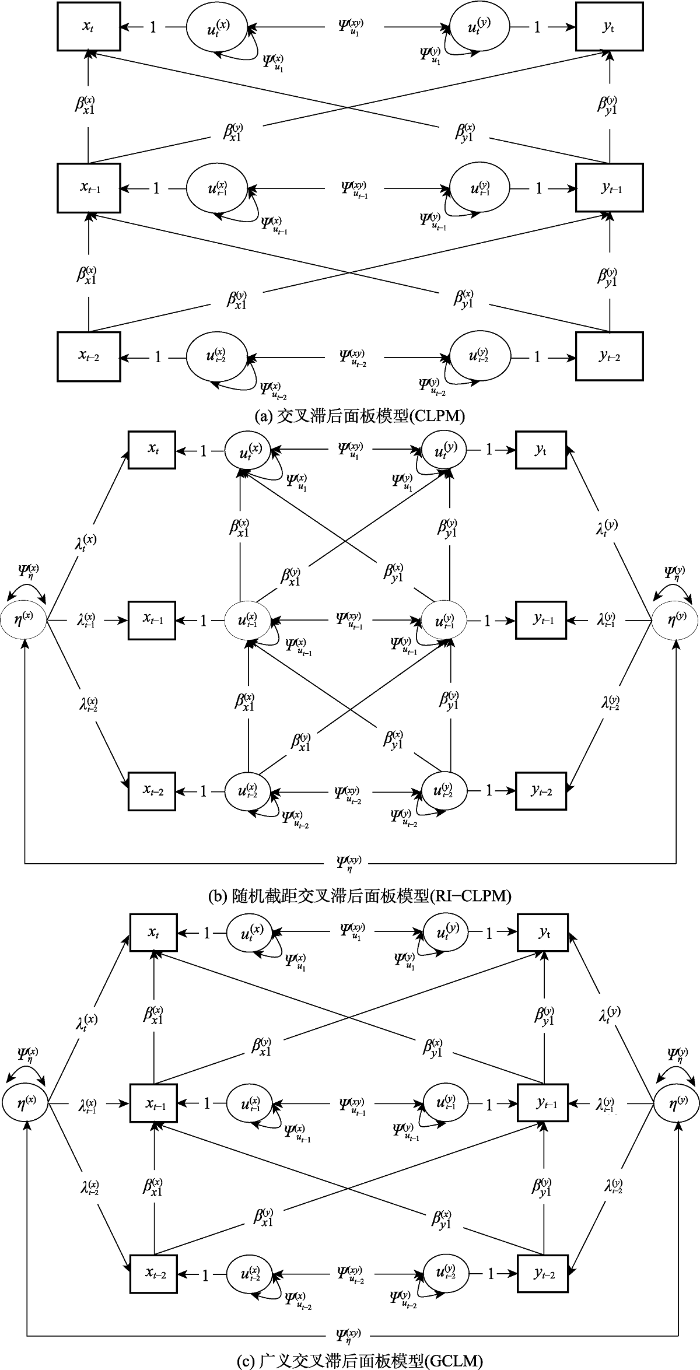
在RI-CLPM和GCLM模型中, 某些参数虽然使用的符号相同, 但其意义(例如,
其中, μ为截距,
RI-CLPM将
如果假设3个变量的追踪数据所研究的“系统”是稳定的, 并且假设在个体内水平变量间的关系不受个体间水平时不变变量的影响, 则可以用RI- CLPM进行处理。但对不同时点变量间相互预测关系的急剧变化(例如从正向预测变为负向预测), RI-CLPM则很难解释, 因为它强调连续性发展以及系统的稳定性。GCLM没有这种限定, 只不过自回归效用和交叉滞后效用为个体间水平变量(
2.4.2 共同方法偏差检验
采用Harman单因子检验分别对3次测量共同方法偏差进行统计检验(周浩, 龙立荣, 2004), 结果显示T1~T3特征根大于1的因子分别是14、20、14个, 第一个因子解释的变异量分别为19.16%、20.66%、21.91%, 均小于40%的临界标准。据此, 可以认为本研究不存在明显的共同方法偏差。
2.4.3 测量等值性检验
为使模型简洁, 本研究使用打包的方法(Little et al., 2002), 使用量表的因子分作为某一时点的指标, 检验了亲社会行为倾向、内化问题和外化问题在3个时点的测量等值性。在评估测量等值性时, 本研究采用了Chen (2007)的建议, 如果CFI和RMSEA指标变化小于0.01, 则视为通过测量等值性检验。如果CFI和RMSEA变化值得出的结论不一致, 则根据RMSEA变化值判断。测量等值性检验结果见表1。表1同时呈现了卡方检验的结果。这个结果仅作为参考, 而不是以其为依据判断测量等值性, 因为有研究者批评卡方值检验对样本量大小过于敏感, 不是可靠的判断指标(Asparouhov et al., 2006)。结果表明, 亲社会行为倾向和外化问题都具有严格等值性, 而内化问题没有通过强等值性检验。进一步的分析表明, 对内化问题而言, T1与T2等值, 但与T3不等值。该结果表明T1和T2的内化问题得分不能与T3的内化问题得分进行个体间比较(因为对不同个体而言尺度不同, 比较也就没有意义), 但是这并不影响个体内分析。
表1 亲社会行为倾向、内化问题和和外化问题的纵向测量等值性检验
| 变量 | Model | χ² | df | CFI | SRMR | RMSEA | 模型比较 | Δχ² | Δdf | p | ΔCFI | ΔRMSEA |
|---|---|---|---|---|---|---|---|---|---|---|---|---|
| 亲社会行为倾向 | ||||||||||||
| M1: 形态等值 | 478.02 | 114 | 0.964 | 0.032 | 0.060 | |||||||
| M2: 弱等值性 | 490.82 | 124 | 0.963 | 0.036 | 0.058 | M2-M1 | 12.80 | 10 | >0.05 | -0.001 | -0.002 | |
| M3: 强等值性 | 562.06 | 134 | 0.957 | 0.035 | 0.060 | M3-M2 | 71.24 | 10 | <0.05 | -0.006 | 0.002 | |
| M4: 严格等值 | 618.75 | 146 | 0.953 | 0.045 | 0.060 | M4-M3 | 56.69 | 12 | <0.05 | -0.004 | 0.000 | |
| 内化问题 | M1: 形态等值 | 29.72 | 15 | 0.998 | 0.014 | 0.028 | ||||||
| M2: 弱等值性 | 34.60 | 19 | 0.998 | 0.016 | 0.026 | M2-M1 | 4.88 | 4 | >0.05 | 0.000 | -0.002 | |
| M3: 强等值性 | 65.90 | 23 | 0.994 | 0.019 | 0.039 | M3-M2 | 31.3 | 4 | <0.05 | -0.004 | 0.013 | |
| M3.1: 强等值性a | 36.59 | 21 | 0.998 | 0.017 | 0.024 | M3.1-M2 | 1.99 | 2 | >0.05 | 0.000 | -0.002 | |
| 外化问题 | M1: 形态等值 | 224.09 | 72 | 0.985 | 0.022 | 0.041 | ||||||
| M2: 弱等值性 | 240.39 | 80 | 0.984 | 0.027 | 0.040 | M2-M1 | 16.3 | 8 | <0.05 | -0.001 | -0.001 | |
| M3: 强等值性 | 313.15 | 88 | 0.978 | 0.032 | 0.045 | M3-M2 | 72.76 | 8 | <0.05 | -0.006 | 0.005 | |
| M4: 严格等值 | 348.34 | 98 | 0.975 | 0.031 | 0.045 | M4-M3 | 35.19 | 10 | <0.05 | -0.003 | 0.000 |
说明:a T1和T2等值, 与T3不等值。
3 结果
3.1 描述性统计和预分析
亲社会行为倾向、内化问题和外化问题的描述性统计和相关统计见表2。以父母受教育程度和收入水平为变量, 采用Little随机缺失值检验法(Little, 1988)检验样本在社会经济地位上是否为完全随机缺失。结果表明(χ² = 50.54, p = 0.54, df = 52, N = 950), 无效样本为完全随机缺失。内化问题的组内相关系数(ICC, intraclass correlation)为0.48 (SE = 0.02, 95% CI = 0.43~0.51), 这表示内化问题48%的方差是组间差异, 52%的方差是组内差异。外化问题的组内相关系数为0.49 (SE = 0.02, 95% CI = 0.45~0.52), 这表示症状49%的方差是组间差异, 51%的方差是组内差异。亲社会行为倾向的组内相关系数为0.37 (SE = 0.02, 95% CI = 0.34~0.41), 这表示症状37%的方差是组间差异, 63%的方差是组内差异。
表2 亲社会行为倾向、内化问题和外化问题的均值、标准差和皮尔逊相关
| 变量 | 1 | 2 | 3 | 4 | 5 | 6 | 7 | 8 | M | SD |
|---|---|---|---|---|---|---|---|---|---|---|
| 1 内化问题T1 | — | 0.77 | 0.56 | |||||||
| 2 内化问题T2 | 0.45 a | — | 0.78 | 0.60 | ||||||
| 3 内化问题T3 | 0.38 | 0.59 | — | 0.76 | 0.61 | |||||
| 4 外化问题T1 | 0.66 | 0.40 | 0.30 | — | 2.26 | 0.66 | ||||
| 5 外化问题T2 | 0.33 | 0.68 | 0.41 | 0.47 | — | 2.36 | 0.69 | |||
| 6 外化问题T3 | 0.36 | 0.48 | 0.67 | 0.44 | 0.56 | — | 2.30 | 0.65 | ||
| 7 亲社会行为倾向T1 | -0.11 | -0.07 | -0.05 | -0.09 | -0.02 | -0.04 | — | 3.62 | 0.67 | |
| 8 亲社会行为倾向T2 | -0.09 | -0.15 | -0.12 | -0.11 | -0.14 | -0.11 | 0.41 | — | 3.68 | 0.68 |
| 9 亲社会行为倾向T3 | -0.08 | -0.10 | -0.22 | -0.06 | -0.08 | -0.11 | 0.29 | 0.43 | 3.65 | 0.68 |
注:a粗体表示在显著性0.05水平上相关显著。
3.2 亲社会行为倾向、内化问题和外化问题发展级联的个体内分析
分别采用CLPM、RI-CLPM和GCLM分析数据, 预测路径包括:内化问题和外化问题的相互预测, 亲社会行为倾向预测内化问题和外化问题, 以及内化问题和外化问题预测亲社会行为倾向。结果显示3个模型与数据的拟合度均在可接受范围, 其中:CLPM拟合指数为χ2 = 68.16, df = 9, CFI = 0.96, RMSEA = 0.087, SRMR = 0.037, AIC = 12368.75,BIC = 12583.12; RI-CLPM拟合指数为χ2 = 36.72, df = 9, CFI = 0.99, RMSEA = 0.060, SRMR = 0.020, AIC = 12325.38, BIC = 12539.76; GCLM拟合指数为χ2 = 10.69, df = 9, CFI = 0.99, RMSEA = 0.015, SRMR = 0.018, AIC = 12296.86, BIC = 12511.24。
从表3结果可以看到, 虽然3个模型数据拟合指标都达到可接受程度, 但是却得到了非常不同的研究结果。从交叉滞后效用上看, CLPM的结果显示T1外化问题可以正向预测T2内化问题(EXT1→ INT2), 而T2内化问题可以正向预测T3内化问题(INT2→EXT3)。但是, 将个体间差异从效用中分离后, RI-CLPM的结果显示仅T2内化问题可以正向预测T3外化问题(INT2→EXT3)。
表3 CLPM、RI-CLPM和GCLM的主要参数
| 效用 | CLPM | RI-CLPM | GCLM | ||||||
|---|---|---|---|---|---|---|---|---|---|
| β | SE | p | β | SE | p | β | SE | p | |
| 自回归效用 | 个体内水平 | ||||||||
| PSO1→PSO2 | 0.41 | 0.03 | <0.001 | 0.21 | 0.07 | 0.002 | 0.11 | 0.03 | <0.001 |
| PSO2→PSO3 | 0.42 | 0.04 | <0.001 | 0.23 | 0.07 | 0.002 | 0.07 | 0.03 | 0.008 |
| EXT1→EXT2 | 0.45 | 0.04 | <0.001 | 0.13 | 0.08 | 0.09 | 0.12 | 0.05 | 0.007 |
| EXT2→EXT3 | 0.44 | 0.04 | <0.001 | 0.14 | 0.07 | 0.036 | 0.08 | 0.05 | 0.089 |
| INT1→INT2 | 0.33 | 0.05 | <0.001 | 0.04 | 0.10 | 0.669 | 0.11 | 0.06 | 0.074 |
| INT2→INT3 | 0.56 | 0.04 | <0.001 | 0.38 | 0.07 | <0.001 | 0.31 | 0.07 | <0.001 |
| 交叉滞后效用 | |||||||||
| INT1→EXT2 | 0.04 | 0.04 | 0.392 | -0.07 | 0.08 | 0.404 | -0.02 | 0.05 | 0.651 |
| PSO1→EXT2 | 0.01 | 0.03 | 0.660 | 0.002 | 0.06 | 0.974 | -0.05 | 0.02 | 0.057 |
| INT2→EXT3 | 0.18 | 0.04 | <0.001 | 0.16 | 0.07 | 0.017 | 0.09 | 0.05 | 0.079 |
| PSO2→EXT3 | -0.02 | 0.03 | 0.651 | -0.06 | 0.05 | 0.302 | -0.06 | 0.03 | 0.015 |
| EXT1→INT2 | 0.18 | 0.05 | <0.001 | 0.12 | 0.08 | 0.117 | 0.06 | 0.05 | 0.214 |
| PSO1→INT2 | -0.03 | 0.04 | 0.497 | -0.02 | 0.07 | 0.726 | -0.07 | 0.02 | 0.004 |
| EXT2→INT3 | 0.03 | 0.04 | 0.458 | -0.03 | 0.05 | 0.554 | -0.07 | 0.05 | 0.158 |
| PSO2→INT3 | -0.03 | 0.03 | 0.363 | -0.05 | 0.05 | 0.318 | -0.03 | 0.02 | 0.143 |
| EXT1→PSO2 | -0.07 | 0.05 | 0.119 | -0.12 | 0.07 | 0.092 | -0.15 | 0.05 | 0.008 |
| EXT2→PSO3 | 0.002 | 0.04 | 0.957 | -0.03 | 0.06 | 0.639 | -0.09 | 0.05 | 0.081 |
| INT1→PSO2 | 0.007 | 0.04 | 0.880 | 0.04 | 0.07 | 0.569 | 0.04 | 0.05 | 0.499 |
| INT2→PSO3 | -0.04 | 0.05 | 0.441 | -0.009 | 0.08 | 0.899 | -0.001 | 0.05 | 0.979 |
| 共变相关效用 | |||||||||
| INT1↔EXT1 | 0.66 | 0.03 | <0.001 | 0.55 | 0.06 | <0.001 | 0.58 | 0.05 | <0.001 |
| INT1↔PSO1 | -0.11 | 0.04 | 0.003 | -0.09 | 0.07 | 0.194 | -0.13 | 0.05 | 0.014 |
| EXT1↔PSO1 | -0.09 | 0.04 | 0.021 | -0.08 | 0.06 | 0.177 | -0.14 | 0.05 | 0.005 |
| INT2↔EXT2 | 0.61 | 0.03 | <0.001 | 0.58 | 0.05 | <0.001 | 0.56 | 0.05 | <0.001 |
| INT2↔PSO2 | -0.12 | 0.04 | 0.007 | -0.12 | 0.06 | 0.050 | -0.13 | 0.06 | 0.04 |
| EXT2↔PSO2 | -0.12 | 0.04 | 0.002 | -0.14 | 0.06 | 0.025 | -0.18 | 0.06 | 0.002 |
| INT3↔EXT3 | 0.58 | 0.03 | <0.001 | 0.57 | 0.04 | <0.001 | 0.53 | 0.04 | <0.001 |
| INT3↔PSO3 | -0.19 | 0.04 | <0.001 | -0.22 | 0.05 | <0.001 | -0.22 | 0.06 | <0.001 |
| EXT3↔PSO3 | -0.07 | 0.04 | 0.095 | -0.09 | 0.05 | 0.074 | -0.07 | 0.05 | 0.147 |
| 个体间水平 | |||||||||
| INT↔EXT | 0.80 | 0.04 | <0.001 | 0.80 | 0.05 | <0.001 | |||
| INT↔PSO | -0.18 | 0.13 | 0.146 | -0.06 | 0.09 | 0.559 | |||
| EXT↔PSO | -0.11 | 0.11 | 0.314 | 0.05 | 0.09 | 0.595 | |||
注:PSO1表示亲社会行为倾向在T1的值, EXT1表示外化问题在T1的值, INT1表示内化问题的值。其它以此类推。加粗数字表示路径系数显著。在RI-CLPM和GCLM模型估计中,
3个模型结果的一致性在于共变相关效用。在个体内水平, 3个时点所测量的内化问题和外化问题均具有较大的相关, 说明在初一到初三阶段(12~15岁)内化问题和外化问题存在较强的协同变化现象。该结果支持研究假设3。就亲社会行为倾向与内化问题和外化问题的共变相关效应, CLPM和GCLM的结果较为一致, 表明亲社会行为倾向与内化问题和外化问题二者之间具有小到中等程度相关(表3)。
在个体内水平, 就亲社会行为倾向与内化问题、外化问题预测关系而言, RI-CLPM和GCLM的结果并不一致。GCLM的结果表明, 亲社会行为倾向可以负向预测内化问题和外化问题(PSO2→EXT3和PSO1→INT2), 该结果部分支持研究假设2。就内化问题和外化问题的相互预测关系而言, GCLM的结果表明二者之间没有相互预测关系。此外, GCLM的结果表明, T1外化问题可以显著负向预测T2亲社会行为倾向(EXT1→PSO2)。
3.3 亲社会行为倾向在内化问题和外化问题发展级联中的作用
为检验模型中加入亲社会行为倾向对内化问题和外化问题相互预测作用的影响, 基于GCLM, 模型中只包括内化问题和外化问题两个变量, 结果表明, 模型数据拟合度良好(χ2 = 17.89, df = 5, CFI = 0.99, RMSEA = 0.055, SRMR = 0.035, AIC = 7361.37, BIC = 7466.17), 且外化问题能显著负向预测内化问题(EXT1→INT2: β = -0.06, SE = 0.03, p = 0.04; EXT2→INT3: β = -0.12, SE = 0.03, p < 0.001), 但内化问题不能显著预测外化问题。该结果支持研究假设1。
3.4 亲社会行为倾向、内化问题和外化问题发展级联的性别差异
由于亲社会行为倾向、内化问题和外化问题发展级联可能存在的性别差异, 我们分别对男生组(n = 517)和女生组(n = 349)用GCLM做进一步分析。结果显示, 男生组(χ2 = 16.14, df = 9, CFI = 0.99, RMSEA = 0.039, SRMR = 0.024, AIC = 7784.08, BIC = 7975.24)和女生(χ2 = 5.04, df = 9, CFI = 1.00, RMSEA = 0.000, SRMR = 0.017, AIC = 4480.55, BIC = 4654.03)组数据模型拟合均在可接受范围。与表3结果不同的是, 在个体内水平, T2内化问题对T3外化问题正向预测作用(INT2→EXT3)仅在女生群体中显著(β = 0.23, SE = 0.08, p = 0.002), 而亲社会行为倾向均不能显著预测内化问题和外化问题; 而在男生群体中, 结果与表3结果类似:亲社会行为倾向可以显著负向预测内化问题和外化问题(PSO2→EXT3: β = -0.08, SE = 0.03, p = 0.02; PSO1→INT2: β = -0.08, SE = 0.03, p = 0.02), T1外化问题可以负向预测T2亲社会行为倾向(EXT1→ POS2: β = -0.21, SE = 0.05, p < 0.001)。这表明在个体内水平, 亲社会行为倾向对内化问题的预测作用、外化问题对亲社会行为倾向的预测作用, 以及内化问题和外化问题的相互作用方式, 对这个年龄阶段男生和女生而言, 具有异质性。该结果部分支持研究假设4。对女生而言, 内化问题可正向预测外化问题。
3.5 亲社会行为倾向不同因子与内化问题和外化问题发展级联
由于亲社会行为倾向的不同因子可能具有不同的影响, 我们用GCLM分别对亲社会行为的6个因子进行分析。结果显示, 公开的(χ2 = 12.64, df = 9, CFI = 0.99, RMSEA = 0.021, SRMR = 0.021, AIC = 14380.18, BIC = 14595.89)、匿名的(χ2 = 11.88, df = 9, CFI = 0.99, RMSEA = 0.019, SRMR = 0.019, AIC = 14089.13, BIC = 14304.84)、依从的(χ2 = 6.50, df = 9, CFI = 1.00, RMSEA = 0.001, SRMR = 0.015, AIC = 13231.66, BIC = 13447.37)、情绪的(χ2 = 9.43, df = 9, CFI = 1.00, RMSEA = 0.007, SRMR = 0.016, AIC = 13668.27, BIC = 13883.97)、紧急的(χ2 = 10.23, df = 9, CFI = 0.99, RMSEA = 0.012, SRMR = 0.017, AIC = 13748.76, BIC = 3964.47)和利他的(χ2 = 12.29, df = 9, CFI = 0.99, RMSEA = 0.020, SRMR = 0.018, AIC = 13680.89, BIC = 13896.60)亲社会行为倾向等6个因子模型数据均拟合良好。由于本研究关心亲社会行为倾向对内化问题和外化问题的交叉滞后效应, 表4中只报告了从亲社会行为倾向到内化问题和外化问题预测路径系数。与表3结果类似的是, T1亲社会行为倾向的6个因子均不能显著预测T2外化问题; 与表3结果不同的是, 除匿名的和紧急的因子, 其它4个因子的结果较为一致, 能显著负向预测内化问题和外化问题, 具有小的效应量。
表4 亲社会行为倾向6个因子GCLM估计个体内水平的交叉滞后效应
| 交叉滞后效用 | 1公开的 | 2匿名的 | 3依从的 | ||||||
|---|---|---|---|---|---|---|---|---|---|
| β | SE | p | β | SE | p | β | SE | p | |
| PSO1→EXT2 | -0.03 | 0.03 | 0.371 | -0.01 | 0.03 | 0.625 | -0.04 | 0.02 | 0.074 |
| PSO2→EXT3 | -0.06 | 0.03 | 0.033 | -0.04 | 0.03 | 0.119 | -0.06 | 0.02 | 0.009 |
| PSO1→INT2 | -0.09 | 0.03 | 0.001 | -0.06 | 0.03 | 0.024 | -0.08 | 0.02 | <0.001 |
| PSO2→INT3 | -0.08 | 0.03 | 0.002 | -0.05 | 0.03 | 0.049 | -0.07 | 0.02 | 0.003 |
| 交叉滞后效用 | 4情绪的 | 5紧急的 | 6利他的 | ||||||
| β | SE | p | β | SE | p | β | SE | p | |
| PSO1→EXT2 | -0.03 | 0.02 | 0.205 | -0.01 | 0.02 | 0.627 | -0.04 | 0.03 | 0.147 |
| PSO2→EXT3 | -0.06 | 0.03 | 0.020 | -0.05 | 0.02 | 0.052 | -0.06 | 0.03 | 0.027 |
| PSO1→INT2 | -0.06 | 0.01 | 0.016 | -0.06 | 0.02 | 0.012 | -0.07 | 0.02 | 0.002 |
| PSO2→INT3 | -0.06 | 0.02 | 0.008 | -0.05 | 0.02 | 0.024 | -0.05 | 0.02 | 0.033 |
注:PSO1表示亲社会行为倾向在T1的值, EXT1表示外化问题在T1的值, INT1表示内化问题的值。其它以此类推。加粗数字表示路径系数显著。
4 讨论
采用为期3年的面板数据, 本研究发现在个体内水平内化问题和外化问题具有较强的协同变化关系, 提示二者之间具有共同的“第三方原因”。在亲社会行为、内化问题和外化问题发展级联模型中, 内化问题和外化问题没有相互的预测关系。进一步分析发现, 发展级联模型中仅有内化问题和外化问题时, 外化问题可以显著负向预测内化问题。就亲社会行为、内化问题和外化问题发展级联模型而言, 仅在女生群体中, T2内化问题可正向预测T3外化问题。在个体内水平, 亲社会行为倾向与内化问题和外化问题具有中等或较弱的协同变化关系, T1亲社会行为倾向可负向预测T2内化问题, T2亲社会行为倾向可负向预测T3外化问题, 具有较弱的预测作用。同时, T1外化问题能负向预测T2亲社会行为倾向, 具有中等的预测作用, 但内化问题不能预测亲社会行为倾向。
CLPM是传统发展心理病理研究的“一匹老马” (Berry & Willoughby, 2017; Hamaker et al., 2015)。当纵向研究只有两个时点的数据时, CLPM仍然不失为一种有价值的分析方法, 可以提供进一步的研究线索。但是, 现在越来越多的纵向研究采集了多时点数据, 因而有可能采用个体内分析方法将个体间效用和个体内效用“分离”, 从而以个体自身为控制, 在个体内水平探索变量之间的相互影响。本研究比较了CLPM、RI-CLPM和GCLM的结果。结果显示, 将个体间效用分离后, 会得出不同甚至截然相反的结论。例如, 如果采信CLPM的结果, 研究者会认为内化问题和外化问题是相互正向预测的关系。也就是说, 外化问题会“转化”为内化问题, 而内化问题又会“转化”为外化问题(EXT1→INT2→ EXT3)。但是, GCLM的结果却表明, 在总样本中, 外化问题和内化问题不具有相互预测关系。由此可见, 混淆个体内效用和个体间效用会严重影响研究结论。
本研究比较了RI-CLPM和GCLM的结果, 二者都是个体内分析模型。RI-CLPM的结果显示T2内化问题可正向预测T3外化问题, 模型中的其它预测路径均没有统计意义上的显著性, 而GCLM则发现了更多具有统计显著性的预测路径。例如, 亲社会行为倾向可显著负向预测内化问题和外化问题, 并且T1外化问题可以显著负向预测T2亲社会行为倾向等。若采信RI-CLPM的结果, 研究者会认为在本研究样本中, 亲社会行为倾向不能预测内化问题和外化问题, 且外化问题不能预测亲社会行为倾向。但是, GCLM的结果却表明, 亲社会行为倾向可以负向预测内化问题和外化问题, 且外化问题可以预测亲社会行为倾向。可见, 不同的个体内分析模型, 同样会带来非常不同的研究结论。
RI-CLPM和GCLM具有不同的假设, 适用于不同的研究问题。如果考虑到心理病理发展级联非连续性, 则GCLM更符合理论假设。本研究结果表明:亲社会行为倾向、内化问题和外化问题3年间测量数据, 其个体内变异量均超过了50%; 并且, 总体来看, 3个研究变量自回归效用较弱。这些结果与传统上对早期青少年的认识一致, 提示亲社会行为倾向、内化问题和外化问题在青少年早期群体中发生了突然的、急剧的变化。采用RI-CLPM分析数据并将随机截距解释为稳定的时不变变量(类特质变量)就忽视了这一点, 从而可能带来估计的偏差。此外, 所有的模型拟合指标都提示GCLM优于CLPM和RI-CLPM。这些证据都支持采信GCLM的结果。我们同时呈现了CLPM和RI-CLPM的结果。这样, 3个模型的共同结果可更加确证, 而对不同的结果, 我们则需要谨慎考虑不同模型的适用条件。
基于GCLM的进一步分析表明, 在女生群体中, T2内化问题可以正向预测T3外化问题(INT2→ EXT3), 具有中等的效应量。这与文献中的部分研究一致(Lee & Stone, 2012; Weeks et al., 2016), 但与大多数文献的结果不一致, 即只有外化问题能预测内化问题(例如, Moilanen et al., 2010; Murray et al., 2020; van Lier et al., 2012)。这可能与分析方法有关, 因为基于CLPM的发展级联模型往往会比较所有可能的预测路径(例如, 用T1变量预测T3变量), 并且统计上不显著的预测路径最终不予保留。基于CLPM的发展级联模型还混淆了个体内和个体间的效应。除了将个体内和个体间效应分离外, 个体内分析方法常假设某个时点的变化会通过自回归效应和某种交叉滞后效应影响下一个时点的变量, 所以, 个体内分析模型通常只会用T变量预测T+1变量。依据不同的数值模拟条件, 研究发现基于CLPM的建模方法会给变量间相互影响的统计结果带来不可预知的影响, 不显著的效应可能变得显著, 显著的效应也可能变得不显著, 还可能改变显著效应的方向等(Hamaker et al., 2015)。毕竟, 将个体间效用分离的统计方法应用于发展级联研究也不过是近五、六年的事(Berry & Willoughby, 2017; Hamaker et al., 2015)。
此外, 在女生群体中, 亲社会行为倾向不能预测内化问题和外化问题。这些结果提示, 对处于青少年早期的女生而言, 外化问题(本研究中为攻击性)可能是内化问题(本研究中为抑郁、焦虑和压力)的转换或掩饰(Carlson & Cantwell, 1980), 与消极的自我概念和低自尊有关 (Lee & Stone, 2012), 其本质仍为与过度自我调节有关的内化问题(Flynn et al., 2015; Nantel-Vivier et al., 2014)。在女生群体中, 亲社会行为倾向不能预测内化问题和外化问题, 可能与我国的文化现实有关, 即家庭和学校对处于青春期的男生和女生教养方式和社会期望不同, 从而产生亲社会行为倾向对内化问题和外化问题预测关系的性别差异。这些可能性需要在中国的儿童青少年群体中做进一步的探究。
值得注意的是, 在本研究样本的男生群体中, 内化问题和外化问题没有相互预测的关系, 这与文献中已有的结果不一致。例如, 在韩国儿童中的研究表明, 8~9岁的内化问题可负向预测12~13岁外化问题(Lee & Stone, 2012); 最近一项研究对瑞士儿童追踪调查数据进行个体内分析, 结果表明13岁的外化问题可以负向预测15岁的内化问题(Murray et al., 2020)。在这两项研究中, 除以上这些负向预测关系外, 内化问题和外化问题都具有相互的正向预测关系。我们设想, 在前述建模方法对统计结果的影响之外, 其原因应首先考虑模型中亲社会行为倾向的影响。在青少年早期的男生群体中, 亲社会行为倾向及其相关自我调节能力和社会认知加工偏好是内化问题和外化问题相互关系的共同影响因素。结果显示, 在模型中加入亲社会行为倾向后, 内化问题和外化问题的相互预测关系就消失了; 而模型中没有亲社会行为倾向时, 外化问题可显著负向预测内化问题。该结果提示有某种非连续性发展的可能。在儿童期, 内化问题和外化问题更有可能具有协同变化关系和相互影响的关系(Memmott-Elison et al., 2020)。但到了青少年早期, 二者之间的关系就变得较为复杂, 内化问题和外化问题可能分化为两条不同的心理病理发展途径; 或伴随着亲社会行为的发展, 内化问题和外化问题会回到正常发展的轨迹中去(Crittenden & Landini, 2011)。虽然这些可能性需要进一步检验, 但该结果具有一定的启示意义, 提示亲社会行为发展是内化问题和外化问题风险的重要保护因素, 也是对内化问题和外化问题可能的干预路径之一。本研究结果同时提示对青少年早期的心理健康工作应该采取性别差异化的促进方案。
基于GCLM的进一步分析表明, 在亲社会行为倾向的6个因子中, 有4个因子对下一年的内化问题和外化具有较弱的负向预测作用, 这与过去的研究结论一致(Memmott-Elison et al., 2020)。但是, 匿名的和紧急的亲社会行为倾向这两个因子不能预测外化问题。只有T1匿名的亲社会行为倾向能负向预测T2的内化问题。这两个因子是中文版亲社会行为倾向测量(PTM)新增的两个因子(寇彧 等, 2007)。这或许和亲社会行为具有不同类型, 而不同类型的亲社会行为, 其自我调节和动机过程不同有关(Davidov et al., 2016; Paulus, 2018)。例如, 为减轻他人痛苦做出的亲社会行为倾向和个体在情绪被唤起情境下做出的亲社会行为倾向, 其内在动机过程和自我调节过程可能不同。有研究表明, 个人能力、特质性因素不能预测我国青少年的亲社会行为, 而社会影响因素却可以(Lai et al., 2015)。又比如, 亲社会行为的不同对象, 其适应意义也不同, 对陌生人、熟人和同伴的亲社会行为行为对内化问题和外化问题具有不同的影响(Padilla-Walker et al., 2015)。此外, 我国的学校班级环境较为重视集体秩序, 父母教养中也较为重视他人视角或社会视角, 表明其它源自文化传统和社会现实的因素能对不同情境下的亲社会行为倾向做出更好的解释(Chen et al., 2021; Lai et al., 2015)。该结果提示, 进一步的研究应该考虑我国的文化传统和社会现实因素, 比如:在中国青少年群体中探讨什么类型的亲社会行为、亲社会行为过程的什么要素对内化问题和外化问题有更为实质性的影响。
本研究的一个优势是采用个体内的分析方法, 克服了传统CLPM的不足, 得到的结果更有可能反映一种因果关系。其特点是以个体自身为控制, 这样就排除了稳定的组间变量的影响, 包括未测量的或很难测量的组间变量, 例如基因、环境、基因环境交互作用以及特质等等。本研究的另外一个优势是比较了RI-CLPM和GCLM两种个体内的分析方法, 并从理论概念角度讨论了模型建构方法的合理性和使用范围。
其中, 有两个难点值得注意。一是如何处理时变变量的影响。从理论上和研究证据上讲, 亲社会行为、内化问题和外化问题的发展级联在个体内水平可能存在相互影响的关系, 但是采用GCLM有可能弱化二者之间的关系。在个体内分析路径系数相对较小的情况下(Memmott-Elison et al., 2020), 则有风险拒绝实际上存在的效用。二是如何处理共同的“第三方原因”的影响, 以及“第三方原因”与变量在个体内水平的复杂交互作用。本研究的结果表明在个体内水平, 内化问题和外化问题共变效用较大, 说明有许多重要的“第三方变量”是二者关系的共同原因。今后的研究需要在亲社会行为倾向与内化问题、外化问题发展级联的理论模型建构上付出更多努力。这是本研究的一个不足。
本研究的另外一个不足是没有采用行为指标测量亲社会行为, 全部采用自评指标而没有采用他评指标来测量内化问题和外化问题, 数据来源较为单一, 指标也较为单一, 这对研究结论会有潜在影响。此外, 本研究仅仅考察了初一到初三学生(约12~15岁)青少年亲社会行为倾向、内化问题和外化问题的发展级联, 研究结论并不能推论至这个年龄段之外的青少年群体。最后, 本研究的样本本身也缺乏足够的代表性。如果个体间存在稳定的差异, 在一定程度上讲, 样本代表性的影响并不大。但是, 考虑到青少年群体个体间差异的动态发展特点, 以及“第三方原因”对亲社会行为、内化问题和外化问题发展级联的复杂影响, 样本的不同还是会对研究结果产生潜在的影响。
5 结论
本研究表明:(1)青少年早期亲社会行为倾向的发展可降低内化问题和外化问题, 不同类型的亲社会行为倾向对内化问题和外化问题的预测作用不同。(2)青少年早期亲社会行为倾向、内化问题和外化问题的发展级联具有性别差异。(3)广义交叉滞后面板模型(GCLM)更符合发展级联模型的理论描述, 能兼顾青少年早期发展连续性和非连续的特点, 适合于分析青少年早期的发展级联问题。
致谢
诚挚感谢主编和匿名审稿人专业又细致的评审意见, 感谢湖北省天门华泰中学和荆州郢都中学在问卷调查中提供的支持, 感谢美国北德克萨斯大学王佳智教授(美国)在英文摘要修改中给予的协助。
参考文献
Maximum likelihood for cross-lagged panel models with fixed effects
Robust chi square difference testing with mean and variance adjusted test statistics
On the practical interpretability of cross-lagged panel models: Rethinking a developmental workhorse
DOI:10.1111/cdev.12660 URL [本文引用: 2]
Developmental transitions among affective and behavioral disorders in adolescent boys
DOI:10.1111/j.1469-7610.2005.00422.x URL [本文引用: 1]
The development of a measure of prosocial behaviors for late adolescents
DOI:10.1023/A:1014033032440 URL [本文引用: 2]
Unmasking masked depression in children and adolescents
DOI:10.1176/ajp.137.4.445 URL [本文引用: 2]
Chinese parents’ comparisons of siblings and adolescents’ internalizing and externalizing problems
DOI:10.1017/S095457942000022X URL [本文引用: 1]
Sensitivity of goodness of fit indexes to lack of measurement invariance
DOI:10.1080/10705510701301834 URL [本文引用: 1]
Investigating genetic and environmental contributions to adolescent externalizing behavior in a collectivistic culture: A multi-informant twin study
DOI:10.1017/S0033291714003109
URL
PMID:25572795
[本文引用: 1]

Little is known about the etiology of adolescents' externalizing behavior (Ext) in collectivistic cultures. We aimed to fill this gap by investigating the genetic and environmental influences on Ext in Chinese adolescents. The etiological heterogeneity of aggression (AGG) and rule breaking (RB) was also examined.The study sample included 908 pairs of same-sex twins aged from 10 to 18 years (mean = 13.53 years, s.d. = 2.26). Adolescents' Ext were assessed with the Achenbach System of Empirically Based Assessment including Child Behavior Checklist, Teacher Report Form, and Youth Self-Report.Univariate genetic analyses showed that genetic influences on all measures were moderate ranging from 34% to 50%, non-shared environmental effects ranged from 23% to 52%, and shared environmental effects were significant in parent- and teacher-reported measures ranging from 29% to 43%. Bivariate genetic analyses indicated that AGG and RB shared large genetic influences (r g = 0.64-0.79) but moderate non-shared environmental factors (r e = 0.34-0.52).Chinese adolescents' Ext was moderately influenced by genetic factors. AGG and RB had moderate independent genetic and non-shared environmental influences, and thus constitute etiologically distinct dimensions within Ext in Chinese adolescents. The heritability of AGG, in particular, was smaller in Chinese adolescents than suggested by previous data obtained on Western peers. This study suggests that the collectivistic cultural values and Confucianism philosophy may attenuate genetic potential in Ext, especially AGG.
The development of depression in children and adolescents
In recent decades, research on child and adolescent depression has proliferated. Currently, attention in the field is directed toward examining the epidemiology, causes, course, sequelae, and treatment response of children at risk for developing or presently experiencing depressive disorders. In this article, a developmental psychopathology approach is used to elucidate the development of depressive disorders, the diverse pathways that evolve, and the processes that contribute to varied outcomes. The developmental psychopathology perspective underscores the importance of moving beyond the identification of isolated aberrations in psychological and biological components of depressive presentations to the understanding of how those components have evolved and how they are integrated within and transact across biological, psychological, and social systems. Implications for prevention and intervention are addressed as is the importance of increasing the public awareness of depressive disorders and reducing the social stigma that interfere with the attainment of treatment for depressed persons.
Anxiety and depression during childhood and adolescence: Testing theoretical models of continuity and discontinuity
DOI:10.1007/s10802-017-0370-x URL [本文引用: 2]
The motivational foundations of prosocial behavior from a developmental perspective-evolutionary roots and key psychological mechanisms: Introduction to the special section
DOI:10.1111/cdev.12639
URL
PMID:28262938
[本文引用: 2]
Prosocial behavior is versatile, multifaceted, and complex. This special section seeks to advance coherent, integrative understanding of prosocial development by addressing this topic through the prism of motivations. This conceptual Introduction presents key ideas that provide a framework for thinking about motivation for prosocial behavior and its development. It outlines the evolutionary roots of prosocial behavior, underscoring the interdependent roles of nature and nurture. This is followed by a discussion of several key psychological mechanisms reflecting different motivations for prosocial action (empathy for a distressed other, concern about another's goal, desire to act in accordance with internalized prosocial norms, and guilt). We discuss the critical components of each motivation and highlight pertinent contributions of the special section articles.© 2016 The Authors. Child Development © 2016 Society for Research in Child Development, Inc.
Prosocial behavior and childhood trajectories of internalizing and externalizing problems: The role of neighborhood and school contexts
DOI:10.1037/dev0000076 URL [本文引用: 2]
Prosocial behavior: Long‐term trajectories and psychosocial outcomes
DOI:10.1111/sode.12100 URL [本文引用: 2]
Analysis on pupils' current mental health situation and their guardians' attitude in eight provinces in China
我国八省小学生心理状况及家长对其评价分析
Internalizing problems during adolescence
In R. M. Lerner, L. Steinberg (Eds.), Handbook of adolescent psychology: Individual bases of adolescent development (Vol. 1, 3rd ed. pp. 642-682). New York: John Wiley & Sons Inc. https://doi.org/10.1002/9780470479193.adlpsy001020
A critique of the cross-lagged panel model
DOI:10.1037/a0038889
URL
PMID:25822208
[本文引用: 4]
The cross-lagged panel model (CLPM) is believed by many to overcome the problems associated with the use of cross-lagged correlations as a way to study causal influences in longitudinal panel data. The current article, however, shows that if stability of constructs is to some extent of a trait-like, time-invariant nature, the autoregressive relationships of the CLPM fail to adequately account for this. As a result, the lagged parameters that are obtained with the CLPM do not represent the actual within-person relationships over time, and this may lead to erroneous conclusions regarding the presence, predominance, and sign of causal influences. In this article we present an alternative model that separates the within-person process from stable between-person differences through the inclusion of random intercepts, and we discuss how this model is related to existing structural equation models that include cross-lagged relationships. We derive the analytical relationship between the cross-lagged parameters from the CLPM and the alternative model, and use simulations to demonstrate the spurious results that may arise when using the CLPM to analyze data that include stable, trait-like individual differences. We also present a modeling strategy to avoid this pitfall and illustrate this using an empirical data set. The implications for both existing and future cross-lagged panel research are discussed.(c) 2015 APA, all rights reserved).
Prosocial and coercive configurations of resource control in early adolescence: A case for the well-adapted machiavellian
DOI:10.1353/mpq.2003.0013 URL [本文引用: 1]
Cutoff criteria for fit indexes in covariance structure analysis: Conventional criteria versus new alternatives
DOI:10.1080/10705519909540118 URL [本文引用: 1]
Adolescent mental health: Prevention and treatment programs
Adolescent mental health represents a neglected area of research. Mental health objectives include the promotion of optimal functioning as well as the prevention and reduction of maladaptive functioning. This article examines behaviors and conditions that place adolescents at risk for adverse outcomes and the urgent need for prevention and treatment to promote adaptive functioning. The current status of prevention and treatment programs is discussed along with critical issues including the interrelation and contribution of both prevention and treatment; the interplay of basic and applied research; and the need to extend existing interventions as well as to devise new models to address underserved, understudied, and high-risk populations. Research on the role of adolescent development, paths toward adjustment and maladjustment, and special opportunities that adolescence presents for intervention are also discussed.
Cross-lagged panel correlation: A test for spuriousness
DOI:10.1037/0033-2909.82.6.887 URL [本文引用: 1]
Trajectories of prosocial behavior and physical aggression in middle childhood: Links to adolescent school dropout and physical violence
DOI:10.1111/j.1532-7795.2006.00500.x URL [本文引用: 1]
Revisioning prosocial tendencies measure for adolescent
青少年亲社会倾向量表的修订
Conceptual representation of early adolescents’ prosocial behavior
青少年亲社会行为的概念表征研究
Individual and social predictors of prosocial behavior among Chinese adolescents in Hong Kong
A multivariate model of gender differences in adolescents' internalizing and externalizing problems
Gender differences observed in interpersonal and self-critical vulnerabilities, reactivity to stressful life events, quality of relationships, and self-concepts inform a multivariate theoretical model of the moderating effects of gender on internalizing and externalizing problems in adolescence. To test this model, data were collected in a 1-year prospective study from an ethnically diverse sample of 460 middle school students. Increases in girls' internalizing symptoms, compared with boys', were partly explained by greater stability in girls' interpersonal vulnerabilities and greater magnitude in coefficients linking girls' relationships with parents and peers and internalizing problems. Boys' risks for externalizing problems, compared with girls', were partly explained by the greater stability in boys' vulnerability to self-criticism. Coefficients for most pathways in the model are similar for boys and girls.
Co-occurring internalizing and externalizing behavioral problems: The mediating effect of negative self-concept
DOI:10.1007/s10964-011-9700-4 URL [本文引用: 4]
A test of missing completely at random for multivariate data with missing values
DOI:10.1080/01621459.1988.10478722 URL [本文引用: 1]
To parcel or not to parcel: Exploring the question, weighing the merits
DOI:10.1207/S15328007SEM0902_1 URL [本文引用: 1]
Developmental cascades
Psychometric properties of a Chinese version of the Buss-Warren aggression questionnaire
DOI:10.1016/j.paid.2007.10.037 URL [本文引用: 1]
Fixed effects models versus mixed effects models for clustered data: Reviewing the approaches, disentangling the differences, and making recommendations
DOI:10.1037/met0000182
URL
PMID:29863377
[本文引用: 1]
Clustered data are common in many fields. Some prominent examples of clustering are employees clustered within supervisors, students within classrooms, and clients within therapists. Many methods exist that explicitly consider the dependency introduced by a clustered data structure, but the multitude of available options has resulted in rigid disciplinary preferences. For example, those working in the psychological, organizational behavior, medical, and educational fields generally prefer mixed effects models, whereas those working in economics, behavioral finance, and strategic management generally prefer fixed effects models. However, increasingly interdisciplinary research has caused lines that separate the fields grounded in psychology and those grounded in economics to blur, leading to researchers encountering unfamiliar statistical methods commonly found in other disciplines. Persistent discipline-specific preferences can be particularly problematic because (a) each approach has certain limitations that can restrict the types of research questions that can be appropriately addressed, and (b) analyses based on the statistical modeling decisions common in one discipline can be difficult to understand for researchers trained in alternative disciplines. This can impede cross-disciplinary collaboration and limit the ability of scientists to make appropriate use of research from adjacent fields. This article discusses the differences between mixed effects and fixed effects models for clustered data, reviews each approach, and helps to identify when each approach is optimal. We then discuss the within-between specification, which blends advantageous properties of each framework into a single model. (PsycINFO Database Record (c) 2019 APA, all rights reserved).
Associations between prosocial behavior, externalizing behaviors, and internalizing symptoms during adolescence: A meta-analysis
DOI:S0140-1971(20)30012-9
URL
PMID:32087386
[本文引用: 9]
The purpose of this study was to conduct a meta-analysis investigating the consistency and strength of relations between prosocial behavior, externalizing behaviors, and internalizing symptoms from preadolescence (i.e., 1-9 years) to late adolescence (i.e., 19-25 years). This study directly addresses inconsistencies and gaps in the available literature by providing the field with a detailed, synthesized description of these associations.Fifty-five studies met the inclusion criteria, containing 742 independent correlational effect sizes. Statistical information and other study information was coded and entered into Comprehensive Meta-analysis III software, which was used to analyze results.Results showed that higher levels of prosocial behavior were significantly associated with lower levels of externalizing behaviors, as expected. Additionally, more reported prosocial behavior was related to less reported internalizing symptoms. Follow-up analyses revealed specific relationships between prosocial behavior and aggression, deviant peer association, risky sexual behavior, substance use, delinquency/general externalizing behavior, depression, and general internalizing behaviors (i.e., emotional problems, negative emotionality). A variety of moderators of these associations were considered, including age and sex.Findings are discussed in the context of the broader research literature, weaknesses in the field are noted, and numerous meaningful directions for future research are presented.Copyright © 2020 The Foundation for Professionals in Services for Adolescents. Published by Elsevier Ltd. All rights reserved.
Effectiveness of prosocial behavior interventions:A meta-analysis
In P. Gargiulo, H. Mesones Arroyo (Eds.), Psychiatry and neuroscience update. Springer, Cham. https://doi.org/10.1007/978-3-319-95360-1_21
Developmental cascades: Externalizing, internalizing, and academic competence from middle childhood to early adolescence
DOI:10.1017/S0954579410000337
URL
PMID:20576184
[本文引用: 1]
The current study was initiated to increase understanding of developmental cascades in childhood in a sample of at-risk boys (N = 291; 52% White). Mothers, teachers, and boys reported on boys' externalizing problems, internalizing difficulties, and academic competence. Consistent with hypotheses regarding school-related transitions, high levels of externalizing problems were associated with both low levels of academic competence and high levels of internalizing problems during the early school-age period, and with elevations in internalizing problems during the transition to adolescence. Low levels of academic competence were associated with high levels of internalizing problems in middle childhood, and with high levels of externalizing problems during the transition from elementary school to middle school. Shared risk factors played a minimal role in these developmental cascades. Results suggest that there are cascading effects of externalizing problems and academic competence in childhood and early adolescence, and that some cascading effects are more likely to occur during periods of school-related transitions. Implications of developmental cascade effects for research and intervention are discussed.
Within- person analysis of developmental cascades between externalising and internalising problems
DOI:10.1111/jcpp.13150 URL [本文引用: 2]
Developmental association of prosocial behaviour with aggression, anxiety and depression from infancy to preadolescence
DOI:10.1111/jcpp.12235 URL [本文引用: 2]
Does helping keep teens protected? Longitudinal bidirectional relations between prosocial behavior and problem behavior
DOI:10.1111/cdev.12411
URL
PMID:26511897
[本文引用: 2]
The current study examined bidirectional, longitudinal links between prosocial and problem behavior. Participants (N = 500) were recruited from a Northwestern city in the United States and assessed for 3 consecutive years from 2009 to 2011 (M(age) of youth at Time 1 = 13.32, SD = 1.05; 52% girls; 67% European American, 33% single-parent families). Results suggested that effects of earlier prosocial behavior toward family and strangers were predictive of fewer problem behaviors 2 years later, while results for prosocial behavior toward friends were more mixed. Results also suggested depression predicted lower prosocial behavior toward family members and anxiety predicted higher prosocial behavior toward friends. Findings show a complex pattern of relations that demonstrate the need to consider targets of helping.© 2015 The Authors. Child Development © 2015 Society for Research in Child Development, Inc.
Associations between prosocial and problem behavior from early to late adolescence
The multidimensional nature of early prosocial behavior: A motivational perspective
DOI:10.1016/j.copsyc.2017.09.003 URL [本文引用: 3]
Associations of parenting dimensions and styles with externalizing problems of children and adolescents: An updated meta-analysis
DOI:10.1037/dev0000295
URL
PMID:28459276
[本文引用: 1]
The present meta-analysis integrates research from 1,435 studies on associations of parenting dimensions and styles with externalizing symptoms in children and adolescents. Parental warmth, behavioral control, autonomy granting, and an authoritative parenting style showed very small to small negative concurrent and longitudinal associations with externalizing problems. In contrast, harsh control, psychological control, authoritarian, permissive, and neglectful parenting were associated with higher levels of externalizing problems. The strongest associations were observed for harsh control and psychological control. Parental warmth, behavioral control, harsh control, psychological control, autonomy granting, authoritative, and permissive parenting predicted change in externalizing problems over time, with associations of externalizing problems with warmth, behavioral control, harsh control, psychological control, and authoritative parenting being bidirectional. Moderating effects of sampling, child's age, form of externalizing problems, rater of parenting and externalizing problems, quality of measures, and publication status were identified. Implications for future research and practice are discussed. (PsycINFO Database Record(c) 2017 APA, all rights reserved).
The structure and stability of externalizing and internalizing problem behavior during early adolescence
Adolescent personality pathology and the alternative model for personality disorders: Self development as nexus
On the differences between general cross- lagged panel model and random-intercept cross-lagged panel model: Interpretation of cross-lagged parameters and model choice
DOI:10.1080/10705511.2020.1764360 URL [本文引用: 1]
Peer victimization, poor academic achievement, and the link between childhood externalizing and internalizing problems
DOI:10.1111/j.1467-8624.2012.01802.x
URL
PMID:22716904
[本文引用: 1]
This study explored whether early elementary school aged children's externalizing problems impede academic functioning and foster negative social experiences such as peer victimization, thereby making these children vulnerable for developing internalizing problems and possibly increasing their externalizing problems. It also explored whether early internalizing problems contributed to an increase in externalizing problems. The study examined 1,558 Canadian children from ages 6 to 8years. Externalizing and internalizing problems, peer victimization, and school achievement were assessed annually. Externalizing problems lead to academic underachievement and experiences of peer victimization. Academic underachievement and peer victimization, in turn, predicted increases in internalizing problems and in externalizing problems. These pathways applied equally to boys and girls. No links from internalizing to externalizing problems were found.© 2012 The Authors. Child Development © 2012 Society for Research in Child Development, Inc.
Cross-cultural validation of the depression anxiety stress scale-21 in China
Developmental pathways linking childhood and adolescent internalizing, externalizing, academic competence, and adolescent depression
DOI:10.1016/j.adolescence.2016.05.009 URL [本文引用: 2]
The relationship between personality types and prosocial behavior and aggression in Chinese adolescents
DOI:10.1016/j.paid.2016.02.002 URL [本文引用: 1]
Statistical remedies for common method biases
共同方法偏差的统计检验与控制方法
Relational and physical aggression, prosocial behavior, and peer relations: Gender moderation and bidirectional associations
DOI:10.1177/0272431605279841 URL [本文引用: 1]
From data to causes I: Building a general cross-lagged panel model (GCLM)
DOI:10.1177/1094428119847278 URL [本文引用: 2]


