


1 前言
音乐情绪(Musical emotion)是由音乐刺激诱发的情绪反应, 主要包括主观体验、生理唤醒、大脑激活、行为倾向以及情绪调节等成分(Juslin & Västfjäll, 2008)。音乐刺激除了能够引发快乐、悲伤、恐惧等基本情绪以外, 还能够引发诸如好奇感、抒情感、超越感等特定的音乐审美情绪(Zentner et al., 2008)。音乐情绪的加工主要涵盖了音乐情绪体验(感觉)和音乐情绪识别(知觉)两大部分(Kallinen & Ravaja, 2006), 而音乐情绪识别能力是对音乐所蕴含或想要表达的情绪作出判断的能力(Koelsch, 2014), 是个体社会认知能力发展的表现之一(Allgood & Heaton, 2015; Trehub et al., 2015)。个体通过对音乐作品中蕴含的情绪进行判断和理解, 去感受作品创作者或表演者的心理感受, 借助音乐作品实现一定程度的社会认知与社会理解; 并且, 音乐情绪识别能力是音乐欣赏的前提, 也是利用音乐开展情绪调节的基础(Gold et al., 2004)。如果音乐情绪识别能力受损, 音乐的审美价值、精神价值和实用价值都将降低, 也会影响个体的情绪理解和情绪交流(Kragness & Trainor, 2019)。
知共情两种成分(Maffei et al., 2019)。情绪共情与分享他人的情绪感受有关, 而认知共情与理解他人内部状态的能力有关, 涉及心理理论、观点采择等(Fan et al., 2011; Shamay-Tsoory, 2011)。共情能力强的个体更容易受到情绪的感染, 对情绪更敏感。有研究发现, 共情能力较高的个体对音乐刺激的加工更为深入, 对其中蕴含的情绪的感知能力更强, 即高共情个体的情绪识别能力更强(Steele, 2019), 尤其是对悲伤情绪的识别更准确(Eerola et al., 2016; Kawakami & Katahira, 2015; Wöllner, 2012)。Sittler等(2019)使用人际反应指针量表对共情能力进行评估, 被试在听完20个音乐片段之后报告了他们听音乐时感知到的情绪。计算共情量表各个子维度与情绪效价之间的相关后发现, 具有较高的共情能力(在子维度得分较高的)的被试能够更准确地识别和评价悲伤歌曲的情绪。
关于共情与音乐情绪识别之间关系的研究处于探索阶段, 研究的音乐类型也还不够广泛。首先, 关于共情与情绪识别之间关系的研究多采用图片、语音等材料, 对音乐的使用较少(Israelashvili et al., 2020)。崔芳和罗跃嘉(2009)考察不同共情能力个体对面孔情绪的识别情况, 发现高共情被试在N1, P2和后部的LPC (late positive component)成分上都表现出了明显的负性偏向, 负性情绪面孔诱发的波幅显著大于正性面孔, 但低共情被试对正、负性情绪面孔的反应没有差异。其次, 关于共情与音乐的研究中, 材料多为西方音乐, 研究结论的普遍性有待其他类型音乐研究的验证。Miu和Balteş (2012)测量了被试对西方古典音乐的情绪唤起及生理指标, 发现与低共情相比, 高共情条件下听悲伤内容的咏叹调促进了怀旧情绪的识别, 降低皮肤电水平; 而听快乐内容的歌曲也促进力量感情绪, 增加了呼吸率, 共情影响了情绪识别时的生理唤醒。Balteş和Miu (2014)进行了关于共情与音乐感受的现场实验, 以歌剧表演《蝴蝶夫人》作为音乐材料, 发现较高的共情水平与“崇高”和“不安”这两种音乐情绪的增加有关。如果想要探索共情对不同文化背景下的音乐情绪识别的可能影响, 就需要增加新的音乐类型, 比如具有独特韵味的中国民族音乐就是很好的选择。中国民族音乐与西方音乐在结构上最典型的区别体现在调式上, 西方音乐多采用七声音阶的大小调式体系, 而中国民族音乐多采用五声音阶的五声调式体系(宫商角徵羽), 调式作为一个文化特异性的线索, 是开展共情与音乐情绪识别研究的重要变量。第三, 以往研究多采用行为指标, 无法反映共情影响音乐情绪识别的内在神经机制。而近年来逐渐增加的脑成像研究, 也只是从空间角度分析了音乐对不同共情水平个体的大脑激活情况(Wallmark et al., 2018), 关于共情在音乐情绪识别的时间进程上的作用的研究还较为缺乏。ERP (event related potentials, 事件相关电位)技术具有较高的时间分辨率, 是探索情绪加工时间进程的有效工具, 但以往关于共情的ERP研究主要集中于疼痛共情领域(Cheng et al., 2014; Zhu et al., 2019), 只有少数研究了情绪加工。Steele (2019)使用stroop任务研究了音乐才能、共情与情绪韵律敏感度的关系, 发现当快乐韵律跟随悲伤音乐而不是快乐音乐时, P50降低, N400增加, 启动效应只出现在悲伤情绪的音乐之后。类似的研究证据还需要大量积累, 才能有效的探讨共情与音乐情绪识别的关系。
本研究采用ERP技术, 通过跨通道情绪启动范式, 考察高共情和低共情大学生在对中国民族五声调式音乐进行音乐情绪识别时的行为反应差异及神经反应差异。跨通道情绪启动范式可以作为一种内隐的情绪识别任务(赵怀阳 等, 2019)。其中, 音乐材料是启动刺激, 面孔图片是目标刺激, 两种刺激具有不同的情绪效价(积极或消极)。被试的任务是对音乐刺激与图片刺激的情绪一致性进行判断, 记录反应时(RT)和正确率(ACC)。如果音乐刺激形成了启动效应, 即在其与图片刺激的情绪色彩一致时, 影响了被试对图片的判断, 则说明音乐刺激已经得到了加工, 音乐情绪的类型得到了识别。在行为指标上, 进行一致性判断的反应时越短, 意味着对情绪类型的判断越迅速, 音乐情绪识别的潜在能力可能较强。以往研究发现, 跨通道启动范式会诱发较为明显的N400和LPC成分。N400一般在刺激呈现之后约250~500 ms的时间窗口出现, 反映了对情绪意义的整合以及情绪信息的匹配加工过程(Hamm et al., 2002; Kamiyama et al., 2013)。情绪不一致条件通常比一致条件诱发了更大的N400 (Kamiyama et al., 2013)。LPC一般出现在刺激之后约400~1000 ms的时间窗口(Langeslag & van Strien, 2010; Liu et al., 2019a), 反映了更高阶的情绪意义的理解过程。N400和LPC这两种成分的幅值大小意味着大脑在情绪加工的晚期阶段分配给情绪刺激注意资源数量不同(Hajcak et al., 2013)。如果共情能力导致对音乐刺激的加工深度不同, 极有可能反映在不同注意资源的分配上, 因此, 这两种成分是较为合适的测量不同共情能力个体音乐情绪识别差异的电生理指标。此外, 以往关于共情的ERP研究表明, P2是中期阶段与注意分配有关的额部成分(梁宗保 等, 2019), 那高、低共情能力的个体在识别音乐情绪的中期阶段是否会体现出P2成分的差异呢?因此, P2可作为本研究中的一个探索性指标。最后, 使用了面孔材料的实验设计几乎都会诱发N170这个面孔特异性的成分, N170成分也是本研究结果需要关注的成分之一。
本研究提出如下假设。第一, 在情绪判断阶段, 与低共情组被试相比, 高共情组被试对音乐情绪识别更准确, 对一致不一致判断更容易, P2和N400成分的波幅更小; 第二, 在情绪意义整合阶段, 高共情组被试对音乐情绪的加工更深入、投入的注意资源更多, 在LPC成分上波幅更大。
2 方法
2.1 被试
拟考察高共情、低共情两种共情水平的个体, 为了达到足够的统计检验力, 使用G*Power 3.1.9.2软件计算所需样本量。本研究为混合实验设计, 在预测中等效应(f = 0.25), 且显著性水平α = 0.05时, 如果要达到80%的统计力水平, 每类被试至少需要12人。实验前期通过网络发放问卷招募大学生被试, 从522份问卷中筛选出高、低两种共情水平的大学生共72人参加脑电实验。所有被试均为右利手, 无精神病史, 视力或矫正视力正常(各组年龄: 高共情组21.31 ± 1.26岁, 低共情组20.69 ± 1.63岁)。实验前所有被试填写基本情况统计表, 签署知情同意书, 实验结束后给予课程学分以及实验报酬。研究得到了西南大学伦理委员会的批准(Licence No. H22002)。
2.2 测量问卷
用于测量共情水平的量表是Davis编订的人际反应指数量表(Interpersonal Reactivity Index, IRI)的中国修订版IRI-C, 量表具有良好的信效度(韩文超 等, 2013)。修订后的量表总共有22个题目, 包括幻想、观点采择、共情关心以及个人痛苦4个维度, 被试根据每个题目符合自身情况的程度进行5级评分(从0“不恰当”到4“很恰当”), 最后的总分相加即可代表共情能力得分, 分数越高, 共情水平越高。研究对522名被试的共情得分进行排序, 根据前后27%的比例从高分组和低分组分别选出36人作为高共情和低共情的被试人选。
2.3 实验材料
实验选用中国民族音乐片段作为音乐刺激材料。出于为跨文化研究积累实证证据的考虑, 选择中国民族音乐中的宫调式和羽调式的音乐, 便于后期与西方大小调式的音乐进行对比分析。以往理论研究认为, 宫调与大调、羽调与小调可能具有类似的情绪色彩(蒲亨建, 2021)。通过音乐类文献、书籍等收集了大量中国民族音乐的曲谱, 挑选出约200余首宫调式和羽调式的音乐, 再请音乐专业的老师和研究生进一步筛选出情绪色彩较为明显的曲目进入评定阶段。为了避免语词对音乐情绪识别的可能影响, 本研究主要选取从各大音乐网站和音视频平台(酷狗音乐、酷我音乐、网易云音乐、哔哩哔哩)下载的器乐曲, 器乐曲由两种相对熟悉的民族乐器“古筝”和“二胡”演奏, 且均由该领域较为著名的演奏者演奏。以保留相对完整的情绪色彩为原则, 将每首曲目截取为8~11秒的片段(音乐片段平均响度为55 dB, 采样频率为44100 Hz, 采样位数为16 bit), 招募29名大学生被试对音乐片段的效价(音乐带给你的听觉感受是不愉快的还是愉快的)和唤醒度(音乐带给你的感觉是平静放松的还是兴奋激动的)进行9级评定(1代表不愉快/平静, 9代表愉快/兴奋激动), 最终选出100段音乐纳入实验(宫调和羽调音乐各50段), 其效价值分别为7.07 ± 0.46和2.34 ± 0.23, 唤醒度值分别为6.27 ± 0.56和4.49 ± 0.48, 两种音乐在情绪效价[t(29) = 65.02, p < 0.001, Cohen’s d = 0.98]和唤醒度[t(29) = 17.10, p < 0.001, Cohen’s d = 0.86)]上差异显著, 宫调音乐的效价和唤醒度均大于羽调。用于匹配的图片材料主要选自《中国化面孔情绪图片系统》(Chinese Affective Picture System, CAPS), 根据图片系统的效价评分选出表达快乐和悲伤情绪的面孔各50张(男性女性面孔各半) (龚栩 等, 2011), 招募41名大学生对这100张图片重新进行效价和唤醒度评定, 快乐与悲伤图片的效价值分别为6.50 ± 0.33和3.03 ± 0.37, 唤醒度值分别为4.68 ± 0.26和3.14 ± 0.16, 两种面孔图片在情绪效价[t(41) = 49.26, p < 0.001, Cohen’s d = 0.98)]和唤醒度[t(41) = 35.90, p < 0.001, Cohen’s d = 0.96)]上差异显著。将音乐材料与图片材料两两配对(宫调-快乐面孔/羽调-快乐面孔/宫调-悲伤面孔/羽调-悲伤面孔), 实验总共有200个匹配试次。
2.4 实验程序
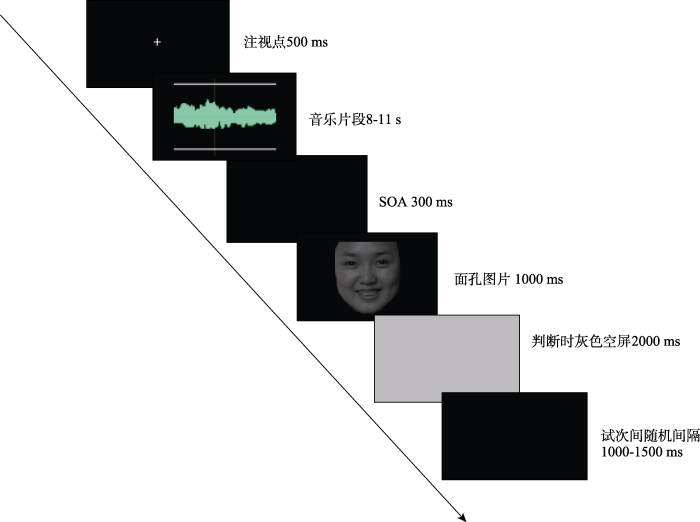
被试在温控适宜、光线柔和的实验室中完成实验。考虑到佩戴脑电帽的需求, 被试进入实验室后, 坐在电脑前通过入耳式耳机完成音乐情绪识别任务。每个试次的实验程序如下: 最开始在电脑屏幕中央的黑色背景上出现一个白色的注视点“+” (500 ms), 提醒被试集中注意力, 之后呈现1段音乐片段, 音乐片段结束之后300 ms, 呈现1张面孔图片(1000 ms), 被试需要准确而迅速的判断音乐片段与面孔图片的情绪是否一致, 一致按“F”键, 不一致按“J”键, 面孔图片之后预留2000 ms的空屏, 如果在空屏时仍然没有按键, 空屏结束后自动进入下一试次(见图1)。试次之间的随机间隔为1000~ 1500 ms。实验包括4个block (各50个试次), block中的刺激以伪随机的形式出现, 以避免同种类型的音乐反复连续出现。练习阶段有5个试次, 反应正确率达到100%即可进入正式实验。
图1
2.5 EEG数据采集
通过ANT Neuro系统和64导电极帽采集EEG数据。采样率为1000 Hz, 所有电极点的头皮电阻均小于5 kΩ。借鉴以往研究面孔情绪知觉的文章的分析方法, 在线参考电极为CPz, 离线分析时采用全脑平均参考(丁小斌 等, 2020; 孙博 等, 2022)。数据分析软件为MATLAB2020b (
根据前人文献总结可知, 额区的FP1/FP2/FPz/ F3/F4/F7/F8是关于情绪冲突和情绪刺激特征知觉的常用电极点, 中央区的C1/C2/C3/C4/Cz是关于情绪刺激意义解读的常用电极点(Liu et al., 2019b; 梁宗保 等, 2019; 袁加锦, 2009), 所以, 本研究用于分析的电极点如下: N170成分的电极点集中于后部脑区(P5/P6/P7/P8/PO5/PO6/PO7/PO8), P2成分的电极点为前部脑区(F3/F4/F7/F8/Fz)和中部脑区(C1/C2/C3/C4/Cz), N400成分的电极点主要集中于前部脑区(FP1/FP2/FPz/F7/F8/AF7/AF8), LPC成分集中于中部脑区(C1/C2/C3/C4/Cz)。分析各成分平均波幅的时间窗分别为: N170 (130~200 ms)、P2 (120~230 ms)、N400 (250~450 ms)、LPC (400~700 ms)。
2.6 统计分析
采用SPSS 22.0软件分析数据。对于行为数据, 分别以反应时和正确率为因变量, 进行2 (音乐类型: 宫调、羽调) × 2 (面孔类型: 快乐、悲伤) × 2 (共情水平: 高共情、低共情)的三因素重复测量方差分析。对于脑电数据, 分别以各成分的平均幅值为因变量, 进行2 (音乐类型: 宫调、羽调) × 2 (面孔类型: 快乐、悲伤) × 2 (共情水平: 高共情、低共情) × 2脑区(前部、中部)的四因素重复测量方差分析(P2成分)以及2 (音乐类型: 宫调、羽调) × 2 (面孔类型: 快乐、悲伤) × 2 (共情水平: 高共情、低共情)的三因素重复测量方差分析(N170、N400、LPC成分)。其中, 音乐类型、面孔类型、脑区为被试内变量, 共情水平为被试间变量。用Greenhouse-Geisser法对P值和自由度进行矫正。
3 结果
3.1 行为结果
1名被试的行为数据缺失(电脑记录时发生故障), 剩余71名被试的行为数据进入分析。对反应时的方差分析结果表明, 共情水平的组别差异不显著, F(1, 69) = 0.19, p = 0.664, 但平均值显示, 高共情组的反应时小于低共情组。音乐类型主效应显著, F(1, 69) = 84.95, p < 0.001, η2p = 0.55, 宫调的反应时显著小于羽调的反应时; 面孔类型主效应显著, F(1, 69) = 37.42, p < 0.001, η2p = 0.35, 对快乐面孔的反应时显著小于悲伤面孔; 音乐类型与面孔类型的交互作用显著F(1, 69) = 66.22, p < 0.001, η2p = 0.49。简单效应分析显示, 在宫调音乐作为启动刺激时, 对快乐面孔的反应时快于悲伤面孔, 在羽调音乐作为启动刺激时, 对悲伤面孔的反应时快于快乐面孔, 出现了情绪一致性效应。
以正确率为因变量的方差分析结果显示, 共情水平的组别差异不显著, F(1, 69) = 1.09, p = 0.301; 音乐类型主效应显著, F(1, 69) = 16.19, p < 0.001, η2p = 0.19, 羽调音乐的正确率低于宫调音乐; 面孔类型主效应不显著, F(1, 69) = 4.37, p = 0.061; 音乐类型与面孔类型的交互作用显著, F(1, 69) = 33.36, p < 0.001, η2p = 0.33。简单效应分析显示, 在宫调音乐作为启动刺激时, 对快乐面孔反应的正确率高于悲伤面孔, 在羽调音乐作为启动刺激时, 对悲伤面孔反应的正确率高于快乐面孔, 也出现了情绪一致性效应(高、低共情组在各条件下的正确率见表1)。音乐类型、面孔类型与共情水平的三阶交互作用显著, F(1, 69) = 4.98, p < 0.05, η2p = 0.07。简单简单效应分析显示, 高共情组在宫调音乐作为启动刺激时, 对快乐面孔反应的正确率高于悲伤面孔, 产生了情绪一致性效应, 但在羽调音乐作为启动刺激时无差异, 而低共情组在两种音乐条件下的反应均没有差异。
表1 高、低共情组在情绪一致和不一致条件下的正确率(M ± SD)
| 条件 | 宫调 | 羽调 | ||
|---|---|---|---|---|
| 高共情 | 低共情 | 高共情 | 低共情 | |
| 情绪一致 | 0.91 ± 0.10 | 0.91 ± 0.12 | 0.84 ± 0.12 | 0.86 ± 0.09 |
| 情绪不一致 | 0.83 ± 0.14 | 0.89 ± 0.11 | 0.82 ± 0.14 | 0.83 ± 0.12 |
注: 宫调-情绪一致、宫调-情绪不一致、羽调-情绪一致、羽调-情绪不一致条件分别是指宫调-快乐面孔、宫调-悲伤面孔、羽调-悲伤面孔以及羽调-快乐面孔的组合。
3.2 ERP结果
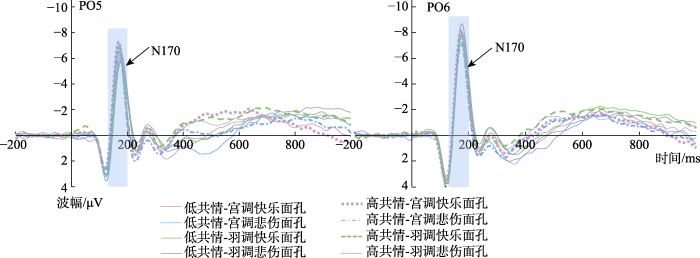
对N170成分进行重复测量方差分析, 结果发现, 共情水平的组别差异不显著, F(1, 70) = 0.31, p = 0.580; 音乐类型主效应不显著, F(1, 70) = 3.60, p = 0.062; 面孔类型主效应不显著, F(1, 70) = 0.63, p = 0.430;音乐类型与面孔类型的交互作用显著, F(1, 70) = 24.18, p < 0.001, η2p = 0.26。简单效应分析显示, 当目标刺激为悲伤面孔时, 羽调诱发的波幅比宫调更负, 目标刺激为快乐面孔时无差异(见图2)。
图2
P2波幅的方差分析结果表明, 共情水平的组别差异不显著, F(1, 70) = 0.11, p = 0.741; 音乐类型主效应显著, F(1, 70) = 9.38, p < 0.01, η2p = 0.12, 羽调诱发的波幅大于宫调; 面孔类型主效应不显著, F(1, 70) = 0.38, p = 0.538; 脑区主效应显著, F(1, 70) = 39.50, p < 0.001, η2p = 0.36, 中部脑区的波幅大于前部脑区; 音乐类型与面孔类型的交互作用显著, F(1, 70) = 9.18, p < 0.01, η2p = 0.12 (见图3)。简单效应分析显示, 在宫调音乐作为启动刺激时, 快乐面孔诱发的P2波幅大于悲伤面孔, 在羽调音乐作为启动刺激时二者没有差异。即宫调音乐引发了P2成分的情绪一致性效应。脑区、面孔类型与音乐类型的三阶交互作用显著, F(1, 70) = 9.80, p < 0.01, η2p = 0.12, 简单简单效应分析显示, 当目标刺激为悲伤面孔时, 羽调在前部脑区诱发的波幅大于宫调。
图3
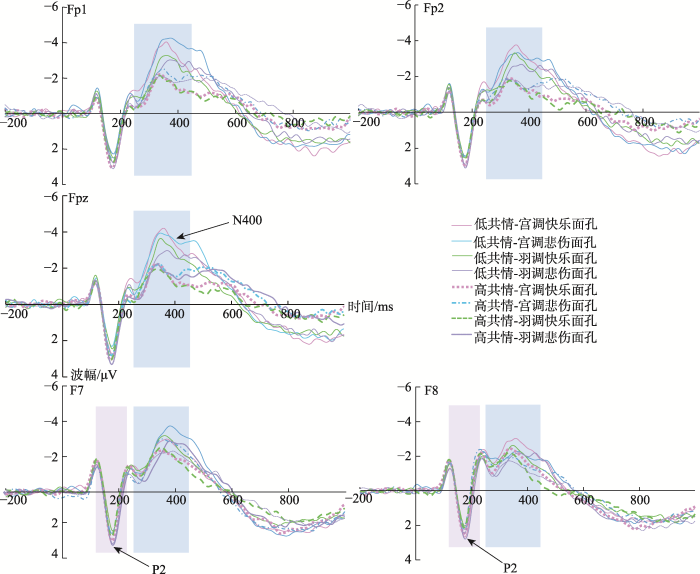
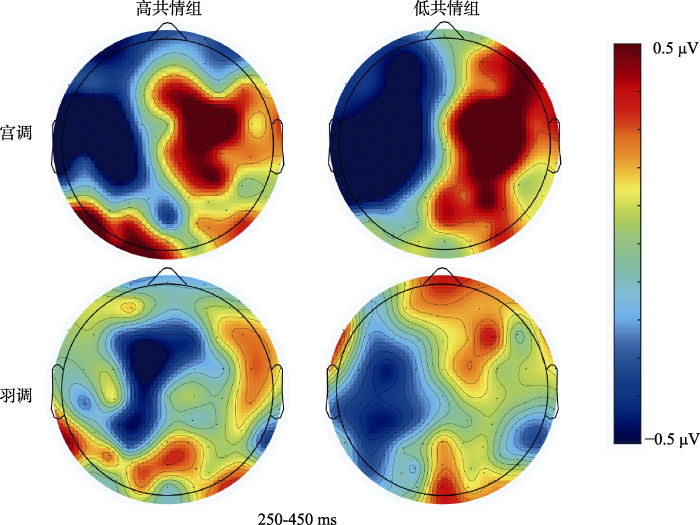
对N400成分进行重复测量方差分析, 结果表明, 共情水平的组别差异显著, F(1, 70) = 4.33, p < 0.05, η2p = 0.06, 低共情组比高共情组诱发了波幅更大的N400, 从地形图可以看出, 该成分主要产生于250~450 ms的左侧额区和中央区电极点(见图3, 图4); 音乐类型主效应显著, F(1, 70) = 4.49, p < 0.05, η2p = 0.06, 宫调诱发了比羽调更负的波幅; 面孔类型主效应不显著, F(1, 70) = 0.07, p = 0.795; 音乐类型与面孔类型的交互作用不显著, F(1, 70) = 1.24, p = 0.269, 但两组在情绪不一致条件下的波幅均大于一致条件。
图4
LPC成分的方差分析结果显示, 共情水平的组别差异边缘显著, F(1, 70) = 3.97, p = 0.05, η2p = 0.05, 高共情组的幅值显著大于低共情组(见图5); 音乐类型主效应不显著, F(1, 70) = 2.81, p = 0.098; 面孔类型主效应也不显著, F(1, 70) = 0.10, p = 0.754; 音乐类型与面孔类型的交互作用显著, F(1, 70) = 4.92, p < 0.05, η2p = 0.07, 简单效应分析表明, 在悲伤面孔条件下, 羽调音乐诱发的波幅大于宫调音乐, 在快乐面孔条件下没有差异。
图5
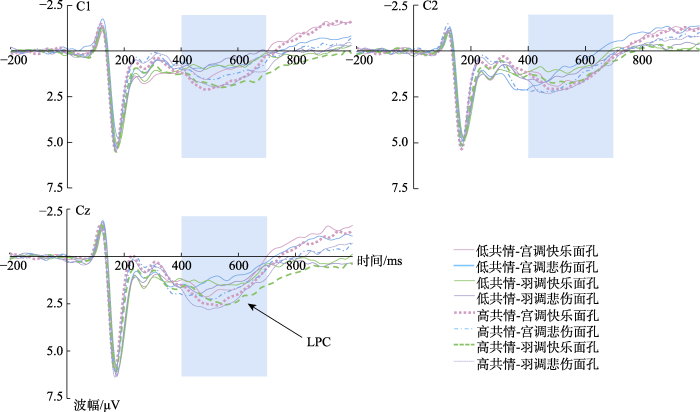
4 讨论
为了考察共情对音乐情绪识别的影响, 本研究通过ERP技术探索了不同共情水平的大学生识别中国民族音乐情绪时的行为反应及神经反应。行为数据显示, 高、低共情组在中国民族音乐情绪识别的反应时和正确率上均没有差异。脑电结果发现, 高、低共情组在P2成分的波幅上没有显著差异, 但在N400和LPC成分的波幅上差异显著: 高共情组的N400波幅小于低共情组, 但LPC波幅大于低共情组。
4.1 高低共情组在中国民族音乐情绪识别上的差异
研究曾预期, 高、低共情组在音乐情绪识别的反应时上可能会存在显著差异, 但结果与预期不一致。也许由于研究对象是大学生, 完成实验任务的难度较小, 导致在行为层面的识别速度上没有体现出显著差异。此外, 在脑电的P2和LPC这两个与注意资源分配有关的成分上, 高共情组只在LPC上大于低共情组, 这也许意味着高共情组并非在音乐情绪识别的每个阶段都投入了多于低共情组的注意资源。而在N400成分上的差异可以被认为是两组对不一致音乐情绪识别的敏感性指标。
总体上看, 我们的研究结果是符合不同共情水平个体在情绪特征方面的表现的。因为高共情个体在情绪感染力和情绪理解方面的优势(Egermann & McAdams, 2012), 确实体现在了中国民族音乐情绪识别的过程中, 且高低共情组在不同阶段的表现不同。首先, 虽然高、低共情组在情绪识别的反应时上没有体现出显著差异, 但从平均值来看, 高共情组用于识别的反应时较少。以往关于青少年疼痛共情的研究表明, 青少年组的反应时较短, 表现出比成年人更快的情绪传染(Kim et al., 2020; Mella et al., 2012), 这意味着反应速度越快, 表现出越强的情绪接收能力。因此, 本研究在反应时方面的总体趋势与以往研究是一致的, 高共情组更容易受到音乐中情绪的影响而相对快速地作出判断; 其次, 高、低共情组在P2成分的波幅上虽然没有显著差异, 但低共情组诱发的波幅大于高共情组, 与最初的研究假设一致。由于高共情组音乐情绪识别能力强, 对音乐情绪效价判断更为明确, 在与面孔情绪是否一致的判断上相对容易, P2成分的波幅较小。此外, 梁宗保等(2019)关于共情的ERP研究表明, P2是心理加工中期阶段与注意分配有关的额部成分。在这个阶段, 需要对情绪刺激表达的信息作出判断和分类, 倾向于对细节的加工, 注意资源占用越多, P2波幅越大。这也许意味着, 在进入晚期的情绪加工前, 低共情组被试对音乐刺激投入的注意资源多于高共情组。因为他们在情绪的受感染能力上低于高共情组(Egermann & McAdams, 2012), 就必须借助于更细致的知觉分析才能更准确地加工情绪刺激, 这正好与袁加锦(2009)的研究结论相一致。在他对正负性情绪图片刺激的研究中发现, P2 波幅的大小反映了不同效价条件下人脑完成知觉分析的难易程度, 知觉分析越易完成, 波幅越低。而低共情组在进行音乐情绪识别时, 知觉分析的难度大于高共情组, 也才会需要投入更多的注意资源。之所以没有出现显著差异, 可能是源于本研究中使用的是截取过的音乐片段, 如果音乐时长增加, 高低共情组在P2成分上的差异也许会发生变化, 这还需要后续研究进一步验证。第三, 高共情组的N400成分波幅小于低共情组, 两组对情绪不一致条件的反应均大于一致条件, 与以往研究结果的趋势相一致。即对情绪不一致的音乐、韵律和语言刺激的进行反应, 均会出现较大的N400效应(Daltrozzo & Schön, 2009; Steinbeis & Koelsch, 2008)。研究表明, N400既反映了语义期望违背的认知冲突效应(Võ & Wolfe, 2013), 也反映了情绪感知过程中对情绪冲突的检测与整合(Zhang et al., 2010), 是个体对情绪不一致情况敏感性的事件相关电位指标(Goerlich et al., 2011), 而本研究中低共情的个体比高共情的个体对情绪不一致的反应更敏感。这与前述P2成分的结果相匹配, 低共情组在中期阶段投入的注意资源大于高共情组, 对音乐情绪刺激的感知和分析更细致, 对不一致的情况更敏感, 于是诱发了更大的N400。由于以往几乎没有关于高低共情个体音乐情绪识别的脑电成分的对比研究, 此次得到的只是一个探索性的结果。高低共情组在N400成分上的差异, 是否源于在识别中国民族音乐情绪时的大脑激活程度的差异, 还需要相关脑成像研究的补充解释。最后, 高共情组的LPC波幅大于低共情组, 与本研究初始假设相一致, 也与既往研究中对LPC的解释相一致(Hajcak et al., 2013; Liu et al., 2019b)。以往研究认为, LPC波幅的增加与情绪刺激加工过程中需要更多的注意资源有关, 任务需要的认知资源越多, LPC振幅越大(Liu et al., 2021)。如果对注意资源的分配存在差异, LPC的幅值也会不同。这说明在中国民族音乐情绪识别的晚期阶段, 高共情组可能比低共情组投入了更多的注意资源, 用于对情绪刺激的意义进行评估, 以作出对音乐情绪刺激意义的更好的整合。
此外, 本研究结果也从音乐情绪识别的角度反映了情绪加工与注意之间的关系, 得到了注意有关理论的支持。关于对情绪性刺激的加工是否需要注意机制的参与, 一直没有形成定论。有研究认为, 情绪性刺激(如语音、图片、音乐等)可以自动被大脑加工, 不需要额外的注意资源(Vuilleumier, 2005), 而另一些研究认为, 情绪性刺激的加工受到了注意资源的调节(Mothes-Lasch et al., 2011)。本研究发现, 在音乐情绪识别的中晚期, 高低共情组在注意资源分配上存在差异, 导致了脑电成分的表现差异。表明在情绪识别的早期可能是自动加工, 而晚期则需要调动注意资源进行控制性的加工, 这与“注意负荷理论” (Load Theory)的观点相一致(Giesbrecht et al., 2014; Lavie, 2005), 也说明注意对情绪的影响应 该从一种整合的视角来看, 而不是局限于某种加工方式。
4.2 中国民族调式音乐(宫调、羽调)的情绪属性
在倡导传承传统文化、提升文化自信的社会背景下, 本研究对独具韵味的、作为中国传统文化典型载体的中国民族音乐的情绪色彩进行了初步探索, 考察了不同调式的民族音乐对音乐情绪识别的影响。研究选取的宫调和羽调属于五声调式中的两种, 二者在音乐形态方面(如音阶构成、调式结构等)存在差别, 可能会让个体产生不同的音乐情绪感受。以往对西方大小调式的研究表明, 不同调式的音乐会被识别为代表了不同的音乐情绪类型, 大调表达了快乐的情绪, 小调表达了悲伤的情绪(Juslin & Lindström, 2010; Webster & Weir, 2005)。音乐表演者们认为, 宫调、羽调所表达的情绪与西方大调、小调表达的情绪相类似, 即宫调式可能偏向快乐、活泼等情绪, 羽调式可能偏向悲伤、忧郁等情绪。本研究的行为结果发现, 宫调的情绪识别反应时显著小于羽调, 与部分认为“快乐的刺激比悲伤的刺激识别得更迅速”的研究结果相一致(Bombari et al., 2013; Naruse et al., 2013), 这也从侧面印证了宫调和羽调音乐蕴含的不同情绪对音乐情绪识别的影响。
4.3 研究局限及未来研究展望
本研究还存在一些需要完善的方面。首先, 研究主要考察的是特质共情的差异, 可以把它作为一种较为稳定的人格特质来进行分析, 但共情领域还存在一种状态共情, 是暂时的、不稳定的、由特定情境引发的共情状态(冯琳琳 等, 2021), 这种类型的共情是否也会影响音乐情绪识别呢?其作用是大于状态共情还是没有差异?这些问题都还需要相应的研究来解答。其次, 为了减少被试聆听音乐的整体认知负荷, 研究只选用了中国民族音乐五声调式中的宫调和羽调两种音乐, 那除此之外的角、徵、羽三种调式的音乐是否也会引起不同共情能力个体的音乐情绪识别差异?在判断的速度和难易程度上是否有区别?这三种调式音乐的音乐情绪与西方大小调式是否也存在对应关系呢?在后续研究中可以考虑增加音乐情绪的类型, 以获得更丰富的可用于对比分析的研究结果。
综上所述, 在对中国民族音乐进行音乐情绪识别时, 高、低共情组在部分脑电成分上显现出了不同, 说明通过ERP技术能够在一定程度上探索两组被试在识别音乐情绪的时间进程上的差异。研究主要发现了P2、N400和LPC三个与音乐情绪识别有关的成分, P2是对音乐情绪刺激进行知觉分析的指标(袁加锦, 2009), N400是对音乐情绪不一致效应较为敏感的指标(Goerlich et al., 2011), 而LPC是对音乐刺激的情绪意义进行后期评估的指标(Liu et al., 2021)。高、低两种共情类型的个体在脑电的N400和LPC成分上差异显著。本研究认为, 高低共情组的差异主要体现在音乐情绪识别时注意资源的分配上, 中期阶段低共情个体对注意资源的需求较多, 用于对音乐情绪刺激的细节加工, 而晚期阶段高共情个体的注意投入更多, 用于解读情绪刺激的意义。因此, 注意投入度可能是不同共情能力个体在产生情感共鸣或受到情绪感染时出现差异的原因之一, 也是影响其音乐情绪加工的认知要素之一。总之, 本研究采用了具有中国特色的民族音乐材料, 研究结果既能从电生理层面对共情与情绪识别之间的关系研究进行一定的补充, 也能够为推进音乐情绪的跨文化和本土化研究积累一定的实证证据。
附录: 实验中使用的中国民族调式音乐曲目名称(样例)
1. 小看戏(宫调)
2. 杨柳青(宫调)
3. 琵琶语(羽调)
4. 兰花花(羽调)
参考文献
Developmental change and cross-domain links in vocal and musical emotion recognition performance in childhood
DOI:10.1111/bjdp.12097
PMID:26080754
[本文引用: 1]

Although the configurations of psychoacoustic cues signalling emotions in human vocalizations and instrumental music are very similar, cross-domain links in recognition performance have yet to be studied developmentally. Two hundred and twenty 5- to 10-year-old children were asked to identify musical excerpts and vocalizations as happy, sad, or fearful. The results revealed age-related increases in overall recognition performance with significant correlations across vocal and musical conditions at all developmental stages. Recognition scores were greater for musical than vocal stimuli and were superior in females compared with males. These results confirm that recognition of emotions in vocal and musical stimuli is linked by 5 years and that sensitivity to emotions in auditory stimuli is influenced by age and gender. © 2015 The British Psychological Society.
Emotions during live music performance: Links with individual differences in empathy, visual imagery, and mood
DOI:10.1037/pmu0000030 URL [本文引用: 1]
Emotion recognition: The role of featural and configural face information
DOI:10.1080/17470218.2013.789065 URL [本文引用: 1]
An EEG/ERP investigation of the development of empathy in early and middle childhood
DOI:10.1016/j.dcn.2014.08.012
PMID:25261920
[本文引用: 1]
Empathic arousal is the first ontogenetic building block of empathy to appear during infancy and early childhood. As development progresses, empathic arousal becomes associated with an increasing ability to differentiate between self and other, which is a critical aspect of mature empathetic ability (Decety and Jackson, 2004). This allows for better regulation of contagious distress and understanding others mental states. In the current study, we recorded electroencephalographic event-related potentials and mu suppression induced by short visual animations that depicted painful situations in 57 typically developing children aged between 3 and 9 years as well as 15 young adults. Results indicate that the difference wave of an early automatic component (N200), indexing empathic arousal, showed an age-related decrease in amplitude. In contrast, the difference wave of late-positive potentials (LPP), associated with cognitive appraisal, showed an age-related gain. Only early LPP was detected in children, whereas both early and late LPP were observed in adults. Furthermore, as compared with adults, children showed stronger mu suppression when viewing both painful and non-painful stimuli. These findings provide neurophysiological support for the development of empathy during childhood, as indicated by a gradual decrease in emotional arousal and an increase in cognitive appraisal with age. Copyright © 2014 The Authors. Published by Elsevier Ltd.. All rights reserved.
Facial expression processing of people with different empathic abilities: An ERP study
不同共情能力个体加工情绪面孔的ERP研究
Conceptual processing in music as revealed by N400 effects on words and musical targets
DOI:10.1162/jocn.2009.21113
PMID:18823240
[本文引用: 1]
The cognitive processing of concepts, that is, abstract general ideas, has been mostly studied with language. However, other domains, such as music, can also convey concepts. Koelsch et al. [Koelsch, S., Kasper, E., Sammler, D., Schulze, K., Gunter, T., & Friederici, A. D. Music, language and meaning: Brain signatures of semantic processing. Nature Neuroscience, 7, 302-307, 2004] showed that 10 sec of music can influence the semantic processing of words. However, the length of the musical excerpts did not allow the authors to study the effect of words on musical targets. In this study, we decided to replicate Koelsch et al. findings using 1-sec musical excerpts (Experiment 1). This allowed us to study the reverse influence, namely, of a linguistic context on conceptual processing of musical excerpts (Experiment 2). In both experiments, we recorded behavioral and electrophysiological responses while participants were presented 50 related and 50 unrelated pairs (context/target). Experiments 1 and 2 showed a larger N400 component of the event-related brain potentials to targets following a conceptually unrelated compared to a related context. The presence of an N400 effect with musical targets suggests that music may convey concepts. The relevance of these results for the comprehension of music as a structured set of conceptual units and for the domain specificity of the mechanisms underlying N400 effects are discussed.
Consistency between self-reference and mother- reference in emotional perception of others’faces: Evidence from ERP.
DOI:10.3724/SP.J.1041.2020.00694 URL [本文引用: 1]
他人面孔情绪知觉中自我参照与母亲参照的一致性: 来自ERP的证据
Being moved by unfamiliar sad music is associated with high empathy
The paradox of enjoying listening to music that evokes sadness is yet to be fully understood. Unlike prior studies that have explored potential explanations related to lyrics, memories, and mood regulation, we investigated the types of emotions induced by unfamiliar, instrumental sad music, and whether these responses are consistently associated with certain individual difference variables. One hundred and two participants were drawn from a representative sample to minimize self-selection bias. The results suggest that the emotional responses induced by unfamiliar sad music could be characterized in terms of three underlying factors: Relaxing sadness, Moving sadness, and Nervous sadness. Relaxing sadness was characterized by felt and perceived peacefulness and positive valence. Moving sadness captured an intense experience that involved feelings of sadness and being moved. Nervous sadness was associated with felt anxiety, perceived scariness and negative valence. These interpretations were supported by indirect measures of felt emotion. Experiences of Moving sadness were strongly associated with high trait empathy and emotional contagion, but not with other previously suggested traits such as absorption or nostalgia-proneness. Relaxing sadness and Nervous sadness were not significantly predicted by any of the individual difference variables. The findings are interpreted within a theoretical framework of embodied emotions.
Empathy and emotional contagion as a link between recognized and felt emotions in music listening
Is there a core neural network in empathy? An fMRI based quantitative meta-analysis
DOI:10.1016/j.neubiorev.2010.10.009
PMID:20974173
[本文引用: 1]
Whilst recent neuroimaging studies have identified a series of different brain regions as being involved in empathy, it remains unclear concerning the activation consistence of these brain regions and their specific functional roles. Using MKDA, a whole-brain based quantitative meta-analysis of recent fMRI studies of empathy was performed. This analysis identified the dACC-aMCC-SMA and bilateral anterior insula as being consistently activated in empathy. Hypothesizing that what are here termed affective-perceptual and cognitive-evaluative forms of empathy might be characterized by different activity patterns, the neural activations in these forms of empathy were compared. The dorsal aMCC was demonstrated to be recruited more frequently in the cognitive-evaluative form of empathy, whilst the right anterior insula was found to be involved in the affective-perceptual form of empathy only. The left anterior insula was active in both forms of empathy. It was concluded that the dACC-aMCC-SMA and bilateral insula can be considered as forming a core network in empathy, and that cognitive-evaluative and affective-perceptual empathy can be distinguished at the level of regional activation.Copyright © 2010 Elsevier Ltd. All rights reserved.
Influence of emotional response on state empathy and helping behavior during emotion induction
大学生诱发情绪时情绪反应对状态共情与助人行为的影响
A new perspective on the perceptual selectivity of attention under load
Hearing feelings: Affective categorization of music and speech in alexithymia, an ERP study
Effects of music therapy for children and adolescents with psychopathology: A meta-analysis
Revision of the Chinese facial affective picture system
中国面孔表情图片系统的修订
The dynamic allocation of attention to emotion: Simultaneous and independent evidence from the late positive potential and steady state visual evoked potentials
DOI:10.1016/j.biopsycho.2011.11.012
PMID:22155660
[本文引用: 2]
Emotional stimuli capture and hold attention without explicit instruction. The late positive potential (LPP) component of the event related potential can be used to track motivated attention toward emotional stimuli, and is larger for emotional compared to neutral pictures. In the frequency domain, the steady state visual evoked potential (ssVEP) has also been used to track attention to stimuli flickering at a particular frequency. Like the LPP, the ssVEP is also larger for emotional compared to neutral pictures. Prior work suggests that both the LPP and ssVEP are sensitive to "top-down" manipulations of attention, however the LPP and ssVEP have not previously been examined using the same attentional manipulation in the same participants. In the present study, LPP and ssVEP amplitudes were simultaneously elicited by unpleasant and neutral pictures. Partway through picture presentation, participants' attention was directed toward an arousing or non-arousing region of unpleasant pictures. In line with prior work, the LPP was reduced when attention was directed toward non-arousing compared to arousing regions of unpleasant pictures; similar results were observed for the ssVEP. Thus, both electrocortical measures index affective salience and are sensitive to directed (here: spatial) attention. Variation in the LPP and ssVEP was unrelated, suggesting that these measures are not redundant with each other and may capture different neurophysiological aspects of affective stimulus processing and attention.Copyright © 2011 Elsevier B.V. All rights reserved.
Comparison of the N300 and N400 ERPs to picture stimuli in congruent and incongruent contexts
The aim of this study was to examine the N300 and N400 effect to pictures that were semantically incongruous to a prior object name. Based upon theories of object identification, the semantic incongruity was manipulated to occur early or late in the object processing stream.High-density visual event-related potentials were measured in response to passively viewed black and white line drawings of common objects. Pictures were preceded with an object name at either the basic (categorical) or subordinate (specific) level. The object either matched or mismatched with the name. With subordinate level names, mismatches could be within- or between-category.The N400 effect was found for both basic and subordinate level mismatches. The N400 was found for both the subordinate-within and subordinate-between. Comparison of the scalp distributions between these N400 effects suggested a common effect was found for all conditions. The N300 effect, however, was only found for between-category mismatches, and only when semantic expectations were high in the match baseline (subordinate matches).The findings are consistent with theories of object identification that suggest that objects are initially categorized prior to being identified at more specific levels. The N300 appears to reflect the categorisation while the N400 effect appears to be responsive to all semantic mismatches. Comparison of scalp topographies, functional differences, and different estimated cortical source locations suggest that the N300 and N400 are two distinct semantic effects that reflect aspects of object identification.
Revision and test of interpersonal response indicator scale in Chinese mainland
中国大陆版人际反应指针量表的修订与检验
Two facets of affective empathy: Concern and distress have opposite relationships to emotion recognition
Musical expression of emotions: Modelling listeners' judgements of composed and performed features
DOI:10.1111/j.1468-2249.2011.00323.x URL [本文引用: 2]
How does music evoke emotions? Exploring the underlying mechanisms
Emotional responses to music: The need to consider underlying mechanisms
DOI:10.1017/S0140525X08005293 URL [本文引用: 1]
Emotion perceived and emotion felt: Same and different
DOI:10.1177/102986490601000203 URL [本文引用: 1]
Interaction between musical emotion and facial expression as measured by event-related potentials
DOI:10.1016/j.neuropsychologia.2012.11.031
PMID:23220447
[本文引用: 2]
We examined the integrative process between emotional facial expressions and musical excerpts by using an affective priming paradigm. Happy or sad musical stimuli were presented after happy or sad facial images during electroencephalography (EEG) recordings. We asked participants to judge the affective congruency of the presented face-music pairs. The congruency of emotionally congruent pairs was judged more rapidly than that of incongruent pairs. In addition, the EEG data showed that incongruent musical targets elicited a larger N400 component than congruent pairs. Furthermore, these effects occurred in nonmusicians as well as musicians. In sum, emotional integrative processing of face-music pairs was facilitated in congruent music targets and inhibited in incongruent music targets; this process was not significantly modulated by individual musical experience. This is the first study on musical stimuli primed by facial expressions to demonstrate that the N400 component reflects the affective priming effect.Copyright © 2012 Elsevier Ltd. All rights reserved.
Influence of trait empathy on the emotion evoked by sad music and on the preference for it.
Cognitive and emotional empathy in young adolescents: An fMRI study
DOI:10.5765/jkacap.200020 URL [本文引用: 1]
Brain correlates of music-evoked emotions
Nonmusicians express emotions in musical productions using conventional cues
Liking unfamiliar music: Effects of felt emotion and individual differences
DOI:10.1037/a0024671 URL [本文引用: 1]
Comparable modulation of the late positive potential by emotion regulation in younger and older adults
DOI:10.1027/0269-8803/a000009 URL [本文引用: 1]
Distracted and confused?: Selective attention under load
The ability to remain focused on goal-relevant stimuli in the presence of potentially interfering distractors is crucial for any coherent cognitive function. However, simply instructing people to ignore goal-irrelevant stimuli is not sufficient for preventing their processing. Recent research reveals that distractor processing depends critically on the level and type of load involved in the processing of goal-relevant information. Whereas high perceptual load can eliminate distractor processing, high load on "frontal" cognitive control processes increases distractor processing. These findings provide a resolution to the long-standing early and late selection debate within a load theory of attention that accommodates behavioural and neuroimaging data within a framework that integrates attention research with executive function.
The recognition of bodily expression: An event-related potential study
身体表情识别的ERP研究
Regulation of mindfulness-based music listening on negative emotions related to COVID-19: An ERP study
Decreased conflict control in overweight chinese females: Behavioral and event-related potentials evidence
Overweight adults are more impulsive than normal weight adults: Evidence from ERPs during a chocolate-related delayed discounting task
Affective and cortical EEG gamma responses to emotional movies in women with high vs low traits of empathy
Empathy for pain from adolescence through adulthood: An event-related brain potential study
Empathy manipulation impacts music-induced emotions: A psychophysiological study on opera
Visual attention modulates brain activation to angry voices
DOI:10.1523/JNEUROSCI.6665-10.2011
PMID:21715624
[本文引用: 1]
In accordance with influential models proposing prioritized processing of threat, previous studies have shown automatic brain responses to angry prosody in the amygdala and the auditory cortex under auditory distraction conditions. However, it is unknown whether the automatic processing of angry prosody is also observed during cross-modal distraction. The current fMRI study investigated brain responses to angry versus neutral prosodic stimuli during visual distraction. During scanning, participants were exposed to angry or neutral prosodic stimuli while visual symbols were displayed simultaneously. By means of task requirements, participants either attended to the voices or to the visual stimuli. While the auditory task revealed pronounced activation in the auditory cortex and amygdala to angry versus neutral prosody, this effect was absent during the visual task. Thus, our results show a limitation of the automaticity of the activation of the amygdala and auditory cortex to angry prosody. The activation of these areas to threat-related voices depends on modality-specific attention.
Developmental changes in facial expression recognition in Japanese school-age children
DOI:10.2152/jmi.60.114 URL [本文引用: 1]
On the “Invisible structure” of modal scale- degree—An analysis of internal structure mechanism related to the auditory psychology of scale-degree
调式音级“隐形结构”论——与音级听觉心理相关的音级内在结构机理分析
The neural bases for empathy
DOI:10.1177/1073858410379268
PMID:21071616
[本文引用: 1]
Human empathy relies on the ability to share emotions as well as the ability to understand the other's thoughts, desires, and feelings. Recent evidence points to 2 separate systems for empathy: an emotional system that supports our ability to empathize emotionally and a cognitive system that involves cognitive understanding of the other's perspective. Converging evidence from neuroimaging and lesion studies shows that a neural network that includes the inferior frontal gyrus and the inferior parietal lobule is necessary for emotion recognition and emotional contagion. On the other hand, the involvement of the ventromedial prefrontal cortex, temporoparietal junction, and the medial temporal lobe in self-reflection and autobiographical memory places these key regions as necessary for cognitive empathy. The proposed dissociation between these systems is supported by recent neurochemical experiments involving administration of oxytocin as well as by ethological, psychiatric, and developmental studies. Finally, although the emotional and cognitive systems appear to work independently, every empathic response may still evoke both components to some extent, depending on the social context.
Is empathy involved in our emotional response to music? The role of the PRL gene, empathy, and arousal in response to happy and sad music
DOI:10.1037/pmu0000230 URL [本文引用: 1]
Comparing the processing of music and language meaning using EEG and fMRI provides evidence for similar and distinct neural representations
DOI:10.1371/journal.pone.0002226 URL [本文引用: 1]
Neural correlates of consciousness of emotional faces and the unconscious automatic processing: Evidence from event-related potentials (ERPs)
DOI:10.3724/SP.J.1041.2022.00867 URL [本文引用: 1]
情绪面孔的意识神经相关物及其无意识自动加工: 来自事件相关电位的证据
Cross-cultural perspectives on music and musicality
Differential electrophysiological signatures of semantic and syntactic scene processing
DOI:10.1177/0956797613476955
PMID:23842954
[本文引用: 1]
In sentence processing, semantic and syntactic violations elicit differential brain responses observable in event-related potentials: An N400 signals semantic violations, whereas a P600 marks inconsistent syntactic structure. Does the brain register similar distinctions in scene perception? To address this question, we presented participants with semantic inconsistencies, in which an object was incongruent with a scene's meaning, and syntactic inconsistencies, in which an object violated structural rules. We found a clear dissociation between semantic and syntactic processing: Semantic inconsistencies produced negative deflections in the N300-N400 time window, whereas mild syntactic inconsistencies elicited a late positivity resembling the P600 found for syntactic inconsistencies in sentence processing. Extreme syntactic violations, such as a hovering beer bottle defying gravity, were associated with earlier perceptual processing difficulties reflected in the N300 response, but failed to produce a P600 effect. We therefore conclude that different neural populations are active during semantic and syntactic processing of scenes, and that syntactically impossible object placements are processed in a categorically different manner than are syntactically resolvable object misplacements.
How brains beware: Neural mechanisms of emotional attention
DOI:10.1016/j.tics.2005.10.011
PMID:16289871
[本文引用: 1]
Emotional processes not only serve to record the value of sensory events, but also to elicit adaptive responses and modify perception. Recent research using functional brain imaging in human subjects has begun to reveal neural substrates by which sensory processing and attention can be modulated by the affective significance of stimuli. The amygdala plays a crucial role in providing both direct and indirect top-down signals on sensory pathways, which can influence the representation of emotional events, especially when related to threat. These modulatory effects implement specialized mechanisms of 'emotional attention' that might supplement but also compete with other sources of top-down control on perception. This work should help to elucidate the neural processes and temporal dynamics governing the integration of cognitive and affective influences in attention and behaviour.
Measuring music-induced emotion: A comparison of emotion models, personality biases, and intensity of experiences
DOI:10.1177/1029864911403367 URL [本文引用: 1]
Neurophysiological effects of trait empathy in music listening
DOI:10.3389/fnbeh.2018.00066
PMID:29681804
[本文引用: 1]
The social cognitive basis of music processing has long been noted, and recent research has shown that trait empathy is linked to musical preferences and listening style. Does empathy modulate neural responses to musical sounds? We designed two functional magnetic resonance imaging (fMRI) experiments to address this question. In Experiment 1, subjects listened to brief isolated musical timbres while being scanned. In Experiment 2, subjects listened to excerpts of music in four conditions (familiar liked (FL)/disliked and unfamiliar liked (UL)/disliked). For both types of musical stimuli, emotional and cognitive forms of trait empathy modulated activity in sensorimotor and cognitive areas: in the first experiment, empathy was primarily correlated with activity in supplementary motor area (SMA), inferior frontal gyrus (IFG) and insula; in Experiment 2, empathy was mainly correlated with activity in prefrontal, temporo-parietal and reward areas. Taken together, these findings reveal the interactions between bottom-up and top-down mechanisms of empathy in response to musical sounds, in line with recent findings from other cognitive domains.
Emotional responses to music: Interactive effects of mode, texture, and tempo
DOI:10.1007/s11031-005-4414-0 URL [本文引用: 1]
Is empathy related to the perception of emotional expression in music? A multimodal time-series analysis
DOI:10.1037/a0027392 URL [本文引用: 1]
Emotions evoked by the sound of music: Characterization, classification, and measurement
DOI:10.1037/1528-3542.8.4.494
PMID:18729581
[本文引用: 1]
One reason for the universal appeal of music lies in the emotional rewards that music offers to its listeners. But what makes these rewards so special? The authors addressed this question by progressively characterizing music-induced emotions in 4 interrelated studies. Studies 1 and 2 (n=354) were conducted to compile a list of music-relevant emotion terms and to study the frequency of both felt and perceived emotions across 5 groups of listeners with distinct music preferences. Emotional responses varied greatly according to musical genre and type of response (felt vs. perceived). Study 3 (n=801)--a field study carried out during a music festival--examined the structure of music-induced emotions via confirmatory factor analysis of emotion ratings, resulting in a 9-factorial model of music-induced emotions. Study 4 (n=238) replicated this model and found that it accounted for music-elicited emotions better than the basic emotion and dimensional emotion models. A domain-specific device to measure musically induced emotions is introduced--the Geneva Emotional Music Scale.
Neural correlates of cross-domain affective priming
DOI:10.1016/j.brainres.2010.03.021
PMID:20298681
[本文引用: 1]
The affective priming effect has mostly been studied using reaction time (RT) measures; however, the neural bases of affective priming are not well established. To understand the neural correlates of cross-domain emotional stimuli presented rapidly, we obtained event-related potential (ERP) measures during an affective priming task using short SOA (stimulus onset asynchrony) conditions. Two sets of 480 picture-word pairs were presented at SOAs of either 150ms or 250ms between prime and target stimuli. Participants decided whether the valence of each target word was pleasant or unpleasant. Behavioral results from both SOA conditions were consistent with previous reports of affective priming, with longer RTs for incongruent than congruent pairs at SOAs of 150ms (771 vs. 738ms) and 250ms (765 vs. 720ms). ERP results revealed that the N400 effect (associated with incongruent pairs in affective processing) occurred at anterior scalp regions at an SOA of 150ms, and this effect was only observed for negative target words across the scalp at an SOA of 250ms. In contrast, late positive potentials (LPPs) (associated with attentional resource allocation) occurred across the scalp at an SOA of 250ms. LPPs were only observed for positive target words at posterior parts of the brain at an SOA of 150ms. Our finding of ERP signatures at very short SOAs provides the first neural evidence that affective pictures can exert an automatic influence on the evaluation of affective target words.Copyright 2010 Elsevier B.V. All rights reserved.
Role of the human mirror system in automatic processing of musical emotion: Evidence from EEG.
DOI:10.3724/SP.J.1041.2019.00795 URL [本文引用: 1]
人类镜像系统参与音乐情绪的自动加工: 来自EEG的证据
Affective and cognitive empathy in pre-teachers with strong or weak professional identity: An ERP study
DOI:10.3389/fnhum.2019.00175 URL [本文引用: 1]


