

ISSN 0439-755X
CN 11-1911/B
主办:中国心理学会
中国科学院心理研究所
出版:科学出版社
CN 11-1911/B
主办:中国心理学会
中国科学院心理研究所
出版:科学出版社
心理学报 ›› 2025, Vol. 57 ›› Issue (11): 2001-2021.doi: 10.3724/SP.J.1041.2025.2001 cstr: 32110.14.2025.2001
邓丽芳1( ), 裴蓓1, 高天艾2
收稿日期:2024-02-01
发布日期:2025-09-24
出版日期:2025-11-25
通讯作者:
邓丽芳, E-mail: lifangdeng@buaa.edu.cn基金资助:
DENG Lifang1(), PEI Bei1, GAO Tian’ai2
Received:2024-02-01
Online:2025-09-24
Published:2025-11-25
摘要:
阈下抑郁作为抑郁症的前兆, 对抑郁风险有重要警示作用。本研究结合扎根理论和机器学习方法, 构建了中国工作紧张人群阈下抑郁影响因素的机器学习模型, 并对各因素之间的关联结构, 因素词频、职业差异和年代变化进行了分析。发现:(1)工作紧张人群阈下抑郁的表征包含5个主范畴, 其中意志减弱词频占比最高; 影响因素包含8个主范畴, 工作因素、评价适应和自主选择词频占比分列前三位。(2) 8类影响因素均与阈下抑郁表征紧密关联; 基于关联规则的网络分析结果显示出“自我认知”、“行为自由”、“环境适应”和“一般社交”副范畴的重要作用。(3)医护人员的躯体因素与其他职业具有显著差异。(4) 2011至2023年间, 工作因素呈上升趋势, 人际因素呈下降趋势。(5)基于BERT的机器学习模型可以用于判别工作紧张人群阈下抑郁的影响因素, 且判别结果能够对工作紧张人群的抑郁风险做出较好预测, 采用XGBoost算法的预测准确率为81.58%, 其中对阈下抑郁组预测的F1分数为0.90, AUC值为0.93。本文拓展了阈下抑郁在工作紧张人群中的研究, 为工作紧张人群阈下抑郁的识别与防治提供了新视角。
中图分类号:
邓丽芳, 裴蓓, 高天艾. (2025). 数智时代工作紧张人群阈下抑郁的影响因素:基于机器学习的证据. 心理学报, 57(11), 2001-2021.
DENG Lifang, PEI Bei, GAO Tian’ai. (2025). The factors affecting subthreshold depression for people with occupational stress in the era of digital intelligence: Machine learning-based evidence. Acta Psychologica Sinica, 57(11), 2001-2021.

图1 研究思路
| 主范畴 | 副范畴 | 概念 | 关键词举例 |
|---|---|---|---|
| 负性思维 | 自我贬低 | 自我否定、自我反责 | 妄自菲薄、自责、愧疚 |
| 过度思考 | 偏执强迫、过度分析 | 患得患失、想不通、钻牛角尖 | |
| 消极期盼 | 消极预测、期盼缺乏 | 生不如死、没盼头、没指望 | |
| 情绪异常 | 不良情绪积累 | 悲伤低落、敏感担忧 | 难过、情绪低落、担心、焦躁 |
| 积极情绪缺失 | 兴趣下降、愉悦缺失 | 失去兴趣、没意思、不开心 | |
| 意志减弱 | 疲乏拖延 | 疲乏无力、任务拖延 | 累、疲劳、倦怠、不想做 |
| 驱动力锐减 | 目标缺失、动机减弱 | 无所事事、自暴自弃、咸鱼 | |
| 注意力下降 | 注意力涣散、记忆困难 | 昏昏沉沉、发呆、忘、记不清 | |
| 日常行为变化 | 自伤自杀倾向 | 自伤倾向、自杀意念 | 自残、伤口、想死、自杀念头 |
| 成瘾行为 | 物质成瘾、网络代偿 | 过度消费、酗酒、买醉 | |
| 人际回避 | 社交活动减少、人际关系疏远 | 社恐、处不好、屏蔽 | |
| 生理习惯变化 | 饮食与体重 | 饮食习惯变化、体重变化 | 暴饮暴食、没食欲、暴瘦 |
| 睡眠问题 | 睡眠模式改变、睡眠质量不佳 | 失眠、睡不着、多梦 |
表1 工作紧张人群阈下抑郁表征编码
| 主范畴 | 副范畴 | 概念 | 关键词举例 |
|---|---|---|---|
| 负性思维 | 自我贬低 | 自我否定、自我反责 | 妄自菲薄、自责、愧疚 |
| 过度思考 | 偏执强迫、过度分析 | 患得患失、想不通、钻牛角尖 | |
| 消极期盼 | 消极预测、期盼缺乏 | 生不如死、没盼头、没指望 | |
| 情绪异常 | 不良情绪积累 | 悲伤低落、敏感担忧 | 难过、情绪低落、担心、焦躁 |
| 积极情绪缺失 | 兴趣下降、愉悦缺失 | 失去兴趣、没意思、不开心 | |
| 意志减弱 | 疲乏拖延 | 疲乏无力、任务拖延 | 累、疲劳、倦怠、不想做 |
| 驱动力锐减 | 目标缺失、动机减弱 | 无所事事、自暴自弃、咸鱼 | |
| 注意力下降 | 注意力涣散、记忆困难 | 昏昏沉沉、发呆、忘、记不清 | |
| 日常行为变化 | 自伤自杀倾向 | 自伤倾向、自杀意念 | 自残、伤口、想死、自杀念头 |
| 成瘾行为 | 物质成瘾、网络代偿 | 过度消费、酗酒、买醉 | |
| 人际回避 | 社交活动减少、人际关系疏远 | 社恐、处不好、屏蔽 | |
| 生理习惯变化 | 饮食与体重 | 饮食习惯变化、体重变化 | 暴饮暴食、没食欲、暴瘦 |
| 睡眠问题 | 睡眠模式改变、睡眠质量不佳 | 失眠、睡不着、多梦 |
| 主范畴 | 副范畴 | 概念 | 关键词举例 |
|---|---|---|---|
| 躯体疾病 | 躯体异常 | 肢体疼痛、躯体不适 | 腰疼、头疼脑热、呕吐 |
| 生理疾病 | 心脑血管疾病、癌症、呼吸系统疾病、其他疾病 | 咽炎、肿瘤、高血压 | |
| 评价适应 | 自我认知 | 自我评价、自尊水平 | 自知、自信、优越感 |
| 环境适应 | 环境评估、应对环境 | 时代、趋势、适应 | |
| 情绪管理 | 情绪内化 | 稳定、压制 | 情绪稳定、镇定、控制情绪 |
| 情绪抒发 | 表达、宣泄 | 释放、发泄、爆发 | |
| 情绪重构 | 分散、重构 | 脱离、释怀、疏通 | |
| 自主选择 | 权利保障 | 规则限制、权益保障、经济物质基础 | 法定、维权、社会保障 |
| 行为自由 | 机会选择、发展规划、生活自主 | 自主、选择权、机会 | |
| 人格因素 | 外向性 | 活跃、合群、乐观/防御、被动、悲观 | 热情、亲切、积极性/清高、腼腆、悲观 |
| 利他性 | 友善、诚信/自私、虚伪 | 善良、真诚、负责/刻薄、不负责、伪装 | |
| 谨慎性 | 严谨、细致、负责/敷衍、马虎、放纵 | 谨慎、细心/草率、放纵 | |
| 果敢性 | 决断、坚韧、勇敢/犹豫、脆弱、怯懦 | 果断、坚强/软弱、犹豫不决 | |
| 机敏性 | 机智、变通/愚笨、浅薄 | 聪慧、灵活/无知、守旧 | |
| 随和性 | 豁达、淡泊/狭隘、竞争 | 心胸宽广、不争不抢/心胸狭隘、暴躁 | |
| 工作因素 | 工作要求 | 岗位胜任、时间压力、任务负荷、工作制度 | 执行力、工作效率、工作量 |
| 工作条件 | 办公环境、待遇与前景、通勤条件 | 办公室、薪资、班车 | |
| 组织人文环境 | 团队氛围、人文关怀、职场人际 | 归属感、照顾新人、指导 | |
| 应激事件 | 个体应激事件 | 生存变故、经济损失、家庭变故 | 车祸、破产、负债、丧偶 |
| 社会环境应激事件 | 自然灾害、社会性灾难 | 火灾、地震、疫情、战争 | |
| 人际因素 | 一般社交 | 平常往来、网络社交 | 朋友、同学、网友、社交圈 |
| 亲密往来 | 恋人关系、亲属关系 | 男/女朋友、父母、一家人 |
表2 工作紧张人群阈下抑郁影响因素编码
| 主范畴 | 副范畴 | 概念 | 关键词举例 |
|---|---|---|---|
| 躯体疾病 | 躯体异常 | 肢体疼痛、躯体不适 | 腰疼、头疼脑热、呕吐 |
| 生理疾病 | 心脑血管疾病、癌症、呼吸系统疾病、其他疾病 | 咽炎、肿瘤、高血压 | |
| 评价适应 | 自我认知 | 自我评价、自尊水平 | 自知、自信、优越感 |
| 环境适应 | 环境评估、应对环境 | 时代、趋势、适应 | |
| 情绪管理 | 情绪内化 | 稳定、压制 | 情绪稳定、镇定、控制情绪 |
| 情绪抒发 | 表达、宣泄 | 释放、发泄、爆发 | |
| 情绪重构 | 分散、重构 | 脱离、释怀、疏通 | |
| 自主选择 | 权利保障 | 规则限制、权益保障、经济物质基础 | 法定、维权、社会保障 |
| 行为自由 | 机会选择、发展规划、生活自主 | 自主、选择权、机会 | |
| 人格因素 | 外向性 | 活跃、合群、乐观/防御、被动、悲观 | 热情、亲切、积极性/清高、腼腆、悲观 |
| 利他性 | 友善、诚信/自私、虚伪 | 善良、真诚、负责/刻薄、不负责、伪装 | |
| 谨慎性 | 严谨、细致、负责/敷衍、马虎、放纵 | 谨慎、细心/草率、放纵 | |
| 果敢性 | 决断、坚韧、勇敢/犹豫、脆弱、怯懦 | 果断、坚强/软弱、犹豫不决 | |
| 机敏性 | 机智、变通/愚笨、浅薄 | 聪慧、灵活/无知、守旧 | |
| 随和性 | 豁达、淡泊/狭隘、竞争 | 心胸宽广、不争不抢/心胸狭隘、暴躁 | |
| 工作因素 | 工作要求 | 岗位胜任、时间压力、任务负荷、工作制度 | 执行力、工作效率、工作量 |
| 工作条件 | 办公环境、待遇与前景、通勤条件 | 办公室、薪资、班车 | |
| 组织人文环境 | 团队氛围、人文关怀、职场人际 | 归属感、照顾新人、指导 | |
| 应激事件 | 个体应激事件 | 生存变故、经济损失、家庭变故 | 车祸、破产、负债、丧偶 |
| 社会环境应激事件 | 自然灾害、社会性灾难 | 火灾、地震、疫情、战争 | |
| 人际因素 | 一般社交 | 平常往来、网络社交 | 朋友、同学、网友、社交圈 |
| 亲密往来 | 恋人关系、亲属关系 | 男/女朋友、父母、一家人 |

图2 工作紧张人群阈下抑郁影响因素理论模型
| 前项 | 后项 | 支持度 | 置信度 | 提升度 |
|---|---|---|---|---|
| 应激事件 | 阈下抑郁表征 | 0.154 | 0.976 | 1.138 |
| 情绪管理 | 阈下抑郁表征 | 0.558 | 0.965 | 1.125 |
| 躯体疾病 | 阈下抑郁表征 | 0.371 | 0.952 | 1.110 |
| 人格因素 | 阈下抑郁表征 | 0.666 | 0.951 | 1.109 |
| 人际因素 | 阈下抑郁表征 | 0.739 | 0.935 | 1.090 |
| 自主选择 | 阈下抑郁表征 | 0.886 | 0.908 | 1.059 |
| 评价适应 | 阈下抑郁表征 | 0.896 | 0.906 | 1.056 |
| 工作因素 | 阈下抑郁表征 | 0.918 | 0.897 | 1.046 |
表3 工作紧张人群阈下抑郁影响因素与表征的关联规则
| 前项 | 后项 | 支持度 | 置信度 | 提升度 |
|---|---|---|---|---|
| 应激事件 | 阈下抑郁表征 | 0.154 | 0.976 | 1.138 |
| 情绪管理 | 阈下抑郁表征 | 0.558 | 0.965 | 1.125 |
| 躯体疾病 | 阈下抑郁表征 | 0.371 | 0.952 | 1.110 |
| 人格因素 | 阈下抑郁表征 | 0.666 | 0.951 | 1.109 |
| 人际因素 | 阈下抑郁表征 | 0.739 | 0.935 | 1.090 |
| 自主选择 | 阈下抑郁表征 | 0.886 | 0.908 | 1.059 |
| 评价适应 | 阈下抑郁表征 | 0.896 | 0.906 | 1.056 |
| 工作因素 | 阈下抑郁表征 | 0.918 | 0.897 | 1.046 |

图3 工作紧张人群阈下抑郁影响因素关联网络图
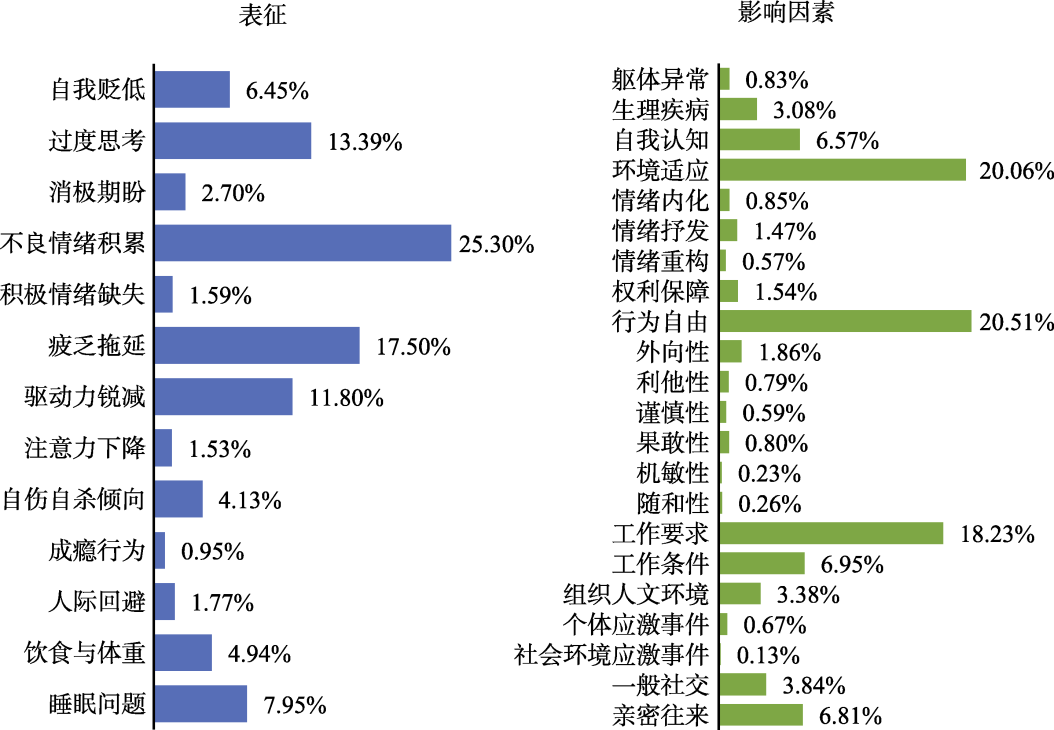
图4 工作紧张人群阈下抑郁表征和影响因素副范畴词频占比

图5 工作紧张人群阈下抑郁表征(左)与影响因素(右)高频词词云图
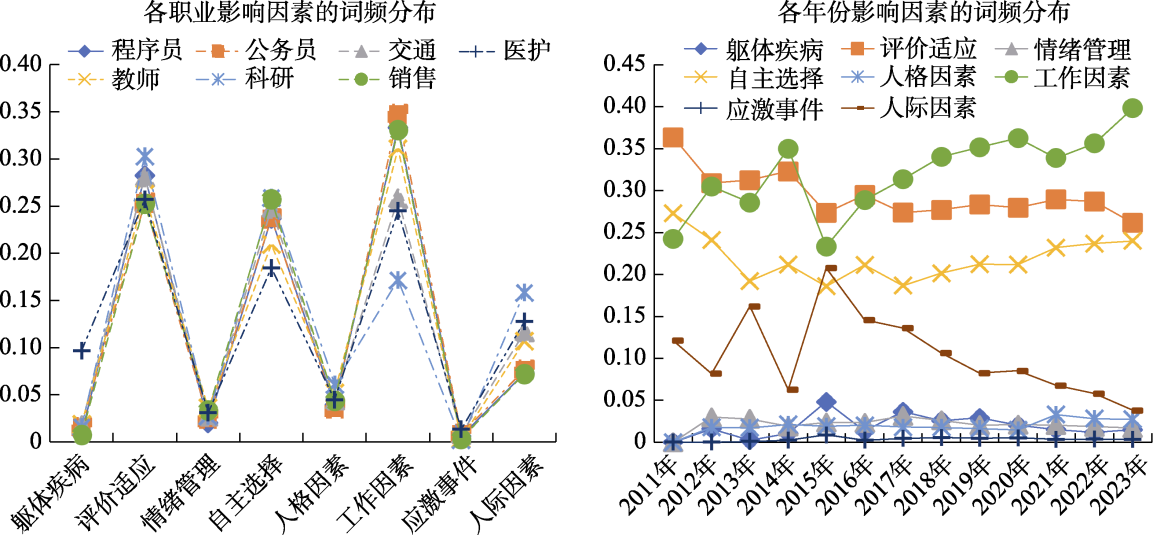
图6 工作紧张人群阈下抑郁影响因素主范畴词频的职业分布与年份分布
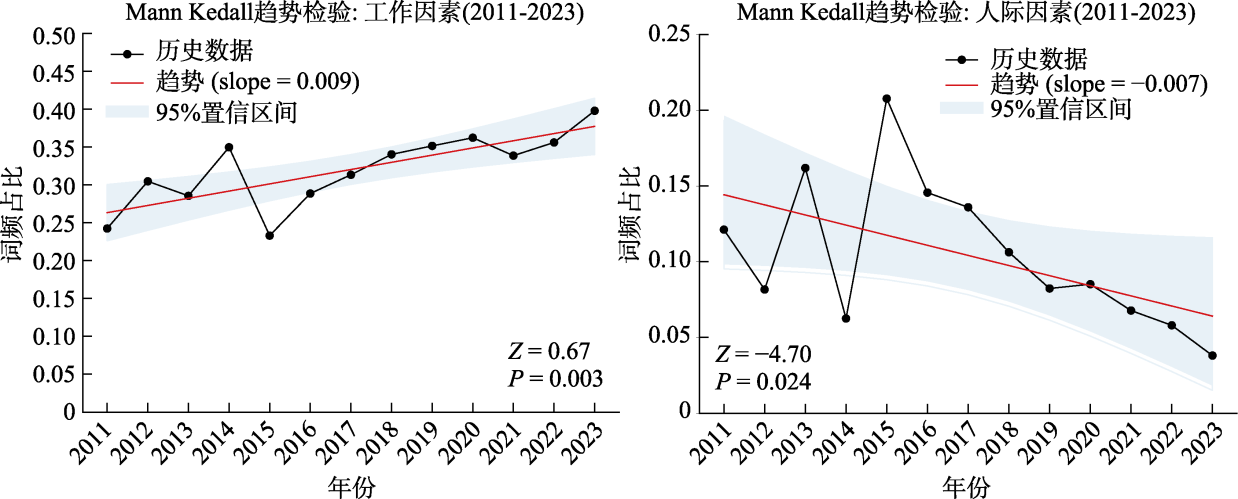
图7 工作因素和人际因素的Mann-Kendall趋势检验结果
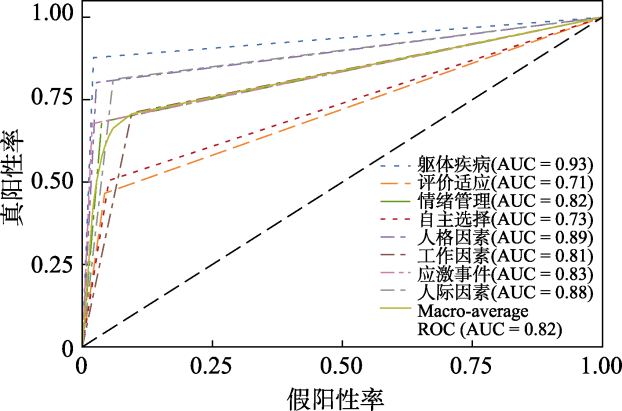
图8 机器学习训练模型Ⅱ(调参后)ROC曲线
| 维度 | 模型Ⅱ | 模型Ⅲ | ||||
|---|---|---|---|---|---|---|
| 查准率Precision | 召回率Recall | F1分数 | 查准率Precision | 召回率Recall | F1分数 | |
| 躯体疾病 | 0.84 | 0.88 | 0.86 | 0.73 | 0.74 | 0.73 |
| 评价适应 | 0.63 | 0.47 | 0.53 | 0.38 | 0.23 | 0.29 |
| 情绪管理 | 0.56 | 0.68 | 0.61 | 0.43 | 0.60 | 0.50 |
| 自主选择 | 0.46 | 0.50 | 0.48 | 0.40 | 0.48 | 0.43 |
| 人格因素 | 0.71 | 0.80 | 0.75 | 0.60 | 0.57 | 0.58 |
| 工作因素 | 0.74 | 0.71 | 0.72 | 0.37 | 0.45 | 0.41 |
| 应激事件 | 0.74 | 0.68 | 0.71 | 0.50 | 0.51 | 0.50 |
| 人际因素 | 0.75 | 0.81 | 0.78 | 0.54 | 0.62 | 0.58 |
| 无用数据 | 0.88 | 0.86 | 0.87 | |||
表4 模型Ⅱ、模型Ⅲ训练结果
| 维度 | 模型Ⅱ | 模型Ⅲ | ||||
|---|---|---|---|---|---|---|
| 查准率Precision | 召回率Recall | F1分数 | 查准率Precision | 召回率Recall | F1分数 | |
| 躯体疾病 | 0.84 | 0.88 | 0.86 | 0.73 | 0.74 | 0.73 |
| 评价适应 | 0.63 | 0.47 | 0.53 | 0.38 | 0.23 | 0.29 |
| 情绪管理 | 0.56 | 0.68 | 0.61 | 0.43 | 0.60 | 0.50 |
| 自主选择 | 0.46 | 0.50 | 0.48 | 0.40 | 0.48 | 0.43 |
| 人格因素 | 0.71 | 0.80 | 0.75 | 0.60 | 0.57 | 0.58 |
| 工作因素 | 0.74 | 0.71 | 0.72 | 0.37 | 0.45 | 0.41 |
| 应激事件 | 0.74 | 0.68 | 0.71 | 0.50 | 0.51 | 0.50 |
| 人际因素 | 0.75 | 0.81 | 0.78 | 0.54 | 0.62 | 0.58 |
| 无用数据 | 0.88 | 0.86 | 0.87 | |||
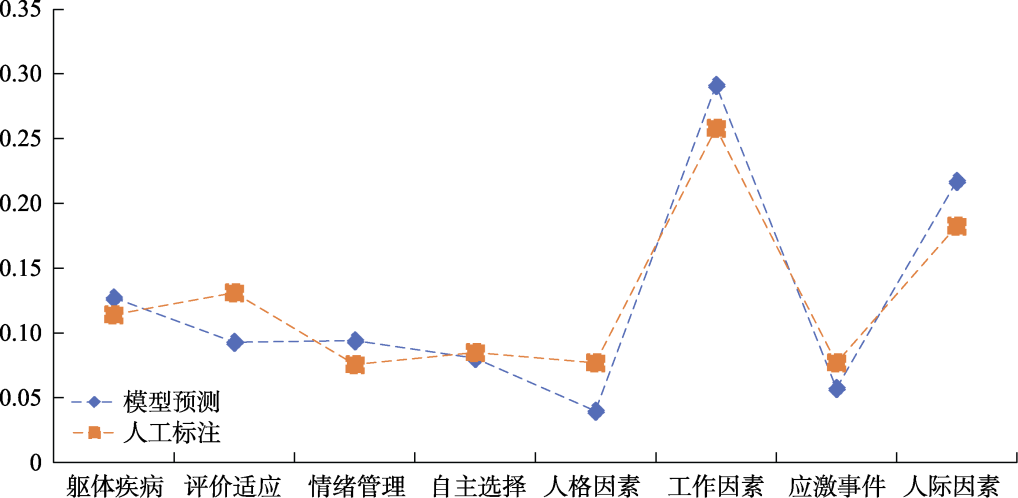
图9 模型预测与人工标注结果对比
| 影响因素 | 查准率Precision | 召回率Recall | F1分数 |
|---|---|---|---|
| 躯体疾病 | 0.67 | 0.50 | 0.57 |
| 评价适应 | 0.79 | 0.54 | 0.64 |
| 情绪管理 | 0.72 | 0.23 | 0.35 |
| 自主选择 | 0.68 | 0.90 | 0.78 |
| 人格因素 | 0.56 | 0.88 | 0.68 |
| 工作因素 | 0.66 | 0.76 | 0.71 |
| 应激事件 | 0.57 | 0.70 | 0.63 |
| 人际因素 | 0.61 | 0.69 | 0.65 |
表5 机器学习模型验证结果
| 影响因素 | 查准率Precision | 召回率Recall | F1分数 |
|---|---|---|---|
| 躯体疾病 | 0.67 | 0.50 | 0.57 |
| 评价适应 | 0.79 | 0.54 | 0.64 |
| 情绪管理 | 0.72 | 0.23 | 0.35 |
| 自主选择 | 0.68 | 0.90 | 0.78 |
| 人格因素 | 0.56 | 0.88 | 0.68 |
| 工作因素 | 0.66 | 0.76 | 0.71 |
| 应激事件 | 0.57 | 0.70 | 0.63 |
| 人际因素 | 0.61 | 0.69 | 0.65 |

图10 机器学习模型验证结果的ROC曲线
| 模型 | 组别 | 查准率Precision | 召回率Recall | F1分数 | AUC值 |
|---|---|---|---|---|---|
| 逻辑回归 (Logistic Regression, LR) | 非抑郁 | 0.62 | 0.78 | 0.69 | 0.85 |
| 阈下抑郁 | 0.89 | 0.89 | 0.89 | 0.93 | |
| 抑郁 | 0.72 | 0.50 | 0.59 | 0.83 | |
| Macro-average | 0.75 | 0.72 | 0.73 | 0.87 | |
| 全局准确率Accuracy | 77.19% | ||||
| 5折准确率标准差 | 0.05 | ||||
| 随机森林 (Random Forest, RF) | 非抑郁 | 0.65 | 0.75 | 0.70 | 0.85 |
| 阈下抑郁 | 0.88 | 0.89 | 0.88 | 0.94 | |
| 抑郁 | 0.75 | 0.58 | 0.65 | 0.93 | |
| Macro-average | 0.76 | 0.74 | 0.74 | 0.91 | |
| 全局准确率Accuracy | 78.07% | ||||
| 5折准确率标准差 | 0.08 | ||||
| 支持向量机 (Support Vector Machine, SVM) | 非抑郁 | 0.81 | 0.66 | 0.72 | 0.72 |
| 阈下抑郁 | 0.88 | 0.89 | 0.88 | 0.88 | |
| 抑郁 | 0.61 | 0.73 | 0.67 | 0.78 | |
| Macro-average | 0.77 | 0.76 | 0.76 | 0.79 | |
| 全局准确率Accuracy | 78.95% | ||||
| 5折准确率标准差 | 0.03 | ||||
| 极端梯度提升 (eXtreme Gradient Boosting, XGBoost) | 非抑郁 | 0.74 | 0.78 | 0.76 | 0.87 |
| 阈下抑郁 | 0.91 | 0.89 | 0.90 | 0.93 | |
| 抑郁 | 0.72 | 0.69 | 0.71 | 0.90 | |
| Macro-average | 0.79 | 0.79 | 0.79 | 0.90 | |
| 全局准确率Accuracy | 81.58% | ||||
| 5折准确率标准差 | 0.08 | ||||
表6 不同机器学习模型预测结果的对比
| 模型 | 组别 | 查准率Precision | 召回率Recall | F1分数 | AUC值 |
|---|---|---|---|---|---|
| 逻辑回归 (Logistic Regression, LR) | 非抑郁 | 0.62 | 0.78 | 0.69 | 0.85 |
| 阈下抑郁 | 0.89 | 0.89 | 0.89 | 0.93 | |
| 抑郁 | 0.72 | 0.50 | 0.59 | 0.83 | |
| Macro-average | 0.75 | 0.72 | 0.73 | 0.87 | |
| 全局准确率Accuracy | 77.19% | ||||
| 5折准确率标准差 | 0.05 | ||||
| 随机森林 (Random Forest, RF) | 非抑郁 | 0.65 | 0.75 | 0.70 | 0.85 |
| 阈下抑郁 | 0.88 | 0.89 | 0.88 | 0.94 | |
| 抑郁 | 0.75 | 0.58 | 0.65 | 0.93 | |
| Macro-average | 0.76 | 0.74 | 0.74 | 0.91 | |
| 全局准确率Accuracy | 78.07% | ||||
| 5折准确率标准差 | 0.08 | ||||
| 支持向量机 (Support Vector Machine, SVM) | 非抑郁 | 0.81 | 0.66 | 0.72 | 0.72 |
| 阈下抑郁 | 0.88 | 0.89 | 0.88 | 0.88 | |
| 抑郁 | 0.61 | 0.73 | 0.67 | 0.78 | |
| Macro-average | 0.77 | 0.76 | 0.76 | 0.79 | |
| 全局准确率Accuracy | 78.95% | ||||
| 5折准确率标准差 | 0.03 | ||||
| 极端梯度提升 (eXtreme Gradient Boosting, XGBoost) | 非抑郁 | 0.74 | 0.78 | 0.76 | 0.87 |
| 阈下抑郁 | 0.91 | 0.89 | 0.90 | 0.93 | |
| 抑郁 | 0.72 | 0.69 | 0.71 | 0.90 | |
| Macro-average | 0.79 | 0.79 | 0.79 | 0.90 | |
| 全局准确率Accuracy | 81.58% | ||||
| 5折准确率标准差 | 0.08 | ||||
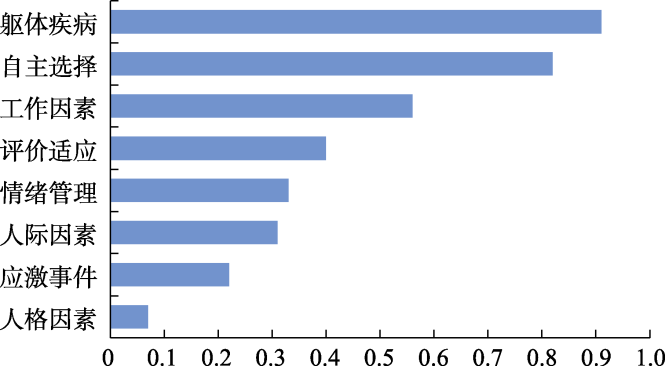
图11 特征重要性排序
| 职业 | 工作紧张相关研究 | 抑郁相关研究 | ||
|---|---|---|---|---|
| 频次 | 排名 | 频次 | 排名 | |
| 医护人员 | 39 | 1 | 26 | 1 |
| 教学人员 | 31 | 2 | 20 | 2 |
| 交通行业人员 | 18 | 3 | 9 | 3 |
| 科研人员 | 9 | 4 | 9 | 3 |
| 销售人员 | 9 | 4 | 4 | 6 |
| IT技术人员 | 8 | 7 | 3 | 7 |
| 公务员 | 8 | 7 | 9 | 3 |
| 其他(如军人、制造业员工等) | ≤4/类 | —— | ≤3/类 | —— |
附表1-1 职业群体工作紧张和抑郁研究的调查对象统计表
| 职业 | 工作紧张相关研究 | 抑郁相关研究 | ||
|---|---|---|---|---|
| 频次 | 排名 | 频次 | 排名 | |
| 医护人员 | 39 | 1 | 26 | 1 |
| 教学人员 | 31 | 2 | 20 | 2 |
| 交通行业人员 | 18 | 3 | 9 | 3 |
| 科研人员 | 9 | 4 | 9 | 3 |
| 销售人员 | 9 | 4 | 4 | 6 |
| IT技术人员 | 8 | 7 | 3 | 7 |
| 公务员 | 8 | 7 | 9 | 3 |
| 其他(如军人、制造业员工等) | ≤4/类 | —— | ≤3/类 | —— |
| 主范畴 | 副范畴 | 含义 |
|---|---|---|
| 负性思维 | 自我贬低 | 对自己能力、价值或身份的负面评价, 通常表现为自我批评、自我否定等 |
| 过度思考 | 对某些问题、事件或担忧过度关注和反复思考, 且难以自我控制 | |
| 消极期盼 | 对未来持有悲观预期, 总是预期最坏的结果或认为不值得期待 | |
| 情绪异常 | 不良情绪积累 | 个体经历的负面情绪(如愤怒、悲伤、焦虑等) |
| 积极情绪缺失 | 缺乏积极情绪体验, 通常表现为愉悦情绪缺失与对事物的兴趣下降 | |
| 意志减弱 | 疲乏拖延 | 感到持续的疲劳和缺乏动力, 在工作、学习或其他活动中表现出拖延行为 |
| 驱动力锐减 | 个体的内在动机或外在激励显著减少, 对工作、学习或其他活动的参与度下降。 | |
| 注意力下降 | 在进行任务或活动时难以集中注意力, 可能表现为分心、易忘、难以持续关注等 | |
| 日常行为变化 | 自伤自杀倾向 | 有自我伤害或自杀的想法、计划或行为 |
| 成瘾行为 | 对某种物质(如药物、酒精)或行为(如网络游戏)产生强烈的依赖 | |
| 人际回避 | 主动避免社交互动或人际关系 | |
| 生理习惯变化 | 饮食与体重 | 主要指饮食习惯、频率改变以及体重变化 |
| 睡眠问题 | 在入睡、睡眠质量、睡眠时间或睡眠持续性方面存在的问题, 如失眠、过度睡眠等 |
附表2-1 阈下抑郁表征副范畴界定
| 主范畴 | 副范畴 | 含义 |
|---|---|---|
| 负性思维 | 自我贬低 | 对自己能力、价值或身份的负面评价, 通常表现为自我批评、自我否定等 |
| 过度思考 | 对某些问题、事件或担忧过度关注和反复思考, 且难以自我控制 | |
| 消极期盼 | 对未来持有悲观预期, 总是预期最坏的结果或认为不值得期待 | |
| 情绪异常 | 不良情绪积累 | 个体经历的负面情绪(如愤怒、悲伤、焦虑等) |
| 积极情绪缺失 | 缺乏积极情绪体验, 通常表现为愉悦情绪缺失与对事物的兴趣下降 | |
| 意志减弱 | 疲乏拖延 | 感到持续的疲劳和缺乏动力, 在工作、学习或其他活动中表现出拖延行为 |
| 驱动力锐减 | 个体的内在动机或外在激励显著减少, 对工作、学习或其他活动的参与度下降。 | |
| 注意力下降 | 在进行任务或活动时难以集中注意力, 可能表现为分心、易忘、难以持续关注等 | |
| 日常行为变化 | 自伤自杀倾向 | 有自我伤害或自杀的想法、计划或行为 |
| 成瘾行为 | 对某种物质(如药物、酒精)或行为(如网络游戏)产生强烈的依赖 | |
| 人际回避 | 主动避免社交互动或人际关系 | |
| 生理习惯变化 | 饮食与体重 | 主要指饮食习惯、频率改变以及体重变化 |
| 睡眠问题 | 在入睡、睡眠质量、睡眠时间或睡眠持续性方面存在的问题, 如失眠、过度睡眠等 |
| 主范畴 | 副范畴 | 含义 |
|---|---|---|
| 躯体疾病 | 躯体异常 | 身体结构或功能上的异常, 如心悸、胸闷、头痛等主观反映的身体不适感 |
| 生理疾病 | 生理机能的异常或障碍, 主要指常见的身体疾病 | |
| 评价适应 | 自我认知 | 在各类情形中对自己(自身想法、行为、形象、能力等)的认识和理解, 包括自我评价、自尊水平等 |
| 环境适应 | 对周围环境变化的适应能力, 包括对新环境的适应和对环境变化的应对。 | |
| 情绪管理 | 情绪内化 | 将情绪体验转化为内心体验的过程, 是情绪的内在处理。 |
| 情绪抒发 | 将情绪通过行为、言语等方式表达出来的过程 | |
| 情绪重构 | 对情绪体验的重新解释和理解, 通过改变对情绪的认知或行为来调整情绪反应 | |
| 自主选择 | 权利保障 | 在社会、法律层面上享有的保护与受到的相应限制, 以及基本的经济保障 |
| 行为自由 | 个体能够自由选择和执行行为 | |
| 人格因素 | 外向性 | 个体特征中倾向于社交、活跃、乐观的程度 |
| 利他性 | 个体特征中倾向于帮助他人、考虑他人利益的程度 | |
| 谨慎性 | 个体特征中倾向于谨慎决策与行动, 避免冒险和冲动的程度 | |
| 果敢性 | 个体在面对挑战和决策时表现出果断和勇敢的程度 | |
| 机敏性 | 个体对环境变化做出反应和适应的应变程度 | |
| 随和性 | 个体特征中倾向于豁达、淡泊的程度 | |
| 工作因素 | 工作要求 | 工作中对工作时间、任务负荷, 以及个体体力、能力、形象举止等要求 |
| 工作条件 | 工作环境中的物质条件、设施、资源以及个体获得的待遇、发展等支持 | |
| 组织人文环境 | 组织内部的文化、价值观、人际关系等非物质因素 | |
| 应激事件 | 个体应激事件 | 对个体产生压力和影响的特定事件, 如亲人去世等 |
| 社会环境应激事件 | 影响整个社会或群体的应激事件, 如自然灾害、社会动荡等 | |
| 人际因素 | 一般社交 | 与朋友、网友等的日常互动, 与亲密往来相比, 涉及的关系更为广泛和浅层 |
| 亲密往来 | 与家庭成员或对象等亲密关系个体之间的往来, 以及对其中情感支持的体验 |
附表2-2 阈下抑郁影响因素副范畴界定
| 主范畴 | 副范畴 | 含义 |
|---|---|---|
| 躯体疾病 | 躯体异常 | 身体结构或功能上的异常, 如心悸、胸闷、头痛等主观反映的身体不适感 |
| 生理疾病 | 生理机能的异常或障碍, 主要指常见的身体疾病 | |
| 评价适应 | 自我认知 | 在各类情形中对自己(自身想法、行为、形象、能力等)的认识和理解, 包括自我评价、自尊水平等 |
| 环境适应 | 对周围环境变化的适应能力, 包括对新环境的适应和对环境变化的应对。 | |
| 情绪管理 | 情绪内化 | 将情绪体验转化为内心体验的过程, 是情绪的内在处理。 |
| 情绪抒发 | 将情绪通过行为、言语等方式表达出来的过程 | |
| 情绪重构 | 对情绪体验的重新解释和理解, 通过改变对情绪的认知或行为来调整情绪反应 | |
| 自主选择 | 权利保障 | 在社会、法律层面上享有的保护与受到的相应限制, 以及基本的经济保障 |
| 行为自由 | 个体能够自由选择和执行行为 | |
| 人格因素 | 外向性 | 个体特征中倾向于社交、活跃、乐观的程度 |
| 利他性 | 个体特征中倾向于帮助他人、考虑他人利益的程度 | |
| 谨慎性 | 个体特征中倾向于谨慎决策与行动, 避免冒险和冲动的程度 | |
| 果敢性 | 个体在面对挑战和决策时表现出果断和勇敢的程度 | |
| 机敏性 | 个体对环境变化做出反应和适应的应变程度 | |
| 随和性 | 个体特征中倾向于豁达、淡泊的程度 | |
| 工作因素 | 工作要求 | 工作中对工作时间、任务负荷, 以及个体体力、能力、形象举止等要求 |
| 工作条件 | 工作环境中的物质条件、设施、资源以及个体获得的待遇、发展等支持 | |
| 组织人文环境 | 组织内部的文化、价值观、人际关系等非物质因素 | |
| 应激事件 | 个体应激事件 | 对个体产生压力和影响的特定事件, 如亲人去世等 |
| 社会环境应激事件 | 影响整个社会或群体的应激事件, 如自然灾害、社会动荡等 | |
| 人际因素 | 一般社交 | 与朋友、网友等的日常互动, 与亲密往来相比, 涉及的关系更为广泛和浅层 |
| 亲密往来 | 与家庭成员或对象等亲密关系个体之间的往来, 以及对其中情感支持的体验 |
| [1] | Adams, K. B., & Moon, H. (2009). Subthreshold depression: Characteristics and risk factors among vulnerable elders. Aging & Mental Health, 13(5), 682-692. |
| [2] |
Beck, A. T. (2008). The evolution of the cognitive model of depression and its neurobiological correlates. American Journal of Psychiatry, 165(8), 969-977.
doi: 10.1176/appi.ajp.2008.08050721 pmid: 18628348 |
| [3] |
Blatt, S. J., D’Afflitti, J. P., & Quinlan, D. M. (1976). Experiences of depression in normal young adults. Journal of Abnormal Psychology, 85(4), 383-389.
doi: 10.1037//0021-843x.85.4.383 pmid: 956505 |
| [4] |
Bonde, J. P. E. (2008). Psychosocial factors at work and risk of depression: A systematic review of the epidemiological evidence. Occupational and Environmental Medicine, 65(7), 438-445.
doi: 10.1136/oem.2007.038430 pmid: 18417557 |
| [5] | Chapman, D. P., Perry, G. S., & Strine, T. W. (2004). The vital link between chronic disease and depressive disorders. Preventing Chronic Disease, 2(1), A14. |
| [6] | Chen, K., Li, Q., Zhu, Z., Zhang, J., Niu, L., Dai, H.,... Zhang, R. (2025). Risk and protective factors for the evolution of subthreshold depression during early adolescence. The Journal of Adolescent Health, 76(3), 385-395. |
| [7] | Clark, C., Crumpler, C., & Notley, H. (2020). Evidence for environmental noise effects on health for the United Kingdom policy context: A systematic review of the effects of environmental noise on mental health, wellbeing, quality of life, cancer, dementia, birth, reproductive outcomes, and cognition. International Journal of Environmental Research and Public Health, 17(2), 393. |
| [8] | Cohen, J. (1988). Statistical power analysis for the behavioral sciences (2nd ed.). Lawrence Erlbaum Associates, Publishers. |
| [9] | Creagh, S., Thompson, G., Mockler, N., Stacey, M., & Hogan, A. (2023). Workload, work intensification and time poverty for teachers and school leaders: A systematic research synthesis. Educational Review, 77(2), 661-680. |
| [10] |
Crockett, M. J. (2017). Moral outrage in the digital age. Nature Human Behaviour, 1(11), 769-771.
doi: 10.1038/s41562-017-0213-3 pmid: 31024117 |
| [11] |
Cuijpers, P., Donker, T., Weissman, M. M., Ravitz, P., & Cristea, I. A. (2016). Interpersonal psychotherapy for mental health problems: A comprehensive meta-analysis. American Journal of Psychiatry, 173(7), 680-687.
doi: 10.1176/appi.ajp.2015.15091141 pmid: 27032627 |
| [12] | Cuijpers, P., Pineda, B. S., Ng, M. Y., Weisz, J. R., Muñoz, R. F., Gentili, C.,... Karyotaki, E. (2021). A meta-analytic review: Psychological treatment of subthreshold depression in children and adolescents. Journal of the American Academy of Child and Adolescent Psychiatry, 60(9), 1072-1084. |
| [13] |
Cuijpers, P., & Smit, F. (2004). Subthreshold depression as a risk indicator for major depressive disorder: A systematic review of prospective studies. Acta Psychiatrica Scandinavica, 109(5), 325-331.
doi: 10.1111/j.1600-0447.2004.00301.x pmid: 15049768 |
| [14] |
Cummings, E. M., Schermerhorn, A. C., Davies, P. T., Goeke-Morey, M. C., & Cummings, J. S. (2006). Interparental discord and child adjustment: Prospective investigations of emotional security as an explanatory mechanism. Child Development, 77(1), 132-152.
pmid: 16460530 |
| [15] |
da Silva Lima, A. F. & de Almeida Fleck, M. P. (2007). Subsyndromal depression: An impact on quality of life?. Journal of Affective Disorders, 100(1-3), 163-169.
pmid: 17126913 |
| [16] | Dai, J. M., Yu, H. Z., Wu, J. H., Wu, C. E., & Fu, H. (2010). Analysis on the association between job stress factors and depression symptoms. Journal of Hygiene Research, 39(3), 342-346. |
| [戴俊明, 余慧珠, 吴建华, 吴翠娥, 傅华. (2010). 不同职业紧张因子与抑郁症状的关联分析. 卫生研究, 39(3), 342-346.] | |
| [17] | Ding, Y., Chen, X., Fu, Q., & Zhong, S. (2020). A depression recognition method for college students using deep integrated support vector algorithm. IEEE Access, 8, 75616-75629. |
| [18] | Fu, X. L., Zhang, K., Chen, X. F., & Chen, Z. Y. (Eds). (2023). Report on national mental health development in China (2021-2022) (pp. 1-29). Social Sciences Academic Press. |
| [傅小兰, 张侃, 陈雪峰, 陈祉妍. (主编). (2023). 心理健康蓝皮书:中国国民心理健康发展报告(2021-2022) (pp. 1-29). 北京: 社会科学文献出版社.] | |
| [19] | Hamed, K. H., & Rao, A. R. (1998). A modified Mann-Kendall trend test for autocorrelated data. Journal of Hydrology, 204(1-4), 182-196. |
| [20] | Han, R., Lian, Y. L., Wang, L., & Liu, J. W. (2016). The relationship between people’s mental health and occupational stress with different length of service. China Journal of Health Psychology, 24(1), 45-48. |
| [韩瑞, 连玉龙, 王磊, 刘继文. (2016). 不同工龄职业人群心理健康与职业紧张相关性研究. 中国健康心理学杂志, 24(1), 45-48.] | |
| [21] |
Howland, R. H., Schettler, P. J., Rapaport, M. H., Mischoulon, D., Schneider, T., Fasiczka, A.,... Nierenberg, A. A. (2008). Clinical features and functioning of patients with minor depression. Psychother Psychosom, 77(6), 384-389.
doi: 10.1159/000151519 pmid: 18716424 |
| [22] |
Hu, Y., Wu, X., Chen, X., Maguire, P., & Wang, D. (2021). Can increased cognitive load help people with subthreshold depression to forget negative information? Journal of Affective Disorders, 283, 384-394.
doi: 10.1016/j.jad.2021.01.062 pmid: 33581464 |
| [23] | Huang, R. H., & Yao, H. L. (2024). “Reshaping” and “high risk”: The impact of generative artificial intelligence on public opinion security. Journal of Intelligence, 43(4): 121-127. |
| [黄日涵, 姚浩龙. (2024). “再塑造”与“高风险”: 生成式人工智能对舆论安全的影响. 情报杂志, 43(4), 121-127.] | |
| [24] |
Kashihara, J., Yamakawa, I., Kameyama, A., Muranaka, M., Taku, K., & Sakamoto, S. (2019). Perceptions of traditional and modern types of depression: A cross-cultural vignette survey comparing Japanese and American undergraduate students. Psychiatry and Clinical Neurosciences, 73(8), 441-447.
doi: 10.1111/pcn.12838 pmid: 30854726 |
| [25] | Klein, D. N., Kotov, R., & Bufferd, S. J. (2011). Personality and depression: Explanatory models and review of the evidence. Annual Review of Clinical Psychology, 7(1), 269-295. |
| [26] | Koudenburg, N., Jetten, J., Enz, K. F., & Haslam, S. A. (2024). The social grounds of personal self: Interactions that build a sense of ‘we’ help clarify who ‘I’ am. European Journal of Social Psychology, 54(6), 1153-1167. |
| [27] | Kube, T., Siebers, V. H. A., Herzog, P., Glombiewski, J. A., Doering, B. K., & Rief, W. (2018). Integrating situation- specific dysfunctional expectations and dispositional optimism into the cognitive model of depression: A path-analytic approach. Journal of Affective Disorders, 229, 199-205. |
| [28] | Lazarus, R. S. (1982). Thoughts on the relations between emotion and cognition. The American Psychologist, 37(9), 1019-1024. |
| [29] | Lee, M. J., Hasche, L. K., Choi, S., Proctor, E. K., & Morrow-Howell, N. (2013). Comparison of major depressive disorder and subthreshold depression among older adults in community long-term care. Aging & Mental Health, 17(4), 461-469. |
| [30] |
Lee, Y. Y., Stockings, E. A., Harris, M. G., Doi, S. A. R., Page, I. S., Davidson, S. K., & Barendregt, J. J. (2019). The risk of developing major depression among individuals with subthreshold depression: A systematic review and meta-analysis of longitudinal cohort studies. Psychological Medicine, 49(1), 92-102.
doi: 10.1017/S0033291718000557 pmid: 29530112 |
| [31] | Legault, L., Ray, K., Hudgins, A., Pelosi, M., & Shannon, W. (2017). Assisted versus asserted autonomy satisfaction: Their unique associations with wellbeing, integration of experience, and conflict negotiation. Motivation and Emotion, 41, 1-21. |
| [32] | Li, X., La, R., Wang, Y., Niu, J., Zeng, S., Sun, S., & Zhu, J. (2019). EEG-based mild depression recognition using convolutional neural network. Medical & Biological Engineering & Computing, 57(6), 1341-1352. |
| [33] | Liao, D., Dong, M., Ding, K., Hou, C., Tan, W., Ke, Y.,... Wang, S. (2023). Prevalence and patterns of major depressive disorder and subthreshold depressive symptoms in south China. Journal of Affective Disorders, 329, 131-140. |
| [34] | Liu, D. Y., Springstein, T., Tuck, A. B., English, T., & Thompson, R. J. (2023). Everyday emotion regulation goals, motives, and strategies in current and remitted major depressive disorder: An experience sampling study. Journal of Psychopathology and Clinical Science, 132(5), 594-609. |
| [35] | Ma, J., Sun, W. J., & Hao, Z. Y. (2025). The interpretable model of disease incentives based on RF-ISSA-SVM and SHAP— Taking obesity as an example. Data Analysis and Knowledge Discovery. https://doi.org/10.11925/infotech.2096-3467.2024.0938 |
| [马捷, 孙文晶, 郝志远. (2025). 基于RF-ISSA-SVM和SHAP的疾病诱因可解释性模型—以肥胖症为例. 数据分析与知识发现. https://doi.org/10.11925/infotech.2096-3467.2024.0938] | |
| [36] | Macqueen, G., Santaguida, P., Keshavarz, H., Jaworska, N., Levine, M., Beyene, J., & Raina, P. (2017). Systematic review of clinical practice guidelines for failed antidepressant treatment response in major depressive disorder, dysthymia, and subthreshold depression in adults. The Canadian Journal of Psychiatry, 62(1), 11-23. |
| [37] |
Madsen, I., Nyberg, S. T., Magnusson, H. L., Ferrie, J. E., Ahola, K., Alfredsson, L.,... Kivimäki, M. (2017). Job strain as a risk factor for clinical depression: Systematic review and meta-analysis with additional individual participant data. Psychological Medicine, 47(8), 1342-1356.
doi: 10.1017/S003329171600355X pmid: 28122650 |
| [38] | Markus, H. R., & Kitayama, S. (2003). Models of agency:Sociocultural diversity in the construction of action. In V.Murphy-Berman & J. J.Berman (Eds.), Cross-cultural differences in perspectives on the self (pp. 18-74). University of Nebraska Press. |
| [39] | McGorry, P., & van Os, J. (2013). Redeeming diagnosis in psychiatry: Timing versus specificity. The Lancet, 381(9863), 343-345. |
| [40] | Min, S. (2019, March 7). The 10 most and least stressful jobs in America. CBS News. Retrieved January 25, 2024, from https://www.cbsnews.com/news/10-most-and-least-stressful-jobs-in-america/ |
| [41] | Munikar, M., Shakya, S., & Shrestha, A. (2019). Fine-grained sentiment classification using BERT. In Proceedings of the 2019 Artificial Intelligence for Transforming Business and Society (AITB) (pp. 1-5). IEEE. https://doi.org/10.1109/AITB48515.2019.8947435 |
| [42] | Nguyen, T., O’Dea, B., Larsen, M., Phung, D., Venkatesh, S., & Christensen, H. (2017). Using linguistic and topic analysis to classify sub-groups of online depression communities. Multimedia Tools and Applications, 76(8), 10653-10676. |
| [43] |
Rathbun, A. M., Shardell, M. D., Ryan, A. S., Yau, M. S., Gallo, J. J., Schuler, M. S.,... Hochberg, M. C. (2020). Association between disease progression and depression onset in persons with radiographic knee osteoarthritis. Rheumatology, 59(11), 3390-3399.
doi: 10.1093/rheumatology/keaa141 pmid: 32333000 |
| [44] | Rudy, D., Sheldon, K., Awong, T., & Tan, H. (2007). Autonomy, culture, and well-being: The benefits of inclusive autonomy. Journal of Research in Personality, 41(5), 983-1007. |
| [45] | Santilhano, W., Bor, R., & Hewitt, L. M. M. (2019). The role of peer support and its contribution as an effective response to addressing the emotional well-being of pilots: A qualitative study of South African stakeholders. Aviation Psychology and Applied Human Factors, 9(2), 67-76. |
| [46] | Sasaki, N., Imamura, K., Tran, T. T. T., Nguyen, H. T., Kuribayashi, K., Sakuraya, A.,... Kawakami, N. (2021). Effects of smartphone-based stress management on improving work engagement among nurses in Vietnam: Secondary analysis of a three-arm randomized controlled trial. Journal of Medical Internet Research, 23(2), e20445. |
| [47] | Stratton, E., Lampit, A., Choi, I., Calvo, R. A., Harvey, S. B., & Glozier, N. (2017). Effectiveness of eHealth interventions for reducing mental health conditions in employees: A systematic review and meta-analysis. PloS One, 12(12), e0189904. |
| [48] | Tang, W., & Vandenberghe, C. (2020). Is affective commitment always good? A look at within-person effects on needs satisfaction and emotional exhaustion. Journal of Vocational Behavior, 119, 103411. |
| [49] | Tengku Mohd, T. A. M., Yunus, R. M., Hairi, F., Hairi, N. N., & Choo, W. Y. (2019). Social support and depression among community dwelling older adults in Asia: A systematic review. BMJ Open, 9(7), e026667. |
| [50] | Tran, T., & Admiraal, W., & Saab, N. (2017). Cultural distance in the workplace: Differences in work-related attitudes between Vietnamese employees and western employers. International Journal of Business and Management, 12, 91. |
| [51] | Uddin, M. Z., Dysthe, K. K., Følstad, A., & Brandtzaeg, P. B. (2022). Deep learning for prediction of depressive symptoms in a large textual dataset. Neural Computing and Applications, 34, 721-744. |
| [52] |
Vasconcelos, S. C., Lopes de Souza, S., Botelho Sougey, E., de Oliveira Ribeiro, E. C., Costa do Nascimento, J. J., Formiga, M. B.,... Silva, A. O. (2016). Nursing staff members mental's health and factors associated with the work process: An integrative review. Clinical Practice and Epidemiology in Mental Health, 12, 167-176.
doi: 10.2174/1745017901612010167 pmid: 28217144 |
| [53] | Volz, H. P., Stirnweiß, J., Kasper, S., Möller, H. J., & Seifritz, E. (2023). Subthreshold depression—Concept, operationalisation and epidemiological data. A scoping review. International Journal of Psychiatry in Clinical Practice, 27(1), 92-106. |
| [54] | Wang, J., Wang, G. G., Ruona, W. E. A., & Rojewski, J. W. (2007). Confucian values and the implications for international HRD. Human Resource Development International, 8(3), 311-326. |
| [55] | World Health Organization. (2023, March 31). Depressive disorder (depression). Retrieved January 25, 2024, from https://www.who.int/news-room/fact-sheets/detail/depression |
| [56] | Wu, J. G., Tang, C. X., Zhuang, Z. J., Lu, G. L., & Niu, C. J. (2012). A cross sectional study on occupational stress and depressive symptoms among employees with different occupation. Journal of Environmental & Occupational Medicine, 29(1), 13-17. |
| [吴金贵, 唐传喜, 庄祖嘉, 卢国良, 钮春瑾. (2012). 职业紧张对不同职业人群抑郁症状的影响. 环境与职业医学, 29(1), 13-17.] | |
| [57] |
Xu, C., Bao, J., Wang, C., & Liu, P. (2018). Association rule analysis of factors contributing to extraordinarily severe traffic crashes in China. Journal of Safety Research, 67, 65-75.
doi: S0022-4375(18)30069-0 pmid: 30553431 |
| [58] | Yu, S. F., Yao, S. Q., Ding, H., Ma, L. Q., Yang, Y., & Wang, Z. H. (2006). Relationship between depression symptoms and stress in occupational populations. Chinese Journal of Industrial Hygiene and Occupational Diseases, 24(3), 129-133. |
| [余善法, 姚三巧, 丁辉, 马良庆, 杨艳, 王智慧. (2006). 抑郁症状与职业紧张的关系. 中华劳动卫生职业病杂志, 24(3), 129-133.] | |
| [59] | Zhang, J. Y., Zhou, Y. Q., Fan, Y. N., & Qin, S. D. (2019). Prevalence rate and influencing factors of sub threshold depression among Daqing youngsters. China Journal of Health Psychology, 27(11), 1617-1620. |
| [张佳媛, 周郁秋, 樊伊楠, 秦仕达. (2019). 大庆市初高中青少年阈下抑郁情况及影响因素. 中国健康心理学杂志, 27(11), 1617-1620.] | |
| [60] | Zhang, R., Peng, X., Song, X., Long, J., Wang, C., Zhang, C.,... Lee, T. (2023). The prevalence and risk of developing major depression among individuals with subthreshold depression in the general population. Psychological Medicine, 53(8), 3611-3620. |
| [61] | Zhang, Z., Zhu, J., Guo, Z., Zhang, Y., Li, Z., & Hu, B. (2024). Natural language processing for depression prediction on Sina Weibo: Method study and analysis. JMIR Mental Health, 11, e58259. |
| [62] | Zhu, T., & Ma, C. (2018). New approaches to research on emotional communication on the internet. Modern Communication (Journal of Communication University of China), 40(6), 139-144. |
| [朱天, 马超. (2018). 互联网情绪传播研究的新路径探析. 现代传播(中国传媒大学学报), 40(6), 139-144.] |
| [1] | 徐静, 骆方, 马彦珍, 胡路明, 田雪涛. 开放式情境判断测验的自动化评分[J]. 心理学报, 2024, 56(6): 831-844. |
| [2] | 赵立, 郑怡, 赵均榜, 张芮, 方方, 傅根跃, 李康. 人工智能方法在探究小学生作业作弊行为及其关键预测因子中的应用[J]. 心理学报, 2024, 56(2): 239-254. |
| [3] | 李为, 边子茗, 陈曦梅, 王俊杰, 罗一君, 刘永, 宋诗情, 高笑, 陈红. 9~12岁儿童应激与额颞区的关联: 来自多模态脑影像的证据[J]. 心理学报, 2023, 55(4): 572-587. |
| [4] | 孙芳, 宋巍, 温晓通, 李欢欢, 欧阳李晟, 魏诗洁. 痛苦逃避和自我参照惩罚条件下脑电特征对自杀意念的分类效能[J]. 心理学报, 2022, 54(9): 1031-1047. |
| [5] | 章文佩, 沈群伦, 宋锦涛, 周仁来. 基于事件相关电位(ERPs)和机器学习的考试焦虑诊断 *[J]. 心理学报, 2019, 51(10): 1116-1127. |
| [6] | 孙鑫, 黎坚, 符植煜. 利用游戏log-file预测学生推理能力和数学成绩——机器学习的应用[J]. 心理学报, 2018, 50(7): 761-770. |
| 阅读次数 | ||||||
|
全文 |
|
|||||
|
摘要 |
|
|||||
