

ISSN 0439-755X
CN 11-1911/B
主办:中国心理学会
中国科学院心理研究所
出版:科学出版社
CN 11-1911/B
主办:中国心理学会
中国科学院心理研究所
出版:科学出版社
心理学报 ›› 2025, Vol. 57 ›› Issue (8): 1309-1322.doi: 10.3724/SP.J.1041.2025.1309 cstr: 32110.14.2025.1309
• 研究报告 • 下一篇
李馨1, 张美1, 顾俊娟2, 王永胜1, 梁菲菲1( )
)
收稿日期:2024-06-21
发布日期:2025-05-22
出版日期:2025-08-25
通讯作者:
梁菲菲, E-mail: feifeiliang_329@126.com基金资助:
LI Xin1, ZHANG Mei1, GU Junjuan2, WANG Yongsheng1, LIANG Feifei1()
Received:2024-06-21
Online:2025-05-22
Published:2025-08-25
摘要: 本研究通过两个平行实验, 探讨首、尾词素位置概率如何影响双字词识别中位置编码的灵活程度及其时间进程。采用掩蔽启动词汇判断任务, 操纵启动条件(原词启动、转换启动、替换启动)和启动时间(80 ms、150 ms、300 ms)。实验1操纵首词素位置概率高低, 保证尾词素相同; 实验2操纵尾词素位置概率高低, 保证首词素相同。以144名大学生为研究对象, 结果发现:(1)词汇位置编码的灵活性体现在词汇识别全程。(2)首、尾词素位置概率均作用于词汇识别, 但尾词素位置概率的作用时程更长。(3)首词素而不是尾词素的位置概率调节词汇位置编码的灵活程度, 当启动时间为150 ms, 首词素经常用在词首时词汇的位置编码更灵活。由此推断, 首词素的位置概率可能与词汇识别的位置编码灵活程度相关; 尾词素的位置概率则与位置编码的灵活程度无关。
中图分类号:
李馨, 张美, 顾俊娟, 王永胜, 梁菲菲. (2025). 双字词识别中首、尾词素位置概率对位置编码灵活程度的影响. 心理学报, 57(8), 1309-1322.
LI Xin, ZHANG Mei, GU Junjuan, WANG Yongsheng, LIANG Feifei. (2025). The influence of initial and final character positional probabilities on the flexibility of position coding in two-character word identification. Acta Psychologica Sinica, 57(8), 1309-1322.
| 属性 | 高首位置概率目标词 | 低首位置概率目标词 | 转换启动词 | 替换启动词 |
|---|---|---|---|---|
| 整词词频 | 1.15(1.26) | 1.07(1.26) | — | — |
| 整词笔画数 | 17.06(4.64) | 17.03(3.68) | 17.04(4.18) | 16.91(4.11) |
| 首字字频 | 545.24(2066.44) | 561.56(1187.20) | 519.27(799.86) | 497.64(824.75) |
| 首字笔画数 | 8.71(3.35) | 8.68(2.89) | 8.35(2.85) | 8.23(2.88) |
| 尾字字频 | 519.27(801.46) | 519.27(801.46) | 553.40(1681.83) | 504.08(1257.42) |
| 尾字笔画数 | 8.35(2.86) | 8.35(2.86) | 8.69(3.12) | 8.68(2.94) |
表1 目标词材料基本特征统计
| 属性 | 高首位置概率目标词 | 低首位置概率目标词 | 转换启动词 | 替换启动词 |
|---|---|---|---|---|
| 整词词频 | 1.15(1.26) | 1.07(1.26) | — | — |
| 整词笔画数 | 17.06(4.64) | 17.03(3.68) | 17.04(4.18) | 16.91(4.11) |
| 首字字频 | 545.24(2066.44) | 561.56(1187.20) | 519.27(799.86) | 497.64(824.75) |
| 首字笔画数 | 8.71(3.35) | 8.68(2.89) | 8.35(2.85) | 8.23(2.88) |
| 尾字字频 | 519.27(801.46) | 519.27(801.46) | 553.40(1681.83) | 504.08(1257.42) |
| 尾字笔画数 | 8.35(2.86) | 8.35(2.86) | 8.69(3.12) | 8.68(2.94) |
| 属性 | 填充词 | 目标词 | 转换启动词 | 替换启动词 |
|---|---|---|---|---|
| 首字字频 | 542.96(1827.41) | 553.40(1681.31) | 521.41(815.30) | 523.68(1066.69) |
| 首字笔画数 | 8.68(2.94) | 8.69(3.12) | 8.57(2.73) | 8.67(2.82) |
| 尾字字频 | 521.41(815.30) | 519.27(799.86) | 542.96(1827.41) | 524.94(1068.47) |
| 尾字笔画数 | 8.57(2.73) | 8.35(2.85) | 8.68(2.94) | 8.60(2.76) |
| 总笔画数 | 17.29(4.00) | 17.04(4.18) | 17.29(4.00) | 17.27(3.84) |
表2 填充词材料基本特征统计
| 属性 | 填充词 | 目标词 | 转换启动词 | 替换启动词 |
|---|---|---|---|---|
| 首字字频 | 542.96(1827.41) | 553.40(1681.31) | 521.41(815.30) | 523.68(1066.69) |
| 首字笔画数 | 8.68(2.94) | 8.69(3.12) | 8.57(2.73) | 8.67(2.82) |
| 尾字字频 | 521.41(815.30) | 519.27(799.86) | 542.96(1827.41) | 524.94(1068.47) |
| 尾字笔画数 | 8.57(2.73) | 8.35(2.85) | 8.68(2.94) | 8.60(2.76) |
| 总笔画数 | 17.29(4.00) | 17.04(4.18) | 17.29(4.00) | 17.27(3.84) |
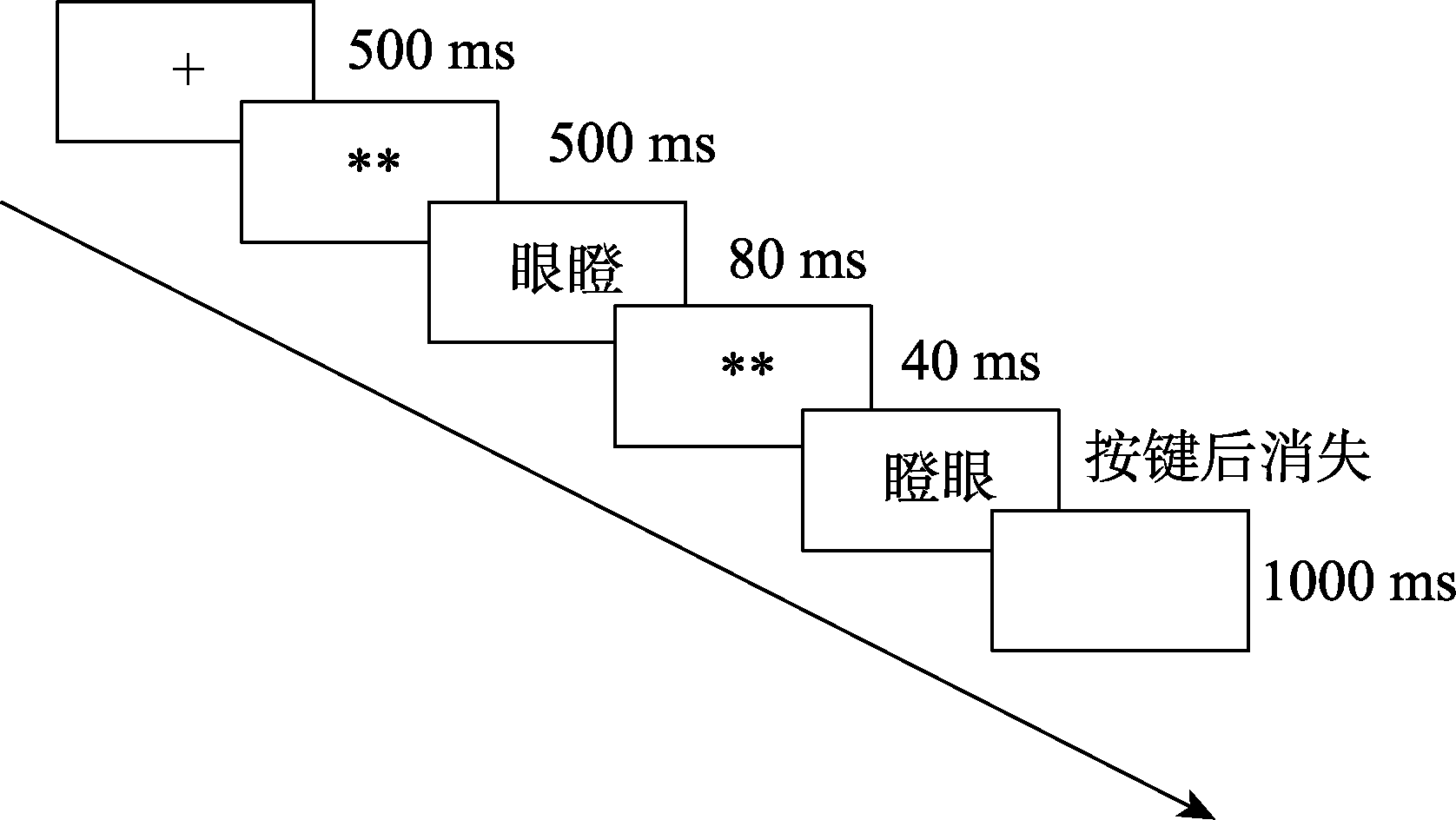
图1 实验1a (启动80 ms)流程图 注: 以转换启动条件为例, 启动词为“眼瞪”, 目标词为“瞪眼”。
| 启动类型 | 正确率 | 反应时(ms) | ||
|---|---|---|---|---|
| 高首词素位置概率 | 低首词素位置概率 | 高首词素位置概率 | 低首词素位置概率 | |
| 原词启动 | 0.94(0.05) | 0.92(0.05) | 625(98) | 622(94) |
| 转换启动 | 0.94(0.05) | 0.90(0.06) | 708(99) | 719(103) |
| 替换启动 | 0.92(0.07) | 0.90(0.08) | 749(95) | 755(98) |
表3 启动80 ms时不同实验条件下的正确率和平均反应时(ms)
| 启动类型 | 正确率 | 反应时(ms) | ||
|---|---|---|---|---|
| 高首词素位置概率 | 低首词素位置概率 | 高首词素位置概率 | 低首词素位置概率 | |
| 原词启动 | 0.94(0.05) | 0.92(0.05) | 625(98) | 622(94) |
| 转换启动 | 0.94(0.05) | 0.90(0.06) | 708(99) | 719(103) |
| 替换启动 | 0.92(0.07) | 0.90(0.08) | 749(95) | 755(98) |
| 因变量 | 固定效应 | b | SE | t/z | 95% CI |
|---|---|---|---|---|---|
| 正确率 | 截距 | 3.00 | 0.12 | 25.94 | [2.78, 3.23] |
| 首词素位置概率 | −0.29 | 0.16 | −1.84 | [−0.60, 0.02] | |
| 启动类型(UN vs TC) | −0.20 | 0.19 | −1.08 | [−0.58, 0.17] | |
| 首词素位置概率×启动类型(UN vs TC) | 0.34 | 0.38 | 0.89 | [−0.41, 1.08] | |
| 反应时 | 截距 | 6.51 | 0.02 | 341.63*** | [6.47, 6.54] |
| 首词素位置概率 | 0.01 | 0.01 | 1.01 | [−0.01, 0.02] | |
| 启动类型(UN vs TC) | 0.06 | 0.01 | 6.21*** | [0.04, 0.08] | |
| 首词素位置概率×启动类型(UN vs TC) | −0.01 | 0.01 | −0.40 | [−0.04, 0.03] |
表4 启动80 ms时不同实验条件下正确率和反应时的线性混合模型统计结果
| 因变量 | 固定效应 | b | SE | t/z | 95% CI |
|---|---|---|---|---|---|
| 正确率 | 截距 | 3.00 | 0.12 | 25.94 | [2.78, 3.23] |
| 首词素位置概率 | −0.29 | 0.16 | −1.84 | [−0.60, 0.02] | |
| 启动类型(UN vs TC) | −0.20 | 0.19 | −1.08 | [−0.58, 0.17] | |
| 首词素位置概率×启动类型(UN vs TC) | 0.34 | 0.38 | 0.89 | [−0.41, 1.08] | |
| 反应时 | 截距 | 6.51 | 0.02 | 341.63*** | [6.47, 6.54] |
| 首词素位置概率 | 0.01 | 0.01 | 1.01 | [−0.01, 0.02] | |
| 启动类型(UN vs TC) | 0.06 | 0.01 | 6.21*** | [0.04, 0.08] | |
| 首词素位置概率×启动类型(UN vs TC) | −0.01 | 0.01 | −0.40 | [−0.04, 0.03] |
| 启动类型 | 正确率 | 反应时(ms) | ||
|---|---|---|---|---|
| 高首词素位置概率 | 低首词素位置概率 | 高首词素位置概率 | 低首词素位置概率 | |
| 原词启动 | 0.94(0.05) | 0.93(0.06) | 527(89) | 530(89) |
| 转换启动 | 0.94(0.05) | 0.93(0.04) | 644(96) | 669(95) |
| 替换启动 | 0.91(0.06) | 0.89(0.08) | 715(82) | 719(85) |
表5 启动150 ms时不同实验条件下的正确率和平均反应时(ms)
| 启动类型 | 正确率 | 反应时(ms) | ||
|---|---|---|---|---|
| 高首词素位置概率 | 低首词素位置概率 | 高首词素位置概率 | 低首词素位置概率 | |
| 原词启动 | 0.94(0.05) | 0.93(0.06) | 527(89) | 530(89) |
| 转换启动 | 0.94(0.05) | 0.93(0.04) | 644(96) | 669(95) |
| 替换启动 | 0.91(0.06) | 0.89(0.08) | 715(82) | 719(85) |
| 因变量 | 固定效应 | b | SE | t/z | 95% CI |
|---|---|---|---|---|---|
| 正确率 | 截距 | 2.85 | 0.10 | 28.87 | [2.67, 3.04] |
| 首词素位置概率 | −0.22 | 0.12 | −1.89 | [−0.45, 0.01] | |
| 启动类型(UN vs TC) | −0.60 | 0.14 | −4.22*** | [−0.88, −0.32] | |
| 首词素位置概率×启动类型(UN vs TC) | −0.10 | 0.28 | −0.34 | [−0.65, 0.46] | |
| 反应时 | 截距 | 6.41 | 0.02 | 352.30*** | [6.37, 6.44] |
| 首词素位置概率 | 0.02 | 0.01 | 2.89** | [0.01, 0.03] | |
| 启动类型(UN vs TC) | 0.10 | 0.01 | 11.61*** | [0.08, 0.12] | |
| 首词素位置概率×启动类型(UN vs TC) | −0.03 | 0.01 | −2.28* | [−0.06, −0.004] |
表6 启动150 ms时不同实验条件下正确率和反应时的线性混合模型统计结果
| 因变量 | 固定效应 | b | SE | t/z | 95% CI |
|---|---|---|---|---|---|
| 正确率 | 截距 | 2.85 | 0.10 | 28.87 | [2.67, 3.04] |
| 首词素位置概率 | −0.22 | 0.12 | −1.89 | [−0.45, 0.01] | |
| 启动类型(UN vs TC) | −0.60 | 0.14 | −4.22*** | [−0.88, −0.32] | |
| 首词素位置概率×启动类型(UN vs TC) | −0.10 | 0.28 | −0.34 | [−0.65, 0.46] | |
| 反应时 | 截距 | 6.41 | 0.02 | 352.30*** | [6.37, 6.44] |
| 首词素位置概率 | 0.02 | 0.01 | 2.89** | [0.01, 0.03] | |
| 启动类型(UN vs TC) | 0.10 | 0.01 | 11.61*** | [0.08, 0.12] | |
| 首词素位置概率×启动类型(UN vs TC) | −0.03 | 0.01 | −2.28* | [−0.06, −0.004] |
| 启动类型 | 正确率 | 反应时(ms) | ||
|---|---|---|---|---|
| 高首词素位置概率 | 低首词素位置概率 | 高首词素位置概率 | 低首词素位置概率 | |
| 原词启动 | 0.95(0.04) | 0.93(0.06) | 522(93) | 525(89) |
| 转换启动 | 0.95(0.04) | 0.93(0.05) | 672(107) | 680(111) |
| 替换启动 | 0.92(0.09) | 0.91(0.08) | 758(103) | 755(102) |
表7 启动300 ms时不同实验条件下的正确率和平均反应时(ms)
| 启动类型 | 正确率 | 反应时(ms) | ||
|---|---|---|---|---|
| 高首词素位置概率 | 低首词素位置概率 | 高首词素位置概率 | 低首词素位置概率 | |
| 原词启动 | 0.95(0.04) | 0.93(0.06) | 522(93) | 525(89) |
| 转换启动 | 0.95(0.04) | 0.93(0.05) | 672(107) | 680(111) |
| 替换启动 | 0.92(0.09) | 0.91(0.08) | 758(103) | 755(102) |
| 因变量 | 固定效应 | b | SE | t/z | 95% CI |
|---|---|---|---|---|---|
| 正确率 | 截距 | 3.15 | 0.13 | 24.52*** | [2.67, 3.04] |
| 首词素位置概率 | −0.20 | 0.14 | −1.44 | [−0.45, 0.01] | |
| 启动类型(UN vs TC) | −0.48 | 0.17 | −2.88** | [−0.88, −0.32] | |
| 首词素位置概率×启动类型(UN vs TC) | 0.23 | 0.33 | 0.68 | [−0.65, 0.46] | |
| 反应时 | 截距 | 6.42 | 0.02 | 284.05*** | [6.38, 6.47] |
| 首词素位置概率 | 0.01 | 0.01 | 0.80 | [−0.01, 0.02] | |
| 启动类型(UN vs TC) | 0.13 | 0.01 | 11.06*** | [0.10, 0.15] | |
| 首词素位置概率×启动类型(UN vs TC) | −0.01 | 0.02 | −0.71 | [−0.05, 0.02] |
表8 启动300 ms时不同实验条件下正确率和反应时的线性混合模型统计结果
| 因变量 | 固定效应 | b | SE | t/z | 95% CI |
|---|---|---|---|---|---|
| 正确率 | 截距 | 3.15 | 0.13 | 24.52*** | [2.67, 3.04] |
| 首词素位置概率 | −0.20 | 0.14 | −1.44 | [−0.45, 0.01] | |
| 启动类型(UN vs TC) | −0.48 | 0.17 | −2.88** | [−0.88, −0.32] | |
| 首词素位置概率×启动类型(UN vs TC) | 0.23 | 0.33 | 0.68 | [−0.65, 0.46] | |
| 反应时 | 截距 | 6.42 | 0.02 | 284.05*** | [6.38, 6.47] |
| 首词素位置概率 | 0.01 | 0.01 | 0.80 | [−0.01, 0.02] | |
| 启动类型(UN vs TC) | 0.13 | 0.01 | 11.06*** | [0.10, 0.15] | |
| 首词素位置概率×启动类型(UN vs TC) | −0.01 | 0.02 | −0.71 | [−0.05, 0.02] |
| 属性 | 高尾位置概率目标词 | 低尾位置概率目标词 | 转换启动词 | 替换启动词 |
|---|---|---|---|---|
| 整词词频 | 1.01(1.18) | 1.00(1.16) | — | — |
| 整词笔画数 | 17.17(4.29) | 16.92(4.24) | 17.04(4.26) | 16.99(4.20) |
| 首字字频 | 486.48(1106.77) | 486.48(1106.77) | 825.26(3903.27) | 822.81(2290.62) |
| 首字笔画数 | 8.58(3.11) | 8.58(3.11) | 8.47(3.01) | 8.48(2.97) |
| 尾字字频 | 635.75(1467.70) | 1014.77(5325.25) | 486.48(1104.71) | 446.96(652.66) |
| 尾字笔画数 | 8.59(3.03) | 8.34(2.99) | 8.58(3.11) | 8.51(3.10) |
表9 目标词材料基本统计特征
| 属性 | 高尾位置概率目标词 | 低尾位置概率目标词 | 转换启动词 | 替换启动词 |
|---|---|---|---|---|
| 整词词频 | 1.01(1.18) | 1.00(1.16) | — | — |
| 整词笔画数 | 17.17(4.29) | 16.92(4.24) | 17.04(4.26) | 16.99(4.20) |
| 首字字频 | 486.48(1106.77) | 486.48(1106.77) | 825.26(3903.27) | 822.81(2290.62) |
| 首字笔画数 | 8.58(3.11) | 8.58(3.11) | 8.47(3.01) | 8.48(2.97) |
| 尾字字频 | 635.75(1467.70) | 1014.77(5325.25) | 486.48(1104.71) | 446.96(652.66) |
| 尾字笔画数 | 8.59(3.03) | 8.34(2.99) | 8.58(3.11) | 8.51(3.10) |
| 属性 | 填充词 | 目标词 | 转换启动词 | 替换启动词 |
|---|---|---|---|---|
| 首字字频 | 486.89(1121.17) | 486.48(1104.71) | 681.40(1315.07) | 669.15(1257.28) |
| 首字笔画数 | 8.59(3.19) | 8.58(3.11) | 8.57(3.08) | 8.51(3.01) |
| 尾字字频 | 681.40(1315.07) | 825.26(3903.27) | 486.89(1121.17) | 487.15(986.16) |
| 尾字笔画数 | 8.57(3.08) | 8.47(3.01) | 8.59(3.19) | 8.62(3.11) |
| 总笔画数 | 17.16(4.42) | 17.04(4.26) | 17.37(4.41) | 17.13(4.43) |
表10 填充词材料基本特征统计
| 属性 | 填充词 | 目标词 | 转换启动词 | 替换启动词 |
|---|---|---|---|---|
| 首字字频 | 486.89(1121.17) | 486.48(1104.71) | 681.40(1315.07) | 669.15(1257.28) |
| 首字笔画数 | 8.59(3.19) | 8.58(3.11) | 8.57(3.08) | 8.51(3.01) |
| 尾字字频 | 681.40(1315.07) | 825.26(3903.27) | 486.89(1121.17) | 487.15(986.16) |
| 尾字笔画数 | 8.57(3.08) | 8.47(3.01) | 8.59(3.19) | 8.62(3.11) |
| 总笔画数 | 17.16(4.42) | 17.04(4.26) | 17.37(4.41) | 17.13(4.43) |
| 启动类型 | 正确率 | 反应时(ms) | ||
|---|---|---|---|---|
| 高尾词素位置概率 | 低尾词素位置概率 | 高尾词素位置概率 | 低尾词素位置概率 | |
| 原词启动 | 0.93(0.04) | 0.92(0.05) | 610(92) | 638(93) |
| 转换启动 | 0.94(0.04) | 0.91(0.06) | 698(90) | 704(88) |
| 替换启动 | 0.94(0.05) | 0.90(0.06) | 729(89) | 757(94) |
表11 启动80 ms时不同实验条件下的正确率和平均反应时(ms)
| 启动类型 | 正确率 | 反应时(ms) | ||
|---|---|---|---|---|
| 高尾词素位置概率 | 低尾词素位置概率 | 高尾词素位置概率 | 低尾词素位置概率 | |
| 原词启动 | 0.93(0.04) | 0.92(0.05) | 610(92) | 638(93) |
| 转换启动 | 0.94(0.04) | 0.91(0.06) | 698(90) | 704(88) |
| 替换启动 | 0.94(0.05) | 0.90(0.06) | 729(89) | 757(94) |
| 因变量 | 固定效应 | b | SE | t/z | 95% CI |
|---|---|---|---|---|---|
| 正确率 | 截距 | 2.74 | 0.09 | 31.57*** | [2.57, 2.91] |
| 尾词素位置概率 | −0.37 | 0.12 | −3.06** | [−0.61, −0.13] | |
| 启动类型(UN vs TC) | −0.09 | 0.13 | −0.68 | [−0.35, 0.17] | |
| 尾词素位置概率×启动类型(UN vs TC) | −0.01 | 0.26 | −0.02 | [−0.52, 0.51] | |
| 反应时 | 截距 | 6.50 | 0.02 | 349.43*** | [6.46, 6.53] |
| 尾词素位置概率 | 0.03 | 0.01 | 5.37*** | [0.02, 0.04] | |
| 启动类型(UN vs TC) | 0.06 | 0.01 | 8.06*** | [0.05, 0.08] | |
| 尾词素位置概率×启动类型(UN vs TC) | 0.02 | 0.01 | 1.66 | [−0.004, 0.05] |
表12 启动80 ms时不同实验条件下正确率和反应时的线性混合模型统计结果
| 因变量 | 固定效应 | b | SE | t/z | 95% CI |
|---|---|---|---|---|---|
| 正确率 | 截距 | 2.74 | 0.09 | 31.57*** | [2.57, 2.91] |
| 尾词素位置概率 | −0.37 | 0.12 | −3.06** | [−0.61, −0.13] | |
| 启动类型(UN vs TC) | −0.09 | 0.13 | −0.68 | [−0.35, 0.17] | |
| 尾词素位置概率×启动类型(UN vs TC) | −0.01 | 0.26 | −0.02 | [−0.52, 0.51] | |
| 反应时 | 截距 | 6.50 | 0.02 | 349.43*** | [6.46, 6.53] |
| 尾词素位置概率 | 0.03 | 0.01 | 5.37*** | [0.02, 0.04] | |
| 启动类型(UN vs TC) | 0.06 | 0.01 | 8.06*** | [0.05, 0.08] | |
| 尾词素位置概率×启动类型(UN vs TC) | 0.02 | 0.01 | 1.66 | [−0.004, 0.05] |
| 启动类型 | 正确率 | 反应时(ms) | ||
|---|---|---|---|---|
| 高尾词素位置概率 | 低尾词素位置概率 | 高尾词素位置概率 | 低尾词素位置概率 | |
| 原词启动 | 0.95(0.04) | 0.91(0.07) | 523(78) | 544(95) |
| 转换启动 | 0.94(0.06) | 0.91(0.08) | 633(97) | 655(92) |
| 替换启动 | 0.91(0.09) | 0.86(0.09) | 705(88) | 712(91) |
表13 启动150 ms时不同实验条件下的正确率和平均反应时(ms)
| 启动类型 | 正确率 | 反应时(ms) | ||
|---|---|---|---|---|
| 高尾词素位置概率 | 低尾词素位置概率 | 高尾词素位置概率 | 低尾词素位置概率 | |
| 原词启动 | 0.95(0.04) | 0.91(0.07) | 523(78) | 544(95) |
| 转换启动 | 0.94(0.06) | 0.91(0.08) | 633(97) | 655(92) |
| 替换启动 | 0.91(0.09) | 0.86(0.09) | 705(88) | 712(91) |
| 因变量 | 固定效应 | b | SE | t/z | 95% CI |
|---|---|---|---|---|---|
| 正确率 | 截距 | 2.67 | 0.10 | 26.17*** | [2.47, 2.87] |
| 尾词素位置概率 | −0.58 | 0.10 | −6.09*** | [−0.77, −0.40] | |
| 启动类型(UN vs TC) | −0.54 | 0.11 | −4.74*** | [−0.77, −0.32] | |
| 尾词素位置概率×启动类型(UN vs TC) | 0.06 | 0.23 | 0.25 | [−0.39, 0.50] | |
| 反应时 | 截距 | 6.40 | 0.02 | 322.38*** | [6.36, 6.44] |
| 尾词素位置概率 | 0.03 | 0.01 | 4.31*** | [0.02, 0.04] | |
| 启动类型(UN vs TC) | 0.11 | 0.01 | 14.22*** | [0.09, 0.12] | |
| 尾词素位置概率×启动类型(UN vs TC) | −0.02 | 0.01 | −1.58 | [−0.05, 0.01] |
表14 启动150 ms时不同实验条件下正确率和反应时的线性混合模型统计结果
| 因变量 | 固定效应 | b | SE | t/z | 95% CI |
|---|---|---|---|---|---|
| 正确率 | 截距 | 2.67 | 0.10 | 26.17*** | [2.47, 2.87] |
| 尾词素位置概率 | −0.58 | 0.10 | −6.09*** | [−0.77, −0.40] | |
| 启动类型(UN vs TC) | −0.54 | 0.11 | −4.74*** | [−0.77, −0.32] | |
| 尾词素位置概率×启动类型(UN vs TC) | 0.06 | 0.23 | 0.25 | [−0.39, 0.50] | |
| 反应时 | 截距 | 6.40 | 0.02 | 322.38*** | [6.36, 6.44] |
| 尾词素位置概率 | 0.03 | 0.01 | 4.31*** | [0.02, 0.04] | |
| 启动类型(UN vs TC) | 0.11 | 0.01 | 14.22*** | [0.09, 0.12] | |
| 尾词素位置概率×启动类型(UN vs TC) | −0.02 | 0.01 | −1.58 | [−0.05, 0.01] |
| 启动类型 | 正确率 | 反应时(ms) | ||
|---|---|---|---|---|
| 高尾词素位置概率 | 低尾词素位置概率 | 高尾词素位置概率 | 低尾词素位置概率 | |
| 原词启动 | 0.95(0.05) | 0.92(0.06) | 511(105) | 533(111) |
| 转换启动 | 0.94(0.06) | 0.91(0.06) | 668(116) | 690(118) |
| 替换启动 | 0.92(0.08) | 0.88(0.09) | 740(102) | 765(102) |
表15 启动300 ms时不同实验条件下的正确率和平均反应时(ms)
| 启动类型 | 正确率 | 反应时(ms) | ||
|---|---|---|---|---|
| 高尾词素位置概率 | 低尾词素位置概率 | 高尾词素位置概率 | 低尾词素位置概率 | |
| 原词启动 | 0.95(0.05) | 0.92(0.06) | 511(105) | 533(111) |
| 转换启动 | 0.94(0.06) | 0.91(0.06) | 668(116) | 690(118) |
| 替换启动 | 0.92(0.08) | 0.88(0.09) | 740(102) | 765(102) |
| 因变量 | 固定效应 | b | SE | t/z | 95% CI |
|---|---|---|---|---|---|
| 正确率 | 截距 | 2.89 | 0.12 | 23.43*** | [2.64, 3.13] |
| 尾词素位置概率 | −0.55 | 0.13 | −4.31*** | [−0.80, −0.30] | |
| 启动类型(UN vs TC) | −0.42 | 0.14 | −3.00** | [−0.69, −0.15] | |
| 尾词素位置概率×启动类型(UN vs TC) | 0.11 | 0.28 | 0.38 | [−0.44, 0.65] | |
| 反应时 | 截距 | 6.42 | 0.02 | 277.35*** | [6.37, 6.46] |
| 尾词素位置概率 | 0.04 | 0.01 | 4.57*** | [0.02, 0.05] | |
| 启动类型(UN vs TC) | 0.12 | 0.01 | 10.42*** | [0.10, 0.14] | |
| 尾词素位置概率×启动类型(UN vs TC) | −0.01 | 0.02 | −0.34 | [−0.04, 0.03] |
表16 启动300 ms时不同实验条件下正确率和反应时的线性混合模型统计结果
| 因变量 | 固定效应 | b | SE | t/z | 95% CI |
|---|---|---|---|---|---|
| 正确率 | 截距 | 2.89 | 0.12 | 23.43*** | [2.64, 3.13] |
| 尾词素位置概率 | −0.55 | 0.13 | −4.31*** | [−0.80, −0.30] | |
| 启动类型(UN vs TC) | −0.42 | 0.14 | −3.00** | [−0.69, −0.15] | |
| 尾词素位置概率×启动类型(UN vs TC) | 0.11 | 0.28 | 0.38 | [−0.44, 0.65] | |
| 反应时 | 截距 | 6.42 | 0.02 | 277.35*** | [6.37, 6.46] |
| 尾词素位置概率 | 0.04 | 0.01 | 4.57*** | [0.02, 0.05] | |
| 启动类型(UN vs TC) | 0.12 | 0.01 | 10.42*** | [0.10, 0.14] | |
| 尾词素位置概率×启动类型(UN vs TC) | −0.01 | 0.02 | −0.34 | [−0.04, 0.03] |
| [1] | Baciero A., Gomez P., Duñabeitia J. A., & Perea M. (2022). Raeding with the fingres: Towards a universal model of letter position coding. Psychonomic Bulletin & Review, 29(6), 2275-2283. |
| [2] | Bai X. J., Li X., & Yan G. L. (2015). Eye movement control in Chinese reading: A summary over the past 20 years of research. Psychological Development and Education, 31(1), 85-91. |
| [白学军, 李馨, 闫国利. (2015). 汉语阅读眼动控制: 20年研究的总结. 心理发展与教育, 31(1), 85-91.] | |
| [3] | Bates D., Maechler M., Bolker B., & Walker S. (2023). lme4: Linear mixed-effects models using ‘Eigen’ and S4. Retrieved July 4, 2023, from https://cran.r-project.org/web/packages/lme4/index.html |
| [4] | Blythe H. I., Johnson R. L., Liversedge S. P., & Rayner K. (2014). Reading transposed text: Effects of transposed letter distance and consonant-vowel status on eye movements. Attention, Perception, & Psychophysics, 76(8), 2424-2440. |
| [5] | Cai Q., & Brysbaert M. (2010). SUBTLEX-CH: Chinese word and character frequencies based on film subtitles. PloS One, 5(6), e10729. |
| [6] |
Cao H. B., Lan Z. B., Gao F., Yu H. T., Li P., & Wang J. X. (2023). The role of character positional frequency on word recognition during Chinese reading: Lexical decision and eye movements studies. Acta Psychologica Sinica, 55(2), 159-176.
doi: 10.3724/SP.J.1041.2023.00159 |
|
[曹海波, 兰泽波, 高峰, 于海涛, 李鹏, 王敬欣. (2023). 词素位置概率在中文阅读中的作用: 词汇判断和眼动研究. 心理学报, 55(2), 159-176.]
doi: 10.3724/SP.J.1041.2023.00159 |
|
| [7] |
Davis C. J. (2010). The spatial coding model of visual word identification. Psychological Review, 117(3), 713-758.
doi: 10.1037/a0019738 pmid: 20658851 |
| [8] |
Gomez P., Ratcliff R., & Perea M. (2008). The overlap model: A model of letter position coding. Psychological Review, 115(3), 577-600.
doi: 10.1037/a0012667 pmid: 18729592 |
| [9] | Gu J. J., Gao Z. H., & Qu Q. Q. (2020). The word boundary effect of Chinese character position processing. Studies of Psychology and Behavior, 18(2), 193-199. |
| [顾俊娟, 高志华, 屈青青. (2020). 汉字位置加工的词边界效应. 心理与行为研究, 18(2), 193-199.] | |
| [10] |
Gu J. J., Li X. S., & Liversedge S. P. (2015). Character order processing in Chinese reading. Journal of Experimental Psychology: Human Perception and Performance, 41(1), 127-137.
doi: 10.1037/a0038639 pmid: 25621586 |
| [11] | Hansell M. (2008). Teaching and learning Chinese as a foreign language: A pedagogical grammar. Modern Language Journal, 92(2), 331-332. |
| [12] | Hua H. M., Gu J. J., Lin N., & Li X. S. (2017). Letter/ character position encoding in visual word recognition. Advances in Psychological Science, 25(7), 1132-1138. |
| [滑慧敏, 顾俊娟, 林楠, 李兴珊. (2017). 视觉词汇识别中的字符位置编码. 心理科学进展, 25(7), 1132-1138.] | |
| [13] | Johnson R. L., Perea M., & Rayner K. (2007). Transposed- letter effects in reading: Evidence from eye movements and parafoveal preview. Journal of Experimental Psychology: Human Perception and Performance, 33(1), 209-229. |
| [14] | Li X. S., & Pollatsek A. (2020). An integrated model of word processing and eye-movement control during Chinese reading. Psychological Review, 127(6), 1139-1162. |
| [15] | Lian K. Y., Ma J., Wei L., Zhang S. W., & Bai X. J. (2021). The role of character positional frequency on college and primary student in oral reading. Studies of Psychology and Behavior, 19(2), 179-185. |
| [连坤予, 马杰, 魏玲, 张书帏, 白学军. (2021). 汉语朗读中词素位置概率线索作用的发展研究. 心理与行为研究, 19(2), 179-185.] | |
| [16] | Liang F. F., Blythe H. I., Bai X. J., Yan G. L., Li X., Zang C. L., & Liversedge S. P. (2017). The role of character positional frequency on Chinese word learning during natural reading. PloS One, 12(11), e0187656. |
| [17] | Liang F. F., Blythe H. I., Zang C. L., Bai X. J., Yan G. L., & Liversedge S. P. (2015). Positional character frequency and word spacing facilitate the acquisition of novel words during Chinese children's reading. Journal of Cognitive Psychology, 27(5), 594-608. |
| [18] |
Liang F. F., Feng L. L., Liu Y., Li X., & Bai X. J. (2024). Different roles of initial and final character positional probabilities on incidental word learning during Chinese reading. Acta Psychologica Sinica, 56(3), 281-294.
doi: 10.3724/SP.J.1041.2024.00281 |
|
[梁菲菲, 冯琳琳, 刘瑛, 李馨, 白学军. (2024). 阅读伴随词汇学习的词切分: 首、尾词素位置概率的不同作用. 心理学报, 56(3), 281-294.]
doi: 10.3724/SP.J.1041.2024.00281 |
|
| [19] | Liang F. F., Gao Q., Li X., Wang Y. S., Bai X. J., & Liversedge S. P. (2023). The importance of the positional probability of word final (but not word initial) characters for word segmentation and identification in children and adults' natural Chinese reading. Journal of Experimental Psychology: Learning, Memory, and Cognition, 49(1), 98-115. |
| [20] |
Liang F. F., Liu Y., Feng L. L., He F., Wang Z., & Bai X. J. (2024). Visual complexity effect in Chinese incidental word learning: Evidence from number of strokes and word length. Acta Psychologica Sinica, 56(12), 1734-1750.
doi: 10.3724/SP.J.1041.2024.01734 |
|
[梁菲菲, 刘瑛, 贺斐, 冯琳琳, 王峥, 白学军. (2024). 中文阅读伴随词汇学习中的视觉复杂性效应:基于笔画数和词长的证据. 心理学报, 56(12), 1734-1750.]
doi: 10.3724/SP.J.1041.2024.01734 |
|
| [21] | Ma G. J., & Li X. S. (2015). How character complexity modulates eye movement control in Chinese reading. Reading and Writing, 28(6), 747-761. |
| [22] | Peng D. L., Ding G. S., Wang C. M., Taft M., & Zhu X. P. (1999). The processing of Chinese reversible words-the role of morphemes in lexical access. Acta Psychologica Sinica, 31(1), 36-46. |
| [彭聃龄, 丁国盛, 王春茂, Taft, M., 朱晓平. (1999). 汉语逆序词的加工——词素在词加工中的作用. 心理学报, 31(1), 36-46.] | |
| [23] |
Perea M., & Fraga I. (2006). Transposed-letter and laterality effects in lexical decision. Brain and Language, 97(1), 102-109.
pmid: 16183108 |
| [24] | Perea M., Winskel H., & Ratitamkul T. (2012). On the flexibility of letter position coding during lexical processing: The case of Thai. Experimental Psychology, 59(2), 68-73. |
| [25] | R Core Team. (2018). R: A language and environment for statistical computing. Vienna, Austria: R Foundation for Statistical Computing. Retrieved from https://www.R-project.org/ |
| [26] | Song X. N., Xu X. C., Yang X. L., Sun G. L., & Cui L. (2022). The influence of predictability, word frequency and stroke number on Chinese word recognition: An eye movement study. Journal of Psychological Science, 45(5), 1061-1068. |
| [宋悉妮, 徐晓晨, 杨秀莉, 孙桂苓, 崔磊. (2022). 预期性、词频和笔画数对中文词汇识别影响的眼动研究. 心理科学, 45(5), 1061-1068.] | |
| [27] |
Su X. Z., Li X. X., Li R. R., Zhao C. Z., & Cui L. (2024). Morphological structures of two-character words influence character position encoding. Acta Psychologica Sinica, 56(4), 383-393.
doi: 10.3724/SP.J.1041.2024.00383 |
|
[苏省之, 李骁轩, 李蓉蓉, 赵长泽, 崔磊. (2024). 双字词的形态结构对汉字位置信息编码的影响. 心理学报, 56(4), 383-393.]
doi: 10.3724/SP.J.1041.2024.00383 |
|
| [28] | Taft M. (2004). Morphological decomposition and the reverse base frequency effect. The Quarterly Journal of Experimental Psychology, 57(4), 745-765. |
| [29] |
Xu E. J., & Sui X. (2018). Effects of predictability on the time course of identity information and location information in Chinese word recognition. Acta Psychologica Sinica, 50(6), 606-621.
doi: 10.3724/SP.J.1041.2018.00606 |
|
[徐迩嘉, 隋雪. (2018). 身份信息与位置信息的加工进程及语境预测性的影响. 心理学报, 50(6), 606-621.]
doi: 10.3724/SP.J.1041.2018.00606 |
|
| [30] | Yan G. L., Tian H. J., Bai X. J., & Rayner K. (2006). The effect of word and character frequency on the eye movements of Chinese readers. British Journal of Psychology, 97(2), 259-268. |
| [31] | Zhang Y. C., Jiang Y., Dong Q., & Wang J. X. (2021). The identity and position processing for Chinese character, digit, and symbol strings—Special mechanism of Chinese reading. Psychological Exploration, 41(6), 504-514. |
| [张妍萃, 江莹, 董青, 王敬欣. (2021). 汉字、数字和符号的身份信息和位置信息加工比较——中文阅读的特别机制. 心理学探新, 41(6), 504-514.] |
| [1] | 梁菲菲, 冯琳琳, 刘瑛, 李馨, 白学军. 阅读伴随词汇学习的词切分:首、尾词素位置概率的不同作用[J]. 心理学报, 2024, 56(3): 281-294. |
| [2] | 曹海波, 兰泽波, 高峰, 于海涛, 李鹏, 王敬欣. 词素位置概率在中文阅读中的作用:词汇判断和眼动研究[J]. 心理学报, 2023, 55(2): 159-176. |
| 阅读次数 | ||||||
|
全文 |
|
|||||
|
摘要 |
|
|||||
