

ISSN 0439-755X
CN 11-1911/B
主办:中国心理学会
中国科学院心理研究所
出版:科学出版社
CN 11-1911/B
主办:中国心理学会
中国科学院心理研究所
出版:科学出版社
心理学报 ›› 2025, Vol. 57 ›› Issue (7): 1262-1280.doi: 10.3724/SP.J.1041.2025.1262 cstr: 32110.14.2025.1262
农梅兰1, 朱瑜2( ), 王雁飞3
收稿日期:2024-05-20
发布日期:2025-04-24
出版日期:2025-07-25
通讯作者:
朱瑜, E-mail: zhuyu@jnu.edu.cn基金资助:
NONG Meilan1, ZHU Yu2(), WANG Yanfei3
Received:2024-05-20
Online:2025-04-24
Published:2025-07-25
摘要:
不道德亲家庭行为在组织中普遍存在且代价高昂, 当前已经成为学术界与管理层关注的焦点问题。现有文献主要聚焦于不道德亲家庭行为的前因研究, 对其后果的探讨尚显不足。本文基于不确定性−认同理论构建了不道德亲家庭行为影响员工工作和家庭生活的综合模型。通过实验研究、三方配对的多时点问卷调查研究以及5次纵向追踪研究, 本文发现不道德亲家庭行为会增强员工的家庭认同, 并通过家庭认同降低员工的组织公民行为以及家庭不文明行为。道德认同中心性调节上述效应, 当道德认同中心性较高时, 不道德亲家庭行为对家庭认同的正向影响及其对组织公民行为和家庭不文明行为的间接影响会被削弱。此外, 不道德亲家庭行为的积极后效具有短暂性, 其通过家庭认同降低家庭不文明行为的间接效应在4周后逐渐减弱, 并于6周后消失。本文为理解不道德亲家庭行为的后果、机制及边界条件提供了新视角, 对组织管理和家庭关系管理具有重要启示意义。
中图分类号:
农梅兰, 朱瑜, 王雁飞. (2025). 以家庭之名行不义之事: 不道德亲家庭行为的影响及其机制. 心理学报, 57(7), 1262-1280.
NONG Meilan, ZHU Yu, WANG Yanfei. (2025). Acting unethical in the guise of family: The effects and mechanisms of unethical pro-family behavior. Acta Psychologica Sinica, 57(7), 1262-1280.
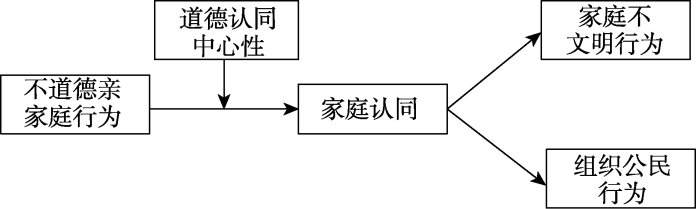
图1 理论模型
| 变量 | 均值 | 标准差 | 1 | 2 | 3 |
|---|---|---|---|---|---|
| 1. 不道德亲家庭行为操纵 | 0.50 | 0.50 | − | ||
| 2. 道德认同中心性操纵 | 0.50 | 0.50 | 0.00 | − | |
| 3. 家庭认同 | 2.93 | 0.67 | 0.38** | −0.48** | − |
表1 研究1情景实验中变量的描述性统计和相关系数表
| 变量 | 均值 | 标准差 | 1 | 2 | 3 |
|---|---|---|---|---|---|
| 1. 不道德亲家庭行为操纵 | 0.50 | 0.50 | − | ||
| 2. 道德认同中心性操纵 | 0.50 | 0.50 | 0.00 | − | |
| 3. 家庭认同 | 2.93 | 0.67 | 0.38** | −0.48** | − |
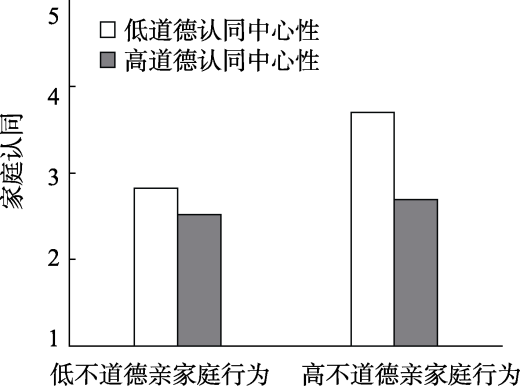
图2 研究1道德认同中心性的调节效应图
| 模型 | χ2 | df | χ2/df | CFI | TLI | SRMR | RMSEA |
|---|---|---|---|---|---|---|---|
| 五因子模型 | 1071.72 | 485 | 2.21 | 0.90 | 0.89 | 0.05 | 0.06 |
| 四因子模型 | 1625.67 | 489 | 3.32 | 0.81 | 0.80 | 0.10 | 0.09 |
| 三因子模型 | 2492.20 | 492 | 5.07 | 0.67 | 0.64 | 0.14 | 0.12 |
| 二因子模型 | 4149.43 | 494 | 8.40 | 0.40 | 0.35 | 0.20 | 0.16 |
| 单因子模型 | 4751.47 | 495 | 9.60 | 0.30 | 0.25 | 0.20 | 0.17 |
表2 研究2的验证性因子分析结果
| 模型 | χ2 | df | χ2/df | CFI | TLI | SRMR | RMSEA |
|---|---|---|---|---|---|---|---|
| 五因子模型 | 1071.72 | 485 | 2.21 | 0.90 | 0.89 | 0.05 | 0.06 |
| 四因子模型 | 1625.67 | 489 | 3.32 | 0.81 | 0.80 | 0.10 | 0.09 |
| 三因子模型 | 2492.20 | 492 | 5.07 | 0.67 | 0.64 | 0.14 | 0.12 |
| 二因子模型 | 4149.43 | 494 | 8.40 | 0.40 | 0.35 | 0.20 | 0.16 |
| 单因子模型 | 4751.47 | 495 | 9.60 | 0.30 | 0.25 | 0.20 | 0.17 |
| 变量 | 1 | 2 | 3 | 4 | 5 | 6 | 7 | 8 | 9 | 10 | 11 |
|---|---|---|---|---|---|---|---|---|---|---|---|
| 1. 性别 | − | ||||||||||
| 2. 年龄 | −0.14* | − | |||||||||
| 3. 受教育程度 | 0.02 | −0.10 | − | ||||||||
| 4. 婚姻状况 | −0.15* | 0.57** | −0.07 | − | |||||||
| 5. 育儿人数 | −0.11* | 0.59** | −0.23** | 0.70** | − | ||||||
| 6. 工作年限 | −0.22** | 0.82** | −0.23** | 0.71** | 0.64** | − | |||||
| 7. 不道德亲家庭行为 | −0.18** | −0.02 | 0.16** | 0.01 | −0.02 | 0.06 | − | ||||
| 8. 道德认同中心性 | 0.07 | −0.01 | −0.10 | −0.04 | 0.06 | −0.11 | −0.27** | − | |||
| 9. 家庭认同 | −0.11 | 0.07 | 0.05 | 0.14* | 0.09 | 0.13* | 0.25** | 0.14* | − | ||
| 10. 组织公民行为 | −0.02 | −0.08 | 0.06 | −0.09 | −0.10 | −0.05 | 0.06 | −0.19** | −0.24** | − | |
| 11. 家庭不文明行为 | −0.01 | −0.21** | −0.02 | −0.21** | −0.12* | −0.30** | −0.03 | 0.12* | −0.24** | 0.11 | − |
| 平均值 | 1.55 | 28.21 | 2.97 | 1.37 | 1.38 | 2.32 | 3.17 | 3.73 | 4.04 | 2.54 | 2.00 |
| 标准差 | 0.50 | 7.77 | 0.69 | 0.48 | 0.64 | 1.37 | 1.08 | 0.96 | 0.70 | 0.92 | 0.87 |
表3 研究2描述性统计与相关分析结果
| 变量 | 1 | 2 | 3 | 4 | 5 | 6 | 7 | 8 | 9 | 10 | 11 |
|---|---|---|---|---|---|---|---|---|---|---|---|
| 1. 性别 | − | ||||||||||
| 2. 年龄 | −0.14* | − | |||||||||
| 3. 受教育程度 | 0.02 | −0.10 | − | ||||||||
| 4. 婚姻状况 | −0.15* | 0.57** | −0.07 | − | |||||||
| 5. 育儿人数 | −0.11* | 0.59** | −0.23** | 0.70** | − | ||||||
| 6. 工作年限 | −0.22** | 0.82** | −0.23** | 0.71** | 0.64** | − | |||||
| 7. 不道德亲家庭行为 | −0.18** | −0.02 | 0.16** | 0.01 | −0.02 | 0.06 | − | ||||
| 8. 道德认同中心性 | 0.07 | −0.01 | −0.10 | −0.04 | 0.06 | −0.11 | −0.27** | − | |||
| 9. 家庭认同 | −0.11 | 0.07 | 0.05 | 0.14* | 0.09 | 0.13* | 0.25** | 0.14* | − | ||
| 10. 组织公民行为 | −0.02 | −0.08 | 0.06 | −0.09 | −0.10 | −0.05 | 0.06 | −0.19** | −0.24** | − | |
| 11. 家庭不文明行为 | −0.01 | −0.21** | −0.02 | −0.21** | −0.12* | −0.30** | −0.03 | 0.12* | −0.24** | 0.11 | − |
| 平均值 | 1.55 | 28.21 | 2.97 | 1.37 | 1.38 | 2.32 | 3.17 | 3.73 | 4.04 | 2.54 | 2.00 |
| 标准差 | 0.50 | 7.77 | 0.69 | 0.48 | 0.64 | 1.37 | 1.08 | 0.96 | 0.70 | 0.92 | 0.87 |
| 变量 | 家庭认同 | 家庭不文明行为 | 组织公民行为 | |||
|---|---|---|---|---|---|---|
| b | SE | b | SE | b | SE | |
| 性别 | −0.11 | 0.08 | −0.17 | 0.10 | −0.06 | 0.11 |
| 年龄 | −0.01 | 0.01 | 0.01 | 0.01 | −0.02 | 0.01 |
| 受教育程度 | 0.04 | 0.06 | −0.12 | 0.08 | −0.11 | 0.08 |
| 婚姻状况 | 0.20 | 0.14 | 0.02 | 0.16 | −0.15 | 0.20 |
| 育儿人数 | −0.08 | 0.10 | 0.13 | 0.12 | −0.06 | 0.14 |
| 工作年限 | 0.04 | 0.07 | −0.30** | 0.10 | 0.13 | 0.09 |
| 不道德亲家庭行为 | 0.22*** | 0.04 | 0.05 | 0.05 | 0.08 | 0.05 |
| 家庭认同 | −0.26*** | 0.07 | −0.36*** | 0.08 | ||
| 道德认同中心性 | 0.26*** | 0.05 | ||||
| 不道德亲家庭行为×道德认同中心性 | −0.20*** | 0.05 | ||||
表4 研究2的路径分析结果(全模型)
| 变量 | 家庭认同 | 家庭不文明行为 | 组织公民行为 | |||
|---|---|---|---|---|---|---|
| b | SE | b | SE | b | SE | |
| 性别 | −0.11 | 0.08 | −0.17 | 0.10 | −0.06 | 0.11 |
| 年龄 | −0.01 | 0.01 | 0.01 | 0.01 | −0.02 | 0.01 |
| 受教育程度 | 0.04 | 0.06 | −0.12 | 0.08 | −0.11 | 0.08 |
| 婚姻状况 | 0.20 | 0.14 | 0.02 | 0.16 | −0.15 | 0.20 |
| 育儿人数 | −0.08 | 0.10 | 0.13 | 0.12 | −0.06 | 0.14 |
| 工作年限 | 0.04 | 0.07 | −0.30** | 0.10 | 0.13 | 0.09 |
| 不道德亲家庭行为 | 0.22*** | 0.04 | 0.05 | 0.05 | 0.08 | 0.05 |
| 家庭认同 | −0.26*** | 0.07 | −0.36*** | 0.08 | ||
| 道德认同中心性 | 0.26*** | 0.05 | ||||
| 不道德亲家庭行为×道德认同中心性 | −0.20*** | 0.05 | ||||
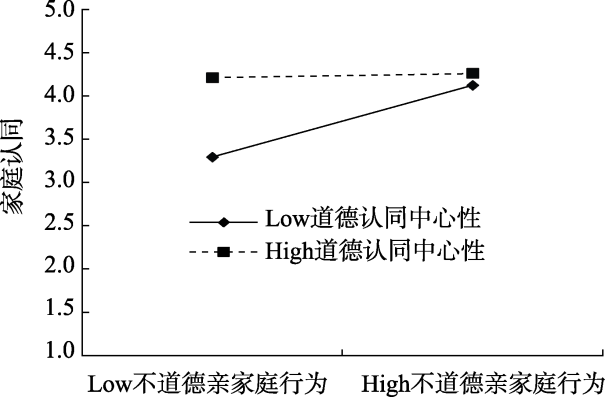
图3 道德认同中心性对不道德亲家庭行为和家庭认同关系的调节效应图
| 变量和检验 | χ2(df) | CFI | RMSEA | SRMR | ∆CFI | ∆RMSEA | ∆SRMR |
|---|---|---|---|---|---|---|---|
| 不道德亲家庭行为 | |||||||
| 区分效度CFA | 1925.90(550)*** | 0.846 | 0.098 | 0.061 | |||
| 构型不变性CFA | 1239.89(480)*** | 0.915 | 0.078 | 0.060 | |||
| 单位等值性CFA | 1277.47(504)*** | 0.913 | 0.077 | 0.065 | −0.002 | −0.001 | 0.005 |
| 家庭认同 | |||||||
| 区分效度CFA | 706.27(395) *** | 0.958 | 0.055 | 0.041 | |||
| 构型不变性CFA | 538.11(335)*** | 0.972 | 0.048 | 0.039 | |||
| 单位等值性CFA | 575.30(355)*** | 0.970 | 0.049 | 0.050 | −0.002 | 0.001 | 0.011 |
| 家庭不文明行为 | |||||||
| 区分效度CFA | 1256.81(395)*** | 0.868 | 0.092 | 0.053 | |||
| 构型不变性CFA | 914.57(335)*** | 0.911 | 0.082 | 0.048 | |||
| 单位等值性CFA | 945.66(355)*** | 0.909 | 0.080 | 0.054 | −0.002 | −0.002 | 0.006 |
表5 各变量区分效度、构型不变性性和单位等值性检验结果
| 变量和检验 | χ2(df) | CFI | RMSEA | SRMR | ∆CFI | ∆RMSEA | ∆SRMR |
|---|---|---|---|---|---|---|---|
| 不道德亲家庭行为 | |||||||
| 区分效度CFA | 1925.90(550)*** | 0.846 | 0.098 | 0.061 | |||
| 构型不变性CFA | 1239.89(480)*** | 0.915 | 0.078 | 0.060 | |||
| 单位等值性CFA | 1277.47(504)*** | 0.913 | 0.077 | 0.065 | −0.002 | −0.001 | 0.005 |
| 家庭认同 | |||||||
| 区分效度CFA | 706.27(395) *** | 0.958 | 0.055 | 0.041 | |||
| 构型不变性CFA | 538.11(335)*** | 0.972 | 0.048 | 0.039 | |||
| 单位等值性CFA | 575.30(355)*** | 0.970 | 0.049 | 0.050 | −0.002 | 0.001 | 0.011 |
| 家庭不文明行为 | |||||||
| 区分效度CFA | 1256.81(395)*** | 0.868 | 0.092 | 0.053 | |||
| 构型不变性CFA | 914.57(335)*** | 0.911 | 0.082 | 0.048 | |||
| 单位等值性CFA | 945.66(355)*** | 0.909 | 0.080 | 0.054 | −0.002 | −0.002 | 0.006 |
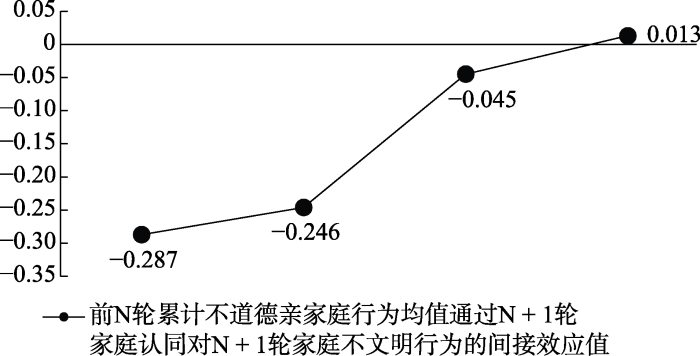
图4 不道德亲家庭行为对后续家庭不文明行为的间接影响变化图
| [1] | Alniacik, E., Erbas Kelebek, E. F., & Alniacik, U. (2022). The moderating role of message framing on the links between organizational identification and unethical pro-organizational behavior. Management Research Review, 45(4), 502-523. |
| [2] |
Aquino, K., & Reed II, A. (2002). The self-importance of moral identity. Journal of Personality and Social Psychology, 83(6), 1423-1440.
pmid: 12500822 |
| [3] | Ayyagari, R., Grover, V., & Purvis, R. (2011). Technostress: Technological antecedents and implications. MIS Quarterly, 35(4), 831-858. |
| [4] | Bagger, J., Li, A., & Gutek, B. A. (2008). How much do you value your family and does it matter? The joint effects of family identity salience, family-interference-with-work, and gender. Human Relations, 61(2), 187-211. |
| [5] | Bai, Q., Lin, W., & Wang, L. (2016). Family incivility and counterproductive work behavior: A moderated mediation model of self-esteem and emotional regulation. Journal of Vocational Behavior, 94, 11-19. |
| [6] | Bazerman, M. H., Tenbrunsel, A. E., & Wade-Benzoni, K. A. (1998). Negotiating with yourself and losing: Making decisions with competing internal preferences. Academy of Management Review, 23(2), 225-241. |
| [7] | Belavadi, S., Rinella, M. J., & Hogg, M. A. (2020). When social identity-defining groups become violent: Collective responses to identity uncertainty, status erosion, and resource threat. In The Handbook of Collective Violence(pp. 17-30). Routledge. |
| [8] | Bernardes, J. (1985). ‘Family ideology’: Identification and exploration. The Sociological Review, 33(2), 275-297. |
| [9] |
Berry, C. M., Carpenter, N. C., & Barratt, C. L. (2012). Do other-reports of counterproductive work behavior provide an incremental contribution over self-reports? A meta-analytic comparison. Journal of Applied Psychology, 97(3), 613-636.
doi: 10.1037/a0026739 pmid: 22201245 |
| [10] | Brislin, R. W. (1986). A culture general assimilator: Preparation for various types of sojourns. International Journal of Intercultural Relations, 10(2), 215-234. |
| [11] | Chen, F. F. (2007). Sensitivity of goodness of fit indexes to lack of measurement invariance. Structural Equation Modeling, 14(3), 464-504. |
| [12] | Chen, M., Chen, C. C., & Schminke, M. (2023). Feeling guilty and entitled: paradoxical consequences of unethical pro-organizational behavior. Journal of Business Ethics, 183(3), 865-883. |
| [13] | Cheng, K., Zhu, Q., & Lin, Y. (2022). Family-supportive supervisor behavior, felt obligation, and unethical pro- family behavior: The moderating role of positive reciprocity beliefs. Journal of Business Ethics, 177(2), 261-273. |
| [14] | Choi, E. U., & Hogg, M. A. (2020). Self-uncertainty and group identification: A meta-analysis. Group Processes & Intergroup Relations, 23(4), 483-501. |
| [15] | Cigoli, V., & Scabini, E. (2006). Family identity: Ties, symbols, and transitions. Routledge. |
| [16] | Cui, J. L., Qi, W., & Shan, M. M. (2013). The effect of family identity and identity fusion on extreme family behavior with a mediator in the process. Psychological Research, (3), 69-74. |
| [崔丽娟, 戚玮, 单铭明. (2013). 家庭认同和认同融合对极端家庭行为的影响及其中介变量的研究. 心理研究, (3), 69-74.] | |
| [17] | De Clercq, D., Haq, I. U., Azeem, M. U., & Raja, U. (2018). Family incivility, emotional exhaustion at work, and being a good soldier: The buffering roles of waypower and willpower. Journal of Business Research, 89(4), 27-36. |
| [18] | Dumas, T. L., & Stanko, T. L. (2017). Married with children: How family role identification shapes leadership behaviors at work. Personnel Psychology, 70(3), 597-633. |
| [19] | Farh, J. L., Hackett, R. D., & Liang, J. (2007). Individual-level cultural values as moderators of perceived organizational support-employee outcome relationships in China: Comparing the effects of power distance and traditionality. Academy of Management Journal, 50(3), 715-729. |
| [20] |
Gong, S., Lu, J. G., Schaubroeck, J. M., Li, Q., Zhou, Q., & Qian, X. (2020). Polluted psyche: Is the effect of air pollution on unethical behavior more physiological or psychological?. Psychological Science, 31(8), 1040-1047.
doi: 10.1177/0956797620943835 pmid: 32701400 |
| [21] | Hales, A. H., & Williams, K. D. (2018). Marginalized individuals and extremism: The role of ostracism in openness to extreme groups. Journal of Social Issues, 74(1), 75-92. |
| [22] | He, H., Zhu, W., & Zheng, X. (2014). Procedural justice and employee engagement: Roles of organizational identification and moral identity centrality. Journal of Business Ethics, 122, 681-695. |
| [23] | Hogg, M. A. (2007). Uncertainty-identity theory. Advances in Experimental Social Psychology, 39, 69-126. |
| [24] | Hogg, M. A. (2022). Self-uncertainty and social identity processes in organizations:An uncertainty-identity theory perspective. In M. A. Griffin & G. Grote (Eds.), The Oxford handbook of uncertainty management in work organizations (online edn, Oxford Academic, 20 Oct. 2022). |
| [25] | Hogg, M. A. (2012). Uncertainty-identity theory. In P. A. M. Van Lange, A. W. Kruglanski, & E. T. Higgins (Eds.), Handbook of theories of social psychology (pp. 62-80), Thousand Oaks, CA: Sage. |
| [26] | Hou, C., Cheng, K., He, J., Hu, P., & Lin, Y. (2023). Can leader self-sacrificial behavior inhibit unethical pro-family behavior? A personal identification perspective. Frontiers in Psychology, 13, 1078122. |
| [27] |
Ilies, R., Liu, X. Y., Liu, Y., & Zheng, X. (2017). Why do employees have better family lives when they are highly engaged at work? Journal of Applied Psychology, 102(6), 956-970.
doi: 10.1037/apl0000211 pmid: 28277725 |
| [28] |
Johnson, H. H., & Umphress, E. E. (2019). To help my supervisor: Identification, moral identity, and unethical pro-supervisor behavior. Journal of Business Ethics, 159, 519-534.
doi: 10.1007/s10551-018-3836-z |
| [29] |
Kühnen, U. (2010). Manipulation checks as manipulation: Another look at the ease-of-retrieval heuristic. Personality and Social Psychology Bulletin, 36(1), 47-58.
doi: 10.1177/0146167209346746 pmid: 19875826 |
| [30] | Lian, H., Huai, M., Farh, J. L., Huang, J. C., Lee, C., & Chao, M. M. (2022). Leader unethical pro-organizational behavior and employee unethical conduct: Social learning of moral disengagement as a behavioral principle. Journal of Management, 48(2), 350-379. |
| [31] |
Lim, S., & Tai, K. (2014). Family incivility and job performance: A moderated mediation model of psychological distress and core self-evaluation. Journal of Applied Psychology, 99(2), 351-359.
doi: 10.1037/a0034486 pmid: 24079671 |
| [32] | Liu, X. L., Lu, J. G., Zhang, H., & Cai, Y. (2021). Helping the organization but hurting yourself: How employees’ unethical pro-organizational behavior predicts work-to-life conflict. Organizational Behavior and Human Decision Processes, 167, 88-100. |
| [33] | Liu, Y., Bai, Q., Yuan, Y., Li, B., Liu, P., Liu, D.... Zhao, L. (2023). Impact of work connectivity behavior after-hours on employees’ unethical pro-family behavior. Current Psychology, 43, 11785-11803. |
| [34] | Liu, Z., Liao, H., & Liu, Y. (2020). For the sake of my family: Understanding unethical pro-family behavior in the workplace. Journal of Organizational Behavior, 41(7), 638-662. |
| [35] | Luan, M., & Li, J. P. (2022). Failed players, successful advertisements: Does showing the failure experience increase observers' intention to try? Acta Psychologica Sinica, 54(12), 1562-1578. |
|
[栾墨, 李俊澎. (2022). 失败的游戏玩家, 成功的广告: 展示失败体验会令观察者更想尝试吗?. 心理学报, 54(12), 1562-1578.]
doi: 10.3724/SP.J.1041.2022.01562 |
|
| [36] | Ma, J., & Wei, W. (2023). Curiosity causes creativity? Revealing the reinforcement circle between state curiosity and creativity. The Journal of Creative Behavior, 57(4), 1-17. |
| [37] | Mael, F., & Ashforth, B. E. (1992). Alumni and their alma mater: A partial test of the reformulated model of organizational identification. Journal of Organizational Behavior, 13(2), 103-123. |
| [38] | Mao, M. Y., Zhang, L. J., & Dai, G. S. (2022). Research on the influence mechanism of non-working time communication technology overload on employee's unethical pro-family behavior. Journal of Business Economics, (12), 41-54. |
| [毛孟雨, 张兰霞, 代广松. (2022). 非工作时间通信技术过载对员工不道德亲家庭行为的影响机制研究. 商业经济与管理, (12), 41-54.] | |
| [39] | Matherne, C. F., Ring, J. K., & Farmer, S. (2018). Organizational moral identity centrality: Relationships with citizenship behaviors and unethical prosocial behaviors. Journal of Business and Psychology, 33, 711-726. |
| [40] |
Matthews, R. A., Wayne, J. H., & Ford, M. T. (2014). A work-family conflict/subjective well-being process model: A test of competing theories of longitudinal effects. Journal of Applied Psychology, 99(6), 1173-1187.
doi: 10.1037/a0036674 pmid: 24773400 |
| [41] | McFerran, B., Aquino, K., & Duffy, M. (2010). How personality and moral identity relate to individuals’ ethical ideology. Business Ethics Quarterly, 20(1), 35-56. |
| [42] | Mittal, S., Yadav, S., Srivastava, R., Sahni, S., & Kumar, H. (2024). The antecedents, drivers and outcomes of employee family incivility in the workplace: A systematic review and future research avenues. Acta Psychologica, 248, 104348. |
| [43] | Moore, C., & Gino, F. (2013). Ethically adrift: How others pull our moral compass from true North, and how we can fix it. Research in Organizational Behavior, 33, 53-77. |
| [44] |
Ng, T. W. H., & Feldman, D. C. (2008). The relationship of age to ten dimensions of job performance. Journal of Applied Psychology, 93(2), 392-423.
doi: 10.1037/0021-9010.93.2.392 pmid: 18361640 |
| [45] | Organ, D. W., Podsakoff, P. M., & MacKenzie, S. B. (2006). Organizational citizenship behavior: Its nature, antecedents, and consequences. Thousand Oaks, CA: Sage. |
| [46] | Podsakoff, P. M., & Organ, D. W. (1986). Self-reports in organizational research: Problems and prospects. Journal of Management, 12(4), 531-544. |
| [47] |
Podsakoff, P. M., MacKenzie, S. B., Lee, J. Y., & Podsakoff, N. P. (2003). Common method biases in behavioral research: A critical review of the literature and recommended remedies. Journal of Applied Psychology, 88(5), 879-903.
doi: 10.1037/0021-9010.88.5.879 pmid: 14516251 |
| [48] | Putnam, R. D. (2007). E pluribus unum:Diversity and community in the twenty-first century the 2006 Johan Skytte Prize Lecture. Scandinavian Political Studies, 30(2), 137-174. |
| [49] |
Qin, X., Chen, C., Yam, K. C., Huang, M., & Ju, D. (2020). The double-edged sword of leader humility: Investigating when and why leader humility promotes versus inhibits subordinate deviance. Journal of Applied Psychology, 105(7), 693-712.
doi: 10.1037/apl0000456 pmid: 31670527 |
| [50] | Qin, X., Huang, M., Johnson, R. E., Hu, Q., & Ju, D. (2018). The short-lived benefits of abusive supervisory behavior for actors: An investigation of recovery and work engagement. Academy of Management Journal, 61(5), 1951-1975. |
| [51] | Rast III, D. E., Gaffney, A. M., Hogg, M. A., & Crisp, R. J. (2012). Leadership under uncertainty: When leaders who are non-prototypical group members can gain support. Journal of Experimental Social Psychology, 48(3), 646-653. |
| [52] | Sharma, D., & Mishra, M. (2021). Family incivility and instigated workplace incivility: How and when does rudeness spill over from family to work?. Asia Pacific Journal of Management, 39(4), 1257-1285. |
| [53] |
Sun, X., Yan, M., & Chu, X. P. (2014). Passive mood and work behavior: The cross-level mediating effect of zhong-yong thinking style. Acta Psychologica Sinica, 46(11), 1704-1718.
doi: 10.3724/SP.J.1041.2014.01704 |
| [孙旭, 严鸣, 储小平. (2014). 坏心情与工作行为: 中庸思维跨层次的调节作用. 心理学报, 46(11), 1704-1718.] | |
| [54] | Tang, P. M., Yam, K. C., & Koopman, J. (2020). Feeling proud but guilty? Unpacking the paradoxical nature of unethical pro-organizational behavior. Organizational Behavior and Human Decision Processes, 160, 68-86. |
| [55] | Tang, P. M., Yam, K. C., Koopman, J., & Ilies, R. (2022). Admired and disgusted? Third parties’ paradoxical emotional reactions and behavioral consequences towards others’ unethical pro-organizational behavior. Personnel Psychology, 75(1), 33-67. |
| [56] | Tenbrunsel, A. E., Diekmann, K. A., Wade-Benzoni, K. A., & Bazerman, M. H. (2010). The ethical mirage: A temporal explanation as to why we are not as ethical as we think we are. Research in Organizational Behavior, 30, 153-173. |
| [57] | Tian, L. M., Yuan, J. C., & Li, Y. M. (2018). Effects of peer presence and self-esteem on adolescent risk-taking behavior: Evidence from an ERP study, Acta Psychologica Sinica, 50(1), 47-57. |
| [田录梅, 袁竞驰, 李永梅. (2018). 同伴在场和自尊水平对青少年冒险行为的影响: 来自ERPs的证据. 心理学报, 50(1), 47-57.] | |
| [58] | Tian, L., Dong, X., Xia, D., Liu, L., & Wang, D. (2020). Effect of peer presence on adolescents' risk‐taking is moderated by individual self‐esteem: An experimental study. International Journal of Psychology, 55(3), 373-379. |
| [59] | Umphress, E. E., & Bingham, J. B. (2011). When employees do bad things for good reasons: Examining unethical pro-organizational behaviors. Organization Science, 22(3), 621-640. |
| [60] |
Umphress, E. E., Bingham, J. B., & Mitchell, M. S. (2010). Unethical behavior in the name of the company: The moderating effect of organizational identification and positive reciprocity beliefs on unethical pro-organizational behavior. Journal of Applied Psychology, 95(4), 769-780.
doi: 10.1037/a0019214 pmid: 20604596 |
| [61] | Wang, H. L., Xu, G. Y., & Li. Z. (2024). Initiative or avoidance? The effect of multiple supporting resources on the relationship between perceived non-decent work and ambivalent occupational identification. Journal of Business Economics, (1), 37-52. |
| [王红丽, 徐光毅, 李振. (2024). 主动抑或回避? 多重支持资源对非体面工作感知与矛盾职业认同的影响机制研究. 商业经济与管理, (1), 37-52.] | |
| [62] | Wang, J., Chen, C. C., Shen, T., Fan, F., Fosh, P., & Guo, Y. (2024). Family matters! Antecedents and boundary conditions of unethical pro-family behaviors. Journal of Business Research, 172, 114444. |
| [63] | Wang, Y., Lau, D. C., & Kim, Y. (2024). Are multiple-identity holders more creative? The roles of ambivalence and mindfulness. Journal of Business and Psychology, 39(1), 187-207. |
| [64] | Wang, Y., Xiao, S., & Ren, R. (2022). A moral cleansing process: How and when does unethical pro-organizational behavior increase prohibitive and promotive voice. Journal of Business Ethics, 176(1): 175-193. |
| [65] | Ward, A. K., Beal, D. J., Zyphur, M. J., Zhang, H., & Bobko, P. (2022). Diversity climate, trust, and turnover intentions: A multilevel dynamic system. Journal of Applied Psychology, 107(4), 628-649. |
| [66] |
Wei, X. H., Wang, G. W., & Chen, Y. (2022). Manipulation checks in the managerial psychology experiment in China: Current status, problems, and suggestions. Advances in Psychological Science, 30(6), 1367-1376.
doi: 10.3724/SP.J.1042.2022.01367 |
| [卫旭华, 汪光炜, 陈义. (2022). 国内管理心理实验中的操纵检验:现状、问题与建议. 心理科学进展, 30(6), 1367-1376.] | |
| [67] | Xu, Z., Xu, S. Q., Hao, K. B., & Xi, Y. M. (2025). When and how does abusive supervision of leaders promote employees’ relations operation. Journal of Industrial Engineering and Engineering Management, 39(1), 1-14. |
| [徐钊, 胥思齐, 郝凯冰, 席酉民. (2025). 辱虐管理何时以及如何促进员工关系经营. 管理工程学报, 39(1), 1-14.] | |
| [68] |
Yan, M., & Zheng, S. (2024). Segmentation or integration? The managerial approach to work-family balance in the age of virtual team work. Advances in Psychological Science, 32(5), 754-770.
doi: 10.3724/SP.J.1042.2024.00754 |
|
[严鸣, 郑石. (2024). 区分还是融合?虚拟化团队工作模式下的员工工作-家庭平衡策略. 心理科学进展, 32(5), 754-770.]
doi: 10.3724/SP.J.1042.2024.00754 |
|
| [69] | Yao, Z., Luo, J., Fu, N., Zhang, X., & Wan, Q. (2022). Rational counterattack: The impact of workplace bullying on unethical pro-organizational and pro-family behaviors. Journal of Business Ethics, 181(3), 661-682. |
| [70] | Zhang, L. X., Li, M. Z., & Mao, M. Y. (2022). To avoid or imitate? Influence of colleagues’ unethical pro-family behavior on employees’ unethical pro-family behavior. Journal of Northeastern University (Natural Science), (9), 1361-1368. |
|
[张兰霞, 李末芝, 毛孟雨. (2022). 回避还是模仿? 同事亲家庭非伦理行为对员工亲家庭非伦理行为的影响. 东北大学学报(自然科学版), (9), 1361-1368.]
doi: 10.12068/j.issn.1005-3026.2022.09.020 |
|
| [71] | Zhou, H., & Long, L. R. (2004). Statistical remedies for common method biases. Advances in Psychological Science, 12(6), 942-950. |
| [周浩, 龙立荣. (2004). 共同方法偏差的统计检验与控制方法. 心理科学进展, 12(6), 942-950.] | |
| [72] | Zhu, Y., Nong, M., Mei, W., & Wang, Y. (2023). From self-avoidance to help others: Exploring why and when feedback avoiding behavior promotes volunteering. Journal of Business Research, 166, 114117. |
| [1] | 邢志杰, 贺伟, 张正堂, 蒋旭婷. 员工伦理型领导原型对伦理型领导有效性的影响:员工崇敬感的中介作用[J]. 心理学报, 2022, 54(9): 1093-1105. |
| [2] | 梁永奕, 严鸣, 储小平. 多团队情境下领导团队代表性的“双刃剑”效应[J]. 心理学报, 2018, 50(1): 58-68. |
| [3] | 陈颖媛;邹智敏;潘俊豪. 资质过剩感影响组织公民行为的情绪路径[J]. 心理学报, 2017, 49(1): 72-82. |
| [4] | 谢俊;严鸣. 积极应对还是逃避?主动性人格对职场排斥与组织公民行为的影响机制[J]. 心理学报, 2016, 48(10): 1314-1325. |
| [5] | 高中华;赵晨. 工作场所的组织政治会危害员工绩效吗?基于个人-组织契合理论的视角[J]. 心理学报, 2014, 46(8): 1124-1143. |
| [6] | 任皓;温忠麟;陈启山;叶宝娟. 工作团队领导心理资本对成员组织公民行为的影响机制:多层次模型[J]. 心理学报, 2013, 45(1): 82-93. |
| [7] | 王震;孙健敏;张瑞娟. 管理者核心自我评价对下属组织公民行为的影响:道德式领导和集体主义导向的作用[J]. 心理学报, 2012, 44(9): 1231-1243. |
| [8] | 尹俊;王辉;黄鸣鹏. 授权赋能领导行为对员工内部人身份感知的影响:基于组织的自尊的调节作用[J]. 心理学报, 2012, 44(10): 1371-1382. |
| [9] | 沈伊默,袁登华,张华,杨东,张进辅,张庆林. 两种社会交换对组织公民行为的影响: 组织认同和自尊需要的不同作用[J]. 心理学报, 2009, 41(12): 1215-1227. |
| [10] | 吴隆增,刘军,刘刚. 辱虐管理与员工表现:传统性与信任的作用[J]. 心理学报, 2009, 41(06): 510-518. |
| [11] | 韦慧民,龙立荣. 主管认知信任和情感信任对员工行为及绩效的影响[J]. 心理学报, 2009, 41(01): 86-94. |
| [12] | 仲理峰. 心理资本对员工的工作绩效、组织承诺及组织公民行为的影响[J]. 心理学报, 2007, 39(2): 328-334. |
| 阅读次数 | ||||||
|
全文 |
|
|||||
|
摘要 |
|
|||||
