

ISSN 0439-755X
CN 11-1911/B
主办:中国心理学会
中国科学院心理研究所
出版:科学出版社
CN 11-1911/B
主办:中国心理学会
中国科学院心理研究所
出版:科学出版社
心理学报 ›› 2026, Vol. 58 ›› Issue (7): 1297-1311.doi: 10.3724/SP.J.1041.2026.1297 cstr: 32110.14.2026.1297
孙梦颖1,2, 冉平1,2, 孙琪1,2( )
)
收稿日期:2025-06-13
发布日期:2026-05-15
出版日期:2026-07-25
通讯作者:
孙琪, E-mail : sunqi_psy@zjnu.edu.cn基金资助:
SUN Mengying1,2, RAN Ping1,2, SUN Qi1,2()
Received:2025-06-13
Online:2026-05-15
Published:2026-07-25
摘要:
先前研究发现多种视觉刺激的知觉过程会受先验和内部噪音共同影响, 且符合高效编码约束的贝叶斯推理机制。但上述发现在生物运动方向感知方面未开展详细探究。为此, 本研究设计了两个实验。实验1通过改变光点人(PLW)刺激呈现时长(250 ms vs. 800 ms)以调节内部噪音水平。结果发现PLW方向估计值表现出参照排斥偏差; 偏差幅度随刺激内部噪音增大而增大。实验2通过改变PLW方向的分布来操纵短时先验, 使其与假设的长时经验产生冲突。结果发现排斥偏差趋势也随之发生改变。为揭示上述影响作用的计算机制, 本研究基于不同假设构建了多种高效编码约束的贝叶斯观察者模型。结果表明, 使用长时先验的高效编码约束的贝叶斯观察者模型能更好地解释两实验的行为结果。因此, 本研究揭示了先验和内部噪音对PLW方向精细估计的影响作用, 并阐明PLW方向估计潜在的计算机制。
中图分类号:
孙梦颖, 冉平, 孙琪. (2026). 生物运动方向估计的计算机制:基于高效编码的贝叶斯推理模型. 心理学报, 58(7), 1297-1311.
SUN Mengying, RAN Ping, SUN Qi. (2026). The estimation of biological motion direction is an efficient-encoding constrained Bayesian inference process. Acta Psychologica Sinica, 58(7), 1297-1311.
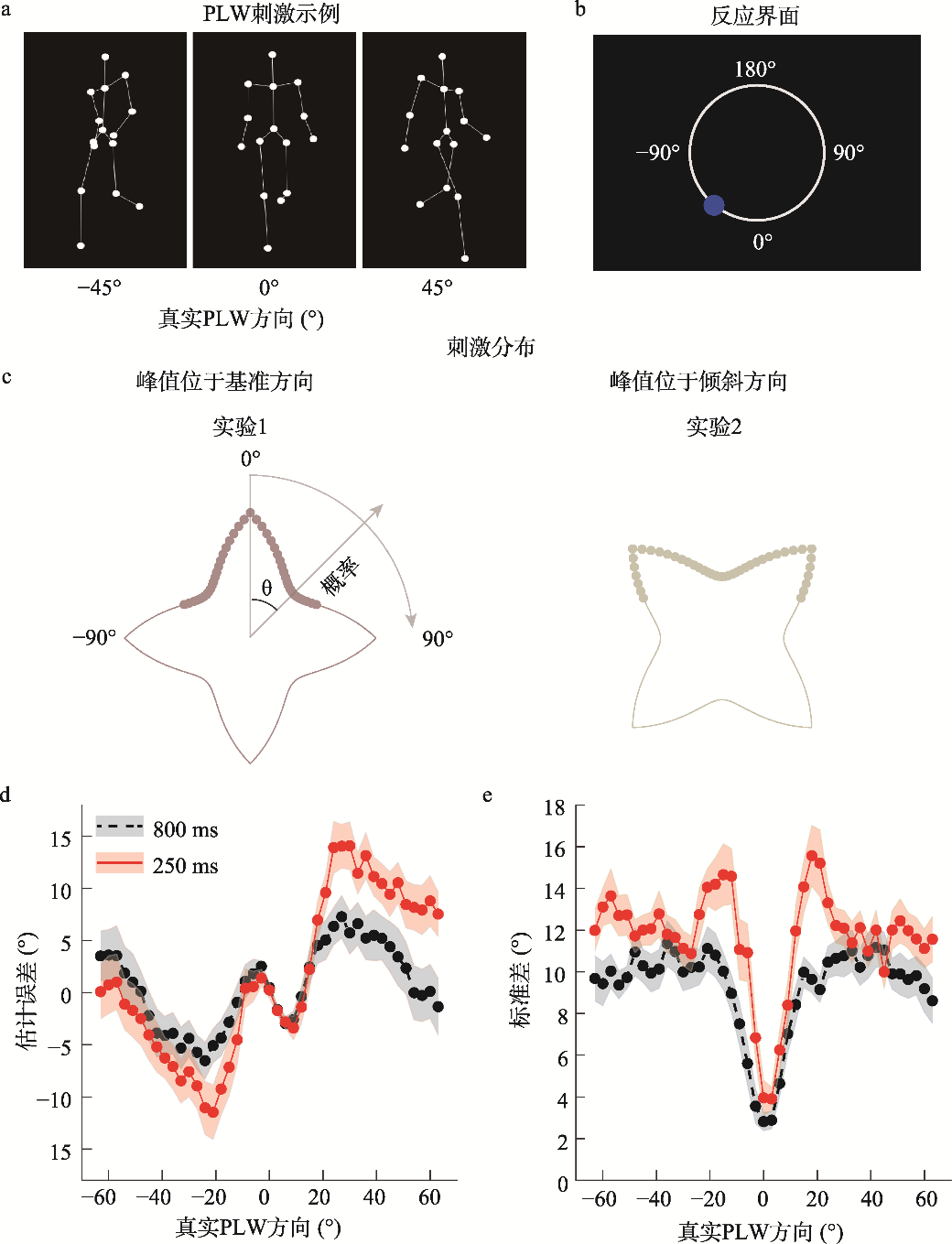
图1 PLW刺激, 刺激分布和行为结果图。(a)每个生物运动方向刺激(PLW)由16个白色光点组成, 实验中不显示白色线条。(b)反应界面显示蓝色探针位于白色圆圈上。被试通过鼠标移动圆圈上的探针位置, 以重现其感知的PLW方向。实验前告知被试, 反应界面圆圈的底部、顶部、左侧和右侧中点分别对应PLW的0°、180°、−90°(270°)和90°方向(图中数字在实验中不显示)。(c)本研究使用的理论刺激分布示意图(浅色实线)。左图四峰分布且峰值位于基准方向(0°、± 90°和180°); 右图四峰分布且峰值位于倾斜方向(± 45°和± 135°)。圆点表示本研究使用的PLW方向。(d-e)估计误差和标准差随PLW方向的变化。圆点和阴影区域分别表示所有被试的平均估计误差和标准差。彩图见电子版, 下同。

图2 本研究使用的扩展的高效编码贝叶斯观察者模型及理想长时先验示意图。(a-b) Sun, Xu等人(2025)开发的知觉−反应映射缩放的高效编码贝叶斯推理模型示意图(系统综述可见: 孙琪, 2026)。模型包含两部分:(a)高效编码贝叶斯观察者模型; (b)知觉−反应映射。(a)高效编码贝叶斯观察者模型假设, 刺激特征($\theta $)(如行进方向)首先通过最大化$\theta $与感觉信号(m)之间的相互信息($F(\theta )$)编码为新的感觉信号, 该过程受外部噪音(δE)和内部噪音(δI)干扰。两类噪音均假定服从以0°为中心, 标准差为σE和σI的正态分布。随后, 感觉信号(m)通过逆F过程(${F}^{-1}(\theta )$)映射回刺激空间, 生成似然分布(p(m|$\theta $))。最后, 感觉系统结合先验(p($\theta $))和似然分布(p(m|$\text{θ}$))进行贝叶斯推理, 计算特征值的最优估计$\widehat{\theta }(m)$。(b) Sun, Xu等人(2025)发现, 实验中记录的报告估计值(${\widehat{\theta }}_{r}(m)$)与贝叶斯解码估计值($\widehat{\theta }(m)$)并不完全相等, 二者呈线性关系, 即${\widehat{\theta }}_{r}(m)=\alpha \widehat{\theta }(m)$。$\alpha $值由反应范围决定, 反应范围越大, $\alpha $值越大。(c)本研究使用的四峰长时先验分布, 四个峰值分别位于0°、±90°和180°。
| 参数 | 含义 |
|---|---|
| 长时先验在某一峰值附近的噪音大小。需注意, 在 | |
| 似然分布的噪音强度。 | |
| 在整合先验中分配给刺激分布(即短时先验( | |
| 知觉−反应映射过程的缩放因子大小。 |
表1 模型中各参数的含义
| 参数 | 含义 |
|---|---|
| 长时先验在某一峰值附近的噪音大小。需注意, 在 | |
| 似然分布的噪音强度。 | |
| 在整合先验中分配给刺激分布(即短时先验( | |
| 知觉−反应映射过程的缩放因子大小。 |
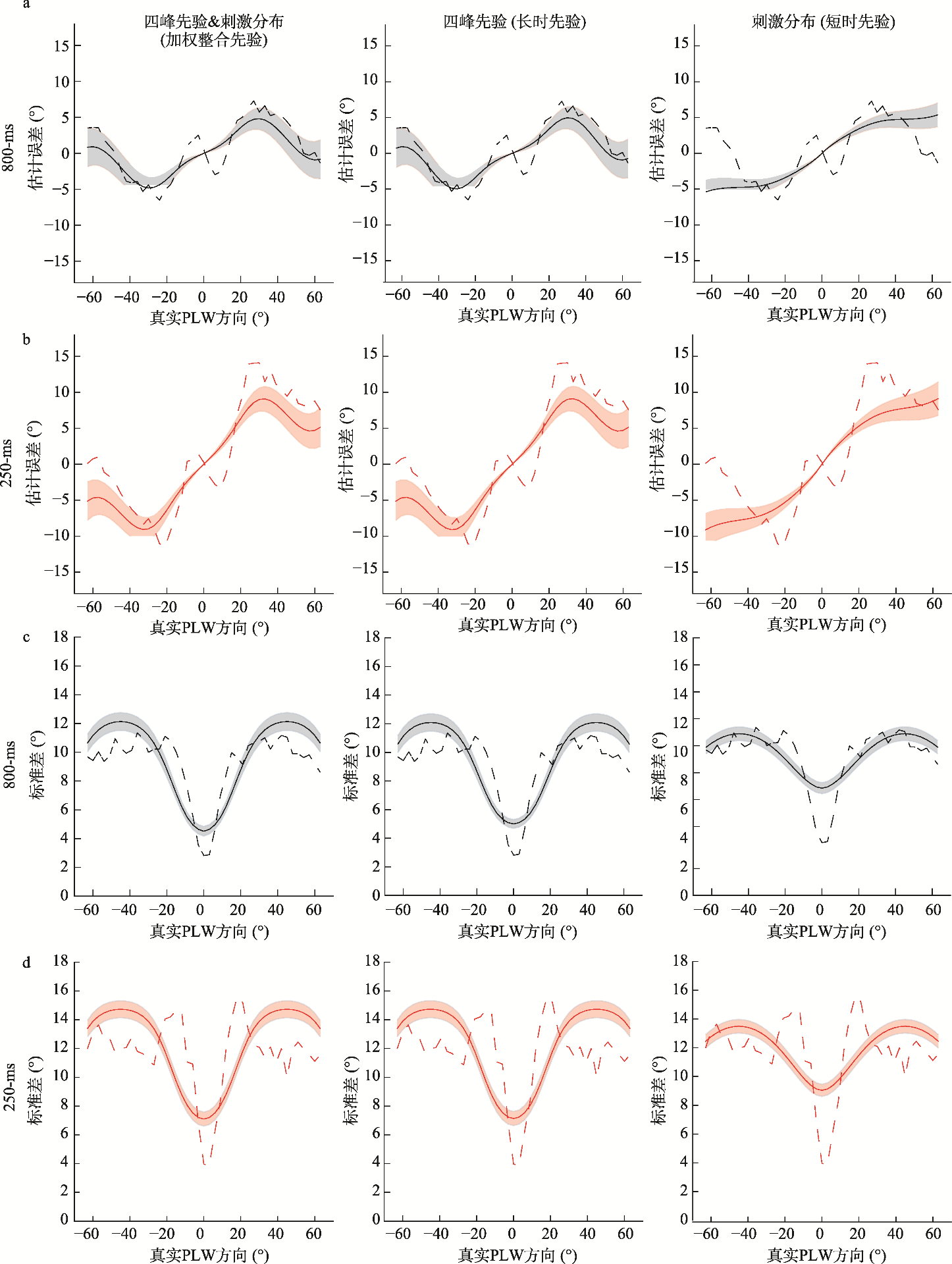
图3 实验1中预测的估计误差和标准差结果。(a)和(b)分别显示800 ms和250 ms条件下的估计误差结果; (c)和(d)分别显示800 ms和250 ms条件下的标准差结果。虚线表示所有被试实际的平均估计误差或标准差, 实线表示所有被试的平均预测估计误差或标准差, 阴影区域表示预测值的标准差。左, 中, 右列分别对应使用加权整合先验(公式4.3), 四峰长时先验(公式4.1)和短时先验(公式4.2)的模型结果。
| Model | 估计偏差 | 标准差 | ||||||
|---|---|---|---|---|---|---|---|---|
| Deviance | AIC | BIC | R | Deviance | AIC | BIC | R | |
| ModelStimDist&4Peaks | 173.27 | 183.27 | 192.10 | 0.78 | 166.49 | 176.49 | 178.11 | 0.40 |
| Model4Peaks | 172.38 | 180.38 | 187.43 | 0.78 | 166.66 | 174.66 | 181.71 | 0.40 |
| ModelStimDist | 243.87 | 246.87 | 257.44 | 0.060 | 151.01 | 163.01 | 173.58 | 0.58 |
| ModelStimDist&4Peaks | 230.45 | 240.45 | 249.25 | 0.79 | 211.40 | 221.40 | 230.20 | −0.29 |
| Model4Peaks | 230.38 | 238.38 | 245.43 | 0.79 | 211.55 | 219.55 | 226.59 | −0.29 |
| ModelStimDist | 269.41 | 277.41 | 284.46 | −1.10 | 218.89 | 226.89 | 233.93 | −1.03 |
表2 实验1中模型结果的描述性统计
| Model | 估计偏差 | 标准差 | ||||||
|---|---|---|---|---|---|---|---|---|
| Deviance | AIC | BIC | R | Deviance | AIC | BIC | R | |
| ModelStimDist&4Peaks | 173.27 | 183.27 | 192.10 | 0.78 | 166.49 | 176.49 | 178.11 | 0.40 |
| Model4Peaks | 172.38 | 180.38 | 187.43 | 0.78 | 166.66 | 174.66 | 181.71 | 0.40 |
| ModelStimDist | 243.87 | 246.87 | 257.44 | 0.060 | 151.01 | 163.01 | 173.58 | 0.58 |
| ModelStimDist&4Peaks | 230.45 | 240.45 | 249.25 | 0.79 | 211.40 | 221.40 | 230.20 | −0.29 |
| Model4Peaks | 230.38 | 238.38 | 245.43 | 0.79 | 211.55 | 219.55 | 226.59 | −0.29 |
| ModelStimDist | 269.41 | 277.41 | 284.46 | −1.10 | 218.89 | 226.89 | 233.93 | −1.03 |
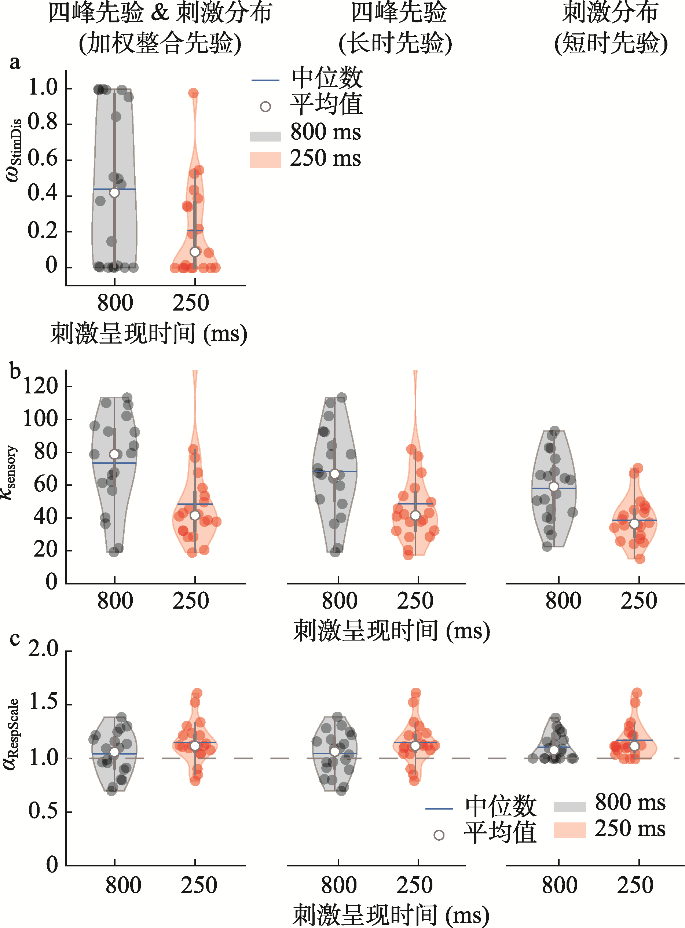
图4 不同模型的参数值分布。(a) (b) (c)分别对应加权整合先验中刺激分布的权重($\omega \_stim$), 感觉噪音大小($\kappa \_sen$ )和知觉−反应映射缩放因子($\alpha $)。不同模型的${\kappa }_{prior}$s值, 见附图2, 参数含义见表1。
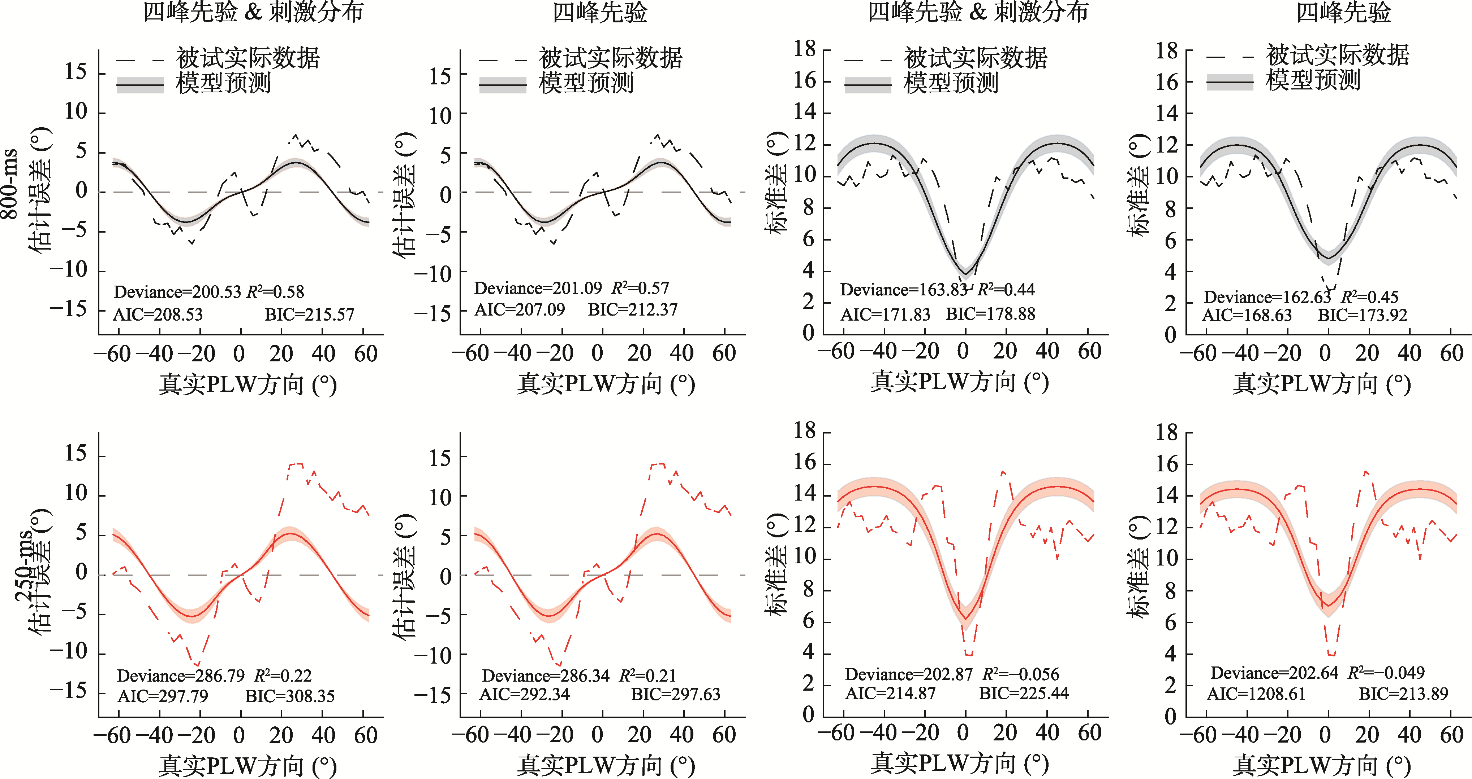
附图2 实验1中无缩放因子($\alpha $−模型预测估计误差和标准差的结果 注:上方和下方的图分别呈现 800 ms和250 ms条件的结果。每张图对应特定先验分布的模型。先验由公式2定义。虚线表示所有被试实际平均估计误差的均值, 实线表示所有被试平均预测估计误差的均值, 阴影区域表示所有被试预测估计误差的标准误。
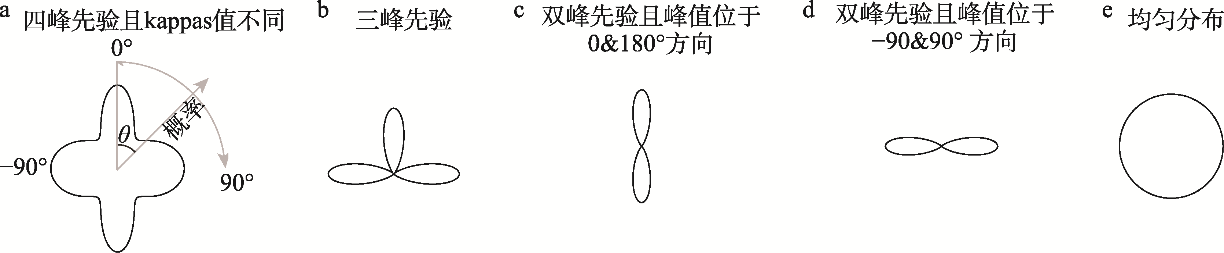
图5 模型中使用的5种新的长时先验分布。 注:图中展示了基于不同场景假设的长时先验分布曲线, 包括四峰先验, 三峰先验, 双峰先验, 均匀分布等, 具体峰值位置和形状对应文中描述的不同场景假设。
| Model | 估计误差 | 标准差 | ||||||
|---|---|---|---|---|---|---|---|---|
| Deviance | AIC | BIC | R | Deviance | AIC | BIC | R | |
| ModelStimDist&4Peaks (same kappa) | 173.27 | 183.27 | 192.10 | 0.78 | 166.49 | 176.49 | 178.11 | 0.40 |
| ModelStimDist&4Peaks (different kappa) | 185.06 | 197.06 | 207.63 | 0.70 | 148.59 | 160.59 | 171.15 | 0.60 |
| ModelStimDist&3Peaks | 172.98 | 182.98 | 184.60 | 0.78 | 166.38 | 176.38 | 185.19 | 0.40 |
| ModelStimDist&2PeaksV | 206.71 | 216.71 | 225.52 | 0.51 | 148.65 | 158.65 | 167.46 | 0.60 |
| ModelStimDist&2PeaksH | 209.16 | 219.16 | 227.96 | 0.48 | 152.85 | 162.85 | 176.65 | 0.56 |
| ModelStimDist&Uniform | 212.20 | 220.20 | 227.25 | 0.45 | 151.56 | 159.56 | 166.60 | 0.58 |
| Model4Peaks (same kappa) | 172.38 | 180.38 | 187.43 | 0.78 | 166.66 | 174.66 | 181.71 | 0.40 |
| Model3Peaks | 172.18 | 180.18 | 187.22 | 0.78 | 166.70 | 174.70 | 181.74 | 0.40 |
| ModelStimDist | 243.87 | 246.87 | 257.44 | 0.060 | 151.01 | 163.01 | 173.58 | 0.58 |
| ModelStimDist&4Peaks (same kappa) | 230.45 | 240.45 | 249.25 | 0.79 | 211.40 | 221.40 | 230.20 | −0.29 |
| ModelStimDist&4Peaks (different kappa) | 231.01 | 243.01 | 253.58 | 0.78 | 204.47 | 216.47 | 227.04 | −0.10 |
| ModelStimDist&3Peaks | 231.16 | 241.16 | 249.97 | 0.78 | 211.34 | 221.34 | 230.14 | −0.29 |
| ModelStimDist&2PeaksV | 247.72 | 257.72 | 266.52 | 0.68 | 201.79 | 211.79 | 220.60 | −0.03 |
| ModelStimDist&2PeaksH | 247.43 | 257.43 | 266.12 | 0.68 | 192.94 | 202.94 | 211.74 | 0.16 |
| ModelStimDist&Uniform | 251.62 | 259.62 | 266.67 | 0.65 | 193.01 | 201.01 | 208.06 | 0.16 |
| Model4Peaks (same kappa) | 230.38 | 238.38 | 245.43 | 0.79 | 211.55 | 219.55 | 226.59 | −0.29 |
| Model3Peaks | 230.90 | 238.90 | 245.94 | 0.78 | 211.21 | 219.21 | 226.25 | −0.28 |
| ModelStimDist | 269.41 | 277.41 | 284.46 | −1.10 | 218.89 | 226.89 | 233.93 | −1.03 |
附表1 实验1模型结果的描述性统计
| Model | 估计误差 | 标准差 | ||||||
|---|---|---|---|---|---|---|---|---|
| Deviance | AIC | BIC | R | Deviance | AIC | BIC | R | |
| ModelStimDist&4Peaks (same kappa) | 173.27 | 183.27 | 192.10 | 0.78 | 166.49 | 176.49 | 178.11 | 0.40 |
| ModelStimDist&4Peaks (different kappa) | 185.06 | 197.06 | 207.63 | 0.70 | 148.59 | 160.59 | 171.15 | 0.60 |
| ModelStimDist&3Peaks | 172.98 | 182.98 | 184.60 | 0.78 | 166.38 | 176.38 | 185.19 | 0.40 |
| ModelStimDist&2PeaksV | 206.71 | 216.71 | 225.52 | 0.51 | 148.65 | 158.65 | 167.46 | 0.60 |
| ModelStimDist&2PeaksH | 209.16 | 219.16 | 227.96 | 0.48 | 152.85 | 162.85 | 176.65 | 0.56 |
| ModelStimDist&Uniform | 212.20 | 220.20 | 227.25 | 0.45 | 151.56 | 159.56 | 166.60 | 0.58 |
| Model4Peaks (same kappa) | 172.38 | 180.38 | 187.43 | 0.78 | 166.66 | 174.66 | 181.71 | 0.40 |
| Model3Peaks | 172.18 | 180.18 | 187.22 | 0.78 | 166.70 | 174.70 | 181.74 | 0.40 |
| ModelStimDist | 243.87 | 246.87 | 257.44 | 0.060 | 151.01 | 163.01 | 173.58 | 0.58 |
| ModelStimDist&4Peaks (same kappa) | 230.45 | 240.45 | 249.25 | 0.79 | 211.40 | 221.40 | 230.20 | −0.29 |
| ModelStimDist&4Peaks (different kappa) | 231.01 | 243.01 | 253.58 | 0.78 | 204.47 | 216.47 | 227.04 | −0.10 |
| ModelStimDist&3Peaks | 231.16 | 241.16 | 249.97 | 0.78 | 211.34 | 221.34 | 230.14 | −0.29 |
| ModelStimDist&2PeaksV | 247.72 | 257.72 | 266.52 | 0.68 | 201.79 | 211.79 | 220.60 | −0.03 |
| ModelStimDist&2PeaksH | 247.43 | 257.43 | 266.12 | 0.68 | 192.94 | 202.94 | 211.74 | 0.16 |
| ModelStimDist&Uniform | 251.62 | 259.62 | 266.67 | 0.65 | 193.01 | 201.01 | 208.06 | 0.16 |
| Model4Peaks (same kappa) | 230.38 | 238.38 | 245.43 | 0.79 | 211.55 | 219.55 | 226.59 | −0.29 |
| Model3Peaks | 230.90 | 238.90 | 245.94 | 0.78 | 211.21 | 219.21 | 226.25 | −0.28 |
| ModelStimDist | 269.41 | 277.41 | 284.46 | −1.10 | 218.89 | 226.89 | 233.93 | −1.03 |
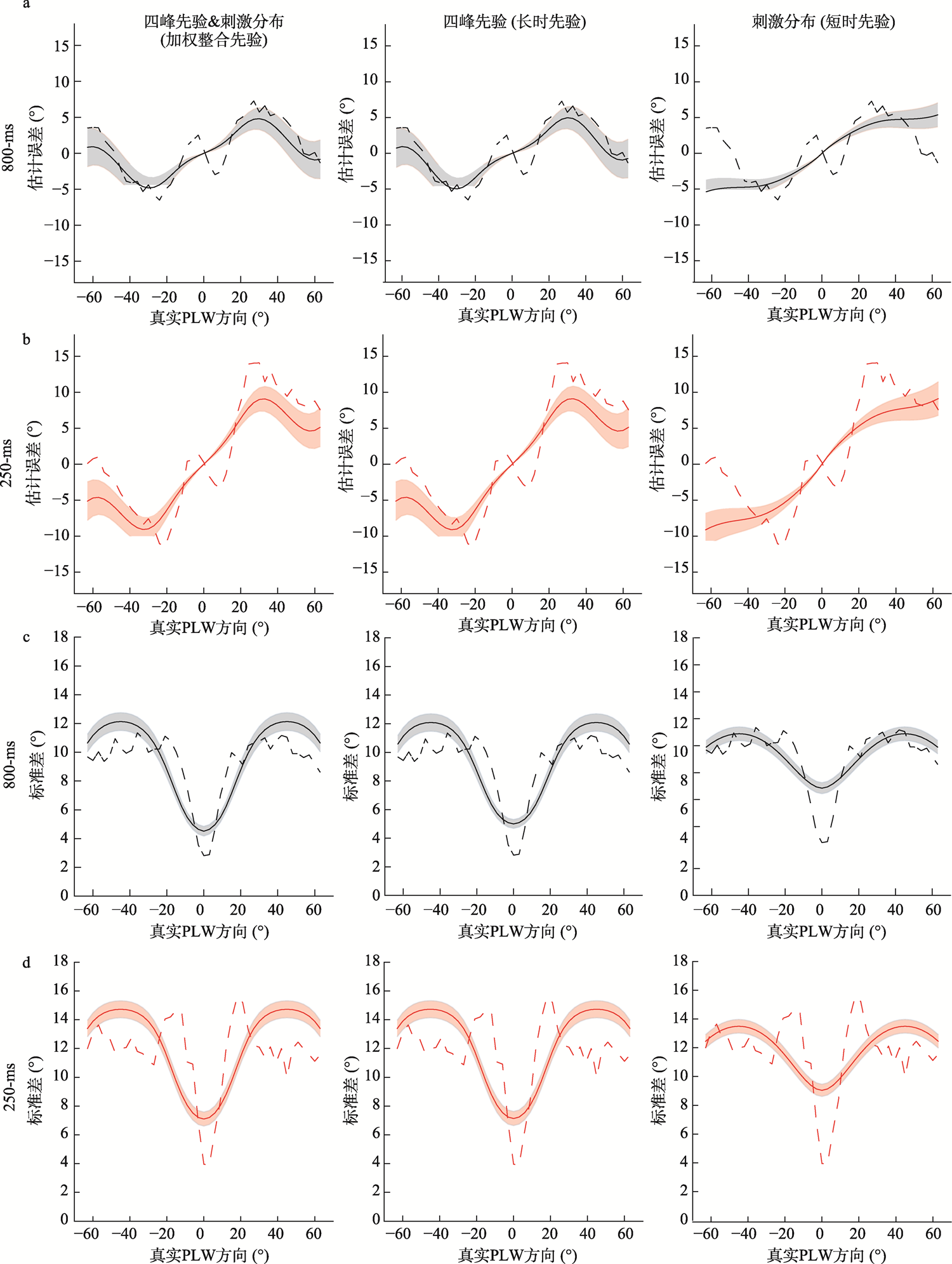
附图3 实验1中所有受高效编码约束的贝叶斯观察者模型的预测的估计误差结果 注:(a)和(b)分别展示了800 ms和250 ms条件下的结果。每张图对应特定先验分布的模型。先验由公式2定义。虚线表示所有被试的平均估计误差, 实线表示所有被试的平均预测估计误差, 阴影区域则表示预测估计误差的标准误。
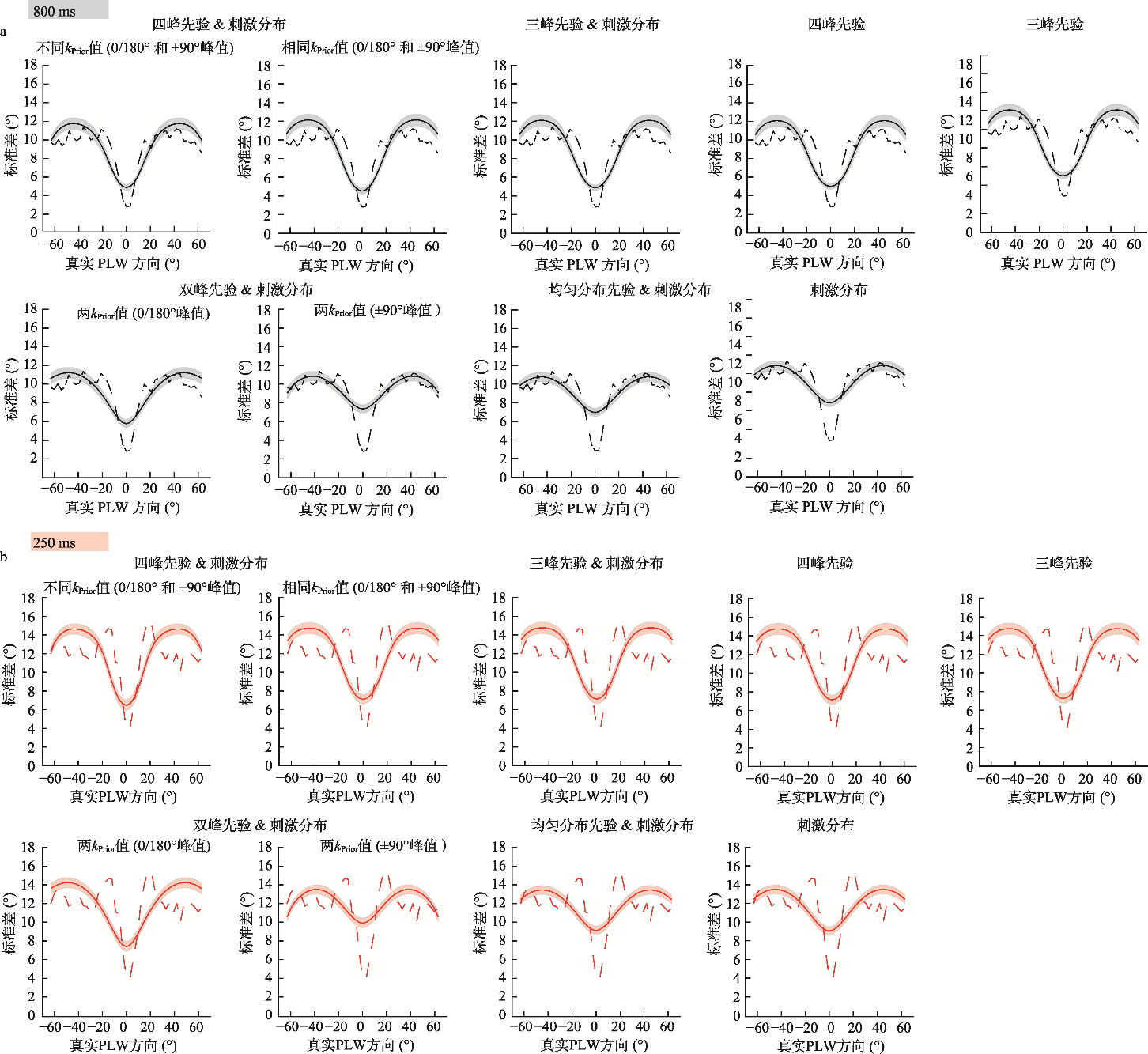
附图4 实验1中所有受高效编码约束的贝叶斯观察者模型的预测标准差结果 注:(a)和(b)分别展示了800 ms和250 ms条件下的结果。每张图对应特定先验分布的模型。先验由公式2定义。虚线表示所有被试实际标准偏差的均值, 实线表示所有被试预测标准偏差的均值, 阴影区域则表示预测标准差的标准误。
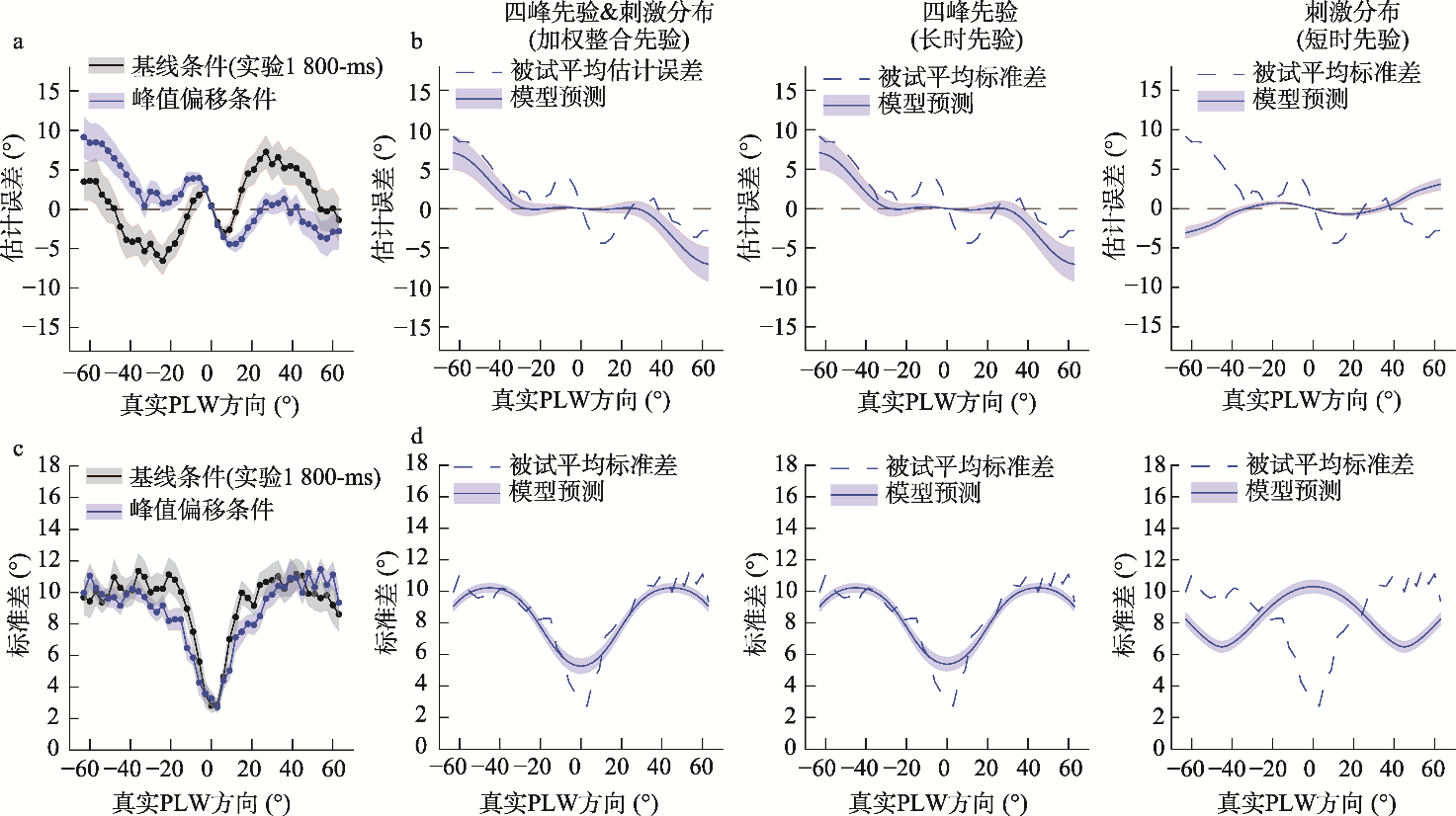
图6 实验2结果。(a)估计误差和(c)标准差随PLW方向的变化。圆点和阴影区域表示所有被试的平均估计误差和标准差。需注意, 基线条件与实验1的800 ms条件一致。(b)预测估计误差和(d)预测标准差随PLW方向的变化。每列对应一种具有特定先验的模型。虚线表示所有被试的平均估计误差和标准差, 实线表示所有被试的平均预测估计误差和标准差, 阴影区域表示预测值的标准差。
| 模型 | 估计偏差 | 标准差 | ||||||
|---|---|---|---|---|---|---|---|---|
| Deviance | AIC | BIC | R | Deviance | AIC | BIC | R | |
| ModelStimDist&4Peaks | 199.52 | 209.52 | 218.20 | 0.57 | 115.28 | 125.28 | 134.08 | 0.84 |
| Model4Peaks | 199.00 | 207.00 | 214.05 | 0.57 | 118.06 | 126.06 | 133.11 | 0.83 |
| ModelStimDist | 260.19 | 268.19 | 275.24 | −0.77 | 230.33 | 238.33 | 245.38 | −1.36 |
表3 实验2中模型结果的描述性统计
| 模型 | 估计偏差 | 标准差 | ||||||
|---|---|---|---|---|---|---|---|---|
| Deviance | AIC | BIC | R | Deviance | AIC | BIC | R | |
| ModelStimDist&4Peaks | 199.52 | 209.52 | 218.20 | 0.57 | 115.28 | 125.28 | 134.08 | 0.84 |
| Model4Peaks | 199.00 | 207.00 | 214.05 | 0.57 | 118.06 | 126.06 | 133.11 | 0.83 |
| ModelStimDist | 260.19 | 268.19 | 275.24 | −0.77 | 230.33 | 238.33 | 245.38 | −1.36 |
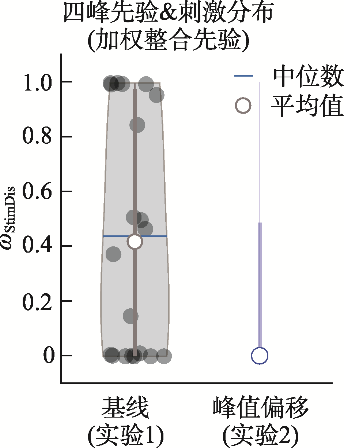
图7 加权整合先验中刺激分布权重{${\omega }_{stim}$}在不同刺激分布下的表现 注: 基线条件与实验1的800 ms条件一致, 不同颜色表示不同实验条件下${\omega }_{StimDist}$的分布, 峰值偏移条件下该参数均值趋近于0, 表明对短时先验的依赖降低。
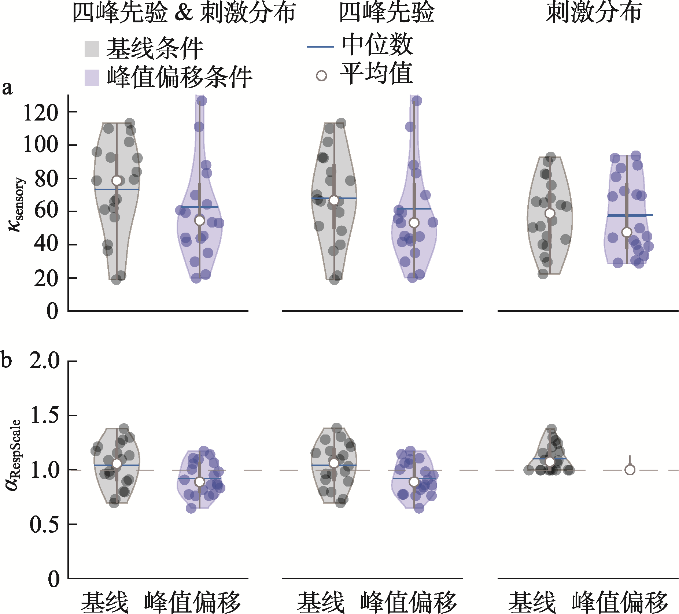
附图5 峰值偏移条件下, 各模型感觉噪音强度${\kappa }_{sensory}$和知觉−反应映射缩放因子α个体估计值分布 注:(a)和(b)分别对应加权整合先验中刺激分布的感觉噪音强度${\kappa }_{sensory}$(感觉噪音强度): 峰值偏移条件下的${\kappa }_{sensory}$估计值(蓝点−在整体上略小于基线条件(黑点) (附图5a)。由于${\kappa }_{sensory}$与感觉噪音幅度负相关, 此趋势提示峰值偏移条件下的感觉噪音可能略有增加。然而, 行为数据中并未观察到标准差(行为变异性−的显著升高(正文图6c)。这一看似矛盾的现象, 恰恰凸显了经典高效编码贝叶斯观察者模型(Wei & Stocker, 2015, 2017−在解释当前数据时的不足。他们的模型预测, 感觉噪音增大会同时导致排斥偏差增大和行为变异性增加, 但我们的数据未呈现此协同变化模式。α (知觉−反应映射缩放因子): 峰值偏移条件下, 包含四峰先验的模型其α平均值显著低于1 (附图5b)。这与正文结论一致, 即排斥偏差的减小主要源于知觉−反应映射阶段的缩放调整(α < 1), 而非感觉噪音或先验权重的变化。这一发现强有力地支持了Sun, Xu, et al. (2025)−提出的、包含独立映射阶段的扩展模型之必要性。
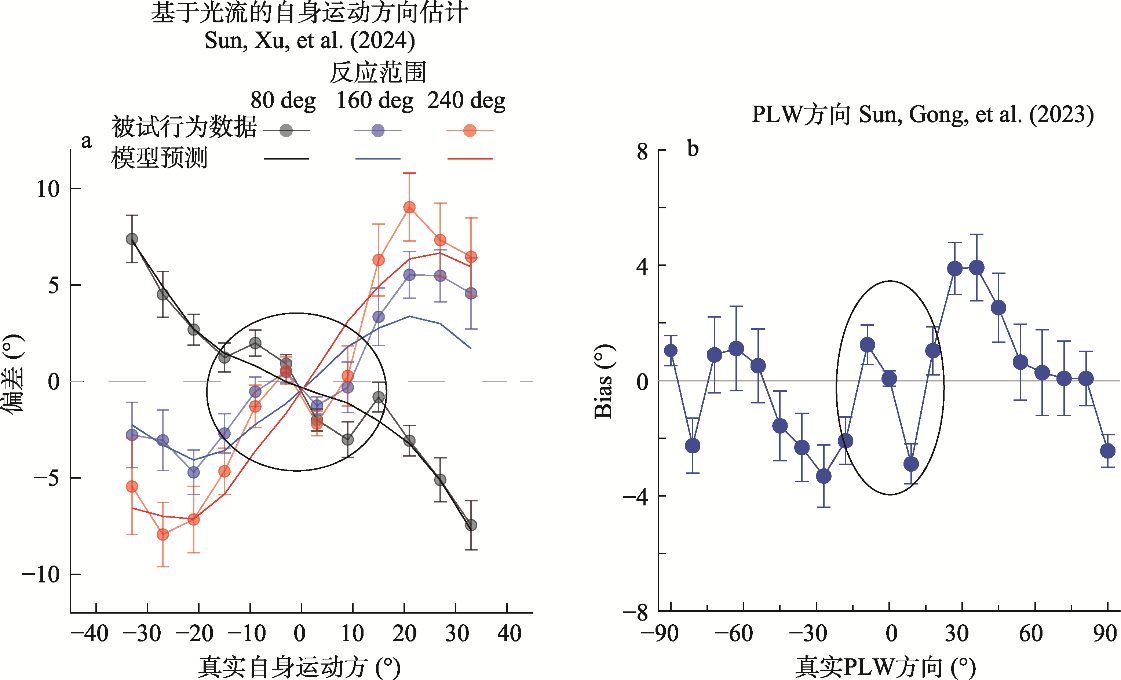
附图1 两种运动方向估计偏差的图示 注:(a)基于光流的自身运动方向估计(Sun, Xu & Stocker, 2025); (b)光点步行者(PLW−运动方向估计(Sun, Gong, et al., 2023)。两张图均根据原始图表重新制作, 并已获得两项研究通讯作者的授权。图中的圆点及误差条表示所有被试的平均估计偏差(即估计值与真实值之差−及其标准差。黑色圆圈标注区域的偏差趋势与其他区域相反。
| [1] | Adams, W. J., Graf, E. W., & Ernst, M. O. (2004). Experience can change the 'light-from-above' prior. Nature Neuroscience, 7(10), 1057-1058. |
| [2] | Attneave, F. (1954). Some informational aspects of visual perception. Psychological Review, 61(3), 183-193. |
| [3] | Barlow, H. B. (1961). Possible principles underlying the transformations of sensory messages. Sensory Communication, 1(1), 217-233. |
| [4] | Bobbert, M. F., Lemmens, M. V., & Groeneveld, M. J. (2023). Motion information plays only a secondary role in sex identification of walking persons in frontal view. Journal of Vision, 23(2), 11. |
| [5] | Chalk, M., Seitz, A. R., & Seriès, P. (2010). Rapidly learned stimulus expectations alter perception of motion. Journal of Vision, 10(8), 2. |
| [6] | Chen, C., & Mitsudo, H. (2023). The gender-based facing bias in 3-D biological motion perception. Perception, 52(3), 183-194. |
| [7] | Crane, B. T. (2012). Direction specific biases in human visual and vestibular heading perception. PLoS One, 7(12), e51383. |
| [8] | Cuturi, L. F., & MacNeilage, P. R. (2013). Systematic biases in human heading estimation. PLoS One, 8(2), e56862. |
| [9] | De Gardelle, V., Kouider, S., & Sackur, J. (2010). An oblique illusion modulated by visibility: Non-monotonic sensory integration in orientation processing. Journal of Vision, 10(10), 6. |
| [10] | Dittrich, W. H., Troscianko, T., Lea, S. E., & Morgan, D. (1996). Perception of emotion from dynamic point-light displays represented in dance. Perception, 25(6), 727-738. |
| [11] | Gekas, N., Chalk, M., Seitz, A. R., & Seriès, P. (2013). Complexity and specificity of experimentally induced expectations in motion perception. Journal of Vision, 14, 355. |
| [12] | Gibson, J. J. (1950). The perception of the visual world. Boston, MA: Houghton Mifflin |
| [13] | Girshick, A. R., Landy, M. S., & Simoncelli, E. P. (2011). Cardinal rules: Visual orientation perception reflects knowledge of environmental statistics. Nature Neuroscience, 14(7), 926-932. |
| [14] | Gu, Y., Fetsch, C. R., Adeyemo, B., DeAngelis, G. C., & Angelaki, D. E. (2010). Decoding of MsTd population activity accounts for variations in the precision of heading perception. Neuron, 66(4), 596-609. |
| [15] | Hahn, M., & Wei, X. X. (2024). A unifying theory explains seemingly contradictory biases in perceptual estimation. Nature Neuroscience, 27(4), 793-804. |
| [16] | Jazayeri, M., & Shadlen, M. N. (2010). Temporal context calibrates interval timing. Nature Neuroscience, 13(8), 1020-1026. |
| [17] | Johansson, G. (1973). Visual perception of biological motion and a model for its analysis. Perception & Psychophysics, 14(2), 201-211. |
| [18] | Knill, D., C., & Richards, W. (Eds.). (1996). Perception as Bayesian inference. Cambridge University Press. |
| [19] | Levari, D. E. (2022). Range-frequency effects can explain and eliminate prevalence-induced concept change. Cognition, 226, 105196. |
| [20] | Levari, D. E., Gilbert, D. T., Wilson, T. D., Sievers, B., Amodio, D. M., & Wheatley, T. (2018). Prevalence-induced concept change in human judgment. Science, 360(6396), 1465-1467. |
| [21] | Mamassian, P., Landy, M., & Maloney, L. T. (2002). Bayesian modelling of visual perception. In R. P. N. Rao, B. A. Olshausen, & M. S. Lewiciki (Eds.), Probabilistic models of the brain: Perception and neural function. (pp. 13-36). Cambridge, MA: MIT Press. |
| [22] | Mao, J., & Stocker, A. A. (2024). Sensory perception is a holistic inference process. Psychological Review, 131(4), 858-890. |
| [23] | Montepare, J. M., & Zebrowitz-McArthur, L. (1988). Impressions of people created by age-related qualities of their gaits. Journal of Personality and Social Psychology, 55(4), 547-556. |
| [24] | Noel, J. P., Zhang, L. Q., Stocker, A. A., & Angelaki, D. E. (2021). Individuals with autism spectrum disorder have altered visual encoding capacity. PLoS Biology, 19(5), e3001215. |
| [25] | Olkkonen, M., McCarthy, P. F., & Allred, S. R. (2014). The central tendency bias in color perception: Effects of internal and external noise. Journal of Vision, 14(11), 5. |
| [26] | Orgs, G., Kirsch, L., & Haggard, P. (2013). Time perception during apparent biological motion reflects subjective speed of movement, not objective rate of visual stimulation. Experimental Brain Research, 227(2), 223-229. |
| [27] | Peng, W., Cracco, E., Troje, N. F., & Brass, M. (2021). Does anxiety induced by social interaction influence the perception of bistable biological motion? Acta Psychologica, 215, 103277. |
| [28] | Ran, P., Sun, M. Y., You, F. H., Zhang, X. Y., Sun, Q., & Sun, Q. (2025). Effects of global information on the estimation of point-light walker directions. Psychological Research, 89(1), 22. |
| [29] | Schouten, B., Davila, A., & Verfaillie, K. (2013). Further explorations of the facing bias in biological motion perception: Perspective cues, observer sex, and response times. PLoS One, 8(2), e56978. |
| [30] | Schouten, B., Troje, N. F., Brooks, A., van der Zwan, R., & Verfaillie, K. (2010). The facing bias in biological motion perception: Effects of stimulus gender and observer sex. Attention, Perception, & Psychophysics, 72(5), 1256-1260. |
| [31] | Sotiropoulos, G., Seitz, A. R., & Seriès, P. (2014). Contrast dependency and prior expectations in human speed perception. Vision Research, 97, 16-23. |
| [32] | Stocker, A. A., & Simoncelli, E. P. (2006). Noise characteristics and prior expectations in human visual speed perception. Nature Neuroscience, 9(4), 578-585. |
| [33] | Stone, L. S., & Thompson, P. (1992). Human speed perception is contrast dependent. Vision Research, 32(8), 1535-1549. |
| [34] | Sun, Q. (2025). Bayesian observer models in visual perception. Journal of Psychological Science, 48(4), 836-846. |
| [孙琪. (2025). 视知觉中的贝叶斯观察者模型及其未来展望. 心理科学, 48(4), 836-846.] | |
| [35] | Sun, Q. (2026). The efficient-coding constrained Bayesian inference model in visual perception and application perspective. Journal of Psychological Science. |
| [孙琪. (2026). 视知觉中的高效编码约束的贝叶斯推理模型及其应用展望. 心理科学.] | |
| [36] | Sun, Q., Dong, L. L., You, F. H., & Chang, D. H. (2025). Estimations of biological motion walking direction are affected by observer and walker genders. BMC Psychology, 12, 698. |
| [37] | Sun, Q., Gong, X. M., & Sun, Q. (2025). Impact of conflicts between long-and short-term priors on the weighted prior integration in visual perception. Cognition, 254, 106006. |
| [38] | Sun, Q., Gong, X. M., Zhan, L. Z., Wang, S. Y., & Dong, L. L. (2023). Serial dependence bias can predict the overall estimation error in visual perception. Journal of Vision, 23(13), 2. |
| [39] | Sun, Q., Wang, J. Y., & Gong, X. M. (2024). Conflicts between short-and long-term experiences affect visual perception through modulating sensory or motor response systems: Evidence from Bayesian inference models. Cognition, 246, 105768. |
| [40] | Sun, Q., Xu, L. H., & Stocker, A. A. (2025). A linear perception-action mapping accounts for response range-dependent biases in heading estimation from optic flow. PLoS Computational Biology, 21(6), e1013147. |
| [41] | Sweeny, T. D., Haroz, S., & Whitney, D. (2012). Reference repulsion in the categorical perception of biological motion. Vision Research, 64, 26-34. |
| [42] | Tomassini, A., Morgan, M. J., & Solomon, J. A. (2010). Orientation uncertainty reduces perceived obliquity. Vision Research, 50(5), 541-547. |
| [43] | Troje, N. F. (2002a). Decomposing biological motion: A framework for analysis and synthesis of human gait patterns. Journal of Vision, 2(5), 371-387. |
| [44] | Troje, N., F. (2002b). The little difference: Fourier based synthesis of gender-specific biological motion. In: R. P. Würtz, & M. Lappe (Eds.), Dynamic Perception. (pp. 115-120). Berlin: AKA Press. |
| [45] | Vanrie, J., Dekeyser, M., & Verfaillie, K. (2004). Bistability and biasing effects in the perception of ambiguous point-light walkers. Perception, 33(5), 547-560. |
| [46] | Weech, S., McAdam, M., Kenny, S., & Troje, N. F. (2014). What causes the facing-the-viewer bias in biological motion? Journal of Vision, 14(12), 10. |
| [47] | Weech, S., & Troje, N. F. (2018). Inverting the facing-the-viewer bias for biological motion stimuli. i-Perception, 9(1), 2041669517750171. |
| [48] | Wei, X. X., & Stocker, A. A. (2012). Efficient coding provides a direct link between prior and likelihood in perceptual Bayesian inference. In NIPS'12: Proceedings of the 26th International Conference on Neural Information Processing Systems (pp. 1304-1312), Red Hook, NY, United States. |
| [49] | Wei, X. X., & Stocker, A. A. (2015). A Bayesian observer model constrained by efficient coding can explain 'anti- Bayesian' percepts. Nature Neuroscience, 18(10), 1509-1517. |
| [50] | Wei, X. X., & Stocker, A. A. (2017). Lawful relation between perceptual bias and discriminability. Proceedings of the National Academy of Sciences, 114(38), 10244-10249. |
| [1] | 王达, 杨志豪, 梅高兴. 社会性注意的同类别和跨类别序列依赖效应[J]. 心理学报, 2026, 58(7): 1312-1324. |
| [2] | 路晓漫, 杜依珂, 叶文龙, 王海飞, 孟鲁, 周梁. 整体构型与局部运动对生物运动拍子同步的作用[J]. 心理学报, 2026, 58(6): 1015-1027. |
| [3] | 陈杰, 蔡佳慧, 兰雅迪, 李雯婕. 生物运动信息对听障个体注意网络功能的影响[J]. 心理学报, 2025, 57(7): 1139-1153. |
| [4] | 刘志雅,莫雷. 不同学习方式下归类不确定时的特征推理[J]. 心理学报, 2011, 43(01): 92-100. |
| [5] | 史滋福,邱江,张庆林. 明确嵌套集合关系对贝叶斯推理的促进效应[J]. 心理学报, 2006, 38(06): 833-840. |
| 阅读次数 | ||||||
|
全文 |
|
|||||
|
摘要 |
|
|||||
